Construction complete on the 3200 megapixel Legacy Survey of Space and Time camera

Scientists and engineers have announced the completion of the Legacy Survey of Space and Time (LSST) – the largest camera ever built. Taking almost two decades to build, the 3200 megapixel instrument will form the heart of the 8.4 m Simonyi Survey Telescope based at the Vera C. Rubin Observatory in Cerro Pachón in the Andes.

First proposed some three decades ago to help study the nature of dark matter, the LSST has been built at the SLAC National Accelerator Laboratory. It is 3 × 1.65 m – roughly the size of a small car – and with a mass of 3000 kg.

The LSST includes three lenses, which have been constructed at the Lawrence Livermore National Laboratory. The biggest being 1.57 m in diameter and is the largest high-performance optical lens ever made. The LSST has now completed a programme of rigorous testing and will be shipped to Chile where it will be installed atop the Simonyi Survey Telescope later this year.

‘The greatest movie of all time’

The camera’s resolution of 3200 megapixel – some 200 times larger than a high-end consumer camera – means that it can take hundreds of ultrahigh-definition TVs to display just one of the LSST’s images at full size.
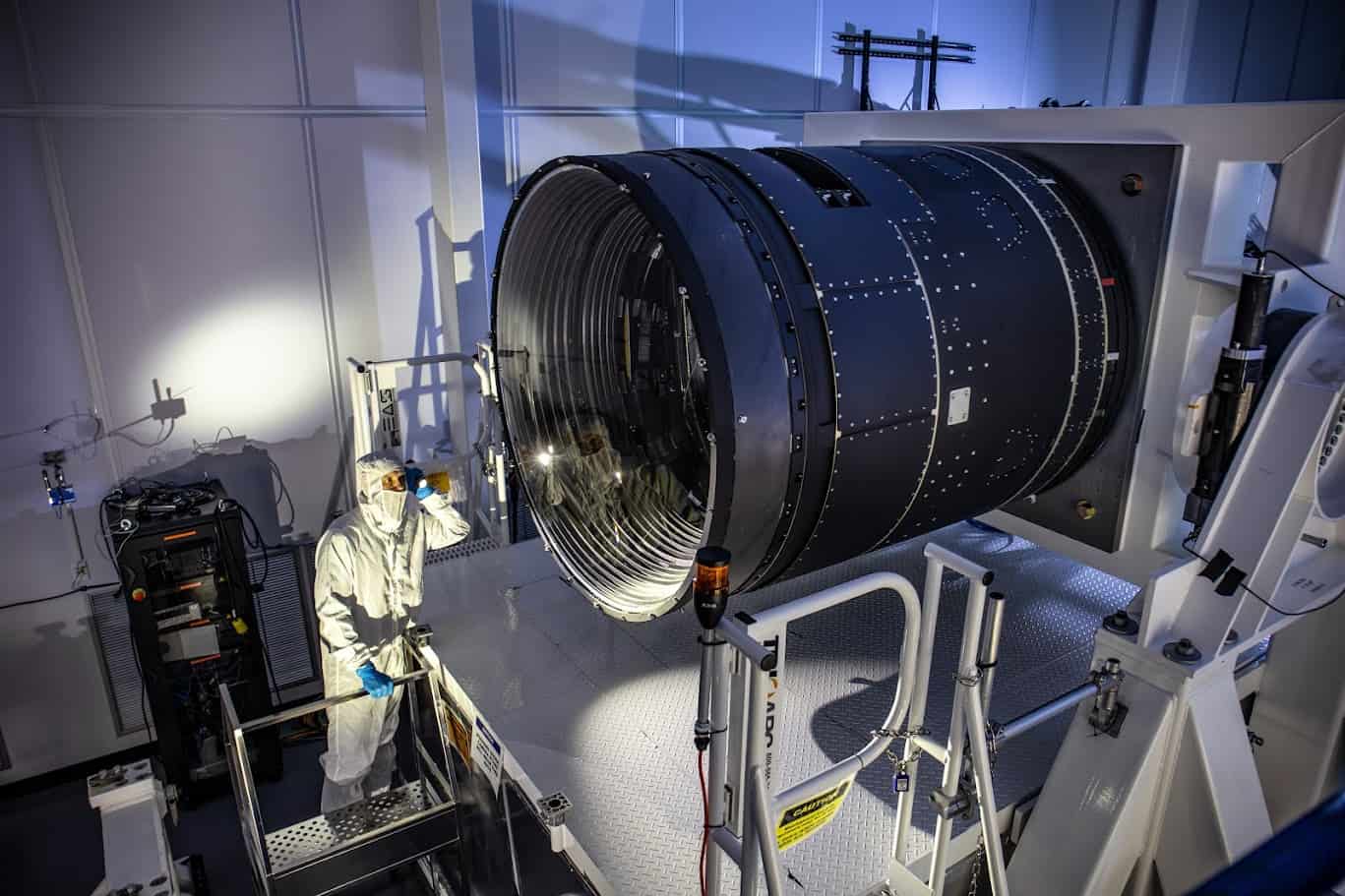
LSST camera

“Its images are so detailed that it could resolve a golf ball from around 15 miles away, while covering a swath of the sky seven times wider than the full moon,” notes SLAC physicist Aaron Roodman, who is deputy director of the Vera C Rubin Observatory and leads construction of the LSST camera. “These images with billions of stars and galaxies will help unlock the secrets of the universe.”

Beginning next year, the LSST will spend over three or four nights to take a complete picture of the southern night sky. It will then replicate this process over a decade to produce almost 1000 full images of sky.

With the completion of the unique LSST camera we will soon start producing the greatest movie of all time and the most informative map of the night sky ever assembled

Željko Ivezić

This will be used to observe the universe in unprecedented detail, plotting the positions and measuring the brightness of objects in the sky to help in improving our understanding of dark matter and dark energy, which is driving he expansion of the universe. It will examine 20 billion galaxies – some 10% of the galaxies predicted to exist in the observable universe.

The observatory will also be used to produce the most detailed star map of the Milky Way with the expectation to image 17 billion stars as well as catalogue some six million small objects within our solar system including asteroids.

“With the completion of the unique LSST camera we will soon start producing the greatest movie of all time and the most informative map of the night sky ever assembled,” notes astronomer Željko Ivezić from the University of Washington who is director of construction of the Vera C Rubin Observatory.


All-optical space-air-sea communication network makes its debut 

Researchers in China have demonstrated a prototype communications network that can transmit and receive data through space, air and water entirely at optical wavelengths. If successfully scaled up, the new network design might have applications as diverse as navigation, ecological monitoring, remote sensing, emergency aid and connecting devices within the so-called “Internet of Things”. 

Many of today’s optical communications networks are designed to work in just one medium: underwater, over land, through space or in the air. Creating a single system that can operate in all of these environments is no easy task, as the requirements of each are different. Fulfilling them requirements thus means combining multiple technologies. 

A team led by microelectronics expert Yongjin Wang of the Nanjing University of Posts and Telecommunications and Suzhou Lighting Chip Monolithic Optoelectronics Technology Co. Ltd. has now done just that by employing four different light sources to establish simultaneous wireless light communications links in any of these environments. “Our new wireless network enables uninterrupted connectivity across environments, facilitating two-way real-time data transmission between the network nodes that carry out communication and data exchange within and between networks,” Wang says. 

Four full-duplex wireless light communication links  

For the underwater portion of their network, the researchers chose blue light because seawater absorbs less in this part of the electromagnetic spectrum, meaning light can travel further. To communicate with airborne device such as drones, they used deep ultraviolet light because it provides “solar-blind” communication with no interference from sunlight. For other air-based applications, they used wireless white light communication, while for point-to-point communications in free space they selected near-infrared laser diodes. These diodes emit light in one direction with high optical power, again allowing the signals to travel further. 

“Our network consists of these four full-duplex wireless light communication links, which are connected in series via Ethernet switches,” explains Wang. “Both wired and wireless access to the all-light communication network is also possible, providing flexible connectivity options.”  

Separating the different light bands also prevents signals from interfering, meaning the network can transmit many signals simultaneously without compromising performance, Wang says. The network can be connected to the Internet via a modem, granting people in remote ocean locations, for example, access to the backbone network for information sharing. It also allows video conferencing and other transmissions via the widely-used TCP/IP (Transition Control Protocol/Internet Protocol) suite, he adds, making it suitable for Internet of Things applications, too. “For example, when a 2560 × 1440-pixel online video at 22 frames per second are fed into the network, users accessing the network from any node can visit this video with little lag,” he tells Physics World.  

From a single communication system to a network  

According to Wang and colleagues, the all-light communication network is a “major breakthrough”, one that should make it possible to transition from single wireless light communication systems to a network of them. Such a network would resist electromagnetic interference (EMI), making it particularly attractive for communicating with underwater equipment and drone clusters. “This is why are we working on integrating mobile nodes in the network, rather than fixed nodes, as is presently the case,” explains Wang. “This will not be easy, however, since it will require tacking the challenge of ‘light alignment’ and network establishment speed.”  

The researchers, who describe the new network in Optics Express, also plan to enhance the throughput of their communication network by using a technique called wavelength division multiplexing. This, they say, will improve the network’s overall efficiency and performance by eliminating the delays associated with using near-infrared laser diodes. 

Neutron mirror gets a boost from boron carbide

A new approach for fabricating multilayer neutron mirrors has been developed by researchers in Sweden. By adding boron carbide to the iron and silicon layers of their mirror, Anton Zubayer at Linköping University and colleagues created a device that is more reflective and polarizing to incoming neutron beams, especially at high scattering angles.

Neutron science involves scattering beams of slow-moving neutrons from samples. Such neutrons have de Broglie wavelengths on par with the separation between atoms in solids, liquids and gases. This means that the diffraction of neutron beams can be used to determine the atomic structure of a sample. Neutrons can exchange kinetic energy with atoms, so they can also probe dynamic properties of matter such as lattice vibrations. Neutrons also have magnetic moments so they can measure magnetic properties of samples.

Some magnetic neutron scattering experiments require beams that are magnetically polarized, but creating such beams can be a challenge.

“Polarizing neutron optics is an essential part for neutron scattering facilities,” Zubayer explains. “It is gaining in importance as new types of instrument demand greater efficiency and novel features.”

Poor interfaces

Neutron beams can be polarized using mirrors that are made by depositing alternating layers of iron and silicon on a substrate. Despite their widespread use, these neutron mirrors have limitations that are associated with the difficulty of creating atomically sharp interfaces between the iron and silicon layers. Instead, the interfaces contain unwanted iron silicide compounds.

These rough interfaces mean that at higher scattering angles, the mirrors are not very effective at reflecting and polarizing neutrons. This can be overcome by exposing the mirrors to strong external magnetic fields – but since these fields can also affect the samples being studied, the mirrors need to be placed some distance away from the samples and this can diminish the quality of the experimental results.

Now, Zubayer and colleagues have taken a new approach to fabricating neutron mirrors, which involves adding isotope-enriched boron carbide to the iron and silicon layers. The boron carbide is enriched with boron-11 – which unlike boron-10, is not a good absorber of neutrons. The compound improves the stability of materials deposited through magnetron sputtering, which was used to deposit the layers.

After building up the layers of their neutron mirror, Zubayer and colleagues determined its atomic structure using several different imaging techniques including X-ray diffraction and electron microscopy.

Thinner and sharper

As they hoped, their new mirror featured far sharper interfaces between the iron and silicon layers and less iron silicide. This allowed the layers to be made thinner than before, making the mirror far more reflective and polarizing to neutron beams at high scattering angles. It also led to less diffuse scattering within the beams.

With this improved performance, Zubayer’s team no longer needed to use an external magnetic field to achieve the desired polarization. As a result, their mirror could be placed closer to samples without affecting measurements.

“We have realised a higher reflectivity, better polarization, less background noise for the beamline, and eliminate the need for large magnets around the device,” Zubayer explains. “Thus, such optics using our approach could unlock new efficiencies and possibilities, leading to better, faster, more reliable, and maybe even new types of experiments.”

With these improvements, researchers could increase the polarized neutron flux used in experiments as well as the use of higher-energy neutrons. The team hopes their new approach could pave the way for new experimental discoveries across fields spanning physics, chemistry, biology, and medicine.

The research is described in Science Advances.

Entangled photons enhance adaptive optical imaging

Quantum-enhanced adaptive optical imaging

Researchers are harnessing the properties of quantum physics to measure distortions in microscopy images and produce sharper images.

Currently, image distortions caused by aberrations from flaws in a sample or imperfections in optical components are corrected using a process called adaptive optics. Conventional adaptive optics relies on a bright spot identified in the sample that serves as a reference point (the guide star) for detecting aberrations. Devices such as spatial light modulators and deformable mirrors then shape the light and correct for these distortions.

For samples that don’t contain bright spots naturally (and can’t be labelled with fluorescence markers), image-based metrics and processing techniques have been developed. These approaches are dependent on the imaging modality and the nature of the sample. Quantum-assisted optics, on the other hand, can be used to access information about aberrations independent of imaging modality and sample.

Researchers at the University of Glasgow, the University of Cambridge and CNRS/Sorbonne Université are measuring aberrations using entangled photon pairs.

Quantum entanglement describes particles that are interconnected regardless of the distance between them. When entangled photons encounter an aberration, their correlation is lost or distorted. Measuring this correlation – which contains information such as phase that’s not captured in conventional intensity imaging – and then correcting for it using a spatial light modulator or similar devices, can improve sensitivity and image resolution.

“There are two aspects [of this project] that I find very exciting: the link that there is between the fundamental aspect of entanglement and the strong correlation you have; and the fact that it’s something that can be useful in practice,” says Hugo Defienne, senior CNRS researcher on the project.

In the team’s setup, entangled photon pairs are generated through spontaneous parametric down conversion in a thin crystal. Anti-correlated photon pairs are sent through a sample to image it in the far field. An electron-multiplying charge-coupled device (EMCCD) camera detects the photon pairs and measures photon correlations and conventional intensity images. The photon correlations are then used to bring the image into focus using spatial light modulation.

The researchers demonstrated their guide star-free adaptive optics approach using biological samples (a bee head and leg). Their results showed that the correlations can be used to produce higher-resolution images than conventional bright-field microscopy.

“I think it’s probably one of the few quantum imaging schemes that is very close to something that can be used in practice,” Defienne says.

Working toward wide-spread adoption of the setup, the researchers are now integrating it with reflection microscope configurations. Imaging times, currently the main limitation of the technique, can be reduced with alternative camera technologies available for commercial and research applications.

“The second future direction we have is to do aberration correction in a non-local way,” Defienne says. That technique would split the paired photons, sending one to a microscope and another to a spatial light modulator and camera. The approach would effectively create an aberration that is correlated with a conventional intensity image to arrive at a focused, high-resolution image.

The research study is published in Science.

Africa’s quantum future offers a beacon of hope

Africa is on the brink of a quantum transformation. With a young, digitally native population and a burgeoning quantum workforce, the continent is poised to take advantage of the coming “second quantum revolution”. We cannot afford to miss out. After all, annual global investment in quantum computing has now already surpassed $30bn and is expected to reach $450–850bn in the next 15 to 30 years.

Africa is making steady progress towards such goals with countries across the continent running careers initiatives to build a quantum-ready workforce, such as OneQuantum Africa, QWorld and Quantum Leap Africa (QLA). There have also been dedicated quantum sessions at annual events such as the Center for High Performance Computing Conference in South Africa, the National University of Science and Technology Emerging Technology Symposium in Zimbabwe, and the Quantum Morocco Conference sponsored by NATO.

Scientific output by African researchers in quantum-related fields has also increased, especially over the past decade. In 2011, for example, researchers based in South Africa published about 50 articles in the field – but the annual total stands at about 200 today.

Many activities in Africa focus on quantum computing. The Kwame Nkrumah University of Science and Technology in Ghana, for example, recently held a workshop on the topic supported by IBM. Then there’s Quantum Quest – a five-week online training course on the basics of quantum computing. Run by the QLA, the African Institute for Mathematical Sciences, the University of Amsterdam and QuSoft, it’s helping to educate the next generation of quantum pioneers.

The South African Quantum Technology Initiative, meanwhile, is collaborating with companies and institutions – including IBM, the Abdus Salam International Centre for Theoretical Physics and the CERN particle-physics lab – to foster a quantum industry in the country. Platforms like IBM-Q cloud quantum computers, managed by Wits University in Johannesburg, South Africa, have given a much-needed impetus to the community. IBM and other industry giants such as Google, Microsoft, NVIDIA, D-Wave and Amazon are also providing researchers with access to quantum simulation and hardware tools.

Talent pool

Despite these positive examples, there is still much more that must be done to boost Africa’s capability in quantum technology. But we feel it will be worth the effort as such work could help Africa overcome the many challenges it faces and build a sustainable future. This is vital given that around 600 million Africans lack access to electricity, which stifles economic growth, education and healthcare.

Quantum computing, for example, could transform ammonia production by helping to discover more efficient catalysts, which is a cornerstone of fertilizer manufacturing. Reducing energy consumption and food production costs can boost competitiveness and enhance agricultural processes that lead to improved food production. Such advances could help to eradicate poverty and hunger while at the same time providing affordable and clean energy.

As well as having a great untapped talent pool of people, Africa also has abundant natural resources, notably rare-earth elements that have been discovered in the continent and will be critical for quantum technologies. The rare-earth elements in Madagascar, South Africa, Burundi, the Democratic Republic of the Congo and Namibia will be crucial to produce quantum hardware and underscore Africa’s potential to significantly influence developments in quantum computing. Sharing intellectual property and developing collaborative frameworks will help to broaden economic and social goals and reduce inequalities.

A thrilling narrative

Africa’s quantum journey, underpinned by collaborative platforms such as the Africa Quantum Consortium, is about making quantum technology relevant and boosting collaboration across the continent. There is huge potential – not just in quantum computing but also in quantum communication, simulation, metrology and sensing.

Through technology transfer, independent scientific capability and good education, we believe Africa can create partnerships that will spawn an entire quantum start-up ecosystem. It will enhance innovation and infrastructure as well as improve Africa’s economic growth through a knowledge- and digital-driven economy.

Learning from the leaders in quantum technologies, such as China, Europe, Singapore and the US, will be vital. Practical quantum computing is still a long way off, but Africa’s quantum future is a beacon of hope, promising to propel the continent into an era of innovation and prosperity. We believe Africa can reach the forefront of knowledge in quantum technologies while at the same time solving some of its great challenges.

It will be easier said than done but through planning, collaboration with the international community, and an unwavering commitment to education and workforce development, we are confident that Africa can contribute to the global quantum revolution. It will, we are sure, be a key player in shaping the future of science, technology and innovation in the continent and beyond.

Artificial intelligence will help pick Nobel Prize for Physics winners

WE HOPE YOU ENJOYED OUR APRIL FOOL JOKE FOR 2024. KEN HEARTLY-WRIGHT WILL BE BACK AGAIN NEXT YEAR.

Artificial intelligence (AI) will be used by the Royal Swedish Academy of Sciences to help choose the 2024 winners of the Nobel Prize for Physics. According to the academy, AI will help it avoid biases that are inherent in selection processes involving human judges.

“There are currently 224 Nobel laureates, but only five are women,” says Anni-Frid Lyngstad, who is a fusion physicist and chair of the Nobel Committee for Physics 2024. “We have worked with computer scientists at Lund University to develop an AI system that can evaluate nominations in a way that eliminates much of the gender and other biases that can creep into the selection process.” She adds, “the winner takes it all, so we have to be certain that the selection process is free and fair”.

Quality nominations from AI

Lyngstad adds that the academy was inspired to use AI after reading last year’s nominations. “We noticed that some of the best nominations began with, ‘Certainly, here is a possible nomination for your prize’ and we realized that AI was very good at identifying the very best in physics”.

The AI system was developed in collaboration with Mats Sundin and colleagues at Lund University. The computer scientists trained their technology using publicly available information about nominations for the prize that were made more than 50 years ago.

“We found that our large language model picked nominees that were controversially overlooked for prizes,” says Sundin. For example, it suggested that Chien-Shiung Wu should have shared the 1957 Nobel Prize for Physics for her discovery of parity violation. It also suggested that Satyendra Nath Bose should have won the 1934 prize for his pioneering work on Bose–Einstein condensation.

Unusual picks

However, Sundin did concede that their system put out the occasional nonsensical winner. “It said that Pippi Longstocking should have won the 1953 prize for her work on super-strong materials, but we are confident that we have fixed that problem.”

Not everyone is convinced though. Agnetha Fältskog of the University of Borås points out that artificial intelligence is notorious for reinforcing biases in its training data. The mathematician adds, “The system was trained using nominations that were mostly made by white men, so I am very concerned and disappointed that the academy has chosen to use it.”

The 2024 selection process began earlier this year when AI was used to analyse the hundreds of nominations that were received by the 31 January deadline. It first created a shortlist of 20 potential laureates for further consideration. The large language model is now being used to write detailed reports about the shortlisted nominees. These reports will then be used by the committee to make its final decision, which will be announced on the first Tuesday of October.

Lyngstad is adamant that the final decision will be made by committee of human experts and not by a computer. “Certainly, here is a guarantee that AI will not pick the winners,” she told Physics World.

Ask me anything: Katrin Erath-Dulitz ‘As a researcher, I rely on creative thinking’

What skills do you use every day in your job?

As a researcher, I rely on creative thinking both to design research projects and to solve problems in the laboratory. We have custom-built machines in the lab which often require some improvisation so that we can progress with our experiments quickly. As a group leader, I also need to work efficiently, keep everyone motivated and handle finances. I’ve always been very organized, but I have developed and refined other skills during my academic journey. When I started my research group a year ago, I was faced with an increasing workload and limited hours in the day, and learning to manage time effectively was a big challenge. My experience as a postdoc has also been valuable. For example, with limited financial resources, I quickly learned to prioritize cost-effective solutions. Similarly, I recognized that projects progress much faster in a team, so now I actively foster a collaborative environment within my group.

In my role as a university teacher, I need to make complex scientific ideas accessible to my students. I want to make them aware that the lecture content also has real-world applications, so I show them how the concepts I teach them are used in my laboratory. I also taught a course in which the students were asked to draft a proposal for an experiment at a large-scale laser facility. I wanted them to reflect on the lecture material and develop creative ideas for experiments.

What do you like best and least about your job?

The most rewarding aspect of my work is the opportunity to pursue projects that I am passionate about, ranging from understanding molecular interactions to constructing intricate scientific apparatuses for our research. I value the freedom to shape my daily schedule and to choose the projects that I want to engage in. There are also exciting aspects that I did not anticipate during my student days, such as the chance to attend international conferences and participate in scientific initiatives at large-scale research facilities all over Europe.

While my career is extremely exciting, frequent relocations over the past decade have made it difficult to establish roots and maintain friendships. Another challenge I have faced is the limited number of permanent academic positions – the uncertainty regarding my personal and professional future was something I found stressful. I feel very fortunate to have secured a position in Innsbruck, which has an exceptional working environment and a high quality of life, with many opportunities for outdoor activities.

What do you know today, that you wish you knew when you were starting out in your career?

Reflecting on my journey, I realize that I may have rushed through my studies. It is clear to me now that investing extra time in exploring content beyond that taught during university classes is crucial. Specifically, I regret not dedicating more time to studying quantum mechanics during my student years. I found myself needing to teach myself a considerable amount of it during my PhD.

Looking back, I wish I had trusted in myself more and started applying for scholarships as an undergraduate student. When I was asked to apply for scholarships for my PhD, I initially doubted my abilities, but with the help of my supervisor I took the chance, and I succeeded. My advice to other students struggling with imposter syndrome is to avoid comparing themselves to their peers and to find supportive mentors, as I did at this early stage.

Superfluid helium: the quantum curiosity behind huge experiments like the LHC

The effects of quantum mechanics are all around us, but the quantum properties of matter are generally only apparent at the microscopic level. Superfluidity is an exception, and some of its bizarre characteristics can be seen with the naked eye. What is more, superfluid helium II has found several important applications in science and technology – and is used multi-tonne quantities today at facilities like the Large Hadron Collider.

My guest in this episode of the Physics World Weekly podcast is John Weisend who is senior accelerator engineer at the European Spallation Source and adjunct professor at Lund University in Sweden. He is a specialist in cryogenic engineering, and has written the book Superfluid: How a Quantum Fluid Revolutionized Modern Science.

We chat about the physics behind this amazing substance and how it is used in some of biggest physics experiments on the planet.

Sponsor logo

This episode is sponsored by Pfeiffer Vacuum.

Pfeiffer Vacuum provides all types of vacuum equipment, including hybrid and magnetically-levitated turbopumps, leak detectors and analysis equipment, as well as vacuum chambers and systems. You can explore all of its products on the Pfeiffer Vacuum website.

Quantum jobs fair for kick-starting graduate careers

Earlier this month, I attended the Careers in Quantum fair at the University of Bristol, organized by the Quantum Engineering Centre for Doctoral Training (CDT). There was an enthusiastic buzz in the air — perhaps unsurprising considering that last year the UK government announced £2.5bn funding for developing quantum technologies as part of the government’s National Quantum Strategy, which includes a plan to double the number of quantum CDTs. The event was led by students in the CDT and featured stalls from nearly 30 quantum companies as well as a programme of talks and discussions.

The day was kicked off by Winfried Hensinger, a researcher at the University of Sussex and co-founder of Universal Quantum. The company’s goal is to build a million-qubit quantum computer, with Hensinger saying he wanted Universal Quantum to be “the AWS [Amazon Web Services] of quantum computing”. The challenge of scaling up quantum computers would come up again and again, and Hensinger’s ambitious talk – in which he revealed he’d wanted to build a quantum computer ever since his PhD – set the tone for the event.

The first panel discussion examined starting a quantum company. Immediately noticing the all-male line-up, the panellists made a point of encouraging female founders, and the gender imbalance was luckily not reflected in the rest of the day. Two panellists – Josh Silverstone of Qontrol and Dominic Sulway of Light Trace Photonics – had spun out their firms from their PhDs.

Although a doctorate is great for developing your technical knowledge and skills, the consensus was that a PhD is not always necessary for success in the sector. That notion would later be echoed in the last talk of the day by Harry Bromley from Aegiq, who spoke about his decision to pursue a career in quantum straight out of his master’s degree.

The importance of communication skills for pitching to investors and describing technical concepts in an accessible way was also highlighted – I was partly there to deliver a short presentation promoting the Physics World PhD contributor network, so I hope this is something that attendees took to heart.

The afternoon began with another panel discussion, this time on the near-term applications of quantum technology. Andrew Weld of QLM predicted that in 10 years, “no-one will be talking about quantum”, because the technology will be so widespread that “quantum technology” will become a meaningless phrase.

The event was dominated by start-ups, with lots of discussion of the challenges of recruitment, attracting investment and finding customers. However, one participant on this panel was Zoe Davidson, a research specialist in optical networks for British Telecom (BT) – which employs more than 100,000 people. She spoke about the company’s projects and what it’s like to deploy cutting-edge technology in a big organization.

The rest of the talks included several University of Bristol alumni (and previous conference organizers) who had returned as speakers, discussing their work at ORCA computing and Wave Photonics. Most of the conference was UK-centric, but there were also talks from Sofie Lindskov Hansen of Danish Sparrow Quantum and Jonas Philips of the Germany-based Quix Quantum – with Philips emphasizing the need for a European quantum supply chain.

Doing a PhD in quantum seems like a safe bet in terms of landing a job, but students still have a lot of choices to make about their futures. Based on the number of speakers who had spun out a company from their research, it’s likely that some of the students wandering around the hall, chatting to companies, and picking up free pens might be sitting on the next big quantum start-up.

When it comes to fish dynamics, three’s a school

How many fish make up a school? It sounds like one of those trick questions, but physicists at Heinrich Heine University Düsseldorf and the University of Bristol have now found an answer.

To do so they fitted a “bowl-shaped” aquarium at Bristol University with cameras to track the three-dimensional trajectories of zebrafish, studying group sizes of two, three, four and fifty fish (Nature Comms 15 2591).

The researchers then used methods from statistical physics to analyse swimming patterns and deduce the minimum group size where individual movements change and become coordinated group patterns.

They found that an isolated pair of fish prefer to move one after the other but when in threes the zebrafish swim next to each other – a characteristic of a large school of fish.

When the researchers then marked small sub-groups of three fish within a larger school, they found that the group of three moved within the school in a similar way to an isolated group of three. So, while three fish form a school, two are not enough.

The team now aim to apply their findings to the behaviour of other animals and how groups of people behave at parties or mass gatherings.

“We will see whether the simple limit of the number three also applies,” says Düsseldorf physicist Hartmut Löwen.

Copyright © 2026 by IOP Publishing Ltd and individual contributors