The clusters were produced by expanding a deuterium gas jet into a vacuum. A laser beam focussed near the top of the plume heats the clusters, causing them to explode. This creates a small plasma of high energy (keV) deuterium ions which collide with each other and undergo a fusion reaction.
The experiment converted laser energy into fusion energy at an efficiency comparable with that displayed by much larger lasers. One advantage of the table-top technique is that the laser can fire 10 shots per second for short periods of time, compared with about one shot per hour from traditional fusion lasers.
Governments that have signed the CTBT – which will come into force this September – are concerned that countries such as Iran, India and Iraq might try to develop so called ‘sub-critical’ nuclear tests. These explosions are below the 1 kiloton limit agreed in the CTBT.
To check if the 321 seismic stations that make up the CTBT monitoring network could detect these sub-critical explosions, the US and Republic of Kazakhstan decided to detonate 0.1 kilotons of conventional explosions at an old Soviet nuclear test site at Degelen mountain in Kazakhstan.
According to Douglas and his colleagues, seismic waves from the explosion were detected as far away as Australia. The prototype CTBT international data centre – which analyses and stores all the data from the monitoring network – also pinpointed the explosion to within 12 km of the epicentre. As no surface waves were perceived by a seismic station in the Russian Federation – close to the old test site – seismologists were able to prove the explosion was not an earthquake.
However, Kazakhstan has an ideal geological structure for transmitting seismic shocks and the researchers also knew the exact time the explosives were scheduled to detonate. By carrying out such tests in an underground cavern, or by muffling the explosions in sand dunes, explosions greater than 1 kiloton could still go undetected.
This is not the first time that astronomers have considered using rotating platters of liquid – usually mercury – for a central mirror. For example, a mercury-based telescope would cost one hundredth that of a glass mirror. But previous techniques had one particular flaw – the telescope could not be tilted without destroying the shape of the mirror. Ermanno Borra, Anna Ritcey and Etienne Artigau suggest that by using liquids based on glycerin – which has a high viscosity – the liquid would stay in a parabolic shape as the mirror is tilted. By coating the liquid with a thin layer of metal, the researchers hope to create a highly reflective surface on the mirror.
Borra, Ritcey and Artigau are confident that their design can cope with a telescope tilt of 10 degrees. They now hope to improve its performance to a tilt of 20 degrees – which would provide half the viewing angle of a normal telescope.
The new design also has one other major benefit – as the liquid mirror rotates, centrifugal forces cause a steady down-flow of air onto the mirror’s surface, bringing it into thermal equilibrium with its surroundings and reducing air turbulence inside the telescope.
The 1860s and 1870s form one of the most exciting periods in physics, probably on a par with the 1920s and 1930s when quantum mechanics was developed. James Clerk Maxwell was working on his theory of the electromagnetic field, Rudolf Clausius introduced the concept of entropy in thermodynamics, and kinetic theory was starting to become fashionable. It was also during this period that the Austrian physicist, mathematician and philosopher Ludwig Boltzmann began his scientific career and wrote some of his most famous papers.
Born in Vienna on 20 February 1844 during the night between Shrove Tuesday and Ash Wednesday, Boltzmann used to say that this was why his mood could swing so violently from one of great happiness to one of deep depression. It was a tragedy that Boltzmann did not live to experience the glory of his pioneering ideas, for he committed suicide during one such depression in September 1906.
Carlo Cercignani starts his book with a short biography of Boltzmann, and includes many original quotations from him and his contemporaries. Among these are a jocular poem by Boltzmann called “Beethoven in Heaven” and a quotation from Robert Musil’s novel The Man Without Qualities, which characterizes the Austro-Hungarian empire in the early 1900s. The chapter on “physics before Boltzmann” also contains numerous quotations and biographical notes about scientists such as Isaac Newton, Roger Josef Boscovich, Sady Carnot and Michael Faraday. Cercignani is clearly a man of wide reading, and this is obvious not just in his parenthetical remarks in the main part of the book, which covers Boltzmann’s scientific work, but throughout the other chapters as well.
Boltzmann studied at Vienna University from 1863 to 1866, where Josef Stefan acquainted his gifted student with the most recent developments in physics. Although Boltzmann’s first scientific paper was on electrodynamics, his second was devoted to the mechanical meaning of the second law of thermodynamics – a topic that Boltzmann would return to again and again throughout his life, and to which he eventually gave an exhaustive answer.
By the time he was 25 years old, Boltzmann was already a full professor of mathematical physics at the University of Graz. It was there that he met his wife Henriette von Aigentler, who was the first female student at the university. His scientific career blossomed at Graz, and his marriage was a happy one. But when his mother died in 1885, Boltzmann suffered his first deep depression. He did not write a single letter that year, and published just one paper on statistical mechanics, linked to a paper by the leading German physicist Hermann von Helmholtz.
From that time on Boltzmann led a restless life. Following his scientific liaison with Helmholtz in Berlin, Boltzmann agreed to succeed Gustaf Kirchoff as professor of physics there in 1888, but withdrew even though the German emperor Wilhelm I had already agreed his appointment. Two years later Boltzmann moved instead to the University of Munich, where he was able to devote his lectures entirely to theoretical physics. He enjoyed the academic life at Munich, but the university could not provide for his retirement, so in 1895 Boltzmann moved back to Vienna to succeed Stefan. However, he soon regretted that decision, and in 1900 left for the University of Leipzig. He did not last long there either, and within two years was back in Vienna once more.
One characteristic of Boltzmann’s work was that many of his papers were worked out in great detail. This verbosity was hardly surprising, for he believed that matters of elegance ought to be left to the tailor and the cobbler. (Albert Einstein said that he adhered scrupulously to the principle in 1920 when preparing a popular lecture on special and general relativity.) For example, Boltzmann’s 1872 paper, which contains the so-called “H-theorem” and the transport equation that is now known as the “Boltzmann equation”, is some 87 pages long.
The H-theorem gave the first explicit probabilistic expression for the entropy of an ideal gas, which is proportional to Boltzmann’s functional, H. It was also the first time that probability had been introduced in such a basic piece of physics as the second law of thermodynamics, and most of Boltzmann’s contemporaries were unable to accept this departure from strict determinism. Boltzmann wrote to his mother in Vienna in September 1872 saying that he had given a lecture on the theorem to the Physical Society in Berlin, but that hardly anyone was able to follow him – apart from Helmholtz, with whom an interesting discussion developed.
Even the ingenious Maxwell, who in 1859 had described the velocity distribution of gas molecules in thermal equilibrium, wrote the following in a letter to his colleague Peter Tait in 1873: “By the study of Boltzmann I have been unable to understand him. He could not understand me on account of my shortness, and his length was and is an equal stumbling block to me.” If Maxwell found Boltzmann’s papers difficult, it is hardly surprising that many other physicists found them difficult as well! Cercignani thinks that this is one reason why Boltzmann does not – even today – receive as much credit as he deserves, particularly since most physicists have never read his original papers.
Although many physicists at the end of the 19th century rejected the atomic hypothesis and the kinetic theory that was based on it, Boltzmann insisted that it did indeed provide a unified world picture. However, today, statistical mechanics is best known through the work of the great American physicist Josiah Willard Gibbs, who originally coined the term “statistical mechanics” and published an in-depth analysis of the field in 1902. Yet the microcanonical and the canonical ensemble of Gibbs can be found in papers that Boltzmann published nearly 18 years previously, albeit under the names “ergode” and “holode”. It is to the great credit of Cercignani – a world expert in statistical mechanics – that he has provided such a conscientious introduction to Boltzmann’s ideas. The book is also easy to read, even though the author is not afraid to include some basic formulae. More subtle derivations are provided in the appendices, which also link Boltzmann’s work to more recent progress in this field.
Boltzmann developed his statistical interpretation of the second law of thermodynamics in his famous paper of 1877 on the second law and probability calculus. He wrote the paper in response to objections from Josef Loschmidt, who said that the H-theorem singled out the direction in time in which H decreases, whereas the underlying mechanics was the same whether time flowed forwards or backwards. It was in this paper that Boltzmann’s famous relation, S = k log W, first appeared. This equation links the entropy, S, to the logarithm of the number of microstates, W, that a given macroscopic state of the system can have, with k now being known as Boltzmann’s constant. Since W is proportional to the probability of the macroscopic state, then the equilibrium state is by far the most probable. The transition from a non-equilibrium to the equilibrium state is simply a transition from a very unprobable to the most probable state. This relationship – on which Max Planck based the derivation of his formula for the intensity distribution of black-body radiation – was later called Boltzmann’s principle by Einstein. It is also engraved on Boltzmann’s tombstone in Vienna.
The book also addresses Boltzmann’s contributions to mathematics and the philosophy of science. Boltzmann’s work posed a number of problems for mathematicians. For example, in 1912 the great mathematician David Hilbert indicated how to obtain approximate solutions of the Boltzmann equation, a method that was later generalized by David Enskog. Meanwhile, “ergodic theory”, which is based on Boltzmann’s concepts in statistical mechanics, is now a special branch of mathematics. And in the philosophy of science, Boltzmann anticipated the views of Thomas Kuhn on scientific revolutions. He also applied Darwin’s theory to the evolution of the human mind, anticipating many aspects of the so-called “evolutionary epistemology” and theory of science that were proposed by Konrad Lorentz and Sir Karl Popper, respectively.
I can warmly recommend the book to everybody who is interested in the history of science.
As part of the redesign we have also moved the In Depth and Patent News services to the News section, and moved WebWatch to a new expanded Reviews section. We have also put the 1997 and 1998 indexes for Physics World magazine online, and plan to update the 1999 index every month.
Those PhysicsWeb users who receive e-mail alerts will find that their alert settings have been changed as a result of the redesign. If you want to change these new settings please go to User options.
We hope that all PhysicsWeb users will enjoy the new improved PhysicsWeb.
Fink and Schönenberger made their measurements by placing discrete amounts of DNA molecules in a water-based solution. A tiny droplet of the solution was then placed onto a gold-coated carbon foil. Blotting paper was then used to remove most of the water on the device, causing some of the individual DNA molecules to span the holes in the foil. According to their calculations, these strands coalesce into a DNA ‘rope’ 2 microns in diameter.
By using a low-energy coherent electron beam from a LEEP microscope, Fink and Schönenberger were able to visualise the DNA strands without damaging the molecules. Next they used a mechanical tip to break one end of the DNA rope away from the foil. The tip was then used to create a small measurable voltage between this end of the rope and the foil.
According to the Standard Model of particle physics, the three types of neutrinos – electron, muon and tau neutrinos – have zero mass. But the number of atmospheric neutrinos – muon neutrinos created by interactions between cosmic rays and nuclei in the atmosphere – detected in experiments is significantly less than that predicted by the Standard Model. The Super- Kamiokande results suggest that muon neutrinos can ‘oscillate’ into tau neutrinos, and vice versa. This can only happen if neutrinos have mass.
Now John Learned of the University of Hawaii, one of the original Super-Kamiokande team, and colleagues suggest that the same results can be accounted for by neutrino decay. They suggest two scenarios called the Dirac and Majorana decay models. In the Dirac model, neutrinos decay into undetectable particles, while in the Majorana model, muon neutrinos decay into anti-tau neutrinos, which could be detected.
According to their calculations, the neutrinos would have a mass greater than 0.316 eV – larger than the 0.07 eV suggested by Super-Kamiokande – and a lifetime of approximately 10-11 seconds. However, only the Majorana model appears to be compatible with the number of neutrinos detected following the explosion of the 1987 supernova.
Sascha Hilgenfeldt, Siegfried Grossman and Detlef Lohse extended the model by making the bubble’s temperature dependent on its volume and by making an allowance of the small emissivity of the weakly ionized gas inside the bubble. The latter term allows for the fact that experiments have shown that only Nobel gases remain inside the bubble during sonoluminescence.
According to their model, sonoluminescence is caused by thermal bremsstrahlung (energy produced by ionised particles changing their velocities) and recombination. In the latter process positive ions and electrons recombine and release their excess energy as photons.
One long-term aim in sonoluminescence research is to create the conditions under which deuterium and tritium will undergo thermonuclear fusion in a table-top experiment.
String theory is seen as a way of reconciling Einstein’s theory of relativity with quantum mechanics. According to the theory, the fundamental particles and their interactions are generated by the vibrations of tiny loops of string. Progress in the field has been rapid in recent years. Recent breakthroughs have included the demonstration that five previously distinct string theories are in fact all variations of the same theory. And although string theory is a notoriously difficult subject to explain, the book has received lavish praise from several quarters. “Everyone who is curious about the horizons of theoretical physics will greatly enjoy this book, ” writes Ed Witten, one of the world’s leading string theorists, on the blurb on the back of the book.
Greene spent two years writing the book, after being approached by the New York literary agent John Brockman. “I mainly worked during the evenings so that my writing wouldn’t encroach on my research work, ” explains Greene. However, he admits he was not sure if the book would succeed. “I tried to keep it informal by writing as if I was talking to someone about string theory, but when you’re writing you just never know what the reaction will be.”
Since the book was published Greene has appeared on several television talk shows and has been interviewed by the press and radio. “I have enjoyed the media attention, although it takes lots of energy and concentration.” However, he says he has not felt any animosity from his colleagues towards the book’s success. “They have generally been supportive. String theorists have very much been working behind closed doors and they are glad that their work is being exposed more widely.”
That’s a view echoed by his namesake Michael Green from Cambridge University, one of the inventors of string theory. “I know Brian quite well. He’s one of the leading researchers on the somewhat more mathematical side of string theory, ” says Green. “He’s a natural person to have written the book because he is well known for his popular lectures and he knows how to explain the subject with great clarity to non-experts.”
But Michael Green is a little mystified why the book has sold so well so quickly. “I’m very gratified that string theory is proving so popular with the public, but the problem is that there’s no real punch-line yet because it’s very much work in progress. In fact, I’m rather jealous since I’d have liked to have written this book myself!”
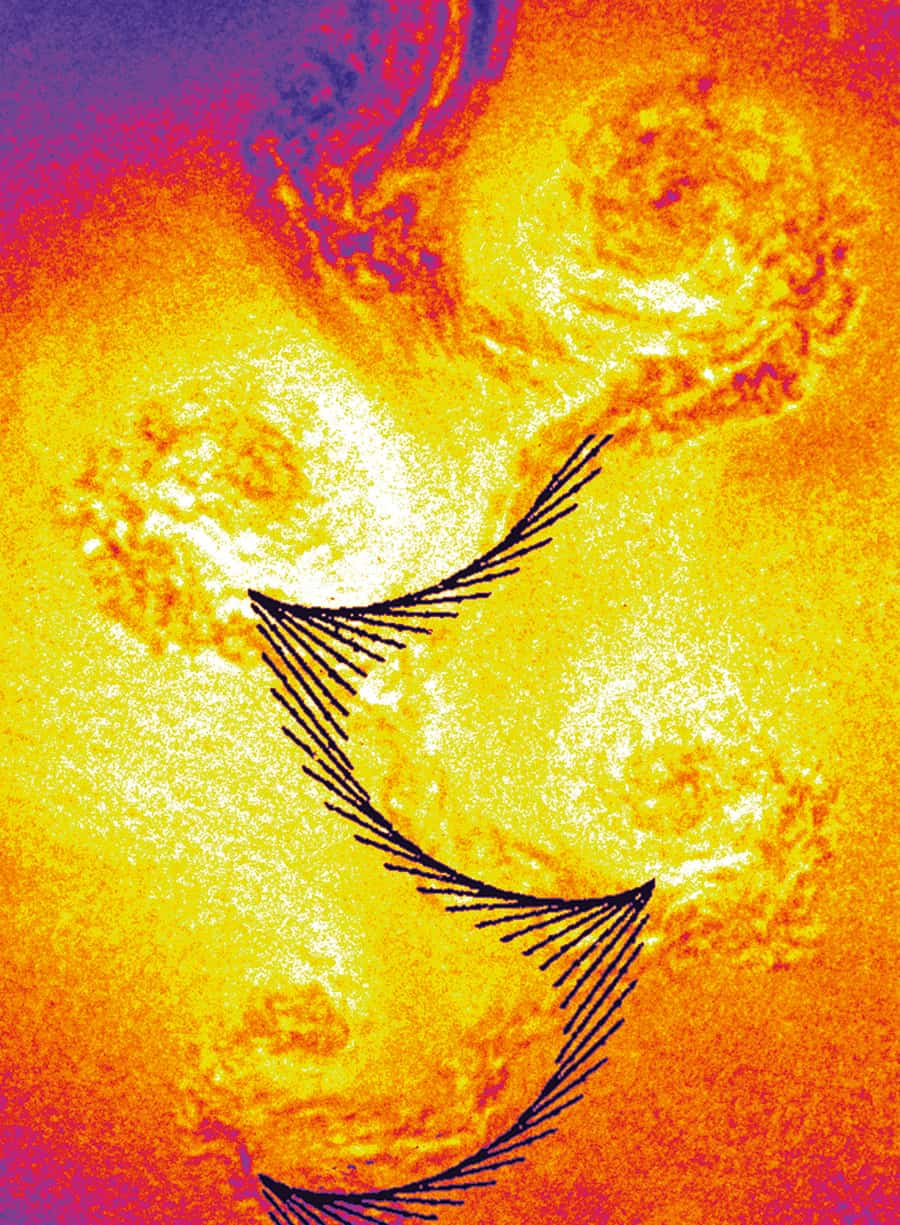
Water vortices A collage of consecutive video images showing the trajectory of a metal strip falling through water superimposed on a still image of the vortices it creates.
In the mid-17th century Galileo Galilei dropped two metal balls from the Leaning Tower of Pisa and showed that they fall at the same rate despite their different masses. In a later version of the experiment, astronaut David Scott dropped a hammer and a feather on the Moon and saw that they hit the surface at the same time. Why did Galileo not choose this more dramatic combination of objects to drop from the Leaning Tower?
While air resistance leads to shape-dependent drag, dropping a feather would have been a particularly poor choice for another, more interesting reason. Most of us know from experience that feathers “flutter” from side to side as they drift slowly towards the ground. They certainly do not fall in a straight line. What special property do feathers possess – in common with sheets of paper, playing cards, autumn leaves and coins flipped into a wishing well – that allows them to partially ignore the downward pull of gravity? The graceful and intricate motion displayed by these objects is due to the fluid around them, which couples the downward motion to lateral or sideways excursions. In contrast, on the Moon a feather drops like a stone because there is no atmosphere.
Although James Clerk Maxwell first considered the motion of an object falling freely though air over 150 years ago, the equations remain unsolved today for the most general case. Nonetheless, fascinating and sometimes orderly effects present themselves and beg to be understood. Ultimately, they are related to one of the last puzzles of classical physics: fluid dynamic instability. This challenging problem spans the scale from micro-organisms swimming through fluids to atmospheric turbulence.
Simplifying the motion
The effect of the surrounding fluid on a falling object’s motion has far-reaching consequences in everyday applications, both man-made and natural. Flying and swimming are practised under the influence of the same forces that cause a feather to flutter from side to side. Every non-spherical object moving with a high enough velocity encounters forces that can cause it to tumble or flutter.
Maxwell noted that the forces exerted by gravity and the fluid do not necessarily act at the same point, and thus can create a torque. The details of the fluid forces depend not only on the shape of the moving body but also on the presence and location of swirls of fluid motion called “vortices”. These differ from case to case, creating a rich variety of applications in engineering and nature. As is often the case in complicated, highly nonlinear systems, the equations that describe the problem in three dimensions are difficult to solve. The system therefore needs to be simplified before any progress can be made. The first step taken by theorists has been to constrain the motion to two dimensions. The problem is further simplified by ignoring vortices and by assuming that the fluid has zero viscosity. In the 1870s Gustav Kirchhoff showed that the problem could be further simplified to a set of equations that could be solved for simple shapes, even though his new equations contained over 20 new “added mass” terms. The same method appears in Horace Lamb’s classic treatise on hydrodynamics, and was most recently applied explicitly to the motion of falling paper by Lakshminarayanan Mahadevan at the Massachusetts Institute of Technology in the US. Is there anything more to be done on this subject?
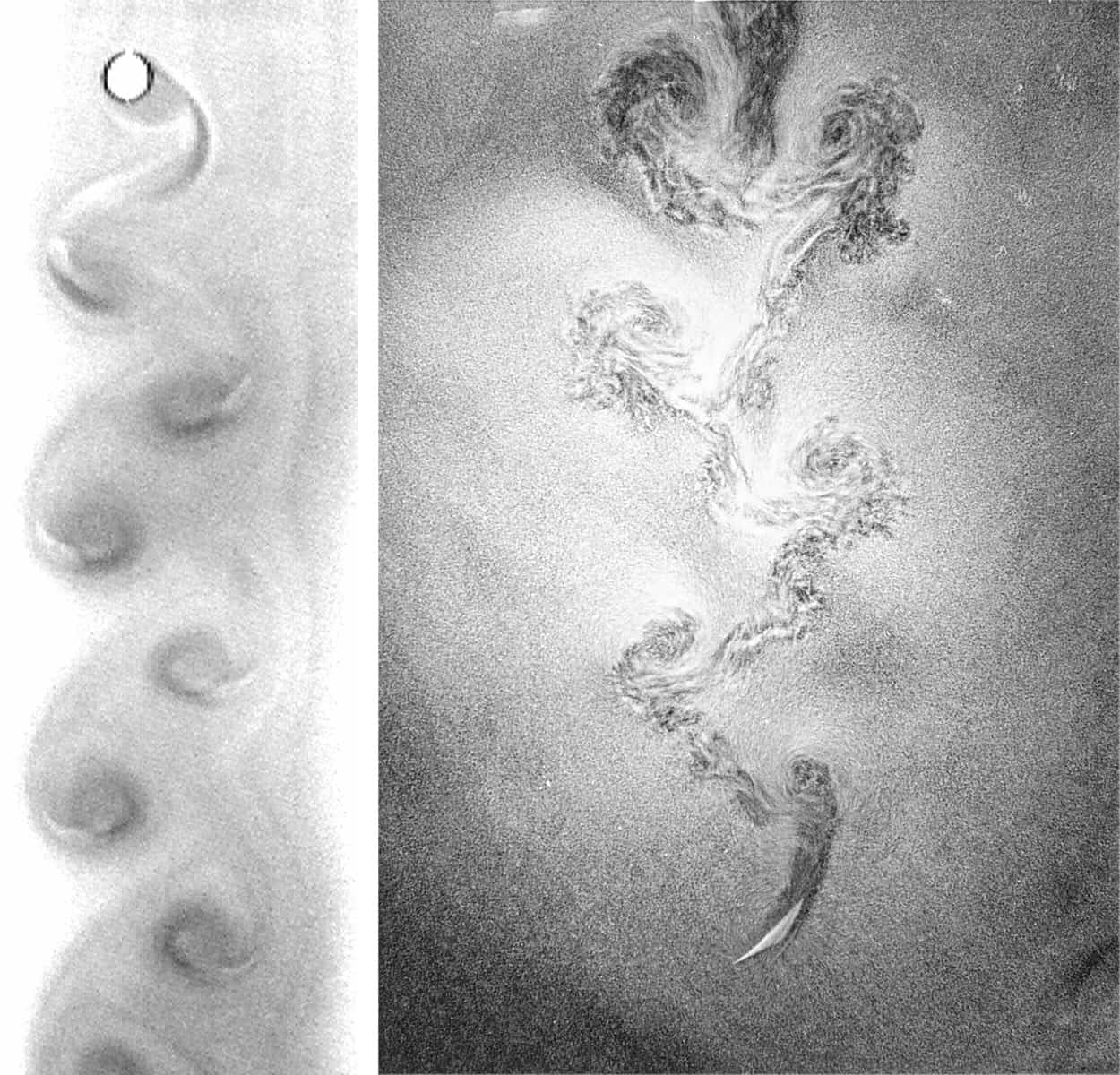
1 View of vortices Images of the vortices shed by (left) a rising air bubble (courtesy of Mingming Wu at Occidental College) and (right) a metal strip as it falls through water. It is possible to see the fluid motion due to a dispersion of small aluminium particles in the water. The vortices shed in each case are synchronized with the “zigzag” motion of the object.
Although there are surprisingly few laboratory experiments devoted to the problem, the results show beyond doubt that there is a fundamental difficulty with the simplified theoretical approach. In the pioneering experimental work of William Willmarth at the University of Michigan in the 1960s, dye-laden discs were dropped into water and vortices were clearly seen in their wake. Recent experiments have confirmed that metal strips and air bubbles produce vortices as they fall or rise in a fluid (figure 1). Vortex production is such an important part of fluid dynamics that a complete theory must take it into account. Yet Willmarth’s experiment with Norman Hawk and Robert Harvey was the main study on the motion of falling objects before the recent flurry of activity in the 1990s.
There have also been a large number of laboratory studies of “autorotating” objects in wind or water tunnels. The efforts were mainly driven by practical considerations, such as the dynamics of aircraft after they stall, meteorological questions related to the formation of hailstones and the industrial problems of sedimentation.
All of the previous experiments on falling objects have been in three dimensions. Although fluttering, gyrating and tumbling behaviour have all been observed, very few quantitative details of the dynamics were given. The recent experiments in which we have been involved bring a new twist to the problem of falling through fluids. Our experiment is restricted to a two-dimensional system, which simplifies the situation considerably. More importantly, it eliminates a variety of modes of motion that tend to destabilize the falling object’s trajectory in 3-D, making it unpredictable and uncontrolled. It also means that a detailed comparison with the classic theoretical studies can be made. Our experimental effort began when Hagai Eisenberg, then a Masters student at the Weizmann Institute, walked into the laboratory and dropped a piece of paper. “This is what I want to study, ” he said pointing to the paper as it fluttered to the ground. By coincidence, Kunihiko Kaneko of Tokyo University had published an elegant and conceptually simple model of falling paper a few months earlier, using simulations of 2-D flow to identify chaotic regimes of motion. Kaneko and Yoshihiro Tanabe broke with tradition and allowed the circulation of the fluid to vary in their model. Although Tanabe and Kaneko did not explicitly consider the presence of vortices, this is a commonly made assumption in models of animal flight where vortices are known to play a role.
Moths, balls and aeroplane wings
For many moving objects, the surrounding fluid (air or water, for example) can exert a sideways force that is more subtle than the drag force. Any baseball pitcher or aeroplane pilot can confirm that the relative motion between an object and the fluid can produce lift. The forces that can make a spinning ball swerve or produce lift in an aeroplane are produced by a common cause: a net circulation of the fluid around the object (see, for example, ” The physics of football” Physics World June 1998).
2 Theory of fluid flow In the classical theory, the flow around a rigid flat object is split into two components. The translational component (a) results in an infinitely large velocity at the trailing edge of the object while the rotational component (b) gives a net fluid circulation around the object, (c) When the right amount of circulation is incorporated in the theory the two components combine to eliminate the infinite speed and provide a smooth fluid flow at the trailing edge. This is known as the Kutta-Zhukovski theorem and has been verified experimentally, (d) The forces acting on the object include the gravitational pull acting at the centre of mass, directed downward. The drag acts in the opposite direction of the instantaneous fluid velocity, and in symmetric objects is usually assumed to also act at the centre of mass. The lift, on the other hand, acts normal to the instantaneous velocity, and at a point that depends on the details of the flow and on the distribution of vortices around the object. If the forces act at different points, a torque is created.
This flow can be separated into translating and circulating components (figure 2). In the case of a baseball or a football, the reason for this circulation is clear: the fluid in contact with the ball rotates with it. The force perpendicular to the flow is directly proportional to the rotation rate, and can be explained in terms of Bernoulli’s law, which relates flow rate and pressure. The fluid moves faster on one side of the object than the other, and the resulting pressure difference exerts a force that can lift the ball or cause it to swerve. Although an aeroplane wing or aerofoil does not rotate, its shape or angle of inclination in the flow produces the same effect on the fluid. In this case the fluid circulation around the wing is not known. However, it can be determined by the Kutta-Zhukovski theorem, which states that the circulating component around the aerofoil is matched so that the flow field continues smoothly past the back edge of the wing. In steady-state situations, such as an aeroplane cruising at constant speed and altitude, the Kutta-Zhukovski theorem has been shown to be correct. But what about unsteady situations where the wings move vertically or flap?
The fluttering fall of paper and the way in which vortices are created have many similarities with the fluid dynamics associated with a bird flapping its wings. No insect, bird or mammal flies in the way a plane does, with rigid, outstretched wings (not to mention the high ground speed needed to take off). Moreover, the hydrodynamics of flapping pose certain conceptual difficulties for the explanation of lift, since the circulation around the wing is always changing. Charles Ellington at Cambridge University in the UK recently built a “mechanical moth” to study the way that momentarily stable vortices are created by the flapping wings and cause the moth to lift. Studying the way vortices are created by the fluttering motion of paper may lead to a better understanding of the physics of flight. Recent simulations by Jane Wang and Steve Childress at the Courant Institute in New York may also lead to new insights. To describe the motion of an object as it falls through a fluid with changing velocity, Tanabe and Kaneko assumed that the steady-state conditions could be applied at each instant. This involved using the Kutta-Zhukovski theorem to specify the lift produced by the fluid in the model of falling paper. We designed and constructed a quasi 2-D laboratory experiment that was accurate enough to check this model using real objects. By dropping thin flat strips of plastic, aluminium or steel in different fluids between two closely spaced glass plates, we observed two fundamental motions: side-to-side oscillations (flutter) and end-over-end rotation (tumble). Our experiment showed that the swinging motion of the falling strips was strikingly regular and was accompanied by a spectacular fluid flow. We found that the fluttering dynamics of the strips and the transition from fluttering to tumbling motion could be described by a single dimensionless parameter that was related to the shape of the strips.
Pushing fluids around
The two sources of drag for an object moving though a fluid are the viscosity of the fluid and its inertia. The viscous drag force comes from the “stickiness” of the fluid: the velocity of the fluid must match the velocity of the object at its surface, so the effects of the drag force are felt in the fluid as well. The viscous drag depends linearly on the relative velocity of the fluid to the object. The second source of drag, sometimes referred to as the “form drag” or “inertial drag”, depends on the density of the fluid rather than its viscosity. This force varies according to the square of the relative velocity of the fluid and the object.
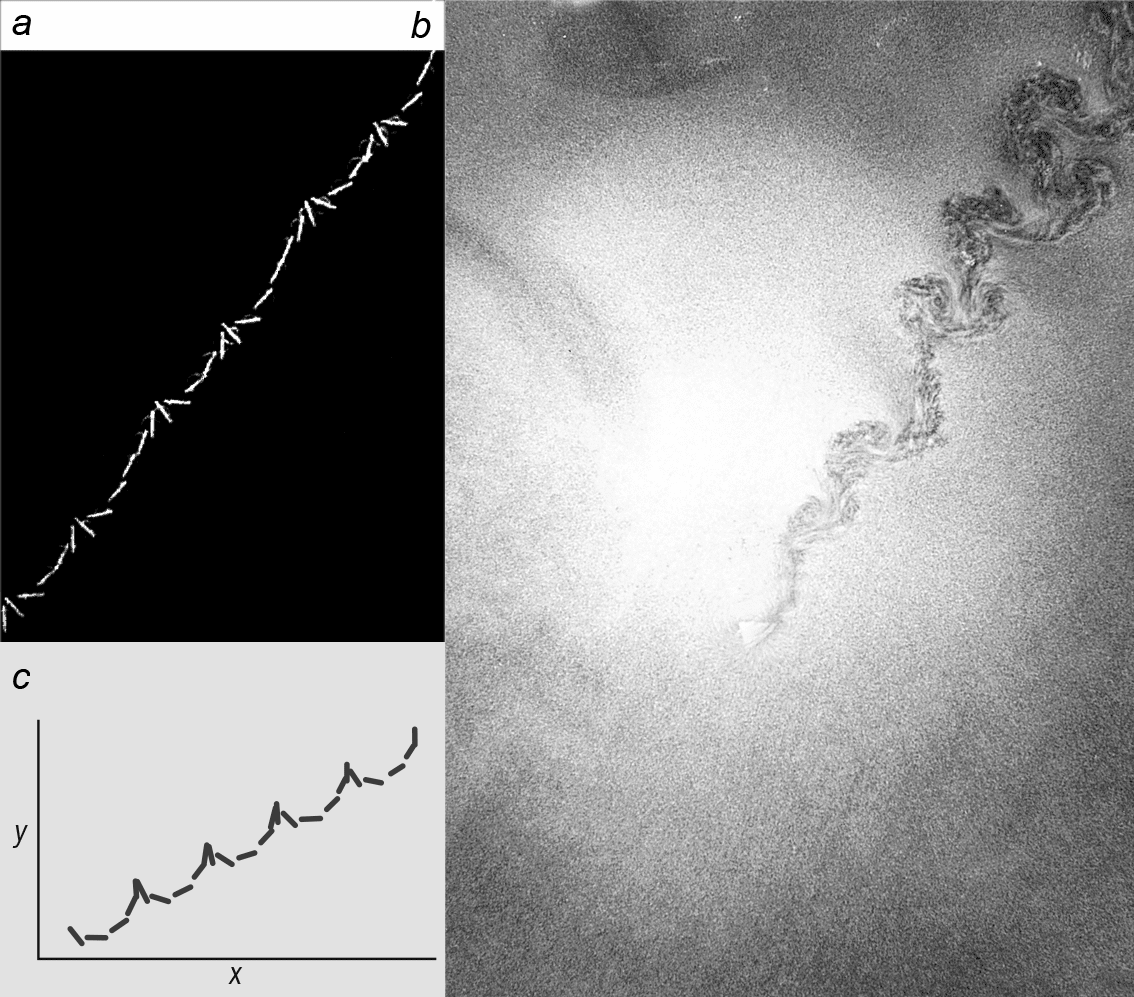
Our falling strips have quite high Reynolds numbers (defined as the ratio of inertial force to the viscous force), of the order of 1000 to 10 000, which means that the inertial drag is more important than the viscous drag. This in turn means that the strips lose energy by transferring it to the fluid, leading to the creation of large flow structures. It also ties in with another observation, that vortices created by the falling object are intimately linked to its dynamics, being produced at every “zig” and “zag” of the fluttering object, or at every 180° turn in the tumbling regime (figure 3).
3 Tumbling strips Three views of a tumbling strip. (a) Frames from a video of a strip constrained to fall in 2D in our experiment show the tumbling motion. The time between exposures was 20 ms. (b) Vortices are shed behind the tumbling strip at every 180° turn and are similar to vortex production in the fluttering regime, (c) A model that incorporates the inertial drag of the fluid with varying circulation predicts that the trajectory of the falling strip is similar to the tumbling motion seen in (d).
We also found that the mechanism determining whether the strips would tumble or flutter could be related to intrinsic properties of the strip itself. The transition from flutter to tumble is given precisely by a dimensionless quantity called the Froude number. For a falling object the Froude number measures the ratio between the typical timescales of falling and of swinging. (This number was originally introduced by William Froude in the 1870s to compare the performance of ships; it is the ratio of the ship’s speed to the speed of surface waves, which are the main source of drag.) For a falling object, the rotary motion – either the fluttering or tumbling – as vortices are shed is the main source of drag.
The strip also stores energy in a similar way to a pendulum. The Froude number thus characterizes the dissipative role of oscillations. Interestingly, it is also used to compare the way that animals, ranging from the rat to the rhinoceros, walk and run. In his monumental work on the physics of biological shapes, On Growth and Form, D’Arcy Wentworth Thompson discusses the “pendulum model” of walking, which accounts for the exchange between gravitational potential energy and swinging kinetic energy during a stride. Energy is expended when the foot makes contact with the ground and reverses the direction of its swing. This is analogous to the creation of a vortex by the strip. Moreover, recent studies of the transition from walking to running in bipeds, or to a brisk trot in quadrupeds, occur at a critical Froude number of 0.8; the transition from a trot to a gallop in quadrupeds then occurs at around a Froude number of 3.
The swinging motion of fluttering strips and walking legs are both limited by a common transition mechanism, which is essentially the “overturning point” of a simple pendulum. When driven hard enough, both legs and falling strips reach this pendulum limit and make a transition to the next, more complicated, mode of motion. For the fluttering strip, once it is given enough angular momentum, it flips over and executes a full rotation: in other words it tumbles. In the case of legs the transition is of course more complicated, but the end result is, if you want to go faster, you need to run. The transition of a pendulum driven to its overturning point is surprisingly similar to these two vastly different phenomena, in which swinging is an intrinsic aspect of motion.
Is there chaos?
Although the motion of falling objects can be random – try dropping a playing card or business card from a height into a waste-paper basket – is it truly chaotic? In other words is the motion highly sensitive to the initial conditions?
Several researchers have found evidence of chaos in the motion of objects in fluids. In 1993 Hassan Aref and Scott Jones from the University of Illinois studied a very general 2-D theoretical model for asymmetrical objects moving through a zero viscosity or “inviscid” fluid in which vortices are not present. Chaos was also seen in the model of Tanabe and Kaneko that did involve viscosity but not vortices.
4 Order parameter for flutter and tumble A graph depicting the dependence of the order parameter as a function of the control parameter ε = (Frc–Fr)/Frc where Frc is the critical Froude number that defines the transition between fluttering and tumbling motion, and Fr is the Froude number of the strip. The angle θmax is the greatest angle that the strip makes with respect to the horizontal direction in each “zigzag” motion. The data are from experiments using three different fluids (blue is water, red is petroleum ether and green is a glycerol-water mixture) and a variety of strip lengths and masses. The line is intended to guide the eye.
Although Stuart Field of Colorado State University, Franco Nori of the University of Michigan and co-workers recently reported the first experimental observation of chaos in a study of falling 3-D objects, we were unable to determine conclusively if the trajectories of our strips were chaotic. In our 2-D experiment, the range of parameters where chaotic motion occurred, if it occurred at all, was minimal and localized at the transition from flutter to tumble. A tumbling strip near the transition suddenly fails to complete a full rotation, and experiences an apparently random transition to the flutter regime for one cycle. This changes the direction of tumbling, and we had a few instances where tumbling strips randomly changed direction on one or two tumbles (out of about ten).
Our experimental approach to falling objects borrows more from condensed-matter physics and bifurcation theory: we think of flutter and tumble as two dynamic states, with a transition from one to the other. This transition is controlled by the Froude number. Above the “critical” value of 0.67 the object tumbles, and below this value it flutters. In our experiments, the Froude number is proportional to the square root of the mass and inversely proportional to the length of the strip. The thickness and width are kept constant, although the width also affects the Froude number. Thus longer or lighter strips, which have a lower Froude number, will flutter, whereas shorter or heavier strips, which have a higher Froude number, will tumble.
But what is the order parameter that quantifies the amount of flutter? The motion of the strip itself suggested the order parameter that we should use. During flutter, the strip oscillates from left to right, and rotates up to a maximum angle, qmax, at each extremity of its swing. No flutter corresponds to a maximum angle of zero. Our experiment showed that *max increases monotonically as the Froude number increases (figure 4). What happens when qmax reaches 90°? This would correspond to a sharply swinging strip, at the point where it could flip end-over-end. We found that our strips did this for Froude numbers just above the “critical” value of 0.67. For comparison, a strip of stationery paper (with a density of 80 g m-2) that is constrained to fall in 2-D would have this critical Froude number if it were about 18 cm long. Thus a standard A4 sheet (which is nearly 30 cm long) should flutter, ignoring its flexibility.
5 Simulation shapes up A detailed comparison of experimentally measured quantities (blue) with computer simulated ones (red). The ratio of the flutter angle and the vertical and horizontal components of the strip velocity to their maximum values are shown as a function of the ratio of distance fallen to strip length. The overall agreement indicates that the model captures the dynamical aspects of the problem.
We compared our experimental data with a revised version of Kaneko’s model in which we replaced the viscous drag with inertial drag in the equations. This simple change normalizes the equations so that the Froude number appears as the only dimensionless control parameter in the model, a fact that agrees well with our experiment (figure 5). What the simulation cannot model is the formation of a vortex. From the video images, we have seen that vortices are produced near the centre of the strip when it is practically horizontal. Then, the strip tilts and the vortex slides along it towards the rising edge, growing as it does so. When the strip reaches its peak angle, the vortex is shed and the strip almost stops momentarily before reversing its direction. By incorporating the creation of vortices into the model, one could hope to capture even these more detailed aspects of the dynamics.
Falling through fluids is an everyday occurrence, yet one that brings out complicated and intricate dynamics that have defied a proper theoretical treatment for centuries. An explanation of this puzzling motion is rooted in fluid dynamics where the creation and shedding of vortices by the object is intrinsic to its motion. We have made progress towards understanding the basic ingredients governing the dynamics by simplifying the problem to 2-D. Our work may eventually lead to an understanding of the problem in 3-D and the role of vortices.
In the meantime, simplified approaches prove their worth and provide us with physical insight into the essentials of flutter and tumble.
The authors would like to thank Hagai Eisenberg, Jay Fineberg, Jean-Marc Flesselles and Franco Nori for useful comments.