It was in 1867, in a letter to his friend and colleague Peter Tait, that James Clerk Maxwell first stated his renowned “demon paradox”. He imagined a vessel with two compartments, separated by a controllable door, with a demon that allowed hot molecules to accumulate on one side, and cold molecules on the other. The resulting temperature difference could then be used to drive a thermal engine. Thus, the demon could convert the thermal energy of molecules at equilibrium into useful work and violate the second law of thermodynamics. It is remarkable testimony to Maxwell’s insight that this question – raised at a time when molecules were still a conceptual crutch and poorly characterized – took us over a century to resolve. Only within recent years have we been able to show that it is impossible to sort molecules without expending more energy than the work that can be extracted from the sorted molecules. The second law of thermodynamics does indeed hold true.
In this book, Hans Christian von Baeyer reviews the history of that clarification, and uses it as a basis for recounting much of the content and history of thermodynamics and statistical mechanics. It is a superb account, exhibiting the expository skills the author demonstrated in earlier books and revealing his sound understanding of the subject. Above all, the book shows a deep sense of the rhythms and structure of science. It is aimed at a broad readership, as the absence of equations makes clear. The author also omits figures, although this at times requires considerable verbal baggage, for example, when he describes the shapes of graphs. The book’s final chapter, on recent work related to motion produced by fluctuations, suffers particularly in this respect.
Nevertheless, in contrast to many other science books sold at airport bookstalls for casual reading, this one promises less and delivers more. It has about 250 slim pages, and the general reader actually has some chance of finishing it. Moreover, unlike many of its competitors, the book does not promise to solve the deep mysteries of nature, such as the origin of life or the meaning of free will.
However, the desirable brevity comes at some cost. You will not, for example, find new historical scholarship. In fact, the author acknowledges his debt to an authoritative earlier volume, Maxwell’s Demon: Entropy, Information, Computing (H S Leff and A F Rex (ed) Adam Hilger 1990), which is an annotated collection of reprints. The brevity of von Baeyer’s book also means that while there is a great deal about entropy – with Boltzmann a central figure – Josiah Willard Gibbs never appears.
Boltzmann supplied us with the microscopic understanding of entropy through his famous equation S = k logW, which appears on his tombstone, although it never actually appears in this book, except in a cumbersome verbal form. (That equation was made immemorial for me when I was a teaching assistant and found an exam script where the student had written “S = k logW, where k is Klotzmann’s constant”.) Boltzmann’s insight was elaborated by Gibbs into the more detailed set of tools that most of us who work in this subject have to use.
The history of thermodynamics in the early 19th century is a welcome reminder that the relative date of scientific developments does not always map neatly into our perception of relative difficulty. The steps toward understanding the first and second laws were interwoven in time. Yet, today, the law of conservation of energy is folklore. Entropy, except for meaningless cocktail-party patter, is a subject for specialized college courses, and even there it is not really understood by many of us until we reach statistical mechanics.
The modern resolution of the demon paradox is based on the fact that to sort molecules, we (or the demon) need to make measurements on them. Von Baeyer gives Brillouin credit for first treating the recorded results of measurements as part of the total physical system viewed in the entropy balance. Actually Leo Szilard had already taken that pioneering step. Brillouin, who made several major contributions to physics, unfortunately only added confusion to our understanding of the demon. Enlarging on Szilard’s early work, we eventually learned that the critical energy dissipation, which saves the second law, occurs when the recorded measurement information is erased and the memory is reset for its next (or first) use. This contrasts with our earlier view that energy is expended only when information is transferred from the molecule to the register that controls the shutter or other sorting device.
In the two concluding chapters von Baeyer makes contact with the forefront of recent research, and this is the weakest part of what is otherwise an excellent book. In the first of these two chapters we meet “algorithmic entropy” and its relationship to real physical entropy. Algorithmic entropy is the minimum number of bits needed to specify a number or structure. According to this view, a periodic array of molecules is easily described, but random placement requires us to give the position of every molecule. However, in a book that emphasizes history I was surprised that we do not learn that it was Charles Bennett, my colleague at IBM, who made the first step in connecting physical entropy to earlier, more mathematical notions about the definition of randomness. While Boltzmann and Gibbs taught us that entropy characterizes ensembles, not a particular molecular configuration, Bennett told us that, in fact, entropy can be assigned to each particular configuration, and then can be averaged over the ensemble.
The last chapter deals with recent work on “thermal ratchets” – systems in which particles are in time-dependent and spatially periodic force fields and also subject to noise. Neither the force field nor the noise exert a net force, but the particles can be moved by the interaction of the two. Again the account is blemished by singling out one name, Dean Astumian, in a field that has a very complex history. Thermal ratchets are supposedly found in biological systems, but that case is far from proven.
These last two chapters illustrate the whims of fashion. The fact that entropy is not just a property of an ensemble is a deep insight, and one that came only after many decades of supposedly deep analyses of entropy. However, this point has attracted surprisingly little attention among practitioners of statistical mechanics. In contrast, thermal ratchets have become a busy little industry, the depth and significance of which may be transitory.
In fact, labels may have a great deal to do with the level of attention given to topics. If Maxwell’s demon had been called Maxwell’s sorting device, would this book have ever been written?
Transforming the Soviet Union’s highly centralized communist regime into an open, democratic society based on free-market principles has proved to be much harder than people at first thought. Life has been painful for almost all levels of society in the former Soviet nations since the early 1990s, and the relatively small – but important – scientific community has been no exception. It has found itself poorly prepared and unable to adapt to the speed of the social transformation, with its new rules, aims and values. However, the roots of this destruction do not date back to 1985, when the policy of perestroika began, but to much earlier.
It was in 1931 at the international congress of the history of science and technology in London that the Soviet Union first presented its strategy for the development of science and technology, based on centralized planning and control. This strategy was supported, for example, by the pro-communist British scientist J D Bernal. He was impressed by the fact that the USSR had set up almost one thousand research institutes, employing tens of thousands of scientists in a co-ordinated programme designed to meet the needs of the entire Soviet society. This approach differed radically from the western attitude to science, and fundamental research in particular.
Of course, the country was forced to introduce these measures because of its policy of self-imposed international isolation and the demands of increased militarization, especially after 1945. But the Soviet programme had far more impact on science than was originally envisaged. A vast number of research institutes were set up at the Academy of Sciences and at defence-related ministries within a very short period of time after the Second World War. Many of these institutes had no scientific traditions, and no way of evaluating the quality of their research, especially as they operated under conditions of total secrecy. One joke at the time was that the research was deliberately kept secret so that nobody would find out how poor much of it was!
Too many scientists – too little talent
The Soviet Union believed that increasing the number of scientists and research institutes would enable it to outstrip western science and boost the rate of new discoveries and inventions. But the evolution of science and technology has its own “clock”, and many areas of science depend on each other for success. In other words, simply doing more research does not necessarily lead to more scientific and technological breakthroughs – if for no other reason than that there are limited numbers of creative and original scientists. It is clear that it was difficult under these conditions for Soviet science to approach – let alone match – the quality of international research in every area of science. As Andrei Sakharov felt in 1968, it would have been easier and cheaper for the Soviet Union to have followed what was already being done in the West, rather than do everything from scratch itself.
Of course, there were talented investigators who did internationally respected work under these conditions. But by no means everyone who could have succeeded in this highly bureaucratic environment managed to do so. The only people who thrived tended to be those exceptional scientists possessing both creative and administrative skills. A classic example was the brilliant physicist and inventor Pyotr Kapitza, who directed the world-famous Institute of Physical Problems in Moscow and also managed the entire Soviet liquid-oxygen industry. But innovative scientists who lacked managerial skills were often unable to shine. Even worse, science began to attract vast numbers of merely average people. This started to affect the Academy of Science so badly that by the 1960s the physicist Lev Artsimovich said it was turning the academy into nothing more than a “bureaucratic research ministry”.
Another problem was the “brain drain” of talented scientists from the universities – particularly those in the provinces – to academic and defence-related institutes, which were located, as a rule, in Moscow. This created a gap between the universities and the academic institutes, which were at the forefront of scientific research. After the Second World War, it even proved necessary to introduce special measures to overcome this phenomenon – for example by creating the Moscow Physical-Technical Institute in Dolgoprudnii. This institute was set up to satisfy the country’s demand for talented physicists, whom the universities were no longer capable of producing.
In the end, the Soviet Union was swamped with far more scientists than it needed, and with an over-abundance of them in the capital, Moscow. But despite the huge number of Soviet researchers, they made far fewer discoveries of international standing than their colleagues in the West. Soviet scientists began to judge themselves by their own standards, and everyone believed they were doing research of international quality – even when this was manifestly not the case. I knew of countless untalented researchers who could not even spell out the aims of their research, but who managed to get away with it because this inability to explain what they were doing was seen as “evidence” that they were involved in very fundamental work. After all, no-one expects quick results from basic science.
By the onset of perestroika in 1985, there were some one and a half million researchers in the Soviet Union, mostly in the applied sciences. There were, of course, good reasons for wanting to become a scientist. Most Soviet citizens lived in small state-owned flats, and a PhD gave scientists the right to an extra 10 m2 of floor space for their families – more than double the normal allocation. This partly explains why so many scientific specialties, which had little to do with science, were formed.
Russia’s problems today
The sudden cuts to research budgets that were imposed in the late 1980s – first in defence research and then in every other area of science – hit particularly hard. By the early 1990s some far-sighted researchers were suggesting that the number of scientists should be cut by two-thirds so that the rest could work more efficiently. However, this measure was considered extreme at the time, and it would have been difficult to implement quickly. In any case, it tends to be the best – rather than the worst – researchers who leave when such measures are introduced, because they know it will be easy to get new jobs. Soviet science and technology entered a phase of self-liquidation, which continues to this day.
However, a carefully controlled two-thirds reduction in the number of scientists – for example at the Academy of Sciences – would allow the salaries of those remaining to be raised threefold. Instead, the scientific workforce is shrinking in an uncontrolled and unplanned fashion as people retire or leave for other jobs. Scientific equipment is dying even faster, and soon Russians will have to buy oscilloscopes and other basic equipment from abroad – if, of course, the money can be found to buy them.
The uncontrolled decay of Russian science may not be fatal for Russia in the short term, but it is nevertheless very damaging to the country in the long term, particularly as many talented researchers leave to seek their fortunes in the West. (None of this, of course, relates to the science and technology that is needed to maintain Russia’s nuclear potential at a safe level, as this is closely monitored by international agreements.)
Bringing back Russians from abroad
While government officials admit that there is a “brain drain” of Russian scientists going abroad, they claim that it has not yet reached crisis levels. However, I am not too worried about the total number of scientists who are leaving. What concerns me more is the number of good, qualified scientists at the peak of their careers – say, between the ages of 25 and 40 – who are going abroad. Since the early 1990s possibly as many as 90% of Russian scientists in this age-range have gone. As a result, the country is in danger of being unable to pass on the scientific experience of its older scientists to younger students.
However, this brain drain from Russia is certainly good for western nations, for it provides them with highly skilled specialists without having to spend any money training and educating them. These newcomers could also include people who will eventually influence the development of western science, just as physicists like Kapitza and George Gamov did when they went to Britain earlier this century.
The only remedy is to make scientific salaries and career prospects broadly comparable with those in the West. Scientists who left Russia may then be tempted home – after all, most of them have kept their Russian citizenship. The country would gain from their experience of high-level research carried out in the West using the latest scientific equipment. Their homecoming could also help Russian research to carry on at a quantitatively smaller but qualitatively much better scale. In other words, the brain drain may actually help to preserve Russian talents in the long term.
But what about the young, the old and all those who for one reason or another (mostly personal) have no desire or possibility to work abroad? After all, there are still many active research groups in Russia, working under extremely difficult conditions. Here, of course, help from western scientists and governments can be highly effective for Russian science. It can also benefit the entire international community. We must preserve and support brilliant and original talent, wherever it appears, Russia included.
What the West can do
So how can the West help address the problems facing Russian science? First, western nations should try to integrate individual Russian scientists and research groups into bilateral and international projects. This form of co-operation is very effective. It allows ideas, experience and equipment to be exchanged, and provides Russian scientists with additional, independent financial help. This not only benefits the research but also allows Russia and western nations to learn from each other’s education systems. The programme of help developed by the philanthropist George Soros was an important example of what can be done in this respect; indeed, I believe his unique initiative deserves to be investigated by science historians.
Second, the help given to Russian scientists should be targeted at those who are doing highly original, pioneering research that is, for whatever reason, more advanced than in the West.
Third, western governments – and indeed the entire international community – would gain if they supported those Russian scientists who control high technologies and can develop advanced new military technologies. I refer here to both nuclear weapons and those non-nuclear technologies with similar destructive capabilities.
To work out the level of financial support that Russian scientists should receive, we should start by estimating how much it has cost Russia to educate those young scientists who have left the country to work in the West – rather than trying to calculate what Russia currently requires. I believe that organizations like UNESCO can play an important part in making such estimates. Of course, I do not want this period of help to last longer than necessary.
Unfortunately, the world has not yet reached the stage where all countries realize the importance of working together on global problems. But this day will inevitably come, and, when it does, we will need a new, supra-national level of responsibility and control. By helping Russia to solve its current crisis, the West would gain vital experience in forming future international programmes of benefit to the entire world.
A small number of physicists have always worked on the financial markets. Employed by banks and other financial institutions, these so-called “rocket scientists” have been valued for their mathematical and computational skills, and their ability to analyse extremely complex problems. And as international finance has become even more complicated, the demand for rocket scientists – most of whom have PhDs – has increased, as have their famously high salaries.
In the past decade these physicists, who tend to be in their twenties, have been joined by more senior physicists who have become interested in both the theoretical and applied problems raised by the financial industry. Many of these physicists have set up their own companies, and some have even abandoned research altogether for a career in finance. While much of the work is confidential in nature, a good deal of it is published in physics journals and on the Web (see further reading). And in July this year the first European Physical Society meeting on the applications of physics in finance will take place in Dublin.
There is no single international finance market. Rather, there are many different markets working in different time zones and dealing in various assets in a large number of currencies. It is this complexity – coupled with the dynamic nature of the markets – that makes international finance an exciting career for physicists. For example, there are stock exchanges in New York, Tokyo, London, Paris, Hong Kong and many other cities across the world, and the values of shares traded on these exchanges can vary from second to second. And just as stocks and shares are bought and sold on stock exchanges, products as diverse as coffee and precious metals are traded on commodity markets around the globe. There are also, for example, markets for interest rates, the debts of emerging countries and more complex financial products known as “derivatives”.
There are also many different players in each of these markets – several types of bank (national, merchant, investment), insurance companies and international finance houses such as Goldman Sachs, Merrill Lynch and Salomon Smith Barney. Although these companies all have different aims – some banks lend money to customers, others help raise capital for clients – they are all interested in increasing the value of their investments while, at the same time, minimizing the risk associated with this investment.
Physicists can play a key role in helping all the players in the finance markets achieve this goal. Whether modelling interest rates or evaluating the risk associated with complex financial deals such as derivatives, there is a need for a mixture of intuition based on observation and an ability to use highly technical mathematical tools – a combination of skills that good physicists possess. Many of these physicists work for large financial institutions and investment houses, but an increasing number are employed by . Many of these have been set up by physicists.
Selected finance companies set up by physicists
Numerix, New York (www.dews.com). Managing partners include Mitchell Feigenbaum, head of the physics department at Rockerfeller University in New York, and Nigel Goldenfeld, professor of physics at the University of Illinois. Numerix’s director of R&D, Alexander Sokol, has a PhD from the Landau Institute for Theoretical Physics in Moscow.
Olsen & Associates, Zurich (www.olsen.ch). Founding members include Michel Dacorogna, who has a PhD in solid-state physics from the University of Geneva.
Oxford Financial Group, Oxford (www.oxfordfinancial.ac.uk). Set up by three mathematicians at Oxford University – Jeff Dewynne, Sam Howison and Paul Wilmott. Key personnel include Adam Hartley, a theoretical atomic physicist from Oxford.
Prediction Company, Santa Fe (www.predict.coni). Founded by Doyne Farmer, a former physicist at Los Alamos, and Norman Packard, previously professor of physics at the University of Illinois. Farmer and Packard were early pioneers in chaos theory and their attempt to “beat the odds” at roulette in Las Vegas using computers built into their shoes was the subject of the book The Newtonian Casino.
Science & Finance, Paris (www.science-finance.fr). Set up in 1994 by one of the authors (JPB), a theoretical condensed-matter physicist at the French atomic energy commission (CEA) in Saclay near Paris, and by Jean-Pierre Aguilar, an engineer and one-time trader. The staff all have PhDs in statistical physics. Aguilar also founded a financial software company that employs more than 120 people, and a fully automated trading company.
Random walks in science and finance
The idea that some financial problems can be addressed with the help of scientific tools is not new. It dates back to 1900 when Louis Bachelier, who studied under Poincaré in Paris, proposed that fluctuations in the prices of stocks and shares could be viewed as a random walk. His PhD thesis actually contained remarkable results and insights, which anticipated not only Einstein’s theory of Brownian motion, published in 1905, but also many of the post-war ideas in theoretical finance.
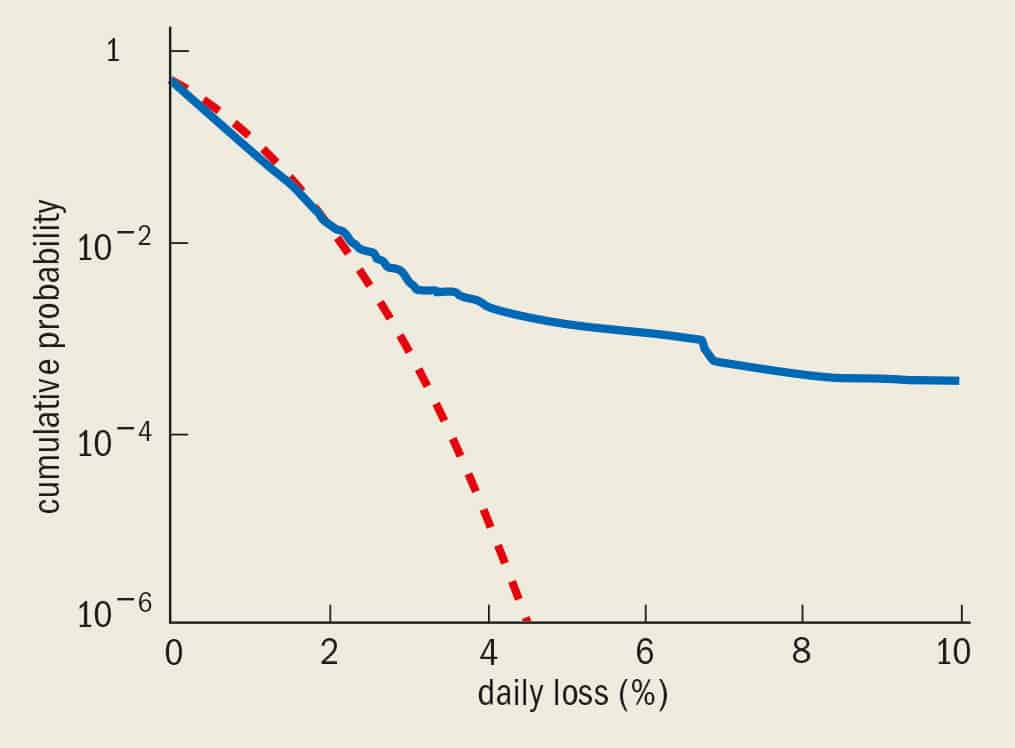
Bachelier’s model of the stock market was, however, too simple and failed to capture many of the crucial aspects of price fluctuations – for example the possibility of crashes. Bachelier assumed that many of the fluctuations followed a Gaussian probability distribution, but crashes were absent from his model because the probability of extreme events is embarrassingly small in a Gaussian world (see figure 1). Since then many scientists have tried to develop better models. The development of a reliable model for price fluctuations is crucial for better control of financial risk by all the key players on the international finance markets. Indeed, the markets can be seen as “risk exchanges” in which players are always trying to reduce risk.
A model of price fluctuations tries to predict what may happen in the future, and with what probability. However, the idea that one could predict what will happen with certainty is obviously absurd. The aim is to develop statistical rules – for example, what is the probability that the price of a particular share will go up (or down) by $1 between today and tomorrow? Inputs to the models include current and past share prices, interest rates and so on. One can test the model by comparing its predictions with actual price changes, and then adjust the value of the parameters in the model to obtain the best representation of reality. A good model is always a trade-off between mathematical simplicity and descriptive power.
1 How often does the market crash? The historical cumulative distribution of the daily losses of the Standard & Poor (S&P) 500 stock index for the 20-year period ending 1 October 1998 (blue line) and Gaussian distribution with same mean and variance (red dashed line). Crashes (daily losses of more than 10%) occur more often in the real world than the Gaussian world, which is the main reason reasons why models based on Gaussian fluctuations often break down. The October 1987 crash is not shown (out of scale). Its Gaussian probability is of the order of e–80! The S&P 500 is the value of 500 leading stocks traded on the New York stock exchange.
From the model, one can then compute various interesting quantities, such as the price of a derivative or the probability for an adverse move, which is essential information when assessing and managing the risk associated with a portfolio of investments. Indeed, Bachelier actually proposed a model for the price of “options”, a form of derivative, in 1900 and compared it with the data available at the time.
Several models of increasing complexity, starting with Mandelbrot’s 1963 “fat tailed” model, have been proposed over the years, but none of these has been firmly established yet. Put simply, all of these models get some things right and some things wrong.
So where does a physicist who is interested in analysing the finance markets begin? The international financial markets generate lots of data about the high-frequency variations in price of many different assets (stocks, currencies, bonds and so on), and these data are available to physicists for analysis. Physicists have their own way of analysing data, which is very different from the way econometricians (as economists who specialize in this area are called) look at data. For example, physicists are not interested in proving that a statistical model is right, but rather in extracting useful intuitions based on observation and developing computational methods to develop this intuition. As physicists we are sure that analysis of financial data will undoubtedly benefit from ideas and methods invented for statistical physics, such as critical phenomena, turbulence and various non-equilibrium phenomena. There is certainly no shortage of data for physicists to look at – one year of trading on the New York stock exchange generates enough data to fill tens of CD-ROMs.
Physicists have also become interested in the development of simple microscopic models that deal with the interaction between traders, and the feedback of past price variations on their behaviour. Whereas models of price fluctuations aim to be descriptive (like, for example, the ideal gas equation, which links the temperature, pressure and volume of a gas), these microscopic models aim to be explicative (like the statistical theory of gases, which explains why the ideal gas equation works).
Signals and noise
From a physical point of view some of the most interesting phenomena on the stock markets – and for which relatively little data are available – are extreme events such as crashes. The probability of such extreme events, which are obviously the most relevant ones for risk management, are also those for which the observation of past time series is not reliable – precisely because only very few of these events occur. Furthermore, the amplitude of “big crashes” is systematically larger than what the extrapolation based on “small” and “moderate” crashes would suggest, as if some nonlinear amplification effect (probably due to imitation and panic) comes into play beyond a certain level of price drop. There is therefore a need for a better theoretical description of crashes to supplement the shortage of real data.
A topic of much research is the possible connection between financial crashes and “critical points” in statistical mechanics, where the response of a physical system to a small external perturbation becomes infinite because all the subparts of the system respond co-operatively. Classic examples include the liquid-gas critical point in water and the Curie point in magnetism (i.e. the temperature above which ferromagnetic materials become paramagnetic). Similarly, during crashes, a large proportion of the players in a market decide simultaneously to sell their stocks.
It was recently claimed by Didier Sornette of the University of Nice in France and Anders Johansen of the University of California at Los Angeles, by James Feigenbaum and Peter Freund of the University of Chicago, and by Marcel Ausloos of the University of Liege in Belgium and colleagues, that this critical point was one with so-called “log-periodic” corrections. This type of critical point is increasingly being used to describe earthquakes and the fracture of materials. The basic idea behind the log-periodic approach is that oscillations in a system occur closer and closer together until they all accumulate at one time, the critical time, tc. When this method is applied to the stock market, the crash occurs at tc. Therefore, to predict when a crash will occur, it is necessary to identify these oscillations – the precursors to the crash – and the parameter, l, relating the period between them.
Recently some physicists claimed to have successfully predicted the October 1997 turmoil on the markets – when shares crashed in value on several stock exchanges across the world – using the log-periodic approach. However, this claim has been disputed by other groups, including ourselves (see box “Can crashes be predicted?”).
Among the ideas coming from statistical physics that might prove quite fruitful is the concept of “noise”. For example, although we know that the Brownian motion of a large particle interacting with many small molecules can, in principle, be described in terms of deterministic equations, Langevin showed that the intricate influence of the molecules can be replaced by an random force that fluctuates with time and has an amplitude related to what we call “temperature”. It is much easier to predict the statistical properties of the motion of the particle with Langevin’s approach than it is to solve all the equations of motion.
Similarly, although it may in principle be possible to model the behaviour of each individual operator or “agent” in a financial market, this is obviously a daunting task. The fact that one of them needs to sell his stock because he wants to buy a car, or that another one wants to buy some stocks because a friend advised him to do so, might be more conveniently described, on a coarser scale, by a Langevin noise.
However, many economists – who believe that agents are rational and try to optimize their “utility function” (essentially a trade-off between profit and risk) – are reluctant to accept such a theoretical shortcut. Indeed, some economists even claim that it is “an insult to the intelligence of the market” to invoke the presence of a noise term!
Interestingly, the same debate happened recently between engineers and physicists in the context of traffic modelling, where the analogue of the rational-agent hypothesis is that each driver wants to maximize his or her speed. Without any “noise” to account for unexpected braking events (caused, for example, by the driver sneezing), the rational-driver model predicts a steady flow of cars all moving rapidly along the road. As soon as a small amount of noise is introduced, however, traffic jams appear and disrupt the steady flow – and make the model more realistic. In other words, the addition of an arbitrarily small amount of noise allows one to reproduce an everyday phenomenon that would be absent in a perfectly rational world. Similarly, one can expect that small irrational effects might completely change the picture emerging from a completely rational economic model.
One of the fundamental tenets of the rational economy is that it is impossible to make a risk-free profit – this means that successful automated trading should also be impossible. Notwithstanding this impossibility, the quest for this modern “philosophical stone” – a guaranteed (“risk-free”) way to make money on the financial markets – is still blossoming. Many different techniques from physics and the other sciences have been explored, sometimes frantically, including methods from deterministic chaos, neural networks and pattern recognition. We feel, however, that the bulk of the published results on trading models suffer from serious flaws, probably due to enthusiasm taking over from scientific rigour. On the other hand, it is possible that some of these methods could be used successfully by more systematic trading managers.
Can crashes be predicted?
The value of the S&P 500 (red line) and the Hang Seng Index (blue line) over the period 1994–1997 (note that the y-axis is logarithmic). Some physicists claim that the Hang Seng crash of October 1997 could have been predicted on the basis of the oscillations marked t1–t4. Others dispute this claim (see text).
Recently Marcel Ausloos of the University of Liege in Belgium and colleagues claimed that the October 1997 turmoil on the markets – when shares crashed in value on the Hang Seng and several other stock exchanges – could have been anticipated. Their prediction was announced in Tendances, a Belgian economics magazine, on18 September 1997. The prediction was based on a log-periodic approach (see Vandewalle et al. in further reading).
In a log-periodic scenario the times, ti, of successive minima (and maxima) should follow a geometrical progression, i.e. (tn+1 – tn)/(tn – tn–1) = λ(tn – tn–1)/(tn–1 – tn–2)(λ < 1). The minima or maxima will get closer and closer together until they converge at the critical (or crash) time, tc = t∞. Ausloos and co-workers based their prediction on a log-periodic continuation of the four local minima in the S&P 500 stock index labelled t1 through t4 in the figure. A follow-up story in the 30 October issue reported that the crash had been predicted in advance.
However, serious doubts about these claims have also been put forward by us (see Laloux et al. in further reading). For example, the procedure is ambiguous since other minima exist. Moreover, the theory predicts that a still bigger crash should have occurred at the end of November 1997 (this would have been t6), but this did not happen. Furthermore, unlike the Hang Seng, which crashed, the S&P experienced only a “correction”, whereas it was predicted to crash by the log-periodic fits. Apart from the fact that the empirical evidence is thin, a plausible theoretical link between “log-periodic” oscillations and price fluctuations has yet to be established.
Complexity in action
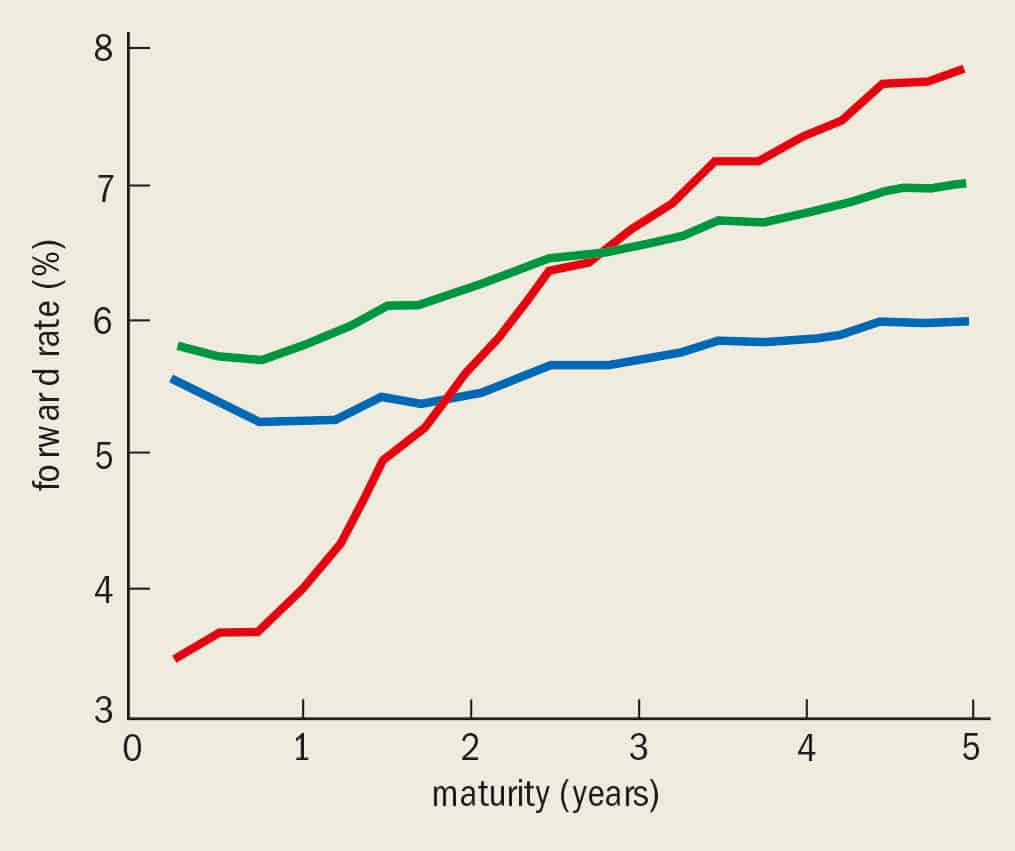
Another reason for scientists to be interested in financial problems is that some of these are truly complex. Take, for example, the “interest-rate curve”: this is essentially the graph that shows how the rate of interest charged to a borrower depends on the length of time of the loan. The interest-rate curve reflects the fact that the cost of borrowing a certain sum from one day to the next differs from the cost of borrowing the same amount for a week, a month, a year, ten years and so on. The interest rate for a loan of fixed duration will also vary with time: for example, the interest rate for a three-month loan taken out one year in the future will differ from the rate for a three-month loan two years in the future. The curve showing how this rate varies is called the forward-rate curve. At any time all of these different rates will be determined by the market, but they will all change over time, much like stocks (see figure 2). However, they will change in a correlated manner because, for instance, the four-year rate and the four-and-a-half year rate will not be very different.
In many ways the evolution of the forward-rate curve resembles the behaviour of an elastic string, with fictitious springs holding loans taken out at different times (i.e. loans of different “maturity”) together. By modelling how the interest-rate curve will vary over time, physicists can help to reduce risk, manage debt and set prices for derivatives based on interest rates (see Bouchaud et al. in further reading).
2 Levels of interest A snapshot of the US forward-rate curve at different moments on 1 September 1992 (red line), 1995 (green line) and 1998(blue line). The forward rate is the rate of interest that would be charged for a loan starting at time I in the future and ending three months later. Predicting interest-rate movements is a key challenge in reducing risk on the finance markets. Some physicists believe that interest-rate curves can be modelled as an elastic string.
Other complex problems are found on the derivatives markets. “Options” and “futures” are examples of derivatives – products whose values are derived from the value of something else, for example shares or interest rates. A future is an agreement to buy (or sell) something at a given time in the future for a price agreed now. No money changes hands initially, although the buyer has to put up a from of surety (called the margin) to cover potential losses.
Options are basically insurance contracts. In an option, the buyer pays a small amount now for the right – not the obligation – to buy or sell something at a given price some time in the future. If the price of the stock happens to drop below this price, then the “writer” of the option will pay the difference. There are many different types of options, and most of them are heavily geared. Take a simple example of a “call option”. I pay £5 now for the option to buy some stock, currently worth £95, at a price of £100 six months from now. If in six months the stock is worth, say, £110, I can sell it immediately. Therefore the £5 I invested is now worth £10 – a profit of 100%. If I had bought the stock itself for £95 and sold it for £110, I would only have made a profit of 16%. But if the stock never rises above £100, I lose all my £5.
Options involve two basic questions. First, what price should the buyer agree to pay? (or how much should the writer of the option charge?). And second, what is the best strategy for the writer to follow – in terms of the number of stocks they should buy or sell during the lifetime of the contract – in order to minimize their risk?
One of the major achievements of modern finance is the Black-Scholes theory of option pricing, which addresses the above two questions. The theory was developed by the late Fischer Black – who had a first degree in physics and a PhD in applied mathematics – and Myron Scholes, an economist at Stanford University in California. Scholes shared the 1997 Nobel Prize for Economics with Robert Merton of Harvard, whose first degrees are in engineering and applied maths. Black would almost certainly have shared the prize had he still been alive. The serves as a common language for all participants in option markets, and it underpins most of the software used in the business.
Unfortunately, the model used by Black and Scholes is Gaussian. This is very convenient from a mathematical point of view because one can rely on a score of useful tools, such as stochastic calculus, to solve it. However, as shown in figure 1, the markets are far from Gaussian. Moreover, in the Black-Scholes world, option writing can be made a completely risk-free operation – which is completely at odds with common sense (see Hull in further reading). The idea that risk can be reduced to zero can lead to a misleading – and potentially disastrous – sense of security on the financial markets.
However, it has recently been shown that this risk-free property is very specific to the Gaussian model and is not true for more realistic models (see Bouchaud and Potters in further reading). In reality, the residual risk is not, perhaps not surprisingly, that small compared with the price of the option. Developing a theory of derivative products in which the risk is properly estimated is a major challenge for econometricians and physicists alike.
The Black–Scholes equation
The Black–Scholes model assumes that the statistics of relative price changes is Gaussian, and that the time between two trades can be made arbitrarily small. This means that prices follow a continuous random walk with time. A further assumption is that markets are efficient and that arbitrage opportunities cannot exist. In other words, there is no risk-free way to make money by trading options.
These assumptions allow one to use the formalism of stochastic differential equations, from which the existence of a zero-risk strategy easily follows. However, the financial return on a zero-risk strategy can only be zero, or else one of the parties would lose money for sure. (In order to allow the possibility of making a profit it is necessary to introduce some risk into the problem.) This, in turn, leads to a partial differential equation – the Black-Scholes equation – for the price of the derivative
δV/δt + 1/2α2S2(δ2V/δS2) + rS(δV/δS) – rV= 0
where V(S,t) is the value of the derivative, S is the price of the root asset, t is time, α is the volatility and r is the risk-free interest rate.
This equation is very similar to the heat (or diffusion) equation in physics. The equation can be readily solved to set the price of the option or devise the perfect “hedging” strategy. (Hedging is the reduction of risk.) Unfortunately, as soon as one of the assumptions (i.e. Gaussian statistics or continuous time) underlying the equation fails, the stochastic differential methods fail and, more importantly, the idea of zero-risk falls to pieces.
On the other hand, the theory is internally consistent and yields a fair first approximation for the option price and the optimal hedging strategy: this is why the model has been adopted by the option market and empirically improved over the years. However, the idea that risk is somehow small, if not exactly zero, has remained in most people’s minds. Given the nature of the market, this can be a very dangerous and expensive perception.
Options for the future
There are many other areas in economics and finance where physicists can usefully try out their favourite tools. Monte Carlo simulations and path-integral techniques for solving partial differential equations are proving useful as derivatives become more sophisticated and analytic solutions are no longer available. And random matrix theory – which has been used in areas of physics as diverse as quantum transport theory and nuclear physics – is being investigated to optimize investment portfolios.
One of the primary assets that physicists bring to finance and economics is their intermediate level of mathematical sophistication – half way between the empirical knowledge of traders and the highly formal approach taken by economists, which is sometimes remote from reality. The use of intuition based on decades of research into the highly complex systems found in statistical physics – including finely honed approximation schemes and problem-solving techniques – offers a new dimension not found in economics textbooks.
Further reading
Much of the research described in this article has been published in EurophysicsLetters, EuropeanPhysical Journal B (formerly Journal de Physique), PhysicaA and the newly created InternationalJournal of Theoretical and Applied Finance, and on Web sites such as www.ge.infm.it/econophysics and xxx.lanl.gov/abs/cond-mat
J-P Bouchaud et al. 1998 Strings attached RISKMagazine July p56
J-P Bouchaud and M Potters 1997 Theoriedes Risques Financiers (Alea-Saclay, Eyrolles, Paris)
D M Gulllaume etal. 1997 From the bird’s eye to the microscope Finance and Stochastics1 2
J C Hull 1997 Futures,Options and Other Derivative Securities (Prentice Hall, International Edition)
L Laloux etal. 1998 Are financial crashes predictable? cond-mat/9804111 Europhysics Letters at press
B Mandelbrot 1997 Scaling and Fractalsin Finance (Springer, Berlin)
N Vandewalle etal. 1998 How the financial crash of October 1997 could have been predicted Eur.Phys. J.B4 139
One of the central questions is how to manipulate or “engineer” these entangled states in real physical systems. Indeed, very few physical systems satisfy the stringent requirements that make it possible to control the quantum mechanical Hamilton operator – which determines the time evolution of the system – while at the same time ensuring that the fragile quantum superpositions are not destroyed by interactions with the environment. Suitable systems include trapped ions that are laser cooled to just a few microkelvin and atoms stored in extremely small cavities.
The last few years have seen significant progress towards quantum-state engineering in these systems. In the latest advance researchers at the National Institute of Standards and Technology (NIST) in Boulder, Colorado, have succeeded in creating entangled states of two trapped ions in a controlled way. This differs from earlier experiments in which entangled states were generated as a result of random processes. Such an ability to control and manipulate the entanglement is an important step towards the building of an ion-trap quantum computer (Q A Turchette et al . 1998 Phys. Rev. Lett . 81 3631). This is directly related to the pioneering work of Serge Haroche, Jean-Michelle Raimond and colleagues at the Ecole Normale Supérieure in Paris, who created entangled states by sending two atoms through small rf cavities. In these experiments photons are confined in the cavity for a relatively long time, making it possible to study atom-photon interactions in detail (E Hagley et al. 1997 Phys. Rev. Lett . 79 1).
A key goal for quantum optics is to control quantum systems and the couplings between the different quantum degrees of freedom. In the early days, the dynamics and behaviour of lasers and other quantum optical systems were dominated by dissipative effects and uncontrollable fluctuations of important parameters, such as the number of atoms in the system. However, about 15 years ago it became possible to create single quantum systems by trapping single ions in a potential, or by storing single atoms in a cavity. These single quantum systems can be prepared microscopically and observed under conditions close to idealized and fundamental theoretical models.
These model systems also led to the idea of “engineering” quantum states. Both types of single quantum system comprise a single spin-½ atom with two possible states – spin up or spin down – that is strongly coupled to a harmonic oscillator (the time-dependent trapping potential for the trapped ions, or the photon field in cavity-based experiments). For a trapped ion, a pure quantum state can be created by laser cooling the ion to the ground state of the trapping potential. The ion has internal (electronic) quantum states and a limited number of external (motional) quantum states. Changing the internal state of the ion – for example by using a laser to excite the ion to a higher electronic state – can therefore influence its external motional state.
Researchers at NIST and elsewhere have exploited these techniques to generate superpositions of the ion motion that are analogous to Schrödinger cat states – in other words the same ion can be in two different locations at the same time (see Physics World March 1997 pp37-42). These techniques have also made it possible to create a two-bit quantum gate by creating an entangled state between an internal atomic state, such as the spin, and the quantized centre-of-mass vibration of a single ion. Haroche and colleagues have also used atoms flying through cavities to produce Schrödinger cat states in the lab, and to observe their decay due to coupling with the environment (see Physics World January 1997 pp24-25).
The next challenge for quantum optics is to extend quantum control to systems of several particles and, eventually, to mesoscopic systems. Key elements of this work will be to study the entanglement of particles – in particular the controlled generation of entanglement – as well as decoherence and the quantum measurement process. An important example of such entangled states is the Bell (or EPR) states of two spin-½ particles, which are the starting point for discussions about the violation of Bell’s inequalities, teleportation and quantum cryptography.
This new research in quantum optics ties in with the current interest in building a quantum computer (see the special issue on quantum information Physics World March 1998). This task requires a physical realization of quantum gates that can act on a set of quantum bits or “qubits” – a qubit is a two-state quantum system, such as a spin-½ atom. Any operation on the system can be decomposed into rotations of a single qubit and a universal two-bit gate that performs entanglement operations between two qubits.
A string of ions stored in a trap provides a model system of a quantum computer. In the language of quantum computing the quantum bit is stored in (long-lived) internal atomic states, while the string of ions represents a quantum register. Operations on single bits are achieved by directing different laser beams onto each ion, and a two-bit gate operation (i.e. entanglement) is implemented by selectively exciting the collective quantized motion of the ions with a laser. In this case the exchange of phonons acts as a data bus that transfers quantum information between the qubits. The state of the register can be read efficiently with the “quantum jump” technique.
In the latest experiment the NIST group stored two beryllium ions in a tight radiofrequency Paul trap. In this case the qubit is represented by two hyperfine energy levels of the ions’ electronic ground state. The beryllium ions have two forms of collective oscillation: the centre-of-mass mode, where the ions oscillate in phase, and the stretch mode, where the ions oscillate out of phase. Transitions connecting the two different vibrational states can be driven by so-called stimulated Raman pulses from pairs of laser beams with frequencies tuned to the internal atomic transitions of the ions.
The states of the individual ions can be altered by using lasers to control their “micromotion”. Ions in a Paul trap exhibit a combination of a (slow) secular motion and a (fast) micromotion at the frequency of the applied radiofrequency field. The amplitude of the micromotion, and thus the effective coupling of the laser to the ion, can be selected by using a static field to push the ions from the centre of the trap. By applying an appropriate sequence of laser pulses, the NIST researchers have produced entangled Bell-like states on demand, and with a fidelity of better than 0.7.
The importance of this result is that the system can be scaled to a large number of qubits – at least in principle – and so provides the first step towards the practical realization of an ion-trap quantum computer. This is in contrast to earlier experiments in which entangled states have typically been produced through random processes – either to create the entanglement, as is the case of photon cascades, or by selecting appropriate states from a larger sample of trials. Recent results from quantum systems based on nuclear magnetic resonance in bulk samples have shown entanglement of particle spins, but these correspond to the selection of pseudo-pure states from a thermal ensemble. The signal therefore decreases exponentially with increasing number of spins.
Given the experimental progress at NIST and elsewhere, it seems likely that ion-trap quantum computers containing up to 10 qubits will be built in the next few years. These systems will provide a playground for a new generation of fundamental tests for quantum mechanics, and will allow the demonstration of the basic elements needed for quantum computing, such as error correction. Furthermore, it should be possible to network several small ion-trap quantum computers together via optical cavities connected by fibres. This suggests a scenario of distributed quantum computing on a network.
Although large-scale quantum computing is in the far distant future, these small quantum computers will provide all the necessary hardware for quantum communication. For example, ion traps containing a few qubits could operate as quantum repeaters for long-distance communications.
All of the other research councils will get increases of at least 3%, with the Medical Research Council receiving a rise of 6.8%. The Engineering and Physical Sciences Research Council (EPSRC) will get an extra £86m, representing a real-terms rise of 3.5%, but £60m of this will have to underpin work in the life sciences. An extra £400m over the next three years was available to the research councils following the recent comprehensive spending review. Universities are currently bidding for a further £600m for new equipment that was also announced as part of the review.
Richard Ellis, director of the Institute of Astronomy at Cambridge University, thinks that the budget is a “disgrace” and says that everyone in the UK astronomy community is very disappointed with the outcome. “I am worried that the message of pure science hasn’t got through to government, ” says Ellis. “The fact that PPARC is the only research council that doesn’t create wealth is a problem. Pure science is as badly off as it was under the previous government.”
However, Richard Brook, chief executive of the EPSRC, welcomed the allocation: “The settlement could be seen superficially as pro-biology. But advances in biology have knock on effects into other areas.” Brook says that he hopes “scientists will see the budget as supportive of their efforts”, although physical scientists will not know how the EPSRC budget is to be divided until after a council meeting on 16 December.
The government states that the life sciences are a high priority and says that the UK must be able to “take advantage of the decoding of the genome”. Martin Rees, an astrophysicist at Cambridge University, expected that the biological sciences would be favoured in the budget allocations. But he says that it should not be forgotten that the international competitiveness of physics in the UK remains precarious. “The physical sciences are more dependent on government funds – the biomedical sciences have the Wellcome Trust and a supportive pharmaceutical industry. But physics has less support from industry or foundations, ” says Rees.
Some feel that the biological sciences may have walked off with the extra money because PPARC did not present a good enough case for physics to the government. Ian Halliday, chief executive of PPARC, responds by saying that “the biologists seized the agenda” with talk of the human genome project and its accompanying industrial wealth. “The government bought the biologists’ vision, ” says Halliday. “They had a very positive agenda – physics has to learn a lesson from this. We were talking in terms of efficiency and savings, whilst they were talking about potential spin-off companies.”
PPARC’s level funding means some of its project proposals will have to bite the dust, among them Britain’s membership of what will be the world’s largest optical telescope, the Very Large Telescope, currently being built by the European Southern Observatory in Chile. However, the settlement will allow the UK to become involved in the Large Millimetre Array.
PPARC’s £20m cash increase does bring some good news for particle physicists. The UK will be fully involved in the construction of the Large Hadron Collider at CERN, the European particle physics laboratory in Geneva, as well as its two main detectors. In addition, a reserve of £30m for the years 2000 and 2001 will protect the UK’s subscription to international organizations, such as CERN and the European Space Agency, against currency fluctuations. But any increase in these international subscriptions is out of the question.
Roger Cashmore, head of physics at Oxford University and a particle physicist, thinks that under-investment in basic science is short-sighted. “If you push at the leading edge of thought, there will always be enormous intellectual and technical spin-offs, as there are from accelerator technology, ” says Cashmore. He says that while he is happy that there is more money for UK science, he is disappointed that physics came out second best. “The budget ignores the fact that a lot of physical science is important for society -quantum computing, for example, could bring about a revolution in information technology.”
The science budget allocation acknowledges that the major scientific disciplines – mathematics, physics, chemistry and engineering – “form the basis for progress across the full span of scientific endeavour”. However, it stresses the importance of ensuring that programmes in the physical sciences “evolve in such a way that they contribute fully and effectively” to the work of the biomedical research councils.
The interface between the physical and biological sciences will be exploited in DIAMOND, a new third-generation synchrotron due to replace the Synchrotron Radiation Source at the Daresbury Laboratory in Cheshire. It is the first central facility to have its own line in the science budget, and will use synchrotron radiation to determine protein structures. DIAMOND is expected to cost about £175m, £110m of which will come from the biomedical research charity the Wellcome Trust. The rest of the money, including £35m already pledged, will have to come from the government.
The Institute of Physics is pleased that all the research councils received above inflation rises in their budgets. Alun Jones, chief executive of the Institute, said that there will now be less pressure on grant applications. “The budget settlement will lead to more quality grant proposals in physics being supported, ” said Jones.
Astronomers have known for decades that the universe is expanding, based on measurements of the “red shift” of light emitted by galaxies. According to the standard cosmological model, there are three possible types of universe: a “closed universe” in which there is enough mass to eventually stop the expansion and cause the universe to collapse in on itself; a “flat universe” in which there is enough mass to slow the expansion, but not enough to cause it to collapse; and an “open universe” which contains so little mass that it will expand for ever.
Results from two international teams of astronomers – the High-Z SN Search and the Supernova Cosmology Project – suggest that we live in an open universe. However, when the teams looked at really distant supernovae, they found that the universe was expanding more slowly in the distant past than it has been in more recent times. One way to explain the results is to include a term called the “cosmological constant” in the general theory of relativity. Einstein once called the cosmological constant his “biggest blunder” but time may prove that he was right in the first place.
PhysicsWeb will be publish its own top ten highlights of 1998 next week.
The gravitational constant was first measured by Lord Cavendish in 1798, who used a torsion-balance to measure the force between a pair of lead spheres. Cavendish measured G to be 6.754 x 10⁻¹¹ metres cubed per kilogram per second squared. Although this technique has been refined many times, it is still subject to a number of systematic errors. Moreover, recent measurements of G have differed by almost 40 times their individual error estimates.
The US team dropped a test mass through a distance of 20 centimetres in a vibration-damped vacuum chamber. The test mass contained a retroreflector which defined one arm of a Michelson-type interferometer. This allowed the position of the test mass to be recorded every 320 microns. The vacuum chamber ensured that there were no errors resulting from temperature, density or pressure changes. The experiments were carried out with a 500 kilogram source mass that was alternatively placed above and below the vacuum chamber. Changing the position of the source mass altered the local gravitational field.
When the source mass was above the dropping region, it caused the falling test mass to slow down slightly, and when it was below, the test mass speeded up fractionally. The team find G to have a value of 6.6873 x 10⁻¹¹ with an error of less than 0.14%.
Donald Umstadter and co-workers used a neodymium-glass laser to illuminate helium gas in a vacuum chamber. The team were able to focus 4 trillion watts of power on the gas. The electric field of the laser pulses ionizes the gas and causes the free electrons to oscillate back-and-forth in a straight line. The magnetic field of the laser interacts with the electrons through the Lorentz force. This force is normally very weak, but at high enough intensities the effects of the electric and magnetic fields on electron motion become comparable. The effect of the Lorentz force is to change the electron motion from oscillation in a straight line to a figure-of-eight pattern. This change causes the scattered light to be emitted as harmonics of the incident light. The researchers hope to use the technique to develop “table-top” X-ray sources.
In the early 1960s Lloyd Richardson had developed a dynamic model to foresee the outbreak of war. He believed that there were three processes that a nation responds to: the external threat (the enemy), the fatigue factor (how much the military costs the public), and the grievance factor (hostility and justifications for going to war). His model suggested that there are only two possible outcomes during a arms race: bankruptcy or war. However, other researchers suggested that there are levels of predictability on whether both sides will go to war. In some cases, for example, nations go to the brink of war and then pull back, a scenario not covered in Richardson’s model.
Tomochi and Kono adapted his equations to include chaotic variables. They believe that three factors in particular affect the outcome: personal enmity could promote armaments – such as Germany after the First World War; deterrent would suppress the growth of arms race; and that large differences in the size of armaments between nations could encourage irrational actions by some states. It also highlights how slow responses to international crises cause a more chaotic and dangerous response. This, the authors say, is better at predicting the real world, with small, internationally isolated countries such as Serbia, taking more hazardous actions that could lead to war.
Geologists have known for some time that ice sheets existed at the equator between 2, 400 and 2, 200 million years ago and then again between 820 and 550 million years ago. Their favourite theory to explain these observations is the ‘snowball’ effect, which says that glaciers crept towards the equator from the poles. However, there is a problem with this theory: if glaciers moved below 25-30 degrees latitude, a runway glacier effect would cause giant ice sheets to form and turn the Earth into a giant frozen ball. According to their calculations, this would cause the oceans to freeze over to a depth of 1 km, and make all life on the planet extinct.
Instead, Darren Williams, James Kasting and Lawerence Frakes argue that if the poles were ice-free, and received most of the sunlight because of a high Earth tilt, the equator would naturally develop glaciers. The tilt angle is important as it defines the amount of sunlight each region of the Earth receives. If the Earth’s tilt was 55 degrees, then large areas around the globe would have experienced the long summer days and long winter nights that are normally associated with high lattitude areas such as Alaska. It would also mean that the poles would be the warmest places on Earth.
The researchers speculate that the Earth might have been highly oblique for most of its history, up to 550 million years ago. However, geologists know that by 430 million years ago the tilt was much lower, closer to its present-day value. They suggest that oblateness – the deviation of the Earth’s shape from being a perfect sphere – participated in a feedback loop to change the Earth’s tilt in under 100 million years. If the location of the continents encouraged the formation of large ice sheets, glaciation would have altered the way that mass is distributed on the Earth’s surface, encouraging the decline of the Earth’s tilt.
Other evidence for an earlier 55 degree tilt is the now higher-than-expected (5°) inclination of the Moon’s orbit, the extinction of a large number of species at 600 million years ago, and temperate fossils found in Antarctica.