Scheer and colleagues used a scanning tunnelling microscope, a mechanically controlled break junction, and lithography to fabricate various simple electronic circuits. These devices measured the effect of passing a current through a single atom as they stretched the circuit to breaking point. They discovered that the current between the metal banks across the atom is equal to the number of valence orbitals in the atom. Their results prove that small quantum effects can effect conductance on macroscopic leads.
Deborah Chung and Shoukai Wang of the University of Buffalo in the US stumbled across this unexpected behaviour whilst researching ‘smart’ materials. These materials, usually based on carbon fibre, use the electrical resistance of the fibres to monitor the properties of structures such as bridges and buildings. Chung has been careful not to call the material a room temperature superconductor. Instead she calls it “a strange conduction phenomenon called negative resistance.”
The phenomenon appears to break one of the fundamental laws of physics – the electrons in the circuit seem to flow towards the negative rather than positive electrode. Chung suspects that the extremely high pressures used to bind the carbon fibber layers together is responsible for the effect. So far, Chung and Wang have demonstrated negative resistances as low as -8 ohms for a contact area of one square centimetre.
The brilliant colours in a butterfly’s wings, for example, are not produced by pigments alone. Instead a diffraction grating – a series of microscopic grooves on the surface of the wing – creates the vivid colours. Michael Gale of CSEM Zurich, Switzerland, is investigating how to produce similar structures on credit cards and bank notes as a security measure. Meanwhile Chris Lawrence of the Defence Evaluation Research Agency and Peter Vukusic from Exeter University have been looking at ways to make pigment-free paint, again inspired by butterfly wings.
The techniques used by flies to detect movement have also inspired physicists. Nicholas Franceschini of the Laboratory for Neurocybernetics in Marseilles has reproduced in electronics the pattern of neurones responsible for vision in flies, and built a robot that is capable of moving about among obstacles. Meanwhile Andreas Gombert of the Fraunhofer Institute in Freiberg, Germany, has used the non-reflective coating found in moths’ eyes as the inspiration for a sol-gel-based coating for solar cells. The coating increases the amount of sunlight that can enter the cell by more than 10%.
The Ministry of Defence funds two research organizations: the Defence Evaluation and Research Agency (DERA) and the Atomic Weapons Establishment (AWE). The review calls on DERA, which carries out non-nuclear R&D for the military, to increase its links with the commercial sector. The role of AWE, which supports Britain’s nuclear capability, will be examined in greater detail over the next few months.
With a turnover of £1 billion and about 12, 000 staff, DERA is one of Europe’s largest R&D organisations. Approximately £900 million of its work is billed to the MoD. The review sets up a Defence Diversification Agency within DERA to increase the transfer of technology transfer from the agency to companies in both the civil and defence sectors. A treasury scheme called Public–Private Partnership will be used to spread the costs of future research programmes between the MoD and the private sector.
The AWE currently has a budget of some £302 million according to the review. Over half of this, £168 million, is spent on maintenance, safety and environmental improvements to its production, testing, research and manufacturing facilities. Costs associated with the Trident nuclear weapon system account for a further £91 million. Another £11 million was spent dismantling old nuclear weapons in 1997/98. According to the MoD, the UK also holds 7.6 tonnes of plutonium, 21.9 tonnes of highly enriched uranium, and 15000 tonnes of other forms of uranium.
Although the UK has abandoned plans to develop any new nuclear weapons, AWE is expected to maintain its expertise in nuclear warhead design through a stockpile stewardship programme similar to that set up in the US. A large laser facility called HELEN that can generate conditions similar to those that exist in nuclear explosions is being built for these purposes. The MoD policy unit has also been instructed to present a report on technologies that the UK needs to have to monitor nuclear tests as part of the Comprehensive Test Ban Treaty.
The device works by utilizing a small hydraulic ram attached on the back of a truck. When the vehicle is parked in the sample area, the ram fires a metal rod 30 m into the soil. At the top of the rod, two pulse delay lasers – one operating in the infrared, the other near 452 nm in the visible region – pump light down a fibre optic cable to a transparent sapphire window at the base of the rod.
The pulse of infrared light heats the soil to over 400 oC in 1 microsecond, decomposing the soil and its contaminants to nitrogen oxide (NO) compounds. The visible wavelength beam then ionizes these NO molecules. Two electrodes placed near the window collect the charged particles. This ‘ion’ current is then converted into an amplified voltage signal and sent to an analysis unit on board the truck. Repeating the procedure at a number of depths and locations in the area can allow scientists to create a three-dimensional map of the contaminants in the region.
The move came about because the French government is frustrated at the slow pace of schemes run by the European Union, such as SOCRATES and the European credit transfer system. Allègre believes that previous attempts to harmonize education systems have not progressed much because they were too rigid.
French universities are very much in favour of the accord. At the conference, their presidents expressed their wish to become a “driving force” in Europe. “It is very important for students to experience other forms of teaching than that in their own country, ” said Jean-Pierre Finance, president of the University of Nancy. However, he pointed out that to make the agreement work, many French universities will have to make their courses more modular.
Nevertheless, the idea of a fully European university is still a long way off. Quite apart from variations in teaching, the structures of educational organizations are very different. The new agreement also does not tackle the thorny issue of funding. University fees vary from country to country, and provisions will have to be made for travel expenses and accommodation costs. Finance believes that this problem can be resolved with contributions from the EU, individual universities, and the students taking part in the scheme. However, Allègre has said that, in the first instance, it will be for the host country to foot the bill.
The Cambridge team studied two heavy fermion compounds: CeIn3 and CePd2Si2. Heavy fermion compounds are materials in which the conduction electrons acquire masses hundreds of times those of free electrons as a result of interactions with magnetic moments within the material. The compounds exhibit many unusual properties, including superconductivity. Under most circumstances phonons are responsible for the superconductivity in heavy fermion systems. However, the Cambridge group found evidence for magnetically mediated superconductivity in extremely pure samples. For both materials the team measured the variation of the magnetic and superconducting transition temperatures with lattice density, and the variation of the resistivity of the normal (i.e. non-superconducting) state with temperature. The magnetic coupling was only observed at lattice densities lose to the critical density at which long-range magnetic order is suppressed.
The results could shed new light on the superconducting and normal-state properties of other strongly correlated electron systems including, perhaps, the high-temperature copper oxide superconductors.
Irish scientists have been worried for some time about an apparent lack of direction in the government’s research policy, especially because of a fiasco with this year’s budget which resulted in money earmarked for research not being distributed. Treacy is now trying to address these concerns through the working group. “I am conscious that there is a great deal of concern at the level of funding for new basic research this year. In this regard, I am reasonably optimistic that this issue can be resolved, ” he says. Meanwhile, the Irish Higher Education Authority has announced that it plans to spend an additional IR£5m on R&D this year. Most of the money – some IR£3.5m – will go on research grants, with the rest to be divided equally between studentships, short-term projects, and the humanities and social sciences.
The 2001 Research Assessment Exercise in the UK will judge the research quality of every university department, and will feature several improvements to the last exercise, which was carried out in 1996. Assessment panels will have to publish a report on each subject area and provide individual departments with confidential feedback on how they performed. Panels will also have to consult overseas researchers before giving any department top marks. Further consultation will now be held on how best to judge interdisciplinary research. The ratings are important because they affect how much money universities receive from the UK’s funding councils.
The rotation of quantum objects has a long and distinguished history in physics. In 1912 the Danish scientist Niels Bjerrum was the first to recognize that the rotation of molecules is quantized. In 1938 Edward Teller and John Wheeler observed similar features in the spectra of excited nuclei, and suggested that this was caused by the nucleus rotating. But a more complete explanation had to wait until 1951, when Åage Bohr (the son of Niels) pointed out that rotation was a consequence of the nucleus deforming from its spherical shape. We owe much of our current understanding of nuclear rotation to the work of Bohr and Ben Mottelson, who shared the 1975 Nobel Prize for Physics with James Rainwater for developing a model of the nucleus that combined the individual and collective motions of the neutrons and protons inside the nucleus.
What makes it possible for a nucleus to rotate? Quantum mechanically, a perfect sphere cannot rotate because it appears the same when viewed from any direction and there is no point of reference against which its change in position can be detected. To see the rotation the spherical symmetry must be broken to allow an orientation in space to be defined. For example, a diatomic molecule, which has a dumbbell shape, can rotate about the two axes perpendicular to its axis of symmetry.
A quantum mechanical treatment of a diatomic molecule leads to a very simple relationship between rotational energy, E, and angular momentum. This energy is found to be proportional to J(J + 1), where J is the angular momentum quantum number. The molecule also has a magnetic moment that is proportional to J.
These concepts can be applied to the atomic nucleus. If the distribution of mass and/or charge inside the nucleus becomes non-spherical then the nucleus will be able to rotate. The rotation is termed “collective” because many of the nucleons (the protons and neutrons) are involved. These nucleons follow well defined orbits inside the nucleus, just like electrons in an atom. The stability of a particular nucleus is closely related to the energies of these orbits. Small changes in the spatial alignment of these orbits lead to changes in the angular momentum (or spin) of the nucleus. Like molecules, nuclei have magnetic moments that are proportional to their angular momentum for a fixed configuration of nucleons.
Rotation in nuclei
The most spectacular examples of collective rotation occur in “superdeformed” nuclei. These nuclei have ellipsoidal shapes in which the major axis is twice as long as the minor axis, like a rugby ball or an American football. If the moment of inertia of the nucleus remains constant – in other words if it does not change its shape or structure – then the energy levels still obey the simple quantum mechanical relationship E ∝ J (J + 1).
1 How to make a rotating nucleus To create a high-spin nucleus, we must ensure that two nuclei fuse. For this to happen the incoming ions must have enough energy (typically 5 MeV per nucleon) to overcome the Coulomb repulsion between the nuclei. A “compound” nucleus is created that usually decays by emitting light particles such as neutrons, protons or alpha particles. (At high angular momentum, fission is also a possible mode of decay.) When the excitation energy becomes less than the particle binding energy it is no longer possible for particles to evaporate, and the emission of gamma-rays (or electrons in some cases) is the only way for the nucleus to lose energy and angular momentum.
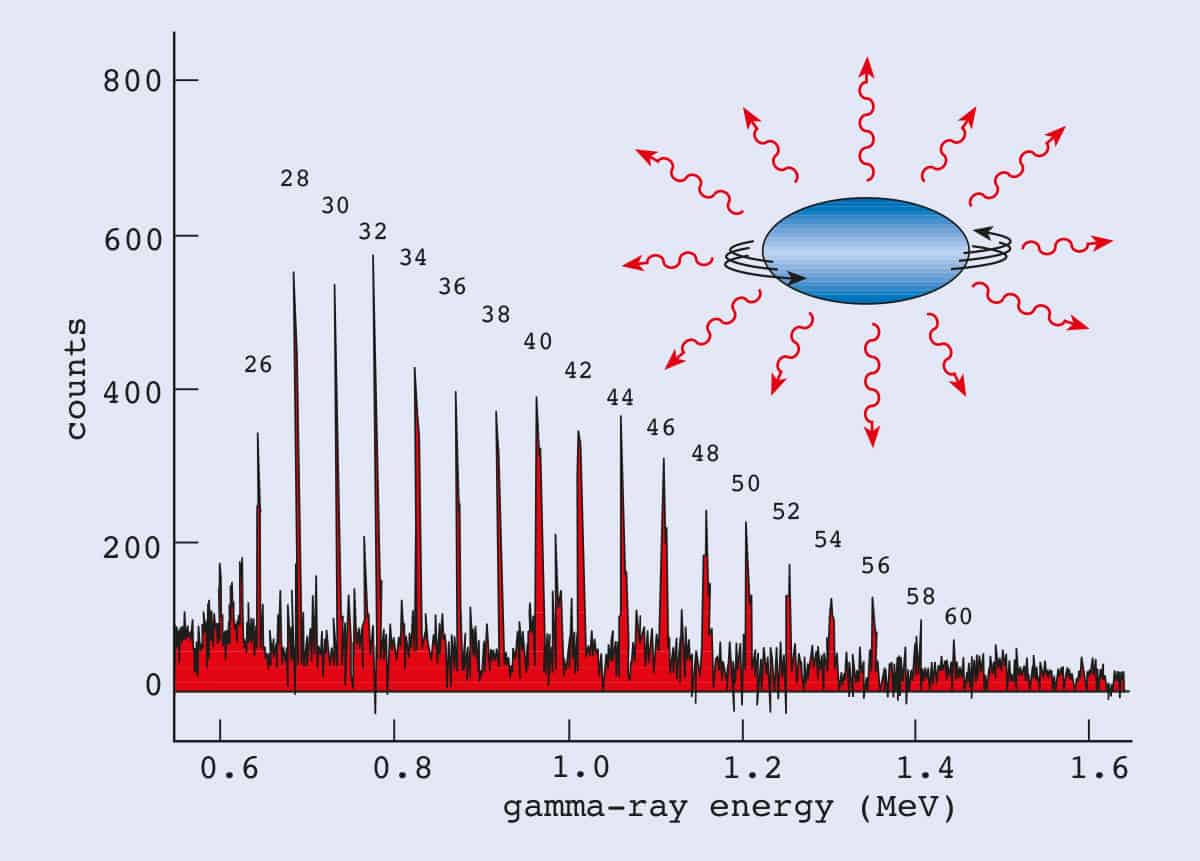
To populate the high angular momentum states in a nucleus, such as the superdeformed states, a thin metal foil is bombarded by high-energy ions (figure 1). When a nucleus in the beam strikes a nucleus in the target foil, they can fuse together to create a “hot” compound nucleus. At first the nucleus loses energy by emitting light particles, such as neutrons, protons or alpha particles. Then, when its energy falls below the energy binding the particles together, it cools further by radiating gamma-rays. Since the energy levels of the deformed nucleus are regularly spaced, the gamma-rays form a characteristic “band” or “picket fence” spectrum (figure 2). Only about 1% of the nuclei formed in these collisions go through a superdeformed stage.
The nucleus is thought to maintain its extreme shape as it loses angular momentum and energy. After emitting approximately 10–20 gamma-rays the superdeformed nucleus, which is still highly excited, decays into states associated with a near-spherical shape that have about the same angular momentum but much less energy. The final decay process between these two shapes is still only partially understood.
A superdeformed nucleus emits electric quadrupole radiation – each photon carries an angular momentum of 2ħ and has a gamma-ray energy of ħω/2, where ħ is the Planck constant and ω is the rotational frequency of the nucleus. To think of this classically, imagine a metal rugby ball that is charged, spinning on its short axis. When either end of the ball is pointing towards an observer, the electromagnetic field is stronger than when a side of the ball faces the observer. Therefore, the field oscillates twice for every complete revolution of the rugby ball. A superdeformed nucleus spins incredibly quickly, about 1021 times per second, and by the time it has decayed to the ground state, which takes about 10-9 s, the nucleus will have completed more revolutions than the Earth has done since it was formed.
2 Spectrum of decay Superdeformed nuclei of dysprosium-152 decay by emitting a regular spectrum of gamma-rays. The number above each transition is the angular momentum quantum number, which decreases by two each time a photon is emitted. The photon carries 2ħ of angular momentum away from the nucleus, which slows down the rotation. After emitting approximately 20 such gamma-rays the nucleus abruptly loses its deformation. (Courtesy: CLRC Daresbury Laboratory, UK)
Patterns of gamma-rays from superdeformed nuclei were first identified in 1986 at the Daresbury Laboratory in the UK in a collaborative project headed by Peter Twin of Liverpool University. Since then, powerful new spectrometers have been built to detect weak gamma-ray decay, including spectra from other examples of superdeformed nuclei. The latest generation of large detector arrays include “Euroball”, which has been built by a collaboration of 30 nuclear physics groups in Europe, and “Gammasphere” in the US. Euroball was designed to be moved to various nuclear physics facilities in Europe and is currently at the Legnaro National Laboratory in Italy. Gammasphere moved from the Lawrence Berkeley National Laboratory to the Argonne National Laboratory earlier this year.
Stability in the nucleus
3 Stability in the nucleus
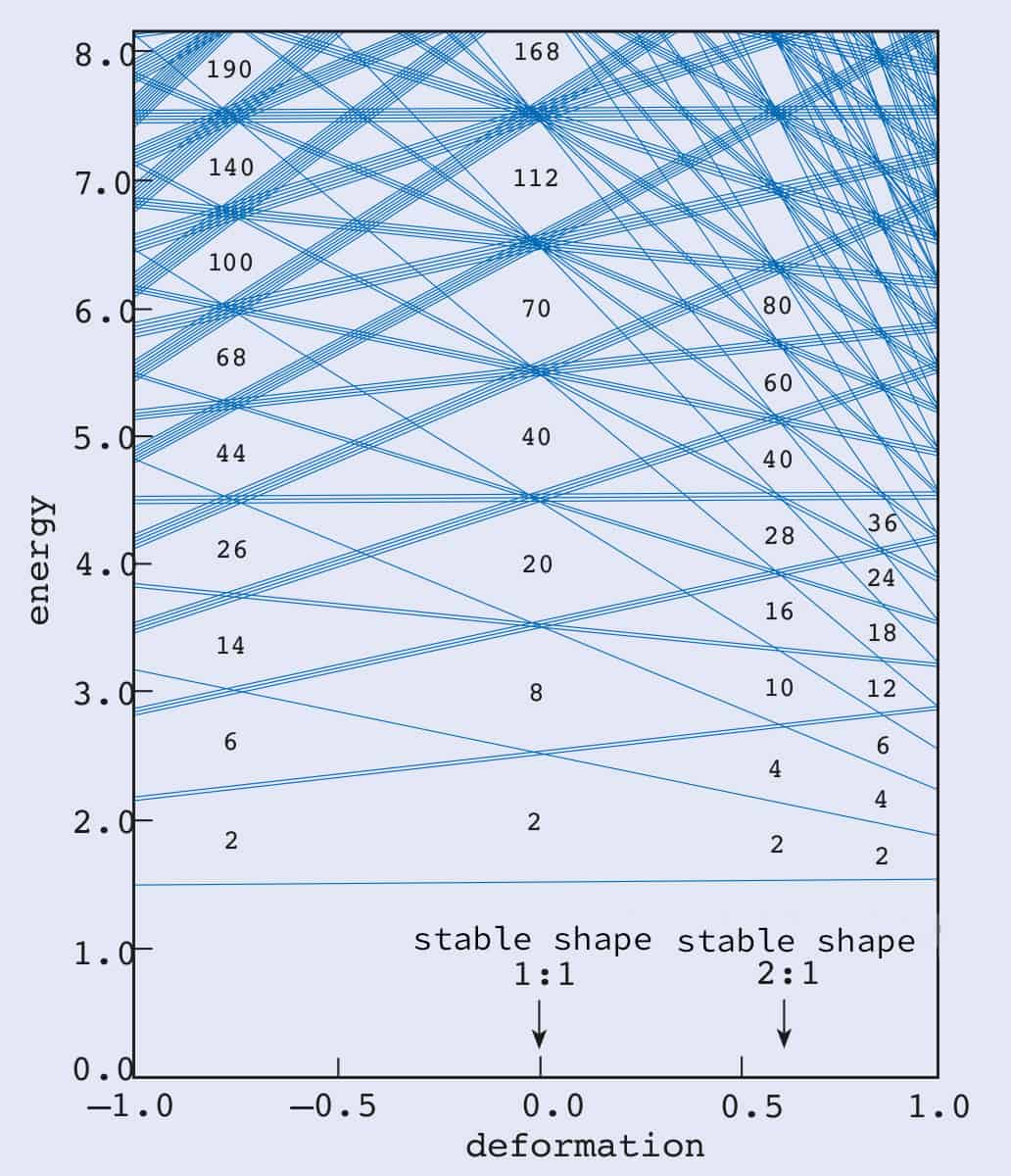
The nucleus is often considered to behave like a drop of liquid, because the protons and neutrons inside it tend to interact only with their nearest neighbours. However, this liquid-drop model ignores the quantum nature of the nucleus. Protons and neutrons move in well defined orbits inside the nucleus, as electrons do inside an atom, and the energy of these orbits depends on the shape of the nucleus.
Ingemar Ragnarsson at the University of Lund in Sweden produced this figure that shows the energy of the orbits (y axis) as a function of the shape of the nucleus. The figure was calculated using a simple harmonic oscillator potential to approximate the energy potential in the nucleus. More than one orbit can have the same energy, which is represented by lines that lie almost on top of each other. Each orbit can hold two nucleons, one spin up and one spin down.
In some parts of the energy diagram there are large gaps between energy levels, for example when the nucleus is spherical (1:1) or “superdeformed” (2:1). If neutrons and protons fill the orbits up to the bottom of such a gap then the configuration is more strongly bound and hence the shape is particularly stable. The numbers indicate how many nucleons can be accommodated by these stable configurations. The gaps persist when more realistic potentials are used in the model, although they then occur for different numbers of nucleons.
Rethinking the nucleus
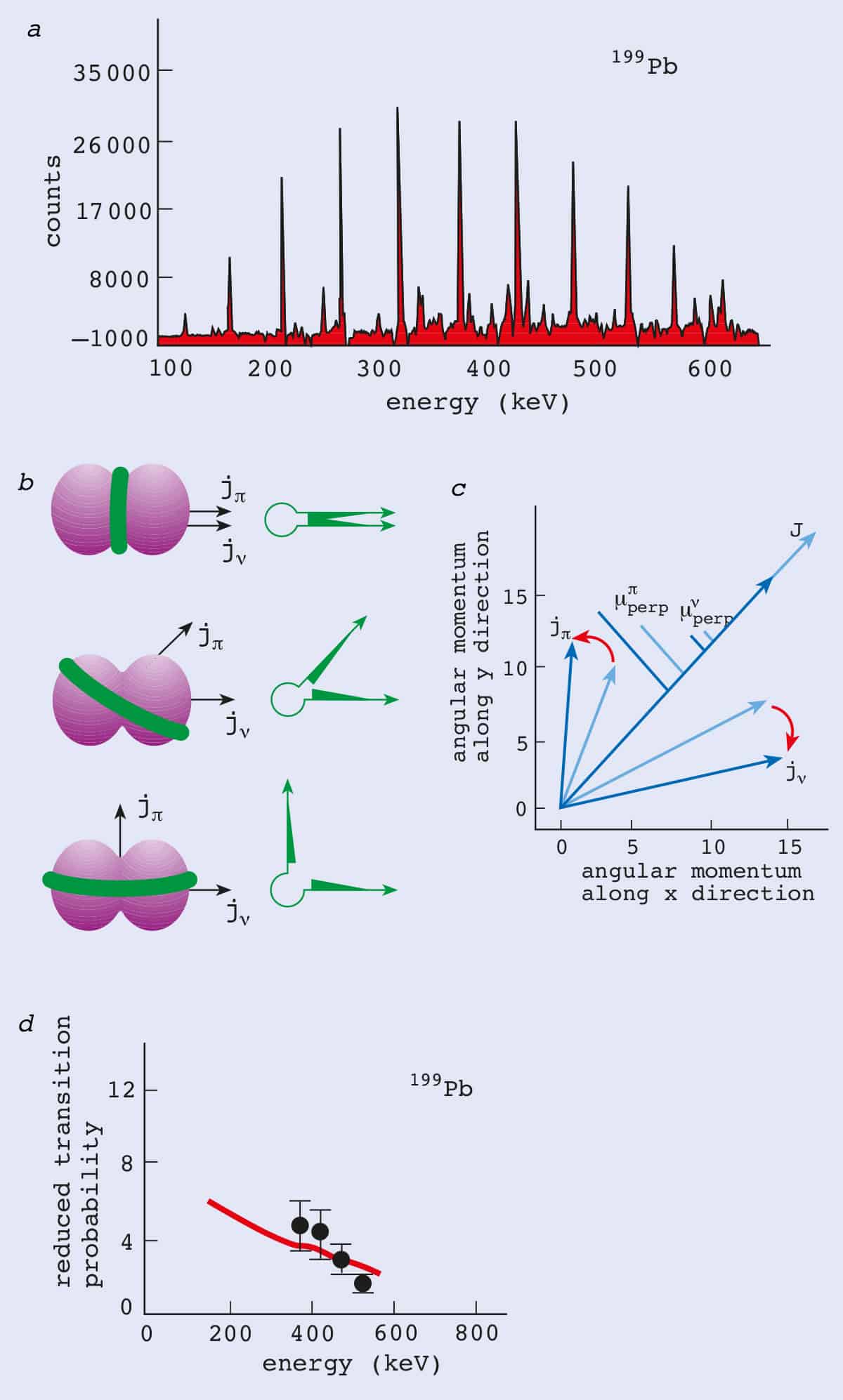
Until recently it was thought that near-spherical nuclei always emitted irregular patterns of gamma-rays. However, in the early 1990s very regular patterns of gamma-rays – and hence possible evidence for rotation – were detected from nuclei that were known to be almost perfect spheres. Working independently, teams from York University in the UK, the Lawrence Berkeley and Lawrence Livermore National Laboratories in the US, and Bonn University in Germany found such patterns in the gamma-ray spectra of lead nuclei with mass numbers of 198 and 199 (figure 4a). Similar examples have since been observed in isotopes of lead with mass numbers of between 191 and 202.
Detailed investigation yielded further surprises. The angular distribution and polarization of the gamma-rays showed that they were not electric quadrupole (E2) in nature but magnetic dipole (M1). Classically, M1 radiation is emitted from a rotating current loop, with the field oscillating at the same frequency as the frequency of rotation. Similar gamma-ray bands have recently been identified in cadmium, indium, tin and antimony nuclei in the mass region around 110, where the nuclei are also near-spherical. These spectra have a pattern that is typical of rotation, which poses an awkward problem: how can we explain these regular patterns of M1 gamma-rays?
4 Evidence for magnetic rotation (a) At first glance the gamma-ray spectrum measured for a M1 “shears” band in lead-199 looks similar to the picket-fence sequence observed in superdeformed dysprosium152 (figure 2). (b) The density distributions of the few protons (green) and neutrons (purple) that are responsible for the band are shown. These active protons and neutrons have angular momentum vectors jπ and jν, respectively. The protons and neutrons in the rest of the nucleus have a density distribution that is near-spherical. Nuclei are created in states with high energy and angular momentum, and decay into states with lower values. The top distribution, in which jπ and jν are parallel, has the highest energy. Each angular momentum vector has a magnetic moment, p., associated with it. (c) The total angular momentum, J = jπ and jν, decreases as jπ and jν move apart. At a high rotational frequency (lighter blue) there is a small angle between jπ and jν. This means that μperp, the component of μ that is perpendicular to J, is small. At low rotational frequencies (darker blue), this component gets larger as jπ and jν move apart. (d) Predictions of the reduced transition probability, which is related to μperp, are in good agreement with values measured in experiment. (Courtesy: P Fallon, LBNL, US)
In 1993 Stefan Frauendorf of the Centre for Nuclear and Hadron Research in Rossendorf, Germany, suggested that the patterns were due to a new mode of behaviour inside the nucleus. He proposed that most of the angular momentum of the nucleus could be generated by just a few of the protons and neutrons. In the case of lead-199, which has 82 protons and 117 neutrons, it is believed that most of the angular momentum comes from just two protons and three neutrons, with the remaining nucleons being passive observers. (Strictly speaking this angular momentum is carried by protons and “neutron holes”. A neutron hole is the absence of a neutron, similar to an electron hole in a semiconductor.) Since only a few protons and neutrons are involved, there must be a very large angular momentum associated with their orbits.
The coupling of such orbits is governed by the overlap of the wavefunctions that represent the distribution of nucleon density in the nucleus. The protons are thought to have a toroidal (doughnut-shaped) density distribution, whereas the neutron holes have a dumbbell-shaped distribution (figure 4b). Generally, the configuration with the lowest energy is the one where the wavefunctions have the greatest overlap. In lead-199 this occurs when the angular momentum vectors of the protons and neutrons are perpendicular to each other. The alignment of these vectors relative to each other, and of the total angular momentum relative to the magnetic moment of the nucleus, changes during the de-excitation process.
The nuclei are created in highly excited energy and angular momentum states. For a fixed proton and neutron combination, the total angular momentum is at a maximum when the two vectors point in the same direction. During de-excitation these vectors gradually move apart from each other, and hence away from the total angular momentum vector (figure 4c). The separation is gradual in the sense that the total angular momentum decreases in quanta of ħ. As the excess angular momentum and energy is carried away by gamma-rays, the nucleus approaches the minimum-energy configuration in which the two vectors are perpendicular and the overlap between the proton and neutron density wavefunctions is at a maximum. This process has been dubbed the “shears” mechanism because the motion of the proton and neutron angular momentum vectors resembles the opening of a pair of shears. As with superdeformed nuclei, only a small fraction of the nuclei (roughly 1–10%) are created in the shears mode.
A detailed theoretical treatment of the shears mechanism predicts that the “reduced transition probability” (which is inversely proportional to the lifetime of the states in the band) is proportional to the square of the component of the magnetic dipole moment of the nucleus, µ, that is perpendicular to the total angular momentum vector. This component of the dipole moment is small when the angle between the neutron and proton angular momentum vectors is small. As the two vectors open, however, this component becomes larger and the reduced transition probability increases as the total angular momentum decreases. This prediction was recently confirmed by experiments using the Gammasphere array, putting the shears mechanism on a firm experimental footing (figure 4d).
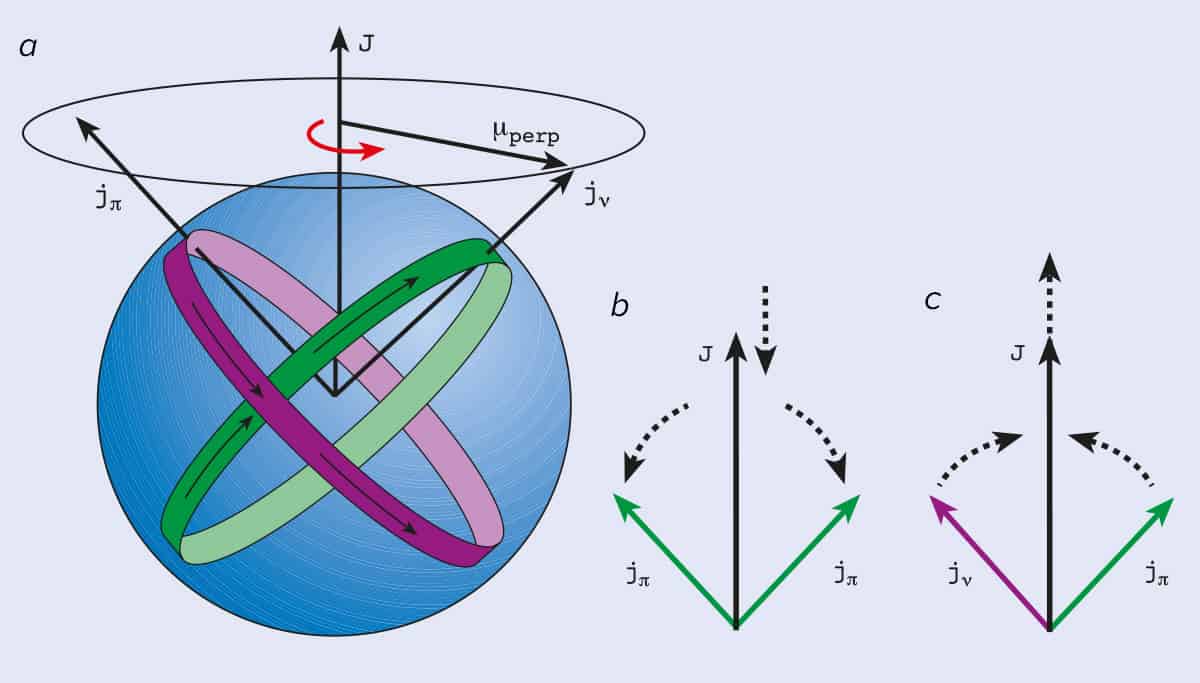
It is easy to see how the orientation of a deformed nucleus (or a dumbbell diatomic molecule) can be specified. But it is not so easy to define an orientation for a nucleus displaying shears behaviour, for which the overall shape is near-spherical. To get a picture of the nucleus, consider the orbits of the few active protons and neutrons involved. Their configuration can be thought of as an anisotropic arrangement of crossed “current” loops embedded in the spherical mass distribution of the nucleus (figure 5a). (Neutrons possess an intrinsic magnetic moment even though they have no overall charge.) An orientation is defined along the total angular momentum vector, J , and the system can rotate about this axis.
5 Current loops in the nucleus (a) The few protons (green) and neutrons (purple) that take part in the shears mechanism form current loops embedded in the spherical mass distribution of the nucleus. These current loops allow us to define angular momentum vectors, jπ and jν, for the active protons and neutrons. The total angular momentum, J = jπ and jν, is along the axis about which the near-spherical nucleus can rotate. These angular momentum vectors have a magnetic moment associated with them. (b) “Antimagnetic” rotation occurs if both “blades” in the shears are protons (or neutrons). (c) Another exotic shears mode occurs when the blades close instead of open as the excitation energy in the nucleus decreases. (Courtesy: P Fallon, LBNL, US)
This behaviour has been termed “magnetic rotation” because the rotational sequences arise from the anisotropy of currents in the nucleus, which produce a magnetic moment. The more familiar rotation of deformed nuclei (and molecules) could be called “electric rotation” to reflect the fact that it results from an anisotropy in the charge distribution.
New modes of rotation
What might we expect from future studies of this new phenomenon? The highest priority is to find more examples of the shears mechanism, so that we can study it in a variety of nuclei. In widely separated mass regions the combination of protons and neutrons that form “blades” of the shears will differ. Moreover, the core of the nucleus could assume different shapes. For example, the cases observed in the lead isotopes involve nuclei with small oblate deformations, whereas the examples in the tin region involve slight proflate deformations. And we have yet to find a case of “pure” magnetic rotation in a perfectly spherical nucleus. Another intriguing question is how and when the transition from magnetic to electric rotation occurs?
More exotic versions of the shears mechanism have also been predicted. For instance, both blades of the shears could be formed from the same type of particle (i.e. two neutron blades or two proton blades). However, such a combination could give rise to a large magnetic dipole moment because the individual moments would be equal and opposite (figure 5b). A regular pattern of energy levels would still be formed from the opening shears, but the decay would now occur by weak electric quadrupole transitions. This has been termed “antimagnetic” rotation in analogy with antiferromagnetism.
Another possible shears mode could occur if the blades close with decreasing excitation energy rather than open (figure 5c). There is no physical reason to exclude this possibility, although it would be energetically unfavourable because the angular momentum would increase as the excitation energy decreased. Again the result would be a regular pattern of energy levels. Researchers are currently devising experiments that could reveal these curious modes of behaviour.
The study of rotational motion in nuclear science and other branches of physics is currently an intensely active area of research. For example, rotational-like behaviour has even been observed in the excitation spectra of some families of elementary particles, which offers clues about the behaviour of the constituent quarks. Whatever is found in future studies, one thing is clear – the study of the rotational behaviour of quantum systems will continue to turn up surprises.
Neutrinos were first detected in 1956 by Fred Reines of the University of California at Irvine and the late George Cowan. They showed that a nucleus undergoing beta decay emits a neutrino with the electron, a discovery that was recognized with the 1995 Nobel Prize for Physics. Ever since the discovery, physicists have wanted to know whether neutrinos have mass.
Direct attempts to determine the mass of the neutrino have been based on the conservation of energy and momentum in, for example, the beta decay of tritium. But results have only provided upper limits on the mass. The new evidence instead depends on a fascinating quantum mechanical process known as neutrino oscillations.
To explain this we first need to know that neutrinos are elementary particles from the family of leptons. All leptons have a spin of 1/2, but some (like the electron) are charged, while neutrinos have no charge. Three types of neutrinos exist, and are distinguished by the way in which they interact. The neutrino emitted in beta decay is now called the electron neutrino, and the others are the muon and tau neutrinos.
The muon neutrino is emitted along with the muon – a charged lepton like the electron but 200 times heavier – in the decay of the pion. The muon neutrino was first detected by Leon Lederman, Jack Steinberger and Mel Schwartz at the Brookhaven National Laboratory in 1962, a discovery for which they shared the Nobel prize in 1988. The tau neutrino has never been detected directly but is known to be emitted in the decay of the tau, the heaviest lepton.
A neutrino oscillation means that one type of neutrino gradually transforms into another as it moves. Indications of such oscillations have been reported before, but the new work provides the first convincing proof of their existence.
The collaboration of 120 US and Japanese scientists measured neutrinos produced in the atmosphere by cosmic rays. SuperKamiokande, a Cerenkov detector containing 50 000 tonnes of ultrapure water and located a kilometre below ground in the Kamioka mine near Takayama, can detect electron and muon neutrinos but not tau neutrinos.
Neutrinos can enter the detector from either above or below – neutrinos from above travel a relatively short distance through the atmosphere, whereas neutrinos from below travel much further through the Earth. Since the cosmic-ray flux is known to be the same from both directions (except for a small geomagnetic effect), and since neutrinos interact so weakly that they penetrate the Earth, it was expected that the same number of neutrinos would enter the detector from both directions. But the SuperKamiokande team found that the number of muon neutrinos entering the detector from below was half the number coming from above. The electron neutrinos, however, were unaffected.
The only explanation for this finding is that muon neutrinos had oscillated into tau neutrinos, which cannot be detected by SuperKamiokande. The distance required for one oscillation must be between 100 and 10 000 km, which means that neutrinos travelling through only the atmosphere would not experience significant oscillations, while neutrinos also travelling through the Earth have a large probability for oscillation.
If neutrinos do have mass, it might be expected that each type of neutrino should have a different mass and a different mass eigenstate. However, nearly all theories of neutrino mass predict that the three types of neutrinos are well defined mixtures of several mass eigenstates. As time passes or the neutrino moves, the relative phases of the different components in this mixture change. Consequently, a state that is originally, say, muon-type, gradually transforms into another type of neutrino. Neutrino oscillations therefore result from the mass of the neutrino.
This quantum mechanical argument is similar to that for an electron orientated at an angle to a magnetic field. In this case the electron is in a mixture of spin-up and spin-down eigenstates, and it precesses around the magnetic field. For the neutrinos, the length of oscillation (analogous to the precession time) depends on the mass difference between the eigenstates. The SuperKamiokande result suggests that both the muon and tau neutrinos are made up of approximately equal mixtures of two mass eigenstates. The mass difference between these eigenstates is such that the squares of the masses differ by 10-2-10-3 (eV)2.
The discovery of neutrino mass is significant for several reasons. For example, the pioneering work of Raymond Davis of the University of Pennsylvania since the 1960s has prompted many experiments to measure neutrinos produced in nuclear reactions in the Sun. These experiments have consistently yielded a neutrino flux less than half that calculated from solar models. It has been thought for some time that the only simple explanation for this anomaly was in terms of neutrino oscillations that convert electron-type neutrinos to another type.
To relate this to the atmospheric result, there must be a third mass eigenstate, very close to one of the other two, that is a mixture of the electron neutrino with the muon and tau neutrinos. The mass difference needed to explain the solar neutrinos is much smaller than that needed to account for the atmospheric result. These three mass eigenstates can explain the “disappearance” of both solar and atmospheric neutrinos, but they are not directly related.
The SuperKamiokande result could also be important for big bang theory, which predicts that the universe contains a large background of neutrinos. If the neutrino mass was 1 eV, this would suggest that neutrinos account for more mass in the universe than all of the protons and neutrons put together. Neutrinos would therefore represent a significant amount of “dark matter”, mass that we cannot see but is predicted to exist by cosmological models. The simplest interpretation of the solar and atmospheric results is that the heaviest neutrino has a mass of 0.1 eV. However, neutrino oscillations depend only on the differences in mass, so it is possible that all three masses are 1 eV or greater but that the mass differences are much smaller. Thus it is not clear how this new evidence relates to the dark matter problem.
But the biggest prize may be the impact the result could have on the development of grand unified theories, which attempt to explain the weak, electromagnetic and strong interactions in terms of a single interaction. A key component of these theories is the symmetry between quarks and leptons. Indeed, there are fundamental similarities between these particles. For a start, both quarks and leptons have a spin of 1/2 and experience the same weak interactions. Furthermore, both types of particle have three families or generations. The first generation of quarks comprises the up and down quarks, the constituents of protons and neutrons. The second generation consists of the strange and charm quarks and is 10-100 times heavier, while the third and heaviest generation comprises the bottom quark and the recently discovered top quark. Similarly the three families of leptons are the electron, muon and tau, and their associated neutrinos.
In certain grand unified theories this underlying symmetry becomes exact at some high-energy scale. These models often assume that neutrinos acquire mass in the same way as other particles do. A very interesting possibility – postulated in 1977 by Murray Gell-Mann, Pierre Ramond and Dick Slansky – is that the neutrino masses are inversely proportional to the high-energy scale at which the quark-lepton symmetry is broken. If this so-called “see-saw” mechanism is true, this measurement of the neutrino mass may be the first window into new physics at energies far beyond those accessible with particle accelerators.