Taking a light hearted tone during the proceedings – with frequent references to popular culture – Hawking said: “I don’t believe science fiction like Star Trek, where people are essentially the same 400 years in the future.”
Hawking said that new technology – such as artificial intelligence – would not be the only change over the next 1000 years. Human beings, said Hawking, were also likely to evolve, either due to environmental factors or genetic engineering.
His lecture touched on topics as diverse as subatomic physics and the mathematical probability that the Chicago Cubs would win the world series in baseball.
After the talk, questions were opened up to a world-wide audience via the Internet. Even astronaut Andrew Thomas, currently orbiting in the Mir space station, appeared briefly. The final question – posed by Al Gore – asked Hawking his viewpoint on an antigravity effect causing the universe’s expansion rate to increase. Hawking took a cautious position and said such an effect must be very small if the current observations are to believed.
The observing time of the original six partners – the US, the UK, Canada, Chile, Argentina and Brazil – will be slightly reduced, but this loss will be offset by “enhanced scientific productivity” made possible by Australia’s contribution, according to Gemini director, Matt Mountain. Australia will give A$13.5 m (about $9.2 m) to the project over the next five years, boosting Gemini’s total funds to $193.2 million.
The Gemini telescopes will give high-quality simultaneous coverage of the northern and southern skies at infrared and optical wavelengths. The extra finance from Australia will be used for technical enhancements, including new infrared sensors that will increase the available observing time. The telescopes are due to begin operation by August 2001.
Australia had hoped to take over a 5% share in the Gemini partnership when Chile was threatened with expulsion after failing to pay its subscription. When Chile found the funds, the Australian Research Council launched a campaign to expand the Gemini membership. The campaign was backed by the UK.
Participation in Gemini will compensate Australia’s large astronomy community for the disappointment it suffered when plans to join the European Southern Observatory were scuppered in March 1996. Access will allow Australian astronomers to “greatly extend our current measurements of how much matter there is in the universe and to study very young galaxies, ” says Jeremy Mould, director of the Mount Stromlo and Siding Spring Observatories of the Australian National University.
Following the deal, the US now has a 47.6% share in Gemini, the UK 23.8%, Canada 14.3%, Australia and Chile 4.8% each, and Argentina and Brazil 2.4% each.
Rumours that Lunar Prospector – NASA’s first lunar mission in twenty five years – had confirmed the existence of water ice had captivated the space science community since the beginning of February.
Lunar Prospector was not originally designed to search for water on the Moon. Four years ago, however, a radar experiment on the Clementine spacecraft recorded an echo that was consistent with the presence of water ice. Lunar Prospector was quickly modified to include experiments to search for water.
Researchers working on the project have now publicly stated that a neutron spectrometer on the craft has discovered between 10 and 300 million metric tons of water at the location suggested by Clementine. Scientists are naturally excited at the results. Sarah Dunkin, a researcher working on the Clementine data at University College London, says: “It will herald one of the most important and exciting discoveries since the days of Apollo.”
The findings were presented today at press conference at Ames Research Center, California, and have renewed interest in astronauts returning to Moon. The presence of water would make a moonbase feasible and practicable for the first time. It would also dramatically reduce the costs of supplying outposts such as the International Space Station or manned trips to Mars.
One of the harder questions to answer will be: how did the water get there? Most scientists believe that the only possible explanation is cometary bombardment. Previously it was thought that any ice left on the surface would have been vaporised on impact. According to Dave Heather, also of UCL: ” Now that its presence has been confirmed, refinements can be made to models of cometary impact and solar system evolution, enhancing our knowledge in these fields.”
The discovery also raises the interesting question of who owns the water. In 1979 five nations signed a Moon Treaty stating that the Moon is a common heritage for all mankind and its resources cannot be claimed by any one nation. However, the US did not sign the agreement.
The figures are from the French Science and Technology Observatory. “The connection between research and innovation is really bad, ” says Rémi Barré, director of the observatory, which monitors scientific activity in France.
The government’s spending on R&D is about FFr 180 bn (about £1.8 bn) each year – 2.4% of the country’s gross national product. Industrial R&D has remained at a constant level since 1990, despite a reduction in government spending on military R&D. However the number of European patents registered by French researchers has fallen by 18% over this period. The electronics industry has seen the largest drop, despite its strong R&D activities.
In academia, French physics scores highly in relation to other disciplines, producing more than 17% of all European publications and more than 5% of publications worldwide (see ). However the growth of physics “productivity” – a measure of the impact of publications – is slowing. “Physics is not the field where we have made the most investments over the last few years, ” says Barré. Moreover he believes that the reduction in funding for large facilities is likely to have an impact in the medium-term.
The observatory’s 1998 report also analyses the number of papers per region in France, Germany and the UK. France has only two regions in the European top twenty – Paris and Essone – whereas Germany and the UK each have five. The situation in France is improving, however, “because French scientists are publishing in a wider range of journals, ” says Barré.
The “Delphi 98” report contains the views of more than 2000 experts from industry, research and education, who were asked to predict what they thought would be the most important developments over the next 30 years. They concluded that Germany leads the world in the environmental, energy, construction and transport sectors, and lies a close second behind the US in chemistry, production, biomedicine and space travel.
The report predicts that new workplace practices, an increasing use of multimedia and a trend towards life-long learning will be the key drivers of change in the first decade of the next century. It says that in the second decade, the need to protect the environment and cut greenhouse gas emissions will lead to the development of a host of new technologies. It also predicts that by 2015 more than 10% of electricity will be generated from renewable sources – a twentyfold increase on present levels.
The government plans to use the report to drive policy in the medium and long term.
Particle physics is a truly global activity, with literally hundreds of university departments around the world specializing in the subject. The basic tools of particle physics are a small number of powerful accelerators, which have led researchers over the last decade to develop what is known as the “Standard Model” of particle physics. The model describes essentially all of the subatomic phenomena that have been observed so far.
However, there are compelling reasons for believing that new phenomena, which would provide the key to a much deeper understanding of the nature of matter, lie just beyond the energy range of existing facilities. The problem is that measuring particle behaviour at these higher energies requires increasingly complex apparatus. For example, the 14 TeV Large Hadron Collider (LHC) at CERN in Geneva, which is due to come on line in 2005, has attracted the interest of some 4000 scientists in 45 countries.
High-energy physicists are therefore under pressure to spend time in the laboratory where their experiment will be carried out. They may need to be away for short spells to attend design meetings or to test or install equipment, and occasionally for longer periods to operate an experiment or to analyse results. Such absences, if too prolonged or too frequent, can eventually hinder their full participation at their own universities. They quite simply need to be in two places at the same time.
To help to resolve this conflict, particle physicists have always used electronic communication (see ). Starting with the ability to log on remotely and transfer files to and from their home university, data networking for particle physics has become more sophisticated over the past 15 years. It was no accident that in 1989 the World Wide Web was invented at CERN so that experimental teams could organize the vast amount of information to which they needed access. Modern experiments now routinely use the Internet to distribute physics analysis software, calibration data and the results of particularly interesting particle collisions. Even weekly meetings of small teams working on a common project are increasingly taking place via the Internet.
Communication breakdown
Unfortunately the reality of the Internet today is that its performance on a given route – for example, between a physics institute in one country and an accelerator centre in another – can be highly variable (see ). The performance often varies strongly according to the time of day, and is often acceptable only when both the source and the destination sites are out of normal working hours. Sometimes it is even impossible to use the Internet when many people at both ends are working. Also, because traffic on the Internet is growing at a rate of about 10% per month, performance can vary greatly over the course of a few months. Links and switches that are well configured at Christmas can be fatally congested by the following summer.
So although there are many routes that perform acceptably during much of the day, there are some that are quite simply inadequate for today’s particle physicists. However, particle physicists know that they should be using the Internet more intensely. First, there is a major latent demand for more and better collaboration between small groups of researchers (say up to 10 people) who are working together on individual aspects of an experiment. This demand has not yet been fulfilled because the tools that are needed to collaborate in this way are only just becoming available.
The other reason why high-energy physicists need to use the Internet more than ever before is the continuing growth in the volume of data recorded by particle physics experiments. For example, the LHC will generate about a thousand times as much data as its predecessor, the large electron-positron collider, which began operating in 1989.
Cost factors
Apart from congestion on the Internet there is also the problem of cost. Although a few labs pay directly to optimize specific aspects of their Internet connections, most Internet services tend to be provided by national academic and research networks, which serve a much wider field than just particle physics. There is not much direct recharging for such services – which are normally funded by some combination of the research and education ministries and the national network organization – and research labs spend little of their own budget directly for networking.
Another problem is that the cost of using the Internet varies greatly around the world. A 1994 report by Coopers and Lybrand for the European Commission showed that the prices for high-capacity international leased circuits, which form the basis of Internet connectivity, were almost eight times as high in Europe as in the US. While it is always possible to imagine that various efficiency issues could explain a factor of two in the range of costs, the factor of eight – which in my experience has been valid for much of the past 15 years – indicates that current European prices for Internet services are at an artificially high level because of a lack of competition in the market. This environment is now changing profoundly following European deregulation on 1 January 1998.
Whenever I have tried to understand the economics of providing telecoms infrastructure, I have come to the conclusion that it must be an extremely profitable business. The pricing of Internet services obviously depends largely on the pricing of the underlying leased circuits. So when will we see effective competition to supply such circuits on an international basis inside Europe and around the world? The recent arrival of private investors (as opposed to the traditional consortia of telecoms suppliers) in the transatlantic cable market is one sign that things are starting to change. Meanwhile, in land-based communications, the arrival of competitors such as Worldcom could stimulate some of the other US and European telecoms vendors to provide access to their own pan-European infrastructures. If this happens, prices might fall quite quickly and still leave suppliers with very respectable profit margins.
I believe that technological progress and increased competition should now quickly and strongly reduce the price and increase the quality of high-performance Internet services. However, there is no simple way to predict just when, in the next five years, the arrival of effective competition will really trigger this process, especially in Europe. We will just have to wait and see.
Should particle physics go it alone?
One body that is attempting to tackle these problems is the International Committee for Future Accelerators (ICFA), which consists of about 20 senior academics and particle physicists. The committee recently created a new networking task-force to look at how particle physicists can get more out of the Internet, and several working groups are already active. One is trying to follow the performance of all of the many routes that we need to use on a regular and uniform basis. Another is making an inventory of the networks on which particle physics depends – particularly in developed countries – while a third group is doing the same exercise in remote regions. Later this year the task-force will recommend to ICFA how the networking of the next generation of particle physics experiments could be improved.
Some people are concerned that the ICFA initiative might lead to the particle physics community deciding to do its own thing and to no longer depend on the general-purpose academic and research Internet. If this were to happen, runs the argument, particle physics would be seen to be responsible for destroying the consensus among the academic and research communities, which has driven much of the progress in international networking over the past few years. This concern is especially acute in Europe, where the introduction of the trans-European TEN-34 network last year, which has a capacity of 34 Mbit s-1, means that the Continent has, for the first time, international academic and research network services that compete favourably with those elsewhere in the world.
I feel strongly that this fear is based on a false dilemma. Any research community needs to be able to measure the performance of its networking on a uniform and ongoing basis, as ICFA is doing. It should also be responsible for understanding how much it is being charged for networking, both directly and indirectly, and should make sure that its members understand those costs and use networking facilities responsibly. It is only right for communities continually to try to understand whether and how they could obtain the same or better networking services at lower costs.
The success of particle physics depends strongly on networking, so we must be well informed about how this field will evolve during the period of rapid change that will come. However, we should not forget that most of our community is based in universities throughout the world, and it seems inconceivable to me that any viable long-term strategy that ICFA might decide on this year could be in any sense “independent” of what is done by the national academic and research networks. Of course, no-one expects networks to look the same in 10 years’ time as they do today, and the particle physics community may still need to invest directly in certain places where it has special needs, but we are truly part of the university community and share its needs, aspirations and concerns.
Perhaps most important is that, if we look at how major industries have managed to achieve the lowest pricing for telecoms services (albeit often for traditional telecoms activities rather than for Internet services), it has been by forming large diverse consortia that then make large competitive purchases on an international basis. There seems to be an important lesson here, which I think both particle physics and all of the academic and research community should heed.
Last month, as expected, the four partners in the International Thermonuclear Experimental Reactor (ITER) project announced a three-year extension of the ITER engineering design activity. Detailed design work on the next-generation fusion-energy device started in 1992 and has cost about $1 bn so far. A decision to build the device, once scheduled to be taken this year, will now be made in 2001 at the earliest. The ITER council said that the extension would “provide the framework for undertaking jointly site(s)-specific and other activities with the aim of enabling future decision on construction and operation of ITER”. What the project is really doing is buying time as it tries to find a cheaper option that the partners will find acceptable. The US is keen to cut the project’s cost by two-thirds.
ITER is a joint effort by the European Union, Japan, Russia and the US to develop a giant tokamak that would use magnetic fields to confine a burning plasma of deuterium and tritium. Current tokamaks are approaching “breakeven” – the point at which the fusion reactions in the plasma release as much energy as is used to heat and maintain the plasma. ITER is geared towards reaching the next stage: the ignition of a burning plasma. Ignition requires the fusion reactions to release about five times the energy needed to maintain the plasma. The role of ITER is to ensure that all of the physics and technology issues associated with a burning plasma are understood, and the ITER council is confident that the four partners have designed a reactor capable of this. The problem is money.
The decision has disappointed fusion enthusiasts in Europe, but was inevitable given the circumstances of the other three partners. It has long been known that Russia has little to contribute to ITER besides brain power, while Japan, enthusiastic in the past, has recently encountered economic problems. The US, meanwhile, has become increasingly opposed to ITER in its current form for a variety of political and technical reasons. These have ensured that the US fusion budget continues to remain below the levels recommended by a series of high-level review panels. (Europe spends about twice as much on fusion as the US, and Japan three times as much.) American politicians are reluctant to fund a facility that will be built overseas, while the inertial-confinement lobby in the powerful weapons labs argues that it is too early to commit to the magnetic-confinement route to fusion. In inertial-confinement fusion – which is currently funded for defence rather than energy reasons – laser or ion beams are used to heat and confine the plasma.
Although the US has undoubtedly undermined ITER, the project’s leaders could learn from recent events there. It is widely accepted that plans to increase the US science budget are due, at least in part, to a united lobbying effort by more than 100 societies representing scientists and engineers. ITER’s profile, on the other hand, has been remarkably low for a project that hoped to spend anything between $6.3 bn and $11.4 bn of taxpayers’ money. ITER must start by convincing the fusion community, and then the wider science and engineering community, of its merits if it is to stand any chance with politicians and the public. The fact that fusion (and fission) hardly feature in the current debates about global warming and climate change is a sign that a lot of work remains to be done.
How bad is a three-year delay? It is certainly bad news for the physicists and engineers working on the project, although it could well provide a reason to keep existing fusion experiments running. However, it is important to realize that ITER was meant to be followed by a demonstration reactor capable of generating electricity and then, about 50 years from now, a commercial fusion power plant. There can be no doubt that new sources of energy will be needed by then. Whether three years is long enough for the ITER partners to convince the world that it really will lead to, in the words of the ITER council, “a virtually limitless, environmentally attractive and economically competitive source of energy”, remains to be seen.
The results show that the limited quality of conventional X-ray images can be dramatically improved by exploiting synchrotron light (D Chapman et al. 1997 Phys. Med. Biol. 42 2015). Moreover, there is no need for a high radiation dose.
Ineffective radiology has a big impact on society. Relatively high X-ray doses can overcome the limitations of conventional techniques, but they act as a deterrent for the mass screening of killer diseases like breast cancer. This is regrettable, since screening allows early detection and, in most cases, very successful therapy.
What is wrong with conventional radiology? Several things: contrast is mainly based on differences in X-ray absorption in different parts of the specimen, and these are often weak; contrast and resolution are also reduced by scattered X-rays; and finally, and more fundamentally, differences in X-ray refraction that could improve contrast are not exploited.
Now Bill Thomlinson of the Brookhaven National Laboratory and co-workers from the US, Germany and Italy have used the National Synchrotron Light Source (NSLS) at Brookhaven to develop a new approach – diffraction-enhanced imaging – that uses a highly monochromatic and collimated X-ray beam to remove some of these limitations. A double-crystal monochromator is used to filter the incident beam via Bragg scattering, and a third high-quality crystal is placed between the object being imaged and the detector to filter out X-rays that have been scattered and are therefore not travelling in the right direction. This “Bragg analyser” would, on its own, improve the image quality, but the NSLS approach goes beyond this simple improvement and ingeniously exploits X-ray refraction to produce even better images.
Refraction by the specimen slightly changes the X-ray direction. However, the refracted X-rays are not rejected by the Bragg analyser because it has a finite angular acceptance. Rather, the angular response or “rocking curve” of the analyser creates contrast between regions of the sample with different refractive indices. The rocking curve is a bell-shaped plot of transmission against angle of incidence and has a maximum at an angle defined by the X-ray wavelength and the lattice spacing in the crystal.
In an unprocessed image, conventional absorption-contrast effects are mixed with the contrast due to refraction. Image processing can, however, separate these effects. To do this, two different images are taken when the Bragg analyser is rotated to the two points of maximum slope on the rocking curve: simple algorithms are then applied pixel-by-pixel to the images. A pair of raw images can thus yield two processed radiographs of superior quality, each based on a different contrast factor. The enhancement is quite spectacular (see right image).
The contrast in one of the processed images is due to absorption, or more precisely “apparent absorption”, a combination of absorption and the intensity loss caused by diffraction as the beam passes through the specimen. The exploitation of this intensity loss, known as extinction, can significantly increase the information obtained from the radiograph.
The other image-processed radiograph – the refraction-contrast image – shows the boundaries between regions with different refractive indices particularly clearly. The processing creates a pseudo-shadowing at the boundaries and an intriguing three-dimensional appearance. The two processed radiographs provide complementary information, mutually enhancing their effectiveness.
Diffraction-enhanced imaging is not the only way to produce superior radiographs with synchrotron light. A novel technique called “phase-contrast imaging” has been developed at the European Synchrotron Radiation Facility in Grenoble, France (A Snigirev et al. 1996 Nucl. Instrum. Meth. A370 634). This approach was recently implemented on the ELETTRA synchrotron at Trieste in Italy by Edoardo Castelli, Ludovico Dalla Palma, Giuliana Tromba and collaborators at a radiation dose compatible with medical radiology (see left image). Compared with a conventional radiograph, a phase-contrast image exhibits very sharp and highly visible boundaries. This can simplify the early detection of microstructures in cancer screening, defect analysis in technological components and many other applications.
There is still some uncertainty about what causes the contrast enhancement, but many authors agree that the temporal and spatial coherence of the X-ray beam are the key factors. Specifically, it is thought that diffraction at the edge between regions with different refractive indices produces sharp diffraction fringes that highlight the boundaries. However, in addition to a coherent X-ray beam, this mechanism also requires a detector with sufficient spatial resolution to reveal the fringes.
Temporal coherence of the X-ray beam can be achieved by brute force, by simply making the beam monochromatic. In fact, virtually any monochromator can provide the necessary temporal coherence. Lateral or spatial coherence is both a novel and exciting factor in X-ray science, and has been made possible by the new synchrotron sources. Indeed, the same geometric characteristics that lead to high brightness – small source size and small angular divergence – also lead to spatial coherence. The source sizes (which are related to the lateral dimensions of the electron beam producing the synchrotron radiation) that are found in most of the new synchrotron sources are much less than 100-200 µm, which leads to adequate spatial coherence for phase-contrast imaging.
The coherence-based explanation and even the term “phase contrast” are questioned by some authors. For practical applications, however, a full explanation of the contrast mechanism is largely irrelevant: Röntgen took radiographs of his wife’s hands without knowing anything about atomic structure or X-ray absorption! What really matters is that a significant increase in contrast can be achieved with synchrotron light, and this has been solidly demonstrated in experiments.
Can synchrotron sources actually be used for routine medical radiology? The barriers are more psychological than real, even from the financial point of view: special synchrotron facilities entirely dedicated to medical facilities are certainly conceivable. Indeed, similar doubts were probably raised one century ago about Röntgen’s apparatus. One can hope, therefore, that in the future, radiology will not be based on a high dose of radiation, but on a high dose of creativity.
Ever since its invention in the 1920s, quantum physics has given rise to countless discussions about its meaning and about how to interpret the theory correctly. These discussions focus on issues like the Einstein-Podolsky-Rosen paradox, quantum non-locality and the role of measurement in quantum physics. In recent years, however, research into the very foundations of quantum mechanics has also led to a new field – quantum information technology. The use of quantum physics could revolutionize the way we communicate and process information.
The important new observation is that information is not independent of the physical laws used to store and processes it (see Landauer in further reading). Although modern computers rely on quantum mechanics to operate, the information itself is still encoded classically. A new approach is to treat information as a quantum concept and to ask what new insights can be gained by encoding this information in individual quantum systems. In other words, what happens when both the transmission and processing of information are governed by quantum laws?
The elementary quantity of information is the bit, which can take on one of two values – usually “0” and “1”. Therefore, any physical realization of a bit needs a system with two well defined states, for example a switch where off represents “0” and on represents “1”. A bit can also be represented by, for example, a certain voltage level in a logical circuit, a pit in a compact disc, a pulse of light in a glass fibre or the magnetization on a magnetic tape. In classical systems it is desirable to have the two states separated by a large energy barrier so that the value of the bit cannot change spontaneously.
Two-state systems are also used to encode information in quantum systems and it is traditional to call the two quantum states |0〉 and |1〉. The really novel feature of quantum information technology is that a quantum system can be in a superposition of different states. In a sense, the quantum bit can be in both the |0〉 state and the |1〉 state at the same time. This new feature has no parallel in classical information theory and in 1995 Ben Schuhmacher of Kenyon College in the US coined the word “qubit” to describe a quantum bit.
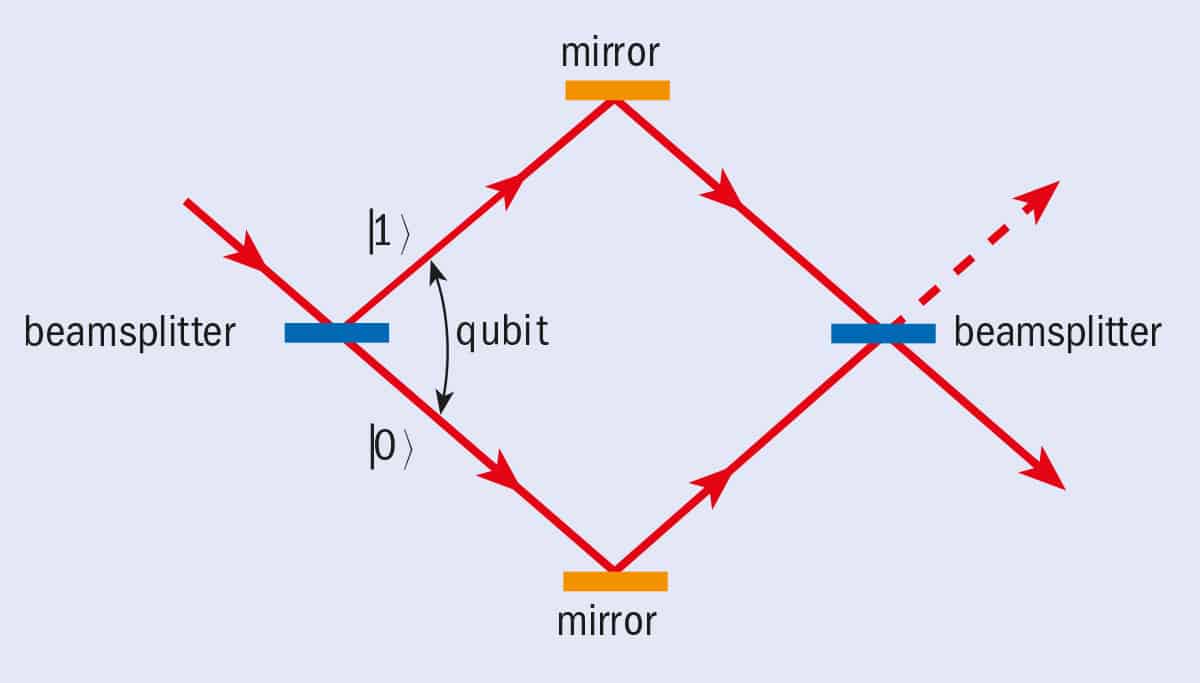
1 Single-particle quantum interference Interference fringes can be observed in a two-path interferometer if there is no way of knowing, not even in principle, which path the particle takes. In a Mach-Zehnder interferometer a quantum particle strikes a beam splitter and has a 50/50 chance of being transmitted or reflected. Mirrors reflect both paths so that they meet at a second 50/50 beam splitter, and the numbers of particles transmitted/reflected by this beam splitter are counted. If no information about the path is available, the particle is in a superposition of the upper and lower paths. To observe interference it is necessary to vary the length of one of the paths (e.g. with a variable wave plate) and count coincidences between the detectors as a function of this phase.
A well known example of quantum superposition is the double-slit experiment in which a beam of particles passes through a double slit and forms a wave-like interference pattern on a screen on the far side. The essential feature of quantum interference is that an interference pattern can be formed when there is only one particle in the apparatus at any one time. A necessary condition for quantum interference is that the experiment must be performed in such a way that there is no way of knowing, not even in principle, which of the two slits the particle passed through on its way to the screen.
Quantum interference can be explained by saying that the particle is in a superposition of the two experimental paths: |passage through the upper slit 〉 and |passage through the lower slit 〉. Similarly a quantum bit can be in a superposition of |0〉 and|1〉. Experiments in quantum information processing tend to use interferometers rather than double slits but the principle is the same (figure 1). So far single-particle quantum interference has been observed with photons, electrons, neutrons and atoms.
Beyond the bit
Any quantum mechanical system can be used as a qubit providing that it is possible to define one of its states as |0〉 and another as|1〉. From a practical point of view it is useful to have states that are clearly distinguishable. Furthermore, it is desirable to have states that have reasonably long lifetimes (on the scale of the experiment) so that the quantum information is not lost to the environment through decoherence. Photons, electrons, atoms, quantum dots and so on can all be used as qubits. It is also possible to use both internal states, such as the energy levels in an atom, and external states, such as the direction of propagation of a particle, as qubits.
The fact that quantum uncertainty comes into play in quantum information might seem to imply a loss of information. However, superposition is actually an asset, as can be seen when we consider systems of more than one qubit. What happens if we try to encode two bits of information onto two quantum particles? The straightforward approach would be to code one bit of information onto each qubit separately. This leads to four possibilities – |0〉1 |0〉2, |0〉1 |1〉2, |1〉1 |0〉2 and |1〉1 |1〉2 – where|0〉1 |1〉2 describes the situation where the first qubit has the value “0” and second qubit has the value “1”, and so on. This approach corresponds exactly to a classical coding scheme in which these four possibilities would represent “00”, “01”, “10” and “11”.
The Bell states and entanglement
There are four possible Bell states for a pair of two-state particles. The two states are |0〉 and |1〉, and the particles or “qubits” are labelled by the subscripts land 2. The four states are
|Ψ+〉 = (1/√2)(|0〉1|1〉2 + |1〉1|0〉2)
|Ψ–〉 = (1/√2)(|0〉1|1〉2 – |1〉1|0〉2)
|φ+〉 = (1/√2)(|0〉1|1〉2 + |1〉1|0〉2)
|φ–〉 = (1/√2)(|0〉1|1〉2 – |1〉1|0〉2)
Each Bell state represents a coherent superposition of two possibilities. In the top two states, |Ψ+〉 and |Ψ–〉, the two qubits are different and in the bottom two states, |φ+〉 and |φ–〉 they are the same. The key point is that the single-particle states are “entangled” in these superpositions. This means that the two-particle Bell states cannot be written as linear combinations of single-particle states.
In the state |Ψ+〉, for example, particle 1 can be in state |φ〉 and particle 2 in state |1〉, or vice versa, but there is no way of knowing which particle is in which state. All that is defined is the fact that the two qubits are different. This means that all of the information is distributed among two qubits, and that none of the individual systems carries any information. This is the essence of entanglement and is one of the novel and counterintuitive features of quantum mechanics.
Entanglement is closely linked to the issue of non-locality in quantum theory. In particular, if the two particles in an entangled state are widely separated, then a measurement on one will immediately influence the quantum state of the other one. It seems as if the particles are communicating faster than the speed of light, but special relativity is not violated because no information is exchanged. To achieve entanglement in the laboratory, experiments must be performed in such a way that it is impossible to find out, even in principle, which particle is in which state.
However, quantum mechanics offers a completely different way of encoding information onto two qubits. In principle it is possible to construct any superposition of the four states described above. A widely used choice of superpositions is the so-called Bell states. A key feature of these states is that they are “entangled” (see box “The Bell states and entanglement”). Entanglement describes correlations between quantum systems that are much stronger than any classical correlations.
As in classical coding, four different possibilities can be represented by the four Bell states, so the total amount of information that can be encoded onto the two qubits is still two bits. But now the information is encoded in such a way that neither of the two qubits carries any well defined information on its own: all of the information is encoded in their joint properties. Such entanglement is one of the really counterintuitive features of quantum mechanics and leads to most of the paradoxes and other mysteries of quantum mechanics (see box “Bell’s inequality and quantum non-locality”).
It is evident that if we wish to encode more bits onto quantum systems, we have to use more qubits. This results in entanglements in higher dimensions, for example the so-called Greenberger-Horne-Zeilinger (GHZ) states, which are entangled superpositions of three qubits (see further reading). In the state 1/2(|000〉 + |111〉), for instance, all three qubits are either “0” or “1” but none of the qubits has a well defined value on its own. Measurement of any one qubit will immediately result in the other two qubits attaining the same value.
Although it was shown that GHZ states lead to violent contradictions between a local realistic view of the world and quantum mechanics, it recently turned out that such states are significant in many quantum-information and quantum-computation schemes. For example, if we consider 000 and 111 to be the binary representations of “0” and “7”, respectively, the GHZ state simply represents the coherent superposition (1/√2)( |”0″〉 + |”7″〉). If a linear quantum computer has such a state as its input, it will process the superposition such that its output will be the superposition of the results for each input. This is what leads to the potentially massive parallelism of quantum computers.
It is evident that the basis chosen for encoding the quantum information, and the states chosen to represent |0〉 and |1〉, are both arbitrary. For example, let us assume that we have chosen polarization measured in a given direction as our basis, and that we have agreed to identify the horizontal polarization of a photon with “0” and its vertical polarization with “1”. However, we could equally well rotate the plane in which we measure the polarization by 45°. The states in this new “conjugate” basis, |0´〉 and |1´〉, are related to the previous states by a 45° rotation in Hilbert space
|0’〉= (1/√2)(|0〉+ |1〉)
|1’〉= (1/√2)(|0〉– |1〉)
This rotation is known in information science as a Hadamard transformation. When spin is used to encode information in an experiment we can change the basis by a simple polarization rotation; when the directions of propagation are used, a beam splitter will suffice. It is important to note that conjugate bases cannot be used at the same time in an experiment, although the possibility of switching between various bases during an experiment – most notably between conjugate bases – is the foundation of the single-photon method of quantum cryptography.
Bell's inequality and quantum non-locality
Entanglement is the source of many of the mysteries of quantum theory. Imagine that a source emits photons that are entangled in, say, a |Ψ+〉 state, and that one photon is sent to Alice and the other is sent to Bob. It is certain that whatever basis Alice chooses to measure the polarization of her photon, she will obtain “0” or “1”with equal probability, the actual results being completely random. Moreover, if Bob chooses the same linear basis, he will always obtain the same result. This means that Alice can predict with certainty what Bob’s result will be – even if they are widely separated and not in contact with each other.
This property of quantum mechanics has puzzled physicists for decades, starting with Einstein, Podolsky and Rosen in 1935. The puzzle has two key elements: locality and reality. Locality means that no physical action can instantly go from Alice’s apparatus to Bob’s while reality, in this example, requires that there must be some element in the physical world that allows Alice to know Bob’s results. Following this line of reasoning, and assuming the validity of both locality and reality, the late John Bell investigated possible correlations for a thought experiment in which Alice and Bob choose bases that are at oblique angles. For three arbitrary angles, α, β and γ, the following inequality must be fulfilled
N(1α,1β) ≤ N(1α,1γ) + N(1β,0γ)
where N(1α,1β) is the number of times Alice obtains “1” with her apparatus at orientation α and Bob obtains “1” with orientation β, and so on.
Quantum mechanics predicts that N(1α,1β) = 1/2N0cos2(α – β) and N(1β,0γ) = 1/2N0sin2(β – γ), where No is the number of pairs emitted by the source. The inequality is clearly violated if we choose the angles such that (α – β) = (β – γ) = 30. This has been confirmed experimentally many times and implies that one of the assumptions entering Bell’s inequality – e.g. locality or reality – must be in conflict with quantum mechanics. These experiments are usually viewed as evidence for non-locality, though this is by no means the only possible explanation. Bell’s inequality is the basis of the two-particle scheme for quantum cryptography proposed by Artur Ekert of Oxford University in 1991.
To show that Bell’s inequality is violated in a two-particle experiment, it is necessary to perform a statistical experiment: the violation cannot be demonstrated with a single measurement. However, the situation is very different with three-particle entangled states such as the GHZ states described in the text. There the contradiction between the Einstein-Podolsky-Rosen assumptions and quantum mechanics arises for individual events. Such experiments are currently being prepared at Innsbruck.
Quantum dense coding
Entangled states permit a completely new way of encoding information, as first suggested by Charles Bennett of the IBM Research Division in Yorktown Heights, New York, and Stephen Wiesner of Brookline, Massachusetts, in 1992. Consider the four Bell states: it is clear that one can switch from any one of the four states to any other one by simply performing an operation on just one of the two qubits. For example, one can switch from |Ψ+〉 to |Ψ–〉 by simply applying a phase shift to the second qubit when it is “0” (i.e. |0〉→ –|0〉, |1〉→ |1〉). The state |φ+〉 can be obtained by “flipping” the second qubit, while the state |φ–〉 can be obtained by the combination of a phase shift and flipping.
All three of the operations are unitary and they do not change the total probability of finding the system in the states |0〉 and |1〉. In working with Bell states it is common to refer to four unitary operations: the phase shift, the bit flip, the combined phase-shift/bit-flip, and the identity operator, which does not change the state on which it operates. All four operations are relatively easy to perform in experiments with photons, atoms and ions.
2 Quantum dense coding Bob can send two bits of information to Alice with a single photon if they share a pair of entangled photons. To begin, one photon each is sent to Alice and Bob. The photons are in one of the four Bell states (see box “The Bell states and entanglement”). Bob then performs either one of the three unitary transformations on his photon, transferring the pair into another Bell state, or simply does nothing – the fourth option. He then sends the photon to Alice who measures the state of the pair. Since there are four possible outcomes of this measurement, Bob has sent twice as much information as can be sent classically with a two-state particle.
To understand what this means, imagine that Bob wants to send some information to Alice. (The characters in quantum information technology are always called Alice and Bob.) Entanglement means that, in theory, Bob can send two bits of information to Alice using just one photon, providing that Alice has access to both qubits and is able to determine which of the four Bell states they are in (figure 2).
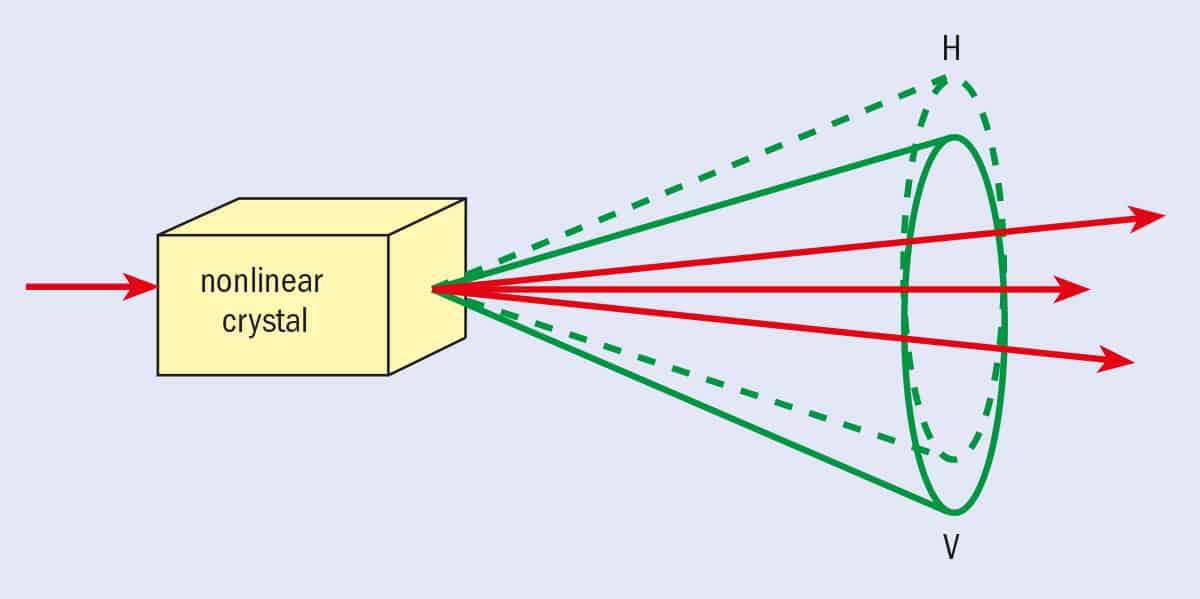
This scheme has been put into practice by my group in Innsbruck using polarization-entangled photons (see Mattle et al . in further reading). The experiment relies on the process of spontaneous parametric down-conversion in a crystal to produce entangled states of very high quality and intensity (figure 3). The nonlinear properties of the crystal convert a single ultraviolet photon into a pair of infrared photons with entangled polarizations.
3 How to entangle photons When an ultraviolet laser beam strikes a crystal of beta barium borate, a material with nonlinear optical properties, there is a small probability that one of the photons will spontaneously decay into a pair of photons with longer wavelengths (to conserve energy). The photons are emitted in two cones and propagate in directions symmetric to the direction of the original UV photon (to conserve momentum). In so-called type II parametric down-conversion, one of the photons is polarized horizontally and the other is polarized vertically. It is possible to arrange the experiment so that the cones overlap (see photograph at top of article). In this geometry the photons carry no individual polarizations – all we know is that the polarizations are different. This is an entangled state.
The experiment used quarter- and half-wave polarization plates (plates that shift the phase between the two polarization states of a photon by λ/4 and λ/2, respectively) to make the unitary transformations between the Bell states. In fact it is possible to identify only the |Ψ+〉 and |Ψ–〉 states uniquely using linear elements such as wave plates and mirrors. However, by being able to discriminate between three different possibilities – |Ψ+〉, |Ψ–〉 and |φ±〉 – Bob could send one “trit” of information with just one photon, even though the photon had only two distinguishable polarization states. It has been shown that a nonlinear quantum gate will be needed to distinguish between all four Bell states. Such a gate would depend on a nonlinear interaction between the two photons and various theoretical and experimental groups are working on this challenge.
Quantum teleportation
Quantum dense coding was the first experimental demonstration of the basic concepts of quantum communication. An even more interesting example is quantum teleportation.
Suppose Alice has an object that she wants Bob to have. Besides sending the object itself, she could, at least in classical physics, scan all of the information contained in the object and transmit that information to Bob who, with suitable technology, could then reconstitute the object. Unfortunately, such a strategy is not possible because quantum mechanics prohibits complete knowledge of the state of any object.
There is, fortunately, another strategy that will work. What we have to do is to guarantee that Bob’s object has the same properties as Alice’s original. And most importantly, we do not need to know the properties of the original. In 1993 Bennett and co-workers in Canada, France, Israel and the US showed that quantum entanglement provides a natural solution for the problem (see further reading).
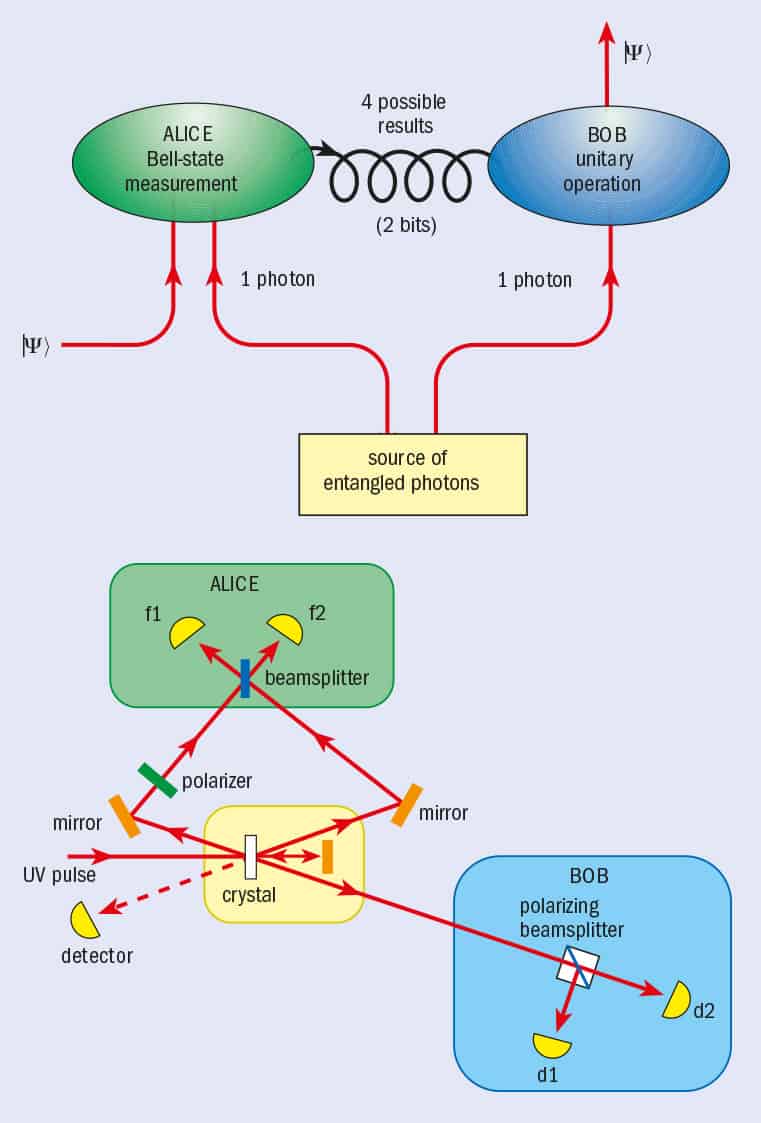
4 Quantum teleportation The scheme of Bennett et al. (top) and the Innsbruck teleportation experiment (bottom). Alice wishes to teleport an unknown quantum state |Ψ〉 (the “teleportee”) to Bob. They agree to share an entangled pair of “ancillary” photons. Alice then performs a Bell-state measurement on the teleportee and her ancillary photon, and obtains one of the four possible Bell results. This measurement also projects Bob’s ancillary photon into a well defined quantum state. Alice then transmits her result to Bob, who performs one of four unitary operations to obtain the original state. In the experiment a pulse from a mode-locked Ti:sapphire laser (not shown) is frequency doubled, and the resulting UV pulse is used to create the entangled pair of “ancillary” photons in a nonlinear crystal. The UV pulse is then reflected back through the crystal to produce a second pair of photons: one is used as the teleportee while the other acts as a “trigger”. Polarizers are used to prepare the teleportee photon in a well defined state, while various filters ensure that no path information is available about Alice’s photons. Coincident photons detections at f1 and f2 project the photons onto a |Ψ–〉 state (in which they have different polarizations). And since Alice’s ancillary and Bob’s photon are also entangled, this detection collapses Bob’s photon into an identical replica of the original.
In this scheme Alice wants to teleport an unknown quantum state |Ψ〉 to Bob (figure 4). They both agree to share an entangled pair of qubits, known as the ancillary pair. Alice then performs a joint Bell-state measurement on the teleportee (the photon she wants to teleport) and one of the ancillary photons, and randomly obtains one of the four possible Bell results. This measurement projects the other ancillary photon into a quantum state uniquely related to the original. Alice then transmits the result of her measurement to Bob classically, and he performs one of the four unitary operations to obtain the original state and complete the teleportation.
It is essential to understand that the Bell-state measurement performed by Alice projects the teleportee qubit and her ancillary photon into a state that does not contain any information about the initial state of the teleportee. In fact, the measurement projects the two particles into a state where only relative information between the two qubits is defined and known. No information whatsoever is revealed about Yñ. Similarly, the initial preparation of the ancillary photons in an entangled state provides only a statement of their relative properties. However, there is a very clear relation between the ancillary photon sent to Bob and the teleportee photon. In fact, Bob’s photon is in a state that is related to Alice’s original photon by a simple unitary transformation.
Consider a simple case. If Alice’s Bell-state measurement results in exactly the same state as that used to prepare the ancillary photons (which will happen one time in four), Bob’s ancillary photon immediately turns into the same state as |Ψ〉. Since Bob has to do nothing to his photon to obtain |Ψ〉, it might seem as if information has been transferred instantly – which would violate special relativity. However, although Bob’s photon does collapse into the state |Ψ〉 when Alice makes her measurement, Bob does not know that he has to do nothing until Alice tells him. And since Alice’s message can only arrive at the speed of light, relativity remains intact.
In the other three possible cases, Bob has to perform a unitary operation on his particle to obtain the original state, |Ψ〉. It is important to note, however, that this operation does not depend at all on any properties of |Ψ〉.
The main challenge in our experiment was to perform a Bell-state measurement on two particles that were generated independent of each other (see Bouwmeester et al. in further reading). Since a Bell-state measurement probes the collective or relative properties of two quantum particles, it is essential that the particles “forget” any information about where they were generated. To achieve this we must perform the experiment in such a way that we are unable, even in principle, to gain any path information. We do this by directing the two photons – the teleportee and Alice’s ancillary – through a semitransparent beam splitter from opposite sides (figure 5). We then ask a simple question: if the two particles are incident at the same time, how will they be distributed between the two output directions?
Since photons were used in the experiment, one might naively have expected that both photons would emerge in the same output beam. This feature, called “bunching”, is well known for bosons (particles with integer spin such as photons) and was demonstrated with optical beam splitters for the first time in 1987 by Leonard Mandel’s group at the University of Rochester in the US. Surprisingly, perhaps, bunching only happens for three of the Bell states. In contrast, for the |Ψ〉 state , the photons always leave in different beams. In other words, the photons “anti-bunch” and behave as if they were fermions. This is a direct consequence of interference.
This means that for the |Ψ–〉 state we have no way of knowing which way the photons reached the detectors: both photons could have been transmitted by the beam splitter, or both could have been reflected. By adding various polarizers it is also possible to identify photons in the |Ψ+〉 state. As with dense coding, however, quantum gates will be needed to make the experiment work with the |φ+〉 and |φ–〉 states.
5 Quantum statistics and entanglement swapping (a) When two particles are incident symmetrically on a 50/50 beam splitter it is possible for both to emerge in either the same beam (left) or in different beams (right). In general, bosons (e.g. photons) emerge in the same beam, while fermions (e.g. electrons) emerge in different beams. The situation is more complex for entangled states, however, and two photons in the Bell state |Ψ–〉 emerge indifferent beams. Therefore, if detectors placed in the two outward directions register photons at the same time, the experimenter knows that they were in a |Ψ–〉 state. Moreover, because we do not know the paths followed by the photons, they remained entangled. (b) It is possible to entangle two photons that have never interacted before by using two down-conversion sources and then subjecting one photon from each entangled pair to a Bell-state measurement. This causes the other two photons, which have never interacted, to become entangled.
In the actual experiment the teleportee photon was also made using parametric down-conversion (figure 4). This provides an additional photon that can be used as a trigger informing us that the teleportee photon is “ready”. The experiment itself involved preparing the teleportee photon in various different polarization states – horizontal, vertical, +45°, –45° and right-hand circular – and proving that Bob’s photon actually acquired the state into which the teleportee photon was prepared. The teleportation distance was about 1 metre. Since the experiment was set up to identify only the |Ψ–〉 state, the maximum success rate for teleportation was, in theory, 25%, and the measured success rate was much lower.
A related experiment was recently performed at the University of Rome La Sapienza (see Boschi et al. in further reading) using only one entangled pair of photons. In this experiment Alice was able to prepare Bob’s particle at a distance, again to within an unitary transformation. By essentially performing a Bell-state measurement on two properties of the same photon, the Rome group was able to distinguish between all four Bell states simultaneously.
The entanglement of photons over distances as great as 10 km has now been demonstrated at the University of Geneva, so teleportation is expected to work over similar distances. The teleportation of atoms should also be possible following a recent experiment at the Ecole Normale Supérieure in Paris that demonstrated that pairs of rubidium atoms could be entangled over distances of centimetres (see Hagley et al. in further reading).
As mentioned above, an important feature is that teleportation provides no information whatsoever about the state being teleported. This means that any quantum state can be teleported. In fact, the quantum state does not have to be well defined; indeed, it could even be entangled with another photon. This means that a Bell-state measurement of two of the photons – one each from two pairs of entangled photons – results in the remaining two photons becoming entangled, even though they have never interacted with each other in the past (figure 5). Alternatively, one can interpret this “entanglement swapping” as the teleportation of a completely undefined quantum state (see Bose et al. in further reading). In a recent experiment in Innsbruck, we have shown that the other two photons from the two pairs are clearly entangled.
Quantum outlooks
We conclude by noting that, amazingly, the conceptual puzzles posed by quantum mechanics – and discussed for more than sixty years – have recently led to completely novel ideas that might even result in applications. These applications could include quantum communication, cryptography and computation. In return, these technological considerations lead to a better intuitive understanding of basic issues such as entanglement and the meaning of information on the quantum level. The whole field of quantum information technology is a classic example of basic physics and potential applications working hand in hand.
In the mid-1930s two influential but seemingly unrelated papers were published. In 1935 Einstein, Podolsky and Rosen proposed the famous EPR paradox that has come to symbolize the mysteries of quantum mechanics. Two years later, Alan Turing introduced the universal Turing machine in an enigmatically titled paper, On computable numbers, and laid the foundations of the computer industry – one of the biggest industries in the world today.
Although quantum physics is essential to understand the operation of transistors and other solid-state devices in computers, computation itself has remained a resolutely classical process. Indeed it seems only natural that computation and quantum theory should be kept as far apart as possible – surely the uncertainty associated with quantum theory is anathema to the reliability expected from computers?
Wrong. In 1985 David Deutsch introduced the universal quantum computer and showed that quantum theory can actually allow computers to do more rather than less. The ability of particles to be in a superposition of more than one quantum state naturally introduces a form of parallelism that can, in principle, perform some traditional computing tasks faster than is possible with classical computers. Moreover, quantum computers are capable of other tasks that are not conceivable with their classical counterparts. Similar breakthroughs in cryptography and communication followed.
This quantum information revolution is described in this special issue by some of the physicists working at the forefront of the field. Starting with the most fundamental of quantum properties – single-particle quantum interference in two-path experiments – they show how theorists and experimentalists are tackling problems that go to the very foundations of quantum theory and, at the same time, offer the promise of far-reaching applications.
Anton Zeilinger of the University of Innsbruck introduces the fundamentals of quantum information – quantum bits, entangled states, Bell-state measurements and so forth – and outlines what is possible with quantum communication. The most ambitious scheme, quantum teleportation, has recently been demonstrated with photons and looks to be possible with atoms. The first application of teleportation is, however, likely to be in a quantum computer or communication system rather than anything more cinematic.
Cryptography is the most mature area of quantum information and has now been demonstrated over distances of ten of kilometres (and under Lake Geneva!). Once just the concern of special agents and generals, cryptography now plays an important role in transactions over the Internet. On page 41 of the March issue of Physics World Wolfgang Tittel, Grégoire Ribordy and Nicolas Gisin of the University of Geneva explain how the very properties of quantum theory that so puzzled Einstein et al . can be used to send messages with complete security. A common theme in communication and cryptography is that many applications work best when classical and quantum methods are used in tandem – which is why Alice and Bob, the two central characters in quantum information, are using the telephone in the illustration.
Quantum computers are a more distant proposition, but the first logic gates have been demonstrated in the laboratory and progress is being made on three fronts: trapped ions, photons in cavities and nuclear magnetic resonance experiments. Recent years have also seen significant progress in the development of new algorithms for quantum computers. David Deutsch and Artur Ekert of the University of Oxford present a progress report on page 47 and also delve into some of the deeper implications of quantum theories of information.
Of course it isn’t all plain sailing. Quantum states are notoriously delicate and interactions with the environment can cause a pure quantum state to evolve into a mixture of states. This causes the quantum bit to lose two of its key properties: interference and entanglement. This process, known as decoherence, is the biggest obstacle to quantum computation, as David DiVincenzo IBM and Barbara Terhal of the University of Amsterdam explain on page 53. However, theorists have developed schemes to correct the errors introduced by decoherence and also any inaccuracies generated by the quantum logic gates themselves.
Collaboration is a hallmark of the ever-growing quantum information community. The European Union, for example, is funding a network of eight groups working on the Physics of Quantum Information, while the Quantum Information and Computation collaboration in the US has been awarded some $5 million over five years by the Department of Defense.
We live in an information age that was founded on the applications of basic physics and in which computer power continues to grow exponentially as the feature sizes in microelectronic circuits become ever smaller. Quantum effects can be seen as a threat or an opportunity to this growth. The quantum information technologies described in this issue may have a very long way to go before they rival the sophistication found in their classical counterparts but, as Deutsch and Ekert conclude, “there is potential here for truly revolutionary innovation”.