Sticky UV-sensitive tape makes 2D material transfers easier

A new type of sticky tape that is sensitive to ultraviolet light makes it easier and cheaper to transfer two-dimensional materials like graphene onto different surfaces. According to its Japan-based developers, the new tape technique could revolutionize 2D materials transfer, bringing us closer to integrating such materials into devices.

2D materials form the basis of many advanced electronic and optoelectronics devices. Because they are just a few atoms thick, however, these materials are difficult to transfer onto device surfaces. Current methods are highly complex and often involve etching a substrate with corrosive acids. The materials’ extreme thinness also means they often need a polymer film to support them during the fabrication process. This film must be removed with solvent afterwards, which is time-consuming and costly, and can damage the material by introducing unwanted defects that degrade its electronic and mechanical properties.

A new functional tape

Researchers led by Hiroki Ago of Kyushu University say they have now found an alternative solution. The new functional tape, which the team developed with the help of artificial intelligence (AI), is made from a polyolefin film and a thin adhesive layer. Before it is exposed to UV light, the tape exhibits strong van der Waals interactions with graphene (a 2D form of carbon) and sticks to it. After UV exposure, these interactions weaken so that the graphene can be readily released and transferred onto a target surface. The tape also stiffens slightly after UV exposure, which makes it even easier to peel the graphene off it.

Working in collaboration with experts from the Japanese manufacturing firm Nitto Denko, the researchers then developed transfer tapes for other technologically important 2D materials. These include hexagonal boron nitride (hBN), which is sometimes referred to as white graphene or “graphene’s cousin”, and transition metal dichalcogenides (TMDs), which show promise for post-silicon electronics. In images obtained using optical and atomic force microscopes, the surfaces of these materials after tape transfer appeared smoother and contained fewer defects than those transferred using conventional approaches.

Flexible and easily cut to size

Since the UV tape is flexible and (unlike protective polymer films) does not need to be removed with organic solvents after transfer, it can be used with substrates that are curved or sensitive to such solvents, such as plastics. Ago thinks this could expand the tape’s applications, and he and his colleagues demonstrated this by making a plastic device that uses graphene to sense terahertz radiation. “Such a device could be promising for medical imaging or airport security as this radiation can pass through objects, just like X-rays,” he explains.

The UV tape is easy to cut to the required size, too, making it easier to transfer just the right amount of 2D material. This “cut-and-transfer” process, as the researchers call it, will minimize waste and reduce cost.

A collaboration that stuck

Before developing the new tape, Ago’s research group worked for more than 10 years on chemical vapour deposition as a means of synthesizing high-quality graphene, hBN and TMDs. During that time, he says, many researchers requested their samples, but most of them had problems transferring these 2D materials to their substrates. “I therefore thought: what if they could easily do this transfer by themselves? This is why we started to try making our 2D materials tapes,” Ago says.
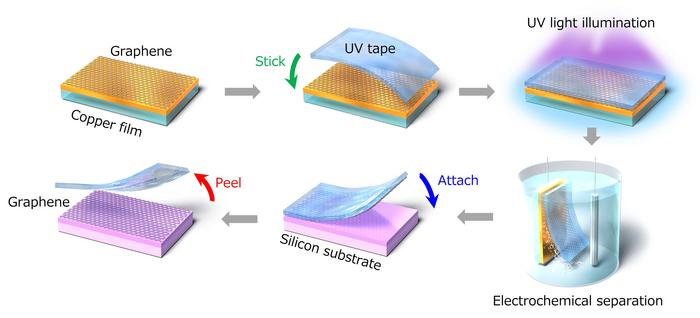
Image showing steps in the tape-transfer process. Tape is stuck to the graphene grown on a copper film, UV light is applied, the graphene+tape is electrochemically separated from the copper, the graphene+tape is applied to a silicon substrate, and the tape is peeled off, leaving just the graphene and its substrate

To advance the technique, Ago collaborated with Nitto Denko, which makes a wide variety of adhesive tapes. Because these tapes were more often used for thick materials like paper, the collaboration struggled at first, but their work paid off: “After extensive research, we finally succeeded in developing UV tapes and transfer processes suitable for the clean transfer of 2D materials,” Ago tells Physics World.

Towards large-scale manufacturing processes of 2D materials

Ago says the most direct application for the technique, which the team describe in Nature Electronics, would be to integrate it into large-scale manufacturing processes for 2D materials. From there, he adds, “I personally expect the development of cutting-edge advanced devices with our UV tape transfer because we can transfer various types of 2D materials and even stack these materials together in different orientations, a process that allows new electronic properties to emerge.”

Though the transfer process is relatively smooth, Ago and colleagues acknowledge that it does produce some wrinkles and bubbles in the 2D materials. They are working on improvements to the composition of the adhesive layer that might help resolve this problem. Another focus for improvement is to increase the size of the transferred 2D materials beyond the 4-inch (102 mm) wafers they currently use.

“I also want to develop the fabrication of more sophisticated devices using different types of 2D materials and UV tapes,” Ago reveals. “These could substantially change the way electronic and photonics devices are produced.” Further collaborations with academia and industry, he says, could enable the team “to improve this unique tape transfer technique and push forward the realization of commercial products using 2D materials”.

Modelling lung cells could help personalize radiotherapy

A new type of computer model that can reveal radiation damage at the cellular level could improve radiotherapy outcomes for lung cancer patients.

Roman Bauer, a computational neuroscientist at the University of Surrey in the UK, in collaboration with Marco Durante and Nicolò Cogno from GSI Helmholtzzentrum für Schwerionenforschung in Germany, created the model, which simulates how radiation interacts with the lungs on a cell-by-cell basis.

Over half of all patients with lung cancer are treated using radiotherapy. Although this approach is effective, it leaves up to 30% of recipients with radiation-induced injuries. These can trigger serious conditions that affect breathing, such as fibrosis – in which the lining of the alveoli (air sacs) in the lungs is thickened and stiffened – and pneumonitis – when the walls of the alveoli become inflamed.

In order to limit radiation damage to healthy tissue while still killing cancer cells, radiotherapy is delivered in several separate “fractions”. This allows a higher – and therefore more effective – dose to be administered overall because some of the damaged healthy cells can repair themselves in between each fraction.

Currently, radiotherapy fractionation schemes are chosen based on past experience and generalized statistical models, so are not optimized for individual patients. In contrast, personalized medicine could be achieved thanks to this new model which, as Durante, director of the Biophysics Department at GSI explains, looks at “toxicity in tissues starting from the basic cellular reactions and [is] therefore able to predict what happens to any patient” when different fractionation schemes are chosen.

The team developed an “agent-based” model (ABM) consisting of separate interacting units or agents – which in this case mimic lung cells – coupled with a Monte Carlo simulator. The ABM, described in Communications Medicine, builds a representation of an alveolar segment consisting of 18 alveoli each 260 µm in diameter. Next, Monte Carlo simulations of irradiation of these alveoli are carried out at the microscopic and nanoscopic scale, and information about the radiation dose delivered to each cell and its distribution is fed back into the ABM.

The ABM uses this information to work out whether each cell would live or die, and outputs the final results in the form of a 3D picture. Crucially, the coupled model can simulate the passage of time and thus show the severity of radiation damage – and the progression of the medical conditions it may cause – hours, days, months or even years after treatment.

“What I found very exciting is that these computational simulations actually delivered results that matched with various experimental observations from different groups, labs and hospitals. So our computational approach could in principle be used within a clinical setting,” says Bauer, the spokesperson for the international BioDynaMo collaboration, which aims to bring new computational methods into healthcare via the software suite used to build this model.

Bauer began working on computational cancer models after a close friend died from the disease aged just 34. “Every cancer is different and every person is different, with different shaped organs, genetic predispositions and lifestyles,” he explains. His hope is that information from scans, biopsies and other tests could be fed into the new model to provide a picture of each individual. An AI-assisted therapy protocol could then be created that would output a closely tailored treatment plan that improves the patient’s chances of survival.

Bauer is currently seeking collaborators from other disciplines, including physics, to help move towards a clinical trial following lung cancer patients over several years. Meanwhile, the team intends to expand the model’s use into other areas of medicine.

Durante, for instance, is hoping to study viral infection with this lung model as it “may predict the pneumonitis induced by the COVID-19 infection”. Meanwhile, Bauer has begun simulating the development of circuits in the brains of premature babies, with the goal of better understanding “at what time point to intervene and how”.

Photonic metastructure does vector–matrix multiplication

A new silicon photonics platform that can do mathematical operations far more efficiently than previous designs has been unveiled by Nader Engheta and colleagues at the University of Pennsylvania. The US-based team hopes that its system will accelerate progress in optical computing.

Analogue optical computers can do certain calculations more efficiently than conventional digital computers. They work by encoding information into light signals and then sending the signals through optical components that process the information. Applications include optical imaging, signal processing and equation solving.

Some of these components can be made from photonic metamaterials, which contain arrays of structures with sizes that are on par, or smaller, than the wavelength of light. By carefully controlling the size and distribution of these structures, various information-processing components can be made.

Unlike the bulky lenses and filters that were used to create the first analogue optical computers, devices based on photonic metamaterials are smaller and easier to integrate into compact circuits.

Mathematical operations

Over the past decade, Engheta’s team have made several important contributions to the development of such components. Starting in 2014, they showed that photonic metamaterials can be used to perform mathematical operations on light signals.

They have since expanded on this research. “In 2019, we introduced the idea of metamaterials that can solve equations,” Engheta says. “Then in 2021, we extended this idea to structures that can solve more than one equation at the same time.” In 2023, the team developed a new approach for fabricating ultrathin optical metagratings.

Engheta and colleagues have now set their sights on vector–matrix multiplication, which is a vital operation for the artificial neural networks used in some artificial intelligence systems. The team has created the first photonic nanostructure capable of doing vector–matrix multiplication. The material was made using a silicon photonics (SiPh) platform that integrates optical components onto a silicon substrate.

Inverse design

The researchers also used an inverse design procedure. Instead of taking a known nanostructure and determining if it has the correct optical properties, inverse design begins with a set of desired optical properties. Then, a photonic structure is reverse-engineered to have those properties. Using this approach, the team designed a highly compact material that is suited to doing vector-matrix multiplications with light.

“By combining the inverse design method with the SiPh platform, we could design structures with sizes on the order of 10-30 micron, with a silicon thickness ranging between 150–220 nm,” Engheta explains.

The team says that its new photonic platform can do vector–matrix multiplication far more efficiently than existing technologies. Engheta also points out that the platform is also more secure than existing systems. “Since this vector-matrix multiplication computation is done optically and simultaneously, one does not need to store the intermediate-stage information. Therefore, the results and processes are less vulnerable to hacking.”

The team anticipates that their approach will have important implications for how artificial intelligence is implemented.

The research is described in Nature Photonics.

How a technique for recycling rare-earth permanent magnets could transform the green economy

Some wind turbines, a pile of hard disk drives being recycled and motors in electric cars

I recently went on a trade mission to Canada funded by Innovate UK, where I met Allan Walton – a materials scientist who co-founded a company called HyProMag. Spun off from the University of Birmingham in 2018, HyProMag has developed a technique for recycling rare-earth magnets, which are widely used in wind turbines, electric-vehicle (EV) motors and other parts of the “green economy”.

Having been invited to tour HyProMag’s prototype recycling facility on the Birmingham campus, I saw that the technology was shaping up to be a great UK success story. So when Physics World sent me a press release announcing that the company is due to start commercial production at Tyseley Energy Park in Birmingham by mid-2024, I knew my instincts were well founded.

Rare-earth permanent magnets – as I described in my column a few months ago – are alloys of elements such as neodymium, samarium and cerium. With the transition to a “clean-energy” economy now in full swing, demand for rare earths is high. Estimates suggest that the market will grow by as much as a factor of seven between 2021 and 2040.

Trouble is, some 80–90% of the world’s neodymium is currently made – or controlled by – Chinese companies. That’s prompted some nations, such as the US, to revamp their own production of permanent magnets. But another way to secure supplies of rare earths is to recycle materials. That’s why the imminent start-up of HyProMag’s facility is so interesting, especially as its process is so energy efficient.

Extracting elements

There are lots of possible methods to extract rare-earth elements from waste materials or from products that have reached the end of their lives. Most of the work has so far focussed on getting the individual elements by first dissolving the magnets and then recovering the rare earths from liquid-waste streams that re-enter the supply chain early in the magnet-making process.

This approach is often called “long-loop” recycling as everything is broken down using various techniques and recovered as rare-earth oxides. These oxides then have to be converted into metals before being cast into alloys and broken down into a fine alloy powder to make the magnets. Long-loop recycling is an important but energy intensive and expensive process.

The Tyseley plant takes a different approach, based as it is on the University of Birmingham’s patented Hydrogen Processing of Magnet Scrap (HPMS) technique. It uses hydrogen as a processing gas to separate magnets from waste streams as a magnet alloy powder, which can be compactified into “sintered” rare-earth magnets. Not requiring heat, it’s a relatively quick process dubbed “short-loop” recycling.

A staggering 259 million hard disk drives were shipped in 2021, so the market for recycled magnets is huge.

When I looked around the company’s prototype line last year, I noticed that it can recycle the hard disk drives (HDDs) found in computers. Each disk can have as much as 16g of magnetic material, about a quarter of which are rare-earth elements. That’s only a small fraction of the disk’s overall mass but, as you’ll recall me pointing out, a staggering 259 million HDDs were shipped in 2021, so the market is huge.

HyProMag’s production method involves a robot with magnetic-field sensors first identifying the location of the HDD’s motor, which contains the all-important rare-earth permanent magnet. The section with the motor is then chopped off, with the rest of the disk sent for conventional recycling. The motor section is finally exposed to hydrogen at atmospheric pressure and room temperature via the HPMS technique.

Amazingly, the rare-earth magnets – typically alloys of neodymium, iron and boron (NdFeB) – just break apart to form a powder. I’ve seen videos of the process and it’s like watching something turn to rust. Crucially, the powder becomes demagnetized so any coatings on the magnet peel away from the surface of the magnets and can be easily separated.

The extracted NdFeB powder is then sieved to remove impurities before being re-processed into new magnetic materials or rare-earth alloys. HyProMag reckons that the process requires 88% less energy than that needed to make rare-earth magnets from primary sources, which is impressive. It has already produced more than 3000 new rare-earth magnets at its pilot plant for project partners and potential customers, with the magnets tested in a wide range of applications in the automotive, aerospace and electronics sectors.

Production promises

But the company wants to get past the trial phase and become a volume supplier of magnets. That’s why the Tyseley scale-up plant is so important. The company reckons it will initially be able to process up to 20 tonnes of rare-earth magnets and alloys a year – and eventually five times that amount. HyProMag is also planning further facilities in Germany and the US.

The technology is promising because so many products contain rare-earth magnets, but when they’re scrapped the magnets get shredded and break apart. The resulting powder remains magnetic, sticking to the ferrous scrap and plant components, but less than 1% of the magnets get recycled. HyProMag can, however, efficiently remove this material before it’s shredded and is already eyeing up a diverse range of economically viable sources of scrap.

“It is difficult to see large-scale recycling of rare-earth magnets taking off without an efficient separation process such as HPMS,” Walton says. “The current pilot line allows us to process up to two tonnes of scrap applications in a single run, with the commercial plant scaled to allow much larger batch sizes.” Loading to powder removal can be done, the company claims, in as little as four hours.

As the demand for rare earths increases and the amount of second-hand magnetic material available also rises, recycling such magnets is becoming an ever-bigger opportunity and an ever-more viable process. Just look at the growth of the EV sector: a typical electric motor has 2–5 kg of magnetic material and worldwide sales of EVs are expected to rise to 65 million per year by 2030, according to market-research firm IHS Markit.

Another huge source of rare earths are wind turbines, many of which are reaching the end of their lives after decades of use. Their generators contain up to 650 kg of rare earths per megawatt of generator capacity. Given that the UK aims to have up to 75 GW of off-shore wind capacity by 2050, it will have nearly 50,000 tonnes of rare-earth magnets in the years to come, according to Martyn Cherrington from Innovate UK, who runs its Circular Critical Materials Supply Chain (CLIMATES) programme.

Such long-term opportunities often need government support – and the recycling of rare-earth permanent magnets has been no exception. Indeed, the fundamental research behind HyProMag’s work began many years before it was spun off. The company has also benefited from financial support from a range of sources, including UK Research and Innovation’s Driving the Electric Revolution programme, the European Union and private investors.

In 2023 HyProMag Ltd was bought by the Canadian firm Maginito, which is part of Mkango Resources – a mineral-exploration and development company listed on the UK and Canadian stock exchanges. Mkango clearly saw the potential of HyProMag’s recycling and magnet-manufacturing technology. It’s a great UK success story, which could have huge long-term global potential for the circular economy.

Can a classical computer tell if a quantum computer is telling the truth?

Quantum computers can solve problems that would be impossible for classical machines, but this ability comes with a caveat: if a quantum computer gives you an answer, how do you know it’s correct? This is particularly pressing if you do not have direct access to the quantum computer (as in cloud computing), or you don’t trust the person running it. You could, of course, verify the solution with your own quantum processor, but not everyone has one to hand.

So, is there a way for a classical computer to verify the outcome of a quantum computation? Researchers in Austria say the answer is yes. Working at the University of Innsbruck, the Austrian Academy of Sciences and Alpine Quantum Technologies GmbH, the team experimentally executed a process termed Mahadev’s protocol, which is based on so-called post-quantum secure functions. These functions involve calculations that are too complex for even a quantum computer to crack, but with a “trapdoor” that allows a classical machine with the correct key to solve them easily. The team say these trapdoor calculations could verify the trustworthiness of a quantum computation using only a classical machine.

Honest Bob?

To understand how the protocol works, assume we have two parties. One of them, traditionally known as Alice, has the trapdoor information and wants to verify that a quantum computation is correct. The other, known as Bob, does not have the trapdoor information, and needs to prove that the calculations on his quantum computer can be trusted.

As a first step, Alice prepares a specific task for Bob to handle. Bob then reports the outcome to Alice. Alice could verify this outcome herself with a quantum computer, but if she wants to use a classical one, she needs to give Bob further information. Bob uses this information to entangle several of his main quantum bits (or qubits) with additional ones. If Bob performs a measurement on some of the qubits, this determines the state of the remaining qubits. While Bob does not know the state of the qubits in advance of the measurements, Alice, thanks to her trapdoor calculations, does. This means Alice can ask Bob to verify the qubits’ state and decide, based on his answer, whether his quantum computer is trustworthy.

Relieved Alice

The team ran this protocol on a quantum processor that uses eight trapped 40Ca+ ions as qubits. The measurements Bob makes relate to the energy of the qubits’ quantum states. To obtain a signal above background noise, the researchers ran the protocol 2000 times for each data point, ultimately proving that Bob’s answers could be trusted.

The researchers call their demonstration a proof of concept and acknowledge that more work is needed to make it practical. Additionally, a full, secure verification would require more than 100 qubits, which is out of scope for most of today’s processors. According to Barbara Kraus, one of the team’s leaders and now a quantum algorithms expert at the Technical University of Munich, Germany, even the simplified version of the protocol was challenging to implement. This is because verifying the output of a quantum computation is experimentally much more demanding than doing the computation, as it requires entangling more qubits.

Nonetheless, the demonstrated protocol contains all the steps required for a complete verification, and the researchers plan to develop it further. “An important task concerning the verification of quantum computations and simulations is to develop practical verification protocols with a high security level,” Kraus tells Physics World.

Andru Gheorghiu, a quantum computing expert from the Chalmers University of Technology in Sweden who was not involved in the research, calls it an important first step towards being able to verify general quantum computations. However, he notes that it currently only works for verifying a simple, one-qubit computation that could be reproduced with an ordinary laptop. Still, he says it offers insights into the challenges of trying to scale up to larger computations.

The research appears in Quantum Science and Technology.

Seismic signal that pointed to alien technology was actually a passing truck

In January 2014 a meteor streaked across the sky above the Western Pacific Ocean. The event was initially linked to a seismic signal that was detected on Papua New Guinea’s Manus Island. This information was used by Harvard University’s Amir Siraj and Avi Loeb to determine where the object likely fell into the ocean. Loeb then led an expedition that recovered spherical objects called spherules from the ocean bottom, which the team claimed to be from the meteor.

Because of the spherule’s unusual elemental composition, the team has suggested that the objects may have come from outside the solar system. What is more, they hinted that the spherules may have an “extraterrestrial technological origin” – that they may have been created by an alien civilization.

Now, however, a study led by scientists at Johns Hopkins University has cast doubt on the connection between the spherules and the 2014 meteor event. They have proposed a very different source for the seismic signal that led Loeb and colleagues to the spherules.

Road rumble

“The signal changed directions over time, exactly matching a road that runs past the seismometer,” says Benjamin Fernando, a planetary seismologist at Johns Hopkins who led this latest research.

“It’s really difficult to take a signal and confirm it is not from something,” explains Fernando. “But what we can do is show that there are lots of signals like this, and show they have all the characteristics we’d expect from a truck and none of the characteristics we’d expect from a meteor.”

That’s right, it was a truck driving past the seismometer, not a meteor.

Discounting the Manus Island seismic data, Fernando and colleagues then used observations from underwater microphones in Australia and Palau to work out where the meteor crashed into the sea. Their location is more than 160 km from where Loeb’s team recovered their samples.

“Whatever was found on the sea floor is totally unrelated to this meteor, regardless of whether it was a natural space rock or a piece of alien spacecraft—even though we strongly suspect that it wasn’t aliens,” Fernando concludes.

He and his colleagues will report their findings next week at the Lunar and Planetary Science Conference in Houston, Texas

Mystery of why inkjet-printed paper curls finally solved

You may have noticed that a sheet of paper that is printed on one side using an inkjet printer curls up at the edges after a few hours or days, even if it the paper was perfectly flat after printing.

The effect has remained a mystery until now thanks to work done by researchers at Graz University of Technology.

They sprayed standard A4 printer paper on one side with an ink consisting of water and glycerol.

The duo then used a laser scanner to observe the curvature of the sheets over time, finding that once printed solvents in the ink migrate begin to slowly migrate through the paper towards the unprinted side (Materials & Design doi:10.1016/j.matdes.2023.112593).

The effect of this is to cause the cellulose fibres on the unprinted side to swell and thus the paper starts to curl.

“To solve the problem, glycerol could be replaced by other solvents,” says Graz material scientist Ulrich Hirn. “However, this is not so easy because glycerol gives the inkjet ink important properties that make it suitable for inkjet printing in the first place”.

Another solution is to print on both sides, which is better for the environment as well.

Space-borne atoms herald new tests of Einstein’s equivalence principle

The motion of freely-falling bodies is independent of their composition. This is one of the foundations of Einstein’s Equivalence Principle (EEP), which underpins our modern understanding of gravity. This principle, however, is under constant scrutiny. Any violations of it would give us hints in our search for dark energy and dark matter, while also guiding our understanding of black holes and other systems where gravity and quantum mechanics meet.

Scientists from the US, France and Germany have now created a new system for testing the EEP: a mixture of two ultracold quantum gases that orbits the Earth aboard the International Space Station (ISS). They also demonstrated the first dual-species atom interferometer in space, which they describe as an “important step” towards testing the EEP. The question they aim to answer with this experiment is simple: do two atoms of different masses fall at the same rate?

Cold atoms on the ISS

The ISS is home to the Cold Atom Laboratory (CAL), which is a “playground” for atoms in space. Launched in 2018, in 2020 it created the first space-borne Bose-Einstein Condensate (BEC) – a special state of matter achieved after cooling atoms to temperatures just above absolute zero. This first quantum gas consisted of ultracold rubidium atoms, but following an upgrade in 2021, the CAL also hosts a microwave source for making quantum gases of potassium atoms.

In the latest work, which is described in Nature, the CAL scientists generated a quantum mixture of both species on the ISS. “Generating this quantum mixture in space is an important step towards developing high precision measurements for testing Einstein’s equivalence principle,” says Gabriel Müller, a PhD student at Leibniz University in Hannover, Germany who is involved in the experiment.

To achieve this mixture, the team confined rubidium atoms in a magnetic trap and allowed the most energetic “hot” atoms to evaporate out of the trap, leaving the “cold” atoms behind. This eventually leads to a phase transition into a quantum gas once the atoms drop below a certain critical temperature.

While this process also works for potassium atoms, simultaneously evaporating both species in the same trap is not straightforward. As the internal energy structure of rubidium and potassium atoms is different, their initial temperatures in the trap vary, and so will the optimum conditions of the trap and the evaporation time needed to reach the critical temperature. As a result, the scientists had to turn to a different solution. “The potassium quantum gas is not generated via evaporative cooling, but rather cooled ‘sympathetically’ via direct thermal contact with the evaporated ultracold rubidium gas,” explains Müller.

Generating this quantum gas in space has its merits, he adds. “On Earth, there’s a gravitational sag, meaning that two atoms of different masses will not be at the same position in the trap. In space, on the other hand, the gravitational interaction is weak, and the two species are overlapped.” This aspect of working in microgravity is essential for performing experiments aimed at observing interactions between the two species that would otherwise be hijacked by the effects of gravity on Earth.

The crucial role of quantum state engineering

Producing a quantum mixture of rubidium and potassium atoms brings the CAL team a step closer to testing the EEP, but other elements of the experiment still need to be tamed. For example, although the two species overlap in the trap, when they are released from it, their initial positions are slightly different. Müller explains that this is partly due to the properties of each atom species leading to different dynamics, but it is also due to the trap release not being instantaneous, meaning that one of the species experiences a residual magnetic force relative to the other. Such systematic effects could easily present themselves as a violation of the EEP if not taken care of properly.

For this reason, the scientists have turned their attention towards characterizing the systematics of their trap and reducing unwanted noise. “This is work that is actively being done in Hannover, to create well-engineered input states of both species, which will be crucial as you need similar initial conditions before you start the interferometer,” says Müller. One solution to the initial position problem, he adds, would be to slowly transport both species to a single position before switching off the magnetic trap. While this can be done with high precision, it comes at the expense of heating up the atoms and losing some of them. The scientists therefore hope to use machine learning to optimize the transport mechanism and thereby achieve similar control of the atomic dynamics, but much faster.

Image showing six red laser beams crossing inside a chamber with a chip suspended above it

Dual-species atom interferometer in space

Once these problems are resolved, the next step would be to perform an EEP test using dual-species atom interferometry. This involves using light pulses to create a coherent superposition of the two ultracold atom clouds, then recombining them and letting them interfere after a certain free evolution time. The interference pattern contains valuable information about the mixture’s acceleration, from which the scientists can extract whether both species experienced the same gravitational acceleration.

A limiting factor in this technique is how well the positions of the laser beam and the atomic sample overlap. “This is the most tricky part,” Müller stresses. One problem is that vibrations on the ISS cause the laser system to vibrate, introducing phase noise into the system. Another issue is that the different mass and atomic energy level structure of both species leads them to respond differently to the vibrational noise, producing a dephasing between the two atom interferometers.

In the latest work, the scientists demonstrated simultaneous atom interferometry of the mixture and measured a relative phase between the interference pattern of the rubidium and the potassium atoms. However, they are well aware that such a phase is likely due to the noise sources they are tackling, rather than a violation of the EPP.

Future missions

A new science module was launched to the ISS with the goal of increasing atom number, improving the laser sources and implementing new algorithms in the experimental sequence. Fundamentally, though, the CAL scientists are striving to demonstrate inertial precision measurement at beyond the current state of the art. “Such realizations are important milestones towards future satellite missions testing the universality of free fall to unprecedented levels,” says Hannover’s Naceur Gaaloul, a co-author of the recent paper.

One example Gaaloul mentions is the STE-QUEST (Space-Time Explorer and Quantum Equivalence Principle Space Test) proposal, which would be sensitive to differences in acceleration of as little as 10−17 m/s2. This precision is equivalent to dropping an apple and an orange and measuring, after one second, the difference in their position to within the radius of a proton. Space is, famously, hard, but atom interferometry in space is even harder.

Ask me anything: Anne Pawsey – ‘I really enjoy working with a huge community of physicists’

What skills do you use every day in your job?

Communication skills in all their forms are vital, whether it’s giving a presentation, writing a news article, discussing matters with one of our boards, or working with the team at the secretariat of the European Physical Society (EPS) in Mulhouse.

I also use a lot of project-management skills. The EPS runs several international conferences, is part of European Union projects, and facilitates the work of our volunteer members to promote and support physics and physicists – so there are often a lot of plates to keep spinning at the same time.

I’m grateful for the broad knowledge of physics I acquired during my degree. My PhD was in soft-matter physics on the behaviour of colloids in liquid crystals, but I also occasionally find that specialist knowledge I picked up in areas of science beyond my thesis topic come in handy for understanding matters under discussion.

What do you like best and least about your job?

I really enjoy working with a huge community of physicists and getting to hear them talk with enthusiasm about their research. I particularly enjoy interacting with the EPS’s Young Minds Sections and hearing about the outreach and engagement activities that they organize with EPS support.

My job is also really varied, and no two days are the same. I might be travelling for an editorial meeting, working on administration in Mulhouse, or participating in a planning meeting for a conference – all in the same week. The downside is that I occasionally miss the focused quiet of a meticulous laboratory experiment and I rarely get the luxury of spending an uninterrupted block of time on something.

What do you know today, that you wish you knew when you were starting out in your career?

I wish I’d known how vital language skills would be. Of course, most science is formally communicated in English and as a native speaker I have an advantage. But everyday life around the world happens in each country’s native language. The EPS is based in Mulhouse, France, very close to the Swiss and German borders, so I use French every day and have to converse in German at least once a week. I’m really grateful for the Erasmus year I spent in Grenoble during my degree for giving me a decent proficiency in French and the confidence to speak a foreign language.

Tackling climate change while improving human wellbeing

Environmental challenges like climate change are forcing us to rethink how we live in cities. This provides humanity with an important opportunity to develop new policies that also improve the overall wellbeing of urban dwellers.

Our guest in this episode of Physics World Weekly podcast is Radhika Khosla – who is an urban climatologist based at the Oxford Smith School of Enterprise and the Environment at the UK’s University of Oxford. She points out that extreme heat is proving to be the most deadly consequence of climate change and talks about the need to develop and implement cooling technologies that do not boost greenhouse gas emissions.

Khosla explains why the rapid urbanization of India offers opportunities to develop environmental policies that improve people’s lives. She also talks about her plans for the journal Environmental Research Letters, where she has recently become editor-in-chief.


Copyright © 2026 by IOP Publishing Ltd and individual contributors