Axis of universe debate rumbles on

The story began when Borge Nodland from the University of Rochester in the US and his former PhD supervisor, John Ralston from the University of Kansas, published a paper in the 21 April issue of Physical Review Letters (78 3043). They had analysed data from 160 radio galaxies published by seven independent research groups before 1980, and claimed that the data showed there to be a preferred direction in space – overturning at a stroke Einstein’s view that the universe is uniform whichever way you look. This seemed dramatic enough for newspapers all over the world the to give the paper full-blown coverage.

So what was Nodland and Ralston’s evidence? Many galaxies emit synchrotron radiation that is highly plane-polarized. As the waves journey through the cosmos, they pass through intergalactic magnetic fields and regions of charged particles, which rotate the plane of polarization. This is a well-known process called the Faraday effect. Nodland and Ralston claimed that the plane of polarization goes through an additional rotation – over and above the Faraday rotation – as radiation travels from a galaxy towards Earth. Their analysis appeared to show that the rate of rotation depends on the angle between the direction of the wave and a fixed direction in space. This fixed direction points roughly from Earth towards the constellation Sextans in one direction and Aquila in the other. The rate of rotation appeared to increase as a wave’s direction of travel approached this “anisotropy axis”.

Many scientists immediately reacted with scepticism, and within the space of ten days, four rebuttals had been fired off to Physical Review Letters by researchers in the US and the UK. One came from Rick Perley from the National Radio Astronomy Observatory in New Mexico and his colleagues, John Wardle of Brandeis University and Marshall Cohen from the California Institute of Technology. They claimed that much newer, high-resolution radio and optical signals – collected 2-3 years ago from 26 galaxies and quasars by the Very Large Array radio-telescope in New Mexico and the Keck Telescope in Hawaii – showed no signs of an axis of anisotropy in the universe. “Any rotation of the plane of polarization over cosmological distances was unmeasurably small and indistinguishable from zero,” they said in a statement.

“I firmly believe that Nodland and Ralston’s results do not hold up,” says Perley. “They made clear predictions that we were able to very quickly prove to be false. They stated that the plane of polarization of all distant objects would be rotated by 1-3 radians. That’s a huge signal, and trivial to measure with instruments like ours that can resolve to better than 1 degree.” Perley also says that there are hundreds of other observations made by dozens of other researchers that he could have used to show that there is no axis to the universe. “The great mystery is how Nodland and Ralston could have remained ignorant of this huge body of work,” he adds.

But Nodland believes that astronomers have attacked his work too quickly, without having thought it through. “Daniel Eisenstein from Princeton University and Emory Bunn from Bates College spoke out no more than a week after our paper was published,” says Nodland. “I would have been embarrassed to say anything as fast as they did.” And although Nodland admits that the more recent data from Perley and co-workers are interesting, he claims that the newer data must be analyzed in the same way as his original work. “I hope they do a full-blown analysis, but all they have so far done is pick out a few galaxies, and then just look at specific spots in those galaxies. They’ve also plotted different variables to the ones we did. I think they’ve misunderstood the spirit of our work – we are not claiming that every galaxy behaves in the way we predicted, just that this is how galaxies behave on average.”

One of the data sets used by Nodland and Ralston was generated by Philipp Kronberg, an astronomer at the University of Toronto, back in 1978. He also voices concern about their work. “It’s a little difficult to understand what they actually did,” says Kronberg. “The effect they claim to have seen is so amazingly large that it just cannot be true – or else people would certainly have picked up on it by now.” He points out that even if the additional polarization were true, and was perhaps related to some fundamental symmetry-breaking, it would probably be masked by other effects.

However, some critics like Ronald Bracewell and Von Eshleman from Stanford University have been willing to give Nodland and Ralston the benefit of the doubt. They have submitted a paper to Physical Review Letters proposing that the additional polarization observed by Nodland and Ralston could be to do with the absolute motion of the Sun through the cosmic background radiation, which is also towards Sextans. Nodland also says he has received several e-mails telling him of theoretical papers that show how anisotropic cosmologies are permitted within the framework of general relativity.

Another twist in the debate is that the paper was not published until two years after it had first been submitted. Nodland explains that the paper was strongly scrutinized by the referees, one of whom asked for an additional statistical analysis of the data. “The other problem was that after my PhD, I spent a year in industry, so I had no time to work on the revisions.” However, Perley thinks that there was a failure in the peer-review process. “I don’t know who the referees were but they probably weren’t familiar with radio astronomy,” he says.

Now that things have how calmed down a little, Nodland plans to respond to the various comments that have been made and has already asked Perley to send him his data. But Perley, for one, is still bemused about the media coverage. “I don’t know how such a completely wrong result could be given such prominence,” he says. He is also embarrassed by some of the statements that he and other scientists made in public. “We look like a bunch of playground kids throwing dirt at one another. I now have a higher opinion of politicians – at least they know how to talk to the press.”

Reality is not a hoax

A year ago, as last June’s Physics World was going to press, our North American correspondent contacted us with a late-breaking story about Alan Sokal, a physicist at New York University who had just published a deliberately meaningless paper in a “critical studies” journal called Social Text. The story sounded amusing but not, in my opinion, important enough to drop another story, and certainly not of such significance still to be of interest a month later. A year later, the “Sokal Hoax” has become a mini-industry – a by-word for the increasing friction at the interface between the natural and social sciences – and, like the editors of Social Text, I have to confess that I made a mistake.

The fact that Sokal’s paper was published does not in itself prove anything profound. However, it did drag into the open an on-going squabble between a group of scientists, many of them physicists, and various sociologists of science. Many scientists feel uneasy about various ideas from sociology, notably the suggestion that the laws of nature as we know them are “social constructs” – essentially laws that scientists have agreed between themselves – and do not have any fundamental significance. “Relativism” is another name for this school of thought.

Writing in defence of Sokal in the New York Review of Books, Steven Weinberg contrasted the laws of physics with the laws of baseball to counter the relativists. Both sets of laws are “real”, he said, but real in different ways: the laws of baseball are clearly a social construct whereas the laws of physics correspond to an objectivity reality. As Weinberg put it: “if we ever discover intelligent creatures on some distant planet and translate their scientific works, we will find that we and they have discovered the same laws.”

It is, however, difficult to deny that social factors play a part in the conduct and progress of physics. Although the laws of physics and the other empirical sciences may be immune to social constructs – indeed some of them must be, otherwise the phrase fundamental research becomes an oxymoron – physicists and scientists are certainly not. The name and affiliation of an author (and gender too, if the results of a recent study in Sweden apply more widely) play some small role in deciding what papers are accepted, read and eventually written about in magazines like this one.

There are also tensions when non-empirical “boundary conditions” such as the scientific method, Popper’s theory of falsification and the practice of peer review are applied to research and knowledge. These ideas have served science well but are not without fault. The recent brouhaha about the “axis of the universe” highlights what appears to be a lapse in the peer-review process at a leading physics journal. Moreover, there is something abstract about the way in which new laws enter the canon of physics. And on-going disputes, such as the controversy over the age of the universe, show that complex problems and partial data can lead to vigorous differences of opinion between camps of “real” scientists.

In years to come the many different ages of the universe that are on offer today will seem as unimportant to physicists as the early erratic results of Michelson, Morley and Millikan seem now. But the convergence of debate and disagreement into knowledge is surely a process that is worth investigating – and one that most physicists do not have the time or the skills to disentangle. It is therefore inevitable that other scholars will inhabit this territory.

Scientists might not like everything that this new breed has to say – especially if some sociologists continue to insist that the objective reality that is essential to physics does not exist – but it is surely worth talking to them and, hopefully, listening as well.

Many articles on the Sokal Hoax are available at http://www.physics.nyu.edu/faculty/sokal.

Cosmic background pays off for Microsoft’s research chief

Computing is a popular career for many physicists who decide that research is too competitive or too poorly paid. Most of them make a good living from computing and some are very successful. But few, if any, have done as well as Nathan Myhrvold. At 37 he is the chief technology officer of Microsoft Corporation, a member of the company’s executive committee, and in charge of a research budget that is set to triple over the next two to three years.

Myhrvold has already made his mark on the research enterprise at Microsoft. In 1991, five years after he joined the company, he founded Microsoft Research to carry out “basic and applied research in computer science which could make a positive difference in people’s lives and set new directions in the field”. Having started with just a handful of scientists, Microsoft Research now includes more than 100 researchers.

Microsoft’s recent conversion to the benefits of basic research is in marked contrast to the shift from long-term research to short-term product development in many American high-technology companies over recent years. Indeed, even the US government seems likely to reduce support for basic research in its attempts to balance the budget. “That’s a terrible mistake, ” says Myhrvold. “All industry of today is based on the fundamental science of 30 years ago, less fundamental research of 20 years ago, and interesting research of 10 years ago. [Reduction in support for fundamental research] would be a disastrous state of affairs if continued.”

Microsoft’s response, overseen by Myhrvold, is to treble its expenditure on what it terms “basic research” over the next two to three years, and to ensure that the research budget grows continuously after that. The investment could reach $330m over the next five years and will lead to the creation of the largest software research facility in the world, with perhaps close to 500 researchers. Of course, that money won’t pay for basic research in the academic sense. “We’re not supporting basic mathematics; even we don’t have the resources to do that, ” says Myhrvold. “We do a lot of stuff that computer scientists call pure research” – work with a distant horizon for conversion into products.

While basic research at Microsoft doesn’t strictly fall under the physics rubric, Myhrvold regards it as appropriate for the physics-trained mind. “There’s a tremendous amount of intellectual challenge in doing computer research, ” he argues. “It’s even more intellectual than physics in that you’re inventing something. It’s satisfying for people who like to do challenging, intellectual work, of which physicists are examples.”

Myhrvold’s own background is in mathematics and physics. He has a bachelor’s degree in mathematics and a master’s degrees in geophysics and space physics, both from the University of California at Los Angeles. He also has a master’s in mathematical economics and a PhD in theoretical and mathematical physics from Princeton University. Myhrvold wrote his thesis on quantum field theory in curved space – near black holes and in the early moments of the universe – and quantum gravity. He recalls that after his PhD, he applied “for about 62 post-doctoral positions and didn’t expect any replies for about two months”. But almost immediately, he says, “I got a call back from Stephen Hawking. He offered me a job, and I said yes.”

At that point, Myhrvold was “absolutely intending to become an academic physicist”. However, he took a three-month leave of absence after his first year with Hawking at Cambridge to work on a software project that he had previously started with two physicist friends in California. He never returned to the academic world. By the end of the three months, the project had become the basis of a company, Dynamical Systems Research (DSR), and Myhrvold had taken on the full-time job of company president.

The company aimed to sell a software system for personal computers that was intended, in effect, to be a mini-version of the program that Microsoft later introduced as Windows. Initially, DSR attracted interest from some investors. In their naivety, however, Myhrvold and his colleagues did not realise that other companies with more commercial clout were working on similar ideas. When IBM launched a similar product called TopView in 1985, interest in DSR started to dry up. Then Microsoft bought the company, in the hope of using DSR’s software in the development of Windows.

As it happened, Microsoft didn’t use the DSR code. But Myhrvold started a rapid ascent through Microsoft’s corporate ranks. Starting with the title of director of special projects, he moved on to become group vice-president of applications and content, and then senior vice-president of the advanced technology division, before founding Microsoft Research, which he continues to manage in his capacity as the company’s chief technology officer.

Throughout that time, he has continued to work with and hire physicists. The research organization currently employs about 30 physics PhDs to work on computer science. What’s the attraction? “Computer science is a young discipline, ” explains Myhrvold. “You can become very successful in it by learning a small amount. ”

While he prefers the physicists he hires to “have got into computers a bit”, Myhrvold regards computer science as “easy to pick up as long as people are quite bright and really want to learn”. As an added incentive, he points out that many software projects involve teams of researchers, similar to experiments in high-energy physics.

There is, however, more to Nathan Myhrvold than computers and he has an active life outside Microsoft. He has bungee-jumped, raced Formula 1 cars, and won first and second places in the world barbecue championships in Tennessee. In fact cooking has become a significant part of his life. Every so often he puts in time as an assistant chef at a French restaurant in Seattle, close to Microsoft’s headquarters.

Does another career beckon? “I’m pretty good as a chef,” Myhrvold admits, “but being a professional chef is very difficult. You have to do everything in real time.” But having achieved so much by the age of 37, nothing seems impossible.

What science policies?

If a week is a long time in politics – and the election campaign leading up to the UK general election on the first of this month has certainly proved that it is – then the past five years have been a time of unprecedented change for the organization of British science. The changes have included: a minister for science in the cabinet, a white paper on science and technology, a major shake-up of the research councils, the new doctrines of wealth creation and technology foresight, a dramatic fall in support for research and development at the Department of Trade and Industry (DTI), an endless series of efficiency reviews at government research labs, and the transfer of the Office of Science and Technology to the DTI in 1995. Sadly for scientists the last of these changes – made for reasons of political expediency rather than scientific policy – reversed the first and relegated the minister for science and technology from the cabinet.

There was no indication in the Conservative party’s pre-election manifesto in 1992 that it planned such a radical overhaul of British science, so it is pointless to complain about the lack of detail on science and technology policy in any of the manifestos this time around. However, this lack of detail makes it difficult to distinguish between the three main parties. In any case, would the promise of a white paper and an exercise to identify emerging and long-term markets and technologies (i.e. technology foresight) have won many votes five years ago? I think not.

What we can be sure of with the Conservatives, however, is that we would get more of the same. The “science budget” might continue to hold its own, but other government spending on science will probably fall. The Eurosceptic policy that has seen the UK bicker over almost every pound spent on joint European ventures – in particle physics, space, neutrons and so on – will not go away. And the non-stop scrutiny of public research establishments with a view to privatization under the “prior options” process will continue too. The Labour and Liberal Democrat parties have promised to stop the process.

For the record, this is what the Conservative manifesto says about science: “British science enjoys a world-wide reputation for excellence and cost-effectiveness, which makes Britain an attractive base for many domestic and overseas companies. We will continue to invest in science and target funds at basic research, which would not otherwise be funded by industry. At the same time we will provide an enterprising environment which encourages firms to invest with confidence in applied science.”

At the time of writing the Labour party has a large lead in the opinion polls and the backing of several prominent scientists. Labour has promised that, if elected, it will limit public expenditure to the planning figures already announced by the Conservative government, so there is no prospect of more money for science in the short term at least. Labour would also continue Conservative initiatives such as foresight and increased collaboration between academic researchers and business, but with less emphasis on cost-effectiveness and the detailed top-down management of research priorities. New ideas include a University for Industry and a National Endowment for Science and the Arts to sponsor young talent.

The Liberal Democrats promise to increase government support for science by shifting funds from military to civil R&D. They also plan to encourage regional technology transfer centres and say they will force companies to publish information on their long-term plans for environmental performance, R&D and training.

The three parties agree on at least one point – they are all waiting for the outcome of the Dearing Review before committing themselves on higher education, although Labour and the Liberal Democrats have pledged to spend more on education. Indeed, the bottom line is that there is little to choose between the parties in terms of their stated science policies, and the Conservative government will stand or fall on its record over the past 18 years.

What Carlo did next

Carlo Rubbia in his office

Probably the best thing that ever happened to Carlo Rubbia was being placed as runner-up by an Italian university appointments panel. Ever since failing to win a chair – he had his eye on a vacancy at Lecce University – Rubbia has become the archetypal larger-than-life globe-trotting physicist, best known for the discovery in 1983 of the W and Z bosons at CERN, the European particle physics lab in Geneva. Since sharing the 1984 Nobel prize for this discovery, he has been director-general of CERN and the d riving force behind a host of other experiments, initiatives and committees.

Rubbia gets a mixed press: everyone agrees that he is a genius and a trail-blazer but few disagree that he can be stubborn and arrogant. Rubbia himself admits that he has “more enemies than anyone else”. “Brilliant, uncompromising,difficult to work with, passionate and dar-ing,” says Nicola Cabibbo, the particle theorist who is now chairman of ENEA, the Italian agency for new technologies, energy and the environment.

In his book The God Particle, Leon Lederman, the Nobel-prize-winning US particle physicist, describes Rubbia’s presentations as “an intimate mixture of blarney, bravado, bombast, and sub-stance”. Rubbia himself admits that he has “more enemies than anyone else”. Although still fascinated by particle physics, he now wants to pay his dues to society by working on what he sees as the main problem for the future – energy.After “years of administration and power struggles”, Rubbia has returned to the”real pleasure of doing science for what-ever science is worth it”.

Born in 1934 in Gorizia, near Italy’s border with Slovenia, Rubbia studied at the acclaimed Scuola Normale in Pisa in the 1950s. After spells at Columbia University in New York and the University of Rome, he joined CERN as a research physicist in 1960 and has been associated with the Geneva lab ever since. In 1970 he was made a professor at Harvard University in the US and for 18 years taught one semester there each year. “I loved teaching; I miss it a lot now, “he told Physics World.

Today Rubbia is a senior research scientist at CERN with his own group dedicated to experimental research on an energy amplifier (a reactor driven by neutrons that burns thorium and plutonium to produce uranium and energy). Plans to build a prototype of the reactor in Spain were announced recently. Rubbia also played a key role in the construction of the Elettra synchrotron radiation source in Trieste and is still involved in neutrino experiments at CERN and the Gran Sasso underground laboratory in Italy.

It was at CERN that Rubbia’s first major tour de force paid off. By the mid-1970s it was clear that the most important challenge in particle physics was to detect the W and Z bosons predicted by the electroweak theory of Glashow, Salam and Weinberg. In the late 1970s, Rubbia and colleagues proposed an experiment to search for these particles in proton-antiproton collisions at the super proton synchrotron at CERN.

“The problem was to get more energy, which was solved by using a ring for collisions instead of firing particles at a tar-get,” he recalls. “The other problem was to get 10” antiprotons, cold and ready togo every morning – in those days anti-protons were really hard to get. We had to invent a revolutionary accelerator. Simon [Van der Meer] was the deus ex machina who figured out how to get those anti-protons into the ‘sardine can’ so that I could use them.” Van der Meer shared theNobel prize with Rubbia for developing the stochastic cooling technique that made Rubbia’s experiments possible.

Rubbia is still intrigued by particle physics and is particularly fascinated by neutrinos: “Neutrinos are considered to be zero mass. The mass of the photon has to be zero, otherwise electrodynamics would go to hell,” he says. “But the mass of the neutrino is zero out of ignorance, not theory.”

Rubbia is keen to send a beam of neutrinos from CERN to the Gran Sasso underground laboratory, 730 km away in Italy. A 3-ton prototype experiment has been demonstrated successfully at CERN, but proposals to build the 600-ton ICARUS detector at Gran Sasso are still under consideration (Physics World November 1996 pp8-9).

Soon after his Nobel prize work, Rubbia’s attention turned to plans to build a synchrotron radiation source in Italy. He chaired the working group whose proposals led to Elettra, the third-generation source that came on-line in Trieste in 1993. Rubbia’s determination and willingness to take risks were demonstrated when he took out a massive L70 bn (about £25 m) bankloan to finish construction, after endless delays in government funding forced the project into debt in the early 1990s. His gamble paid off – Elettra opened ahead of schedule and the cash eventually came through to pay off the loan.

Rubbia ended his involvement in Elettra last year with the source outperforming its design specification, over-subscribed by satisfied users, and with its books balancing for the first time ever. Giorgio Margaritondo, a physicist at the Ecole Polytechnique Federale de Lausanne in Switzerland and co-ordinator of the experimental division at Elettra, says that Rubbia’s involvement in the project was “a complete success – technical, scientific and financial – under extraordinarily difficult circumstances”.

Vladimir Keilis-Borok, director of the international geophysics institute in Moscow, is equally impressed by Rubbia’s involvement in the INTAS project to help scientists in the former Soviet Union. “Rubbia invested his brilliance, prestige, and compassion in the initiative, applying the same uncompromisingly high standards that he observed in science. When he saw that the initiative was running effectively, Rubbia resigned graciously to pursue other trail-blazing interests,” he says.

Along with his work for Elettra and at CERN, Rubbia has always been a member of endless boards and committees, in both the public and private sector. Recent examples include the boards of Alitalia, Olivetti, the San Paolo Foundation and the so-called Rubbia committee, which was set up in 1995 to review the research programme of ASI, Italy’s problematic space agency.

Rubbia now heads a group at CERN dedicated to research on an energy amplifier. This is a reactor driven by neutrons that burns thorium and plutonium to produce uranium and energy. The project has no special funding and Rubbia is coy about where the money comes from: “We get by somehow but money is not the central issue here. The central issue is to find the underlying scientific background, and to concentrate on ideas.” Work on the project is also carried out at Elettra, where it is funded by various agencies in Italy, France and the Netherlands.

So what attracted Rubbia to the energy experiment? “Fundamental science now has a function within society which is somewhat different from what it used to be,” he says. “In the past we only had to provide knowledge, no matter how much it cost, and no matter how long it would take. Today, people are increasingly concerned about the rising cost of science.” He also believes that many processes that influence the quality of life – such as pollution and climate change – revolve around energy.  “Energy is something that physicists invented and I think we have a major responsibility to find ways and means to perhaps invent new things that would improve on the environmental impact of energy,” he says.

And what will Carlo do next? Every time the government changes in Italy – and it changes frequently – he is mentioned as possible science minister. But Rubbia does not seem interested. Others, including Giorgio Salvini – Rubbia’s one-time super-visor at Rome University and subsequently Italy’s science minister – doubt if Rubbia is cut out to be a politician.

Stories about Rubbia abound. Lederman, for example, recalls a sign that read “No Swimming. Carlo is using the ocean” appearing on the beach near a conference on Long Island. But construction of a more lasting legacy, the Large Hadron Collider, is due to start at CERN in 2000. Rubbia was chairman of the committee which presented the LHC proposal to the CERN council in 1987, and was a prime mover behind the project during his term as director-general.Others may have taken up the running but Rubbia is still making waves.

100 years of the electron: from discovery to application

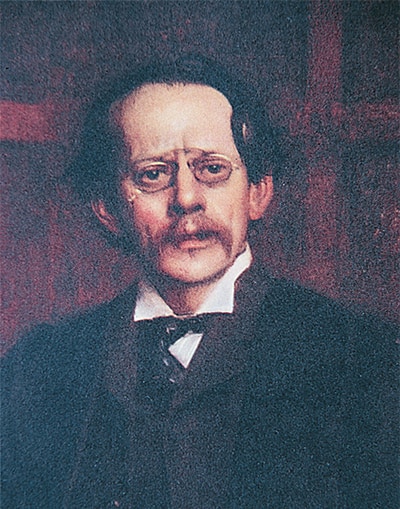
J J Thomson

Thomson grew up in humble surroundings near Manchester, where his parents had intended him to be an apprentice locomotive maker. But, as Gordon Squires recounts, a university scholarship led J J to Cambridge in 1876, where he made his momentous discovery as professor of the Cavendish Laboratory in 1897.

Thomson was from an era when physicists could afford to ignore the many practical applications of their discoveries, and once proposed the following toast: “Here’s to the electron. May no-one find a use for it”. That, of course, has now all changed. Electron beams, for example, are helping semiconductor multinationals to design integrated circuits that are even tinier than currently possible with light beams, as Lloyd Hariott and Alexander Liddle of Bell Labs explain.

Then there is the ubiquitous electron microscope, which can elucidate crystal structure, and even image and manipulate individual atoms. Ray Egerton from the University of Alberta in Canada describes electron energy-loss spectroscopy, a technique which can characterize interfaces buried deep in sample, and explain how individual atoms in a solid are bound to one another.

But a century after Thomson’s discovery, physicists still do not fully understand the fundamental properties of the electron. Ed Hinds and Ben Sauer from Sussex University in the UK describe the latest experiments to measure the electric dipole moment of the electron. Current theory predicts that it should be immeasurably small, but if the electron does have a dipole moment, we might get a glimpse of new physics that lies beyond the Standard Model that has ruled the sub-atomic world for more than 20 years.

Life after Schrödinger

It is difficult to imagine how a discovery in physics could reverberate around the world in the same way that Dolly the cloned sheep has in recent weeks. As biologists clone sheep and monkeys – albeit with only one event in noisy backgrounds of several hundred failed attempts – physicists are still trying to ‘clone’ the wavefunctions of single atoms, and then only in special circumstances. Yet as medical and biological research garners larger amounts of the public funds available for science, physicists with the requisite expertise could do worse than follow the old adage: “If you can’t beat them, join them”.

Physicists have developed a range of techniques now routinely used in medical diagnosis and, to a lesser extent, in treatment and therapy. However, there are also numerous opportunities for physicists to contribute to the most basic research in the life sciences. They would be in good company. Erwin Schrödinger was one of the first to stray into this field, most notably with the publication of What is Life? in 1944. Other physicists have left the fold completely and become biologists: Francis Crick of double-helix fame is one who springs to mind. Instrumentation will, inevitably, be the area where physicists have most to contribute. The enormous worldwide effort currently under way to sequence the human genome relies heavily on automated techniques, many based on physical processes such as fluorescence. Nuclear magnetic resonance is widely used to study the behaviour of proteins, while the manipulation of biological samples with scanning force microscopes and laser tweezers is becoming more widespread. In the US, neuroscience departments in universities are recruiting physicists to investigate how the brain works – optical imaging of voltage-sensitive dyes is a key tool in this research. Lucent Technologies is also doing similar work to figure out new directions in computing. Elsewhere, single-photon emission computed tomography (SPECT) is joining better known techniques, such as PET and MRI, to study drug addiction and various brain disorders.

An ongoing challenge in biology is to understand protein folding, in particular how the sequence of amino acids in the protein determines its final shape and function. Some have called this problem the ‘biological equivalent of the big bang’. Physicists have steadily been moving into this area for some time, bringing new theoretical and experimental tools to bear on this most basic, yet most puzzling, of processes. However, it would be naive to think that physicists could solve this or any other biological problem on their own – interdisciplinary collaboration must be the order of the day. Indeed, biology has a lot to teach the physical sciences, and some enterprising physical chemists are already using DNA-based techniques to self-assemble metal nanoparticles. Their long-term goal is to make nanoparticles with useful optical and electronic properties.

Moving into biology will also involve a change of mind set for physicists: notions of reproducibility and predictability will have to be rethought, and guiding principles like symmetry and associated conservation laws will be less powerful than in the physical world. As for a discovery to match cloning, unless some determined general relativist manages to build a time machine and return to the present with Einstein, 100 years from now the world will probably be celebrating the centenary of Dolly rather than the bicentenary of the electron.

The continued menace of communism in Russia

1. It is already nearly five years that the self-acclaimed ‘world socialist system’ crashed and the USSR broke into pieces. One might think that the grandiose experiment over the lives of hundreds of millions of people that Bolsheviks (communists) had launched in 1917 ran its full course and the total impotence of the communist ideology and practices became obvious. Unfortunately, there is a lot of wisdom in the saying that history only teaches us that history teaches us nothing at all. The short span of human memory, organic shortcomings of the democratic form of government, and certain crude blunders of the ruling few in Russia resulted in shaping up of a realistic communist and fascist threat for the future of our country and of the whole world. A historian A Yanov compared today’s situation in Russia with that in Germany in the 1930s directly before fascists gained power. Alas, I do see basis to this analogy (with communists substituted for fascists). The danger is all the more frightening since Hitler had no nuclear weapons while Russia may again turn into an aggressive nuclear power.

In this situation, the momentous significance of the presidential election on June 16, 1996 is obvious to everyone. If communists win, there is foundation for the blackest predictions; many even among very decent people fail to understand this. This was the stimulus for my writing this text. The thing is, I firmly believe that a just and decent person, in my interpretation of these two qualities, cannot feel attracted to fascists. The fascist ideology, with its racism, antidemocratic stance, chauvinism etc. is self-proclaiming and generates nausea. Communists, however, proclaim in their mottoes the shining ideals of justice and equality of all people and peoples, denounce arbitrary rule and lawlessness. As a result, those who do not know or turn a blind eye to history’s lessons are quite capable of swallowing the bait of the communist propaganda with its shameless, brash and covert lies. This is why anyone who is not blind to the past and believes that communism must be resisted should made a contribution to this fight.

I do not doubt that very many people understand this and share the view that only democratic evolution can bring happy future to Russia. Hence, my effort may be superfluous. Nevertheless, my opinion may not be devoid of interest. The reason is that political writing is typically done by journalists and sociologists, or people of ‘lyrical’ inclinations, who were never favoured here (I refer to the popular in the USSR the image of the ‘lyricist vs physicist’ confrontation). In contrast, I am a physicist and partly astrophysicist, that is, I belong to a ‘favoured’ group. Moreover, even if this is accidental, political powers have not passed me by with their favors: I received 1st degree Stalin Prize (later repainted into State Prize), Lenin Prize, some orders, was elected corresponding member of the Academy of Sciences (RAN now) in 1953 and full member (academician) in 1966. I could boast of a number of awards from this Academy and from a number of Academies abroad. In other words, I am not among those to whom the Soviet (communist) power either made active life difficult or whom it even put into prison. Thus this is not the case of vindication for me. Furthermore, I was a naive believer in communist ideals for many years, contrary to all facts and experiences. I will return to this aspect later. At the moment I only wish to explain that having understood at the sunset of my life the awful fallacy of the communist ideology and practices, I strive to help others not to commit old mistakes, not to be blind and deaf to the facts of not such a distant past.

2. Several years ago I watched a videotape about Robert Oppenheimer and the development of the atomic bomb in the USA. One detail caught my eye especially and stayed in memory. All ‘nice guys’ were liberals (some of them, if I am not mistaken, were communists) but they understood absolutely nothing about the practical side of communism in Russia or about the Stalinist dictatorship. On the contrary, the unpleasant guys, some of them in secret services, proved to be considerably more sagacious. This is very typical. Quite a few well known and respectable writers and scientists in the West supported the USSR, condoned, up to the second half of the 1940s, and some even longer, everything that its rulers, with Stalin at the helm, were doing to the population. Suffice it to mention Romain Rolland and Frederic Joliot-Curie in France. In 1937, at the very peak of terror, Lion Feuchtwanger visited the USSR but had left having understood nothing. How about the number of personalities in the West who became KGB informers on ideological grounds? We can mention K Fuchs who leaked atomic bomb data, and S Efron who ultimately brought himself and his wife Marina Tsvetaeva (Russian poetess) to a sad end. Infinite is the list of all misled souls.

A fairly popular opinion is that communists’ successes and the support accorded them by liberals in the West stemmed from lack of information. This is definitely not true. The butchery carried out by Stalin’s pack were sufficiently documented by as early as the end of the 1930s. Public trials and absurd confessions of the former leading Bolsheviks, their executions, the assassination of Trotsky and other heroics of the KGB outside the borders of the USSR, the murder of nearly the entire top echelons of the Red Army(this is a lot more than an ‘awl in a sack’ that, as the Russian saying goes, will out. But those who refused to see chose to close their eyes to it, blinded by the nearly religious faith in communism and, at least to the same degree, by the opposition of the USSR to the fascist Germany.

Archives have been opened in Russia in the last years and we were able to find out much of what remained hidden. Among these materials are, for example, the Ribbentrop-Molotov German-Soviet Pact, Lenin’s previously top-secret bloodthirsty ‘instructions’ (such as those on murdering of orthodox priests), and the scale of the terror. Numerous new evidence of lawlessness and repression were published, to complement that already contained in Solzhenitsin’s GULAG Archipelago . The latest estimates indicate that more than 21 million people were shot or had died in prisons and concentration camps. This is roughly the total population of the Scandinavian countries (Denmark, Norway, Iceland, Sweden and Finland) (!). We have also learnt that the spiritual and organizational leader of all repression was Stalin in person, this truly bloodthirsty bandit who showed mercy to no one. For example, it is his signature that was found under the ‘decision’ to shoot thousands of captive Polish officers in Katyn in 1940. It appears that by now only blind and deaf may refuse to conclude that Hitler and Stalin are virtually brothers in blood, that the fascist and communist rules are totalitarianism of the same mint.

3. Why had it taken so long to digest these truths?

Three causes emerge. First, as I have already emphasized, fascist mottoes produce negative response as a matter of course. Contrary to this, communism’s appeals to social justice, internationalism etc are very seductive. Second, Hitler & Co broadcast their troglodyte plans openly. True, even fascists tried to hide their ugliest deeds such as the ‘operations’ of gas ovens in Oswiecim (Auschwitz). On the whole, though, their true face and ideology were exposed for all to see. As for the communists, they played their hypocritical game skillfully and consistently from beginning to end. Examples are endless. Suffice it to mention the brutal murder of czar’s entire family, including young teenage girls and the terminally ill boy. Lenin had sanctioned this crime. I have read somewhere recently that responding to incessant queries about the fate of czar’s family that kept coming from A A Ioffe, the Russian representative in Germany, Lenin gave roughly the following instruction: Tell him that the family have not been shot; this will make it easier for him to lie. In fact, this is a relative ‘detail’; hypocrisy and lies infused everything that the Bolsheviks ever did. Consider the above-mentioned Katyn. I remember well how a specially formed commission, which included a known KGB agent Orthodox metropolitan Nikolai, published the conclusion that the crime was committed by the Germans. The truth was acknowledged only very recently, just 50 (!) years later.

The third reason for the popularity of communism in the West was that the alternative form of rule – a democracy – is by a long shot not an ideal system. Furthermore, capitalism is disgusting in many of its facets, and familiar lines from the Soviet poet-laureate Vladimir Mayakovsky are quite true to life:

A doughnut to one

and the hole from its middle to another

This is what the democratic republic

is all about.

This is quite correct but the tragedy was that in the socialist society (a ‘developed socialist society’ of the 1970s on top of that) that communists in the USSR and in its satellite states pretended to have constructed, it was only on paper that the social equality existed. In actual fact, the absence of human rights, the reign of lies, despotism, arbitrariness, and often terror ruled the land. I heard that Mayakovsky ultimately understood it, which was one of the reasons for his suicide in 1930. In addition to Mayakovsky, we can recall other outstanding poets whose physical ordeals in Bolsheviks’ hands have no question mark on them. Nikolai Gumilev was shot, Osip Mandelshtam died in a concentration camp, Marina Tsvetaeva was humiliated, lost all roots and ultimately hanged herself, Anna Akhmatova and Boris Pasternak were persecuted, Iosif Brodsky was arrested and then exiled abroad. Recalling all this is frightening and painful, especially if one keeps hearing eulogies of dirty liers or incorrigible fools about ‘communism’s humanism’.

4. We used to read tons about ‘the rot setting in’ in capitalism, about its forthcoming doomsday, about economic advantages of ‘socialist system’ and its inevitable victory. Let us acknowledge that in the past communists did accept the ‘criterion of putting to practice’, which is an inherently clear statement that any theoretical construct must be judged, and its fate evaluated, only by comparing with reality. By the way, experimental testing (i.e. the same ‘criterion of putting to practice’) and its decisive role form the basis of all natural sciences. Theories are almost always in abundance while there is only one reality. Communist practices crashed in flames, getting no help from the vaunted clichés of ‘proletariat’s dictatorship’ and ‘democratic centralism’ which proved to be nothing less than dictatorship by a pack of leaders (Führers) and then by a single Führer and the ‘genius of all sciences’. The economic system of ‘socialism’ ended in complete failure: the country with the most abundant resources became a poor beggar. The victorious country that paid for the victory by millions of lives of its citizens, fell to a humiliating low of receiving humanitarian aid from the previously vanquished and destroyed Germany. The latter rose from the ashes owing to the democratic society that replaced fascism and thanks to the help provided by other democracies. Democracy proved capable of modifying and adjusting its rule, curing drawbacks of capitalism where possible, fighting racism (one example is the successful fight to exterminate racial discrimination in the USA) etc.

The conclusion that one has to draw from applying the practical criterion-what we call history’s verdict-is obvious. One of its versions was excellently formulated by Winston Churchill: democracy is a very bad sort of rule but nobody suggested anything better.

I also heard an opinion that Russia was specially unlucky in that Stalin has become its leader. True, such monsters are produced not so frequently, but not so rarely either (remember Hitler and Pol Pot). However, there is no ground to believing that the fate of the country in a broader perspective would be significantly different if Trotsky or someone else happened to be in power. The basis for this conclusion is the story of building ‘socialism’ in East Germany, Czechoslovakia, Albania, Poland, Bulgaria, Romania and, finally, Cuba. In the last case there was not even a threat of direct occupation but the self-proclaimed ‘Freedom Island’ proved to be a ‘Prison Island’ from which its citizens flee in despair to the US. Another example is Yugoslavia. Bros Tito rejected Stalin’s pressure and was creating his sort of ‘socialism’ in his own manner. The tragic fate of his country is for all of us to see. Unfortunately, as I had an occasion to write before, so many people refuse to see the obvious.

5. So much has been written about communism, its essence and its fate that I could not hope, nor attempt, to add anything new. I will only remind the reader of a few points. Also, in this context, I cannot help mentioning Lev Tolstoi’s revelation. I was brought up in the Soviet period, my interests did not concentrate on great literature, so that I regarded Tolstoi as a great writer and knew nothing of him as a great thinker. Moreover, I always was and still remain an incorrigible atheist, hence Tolstoi’s religious pursuits leave me indifferent. However, in an excellent article by the recently deceased I D Konstantinovsky (in a Moscow magazine Ogonek ) and in his book As a Candle from a CandleŠ An Experimental Biography of an Idea (Moskovsky Rabochii 1990). I learnt of Tolstoi’s unfamiliar facet. It may be of interest to very many people.

Long before revolution Tolstoi was acutely aware that violence could not create a just and flourishing society. For him, attempts to grab power and then build a ‘socialist society’ by any sort of ‘equidistribution’, forced production quotas, drawing ‘lists’ for food rationing etc were a social utopia. Tolstoi asked: ”Why do you think that the people who will form a new government, the people who become directors of factories and land Š will not find a way to get hold, just as now, of a lion’s share and leave to the simple and the meek only the bare essentialsŠ People who are governed in life only by the worries of their own well-being will always find a thousand ways of corrupting the social arrangements”. Elsewhere Tolstoi wrote: ”If what Marx predicts does materialize, all that would happen would be for the despotism to shift: where capitalists were lords, administrators of workers will be lords”.

Lenin’s predictions were different: ”The entire society will be one office and one factory, with equal labour and equal pay”. Isn’t it obvious that Tolstoi was right while comrade Lenin and his pack were ignorant of human nature and had no success in trying to warp it by bloodletting.

6. For reasons that I hope will become clear soon, I wish to reveal some details of my own life.

My father was an engineer of the old generation, never a party member. We had no one among our relatives or close friends who would go for political activity or at least would be capable of comprehending the real situation in the country. I was not personally acquainted with a single person who suffered from Stalin’s repression. I was surrounded by communist banners, by prayers sung to the ‘Great Stalin’ and by the information on the truly appalling feats and gambles of the fascist side. We should not forget that the Soviet power had unquestionable achievements as well. Suffice it to mention here the elimination of illiteracy and unemployment, the absence – in the prewar decades – of racial discrimination (and specifically of state-supported anti-Semitism), the possibility to get education. Consequently, I am not going to repent, even today, that in 1937, at 21 years of age, I enrolled in the young communist league (komsomol). There was not a shadow of career-making in it: non-party-members were allowed into post-graduate courses of the physics department, and that was as far as my plans stretched. Neither am I ashamed of joining (or rather becoming a candidate to) the communist party in 1942. It happened in Kazan on the Volga to which the predominant part of the Academy of Sciences of the USSR was evacuated; that was the period when the German armies were closing in on the Volga. I never tried to avoid mobilization, tried to volunteer twice, and had no ‘shield’ from being drawn. However, there must have existed some sort of obscure instruction: do not accept into the army, without special reason, young scientists without previous military training. Frankly speaking, this was a wise decision, proved very beneficial after the war, when the destroyed industry was being reconstructed and new technologies were emerging. An aside: I had never occupied any party positions of any distinction whatsoever.

In 1942 I defended the DSc degree in Physics and Mathematics, worked in the Lebedev Physics Institute of the Academy of Sciences of the USSR (FIAN) but, although I had plenty of energy to teach, could not find a position in the Moscow institutes. Consequently, when I was invited to become a part-time professor of the radiophysics department of the University of Nizhnii Novgorod (then Gorkii) (GGU), I accepted.1

There I met Nina Ivanovna Yermakova and we got married in 1946. I mention this fact here only because Nina was not a mere ordinary Soviet citizen: she was in exile. Her father was a communist, an outstanding engineer; in 1938 he was arrested and sent to serve his 15-years sentence in the far North. However, it proved possible to collect a large number of supporting signatures of his colleagues (in those times this was an exceptional, very non-trivial feat) and I P Yermakov was returned to a Moscow prison for ‘additional inquest’. At this moment the Second World War erupted on the borders of the USSR, the Butyrka prison was relocated to Saratov, and Nina Yermakova’s father died there of hunger, allegedly in the same prison cell as the well known biologist Nikolai I Vavilov. Nina was at that moment a student of the Moscow University’s Mechanics and Mathematics faculty, and was acquainted with other students whose parents were prosecuted (‘repressed’). At that moment our glorious ‘services’ decided to concoct a ‘process’ on a group of youngsters who were chosen for the roles of ‘insurgents’ who, allegedly of vindictiveness, planned to kill the great leader and teacher himself. Alas, Nina lived in a flat on the Arbat street through which this leader sometimes ‘drove in five cars’ (I am using B Slutsky’s imagery). Well, the young terrorists were said to prepare the assassination by shooting from the window of that Arbat room. However, the script-writers from the NKVD-KGB did not bother to check their facts. The rooms in the Arbat flat in which the Yermakovs lived was peopled by ‘reliable inhabitants’ while Nina and her mother were left in a room whose window faced the inner yard. KGB thus had to change the accusation of terror to an ‘innocuous’ one of ‘counter-revolutionary discussions’ and of participation in a ‘bad’ group of terrorists (articles 58-10, 11 of the Penal Code of the time). The absence of windows to the Arbat roadway and the refusal to ‘confess’ the guilt, despite ten days in severe-regime single cell with ban on sleep, led to a ‘sentence’, by Special Trial Unit, that in those times was regarded as unbelievably mild: three years of hard labour, minus the nine months already spent in jail (from July 1944). The war has ended at this very moment and amnesty was announced; for inmates with less than three-year terms it covered article 58 as well (there were so few ‘counter-revolutionaries’ with only three years’ sentence that their case, I believe, was simply overlooked when amnesty was being defined). The amnesty was half-hearted: people were let out of labour camps but banned from settling in large cities. This is how Nina found herself in the village of Bor, on the Volga’s banks the other side of Nizhnii Novgorod; a lucky combination of circumstances allowed her to enroll in the Polytechnic Institute. A curious stroke to the picture: after marriage, I would write an application to the KGB once each year (I was not allowed to do it more often) requesting that my wife be permitted to move to Moscow. These applications were seconded by the directors of FIAN S I Vavilov and D V Skobeltsyn, well known physicists and public figures. I had no success and only learnt that these two directors also had exiled relatives and equally failed to wangle official permissions for them to stay in the capital. 2

To exhaust this topic, I will add that my wife was able to return to Moscow only in 1953, as a result of a new amnesty that followed Stalin’s death. Another nice feature. When my wife received the official ‘rehabilitation’, this operation needed a visit by a KGB officer accompanied by witnesses who were to compose a protocol to the effect that the windows of the room where Nina used to live did indeed give into the yard. Truly, there is but one step from tragic to ridiculous too.

But let us return to Stalin’s times. Clouds were gathering over my head. I was a party member who had lost his class sensitivities to such an extent that had married an exiled person, being himself a Jew to boot (this became an important factor by that time) and, finally, a ‘cosmopolitan’ and a ‘sycophant’. I doubt if the younger generations remember this last rabid label but in the second half of the 1940s it was all over the pages of newspapers and agendas of meetings. So: bad apples were discovered, literary critics more than anybody else, and quite a few others who ‘began to kowtow to everything foreign’, to ‘lick the boots of foreign science’ and at the same time ‘belittle national values and national interests’. A great many, I do not know how many, were subjected to the so-called ‘trials of honour’, and some were repressed. On October 4, 1947 (my birthday, by the way) an article was printed in Literaturnaya Gazeta , with a title ‘Against Sycophantism’; it was signed by the director of the Agricultural Academy B Nemchinov. The article was an attack mostly against certain ‘enemies of truly scientific’ Michurin-Lysenko biology (A R Zhebrak was the main culprit) but I was also branded a ‘bootlick’. Some time later I managed to find out how my name and my ‘sins’ got into this article but this is not the right place for this story. I cannot help mentioning that eleven most prominent Soviet physicists sent an official protest to the paper, characterizing the accusations against me as ‘insulting slander’. The communist party cell of FIAN treated the article in Litgazeta similarly and passed a special resolution to clear my name. As was normal for the times, no retractions were printed in the paper. The ideological ‘crusade against sycophants’ was getting stronger by the day. Before I could bat an eyelid, the Superior Attestation Commission rejected the application for Professorship degree for me, submitted by the Gorkii University. My name started its odyssey as a negative specimen through various executive orders and articles, and I was dropped from the Learned Council of FIAN ‘for the purpose of strengthening it’. I describe it all not for revenge (this would be ludicrous) but to partly conjure up the colours of the time and, most of all, to formulate my firm conviction: in view of the combination of circumstances, I was a sure candidate for arrest. If anything saved me, it was Š the hydrogen bomb.

In 1947 the gigantic effort of producing the Soviet atomic bomb, headed since 11 February 1943 by Igor V Kurchatov, was in full swing. There was still a long way to go to the test blast (it had taken place on August 29, 1949). Nevertheless, the possibility of developing the hydrogen bomb (thermonuclear weapons) was already a matter for thought. Has it happened due to local initiative or has it been stimulated by intelligence data – I do not know (A D Sakharov in his ‘Memoirs’ 3 writes in chapter 6 that intelligence information was the likeliest stimulus. 4 Preliminary calculations carried out by Yakov B Zeldovich and his group at the Institute of Chemical Physics of the Academy of Sciences of the USSR led to fairly pessimistic conclusions. As was customary in such situations, Kurchatov decided to throw the same problem to a parallel group of physicists at FIAN, headed by Igor E Tamm. It was most probably quite difficult to get permission for this since Tamm’s reputation with the authorities was not too good (he was a Menshevik before 1917, and in the 1930s his brother was shot; I wrote about this in an article devoted to Tamm’s 100th anniversary in RAN Vestnik 1995 no 6, p 520. I believe that Kurchatov was able to involve Tamm only because the problem had not seemed too pressing; rather, it appeared fairly hopeless. For the same reasons, Tamm was able to incorporate me into his group, despite my shortcomings outlined above. Sakharov was included in the group, as he writes himself, because he was supported by FIAN director S I Vavilov who wished to get him somewhere to live in Moscow. Truly there is but a single step from the great to the laughable.

I won’t describe the details of our work since Sakharov has done it in his excellently written Memoirs . It is only important to mention that in 1948 Sakharov came up with what he called ‘the first idea’ and then I suggested ‘the second idea’, and these made the creation of the H-bomb possible. Even in 1989, when Sakharov had a chance to amend his book, the ideas no 1 and no 2 were still strictly classified: 40 years after emergence! This absurdity, so typical for our recent past, was overcome (if this expression is permissible) only after Sakharov’s death (see Priroda no 8, pp 10 and 20, 1990). Expanding on the gist of the two ideas is unnecessary here. In 1950 Tamm and Sakharov were sent to the ‘object’ (which at that time was deeply classified but nowadays is known as Arzamas-16) in order to direct the actual development of the hydrogen bomb. However, I was not allowed to participate in this work and had stayed behind, in Moscow, heading a small ‘support group’ guarded by secret service; I still had only a restricted access to classified research, even though my classification was ‘Top Secret. Special File’. I was obviously tremendously lucky: had some sort of ensured protection and at the same time was able to do research ‘for soul’s sake’ (had enough time left for it) and to travel to the exiled wife. In fact, menacing complications resumed in 1952; I lost access even to some of my own research reports (on controlled nuclear fusion). Sakharov writes in his memoirs that at the beginning of 1953 ‘cargo trains were ready for the deportation of the Jews, and the propagandist texts were already printed to justify the measure’. Unfortunately, I have no other reliable information on the matter. I do not know what fate awaited me: to stay behind in a ‘sharazhka’ (prison research unit) as a still ‘useful Jew’, or depart with a doomed train. Fortunately, Stalin failed to implement his last insane schemes.

After the first hydrogen bomb was successfully tested on August 12, 1953, my awards were a class lower than those of Tamm and Sakharov but were quite high nevertheless. However, the most important thing was that after the arrest and execution of Lavrentii Beriya and his henchmen KGB’s hands became shorter and the climate in the country mellowed in many respects. This article is not the place to describe it all. I should only remark that until the famous Khrushchev’s revelation of 1956 I, like so many others, remained ignorant of the true role played by Stalin in unleashing the now exposed outrageous atrocities. I am very ashamed of this blindness of mine. The falling-off of scales was so painful that I became very careless and soon attracted KGB’s attention. Some of our acquaintances began to avoid my and my wife’s company; we found out later that they were invited ‘where one does not dare to refuse invitation’ and demanded to inform about me. The menacing hand with the sward has weakened, however, and people, at least of my station in life, were not thrown into jails or lunatic asylums for mere loose talk among fellow Soviet citizens. The only field in which the damage was done was the travel to scientific conferences abroad. Using secrecy rules as a pretext, I was not allowed abroad and lost a great deal from missing conferences to which I was regularly invited. That the secrecy was a pretext was beyond doubt since people who knew incomparably more about classified matters had much greater freedom of travel (fortunately, Tamm had). Still, I did visit some places in the 1960s, and a couple of times even together with my wife (that was a rare privilege in the Soviet times). But even this phase closed as a result of the clandestine reports of ‘well-wishers’ and later because I was, let us say, too close to Sakharov. I do not mean any personal closeness but the fact that since 1971 I headed the Tamm Department of Theoretical Physics of FIAN and Sakharov was on the staff of this department from 1969 till his death. I never signed any ‘letter’ directed against him, I tried to help him, and visited him twice in Gorkii during his exile. 5 I am not trying to boast, I simply explain why I did not enjoy any favors from the authorities.

In 1989 I was elected people’s deputy from the Academy of Sciences of the USSR to the Supreme Soviet and tried to be conscientious about my duties; I was a fairly active member of the Parliamentary Commission Against Privileges. Now that I write this, it is a sad joke to remember that B N Yeltsin was just about the originator of this struggle. In politics I was, not without qualifications, on the side of Gorbachev and Yakovlev, and I do not regret this. 6 I will complete the autobiographical part of this article by saying that I resigned from the Communist Party at the beginning of 1991, and completely stopped any political activity ever since the dismissal of the Parliament at the end of 1991.

8. Soviet science and technology had outstanding achievements: suffice it to mention the launching of satellites and the space research, the highest level achieved in physics, mathematics and in some other sciences. An evidence of this level is the fact that, having ultimately gained the freedom of travel and at the same time suffering from low wages, a number of our specialists (some members of the Russian Academy of Sciences among them) were able to find excellent employment in the West, some as full professors. Note that this happened against the background of obvious insufficiency, for instance in the USA, of vacant positions for the young American scientists. An opinion was formed in this connection that science under ‘socialism’ was in full bloom. This judgment is at least very one-sided. Physics, mathematics and some other fields were in good state. But biology, which was doing quite well after the 1917 revolution, was virtually quartered, especially at the sadly immortalized session of the Agricultural Academy in 1948. The thing was that Stalin, and Khrushchev after him, chose to imagine themselves to be experts in biology as well, had supported the ignorant and aggressive brute Lysenko, and suppressed, sometimes physically, all his opponents. Cybernetics (computer sciences) and cosmology suffered a similar fate, even if in less dramatic circumstances. As for social sciences (economics, history, literature and language studies etc), there wasn’t even a shade of freedom of opinion there, everything was dictated by the Marx-Engels dogmas and by the latest instructions of the Central Committee of the Communist Party.

In fact, physics has matured for a ‘Lysenko treatment’ as well: the all-USSR Conference was in preparation, to take place on the 21 March 1949, but got canceled at the very last moment. No documents about this survived or have not been uncovered yet. The most plausible version is this.7

The atomic bomb has not been test-exploded yet, and Kurchatov has replied to Beriya’s question that ‘no, the bomb cannot be produced without relativity theory and quantum mechanics’. Beriya responded, very disturbed, that the bomb is all-important and the rest is rubbish (‘the rest’ meant sniping at modern physics for its allegedly idealistic orientation). Presumably, Beriya immediately reported to Stalin about the situation, and Stalin ordered to cancel the conference being organized by the Central Party Committee: no one else would dare.

This event points to the obvious: physics, mathematics and some other sciences were supported only since they were required to develop bombs, rockets and other weapons systems, for the industrial effort etc. To achieve such aims, nothing was spared. I recall how our salaries were raised several-fold after Americans exploded atomic bombs in Japan; imagine the golden rainfall enjoyed by the leaders of important projects after their successful completion. However, man lives not upon bread alone, and on the whole our life was quite bitter. The ideological repression, 8 censorship, the ban on using copiers unless in a special room behind iron bars, impossibility of free travel abroad and free exchange of information with our colleagues in the West. And of course, brutal repression. A brilliantly talented physicist Matvei Bronshtein was shot, outstanding physics theorist S Shubin died in a labour camp, no one knows where. An incomparable physics experimentalist L Shubnikov, and several other physicists from Kharkov with him, were shot. The great Lev Landau spent a year in jail and miraculously avoided death. In fact, the recently published Tragic Fates: Scientists of the Academy of Sciences of the USSR in GULAG (Moscow: Nauka, 1995) lists 105 full and corresponding members of the Academy of Sciences of the USSR, incarcerated in different periods (the list in definitely not exhaustive).

I should remark that even at this first stage of democracy in Russia, censorship has been removed, we talk freely, can travel abroad, and our science could flourish were it not for financial difficulties. The world science today is a typical democracy with all its advantages and disadvantages. Sometimes scientists get a doughnut and sometimes the hole in it, there is no equality and no justice, and there cannot be. Some people get Nobel or other prizes (doughnut) while some (just as deserving) do not (hole). Some are elected to various academies, others (equally deserving) are not. Some occupy excellent positions, others fail to find good employment. Some publish their results easily, others struggle, etc. This all stems from human nature and is typical of democracy. A lot can be improved and indeed needs improving, and this ability to improve is also a typical trait of democracy. However, it is impossible to reach the ideal state (complete justice), and quite often it is not clear what the ideal is. Still, there is a great difference between sometimes getting the hole of a doughnut and for an innocent person to be thrown into jail or be exiled.

9. It is high time, however, for me to return to the main topic of the article. I have already stressed that we now possess important fruits of democracy: freedom of speech, free elections etc. Plus, of course, shelves full of food and merchandise in shops. I remember too well not only empty shelves but also rationing cards, and the abundance of food and stuff never ceases to surprise me. Alas, here I have to stop the pro’s and start the con’s. The goods are there, indeed, but a considerable part of the population cannot afford to buy them. The average salary of those on the stuff of the Academy of Sciences is 300, 000 roubles per month. Doctors, teachers and all other ‘state budget’ people draw wages that are patently inadequate for decent life. Pensioners and invalids fare much worse. In January 1996 the total number of citizens with income below the official minimum was 37.3 million people, which is a quarter of the entire population of the country. Add to this the crazy and unbelievably unscrupulous delays of many month in paying wages and pensions. This takes place against the background of growing social inequality. ‘Nouveau Russians’ and a certain, not quite decipherable to me, layer of very rich attend night clubs and restaurants, drive expensive foreign cars, have super-luxurious (by our standards, anyway) country villas, spend holidays at spas abroad, or even buy real estate in the West. How could they get hold of the money? What part of the rich (I fear that a very high proportion) are crooks? The situation is aggravated by inane wasting of resources by the authorities: enormous expenditure on repairing the ‘White House’ and on equipment for it and for the Federal Assembly, the cost of upkeep of the former and current lords of the Duma (Russia’s parliament) (see Argumenty i Fakty no 7, 1966, p. 2), of countless, mostly meaningless, trips of various highly placed officials with their retinues, let alone Duma members and powerful administrators. I was never able to see published figures of all these ‘expenditure articles’. In contrast, as far as I could find out, in UK there are only about twenty state-owned cars for all ministers and civil servants. Papers reveal again and again how ministers in the USA and other countries resign after being caught using taxpayer’s money for private purposes (such as going to a sanitarium with a family). In fact, numerous examples could be found that show how ”people’s servants” are monitored by their electors and dare not misuse public money or resort to parliamentary immunity to escape criminal investigation.

I cannot help mentioning, when describing the current situation in Russia, the rampant crime wave and the corruption that is eating away at the administration and law-enforcement branches. Finally, we all know about blunders in Chechnya and the aberrations in the army.

Is it any surprise then that the ‘ruling party’ has received mere 10% at the elections of 17 December 1995, while LDPR (Zhirinovsky’s ultra-right Liberal-Democratic Party of Russia) and other organizations of this type (referred to as ‘left’ in Russia, for some reason, although friends and analogues of Mr Zhirinovsky are labelled right everywhere else) collected together about 15% of the votes and communists of all colours received 25%. Clearly, these negative sides of our lives now cannot be outweighed by the freedom of speech and the availability of foreign travel (provided money is available) for most of those who do not have enough to eat, and not only for them.

I am not an expert in economics, finances and the methods of governmental control and thus have no right nor desire to offer advice in these fields. In fact, I am not of those who claim ‘to know how everything should be done’. It appears admissible, though, and in the context of this article to some extent necessary, to make several remarks and express an opinion on select issues.

What is the purpose of reforms carried out in Russia and of the entire historical process of passing from the ‘well-developed (or advanced) socialism’ to something different? The aim is to build up in Russia a stable, affluent society of a Western type, that is, characterized by market economy and strong democracy. Sometimes people speak of ‘advanced capitalism’ but for myself, as for quite a few people who lived that long under the Soviet system, the word ‘capitalism’ is fraught with very negative connotations. It is associated with grim factory blocks and workers that are jaded with poverty and hard labour. Marx may have imagined a picture like this but nowadays it has very little in common with reality.

The most important aspect that permits one to regard this aim as realistic is the fact that it has already been achieved in a number of countries and thus is not an utopia, like communism. Of course, each country has its specifics, and Russia has its specifics raised to power two, if I may say so. Nobody in his or her senses suggests blind copying.

Alas, our reforms were poorly prepared, and were carried out in haste and confusion. This may explain how very grave errors were committed. ‘A voucher to everyone’ operation seems ludicrous to me (I have sold mine for 20 US dollars), while many other acts of privatization appear to be simply criminal. A typical example can be taken from a recent interview with the former mayor of Sank Petersburg Aleksandr Sobchak (Izvestiya 20 February 1996). He said: ‘The Baltic Shipping Company’ was in fact sold out as a result of careless privatization. It was bought up for a song as a rented enterprise and then sold off by parts for debts. About fifteen people got rich, bought real estate abroad and emigrated while a huge shipping company, one of the largest in the world and dominating the Baltic sea, disappeared.’

Such follies, uncountable in number, bled the country and generated this phenomenon of ‘nouveau Russians’. Tens of billions of dollars fled from the country, and was anybody punished? At the same time, Russia struggles for credits from the West (these will have to be paid back) of considerably smaller size.

The President and the government looked indifferently on the creation of crooked banks of MMM type and of various ‘enterprises’ erected to rob gullible investors. Who of the organizers of this thievery has been prosecuted? The previous Duma discredited itself by saving its member Mavrodi (the MMM-Mavrodi) from trial by court by a revolting shield of parliamentary impunity. Now populist stimuli make authorities discuss possible compensation of the duped investors. At whose expense? I am of the opinion, by the way, that if compensation is undertaken, it is only the pensioners and the poor that must be given anything. As for those who simply wished to get rich ‘while the getting was good’ (I think that their number is not less than that of the former group), there is no reason to restore their investments at the expense of the rest of the population who had clear heads on their shoulders.

When we read about the life of the military in the army and the navy, the heart virtually misses a beat (the latest evidence known to me appeared in Izvestia on February 14, 1996 about the situation on the Admiral Gorshkov aircraft carrier). No one threatens Russia, armed with its nuclear arsenal, and even regardless of it; it is absurd to keep an enormous army that the country cannot afford to feed and arm. The only argument I heard for maintaining this army is the unbelievable, unheard of anywhere in the world number of generals who insist on the respectable number of subjects. As a result, instead of urgent reductions in the army, the government extends the conscription term and sends students (!) to the army. Using the words coined by Napoleon’s minister of police Fouché,’this is worse than a crime-this is a mistake’.

I have already mentioned the delays (sometimes of many months) in payments of wages. Entering the election campaign on 15 February 1996, B Yeltsyn promised to do away with this disgusting despotism. However, what precluded him from declaring this earlier? Why only the threat of failing at the election crucible awoke the President from his lethargic sleep? (or was it his many courtiers who woke him up once they realized that the threat of losing power was quite real?)

This list of shortcomings would be very incomplete if I forgot to mention the absolutely insufficient fight against the cancerous corruption and crime. Papers often revealed that police and security services know nearly all criminal ‘authorities’ and ‘thieves-in-the-law’ virtually by names. Their meetings were broken into but Š the culprits were immediately released (?!). Numerous assassinations and murders remain unsolved. Courts let obvious criminals and fascists off the hook.

I will allow myself two more remarks. I still remember the destruction of the Christ The Savior cathedral in Moscow and definitely regard it as a barbaric act, quite in the spirit of other feats of Stalin and his ilk. However, why is it necessary now, amid raging financial crisis, to reconstruct the cathedral at the state’s expense? We hear, though, that some church money are also attracted but their fraction is hushed up and that is reason enough for knowing the true source of financing. This flirting with church and direct financial support contradict the separation of church from the state. If the government has money to spare, it must build hospitals and homes for the aged, not reconstruct the churches. By the way, our modern communists, whose fathers, led by Lenin, persecuted priests in the most brutal fashion, nowadays flatter the Orthodox church and even denounce atheism (I have heard this remark from Zyuganov), even though atheism is not al all against freedom of religious beliefs.

My second remark is aimed at KGB. In the Czech republic and in Germany, the archives of KGB analogues are open to public. Each citizen can find out who had been writing slanderous reports to KGB on him or anyone else. I do not speak of vengeance: simply, exposed informers must be prohibited from occupying positions in law-enforcement structures. By the way, our media several times informed the public that some of the highest-rank priests of the Russia’s Orthodox church closely cooperated with KGB. Do not the Christians have the right to know the truth about it? In short, I believe that the archives of the former KGB must be completely opened for all Russian citizens. This act would be the best guarantee that FSB (Federal Security Service) will never turn into something quite equivalent to KGB.

Why did I need to start the enumeration of the open sores of our society and to remind about the errors committed? Obviously, to ask a question: how can we cure these sores, how to live on, how to reach the goal of building in Russia a rich democratic society? Could it be that this requires yielding power to communists whose critical arrows partly aim at the same target and who have plenty of experience of destroying a society they dislike? My answer to this question is, categorically, in the negative.

In principle, our current Constitution and the presidential type of government make it possible to eliminate the shortcomings and speedily move in the predetermined direction. What party is capable of this? A tough question; I can only confess that in the elections to the Duma in 1993 I voted for the Grigory Yavlinsky’s ‘Yabloko’ (Apple) combine of parties although almost all those close to me preferred Yegor Gaidar ‘Russia’s Choice’. As these friends, I do regard Gaidar and his team as honest people and truly democratically minded. 9 Alas, Gaidar and his team made many errors while Yavlinsky at least had no chance of making them. I consider him to hold honestly to democratic principles and to be a highly professional economist. These are the reasons why I would like to see him at the helm. In the elections to the Duma in 1995 I also voted for Yabloko, although my vote in the single-mandate electoral region went to the representative of the DVR. I plan to vote for Yavlinsky at the presidential elections as well, unless it becomes unmistakably clear that he fails to pass on to the second round. In this case I may have to vote for Boris Yeltsin. If even Yeltsin does not make it to the second round, I will have a single option: to vote against both opponents (say, Zyuganov and Zhirinovsky). Indeed, if the number of second-round voters that vote ‘against everybody’ is found to be greater than that supporting any of the candidates, the results of elections will be announced null and void.

Should the Communists win in the presidential elections, the country will be rolling back, and fast. This conclusion follows, on one hand, from the knowledge of the Communist (Bolshevik) rule between 1971 and 1991. On the other hand, the available documents of the Communist Party of the Russian Federation (KPRF) point in the same direction. 10 The program of the KPRF (which is the most liberal among all currently active communist groups acting now in Russia) does not have a single word of reproach regarding the crimes of VKP(b)-KPSS, to Stalin’s terror, to the persecution of dissidents, including the use of psychiatric hospitals, in the post-Stalinist era. As one would expect, a seemingly inescapable call for repentance is nowhere to be discovered. I was truly shaken when I found in the text of the election platform of the KPRF (p 5) a quote from Lenin: ‘political parties must be judged not by their promises but the results of implementation of these promises’. Don’t we remember what communists promised in 1917, and many times later, and what they actually did? If communists win now, the story would repeat itself. Indeed, communists ‘forgot nothing and learnt nothing’. Formally, this statement could be challenged. I have not found in the publications of KPRF the demand for proletariat’s dictatorship, nor of loyalty to Marxism-Leninism, and these were a trademark of the documents of KPSS. I think, nevertheless, that this is not more than smoke screen needed to avoid frightening away the voters by reminding them of the past; moreover, these mottoes are not that important in the practical activities. These practical steps will involve nationalization, restriction of the freedom of speech and freedom of the press (I can advise looking at the statements of KPRF’s member of Duma Yu Ivanov, published in Izvestiya on February 15, 1996). Once communists fail-inevitably-to achieve economic success on a ‘socialist’ path, they will immediately start a witchhunt for the culprits (this will again generate ‘enemies of the people’), and law-enforcement branches will start on the familiar path of VChK, OGPU, NKVD and KGB. The overtures we see even now between KPRF and various nationalist-chauvinistic and brownshirt elements will grow stronger, the army will not be reduced, the foreign policy will get tougher by using demagoguery about NATO’s aggressiveness, and so forth. On the whole, Communists’ victory in the elections will be their revenge, a leap into the past (I quite agree with the prediction of O Moroz in Literaturnaya Gazeta of February 14, 1996) and a terrible threat for Russia and the entire world.

The responsibility of the Russian voter is overwhelming. Everyone to polling stations! I suggest you will vote exclusively for a democratic candidate or a candidate supported by the democratic parties.

Vitaly Ginzburg

(Translation by Vitaly Kisin)

Footnotes

1 I worked at the radiophysics department of GGU and at the Radiophysics Institute (NIRFI) and then was in contact with them for many years. Quite a few physicists of high calibre emerged from these places, including the present governor of the Nizhnii Novgorod region B Nemtsov.

2 See a story about this that I published in Science and Life 1992, no 1 and in my book On Physics and Astrophysics 1995 (Moscow: Bureau Quantum).

3 A Sakharov Memoirs 1990 (New-York: Chekhov).

4 A very recent article by Yu B Khariton, V B Adamsky and Yu N Smirnov (Soviet Physics Uspekhi 1966 166 185) describes for the first time and in considerable detail the history of developing the Soviet hydrogen bomb. The article shows clearly that in this case intelligence played no part. The history of the development of atomic and hydrogen bombs in the USSR can be found in D Holloway Stalin and the Bomb (New Haven: Yale University Press).

5 For details, see my article ‘On the Sakharov phenomenon’ published in the magazine Svobodnaya Mysl (Free Thought) nos 14, 15 (1990) and in the already mentioned book On Physics and Astrophysics).

6 A N Yakovlev, formerly member of Politburo of KPSS and one of the initiators and leaders of the ‘perestroika’, is currently the Chairman of the Commission, set up by the President of the Russian Federation, on Rehabilitation of the Victims of Political Repression. In this capacity, he had access to an enormous amount of reliable data, numbers and facts, that characterize the Communist (Bolshevik) rule in Russia and the USSR. He’s recently published a book ‘Like the the relic, like the holy oil’, based on this archive. On the whole, we know it all, but one discovers many important details, many new examples. The general statements and conclusions in this article and in Yakovlev’s book are in excellent agreement.

7 About this and the preparation of the above-mentioned conference, see A S Sonin Physical Idealism: A History of One Ideological Campaign (Moscow: Fizmatlit, 1994).

8 See, among others, the book by A S Sonin cited above. I would also like to recommend E Kolmen’s Our Lives Should Have Been Different (New York: Chalidze Publications, 1982). This is an autobiography of one of the brilliant and active ‘fighters for purity of the Marxist(Leninist ideology’, who only understood what was what by the end of his long life.

9 In addition to this, Yegor Gaidar is undoubtedly and very knowledgeable and well-educated person (see his book State and Evolution (Moscow: Eurasia, 1995).

10 IIIrd Congress of the Communist Party of the Russian Federation (relevant documents) (Moscow: Informpechat, 1995); For our Soviet Motherland, Election Platform of the Communist Party of the Russian Federation (Moscow, 1995).


Thinking small

As Physics World went to press in mid-February, the DESY laboratory in Hamburg, Germany, was playing down reports that evidence for new physics – rumoured to be supersymmetry – had been found in high-energy scattering events at the HERA collider. Conclusive proof of new physics beyond the Standard Model of particle physics is the dream of physicists working at existing accelerators, or those making plans for new ones. Confirmation that nature is supersymmetric would be an awesome step forward, although the high-energy approach is not the only route to new physics. For example, there is one school of thought which believes that radically new physics will also emerge in condensed-matter systems as more complex materials are synthesized and studied. But what comes after supersymmetry? If this fundamental symmetry between fermions and bosons is not observed at HERA or other accelerators currently operating, it should be seen at the Large Hadron Collider ten years from now. What then? The Planck energy – the energy at which all four fundamental forces are expected to be unified into a “theory of everything” – is so remote from the energies of planned experiments that some observers have taken to calling these theories “ironic” or “post-modern” in the sense that there is no chance of confrontation with experiment. The Planck energy is about 1019 GeV, whereas the optimistic accelerator physicists are currently thinking of energies around 105 GeV. In “Atom interferometry, spacetime and reality” Ian Percival suggests a short cut to the Planck scale based on atom interferometry. There is no guarantee that this approach will work and it will certainly not provide the sort of information that would come from colliding particles at Planck energies. But it could help to distinguish between various quantum theories of gravity, themselves a key ingredient in any theory of everything. These experiments might also help decide between the different extensions to quantum theory that are needed to connect the quantum and classical worlds. Percival’s proposal is to probe physics on the Planck scale – at times around 10-43 seconds – by detecting the effects of fluctuations in spacetime itself at much longer times (about 10-25 seconds). This is essentially the approach adopted by Einstein to establish the reality of atoms based on Perrin’s studies of Brownian motion. The idea might sound off the wall, but so did Casimir’s predictions about forces arising from fluctuations of the vacuum, and these have just been measured. We can also take heart from recent experimental progress in related areas of atomic physics. In “Atomic physics in ion traps” Christopher Monroe and John Bollinger describe experiments in ion traps that are studying the quantum properties of single particles. Trapped ions can be used to test the fundamental symmetries of physics, and this work could also be laying the foundations of quantum computers. The traps are also versatile enough to confine plasmas containing half a million ions. These strongly coupled plasmas have parallels with astrophysical plasmas and condensed matter systems.

In “Bose-Einstein condensation” Christopher Townsend, Wolfgang Ketterle and Sandro Stringari report on recent advances in Bose-Einstein condensation, the process by which large numbers of laser-cooled in a magnetic trap atoms are nudged into a single quantum state. Besides being a model system in many-body physics, this research has also yielded a rudimentary atom laser that, like its optical antecedent, offers numerous opportunities for further fundamental research and applications.

What atom interferometers, ion traps and magnetic traps have in common is that they involve the arrangement of conventional components – lasers, magnets, radio-frequency sources and so forth – on laboratory benches by small groups of researchers. The experimental know-how required is not trivial, and the theory is not easy, but if a laser-like beam of atoms could be directed from a Bose-Einstein condensate into an atom interferometer, the results could be spectacular.

Bose-Einstein condensation

MIT magnetic trap

In 1924 the Indian physicist Satyendra Nath Bose sent Einstein a paper in which he derived the Planck law for black-body radiation by treating the photons as a gas of identical particles. Einstein generalized Bose’s theory to an ideal gas of identical atoms or molecules for which the number of particles is conserved and, in the same year, predicted that at sufficiently low temperatures the particles would become locked together in the lowest quantum state of the system. We now know that this phenomenon, called Bose-Einstein condensation (BEC), only happens for “bosons” – particles with a total spin that is an integer multiple of h, the Planck constant divided by 2 pi.

This Bose condensate, and the process of condensation itself, was predicted to have many unusual properties and for years experimenters have tried to produce Bose-Einstein condensation in the laboratory. Finally in 1995 groups at JILA, a laboratory run by the National Institute of Standards and Technology and theUniversity of Colorado in Boulder, Colorado, and the Massachusetts Institute of Technology (MIT) obtained compelling evidence for Bose-Einstein condensation in dilute atomic gases.

Both the Boulder and MIT groups, and a group at Rice University in Houston, Texas, have since improved the techniques for creating and observing this exotic quantum phenomenon, and rapid progress has been made in understanding its dynamic and thermodynamic properties. At MIT we have recently verified the intriguing feature that Bose-condensed atoms are “laser-like” – in other words, that the matter waves of the atoms are coherent. In these experiments we have succeeded in observing coherence directly, and have demonstrated a rudimentary “atom laser” that generates a beam of coherent atoms, in analogy to emission of coherent photons by an optical laser. At the same time, theorists have clarified many fundamental issues and have developed powerful methods to simulate real systems.

Order reigns in the ground state

The dynamical behaviour of a gas at room temperature is not affected by the fact that one atom cannot be distinguished from another. In accordance with the Heisenberg uncertainty principle, the position of an atom is smeared out over a distance given by the thermal de Broglie wavelength, lambdadB = (2 pi h-bar2 / kBmT)1/2, where kB is the Boltzmann constant, m is the atomic mass and T is the temperature of the gas. At room temperature the de Broglie wavelength is typically about ten thousand times smaller than the average spacing between the atoms. This means that the matter waves of the individual atoms are uncorrelated or “disordered”, and the gas can thus be described by classical Boltzmann statistics.

As the gas is cooled, however, the smearing increases, and eventually there is more than one atom in each cube of dimension lambdadB. The wavefunctions of adjacent atoms then “overlap”, causing the atoms to lose their identity, and the behaviour of the gas is now governed by quantum statistics.

Bose-Einstein statistics dramatically increase the chances of finding more than one atom in the same state, and we can think of the matter waves in a Bose gas as “oscillating in concert”. The result is Bose-Einstein condensation, a macroscopic occupation of the ground state of the gas. (In contrast, fermions – particles with a total spin of (n + ½)h, where n is an integer – cannot occupy the same quantum state.) Einstein described the process as condensation without interactions, making it an important paradigm of quantum statistical mechanics.

The density distribution of the condensate is represented by a single macroscopic wavefunction with a well defined amplitude and phase, just as for a classical field. Indeed, the transition from disordered to coherent matter waves can be compared to the change from incoherent to laser light.

Chilling the atoms

Bose-Einstein condensation has been cited as an important phenomenon in many areas of physics, but until recently the only evidence for condensation came from studies of superfluid liquid helium and excitons in semiconductors. In the case of liquid helium, however, the strong interactions that exist in a liquid qualitatively alter the nature of the transition. For this reason a long-standing goal in atomic physics has been to achieve BEC in a dilute atomic gas. The challenge was to cool the gases to temperatures around or below one microkelvin, while preventing the atoms from condensing into a solid or a liquid.

Efforts to Bose condense atoms began with hydrogen more than 15 years ago. In these experiments hydrogen atoms are first cooled in a dilution refrigerator, then trapped by a magnetic field and further cooled by evaporation (see below). This approach has come very close to observing BEC, but is limited by the recombination of individual atoms to form molecules and by the detection efficiency.

In the 1980s laser-based techniques such as Doppler cooling, polarization-gradient cooling and magneto-optical trapping were developed to cool and trap atoms. These techniques profoundly changed the nature of atomic physics and provided a new route to ultracold temperatures that does not involve cryogenics. Atoms at sub-millikelvin temperatures are now routinely used in a variety of experiments. Alkali atoms are well suited to laser-based methods because their optical transitions can be excited by available lasers and because they have a favourable internal energy-level structure for cooling to low temperatures.

However, the lowest temperature that these laser cooling techniques can reach is limited by the energy of a single photon. As a result, the “phase-space density” – the number of atoms within a volume lambdadB3 – is typically about a million times lower than is needed for BEC.

The successful route to BEC turned out to be a marriage of the cooling techniques developed for hydrogen and those for the alkalis: an alkali vapour is first laser cooled and then evaporatively cooled. In evaporative cooling, high-energy atoms are allowed to escape from the sample so that the average energy of the remaining atoms is reduced. Elastic collisions redistribute the energy among the atoms such that the velocity distribution reassumes a Maxwell-Boltzmann form, but at a lower temperature. This is the same evaporation process that happens when tea cools, but the extra trick for trapped atoms is that the threshold energy can be gradually lowered. This allows the atomic sample to be cooled by many orders of magnitude, with the only drawback being that the number of trapped atoms is reduced.

The challenge in combining these two cooling schemes for alkalis was a question of atomic density. Optical methods work best at low densities, where the laser light is not completely absorbed by the sample. Evaporation, on the other hand, requires high atomic densities to ensure rapid rethermalization and cooling. This changed the emphasis for optical methods: while they had previously been used to produce low temperatures and high phase-space density simultaneously, they now needed to produce high elastic collision rates. Furthermore, this had to be achieved in an ultrahigh vacuum chamber to prolong the lifetime of the trapped gas. Thus no new concept was needed to achieve BEC, but rather it was an experimental challenge to improve and optimize existing techniques. These developments were pursued mainly at MIT and Boulder from the early 1990s.

Improved techniques in magnetic trapping

For evaporative cooling to work, the atoms must be thermally isolated from their surroundings. This must be done with electromagnetic fields, since at ultracold temperatures atoms stick to all surfaces. The best method for alkalis is magnetic confinement, which takes advantage of the magnetic moment of alkali atoms. After the atoms are trapped and cooled with lasers, all light is extinguished and a potential is built up around the atoms with an inhomogeneous magnetic field. This confines the atoms to a small region of space.

Atoms can only be cooled by evaporation if the time needed for rethermalization is much shorter than the lifetime of an atom in the trap. This requires a trap with tight confinement, since this allows high densities and hence fast rethermalization times. For this reason, the first experiments that observed BEC used so-called linear quadrupole traps, which have the steepest possible magnetic fields.

Observation of Bose condensation

These techniques do indeed produce high densities and fast evaporation, but with one major problem: the magnetic field is zero at the centre, which causes an atom to become “disorientated” and lose the alignment of its magnetic moment. Since a magnetic field can only confine atoms with magnetic moments that are antiparallel to the field, these “spin flips” result in a disastrous loss of atoms from the trap. Both the Boulder and MIT groups found ways to circumvent this problem. The Boulder group added a rotating magnetic field to keep the atoms away from the “hole”, while we “plugged” the hole with the repulsive force from a focused laser beam.

Both of these schemes were successful but had major limitations. In March 1996 we observed BEC in a novel “cloverleaf” magnetic trap that overcame these limitations. This trap is a variant of the Ioffe-Pritchard trap, first suggested back in 1983, and has a non-zero magnetic field at its centre to avoid the loss of atoms. The confinement is tight in two directions and relatively weak in the third, which gives rise to cigar-shaped, rather than spherical, trapped clouds. The novelty of the trap lies in the “cloverleaf” winding pattern of the coils, which allows excellent optical access to the sample for laser cooling and trapping, and for probing the condensate (see figure 1). The design has proved to be reliable and versatile, and most of the experimental results described here were obtained with this trap. In view of the effort that has gone into designing traps in recent years, it is rather surprising that the most suitable configuration dates back over 13 years.

Evaporation can be readily achieved in a magnetic trap using electron spin resonance. The magnetic moments of trapped atoms are flipped by applying a radio-frequency field in resonance with the energy difference between the spin-up and spin-down states. The frequency of the field is adjusted so that it only affects the atoms at the edge of the cloud – in an harmonic oscillator potential, these atoms have the highest energy. When the moments of these atoms are flipped, the magnetic forces become anti-trapping and the atoms are expelled from the trap. As the cloud cools it shrinks towards the centre of the trap, so the frequency of the radio-frequency field must be continually reduced to maintain evaporation at the edge of the cloud.

In our experiments we start with sodium atoms effusing from an oven at a temperature of 600 K (a velocity of 800 m s-1) and a density of about 1014 cm-3. Over a distance of 0.5 m the atoms are first slowed with a laser beam to a speed of around 30 m s-1. This is slow enough for around 1010 atoms to be captured in a magneto-optical trap. Some tricks with laser cooling and trapping reduce the temperature of the gas to about 100 µK, which is cold enough for the atoms to be trapped with magnetic fields. Evaporation then cools the gas to about 2 µK – the temperature at which a condensate forms – in roughly 20 s.

Coincidentally, the density of atoms at condensation is about 1014 cm-3, similar to that in the atomic beam oven. Thus the cooling sequence lowers the temperature by 8 to 9 orders of magnitude. During evaporative cooling we typically lose a factor of 1000 atoms and form condensates with 107 atoms. In the cloverleaf trap the condensates can be up to 0.3 mm long. Condensation has thus provided us with macroscopic quantum objects.

Observing condensation

Trapped condensates are very small and optically thick, so they are difficult to observe in the trap. The first observations of BEC were made by switching the trap off and allowing the atoms to expand ballistically. A laser beam in resonance with an atomic transition was then flashed on, and the resulting absorption of light created a “shadow” that was recorded by a camera. This snapshot of atomic positions indicates how much the atoms have expanded since they were released from the trap, and hence it records their velocity distribution. The atoms in the condensate expand very little because they are in the lowest energy state, and the dramatic signature of Bose condensation was thus the sudden appearance of a sharp peak of atoms in the centre of the image.

Absorption imaging is inherently destructive because the atoms are released from the trap. Moreover, the absorbed photons also heat the atoms. In early 1996 we observed a Bose condensate non-destructively using “dark-ground” imaging, a technique that relies on dispersion rather than absorption.

Dispersion and absorption are conveniently described together by a complex index of refraction. The imaginary part of the index describes the absorption of photons from the probe beam, followed by inelastic scattering of the light through large angles. The real part corresponds to coherent elastic scattering through small angles. This dispersive scattering alters the phase of the light, and since the light is only slightly deflected, the technique is virtually non-perturbative. The key point is that if the probe laser is detuned sufficiently far from any atomic resonances, dispersive scattering dominates absorption and the condensate then simply looks like a piece of shaped glass – in other words like a lens.

To “see” the condensate using dispersive scattering, the phase shift introduced by the atoms must be transformed into a variation in intensity. This is a well known problem in optics and can be solved by spatial filtering. The signal in the Fourier plane is modified either with opaque objects (“dark-ground imaging”) or with phase-shifters (“phase-contrast imaging”).

The non-destructive nature of dispersive imaging allows many images to be taken of the same condensate. Figure 2 shows the formation of a condensate observed with phase-contrast imaging. Such real-time movies will be invaluable in studying the dynamical behaviour of a condensate.

Theory and first experiments

The theoretical study of trapped weakly interacting Bose gases has a long history, starting in the 1950s with the pioneering work of Gross and Pitaevskii on the macroscopic wavefunction for such systems. The past year has seen a dramatic increase in the number of papers devoted to the theory of trapped Bose gases, indicative of the many unsolved and intriguing questions that are attracting the interest of the scientific community.

Roughly speaking, there are two aspects to the theoretical research. On the one hand there is the solution of the “many-body problem” in the case of many atoms occupying the ground state. The challenge is to understand how the interatomic forces modify the structural properties of condensates such as ground state configuration, dynamics and thermodynamics. The second issue of great interest is the study of coherence and superfluid effects in these novel systems.

Condensate wavefunction

Theoretical studies of the structural properties have been stimulated by the recent availability of experimental data. For a dilute Bose gas, interaction effects are simplified by the fact that collisions take place only between pairs of atoms and can be described in terms of a single parameter, the s-wave scattering length (which in most cases is a distance comparable with the range of the interaction). This situation is in stark contrast to the complex interactions that exist in liquid helium.

However, an important message emerging from the recent theoretical work is that two-body interatomic forces in condensates can be highly significant, even though the gas is dilute. In the Schrödinger equation for the condensate wavefunction, the significance of interactions depends on the size of the interaction energy per atom compared with the ground-state energy of the harmonic trap. This ratio is a function of Na/aHO, where a is the s-wave scattering length, aHO is the amplitude of oscillation of a particle in the ground state and N is the number of atoms. Although a/aHO is typically about 10-3, N can be ~ 107, so interactions can strongly modify the ground-state wavefunction and the ground-state energy (see figure 3). This predicted dependence of the energy on the number of atoms has been verified by experiments at both Boulder and MIT.

From the time-dependent Schrödinger equation it is possible to investigate the normal modes of oscillation of a Bose condensate. These are analogous to the phonon and roton excitations that have been extensively studied in superfluids. Historically, understanding collective quantum excitations has played a crucial role in explaining the properties of superfluid liquid helium and was the subject of pioneering work by Lev Landau, Nikolai Bogoliubov and Richard Feynman (see Donnelly in Further reading).

Bose shape oscillations

For a trapped Bose gas the equations of motion have a form that was derived by Bogoliubov in 1947, and recently these have been studied extensively. When the parameter Na/aHO is very large the equations take the simple form of the hydrodynamic equations for superfluids. For an isotropic harmonic-trapping potential the frequency, omega, of the quantum excitations is found to follow the dispersion law omega = omega0(2n2 + 2nl + 3n + l)1/2, where omega0 is the frequency of the trap, n is the number of nodes in the wavefunction along a radius of the trap and l is the angular momentum carried by the excitation. This should be compared with omega = omega0(2n + l) for particles that do not interact. The role of the interactions is particularly important in the “surface” modes (n = 0), where they reduce the energies of the excitations from omega = omega0l to omega = omega0l1/2.

The hydrodynamic equations can also be solved analytically for anisotropic traps, and have provided useful predictions for the experiments at Boulder and MIT. In these experiments the condensates were gently “shaken” by modulating the magnetic trapping fields, inducing oscillations in the shape of the condensate. The mode shown in figure 4 is the analogy of a quadrupole oscillation for a cigar-shaped cloud: contraction along the long direction is accompanied by expansion along the short direction and vice versa. Experiments at MIT verified the theoretical prediction for the frequency of this mode to 1%. Indeed, the measurements of the internal energy and the frequency of collective excitations carried out at both Boulder and MIT have provided the most spectacular and convincing proof of the importance of interactions in condensates.

The effects of two-body interactions are less crucial when the temperature is increased towards the BEC transition temperature. This is because atoms become thermally excited and spread out to form a much more dilute gas than the condensate. Early measurements at MIT confirmed that the predictions for a non-interacting gas for the transition temperature kBT0 = 0.94h-bar omega0 N1/3 and for the “condensate fraction” – the proportion of atoms that are condensed – N0/N = 1 -(T/T0)3 are not strongly affected by interactions.

However, theory predicts that interactions should effect both T0 and N0/N, and it should be possible to observe these effects by measuring both quantities with high precision. At Boulder a shift of N0 consistent with theoretical expectation has been observed, but this shift is comparable to the uncertainty in the measurement (figure 5). In general, the thermodynamic behaviour of trapped Bose gases shows interesting differences compared to the uniform (constant density) case. In particular, interactions in a uniform gas raise T0, while for a trapped gas it is lowered.

Condensate fraction

Many theoretical questions for trapped Bose gases remain to be explored and understood. Two major issues concerning collective excitations are the treatment of oscillations near to T0 and the mechanisms by which oscillations are damped, particularly at low temperatures. Related questions concern nonlinear effects in excitations, the onset of chaotic phenomena and the variation of excitation frequencies with temperature.

An important problem is the behaviour of trapped gases with negative s-wave scattering lengths. In the experiments at MIT and Boulder the scattering lengths are positive. This means that the effect of the two-body collisions is to cause repulsion between the atoms (“hard-sphere” collisions), and in such an instance it is theoretically well understood that a Bose condensate is stable. For negative scattering lengths, however, the forces between the atoms are attractive and tend to cause a condensate to collapse. This is believed to prevent condensation completely in a uniform system and restrict the number of atoms that can be condensed in an inhomogeneous system such as a trap. Measurements of BEC in lithium have been carried out at Rice University and the number of condensed atoms is consistent with theory.

As mentioned above, the property of superfluidity (i.e. persistent flow without viscous damping) is closely related to the existence of long-range order, or coherence, in the ground state. Indeed, the superfluid velocity is proportional to the gradient of the phase of the ground-state wavefunction. This implies, for example, that the moment of inertia of a Bose gas below T0 differs from that expected for a rigid body. Superfluidity and coherence phenomena will become challenging areas for future research. Theorists have already made quantitative predictions for the Josephson-type effects and interference phenomena associated with the phase of the condensate wavefunction. The role of vortices in the dynamics of the system, the possible occurrence of “second sound”, and the interplay between collective excitations, rotational properties and superfluidity are further problems of fundamental interest.

Realization of a basic atom laser

The possibility of producing a coherent beam of atoms, which could be collimated to travel large distances or brought to a tiny focus like an optical laser, has sparked the imagination of atomic physicists. Such an atom laser could have a major impact on the fields of atom optics, atom lithography and precision measurements.

A Bose-Einstein condensate is a sample of coherent atomic matter and is thus a good starting point for an atom laser. The process of condensing atoms into the ground state of a magnetic trap is analogous to stimulated emission into a single mode of an optical laser and one can think of the trap as a resonator with “magnetic mirrors”. An important feature of a laser is an output coupler to extract a fraction of the coherent field in a controlled way, and at MIT we recently demonstrated such a device for a trapped Bose gas.

6 Interference pattern of two overlapping condensates

Since a magnetic trap can only confine atoms with magnetic moments lying antiparallel to the magnetic field, we altered the “reflectivity” of the magnetic mirrors by applying a short radio-frequency pulse to tilt the magnetic moments of the atoms. The atoms extracted in this way were accelerated under gravity and observed by absorption imaging. By changing the amplitude of the radio-frequency field, the extracted fraction could be varied between 0% and 100% (see Physics World 1996 October p18).

A crucial feature of a laser is the coherence of its output – in other words, the presence of a macroscopic wave. In theoretical treatments coherence has been used as the defining criterion for BEC. However, none of the measurements described so far have provided evidence for long-range order. For example, although measurements of the collective agree with the solutions of the Schrödinger equation at zero temperature, similar frequencies have been predicted for a classical gas in the hydrodynamic regime.

One method to investigate coherence is to look for the effects of the phase of the condensate wavefunction. In superconductors this phase has been observed through the Josephson effect, and in liquid helium it has been inferred from the motion of quantized vortices. The phase is a complex quantity, which means it can only be detected as an interference effect between two different wavefunctions, analogous to the interference between two independent laser beams. The subject of coherence and the interference properties of trapped Bose gases has recently received considerable theoretical attention. The under-lying theoretical questions are of major interest and concern. For example, does the concept of spontaneous symmetry breaking (an important concept throughout physics) apply in systems with small atom numbers, and what are the effects of the particle-particle interactions on the phase of the condensate (“phase diffusion”)?

At MIT we have recently observed high-contrast interference of two independent Bose condensates, and thus showed that a condensate does indeed have a well defined phase. We formed a double-well trapping potential by focusing a sheet of light into the cloverleaf trap to repel atoms from the centre. Evaporation then produced two separate condensates. These were allowed to free-fall under gravity and expand ballistically.

After dropping 1 cm the clouds overlapped horizontally and the interference pattern was observed by absorption (figure 6). The period of the fringes is 15 p.m, which agrees with the estimated relative de Broglie wavelengths of the overlapping clouds. When the resolving power of the imaging system is taken into account, the intensity difference between the light and dark fringes implies that the modulation of the atomic interference was between 50% and 100%. An exciting feature of figure 6 is that it is a real-time photograph of interference. In traditional experiments that have demonstrated the wave nature of matter, the wavefront of a single particle is split and then recombined, and this is repeated many times to build up an interference pattern.

High-contrast interference was also observed between two pulses of atoms extracted from a double condensate using the radio-frequency output coupler. This demonstrates that it is possible to extract a coherent beam of atoms from a Bose condensate, and is a rudimentary realization of an atom laser.

Where do we go next?

Bose-Einstein condensation has not only provided us with a novel form of quantum matter, but also a unique source of ultracold atoms. Evaporative cooling has made nanokelvin temperatures accessible to experimenters, and with further optimization it should be possible to produce condensates of 108 atoms in timescales of 5-10 seconds. This production rate is comparable to the performance of a standard light trap, and indicates the potential for Bose condensation to replace the magneto-optical trap as the standard bright source of ultracold atoms for precision experiments and matter-wave interferometry.

The experiments to date have studied some of the basic properties of condensation, and have found good agreement with theory. The observation of phase coherence in BEC is a significant step that has opened the door to work with coherent atomic beams. However, a number of fundamental questions that can be addressed by experiments still remain, in particular with regard to the dynamics of Bose gases, such as the formation of vortices and superfluidity.

Another important direction is to explore other atomic systems. The work at Rice with lithium has made the first steps towards understanding Bose gases with negative scattering lengths. Recently at Boulder two different types of condensate were produced in the same trap by “sympathetic cooling”. In this scheme a cloud of rubidium atoms in one energy state was cooled in the usual way with evaporation, while a second cloud of atoms in a different energy state was simultaneously cooled just by thermal contact with the first cloud. Such cooling of one species by another will make ultracold temperatures accessible for atoms that are not well suited to evaporation, such as fermionic atoms whose elastic scattering rate vanishes at low temperatures, or rare isotopes that can only be trapped in small numbers. Fermions do not condense but cooling them into the regime where quantum statistics applies could yield valuable insights into Cooper pairing and superconductivity.

It is always exciting when subfields of physics overlap. Atomic physics has traditionally dealt with individual atoms or interactions between a few atoms. The realization of BEC in dilute atomic gases now allows us to study many-body physics and quantum statistical effects with the precision of atomic physics experiments, and it is exciting to see the rapid progress that is being made in exploring these new quantum gases.

Further reading

Observations of BEC

M H Anderson et al. 1995 Observation of Bose-Einstein condensation in a dilute atomic vapor Science 269 198

M R Andrews et al. 1997 Observation of interference between two Bose condensates Science 275 637

C C Bradley et al. 1995 Evidence for Bose-Einstein condensation in an atomic gas with attractive interactions Phys. Rev. Lett. 75 1687

K B Davis et al. 1995 Bose-Einstein condensation in a gas of sodium atoms Phys. Rev. Lett. 75 3969

J R Ensher et al. 1996 Bose-Einstein condensation in a dilute gas: measurement of energy and ground-state occupation Phys. Rev. Lett. 77 4984

W Ketterle et al. 1996 Bose-Einstein condensation of ultracold atomic gases Physica Scripta T66 31-37

Theory

F Dalfovo and S Stringari 1996 Bosons in anisotropic traps: ground state and vortices Phys. Rev. A 53 2477

S Giorgini, L Pitaevskii and S Stringari 1996 Condensate fraction and critical temperature of a trapped interacting Bose gas Phys. Rev. A 54 R4633

S Stringari 1996 Collective excitations of a trapped Bose-condensed gas Phys. Rev. Lett. 77 2350

Superfluidity

R Donnelly 1997 Rotons: a low-temperature puzzle Physics World February pp25-30

Copyright © 2026 by IOP Publishing Ltd and individual contributors