Low-dose CT, the gold standard technique for diagnosing lung cancer in at-risk groups, has reduced lung cancer deaths by 20–25% in clinical trials. Access to this screening technology, however, can be limited in resource-poor settings, leading to disproportionately high lung cancer mortality in such regions. Researchers at Massachusetts Institute of Technology (MIT) hope to address this inequity in early detection of lung cancer with the development of a simple test based on inhalation of nanoparticle sensors.
The new screening test, described in Science Advances, is a needle-free diagnostic platform called PATROL that integrates three modules: activity-based nanosensors (ABNs); a portable inhalation unit; and a multiplexable paper-based lateral flow assay (LFA).
The ABNs are made from polymer nanoparticles coupled with reporters, such as synthetic DNA barcodes, via peptide substrates. To identify a minimal set of probes with high predictive power, the researchers examined a library of candidate peptides that are cleaved upon exposure to cancer-associated proteases. They selected 20 peptides as potential nanosensors and performed tests in mice to identify a combination of four ABNs likely to give accurate diagnostic results.
To undergo a screening test, the patient inhales the ABNs, which are formulated into micron-sized aerosols to optimize deposition in the lungs. If these nanosensors encounter cancer biomarkers, such as lung cancer-associated proteases, the DNA barcodes are cleaved from the particle and released into the circulation, where they eventually concentrate in the urine. These reporters can then be detected using an LFA-based urine test.
To rapidly analyse urine samples without the need for complex lab equipment, the team developed LFAs that can quantify the four different DNA barcodes on a single paper strip at room temperature. And as the nanosensors are delivered using a nebulizer or handheld inhaler, patients can self-administer the PATROL test at home.
“We were really pushing this assay to be point-of-care available in a low-resource setting, so the idea was to not do any sample processing, not do any amplification, just to be able to put the sample right on the paper and read it out in 20 minutes,” says senior author Sangeeta Bhatia in a press statement.
The researchers note that PATROL could have a particularly significant impact in low- and middle-income countries that don’t have widespread availability of CT scanners. “Our goal was to provide a method that can detect cancer with high specificity and sensitivity, and also lower the threshold for accessibility, so that hopefully we can improve the resource disparity and inequity in early detection of lung cancer,” adds co-lead author Qian Zhong.
In vivo assessment
The researchers tested whether the nanosensors can detect lung cancer in mice, examining animals 7.5 weeks after tumours started to form (likely correlating with stage 1 or 2 cancer in humans). They note that while dry powder inhalers offer superior deep-lung deposition in humans, they are breath-actuated and unsuitable for rodents. So instead, they placed the mice in an inhalation tower and exposed them to nebulized nanosensors.
Two hours after ABN inhalation, the researchers collected urine samples from the animals and quantified the reporters using mass spectrometry. They found that substrates exposed to the tumour microenvironment shed the DNA barcodes into circulation, and that urinary signals from all four reporters differed between tumour-bearing and healthy mice. Use of unsupervised algorithmic methods enabled differentiation of all tumour-bearing mice from healthy counterparts.
They concluded that the inhalable ABNs “demonstrate robust power for the early detection of mouse autochthonous lung adenocarcinoma”.
Inhale and detect
Finally, the researchers tested the performance of the entire “inhale and detect” PATROL platform. They synthesized DNA-coded ABNs of approximately 15 nm in diameter and used the same lung cancer mouse model and nebulizer delivery to validate urinary DNA reporter detection using the LFA.
Comparing urinary concentration of each barcode revealed significant differences in the cleavage of three of the reported probes (but not the fourth) between healthy and cancer-bearing mice. Urinary readouts detected with LFA showed similar signal-to-noise ratios to the mass spectroscopy measurements. Again, unsupervised clustering algorithms could classify all of the mice with early-stage lung cancer.
Receiver operating characteristic (ROC) analysis showed that three of the probes acted as competent single classifiers, with area under the ROC curve (AUC) values of 0.82, 0.88 and 0.85. Combining the four probes increased the AUC to 0.93. With 100% specificity, the LFA detected DNA reporters with a sensitivity of 75.2%, comparable to that of micro-CT.
The team also examined the safety profile of the inhalable ABNs, and saw no general toxicity or clogging of vasculature in mice seven days after delivering a single dose of ABNs via nebulization.
“Collectively, PATROL holds great clinical potential not only to attain both sensitive and specific lung cancer detection at early stages but also to enable easy deployment in resource-limited settings,” the researchers conclude. Next, they plan to analyse human biopsy samples to see whether the sensor panels can also detect human cancers, hopefully followed by clinical trials in human patients.
The remarkably high efficiency of solar cells made from materials called perovskites has puzzled scientists for nearly 20 years. Now, researchers at Forschungszentrum Jülich (FZJ) in Germany say they have found an explanation. By studying the materials’ photoluminescence over a wide dynamic range, they showed that free charge carriers (electrons and holes) in perovskite solar cells recombine very slowly, increasing the carriers’ lifetimes and boosting the cells’ efficiency. Their work also revealed that shallow defects in the material play an important role in recombination when it occurs – knowledge that could help scientists increase efficiencies still further.
Solar cells generate electricity when photons from sunlight excite electrons from a lower-energy valence band in the cell material to a higher-energy conduction band. Once this happens, both the electrons and the positively-charged holes they leave behind can move freely, creating an electric current. The problem is that the photoinduced electrons and holes eventually recombine, and when this happens, they no longer contribute to the current flow. This recombination process is the main driver of inefficiency in solar cells.
A major trigger for recombination is the defects that arise naturally in solar-cell materials during manufacturing. Researchers had previously thought that the main culprits were defects that are energetically located midway between the valence and conduction bands. “This is because these ‘deep defects’ are similarly accessible to excited electrons and their counterparts, the holes,” explains Thomas Kirchartz, a physicist at the FZJ who led the study.
Perovskite solar cells are different
Kirchartz and colleagues, however, showed that this is not the case in solar cells made from perovskites. These materials have an ABX3 chemical structure (where A is caesium and methylammonium (MA) or formamidinium (FA), B is lead or tin and X is chlorine, bromine or iodine), and the FZJ team showed that for them, shallow defects – that is, defects located not in the middle of the band gap, but close to the valence or conduction bands – play a more important role in recombination.
The team obtained this result thanks to a new photoluminescence technique that can measure a wider range of light intensities with a better resolution. This approach, made possible by superimposing signals amplified to different extents, means they can distinguish loss processes caused by shallow defects from those caused by deep defects – something that was not possible in previous measurements.
“In the past, it was assumed that deep defects (even if their density is low) dominate recombination because the harmonic oscillator model predicts this,” explains Kirchartz. “However, perovskites are known to disobey this model, which means that electrons can couple to some energetically distant states.”
By performing their measurements over time scales ranging from nanoseconds to 170 µs and over light intensities spanning nine to 10 orders of magnitude, the researchers found that the differential decay time of charge carriers in their samples (Cs0.05FA0.73MA0.22PbI2.56Br0.44 triple-cation perovskite films) obeys a power law. This is strong evidence that their sample has very few deep defects and that shallow defects dominate recombination, they say. “The presence of shallow defects had only been theoretically predicted before, but it was hardly ever assumed that it would be so important in this context,” Kirchartz says.
The researchers hope that their work will change the way that recombination in perovskite films and devices is analysed. “We see our study as a contribution to the idea of explaining how to perform certain measurements to obtain quantitative data that can discriminate between different models,” says Kirchartz. “We want to go away from comparative research that says: ‘My new sample is better than previous samples, see experiment A, B and C.’ Instead, we want the data analysis to be more quantitative.”
Looking forward, the FZJ team would now like to combine its approach with another recently described by colleagues at the University of Cambridge, UK that might provide information on charge carrier transport and recombination from a single measurement. “We also want to explore how we can obtain a single, scalar figure of merit for recombination from approximate power law decays (for example, a number with a unit that correlates well with a scale of ‘good to bad’),” Kirchartz tells Physics World. “This might be less straightforward than for exponential decays but should still be possible.”
There is a propensity in popular tech media – particularly coming out of Silicon Valley – to suggest that we are on a ceaseless march of technological growth and prosperity. This narrative of techno-optimism is certainly appealing – after all, we witnessed some tremendous, civilization-altering advances over the course of the 20th century that have improved the lives of countless millions and impacted sectors from transportation to healthcare. However, in his new book Invention and Innovation: a Brief History of Hype and Failure, environmental scientist and policy analyst Vaclav Smil advises scepticism when encountering the assertions of tech evangelists, looking at some infamous past failures and the lessons we can learn from them.
In the book, Smil puts failed inventions into three categories: those that proved to be problematic, those that left their promises unfulfilled, and those that remain unattained. To be a brief history as promised, he picks a handful of examples for each case, exploring the origins and social contexts of the inventions in great depth.
But what constitutes failure when it comes to technology? Smil notes that historians may object to the term “failed technology” because what proves to be a success is often the result of social context, and the right technology being developed in the right place at the right time. However, he argues that influence also goes the other way: whether societies embrace technology and innovation can have a profound impact on their own trajectories. For example, Smil contrasts the fall of the Soviet Union with the entrenchment of the ruling party in the People’s Republic of China through the lens of their relative abilities to innovate – in particular the latter’s success in adopting technology from abroad.
Unexpected consequences
Certain inventions are explicitly designed to do harm (think of every single weapon invented), but there are also those that aimed to solve critical problems and yet caused new, worse ones of their own.
Among the three examples Smil gives for “Inventions that turned from welcome to undesirable”, he highlights the introduction of lead into petrol to prevent car engines from “knocking” – a phenomenon in early automobiles caused by some of the gas in the engine spontaneously igniting, damaging the vehicle. Introducing an additive to the fuel reduced occurrences of knocking. Despite us knowing since the Ancient Greeks that lead is highly toxic, the metal was one of the options considered.
Smil goes on to explain that General Motors (GM) advocated heavily for the use of lead instead of alternatives such as ethanol, even going as far as dismissing the health concerns surrounding leaded fuel and claiming there were no available alternatives. Why GM took this stance comes down to money – a new industry creating an ethanol-containing fuel “could not be controlled by GM”.
Ultimately, Smil tells us, the reasons for the gradual phasing out of leaded petrol in the 1970s had little to do with the health concerns associated with lead and more to do with reducing smog in US cities. The whole incident serves as a reminder of the influence of sheer greed.
What could have been
Possibly my favourite chapter of the book focuses on inventions that looked set to dominate, but will probably never live up to their promise. Here, Smil addresses nuclear fission and supersonic flights, but I was most interested in the section on lighter-than-air flight (LTA).
The story goes back to the late 18th century and the advent of ballooning. Even by the time they took on the well-known form of “airships”, the contraptions seem almost comical by modern standards. Smil’s descriptions of the speed and distance covered by early airships make me think no-one could possibly have considered them for serious travel – and yet, for the pioneers of aviation at the time, they were the future.
Smil goes into great detail about the rise of airships during the early 20th century, when they were used for cargo deliveries, military purposes and commercial flights – although the latter application came to a swift end with the Hindenburg disaster in 1939, when 35 out of 97 passengers were killed in an explosion upon landing.
Following the Second World War, airships slowly disappeared from our skies, and my own hopes of seeing them re-emerge as a feasible means of safe and environmentally friendly transport in the 21st century were dashed by the author, as he enumerates the many reasons why airships struggled to be commercially viable in the past. From the rise of planes and jet engines, to the ever-present cloud of international politics, these obstacles will certainly continue to persist in the near future. However, some advocates do think advances in materials and propulsion could produce a modern cargo-lift solution that is both sustainable and reliable – with Smil even saying that “the lure of LTA craft will probably never disappear”.
Putting the “hype” in Hyperloop
Smil opens the chapter “Inventions that we keep waiting for” by looking at Elon Musk’s “Hyperloop” (a name that Smil does not approve of for etymological reasons). The proposed high-speed transportation system involves people travelling in capsules inside a very low-pressure and very straight (not a loop) metal tube. The capsules would be supported by a cushion of air, moved by a magnetic linear accelerator, and energized by solar panels.
The general concept of travel in a near vacuum is not a new one – I had no idea that it is actually more than two centuries old. It is astonishing that people were seriously considering the use of tube-based travel to cover the 600 km from London to Edinburgh in a matter of minutes, in the 19th century.
Not that these proposals were uniformly embraced. Indeed, the logistics seem to have been treated as a secondary problem, much like – as Smil reminds us – Musk seems to do today, with the entrepreneur trivializing, for example, the complicated process of route selection and approval, and the impact that kilometres of heavy-duty pylons would have on farmland.
Unglamorous innovation
Smil’s book is a measured warning not to be easily swayed by grandiosity. He reminds us that astonishing advances in some areas have been accompanied by a woeful lack of progress in other, perhaps more important ones. Given his background in environmental science, it is unsurprising that Smil calls for greater societal focus on conventionally unglamorous areas such as addressing the impending climate catastrophe and cancer eradication.
I read the book over a few weeks and found myself ruminating on several of the stories in it. There are undoubtedly other examples that Smil could have focused on – as he himself admits – but I found his choices compelling.
However, if you are looking for a deep dive into the sociology of inventions and failure, Invention and Innovation isn’t for you. I also found the framing of society as being dominated by a “scientifically illiterate” group slightly problematic, although it is hard to disagree with the fundamental premise and context in which the term is used. But for me, the book is an enjoyable and eye-opening read, and one I expect I shall return to in the future.
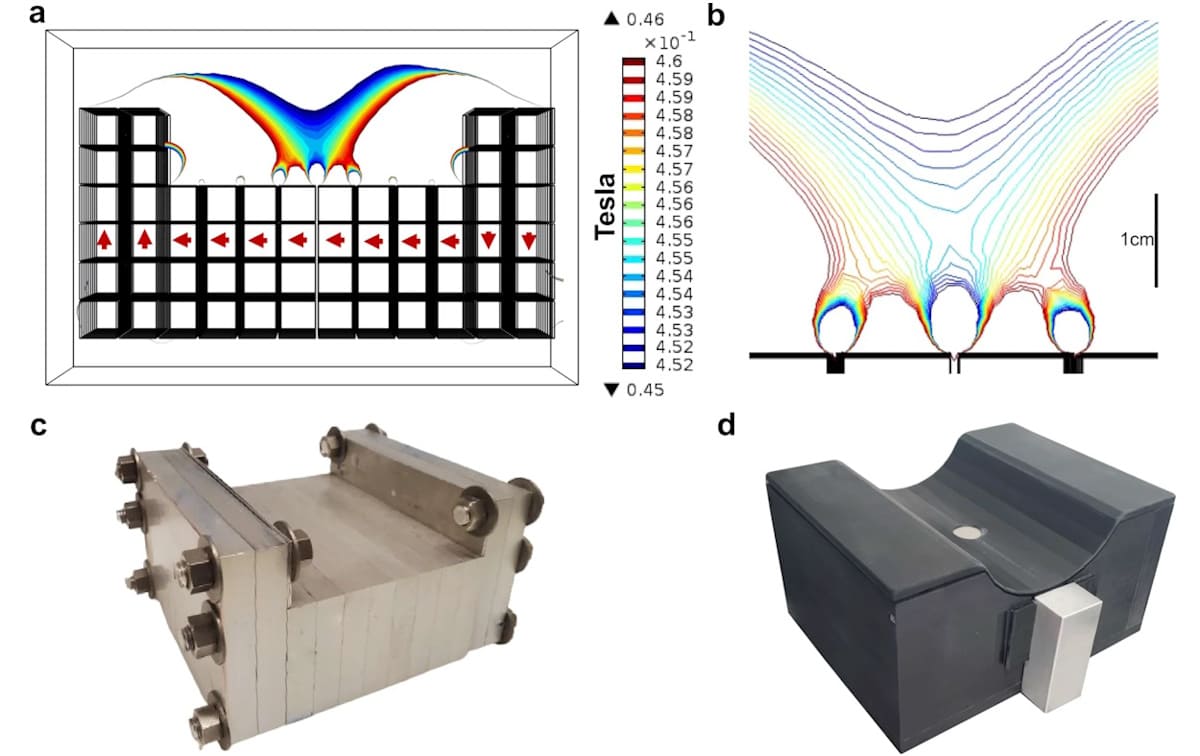
Single-sided MR sensor a, b) Simulated magnetic field profile of the sensor’s array of 12.7 mm3 magnets, red arrows indicate magnet orientation. c) Constructed magnet array with assembled aluminium frames and iron yokes. d) The assembled array, with RF coil, matching network and Delrin casing, comfortably seats the calf muscle. (Courtesy: CC BY 4.0/Nat. Commun. 10.1038/s41467-023-44561-9)
Magnetic resonance imaging (MRI) is a common medical imaging technique found in hospitals around the world, and something that many of us will experience at some point during our lifetimes. The non-invasive technique identifies diseased tissues by detecting differences in tissue morphology based on the different relaxation times of the tissue after exposure to RF pulses in a magnetic field. Magnetic resonance can also be used as a fundamental measurement mechanism for other types of medical imaging scanners.
There’s an interest in creating portable point-of-care (POC) devices that can image soft tissue just like an MRI scan can. Such systems could rapidly detect aneurysms or fluid pockets, for example, without needing to transport patients to centralized care facilities to perform MRI procedures. The ability to provide this diagnostic information at the bedside with a portable device could improve patient outcomes, reduce the time to treat patients and present lower diagnostic costs for healthcare facilities.
MRI itself is too bulky for bedside imaging, however, and is not suitable for patients who have certain metal implants. Moreover, the power requirements of MRI far outstrip the power capabilities of a portable scanner, as does the weight of the equipment.
These challenges in transferring MRI capabilities to POC devices have led researchers to develop new magnetic resonance-based sensor devices. One such development has come from researchers at Massachusetts Institute of Technology and Harvard University. “Our previous clinical study revealed that skeletal muscle interstitial fluid is an important reservoir for fluid in the body,” lead author Michael Cima tells Physics World. “We needed a magnet design that that could measure that volume at a patient’s bedside.”
POC analysis of muscle tissue
Cima and colleagues chose to create a POC device using a low-field single-sided magnetic resonance (SSMR) sensor to look at skeletal muscle in vivo. Compared with standard MRI equipment, the system is much more portable with a weight of only 11 kg. SSMR sensors use the power of magnetic resonance-based contrast to acquire spectroscopic (non-imaging) data over a limited tissue depth and provide information on the structure of different tissue types – allowing them to be distinguished from one another.
The portable sensor uses a permanent magnet array and surface RF coil to provide low operational power and minimal shielding requirements. The magnet array, constructed from 12.7 mm3 neodymium magnets deployed in aluminium frames, is designed to comfortably seat the calf muscle. The fully assembled sensor with Delrin casing measures 22 × 17.4 x 11 cm.
The sensor can capture low-noise diagnostic measurements within minutes, including T2 relaxation data, which can provide insight into the fluid status, vascular kinetics and oxygenation of skeletal muscle tissue, among other applications. Tissue overheating is avoided by encasing the coil in aluminium nitride, which has a high thermal conductivity that can dissipate generated heat. All these aspects combine to make the SSMR sensor suitable for use as a POC device.
The researchers tested the sensor both in vitro and in vivo, including a clinical study on healthy humans to determine whether the device could successfully detect muscle tissue – which it did. Compared with previous attempts at creating similar SSMR sensors for POC applications, the devices from Cima and his team show better sensitivity and larger penetration depths, and are safer for clinical use.
The new sensor has a penetration depth greater than 8 mm, outperforming other systems described in the literature, which were limited to less than 6 mm depth. Analysis at these levels allowed for an accurate evaluation of the muscle tissue while avoiding signals from other subcutaneous layers, such as the adipose (fat under the skin) tissue that lies closer to the skin’s surface.
The most important outcomes of this study, says Cima, is that “the magnet design met the required performance specifications and is now being used in a 90-patient trial with end-stage renal patients”. When asked about the future potential of these devices, Cima says that “the clinical value of this technology will be demonstrated if we can show that it predicts the ‘dry weight’ [normal weight without excess fluid in the body] of end-stage renal patients. No clinically accepted way to do that currently exists.”
Three of the world’s largest physics publishers have joined forces to announce a new “purpose-led” publishing coalition. The American Institute of Physics (AIP), the American Physical Society (APS) and IOP Publishing, which publishes Physics World, have come together to remind researchers what sets them apart from other publishers. The three firms confirm that they will continue to reinvest the funds generated from publishing back into research and “never” have shareholders that results in putting “profit above purpose”.
Scientific publishers have long been central to managing the process of peer review by which researchers judge the quality of papers submitted to journals. In recent years, publishers have invested heavily in digital technology and developed new ways to disseminate research to a wider audience. However, some firms have come under the spotlight for the money they make, with Dutch publishing giant Elsevier, for example, announcing profits of €1.2bn in 2022 – a profit margin of almost 40%.
The recent move to open access, in which researchers pay a fee to publish an article in a journal, has also encouraged some publishers to boost revenues by publishing as many papers as possible. At the same time, there has been a rise in retractions, especially of fabricated or manipulated manuscripts sold by “paper mills”. Last year, for example, more than 10,000 journal articles were retracted – a record high – with about 8000 alone from journals owned by Hindawi, a London-based subsidiary of the publicly owned publisher Wiley.
The new “purpose-led” coalition is designed to show how the three learned-society publishers have a business model that is not like that of profit-focussed corporations. In particular, they plough all the money generated from publishing back into science by supporting initiatives such as educational training, mentorship, awards and grants. “Purpose-led publishing is about our dedication to science, and to the scientific community,” says Antonia Seymour, IOP Publishing’s chief executive. “We’re proudly declaring that science is our only shareholder.”
“Science is our shareholder”
The coalition has announced five main objectives that they will abide by. These are: investing 100% of funds from publishing back into science; publishing only content that “genuinely adds to scientific knowledge”; ensuring their terms are reasonable; putting research integrity ahead of profit; as well as admitting errors and setting them right. The trio also say they will “never” relinquish their not-for-profit status or have shareholders “for whom we put profit above purpose”.
The ethos is underlined by Alix Vance, chief executive of AIP Publishing, who says the three firms “exist purely to give back to science”, adding that they want to “benefit science and all those engaged in its advancement”. Meanwhile, Rachel Burley, chief publications officer at the APS, says that researchers who publish articles any of the three purpose-led publishing members are “not only advanc[ing] knowledge through high quality, peer-reviewed journals [but] also investing in the community they are a part of”.
Ultralong, fracture-free semiconductor fibres have been produced inside glass cladding by researchers in Singapore and China. By etching off the glass and replacing it with a flexible polymer sheath embedded with metallic wires, the researchers were able to produce microscale fibres that could be spun into textiles. The work, which builds on a long-standing quest to produce fibre-based electronics, could have applications in smart clothing, medical devices and potentially in photonics.
The first fibres containing a semiconductor inside optical glass were developed by chemist John Badding of the Pennsylvania State University in the US following a sabbatical at the University of Southampton in the UK. He used high-pressure chemical vapour deposition to place various materials inside a hollow-core optical fibre. “[Badding] came to me and said, ‘Is this any good?’ and I was, like, ‘You’re kidding me, this is amazing!’ and we started collaborating,” says materials scientist and engineer Venkatraman Gopalan, also of Penn State. The technique was hamstrung by the slow production rate of the fibres, however, and the collaboration effectively ended after the sudden death of Badding at 57 in 2019.
In 2008 John Ballato of Clemson University in South Carolina developed the molten core method for producing optical fibres of silicon and germanium. The two materials are heated above their melting points of over 1000 °C. The molten silicon is then injected into the glass as it is drawn into a fibre and, as the two cool, one solid surrounds the other. This method allows tens of metres to be produced every minute, and the fibres have attracted interest for medical lasers, nonlinear optics and various other applications. One problem is that differences in the thermal expansion coefficients between the semiconductor and the glass cause the semiconductor to fracture as it cools. This creates optical losses and makes it impossible to remove the glass without the fibre falling apart.
Cracking new study
In the new work, researchers at Nanyang Technological University in Singapore, Jilin University in China and elsewhere conducted a thorough study of this cracking. “We worked with mechanical experts who helped us to explain what the key factors are,” says Lei Wei of Nanyang Technological University. This improved theoretical understanding allowed the researchers to choose aluminosilicate glass to clad germanium, for example. The result was long semiconductor wires encased in glass without the cracks.
In future, the researchers believe these glass-clad fibres could be useful in photonics. In the present paper, however, they etched off the glass to leave the silicon wires less than 100 micron thick. “For electronics, a semiconductor alone will not work, we need to have metal contacts to talk to the semiconductor,” says Wei. They therefore used a low-temperature process to attach two metal wires embedded in a conductive polymer to the semiconductor and embedded the three leads together in an insulating polymer. The result was a flexible optoelectronic fibre that could be spun into a yarn.
The team produced several devices containing their yarn interwoven into other textiles. One example was a beanie hat that could detect the light from a traffic signal and produce a vibratory signal on a mobile phone indicating whether the signal was red or green. This, they envisage, could help a visually impaired person. Another was a smartwatch strap that could measure a person’s heart rhythm.
Washable transistor could be next
They also showed that the technology has a practical resilience. “We put our device into the washing machine…We can wash it multiple times and it still maintains its original performance,” says Lei Wei. The researchers are now attempting to fabricate a transistor inside the fibre to allow more direct incorporation of electronic circuitry.
Ballato is enthusiastic about the research. “I’ve known this group for 15 years, so I’m not surprised by the excellence of the work,” he says; “They’ve been able to take these important but somewhat academic concepts and reduce them to practice in a very useful and important way that validates the scalability of the fibres themselves.”
He is most impressed by the team’s ability to combine materials that require different processing conditions into a single structure. “With this new toolkit, they are ahead of everyone else in the ability to use them to develop practical, functional devices,” he says.
“This is very exciting – John [Badding] would have been thrilled to see this!” says Gopalan. He believes that for sensing and imaging, the technique shows real promise, although he says that the current fibres would be too thick for practical use in signal transmission, and suspects the molten core process might not be able to produce sufficiently pure, thin fibres for signal transmission at all. The next step is “to thoroughly characterize the basic electronic and optical properties of these fibres,” he says: “That will determine where the applications may lie.”
According to Arturs Meijers, head of Clinical Medical Physics at the Paul Scherrer Institute (PSI) in Switzerland, proton therapy is at the cusp of a paradigm shift that could transform the way that treatment plans are verified before they are delivered to a patient. Instead of the current measurement-based regime for patient-specific quality assurance (QA), independent dose calculations that check the quality of the treatment plan and ensure that it is delivered as intended would offer a speedier solution that also has the potential to improve quality control.
“In proton therapy we want to transition away from measurement-based techniques for patient-specific QA, since it takes a lot of time and often creates a bottleneck in the treatment delivery room,” Meijers explains. “A solution that verifies the delivery of the treatment plan by reconstructing the dose from the log files could provide a QA process that is at least equivalent but in principle even better than what we have now.”
PSI’s current protocol for patient-specific QA, in common with most proton therapy centres, is to measure the dose delivered by the proton beam using a detector array, with a water-like phantom acting as a surrogate for a human patient. Measurements recorded at one or more depths in the phantom can then be compared with the dose distribution in the treatment plan, but this time recalculated for an equivalent water cube.
The big problem with this approach is the time needed to take the measurements, which also reduces the availability of the therapy suite for treating patients. But it also has several limitations for achieving proper quality control. “All the comparisons are made using very simple geometries and calculations that are based on water,” says Meijers. “A number of studies suggest that this measurement-based approach can miss potential issues, and might not always catch any errors that arise in the treatment planning simulations.”
Integrating the data
Through a collaboration with IBA Dosimetry, Meijers and his team at PSI are now testing whether a software-based solution that recalculates the delivered dose from the treatment log files could offer a better solution. Importantly, the PSI team has also worked with Varian to extract the treatment log files from its ProBeam machine for proton therapy, then convert them into the standard DiCOM format that is used by IBA’s myQA iON platform for patient-specific QA.
“This is one of the first demonstrated integrations of myQA iON with the log files from the ProBeam machine,” says Meijers. “It’s one thing to have access to the information, but quite another to interface the specific file formats used by different system vendors with other software applications. These non-standard processes for accessing and using information is one of the key challenges for progress in the field.”
Now that the integration is complete, the PSI team is starting to use the log-file data within myQA iON to reconstruct the dose distribution from the actual delivery sequence provided by the machine. “During the treatment process there is a lot of data exchange between different subsystems, and there is always a risk that information can be misinterpreted or the data become corrupted,” explains Meijers. “By reconstructing the dose from the log files we can check the integrity of the data across the entire workflow, all the way from the treatment planning system to the delivery of the beam.”
Within IBA’s myQA iON platform it is also possible to verify the initial patient plan created in the treatment planning system against an independent dose calculation produced using the Monte Carlo method. This simulation technique treats the millions of interactions generated by the proton beam in a probabilistic way, providing the most accurate method for calculating the dose distribution across a full 3D volume. “Using this two-step QA process we can verify the quality of the original treatment plan and check that the information has not been compromised by the time we get to the delivery of the treatment,” adds Meijers.
A gradual transition
To evaluate the performance of this new QA process in a clinical setting, the PSI team is now running the software-based solution in parallel with its existing measurement-based techniques. “Before we make the transition we want to baseline the new method against our established processes,” says Meijers. “Recalculating the dose from the log files does not add much overhead, so we will run both workflows for at least a few months to gain confidence in the performance and behaviour of this new approach.”
While it is too early to be certain that the software-based solution matches or improves on the level of quality control provided by a measurement-based regime, Meijers can already see the potential to dramatically reduce the time needed for patient-specific QA – both in terms of manpower and the use of the therapy suite. Currently it might take 30 minutes to take the measurements needed to verify the treatment for each patient, while myQA iON can recalculate the dose from the machine data within a matter of minutes.
“With this process you can pretty much eliminate the need to book the treatment room for taking measurements,” says Meijers. “However, in practice we are unlikely to switch completely from one workflow to another, It will be more of a gradual transition where we tune down the number of measurements over time.”
Dose verification The myQA iON platform makes it easy to compare the actual delivered field dose distribution that is reconstructed with the treatment log files extracted from Varian ProBeam machine, against the original treatment field dose calculated by TPS. (Courtesy: IBA Dosimetry/PSI)
To support this hybrid approach myQA iON provides an easy way for medical physicists to review the results from different dose verification methods. The original patient plan can be imported from the treatment planning system to enable comparison with the independent Monte Carlo calculations, while measurement datasets can also be uploaded to check against the dose distribution that is reconstructed from the treatment log files. Combining all of this verification information in a single web-based system also ensures that everyone in the clinical team can access the most up-to-date information from any computer in the treatment centre.
Meijers believes that recalculating the dose from the machine data could be particularly beneficial for verifying treatment modalities based on pencil beams, in which a very narrow proton beam is scanned across the tumour volume. “From the treatment log files we can calculate the amount of dose delivered by the beam to each spot position,” he says. “These actual delivery sequences give us more information about the dose distribution than we get from a high-level measurement of a dose plane in a simulated water cube.”
Indeed, there is a clear mandate for change within the proton therapy community. Work within the Particle Therapy Co-Operative Group (PTCOG) has been analysing the treatment and workflow efficiencies for different approaches to patient-specific QA, and has concluded that recalculating the dose from the log files offers greater value for quality control than the conventional measurement-based methodology. “It’s important to demonstrate that this new approach is not just making our lives easier, but that the level of quality control it provides is at least equivalent to current techniques and preferably even better, says Meijers. “We certainly don’t want to make our QA processes less robust, or introduce methods that may not be able to detect certain issues.”
Eliminating the need for measurements will also be crucial for the introduction of adaptive treatment protocols, in which the treatment plan is updated to account for the changing anatomy of the patient. A software-based solution would allow the new treatment plan to be independently checked without the need for additional measurements, potentially allowing the updated plan to be delivered while the patient is still in position.
In the short term, however, the main motivation for Meijers is to maximize the amount of time that the therapy suite is available for treating patients. “For facilities that are fully booked or close to capacity, patient-specific QA is one of the main bottlenecks,” he says. “By making our workflows more efficient, this approach can increase the number of fractions that are delivered each day and increase the treatment capacity of the facility.”
A rare and valuable collection of transiting exoplanets on long-period orbits has been discovered hidden in data from NASA’s Transiting Exoplanet Survey Satellite (TESS) mission. Because exoplanet catalogues are dominated by short-period worlds close to their star, these longer-period candidates provide something different: specifically, insight into cooler planets.
“One of the great frontiers of exoplanet science is pushing out to these long periods that are comparable to those in the solar system,” says Faith Hawthorn, a final year PhD student at the University of Warwick who led the findings.
Longer-period exoplanets are less likely to transit than those closer in, and will do so more infrequently, making them harder to discover. Hawthorn and her team were able to work around this by taking advantage of the way that TESS surveys the sky. TESS spends a year (or “cycle”) observing one half of the celestial sphere, before moving onto the other half the following year. In cycles 1 and 3 it surveyed the southern sky, and in cycles 2 and 4, the northern sky. During each cycle the sky is split into sectors that TESS spends 27 days watching before moving onto the next sector. Consequently, TESS usually favours the detection of planets with orbital periods shorter than 10 days.
With the aid of an algorithm written by second author Sam Gill, also from Warwick, Hawthorn’s group searched the data from cycles 1 and 3, covering the southern celestial sky, for planets that transited twice, once in each cycle. They refer to these as “duotransits”, and they eschew the perceived wisdom of waiting to observe at least three transits to confirm the orbital period.
The algorithm initially picked out 2000 potential duotransits, and after vetting these by eye, Hawthorn’s team narrowed this down to 85. Twenty-five of these had already cropped up in analysis of the TESS data by other teams, but 60 were brand new. All appear to be gas giants, with the smallest being 2.67 times the radius of Earth, and they all require confirmation by radial velocity measurements to determine their mass.
Tantalizing transits
“Our technique exploits the way that TESS operates,” Hawthorn tells Physics World. “Other techniques, such as microlensing and astrometry, tend to contribute most of the long-period ones, but the important thing for us is that if you have a transiting planet you can also do transmission spectroscopy to look at their atmosphere.”
Transit spectroscopy involves measuring the imprint of a planetary atmosphere on a star’s light as that light is filtered through the atmosphere on its way to us. Molecules in a planet’s atmosphere leave dark absorption lines in a star’s spectrum, telling us the constituents of that atmosphere. Transit spectroscopy is now often performed on short-period worlds, but the opportunity to do it for longer-period worlds has not arisen often.
“If we truly want to understand how the atmospheres of exoplanets – and the exoplanets themselves – compared with those in the solar system, it’s these longer-period exoplanets that we need to study,” says Diana Dragomir, an astronomer at the University of New Mexico. Although Dragomir was not involved in Hawthorn’s study, she was part of a team that discovered two long-period duotransits in TESS data in 2023 and which also discovered hundreds of exoplanet candidates by employing an algorithm to detect single transits that had been missed by the conventional multi-transit techniques.
“I believe that there are still many single transits and duotransits in the TESS data that remain undiscovered,” Dragomir tells Physics World. “I do think that with improving algorithms we will find many of those in the coming years.”
Unusual candidates
Hawthorn’s candidate worlds have orbital periods that range between 20 and 700 days, although pinning down their precise period is impossible from just two transits. Most orbit standard F-, G- and K-type stars (our Sun is a G-type star, F-type stars are slightly hotter, K-type slightly cooler), but a few stand out as being different.
“It was nice that we did see a few unusual cases within what we found, but the caveat is they are just candidates for now,” says Hawthorn.
One system, designated TIC-221915858, has a hot A-type star (surface temperature 9200 °C, compared with the Sun’s 5500 °C) that would be the hottest star found by TESS to host a planet.
Another candidate is TOI-709, which involves a compact, evolved “hot subdwarf star” that has begun losing mass after its red giant phase and is on the way to transforming into a white dwarf. Another unidentified transit and a possible companion star muddy the waters.
“That’s a really weird one,” says Hawthorn. “It’s actually unlikely to be a planet, but we chose to keep it in the sample because it is so interesting and unusual. From our point of view looking at the data, it passed all our vetting tests. But there’s something really odd going on there.”
Similar to the solar system
If astronomers hope to find a broader range of planets like those in our solar system and not just those that orbit close to their stars, then embracing more unconventional techniques is key.
“Everyone kind of got used” to waiting for at least three transits, says Dragomir. “Perhaps, as a community, we should become more open to what properties are truly needed – or not – for a new exoplanet to be declared as such.”
If the discoveries begin to mount up as advanced algorithms pick out more long-period planets hidden in the data, then astronomers will be able to perform statistical analyses to get a better sense of how common planetary system architectures like our solar system’s are.
“I would like to know how common they are relative to the closer-in planets,” says Dragomir. “In order to make this assessment we need as large a sample of longer-period planets as we can get.”
Imagine if, in one fell swoop, with one small tweak to the laws of gravity, you could wave away the need for all the dark matter in the universe. You’d rid yourself of a pesky particle that is only inferred to exist and has so far defied discovery. Instead, you would replace it with an elegant theory that modifies the fundamental work of Isaac Newton and Albert Einstein.
At least that’s the dream of modified Newtonian dynamics, or MOND. Developed by Israeli physicist Mordehai Milgrom and Mexican-born American-Israeli theorist Jacob Bekenstein in the early 1980s, it was their antidote to the popular “dark matter” paradigm. To them, dark matter was an unnecessary and clumsy bolt-on to cosmology that, if real, means that 80% of the matter in the cosmos is invisible.
In the 40 years since it was devised, MOND’s achievements continue to be overshadowed by cosmology’s love affair with dark matter. MOND has also struggled to explain phenomena at scales larger and smaller than individual galaxies. So is MOND something we should be taking seriously after all?
Curious curves
Our story starts in the late 1960s, and into the 1970s, US astronomers Vera Rubin and Kent Ford realized that stars on the outskirts of galaxies were orbiting just as fast as stars close to the centre, in apparent defiance of Johannes Kepler’s laws of orbital motion. They illustrated this in the galaxies’ rotation curves, essentially just a graph of orbital velocity versus radius from the centre. Rather than showing a negative slope, the graphs were a flat line. Somewhere, there was some extra gravity pulling those outer stars around.
Dark matter – an unseen form of matter so abundant that it would be the dominant gravitational force in the universe – was the popular solution. Today, the concept of dark matter is intimately entwined in our standard model of cosmology and is inherent in our understanding of how structure in the universe forms.
1 Disc proof
a Courtesy: ESO/J Emerson/VISTA/Cambridge Astronomical Survey Unit
(a) NGC 253 is a bright spiral, or disc, galaxy about 13 million light-years from Earth in the southern constellation of the Sculptor. (b) Stacy McGaugh from Case Western Reserve University in the US and colleagues derived a universal law governing the rotation of disc galaxies. The law indicates that the rotation of such galaxies is specified by the visible matter it contains, even if the galaxy is mostly composed of dark matter.
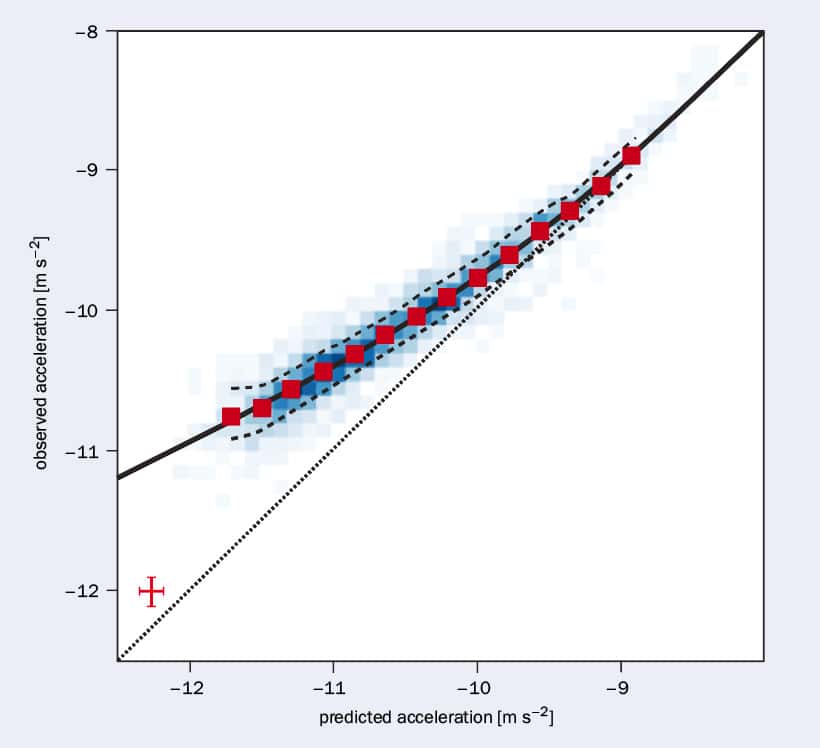
The picture that dark matter forms is neat, but not quite neat enough for a small community of physicists and astronomers who have shunned dark-matter cosmology and adopted MOND instead. In fact, they have abundant evidence for their case. In 2016 Stacy McGaugh of Case Western Reserve University measured the rotation curves of 153 galaxies (Phys. Rev. Lett.117 201101) and found, with an unprecedented accuracy, that their rotation curves are explained by MOND, without the need to resort to a halo of dark matter around each galaxy. In doing so, he justified Milgrom’s prediction.
“I would assert that MOND explains these things better than dark matter, and the reason for that is its predictive power,” says McGaugh – a former dark-matter researcher who is now a MOND advocate, following an epiphany that saw him switching sides. He is referring to the fact that if you know the visible mass (all its stars and gases) of a galaxy, then by applying MOND you can calculate what the rotation velocities are going to be. In the dark-matter paradigm, you can’t predict the velocities based on the presence of dark matter. Instead, you have to measure the galaxy’s rotation curve to infer how much dark matter is present. McGaugh argues that’s circular reasoning, and not proof of dark matter.
How to modify gravity
Modifying the laws of gravity might be anathema to many physicists – such is the power of Newton and Einstein – but it’s not such an outlandish thing to do. After all, we live in a mysterious universe, filled with scientific conundrums. What is the dark energy responsible for the acceleration of the universe’s expansion? Why is there a tension in different measurements of the expansion rate of the universe? How are galaxies forming so quickly in the early universe, as witnessed by the Hubble and James Webb space telescopes? Researchers are increasingly looking at modified gravity theories to provide the answers, but not all modified gravity models are equal.
What every theory of modified gravity, including MOND, must do is explain why it remains hidden from us on everyday scales, only kicking into action under certain conditions
Tessa Baker, a cosmologist and modified gravity guru at the University of Portsmouth in the UK, has built her career on testing the laws of gravity and searching for modifications, in her case to try to explain dark energy. “MOND, which is one example of a modified gravity theory, is unusual in that it is a theory that tries to replace dark matter,” explains Baker. “The majority of theories of modified gravity do not do that.”
What every theory of modified gravity, including MOND, must do is explain why it remains hidden from us on everyday scales, only kicking into action under certain conditions. Physicists call the point at which this transition occurs as “screening”, and it’s all a problem of scale.
“The tricky part is, how do you hide the modification on scales where we know general relativity works very well?” asks Baker. The obvious place to start might be considering whether gravity varies on a distance scale, so in our solar system gravity fades with the inverse-square rule, but on the scale of galaxy clusters it decreases at a different rate. “This categorically does not work,” says McGaugh, adding that there are other scales that do work.
For example, one theory of modified gravity that Baker works with – known as f(R) gravity – generalizes Einstein’s general theory of relativity. Under f(R), gravity switches on the dark-energy effect in areas of space where the density of matter becomes low enough, such as in cosmic voids. For MOND, the scale of the screening mechanism is acceleration. Below a characteristic gravitational acceleration referred to as a0 – which is about 0.1 nanometres per second squared – gravity operates differently.
Rather than following the inverse-square rule, at accelerations below a0 gravity drops off more slowly, by the inverse of distance. So something orbiting at four times the distance would feel a quarter of the gravity, not a 16th. The low gravitational accelerations necessary for this are exactly those experienced by stars on the outskirts of galaxies. “So MOND switches on those modifications at low accelerations in the same way that f(R) gravity switches on its modifications at low densities,” explains Baker.
Conflict and controversy
MOND excels for individual galaxies, but depending on whom you speak to, it’s perhaps not doing so well in other environments. And one failure in particular has already turned one of MOND’s staunchest supporters against the theory.
An ideal laboratory in which to test MOND is one where dark matter would not be expected to be present in any great amounts, meaning any gravitational anomalies should just come from the laws of gravity themselves. Wide binary star systems are one such environment consisting of pairs of stars that are 500 AU or more apart (where one astronomical unit or AU is the mean distance between Earth and the Sun). At such huge separations, the gravitational field felt by each star is weak.
Thanks to the European Space Agency’s Gaia astrometric space mission, teams of MOND researchers have now been able to measure the motions of wide binaries in search of evidence of MOND. The results have been controversial and conflicting, in terms of the survival of MOND as a valid theory.
One team, led by Kyu-Hyun Chae of Sejong University in Seoul, carried out an exhaustive analysis of 26,500 wide binaries and found orbital motions that matched the predictions of MOND (ApJ952 128). This was supported by earlier work from Xavier Hernandez of the Universidad Nacional Autónoma de México, who hailed how “exciting” Chae’s result were. But not everyone is convinced.
2 Testing ground
Courtesy: a NASA/JPL-Caltech; b CC BY 4.0 Kyu-Hyun Chae/Ap J.952 128
(left) Wide binary star systems such as this one should be an ideal test for MOND because the effect of dark matter should be minimal, so gravitational effects should come solely from the laws of gravity. (right) Kyu-Hyun Chae of Sejong University in Seoul tested this by analysing observations of more than 20,000 wide binary systems. He found a consistent gravitational anomaly (a boost factor of 1.4) at accelerations lower than 0.1 nm/s2. This agrees with the original MOND theory.
At the University of St Andrews in the UK, Indranil Banik was working on his own six-year project to measure MOND in wide binaries. He had published his plans ahead of taking his measurements, making sure to take time to talk to other experts and get feedback, fine-tuning his method so that everyone could be in agreement. Banik fully expected his results to show that MOND was real. “I obviously expected the MOND scenario to work,” he says. “So it was indeed a very major surprise when it didn’t.”
In a paper published in late 2023 Banik found no deviation from standard Newtonian gravity at all (Monthly Notices of the Royal Astronomical Society 10.1093/mnras/stad3393). The results were such a hammer blow to him that it shook Banik’s world, and he publicly declared that MOND was wrong – which caught him some flak. Why, though, should his results be so different to Chae and Hernandez? “Certainly, they still argue there is something there,” says Banik. However, he is sceptical of their results, citing differences in how they dealt with uncertainties in their measurements.
These points of contention are highly technical, so it’s perhaps not a total surprise that different interpretations have been arrived at. Indeed, for outsiders it is difficult to know who is correct and who isn’t. “It’s very hard to know how to judge this,” admits McGaugh. “I don’t even feel entirely qualified to judge on those scales, and I’m way more qualified than most people!”
It’s not just wide binaries where Banik sees MOND failing. He also cites the case of our own solar system. One of the central tenets of MOND is the phenomenon of the “external field effect”, whereby the overall gravitational field of the Milky Way galaxy is able to imprint itself on smaller systems, such as our solar system. We should see this imprint, particularly on the orbits of the outer planets. Searching for this effect through radio-tracking data from NASA’s Cassini spacecraft, which orbited Saturn between 2004 and 2017, has found no evidence for the external field effect on Saturn’s orbit.
“People are starting to realize that there is no way to reconcile MOND with the non-detection of effects in the Cassini data and that MOND will not work on scales below a light-year,” says Banik. If Banik is correct, then it leaves MOND in a very bad place – but it’s not the only battlefield where MOND’s war against dark matter is being fought.
Cluster conundrums
In 2006 NASA released a spectacular image of two colliding clusters of galaxies, referred to in their combined form as the Bullet Cluster. The Hubble Space Telescope provided high-resolution views of the whereabouts of the galaxies, while X-ray observations of the hot gas between those galaxies came from the Chandra X-ray Observatory. Based on the locations of the galaxies and gas, as well as the degree of gravitational lensing as matter in the cluster bent space, scientists were able to calculate the location of the dark matter in the cluster.
“It was claimed that the Bullet Cluster confirmed the existence of dark matter, which has been used to argue strongly against MOND,” says Pavel Kroupa, an astrophysicist at the University of Bonn. “Well, it turns out that the situation is exactly the opposite.”
Kroupa is ferocious in his enthusiasm for MOND, and has set his sights on exploring it on the largest scales of structure possible – large-scale galaxy clusters. In his crosshairs is nothing less than the standard model of cosmology, known colloquially as “lambda-CDM” or ΛCDM (Λ refers to the cosmological constant, or the dark energy component of the universe, and CDM is cold dark matter).
Primordial An artist’s impression of how the very early universe (less than 1 thousand million years old) might have looked when it went through an abrupt eruption of star formation. (Courtesy: A Schaller/STScI)
For one thing, Kroupa believes that such huge galaxy clusters shouldn’t even exist, never mind have had time to collide, at high redshifts. ΛCDM posits that structures should grow slowly, and Kroupa argues that it would be too slow for what our telescopes are showing us: massive galaxies and huge clusters in the early universe. More pertinently, it’s the dynamics of the cluster collisions themselves that give Kroupa hope. In particular, ΛCDM predicts that the velocities of the galaxies falling into the combined cluster’s gravitational well should be a lot lower than what is observed.
“Galaxy cluster collisions are in complete disagreement with ΛCDM while being in rather natural agreement with MOND,” says Kroupa. Despite Kroupa’s enthusiasm, McGaugh isn’t so sure. In fact, he thinks galaxy clusters are a real problem for both ΛCDM and MOND.
“It’s a mess,” he concedes. “For dark matter, the collision velocities are much too high. Dark-matter people have gone back and forth, arguing are the velocities too fast, or not? For MOND, it is that galaxy clusters show a mass discrepancy even after you apply MOND. Clusters concern me because I just don’t see a nice way out of that.”
A theory of everything?
Clusters and wide binaries can be debated ad infinitum until one side or the other admits defeat. But perhaps the most serious criticism levelled at MOND has been its outright lack of a workable cosmological model. It’s all well and good trying to replace dark matter with modified gravity in galaxies, but for the theory to ultimately be successful it must explain everything that dark matter can and more. This means it needs to be a rival to ΛCDM in explaining what we see in the cosmic microwave background (CMB) – the primordial microwave radiation that fills the universe.
The CMB is often characterized as the “fireball of the big bang”, but it’s more than that. Imprinted upon it in the form of subtle temperature variations from just 379,000 years after the Big Bang are what we call anisotropies, corresponding to regions of slightly higher or lower density formed by acoustic waves that reverberated through the primordial plasma. These are the seeds of structure formation in the universe. From these seeds grew the “cosmic web” – a network of filaments of matter along which galaxies grow and, where the filaments meet, large galaxy clusters.
MOND was devised to explain galaxy rotation curves by riffing on Newton, not Einstein. It took another 20 years for Bekenstein to come up with a relativistic model of MOND that could be applied to modern cosmology. Called Tensor–Vector–Scalar (TeVeS) gravity, it proved unpopular, struggling to explain the size of the third acoustic peak in the anisotropies that in the standard model is attributable to dark matter, as well as limitations in modelling gravitational lensing and gravitational waves.
Many people thought that the problem of a relativistic model of MOND was so difficult that it wasn’t possible. Then, in 2021 Constantinos Skordis and Tom Złośnik of the Czech Academy of Sciences proved everybody wrong. In their model, the duo introduced gravity-modifying vector and scalar fields that operate in the early universe to create gravitational effects that mimic dark matter, before evolving over time to resemble the regular MOND theory in the modern universe (Phys. Rev. Lett.127 161302).
Sky puzzle The Planck mission mapped the cosmic microwave background. The widely accepted interpretation of the data is that the universe is around 4.9% ordinary matter, 26.8% dark matter and 68.3% dark energy. MOND theory was not initially able to explain the temperature variations revealed by missions such as Planck. But in 2021 Constantinos Skordis and Tom Złośnik created a MOND-inspired model that matches the Planck data just as well as dark-matter models. (Courtesy: ESA and the Planck Collaboration)
Given the torturous history of trying to develop a relativistic model of MOND, McGaugh believes it is a “remarkable accomplishment” to be able to write down such a theory that does fit the microwave background. The Skordis and Złośnik model is not perfect. Like TeVeS, it struggles to explain the amount of gravitational lensing we observe in the universe. Banik also highlights difficulties in the model, saying that “it got into difficulty in that it doesn’t provide a good explanation for galaxy clusters”.
Baker echoes these concerns. “While it was a good step forward for MOND to be able to do that,” he says, “I don’t think it was enough to bring MOND back into the mainstream. The reason being [Skordis and Złośnik] have added a lot of extra fields to it, a lot of bells and whistles, and it really loses elegance. It works with the CMB, but it seems very unnatural.”
Perhaps we’re putting undue weight onto the model’s shoulders. It could be viewed as just a beginning, a proof of concept. “Whether this is the final theory, or even down the right path, I don’t know,” says McGaugh. “But people have been saying that it can’t be done, and what Skordis and Złośnik have shown is that it can be done, and that’s an important step forward.”
MOND continues to fascinate, frustrate and foster disdain from dark matter’s disciples. There’s still a long way to go for the scientific community to consider it a heavyweight rival to ΛCDM, and it’s certainly hampered by having relatively few people working on it, meaning that progress is slow.
But the successes that this upstart theory has had shouldn’t be ignored, says McGaugh. If nothing else, it should keep astronomers working with the mainstream dark-matter model on their toes.
A smart glove that tracks finger, hand, and wrist movements with unprecedented accuracy has been developed by researchers at Canada’s University of British Columbia (UBC) and Texavie Technologies. The washable device is embedded with individual sensor fibres that respond to tiny changes in the material’s stretch and pressure. The sensors wirelessly transmit this information into a machine learning algorithm that estimates the hand’s fine scale movements almost immediately.
In addition to remotely capturing dynamics and providing information about how hands interact with objects for robotics and virtual reality, the glove offers a tool for assessing stroke and other patients’ hand movements and grasping forces. Such assessments can help patients to receive feedback on what movements they need to focus on to improve their hand mobility function.
In the new design, created by Peyman Servati and his team, numerous custom-made fibre sensors are sewn into the glove’s stretchable fabric at points overlying the finger joints, fingertips, wrist, and palm. Movements in the joints, or pressure caused by the hand interacting with an object, create stretches in the fabric. The sensors can detect stretches as low as 0.005% and as high as 155% of their original length. All of these sensors, linked via stretchy connectors to a wireless processing board on the back of the glove, feed data into an algorithm that estimates the joint angles with an accuracy of 1.4°. The output is a 3D image of the hand’s shape that dynamically follows the glove wearer’s movements.
Weaving good yarns
Servati and his colleagues developed special fibres called helical sensor yarns, which improve the performance accuracy of materials used in wearable textile sensors. These stretchable yarns consist of an elastic core wrapped with metal-coated nanofibres in helical form. A polymer matrix and elastomer shell bind the structure together, providing durability, dynamic range, and tensile strength. External stretching/pressure-releasing cycles change the contact area of the bound-together metallic nanofibres, resulting in changes in their electrical resistance. These yarns were sewn between two layers of nylon-polyester-spandex to make the smart gloves.
Using motion-capture camera systems, the researchers collected more than three million frames of hand movement by five participants with different hand sizes. They were wearing smart gloves that were marked with visible labels at 16 points. The participants grasped objects, switched between gestures, and randomly moved their fingers. A neural-network architecture mapped visible images to simultaneously collected sensor data, resulting in a machine learning model that estimated hand joint angles and tactile information from the strain data measured by the sensor yarns.
“Capturing dexterous hand and finger movements with accuracy is a very hard task. Current camera-based systems are costly and have issues with limited field of view,” says Servati. The glove is the most accurate design in the market for estimating the angles of fingers and wrist during movement with minimal delay. It matches the accuracy of gold-standard camera equipment.
Subjects wearing the glove also tested how the glove performed at capturing specific movements related to everyday tasks. The device was able to detect words “typed” by multi-finger movements on a random surface with 98% accuracy; it estimated 100 static and dynamic gestures adapted from American Sign Language with 95% accuracy. It also detected 34 objects – including mugs, glasses, baseballs, and tennis balls – from the hand’s grasp shape and forces with 98% accuracy.
Rinse, wash, repeat
One use of the glove could be to aid stroke and patients who have lost partial hand mobility. Working with clinical experts including Janice Eng, who specializes in stroke rehabilitation at the UBC Department of Medicine, Servati and his team found that many patients require an accurate way to assess their hand movements and grasp forces. Performing these assessments remotely and modifying exercise routines or evaluating compliance could also help patients with Parkinson’s and other hand mobility issues.
“This is very hard to do even in clinic, and nothing exists to do it accurately and remotely,” says Servati.
Wearable devices are attractive for clinical tasks, but many designs lack the reliability, accuracy, and washability that are needed for practical use. After repeated soaking and stirring in water and detergents, and after undergoing repeated machine laundering cycles, Servati’s glove experienced less than 10% change in sensor performance.
“It is really exciting to develop this technology in a durable and washable form that can create a major leap in human-computer interaction and the possibility to accurately represent interaction with objects without the need for camera,” says Servati.
Subramanian Sundaram, a researcher in Boston University’s Biological Design Center, who was not involved in the study, says that studying how these fibres’ functionality changes under daily-use conditions is the “right direction to focus on” for creating reliable textiles that people can use repeatedly. Although the quantitative error estimates of joint angles are important considerations for potential medical applications, he believes that such applications are still a long way off. “The key challenge, not unique to this work, is determining the specific settings where this type of technology is critically needed,” he says.