

Fancy some more? Check out our puzzles page.
Is LMFP the next big thing for EV batteries?
Want to learn more on this subject?
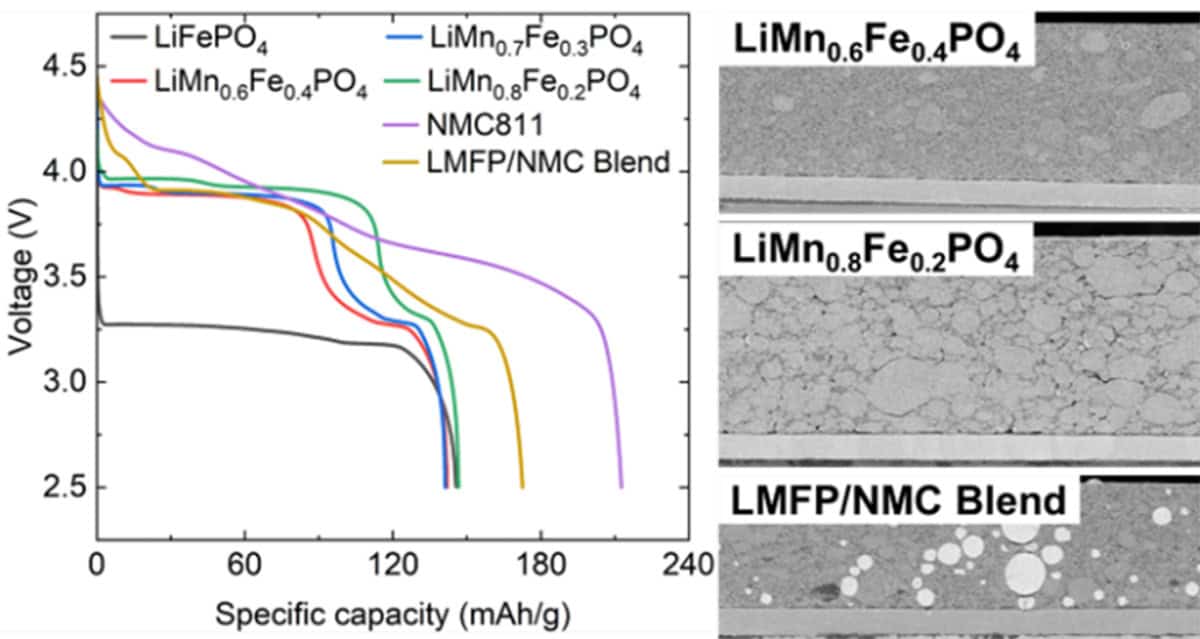
While LiMnxFe1-xPO4 (LMFP) cathode materials have been investigated academically for decades, they have been adopted by dominant battery manufacturers only in the past three years. What has prompted this sudden commercial interest? What market share might LMFP gain, can it outpace LFP and NMC? What are the outstanding limitations, and how might these be overcome?
In this webinar, we aim to answer these questions, covering challenges ranging from the fundamental characteristics of LMFP to large-format cell manufacture and industry trends. We will also showcase recent research carried out at WMG to better understand LMFP behaviour and how AI can be used to design improved LMFP electrode microstructures to enable fast charging.
Join this webinar to find out how this emerging material may alter the EV and battery manufacturing landscape.
Want to learn more on this subject?

Gerard Bree is an assistant professor in the battery materials and cells (BMAC) research group at WMG at the University of Warwick, where he carries out research to better understand how lithium-ion battery performance can be improved so that batteries provide more energy over a longer lifetime at a lower cost. He is interested in the interaction between academia and the battery industry and works on many projects supporting companies to build a battery supply chain in Europe. Bree received his undergraduate degree from Trinity College Dublin and his PhD from the University of Limerick.
Gravitational waves could leave traces in light from cold atoms
A single atom is one of the last places one would expect to find a gravitational wave. These ripples in spacetime are caused by movements of massive objects such as black holes, and they are typically detected using instruments that measure tiny changes in the distance between mirrors separated by kilometres. Their home territory is on large scales, not the microscopic scale of an atom.
Despite this, physicists have questioned for decades whether gravitational waves might affect how often atoms spontaneously emit photons. Previous theoretical studies suggested that the answer was no: the total spontaneous emission rate of a single atom remains unchanged, so the atom appears unaffected by the wave.
This null result is not surprising. Gravitational waves stretch space in one direction while squeezing it in a perpendicular direction. Detectors such as LIGO measure this effect by sending light between mirrors in perpendicular “arms” and comparing how long the light takes to travel along each arm. For a single atom, there is no comparable separation to measure, so scientists did not expect that passing gravitational waves could be detected this way.
A hidden signal
In a new study, published in Physical Review Letters, Navdeep Arya and collaborators at Stockholm University in Sweden and Eberhard Karls Universität Tübingen in Germany identified a loophole in this argument. Although gravitational waves do not leave an imprint in the number of photons emitted, Arya and colleagues calculated that they do affect how those photons are distributed in angle and frequency.
This distinction is crucial. Because a gravitational wave does not make the atom emit more or fewer photons overall, its effects will cancel out if one only measures the total number of photons. However, if the photons are sorted by their direction and frequency, a characteristic pattern emerges that reflects the wave’s stretch-and-squeeze geometry. Depending on the wave’s frequency, this pattern can manifest either as a small shift in the emitted photon frequencies or as additional sidebands in the spectrum.
The reason this is possible, Arya explains, is that the atom isn’t the only thing the gravitational wave interacts with. “It’s actually the atom and the [quantum] field,” he says. Because the field is a global object, he adds, it can carry information about the gravitational wave even when the atom itself does not.
Beyond counting photons
The existence of these effects opens a new way of thinking about gravitational-wave detection. Instead of watching how spacetime changes the distance between mirrors, a next-generation detector might look for how a passing wave changes the light emitted by atoms. This approach would make it possible to detect lower-frequency gravitational waves, which are difficult to reach with ground-based detectors such as LIGO.
A system that could detect these effects experimentally would look very different from a traditional gravitational-wave detector. Instead of measuring how a passing wave changes the distance between mirrors, one would need to excite a large cloud of atoms, collect the photons they emit through spontaneous emission, and resolve the angles and frequencies of those photons.
Though this is not a standard experiment, parts of the required technology already exist. Cold-atom experiments, for example, routinely trap and control millions of atoms. The challenge is to combine these capabilities with sufficiently precise measurements of the directions and frequencies of the emitted photons, while also controlling technical noise.
Phase shift in optical cavities could detect low-frequency gravitational waves
Read more
The researchers say their next step is to understand whether the signal will survive under realistic experimental conditions. According to Jerzy Paczos, the Stockholm PhD student who led the study, the most important task will be to consider the full range of technical noise that would appear in a real experiment, determine which noise sources matter most, and conclude from that whether their proposal is truly feasible. The researchers are also interested in whether cavities or collective effects in atomic arrays could amplify the signal.
For now, the work suggests that gravitational waves may leave traces in a place that physicists have not fully looked before: not in how fast an atom emits light, but in the detailed pattern of the light it gives off. In doing so, it points to a new way of using quantum systems to probe spacetime itself.
Striking mathematical pattern uncovered in Chinese money plant leaves
Researchers in the US and Canda have discovered a naturally occurring “Voronoi pattern” in the Chinese money plant.
Voronoi diagrams were introduced in the 1600s by French philosopher René Descartes and are named after the Russian mathematician Georgy Voronoi, who defined and studied them in the early 1900s.
Voronoi diagrams are geometric patterns used to divide space into regions. The plane is divided up into tessellating polygons, known as cells, that each contain a “seed” point. Every location inside a cell is closer to its seed than any other seed in a neighbouring cell.
Voronoi patterns have numerous applications across mathematics, as well as in various other disciplines such as modelling animal territories, city planning or crystal growth.
Voronoi-like patterns are common in nature, such as giraffe stripes. However, the difference between textbook Voronoi patterns and what we see in nature is that the latter usually lacks visible seed points.
Now, Saket Navlakha from Cold Spring Harbor Laboratory in New York and colleagues have found an exception in Pilea peperomioides, the Chinese money plant.
Chinese money plants are perennials native to China’s Yunnan and Sichuan provinces. The plant has round, flat leaves that feature prominent pores called hydathodes. These points are then surrounded by looping reticulate veins that transport water and nutrients to and from the leaf.
By mapping the pores and veins, the team discovered a naturally occurring, visible, Voronoi pattern with the veins acting as the cell boundaries and the pores being the seed points. They then built a mathematical model to match the observed patterns.
“To our knowledge, this is the first demonstration of the occurrence of Voronoi diagrams in plant venation patterns, where both edges and centres are visible and functional,” they write.
The researchers now plan to use the model to understand why other plants that have similar vein structures do not stick to the Voronoi structure in the same way as the Chinese money plant.
Altermagnetic insulator shows giant magneto-optical Kerr effect
Researchers in China have developed a new way of probing the magnetic domains within altermagnetic materials and used it to study a prominent altermagnet candidate, alpha-phase iron oxide. According to their measurements, this material shares certain properties with ferromagnets despite having a near-zero net magnetization – a fact the researchers say supports its classification as an altermagnet.
In most magnetically ordered materials, the spins of atoms (that is, their magnetic moments) can either line up parallel with each other or antiparallel, alternating up and down. These arrangements are driven by spin-exchange interactions between the atoms, and they lead to ferromagnetism and antiferromagnetism, respectively.
Altermagnets, which were identified as a distinct class of magnets in 2022, behave differently. While their neighbouring spins are antiparallel, like an antiferromagnet, the atoms hosting these antiparallel spins are related to each other by rotational or mirror symmetries rather than the spatial inversion and half-lattice translation symmetries found in conventional antiferromagnets, explain physicists Luyi Yang and Wanjun Jiang of Tsinghua University, Beijing, who led this study. This unique property leads to a zero net magnetization in altermagnets while still allowing for the spin-split electronic band structures typically found in ferromagnets.
An altermagnet candidate
Alpha-phase iron oxide (α-Fe2O3) is a naturally occurring mineral commonly known as haematite. It was long believed to be an antiferromagnet, but recent theoretical research has suggested that it should be relabelled as an altermagnet.
To shed more light on the nature of α-Fe2O3, the team turned to a phenomenon known as the giant magneto-optical Kerr effect (giant MOKE). Named after the Scottish physicist John Kerr, who discovered it in 1877, it occurs when linearly polarized light reflects off the surface of a magnet. Interactions between the light and the material’s magnetic domains cause the polarization vector of the light to rotate, and the direction of rotation can be reversed by reversing the direction of magnetization. The effect therefore provides a “window” into materials’ magnetization states, enabling scientists to monitor and characterize them.
The Tsinghua University researchers say they found evidence of a connection between the material’s MOKE responses and its Néel vector, which is a parameter that defines its so-called staggered magnetic order. In altermagnets, the orientation of this Néel vector determines the material’s magnetic space group, which in turn dictates whether magneto-optical responses are allowed or not, they explain.
“By using magnetic fields to switch the Néel vector through a tiny canted magnetization in α-Fe2O3, we selectively measured the symmetry-permitted MOKE signals and confirmed the absence of symmetry-forbidden components on different surface orientations of α-Fe2O3 single crystals,” they say.
The researchers also observed that at large applied magnetic fields, the MOKE signals remain constant. This finding further rules out contributions from canted magnetization, which should increase with the field. These experiments therefore strengthen the idea that the MOKE signal they measured is truly driven by the Néel vector and the corresponding symmetry of α-Fe2O3.
Broadening methods for imaging altermagnetic domains
To date, most experimental studies on altermagnets have focused on spin transport. Yang, Jiang and colleagues say that they turned to MOKE-based measurements because they would like to study insulating altermagnets, for which electrical transport measurements are inaccessible. “We aimed to uncover the symmetry requirements for magneto-optical responses and broaden the methods for imaging altermagnetic domains,” they explain.
The main challenge they encountered was proving that the MOKE they observed predominantly originates from the Néel vector, rather than from the canted weak magnetization. The researchers say they addressed this through symmetry analysis, first-principles calculations and performing the experiment in different configurations to show that the Kerr signal remains nearly constant even as the canted magnetization keeps increasing at large applied magnetic fields. “By examining such effects on single crystals with different surface orientations, we confirmed that different Néel vector orientations produce distinct MOKE responses, which are consistent with the symmetry of magnetic space group predicted by theory,” they tell Physics World.
The researchers say their work shows that MOKE responses are not limited to ferromagnets, as is conventionally understood. Provided the symmetry requirements are satisfied, altermagnets can also exhibit giant MOKE. “We have shown that standard MOKE imaging microscopy can be used to visualize altermagnetic domains and domain walls in α-Fe2O3,” they say. “This could accelerate the development of altermagnetic spintronics based on these structures, with potential applications in advanced memory and logic devices.”
The researchers now plan to extend their approach to other altermagnetic insulators and metals and to use the magneto-optical response to study the (presumably) ultrafast dynamics of domain walls. Their present study is detailed in Chinese Physics Letters.
Paul Howarth: IOP president highlights the need to raise the profile of physics in society
This episode of the Physics World Weekly podcast features an interview with Paul Howarth, who became president of the Institute of Physics (IOP) in February.
The IOP is the professional body and learned society for physics in the UK and Ireland. Representing 21,000 members, it supports physicists at all stages of their careers and seeks to make physics accessible to people from all backgrounds.
With a PhD in nuclear physics, Howarth has had a long career in the nuclear sector working on the European Fusion Programme and at British Nuclear Fuels, as well as co-founding the Dalton Nuclear Institute at the University of Manchester and serving as chief executive officer of the National Nuclear Laboratory.
He talks to Physics World’s Michael Banks about his career in nuclear energy and his priorities now as president of the IOP. These include improving physics education and raising the profile of physics and physicists across society.
Howarth also voices concerns about recent funding cuts to particle physics, astronomy and space science in the UK, saying it could hamper the flow of students into the subject, with a potential impact on burgeoning areas such as quantum tech.
- The Institute of Physics owns IOP Publishing, which brings you Physics World.
Physicists spot signs of an atom-like system bound by the strong force alone
Signs of an exotic atom-like system made up of a neutral meson bound to an atomic nucleus via the strong interaction have emerged in experimental data from two international collaborations. If confirmed, this hitherto unobserved system could shed light on the origins of hadron masses and provide new insights into the fundamental symmetries of quantum chromodynamics in nuclear matter.
The strong interaction is one of the four fundamental forces of nature, alongside gravity, electromagnetism and the weak interaction. It is responsible for binding quarks into hadrons, which are three-quark particles such as protons and neutrons, and for holding protons and neutrons together within atomic nuclei. Electrically neutral mesons – short-lived particles made up of a quark and an antiquark – are likewise subject to the strong interaction, which can bind them to atomic nuclei in a way that is conceptually similar to an electron bound to a nucleus by the electromagnetic force.
Studying these meson-based nuclear systems is important because it helps us better understand the properties of the strong interaction, says study co-leader Yoshiki Tanaka of RIKEN in Japan. The eta prime meson, η′, is particularly interesting, Tanaka adds, because its relatively large mass cannot be explained by a simple quark model. “This U(1) problem, as it known, was raised as long ago as the 1970s by the physicist Steven Weinberg,” he notes.
Direct experimental access to the 𝜂′-meson mass in nuclei
Modern theories attribute the η′ meson’s large mass to the presence of chiral symmetry breaking in quantum chromodynamics, which is the fundamental theory of the strong force. These theories predict that this mass should be reduced in a nuclear system, and this is what Tanaka and colleagues set out to test.
“Spectroscopy studies of 𝜂′-mesic nuclei provide direct experimental access to the 𝜂′-meson mass in nuclei and offer a unique opportunity to investigate the underlying mechanisms of how the mass of hadrons comes about,” he explains.
In the team’s study, a beam of protons strikes a ¹²C atomic nucleus at near-relativistic speeds and removes a neutron from it. This neutron, together with a proton, forms a deuteron that propagates away in a forward direction, leaving behind a nucleus of ¹¹C in a highly energetic state. It is this excess energy that gives rise to an 𝜂′-meson.
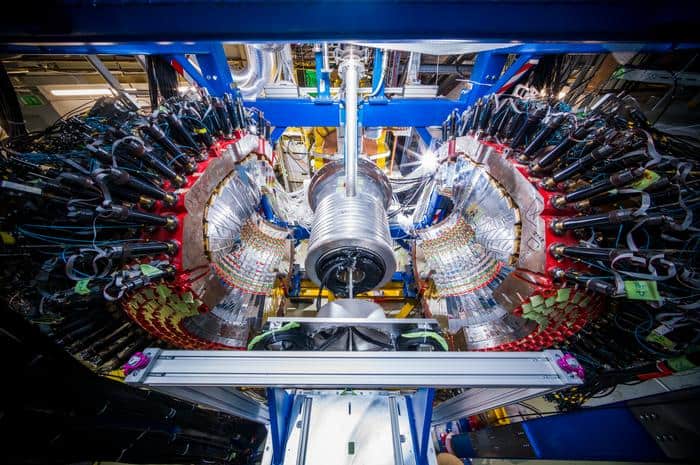
In rare cases, the researchers explain, the meson then binds to the ¹¹C nucleus, forming an 𝜂′-mesic nuclear system. But because these events are so rare, they are hard to find. “One of the major challenges we encountered in the work was the very large amount of background events we registered during our measurements,” Tanaka recalls. “These were about 100 to 1000 times higher than the signal events.”
The researchers overcame this problem by developing a new experiment that allows them to efficiently select signal events associated with the formation of 𝜂′-mesic nuclei by “tagging” the particles they decay into. This enabled them to measure not only the forward-travelling deuteron, but also the decay products of the short-lived 𝜂′-mesic nuclear state.
The researchers say that their results, which they describe in Physical Review Letters, indicate that the 𝜂′-meson mass drops by about 60 MeV in nuclear matter. “This result qualitatively supports the theoretical scenario [that attributes] the origin of the 𝜂′-meson mass to chiral symmetry breaking together with the dynamics of gluons (massless particles that mediate the strong nuclear force) in general,” Tanaka says.
Members of the team, which also includes researchers from the η-PRiME Collaboration and the Super Fragment Separator Experiment Collaboration, together with physicists from Justus Liebig University Giessen in Germany with their working groups GSI/FAIR, say they are now planning follow-up experiments to confirm that they have indeed observed 𝜂′-mesic nuclei. “We also aim to increase the significance to the 5σ level, which is required to firmly establish the discovery on new quantum states in particle and nuclear physics,” Tanaka says.
Thumbs up to Artemis II: a jigsaw puzzle
There are two difficulty settings: choose between a 96-piece jigsaw and the 48-piece version.
Image courtesy: NASA
Fancy some more? Check out our puzzles page.
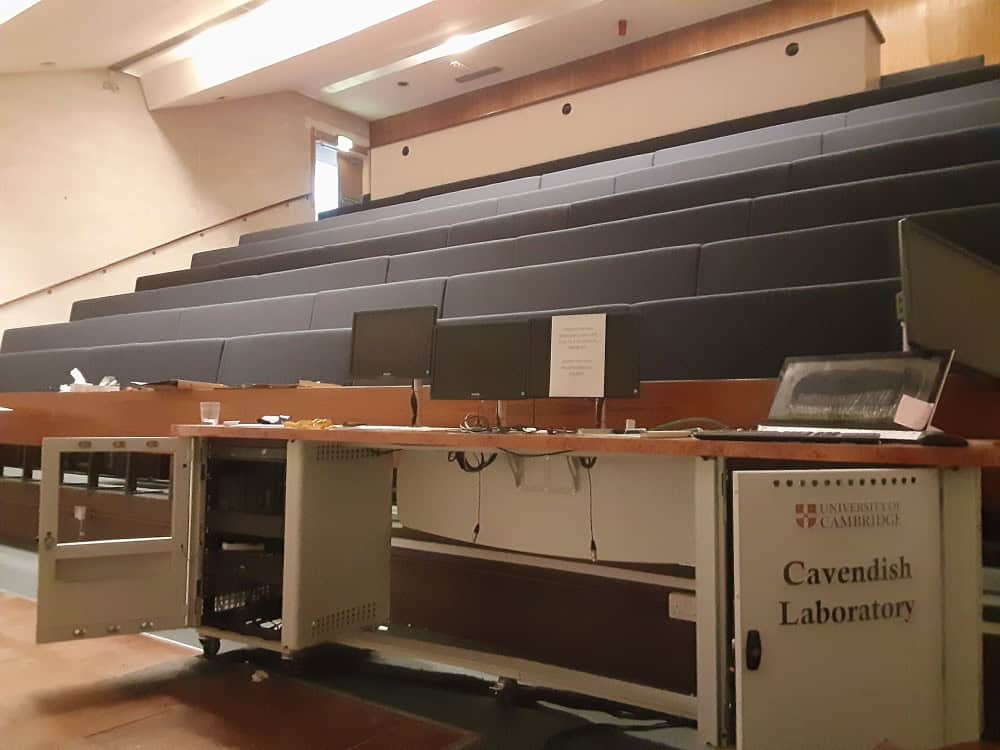
Final look inside the Cavendish lab’s 50-year home before demolition
The prestigious Cavendish Laboratory at the University of Cambridge in the UK has an iconic status in the history of science.
The university’s physics department was initially based in central Cambridge. It is where Francis Crick and James Watson famously worked on the double-helix structure of the DNA molecule.
Yet in 1974 – 100 years after its foundation – the Cavendish moved to a new home on the outskirts of the city.
The building was built in a drab style, covered in grey-brown pebble dash, and featured a maze of interconnected blocks. It was home to generations of physicists, and many thousands of students over the last 50 years.
But the outdated and crammed structure is no longer deemed fit for use and in October last year the lab moved to the nearby larger, brighter and airy purpose-built Ray Dolby Centre. The new centre has been designed to encourage meetings and exchanges with a single entrance, common foyer and centralized café, which are also open to the public.
The move to the Dolby Centre took almost a year to complete, during which time about 180 truckloads moved 3000 m3 of research equipment, crates and furniture belonging to the lab’s 31 research teams.
This included specialized equipment such as 47 cryostats, 98 optical tables, various molecular beam epitaxy set-ups as well a teaching laboratory and museum collection, which includes the model of DNA created by Watson and Crick as well as the cathode ray tube that was used to discover the electron.
Pending chemical and asbestos decontamination, the old building will now be demolished by third-party contractors.
Once complete, the site will host a cycle route until plans are developed for the future use of the site.
Physics World visited the old building in February and this article presents a selection of images from the site.

“An eerie” feel to what was once a bustling world-class laboratory
Following the move to the state-of-the-art Dolby Centre, it’s unlikely that the old building of the Cavendish Laboratory will be missed, except perhaps for its picturesque park and pond.
When I visited the building in February, a few bikes clung to the racks to be disposed of if unclaimed, while a sooty barbecue stood in a corridor.
The silent, empty library and still glowing “lecture in progress” sign in a long-abandoned lecture theatre lent an eerie atmosphere to the place.
Among the emptied, abandoned labs a few areas seemed untouched by the move.
Some offices were still adorned with books, pictures and lab coats, while white boards were filled with equations.
Some of the old equipment left by researchers has been donated to schools and charities, with remaining materials destined for the skip that is placed at the main entrance.
A couple of areas were wet, with water dripping from the ceiling – an indication that it is time to move on.
As I entered a communal area, half-empty liquor bottles line up on a windowsill, a reminder that good times were once had.
Mićo Tatalović

Trapping light in open space
Photonic crystal slabs are periodic structures that confine light in two dimensions while allowing it to leak in the third. Their in‑plane periodicity forces light to behave like an electron in a crystal, forming bands rather than isolated modes.
These objects can host an array of novel physical phenomena, from ultra‑sharp resonances to exotic singularities such as exceptional points. Among the most intriguing are bound states in the continuum (BICs). These are modes that, despite lying in an energy range where radiation is allowed, remain perfectly confined.
In a new theoretical study, a team of researchers from China showed that this leakage, and its surprising absence in certain cases, can be understood from a single first‑principles viewpoint. Central to their approach are Bloch waves and the scattering matrix.
Bloch waves are the natural building blocks of waves in periodic structures. Instead of spreading freely, light inside a photonic crystal is organised into Bloch waves whose fields repeat from one unit cell to the next, up to a phase factor. Even in an open slab, only a small number of these Bloch waves propagate across the thickness and carry energy towards the surrounding medium.
The scattering matrix describes how incoming waves are converted into outgoing ones by the periodic structure. The values of frequency where the matrix becomes singular (its poles) correspond to resonant modes. For open systems, these frequencies are complex: the real part sets the resonance position, while the imaginary part measures how fast energy leaks away.
One key insight of this work is that the complexity of the problem collapses dramatically once the analysis is restricted to the minimal set of Bloch waves that actually propagate. Interference between just two waves can already explain “accidental” bound states in the continuum (BICs), where radiation vanishes despite the mode lying in an open channel. Including three waves naturally produces Friedrich–Wintgen and symmetry‑protected BICs near band crossings. Adding polarisation reveals far‑field vortices and exceptional points.
By grounding resonant photonics in a minimal scattering‑matrix picture, the authors unify a wide range of phenomena within a single, transparent framework. This should prove valuable for designing efficient resonators, lasers, and topological photonic devices.
Read the full article
Jie Liu et al 2026 Rep. Prog. Phys. 89 037901
Copyright © 2026 by IOP Publishing Ltd and individual contributors