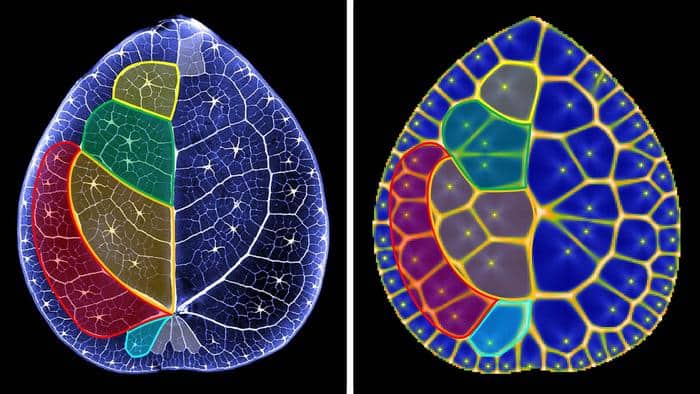
Researchers in the US and Canda have discovered a naturally occurring “Voronoi pattern” in the Chinese money plant.
Voronoi diagrams were introduced in the 1600s by French philosopher René Descartes and are named after the Russian mathematician Georgy Voronoi, who defined and studied them in the early 1900s.
Voronoi diagrams are geometric patterns used to divide space into regions. The plane is divided up into tessellating polygons, known as cells, that each contain a “seed” point. Every location inside a cell is closer to its seed than any other seed in a neighbouring cell.
Voronoi patterns have numerous applications across mathematics, as well as in various other disciplines such as modelling animal territories, city planning or crystal growth.
Voronoi-like patterns are common in nature, such as giraffe stripes. However, the difference between textbook Voronoi patterns and what we see in nature is that the latter usually lacks visible seed points.
Now, Saket Navlakha from Cold Spring Harbor Laboratory in New York and colleagues have found an exception in Pilea peperomioides, the Chinese money plant.
Chinese money plants are perennials native to China’s Yunnan and Sichuan provinces. The plant has round, flat leaves that feature prominent pores called hydathodes. These points are then surrounded by looping reticulate veins that transport water and nutrients to and from the leaf. Rooted in physics
By mapping the pores and veins, the team discovered a naturally occurring, visible, Voronoi pattern with the veins acting as the cell boundaries and the pores being the seed points. They then built a mathematical model to match the observed patterns.
“To our knowledge, this is the first demonstration of the occurrence of Voronoi diagrams in plant venation patterns, where both edges and centres are visible and functional,” they write.
The researchers now plan to use the model to understand why other plants that have similar vein structures do not stick to the Voronoi structure in the same way as the Chinese money plant.