What do volcanic eruptions and grinding coffee have in common? According to a team of coffee chemists and geophysicists in the US and the Republic of Korea, they both produce a fair amount of static electricity, so much so that volcanologists are now examining the espresso-making process.
It is well-known that static electricity is created when grinding coffee beans due to the fracturing and friction that occurs. This causes coffee particles to clump together and stick to the grinder. However, not much was known about how this impacts the resulting brewed coffee.
To investigate the possible impacts, the team ground roasted coffee beans from different countries, and with different roast colours and moisture contents. They found no association between static electricity – as measured by a electrometer – and the coffee’s country of origin. However, the team did find that static was lower when coffee had a higher internal moisture content and when the grinding was set coarser. Light roasts also produced less charge than darker roasts, which tend to be drier.
Splash of water
When they compared espresso made with identical coffee beans ground either with or without a splash of water, they found that grinding with water resulted in a stronger and more consistent brew. “It’s sort of like the start of a joke — a volcanologist and a coffee expert walk into a bar and then come out with a paper,” says volcanologist Joshua Méndez Harper from Portland State University. “These investigations may help resolve parallel issues in geophysics—whether it’s landslides, volcanic eruptions, or how water percolates through soil.”
This week the Australian Acoustical Society and the Acoustical Society of America co-hosted the Acoustics 2023 meeting in Sydney. So it’s not surprising that the acoustics of Australia’s most iconic instrument – the didjeridu – was up for discussion.
In case you haven’t seen or heard the traditional wind instrument, it is a cylindrical or conical wooden pipe that is normally about 1.2 m long (see figure below). Developed by Aboriginal peoples about 1000 years ago, the didjeridu is played using a special breathing technique that creates a continuous drone from the instrument. A skilful player then uses their own vocal tract to modify the sound that the instrument makes.
Complex sounds: playing the didjeridu involves creating and manipulating resonances inside the vocal tract. (Courtesy: Kate Callas)
Now, the physicists Joe Wolfe and John Smith at the University of New South Wales have done acoustic experiments to gain a better understanding of how the instrument is played.
“We were interested in the effect of the player’s vocal tract on various wind instruments,” explains Smith. “The didjeridu seemed like an obvious start because the effect is so striking.”
He goes on to explain the basics of the playing technique, “Resonances in the mouth tend to remove bands of frequencies in the didjeridu sound and we notice the remaining bands. It’s a bit like a sculptor removing marble to leave the things that we notice.”
Their study involved the development of new experimental techniques, such as injecting sound into a player’s mouth to determine their impedance spectrum. This is a measure of which frequencies will resonate with the vocal tract and which will not.
The team also looked at the acoustic properties of didjeridus and compared advanced playing techniques of other wind instruments such as the clarinet and saxophone. “We continue to research subtle features of expressive playing of wind instruments,” says Smith.
The effect of doubling atmospheric carbon dioxide on the climate becomes more pronounced as carbon dioxide levels rise – researchers in the US have shown. This effect, which had not been factored into previous estimates of the Earth’s radiation budget, explains about half the variation between estimates of the climate’s sensitivity to increased carbon dioxide. It also suggests a potential new approach to geoengineering.
The surface of the Earth is warmed by solar radiation and it emits infrared radiation back into space. However, much of this infrared radiation is absorbed by carbon dioxide and other gases in the lower atmosphere (the troposphere). This traps heat much like the glass of a greenhouse. Without this greenhouse effect, Earth would not be warm enough for liquid water and could not support life.
For the past two centuries human activity has been boosting the amount of carbon dioxide in the atmosphere – enhancing the greenhouse effect and warming the surface of the Earth and the troposphere.
Stratospheric effects
However, this description is a simplification. About 8–15 km above Earth’s surface lies the tropopause, and above this is the stratosphere. The stratosphere also absorbs incoming solar radiation and re-emits energy at infrared wavelengths – most of which goes back into space. As the stratosphere’s principal heat source is from above, it is warmest at the top.
“Whereas the troposphere is coupled to the surface by turbulent heat fluxes, the only heat exchange in the stratosphere occurs through radiation,” explains atmospheric scientist Brian Soden of the University of Miami in Florida. “When we’re adding carbon dioxide we’re increasing the emissivity at infrared wavelengths, which causes the stratosphere to want to emit more radiation.” This has to be included when calculating the “radiative forcing” of increasing carbon dioxide, which is a measure of how much an increase perturbs the Earth’s radiative energy balance.
Radiative forcing is a crucial parameter in climate predictions made by the Intergovernmental Panel on Climate Change (IPCC), but its accuracy has been questioned significantly for the past 30 years. For example, different models have disagreed by up to 50% on the radiative forcing resulting from doubling the atmospheric concentration of carbon dioxide. Now Soden and colleagues believe they can explain a significant part of this hitherto unexplained discrepancy.
Pre-industrial conditions
“Almost all previous calculations of the radiative forcing from carbon dioxide would take a climatology of temperature profiles from, say, pre-industrial conditions – so you would have a global distribution of temperature and humidity and 280 ppm carbon dioxide – and you would repeat that calculation, but instead of 280 ppm you’d double it,” explains Soden. “You could even do it with a range: we know that forcing from carbon dioxide increases not linearly but with the logarithm from 1 ppm to something like 10,000 ppm…But all of those calculations assume the same climatology – and that’s where there was a disconnect: you wouldn’t expect the same temperature and humidity profiles for 10 ppm as for 100 ppm or 1000 ppm.” The researchers therefore developed models of how radiative forcing would change as the carbon dioxide concentration in the atmosphere increased.
A counter-intuitive prediction that dates back to the first detailed predictions of anthropogenic climate change in the 1960s, and has been verified experimentally, is that the stratosphere cools because increased carbon dioxide raises its emissivity, causing it to lose more heat to space. Simultaneously, at the bottom the troposphere releases less heat because the increased carbon dioxide traps more infrared radiation.
“When you increase the emissivity, you have to reduce the temperature for [the stratosphere] to remain in radiative equilibrium.” This cooling means that, at higher carbon dioxide concentrations, the temperature drops further and it becomes more difficult for the Earth to radiate away heat. The radiative forcing of carbon dioxide therefore becomes ever larger. Every additional input of carbon dioxidetherefore has a greater forcing effect.
Following this logic, the researchers are now looking at new ideas for geoengineering. Previous studies have focused on the use of aerosols that reflect sunlight back into space: “In this work, we are proposing to use absorptive aerosols to warm the [stratosphere] and lead to smaller carbon dioxide forcing, says Haozhe He, who led the work as Soden’s PhD student and is now a postdoc at Princeton University. This idea is supported by the fact that the 1991 eruption of Mount Pinatubo, which caused dramatic tropospheric cooling, was accompanied by stratospheric warming from sulphate aerosols.
“This is a very important [result] for the climate community – it resolves a major mystery as to whether or not we were faithfully treating the processes that drive global warming,” says William Collins of Lawrence Berkeley National Laboratory in the US, a coordinating lead author of the Sixth Assessment of the IPCC. “What [Soden and colleagues] have shown is that the climate community has been doing a much better job than we suspected for decades. The models were correct all along, we were testing them the wrong way. They were always producing a better answer than we thought.”
The US government has announced ambitious plans to boost collaboration with international partners on commercializing fusion energy as a tool to tackle climate change. The initiative was outlined on Tuesday at the UN Climate Change Conference, COP28, which is taking place between 30 November and 12 December in Dubai, United Arab Emirates.
“We are edging ever closer to a fusion-powered reality,” US climate envoy John Kerry told the COP28 meeting on Tuesday. “At the same time significant scientific and engineering challenges exist [and] careful thought and thoughtful policy is going to be critical to navigate this.”
The plan involves 35 countries working together on five “overreaching goals” to bring fusion energy to grid. These are: research and development; growing the supply chain and future global fusion market; coordinating international regulatory frameworks to create a secure environment for fusion energy; fostering and strengthening a diverse global workforce; and improving public education and engagement in fusion energy.
Before travelling to Dubai, Kerry visited Commonwealth Fusion Systems, a 2018 MIT spin-off in Devens, Massachusetts, where he noted that fusion energy is no longer “just a science experiment”. “Benefitting from decades of investment from the Department of Energy, it is now also an emerging climate solution,” he added. The international plan also comes as the UK and the US signed a cooperation agreement on fusion energy on 8 November.
Investment in fusion by private companies worldwide has already reached $6bn. The US government notes that the rise in private investment “reinforce[s] the need for global engagement to resolve research challenges and develop international supply chains and workforces”, adding that “timely commercial fusion deployment will benefit from early international coordination on regulatory frameworks and policy implementation to facilitate fusion’s market entry.”
As expected, private fusion firms have expressed their support for the measures. Michl Binderbauer, chief executive officer of TAE Technologies in California, notes the company is “celebrating” the “support for fusion energy as a new clean energy source of the near future.”
That is backed up by another California-based firm, San Diego’s General Atomics, which says it “applauds” the engagement initiative. “This plan will support broad international cooperation to develop fusion as a clean energy source for the next generation,” a statement notes.
This episode of the Physics World Weekly podcast features a lively discussion about our Top 10 Breakthroughs of 2023. Physics World editors discuss the merits of research on a broad range of topics including particle physics, quantum technology, medical physics and astronomy.
The top 10 serves as the shortlist for the Physics World Breakthrough of the Year award, the winner of which will be announced on 14 December.
Links to all the nominees, more about their research and the criteria for the award can be found here.
Physics World‘s coverage of the Breakthrough of the Year is supported by Reports on Progress in Physics, which offers unparalleled visibility for your ground-breaking research.
Physics World is delighted to announce its top 10 Breakthroughs of the Year for 2023, which ranges from research in astronomy and medical physics to quantum science, atomic physics and more. The overall Physics World Breakthrough of the Year will be revealed on Thursday 14 December.
The 10 Breakthroughs were selected by a panel of Physics World editors, who sifted through hundreds of research updates published on the website this year across all fields of physics. In addition to having been reported in Physics World in 2023, selections must meet the following criteria:
Significant advance in knowledge or understanding
Importance of work for scientific progress and/or development of real-world applications
Of general interest to Physics World readers
The Top 10 Breakthroughs for 2023 are listed below in chronological order of when they were reported in Physics World. Come back next week to find out which one has won the overall Physics World Breakthrough of the Year award.
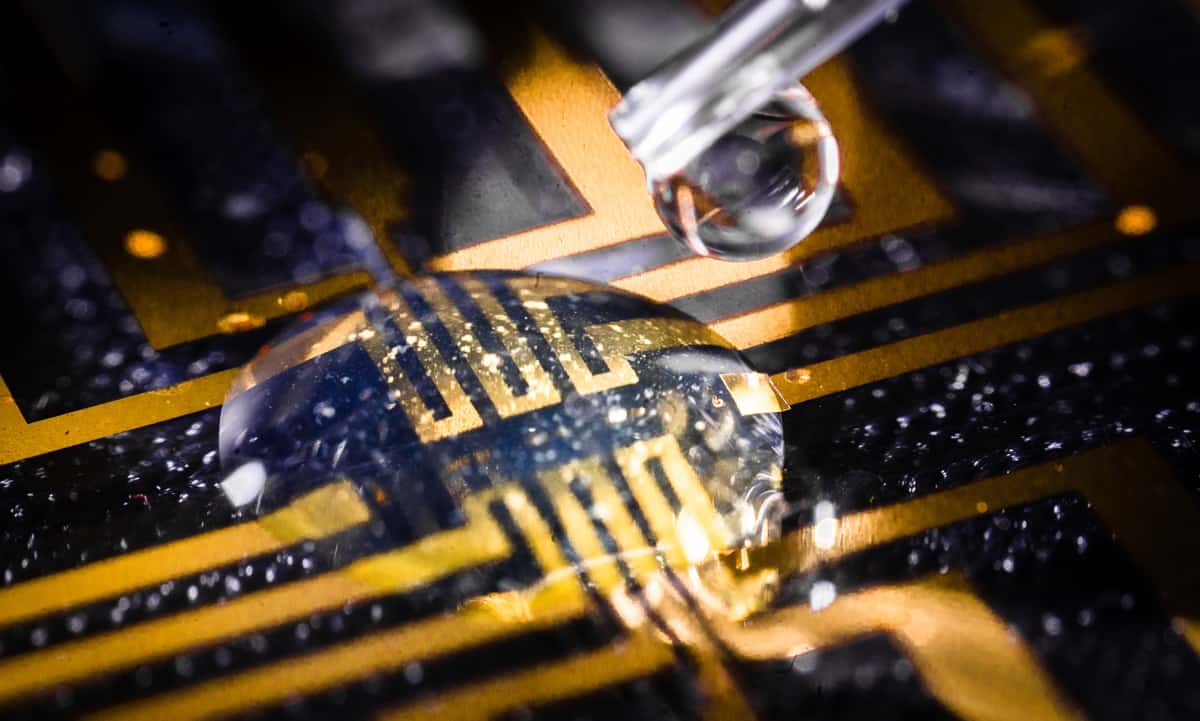
A complex cocktail The injectable gel being tested on a microfabricated circuit. (Courtesy: Thor Balkhed)
To Xenofon Strakosas, Hanne Biesmans, Magnus Berggren and colleagues at Linköping University, Lund University and the University of Gothenburg for developing a way to create electronic circuits directly inside living tissue. Interfacing neural tissue with electronics provides a way to study the complex electrical signalling of the nervous system or modulate neural circuitry to treat disease. However, the mismatch between rigid electronics and soft tissues risks damaging delicate living systems. Instead, the team used an injectable gel to create soft electrodes directly within the body. After injection into living tissue, enzymes in the gel break down endogenous metabolites in the body, which trigger enzymatic polymerization of organic monomers in the gel, converting them into stable, soft conducting electrodes. The researchers validated the process by injecting gels into zebrafish and medicinal leeches, where the gel polymerized and grew electrodes within the tissue.
To Tejin Cai at the University of Rochester in the US and Canada’s York University, and colleagues working on Fermilab’s MINERvA experiment for showing how information about the internal structure of the proton can be gleaned from neutrinos scattering from a plastic target. Neutrinos are subatomic particles that are famous for rarely interacting with matter. So, there were doubts when Cai, a postdoctoral researcher, suggested that the occasional scattering of neutrinos from protons in plastic could be observed. The big challenge for the team was observing the signal from neutrinos scattered from lone protons (hydrogen nuclei) within the much larger background of neutrinos scattered off protons bound-up in carbon nuclei. To solve this problem, they simulated the carbon-scattered signal and carefully subtracted it from the experimental data. As well as providing insights into the structure of the proton, the technique could also shed further light on how neutrinos interact with matter.
To Celia Viermann and Markus Oberthaler of the University of Heidelberg, Germany, together with Stefan Floerchinger of the University of Jena, Germany, and colleagues at the Universidad Complutense de Madrid, Spain, Ruhr-Universität Bochum, Germany and the Université libre de Bruxelles, Belgium, for using a Bose–Einstein condensate (BEC) to simulate an expanding universe and the quantum fields within it. In this simulated system, the condensate represented the universe, while phonons moving through it played the role of the quantum fields. By changing the scattering length of the atoms in the BEC, the team made the “universe” expand at different rates and studied how the phonons seeded density fluctuations within it. Theories of cosmology predict that similar effects were responsible for seeding large-scale structure in the early universe, so the simulated universe may produce valuable insights into how the real one came to be the way it is today.
To Romain Tirole and Riccardo Sapienza at Imperial College London and colleagues for the demonstration of Young’s double-slit interference in time. The 19th-century observation of the interference of light waves by Thomas Young is one of the most iconic experiments in the history of physics and provided fundamental support to the wave theory of light. While that experiment and others like it involve diffraction of light through a pair of narrow slits in space, researchers in the UK and elsewhere showed it is possible to achieve the equivalent effect using double slits in time. The temporal analogue involves fixed momentum but changing frequency. A material in which two slits rapidly appear and then disappear, one after the other, should cause incoming waves to maintain their path in space but spread out in frequency. The researchers achieved this by turning the reflectivity of a semiconductor mirror on and off twice in quick succession and recording interference fringes along the frequency spectrum of light bounced off the mirror. They saw that the interference happens between waves at different frequencies – rather than different spatial positions. The work could have several applications such as optical switches for signal processing and communication or in optical computing.
Restoring control A digital bridge between the brain and spinal cord helped an individual with paralysis to walk naturally. (Courtesy: CHUV/Gilles Weber)
To Grégoire Courtine at Ecole Polytechnique Fédérale de Lausanne (EPFL), Jocelyne Bloch at Lausanne University Hospital and EPFL, Guillaume Charvet at CEA-Leti’s Clinatec, and colleagues for developing a “digital bridge” between the brain and spinal cord that enabled an individual with paralysis to stand and walk naturally. Spinal cord injury can disconnect communication between the brain and the region of the spinal cord that produces walking, which can lead to permanent paralysis. To restore this communication, the team developed a brain–spine interface, comprising two implantable systems: one to record cortical activity and decode the user’s intention to move the lower limbs; and the other to electrically stimulate the region of the spinal cord that controls leg movement. The team tested the system in a 38-year-old man with a spinal cord injury from a bike accident 10 years earlier. Following implant surgery, the bridge enabled the participant to regain intuitive control over his leg movements, enabling him to stand, walk, climb stairs and traverse complex terrains.
To Ben Lanyon and colleagues at the University of Innsbruck, Austria, and the University of Paris-Saclay, France, for constructing a quantum repeater and using it to transfer quantum information over a distance of 50 km via standard telecommunications fibres, thereby demonstrating all the key functionalities of a long-distance quantum network in a single system. The team created its quantum repeater from a pair of trapped calcium-40 ions that emit photons after being illuminated with a laser pulse. These photons, each of which is entangled with its “parent” ion, are then converted to telecoms wavelengths and sent down separate 25-km-long optical fibres. Finally, the repeater swaps the entanglement on the two ions, leaving two entangled photons 50 km apart – roughly the distance required to create large-scale networks with multiple nodes.
Saw Wai Hla, Volker Rose at Argonne National Laboratory in the US and colleagues for imaging a single atom with synchrotron X-rays. Until recently, the smallest sample size that could be analysed using synchrotron X-ray scanning tunnelling microscopy was an attogram, which is around 10,000 atoms. This is because the X-ray signal produced by a single atom is extremely weak and conventional detectors are not sensitive enough to detect it. To get around this, the team added a sharp metallic tip to a conventional X-ray detector, which is placed just 1 nm above the sample to be studied. As the sharp tip is moved across the surface of a sample, electrons tunnel through the space between the tip and the sample, creating a current and this essentially detects “fingerprints” that are unique to each element. This allowed the team to combine the ultrahigh-spatial resolution of scanning tunnelling microscopy with the chemical sensitivity provided by intense X-ray illumination. The technique could lead to applications in material design as well as in environmental science through the ability to trace toxic materials down to extremely low levels.
To the EIGER Collaboration for using the James Webb Space Telescope (JWST) to find compelling evidence that early galaxies were responsible for the reionization of the early universe. Reionization occurred about 1 billion years after the Big Bang and involved the ionization of hydrogen gas. This allowed light that would have been absorbed by hydrogen to travel to the telescopes of today. Reionization appears to have begun as local bubbles that grew and coalesced. These bubbles would have been created by sources of radiation, and one possibility is that it came from stars in galaxies. The EIGER researchers used the JWST’s Near Infrared Camera to look at light from ancient quasars that had passed through the ionized bubbles. They found a correlation between the locations of galaxies and the bubbles, suggesting that light from these early galaxies was indeed responsible for reionization.
To Meng Wang, Songlin Shi and Jay Fineberg of the Hebrew University of Jerusalem, Israel, for discovering that cracks in certain materials can spread faster than the speed of sound. The result contradicts both previous experimental results and predictions based on classical theory, which state that supersonic crack propagation should not be possible because the speed of sound in a material reflects how quickly mechanical energy can move through it. The team’s observations may indicate the presence of so-called “supershear” dynamics governed by different principles than those that guide classical cracks, as predicted by Michael Marder of the University of Texas at Austin, US nearly 20 years earlier.
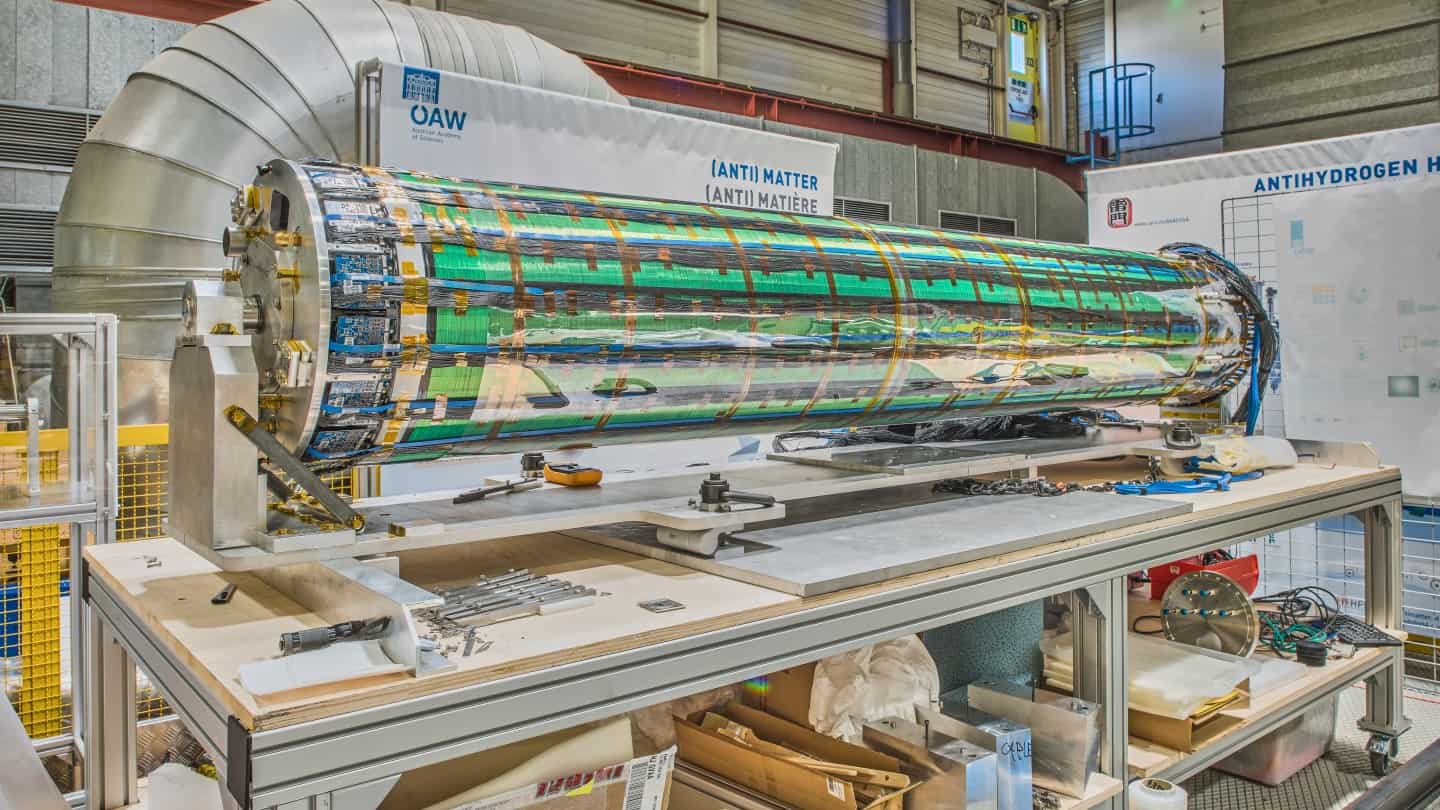
Going down: ALPHA-g’s barrel scintillator being assembled at CERN. (Courtesy: CERN)
To the ALPHA Collaboration for showing that antimatter responds to gravity in much the same way as matter. The physicists used the ALPHA-g experiment at CERN to make the first direct observation of free-falling antimatter atoms – antihydrogen that comprises an antiproton bound to an antielectron. This was done in a tall cylindrical vacuum chamber in which antihydrogen was first held in a magnetic trap. The antihydrogen was released from the trap and allowed to annihilate at the walls of the chamber. The team found that more annihilations occurred below the release point than above it. After considering the thermal motion of the antihydrogen, the team concluded that antimatter falls down. Tantalizingly, the antihydrogen’s acceleration due to gravity was about 75% of that experienced by normal matter. Although this measurement has a low statistical significance, it leaves the door open to new physics beyond the Standard Model.
An honourable mention in our top 10 for this year goes to physicists working at the $3.5bn National Ignition Facility (NIF) in the US for work that was performed at the lab late last year after we picked our 2022 winners (and so misses out on our 2023 breakthrough choice too). On 13 December 2022 the lab announced the generation of more energy from a controlled nuclear fusion reaction than was needed to power the reaction. The laser shot, performed on 5 December 2022, released 3.15 million joules (MJ) of energy from a tiny pellet containing two hydrogen isotopes – compared to the 2.05 MJ that those lasers delivered to the target. This demonstration of net energy gain marks a major milestone in laser fusion.
Physics World‘s coverage of the Breakthrough of the Year is supported by Reports on Progress in Physics, which offers unparalleled visibility for your ground-breaking research.
Scandium remains a superconductor at temperatures above 30 K, making it the first element known to superconduct at such a high temperature. The record-breaking discovery was made by researchers in China, Japan and Canada who subjected the element to pressures of up to 283 GPa – around 2.3 million times atmospheric pressure at sea level.
Many materials become superconductors – that is, they conduct electricity without resistance – when cooled to low temperatures. The first superconductor to be discovered, for example, was solid mercury in 1911, and its transition temperature Tc is only a few degrees above absolute zero. Several other superconductors were discovered shortly afterwards with similarly frosty values of Tc.
In the late 1950s the Bardeen–Cooper–Schrieffer (BCS) theory explained this superconducting transition as the point at which electrons overcome their mutual electrical repulsion to form so-called “Cooper pairs” that then travel unhindered through the material. But beginning in the late 1980s, a new class of “high-temperature” superconductors emerged that could not be explained using BCS theory. These materials have Tc above the boiling point of liquid nitrogen (77 K), and they are not metals. Instead, they are insulators containing copper oxides (cuprates), and their existence suggested it might be possible to achieve superconductivity at even higher temperatures.
The search for room-temperature superconductors has been on ever since, as such materials would considerably improve the efficiency of electrical generators and transmission lines, while also making common applications of superconductivity (including superconducting magnets in particle accelerators and medical devices like MRI scanners) simpler and cheaper.
A simple platform for studying superconductivity
Elemental superconductors have attracted considerable attention during this search because they provide such simple platforms for studying superconductivity. Roughly 20 elements are known to be superconductors at ambient pressures. Of these, niobium has the highest Tc, at around 9.2 K. A further 30 elements become superconducting at high pressures, but the previous record Tc in this group was just 26 K, for the element titanium.
In earlier work, researchers reported that scandium (Sc) undergoes four structural phase transitions at pressures of about 23, 104, 140 and 240 GPa, producing Sc II, Sc III, Sc IV and Sc V, respectively. Scandium was also known to become superconducting at 21 GPa with a Tc of around 0.35 K, and previous experiments had pushed this Tc as high as 19.6 K at 107 GPa, near the phase boundary between the Sc II and Sc III phases.
In the new work, which lead researcher Changqing Jin describes as “a follow up to our previous discovery” of superconductivity in titanium at 26 K, a team from the Institute of Physics, Chinese Academy of Sciences (IOPCAS) and the School of Physics, University of Chinese Academy of Sciences (UCAS) increased the pressure on scandium to 238 GPa. In doing so, they discovered a Tc of above 30 K in the V phase of the element. The result means that scandium is the only known elemental superconductor to have a Tc in the 30 K range, and the team suggests this value may go even higher with further compression.
In a separate study, a team of researchers led by Chen Xianhui from the University of Science and Technology of China (USTC) of the Chinese Academy of Sciences (CAS) and Sun Jian from Nanjing University independently obtained similar results showing that the Tc of scandium increases monotonically into the 30 K region as pressure is increased. Both teams obtained their results by loading their scandium sample into a diamond anvil cell and measuring the element’s conductivity as a function of temperature as they increased the pressure. Such experiments are technically challenging, and several attempts were necessary before they reached the high pressure of 283 GPa.
Pressure-induced electron transfer
In the BCS framework, superconductivity stems from interactions between electrons and vibrations in the material’s crystal lattice (phonons). According to the researchers, scandium fits neatly into this picture, as high pressures cause electrons to move out of the element’s 4s orbitals and into its 3d ones, increasing the electron-phonon coupling.
“The above 30 K Tc observed in the Sc V phase not only sets a new record for elemental Tc, but also points to a fresh strategy for exploring high Tc superconductivity in diverse elemental solids,” Jin tells Physics World. “Such elements could be promising for potential applications in extreme environments.”
Jin adds that he and his colleagues are now trying to reach high Tc phases at lower or even near-ambient pressure by introducing “chemical pressure”, which involves substituting or adding chemical entities to a solid network.
Using a cutting-edge spectrograph on the James Webb Space Telescope (JWST), astronomers have found evidence that interstellar oxygen was far more abundant in many ancient galaxies than previously thought. Led by Kimihiko Nakajima at the National Astronomical Observatory of Japan, the team hopes that their observations could improve our understanding of the early universe.
The Big Bang created an early universe that was made of hydrogen and helium, with a tiny bit of lithium – and this matter coalesced to form the first stars and galaxies. Heavier elements such as oxygen were then created by nuclear fusion in the cores of these stars. As the stars exploded as supernovae, heavy elements were dispersed across entire galaxies, forever transforming the chemical composition of the cosmos.
“Gas-phase metallicity” is an observational parameter that describes the abundance of these heavier elements in galaxies (astronomers use the term metal for all elements heavier than helium). Its value is crucial for understanding a galaxy’s evolutionary history, as well as predicting when complex molecules – the possible building blocks of life – may begin to emerge.
Reliable gauge
A reliable gauge of a galaxy’s gas-phase metallicity is the abundance of ionized oxygen in its interstellar medium. This abundance can be determined by observing the characteristic light emitted by oxygen. However, this approach has its limits when observing the very early universe.
“Previous observations had already revealed the presence of abundant oxygen in galaxies approximately two billion years after the Big Bang,” Nakajima explains. “However, the light from galaxies that existed even further back in time is significantly affected by the universe’s expansion, causing it to shift into the near-infrared range.”
Now, Nakajima and colleagues have observed this red-shifted light using the JWST’s Near Infrared Spectrograph (NIRSpec) – and this has allowed them to make a breakthrough in measuring the gas-phase metallicity of ancient galaxies.
Breakthrough observations
“We identified 138 ancient galaxies that existed over 12 billion years ago and determined their oxygen abundances, a level of analysis nearly impossible prior to the launch of JWST,” Nakajima enthuses. “We developed and rigorously applied advanced analysis techniques to the NIRSpec data, conducting analyses on a scale several times larger than earlier studies.”
Their results reveal that in all but a few of the oldest galaxies observed by NIRSpec, the composition of the interstellar medium was remarkably familiar. “Most of the galaxies had oxygen abundances similar to modern galaxies,” Nakajima says. However, six of the most ancient galaxies that existed when the universe was only 500–700 million years old had much less oxygen than modern galaxies.
With this discovery, the team could more closely pinpoint when the universe’s elemental composition began to change. “The results demonstrate a rapid and dramatic increase in the abundance of oxygen in galaxies during the first 500-700 million years after the birth of the universe,” Nakajima says. “This finding may suggest that, with necessary ingredients like oxygen already readily available in the early universe, life may have appeared sooner than previously thought.”
The team speculates that this sudden change could have been caused by differences in the nature of star formation in the early universe, as well as material flowing in and out of its galaxies. Through further observations with NIRSpec, combined with more in-depth statistical calculations, they will now aim to build a more robust theory in their future work.
Researchers at ETH Zürich in Switzerland have transformed a microchip laser that emits a single frequency (or colour) of light into one that emits light over a broad range of frequencies. The new optical comb device, which works thanks to a process known as a quantum walk, could be used to make miniaturized optical sensors for environmental and medical monitoring and to increase data transmission rates in telecommunications.
Led by physicist Jérôme Faist, the ETH researchers began with a quantum cascade laser integrated into a microchip. This device consists of a micro-ring structure made up of layers of arsenide, gallium, indium and aluminium. The ring confines and guides light and when connected to a direct source of electrical current, the electrons in it are stimulated to quickly jump across the different layers, emitting a cascade of photons. As the photons circulate in the ring, they multiply, producing coherent laser light with a single frequency.
Faist and colleagues found that if they excite this system with an additional alternating current oscillating at a certain resonance frequency, the light emitted goes from being a single colour to multiple colours in a space of just a few nanoseconds. Notably, before it stabilizes its final form, the spectrum of the emitted light resembles the motion of a so-called quantum walk.
A laser’s quantum walk
First proposed by the physicist and Nobel laureate Richard Feynman, the quantum walk is very different from the classical random walk commonly used to model the behaviour of physical systems ranging from fluctuating stock markets to the Brownian motion of pollen grains on the surface of a liquid. The classical random walk works like a lost hiker who chooses their next steps according to the toss of a coin. If the coin lands on heads, for example, the hiker might take a step to the left, whereas tails might call for a step to the right. After many coin tosses, the hiker’s position will be random, but likely close to their starting point.
In a quantum walk, in contrast, a quantum particle effectively moves in both directions at the same time after every toss, adopting a coherent superposition of right and left. This means there are always several possible paths the particle can take to arrive at its final position.
An optical comb-like spectrum
In the new device, this quantum walk has a remarkable outcome. “The different colours (or frequencies) add energy to the light emitted and create an optical comb-like spectrum,” Faist explains. “The optical frequencies are equidistant from each other, and their number is selected by the frequency and amplitude of the electrical oscillating signal sent to the laser.”
As for applications, the researchers say miniaturized optical sensors for environmental and medical monitoring are a possibility. In the longer term, Faist adds that such devices could increase the data transmission rate for optical communications, since each colour of light the laser emits – up to 100 colours in total – could serve as an independent communication channel.
Lee McIntyre is angry. He’s angry about the storming of the US Capitol in January 2021. He’s angry about lies concerning evolution, global warming and vaccines. He’s angry about the role of Facebook and X/Twitter in amplifying these lies. In one of his previous books, How to Talk to a Science Denier, the Boston University philosopher was enraged by science denial. In this one he’s enraged by something broader still: “reality denial”.
Rant lit assumes that it can bring people to their senses by exposing the vapidity of intellectual corruption vehemently enough. It’s fun to read if you don’t take it too seriously, for rant lit is full of dirty laundry, horrifying anecdotes and recognizable villains. The passion and axe-grinding make for wicked phrases and bright prose. Rant lit is feel-good writing for allies.
McIntyre’s book is no exception. On Disinformation is littered with witty put-downs such as “epistemic homicide”, “truth killers”, “firehose of lies” and “zombie foot soldiers”. The book’s villains include Donald Trump, Russian bots and trolls, and people on social media. Truth, it says, is under attack by a “co-ordinated campaign” of individuals and organizations who cherry-pick evidence and experts, and promote conspiracy theories and illogical thinking. That, plus select anecdotes and information, all but exhausts the book’s analytical content.
The spiritual tone is evangelical. It’s a truth-teller’s Bible, full of religious certitude and morally charged language. If you took an evangelical tract and replaced “morality” with “knowledge”, “God” with “truth” and “Satan” with “fact-deniers”, you’d pretty much have this book. It tells us that the “days are dark” and the world full of “cutthroats” who know exactly what they are doing and their minions who don’t. Saving reality is the burden of us knowledgeable ones, collectively and individually. “So now we must all just grab an oar and row,” McIntyre warns.
Rant lit assumes that it can bring people to their senses by exposing the vapidity of intellectual corruption vehemently enough. It’s fun to read, if you don’t take it too seriously
The final chapter contains the instructional content – our marching orders. He lists 10: confront the liars; learn from previous battles; try to be kind; treat those on the other side as victims; focus; don’t be deluded that the answer is education or critical thinking; accept that victory will not be easy; demand more resources from politicians; take comfort in your allies; and improve your intel. We must act quickly, for the US elections are only six months off.
But as with other rant literature, On Disinformation’s vivid prose is peppered with flaws and contradictions. Truth is sometimes said to be a weapon and sometimes what we are fighting for. We have history on our side but we have to act immediately or we lose everything; if we don’t win the next election, democracy dies if the Evil One makes his Second Coming. Disinformation is mainly due to foreign agents but we fight fellow citizens. When we confront zombie truth-killers out to get us, we have to be sensitive to them.
Man on a rantLee McIntyre is a philosopher at Boston University in the US. (Courtesy: Rick Bern)
The prose also conceals undefined terms and unquestioned assumptions. What, after all, is truth? Personally, I know that the 2020 US election was not stolen, that global warming is real and that taking vaccines saved the lives of millions of people during the pandemic, including maybe my own. How do I know? Because of the journals and newspapers, the politicians and law courts, and the experts and acquaintances whom I largely trust. That reliance on trust is what makes me human.
Inspired and emboldened by the book, I went down the corridor to the office of a colleague whom I know voted for Trump – rare in academia, at least in the north-east of the US, but he was within walking distance. He was receptive, even grateful, to speak to someone who didn’t treat him as the enemy. When I brought up specific instances of disinformation, such as about the election and the number of people at Trump’s inauguration, he was largely indifferent, but said he had voted based on other factors.
He was concerned about erosions of equality and freedom, and outraged over the dominance of cancel culture, especially in our university. He attacked election deniers, embraced the two-party system, and pointed out that 74 million Americans voted for Trump – were these all zombies? He hated being treated as an enemy of truth and “un-American”, which made him even more resolute. For much information he relied on websites and links e-mailed by friends. He said he’d vote differently if he thought it reasonable. In short, he was not a minion but trying to make sense of what he saw around him with a different set of concerns than McIntyre.
The prose conceals undefined terms and unquestioned assumptions. What, after all, is truth?
To be fair, McIntyre occasionally admits that people who do not share his views about what’s real are not necessarily morons. Beliefs, he says at one point “are heavily influenced by community, trust, values and how we see ourselves in relation to the people around us”. But that’s no excuse, McIntyre says. It’s a war out there. Donald Trump has called his adversaries “vermin” who must be “rooted out”. In the next US election, evidently, it’s zombies vs vermin. The latter must prevail.
I closed On Disinformation loving the rant, cheering the author, agreeing with each of his positions and thrilled to be on the side of the angels – or at least of the realists.
But I also felt that, if we think of reality as something we are fighting over, we have misunderstood what reality is, who our opponents are and how they operate. When reality has become a battleground, truth is already lost.
Conventional electrocardiograms (ECG) often require bulky, heavy devices, such as the 12-lead ECG you see at a hospital bedside. Patients are connected to equipment by wires, and they must lay still while the electrical signals of their heart are monitored.
As such, conventional ECGs don’t work well for monitoring the heart’s electrical activity during daily activities, such as working in your garden, taking a shower or cooking a meal.
For Peter Elango, continuous ECG monitoring is the goal. Elango, a PhD candidate working in Madhu Bhaskaran’s research group at RMIT University in Melbourne, and his colleagues have prototyped a wearable ECG device. Described in Applied Physics Reviews, the device may save lives and reduce healthcare costs while enhancing point-of-care diagnostics.
“This research started as a ‘what if’ – what if you could miniaturize the hospital [ECG] setup, and what if you could make it more compact and versatile?” Elango says.
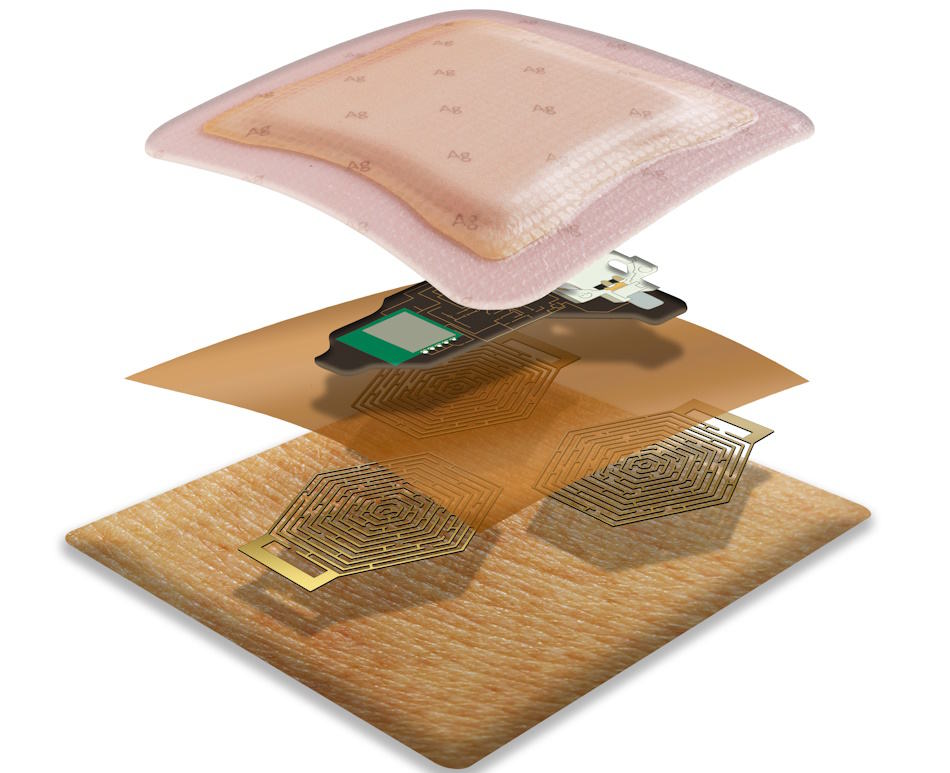
The result is a lightweight, hexagonal-shaped patch consisting of three dry electrodes, each less than one tenth of the width of a human hair. Unlike the “wet” Ag/AgCl electrodes typically used in devices that measure ECG signals, dry electrodes don’t use a conductive gel to enhance electrical signalling. As a result, they are more comfortable and may result in less skin irritation.
Sensor schematic The various layers of the ECG patch, including a dressing, Bluetooth module and gold dry electrodes. (Courtesy: Peter Elango, RMIT University)
Elango compares the ECG patch to a band-aid. “You peel it, just put it on, and you don’t feel it because it’s around 10 grams, it’s almost featherweight. It can be on the chest region or the neck region; you’re not even going to feel it,” he says.
The researchers optimized the patch design and electrode placement to conform to the skin and move with a patient’s body throughout the day, ensuring that cardiac signals are collected continuously. The patch is integrated with wireless Bluetooth communication for signal transmission and processing. And each electrode is gold, a material that Elango says will be reclaimed and recycled after a patient is done using the ECG patch.
“What’s fascinating is not only can the user be aware of their day-to-day cardiac activity, the medical personnel, the family members could access it, which is particularly important if a person is just admitted and released from the hospital and they need constant care and monitoring,” Elango explains.
The gold standard for monitoring the heart’s electrical signals is still a 12-lead ECG. Elango says that their device will be an indicator for patients to go and see a medical practitioner.
“The future of wearable sensors is imminent – even a few years ago, our watches couldn’t make phone calls, for example, and now they can. This work could potentially revolutionize how we monitor cardiac health,” he adds.
The researchers have patented their device and are looking to license it with a company before proceeding with clinical trials. They’ll also be fine-tuning electrode parameters and signal processing.