Size matters: the economies of scale, from the very big to the very small

One hundred and fifty years ago in the US, the combined power of four strong horses harnessed to a plough was no more than 3 kilowatts – and more than half the entire labour force worked on farms. Today, even the smallest John Deere tractor produces 120 kilowatts and about 1.3% of workers are employed in agriculture. This means that the power rating of farm machinery has been multiplied by 40 and the rural workforce has been divided by 40 in that time – all of which is hardly a coincidence.

In transport, both modern ships and large airliners can generate up to 90 megawatts. That makes them nearly 1000 times more powerful than a typical small car and 100,000 times more powerful than a 19th-century waterwheel. And these are not even the most powerful machines out there: some steam engines that generate electricity now operate at 1000 megawatts. Setting aside the environmental impact, these enormous increases in power have brought a surfeit of food and affordable consumer items to a largely urban society, with increased access to information and mobility.

The Czech–Canadian scientist and policy maker Vaclav Smil analyses this growth of scale and power in his latest book Size: How It Explains the World. Smil is a prolific author who has already published more than 40 books on topics ranging from energy and food production to technical innovation and public policy. In this work, he revisits some of those territories, linking them together with a discussion of size, though it might be more accurate to say that the book is about proportion.

Size is not as trivial as simply a list of things that have become very big over the centuries. The physical limitations on that growth are discussed – the size of oil tankers, for example, is often expressed in deadweight tonnage (dwt), and the sizes of these ships increased steadily from about 20,000 dwt after the Second World War to about 300,000 dwt by the 1970s. There are no engineering limitations to making them more than twice that size and yet that hasn’t happened. Smil points out that this is because only a handful of deep-water ports in the world can accommodate such mega-ships, and they would be unable to pass through either the Suez or Panama canals.

On the opposite end of the size scale, Smil discusses Moore’s law, in which engineer Gordon Moore predicted in 1965 the rapid doubling of the number of components placed on a microchip. A graph of the number of transistors versus time shows that the law was maintained for many decades, but that there has been a slight levelling off since 2008. Smil links this tailing off to work by the US electrical engineer Robert Dennard, who showed that as transistors become smaller, they can be made to run faster without increasing the overall power consumption – but that this scaling effect had already begun to reach its limit by the 1990s. Future improvements may also be controlled by both the natural limits of lithography, the widely used light-printing technique, and by the enormous investments needed to develop a new manufacturing facility.

Size also goes beyond simply analysing technology. In an attempt to appreciate the human scale in all aspects of design, Smil starts with a lengthy discussion of the giants encountered in Gulliver’s Travels. We learn that – despite Jonathan Swift’s attempts to build his fictitious world with some plausibility – a modern understanding of materials reveals that his giants would have been unable to walk upright. Worse, their mass-to-surface-area ratio would have made it very difficult for them to cool themselves down, an issue mirrored in the significantly smaller Lilliputians, who would have had to eat almost constantly to maintain their body temperature.

The scattergun nature of the topics in the book might prevent it from ultimately presenting a cohesive thesis – but it is no less enjoyable for that. The lengthy discussion of normal distributions and how they apply to issues as diverse as income distribution, as well as the heights of basketball players, is both informative and entertaining. I also enjoyed the section on the human body and perceived attractiveness, which leads to an analysis of how we are represented in paintings. That in turn takes us to a wonderful rant about the supposed ubiquity of the “golden ratio” in art and design. Smil approaches this concept with some scepticism, concluding that the so-called ratio cannot be precisely expressed as a fraction, and is therefore not even truly a ratio.

All in all, I suspect that many Physics World readers would be delighted to find this book waiting for them under the Christmas tree. Indeed, it would be perfect reading material for anyone who enjoys a mathematical analysis of the world around them, and finds themselves with a little free time.

  • 2023 Penguin 304 pp £20hb

Flash heating technique extracts valuable metals from battery waste quickly and cheaply

A cost-effective new way of recovering metals directly from lithium-ion battery waste could significantly reduce the environmental impact of these ubiquitous devices while cutting the time required to recycle them almost 100-fold. Developed by scientists at Rice University in the US, the technique is known as flash Joule heating, and it has already been used to recover valuable metals from other forms of electronic waste without toxic solvents and with less energy than current laboratory methods.

“Currently, 95% of batteries are not recycled because we don’t have the capacity to recycle them, even as waste from electronics is increasing at an annual rate of 9%,” says James Tour, the Rice nanoscientist who led the project. The recent popularity of electric cars adds urgency to the problem, he adds: “Batteries in electric vehicles last about 10 years, and many of those are coming due now, because it’s been about 10 years that we’ve been using them.”

Spent batteries that are not recycled mostly end up in landfill, as do many other forms of electronic waste (e-waste). This is bad for the environment, as e-waste often contains heavy metals, including some that are toxic. It is also a missed commercial opportunity, since e-waste could in principle be an important and sustainable source of precious metals such as rhodium, palladium, silver, and gold as well as less costly elements like chromium, cadmium, lead and mercury.

The problem is that e-waste recycling methods are far from perfect. The most common ones are based on pyrometallurgy, which involves creating a molten soup of metals at high temperatures. These methods lack selectivity, are energy intensive and produce hazardous, heavy-metal-bearing fumes, especially when the waste contains metals with relatively low melting points such as mercury, cadmium or lead.

Other techniques use hydrometallurgy, which involves leaching metals out of e-waste using acids, bases or cyanide. While these methods are more selective, they produce large quantities of liquid or sludgy waste and involve chemical reactions that are kinetically slow and thus hard to scale up. “A lot of current battery recycling processes involve the use of very strong acids, and these tend to be messy, cumbersome processes,” Tour observes.

A further alternative, biometallurgy, separates metals by harnessing natural biological processes in microorganisms, but this promising family of techniques is still in its infancy.

Gone in a flash

In 2020, Tour and his colleagues at Rice developed a way of producing graphene from carbon sources like waste food and plastic. Later, they adapted this flash Joule heating method to recover precious metals from e-waste and remove toxic ones from the remaining material.

The technique works because the vapour pressures of metals in e-waste are very different from those of other waste components such as carbon, ceramics and glass. In a process known as evaporative separation, the researchers vaporize these metals in a flash chamber by applying an intense pulse of current lasting less than 1 second, heating the waste to 3400 K.

The vapours are then transported under vacuum from the flash chamber to a cold trap where they condense into their constituent elements, explains team member Bing Deng. The metal mixture in the trap can then be further purified using established refining methods.

Activating the black mass

In their latest study, Tour and colleagues extended this process to the so-called black mass, which is the combined waste that comes from the cathode and anode in lithium-ion batteries. Using the Joule-heating approach, the team heated the black mass to temperatures above 2100 K within a few seconds. This ultrafast high-temperature treatment removes the inert layer on the battery metals while also lowering the oxidation state of the black mass, allowing it to be dissolved in a dilute acid.

“What we found is that if you ‘flash’ the black mass, then you can easily separate out the critical metals using only low-concentration hydrochloric acid,” Tour explains. “You could say the flash liberates the metals, so they dissolve easier. We’re still using acid, but much less.”

Using this method, the team recovered more than 98% of the metal from various types of mixed battery waste. What is more, dissolving the waste takes less than 20 minutes, as opposed to 24 hours using traditional methods.

“Industry traditionally tries to recycle the black mass, but current recycling strategies are limited by the complex treatment procedures as well as the substantial energy consumption and CO2 emissions,” says team member Weiyin Chen. “The most important result of our process is reducing the acid usage by 10 times and the time consumption by 100 times during the recycling.”

The Rice researchers say they are now looking to scale up their recycling technique. “We have already demonstrated kilogram-level recovery in our lab and the flash-Joule process can presumably be integrated into a continuous system in the future,” Chen tells Physics World.

They describe their work in Science Advances.

Dangerous soil liquefaction can occur away from earthquake epicentres in drained conditions

Contrary to conventional wisdom, soil liquefaction during earthquakes can occur away from epicentres, in drained conditions, and at relatively low seismic energy density levels. The finding by an international team of researchers could allow us to better assess and prepare for earthquake hazards.

One of the most catastrophic and unsettling of earthquake-related hazards is soil liquefaction. This occurs when seismic shaking temporarily increases the space between individual soil grains, causing a loss of solidity. The soil starts to behave like a viscous liquid, into which vehicles, buildings and other structures can sink. At the same time, buried infrastructure like pipelines can “float” to the surface (see figure). Liquefaction can also cause the ground to spread and crack, and even trigger landslides.

While soil liquefaction can be a devastating effect of an earthquake, it can have useful applications. Civil engineers deliberately induce liquefaction to improve soil quality before construction and minimize the risk of seismic liquefaction. This can be done by blasting, dynamic compaction and vibroflotation, which involves a large vibrating probe.

Undrained conditions

Traditionally, seismic liquefaction has been associated with undrained conditions (soil that does not naturally drain of water) near the epicentres of earthquakes. However, geoscientists have also observed liquefaction occurring away from the epicentre with lower levels of seismic energy.

“This is quite a common scenario,” explains Shahar Ben-Zeev, a seismologist at the Hebrew University of Jerusalem. For example, he notes, “many of the liquefaction events that occurred during the famous Canterbury 2010–2011 earthquake sequence that caused an enormous amount of damage in Christchurch, New Zealand, occurred in the far-field, under very low seismic energy density input.”

To understand how this is possible, Ben-Zeev and colleagues did both grain-scale simulations and physical experiments on the response of layers of water-saturated, cohesionless grains to horizontal shaking. The physical experiments were undertaken in a transparent box, within which an array of pressure transducers allowed measurements of both grain motion and pore pressure.

Interstitial fluid flow

The researchers found that, even in drained conditions, seismic shaking can trigger interstitial fluid flow within soils, leading to the build-up of excess pore pressure gradients and, as a result, the loss of soil strength. Drained liquefaction was seen to unfold rapidly — guided by the movement through the soil of a compaction front at a speed that is constrained by the rate of seismic energy injection.

“The classical undrained mechanism is perceived as a cumulative process, i.e., the pore pressure rises gradually over time,” explains Ben-Zeev. However, he adds: “In the drained scenario, the pressurization is rapid and more instantaneous. Accordingly, we found that the control parameter for drained liquefaction is the seismic power (the rate of the seismic energy density input into the soil).”

The findings, the team noted, also have implications for how we interpret liquefaction-related geological features associated with past earthquakes that have not been measured using seismic instruments.

“Decision and policy-making procedures regarding earthquake preparedness rely on earthquake catalogues, mainly the reoccurrence time interval of a certain earthquake magnitude in a region, Ben-Zeev explains. One way to construct a catalogue that goes back before  instrument records, he notes, is to examine soft-sediment deformation in the geological record.

“If evidence of soil liquefaction events is found, it is possible to calculate ground motion parameters that triggered liquefaction, and then to constrain epicentral distance and magnitude,” he says. “Our study, which showed that liquefaction can be initiated under relatively low intensity shaking, calls for the re-examination of possibly overestimated paleo ground motion.”

Not fully explained

Oliver Taylor, a geotechnical engineer with ECS Limited who was not involved in the study believes that the work is significant: “[Ben-Zeev and colleagues] provide a thorough insight into soils that liquefy outside the classical undrained regime. This is something that has been observed in-situ, yet not fully explained by our current understanding.”

However, Taylor notes that the team only tested the loosest possible soil condition on an uncompacted uniform sand. “The issue with this,” he adds, “is that it only creates the ‘worst-case’ scenario from which the results are ‘validated’ – and may not be representative of the in-situ conditions where low energy-density liquefaction was observed”.

Calling the study “very interesting”, Chi-Yuen Wang − an applied geophysicist at the University of California, Berkeley – points out that it is “unclear why [the] simulation did not consider the compressibility of the porous soil, given that the latter is the major component of storage of soil at shallow depth, which controls the evolution of pore pressure.”

With their initial study complete, Ben-Zeev and his colleagues have been using the same theoretical framework to explore the mystery of how soil liquefaction can occur many times at the same location. This is not expected to occurs because the initial episode should densify the soil and prevent re-liquefaction in the future.

The study is described in Nature Communications.

Moiya McTier: from scientist to science communicator

Moiya McTier

As a kid, I dreamt about becoming a professional athlete, a famous artist, or maybe the US president. I wanted to solve the mystery of the electron’s quantum leap, or be the world’s leading expert in Arthurian legend. So far, I have achieved none of these dreams – but instead I find myself in the coolest career I could possibly imagine. In fact, I didn’t even know I wanted it when I was younger because the career didn’t exist: I created it myself.

I’ll admit that I had a tremendous advantage along this self-made path compared to most as I was born into academia. My mom was in a PhD programme for literature until I was 14, and some of my earliest memories are of attending the classes she taught to pay her tuition, playing in college lecture halls and writing on blackboards in front of the students. There was virtually no chance I wouldn’t end up in academia, but teenage Moiya couldn’t pick a discipline to save her life. To my mom, however, who struggled to make ends meet with a background in the humanities, the choice was clear: I was to be a scientist.

Cosmic curiosity

In my second year of my undergraduate degree at Harvard University, a friend convinced me to try an astronomy class. I was utterly uninterested. Against my mom’s wishes, I had already fallen in love with the folklore and mythology department. But, by the end of that semester, I thought space was pretty cool too. When I decided to do a double major in both astronomy and folklore – the first person to do so in Harvard’s history – people thought it was an act of courage and conviction. In reality, however, I was just terrified of choosing one and finding out later that it was the less fun choice. In fact, in the decade since, I have continued to make decisions based on maximizing fun and purpose, and it has led to an incredible life.

By my final year, I had only learned enough about the universe to know that I needed to learn more. My classes and research had taught me that planets in circumstellar habitable zones – the area around a star where the conditions are conducive for a planet to host life – are common in the universe. I needed to know if there was a similar Goldilocks zone around the whole galaxy, so I applied to astronomy PhD programmes to satisfy my knowledge cravings.

Once at Columbia University in New York City, I crafted a plan to pursue research projects that would give me the knowledge and skills to answer my big galactic questions. But the classes were gruelling, I quickly realized that I found research tedious, and the toxic parts of academic culture that were hidden from me as a child started to leave a bad taste in my mouth. Public talks and outreach events cleansed my palate for a few sweet hours at a time, but the dread settled in again every time I opened a python window on my computer. My priority gradually shifted from my science to science communication. I still wanted to get the PhD, but I was motivated more by the title and the credibility it granted than by curiosity or passion about the research itself.

Year of yes

In 2018 I was a third year grad student looking ahead to my departure from academia. I committed to what I called a “Year of yes” – 12 months of agreeing to every science communication opportunity that came my way so I could hone my skills and find my voice as a “scicommer”. It was exhausting, but so incredibly satisfying to push myself outside of my comfort zone and confront my imposter thoughts. I didn’t think I was the right person to go on a speaking tour around South Africa, perform in a stand-up comedy showcase, or write a popular-science book, but it didn’t matter what I thought. The “Year of yes” demanded that I accept every invitation, if only to see if I could do “the thing” in question.

Spoiler: I could always do the thing, and do it well.

Aside from the confidence boost, the biggest advantage of the “Year of yes” was the way it made my word-of-mouth references snowball into an avalanche of potential gigs. A science talk for an amateur astronomy club begat a creative workshop for a consulting company, which led to a motivational keynote for a professional conference. I started to make my own content: podcasts, a YouTube channel, and a book (finally achieving one of my many childhood dreams). My platform was growing steadily, and by the time I defended my dissertation in 2021, I was working nearly full-time as a science communicator.

People thought I was brave for veering from the conventional path, but I was merely following the fun and trying to avoid the monotony of a 9-to-5 job

While my astronomy peers were applying to postdoctoral programmes – a seemingly miserable and demoralizing process – I took a leap of faith and started my own science communication business instead. Again, people thought I was brave for veering from the conventional path, but I was merely following the fun and trying to avoid the monotony of a 9-to-5 job.

It didn’t seem risky – I had a book deal with a major publisher, after all – but I’d be lying if I said I felt secure in my decision. The life of a freelancer comes with equal parts freedom and stress about landing your next job, but my good fortune and the referral avalanche I worked so hard to build keep me busy. Within a week of defending my thesis, I had a short job consulting on the science and folklore of the upcoming Disney movie, Wish, and days before I turned in the first full draft of my book, I was asked to host a YouTube show about mythology for PBS.

These days, my time is split between several fun projects like helping people be less afraid of space, protecting artists from unethical generative AI, and writing book number two. No two days are the same, which is perfect for my ADHD brain that needs to bounce from one task to another so it doesn’t get bored.

While it may seem like a daunting challenge to craft your own dream career as I have, I am not an anomaly. It’s easier now than it has ever been to forge your own path – not easy by any means, but easier. All you have to do is follow the fun to a niche that snugly holds whatever makes you uniquely you.

European Space Agency’s Euclid mission takes its first dazzling images of the cosmos

The first full-colour images of the cosmos taken by the €1.4bn Euclid mission have been released today by the European Space Agency (ESA).

The five dazzling images show galaxies, globular clusters and nebulae in incredible detail. The image above is the iconic horsehead nebula, which lies some 1375 light-years away from Earth as part of the constellation Orion.

While other telescopes have taken images of the famous nebula, they are unable to create such a sharp and wide view with just one observation as Euclid is able to. Euclid captured the image above in about one hour.

“Euclid will make a leap in our understanding of the cosmos as a whole, and these exquisite Euclid images show that the mission is ready to help answer one of the greatest mysteries of modern physics,” notes Carole Mundell, ESA’s director of science.

Euclid has a 1.2 m-diameter telescope, a camera and a spectrometer that it will use to plot a 3D map of the distribution of more than two billion galaxies.

The other four images released today are shown below.

Perseus cluster of galaxies

Perseus cluster of galaxies

The image shows 1000 galaxies belonging to the Perseus Cluster, which lies 240 million light-year away from Earth. The image also contains over 100,000 additional galaxies further away in the background, which each contain up to hundreds of billions of stars.

Spiral galaxy IC 342

Spiral galaxy IC 342

This image is galaxy IC 342, which is also known as the “hidden galaxy”, so called because it is difficult to observe as it lies behind the disc of the Milky Way where dust, gas and stars obscure the view. It is located around 11 million light-years from Earth and as it is a spiral galaxy, is considered a look-alike of the Milky Way.

Irregular galaxy NGC 6822

Irregular galaxy NGC 6822

The irregular dwarf galaxy NGC 6822 is located 1.6 million light-years from Earth and is a member of the same galaxy cluster as the Milky Way. The galaxy has been observed recently by the James Webb Space Telescope, but Euclid is the first to capture the entire galaxy and its surroundings in high resolution.

Globular cluster NGC 6397

Globular cluster NGC 6397

Globular clusters are collections of hundreds of thousands of stars held together by gravity and are some of the oldest objects in the universe. Located about 7800 light-years from Earth, NGC 6397 is the second-closest globular cluster to us.

Next steps

Euclid was launched on 1 July from Florida’s Cape Canaveral Space Force Station and is currently located in a spot in space called Lagrange Point 2 – a gravitational balance point some 1.5 million kilometres beyond the Earth’s orbit around the Sun.

Routine science observations are expected to begin in early 2024 where Euclid will spend the next six years studying the large-scale structure of the universe, creating the largest cosmic 3D map ever made, with the aim of understanding how the universe evolved following the Big Bang.

Cool tricks offer new solutions for quantum networking

Emerging systems for quantum communications and cryptography rely on the ability to transmit single photons with high fidelity. Single-photon emitters based on quantum dots cooled to cryogenic temperatures have been shown to produce indistinguishable single photons with high brightness, but for practical use in real-world communications networks both the single-photon source and its cooling mechanism must be integrated into a standard rack-mounted unit.

Scientists at TU Berlin have recently shown that this tricky integration can be achieved with a Stirling cryocooler supplied by AMETEK Sunpower. They have built a plug-and-play testbed for quantum key distribution that emits single-photon pulses at telecoms wavelengths, and that combines the quantum-dot device, the cryocooler, and all the associated optical components into a standalone 19-inch module (Appl. Phys. Rev. 9 011412).

Other iterations of such quantum-dot emitters would typically require a bulky and complex cooling system to enable operation at temperatures below about 50 K, but the scientists at TU Berlin found that the compact Stirling cryocooler was able to maintain the required operating temperature without introducing unwanted vibrations into the system. These cryocoolers are already widely used in scientific instruments that require a low-noise background, such as infrared and radio-wave detectors for telescopes and superconducting quantum-interference devices (SQUIDs), while recent design improvements are widening their appeal for applications with more demanding requirements.

The Sunpower design features a free-piston mechanism that exploits gas bearings to enable friction-free operation. “The motion of the piston is driven by an electronic controller, while the oscillation of the moving parts charges the gas bearings to enable the piston and displacer to levitate on a film of gas,” explains Cliff Fralick of AMETEK Sunpower. “There is no lubrication used, and no maintenance needed, which ensures that these hermetically-sealed cryocoolers will have a long and dependable lifetime.”

Such contact-free operation has made these free-piston cryocoolers a popular choice for applications that demand reliable and robust cooling solutions. One stand-out example was a device that was designed to cool an imaging spectrometer onboard NASA’s RHESSI space mission, launched in 2002 to study the energetic particles released in solar flares. Despite a target mission lifetime of just two years, the cryocooler enabled the spectrometer to continue capturing images for 16 years, until the instrument was finally decommissioned in 2018.

Sunpower’s free-piston design also delivers higher cooling powers and a better thermal efficiency than other cryocoolers on the market. One of the most powerful models in the company’s range of compact devices, the Cryotel GT, removes heat at a rate of 16 W with 240 W of input power while maintaining a temperature of 77 K, achieving a cooling efficiency of nearly 20% of the theoretical Carnot limit. In addition, the high specific power of the design allows for a smaller size, with the GT measuring 276 mm long and 83 mm diameter, and with a mass of only 3 kg.

Such design parameters have made Sunpower’s cryocooler a popular choice for instruments that need to pick up faint signals. “In order to detect something that produces very little energy, it is necessary to generate a very cold background to minimize the noise floor and improve the signal-to-noise ratio,” says Fralick. “That applies to many scientific applications such as infrared detectors, SQUIDs, low-noise amplifiers, telescope instruments, and deep-space communications.”

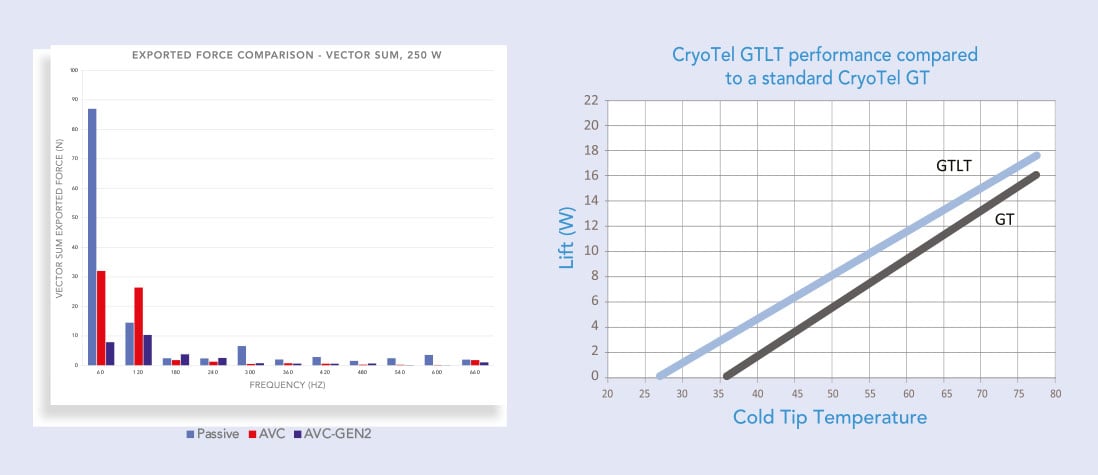
Recent innovations have now widened the appeal of Sunpower’s cryocoolers for a range of new applications, particularly within the growing field of quantum technology. The company has recently released a premium version of the GT that offers a minimum temperature around 10 K lower than the standard version, while also increasing the usable heat load capacity at temperatures between 30 to 50 K.

“The GT typically has a minimum temperature of approximately 38 K, while the new GTLT can provide meaningful cooling power at temperatures down to 30 K,” says Fralick. “By boosting the cooling performance at lower temperatures, the GTLT expands the range of applications that can be addressed with our technology.”

Sunpower

The company has also been working to reduce the level of vibrations exported from the cryocoolers, since excessive vibrations created by the oscillating components have limited the adoption of Stirling cryocoolers in certain applications. All the cryocoolers are fitted with a passive balancer as standard, while Sunpower also offers the option of Active Vibration Cancellation (AVC) across all the instruments in its product range.

The company’s initial AVC offering reduced the level of exported vibrations by a factor of five, while its latest release – the AVC-GEN2 balancer – delivers a further two-fold performance improvement. “This yields a ten-fold reduction in exported vibrations compared to the passive balancer, which is a critical benefit for customers who are exploring applications in quantum technology,” says Fralick. “Combining the CryoTel GTLT with the AVC-GEN2 active balancer offers a compact solution that delivers the performance needed for these applications.”

Indeed, the QKD system developed at TU Berlin makes use of both these innovations to optimize the performance of the quantum-dot emitter while also minimizing vibrations inside the confines of the turnkey module. Another key customer in the quantum sector is UK start-up company Aegiq, which has developed a commercial single-photon source that exploits compact cryogenic cooling, ensuring that its module fits inside a 19-inch rack.

Sunpower is continuing to make improvements to its products and technology, with an ongoing drive towards colder temperatures, higher capacity cooling, and lower levels of exported vibration. “Quantum applications are growing quickly, and Sunpower is focused on delivering the technology advances that meet the demands of customers in this field,” says Fralick.

Total-body PET imaging reveals immune response in COVID-19 patients

Total-body immunoPET images

Understanding how the body’s immune system responds to viral infections is essential for developing new vaccines and improved treatments. The recent pandemic reiterated this need, prompting particular interest in the role of T cell response to COVID-19 infection.

Previous studies of human immune response relied on peripheral blood assays; but most T cells reside in tissue rather than blood. What’s needed is a non-invasive way to quantify immune cell biodistribution and kinetics in vivo, particularly in lymphoid organs. With this aim, researchers at UC Davis used the uEXPLORER total-body PET scanner to perform first-in-human immunoPET imaging of CD8+ T cell biodistribution in three healthy individuals and five patients recovering from COVID-19. They report their findings in Science Advances.

Negar Omidvari

The team used an immunoPET imaging probe based on a 89Zr-labelled minibody (an antibody fragment) with high affinity to human CD8 (expressed on the surface of CD8+ T cells). The long half-life of 89Zr (78.4 h) allows the radiotracer’s biodistribution to be followed for several days after injection. However, 89Zr-based immunoPET imaging with conventional clinical PET scanners suffers from high noise and concerns over radiation dose.

“The high statistical noise was the major barrier for dynamic imaging and kinetic modelling of immunoPET tracers with conventional PET scanners,” explains first author Negar Omidvari. “Total-body PET scanners have extended axial length compared to conventional PET scanners, resulting in a significant increase in sensitivity. We expected that total-body PET would bring significant improvements in imaging 89Zr-based tracers, while at the same time allowing for dose reduction and total-body dynamic imaging.”

T cell tracking

The eight participants in the study received low doses (mean activity of 18.8 MBq) of radiotracer via intravenous infusion. The researchers then performed three total-body PET/CT scans: a 90-min dynamic PET scan starting immediately before the infusion, plus two 60-min PET scans 6 and 48 h later. No adverse effects or changes in participants’ vital signs were observed during the study.

Despite a sixfold reduction in radiation dose, the total-body PET scans exhibited significantly better image quality than previous human PET scans with this radiotracer. In particular, a large number of high-contrast lymph nodes were visualized in all subjects. Standardized uptake value (SUV) images at the three imaging timepoints showed high tracer uptake in lymphoid organs in all subjects, with the highest uptake observed in the spleen. Tracer uptake in peripheral lymph nodes was seen in all subjects as early as 30–90 min post-infusion, peaking at 48 h.

Time–activity curves for all organs-of-interest revealed consistent trends in tracer kinetics, with SUVs in bone marrow regions increasing during the dynamic scans in all subjects and plateauing towards 90 min. Between the 6 and 48 h timepoints, SUV decreased in the spleen, bone marrow and lungs, and increased in the lymph nodes and tonsils, for all subjects. During the last 42 h, changes in SUV were similar in all organs-of-interest, with no significant differences between COVID-19 patients and controls.

The researchers also calculated tissue-to-blood ratios (TBRs), defined as the ratio of tissue activity to whole-blood activity. Plotting TBRs as a function of time revealed distinct differences between COVID-19 patients and controls in all bone marrow regions at early timepoints (up to 7 h). The team note that subject 2 (who had been infected with COVID-19 twice) had TBRs of all bone marrow regions, spleen and tonsils two to three times higher in than all other patients.

These changes were not evident in the SUV images, suggesting that TBR values are more informative for assessing CD8 distribution.

“Tissue SUVs are directly related to concentrations of the radiotracer in blood, which change as a function of time,” Omidvari explains. “Therefore, if there are differences in blood clearance of the radiotracer between different patients, comparing tissue SUVs between patients at a specific timepoint becomes prone to error. Also, when imaging with immunoPET tracers, T cell trafficking can affect the SUVs at later timepoints, because T cells can get labelled and then move to a different tissue.”

Better than bloods

For comparison, the researchers performed peripheral blood assays on samples drawn from each subject before radiotracer infusion. Flow cytometry revealed higher percentages of CD8+ T cells, activated CD8+ T cells and CD8+ memory T cells in the peripheral blood of COVID-19 convalescent patients compared with controls.

The COVID-19 patients, who were first scanned within eight weeks of symptom onset, also underwent a second set of PET/CT scans and blood assays roughly four months later. Comparing baseline with 4-month scans revealed increased TBRs in all bone marrow regions of all subjects. The researchers note that, although this study included a small number of subjects, the immunoPET platform appears more sensitive than blood assays for studying CD8+ T cell physiology in individuals.

“We see a huge difference in the PET data of subject 2 in many different tissue types at all timepoints, which is not visible in the blood data,” says Omidvari. “We also see a small increase in bone marrow TBRs of all COVID-19 patients at 4-month follow-up scans compared to their baseline scans. However, in peripheral blood CD8 assay, we don’t see these differences or patterns.”

The team concludes that dynamic immunoPET imaging is currently the only non-invasive technology that can provide in vivo insight into whole-body T cell distribution and trafficking in human subjects, with the use of total-body PET enabling acceptable radiation dose burden.

“Next, we plan to improve the kinetic modelling to include the T cell trafficking pathway into the model, to not only quantify the trafficking rates in different tissues, but also to decouple the effect of T cell trafficking on tissue uptake,” Omidvari tells Physics World.

Electrons caught going around the bend

Graphs showing the smooth flow of photocurrent streamlines around a microscopic structure shaped like an airplane wing. Several silhouettes of an airplane taking off are shown for comparison

Taking inspiration from the flow of air around aeroplane wings, researchers in the US have imaged photoexcited electrons flowing around sharp bends for the first time. Because such bends are often found in integrated optoelectronic circuits, observing the electrons’ “streamlines” could lead to improvements in circuit design.

More than 80 years ago, the physicists William Shockley and Simon Ramo showed theoretically that when electrons travel around bends, their streamlines get locally compressed, producing heat. Until now, though, no-one had measured this effect directly because it is so difficult to observe the streamlines of electron photocurrents – that is, electric currents induced by light – through a working device.

In the new work, which is described in the Proceedings of the National Academy of Sciences, researchers led by physicists Nathaniel Gabor and David Mayes of the University of California, Riverside built a micromagnetic heterostructure device made from a layer of platinum on a yttrium iron garnet (YIG) substrate and placed it in a rotating magnetic field. They then directed a laser beam onto the YIG, causing the device to heat up and triggering a phenomenon known as the photo-Nernst effect. It is this effect that generates the photocurrent.

Observing the overall pattern of streamlines

By changing the direction of the external magnetic field, the team “inject the current in such a way that we not only control its source location, but also its direction,” explains Mayes. What is more, he adds, “it turns out that when you measure the electronic response as you do this over and over, you end up observing the overall pattern of streamlines.”

To demonstrate the power of their technique, the researchers repeated the experiments on a modified device called an electrofoil that enabled them to contort, compress and expand the photocurrent streamlines in the same way that aeroplane wings contort, compress, and expand the flow of air. In both scenarios, the streamlines represent the direction of flow that yields the greatest response at each point, as predicted by Shockley and Ramo’s theorem.

“Back in the late 1930s, these two eminent physicists realized that a free charge in a device does not have to reach an electrode to induce an electric response,” Mayes tells Physics World. “Instead, the motion of the free charges will affect all the other charges in the device due to the Coulomb force.

“Shockley and Ramo were able to show that the streamlines not only illustrate the ‘preferred’ current direction for the device, but that they also represent the pattern of current flow through it as if we had simply biased one end of the device and grounded the other.”

Avoiding hot spots

Gabor notes that being able to determine where current flow lines are being compressed in a device could help circuit designers avoid creating such local hot spots. “The results from our study also suggest that you should not have sharp bend features in your electrical circuit,” he says, adding that gradually curving wires are “not the state-of-the-art right now”.

The researchers are now exploring ways of increasing the resolution of their technique while also testing new devices and materials. In particular, they would like to measure streamlines in devices fashioned into geometries such as a “Tesla valve”, which constrains electron flow in one direction.

“Our measurement tool is a powerful way to visualize and characterize charge flow optoelectronic devices,” says Gabor. “We hope to advance our ideas towards new emerging materials that include both magnetic Nernst-like effects and unconventional current flow behaviour.”

LAP’s LUNA 3D delivers surface guidance for radiation therapy

In this short video filmed at October’s ASTRO 2023 meeting in San Diego, US, Trent van Arkel, CEO of LAP of America Laser Applications, LLC, introduces the LUNA 3D. He explains how the 510(k) pending surface-guidance system is used to accurately and reproducibly position patients for radiation therapy.

LAP is well known for producing lasers, van Arkel goes on to say, but in fact has been involved in advanced optics and laser measurements in industrial fields for over 20 years. He describes how the experience gained in these high-precision, harsh environments has been channelled to improve this product. In addition, he says that the company has expanded its sales force and development team into the field of radiotherapy – especially in surface-guided radiation therapy (SGRT). This, van Arkel says, has enabled LAP to develop this highly intuitive product – with an expanded field of view, browser-based user interface (UI) and a virtual laser tool.

The expanded field of view of the LUNA 3D has been designed to allow the therapist to position the patient at a convenient height, before the platform is raised to a working level. In addition, team members wanted to create an SGRT product that’s as easy to use as a laser. They did this by using a browser-based UI, which is a hardware-independent software architecture that allows radiation therapy data to be accessed when and where needed.

The final improvement, van Arkel explains, is the virtual laser tool, which mimics the positioning laser in the room – bringing that functionality to the surface-guidance system in a virtual environment, and so saving time when setting up the patient and getting them ready for their first treatment.

LUNA 3D is 510(k) pending (K232031) – not available for sale in the US. Availability of products, features and services may vary, depending on your location.

Tailored material makes speedier skyrmions

Skyrmions – quasiparticles with a vortex-like structure – can be made to diffuse more than 10 times faster than their natural drift rate in specially-designed materials developed by researchers in Germany and Japan. This speedier movement could come in handy for novel forms of computing that work using random (stochastic) processes like the Brownian motion of particles.

Skyrmions are made up of numerous electron spins and can be thought of as two-dimensional whirls (or “spin textures”) within a material. They exist in many magnetic materials, including cobalt–iron–silicon and the manganese–silicide thin films in which they were first discovered. As well as being of interest in fundamental condensed-matter physics, skyrmions have attracted considerable attention in recent years as a possible basis for future hard-disk technologies.

Today’s hard disks store information in magnetic domains, which are areas where all magnetic spins are aligned in the same direction. There are fundamental restrictions on how small these domains can be, which limits storage capacities. Skyrmions, in contrast, measure just tens of nanometres across, and could therefore be used to create storage devices with much higher densities. A further advantage is that whereas flipping all the spins in conventional domains – to switch a device’s memory state from 1 to 0, for example – requires a considerable amount of power and can be slow, a skyrmion-based switch would require many fewer spin flips. In addition, the final spin state in such a system would be robust against external perturbations, making skyrmion structures more stable than conventional magnetic domains.

Stochastic dynamics for highly energy-efficient computers

Skyrmions can be made to move by applying a small external electric current to a magnetic thin film, but they also move naturally, and randomly, thanks to diffusion. Such stochastic dynamics have attracted much interest recently because they could be exploited to make highly energy-efficient computers, says Takaaki Dohi, a spintronics researcher at the University of Tohuku who led the development of the new materials.

Dohi notes that the distinct topological properties of magnetic skyrmions give rise to a special version of the Magnus force, which lifts spinning objects as they move through a fluid. The gyrotropic force, as it is known, makes ferromagnetic skyrmions move in circles rather than along straight lines. This circular motion drastically reduces the skrymions’ diffusive motion compared to that of normal Brownian particles, which (as laid out by Albert Einstein in his landmark 1905 study of Brownian motion) exhibit an inverse relationship between particle friction and the diffusion coefficient.

Importantly, though, the direction of the skyrmions’ circular motion (clockwise or anticlockwise) depends on a property known as their topological charge, which relates to the winding number of their whirl-like structures. This means that if two skyrmions with opposite winding numbers can be coupled together, their respective gyrotropic forces will cancel out and their diffusive motion will increase. A computer based on this type of “gyrotropic-compensated” skyrmions would thus be faster and would consume less energy .

Increased skyrmion diffusion

Dohi and colleagues at the Johannes Gutenberg University in Mainz and the University of Konstanz have now demonstrated this type of coupling-based compensation in multilayer stacks of materials. Each stack is composed of two individual ferromagnetic layers made from cobalt-iron-boron that are separated by an iridium spacer. By controlling the thickness of this structure, the researchers could tailor the sign and strength of the antiferromagnetic exchange coupling between the layers. By varying the thickness of the individual ferromagnetic layers, they could control the net spin. “In this way we can tune the two competing gyrotropic forces to compensation,” Dohi says. “For 90% compensation, for example, we find that the diffusion coefficient enhances by more than a factor of 10 compared to a ferromagnetic skyrmion.”

In their study, which they describe in Nature Communications, the researchers investigated the movements of skyrmions using the magneto-optical Kerr effect (MOKE), which detects the net magnetization of both ferromagnetic layers. They were therefore not able to explore the limit of 100% compensation, for which their theory predicts an even larger increase in diffusion. “This is why we are looking into other (electrical or optical) means that might allow us to go to this limit,” Dohi says. “For instance, a magnetic tunnel junction placed at the top of a synthetic ferromagnetic could resolve this problem.”

While skyrmions in naturally occurring antiferromagnets should also diffuse faster than their ferromagnetic counterparts, experiments to date have found that they suffer from strong “pinning”, which slows down their movement. “Our result shows that synthetic antiferromagnets are better in this this regard since they combine the low pinning advantages of ferromagnets and the fast dynamics of antiferromagnets,” Dohi tells Physics World.

The researchers are also exploring ways to decrease the size of the skyrmions in the synthetic antiferromagnets as well as further reducing their pinning. “Both these aspects are crucial for the scalability and energy efficiency of possible future devices that exploit these quasiparticles,” he concludes.

Copyright © 2026 by IOP Publishing Ltd and individual contributors