Physicists wanted: the demand for physics skills in the UK workplace

If you are an early-career physicist, or about to graduate with a degree in physics, then I have some good news for you. There is a substantial and growing need for employees with physics skills and knowledge in the UK and Ireland. But as well as requiring physics expertise, most roles generally call for additional transferable skills that will enable candidates to successfully apply physics within the workplace.

Additionally, employers value physics know-how not only in its own right, but also as a foundation for solving complex problems in areas outside science. These are some of the main findings of a 2022 report Physics in Demand: the Labour Market for Physics Skills in the UK and Ireland produced for the Institute of Physics (IOP) by labour-market analytics specialists Emsi Burning Glass.

Increasing opportunities

By combining market research, analysis and data expertise, the Physics in Demand report finds that one in 20 jobs requires physics skills – quantitatively speaking, that is 1.85 million jobs in 2020 across the UK and Ireland – with demand increasing over the decade between 2010 and 2020. The fastest-growing are roles as scientists, which are up 24% since 2010, with demand for physical scientists within that group rising by 40%. The slowest-growing are teaching positions, which only exhibited 6% growth over the same period. In terms of adding the highest volume of jobs during that decade, construction managers came out on top with 28,100 net new jobs and showing 21% growth.

The report also highlights an increasing need for physics skills and knowledge in roles not traditionally associated with the field. Physics expertise is required in many sectors, including healthcare, the public and regulatory sector, teaching, engineering, construction and manufacturing. Within higher-skilled jobs, increasing opportunities are opening up in data science, software engineering, computer science and quantitative analysis. Demand is also increasing for physics skills in the business, financial and digital sectors. As the report puts it: “The analytical rigour associated with physics gives physics-trained professionals competitive advantages in taking on these roles, distilling their complex problems and identifying how to solve them.”

One of the biggest scientific challenges for the immediate future is within the global energy sector, with the push towards net-zero emissions. As the report stresses, physics is fundamental to that quest, and will likely hold the solutions for many of the questions around clean and sustainable energy, and how to use existing materials in new ways.

In addition, physics will be needed to develop new tools and therapies to improve health outcomes, and in analysing big data to help inform complex political and business decisions. Discussions with employers while compiling the report highlighted that growth is expected in the numbers of physics-centric roles in photonics engineering, quantum technologies, nuclear fusion and transport electrification.

Focusing in

The report is useful for physicists because it aims to identify the specific demand for physics skills in the workplace, which is often hidden in a broader desire from employers and policymakers to boost skills in science, technology, engineering and mathematics (STEM) subjects more widely. The study found that outside academia, there are relatively few roles that are solely and explicitly “physics jobs”. But jobs requiring a distinct physics knowledge, or an ability to apply physics, cover a wide range of sectors. In fact, the report identifies 35 different occupations that require a high level of physics know-how, with the median earnings across these occupations being £38,123 in 2020.

These physics-related roles include engineers spanning the design, civil, electrical, electronics, flight, heating, IT, mechanical, production, quality control and refrigeration sectors. Other jobs include production managers in the construction industry and managers in R&D; senior officers in the fire, ambulance and prison services; health and safety officers; environmental health professionals; aircraft pilots; and even conservation professionals.

Earning trends
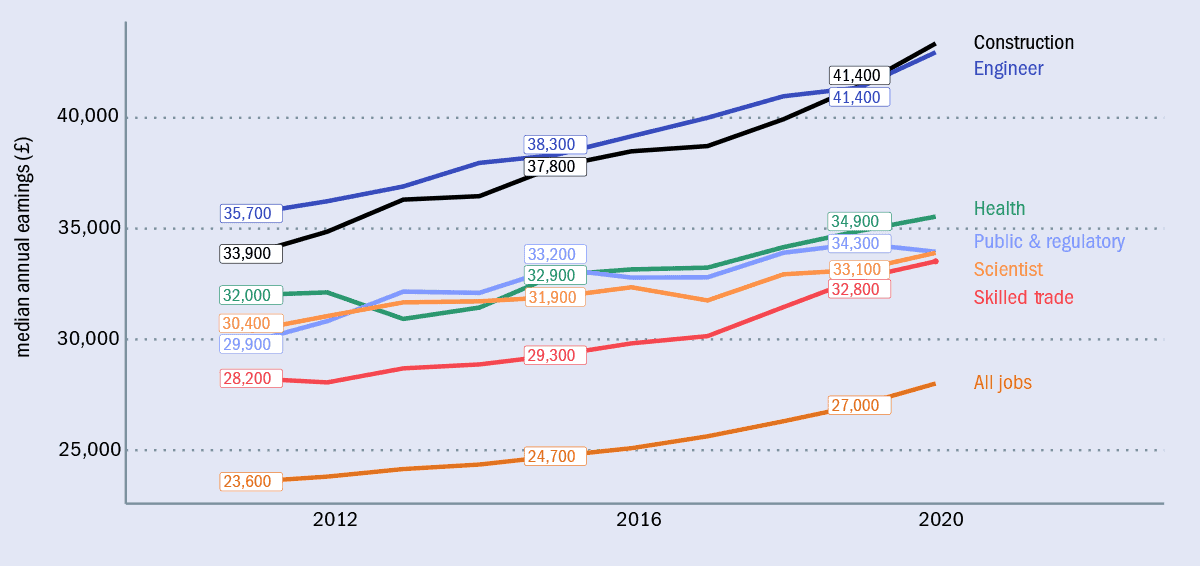
Chart of median salaries for six industry sectors

Median salaries of occupations in the UK that require physics skills, from 2011 to 2020. Airline pilots and flight engineers are the highest paid – median salary of £97,400 – followed by electrical engineers (£52,200), construction managers (£48,600) and research and development managers (£46,700). As well as being the highest-paid group in the UK, construction has seen the strongest growth in median earnings: 28% since 2011, compared to 19% for all jobs. By contrast, health (11%) and scientist (12%) have seen the slowest growth.

The report highlights that earnings for physics-related occupations are also trending upwards, with construction and engineering roles the fastest growing, reaching median pay of approximately £43,000 as of 2020. The highest-paid physics-based jobs overall are airline pilots and flight engineers, who both have a median salary of £97,400. The next highest paid are electrical engineers at £52,200, construction managers at £48,600, then managers in research and development roles who have median salaries of £46,700. At the other end of the scale, the salaries for health-related roles and scientist positions saw the slowest growth over the decade to 2020.

Regional variations

When analysing the geographic concentration of physics work in the UK and Ireland, the report finds that “physics plays a vital role in the skills mix of all nations and regions”. But physics roles are found to be clustered around specific industrial hotspots. With previous studies (see “There’s no place like homePhysics World October 2019) showing many physics graduates wish to remain living in the area in which they grew up or studied, understanding which regions have the highest concentrations of physics-based job opportunities is particularly useful.

Although the labour market demand for physics skills is “large enough to be significant everywhere”, the report shows that Scotland has the greatest concentration of physics-based roles –16% more than in the UK and Ireland overall, and growing by 8% in the decade from 2010 to 2020. Indeed, Scotland’s main industrial sector of oil and gas, together with associated industries, provides twice as many jobs for physics-trained workers in the north-east of Scotland, compared with the UK and Ireland-wide average. Cumbria, in England’s north-west, has the second-most concentrated amount of job offerings, in this case mainly within nuclear energy and shipbuilding. The north-west England region as a whole – where there is a focus on transport manufacturing and civil engineering – has seen 16% job growth in the 10 years to 2020.

Physics is everywhere

Map of the UK and Ireland with regions highlighted in shades of red and yellow

This map sets out the pattern of physics-demanding roles across the nine regions of England, plus Scotland, Wales, Northern Ireland and the Republic of Ireland. The map is coloured according to the Location Quotient (LQ), a metric used in economic geography to understand relative specialization, where an LQ of 1 represents the number of jobs that would be predicted given the overall trend, and values over 1 demonstrate concentration and specialization. The map also highlights the key statistics for each region or country.

When looking at growth in numbers of physics roles from 2010 to 2020 for all regions, the Republic of Ireland – which has a focus on the air transport sector, similar to London – saw the quickest growth at 44%, while London’s demand grew second fastest at 27%. For scientific research and development, both east England and south-east England are hotspots, with the former showing 18% physics job growth and the latter 10%. Growth of 16% was seen in the East Midlands, which has a focus on transport equipment manufacturing. South-west England – where defence and manufacturing of aircraft, spacecraft and domestic appliances dominates – and the West Midlands – which is a centre for heavy industry – both showed 15% growth.

In Northern Ireland, whose top industries include transport-equipment manufacturing and civil engineering, the figure was 12%. Meanwhile in Yorkshire and the Humber – where specialized construction, and machinery repair and installation are the leading industries – it was 9%. Wales – where manufacturing of transport and energy-supply equipment dominates, had slower growth of 3%.  Bucking this upward trend in growth is north-east England, a centre for heavy industry and infrastructure, which has witnessed a 4% decline in physics jobs.

Keeping up with employers’ requirements

The study also looks at how the specific demands of employers are changing and converging around certain roles – including the mix of transferable skills that are required, and how well these demands are being met by current applicants. In terms of what employers are looking for, it turns out that very specific physics knowledge is required for some roles, such as those within sensor-development or gravitational-wave detection. But for other positions, such as data scientist, broader physics skills are needed that can also be held by graduates in mathematics, computer science or other related subjects.

Similarly, although new and emerging technologies are fuelling the need for a workforce with very specific physics skills, this skillset must be complemented with a broad knowledge base of fundamental physics. In certain roles, particularly in those applied for by graduates, the physics skills required will be put to use for scientific research. Physics skills are also valued in sectors such as business and finance, including for driving new technology start-up businesses forward.

The report’s authors found a consensus on the need to match technical physics skills with transferable skills

But applicants need to possess more than just physics skills. After analysing more than 50 million unique job postings and speaking to senior decision-makers from 14 organizations that require workers with physics knowledge, the report’s authors found a consensus on the need to match technical physics skills with transferable skills.

The most frequently requested transferable skill is communication, which is stated as a requirement in almost one-third of roles within business and finance, and in the public and regulatory sector. Meanwhile, innovation skills are sought after for 15% of science, 14% of digital, 10% of teaching and 8% of business and finance roles. Research skills are stipulated for 28% of scientists and in 14% of business and finance roles. (For advice on developing your soft skills see “16 key skills and attributes for a successful career in physicsPhysics World October 2022.)

Some roles are cited by employers as hard to recruit for, although a lack of candidates with the desired mixtures of skills is not universal. The report states that in June 2021, more than 8500 job postings had been online for “significantly longer than average, with the largest number being engineering roles, but significant numbers found too seeking science skills in digital or business and finance”. According to the report, “job postings which are left online for longer are indicative of difficulties in finding the right talent” although, it adds, there may have been reasons other than skills shortage for job postings being active for longer than 40 days.

Measuring skills shortage
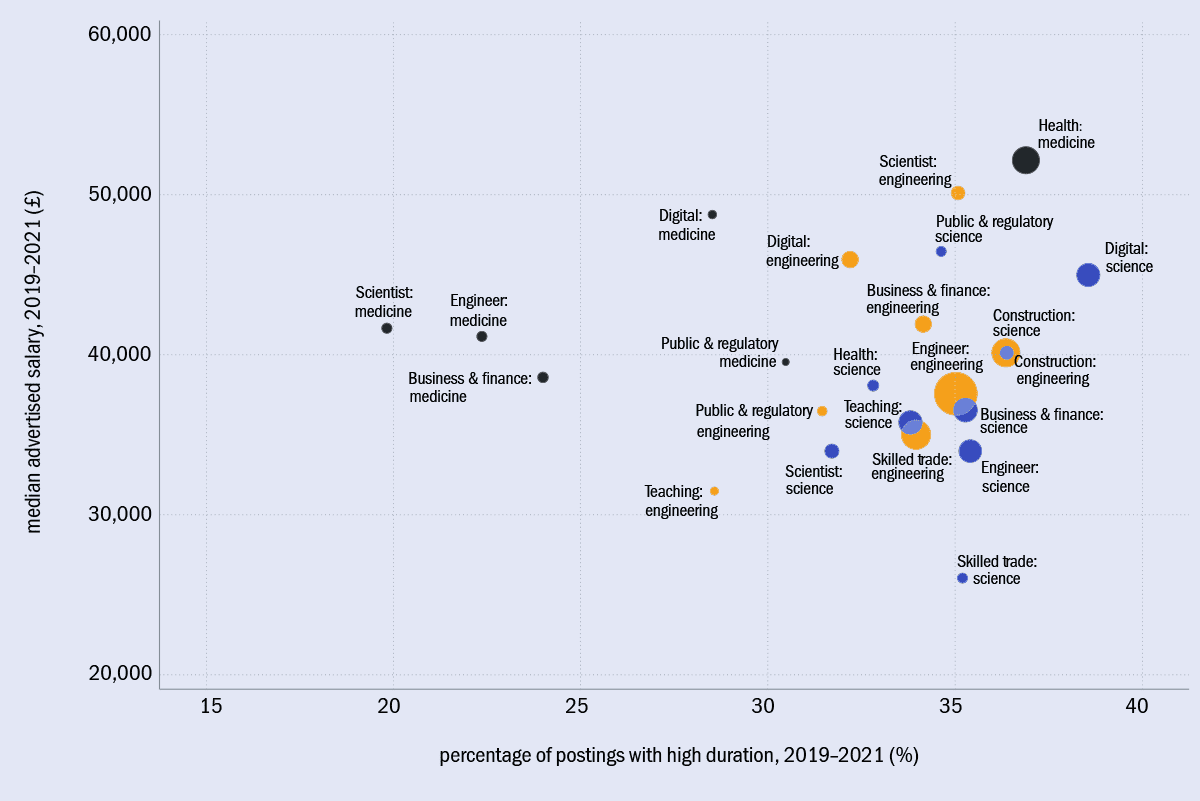
Bubble chart of physics jobs showing the duration density of online job postings

The Physics in Demand report uses online job adverts to identify where employers are finding it hard to fill vacancies. Most job postings are online for around one month. The top quartile of posting durations starts around the 40-day mark; at this point employers are consciously leaving postings open for longer. For this reason, the report uses the share of postings with duration over 40 days as an indicator of skills shortage. Pay can be another, albeit weaker, indicator of skills shortage. Using the prevalence of high-duration postings as the skills-shortage metric reveals that some but not all are in the highly paid category. This chart shows the median advertised salary and high duration density for jobs posted 2019–2021. The size of the dot indicates volume of job postings.

There were close to 9000 active vacancies at the time Physics in Demand was written, and the report stresses that developments in technology and in the economy of the UK and Ireland will continue to create new job opportunities for physics graduates, both within and outside of physics’ traditional domains. This demand and the need to fill it is noted by Tom Grinyer, chief executive of the IOP.

“Physics skills support nearly two million jobs and underpin productive industries in every part of the UK and Ireland,” he says. “However, there is an acute shortage of physics skills in our economy, with IOP research showing two-thirds of physics-powered businesses have had to pause or delay much-needed R&D investment because of skills shortages. At the same time, demand is growing for highly skilled roles – the number of jobs for physical scientists grew by 40% between 2010 and 2020.”

Essentially, the overall picture for those graduating with a degree in physics is a positive one. There is a high and increasing demand for your talents in the current UK and Ireland labour market, as we attempt to meet the needs of science, commerce and society.

Newly observed oxygen-28 nucleus fails ‘double magic’ test

Scientists in Japan have become the first to observe the super-heavy oxygen isotopes oxygen-27 (27O) and oxygen-28 (28O). The latter packs a whopping 20 neutrons into its nucleus alongside its eight protons and was a candidate for “double magic” status, meaning it was thought to be especially stable. However, a team at the Tokyo Institute of Technology and RIKEN found that this was not the case. The discovery should help us improve upon current theories of nuclear structure and could have implications for the physics of neutron stars.

When nuclear physicists talk about magic numbers, they aren’t discussing digits that exist in a realm of wizards and warlocks. What they’re referring to is a situation in which an atom’s nucleons (protons and neutrons) are arranged in such a way as to make its nucleus unusually stable. Specifically, atoms with 2, 8, 20, 28, 50, 82 or 126 protons or neutrons are highly unlikely to undergo energy losses due to radioactive decay.

Takashi Nakamura, a physicist at the Tokyo Institute of Technology and one of the authors of a paper in Nature on the discovery, explains the magic-number concept using the nuclear shell model. “You can consider a nucleus made of a number of multi-layered shells,” he says. “You can imagine this like an onion. Each shell has a definite number of ‘seats’. If the seats in one shell are filled with neutrons (or protons), then the shell is ‘closed’.”

A source of stability

Nakamura gives the example of 16O, which has eight neutrons and eight protons. Two neutrons fill its first shell, and the next six neutrons fill the second shell. The shells for protons and neutrons act independently of each other, so the same stacking procedure within shells also works for the protons in 16O.

When both neutrons and protons are magic numbers, as in 16O, the nucleus is termed “doubly magic”. This situation is extremely rare. Among naturally occurring nuclei, we know of only four others besides 16O that meet the criteria: helium-4, calcium-40, calcium-48 and lead-208.

In exotic nuclei, which are either artificially generated or exist for only very short times, the list is similarly short, with only seven candidates for double magic status. The 28O isotope of oxygen was the last candidate to be tested.

Four-neutron measurement

To find out if 28O is doubly magic, Nakamura and his team first had to create it. For this, they worked with researchers at the RIKEN Radioactive Isotope Beam Factory in Wako, on the outskirts of Tokyo. The researchers accelerated a beam of calcium-48 (48Ca) atoms to 70% the speed of light and directed it at a thick target made of beryllium. The beryllium nuclei act like tiny knives, stripping protons and neutrons from 48Ca to turn it into fluorine-29 (29F). In the final step, the 29F, which is still moving at 60% of the speed of light, impinges on a proton. The resulting collision removes a proton from the nucleus, leaving 28O.

Detecting the newly created 28O and 27O was an achievement, Nakamura says, because it involved observing them via their decay into 24O and four or three neutrons, respectively. “Neutron detection is very difficult at this energy,” he explains. “Before this publication, up to two-neutron measurement has been a limit. I know of one exceptional example of the three-neutron measurement. But I’ve never seen the four-neutron measurement in coincidence.”

No magic here

The team had good theoretical reasons to expect 28O to be doubly magic. “For 28O, it has eight protons and 20 neutrons,” Nakamura explains. “The 20 neutrons have three shells: the first shell has two seats, the second shell has six seats, and the third shell has 12 seats. With that the shells are closed with 20 neutrons.”

This, however, was not what the researchers observed. Though the proton seats were filled, as expected, the energy gap between the final two neutron shell orbitals was weak, allowing mixing between these two shells. “This kind of shell erosion sometimes happens for neutron-rich nuclei, but it was not at all obvious for 28O as the protons still fill the normal seats of eight,” Nakamura says.

Discovering that 28O lacks the doubly-magic touch is not a failure, though. In fact, Nakamura describes it as “an important benchmark” in modern nuclear theory. He adds that the result should make it possible to improve our theories about isotopes with large neutron/proton ratios. The research can also help us assess unknown nuclear interactions such as three-neutron forces, which are important for evaluating the properties of neutron stars.

Implantable bioartificial kidney aims to free patients from dialysis

End-stage renal disease, when the kidneys can no longer support the body’s needs, is best treated via kidney transplantation. The supply of donor organs is limited, however, and many patients must rely on dialysis instead. And while a kidney transplant provides excellent outcomes, it requires the patient to take lifelong immunosuppression drugs, which cause their own health complications. To address these issues, researchers are hoping to develop an implantable bioartificial kidney to treat kidney failure.

Researchers at UC San Francisco (UCSF) are working to create such a device. In their latest study, reported in Nature Communications, they demonstrate that kidney cells housed in an implantable bioreactor could survive inside a pig and mimic several important kidney functions. Crucially, the implanted device did not provoke an immune reaction. The research is part of The Kidney Project, jointly headed by UCSF’s Shuvo Roy and William Fissell of Vanderbilt University Medical Center.

As an initial step towards an implantable bioartificial kidney, Roy, Fissel and colleagues created a cell-containing bioreactor that replicates key functions of the renal tubule, which includes delivering oxygen and nutrients to kidney cells while protecting them from recipient immune cells that could cause rejection. To achieve this immunoprotection, the team engineered a thin (less than 1 μm) silicon nanopore membrane (SNM) from silicon wafers containing nanoscale slit pores.

The researchers built a prototype bioreactor housing an SNM with 10-nm-wide pores, with human renal epithelial cells (HRECs) cultured on acrylic inserts either side of the SNM. To test whether the SNM provides an immunoprotective barrier in vitro, they exposed one side of the SNM to the proinflammatory cytokine TNF-α.

Six hours after exposure, levels of TNF-α in the compartment protected by the SNM were negligible, demonstrating that the 10-nm-wide pores prevent the passage of large cytokines (and thus also larger immune system components such as T cells and antibodies). Cells on the side directly exposed to TNF-α had less than 50% viability, while those sealed by the SNM maintained a high viability of nearly 90%.

It’s also important that an implant does not cause blood clots, which can form on surfaces in contact with blood and lead to device failure and serious complications for the patient. To avoid this, the researchers employed computational fluid dynamics to optimize the geometry of the U-shaped blood flow path though the bioreactor.

Bioreactor components

They used this design to create an implantable bioreactor containing four SNMs in a polycarbonate housing, aligned with the top and bottom surfaces of the blood channels. They placed acrylic inserts seeded with confluent HRECs on the opposite sides of each SNM, and used stainless steel connectors to transition the blood between the SNMs and PTFE vascular grafts.

To test the biocompatibility of these bioreactor prototypes, the team assembled and surgically implanted devices into five healthy pigs on dual antiplatelet therapy (without immunosuppression). The bioreactors connected to the animals’ vasculature via the PTFE grafts. No complications related to the devices or the surgery occurred and the animals remained healthy during the throughout the three- or seven-day experiments (the time in which hyperacute rejection would typically occur), with no sign of rejection.

The researchers evaluated whether implanting bioreactors containing xenogeneic human cells provoked an immune reaction in the pigs. Examining 13 common inflammatory biomarkers revealed an increase in some cytokines two days after implant, as expected due to postoperative inflammation. But seven days after implant, all cytokine levels had decreased to a state of minimal inflammation. This finding is in contrast to the vigorous response expected in a typical xenograft model with an immunocompetent recipient.

After three or seven days, the researchers removed the bioreactors from the animals for evaluation. They found that the explanted SNM was intact, with minimal cell and protein attachment and no blood clots formed in the device – an important step in demonstrating its safety. In addition, the encapsulated HREC cells remained more than 90% viable, with no evidence of cell detachment and maintenance of tight intercellular junctions.

“We needed to prove that a functional bioreactor will not require immunosuppressant drugs, and we did,” says Roy in a press statement. “We had no complications and can now iterate up, reaching for the whole panel of kidney functions at the human scale.”

Recent developments in porous anodic alumina preparation

Want to learn more on this subject?

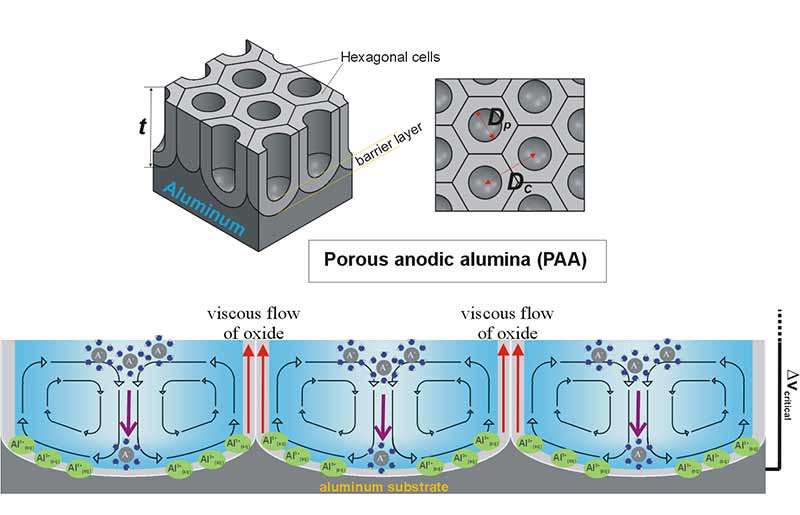
Porous anodic oxide (PAA) is one of the self-organizing materials whose pore geometry can be fully controlled by variation of electrochemical parameters during aluminum anodization. Under certain conditions, pores grow into a hexagonal close-packed (hcp) structure. The self-organization regime holds within narrow anodization conditions, which are usually limited to a given voltage dependent on a type of electrolyte used in anodization. Outside this regime, regularity of pore arrangement deteriorates significantly. The factors that are responsible for the pore organization are still not fully recognized as the synthesis of PAA with large interpore intervals (Dc > 380 nm) is still under development.


The overall PAA growth process is complicated, but it is believed that regularity of pore formation is governed mainly by an equilibrated counter-ion (Al3+ and electrolyte anions A) exchange at the electrolyte/oxide interface. The self-ordering conditions were quite well elaborated for relatively low voltages that enabled obtaining PAA with Dc ranging between 60–140 nm. However, producing the self-ordered PAA with larger Dc remains challenging because it usually involves anodization under high voltages that is prone to instabilities and breakdown events.

During the webinar, recent achievements in the production of PAA including high-voltage anodization are discussed, focusing on the strategies that can lead to the self-ordering growth of PAA with large Dc.

An interactive Q&A session follows the presentation.

Want to learn more on this subject?

Małgorzata Norek worked at the Military University of Technology, Warsaw, first as an assistant professor (2009–2018), and later as an associate professor (2018–present). In the years 2003–2005, she worked at the Institute of Physics, Polish Academy of Science in Warsaw, where she investigated photophysical properties of aromatic molecules. She received the EC Marie Curie Fellowship twice: in 2004 at the Università degli Studi di Firenze, where she investigated symmetry of triplet states of monoazaphenanthrenes by Optically Detected Magnetic Resonance, and again in 2005–2008 at the Technische Universiteit Delft, where she worked on preparation and evaluation of Lanthanide (III) containing contrast agents for medical diagnosis and therapy. She completed her PhD at the Technische Universiteit Delft in 2008. Her current scientific interests focus on the synthesis and characterization of porous anodic alumina (PAA), fabrication and characterization of PAA-based photonic structures, templated synthesis of ordered nanostructures (e.g. SnO2, ZnO), investigation of optical properties of selected semiconductor nanostructures, and optimization of these properties by modifying their surface.


Where radiation physics meets radiobiology: opening up diverse career paths for students 

Radiotherapy linac

Physics for patients, physics for health, physics for good: that’s the high-level career opportunity that awaits students heading to the University of Oxford, UK, this September to take up their places on the newly launched MSc in Medical Physics with Radiobiology. This one-year, full-time master’s programme is tailored for graduate scientists intent on pursuing a professional pathway in medical physics – from a clinical or academic research perspective – as well as related roles that require an in-depth understanding of medical physics (radiation protection and security, for example, or product development and engineering functions within the specialist technology companies serving the medical imaging and radiotherapy communities).

Launching with an initial cohort of 15 students for the 2023/24 academic year, the MSc is a collaboration between the University of Oxford’s Department of Oncology and the Department of Medical Physics and Clinical Engineering at Oxford University Hospitals (OUH) NHS Foundation Trust. The academic cycle being what it is, applications are already open for the 2024/25 academic year (starting September 2024) from candidates who hold, or are predicted to achieve, a first-class or strong upper-second-class undergraduate degree with honours in physics or a closely related subject.

Daniel McGowan

“Our teaching priority is to elaborate on how ionizing and non-ionizing radiation are used in clinical practice, both in the context of radiotherapy and medical imaging,” explains Daniel McGowan, academic and clinical lead for the MSc (as well as Head of Education and Research in the OUH Department of Medical Physics and Clinical Engineering). That focus on radiation physics is reinforced by dedicated teaching modules on the fundamental principles of radiobiology to give graduate students a granular understanding of the effects of radiation at the molecular and cellular level (for example, how radiation induces DNA damage and how that feeds through into advanced treatment modalities in radiation oncology).

“We’re trying to differentiate this MSc versus other medical physics courses by addressing gaps in the learning market,” adds McGowan. “So, while radiobiology is front-and-centre, we’re also putting significant emphasis on a range of other hot topics that early-career medical physicists increasingly need to understand – from the design of clinical studies, for example, to the clinical impact of machine learning in cancer diagnosis and treatment planning for radiotherapy.”

No shortage of options

Another focus for McGowan and his teaching colleagues is to showcase the diversity of career pathways available to graduates pursuing combined studies in medical physics and radiobiology.

One way to help students figure out their next steps is the extensive guest speaker programme within the department of oncology – whether that’s a clinical physicist talking about the implementation of MR-guided radiotherapy in a hospital setting or an R&D scientist from industry specializing in imaging software. “The flexibility afforded by our MSc is key,” he explains. “As such, we encourage students to maintain an open mind about their long-term career choices.”

By extension, choice and flexibility are hard-wired into the MSc research project and dissertation – a piece of work that’s undertaken after students complete their six months of MSc taught-course modules. The 2023/24 cohort will have a long list of research projects to choose from, including experimental studies in FLASH radiotherapy (to elucidate how radiation delivered at ultrahigh dose rates can drastically reduce collateral damage and toxicity in normal healthy tissue while preserving anti-tumour activity); patient safety and QA in MR-guided radiotherapy (in which an MR-Linac configuration allows clinicians to see what they treat in real-time and adapt radiation delivery accordingly); as well as investigations into the use of virtual reality for improving the patient experience.

Wanted: multidisciplinary physicists

Other project options include the provision of targeted R&D support to industry partners – for example, on the testing and optimization of advanced imaging algorithms for PET or MRI systems – or collaboration with government scientists specializing in radiation protection, safety and regulation at the nearby Harwell campus of the UK Health Security Agency (UKHSA).

Tom Whyntie

Alongside the twin-track focus on medical physics and radiobiology, another differentiator of the new MSc course is the opportunity it affords students to learn directly from clinical physicists working at the sharp-end of diagnosis and treatment in a hospital setting at OUH. “What we’re focused on is the inherent interdisciplinarity spanning physics, biology and medicine,” notes Tom Whyntie, a teaching fellow in the Department of Oncology with responsibility for MSc student learning and development.

Whyntie himself took a somewhat convoluted route into medical physics, having completed a PhD in dark-matter research at CERN’s Large Hadron Collider (LHC). “Given my background, I recognize the importance of blue-sky physics that’s driven, for the most part, by intellectual curiosity,” he explains. “What blows me away about my current research – developing novel pulse sequences for MR-guided radiotherapy – is seeing the direct impact of the work on treatment outcomes and patient care. This is physics in action – that straight line between research lab, clinical translation and at-scale clinical application.”

  • The Institute of Physics and Engineering in Medicine (IPEM) accredits master’s programmes in medical physics and biomedical engineering in the UK. Given that it is a new course for the 2023/24 academic year, the University of Oxford’s MSc in Medical Physics with Radiobiology has provisional accreditation status from IPEM. The course will be subject to further inspection for full accreditation once the first cohort of students completes the taught-course and research modules in autumn 2024, with the initial cohort and subsequent student intakes receiving the IPEM-accredited degree qualification.

Pushing the boundaries in radiation oncology

Nathalie Lövgren

Nathalie Lövgren is a medical physics student undertaking a DPhil in oncology at the University of Oxford.  Here she tells Physics World about her research experience to date and the learning opportunities for graduate students considering MSc or doctoral studies within the department.

What’s the focus of your DPhil work?

I’m a member of Kristoffer Petersson’s multidisciplinary team investigating the biological mechanisms underpinning FLASH radiotherapy and optimal ways to implement the technique in clinical practice. My DPhil work focuses on clinical translation: evaluating the feasibility of deploying FLASH proton therapy into clinical practice and how the FLASH effect (normal tissue-sparing) can be accounted for in the treatment planning system.

How important is collaboration to you as an early-career scientist?

It’s fundamental – and essential. The Department of Oncology is a cosmopolitan research environment, with visiting doctoral students from other UK and EU institutions conducting their research with us in Oxford, either coming for weeks or months at a time. For me personally, that means exposure to diverse research backgrounds, cross-fertilization of ideas, and an opportunity to build up a network across the medical physics and oncology communities.

What about opportunities for learning and development beyond your core research?

We’re encouraged to push the boundaries in terms of our broader skills development, prioritizing opportunities that will be useful to us down the line in our research careers. A case in point: I’ve just enrolled on a seven-month online Python course – Training in Data Science and Machine Learning for Health, Disease and Bioscience – at University College London. The course coverage forms a great base for a wide range of programming or machine-learning-based projects in the future. Outreach and engagement are also key. I’ve presented my research at several international conferences so far and, in the process, have initiated valuable contacts and collaborations with other early-career scientists as well as radiotherapy equipment vendors.

Fermionic quasiparticles caught slowly ‘disappearing’ for the first time

Researchers have directly observed fermionic quasiparticles slowly “disappearing” for the first time. This vanishing act took place near a quantum phase transition in a so-called heavy-fermion compound. As well as advancing our understanding of the stability of fermionic quasiparticles, such transitions could have applications in quantum information technology.

The most well-known phase transition occurs when water abruptly transforms into ice as it cools below 0 °C. The characteristics of ice are very different to those of liquid water – the density of ice is much lower, for one, and its structure changes dramatically. In some phase transitions, however, change occurs more gradually. For example, iron goes from being ferromagnetic to paramagnetic when heated to 760 °C, but as the transition progresses, the system takes longer and longer to come to equilibrium, thereby slowing the transition and making it more continuous. This means that the two phases (ferromagnetic and paramagnetic) become closer in energy.

This phenomenon is typical for phase transitions that involve excitations of bosons, which are particles that mediate interactions (including the interactions responsible for magnetism). At a fundamental level, however, matter is not made up of bosons, but of fermions.

“Electrons belong to the family of fermions,” notes study team member Shovon Pal, “and matter made up of these particles cannot usually be destroyed because of the fundamental laws of nature. Fermions therefore cannot disappear and it is for this reason they are normally never involved in phase transitions.”

Superposition of two types of electron states

Using terahertz time-domain spectroscopy measurements, Pal and colleagues in Manfred Fiebig’s group at ETH Zurich, Switzerland observed this critical slowing near a quantum phase transition in YbRh2Si2. The quasiparticles in this material consist of a superposition of two types of electron states: one composed of localized electrons like those found in an insulator and one composed of mobile electrons like in a metal. One striking feature of this superposition is that the electrons are, to a certain extent, spatially bound, which gives them an effective mass 103 to 104 larger than the rest mass of a normal electron. Compounds that support this type of binding are thus known as heavy-fermion compounds.

In another contrast with “normal” electrons, these quasiparticles, which only exist in the quantum regime, can be destroyed during a phase transition. This is the key factor that allows them to undergo a continuous transition comparable to those involving bosons, Pal says.

Critical exponent

In their study, the researchers extracted a parameter known as the critical exponent that relates to a collapse in the probability of forming these exotic states at the phase transition. “Critical exponents can be used to classify phase transitions and this concept can now be extended to classify transitions not only associated with the breakdown of bosonic order parameters, like the magnetization in a ferromagnetic transition, but also to exotic phase transitions with the destruction of fermionic particles,” explains Pal, who is now at NISER in India.

The researchers used terahertz radiation because its energy scales are on a par with the intrinsic energy scales of heavy fermions. “Upon THz excitation, the quasiparticles break down and disappear, taking the system into a non-equilibrium state,” Pal explains. “It naturally strives to return to equilibrium via the re-emergence of quasiparticles and this reconstruction process occurs after a certain time delay that corresponds to the intrinsic energy scales of heavy-fermion systems.”

By measuring this delayed response, the team was able to observe and characterize the evolution – that is, the disappearance and reappearance – of the quasiparticles.

The study, which is detailed in Nature Physics, highlights a new way to investigate many-body correlations in certain exotic quantum materials like heavy-fermion compounds. “It is thus a starting point for many further investigations on different materials unveiling the physics of phase transitions in the quantum world,” Pal tells Physics World.

Dry scroll pumps: energy efficiency ensures sustainability is aligned with cost reduction

The HiScroll family of dry scroll vacuum pumps from Pfeiffer Vacuum, Germany, is nothing if not versatile. With the emphasis on ultra-quiet, efficient and oil-free operation, the pumps are being positioned as a core building block for small vacuum systems in academic and industrial R&D laboratories – think nanomaterials processing, thin-film deposition, mass spectrometry systems, vacuum drying and the like – as well as for backing turbopumps in the accelerator beamlines of advanced light sources and other large-scale high-energy physics facilities. Instrumentation OEMs are also on the radar, attracted by Pfeiffer Vacuum’s emphasis on sustainable product design and manufacturing – reducing the carbon footprint of the HiScroll series while simultaneously lowering operational running costs for scientific and industrial end-users.

The HiScroll series comprises three dry scroll pumps with a nominal pumping speed of 6.1—18.1 m³/h, with all formats characterized by “high-performance, high-efficiency operation” when evacuating against atmosphere. “The Interior Permanent Magnet (IPM) synchronous motors with sensorless INFORM control achieve more than 50% in energy savings versus conventional drives, helping users to reduce their electrical running costs,” notes Andreas Schopphoff, head of market segment R&D at Pfeiffer Vacuum.

In terms of performance specifics, the HiScroll 6 provides a pumping speed of 6.1 m³/h and tested base pressure of 1.5×10⁻² hPa, while the equivalent figures of merit are 12.1 m³/h, 6×10⁻³ hPa for the HiScroll 12 and 18.1 m³/h, 6×10⁻³ hPa for the HiScroll 18. The leakage rate for all three HiScroll variants is 5×10⁻⁷ Pa m³/s.

Plug-and-play vacuum

Simplicity and ease of use are central to the HiScroll value proposition. A case in point: using a single cable (to maximize energy saving), the HiScroll pumps are easy to connect to Pfeiffer Vacuum HiPace turbopumps, display units or to a higher-level external control system (via RS-485 or ProfiNet automation protocols). “For early-career scientists,” adds Schopphoff, “the vacuum system is an enabling technology – a means to an end that they don’t really want to think about too much. Because of that, our dry scroll pumps are designed to be plug-and-play and as intuitive as possible.”

Andreas Schopphoff of Pfeiffer Vacuum

Versatility is a given, with standardized AccessLink accessory ports allowing the use of many optional accessories, all of which are automatically recognized by the HiScroll electronics. There’s a safety valve, for example, to ensure the vacuum system is protected when the pump is stopped (or stops due to a power failure), preventing partially compressed gas from re-expanding through the pump inlet. Users can also specify an integrated pressure sensor and run the pump in “boost mode” for short periods when there’s a need to fast-track the evacuation of the vacuum chamber, while the intelligent pressure and speed control reduces energy consumption and general wear-and-tear.

Worth noting that the small-footprint motor (just 30 mm wide) means the HiScroll pumps are extremely quiet at <47 dB[A] acoustic emission when running and <42 dB[A] in stand-by mode. Meanwhile, the adaptive fan control provides optimal cooling in all operating conditions and, in turn, helps to further reduce noise and vibration impacts. “Our users really appreciate the low-vibration operation and compact design – features that make the HiScroll pumps ideal for use in tight and highly integrated working environments,” notes Schopphoff.

That triple-play of low noise, low vibration and low power consumption is also attracting interest from instrumentation OEMs, with Pfeiffer Vacuum recently securing a bulk order for HiScroll pumps from a leading manufacturer of electron microscopes. “Like many OEMs, the customer in question is taking an increasingly holistic approach to its system design,” says Schopphoff. “With the vacuum pump in ‘always on’ mode within an electron microscope, there’s clear potential to realize significant savings on electrical running costs – a big plus for many scientific and industry end-users.”

Better by design

The prioritization of sustainability in the HiScroll portfolio extends upstream as well thanks to innovative product design and granular attention to detail when it comes to assembly. “Our HiScroll series already scores points in production through deliberate material savings – for example, minimizing the amount of copper that’s used,” explains Schopphoff. What’s more, the pump housing, like the hood and the housing of the electronics, is manufactured by casting to avoid excessive production waste. That rationale even extends to the packaging, with weight-optimized and space-saving insulating materials protecting the HiScroll pumps from damage during transit.

‘New pumps for old’ offer will cut energy use, save money

Do you know how much power your current vacuum pump is using? If you don’t, but suspect the answer is likely to be “too much”, then Pfeiffer Vacuum wants to hear from you.

The company’s HiScroll family of dry scroll vacuum pumps is being positioned as an energy-saving and money-saving alternative to legacy vacuum pumps, offering >50% enhancements in energy efficiency for specific research, industry and OEM applications.

Notwithstanding the operational upside, Pfeiffer Vacuum is also offering to scrap users’ existing rotary-vane or diaphragm pumps in exchange for a new HiScroll alternative at a discounted price. “Our ‘new-for-old’ offer is about helping customers to cut down on their electrical running costs, reduce noise levels in the lab, and save some money along the way,” explains Schopphoff.

There’s a simple two-step process to apply for your new HiScroll pump:

  • Step 1: send an email with the subject line “Save Energy”, a photo of your old vacuum pump’s nameplate, plus your contact information to .
  • Step 2: a Pfeiffer Vacuum expert will contact you immediately with a special offer for a suitable replacement.

Read more

High-compression turbopumps cut costs, reduce complexity in UHV applications

Why should anyone care about condensed-matter physics?

Most people outside physics probably have no idea what condensed-matter science even means. Physicist and popular-science author James Kakalios is on a mission to show the public just how exciting and useful this field of physics can be.

One of his key pieces of advice for would-be science communicators is to connect the outcomes of research with the everyday world. After all, without the humble semiconductor transistor, there would be no smartphones or personal computers. Healthcare technologies would be far less advanced, and you wouldn’t even be able to start most cars on the road today.

Find out more by watching this video and reading Kakalios’ article “What’s the matter with condensed matter? Getting past the relative obscurity of solid-state physics in the public eye”.

Heart-inspired pump boosts energy efficiency

Pumping patterns that mimic the human heartbeat can drastically reduce turbulence in a fluid that is pumped through pipes, researchers in Austria have discovered. Through a simple set of experiments, Björn Hof and colleagues at the Institute of Science and Technology Austria showed how pumping pulses interspersed with rest periods could lead to the development of far more efficient pumping techniques.

The pumping of fluids plays crucial roles in industry, agriculture and the provision of utilities such as water. Indeed, it is estimated that 10% of all electrical energy consumed globally is used for pumping. Because of this energy intensity, people have been trying to develop better and more efficient pumps for a very long time. However, experts still do not fully understand how to optimize the pumping process.

For over a century, researchers have understood that turbulence in a pipe will increase friction between pipe and fluid, thereby reducing pumping efficiency. While there has been some progress in developing methods for eliminating turbulence, it has not been and easy problem to solve.

Difficult in practice

“In practice, the methods we have developed so far turned out to be not so useful,” Hof explains. “Even if we can eradicate turbulence in some part of the flow, turbulence can be triggered a little further downstream by dents, bends, or other imperfections in pipes, and the whole effect is lost.”

Instead of exploring novel designs of pumps or pipes, Hof and colleagues have focused on controlling the velocity of the fluid passing through them. “We knew from our transition work that a change in the time averaged velocity profile can be very efficient in suppressing turbulence,” says Hof. “This is far easier than instantaneously reacting to velocity changes, a turbulence control approach used by many previous studies.”

To test their idea, the team constructed a simple apparatus in which water is pumped through a clear pipe. A customized syringe pump is used to carefully control its flow rate. To observe the flow patterns that emerged, they seeded the water with reflective particles. Shining a laser beam down the centre of the pipe allowed the team to take snapshots of the fluid at regular time intervals.

Remarkably similar

Using this setup, the researchers quantified the degree of turbulence resulting from a variety of pulsed flow patterns. They found that the pumping pattern that consistently generated the least turbulence was remarkably similar to the flow pattern of blood driven by the human heart.

“Overall, we found that the best performance is found for a waveform that is very close to that found in the aorta, where large fluctuation and drag levels would be harmful for its inner lining of cells,” Hof explains.

In our blood vessels, fast-flowing pulses generated by the heart’s regular contraction are separated by brief rest periods, where the heart relaxes to allow its chambers to fill up with blood. When they included this resting phase in their pumping pattern, Hof’s team found that turbulence in the pipe was almost completely eliminated for flow speeds comparable to those in the aorta. Even at far higher flow speeds, the amount of drag created by turbulence was reduced by more than 25%.

The researchers acknowledge there will be many challenges to overcome before heart-inspired technology can be incorporated into practical pumping applications. “For now, current pumps may not be suitable to achieve the required waveform, and further studies will also be needed to see if gains persist at even higher flows speeds,” Hof says.

The team also plans to look for other flow patterns that could be even better at reducing turbulence – especially at higher flow speeds. Through further research, the team hopes that new pumping techniques could be developed that significantly improve the efficiency of pumping – reducing both its cost and environmental impact.

The research is described in Nature.

Physics of carnivorous pitcher plants, daring nuclear-reactor mission in war-torn Vietnam 

Pitcher plant in Oxford

Carnivorous pitcher plants consist of hollow, cup-like structures that capture and then digest unsuspecting prey. Found mostly in the tropics, especially south-east Asia, pitcher plants have a slippery rim at the top, called a peristome that is covered in small ridges that collect water. This liquid film then causes the prey to skid, like an aquaplaning car, and fall into a pleasant pool of digestive juices at the bottom of the pitcher.

One mystery about these plants, however, is why they come in such a range of different shapes and sizes such as tubes, goblets and some even have “teeth” on their ridges.

Now, researchers at the University of Oxford’s Botanic Gardens teamed up with Oxford mathematicians so see what effect the shape and size had on the type of prey pitchers captured. After all, a more elaborate structure, such as being highly ornate, comes at a greater energy cost than having just a simple design that could do the same job.

The results, published in the Proceedings of the National Academy of Sciences, suggest that variations in peristome geometries have a profound effect on what the plant could catch and how much. “We were able to show that in an optimal structure, the cost of production might be offset by the extra prey that can be caught,” says mathematician Derek Moulton. For example, the geometry of highly flared peristomes appeared to be particularly suited to capturing walking insects such as ants.

Well-adapted to their prey

“Just as birds’ beaks are shaped differently to feed on nuts, seeds, or insects and so on,” says botanist Chris Thorogood, “these pitcher plants are well-adapted to the different forms of prey that exist in their environments.”

Since the Russian invasion last year, there has been much concern about the Zaporizhzhia nuclear power plant in Ukraine. The plant was seized by Russian forces in March after a battle with Ukrainians that resulted in some minor damage to the main facility. The Russians have controlled the plant ever since and appeared to have taken defensive positions near to the reactors.

The nightmare scenario of a nuclear power plant being destroyed by military action has thankfully not happened – at least for now – but this is not the first time that a reactor has been under threat by warfare.

Research reactor

In 1963, a US-supplied TRIGA reactor was switched on at Vietnam’s Dalat Nuclear Research Institute, which is about 300 km northeast of Ho Chi Minh City (called Saigon at the time). This was not a power reactor, but was used for training, research and isotope production. Despite the growing intensity of the Vietnam War, the reactor operated until 1968, when it was put into a long-term shutdown.

In 1975, the reactor was on the front line of battle as the North Vietnamese Army advanced on Saigon. To prevent the facility and its fuel rods from falling into enemy hands, the Americans briefly considered bombing the reactor – which would have caused radioactive contamination.

Instead a daring plan was hatched to snatch the reactor’s fuel rods. The physicist Wally Hendrickson volunteered for the mission and his story is told in a fascinating BBC Radio 4 programme called “Wally, the reluctant nuclear hero”.

Copyright © 2026 by IOP Publishing Ltd and individual contributors