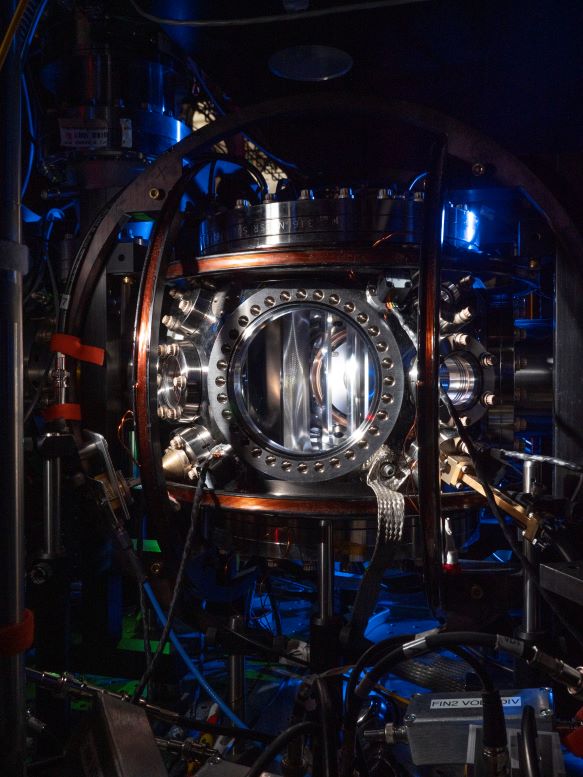
Essential for life: this illustration shows how fundamental constants of nature set the fundamental lower limit for liquid viscosity. (Courtesy: thehackneycollective.com)
The values of the fundamental physical constants – seemingly fine-tuned for the emergence of nuclear matter and ultimately life – might not have been fixed at the universe’s outset but instead changed over time through a process akin to biological evolution. That is the hypothesis of a physicist in the UK, who has shown that life-friendly limits on fluid viscosity and diffusion impose constraints on the constants’ values. Having found that those constraints go beyond the requirements of stellar nucleosynthesis, he conjectures that the conditions needed for fluid motion in and among living cells could have emerged later on in cosmic history.
For decades, physicists have debated the possible explanation for a striking fact of our universe – that the values of many physical constants appear just right for the existence of the world we see around us. Star formation, for example, requires both hydrogen and helium. But this condition depends on a very specific value of the strong nuclear force – any weaker than it actually is and there would have been no helium; but any stronger and all the hydrogen would have converted (to helium).
Some scientists argue that this apparent fine-tuning provides evidence of design in the universe, perhaps even the existence of God. Others instead have mooted the possibility of a myriad of different universes – whether existing simultaneously or one after another – with physical conditions varying very slightly from one to the next. We would then necessarily exist in that universe suited to generating life. Still other researchers have postulated that the ultimate theory of everything – still to be worked out – would logically require the constants to have the values that they do.
Cosmic evolution
But Kostya Trachenko at Queen Mary University of London reckons there could be an alternative explanation. He suggests that there is no need for a “grand design” for the cosmos, but that each of the universe’s physical “traits” could independently emerge, and become entrenched, through a gradual process of evolution – somewhat like the proliferation of certain survival-enhancing features in animals.
The spur for this idea comes, as Trachenko puts it, not by considering physical constants in the context of particle physics or cosmology but investigating them instead at the much lower and biologically-relevant energies of condensed-matter physics. This approach involves reducing complex physical or biophysical processes to their bare essentials and then expressing them in terms of one or more fundamental constants.
In 2020, Trachenko and Vadim Brazhkin published a paper establishing a universal lower limit for viscosity. As the pair pointed out, a fluid’s viscosity reaches a minimum at the temperature marking its transition from liquid to gas (in the latter case higher temperatures lead to more molecular collisions, which create greater friction between fluid layers). By modelling that transition, they were able to express the “kinematic viscosity” – the ratio of viscosity to density – in terms of Planck’s constant (ħ), molecular mass and electron mass (me).
Fluid flow is essential
Trachenko has now explored the implications of that work for the existence of life. As he notes, fluid flow is essential for many processes that take place within cells – such as molecular transport or the diffusion involved in cell proliferation. It is also vital in larger-scale, multi-cellular processes, such as blood circulation.
The idea was to work out the constraints that such processes place on the values of the fundamental constants. In addition to kinematic viscosity, which governs pulsed blood flow and other time-varying phenomena, Trachenko also considered the dynamic viscosity of steady flow and diffusion constants. Using the Navier–Stokes equation and other elements of classical fluid dynamics, he showed that all three parameters could be cast in terms of me, the proton mass (mp) and ħ (with the dynamic viscosity and diffusion constant also featuring the electron charge, e).
Trachenko found that the three parameters depend on the fundamental constants in different ways. As such, he says, combining the limiting expressions for life in each case – minima for the two viscosities and a maximum for diffusion – yields a limited range, or “bio-friendly window”, within which the constants have to exist. This, he claims, is an unexpected result given the complexity and variety of the biological processes involved (although he adds that biochemists and biologists will be needed to establish the three parameters’ numerical limits).
Fred Adams of the University of Michigan in the US praises Trachenko’s “novel” approach to imposing constraints on the fundamental constants. But he cautions that it may not yield unique limits, arguing that current biological theory is insufficient to work out the full range of allowed viscosities. “If we had a complete and comprehensive theory of biology and that theory showed that viscosity in any ‘living’ universe must lie within a certain range, then the argument would be strong,” he says.
Fine-structure constant
Moving beyond the viscosity-derived limits themselves, Trachenko also looked at how these limits relate to those imposed by the need to produce heavy nuclei inside stars. Specifically, he considered the necessary tuning between the fine-structure constant (which features e and ħ) and the proton-to-electron mass ratio (mp/me). He realised that simultaneous changes of me and mp or of ħ and e could leave the stellar parameters fixed while altering the fluid parameters. In other words, a universe with different fundamental constants could in principle still contain heavy elements while its fluids are all at least as viscous as tar – so prohibiting life.
He describes the extra tuning needed for life-friendly viscosity as “overkill” in the early universe, pointing out that the precise values of the constants would need to be baked in at least 10 billion years ago – long before there were even any hints of what life might look like. “It’s a bit like asking a chef to get the right ingredients for an exquisite meal before you decide what the meal is,” he says.
It was this insight, he says, that prompted him to consider an evolutionary mechanism instead. He acknowledges that the details of any such mechanism are sketchy at this stage, both in terms of how the constants might change and what evolutionary pressure would bear so that certain values are favoured over others. He says only that a certain set of physical constants would start to favour the emergence of a new physical “structure”, which would endure if it had robust properties.
“I realise that what I am saying is quite crude but we just don’t know enough at the moment to be more specific,” he says.
The calm and hushed corridors of the University of Birmingham’s Teaching and Learning Building offered little indication of the intense efforts being made by the ten teams taking part in the second quantum hackathon to be organized by the UK’s National Quantum Computing Centre (NQCC). They had just two days to devise quantum solutions to real-world problems set by end-users ranging from the National Health Service (NHS) and the National Grid to Rolls Royce and financial specialists Nomura, and to test their approaches on hardware platforms from different technology providers.
“It has been a great experience that has really allowed us to take a deep dive into a use case that is relevant for many of our customers,” said Salvatore Sinno, an R&D specialist at digital solutions provider Unisys. “Our team has been exceptional, and delivering a solution within just two days shows that anything is possible when you have the right skills and the right interaction between business, research, and hardware specialists.”
Compared to last year’s event, which was the first of its type in the UK, the 2023 edition saw a significant uplift in participation, particularly from the commercial sector. “We were excited last year about the level of enthusiasm and engagement throughout the hackathon,” said Michael Cuthbert, director of the NQCC. “This year we have more industry partners who are exposing our hackers to a broader range of use cases, plus there are more companies providing access to their hardware platforms compared to last year.”
In some cases, the hackers were provided with exclusive access to hardware platforms that are not publicly available, allowing them to gain experience of using different machines and modalities. “That’s a measure of the maturing technology landscape in quantum computing,” continued Cuthbert. “It’s exciting to be able to explore the differences and similarities between the platforms, and to see what sort of performance can be achieved across the range of technologies we have available.”
Quantum computing is quite a new area for us, and we wanted to gain an understanding of its current capabilities and limitations
Fazal Chaudry, UKAEA
One of the primary objectives for the event was to build awareness of the current capabilities of quantum computing among different organizations and businesses, and to provide participants with hands-on experience of writing quantum algorithms and running them on a real quantum computer. The hackers were mostly PhD students and early-career scientists with varying levels of experience with quantum computing, while each team also included a technical specialist from one of the hardware providers plus an industry mentor to explain and contextualize the use case.
Fast forward: The hackers were given just two days to understand their use case, devise a quantum solution, and write the code needed to run and test their algorithm on a real quantum computer (Courtesy: NQCC)
While some of the industry partners had already started to develop their own expertise in quantum computing, for others the hackathon offered a valuable first-look at emerging quantum algorithms and hardware. “Quantum computing is quite a new area for us, and we wanted to gain an understanding of its current capabilities and limitations,” said Fazal Chaudry, a principal systems engineer at the UK Atomic Energy Authority (UKAEA). “We created a use case for the team based on a problem in nuclear fusion that we would normally study using classical simulation, and we wanted to see if we could tackle the same problem with a quantum computer.”
Chaudry’s conclusion, at least part way through the event, was that quantum computers are not quite there yet. “The team have developed some algorithms that in principle could solve the problem, but the hardware is still not yet mature enough to offer us a performance advantage,” he said. “But it’s a useful starting point, and it offers a way for us to understand what we need to do.”
One major learning point for Chaudry was that quantum computers require a different way of approaching the mathematical problem. “Rather than trying to translate an existing classical problem to a quantum computer, we need to rethink the way we encode information to achieve a speed up,” he continued. “We might need to represent the problem in a vastly different way, but in that case we still need a metric to compare the performance and test whether a quantum computer can offer a genuine advantage.”
We carefully balanced the teams to combine different areas of expertise and varying skill levels in quantum computing
Daisy Shearer, NQCC
For the hackers, meanwhile, the event offered an opportunity to enhance their existing skills in quantum computing, learn about potential use cases in different industry sectors, and to see how the technology might be exploited in other research fields. “We carefully balanced the teams to combine different areas of expertise and varying skill levels in quantum computing,” explained the NQCC’s Daisy Shearer, who led this year’s event. “We have people from engineering and chemistry backgrounds who have been sharing their domain knowledge, while people with more experience of quantum computing have been exposed to different industry problems and hardware technologies.”
For PhD student Annie Paine, who has already been working with quantum algorithms in her research project, the hackathon offered the chance to enrich her knowledge of different coding techniques. “I’ve wanted to learn about a technique called equivariant embedding for a while, but it hasn’t been the top priority during my PhD,” she explained. “Having two days where I can really focus on it has been really good, plus I have seen how this particular method can be applied to the problem of DNA sequencing.”
Fergus Hayes, meanwhile, a post-doc researcher who has been investigating how quantum computing might be used to detect gravitational waves in large astronomical datasets, was excited to explore the range of strategies that can be deployed to tackle a particular problem. “We have been working with the NHS on a travelling salesman problem where we need to find the optimal path between different healthcare centres,” he explained. “I’ve already been exposed to new ideas and new tools that I might be able to use in my research, plus I’m hoping to get an even wider picture when we hear about what the other teams have been doing.”
In the zone: the hackers valued the opportunity to share their knowledge and experience of different quantum computing techniques (Courtesy: NQCC)
Both Paine and Hayes valued the opportunity to share experiences with other people working in the field, and to find out how similar quantum tools and techniques could be applied in different practical scenarios. Indeed, many of the use cases involved some form of optimization, which is a challenging mathematical problem even for the most powerful classical computers. “We believe that quantum computing can already offer some benefits for these large optimization problems,” said Sinno, whose use case centred around the logistical puzzle of routing cargo vehicles to multiple destinations within specific time windows. “This use case is very close to our hearts, as it is the type of problem that our customers often present us with.”
Overcoming limitations
For Sinno, working alongside the students and technology providers offered new insights into his particular use case. “We found a way to overcome the current limitations of the hardware, but it showed us that quantum computing is still not yet mature enough to tackle every type of problem,” he said. “You really need to bring everyone together – the business, the research community, and the technology providers – to identify the right use cases and translate them into problems that can benefit from today’s quantum computers.”
Chaudry agrees, pointing out that the limited scale of current hardware platforms is not the only hurdle that is preventing more widespread adoption of the technology. “When we programme classical computers we have no knowledge of what’s happening inside, but we found that you really need to understand the inner workings of the quantum hardware to make the code work,” he says. “We need higher level algorithms to allow end users like us to move away from that machine-based thinking and focus more on solving our particular problem.”
The hackathon has emphasized to me that we also need to focus on the usability of our hardware
Dave Roberts, ORCA Computing
That view was echoed by Dave Roberts from ORCA Computing, which had provided the hackers with private access to its photonics platform during the event. “From a hardware point of view the constant driving factor is to make our devices more powerful, but the hackathon has emphasized to me that we also need to focus on the usability of our hardware,” he said. “To bring in end users who might not play with quantum computers every day, we need to provide more powerful tools in the software stack to ease the transition from real-world problems into code that can run on a quantum computer.”
Such shared discovery and learning among key stakeholders in the UK’s quantum ecosystem is exactly the sort of outcome that the NQCC was hoping to achieve from the event. “We wanted our teams to explore the types of problems that can be tackled by quantum computers, and to find out whether the technology offers the scale, performance and maturity to approach the use cases provided by our industry partners,” said Cuthbert. “From the innovative solutions they presented at the end of the hackathon, it’s clear to me that all of our participants have learnt something that they can take forward beyond these two days.”
Chemical reactions are like a dance between atoms and molecules. As the dancers bounce into each other, they may react to form new combinations, or they may not. The whole process is incredibly complex and unpredictable, with many possible outcomes.
One way to simplify this dance would be to place the reactants into a single, combined quantum state. Under these circumstances, all the reacting atoms or molecules would behave similarly – more like a line dance, less like a mosh pit – and the reaction would proceed at an accelerated rate. This quantum-assisted speed-up is known as quantum superchemistry, and theorists have long predicted that it should be possible.
Researchers at the University of Chicago, US, have now spotted the first experimental evidence of quantum superchemistry in a gas of caesium molecules. The result paves the way for a deeper understanding of chemistry and an enhanced degree of control over chemical reactions.
Ultracold chemistry
To achieve this feat, a team led by Chicago’s Cheng Chin began by loading caesium atoms into an optical trap and cooling them to temperatures close to 0 K. Such extreme cooling is typical in the field of ultracold chemistry because it means that the atoms and molecules present can only exist in their lowest-energy quantum ground states. This is ideal for studying chemistry at its fundamental level, as it reduces the complexity of reactions significantly.
Once the caesium atoms were in this collective ground state, which is known as a Bose-Einstein Condensate (BEC), the researchers used an applied magnetic field and a so-called Feshbach resonance to tune the strength of the interactions between the atoms. This process converts the atomic BEC to a molecular BEC. The team monitored the dynamics of the molecule-creating reaction at the resonance, then continued monitoring after the magnetic field was turned off. At this point, the researchers imaged the unpaired atoms and newly-created molecules independently.
All for one
When the researchers analysed their data, they found that molecule formation accelerated at the value of the magnetic field that corresponded to the Feshbach resonance. The observed reactions quickly reached an equilibrium and were followed by coherent oscillations between atoms and molecules as pairs formed and broke. When the magnetic field was switched off, the reactions slowly decayed. Notably, a reaction known as three-body recombination, in which three caesium atoms come together to form Cs2 and Cs, was especially favoured.
The researchers also analysed the influence of particle numbers on the reaction dynamics and found that it fitted well with a quantum field model. In particular, they saw evidence of the so-called Bose enhancement – the tell-tale sign of quantum-accelerated reactions – in the faster oscillations that occurred at higher sample densities.
According to Chin, these experimental results lined up with theoretical predictions. “This has been a scientific goal for 20 years, so it’s a very exciting era,” he told the University of Chicago press office. Traditional chemistry, he added, is like “rolling the dice”, with reaction outcomes dependent on probability. With the new technique, one can steer the molecules into an identical state.
Although this experiment was performed with simple, two-atom molecules, the team plan to work their way up to handling larger and more complex molecules. “How far we can push our understanding and our knowledge of quantum engineering, into more complicated molecules, is a major research direction in this scientific community,” Chin said.
A specific kind of chemical reaction
Uwe Fischer, a physicist at the Seoul National University in Korea who was not involved in the research, notes that the chemical reactions studied in this work are defined in a rather narrow and specific context that will be unfamiliar to many chemists. Nevertheless, he says the result is important because it marks the first time that superchemistry has been observed experimentally.
Florian Schreck, a physicist from the University of Amsterdam in the Netherlands who was also not involved in the research, agrees that the result is crucial for this sub-section of quantum chemistry, as it verifies something that was predicted a long time ago, but was never previously seen. He attributes some credit for the result to the “exquisite control” the researchers had over their experimental set-up, such as the stability of the magnetic field. He adds that the many-body quantum effects the Chicago team see at work in a chemical reaction can probably be extended to more complex situations, giving tighter control over reactions at ultracold temperatures. Finally, Schreck notes that the experiment adds a lot of detail on what happens during a reaction, which should help theorists refine their models.
When Christopher Nolan (Interstellar, Memento, TENET) makes a film about J Robert Oppenheimer, the father of the atomic bomb, you expect it to be spectacular. With a runtime of three hours, the simply titled Oppenheimer is expansive in every aspect. Indeed, new film stock had to be made to shoot the black-and-white sequences for gigantic IMAX screens.
From sequences that visualize quantum physics to those depicting the titular character’s mental state soon after the devastating explosions of atomic bombs – not to mention the actual Trinity test – the film is a visual masterpiece. But much of it is dialogue-based, with the drama coming from political machinations, in a world dealing with the fallout of the Second World War.
I first saw Oppenheimer in the IMAX at the Science Museum in London and then for a second time in a small, seaside cinema in Devon, UK. On an ordinary cinema screen, it is staggering. On an IMAX, it is visceral. This is no surprise as Nolan is an expert of IMAX and although this film, with its concentration on politics, is closer to The West Wing than Interstellar, in his hands, the immense format leads to total immersion in the world and its characters. Add an exceptional performance by Cillian Murphy in the role of Oppenheimer and a typically Nolan time-bending narrative, and it is no wonder that audiences have flocked to IMAX screens to take it all in.
Nolan’s films rarely follow a straight story arc. Narratively, there are two main strands: the early-career scientist Oppenheimer, and the embattled, politics-laden administrator of the 1950s. Between them is the story’s fulcrum – the atomic bomb development in Los Alamos, New Mexico. In the former, Oppenheimer’s focus, and that of the film, is physics. Patrick Blackett, Niels Bohr, Isidor Rabi and Werner Heisenberg all feature. Later, everything turns to politics, just as Oppenheimer’s career did, as he sought to use his notoriety as the father of the atomic bomb to try to influence nuclear policy in the US.
This political strand centres around trial-like proceedings that were held when Lewis Strauss (played by Robert Downey Jr, another formidable performance), chair of the Atomic Energy Commission, sought to remove Oppenheimer’s security clearance in 1954. Unusually, the whole film script – which includesnot just the dialogue but also the stage directions, actions, expressions and so on – was written in the first person to aid those reading it to feel the intense focus of the film on Oppenheimer the man. Apart from Oppenheimer and Strauss, other key physicists such as Ernest Lawrence (Josh Hartnett), Edward Teller (Benny Safdie) and Hans Bethe (Gustaf Skarsgård) play key roles.
The film also focuses on key figures from Oppenheimer’s personal life, including his long-time partner Jean Tatlock (Florence Pugh) and his wife Kitty (Emily Blunt). The latter was a fascinating character, and Blunt does a wonderful job in portraying this complex woman. A scientist herself, Kitty was a trained biologist and chemist and prior to meeting Oppenheimer, she worked at the Caltech X-ray lab, with physicist Charles Lauritsen, on experimental cancer therapy. Later, at Los Alamos, Kitty worked in the health group, conducting blood tests to assess the danger of radiation. None of this is included in the film, which instead only focuses on the pair’s passionate and often tumultuous relationship. In a film with so few female scientists represented, this seems to be an unfortunate omission.
Dramatic arc Emily Blunt plays Kitty Oppenheimer in a role that reveals the complexity, but not the scientific work, of Robert Oppenheimer’s wife. (Courtesy: Universal Pictures)
Nolan uses a mixture of colour and black-and-white film to illustrate the two perspectives. The subjective, where we are seeing the world from Oppenheimer’s perspective, is in colour. The objective, largely in terms of how he is seen by Strauss, is in black and white. As with Interstellar, physics and storytelling collide and use one another in key aspects of the narrative.
The film begins by immersing the audience deeply in the most significant fundamental physics discoveries of the time – from nuclear and particle physics to quantum mechanics, which was a radical new way to consider the world around us. In a scene that Nolan has likened to Luke Skywalker meeting Obi Wan Kenobi in Star Wars, a young Oppenheimer meets the celebrated Bohr. In a later period, an older Oppenheimer meets his acquaintance Albert Einstein at the Institute for Advanced Study in Princeton, when the former moved there to serve as director from 1947 until 1966.
Alongside these scenes, we are treated to visualizations of waveforms and particle behaviour, giving the audience a sense of what it might feel like to consider matter in this way. Visually, this metaphor continues throughout the film and, ultimately, to the destruction of that matter.
We never see the true devastation of the two atomic bombs dropped on the Japanese cities of Nagasaki and Hiroshima, but Nolan visualizes the horror through Oppenheimer’s imagination in an aurally and visually hard-hitting thread that runs throughout the film. In one of the film’s most jarring scenes, as the scientists and others at Los Alamos “celebrate” the dropping of atomic bombs (and thus the end of the Second World War with Japan’s surrender), Oppenheimer envisions the horrifying impact of the bombs on people, all while giving a celebratory speech. This signifies his early misgivings despite his work on making the atomic bomb a reality.
The big questions of the film are left for the audience to decide. Nolan is not a didactic storyteller
Murphy’s face – gaunt and haunted – fills the screen and his likeness to Oppenheimer is striking as we see him try to come to terms with what he must create (in the earlier timeline) and has successfully created (in the later). It is, however, impossible to know for sure what Oppenheimer truly felt about his role in the Manhattan Project. Asked by CBS in 1965 whether dropping the atomic bomb was necessary, he concluded “I have not a very good answer to this question.” This uncertainty is core to the Oppenheimer script. The big questions of the film are left for the audience to decide. Nolan is not a didactic storyteller.
Oppenheimer does not end with the dropping of the bombs – in fact much of the weight of his story comes after the fact. In the 1950s the Republican senator Joseph McCarthy led a campaign against leftist members of the American community, with many of them losing their jobs under accusations of being members of the Communist Party. In many cases, they were not. This McCarthyism was meted upon Oppenheimer, and Nolan’s film sees the politicians, especially Strauss, trying to bring him down.
One effect of the interwoven timelines is that we are confronted with people celebrating a man for his role in the mass killing of civilians and vilifying him for having left-wing sentiments. It’s a rare moment where there are clear good guys and bad guys, but for the most part Nolan’s characters are flawed and troubled.
In that courtroom-esque drama, the politicians are trying to remove Oppenheimer from their plans to build an even more monstrous weapon – the hydrogen bomb. Oppenheimer was aware that the Second World War was effectively over at the time the two atomic bombs were dropped on Japan – the Nazis had already surrendered and the Japanese were close to beaten.
After that, Oppenheimer was of the firm opinion that there was no justification, and no military target big enough, to justify the hydrogen bomb. His fear stemmed from the realization that humanity – or at least the politicians among us – would use any bomb they have built, no matter how big. Those politicians effectively use his left-leaning political views to remove him, and his objections, from the project.
The argument for nuclear weapons is that they form a deterrent. Whether the deterrent has worked or not is an open question. The people of Ukraine might have a different point of view from that of Vladimir Putin, for example. War certainly has not stopped. In an ideal world, these bombs would never have been made but, as the film makes clear, this is not realistic. The discovery of the immense power of the atom could not have been kept secret. That simply is not how science works. Whether there was ever a need to use it on people is quite another question.
One physics detail explored in the film is Teller’s calculations that the detonation of the atomic bomb might set off a chain reaction that would ignite the entire Earth’s atmosphere. Teller theorized that temperatures created by a nuclear fission bomb might be so extreme that they would fuse hydrogen atoms together, as in the heart of our Sun. If true, this might have caused a chain reaction that would engulf the planet, vaporize the oceans and extinguish all life. The scientists at Los Alamos knew that there was a negligible, but non-zero possibility the bomb would set alight the atmosphere in an uncontrollable runaway effect. They, and the politicians and generals in charge, still pressed the button.
“Are you saying there’s a chance we destroy the world?” General Groves (Matt Damon) asks Oppenheimer. In creating this film, Christopher Nolan asks that question anew.
Scientists generated the first petawatt laser pulse in the 1990s. In the decades that followed, lasers that produce petawatt-level power were built – equivalent to one quadrillion (1015) watts, or a significant fraction of the energy Earth receives from the Sun in a short amount of time.
One potential application of petawatt laser technology is advanced ion accelerators for particle therapy. Ongoing research has been dedicated to myriad topics in this area, from increasing particle energies and yields to improving beam quality and control.
Renewable targets are also on scientists’ radar.
Laser-driven acceleration works by firing extremely powerful laser pulses at targets made of thin metallic foil. The heat generated ejects electrons in the material, while the heavy atomic nuclei remain in place, creating a strong electric field that can then then launch a pulse of protons.
But conventional metallic foil targets present two challenges for applications of laser-accelerated ions. First, intense laser pulses damage targets, so they need frequent replacement – making it difficult to generate several ion pulses per second. Second, with each shot of the laser, debris is generated and accumulates on the laser optics, reducing the quality of the laser pulse. With foil targets, ions are then accelerated from a contaminated layer containing a mix of different hydrocarbons, making particle acceleration difficult to control.
Cryogenic hydrogen jets may supply an alternative. These targets, which have been explored for inertial confinement fusion and other research studies, can be used to generate proton beams without being replaced as frequently as metallic foils. Their performance as proton sources to date has been limited to low (with respect to therapeutic applications) particle energies and yields, but current designs offer a continuous jet of pure hydrogen that, a recent proof-of-concept experiment suggests, might exceed the performance of metal foils.
An international group of scientists led by researchers at Helmholtz-Zentrum Dresden-Rossendorf (HZDR) is investigating micron-sized cryogenic hydrogen jet plasma as an alternative to metallic foil targets. The plasma filament renews itself, so the petawatt laser has a new target for every shot.
“From the beginning, it was clear that this type of target had some unique advantages which you could not easily find elsewhere,” says Martin Rehwald, a postdoctoral researcher at HZDR.
Hydrogen, liquefied in a cryogenically cooled copper box, is pressed through a micron-sized aperture into a vacuum, where evaporative cooling sets in to form a solid target. Laser-accelerated protons are produced when a high-intensity laser beam hits this cryogenic target, with radiation pressures pushing electrons out of the hydrogen and creating the extreme electric fields needed to accelerate protons.
The HZDR team’s research demonstrated that priming the cryogenic hydrogen jet with a weaker light pulse before the main pulse yields a two-fold increase in proton energy (up to 80 MeV) compared with the non-primed case. The weaker pulse allows the hydrogen filament to expand – and the acceleration distance to increase – before the main high-intensity pulse hits the jet.
Simulations suggest that proton energies exceeding 100 MeV can be expected when experimental conditions, including the target density profile, are optimized.
“We know from simulation how to further increase the proton energies. Here, the hydrogen content of the target actually allows us to model the interaction more precisely with respect to metallic foils,” says Rehwald. “You can easily imagine [acceleration schemes that] lead to higher particle energies than just having a stationary [electric] field. But in order to reach such regimes, we need to match our laser beam and the density profile very precisely. All of this can only be done with great control of the target.”
The researchers have already developed and implemented a device to help prevent damage to the cryostat caused by fast electrons and other particles emitted as a result of laser–target interactions. That device made the current study possible, the researchers say.
In the future, gases such as helium and argon could be used to produce other ion beams.
“We are preparing a new set of experiments where we want to apply the gained knowledge to, for example, further understand and optimize the acceleration mechanism as well as improve the stability of our acceleration process,” Rehwald says. “We think that potential applications of laser-driven proton accelerators will benefit from our research. For example, this could be of interest for new methods of radiation therapy in the future.”
Astronomers have voiced their concern over an update by the International Astronomical Union (IAU) to its harassment policy, which they say helps to provide a safe space for harassers. The changes to the code were announced last week in an e-mail sent to IAU members from its president, Debra Elmegreen. The e-mail said that the IAU’s executive committee had modified its 13-page code of conduct to include a “substantive change” to its harassment policy.
According to the revised code, it is now “a form of harassment to physically or verbally abuse or discriminate against alleged offenders of IAU’s policies, or if such policies are found to have been breached, inflict (or pressure others to inflict) punishments besides those officially sanctioned”. The code also states that “the physical or verbal abuse or discrimination of those who work or have worked with the alleged or sanctioned perpetrator, simply because of their scientific collaboration, is also a form of harassment and as such is covered by this policy”.
After the changes were made public, some researchers questioned the motivation behind the modification and the wording itself, pointing out, for example, that it is not clear what the IAU means by the word “discriminate”. Some astronomers worry that it is now a policy violation to refuse to work with an astronomer who has been found guilty of harassment or that someone organizing an IAU conference, say, now cannot refuse an alleged harasser from sitting on an organizing committee.
‘Dreadful additions’
“The additions are dreadful, both in terms of their wording and in terms of the message they send – that the IAU is going out of its way to provide a safe space for harassers and their enablers,” Anna Watts, an astrophysicist at the University of Amsterdam, told Physics World. “The current wording, for example, would preclude a victim of harassment that occurred at an IAU event, even if that harassment were confirmed and sanctioned by the IAU, from reporting the incident to the perpetrator’s home institution or collaboration since this would be ‘pressuring for additional punishment’.”
I can easily see situations where an ally refuses to share a stage with a harasser and they are then subjected to a complaints process by the harasser
Emma Chapman
That view is echoed by Emma Chapman, an astrophysicist at the University of Nottingham in the UK. “I agree strongly that researchers should not be targeted for working with a harasser – sometimes they have no choice and are themselves being harassed,” she noted on X, formerly known as Twitter. “But I am very concerned about what counts as a ‘punishment besides those officially sanctioned’. Does asking not to work with a perpetrator count as a ‘punishment’ for which I myself could be sanctioned by the IAU? How about if I decline to speak on the same stage?”
In protest at the policy changes, Chapman penned a letter to Elmegreen, which has been seen by Physics World. “The first sentence [of the changed harassment code] does serve in its ambiguity to add a layer of protection to a proven harasser,” she writes. “I can easily see situations where an ally refuses to share a stage with a harasser and they are then subjected to a complaints process by the harasser.” Chapman adds that she does not believe that the intentions of the committee were malicious but more that “the way their words could be twisted were not properly considered”.
‘Fair treatment for all’
On 18 August, however, the IAU sent another e-mail to members, seemingly doubling down on the policy changes. “While several people have applauded the changes, some fear that the new policy will ‘protect’ harassers or force people to collaborate with alleged or known offenders,” the e-mail states. “But a careful reading of the full code of conduct will demonstrate this not to be the case.”
In a statement sent by the IAU to Physics World and attributed to Elmegreen, she reiterates that the code of conduct only applies only to IAU-related activities and that it is to “help and to foster professional respect and fair treatment for all”.
“The new wording in the code of conduct says that it is harassment to physically or verbally abuse or discriminate against people who are merely alleged to have breached the IAU Code of Conduct at an IAU activity,” notes Elmegreen. “The statement has no bearing on whom people choose to work with or associate with, including at IAU events.” The IAU says it will now be considering feedback from scientists who have written to it about the code.
Monitoring precession: The researchers measured the electron electric dipole moment in hafnium fluoride ions confined within an ion trap. (Courtesy: Casey Cass/University of Colorado)
Physicists at the University of Colorado, Boulder, US have determined the shape of the electron’s charge distribution to unprecedented precision. Led by Eric Cornell and Jun Ye, the team found that any imbalance in this charge distribution – the electron’s electric dipole moment, or eEDM – must be less than 4.1 x 10⁻³⁰ e cm, with an uncertainty of 2.1×10⁻³⁰ e cm. This precision is equivalent to measuring the size of the Earth to within the dimensions of a virus, and the result has important implications in the search for new particles beyond the Standard Model.
One way to look for new particles is to do it directly, by smashing known particles together in large particle accelerators such as the Large Hadron Collider (LHC) at ever increasing energies. The alternative is to do it indirectly, by looking for tell-tale signs of new particles in the charge distribution of the electron. This is the method the CU-Boulder team employed, and it allows the search to be carried out on a laboratory tabletop.
The symmetry of the universe, mirrored in an electron
The electron has a magnetic moment due to its spin, and can be thought of as a rotating charge generating a magnetic dipole. In contrast, an electric dipole moment (EDM) could only occur if the charge distribution of the electron is distorted slightly. The presence of such a distortion would mean that the electron no longer obeys time-reversal symmetry, which is the fundamental requirement that physics is the same whether time flows forwards or backwards.
To understand why this symmetry would be violated, consider what would happen if time reversed. The electron would then spin the opposite way and the direction of its magnetic moment would flip. The eEDM, however, is a result of a permanent charge distortion, so it would remain unchanged. This is a problem, because if we start with both moments parallel, a time reversal leads to them being antiparallel, violating time symmetry.
The Standard Model – the current best framework for the forces and particles that make up the universe – only allows for a very small amount of time-symmetry violation, so it predicts that the electron’s electric dipole moment cannot be more than ~10-36 e cm. This is much too small to be experimentally testable even with current state-of-the-art equipment.
However, extensions to the Standard Model such as supersymmetry predict the existence of many new particles at energies higher than any discovered so far. These new particles would interact with the electron to give it a much larger eEDM. Searching for a non-zero eEDM is therefore a search for new physics beyond the Standard Model and a hunt for a “marker” of new particles.
Molecular ions help measure the eEDM
To measure the eEDM, the CU-Boulder researchers detect how an electron wobbles in an external magnetic and electric field. This wobble, or precession, is similar to the rotation of a gyroscope in a gravitational field. When an electron is placed inside a magnetic field, it will precess at a specific frequency thanks to its magnetic moment. If the electron also has an EDM, applying an electric field will change this rate of precession: if the electron is orientated in one direction with respect to the electric field, the frequency of precession will speed up; if it’s “pointing” in the other direction, the rate will slow down.
“We are able to determine the eEDM by measuring the frequency difference of this wobble, once with the electron oriented in one direction and again with it in the other,” explains Trevor Wright, a PhD student at CU-Boulder and co-author of a paper in Science outlining the results.
Rather than study an electron on its own, the researchers monitor the precession frequency of an electron inside hafnium fluoride molecular ions (HfF+). The internal electric field of these ions makes the frequency difference much larger, and by confining the ions in a trap, the researchers were able to measure the precession of the electron for up to three seconds, Trevor explains. Indeed, the researchers had such good control over the molecules that they were able to measure the precession frequency to a precision of tens of µHz.
After 620 hours of data collection, during which the researchers changed multiple experimental parameters to investigate and reduce systematic errors, they reduced the upper limit on the electron EDM to 4.1×10⁻³⁰ e cm. This is 37 times smaller than their own previous measurement and 2.4 times smaller than the previous best limit.
David vs. Goliath; eEDM vs LHC
The new limit contradicts predictions for the eEDM made by some extensions to the Standard Model such as split supersymmetry (split SUSY) and spin-10 grand unified theory, though the previous limit had already given them a thumbs-down. As team member Luke Caldwell, a postdoctoral researcher at CU-Boulder, explains: “Typically the predicted size of the eEDM scales inversely with the energy scale of the proposed new physics and so more precise measurements of the eEDM probe physics at higher and higher energy scales. Our measurement provides constraints on new physics at energy scales at tens of TeV, well beyond the reach of particle colliders like the LHC.” This makes it unlikely that new particles exist below these energies.
Many researchers, including the team at Boulder, are pushing to lower the limit even further. “The next generation of the eEDM experiment will use a different molecule, thorium fluoride. This molecule is inherently more sensitive to the eEDM,” says Caldwell, adding that they should be able to measure its electron precession for 10-20s. “A prototype of this new apparatus is already up and running, trapping ions and recording the first electron precessions.”
The ground beneath our feet may appear solid and stationary. But throughout Earth’s history, the relatively thin veneer covering our planet has been repeatedly squeezed, cracked and resculpted by tectonic forces. Plate tectonics can move continents, build mountain ranges, and trigger earthquakes and volcanoes when pent up energy is suddenly released.
But while tectonics can destroy life indiscriminately at a local level, it is also vital for sustaining habitable conditions across the Earth’s surface. That’s because carbon-rich materials are recycled back into the Earth’s interior at “subduction zones” – regions where one plate is thrust under another – in a process that helps to regulate the carbon cycle. Meanwhile, water vapour and gases released through volcanic activity help to stabilize the Earth’s climate and atmospheric conditions.
We only need to look at the noxious atmosphere of Venus – with its dense carbon dioxide and sulphuric acid clouds – to see what can happen on a rocky planet without plate tectonics. That’s why many geoscientists therefore assumed that plate tectonics must have existed by the time life emerged, during the first billion years of Earth history. Plate tectonics, in essence, was considered a key pre-requisite for life.
But new findings by an international research team indicate that life could have preceded plate tectonics – and that life could have come first by some margin. If the work holds true, our young planet may have experienced a prolonged period without moveable plates, under a more rudimentary form of tectonics known as a “stagnant lid”. Such a scenario, if confirmed, would transform our understanding of how life emerges and survives – and potentially help in the search for life beyond our planet.
On shaky ground
The notion of plate tectonics may be widely accepted today, but it was controversial for many years. The story began in 1912 when the German scientist Alfred Wegener proposed the idea of “continental drift”. He suggested that today’s continents were once part of a much larger supercontinent but later drifted to their current positions on the Earth’s surface. In his book The Origin of Continents and Oceans, Wegener famously noted how the coastlines of South America and Africa fit together like a jigsaw and described how similar fossils crop up in entirely different parts of the world.
Wegener’s idea was initially met with scepticism, mainly because researchers were unsure what might have made the plates move. An answer began to emerge in the mid-20th century when a map produced in 1953 by the US geologist and cartographer Marie Tharp revealed the existence of a mid-ocean ridge spanning the entire Atlantic Ocean and running parallel to continental coastlines. Featuring a huge valley in its centre, Tharp argued this indicated that the ocean floor was expanding.
Rifts and ridges The world ocean floor map created by Marie Tharp and Bruce Heezen in expeditions sponsored by the Lamont-Doherty Geological Observatory, hand-painted by Heinrich C Berann and published in 1977. (Courtesy: Library of Congress Geography and Map Division)
A full theory for sea-floor spreading was subsequently proposed by US geologist Harry Hess in 1962. He suggested that oceanic crust is being continuously formed at mid-ocean ridges, where molten material from the Earth’s interior wells up to the surface as part of a convection cell, before it solidifies into new ocean floor. This fresh crust is then shunted horizontally in both directions by subsequent upwelling magma.
Meanwhile, where oceanic plates border continents, older sections of oceanic crust are thrust underneath the less-dense continental crust at oceanic trenches, and recycled back into the Earth’s interior. In fact, the sinking tip of the plate also contributes to sea-floor spreading by dragging the rest of the plate behind while it plummets into the abyss.
Evidence for sea-floor spreading arrived in 1963 when British geologists Frederick Vine and Drummond Matthews looked at measurements of the Earth’s magnetic field taken by a research ship travelling across a ridge in the Indian Ocean. They noticed the field was not uniform, but had anomalies that ran in stripes parallel to the ridge – and virtually symmetrically on either side of it – spanning the ocean floor. They said the stripes arise because magnetic minerals within the newly forming sea floor tend to align with the Earth’s magnetic field while the rock is solidifying. New stripes are formed each time the Earth’s magnetic field flips – a phenomenon that has occurred many times during the Earth history when the north pole suddenly becomes the south pole.
To use an analogy, the moving sea floor is rather like an old-fashioned cassette tape, recording each reversal of the geomagnetic field. Each reversal can be dated via fossil studies and radiometric testing of basalts drilled from the ocean floor, to chart a history of the magnetic field. These days, the existence of plate tectonics is now almost universally accepted.
But there is much less agreement over when plate tectonics first began. Part of the issue is that the Earth formed roughly 4.54 billion years ago and today virtually all oceanic crust older than 200 million years has been recycled back into the Earth. Our long-term archive of Earth history is, in other words, contained within hidden rock formations in the continents.
But even there, the few accessible rocks that do remain from the first billion years have been significantly altered by heat, chemistry, physical weathering and extreme pressures. That’s why no-one’s sure when plate tectonics started, with estimates ranging from more than 4 billion years ago to just 700 million years ago. It’s a huge and unsatisfactory uncertainty.
What’s more curious is that the earliest undisputed fossil evidence of life dates back 3.5–3.4 billion years, with signatures of life in sedimentary rocks indicating that life may have existed 3.95 billion years ago. So could life have emerged hundreds of millions of years before plate tectonics was even a thing? With so few original rocks surviving from this period, geologists are often stranded in the realms of speculation.
Zircons: time capsules from Earth’s fiery beginnings
Fortunately, geoscientists have a secret weapon to obtain snapshots of conditions on early Earth. Say hello to zircons – chemically stable mineral fragments (ZrSiO4) that are found in a variety of colours and geological settings. The beauty of zircons for geoscientists is that they remain largely unaffected by changes in their host rock. They’re like a time capsule of that long-distant period.
In particular, scientists have recently been studying ancient zircons that crystallized within granite rocks formed during the Earth’s first 600 million years. During this period, known as the Hadean eon, our planet was a hellish place, likely shrouded in an atmosphere rich in carbon dioxide and frequently bombarded by extraterrestrial bodies. One of them probably created the Moon.
Despite the lack of a crust, however, it appears that solid rocks must have been forming because a limited number survive today. Intact rocks as old as 4 billion years exist in the Acasta Gneiss Complex of north-west Canada, and the oldest known materials of Earth origin are 4.4 billion-year-old zircon crystals found in the Jack Hills in Australia (Nature Geoscience10 457). They are housed in much newer, “meta-sedimentary” rocks.
Time crystals Researchers from the University of Rochester in the US have used zircons collected from sandstone samples collected in Australia and South Africa (pictured) to show that the magnetization strength on Earth remained nearly constant between 3.9 and 3.4 billion years ago. As the strength of the Earth’s field varies with latitude, both sets of zircon crystals must therefore have formed at unchanging latitudes. Plate tectonics, in other words, had not yet started – even though life already existed, challenging conventional wisdom. (Courtesy: University of Rochester / photo by J Adam Fenster / illustration by Michael Osadciw)
In this new research (Nature618 531), researchers studied Jack Hills zircons spanning the period 3.9–3.3 billion years ago, as well as zircons from the same period found in the Barberton Greenstone Belt of South Africa. Led by John Tarduno from the University of Rochester in the US, the researchers were initially interested in what the zircons might reveal about the state of the Earth’s magnetic field during that period. It was only later that they realized their findings had far broader implications.
Zircon crystals from both the Australian and South African sites were found to contain inclusions of an iron-rich mineral called magnetite, which were magnetized by the Earth’s field at the time they formed. Even though billions of years have since passed, this information about Earth’s ancient magnetic field has remained locked in the zircon crystals all this time. In fact, because the Earth’s magnetic field is a dipole – with a field strength varying with latitude – measuring the strength of remnant magnetization among zircon’s magnetite content can reveal the latitude at which it formed.
The next challenge was to date the zircon samples. Conveniently, the crystal structure of zircon also incorporates uranium, which gradually decays into lead at a known rate. The researchers could therefore work out the age of the zircon crystal from the ratio of uranium to lead, which Tarduno’s team measured using a selective high-resolution ion microprobe, or SHRIMP.
If plate tectonics had existed during the 600 million years covered in this study, then you’d expect the zircon crystals to have formed at a variety of latitudes as the plates move around. That in turn would mean that zircon crystals would have a range of magnetization strengths depending on how old they are. To their surprise, however, Tarduno and team discovered something very different.
At both the Australian and South African sites, the magnetization strength remained nearly constant between 3.9 and 3.4 billion years ago. This suggests that both sets of zircons were forming at unchanging latitudes. In other words, plate tectonics had not yet started. Part of the reason for this conclusion, explain the researchers, is that, on average, plates during the last 600 million years have moved at least 8500 km in latitude. And during this recent period, there has never been an example of two plates remaining at constant latitude simultaneously.
In other words, plate tectonics had not yet started. The researchers conclude that the Earth likely had a more rudimentary variety of tectonics, which still included some chemical recycling and fracturing of solid rock at the Earth’s surface.
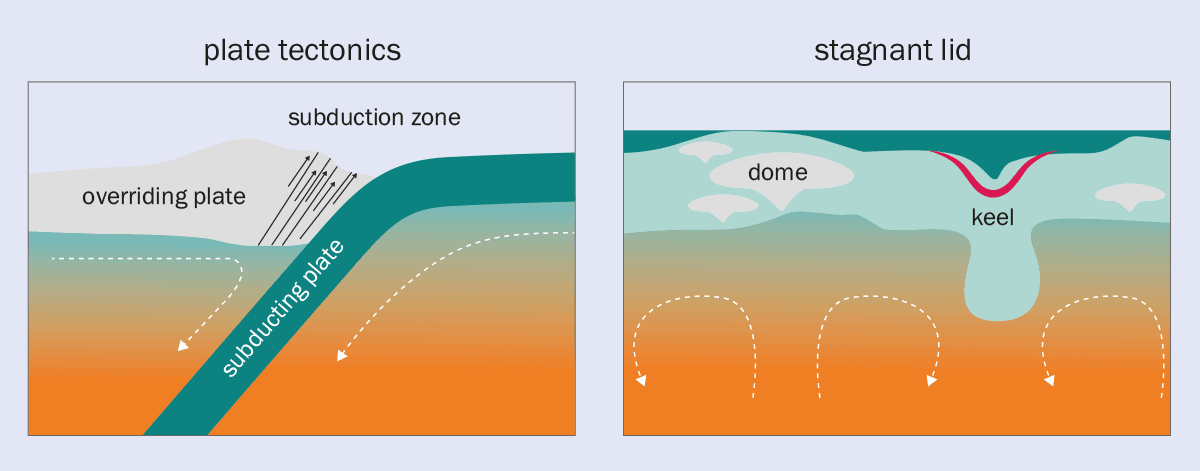
The crucial difference between today’s plate tectonics and this “stagnant lid” form of tectonics is that the latter does not include plates moving horizontally across the surface, which allows for heat to be efficiently released. Instead, Earth would have been a festering world with no continental crust, populated by isolated regions of thick oceanic crust separated by areas of upwelling magma (figure 1). “Maybe stagnant lid is an unfortunate name as people might think that nothing is going on,” says Tarduno. “But what you do have is plumes of material coming up that can heat the bottom of this primordial crust and lithosphere.”
1 Shift of focus The movement of tectonic plates is vital for sustaining habitable conditions across the Earth’s surface because it recycles carbon-rich materials back into the Earth’s interior at “subduction zones”, where one “subducting” plate is thrust under an “over-riding” plate. However, life could have preceded plate tectonics, although there may instead have been a more rudimentary form of tectonics known as a “stagnant lid”, in which plumes of material emerged from the deep to form granite domes, which sat alongside “keels” formed by sinking denser volcanic rock. (Courtesy: IOP Publishing)
Towards the end of the study period (3.4–3.3 billion years ago), the magnetization observed in the zircon crystals starts to strengthen, which Tarduno suggests could indicate the onset of plate tectonics. The reason is that huge slabs of crust descending into Earth’s interior at subduction zones result in the mantle cooling quicker. In turn, this process can strengthen the efficiency of convection in the outer core – resulting in a stronger geomagnetic field.
A ‘Goldilocks situation’ for early life?
If basic life were already present nearly half a billion years before tectonics, as implied by this study, it raises interesting questions about how life might survive in a plate-tectonic-less world. A weaker magnetic field from this stagnant-lid phase would have left the Earth’s surface more exposed to cosmic radiation, which our current strong field shields us from. Energetic protons in the solar wind would then have collided with atmospheric particles, charging and energizing them so that they can escape into space – in principle, stripping an entire planet of its water.
But Tarduno says that even the relatively weak magnetic field strength observed in this new study would have provided some shielding. In fact, he suggests this simmering, stagnant form of tectonics may have created a “Goldilocks situation” that would have been just right for primordial life, free from the dramatic shifts in environmental conditions that can occur in fully fledged plate tectonics.
It’s a tantalizing idea because stagnant lid forms of tectonics are thought to be common throughout our solar system, existing on Venus, Mercury and in a less dynamic form on Mars.
To develop the research, Tarduno’s team now plans to study zircons of similar ages from other locations, to give a wider range of data points. “Our approach is different from previous work because we have an indicator of motion,” he says. “All arguments about plate tectonics from this time in Earth history have been based on geochemistry – not on the principal indicator of what plate tectonics is.”
Peter Cawood, an earth scientist at Monash University in Australia, who was not involved in this Nature study, says that further understanding of early Earth may come from places in our solar system whose surfaces have not been repeatedly recycled by plate tectonics. “Mars, the Moon and meteorites provide a more extensive record of their early history,” he says. “Samples from these bodies, and in particular the potential for sample-return missions from Mars, may provide important new insights into processes that acted on the early Earth.”
Giant leaps on that front may occur via the Mars Sample Return Mission, scheduled to launch in 2027. But Cawood reckons that perhaps a more critical question for the development of initial life is when exactly water – a prerequisite for life – first appeared on Earth. “Previous work on the Jack Hills zircons, using oxygen isotopes, suggests that there has been water since at least 4400 million years ago,” he says.
For Cawood, this research could potentially help with the search for life within our solar system and beyond – and even our concept of what life looks like. “If life on Earth developed during this stagnant lid phase, then perhaps this also occurred on Mars. If Earth had remained in a stagnant lid phase and life had continued to evolve it would certainly look different from the biosphere we have today. So, to paraphrase Spock speaking to Kirk – ‘it’s life Jim, but not as we know it’.”
Using a scaffold made from conductive silicon nanowires, researchers in the US have developed artificial heart tissue that they say could be readily transplanted into natural tissue. Led by Ying Mei at Clemson University, the team hopes its technique could be a game changer in the global effort to treat heart disease.
Together, cardiovascular diseases are the leading cause of death worldwide, taking an estimated 17.9 million lives every year according to the World Health Organization. One of the main reasons these conditions are so prevalent is that heart cells have a limited ability to regenerate themselves when damaged, making it especially challenging for researchers to develop effective treatments.
Among the most promising advances in heart disease research involves the use of heart cells derived from stem cells, which are usually injected straight into damaged heart muscle. So far, this technique has been used to restore heart contraction in several different types of animal – but is still a long way from becoming a medically viable treatment. Among the things holding the technique back include the low survival rate of injected cells, and a limited recovery of the heart’s full function – especially the regular rhythm of its contraction.
Miniaturized, organ-like structures
Recently, progress in stem cell treatments has been achieved for a variety of other organs, including the brain, lung and retina. Each of these studies involved the transplantation of organoids. These are miniaturized, organ-like structures that can be grown in the lab from stem cells, and which replicate the structure and function of a real organ.
Although cardiac organoids have already proven to be an excellent platform for modelling heart disease and testing new drugs, their potential for treating heart disease still requires further investigation.
In their study, Mei’s team investigated whether cardiac organoids could be made to contract in regular rhythms by growing the tissue in scaffolds made from electrically conducting silicon nanowires.
Biocompatible and biodegradable
In biological applications, silicon offers a host of advantages compared with other conducting nanomaterials. Through a series of tests on heart tissue in rats, the team showed that the material is biocompatible, biodegradable, has an easily tuneable conductivity, and easily adjustable dimensions and surfaces – all of which would be vital to ensuring the greatest chance of success for an implanted organoid.
Through a carefully controlled process, Mei and colleagues created an organoid from a mixture of stem-cell-derived heart cells, stromal connective tissue cells, and endothelial cells – which line the walls of blood vessels.
In the experiment, these cells assembled themselves around a pre-constructed silicon scaffold to form a nanowired organoid. Just as the team hoped, this miniature tissue performed many of the heart’s most important functions, including its regular rhythm of contraction.
When the researchers injected their nanowired organoids into rat hearts, they recorded a far higher cell survival rate compared with unwired organoids. This accelerated the development of its stem cells into healthy, well-functioning heart tissue.
Mei’s team hopes its research could be an important milestone towards feasible new treatments for heart disease. If the same success can be recreated with organoids grown from human stem cells, it could pave the way for treatments which enable patients’ heart tissue to regenerate and restore its full function. In turn, the use of silicon nanowire scaffolds may ultimately lead to new treatments tailored to different types of heart disease, with the potential to save millions of lives.
The US Department of Energy (DOE) has announced plans to build two commercial-scale pilot plants that would remove carbon dioxide from the atmosphere through direct air capture (DAC). The $1.2bn effort represents the first phase of a 10-year, $3.5bn programme for four carbon-dioxide removal hubs. Environmentalists, however, have criticized the plan, saying DAC technology is expensive and its adoption would give oil and coal companies cover to continue to burn fossil fuels.
Worldwide some 130 DAC plants have been commissioned. But once complete, the two plants should be the world’s largest, able to eventually remove over 250 times more carbon dioxide than the largest DAC plant currently operating.
The US DAC programme emerged from infrastructure legislation that a bipartisan Congress passed last year, with US president Joe Biden’s infrastructure co-ordinator Mitch Landrieu calling it “the largest investment in engineered carbon removal in history”.
1PointFive, a subsidiary of Occidental Petroleum, will build one of the pilot plants in Kleberg County, Texas, while non-profit research company Battelle will build the other in Louisiana’s Calcasieu Parish.
According to Occidental, its Texan plant will use liquid sorbents to capture and sequester one million tonnes of carbon dioxide in saline formations each year, increasing to 30 million tonnes a year. The company has not yet indicated a schedule for starting up and reaching maximum capacity. The Louisiana plant, meanwhile, will rely on solid sorbents with similar sequestration capacities.
“Cutting back on our carbon emissions alone won’t reverse the growing impacts of climate change; we also need to remove the CO2 that we’ve already put in the atmosphere – which nearly every climate model makes clear is essential to achieving a net-zero global economy by 2050,” noted US energy secretary Jennifer Granholm. “With this once-in-a-generation investment…the DOE is laying the foundation for a direct air capture industry crucial to tackling climate change – transforming local economies and delivering healthier communities along the way.”
‘A moral hazard’
Yet not everyone sees it that way. Former US vice-president Al Gore, a prominent critic of actions responsible for climate change, labelled DAC technologies “a moral hazard” in a TED talk he gave before the announcement, adding that the technology gives fossil fuel producers “an excuse for not ever stopping oil”.
Gore added that the amount of energy required for DAC would exceed that needed to prevent the emissions of carbon dioxide that the technology would remove.
On the other hand, supporters of the technology assert that, as the amount of global carbon continues to increase, DAC can serve as an effective back-up technology for removing it. Indeed, the DOE has also announced that it intends to allocate almost $100m for feasibility and design studies on 19 other carbon-removal projects.