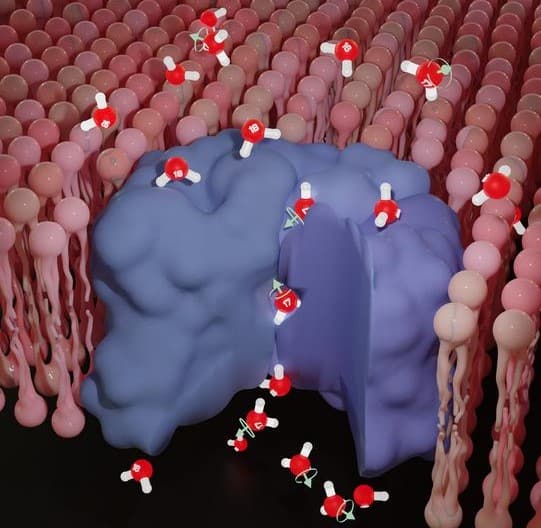
Going with the flow: artist’s impression of the preferential flow of water molecules containing oxygen-17 into a human cell. (Courtesy: PNAS)
The effect that nuclear spins have on certain biological processes has been observed for the first time by researchers in Israel. The team led by Yossi Paltiel at the Hebrew University of Jerusalem performed two experiments that showed how interactions between oxygen isotopes and chiral biomolecules depend on the isotopes’ nuclear spin.
Many processes in the natural world are affected by the spin of electrons — including photosynthesis, and the ability of some animals to sense Earth’s magnetic field. Until recently, however, it had been assumed that the spins of nuclei do not affect biological processes.
Now, Paltiel’s team has found that nuclear spin can affect how different isotopes of oxygen interact with chiral biomomecules.
Probing chirality in life
“Our research probes the rule of chirality in life,” Paltiel explains. “We are currently investigating the effect of ‘chiral induced spin selectivity’ (CISS), which establishes a link between electronic spin and chirality.”
Chirality is an asymmetrical property held by an object that cannot be mapped onto its mirror image using rotations and translations. A familiar example is the human hand. Indeed, chiral is derived from the Greek word for hand and chiral objects are referred to as being either righthanded or lefthanded.
Many important biomolecules can exist in righthanded and lefthanded versions, but one chirality tends to dominate in nature. CISS means that electrons with spins in a certain direction (say, up) will interact with a chiral molecule in a different way than electrons with spins in the opposite direction (down).
Oxygen isotopes
Now, Paltiel and colleagues have shown that nuclear spins are also relevant to CISS. The researchers set up two experiments involving three stable isotopes of oxygen. These are oxygen-16 and oxygen-18, which both have zero nuclear spin, and oxygen-17, which has a nuclear spin of 5/2.
Their first experiment involved the electrolysis of water: a vital process in photosynthesis. Here, the team generated a spin-selective electron current using the CISS effect. This was done by coating the anode with a layer of molecules with uniform chirality. The anode is where oxygen molecules are produced by electrolysis and it is known that this production is enhanced when a spin-selective electron current is used.
The water used in the experiment contained the three oxygen isotopes and the researchers analysed the isotopic composition of the oxygen that was produced to see if this was affected by nuclear spin. They found that significantly fewer oxygen molecules containing oxygen-17 were produced when the chiral coating was used than when a bare anode was used. This, the team says, shows that CISS can also involve nuclear spins.
Water transport
In the second experiment, Paltiel’s team looked at the transport of water through the membranes of living human cells. Within a cell membrane, water is transferred through special proteins called aquaporins, which prevent other ions or solutes from passing through with the water.
The molecules responsible for this selectivity are chiral and therefore offer a way of testing if CISS is involved in the water transport process. The researchers looked at how water molecules containing oxygen-17 and oxygen-18 are transported through aquaporins. They found that there was a clear preference for the transport of one isotope over the other, again showing that CISS is involved in the transport of water through human cells.
“Our research demonstrates that nuclear spin plays a crucial role in biological processes, suggesting that its manipulation could lead to ground-breaking applications in biotechnology and quantum biology,” Paltiel says. “This could potentially revolutionize isotopic fractionation processes and unlock new possibilities in fields such as NMR [nuclear magnetic resonance].”
NMR involves probing the nuclear spins in a material using external magnetic fields – but so far, the magnetic isotopes in biological systems suitable for the technique other than hydrogen have been extremely rare and difficult to purify. The team’s discovery presents a possible method to enrich the magnetic isotope oxygen-17 in biological systems – which could then be detected using NMR.
The researchers believe that their experiments only scratch the surface of the effects of CISS and nuclear spin. They hope that the further exploration of nuclear spins in biology could lead to exciting applications.
Middle bias, randomness bias, linearity bias, normalcy bias – the list of cognitive glitches that can send us chasing after red herrings or playing into the hands of manipulators goes on and on. With so many forms of faulty cognition vying for our attention, it’s a wonder any of us achieve anything at all. In How to Expect the Unexpected: the Science of Making Predictions and the Art of Knowing When Not To, Kit Yates explores these biases and psychological traits in detail, showing how they muddy our interpretations of events and how some of them even contradict each other. Better still, by working through the mathematics and logic of events, Yates aims to make us better prepared to expect what we would not otherwise have expected.
Yates’ discussion of game theory is delivered so intuitively that you may be left wondering what is so complicated about it to captivate some of the most esteemed mathematical intellects of the past century
As a senior lecturer in mathematical sciences at the University of Bath, UK, Yates is a pro at presenting maths in simple terms. His discussion of game theory, for example, is delivered so intuitively that you may be left wondering what is so complicated about it to captivate some of the most esteemed mathematical intellects of the past century. But you don’t need to trawl too far through the scholarly literature on game theory for confirmation that this apparent simplicity is at least partly due to Yates’ deft articulation, which manages to dodge the matrix algebra and other technical tools so often invoked. There is not a single equation in the book, but they are not missed, since the (inevitably wordier) descriptions that replace them never come across as arduous.
The anecdotes Yates uses to illustrate these mathematical principles help make the book compelling to read. From the stupendously unlucky Deepa Sharma – an Indian doctor who was killed by an avalanche in Himachal Pradesh where “the results of a positive feedback loop [the displacement of an initially small stone is amplified]…cost her her life” – to the incredibly fortunate Mike McDermott – an English electrician who exemplified the laws of probability and very large numbers when he scored five-figure lottery wins twice in a few months playing the same set of numbers – these examples are all the more engaging for their human details. Another example illustrates the perils of metrics becoming targets in performance-oriented policies. Here, Yates doesn’t just highlight problems at a specific US hospital. He also narrates in detail the plight of a Vietnam veteran, Walter Savage, who became one of many individuals to suffer as a result.
In places, there are so many anecdotes that it starts to feel like the maths in the book is merely a plot device to string together intriguing stories. But as well as being beguiling in their own right, all these examples are highly effective at demonstrating how worthwhile it is to have a basic grip on mathematical ideas. Yates’ argument for the relevance of these ideas is also not limited to anecdotes. It embraces broader principles, too. An example is his discussion of Bayes’ theorem, which describes the probability of an event based on prior knowledge of conditions that might be related to the event. Yates explains this in terms of the location of a randomly positioned marker. An initial guess would suggest the marker is equally likely to be anywhere. However, new information as to whether a subsequent series of random points falls to the right or left of the marker can update this initial guess in a way that “eventually converg[es] towards the truth”.
While Bayesian thinking is undoubtedly a useful way of statistically informing what is not really known, Yates highlights a key flaw in our “natural ability to learn from experience in a Bayesian way”: we end up valuing ourselves based on the treatment we experience. These real-world Bayesian updates to our outlook are worth noting because they can hamper us from achieving our true potential and limit our aspirations, particularly in sectors where no-one like us has excelled before.
Yates includes plenty of personal examples too, from exploits with his kids to the book’s opening gambit: a trip to see Paula, a self-described psychic. Any readers who cherish a faith in mystics and clairvoyants should consider themselves warned: what follows is a gloves-off debrief of the various ruses a psychic may implement. The true stories he later shares – such as psychics ruthlessly targeting the bereaved and vulnerable to make money, or sending police tracking a missing person off on a wild goose hunt – suggest his critical tone is justified.
There’s nothing bland or robotic in Yates’ writing style, and while this real human zeal may not always be flattering (a comment about studies of cats falling from high rises in the 1980s “when apparently there was nothing better to study” being a case in point), it imbues the subjects covered with an infectious enthusiasm, artfully dispelling the dry, stuffy perceptions many people have of maths. Many physicist readers will, of course, find the maths itself genuinely fascinating, encompassing as it does topics from combinatorics to chaos. Some may even feel disappointed not to be invited deeper into these mathematical mysteries, but as in his first book, The Maths of Life and Death, Yates’ aim is more to familiarize the reader with the basic principles and why they matter, rather than to delve into the details.
Overall, How to Expect the Unexpected is well placed to equip us with the maths needed to make better choices and avoid the pitfalls of circumstance. Indeed, I suspect it will leave many readers frustratingly wiser in hindsight at what we should have done. Nonetheless, its greatest achievement may be that it exposes everyone’s potential to grasp mathematics, even those who are convinced they are rubbish at it. In this respect, its conclusion is delightfully clear: QED.
Harnessing the power of nuclear fusion to generate electricity is a longstanding aspiration of the physics community. One company working towards this goal is UK-based First Light Fusion, which is using a technique called projectile fusion to create a simple, low-cost inertial fusion power plant.
Having confirmed last year that its technology can achieve fusion, First Light is now developing a net-energy-gain demonstrator, known as Machine 4. And while working with Spanish engineering firm IDOM to optimize the reactor design, the team realized that projectile fusion could also be used to produce a variety of sought-after medical isotopes.
Inertial confinement fusion, one of two main fusion technologies under development, works by compressing a small fuel target containing a mixture of hydrogen isotopes. At high enough temperatures and pressures, nuclear fusion reactions occur between deuterium and tritium in the target.
The most common inertial fusion technique – and the approach with which the National Ignition Facility first demonstrated energy gain from fusion last December – uses high-powered lasers to trigger the fusion. First Light is developing a different approach, in which a high-velocity (and low cost) projectile is fired at the target. An amplifier within the target focuses the projectile’s energy, with the resulting shock waves squeezing the fuel so much that it gets hot and dense enough to fuse and release a pulse of energy.
The majority of the energy released by fusion is in the form of high-energy neutrons. This energy is absorbed by a blanket of liquid lithium lining the reactor’s inner wall, and the heat can be extracted to generate electricity. The neutrons are also used to create tritium, via a reaction with the liquid lithium blanket.
Fusion focused Nick Hawker is First Light’s CEO and co-founder. (Courtesy: First Light Fusion)
“While the main focus of the reactor was originally the production of electricity from fusion, the First Light reactor also produces tritium to be self-sufficient in tritium fuel,” explains Nick Hawker, First Light’s co-founder and CEO. “Tritium is used by most other fusion reactors and is in short supply, so we started to vary the design to see if over-production of tritium was possible. During these investigations, Hawker explains, “we also realized that these neutrons could be useful for isotope production”.
In-demand isotopes
Radioisotopes are widely employed within medicine for a range of diagnostic and therapeutic applications. The most prevalent is technetium-99m (Tc-99m), the decay product of molybdenum-99 (Mo-99). Tc-99m is employed in tens of millions of nuclear medicine procedures each year, including myocardial perfusion imaging to diagnose heart disease, and scans to detect and stage cancer.
At present, Mo-99 is typically made using fission-based production in a few ageing nuclear reactors and, due to a half-life of just a few days, it can’t be stored. As such, there’s a growing demand for new ways to produce Mo-99 and other medical isotopes. One approach is to bombard nuclei of stable elements with high-energy neutrons – such as those produced by First Light’s reactor – causing them to transmute into the required radioisotope.
“The neutrons produced by fusion are high energy, and the flux is also very high. This means that there is a very wide scope for isotope production with fusion as the neutron source,” Hawker explains. “We can in theory create a large range of different isotopes, including Mo-99.” The team has also studied isotopes used for cancer treatments, including copper-67, samarium-153, lutetium-177 and yttrium-90.
Neutron-induced reactions are energy dependant, with some transmutations necessitating high-energy neutrons. As First Light’s reactor will produce high-energy 14 MeV neutrons, the company may benefit from creating isotopes that have a threshold reaction energy for production. “While most isotopes can be made with high-energy neutron bombardment, we must find where we are cost competitive or have a unique advantage,” Hawker tells Physics World.
Hawker notes that First Light originally discounted the idea of isotope production as the reactor’s liquid blanket makes it difficult to place a sample on the first wall, where the neutron flux is highest. However, the team has now designed a way to control neutron paths through the blanket, allowing neutrons to penetrate and focus on specific regions where isotope production components can be placed.
Importantly, this can be achieved without compromising the reactor’s ability to produce electricity. “We can have a thick blanket for good tritium and electrical production, but also allow neutrons out in a focused region (which can move) for isotope production,” Hawker explains. “This means that we can address all three opportunities with little compromise.”
First Light continues to work closely with IDOM on the design of its reactor chamber and the development of Machine 4, which will be housed in a purpose-built facility at the UK Atomic Energy Authority’s Culham Campus in Oxfordshire. Construction is anticipated to begin next year, with operations likely to commence in 2027. “Once the system is performing high-yield shots, this may give us an opportunity to test the isotope production as a proof of principle,” says Hawker.
Ultimate ambition First Light is aiming to create a fusion power plant that produces around 150 MW of electricity, fires once every 30 s and costs less than $1 bn. (Courtesy: First Light Fusion)
Proven approach
First Light is not the only company exploiting fusion to create medical isotopes. SHINE Technologies of the US is using its fusion technology to produce the therapeutic isotope lutetium-177 (Lu-177). SHINE made its first commercial sales of Lu-177 in 2020 and recently opened the largest Lu-177 production facility in North America at its headquarters in Janesville, WI. The company is also currently constructing a fusion-driven medical isotope production facility, the Chrysalis, to produce Mo-99.
Medical isotope production is Phase 2 of SHINE’s four-phase roadmap towards generating fusion energy. “Advancements in radiopharmaceutical therapies have shown great results in extending the lives of patients who might otherwise be out of options,” says SHINE’s founder and CEO Greg Piefer. “We’re excited to play an important role in making sure these groundbreaking therapies reach patients faster, potentially saving or extending the lives of many tens of thousands of people each year.”
“We believe that fusion has the potential to produce isotopes to diagnose and treat cancer,” Piefer tells Physics World. “We see ourselves as pioneers of that vision, and it’s great to see other companies that are interested in developing solutions that reduce the market dependency on reactors as well.”
Every minute, up to 10,000 muons rain down on every square metre of the Earth’s surface, ghosting through our bodies as we go about our lives. Increasingly, scientists are using these subatomic particles – produced when cosmic rays collide with atoms high in the atmosphere – to help predict natural disasters.
Observing how muon fluxes change when passing through objects can reveal the hidden interiors of volcanoes and other difficult-to-access structures. This video explores the emerging field of muography, which is now also being used to predict how cyclones will evolve in terms of strength, speed and direction.
Independent researchers have found no evidence of room-temperature superconductivity in a modified form of lead apatite, dashing hopes of a technological breakthrough. The material came to public attention in July after two Korean scientists, Sukbae Lee and Ji-Hoon Kim, together with colleagues in Korea and the US, claimed it could conduct electricity without resistance at ambient pressure and temperatures. Subsequent attempts at replicating their results have come up short, however, and some experts believe the tantalizing finding may have been due to impurities in the supposedly superconducting sample.
Materials that carry current without resistance at high temperatures have long been sought after. A true room-temperature superconductor would bring major benefits, including efficient electrical grids and more powerful computers. It would also make it possible to reduce the size and cost of particle accelerators, MRI machines and other devices that rely on bulky cooling systems to keep their magnetic coils in a (low-temperature) superconducting state.
In a pair of un-peer-reviewedpapers posted on the arXiv preprint server on 22 July, Lee, Kim and colleagues claimed to have produced such a material. Dubbed LK-99 after its discoverers’ initials, the material was first described as a room-temperature superconductor in April in a little-noticed paper published in the Journal of the Korean Crystal Growth and Crystal Technology. More recently, in the two arXiv papers, the team specified that the material displays four signs of superconductivity: resistance-free current flow; magnetic field expulsion and levitation (the Meissner effect); and a critical temperature and critical magnetic field below which the superconducting transition occurred.
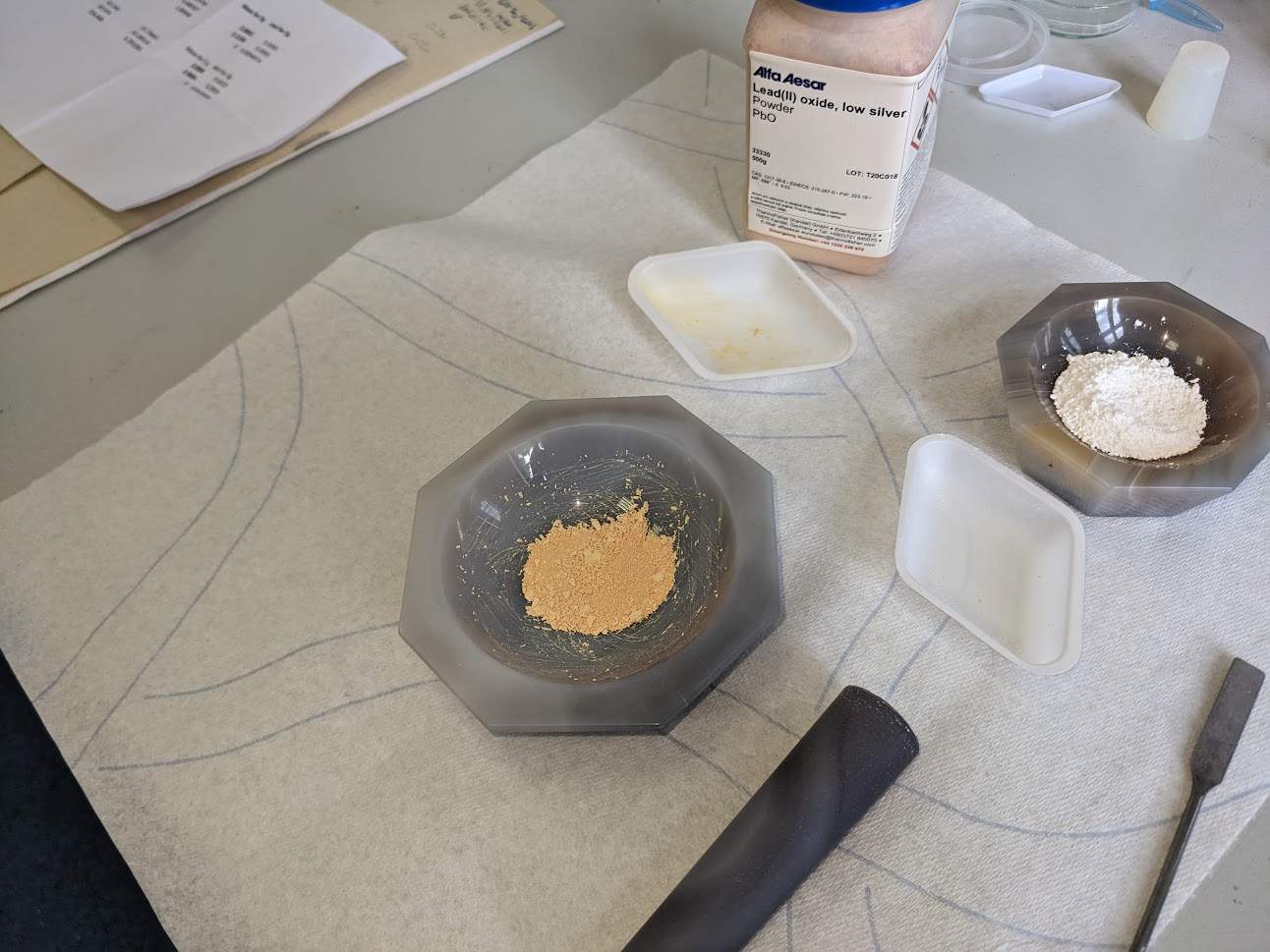
The team also proposed an explanation, suggesting that superconductivity could arise from chemical pressure or “stress” caused by introducing copper atoms into lead apatite. Since the arrangement of these introduced impurities is crucial, the team provided a “recipe” for making the material, X-ray diffraction data on its structure and a chemical formula for the final product: Pb10−xCux(PO4)6O, where x is the concentration of copper atoms and is between 0.9 and 1.1.
First replication attempts come up short
Armed with this information, many research groups (and at least one technically-knowledgeable amateur with access to good equipment) began synthesizing their own samples. “The possibilities within the claims of Lee, Kim et al. would be a game-changer for society if they would turn out to be true, so we of course wanted to be part of the history in case of a real breakthrough,” says Ross Colman, who participated in a live online replication attempt with colleagues at Charles University in Prague, Czechia.
Superconductivity or bust: The starting materials in the “recipe” for synthesizing LK-99 include lead oxide. (Courtesy: Ross Colman)
Initial experiments did not produce any breakthroughs. In one of the first reports, V P S Awana and colleagues at India’s CSIR-National Physical Laboratory (NPL) synthesized a sample that became weakly magnetic when placed on a strong magnet, rather than expelling magnetic field like a superconductor would. Another early replication attempt, this one by Zhiqi Liu and colleagues at Beihang University in Beijing, China, yielded a sample that behaved like a semiconductor, with a large room-temperature resistance.
Colman says these inconsistencies are partly due to the “messy” nature of the instructions for synthesizing LK-99. “Whilst the synthesis recipe is presented very simply, there are a number of inaccuracies or missing information,” he says. Examples include the dimensions of the equipment used, how the temperature should change during different synthesis stages, and even the fact that the material becomes molten at 925 °C. “A more detailed description would have prevented a lot of guesswork,” he says.
A door opens a crack…
On the theoretical side, things were slightly more encouraging. A team led by Xing-Qiu Chen of China’s Shenyang National Laboratory for Materials Science calculated that a material with the formula Pb10−xCux(PO4)6O would contain electronic structures known as flat bands at the Fermi level, which is the highest energy level that an electron can occupy at 0 K. These flat bands can be a hallmark of superconductivity.
Independently, Sinéad Griffin, a staff scientist at the Lawrence Berkeley National Laboratory in the US, came to a similar conclusion: swapping copper for lead in the appropriate place within Pb10−xCux(PO4)6O produces flat bands. Less promisingly, Griffin calculated that an experimentally easier substitution has no such effect. “This result hints to the synthesis challenge in obtaining Cu substituted on the appropriate site,” she wrote.
…and then slams shut
Despite this caveat, the flat-band results were greeted with elation among LK-99’s growing army of fans on social media. When Griffin posted her paper on Twitter/X, accompanied by a “mic drop” GIF featuring former US president Barack Obama, the responses included “This is so badass” and “Incredibly based tweet”.
Over the next fortnight, though, the replication failures continued, and the air began to leak out of the hype bubble. A second effort by the Indian NPL team used purer precursor materials and produced a sample with X-ray diffraction peaks that more closely matched those in the original arXiv papers. Alas, this new sample was not a superconductor either. It was diamagnetic, becoming magnetized in the opposite direction to the applied field.
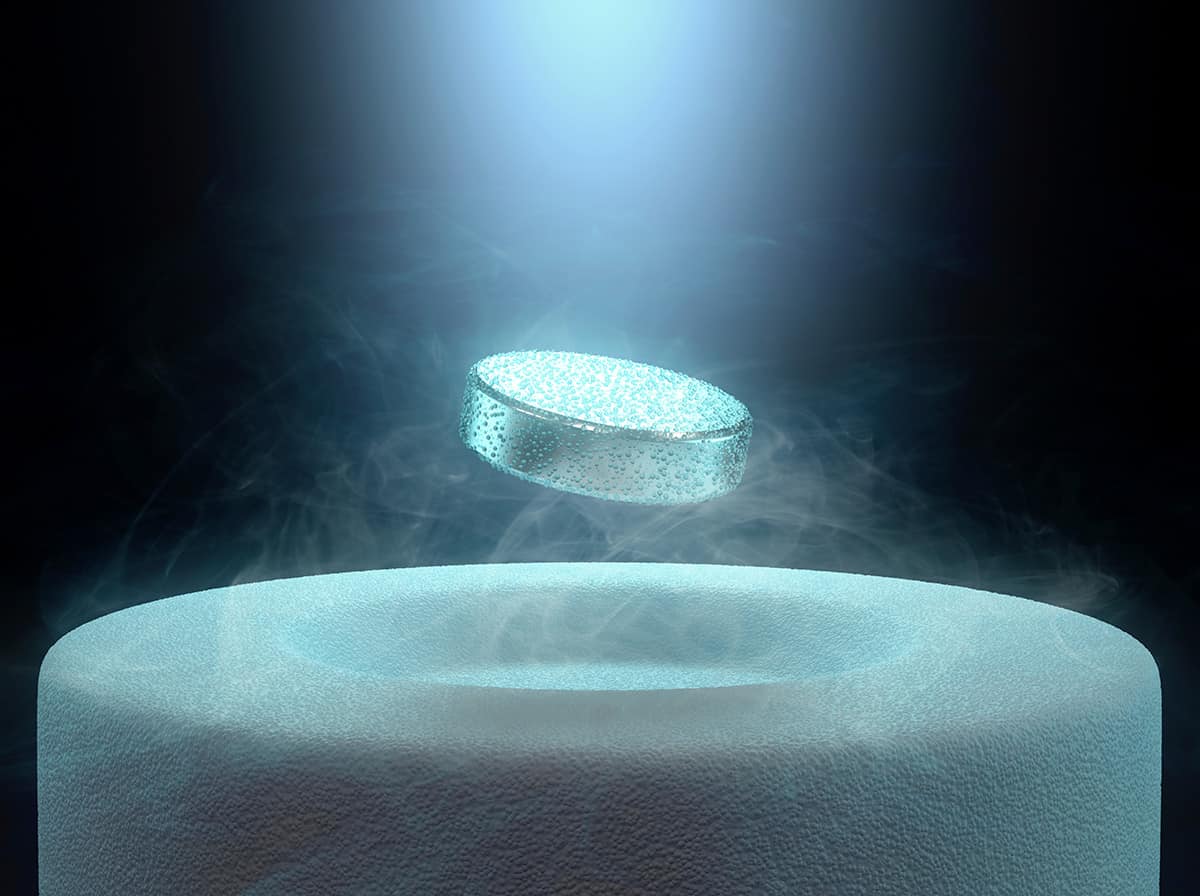
Textbook case: A standard, low-temperature superconducting material levitates above a magnet. (Courtesy: iStock/ktsimage)
This is important, because one of the strongest pieces of evidence in favour of room-temperature superconductivity in LK-99 was the material’s ability to levitate when placed atop a strong magnet under ambient conditions. The Korean team interpreted this as being due to the Meissner effect, but diamagnetic objects (including frogs and strawberries) will also levitate if the magnetic field is strong enough.
Another alternative explanation for LK-99’s levitation came from Shuang Jia and colleagues at Peking University in Beijing. Although they persuaded “some small flaky fragments” of their synthesized sample to levitate, these levitating fragments “ubiquitously contain weak yet definitive soft ferromagnetic components”. Ferromagnetism, they wrote, can explain levitation in LK-99 without recourse to superconductivity.
A fuller picture emerges
For Andrei Bernevig, a condensed-matter theorist at Princeton University, US, the varying results and associated hype are a source of frustration. “A lot of the stuff early on was rushed and statements from all sides were unchecked,” he tells Physics World. “The social media, memes, etc., have been completely detrimental to progress in this field in my view…I hope we never do science like this again.”
To provide concrete answers, Bernevig and his Princeton colleague Leslie Schoop, together with collaborators in Spain, Germany and the University of Oregon, US, focused on a different question. Rather than investigating whether LK-99 exhibited signs of superconductivity, they began by asking: just what is LK-99, anyway?
After synthesizing their own sample, the team performed X-ray diffraction measurements on the best crystal in the batch. This crystal turned out to contain at least three different components. “The recipe is simple, but it does not result in a single-phase material,” explains Schoop, a materials chemist. “When a sample consists of multiple materials, as LK-99 seems to, it is difficult to get the exact same results in different labs.”
A mystery in three colours: A photo of the final product in the Princeton team’s synthesis. (Courtesy: Scott Lee)
At first glance, this conclusion might seem to support the hypothesis put forward by online LK-99 fans who suggested the replication failures were due to incorrectly-synthesized samples. Alas, theorists in the Princeton team calculated that in a material with the “correct” structure, the flat bands that inspired so much excitement are localized and thus, in effect, the wrong type. “These localized flat bands tend to give rise to magnetism in LK-99 (for the assumed structures) instead of superconductivity,” explains team member Jiabin Yu, a postdoctoral researcher in condensed-matter theory at Princeton.
Other calculations by the same team showed that copper atoms are unlikely to enter the structure of LK-99’s precursors in concentrations high enough to affect its properties. This suggests that the Korean team’s explanation for superconductivity is incorrect. It also casts doubt on the material’s proposed structure, with consequences for theorists as well as experimentalists. “If the structure of ‘LK-99’ is different from the assumed ones, then we currently cannot make any reliable claims about the superconductivity,” Yu says.
The role of impurities
A further insight came from Wei Wu, Jianlin Luo and colleagues at the Beijing National Laboratory for Condensed Matter Physics, China. Like the Korean researchers, they observed a sharp “superconducting-like” transition in the resistivity and magnetic susceptibility of LK-99 at temperatures a little below 400 K.
However, they suggest that this could have arisen from Cu2S impurities in the original sample, which the Korean researchers acknowledge were present. Cu2S undergoes a structural phase transition at around 385 K, and the Beijing researchers found that this phase transition produces a sharp drop in the resistivity of an LK-99/Cu2S mixture. This, they say, may be what the Korean team saw.
“If there’s a simple alternative explanation for the results, there’s no reason to consider the extraordinary claim of room-temperature superconductivity anymore.”
Michael Fuhrer
When Physics World put these questions to members of the team, Lee, the corresponding author for the first arXiv paper, did not respond. Hyun-Tak Kim, a physicist at the College of William and Mary in the US and the corresponding author for the second arXiv paper, declined to comment because he has submitted the paper to a journal, and will address criticisms in his response to a reviewer’s report.
“The final nail in the coffin”
Absent further developments, Michael Fuhrer, a condensed-matter physicist at Monash University, Australia, who has been following the replication attempts, calls Wu and Luo’s result “the final nail in the coffin” for LK-99 as a room-temperature superconductor. Together with the ferromagnetism and diamagnetism reported elsewhere, Fuhrer says it shows that the Korean team’s findings can “very likely be explained” by the presence of impurities in their sample. “If there’s a simple alternative explanation for the results, there’s no reason to consider the extraordinary claim of room-temperature superconductivity anymore,” he tells Physics World.
Colman is slightly more optimistic. “There remains a spark of hope that the observations of superconductivity are still real, if related to a very specific impurity in the Korean samples,” he says, “but tracking down the truth of the observations may be a very difficult process. Experimental reproduction of the properties is impossible if only a single grain in a multigram batch shows the properties that you are interested in.”
Still, Fuhrer doesn’t think the scientific community should judge the team harshly. “Science isn’t a court of law, and we’re unlikely to get ‘proof’ that the original LK-99 samples don’t contain any superconductor,” he says. Instead, the failed replication attempts “simply show that the results are more likely to be explained another way…I think this was a genuine example of competent scientists who believed they were right but got fooled in a rather subtle and surprising way.”
Researchers in South Korea and Switzerland have developed an algorithm that creates 3D objects that follow specific meandering paths as they roll downhill. They have also shown that their technique could be used to develop new control protocols for seemingly unrelated systems including quantum spins and the polarization of light.
Rolling objects have played key roles in technology since at least the advent of the wheel. Most rolling objects used by humans are cylindrical, spherical or conical. The first two shapes are useful because they tend to roll in straight lines, whereas conical shapes are used when a circular trajectory is needed.
However, there are also objects that will roll downhill forever while following repeating, meandering paths – a simple example being a sinusoidal path. These objects include oloids, sphericons, polycons, platonicons and two-circle rollers. Some of these have been used in robotics and also for mixing materials. Beyond these practical applications, the discovery and characterization of shapes that take meandering paths is an interesting mathematical problem.
Seeking trajectoids
Now, Bartosz Grzybowski at the Institute for Basic Science in Ulsan and colleagues have sought to solve a mathematical problem that generalizes the search for such objects – which they have dubbed “trajectoids”. They have also successfully made some of these trajectoids using 3D printing.
Writing in the journal Nature, the team states the problem as “given an infinite periodic trajectory, find the shape that would trace this trajectory when rolling down a slope”.
The team showed that a potential trajectoid can be described by a virtual exercise that involves drawing a periodic trajectory on a flat surface. Then, a sphere is rolled over the surface such that the line is transferred to the surface of the sphere. If the start of the trajectory matches up with the end of the trajectory – thereby creating a continuous loop on the surface of the sphere – then it should be possible to create a trajectoid that follows that route. The team also found that when trajectories do not match up, they can be tweaked to do so.
Two or more periods
Although this technique can be used to identify suitable trajectoid paths, the researchers discovered that fitting one period of a trajectory onto a sphere was actually a difficult thing to do. In contrast, they found that it was much easier to fit two (or more) periods of a trajectory onto a sphere. Indeed, the team surmises that this technique should work for just about every possible repeating path – showing that the number of paths that cannot be mapped after two or more rotations are exceeding rare.
Once they had perfected their method to identify trajectoid paths, the researchers devised a scheme for fabricating the corresponding trajectoids. In their technique, an ideal trajectoid begins as a dense spherical core with a concentric outer shell that has zero density. The desired trajectory is split into a series of linear segments. To have the object roll along a linear segment, part of the outer shell is “shaved off” to create a small region that has cylindrical curvature and will therefore only roll along the direction of the line segment (assuming no slippage).
This process is repeated for all successive linear segments. This creates a trajectoid that is a combination of cylindrical surfaces, all of which have axes of rotation that are parallel to the rolling plane and go through the centre of mass of the object.
3D printed shells
The team then created such trajectoids using 3D printing to create low density outer shells. These were printed in hemispheres that were then glued onto heavy steel balls with much higher densities. The trajectoids were then rolled down an incline that was covered with sandpaper to prevent slippage.
The team tested a number of different trajectoids and found that many of them did a very good job at following their expected downhill routes. Others, however, came to a halt, while some trajectoids struggled to negotiate sharp turns in their predicted paths.
The process of translating a repeating meandering trajectory onto a sphere is similar to how the evolution of some quantum systems is described in terms of the trajectory of a point on a “Bloch sphere”. Examples of this include the description of how a nuclear spin is manipulated in a nuclear magnetic resonance (NMR) measurement, or how an electronic spin is manipulated in a quantum bit (qubit).
In their paper, Grzybowski and colleagues say that research suggests that there are a large number of ways that such a spin can be manipulated (by applying successive magnetic fields, for example) such that it follows specific trajectories before returning to its original state. This could be particularly useful for creating new sequences for doing NMR or for processing quantum information. The polarization of light can also be described in terms of a point on a sphere and so the research could lead to the development of optical systems that are designed not to change the polarization of light as it is processed.
Discussion points Creating a truly inclusive and diverse subject requires continuous effort, reflection and adjustment. (Courtesy: Daniel Marchant)
Creating inclusive and equitable environments in the lab and at scientific conferences is crucial if we are to foster equal opportunities for all. This involves addressing many issues such as ensuring there is a gender balance within the subject, removing language barriers and making the events accessible for individuals with disabilities. Despite progress in recent years, there remain many challenges facing physics – including in quantum technologies. Quantum technology is a burgeoning field where developments are occurring at a breath-taking rate, but we must ensure that progress does not come at the expense of cultivating a safe environment.
Such thoughts were on our minds as the organizers of BQIT (Bristol Quantum Information Technologies) workshop – an annual meeting that has been running for the past 10 years. Recently, a particular focus at the conference has been addressing issues in equity, diversity and inclusion. That’s why, since 2019 BQIT has featured panel discussions on topics such as tackling implicit bias; the impact of working conditions in academia on mental health; the effect of the COVID-19 pandemic on research; and ways in which institutions can help fight pandemic burnout and impostor syndrome.
In April, some 200 participants met at the University of Bristol for BQIT where the diversity and inclusion session, which we organized together with Alex Clark and BQIT chair Holly Caskie, was for the first time transformed into an interactive workshop. Following an introductory talk from Caroline Clark, participants were divided into groups, which included people at various stages of their career to promote diverse perspectives. Each group also had help from facilitators from the University of Bristol’s equity, diversity and inclusion team.
Although the groups debated the issues facing those in quantum technologies, our discussions touched on topics that are also relevant to many other areas of physics.
One major concern in physics is the large gender imbalance, which is caused in part from a lack of diversity in applicants and unconscious selection bias. Delegates discussed how interventions such as “blind” interviews and redefining success metrics beyond gender balance can help. Another problem concerns language barriers, which often results in a bias against non-native English speakers. This issue can be tackled by focusing on effective communication and recognizing that science ability is not limited by language proficiency. Accommodating individuals with disabilities requires accessible buildings, laboratories and equipment, including technologies such as remote experiment control.
We have to clearly communicate expectations and requirements, create suitable job roles, and promote a supportive work environment
If we are to create a more inclusive community, we also must pay particular attention to people who have caring responsibilities, who are neurodivergent or who come from minority groups. It’s vital to strike a balance between career aspirations and caring responsibilities, which means we have to clearly communicate expectations and requirements, create suitable job roles, and promote a supportive work environment. In the case of neurodiversity, one solution is to use anonymous questionnaires to help tailor workspace adjustments, while another involves cultivating socially cohesive groups to foster understanding and support. Creating an inclusive academic culture also requires us to address personal biases and learn more about the problems at hand. We also need to use techniques such as creating agile working practices, offering leadership training and creating physically inclusive workspaces.
The trouble in such a fast-moving field as quantum technology is that people end up being expected to work long hours, which can lead to a significant imbalance between work and personal life. This is especially taxing for those with fixed-term contracts, given the added pressure of traditional productivity metrics and the constant push to publish papers. That’s why we need to train supervisors in pastoral support and mental health. Unnecessary pressure can also be alleviated with robust support networks and clear expectations. Universities should also encourage staff to strike a good work/life balance and to take holidays. Flexibility is vital, especially for experimentalists who spend long hours in the lab, so we must employ arrangements that allow individuals to compensate for extended work hours with time off.
On conferences
We know that conferences are vital for researchers to collaborate and share knowledge, but they must be held at safe, accessible and welcoming venues. Meetings should feature a diverse array of participants, encourage a broad range of perspectives, and empower under-represented groups. Alternative formats like table-based poster sessions and hybrid events are useful for addressing accessibility challenges, provided that technological barriers are managed.
Conferences should also provide comprehensive support for attendees, including help with delegate fees, visas, accommodation and transport costs and even childcare facilities and on-site prayer and reflection rooms. We can also encourage people to interact in a respectful way through, for example, having pronoun badges, running structured engagement opportunities, and organizing an array of session types.
A kind, inclusive culture that celebrates teamwork is one that celebrates diverse perspectives and allows talent to flourish
If we are to build a diverse field, we also need to examine why people from under-represented groups find it hard to progress in their careers or leave physics altogether. Encouraging physicists to stay in the field means making sure they have enough money to live on, they have a good work/life balance and that we are able to be accommodating of different responsibilities that many individuals face. A kind, inclusive culture that celebrates teamwork is one that celebrates diverse perspectives and allows talent to flourish.
We call on those in senior positions in the quantum community to consider these issues and find ways to implement solutions. Future BQIT meetings will aim to implement these suggestions as best we can. The path to a truly inclusive and diverse community, especially in new and rapidly developing fields, requires continuous effort, reflection and adjustment. We now want to broaden discussions and identify further challenges within quantum technologies. Our long-term vision is a quantum community where individuals from all backgrounds have equitable access to opportunities, where diverse perspectives are highlighted and where a wealth of experiences and viewpoints can drive collaboration. We believe we can get there.
If you are a fan of the music of the 1960s and 70s you have probably heard the name Tom Dowd. Born in New York City in 1925, Dowd was a recording engineer who worked with some of the biggest names of the era including Aretha Franklin, John Coltrane and Diana Ross. He died in 2002.
Now, the success of the film Oppenheimer has got music fans talking about his participation in the Manhattan Project. Dowd graduated from Stuyvesant High School (which has produced four Nobel laureates) age 16 and enrolled at Columbia University to study physics. At 18, he was drafted into the US army and contributed to the development of the atomic bomb by doing neutron beam research at Columbia.
After the war he was not able to publish his top-secret work so it could not contribute to a PhD. As a result, he gave up on physics and instead took a job at a recording studio. His first hit was “If I Knew You Were Comin’ I’d’ve Baked a Cake”, which was released in 1950 by Eileen Barton and the rest is history. You can read more in this article in JamBase by Andy Kahn.
Pondering Barbenheimer
If like me, you are still puzzled by the Barbenheimer cultural phenomenon, the Bulletin of the Atomic Scientists offers an explanation. In “What Barbie can teach us about nuclear weapons”, Emily Faux explores why people have been so keen to find connections between two films – Barbie and Oppenheimer – which at first glance appear to have little in common.
Staying on the theme of film icons, perhaps the most famous movie tagline is “In space no one can hear you scream” – which was used to promote Ridley Scott’s 1979 masterpiece Alien. Well, it turns out that under some circumstances, sound can be transmitted in space – or at least across a vacuum standing in for a short distance in space.
Zhuoran Geng and Ilari Maasilta at the Nanoscience Center at Finland’s University of Jyväskylä have shown that if two pieces of piezoelectric materials are separated by a small vacuum gap, sound waves can “tunnel” between the two materials. The secret lies in the fact that a sound vibration in a piezoelectric material creates an electric field, which has no problem reaching across a vacuum. When it interacts with the piezoelectric material on the other side of the gap, it causes the material to vibrate – recreating the sound wave.
Researchers at the University of the Basque Country (UPV/EHU), Spain, have shed fresh light on the viscoelastic behaviour of human tears, demonstrating that real tears are much more complex than the artificial tears and eye drops used to replace them. The work could help clinicians better understand conditions such as dry eye syndrome and may aid the development of customized treatments.
In the study, the researchers monitored the Brownian motion of micron-sized particles in healthy human tears. To track this movement, they examined how light reflects off the particles, a technique known as dynamic light scattering. From these data, they obtained information on the liquid’s viscosity (the rate at which it flows) as well as its elasticity and stability. They also studied the behaviour of the liquid under stresses such as those caused by blinking the eye.
The team found that the viscoelastic properties of the human tears depend on the concentration and size of molecules of hyaluronic acid within them. The viscosity of human tears is 50% higher than that of pure water, and comparable to that of artificial tears containing 0.1% hyaluronic acid.
Applicable to other biofluids
The researchers have been working on this project at the Institute of Structure of Matter (IEM-CSIC) in Madrid for the last two years, and first employed dynamic light scattering in a previous study involving polystyrene particles in aqueous solutions. “The inspiration for the current project emerged during a presentation on the technique at the POLYMAT centre in San Sebastian,” explains Juan F Vega, the lead author of the present study and a member of the experimental ophthalmo-biology group at UPV/EHU. “It was during this event that I had the opportunity to connect with researchers in ophthalmology who expressed a keen interest in studying the properties of artificial and human tears. Together with my collegue Arantxa Acera, we therefore decided to initiate a collaborative effort.”
Studying volumes of liquids on the microscale, such as tears and eye drops, requires new methods. The authors combined two commonly used methods and adjusted apply them to the microscale: dynamic light scattering (DLS) for studying liquids by shining light to scatter off the suspended particles, and rheological methods that measure the viscosity and stress tolerance of liquids by creating flow under different geometries such as plates or cones. (Courtesy: Juan F Vega and Itxaso Calafel)
According to Vega, the same technique could also help researchers understand other materials. “By utilizing this technique to explore the properties and behaviours of tears, we can expand our fundamental knowledge of biofluids in general,” he says. “This can lead to a deeper understanding of the complexities and dynamics of biological fluids, opening up avenues for research and advancements in various fields beyond ophthalmology, such as biomaterials, drug delivery systems and physiological processes.”
As an example, Vega says the research could help scientists develop eye drops with the right stability, lubrication and moisturizing properties for a patient’s ocular pathology or condition. “Ultimately, this work aims to enhance the comfort and well-being of individuals experiencing symptoms such as those associated with dry eye syndrome,” he says.
Improving artificial tears
The UPV/EHU team members will be focusing on two key areas of future research. The first is to explore more complex formulations of commercial artificial tears. “By analysing these liquids in detail, we aim to gain a comprehensive understanding of their composition and how they interact with the ocular environment,” Vega tells Physics World. “Such studies will provide us with valuable insights into the effectiveness and limitations of these products and will allows us to identify areas for improvement and optimization.”
Once they understand the properties and shortcomings of commercial artificial tears, he adds, the next step will be to design new lab-formulated tear “mimics” with properties that are more similar to those of healthy tears.
Written in the stars Sara Webb is a passionate research astrophysicist and science communicator (Courtesy: Sara Webb)
What skills do you use every day in your job?
I’m biased, but I truly think my day job is one of the coolest in the world, and what makes it so interesting to me is that every day is so different. I’m an astronomer and machine-learning researcher who works on exploring the universe and applying machine learning to novel projects. During my astronomy PhD, my work included observing on telescopes, writing code, analysing hundreds of thousands of astronomical sources and writing papers around them. After completing my PhD, though, I’ve taken a less traditional approach, applying my research in machine learning to different fields on top of my astronomical research.
The main skills I need to use every day, whether I’m working on an astronomy problem or not, are critical thinking and problem solving. It’s very rare that I start a task and complete it in one go, as research often takes twists and turns you don’t expect. This is especially true with programming, and it takes a lot of persistence and iterations to complete projects. Another skill is science communication. It is so important when working with different stakeholders in our cross-disciplinary research to be able to communicate what we are doing in clear terms. This is also key for the science communication I do in traditional and social media, as there is a need to explain or unpack complex topics for a wide range of audiences.
What do you like best and least about your job?
My favourite thing about my job is the people I get to meet and work with. Research is full of amazing people with different ideas and expertise, so you are constantly learning. A large part of research is collaborative, which means working with people from different countries and teams, and we often get to travel to different parts of the world for work. Another notable part is being one of the first people to look at the pictures of the universe we’re taking. It’s always beautiful and humbling.
My least favourite part is the uncertainty of research funding and jobs in academia. It’s a pretty untraditional job, and means that for a large part of our careers we are planning for each next stage and job availabilities. But the uncertainty and ever-changing landscape of research can lead to some amazing opportunities.
What do you know today that you wish you knew when you were starting out in your career?
I wish I knew that most (if not all) people experience some form of “impostor syndrome”. I often felt out-of-place for various reasons throughout my studies; sometimes it was being one of the few women in a massive lecture theatre, and other times it was comparing myself to peers and thinking I hadn’t achieved enough. I wish I had known I wasn’t alone in these thoughts, and that I hadn’t let my own insecurities stop me from applying for opportunities and awards when I was younger.
Something that has been eye-opening as I work with different people, all with amazing careers, is hearing them express similar thoughts. Unfortunately, impostor syndrome seems to be a universal feeling, especially for gender minorities in STEM. I hope that by sharing just how common it is, it might encourage young scientists to not let it hold them back.
I also wish I knew how crucial work–life balance was, and that I couldn’t do my best work if I was burnt out and tired. Rest and relaxation is one of the best gifts I’ve given myself in the past couple of years and it’s made me a better researcher.