The sound of silence: career opportunities in acoustic science and engineering

The science of sound has a special importance in the marine world. Acoustic waves travel faster and further in water than in air, which has made sonar a vital technique for navigation as well as for locating subsea objects and structures. But the efficiency of sound propagation in water presents a problem for ships and submarines that want to avoid detection, which means that the key goal for many of the acoustic specialists at QinetiQ – the global defence and security company headquartered in the UK –  is to make these maritime platforms as quiet as possible.

“It’s a hiding game,” says Dave Steele, who is technical lead for a team that designs and develops acoustic materials that stifle the sound reflected back from ships, submarines and other water-based structures. “Sound bounces off any object in the water, and so for anything that wants to remain hidden we need to control that energy.”

Acoustic specialists at QinetiQ are investigating various different methods to suppress the noise generated by maritime platforms. In Toby Hill’s team, for example, the aim is to design propulsion systems that enable ships and submarines to move through the water as silently as possible. “The huge power plants and propellers in these propulsion systems generate lots of energy that is dumped into the sea,” Hill explains. “Our aim is to minimize the amount of noise they produce by developing shapes that interact more efficiently with the water flow.”

Research and innovation

Across most of these activities the key customer for QinetiQ is the UK’s Ministry of Defence (MoD), which in April 2023 renewed a long-term contract, called the Maritime Strategic Capability Agreement (MSCA), that commits almost £260m to research and innovation at QinetiQ over the next 10 years. While the renewal of the MSCA will sustain key skills and facilities across several of QinetiQ’s sites in the UK – with the ultimate aim of maintaining the MoD’s ability to design, build and operate the Royal Navy’s surface and subsurface fleet – it also provides its technical teams with the springboard they need to plan for the future.

“We now have a commercial baseline that allows us to start exploring longer term solutions,” comments Steele. “It’s an exciting time, because we will be able to strengthen our core capabilities while also leveraging our skills and expertise to explore new opportunities with a range of different customers.”

That long-term view is driving a need for a new influx of acoustic scientists and engineers. “We need more people because we have lots of work, and we need to strengthen our capability,” says Hill. “The MSCA is a long-running contract, but customers from the MoD or the commercial sector also come to us with specific problems that need to be solved within a shorter timeframe.”

Whether developing noise-cancelling materials or reducing the sound made by propulsion systems, acoustic physicists like Hill and Steele typically exploit a combination of numerical, analytical and experimental techniques to take their solutions from initial idea to full integration and test. “For each project we might identify some candidate materials based on our prior knowledge and experience, and then we use analytical techniques and finite-element modelling to optimize the performance of the material for the specific application,” explains Steele. “We then create small-scale samples to assess their behaviour against our numerical predictions, and if that checks out we progressively scale up our testing regime towards the full-scale solution.”

Propulsion stock image

The scientists and engineers at QinetiQ have access to some unique experimental facilities to gather the real-world data they need to be confident in their designs. For Hill and his team, that means measuring the noise, vibration and turbulence created by both model structures and full-scale solutions in large water tunnels and other hydromechanical testing facilities. “It takes at least five years and billions of pounds to build these maritime platforms,” he says. “Our customers need to make multimillion-pound design decisions, and it makes sense for them to invest in the experimental facilities needed to prove that the design will perform as expected.”

Field trials are also vital to verify the performance of design solutions in the harsh underwater environment, with submarines in particular subject to large variations in temperature and pressure. The technical teams work closely with their customers to translate lab results and numerical data into realistic exercises that address the specific challenges of each application. “We have the capabilities to test the performance of the materials when they are applied to end platform,” explains Steele. “We need to prove the design in a real-life scenario to de-risk the technology solution for the customer.”

Peppered in with these long-term strategic projects are more urgent operational requests that demand expert acoustics knowledge. Team members are also often involved in collaborative projects, both within QinetiQ and with external companies who may be developing and deploying integrated platforms. “The unusual combination of skills and experience within the team puts us in a unique position to solve a diverse range of problems.” says Steele. “Customers often come to us because they recognize that we have this amazing core knowledge across a broad range of materials.”

Training provided

However, both Steele and Hill recognize that new recruits are unlikely to offer such a specialized combination of knowledge and skills from the outset – particularly when the classified nature of the work generally restricts the roles to UK nationals. “We don’t expect anyone to have experience of what we do,” says Hill. “We provide the training needed for new members of the team to develop the specific skills needed to work in maritime acoustics.”

A small number of people, like Hill, join QinetiQ with relevant experience from industry or academia, but in most cases new recruits are younger scientists and engineers who are just starting out on their careers. “Generally we’re looking for graduates, PhDs or post-docs who are interested in an area that’s relevant for us and might have developed some transferable skills,” says Hill. “People from the physics community are likely to have the numerical or experimental skills we are looking for, and might be interested in solving the sort of problems we work on.”

New graduates have the option of joining QinetiQ’s two-year training scheme, in which they are based in a “home” business while taking a series of six-month placements in other areas, or building their skills and expertise within a specific technical area. Steele’s team has also hosted undergraduate students who spend a year in industry as part of their degree, which in some cases has led to a permanent position. “Placement students and new graduates get involved in project work right from the start,” he says. “We give them context, training and support, but we also throw them into the work and provide them with the opportunity to do some real science.”

Strong focus on collaboration

Once in the organization, QinetiQ’s scientists and engineers have plenty of opportunities to develop their skills and experience, whether they decide to stay in the same team or move to another part of the business. Either way, the diverse range of projects and strong focus on collaboration provides sufficient variety and scientific challenge to keep things interesting. “Everyone works on several projects at the same time, which means that no two days are the same,” says Steele. “It’s not just a conveyer belt of designing new materials – we get to identify a problem, investigate it, come up with a solution, and then think about how the solution might be used in another setting.”

The acoustic scientists and engineers within QinetiQ are also well aware that their specialist knowledge and skills is providing a tangible benefit, whether for an external customer or the UK’s national security. “We act as a consultancy, using our expertise to work in partnership with our customers to devise and optimize a solution,” says Steele. “People who join us from academia appreciate the context and purpose for their work, knowing that it yields an outcome that is genuinely useful for our customers.”

Combined with the diverse opportunities within QinetiQ, Steele says that technical specialists within the organization generally enjoy a long and varied career. “QinetiQ is blessed with an intelligent, engaged and motivated workforce, which makes it a brilliant place to work,” says Steele. “People tend to stay for the variety and challenge of the science, and for the other people they get to work with.”

Magnetic trap keeps a superconducting microsphere levitated and stable

It might not look like much, but this tiny levitating particle could be the key to a new generation of quantum sensors. Using a carefully designed magnetic trap, physicists in Sweden and Austria succeeded in levitating a 48-μm-diameter sphere of superconducting material and keeping it stable enough to characterize its motion – an achievement they describe as a “critical first step” towards using the sphere’s position to create quantum states. Such position-based quantum states could have applications in several areas, including metrology and searches for the mysterious dark matter thought to make up 85% of the universe’s mass.

To levitate their microsphere, the researchers needed to overcome both gravity and the attractive van der Waals force that would otherwise keep the microsphere glued to the surface. They did this by constructing a chip-based magnetic trap from wires made of niobium, which becomes a superconductor at low temperatures. This trap creates the magnetic field “landscape” needed to levitate the superconducting microsphere via the mechanism known as Meissner-state field expulsion, in which currents that arise in the superconductor completely oppose the external magnetic field.

Stable levitation

“Key to our success was achieving a magnetic field strength high enough to initiate levitation and to keep it stable,” explains team leader Wilef Wieczorek of the Chalmers Institute of Technology in Sweden. “For that, we had to carry 0.5 A of current at millikelvin temperature through the set-up without heating up the experiment.”

The levitation remained stable over a period of days. During this time, researchers from Chalmers and the Institute for Quantum Optics and Quantum Information (IQOQI) in the Austrian Academy of Sciences measured the particle’s centre-of mass motion using an integrated DC superconducting quantum interference device (SQUID) magnetometer. They did this while continuously tuning the frequency of the magnetic trapping potential between 30 and 160 Hz, which enabled them to characterize the amplitude of the particle’s motion as a function of these frequency shifts.

More sensitive force and acceleration sensors

Wieczorek and colleagues say their experiment could make it possible to develop better sensors for force and acceleration. “Our work is critical first step to creating quantum states in the position of the micron-sized particle,” Wieczorek tells Physics World. “It paves the way to coupling the motion of the particle to superconducting quantum circuits, which would facilitate quantum state generation of the particles’ motion.”

In the long term, Wieczorek says that the team’s platform could be developed into a precise force and acceleration sensor with applications in dark-matter searches. The instruments used in such searches must be highly sensitive to have any hope of detecting shifts due to dark matter, which is believed to interact with normal matter only weakly, via the force of gravity.

Wieczorek and colleagues, who report their new technique in Physical Review Applied, say they will now try to reduce the motional amplitude of their microspheres by improving several technical aspects of their experiments. This might include installing passive cryogenic isolation and using feedback-based cooling techniques routinely employed in the field of cavity optomechanics.

How scientific models both help and deceive us in decision making

We live in a society where scientific models surround us. They are used for everything from creating weather bulletins and making climate projections to providing economic forecasts and informing policies for public health. But despite being such useful tools, all scientific models have limitations. Because as any modeller knows, the output of a model is only as good as the data you put in.

What’s more, uncertainties creep in at every corner of the modelling exercise. The results of a model depend on, for example, the values of the parameters, the boundary conditions, and the basic assumptions of the model itself. So how can we ensure scientific models are used responsibly when deciding matters of public policy? That’s the question tackled in Escape from Model Land: How Mathematical Models Can Lead Us Astray and What We Can Do About It by Erica Thompson, who trained as a physicist and is now in the Department of Science, Technology, Engineering and Public Policy at University College London.

Erica Thompson’s book is a tour de force in explaining the practical challenges of scientific modelling

Thompson’s book is a tour de force in explaining the practical challenges of scientific modelling. What happens, Thompson asks, if the data we compare our model against are scant or hard to harvest? How can we assess the reliability of long-term model projections? And how can we work out if a model is a good representation of the real world? These are important questions because if we want to escape “model land”, we have to see where the limits of modelling lie.

Think, for example, how politicians used epidemiological models during the COVID-19 pandemic. By seeing what might happen if nothing were done to stop the spread of the virus, governments used these worst-case-scenario forecasts to justify lockdowns and policies on social distancing. Or think about how we decide on climate policy by looking at long-term projections of what might happen with different levels of greenhouse gases in the atmosphere.

But what exactly lies beyond model land? Thompson’s bold vision is that we should empower humans more wisely, deploying our expert judgement to use models reliably when making decisions. We can, the author argues, make models more trustworthy by being transparent about our value judgements, declaring where our conflicts of interest lie and involving a greater variety of experts.

“If we are serious about addressing lack of confidence in science,” Thompson writes, “it is necessary for those who currently make their living from and have built their reputation on their models to stop trying to push their version of reality on others.” In particular, the author believes we should encourage modelling efforts from under-represented groups and those with different political views. “[We should] acknowledge that decision-making requires value judgments as well as predicted outcomes. And yes, that’s a big ask.”

As such, the book builds on a well-established tradition in the contemporary philosophy of science, which examines how our own human values enter science when interpreting and selecting data, when choosing which approach to adopt to a problem, and when interpreting the outcomes of models. Even the latest 2022 report from the Intergovernmental Panel On Climate Change (IPCC) contains references to the philosophical literature.

Thompson believes that the difference between the outcome of a model and the actions we take based on it – what the author dubs the “accountability gap” – can be bridged by offering “an expert bird’s-eye perspective from outside Model Land”. So rather than just reporting the results of models, we should “offer additional expert judgements, arrived at by consensus, about the degree to which model results are judged to be reliable”.

The author believes that we need a rich and diverse variety of expert voices when extrapolating from models for decision-making

The author essentially believes that we need a rich and diverse variety of expert voices when extrapolating from models for decision-making. Scientific models, in other words, aren’t just devices that take snapshots of some well-defined piece of reality. As the University of Edinburgh sociologist Donald MacKenzie says, we should see them as “engines” that take an active part in the decision-making process.

In my own recent book Perspectival Realism, I discuss how scientific models deliver knowledge of what is possible by acting as what I call “inferential blueprints”. Models allow different communities to come together and make relevant and appropriate inferences about a target system. The Coupled Model Intercomparison Project, for example, doesn’t just involve modellers but also includes dendroclimatologists and scientists studying isotopes in corals, who provide data to help us reconstruct how the Earth’s temperature varied in the past.

Escape from Model Land draws on research carried out by David Tuckett from University College London, who has studied how people make decisions under conditions of “radical uncertainty” (i.e. when the uncertainty cannot be quantified). Thompson explains how models can help us to assess risks and make appropriate decisions even though our emotional attachment often makes us unwilling to alter our assumptions or take into account conflicting information or external views. That’s the reason behind Thompson’s call for diversity in modelling: it’s so we can improve our decision making and get better policy outcomes.

Overall, the author does a brilliant job at presenting technical information in an accessible and easy-to-read way. I found the book’s analysis of scientific modelling clear and well informed by the latest developments in philosophy. If we are truly to escape model land, as Thompson hopes, then we as humans – with all our biases and various levels of expertise – will have to be centre stage. Diversity, equality and inclusion will be crucial if models are to become more reliable and more trustworthy and, ultimately, allow us to make better and more informed decisions.

  • 2022 Basic Books 247pp £20/$30hb

DNA microcapsules deliver retrievable data storage

Humans are generating increasing amounts of data, yet the ability to store all of this information is lagging behind. Since traditional long-term storage media such as hard discs or magnetic tape are limited in terms of their storage density, researchers are looking into small organic molecules and, more recently, DNA as molecular data carriers.

A new technique dubbed “thermoconfined PCR” could be used to store data in synthetic DNA, say researchers at TU Eindhoven in the Netherlands. The technique, which involves localizing functionalized oligonucleotides inside thermoresponsive, semipermeable microcapsules, outperforms current DNA storage methods and provides a new approach for repeated random access to archived DNA files.

The advantages of DNA

DNA has many advantages when it comes to storing data. For one, the same amount of information may be stored in a much smaller physical volume than is possible with conventional technologies. DNA is also very stable and is thus suitable for long-term archiving. Using DNA to store data is also intuitive, since its main function in nature is to store the genetic information for all living organisms.

DNA strands are polynucleotides that combine four different nucleobases – adenine (A), cytosine (C), guanine (G) and thymine (T). It is the sequence of these bases that determines the information stored. Rather than being stored as zeros and ones, data will be encoded in the AT and CG base pairs that make up DNA. The current best method can achieve a storage density of 17 exabytes per gram, a value that is six orders of magnitude higher than achievable with current non-DNA storage devices.

In recent years, researchers have succeeded in synthesizing DNA on a large scale, meaning that using DNA for data storage is now viable. What is more, sequencing technologies – using light or nanopores, for example – have advanced to the point where high-throughput readout of DNA sequences is now possible.

Stably encapsulating DNA files

To selectively retrieve data encoded in the DNA, the polymerase chain reaction (PCR) is used to create millions of copies of the required piece of DNA. In the new study, a team of researchers led by Tom de Greef has used microreactors, the membranes of which have temperature-dependent permeabilities, to encapsulate the DNA and enhance the PCR process.

“Our method is based on stably encapsulating DNA files functionalized with the polymer biotin in individual populations of the thermoresponsive microcapsules,” explains de Greef.

The researchers anchor one DNA file per capsule. Above 50°C, the capsules seal themselves thanks to their reduced permeability. This allows the PCR process to take place separately in each capsule. Next, they lower the temperature to room temperature, which increases the capsule membrane’s permeability again and makes the file copies detach from the capsule. Importantly, since the original file remains anchored to a capsule, its quality does not deteriorate, in contrast to that observed in previous PCR-based DNA data storage techniques. Indeed, de Greef says that losses currently stand at 0.3% after three reads compared with 35% for existing methods.

To make the data library easier to search, de Greef and colleagues labelled each of the files with a fluorescent molecule and each capsule has a different colour. “A device can then recognize the colours and separate them from another,” says de Greef. “A robotic arm could then neatly select the desired file from the pool of capsules.”

The technique is detailed in Nature Nanotechnology.

Quantum entanglement doubles microscope resolution

Since the inception of quantum mechanics, physicists have sought to understand its repercussions for our universe. One of the theory’s stranger consequences is entanglement: the phenomenon whereby a pair or group of particles becomes connected in such a manner that the state of any one particle cannot be described independently. Instead, its state is intrinsically correlated with the state of the other(s), even if the particles are separated by large distances. As a result, a measurement performed on a particle in an isolated location can affect the state of its entangled twin far away.

Researchers at the California Institute of Technology (Caltech) in the US have now discovered a way to use this quantum property to double the resolution of optical microscopes. The new technique, dubbed quantum microscopy by coincidence (QMC), illustrates the advantage of quantum microscopes over classical ones, and could have applications in non-destructive imaging of biological systems such as cancer cells.

Quantum microscopy by coincidence

An optical (light) microscope can resolve structures that are about half the wavelength of the light used. Anything smaller than that cannot be distinguished. Therefore, a possible route to improved resolution is to use higher intensities and shorter wavelengths of light.

But there is a caveat. Shorter wavelengths of light have higher energies, and this highly energetic light can damage the object being imaged. Living cells and other organic materials are particularly fragile.

In the latest work, which appears in Nature Communications, a team led by Lihong Wang used a pair of entangled photons, or biphotons, to circumvent this roadblock. The photons that make up the biphoton pair do not have an individual identity and they necessarily behave as a composite system. But, crucially, the wavelength of these composite photons is half the wavelength of an unentangled, classical photon at the same energy. Therefore, a biphoton pair carrying the same amount of energy as a classical photon can achieve double the resolution.

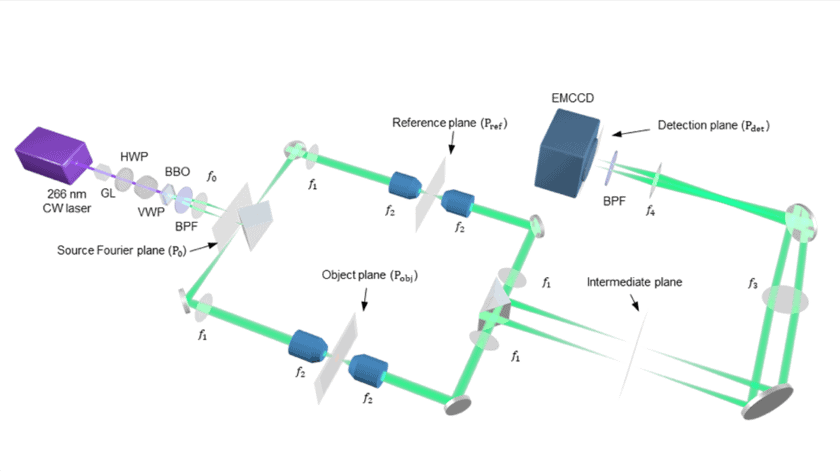
Diagram of the optical setup, showing a beam leaving a laser, passing through various optics, being split into two paths, passing through an imaging and reference plane, and then recombining onto a detector

To demonstrate this, Wang and colleagues used a crystal to split an incoming photon into an entangled biphoton pair made up of a signal photon and an idler photon. These biphotons travel along symmetric paths designed using a network of mirrors, lenses and prisms. The signal photon traverses the path containing the object being imaged, whereas the idler photon travels unobstructed. Eventually, both photons reach a detector plate, which records the information carried by the signal photon. This information is then correlated with the detection of the idler photon’s state and used to create an image.

Advantages over classical microscopy

The concept of using entangled photons to enhance imaging is not new, but it has previously been limited to imaging larger objects. The Caltech team is the first to demonstrate a viable setup that can resolve details down to the cellular scale. Using the spatial and temporal correlations between the signal and idler photon measurements (which do not exist for classical photons), Wang and colleagues also showed that the QMC method has advantages over classical microscopy in terms of noise resistance and image contrast.

A figure showing two images of a cancer cell. The image taken with a classical microscope is blurry, the image taken with the quantum microscope shows better-resolved sub-cellular structures

So far, the team has demonstrated the advantages of QMC through the bioimaging of cancer cell (see photo above). According to Wang, other applications could include non-destructive imaging of photosensitive materials such as organic molecules and memory devices. Additionally, since QMC produces a twofold improvement in the resolution of the microscope, any future advances in classical microscopy could be further enhanced by leveraging this property of quantum microscopy.

But while QMC has much promise, a major challenge when compared with state-of-art classical microscopes is speed. Current methods to create entangled photons are inefficient, resulting in a low output of biphoton pairs. Since any advantage of QMC relies on being able to generate an abundance of biphotons, developing methods that can accomplish this will be crucial. “The development of strong and/or parallel quantum sources for quantum imaging is expected to speed up data acquisition,” Wang tells Physics World. Once that happens, quantum imaging techniques will truly come to the forefront of microscopy.

Astronomers downsize proposed Arecibo observatory replacement

Astronomers at the iconic Arecibo Observatory in Puerto Rico have revised their plans for a telescope to replace the original facility, which dramatically collapsed in 2020. The so-called Next Generation Arecibo Telescope (NGAT) would, if funded, involve building a phased array of small parabolic antennas to carry out pioneering research to maintain the island’s position at the forefront of astronomy.

The Arecibo Observatory, which first opened in 1963, is located in a natural bowl and was used for research into radio astronomy, planetary and space studies as well as atmospheric science.  But on 1 December 2020 the radio telescope’s suspended platform – with its Gregorian dome focus and a plethora of instrumentation – fell after multiple suspension cables failed. The 900-tonne platform crashed into the 305 m dish, which lies almost 140 m below, destroying parts of it.

Despite the damage, the National Science Foundation (NSF), which funds the observatory, decided it would not close the site. Early this year, it extended an agreement to maintain and operate the collapsed telescope from March until the end of September “to ensure a smooth transition to the next phase”. “NSF [will] work with a small business to handle the day-to-day operations and maintenance of the Arecibo site, ensuring maximal flexibility for the use of the site into the future,” says an NSF spokesperson.

The NSF is also considering proposals to convert the facility into a Arecibo Center for STEM Education and Research. Meanwhile, the site continues to support research. As well as analysing historic data and transferring them from the site to the Texas Advanced Computing Center, scientists are still working with Arecibo’s ancillary equipment, which includes a lidar facility, optical laboratory and a 12 m radio antenna.

But in 2021 Anish Roshi, the observatory’s head of radio astronomy, unveiled a proposal to replace the telescope with a phased array of 1112 parabolic dishes, each 9 m in diameter, placed on a tiltable, plate-like structure. This new facility, with an estimated cost of $454m, would provide the same collecting area as a 300 m parabolic dish. “It would have a much wider sky coverage and would offer capabilities for radio astronomy, planetary, and space and atmospheric sciences,” Roshi says. “It would be a unique instrument for doing science that competitive projects couldn’t do.”

Downsize me

A lack of support from the NSF, however, has forced researchers to go back to the drawing board to make the array “more cost-effective both for construction and operation” as Roshi puts it. In the revised proposal, submitted to arXiv late last month, his team now envisions a downsized version of the original concept. Dubbed NGAT-130, it would consist of 102 dishes, each 13 m in diameter, that would in combination have a collecting area equivalent to a single 130 m dish.

“You can make a very competent telescope even with the reduced collecting area that could study solar coronal emissions, space weather and [hydrogen] intensity mapping, for example,” Roshi told Physics World. “We tried to do something more cost-effective, but appealing internationally.”

Roshi concedes that his team has no cost estimates for its revised design. “We need to make a robust cost model for the mechanical structure and transmitters,” he says. “Both these require modelling and prototyping.”

The NSF will not comment on the new proposal as it “does not speculate on awards that have yet to be reviewed”, according to a spokesperson. To reach that stage, Roshi says they aim to create a “structure” by August, in which engineers and scientists begin work on modelling, designing and prototyping NGAT-130.

Quantum repeater transmits entanglement over 50 kilometres

Physicists at the Universities of Innsbruck in Austria and Paris-Saclay in France have combined all the key functionalities of a long-distance quantum network into a single system for the first time. In a proof-of-principle experiment, they used this system to transfer quantum information via a so-called repeater node over a distance of 50 kilometres – far enough to indicate that the building blocks of practical, large-scale quantum networks may soon be within reach.

Quantum networks have two fundamental components: the quantum systems themselves, known as nodes, and one or more reliable connections between them. Such a network could work by connecting the quantum bits (or qubits) of  multiple quantum computers to “share the load” of complex quantum calculations. It could also be used for super-secure quantum communications.

But building a quantum network is no easy task. Such networks often work by transmitting single photons that are entangled; that is, its quantum state is closely linked to the state of another quantum particle. Unfortunately, the signal from a single photon is easily lost over long distances. Carriers of quantum information can also lose their quantum nature in a process known as decoherence. Boosting these signals is therefore essential.

Repetition without hesitation or deviation

Quantum repeaters can provide this boost, but not in a straightforward way. Because the rules of quantum mechanics restrict the copying of entangled states, repeaters cannot simply copy the signal they receive and pass it on to the next node. Instead, they must store information in a so-called quantum memory and then transfer it using a process known as a Bell state measurement (BSM).

A fully capable quantum repeater also needs to comply with certain practical requirements. Firstly, the quantum signals need to be at wavelengths used in telecommunications, so they can be transmitted through optical fibres without too much loss. Secondly, the storage time of the quantum memory should exceed the time needed to generate entanglement. Finally, each step in the process should be deterministic, meaning that signals need to be produced after each successful step.

All in one

The latest work, which is described in Physical Review Letters, combines all three practical requirements in a single experiment. In the initial sequence of events, two trapped calcium ions each emit a photon, forming two entangled photon-ion pairs. Here the trapped ions work as qubits, and their quantum states are distributed over the quantum network. The photons in these pairs are then converted to the telecoms wavelength of 1550 nm and sent to two different nodes via separate 25-km-long optical fibres. The total distance between nodes is thus 50 km.

Whenever one of the photons reaches its designated node, the state of its entangled ion gets stored in the ion’s protected memory states. The system then makes repeated attempts to send a second photon (entangled with the second ion) to the other node. Once photons are detected at both nodes, the experimenters perform a BSM to transfer the ion states to their respective entangled photons.

To test this protocol, the researchers repeated it 44 720 times over a period of 33 minutes, registering 2053 successes in 2 229 883 attempts to entangle photons between the remote nodes. That might not sound like a high success rate, but the presence of the ion memories made establishing entanglement 128 times more likely. This indicates that further improvements may be possible, up to the limit where both detectors successfully detect both photons and are restricted only by decoherence in the ions’ memory states.

Extending the network further

The researchers also modelled how far their method could be pushed. Taking into account all the different factors, they showed that a network of 17 ion-based repeater nodes could establish entanglement between ions 800 kilometres apart. According to lead researcher Ben Lanyon of the University of Innsbruck, members of the team now plan to uncoil the fibres that are currently in their labs and send entanglement off campus, into the existing commercial optical fibre network. “Our vision is to get out of the lab and start building quantum networks of matter and light between cities and countries,” he tells Physics World.

Ronald Hanson, a physicist at QuTech in the Netherlands who was not involved in the work, describes the result as important because it combines several elements required for a quantum repeater. In particular, he notes that the experiment demonstrates multi-qubit operation inside the node, efficient qubit-photon interfaces and telecom compatibility, with each element working at high fidelity to give a good overall performance – the most relevant metric. While a fully functioning quantum Internet is still some way off, Hanson believes this demonstration is a step towards functional quantum repeaters based on trapped ions.

Laser speckle imaging assesses donor hearts

An imaging technique originally developed to detect how light scatters off red blood cells has been improved by researchers in France so that it can now safely image coronary blood circulation in donor hearts during ex situ heart perfusion (ESHP), a procedure used for heart preservation and screening. The new technique, known as laser speckle orthogonal contrast imaging (LSOCI), enables noninvasive high-resolution imaging of all the peripheral blood vessels of the heart in real time, and could provide valuable information to doctors on the quality of an organ to be transplanted.

“Such dynamic speckle technology has been around for a long time,” explains team leader Elise Colin from Paris Saclay University and the start-up ITAE Medical Research, “but it is normally applied to stationary objects. We had no idea if we would be able to obtain images of blood activity at all when we applied it to an object with significant movement, like a beating heart.”

Graft failure following heart transplantation surgery can come about because of abnormalities in the donor organ, such as coronary artery disease. The risk of these abnormalities increases with age or in patients with pre-existing heart conditions. Careful screening for such conditions is thus vital to determine whether an organ is eligible for transplantation.

In recent years, ESHP has enabled assessment of the heart outside the body. Here, doctors monitor the performance of a donor heart after oxygenated nutrients have been supplied to it via its blood vessels. The problem is that conducting coronary angiography during ESHP (to screen for coronary artery disease) can damage the heart. Alternative imaging techniques to identify abnormal blood flow in donor organs are thus needed.

Analysing speckle images

The LSOCI technique used in this study analyses speckle images, which result from the many constructive and destructive interferences that occur when the surface or volume of an object is illuminated with coherent light such as that from a laser. In these images, researchers look at the speckle contrast parameter, which Colin describes as a type of “blur function”. “This is all the more important when the scatterers producing the signal are in motion, as is the case of red blood cells, for which this technique was developed,” she explains.

Colin and colleagues have now improved LSOCI to observe small blood vessels in the heart. The new method, which they detail in the Journal of Biomedical Optics, is able to analyse blood flow in the organ using a specific polarimetric filter that favours the interactions between light waves that have undergone more multiple scattering. These interactions generally occur at depth in the blood vessels, meaning that surface light scattering is suppressed. The speckle patterns produced are therefore mainly produced by multiple scattering of moving red blood cells inside the vessels.

In the case of an organ that moves periodically, like the heart, researchers need to be able to calculate the blur function without it being affected by the overall motion of the organ. To do this, Colin and colleagues developed an algorithm that allowed them to select the images that have the least movement between them, along different periods of heartbeat.

“It is important to understand that the resulting images do not contain the same information as a radiometric image, for example,” she tells Physics World. “The images produced are motion images of red blood cells, and when the heart is made to stop beating, no vessels are visible in the image.”

Valuable information for doctors

The images obtained represent the vasculature of the heart at different time points and by analysing a sequence of these images, the technique can be used to visualize vasculatures as small as 100 µm in a matter of seconds. It could thus be used to identify myocardial perfusion abnormalities indicative of underlying heart conditions, say the researchers.

“This information is valuable for doctors so that they can assess the quality of an organ to be transplanted,” says Colin. “Such information is important since it allows us to consider using grafts with less stringent age limits, for we now have a post-evaluation method to assess the health condition of these donor organs. An indirect consequence of this is that it increases the number of transplantation possibilities.”

Colin and colleagues are now in the process of filing a patent for a method of temporal calibration based on their technique, but say that they still need to validate the concept specifically for their image enhancement method. “Once this has been done, we will be able to ensure that doctors have access to an image with a quantified medical index, meaning that the values are comparable over time from one system to another,” says Colin. “We would also like to continue our research on polarization optimization. This would allow us to achieve the best contrast and move towards obtaining three-dimensional information.”

Sony announces venture into quantum computing via UK firm Quantum Motion

The Japanese electronics giant Sony has announced its first steps into quantum computing by joining other investment groups in a £42m venture in the UK quantum computing firm Quantum Motion. The move by the investment arm of Sony aims to boost the company’s expertise in silicon quantum chip development as well as to assist in a potential quantum computer roll-out onto the Japanese market.

Quantum Motion was founded in 2017 by scientists from University College London and the University of Oxford. It already raised a total of £20m via “seed investment” in 2017 and a “series A” investment in 2020. Quantum Motion uses qubits based on standard silicon chip technology and can therefore exploit the same manufacturing processes that mass-produce chips such as those found in smartphones.

A full-scale quantum computer, when built, is likely to require a million logical qubits to perform quantum-based calculations, with each logical qubit needing thousands of physical qubits to allow for robust error checking. Such demands will, however, require a huge amount of associated hardware if they are to be achieved. Quantum Motion claims that its technology could tackle this problem because it develops scalable arrays of qubits based on CMOS silicon technology to achieve high-density qubits.

The company will use money from Sony Innovation Fund as well as other investors such as Bosch Ventures, Porsche SE and Oxford Science Enterprises to build on the firm’s recent work. In 2020, for example, Quantum Motion managed to isolate a single electron and measure its quantum state for a record-breaking nine seconds, while last year it showed how it could  quickly characterize thousands of multiplexed quantum dots that had been fabricated in a chip factory.

Despite being new to quantum computing, Sony’s investment will now give it access to expertise in quantum chip design and manufacturing. It is also an entry point into the Japanese market, which is expected to become one of the biggest for quantum computing. Quantum Motion chief executive James Palles-Dimmock, who is a physicist by training, says the company is delighted to have Sony Innovation Fund as an investor as it will help the firm to scale the development of silicon-based quantum computers.

  • IBM wants to build a 100,000 qubit quantum computer by 2033. It will reach its goal by working with the University of Tokyo to develop and scale quantum algorithms and by starting to build a viable supply chain. IBM will also work with the University of Chicago to bridge quantum communication and computation via classical and quantum parallelization as well as by adding quantum networks.

Leaky-wave metasurfaces connect waveguides to free-space optics

Leaky-wave images

Researchers in the US have shown how light travelling through optical waveguides can be converted into freely propagating light waves with arbitrarily shaped wavefronts – an achievement that the team claims as a first. Nanfang Yu and colleagues at Columbia University and at the City University of New York (CUNY), achieved the feat using “leaky-wave metasurfaces”.

Although there are many different optical systems for controlling light, they tend to  fall into two types. One involves controlling the properties of light waves travelling through free space, and can include systems ranging from simple lenses, to advanced telescopes and holograms. The other type involves the use of photonic circuits, which manipulate light propagating along optical waveguides with a cross-sectional dimension of typically hundreds of nanometres. These circuits are ideal platforms for optical information processing, making them key elements of modern devices including sensors and optical communications chips.

With advances in optical technologies ranging from augmented reality, to probes for controlling and manipulating neurons, there is growing motivation to integrate these two categories of optical control systems. Yet as Yu explains, the two have so far remained largely incompatible with each other.

Interfacing challenges

“There has always been a challenge in ‘interfacing’ these two categories,” he says. “It is fundamentally hard to transform a tiny and simple waveguide mode into a broad and complex free-space optical wave, or vice versa. However, demands for ‘hybrid’ systems consisting partly of photonic integrated circuits and partly of free-space optics are becoming real.”

For Yu and colleagues, the solution lies with metasurfaces, which are thin sheets made from arrays of sub-wavelength sized structures. These metasurfaces can alter the properties of light waves passing through them. In their previous research, they showed how metasurfaces can be used to manipulate light travelling in free space.

To extend these capabilities to guided light waves, the researchers started with a photonic crystal (PhC) comprising a square array of square holes in a polymer film. This PhC allows flat sheets of light to propagate back and forth as standing waves.

Symmetry-breaking perturbation

“In the next step, we introduced a symmetry-breaking perturbation to the PhC slab by deforming square holes of the PhC into rectangular ones,” Yu explains. “The perturbation lowers the degree of symmetry of the PhC so that the photonic modes are no longer confined to the slab and can leak into free space, with a leakage rate proportional to the magnitude of the perturbation.”

The team found that by varying the perturbation across the slab – orienting its rectangular holes along different directions – they could fine-tune the shape of the wavefront of the leaking light. Using their leaky-wave metasurfaces, Yu’s team developed a new technique for converting the light propagating through a waveguide into a wave travelling in free space.

“Here, an input waveguide mode is first expanded into a slab waveguide mode, which enters a leaky-wave metasurface and produces the desired surface emission,” CUNY’s Adam Overvig explains. “In this way, the initial simple waveguide mode confined within a waveguide with a cross-section on the order of one wavelength is eventually converted into a freely propagating light wave with a complex wavefront, over an area about 300 times of the wavelength.”

The team demonstrated how their devices could produce diverse emission patterns. These included 2D arrays of focal spots, corkscrew wavefronts, holographic images, and laser beams with spatially varying polarizations. If the technology is scaled up, these could one day be applied across many different types of advanced optical systems. Applications include optical displays like holograms and augmented reality goggles; and high-capacity optical communication channels between computer chips.

In quantum optics, optical lattices are used for trapping ultracold atoms and molecules. “Compared to traditional methods where optical lattices are produced by interference of multiple beams via free-space optics, our devices could be directly integrated into the vacuum chamber to simplify the optical system, making portable quantum optics applications such as atomic clocks a possibility,” Columbia’s Heqing Huang explains.

The research is described in Nature Nanotechnology.

Copyright © 2026 by IOP Publishing Ltd and individual contributors