Barbie space scientist, physics of basketball, low-cost fluorescence microscope

To mark International Women’s Day on Wednesday, Barbie created “one-of-a-kind role model dolls” to honour seven female leaders in science, technology, engineering and medicine. They include Susan Wojcicki, chief executive of YouTube, German microbiologist Antje Boetius from the Max Planck Institute for Marine Microbiology as well as the UK space scientist and science educator Maggie Aderin-Pocock.

The Barbie doll inspired by Aderin-Pocock, which won’t be on general sale, has a starry dress reminiscent of the night sky and comes with a telescope accessory for stargazing.

Aderin-Pocock, who has just become University of Leicester’s new chancellor, says that when she heard the news of a Barbie in her honour she “danced around the living room” with her daughter.

“When I was little, Barbie didn’t look like me, so to have one created in my likeness is mind-boggling,” says Aderin-Pocock. “It’s such an honour to receive this doll that is celebrating my achievements.”

Slam dunk

This week the American Physical Society held its March meeting in Las Vegas and one intriguing talk was given by PhD student Boris Barron from Cornell University.

He described using density functional theory – originally developed to study the behaviour of large collections of electrons – to suggest the best positioning for each player on the basketball court if they want to raise their probability of either scoring or defending successfully.

Barron used data of player positions from this season’s NBA games to develop his model and was able to predict where a particular player may go next as well as determine the players that were in good or bad positions.

And finally, researchers in the US have come up with a device that can convert a smartphone or tablet into a fluorescence microscope for under $50. The authors suggest that the device – which they have named a glowscope – could be used to image cells, tissues, and organisms under low magnification and is perfect for schools, scientific outreach and even in research labs.

The authors say the glowscope can be used, for example, to image live zebrafish embryos – which are between two and three millimetres long – adding that it can measure the heart rates of the embryos and even the movements of individual heart chambers.

Hydrogel helps grow new tissue in areas of brain damage

Brain haemorrhage and brain cancer are major causes of death and disability worldwide. The brain is particularly vulnerable to ischemic damage, in which loss of blood supply leads to the loss of brain tissue volume and the formation of a cavity. And unlike other parts of the body where spontaneous wound healing processes occurs, loss of neuronal tissue is irreversible.

The development of an efficient technique for brain tissue regeneration is urgently needed to help treat these life-threatening conditions. To date, however, there is no established therapeutic strategy. One potential solution could lie in neural tissue engineering – the use of biomaterials to create a scaffold that fills the volume loss, enabling cells to migrate into the damaged area and reconstruct tissue.

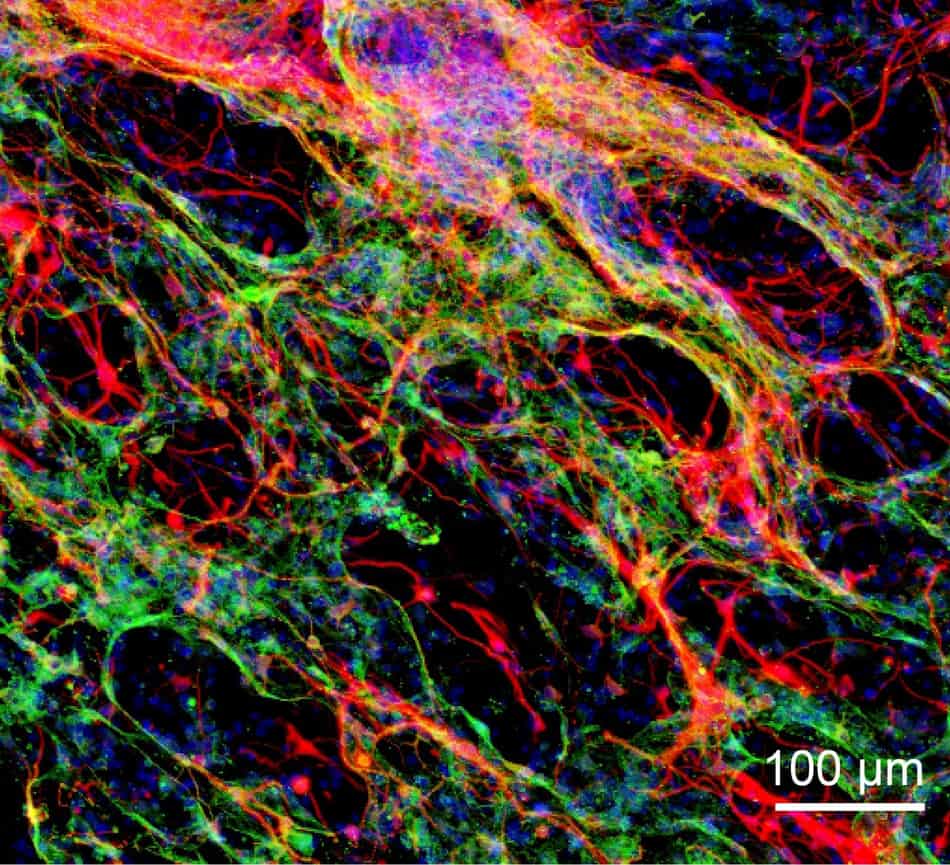
Researchers at Hokkaido University have now created synthetic hydrogels that provide an effective scaffold for neuronal tissue growth in areas of brain damage. Describing the study in Scientific Reports, the team showed that the hydrogels, used in combination with neural stem cells (NSCs), could grow new brain tissue, providing a potential approach for brain tissue regeneration.

Hydrogel optimization

To create the ideal substrate for brain tissue reconstruction, Satoshi Tanikawa and colleagues altered the electric charge of the hydrogel to determine the conditions under which NSCs can efficiently attach and grow. They found that a neutral hydrogel with a 1:1 mixture of anionic and cationic monomers (C1A1) generated the most suitable scaffold for attachment, growth and differentiation of NSCs.

The researchers used cryogelation to create pores in the C1A1 hydrogels and enable 3D culture of cells in the porous structure. They also adjusted the ratios of crosslinker molecules to achieve a similar stiffness to that of brain tissue, an important parameter as the stiffness of the cell culture substrate can impact the direction of stem cell differentiation.

After optimizing the hydrogel formulation, the researchers examined its potential for in vivo brain tissue reconstruction. They created a model of traumatic brain injury in mice by removing a 1 mm-diameter, 1 mm-deep region of brain tissue, and then implanted the porous hydrogel into the cylindrical cavity.

On day 56 after hydrogel implantation, the boundary between the brain tissue and the hydrogel was obscured, while cavities clearly remained in control brains. Fluorescence microscopy revealed that immune cells and astrocytes from surrounding brain tissue had infiltrated into the pores of the implanted hydrogel.

Neurons and glial cells

For effective brain tissue reconstruction, creation of a vascular network in the new tissue is critical. To induce vascularization, the researchers immersed the C1A1 hydrogel in vascular endothelial growth factor (VEGF) before implantation into the mice brains. In vivo imaging using two-photon microscopy revealed that this step led to the formation of blood vessels inside the hydrogel two to three weeks after implantation

After three weeks, when blood vessels had formed and host glioneuronal cells had migrated, the team injected fluorescently labelled NSCs into the implanted hydrogel in the mouse brain. Forty days later, fluorescence images demonstrated the presence of viable stem cells in the hydrogels, with a high cell survival rate. Some of the NSCs had differentiated into new glial or neuronal cells, and some of the new neuronal cells had migrated into surrounding host brain tissue.

The researchers point out that direct injection of NSCs alone or NSCs with control Matrigel did not support cell survival in the mouse brain. They also highlight the importance of the two-step process – implanting the hydrogel and NSCs at the same time proved unsuccessful. Finally, they note that they did not see any behavioural abnormalities or deaths in any of the mice implanted with the hydrogels.

“We demonstrated that C1A1 electrically charged porous hydrogels can serve as scaffolds for brain parenchymal defects, and stepwise transplantation of NSCs into the hydrogel following gel implantation may induce the reconstruction of brain tissue along with the implanted hydrogels,” the team writes. “Therefore, this two-step method for neural regeneration may become a new approach for therapeutic brain tissue reconstruction after brain damage in the future.”

“We are currently trying to prove functional recovery with our method, using a mouse model of brain damage,” senior author Shinya Tanaka tells Physics World. “This evaluation is very critical for future possible clinical applications.”

Quantum effects could help make twisted bilayer graphene a superconductor

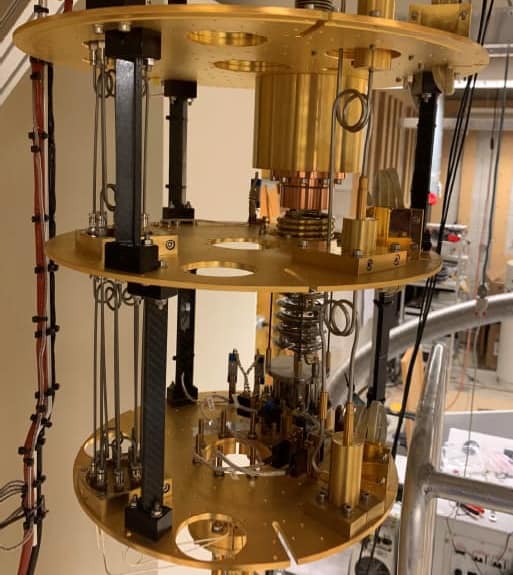
The cryostat insert used in the experiments

Quantum geometry plays a key role in allowing a material known as twisted bilayer graphene (tBLG) to become a superconductor, according to new experiments by physicists at The Ohio State University, The University of Texas at Dallas, and the National Institute for Materials Science in Japan. The finding implies that the widely employed Bardeen–Cooper–Schrieffer (BCS) equations for superconductors need to be modified for materials like tBLG that have very slow-moving charges. It may also help provide new guiding principles in the search for new superconductors that operate at higher temperatures, say the researchers.

Graphene is a two-dimensional crystal of carbon atoms arranged in a honeycomb pattern. This so-called “wonder material” boasts many exceptional properties, including high electrical conductivity as charge carriers (electrons and holes) zoom through the carbon lattice at very high speeds.

In 2018 researchers led by Pablo Jarillo-Herrero of MIT found that when two such sheets are placed on top of each other with a small angle misalignment, they form a structure known as a moiré superlattice. And when the twist angle between them reaches the (theoretically predicted) “magic angle” of 1.08°, this “twisted” bilayer configuration begins to show properties such as superconductivity below a certain critical temperature, Tc, – that is, it conducts electricity without any resistance.

At this angle, the way in which electrons move in the two coupled sheets changes because they are now forced to organize themselves at the same energy. This leads to “flat” electronic bands, in which electron states have exactly the same energy despite having different momenta. This flat band structure makes electrons dispersionless – that is, their kinetic energy becomes completely suppressed and they cannot move in the moiré lattice. The result is that the particles slow almost to a halt and become localized at specific positions along the coupled sheets.

A conduction paradox

In the new work, the researchers, led by Marc Bockrath and Jeanie Lau, showed that electrons in tBLG move with a speed as slow around 700–1200 m/s. This might seem fast in conventional terms, but is actually a factor of 1000 slower than the speed of electrons in monolayer graphene.

“This velocity constitutes an intrinsic speed for electrons in tBLG and hence also a limit to how much current the material can carry, whether it is superconducting or metallic,” explains Lau. “This slow speed gives rise to a paradox: how does tBLG conduct electricity, let alone superconduct, if the electrons move so slowly?”

“The answer is quantum geometry,” she says.

Ordinary geometry refers to how points or objects are related spatially – for example, how far apart they are and how they are connected. Quantum geometry is similar, but describes the quantum nature of electrons, which are not only particles but also waves, and thus have wavefunctions, and how these wavefunctions connect and interlink. “This contribution turns out to be critical to enable superconductivity,” Bockrath tells Physics World. “Instead of fast-moving electrons, the rich connections of electron wavefunctions are important.”

Most superconductors to date are described by the BCS theory (named after its discoverers, Bardeen, Cooper and Schrieffer). This theory explains why most metallic elements superconduct below their Tc: their fermionic electrons pair up to create bosons called Cooper pairs. These bosons form a phase-coherent condensate that can flow through the material as a supercurrent that does not experience scattering, and superconductivity is a consequence of this.

The theory falls short, however, when it comes to explaining the mechanisms behind high-temperature superconductors. Indeed, the mechanism underlying high-temperature superconductivity is regarded as one of the fundamental unsolved problems in physics.

“Our results show that the BCS equations also need to be modified for superconductors like tBLG with very slow-moving charges,” says Lau. “Our work may also provide new guiding principles in the search for new superconductors that can operate at higher temperatures than the known ones,” adds Bockrath.

The team will now continue to investigate tBLG to quantify and understand the role of quantum geometry in collaboration with theorists.

The research is detailed in Nature.

Revamping undergraduate physics degrees with a focus on translational skills

A physics degree gives graduates an enviable set of skills that can prove useful in a wide range of jobs. But could physics courses be improved to make students even more prepared for the future of work?

In this episode of the Physics World Weekly podcast, Andrew Mizumori Hirst and William Wakeham explain how graduates would benefit from a greater emphasis on the teaching of translational skills such as effective communication; team working; creativity; and the ability to find cross-disciplinary solutions to complex problems.

Mizumori Hirst is director of White Rose Industrial Physics Academy and Wakeham is chair of the South East Physics Network – both in England. They address a wide range of issues facing university educators including technology, assessment, diverse learning styles and teaching students how to tackle open-ended problems.

Wakeham and Mizumori Hirst have also teamed up with Veronica Benson – formerly of the South East Physics Network – to write an article for Physics World called “Building a physics degree for the future: five key questions we need to answer”.

Detection technologies from the Tibidabo group

Tibidabo Scientific Industries comprises five companies – Lambert Instruments, Photek, Photonic Science and Engineering, Scintacor and Precision X-ray. Together, as the company’s vice-president for North America Tom Nunn explains, they form a family of brands that develop and manufacture technologies that can detect photons from X-ray to short-wave infrared.

In this short video filmed at Photonics West 2023, you can first hear how the Tibidado group supports the photonics industry whether it’s through scientific research, medical technology , aerospace or security.

Then Scintacor managing director Jon Kemp explains how the company sees itself as a centre of excellence for scintillation and phosphor screens. Its technology allows non-ionizing radiation and non-visible photons to be detected at visible wavelengths. Kemp introduces their new IRis safety wand, which was developed to help data centres manage high-powered lasers safely.

Duncan Stacey, Photonic Science business development manager, describes its wide range of cameras for photon-starved or low-light-level applications (surveillance, astronomy, spectroscopy, industrial inspection) including cameras harnessing one of the new sCMOS sensors.

Next, you can hear from Lambert Instruments, which creates advanced imaging solutions for cell biology, combustion research, low-light levels and high-speed imaging. Jeroen Wehmeijer, general manager, introduces the firm’s new Stamina system, which records at high speeds and recombines images from many different cameras using image intensifiers.

Finally, the video looks at Photek, which makes detectors and camera systems for applications ranging from fusion research and high-energy particle physics to biosciences and space . It tailors detector systems and cameras for customer-specific applications, with Fenton Mann, technical sales manager, showcasing one of its flagship photon counting systems. The product combines a photo detector with extremely fast read-out electronics and can time stamp single-photons events.

Proton–boron fusion passes scientific milestone

Physicists in the US and Japan have observed nuclear fusion between protons and boron-11 atoms in a magnetically confined plasma for the first time. They say that the result demonstrates the potential of proton–boron fusion as a plentiful, economical source of energy. But others caution that the scientific basis for such an energy source remains largely unproven and that huge technical hurdles stand in the way of commercial power plants.

All forms of fusion hold the promise of near limitless, clean, baseload energy without the problems of possible meltdown and long-lived waste that plague fission. But proton–boron (p11B) fusion brings a couple of additional virtues compared to the more mainstream reactions involving hydrogen isotopes deuterium and tritium.

Boron can be easily mined whereas tritium is rare on Earth and difficult to produce artificially. The proton–boron reactions also produce three helium atoms (alpha particles) – whose energy could in principle be directly converted into electricity – while generating no neutrons, and thereby substantially reducing radioactive contamination of reactor components.

However, those plus points come at a price. Deuterium–tritium fusion itself requires enormous temperatures to overcome the mutual repulsion of the nuclei – around 100 million kelvin. But proton–boron reactions need far more extreme conditions still – some 1.5 billion kelvin.

As the authors of the latest research explain in a paper published in Nature Communications, the higher a plasma’s temperature the more energy is usually radiated away in the form of synchrotron and bremsstrahlung radiation. This, they point out, makes it harder to generate more energy through fusion reactions than is needed to power a reactor – a major problem when a commercial plant is likely to need an energy gain of at least 50 to overcome inefficiencies in the power-generation process.

The new work was carried out by Richard Magee and colleagues at Californian fusion company TAE Technologies together with scientists at the National Institute for Fusion Science in Toki, Japan. The researchers did their experiments on the institute’s Large Helical Device (LHD), a stellarator with the necessary fusion fuel already in place – the protons being fired in as high-energy neutral beams while boron powder is injected into the plasma to help reduce impurities.

TAE provided the detector, which relied on a partially depleted silicon semiconductor generating a current when struck by alpha particles. It was made to avoid erroneously registering signals from X-rays and other plasma radiation by being angled away from the core plasma and having the charged alpha particles steered to it by the LHD’s large magnetic field.

The researchers performed several dozen experimental shots in February last year. They observed fusion reactions by comparing the signal on their detector before and after turning on the neutral beams as well as carrying out some shots without any boron powder. Only when they had both neutral beams and boron powder did they get a jump in output – the exact value of which told them that they were producing about 1012 fusion reactions per second, which agreed with computer simulations.

Challenges ahead

This is not the first demonstration of proton–boron fusion – scientists have previously observed it using particle accelerators and powerful lasers. But the US–Japanese collaboration argues it is important to study the reaction where it would ultimately be exploited – inside a magnetically confined, thermonuclear plasma. The researchers acknowledge that much more work needs to be done, but are confident that TAE will achieve energy gain in one of its devices.

Indeed, TAE claims to be well on the way to commercial fusion energy. The company has built a series of increasingly sophisticated reactors to explore field-reversed configuration fusion, which involves firing pulses of plasma into a chamber and holding them in place magnetically by rotating them. None of the devices to date have demonstrated proton–boron fusion – its current “Norman” reactor using a hydrogen plasma – but the firm says it intends to send electricity to the grid from a pilot proton–boron power plant by the early 2030s.

Peter Norreys, a plasma physicist at the University of Oxford in the UK, says the researchers have done “a fine job” in their experiments. But he argues that proton–boron fusion is still far from rivalling deuterium–tritium reactions. One potential complication, he says, is the need for relativistic descriptions of plasma dynamics at such high temperatures. He also thinks it likely that bremsstrahlung radiation could impair plasma confinement by eroding a reactor’s inner surfaces.

Scientists at the EUROfusion consortium in Garching, Germany, are also guarded. Tony Donné, Hartmut Zohm and Volker Naulin told Physics World that the observed reaction rate in the latest experiments is about ten orders of magnitude too small to be useful for fusion energy (taking into account proton–boron’s low power density).

They have “strong doubts” that it will ever be possible to achieve the gains needed for commercial power generation, and caution that bremsstrahlung radiation could in fact be so strong that it exceeds the power needed to heat and control the plasma – causing the plasma to collapse.

Evidence for ‘near-ambient’ superconductivity found in lutetium hydride

This article reports on research described in a paper in Nature. This paper has since been retracted by the journal.

Superconductivity has been observed at 20 °C (294 K) in a nitrogen-doped lutetium hydride under a pressure of 1 GPa (10 kbar). The material was made and studied by Ranga Dias and colleagues at the University of Rochester in the US, who claim that the finding raises hopes that a material that superconducts at ambient conditions may soon be found.

Being able to carry electrical current with no electrical resistance, superconductors have a wide range of applications. But practical devices that use superconducting components, such as the magnets in magnetic resonance imaging machines, must be chilled to ultralow temperatures to ensure the material superconducts. Condensed-matter physicists have therefore long hoped to develop materials that superconduct at room temperature, which would slash the costs of operating such devices.

For many years, the materials with the highest superconducting transition temperatures were the copper-oxide-based “cuprates”, which superconduct when cooled to below around –130 °C at ambient pressure. But then in 2015 Mikhail Eremets and colleagues at the Max Planck Institute for Chemistry and the Johannes Gutenberg University Mainz, both in Germany, observed superconductivity at –70 °C in a sample of hydrogen sulphide albeit at pressures of about 150 GPa.

Four years later, Eremets’ team and a group led by Russell Hemley at George Washington University in the US reported superconductivity at temperatures up to about –20 °C at similar high pressures. Then in October 2020, Dias and colleagues claimed in the journal Nature to have discovered superconductivity at a balmy 15 °C in a hydrogen sulphide material.

Dias’s paper hit the headline and was included by Physics World in its Breakthroughs of the Year for 2020. The superconductor in question was made by adding carbon to hydrogen sulphide and then squeezing the sample to 220 GPa. Dias’s team found a maximum superconducting temperature of 15 °C occurring at about 260 GPa.

Concerns were raised over the finding, however, and the paper was subsequently retracted in September 2022 by editors at Nature. However, Dias and colleagues maintain that they stand by their results. Indeed, Dias says that the 2020 paper has since been resubmitted to Nature with new data that, he and his team claim, validate the earlier work.

High hopes

Now, Dias and colleagues are back with a new material and one that superconducts at room temperature under less pressure than previous efforts. Dias’s team created it from a gaseous mixture of 99% hydrogen and 1% nitrogen that was place in a reaction chamber with a pure sample of lutetium. The components were left to react for a couple of days at about 200 °C.

The resulting lutetium-nitrogen-hydrogen compound was initially a blue colour. But the sample then turned pink as it was squeezed under pressure, with its change of colour coinciding with the onset of superconductivity at a temperature of –102 °C and pressure of 0.5 GPa.

The scientific community expects that this time the synthesis will be described in great detail

Mikhail Eremets

But when the team compressed the sample to still higher pressures, the team observed a maximum superconducting transition temperature of 20 °C at a pressure of 1 GPa. The material therefore has the highest temperature ever recorded at such low pressures.

Eventually, when the material was compressed beyond 1 GPa, the sample became non-superconducting again and its colour changed again as it turned into a metal. “It was a very bright red,” says Dias. “I was shocked to see colours of this intensity.”

Given the controversial nature of their previous work, the researchers made various measurements to show that the phase was indeed superconducting. In particular, they recorded the electrical resistance showing it dropped to zero at the transition temperature.

The researchers also measured the magnetic susceptibility, observing that the material expelled magnetic field lines, which is another characteristic of a superconductor. Finally, they measured the specific heat, which also showed a characteristic response at the transition temperature.

The team says, however, that further work will be needed to determine the exact stoichiometry of hydrogen and nitrogen in the sample and their atomic positions. While the authors carried out X-ray scattering to determine the crystallographic structure of the sample, they could not determine the precise location of the hydrogen and nitrogen atoms, which could be resolved via neutron scattering in future studies.

Eremets, who was not involved in the new work, told Physics World that the superconductivity seems to be “proven comprehensively” by electrical transport, magnetic susceptibility, heat capacity and other measurements. But he admits that it will be “of paramount importance” to reproduce and confirm the current claim with additional tests.

“The data of the [2020] retracted paper also looked good but the claimed [room-temperature superconductivity] has not been reproduced in careful experimental and theoretical studies,” he says.

Eremets adds that it is important that the authors “provide all necessary information and support for a smooth reproduction” of the sample and the results. “The scientific community expects that this time the synthesis will be described in great detail,” he says. “If it were not possible for other researchers to reproduce the synthesis, it would be important that authors distribute samples for validation.”

The research is described in Nature.

Avantes launches its new Pacto spectrometer

In this video filmed at the Photonics West 2023 meeting in San Francisco in January, Damon Lenski, US general manager from Avantes, talks about the company’s new Pacto spectrometer – a compact device that’s designed to be embedded in other systems.

The Pacto is perfect for the life sciences and biomedical industries thanks to its ultra-low stray light levels. But it’s also ideal for use in precision agriculture – for example, to analyse grains or to sort fruits – and in the  semiconductor industry, where it can help take high-resolution measurements of plasma.

Lenski goes on to describe how it has been made using Aventes’ new “AvaMation” manufacturing approach, which ensures very high unit-to-unit reproducibility. This process will be extended to other product lines during 2023.


3D cancer model reveals how a static magnetic field can enhance radiotherapy

3D model of pancreatic cancer

Pancreatic cancer is a notoriously lethal disease, with a five-year survival rate of about 9%. As surgery is only appropriate for 8–20% of patients, chemotherapy is the most common treatment, with radiation therapy still sparsely used and mainly as an adjuvant option.

Clinical trials examining radiation treatments of pancreatic cancer have produced conflicting results, promoting a debate on the best guidelines to apply and potential benefits. Pancreatic cancer is notoriously resistant to chemotherapy and radiotherapy due to an extremely complex tumour microenvironment (TME, the tissues surrounding a cancerous lesion) characterized by the presence of diverse cell populations and strong hypoxia gradients.

Newer advanced radiotherapy modalities, such as MR-guided radiotherapy which employs MRI to guide the delivery of the radiation dose, can provide some benefit by supplying accurate information about the TME. This could then be used to optimize the treatment. To date, however, there is limited knowledge regarding the interaction between radiation and the static magnetic field from an MR-guided radiotherapy system, and how this may impact the response of cancer cells.

To study complex TMEs like those associated with pancreatic cancer, a UK-based research team has developed a 3D polymeric highly macro-porous scaffold model. The researchers, from the University of Surrey, University College London and the National Physical Laboratory (NPL), created the multicellular non-animal model to evaluate the impact of a static magnetic field on the response of pancreatic cancer cells to MR-guided radiotherapy.

Pancreatic ductal adenocarcinoma has a complex and highly immunosuppressive TME containing many different cell types, including pancreatic stellate cells that, once activated by cancer cells, create dense desmoplasia (excessive connective tissue). This desmoplasia, along with chaotic cancer cell growth, causes the collapse of blood vessels and the formation of aberrant, disorganized vessel networks, hindering chemotherapy delivery and creating large hypoxic expanses that impair radiotherapy efficiency.

The 3D model, described in the British Journal of Radiology, incorporates pancreatic cancer cells, human microvascular endothelial cells and pancreatic stellate cells. It consists of an outer collagen-coated compartment for growth of stellate and endothelial cells, and an inner fibronectin-coated compartment for growth of the cancer cells. This architecture supports growth and proliferation of different TME cells, enabling cells to migrate from one compartment to another during an extended observational period of 37 days. Importantly, the model is able to replicate the hypoxic regions of the TME.

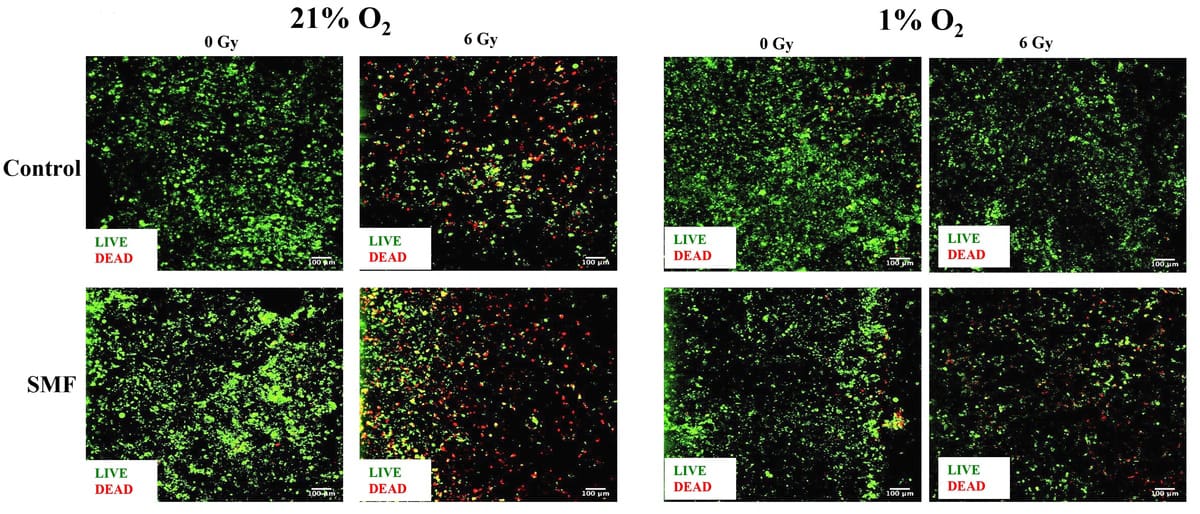
Principal investigator Giuseppe Schettino and colleagues used their 3D scaffold model to investigate the response of pancreatic cancer cells to radiation in combination with a static magnetic field. They irradiated samples exposed to hypoxia (1% O2) or normoxia (21% O2) with 6 MV photons in the presence or absence of a 1.5 T field, using dedicated equipment at NPL. They then monitored cell viability and cell apoptosis one and seven days after irradiation.

The results revealed a systematic trend of hypoxia-associated radioprotection in pancreatic cancer cells in the 3D scaffolds, with increased tumour cell viability and decreased cell apoptosis seen in both short-term and long-term analyses. Specifically, irradiation of scaffolds in normoxia led to a significant decrease in live cells, while those treated with radiation in hypoxia showed no significant decrease. The team notes that this is in line with previous findings of radioprotection under in vitro hypoxia.

Cancer cell viability after radiation treatment

The researchers report that, in both hypoxia and normoxia, they observed a small enhancement of the effect of radiation in the presence of the static magnetic field. Exposure to the magnetic field alone did not induce any toxicity. They now plan to investigate the mechanisms responsible for such radiation enhancement in future studies.

“It is important to have good models on which to test new therapeutic approaches for difficult-to-treat cancers, such as image-guided radiotherapy, which employs strong magnetic fields,” says Schettino. “Before clinically adopting new approaches, they need to be well evaluated and understood at the pre-clinical level, which usually requires use of animal models that don’t always well represent humans. Our non-animal model can assess the potential impact of the magnetic field on the radiation response.”

“Our work is aimed at improving cancer radiotherapy through a more biologically optimized approach,” he tells Physics World. “We need to analyse how interaction between the magnetic field, the radiation beam, and cellular and molecular processes could alter the response of both normal and cancerous tissues, and therefore the efficacy of the radiotherapy. Estimating such an effect, or lack of effect, is helpful in designing and planning new clinical trials.”

Schettino advises that the NPL is interested in using the multicellular scaffold model with proton beams and potentially also FLASH beams.

Deconstructing structures: making engineering and innovation come to life

String, nail, magnet, pump: the contents of Nuts and Bolts: Seven Small Inventions That Changed the World (in a Big Way) reads more like a list for a visit to a hardware shop than a book about engineering. But understanding and appreciating the remarkably simple objects that enable modern life might help us to engineer new solutions to tackle some of the world’s biggest challenges. From telegrams to washing machines, from the COVID-19 vaccine to the International Space Station, complicated contraptions rely on these seemingly modest components. At least, that’s what engineer, physicist and author Roma Agrawal says in her latest book.

Nuts and Bolts begins with Agrawal coaxing a steel rod out of a 1000 °C furnace, sees her dismantling ornate watches with the UK’s first doctor of horology (the study of mechanical time-keeping devices) and chatting to British cardiologist, writer and comedian Rohin Francis, who has an extremely popular YouTube channel called Medlife Crisis. But this book is about much more than simply engineering. It’s about the thrill of discovery, the passion of craftspeople and the effort involved in translating an idea into reality.

Agrawal couples precise science with exceptional storytelling, and while she diligently documents the intricacies of bicycles, cameras and heart pumps, her real enthusiasm lies in much bigger structures

Whether it’s LEDs or lasers or the Large Hadron Collider at CERN, there’s a lot of physics in this book, too. Having first studied physics at the University of Oxford, Agrawal later trained in structural engineering and has worked for some of the UK’s largest engineering firms. Her curiosity, talent and personal experiences are woven between careful drawings and technical descriptions.

Agrawal couples precise science with exceptional storytelling, and while she diligently documents the intricacies of bicycles, cameras and heart pumps, her real enthusiasm lies in much bigger structures. Perhaps unsurprisingly, she’s particularly excited by those that she played a hand in constructing. For instance, the cables of the Northumbria University Bridge and the complex configuration of bolts required to endure the fierce winds battering the spire of the Shard. Here her text is effortless and her expertise impeccable, as Agrawal herself is the main character.

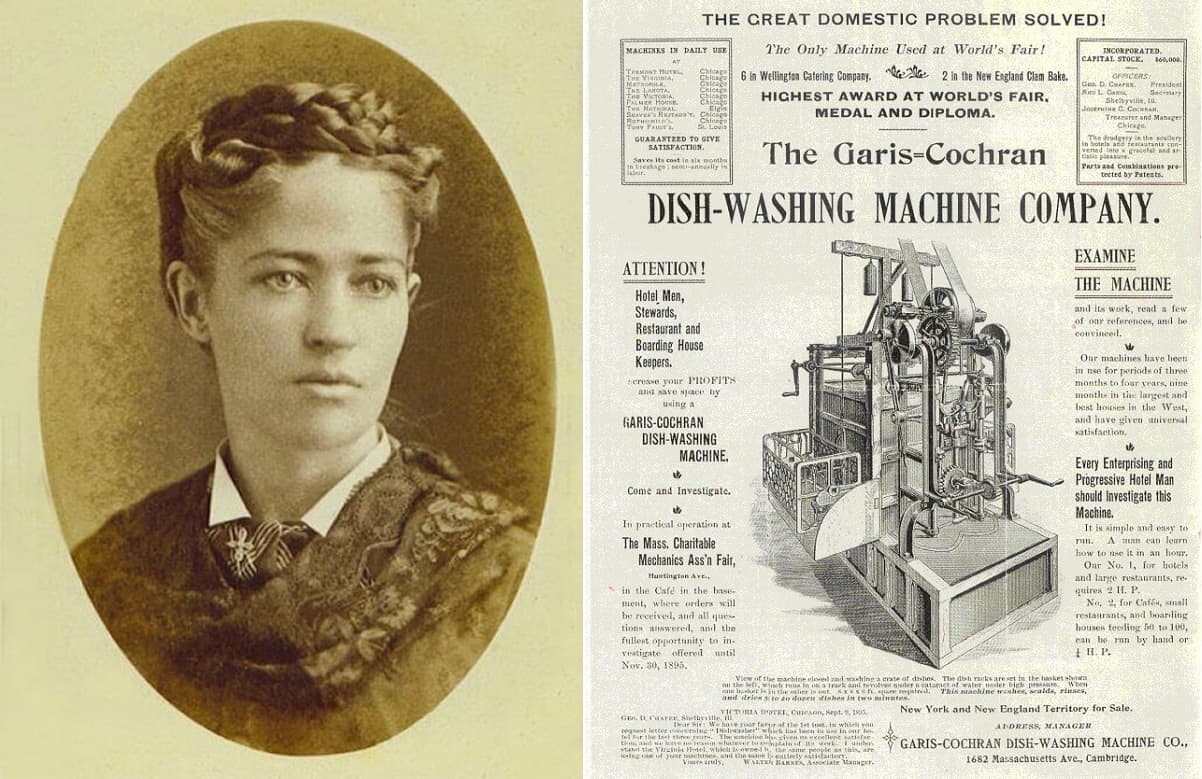
Elsewhere in the book, we learn about Josephine Cochrane, an American socialite and inventor from the late-1800s who enjoyed hosting fancy dinner parties in her Chicago mansion. Like Agrawal, engineering was in Cochrane’s blood: her grandfather invented the first steamboat and her father constructed mills. But Cochrane was born at a time when women were afforded little opportunity. Frustrated that her crockery was becoming chipped as it was being washed, Cochrane believed engineering could come up with a practical and efficient solution. With no formal training and little assistance – Cochrane mainly rejected the contributions of the professional (male) engineers for being subpar – in a shed in her back garden, Cochrane invented the world’s first working dishwasher.

Sepia photo of a woman in her 20s, and an old newspaper advert for a dishwasher company

She filed her first patent in 1885, was recognized with the highest award at the World’s Columbian Exposition in Chicago in 1893 and went on to set up a business that was bought by KitchenAid and became the Whirlpool Corporation. Apart from Cochrane, Agrawal also introduces readers to others of a similar ilk, including Emily Warren Roebling, who oversaw the construction of the Brooklyn Bridge; Stephanie Kwolek, who discovered the wonder material Kevlar; and Chandra Bose, who contributed to the invention of radio and made serious contributions to our understanding of the biophysics of plants.

Perhaps what I wasn’t expecting was for the book to be so deeply personal, including the story of how engineering is central to Agrawal’s past and critical to her present. India, where Agrawal grew up, has the largest number of engineering institutions in the world. A wheel, which Agrawal uses to explore transport and machinery, is the centre of the Indian flag. “Taar” (meaning “wire” in Hindi), the popular Indian telegraph service that relied on magnets and cables, connected three generations of Agrawal’s family. Stringed instruments, including the tanpura that provided the musical accompaniment to Agrawal’s Indian dance lessons, would go on to inspire C V Raman to describe the scattering of light by atoms that would win him India’s first Nobel prize in science.

Before exploring the “superpowers” that lenses give humans, Agrawal shares a letter to her daughter, Zarya, who was conceived by in vitro fertilization (IVF) – a procedure that involves the use of a microscope to identify and combine cells that could become a baby. It would take another feat of engineering – a breast pump – to give Agrawal the time and strength to write this book. For Agrawal, engineering isn’t just roads and bridges: it enables life itself.

So, while at first glance Nuts and Bolts could be any other book about engineering – there’s a spring, a bike wheel and a bicycle pump on the cover – it is much more than that. With refreshing simplicity, Agrawal delivers a masterclass in providing technical content alongside historical context, uncovering hidden figures, and making innovation come to life. Her honesty, bravery and passion are evident on every page. Agrawal is not your typical structural engineer. She has the power to make seemingly inanimate objects ones of wonder and the ability to make engineering a deeply human story.

  • 2023 Hodder & Stoughton 320pp £22 hb
Copyright © 2026 by IOP Publishing Ltd and individual contributors