Photon-counting detectors lower contrast-related risks in CT angiography

Photon-counting detector CT (PCD CT) is heralded as a major technological advance in CT imaging. Photon-counting systems measure each individual X-ray photon, providing increased image resolution and a reduction in radiation dose. Researchers from the University of Zurich have now demonstrated that the technique can reduce the amount of iodinated contrast media required for CT angiography (CTA) by 25%, while producing comparable image quality to conventional CTA.

CTA is the standard imaging exam used to assess cardiovascular disease and for follow-up after surgical interventions. The ability to use less contrast reduces the risk of contrast-induced acute kidney injury in patients with kidney disease, diabetes or arterial hypertension. As well as making CTA exams safer for patients, reducing the use of iodinated contrast also benefits the environment, as iodine breakdown products have harmful environmental effects.

The introduction of PCD CT has energized CT research, with numerous studies examining how the technology may change the use of CT and improve its diagnostic capability. In September 2021, the Siemens NAEOTOM Alpha became the first commercial photon-counting CT system to achieve 510(k) clearance from the US Food and Drug Administration (FDA). The FDA stated that this represented “the first major new technology for computed tomography imaging in nearly a decade”.

Making CTA safer

In their prospective study, described in Radiology: Cardiothoracic Imaging, the University of Zurich researchers aimed to develop and evaluate a low-volume contrast media protocol for thoraco-abdominal CTA using PCD CT. The study included 100 patients who underwent CTA with PCD CT of the aorta in the chest and abdomen, and had previously undergone a CTA exam with conventional energy-integrating detector (EID) CT at equal radiation dose.

The EID CTA exams used 70 ml of iodinated contrast media: delivered as a 40 ml bolus of contrast, followed by 60 ml of a 1:1 mixture of contrast and saline, and then a saline flush. This protocol was also used for PCD CT angiography scans of 40 patients (group 1). The researchers then imaged 60 patients (group 2) with PCD CT using a low-volume contrast media protocol: a bolus of 30 ml contrast, followed by 45 ml of 1:1 mixture of contrast and saline, and a saline flush. This equates to a total contrast volume of 52.5 ml – a 25% reduction compared with the first group.

Principal investigator Kai Higashigaito and colleagues report that for group 1 patients, PCD CT improved the overall image quality. “PCD CTA of the aorta demonstrated higher objective and subjective image quality compared with third-generation EID CT at equal contrast media volume and matched radiation dose,” they write.

To determine the optimal energy of virtual monoenergetic imaging (VMI) for PCD CT-based CTA, the researchers assessed the images from group 1 for objective qualities such as contrast-to-noise ratio (CNR) and subjective qualities such as image noise. They observed the highest objective image quality at 40 keV and the highest subjective image quality at 60 keV. Thus they selected 50 keV as the ideal energy of VMI for CTA of the aorta in the group 2. In these patients, who received 25% less contrast, PCT CT produced noninferior images to EID CT.

PCD pioneers

Co-author Hatem Alkadhi tells Physics World that University Hospital Zurich was the first clinical site in the world to install a PCD CT system for clinical use, in April 2021. The scanner is now routinely used for all cardiovascular CT examinations, including CTA, of all body regions.

“We are currently conducting various research studies with PCD CT, mainly in the field of cardiovascular imaging,” he explains. “As an example, we are currently developing a low-volume contrast media protocol for coronary CT angiography. Our initial results indicate that we can reduce the amount of administered contrast media by 40% as compared to our current standard, while still obtaining diagnostic image quality.”

Alkadhi says that the team is also studying the ultrahigh-resolution mode of PCD CT, which enables image reconstruction with very high spatial resolution. This technique improves coronary artery and coronary plaque imaging, he says, but also improves coronary stent imaging, with a better visualization of the in-stent lumen.

In addition, the researchers are investigating the spectral capabilities of their dual-source NAEOTOM Alpha scanner, which enables dual-energy-based calcium–iodine separation in the arteries. They are using an algorithm called PureLumen to subtract contributions from calcified plaques from the vessel wall image. “Thus, a major shortcoming of coronary CTA – the overestimation of coronary stenoses because of blooming artefacts from dense vessel wall calcifications – can be overcome with this very exciting technique,” Alkadhi explains.

If science is to thrive, we must understand its human foundations

Illustration of a large group of people

In October 2022 the president of Stony Brook University, Maurie McInnis, began her “State of the university” address with a tribute to Brookhaven National Laboratory. Stony Brook, she reminded her audience, helps to manage the “bustling” lab, which is located near Stony Brook on Long Island. It provides “eureka moments” for students, she said, helping them define and realize their goals. The lab helps students make a difference, both to themselves and to the world.

These were stirring words. Still, I couldn’t help being reminded of the havoc that occurred at Brookhaven 25 years ago after it was announced that there had been a non-hazardous leak from the spent fuel of the lab’s research reactor. It’s a dramatic and almost unbelievable story that I cover in a new book written with former Brookhaven interim director Peter Bond entitled The Leak: Politics, Activism, and Loss of Trust at Brookhaven National Laboratory.

Federal, state and local health environmental experts found the leak harmless. But its impact was spun way out of proportion by politicians and activists. Their loud voices, which were amplified by media commentators, unqualified “experts” and celebrities such as Alec Baldwin and Christie Brinkley, convinced many nearby residents that they were in imminent danger of meltdowns, cancer and other deadly diseases.

These concerns led not only to the reactor being closed down in 1999 but also to calls for the entire Brookhaven lab to be shut. That didn’t happen, but the incident did lead to the firing of Associated Universities, Inc. (AUI) – the group of nine universities that had managed Brookhaven since it was founded in 1947. In fact, Stony Brook’s partnership with the lab was a direct result of that firing, as it was chosen to replace AUI.

So why didn’t all the lab’s nearby residents simply accept the word of the experts – of the federal, state and local authorities who, after numerous extensive and thorough studies, concluded that the leak at Brookhaven was non-hazardous? The reason is visible in the unfolding drama portrayed in The Leak. Simply put, experts don’t come with a stamp of approval; they become that way only after they’ve spoken to people who hear them as experts.

All about the acoustics

Expertise is often pictured in what one might label the “call-and-response” model. In it, somebody needs information and so seeks out and asks the appropriate authority. That authority delivers the information, and the information-seeker acts accordingly. The call-and-response model assumes that the person knows the voice is from an expert, who is responding appropriately to the person’s questions.

The model works well in certain circumstances, such as when you have to fix your plumbing, mend your car or seek medical advice. But it doesn’t apply in larger social contexts, such as the potential threat of a nuclear reactor in a government laboratory. If it had held true, people living near the lab would have listened to how the government experts evaluated the hazard, and accepted their judgement.

The fact that many people in the community ignored the expert voices means (according to the model) that they were responding irrationally. Those people were exposed to an entire spectrum of individuals claiming expertise and shouting different advice. Some of those individuals seemed to be responding to the concerns voiced by the neighbours, while others gave advice that sounded patronizing, irrelevant and too technical.

This situation is better modelled by an “acoustical” picture of expertise. I see this as involving a “soundscape” in which the audibility of a voice depends on where both speaker and hearer are positioned. The soundscape at Brookhaven in 1997 – and in many other public controversies – was cacophonous. But if we want effective action, we need to map that soundscape by identifying which voices are loud or soft, which are clear or staticky, and where and to whom they are speaking.

The critical point

In his book The Great Instauration, published in 1620, the philosopher and statesman Francis Bacon warned that science was in danger of becoming a “magnificent structure without any foundation”. Humans, he said, were apt to ignore, squander and undermine the considerable beneficial powers of science unless they were able to appreciate how it operated in a way they could understand and value.

Bacon was writing before modern science, and had to try to link its promise and potential benefits with the lives of those who needed to support it. These days we live in a world dominated by science and technology but we still need to speak in an acoustical landscape to outline the links between scientific facilities and the lives of those who provide the funding and foundations.

In 1998 the US Department of Energy hosted a “Lessons learned” conference near its headquarters in Washington DC, attended by representatives from the agency and many US national labs. One delegate was Judy Jackson, the then-head of public affairs at Fermilab near Chicago. When she took the podium, her first slide simply read: “Brookhaven’s experience: ‘There but for the grace of God…’” The damage to valuable and irreplaceable scientific facilities that took place at Brookhaven could, in her view, happen anywhere.

But can we afford to let advanced, multibillion-dollar scientific facilities rely on Divine grace for their survival? The health and welfare of these facilities – their ability to define and fulfil the goals for which they were built – requires a deeper understanding of human nature, not as a tack-on but as a foundation. Why, in other words, do humans find it meaningful not just to build scientific facilities but to close them down too?

It’s a question that is critical to any science-dominated university, including Stony Brook. But when educational goals become focused on technical training and scientific advance – and we ignore the study of the world in which humans live – we are in danger of undermining the very foundations on which the magnificent structures of science are built.

‘Volatile’ elements in inner solar system have several different origins

Rocky planets

Planetary scientists in France have reviewed and analysed recent research on the origins of “volatile” elements in the inner solar system and concluded that these elements have several different origins. They point out that the mechanisms involved in delivering volatiles to rocky planets such as Earth probably play a crucial role in a planet’s habitability. As a result, a better understanding of the origins of volatiles in the inner solar system could inform our search for life on other planets.

Today, the Earth has an abundance of the volatile elements hydrogen, nitrogen, carbon and oxygen, which are all crucial for life as we know it. Planetary scientists, however, do not understand why these elements are so common on Earth and other rocky planets. Scientists believe that the solar system was formed by a protosolar nebula (PSN) of gas and some dust. The PSN then condensed to form the Sun, planets, asteroids, and comets. The problem is that the elemental and isotopic makeup of the volatiles in the inner solar system does not match that predicted for the PSN. This suggests that these elements did not come directly from the PSN but were instead delivered by more complicated processes.

Three delivery processes

In their recent research, Michael Broadley and colleagues at the University of Lorraine looked that three separate processes that could have been involved in delivering volatiles to the inner solar system. First, they look at how volatiles are incorporated within solids that formed early in the PSN. Then, they looked at how these volatile-bearing solids were distributed within the PSN. Finally, the team considered how these solids would accrete to form the rocky planets.

An important part of their work is an analysis of volatile distributions is the role of “chondrites,” solid bodies that contain a large proportion of the solar system’s volatile elements. Chondrites can be made of the mineral enstatite, can be more carbonaceous in composition, be “ordinary” stony bodies, or are comet-like with a mostly icy makeup. Comets contain more water and carbon than any of the other three types of chondrites, so from this we can conclude that volatiles are not evenly distributed throughout the solar system.

In their review, Broadley and colleagues establish that volatiles are present in chondrites and comets, contained within the microscale structures of carbon-based organic compounds and water-containing hydrated silicates. The authors confirm the presence of volatiles in these celestial bodies through analysis of the isotopic signatures in their resident organic and silicate compounds. Given that certain isotopes can be found in the primitive extraterrestrial materials of some space objects and not others, it is possible to determine which objects contain the same volatiles that were formed by the PSN. This radioactive signature of volatiles is unequivocally distinct from the composition of the PSN, which is known to have formed the terrestrial planets. This means that volatiles come from a different cosmochemical reservoir than other elements in the solar system.

Ultimately, there are many unknowns in planetary science, including the origin of volatiles throughout the solar system. Broadley and colleagues’ work codifies our understanding of the distribution of volatiles in chondrites, comets, and terrestrial planets, by using diagnostic criteria to evaluate the properties of so-called “primitive matter.”

The research is described in Nature.

Alice and Bob make cat qubits, 3D printed basketball never deflates

Quantum technology is hot right now and every week it seems that we get a press release about a new university spin-out company. Not surprisingly, the names of many of those companies contain the letter Q – and often have a dearth of vowels, as is the current fashion.

So, I was pleased to discover that there is a quantum company called Alice & Bob. The eponymous pair are the protagonists often used in descriptions of quantum key distribution (QKD). This is a way of using photons to exchange a cryptography key such that the laws of quantum mechanics prevent an eavesdropper (called Eve) from intercepting it.

Based in Paris, Alice & Bob doesn’t seem to be in the QKD business, but rather makes superconducting “cat” quantum bits (qubits). Cat is an allusion to Erwin Schrödinger’s famous thought experiment that illustrates the bizarre concept of quantum superposition.

It’s not clear to me what cat qubits are. Perhaps they support Schrödinger’s cat states, which are superpositions of two diametrically opposed states. An example would be an ensemble of atoms in which all the atomic spins point up, or all the spins point down. Apparently, these cat qubits do a good job at quantum error correction, which allows quantum calculations to be done using less than perfect qubits.

Perhaps Eve will launch a rival company.

From the sublime to something much more practical. The sports-equipment manufacturer Wilson has unveiled a prototype basketball that never needs to be pumped up. Made using a 3D printer, the ball looks a bit like a spherical sieve comprising a rigid frame with lots of holes in it.

The company says the ball nearly matches the “performance specifications of a regulation basketball, including its weight, size and rebound (bounce)”. It was debuted last weekend at a National Basketball Association (NBA) event, but apparently the league has no plans to use it in league play.

The ball was manufactured in collaboration with a company called EOS and you can read more about it and watch a video on Gizmodo.

Finding solace in the stars

A new film Space, Hope and Charity tells the story of Charity Woodrum, an astrophysicist whose childhood dream of working for NASA was nearly derailed by a personal tragedy. Woodrum is now studying for a doctorate in galaxy quenching at the University of Arizona using data from the James Webb Space Telescope. She joins this episode of the Physics World Stories podcast to speak about finding purpose in academic research, and her gratitude to the colleagues who helped her through the darkest moments.

Podcast host Andrew Glester is also joined by the film’s director Sandy Cummings, a broadcast journalist with more than 20 years of experience working for NBC News. Cummings says she is drawn to stories of people facing huge challenges, and the quest for hope and purpose.

Space, Hope and Charity aired at this year’s American Astronomical Society annual meeting in Seattle, US. Its official premiere is at the Phoenix Film Festival with three screenings and Q&A sessions over three days, 31 March – 2 April 2023. See the trailer on YouTube.

Graphic novel tells a tale of catastrophe and complexity

During the first year or two of the COVID-19 pandemic, many of us spent time doing jigsaws. Some of the puzzles will have been easy, some more challenging. But they all had two things in common. First, we knew what the final picture should look like (it was right there on the box cover). And second, the only way to finish the puzzle was to try a given piece and check where it might fit.

There is no formula for solving a jigsaw puzzle. We can start by separating out edge pieces or those of a similar colour. But ultimately, trial and error is the only viable way to complete it. In the jargon of computer science, any program for solving a jigsaw puzzle is what’s known as “NP” – we can check if a particular trial is the right solution, but we have no direct way to get there without guesswork.

But there are many situations where there is a formula for solving a problem. If, say, you want to find the largest value in a list of random numbers, you can write a simple computer program to look at each pair of numbers and keep the larger of the two values until you’ve checked them all. These are what are known as “P” problems.

They are quicker to solve than NP problems that have the same number of items (be it numbers on a list or pieces of a jigsaw puzzle). But no-one has yet proved that NP problems can never be solved using P algorithms. What’s known as P ≠ NP is one of the biggest unsolved problems in computer science and plays a central role in The Phantom Scientist – a new graphic novel by French computer scientist Robin Cousin.

Translated into English by Edward Gauvin, Cousin’s novel is an engaging mix of mystery, science fiction and complexity theory, told through artwork that is simple, uncluttered and easy to follow. It takes place at the fictitious Institute for the Study of Complex and Dynamic Systems, inspired by Cousin’s experience of a real-life lab belonging to the French National Centre for Scientific Research (CNRS) in Paris.

Every seven years the institute’s hit by some kind of dramatic and fatal catastrophe, which requires all researchers to leave and a new director to be appointed

The institute in the book is not short of space, resources or funding, having only 24 scientists (and some support staff) spread out over seven buildings in a wooded campus. As the director of the institute explains to Stephane Dousay, the 24th scientist to join: “You are free to conduct your research as you see fit. We ask only that you file regular reports.” (I did say it was a science-fiction story.)

What’s also unusual about the institute is that every seven years it’s hit by some kind of dramatic and fatal catastrophe, which requires all researchers to leave and a new director to be appointed. It is, if you like, a living experiment in nonlinear dynamics, described by one protagonist as being “engineered to create…an instability conductive to major scientific discoveries”. Or, as one outgoing director says in a video message to his successor: “Like all dynamic systems, the institute tends toward entropy and chaotic behaviour.”

The story actually begins six years into the fourth incarnation of the centre with the arrival of Stephane, a physicist who studies pattern formations in budding plants. The other scientists in Stephane’s building are Louise (a linguist), Vilhem (who is working on a computer program that will predict upcoming events in his life), and an occupant whom no-one has ever seen and about whom little is known.

The languid, almost cinematic pace of the story pulls the reader in, creating a sense of space and time

Eventually, we learn that this mysterious researcher, the phantom scientist of the title, is reputed to have made a major advance in the study of complexity of computer algorithms. Weird things start to happen at the institute. Louise discovers notes left in the eponymous researcher’s lab that suggest he’s (spoiler, it is a he) developed an algorithm that enables previously intractable problems to be quickly solved. And then the bodies start to pile up.

I’ll say no more about the story to avoid giving the game away. However, I will note that the forest location for the campus is important as it lets Cousin show his characters doing mundane things like walking – silently and alone – from one facility to another. Or they’re shown fixing dinner in their apartments or programming their computers in the lab.

The languid, almost cinematic pace of the story pulls the reader in, creating a sense of space and time that contrasts with the change in tempo as events accelerate towards the end. It also provides Cousin with an opportunity to plant clues and hidden references in the story, many of which I missed on first reading.

In fact, this is a novel that rewards rereading. It touches on everything from origami and kirigami to the Fibonacci sequence and the “sofa problem” (what’s the largest area of a sofa that can be manoeuvred through a one-metre wide L-shaped hallway?). There’s also a deeper point, which is that even if computer algorithms replace trial and error, we will still always need human ingenuity. As Stephane says regarding the sofa problem: “No-one’s ever solved it, but I’ll bet a mover could eyeball it in an instant.”

  • 2023 MIT Press 128pp $24.95hb

New theory links supermassive black holes and dark energy

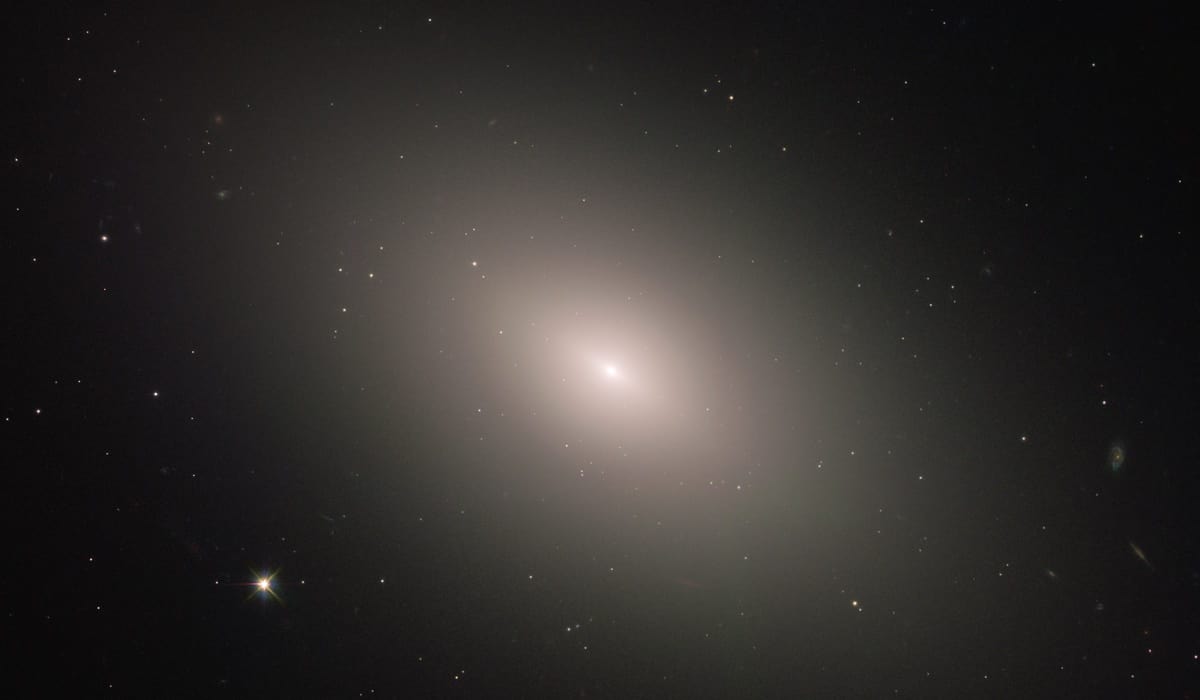
The galaxy Messier 59

A controversial new theory suggests that supermassive black holes that lurk at the heart of most large galaxies could be the source of dark energy, the mysterious force driving the accelerating expansion of the universe.

The suggested link – referred to as a “cosmological coupling” – was born from observations of black holes at the heart of distant galaxies that seem to have grown more rapidly than simply accreting mass or merging with other black holes would allow.

Investigating this further, the team, including lead author Duncan Farrah from the University of Hawai‘i at Mānoa, discovered that the strength of the coupling means the growth of the black holes matched the accelerating expansion of the universe.

“There is no agreement on which model for dark energy is most likely to be correct, but the simplest model for dark energy is a ‘cosmological constant’. In this model, the whole universe is pervaded by uniform and constant energy density,” Farrah tells Physics World. “This doesn’t sound so mysterious, but the energy density must stay constant even as the universe expands. There’s no object known that behaves in the required way. Because of this, it is thought by some to be a property of the vacuum itself.”

Most models of black holes suggest that at their heart is a singularity, a point at which mass is squeezed into an infinitesimally small point and thus becomes infinitely dense. The new cosmological coupling replaces this singularity with vacuum energy, proposed as the source of dark energy.

The researchers detail the theory in two papers, published in The Astrophysical Journal and The Astrophysical Journal Letters, with both laying out different aspects of the cosmological connection and providing the first “astrophysical explanation of dark energy”.

Evidence for an astrophysical dark-energy model

In the first paper, the team looked at black holes in the centres of “red and dead” elliptical galaxies that are currently inactive.

“Because these galaxies are not expected to do much, their central black holes are not expected to grow much with time,” Farrah explains. “We found that, after accounting for all possible ‘normal’ channels of black-hole growth, these black holes still show a large increase in mass between about seven billion years ago and today – nearly a factor of 10 in mass. This is surprising, and not that easy to explain.”

In their second paper, the team attempted to discover whether this unexpected black-hole mass growth could be the result of the expansion of the universe via cosmological coupling alone.

“Our second paper shows that this rate of mass increase is consistent with the mass of the black holes increasing in sync with the volume of the universe,” Farrah says. “That is, if the volume of the universe doubles, so does the mass of the black holes.”

Farrah explains that if the result is correct, then if the volume of the universe doubles, the mass of a given black hole will double, but the number of black holes per unit volume will still halve due to the fact that black holes are specific objects.

“Putting those two things together, then the mass density of black holes will stay constant as the universe expands. This is exactly the behaviour expected of the ‘something’ that gives rise to accelerating expansion,” Farrah says. “Since no other object exhibits this behaviour, it argues that black holes are that ‘something’. So dark energy does not need to be a property of the vacuum itself, and it does not need to be uniform. It can reside within black holes, and be produced when large stars collapse in death, something that has been predicted since the mid-sixties.”

One of the key appeals of the team’s cosmological coupling theory is that while some dark-energy models require additions to be made to our models of the universe, all the elements needed for this model are already known.

“It provides a source for dark energy from something we already know exists, namely black holes. There is no need for any new type of object or new particle,” says Farrah.

A controversial coupling

The new theory hasn’t passed without controversy in physics circles, with many researchers unwilling to accept this cosmological coupling just yet.

“I can spot things that are troubling,” Universidad ECCI cosmologist Luz Ángela García tells Physics World. “Saying that their observation sets evidence for black holes being made out of dark energy seems like a long shot, in particular, because we cannot perform measurements ‘inside’ the black hole.”

García is also troubled by the fact that by linking dark energy to black holes, the team’s theory connects this force to the life cycle of stars, describing it as “very risky”. This is because when scientists consider the energy–matter content of the universe, black holes and thus dark energy in this model have already been accounted for in the 5% “ordinary matter” proportion of the energy–matter content of the universe.

Finally, García notes that the timeline of the universe leaves a gap of two billion years that the team’s theory struggles to fill.

“The peak of the number of black holes and quasars coincides with the peak of the star formation history approximately 10 billion years ago, and after that there’s a rapid decline in the number of these massive objects,” she explains. “On the other hand, the kickstart of the dark-energy domination occurs more or less eight billion years ago.”

So if black holes are the source of dark energy, García asks, why does it take dark energy two billion years to dominate other forms of matter and energy?

“Although we can’t rule out the idea completely, it seems to me it is very unlikely that black holes are the source of dark energy,” she concludes.

Farrah himself concurs that the mystery of dark energy is far from solved, acknowledging that while the two papers provide evidence of an astrophysical source for dark energy, their argument needs much more scrutiny.

“Dark energy remains a deeply mysterious phenomenon,” Farrah concludes. “I would say our papers raise the possibility of black holes as a source for dark energy and provide an ‘interesting hypothesis’, but at present, no more than that.”

New approach retrains deep neural networks to deal with changes in complex systems

Deep learning results

A systematic approach to retraining deep-learning artificial intelligence algorithms to deal with different situations has been developed has been developed by climate researchers in the US. The team found that, contrary to conventional wisdom, retraining earlier levels of the algorithm often achieves better results than retraining later ones.

Deep learning is a highly advanced, sometimes controversial type of machine learning in which computer algorithms teach themselves the important features of a system and learn to make classifications about its nature and predictions about its behaviour, often with accuracies that outstrip the capabilities of humans. Perhaps the most famous demonstration of deep learning in action was the victory of Google’s AlphaGo program over the champion go player Lee Sedol in 2017. However, deep learning has more practical applications: it can predict protein folding, screen tissue biopsies for early signs of cancer and predict weather patterns.

However, as deep learning algorithms are not programmed by an external operator, they cannot simply be reprogrammed either. Instead, if the system changes, the algorithm must be retrained using data from the new system. This is important in climatology if deep learning algorithms that trained using today’s climatic conditions are to make useful predictions about weather conditions in a world affected by climate change. This process – familiar to humans – of adapting prior experience to unfamiliar situations is known to computer scientists as transfer learning.

Deep mystery

Climate scientist Pedram Hassanzadeh of Rice University in Texas explains that deep learning algorithms process information in a sequence of layers. “The information goes into a layer, which extracts some information, and then sends this information to another layer, which extracts more information.” This process eventually produces the output, but as Hassanzadeh explains, “Nobody knows exactly what the job of each layer is because we don’t design any of them – they are all learned.” Transfer learning uses the small amount of available data from the new data set to retrain one (or a few) of these levels, and Hassanzadeh says it is “important which level you pick”.

Conventional wisdom, he says, dictates that the specifics of the problem are worked out in the deepest layers of the network (those layers closest to the output). Therefore, to perform transfer learning, these are the best to retrain. “What’s been done in the past is that, say, Google trains a thousand-layer network on Google Images, and then somebody brings a small number of X-rays, so they retrain layers 998 and 999,” Hassanzadeh explains. Now he and his colleagues have taken a systematic approach instead.

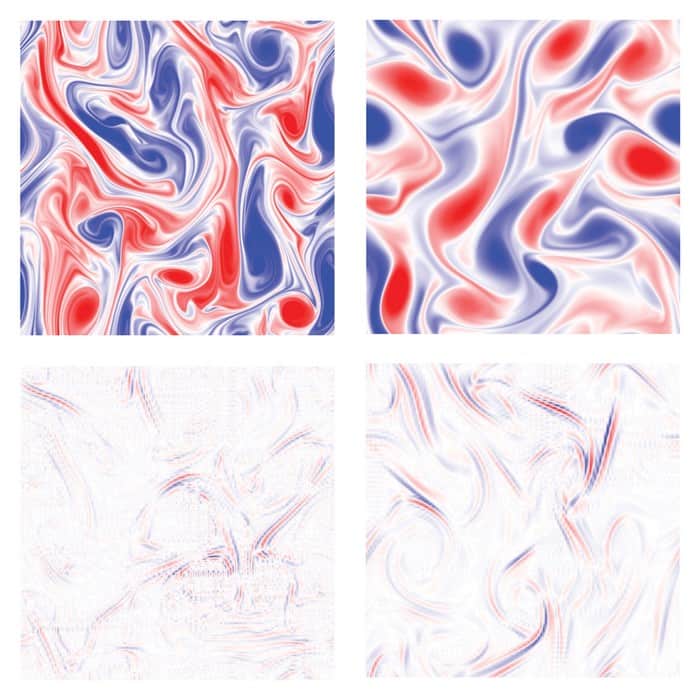
The researchers performed high-resolution simulations of the behaviour of fluids under three different sets of conditions. They used these data to train three 10-layer deep learning algorithms to predict the behaviour of fluids under each of these specific parameters. They changed some parameters such as the Reynolds number (the ratio of inertial forces to viscous forces) or the vorticity of the fluid in each case and conducted another set of high-resolution simulations to predict the behaviour of the new fluids. In each of the three cases, they trained the same algorithms on the new data. Finally, they conducted transfer learning of the old algorithms on a small subset of the new data, looking at the effect of retraining each level and comparing the performance of the retrained old algorithm with the algorithm that had been trained from scratch on the new data.

Retraining shallow layers

The results were surprising. “In this paper, we found that the shallowest layers were the best to retrain,” says Hassanzadeh. Having access to the predicted signal produced by retraining each layer in turn gave them a window into the effect each layer had on this final signal. Therefore, they simply used spectral analysis of each signal to see how each layer was modifying each frequency present. Some levels were controlling the low-frequencies, and it was useful to retrain these as they captured the smoothly varying, macroscopic features of the algorithm. Other levels, meanwhile, predicted the details, and retraining these alone was near-useless. The researchers have provided a protocol for determining the most important levels in any given case. “We didn’t want to say we have a rule of thumb in this paper,” says Hassanzadeh. “Now we have found systems where, for example, the middle layers are the best [to retrain].”

The team describes the work in a paper published in PNAS Nexus.

“I think it’s a really interesting paper,” says astrophysicist and machine learning expert Shirley Ho of the Flatiron Institute in New York City. She adds, “On the other hand, in many other scientific disciplines we’ve been using spectral analysis for a long time now, so I guess the question is whether or not applying it to the multiple layers is a significant contribution.  I get the feeling that it’s probably one of those things that’s been in people’s minds, but no-one has written it. It may be one of those great papers where, once you say it, it’s obvious to everybody.”

Creativity for scientists: how to build an innovation culture in your university, company or research group

This episode of the Physics World Weekly podcast features Dennis Sherwood, a consultant and author who helps individuals and organizations boost their creativity.

Sherwood has drawn on his experiences to write the book Creativity for Scientists and Engineers: a Practical Guide and in a wide ranging interview he gives examples of creativity in physics ranging from Archimedes’ work on density to a more recent breakthrough in optical imaging. Sherwood also looks at the barriers to creativity and gives tips on how these can be overcome by scientists.

Also in this podcast, Physics World editors chat about a curious star system that could someday enrich the Milky Way with gold and platinum; and a new artificial skin that is designed to be bitten by mosquitoes.

Advanced electron microscopy: new paradigms for studying nanomaterials

Want to learn more on this subject?

In this webinar, you will learn about the remarkable progress achieved by electron microscopy instrument to answer applied and basic questions raised by the constantly growing field of nanotechnology.

We will present a series of studies of nano objects (such as molecules, nanoparticles, nanotubes, nanowires) to provide examples on the need to change our views of experiment design, execution and analysis. Previously, it was common to think that electron microscopy as a very useful but qualitative atom resolution imaging tool for materials science. At present, researchers must use these advanced tools in association with physicochemical simulations, machine learning, big data, etc.  to target the generation of reliable and quantitatively verified physical models from the measurements.

Finally, it is very important to exchange ideas on how to approach the critical problem of human resources formation associated with complex modern analytical techniques and, how to make these onerous instruments accessible by the operation of multi-user facilities/networks.

Prof. Ugarte will discuss his experiences to tackle these issues in the context of a South American country.

Want to learn more on this subject?

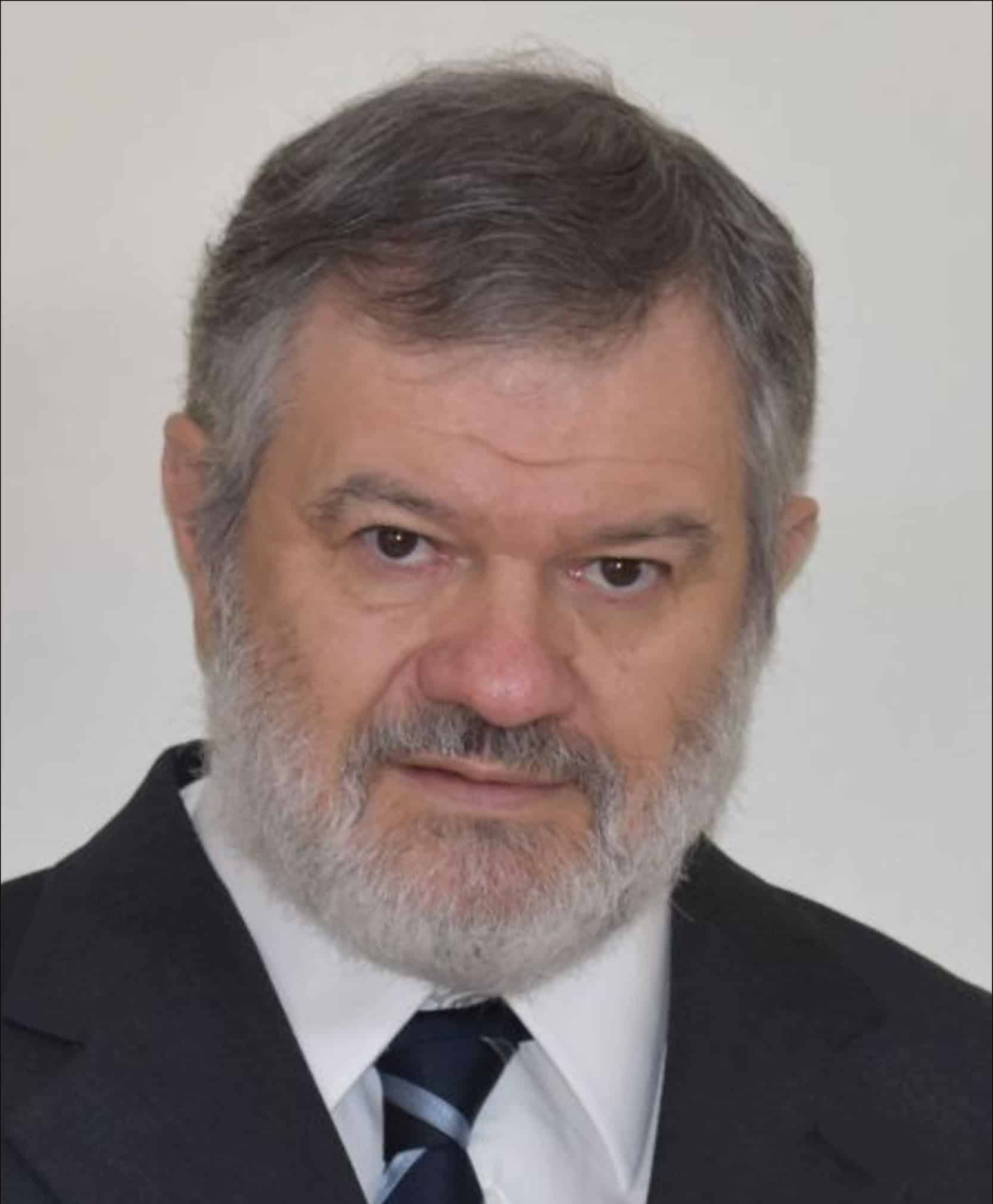
Daniel Ugarte is professor at the Institute of Physics, Universidade Estadual de Campinas (UNICAMP), Brazil. He obtained his degree in physics at the Universidad Nacional de Córdoba (Argentina) and finished his PhD at the Université Paris-Sud. After a postdoc at the Ecole Polytechnique Federale de Lausanne, he joined the Brazilian Synchrotron Light Laboratory (LNLS, Brazil) in 1993. He moved to the Institute of Physics Gleb Wataghin, Universidade Estadual de Campinas (UNICAMP) in 2004, where he acts as full professor. His activities have been related with the experimental study of structural and electronic properties of nanoscale systems, mainly using electron microscopy methods. At the end of nineties, he designed and created the Brazilian National Center of Electron Microscopy; this lab was the seed to the subsequent creation of the Brazilian National Nanotechnology Laboratory (LNNANO) in Campinas. Daniel has published approximately 120 journal papers, several in high-impact journals (including Nature, Science, Nature Nano, Phys. Rev. Lett., Nano Lett.). His articles have received approximately 18,000 citations (Google Scholar). He has given approximately 100 invited talks in prestigious international conferences among them APS March Meeting, MRS Fall Meeting, Gordon Conference. He received several national and international awards, among them are Guggenheim Fellowship (USA, 2002), Latsis (Switzerland, 1994) and recently the TWAS Prize in Physics in 2018. He was elected member of the Brazilian Academy of Sciences in 2012 and of The World Academy of Sciences (TWAS) in 2019.

Copyright © 2026 by IOP Publishing Ltd and individual contributors