Hydrogen-producing solar cells mimic photosynthesis

Illustration showing sun shining on an array of solar-energy-to-hydrogen devices located in shallow water. A lens system directs UV and visible light to the devices and infrared light to heat the water around them.

Two independent teams have taken inspiration from nature to develop better ways of producing hydrogen with solar cells. The first team, from the University of Michigan in the US, achieved a record-breaking solar-energy-to-hydrogen efficiency of more than 9% using a solar panel containing an indium gallium nitride (InGaN) catalyst. The second team, from the EPFL in Switzerland and Toyota Motors Europe, created a new type of transparent, porous gas diffusion electrode that harvests water from the air and turns it into hydrogen when exposed to sunlight. Both technologies could, in principle, supply hydrogen for fuel cells and industrial processes in a “green” way, without the need for fossil-fuel precursors.

In photocatalytic solar water splitting, scientists use the energy from sunlight to split water into its component elements: oxygen and hydrogen. This process mimics a crucial step in natural photosynthesis and could be a clean and renewable way to produce energy. The problem is that the efficiency of the solar-to-hydrogen (STH) process is very low, making it uneconomical compared with fossil-fuel-based methods of generating the large quantities of hydrogen needed for various industrial processes.

9.2% efficiency

At Michigan, Zetian Mi and colleagues used the ultraviolet-to-visible part of the Sun’s spectrum to photoexcite the semiconductor InGaN, causing it to produce electrons and “holes” (regions of positive charge) that can split water into hydrogen and oxygen. The researchers then used the infrared portion of sunlight to heat the reaction system to around 70 °C. This heating helped to prevent the hydrogen and oxygen from recombining to form water, which is the main “backreaction” in water splitting and a major limiting factor in STH efficiency.

Using pure water, this strategy resulted in a STH efficiency of 9.2% under concentrated simulated sunlight – 10 times greater than previous such experiments. Under the same conditions, the researchers achieved an efficiency of 7.4% using tap water and 6.6% with sea water. They also obtained an efficiency of 6.2% using pure water in a large-scale prototype photocatalytic water-splitting system located outdoors.

The device, which the team describes in Nature, is also stable at high temperatures and at light intensities equivalent to 160 Suns. “In principle, this technology can supply hydrogen for fuel cell stations and any industrial processes that require hydrogen,” Mi tells Physics World. “A unique advantage of this approach is the distributed generation of hydrogen, compared to conventional centralized steam methane reforming processes, thereby significantly reducing the cost associated with hydrogen transportation.”

Like an artificial leaf

The gas diffusion electrodes made by Marina Caretti and colleagues in the EPFL team, meanwhile, are based on quartz (silicon dioxide) fibres processed into felt wafers that are then fused together at temperatures of 1350 °C. The team coated the resulting transparent porous substrates with a transparent thin film of a photoactive material, fluorine-doped tin oxide, in an atmospheric chemical vapour deposition process for 10 min at 600 °C with monobutyltin trichloride and trifluoroacetic acid.

The structure thus produced has a porosity of 90%, giving it the maximum amount of contact with water vapour in the air and a good conductivity of 20 ± 3 Ω sq−1. It is also transparent, allowing light to pass through the coated semiconductor.

When exposed to sunlight, this device behaves like an artificial leaf, harvesting water from the air and using sunlight to produce energy (in the form of hydrogen gas, in this case). The energy from the solar radiation is stored in hydrogen bonds, similar to the way that plant leaves store energy in the chemical bonds of sugars and starches produced during photosynthesis.

Technology could harvest humidity from the air

The EPFL researchers, who detail their work in Advanced Materials, acknowledge that the solar-to-hydrogen conversion efficiency of their photoelectrochemical (PEC) device is quite low. However, maximizing this efficiency was not a goal of their study, and team member Kevin Sivula points out that its maximum theoretical efficiency is around 12%. This, he says, indicates “promise for improvement”.

“The system concept will also eliminate the need for a highly acidic electrolyte, traditionally employed in PEC devices,” he tells Physics World.

The EPFL team’s prototype was only stable for about an hour under one Sun’s worth of illumination, which Sivula says will “need to be improved” to make the device practical. One possible application for it might be in PEC cells, which use incident light to stimulate a photosensitive material such as a semiconductor that is immersed in liquid solution. The goal in this case is to drive chemical reactions, but the process has some drawbacks – one being that it is complicated to make large-area PEC devices that use such a solution. The new work shows that PEC technology can be adapted to harvest humidity from the air instead.

Optimization in progress

The EPFL researchers are now seeking to optimize their system by studying different fibre and pore sizes and different semiconductor materials. They are pursuing their work in the context of the EU Project Sun-to-X, which is dedicated to advancing this technology.

The Michigan researchers, for their part, now plan to separate the pure hydrogen from mixed hydrogen and oxygen produced in their photocatalytic water splitting process using a membrane. “We will also develop a new photocatalytic approach to directly produce high-purity hydrogen from water splitting,” Mi says.
Coherent correlation imaging tracks fluctuations on the nanoscale

Using a new image reconstruction technique, physicists in Germany and the US have made clear and detailed movies of nanoscale fluctuations in a magnetic material. To capture these features, a team led by Christopher Klose at the Max Born Institute, Berlin, used an advanced algorithm to identify correlations in the spatial patterns in multiple X-ray images.

Fluctuations and phase transitions are a near-universal features of matter and X-ray and electron imaging techniques can be used to observe these phenomena on the nanoscale. However, these methods have an inherent trade-off between high spatial resolution and high temporal resolution – the latter being needed to track the dynamics of fluctuations and phase transitions.

While both temporal and spatial resolution can be improved by boosting illumination, intense beams of X-rays and electrons can damage delicate features in a sample.

To overcome this limitation, Klose’s team has developed a technique called coherent correlation imaging (CCI). Their approach relies on the fact that nanoscale fluctuations are not entirely random, but instead display distinctive spatial patterns.

Many snapshots

CCI first involves taking thousands of snapshots of samples in quick succession, using relatively low levels of illumination. While these snapshots appear to be mostly indistinct from each other, the researchers found they contain enough information to categorise each image using a hierarchical clustering algorithm. This sorts the images into groups with spatial patterns that display clear correlations. By combining the images in each group, the team was able to reconstruct clear images of the patterns in samples.

To demonstrate their approach, Klose and colleagues used CCI and X-rays to image fluctuations in a thin-film ferromagnet. This material is widely used in modern hard drives, where information is encoded into magnetic domains. These are nanoscale regions in which the magnetization can either point in one of two opposing directions. These domains are known to be highly stable at room temperature, with little information lost due to fluctuations. So far, however, researchers have not been able to confirm this stability directly by imaging the material.

Klose’s team used CCI to test the ferromagnet’s stability at 37 °C, which is above room temperature. Far from remaining static, the algorithm identified transitions between 30 distinct domain states in the film. By assessing the similarity between these states, the researchers also determined the order in which the transitions occurred. This allowed Klose and colleagues to construct clear, detailed movies of the fluctuations.

Through further improvements, CCI could soon enable researchers to answer fundamental questions surrounding the nature of phase transitions in advanced materials including high-temperature superconductors. Klose and colleagues now hope to extend their technique to electron microscopy – allowing them to reconstruct images on even smaller scales.

The technique is described in Nature.

‘I see a piece of myself in every student that I’ve mentored, and we motivate each other’ – Wen-fai Fong on supporting the next generation of astronomers

“It’s very cliché, but I was never really interested in astronomy in particular until I was forced to look up at the sky in the 8th grade,” says astronomer Wen-fai Fong. “I was given a project to chart the phases of the Moon, so I had to stand out on my driveway and just look up at the sky every night.” Today, she is an assistant professor of physics and astronomy who leads a pioneering group of space scientists at Northwestern University in the US.

Fong’s team studies some of the universe’s most extreme and violent events including gravitational waves that are launched when neutron stars and black holes merge, and gamma-ray bursts  – the most powerful cosmic explosions since the Big Bang with sources that until recently were shrouded in mystery. In addition to this, she also oversees something much more delicate – the fledgling careers of the next generation of astronomers during this unique and exciting time in the field.

Fong, who grew up in a suburb outside of Rochester, New York, hadn’t really considered the stars until her high school project drawing the Moon, but seeing it change kick-started her interest in astronomy and physics. She explains that while she was inspired by her family – her father and older sisters work in medicine – none of them had much experience with physics. This meant that despite an early interest in mathematics, physics remained intimidating until a summer camp changed her perspective.

The summer camp showed me that other girls were interested in physics

“I went to a summer camp at the local university for girls who are interested in physics, and that was really a formative experience for me,” says Fong. “It was led by female physics graduate students and that also gave me automatic role models in the field. The summer camp showed me that other girls were interested in physics.”

Before leaving high school to take up dual bachelor’s degrees in physics and biology at the Massachusetts Institute of Technology (MIT), Fong began asking local physics professors if she could shadow them in their labs. This led to her meeting Judy Pipher, a professor of physics and astronomy who taught at the University of Rochester from 1971 to 2002. Pipher, who passed away in February 2021, would become a major influence on Fong.

“She welcomed me into her lab, and met with me one on one,” Fong recalls. “I think just having an older female role model was really important as it solidified that a career in physics is possible for someone like me.”

Following this, she worked with professor of astrophysics Edo Berger on observations of gamma-ray bursts, a phenomenon that remains intrinsic to her career to this day. After winning an Einstein Postdoctoral Fellowship in 2014 and moving to the University of Arizona’s Steward Observatory, Fong was awarded a Hubble Postdoctoral Fellowship in 2017, which led to her joining Northwestern’s physics and astronomy faculty a year later. At this time Fong also affiliated herself with Northwestern’s Center for Interdisciplinary Exploration and Research in Astrophysics (CIERA), becoming an important part of the CIERA team.

It was at Northwestern that she would form her own research group, mentoring gifted space-science students. Indeed, the Fong group quickly became an impressive force in space-science research; as well as becoming the antithesis of the gender imbalance Fong saw during her education, with mainly female researchers making up its members.

Hopefully it is empowering for these women to see that their peers as well as their mentors are similar to them

“Women are still underrepresented in physics but I never fixate on that. I always tell my students, ‘You’ve gotten here, focus on the science’ and advise them not to let the stereotypical bias of physics affect them too much,” says Fong. “Hopefully though it is empowering for these women to see that their peers as well as their mentors are similar to them.”

Fast phenomena

The broad aim of the group is to study powerful events and phenomena that aren’t replicated here on Earth or even within the solar system. “I am interested in uncovering the origins of the fastest explosions in the universe, or fastest transients,” Fong explains. “We have these explosions like gamma-ray bursts and fast radio bursts which we see but we don’t know what causes them.” She adds that understanding the cause of these phenomena is vital to progressing physics, as well as offering unique research opportunities. “When we have a handle on what actually causes them, we can use these rare explosive events as a way to understand physics that we can’t see elsewhere in the universe,” Fong continues.

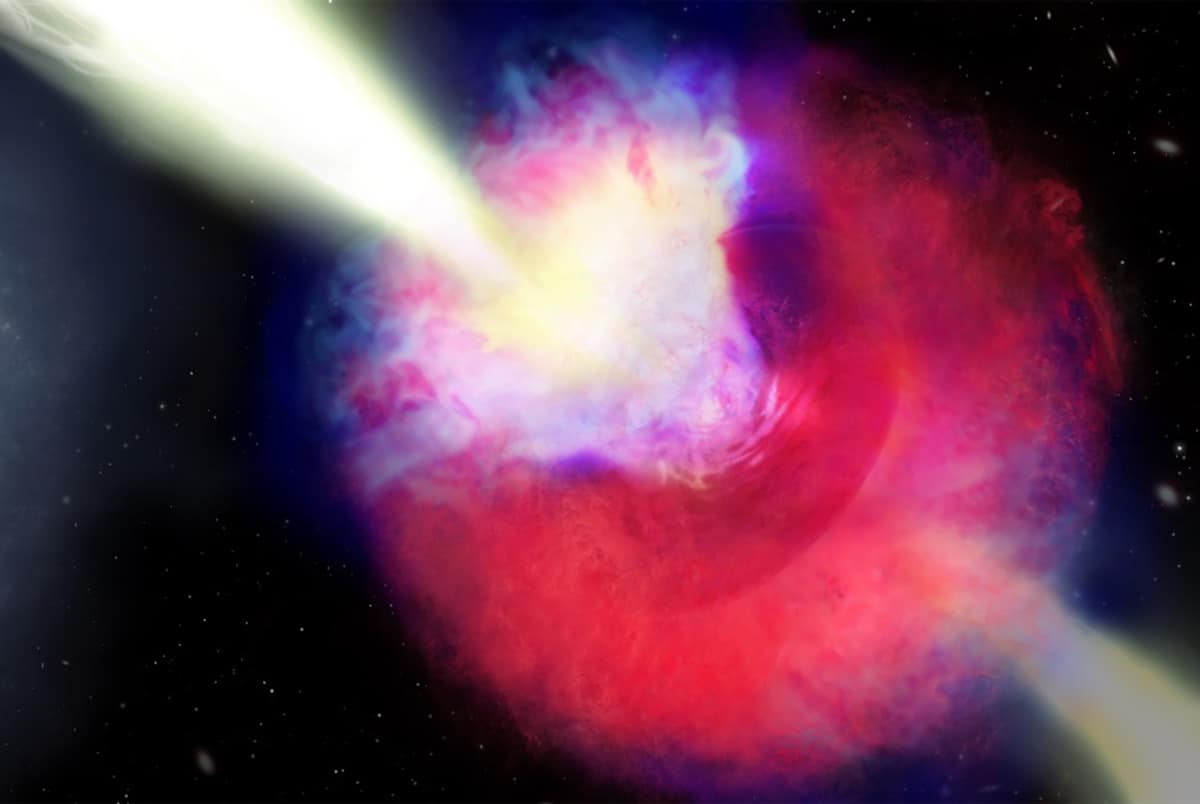
Artist’s impression of GRB 211211A, showing the kilonova and gamma-ray burst.

One significant finding recently delivered by the group is helping change how we think about these short-lived, or transient, events. At the end of 2022, Northwestern PhD student and Fong group member Jillian Rastinejadi led the team to detect a long gamma-ray burst – dubbed GRB 211211A – associated with the merger of two neutron stars (Nature 612 223). This is extraordinary because long gamma-ray bursts have always been associated with the collapse of massive stars, and the merger of neutron stars had been ruled out as the cause of these events until now.

The research also exemplifies what drives Fong to keep studying gamma-ray bursts, whether long or short-lived – the element of surprise. “The really fun part about gamma-ray bursts is every time I think ‘Oh, we know about gamma-ray bursts, we understand them’ one comes along that totally, totally throws us for a loop,” Fong explains.

The Northwestern assistant professor highlights the work of another PhD student in her group, astronomer Anya Nugent, who led a project to create a colossal catalogue of galaxies observed by ground and space-based telescopes to host short gamma-ray bursts (ApJ 940 56). “I’m really proud of that, because it took years and years of work to build a gold-standard fast-radio-burst catalogue,” Fong says.

Shaping the future of astronomy

Aside from studying some of these fascinating events, Fong has another equally crucial role within her astronomy group at Northwestern – mentoring the next generation of astronomers. “I think every student is different and it’s important to kind of cater your mentoring style accordingly. A good mentor can really alter someone’s career path,” Fong says. “By getting this far and winning a spot in a prestigious PhD programme, they’ve shown that they’re really interested in astronomy as a career path. So, my role is to help shepherd them and facilitate that interest.”

A good mentor can really alter someone’s career path

Fong’s own experiences as a graduate student help her adjust her mentoring role. This can come in the form of something as simple as reminding her that the mere presence of a mentor can positively impact the work being undertaken by a student or postdoc. Fong also has experience dealing with imposter syndrome, particularly when moving from one stage of her career to another, which can lead to feelings of inadequacy. She advises her students to form allegiances with each other for further support.

Fong acknowledges that there are some challenges faced by her team that she did not experience in the formative years of her career, particularly the COVID pandemic that caused isolation and frustratingly slowed research. This has taught her the value of empathy in her mentoring role, something that also helps mitigate the high-pressure nature of astronomy arising from how fast paced the field can be. She is also keen to lead by example. As the type of astronomy the team performs is time variable, it means there are lots of late nights and “after-hours” observations – something she pitches in with, even while raising a nine-month-old child.

The Northwestern researcher is clear, however, that leading the Fong group isn’t a one-way street. Fong says she benefits as much from her charges as the group’s students and postdocs do from her experience. “I see a piece of myself in every student that I’ve mentored, and we motivate each other. I’ve learned so much from them. It’s really important to keep that mindset in academia,” Fong concludes. “I hope that when I’m 60 years old and on the brink of retirement, I still keep that mentality that allows me to always be learning from the youngest members of the group.”

Ionocaloric cooling makes a new type of refrigerator

A new refrigeration method dubbed “ionocaloric cooling” could one day replace traditional systems based on vapour compression, reducing the need for gases that harm the Earth’s atmosphere and contribute to climate change. The method, developed by researchers at the Lawrence Berkeley National Laboratory (LBNL) in the US, takes advantage of the ways that energy is stored or released when a material changes phase, such as from a solid to a liquid or vice versa.

Conventional refrigerators and air conditioners are designed to use volatile hydrofluorocarbons, which are extremely powerful greenhouse gases with a global warming potential (GWP) 2000 times greater than carbon dioxide. In such systems, the refrigerant is pumped around a closed loop in which it undergoes a phase change from a liquid to a gas and then back to a liquid. The transition to a gas involves an expansion and requires energy, which the refrigerant acquires by cooling the surroundings on its “cold” side. Heat is then released on the “hot” side when the fluid condenses back to a liquid.

This standard cycle can also be applied to other substances that similarly undergo a phase transition involving the absorption and emission of heat. These alternative substances include electrocaloric and magnetocaloric materials, which switch between two solid phases in the presence of applied electric or magnetic fields. The drawback is that the heating and cooling abilities of electrocaloric and magnetocaloric refrigerants are relatively modest, leading to cooling cycles that are inefficient for widespread practical use.

A third possibility is to use the barocaloric effect, which occurs when the material being compressed and expanded is a solid rather than a liquid or gas. For most barocaloric materials, however, this effect is very small at ambient temperatures and pressures.

A completely new caloric effect

The new technique invented by Drew Lilley and Ravi Prasher at LBNL makes use of an entirely different caloric effect. It works by adding salt to a solid, which makes the solid “want” to be a liquid in the same way as adding salt to a cold, icy road transforms the ice into slush.

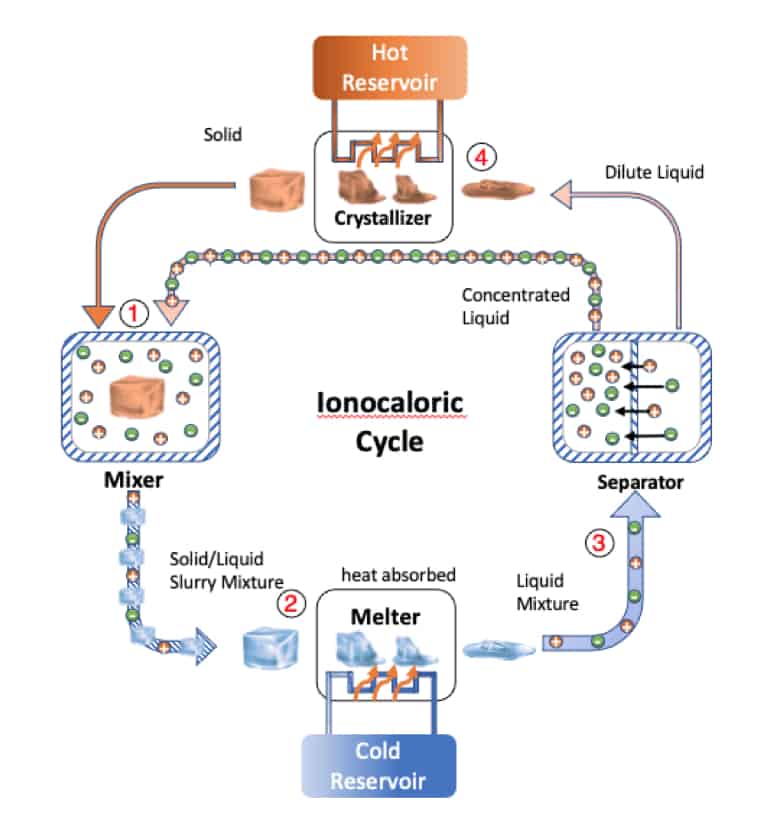
“To become a liquid, the solid must melt, which means it must absorb energy,” Lilley explains. “If you prevent the solid from absorbing energy from its surrounding, it will ‘steal’ energy from itself, so cooling the whole material down (see steps 1 to 2 in the image above). Once it has cooled down, the solid can continue melting, but at a lower temperature, and absorbs energy from its surroundings. This leads to refrigeration (steps 2 to 3 in the diagram).”

Lilley goes on to explain that the mechanism for the phase and temperature change in this “ionocaloric” cycle is the flow of electrically charged atoms or molecules – ions – when a current is applied to the system. If the ions are later removed from the liquid that contains dissolved salt (steps 3 to 4 in the diagram) the reverse effect occurs: the substance no longer “wants” to be a liquid, so it becomes a solid. To do so, it must crystallize and release energy, but if it is prevented from exchanging energy with its surroundings, it will instead release the energy to itself and heat up. Once heated, it will continue releasing energy by crystallizing and give up this heat to its environment.

In a series of experiments designed to test the refrigeration capabilities of this solvent-salt mixing process, Lilley and Prasher found that the temperature decreased by up to 28 °C using less than 1 V of applied current. They also observed variations in entropy (the physical entity used to estimate the effectiveness of a cooling principle) as large as 500 J K-1 kg-1. This is greater than the variations observed in magnetocaloric and electrocaloric materials and similar to that of the best barocaloric material (plastic crystals of neopentylglycol). It also compares well to today’s refrigerants.

A slow, salty cycle

The salt the researchers used is made from iodine and sodium, and they mixed it with ethylene carbonate – a common organic solvent that is, incidentally, a common additive in lithium-ion battery electrolytes. The resulting ethylene carbonate–sodium iodide (EC-NaI) mixture is, they say, CO2-negative, environmentally benign, non-hazardous, zero-GWP, nontoxic and non-flammable.

“Our technology is sustainable [and] does not employ extreme fields – we only need to apply around 1 V,” Lilley tells Physics World. He adds that the efficiency of the prototype system in their experiment is “four to five times larger than any previous prototypes utilizing solid-state materials” and exhibits “power densities that rival that of vapour compression”.

The main drawback of ionocaloric refrigeration is its slow speed. According to Lilley and Prasher, who published their work in Science, a single cycle can take between five minutes and several hours. Even so, Emmanuel Defay, a researcher at the Luxembourg Institute of Science and Technology who was not involved in the work, is impressed by the potential of this new member of the caloric material family. “It exhibits large efficiency and could be environmentally benign,” he writes in a related Perspectives article. “This is a serious contender for the future of cooling.”

The LBNL researchers’ next step will be to start a company to commercialize their technology. “Hopefully our approach will have a real-world impact on improving refrigeration and heat pumping through efficiency gains and the decarbonization of refrigerants,” Lilley says.

Quantum entanglement maps gluons inside nuclei

Using quantum entanglement, physicists in the US have mapped out distributions of gluons within atomic nuclei at higher precision than previously possible. Physicists working on the STAR experiment at Brookhaven National Laboratory (BNL) made their measurements by using an interference effect related to the quantum entanglement of the oppositely charged pions created when high-energy gold nuclei pass very close to each other.

According to the theory of quantum chromodynamics, gluons are mediators of the strong nuclear force. This is the interaction that binds quarks inside protons and neutrons, and also holds protons and neutrons together in nuclei. Because of the nature of the strong force, it is very difficult to calculate the properties of even very simple nuclear systems such as individual protons and neutrons. As a result, physicists have a poor understanding of how gluons are distributed in nuclear matter. Now, physicists in the STAR collaboration have improved our understanding by using the quantum entanglement.

The team studied gluon distributions with the help of BNL’s Relativistic Heavy-Ion Collider (RHIC), which accelerates heavy ions (electrically charged nuclei) to close to the speed of light. Recent experiments at the collider had revealed that the speeding nuclei are surrounded by clouds of photons that are linearly polarized in specific directions relative to the nuclei.

Grazing nuclei

Now, the STAR Collaboration has used these photons to probe the gluons within nuclei. This was done by slightly offsetting two opposing beams of gold nuclei so that they do not collide.  Instead, the nuclei graze each other by a few nuclear radii.

The polarized photons surrounding a nucleus can briefly fluctuate into quark-antiquark pairs, which can then interact with the gluons in the other nucleus as it passes by. These interactions produce extremely short-lived rho mesons, which rapidly decay into a pair of oppositely charged pions. By observing the trajectories of these pion pairs, the team can calculate the positions of the gluons in the nucleus.

Because a pion pair is created by the decay of a rho meson, the two pions are in a state of quantum-mechanical entanglement and remain so until detected. This results in an interference pattern in the detector that can be related to the polarization of the photon that originally interacted with the gluon. This provides the researchers with additional information about the location of the gluon within the nucleus.

Their experiment is somewhat like positron emission tomography (PET), which creates images of the inside of the human body using pairs of gamma-ray photons created by a nuclear decay process.

Using the technique, the team could begin to see the positions of protons and neutrons inside a nucleus by observing the gluon distribution. Their observations matched up with both theoretical predictions of nuclear structure as well as experimental measurements using other techniques.  With further refinements of the technique, combined with the next generation of heavy-ion colliders, the STAR collaboration hopes that physicists will be able to create even more detailed images of the interiors of nuclei.

The research is described in Science Advances.

It’s all about the money. Why seemingly great technological solutions can sometimes fail

When I was younger, I used to believe that science alone could solve any technological challenge – and that whatever solution was technically the best would win out. It was only after spending a few years in industry that I came to realize how economics, market forces and competition play equally important (and sometimes bigger) roles. A technological solution that might seem excellent on paper can, I learned, be dragged down by practical difficulties and poor timing.

For anyone developing new technology, it’s therefore important to set review points on projects, continually assess the market and the competition, and regularly look at the readiness of your technology in a dispassionate and balanced way. I can think of dozens of technologies that didn’t pan out as intended. But here I’m going to explore “solar concentrator” photovoltaics (CPVs) – devices that generate electricity using lenses or curved mirrors to focus sunlight onto tiny solar cells.

I was reminded of this topic while writing about the world’s most efficient solar cell, which was developed in 2019 at the US National Renewable Energy Laboratory. It is a CPV device and has a record-breaking efficiency of 47.1% when illuminated by 143 suns. On the face of it, the device sounds amazing given that today’s silicon photovoltaic (PV) flat panels have an efficiency of only 22%.

Why did concentrator photovoltaics, which were once touted as the next big thing, fall by the wayside?

Sure, most CPV installations look impressive and futuristic, but flat-panel silicon PVs have fallen so much in price that attempts to deploy CPVs have almost ground to a halt since 2017 (even if research on them has continued). Is this why CPVs, which were once touted as the next big thing, have fallen by the wayside?

Market forces

Research into CPVs began in the mid-1970s after the shock of the Middle East oil embargo (Prog. Photovolt. Res. Appl. 8 93). Most work took place at Sandia National Laboratories in New Mexico, with the first system consisting of an acrylic Fresnel lens that focused sunlight onto silicon PV cells. The cells were cooled by water to stop them from warming up and losing efficiency; they also used a tracking system so they always faced the Sun.

Other companies quickly tried their hand, with CPV systems developed by everyone from Motorola and Boeing to GE and RCA. Several successful large-scale demonstration projects emerged from this early work, notably the 350 kW Soleras Project in Saudi Arabia and the 300 kW Entech system in Austin, Texas. The former ran continuously from 1981 for over 15 years and provided valuable insights into the practicalities and operating costs of CPVs.

During the early 1980s, however, work stalled as the urgency of the energy crisis passed. With oil and natural gas proving much more abundant than expected, the cost of these fuels plummeted. So once US federal funds for CPVs became scarce, most of the participants dropped out. Research was scaled back, although a dedicated few continued to pursue the dream.

It was easy to blame the loss of interest in CPVs on low natural gas prices or a lack of political will. But the biggest problem was that CPV systems didn’t sell. Regular, flat silicon solar PV panels, in contrast, have hundreds of applications, ranging from navigation to telecommunications. They are incredibly reliable, lack moving parts, and need very little maintenance.

Solar PVs are particularly useful for people in developing nations, who now use them for lighting, refrigeration and water pumping – especially in remote areas where other sources of power are not available. Simply put, none of these applications are particularly suitable for CPVs, which were only cost effective for installations larger than 100 kW.

A new dawn?

The market for CPVs did improve following the development in the early 2000s of high-efficiency “tandem” multi-junction CPVs, which combine silicon with a III-V semiconductor such as gallium arsenide. In fact, various multi-megawatt CPV projects have been commissioned around the world since 2010 using such devices. Modern commercial systems have efficiencies of up to 42% and the International Energy Agency thinks this could rise to 50% by the mid-2020s.

And yet even these superior CPVs are not perfect, needing active tracking systems so they always face the Sun as well as special cooling. That’s a lot of added complexity for the extra efficiency. What’s more, the cells don’t work as well in hazy or polluted conditions because the spectrum doesn’t match the spectrally “tuned” cells. Cloudy days are another problem because the sunlight isn’t concentrated enough.

These limitations of multi-junction PV systems reduce their power output and impact the economics with the higher capital costs and maintenance bills. It’s hard to see how they can improve on solar PV panels, the price of which has dropped by 82% between 2010 and 2019, according to the International Renewable Energy Agency.

The fall in cost of flat-panel solar PV has mostly been driven by economies of scale, but the Chinese government has played a role too. By heavily subsidising its solar PV industry, some have argued that China has been able to sell solar panels in the US and Europe for less than it costs to make and ship them. Known as “dumping”, the practice has driven out competitors and allowed Chinese suppliers to corner the market.

With the economics now favouring flat-panel solar PV so strongly, the near-term outlook for the CPV industry has faded. Several of the largest CPV manufacturing facilities have closed operations including those of Suncore, Soitec, Amonix and SolFocus. Flat-panel solar PVs, despite being less efficient, have won the day due to simple economics.

However, all is not lost. Perhaps a second golden age for solar concentrator technology is on the cards using the concentrated energy to warm up liquids, with the stored heat converted to electricity when the Sun isn’t shining. It’s a fascinating possibility that I’ll discuss next month.

Proton minibeams could improve treatment of cancer metastases

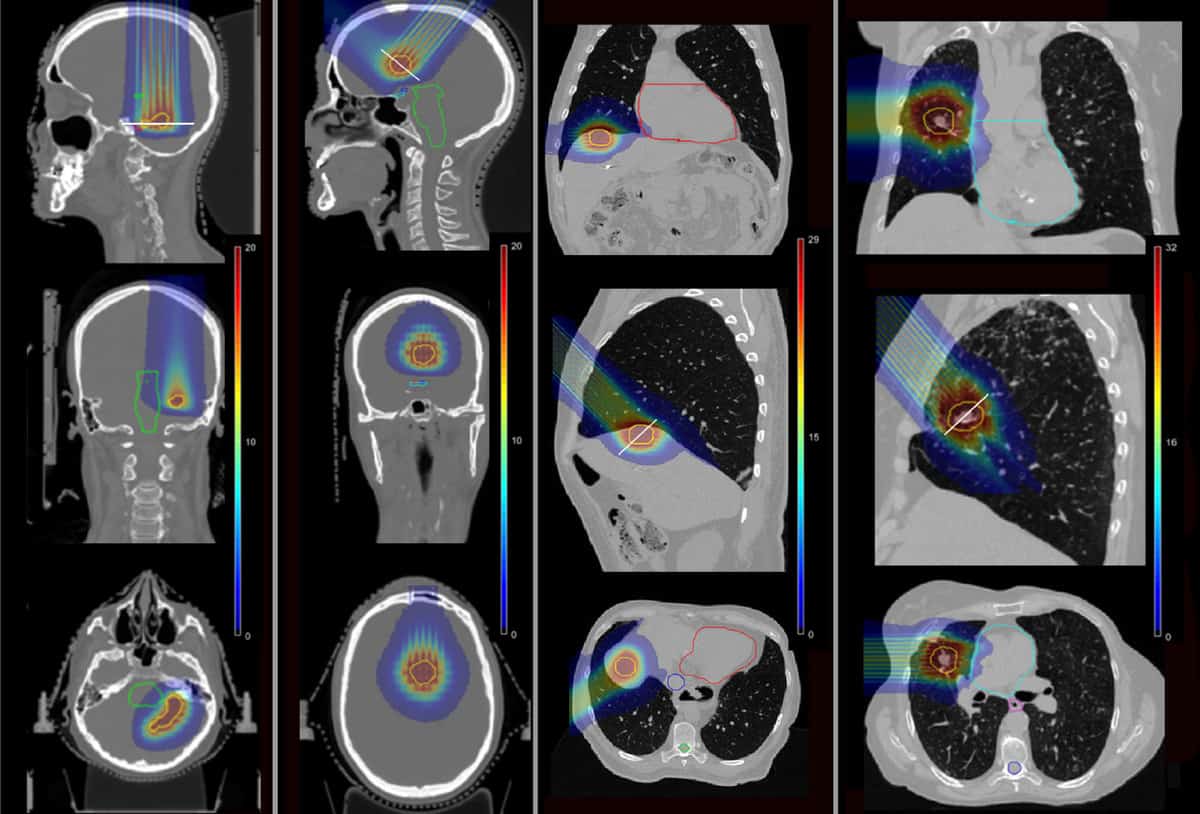
Proton minibeam radiation therapy plans

Treating cancer patients with spatially modulated radiation beams could destroy tumours while minimizing damage to nearby organs and healthy tissue. That’s the idea behind proton minibeam radiation therapy (pMBRT), an emerging treatment technique that uses an array of submillimetre-sized radiation beams to deliver therapeutic dose.

The minibeams comprise alternating high-dose peaks and low-dose valleys, a pattern that’s less harmful to healthy tissue at shallow depths. At greater depths, these beams gradually widen to create a homogeneous dose distribution within the target volume. Studies in small animals have shown that pMBRT can dramatically reduce normal tissue toxicity, with equivalent or superior tumour control, compared with conventional proton therapy.

“Proton minibeam radiation therapy has already shown a remarkable gain in the therapeutic index in preclinical studies,” says Ramon Ortiz from Institut Curie. “These promising results encourage the translation of this technique into the clinical domain.” With this aim, Ortiz (now at UC San Francisco) and colleagues at Institut Curie evaluated the benefits of pMBRT for treating cancer metastases, reported their findings in Medical Physics.

Simulating pMBRT scenarios

Metastatic disease accounts for up to 90% of cancer-related deaths. Metastases are commonly treated using stereotactic radiotherapy (SRT) techniques, but the dose required for local control is often limited by the risk of toxicity to nearby normal tissue. For brain metastases, for example, radiation-induced brain necrosis is reported in half of patients treated with SRT.

To determine whether pMBRT can reduce such complications, the team used Monte Carlo simulations to compute dose distributions for four patients who previously received SRT at Institut Curie. The patients had been treated for metastatic lesions in the brain’s temporal lobe, frontal lobe, the liver and the lung.

The researchers simulated single-fraction pMBRT plans, using one or two treatment fields to deliver the same biological equivalent dose (BED) to the tumour target as prescribed for the SRT. They modelled a brass minibeam collimator containing 400 μm × 5.6 cm slits at various centre-to-centre separations, to create both narrow- and wider-spaced minibeams. They then computed dose distributions for the four patient cases, for pMBRT, SRT and conventional proton therapy.

In the narrow-spaced pMBRT plans, which create a uniform dose distribution in the target volume, tumour coverage was similar to or slightly better than in the SRT plans. Plans using wider-spaced pMBRT beams, which deliver a quasi-uniform dose distribution to the target, had a lower tumour coverage.

Importantly, pMBRT significantly reduced the dose to critical structures compared with SRT. In the first brain case, pMBRT decreased the mean BED to organs-at-risk (OARs) by between 44% (right acoustic nerve) and 100% (left acoustic nerve). In the second brain treatment, pMBRT completely spared the OARs, including the optic tract, brainstem and chiasm.

In the liver case, the mean BED to the liver and ribs was reduced by 25% and 75%, respectively, while avoiding irradiation of the superior vena cava. And for the lung case, the dose to OARs was reduced by between 11% (ribs) and 100% (pulmonary artery and bronchi). The mean BED to OARs was mostly similar between pMBRT and conventional proton therapy.

The researchers also investigated possible adverse effects of pMBRT on normal tissues. For the two brain metastases cases, for example, they computed the dose delivered to healthy brain tissue. They considered the dose limits for standard fractionated irradiation, in which a normalized total dose at 2 Gy-fractions (NTD2.0) of 72 Gy leads to a 5% probability of radio-necrosis within five years.

For all pMBRT plans, the maximum valley NTD2.0 to the healthy brain (61 Gy(RBE) for the temporal lobe case and 47 Gy(RBE) for the frontal lobe case) remained below this dose tolerance threshold, in contrast to conventional proton therapy. For the patients with lung and liver metastases, the mean doses to lung and liver tissues in pMBRT plans were also well below the maximum tolerable mean doses.

Clinical benefits

The pMBRT treatments considered in this study were delivered using just one or two minibeam arrays. The use of fewer fields than in the SRT treatments (three or four arcs) requires less patient repositioning, reducing the fraction treatment time, as well as lowering the volume of normal tissue exposed to low doses. In addition, delivering pMBRT in one treatment fraction considerably reduces the total treatment time compared with the SRT plans, which used three to five fractions.

The researchers point out that the pMBRT plans evaluated in this work could be delivered clinically using the set-up already implemented at the Orsay Proton Therapy Center for preclinical trials, with target and organ motion during treatment controlled as in SRT and proton therapy.

Ortiz tells Physics World that Institut Curie is now discussing the possibility of Phase I/II clinical trials. “These would evaluate the neurotoxicity and tumour control rates in the treatment of recurrent glioblastoma multiforme with proton minibeams,” he explains. “This study aims to contribute to the preparation of those clinical investigations.”

Dark spins could boost the performance of diamond-based quantum devices

The performance of some quantum technologies could be boosted by exploiting interactions between nitrogen-vacancy (NV) centres and defects on the surface of diamond – according to research done by two independent teams of scientists in the US.

NV centres in diamond have emerged as a promising solid-state platform for quantum sensing and information processing. They are defects in the diamond lattice in which two carbon atoms are replaced with a single nitrogen atom, leaving one lattice site vacant. NV centres are a two-level spin system into which quantum information can be written and read out using laser light and microwaves. An important property of NV centres is that once they have been put into a specific quantum state, they can remain in that state for a relatively long “coherence” time – which makes them technologically useful.

Very sensitive

NV centres are very sensitive to magnetic fields, which means that they can be used to create high-performance magnetic field sensors for a wide range of applications. However, this sensitivity has its downside because sources of magnetic noise can degrade the performance of NV centres.

One source of magnetic noise are the interactions between NV centres and the spins of unpaired electrons on the surface of diamond. These spins cannot be detected using optical techniques, so they are referred to as “dark spins”.

As they interact with NV centres, dark spins can destroy quantum information that is stored in an NV centre or reduce the performance of NV-based sensors. Such interactions can be minimized by using NV centres that are deeper inside the bulk of the diamond. However, this solution makes it more difficult to use them to sense magnetic fields over very short length scales – something that is useful for studying individual spins, nuclei or molecules.

Technologically useful

Because of the difficulty of detecting dark spins, their behaviour has mostly remained a mystery. However, previous studies have shown that dark spins have long coherence times, which could make them useful in quantum technologies.

Both teams probed interactions between NV centres and dark spins using double electron-electron resonance (DEER). This is a technique that determines the distance between pairs of electron spins by applying microwave pulses to both simultaneously.

One team led by Nathalie de Leon at Princeton University used DEER measurements to develop a model of how NV centre coherence times vary with their depth below the surface of diamond. The team also discovered that the dark spins are not static, but instead “hop” between sites on the surface. These discoveries suggest that NV-based technologies could be optimized by selecting an appropriate depth for the NV centres – and by developing ways to control the hopping of dark spins.

Chemical vapour deposition

Meanwhile a team led by Norman Yao at the University of California, Berkeley used similar techniques to explore how NV centres interact with a different type of dark spin called P1s. These were created on a diamond surface by the chemical vapour deposition of nitrogen.

In one experiment the researchers prepared a sparsely populated bath of P1s so that mutual interactions between NV centres dominated over the influence of the P1s. In this case, they could use microwave pulses to selectively decouple the NV centres either from each other, or from the impurities. This study revealed that in this case interactions between NV centres dominated the decoherence process, rather than interactions between NV centres and the P1s.

However, when Yao and colleagues prepared a denser bath of P1s, they could use the interactions to exchange quantum information between the NV centres and the P1s. This rich quantum environment could be particularly useful for performing quantum simulations that involve many interacting spins – including complex biomolecules and exotic states of matter.

Yao’s team describes its work in a paper on arXiv that has been accepted for publication in Nature Physics. De Leon and colleagues present their findings in Physical Review X.

Astronomical origins of Groundhog Day, infrared ‘chameleon’ runs hot and cold

If you are reading this in the US or Canada, you will be aware that yesterday was Groundhog Day. And depending on your rodent of choice, you can look forward to either a long or short winter.

For readers outside of North America, a brief explanation. Legend says that a groundhog emerging from its den on 2 February can foretell how long winter will last. If the creature can see its shadow, there will be six more weeks of winter. But if there is no shadow, winter will be shorter.

Today, a mini-industry exists in some small towns in the US and Canada, where captive groundhogs are awakened and their shadows sought. But is there any scientific basis to this quaint custom? Not surprisingly, the answer is not really – at least according to an article in Salon by Nicole Karlis.

Cold and clear

In eastern North America, where the groundhog myth emerged, clear skies in the winter are often accompanied by cold temperatures – whereas cloudy winter days are often rather warm. Despite this connection between weather and shadows, the article says that the most famous groundhog – Pennsylvania’s Punxsutawney Phil – was only correct about 40% of the time over the past decade.

Karlis points out that 2 February has an astronomical significance in the solar calendar – being about halfway between the winter solstice and the spring equinox. As a result, it coincides with the ancient Celtic festival of Imbolc, which celebrates the coming of spring.

There are lots more fascinating facts and connections in Karlis’ article: “Why Groundhog Day has its roots in astronomy”.

Chameleon-like material

Winter or summer, in many climates it can be expensive to maintain a comfortable temperature inside buildings. On hot days, the exterior of a building will absorb heat and when it is cold the exterior will radiate precious heat away. Now, researchers at the University of Chicago have developed a chameleon-like material that can modify its thermal properties according to the outside conditions.

On a hot day, the material can radiate about 92% of the heat it contains, while on a cold day it only radiates about 7% of its heat. Po-Chun Hsu, who led the research, says, “This kind of smart material lets us maintain the temperature in a building without huge amounts of energy”.

The material is a layered structure in which a layer of copper can be created or removed by applying a small electrical current. When the copper layer is present, the material loses very little heat to its surroundings. But when the copper is removed, the material becomes very good at radiating heat.

Hsu and colleagues describe their new material in Nature Sustainability.

UK creates ‘high-risk, high reward’ research funding agency

A new “high-risk, high-reward” science and technology funding body in the UK has been formally established following a commencement order in parliament. The Advanced Research and Invention Agency (ARIA), which has been backed with £800m, has been created with the goal of “identifying and funding revolutionary science and technology at speed from world-class scientists”.

ARIA will aim to remove bureaucracy by “minimizing hurdles across a typical project lifecycle” that can hamper grants given by other UK funding agencies. The UK’s Department for Business, Energy and Industrial Strategy (BEIS) says ARIA will operate “with a unique level of freedom which puts trust in the decisions of experts in their field” to create “transformational research programmes with the potential to create new technological capabilities for the benefit of humanity”.

Alongside ARIA’s formal launch, BEIS also announced five new members to the agency’s board. The appointments include the Nobel-prize-winning organic chemist David MacMillan of Princeton University; asset management expert Stephen Cohen, who is a commissioner for both the UK Civil Service and the Gambling Commission; and Sarah Hunter, global director of public policy at X, the Google-founded “moonshot factory”.

They are joined by Kate Bingham, a managing partner at SV Health Investors and the former chair of the UK Vaccines Taskforce; and Antonia Jenkinson, the former chief financial officer of the UK Atomic Energy Authority, who will serve as ARIA’s chief financial and operations officer.

“This group brings together unique experience from across the science, technology and investment sectors, ensuring ARIA invests in the high-risk research that offers the best chance of high rewards, supporting ground-breaking discoveries that could transform people’s lives for the better,” BEIS noted in a statement.

The global race

Completing the board are the previously announced appointments of Patrick Vallance, the UK government’s chief scientific adviser; Ilan Gur, a materials scientist and founder of Activate; and Matt Clifford, chief executive office of the talent investment firm Entrepreneur First.

According to BEIS, securing the latter two as ARIA’s founding chief executive officer and chair, respectively, “demonstrates the UK’s ability to attract global scientific and entrepreneurial talent, as well as the continuing strength of our research base”.

“I could not imagine a better board of directors to oversee ARIA’s formation,” notes Gur. “Guided by their experience and judgement, ARIA will make bold bets that leverage the strengths of the UK research system to drive world-changing breakthroughs.”

An ARIA spokesperson told Physics World that the agency will soon begin appointing its founding cohort of programme directors. Once in place, these full-time ARIA staff will then design and distribute funding via a series of multi-year programmes.

“The UK has long been a leading light in scientific discovery, research and pioneering technology,” notes UK science minister George Freeman. “As the global race for science and technology leadership heats up, we are committed to going further to cement our position as a science superpower.”

Copyright © 2026 by IOP Publishing Ltd and individual contributors