Theoretical physicists at Rice University in the US have proposed a practical new approach to growing carbon nanotubes with a single chosen “handedness”, or chirality. If realized experimentally, the approach would fulfil a long sought-after goal in nanotechnology and could make nanotube-based technologies more accessible.
Carbon nanotubes (CNTs) are rolled-up hexagonal lattices of carbon just one atom thick. Thanks to their excellent electrical and mechanical properties, they show promise for many applications, including ultra-strong fibres and conductive wires. They can be single-walled or multi-walled, and the way the hexagons are angled within the lattices – their chirality – determines whether they are metallic or semiconducting.
Nanotubes normally grow in a way that produces single and multiple walls and different chiralities at random. However, some applications (like highly conductive fibres or the semiconductor channels of transistors) require batches with just one type of chirality. Separation techniques such as centrifuging can meet this need, but they are complex and costly.
Growing like Lamarck’s giraffes
The new approach developed by Boris Yakobson and Ksenia Bets at Rice requires would-be chiral nanotube growers to set up an optimized localized zone in the CNT growth chamber. This zone contains a precursor feedstock from which the CNTs are created, and Yakobson and Bets’ “recipe” calls for it to move along the reactor at a prescribed speed, allowing only some types of CNT to be “fed”. Since tubes with different chiralities grow at different speeds, they can then be separated by length, leaving the slower-growing types behind.
The researchers describe their method with an analogy to “Lamarck’s giraffes” – a 19th-century theory suggesting that giraffes evolved long necks due to a gradual evolutionary selection of animals that can reach progressively higher for tree leaves to eat.
“It works as a metaphor because you move your ‘leaves’ away, the tubes that can reach them continue growing fast and those that cannot just die out,” says Bets. “Eventually all the nanotubes that are just a tiny bit slow will ‘die’.”
As the main obstacle to widespread industrial use of nanotubes, an in-growth method of chirality selection was a highly-coveted goal for researchers in this field, says Yakobson. “Our new technique can unlock many CNT-based technologies developed over the last decades for mass production,” he claims. “Indeed, chirality selection means single, well-defined electronic bandgaps for transistor or well-defined optical properties perhaps for solar cells applications.”
The Rice team, who detail their study in Science Advances, hope their technique will now be realized in a real-world experiment. “Now that the paper has been published, experimental groups worldwide can try implementing this methodology on their particular growth setups, exploring the possibilities and limitations of the approach pushing the technology development even further,” Yakobson tells Physics World.
In this episode of the Physics World Weekly podcast Katherine Morris of the University of Manchester explains how her research on environmental radiochemistry will lead to better ways of storing nuclear waste and remediating contaminated sites. She also talks about how her team uses the UK’s Diamond Light Source to better understand the chemistry of systems containing radioactive materials.
This webinar will demonstrate planning tools available for the Gamma Knife, such as inverse optimization, which can be used to improve plan consistency and quality and, remote access that allow users to contribute and explore plans from any location.
Plan comparisons will be made between manually created clinical plans by an expert planner and inverse optimized plans using the Lightning software.
Following this, we will discuss the potential impact of Lightning optimized plans on treatment delivery and explore techniques to verify delivery of these plans using Gafchromic film.
The webinar, hosted by Benjamin Earner, concludes with a discussion of various real-world scenarios that benefit from remote access in the clinic and how these can improve patient care and user experience.
Benjamin Earner is a principal physicist at the London Gamma Knife Centre, London, UK, which is part of the HCA Healthcare UK network. He has worked with the Gamma Knife Icon for more than six years and has been involved in the commissioning of stereotactic radiosurgery and radiotherapy systems for 14 years. He has a passion for bring innovation and workflow improvements to the clinic, with a particular emphasis on the integration of software solutions. Benjamin has co-authored several articles on the implementation of Gafchromic film for radiotherapy applications.
From Laura Bassi to Marie Curie, for centuries, women have been making important contributions to the world of physics. Now with ViewRay’s MRIdian system, women are leading the charge in bringing the latest advancement of MRI-guided radiation therapy to the forefront of radiation oncology and expanding the medical physics landscape.
Based on American Association of Medical Physicists (AAPM) TG-100, ACR phantoms are used to evaluate the key performance of MR scanners, such as magnetic field homogeneity, geometric accuracy, slice thickness, low-contrast detectability, high-contrast spatial resolution, slice position accuracy, uniformity, and radiofrequency coil checks. Although literature highlights the needs and considerations for QA of MRI simulation in radiotherapy with the ACR phantom, a dedicated QA procedure for radiation oncology is not yet established and available since the commercialization of MRL systems.
The Magphan RT phantom (The Phantom Laboratory, Salem, NY, USA) has been released, providing an integrated test that performs all of the measurements required to ensure MRI performance in MRgRT with an automated analysis platform that facilitates a comprehensive and sophisticated QA of a MR scanner.
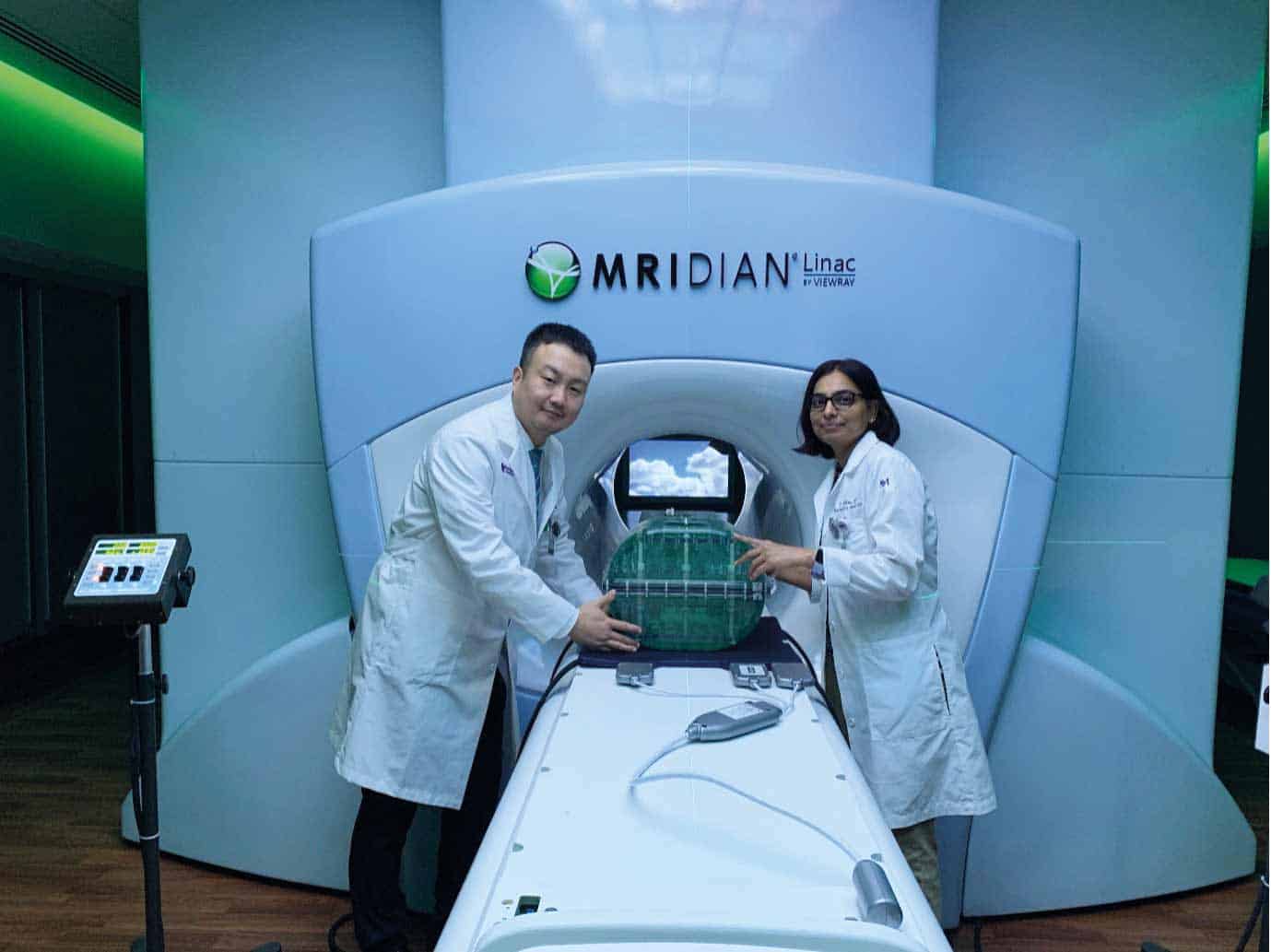
This series of five webinars will specifically highlight women physicists across the globe that are using MRIdian to transform cancer care as we know it. Poonam Yadav will discuss different modes of the system, periodic MRI QA and their challenges, establishing time-saving MRI QA and consistency of the results.
This presentation is the second in a series of Women in Medical Physics, supported by ViewRay.
Poonam Yadav, PhD, is an associate professor of radiation oncology at Northwestern University Feinberg School of Medicine. Much of her current work involves the ViewRay MRIdian System, an MRI-guided radiation therapy machine that enables clinicians to monitor tumours and surrounding tissues during treatment. This technology allows us to adapt to changes in the patient’s anatomy to ensure accurate delivery of radiation. Previously, she served as faculty at the University of Wisconsin School of Medicine and Public Health’s Department of Human Oncology, with an affiliate appointment at the University of Wisconsin Carbone Cancer Center where she led numerous research studies, technology implementation, and substantial clinical practice. Poonam has designed and led several clinical physics studies. She finds interdisciplinary approach in radiotherapy quite motivating and to engage with. She is actively involved in investigating a whole host of clinical situations such as ventricular tachycardia, benign diseases and others where patients can benefit from radiation therapy. Poonam is a strong advocate for everyone to have equal access to education and training and has been an advocate for this cause through AAPM and other professional organizations.
The UK must attract highly qualified workers from abroad if the country wants to have a flourishing industry and economy. That is one of four recommendations in a new report released by the House of Lords Science and Technology Committee. The conclusions were reached following an inquiry by the committee last year into science, technology, engineering and mathematics (STEM) skills in the UK.
Led by Julia King, a former chief executive of the Institute of Physics, which publishes Physics World, the inquiry sought to assess whether the UK’s workforce is sufficiently skilled to achieve the government’s ambition of becoming a “science and technology superpower” by 2030.
After hearing from representatives from a range of sectors, including pharmaceuticals and manufacturing, the committee has concluded that there is a widespread shortage of STEM skills, such as mathematics and coding. It also says that the government’s proposed solutions to tackle the shortage are “inadequate and piecemeal”.
To address the skills gap, the committee recommends four policies, the first being to encourage skilled workers from abroad to move to the UK. The report states that overseas talent is a “key” part of the solution and calls on the government to explore new types of visas, revise visa costs and make it easier for small companies to sponsor people from overseas.
The committee’s second recommendation is for a quantitative assessment of exactly which skills are missing in the UK, with routes for people to gain them through apprenticeships and – later in their careers – through modular courses below degree level.
Recruiting and retaining science teachers, particularly in high-demand subjects like physics and computing, is another priority, as is tackling the uncertainty of short-term postdoc work in academia. More should also be done support PhD students to find careers in industry.
Economic focus
To become a science superpower, King says the UK would need a growing STEM culture, excellent teaching, a science-literate population as well as more young people aspiring to STEM jobs. Together with well-funded research in UK universities, this would then fuel a rapid growth in technology companies.
Markers of success for this strategy would include the UK becoming a preferred international research partner as well as a desirable work destination for world-class scientists. Companies would also choose to list on the UK stock market, rather than seeking financial support elsewhere.
“The right skills are critical to the UK’s economic growth,” King told Physics World. “For example, there are many opportunities from the green economy, from retrofitting homes to developing new low-carbon heating technologies to zero-carbon aviation.”
King adds that companies in all areas and of all sizes are reporting skills shortages at technician, graduate and PhD level. “Investment in STEM skills is critical to drive the growth we need to restore the economy and to support critical services such as the NHS,” she says.
The findings from the Lords’ report are detailed in a letter to UK science minister George Freeman published in mid-December. The committee has requested a response from the UK government by 15 February.
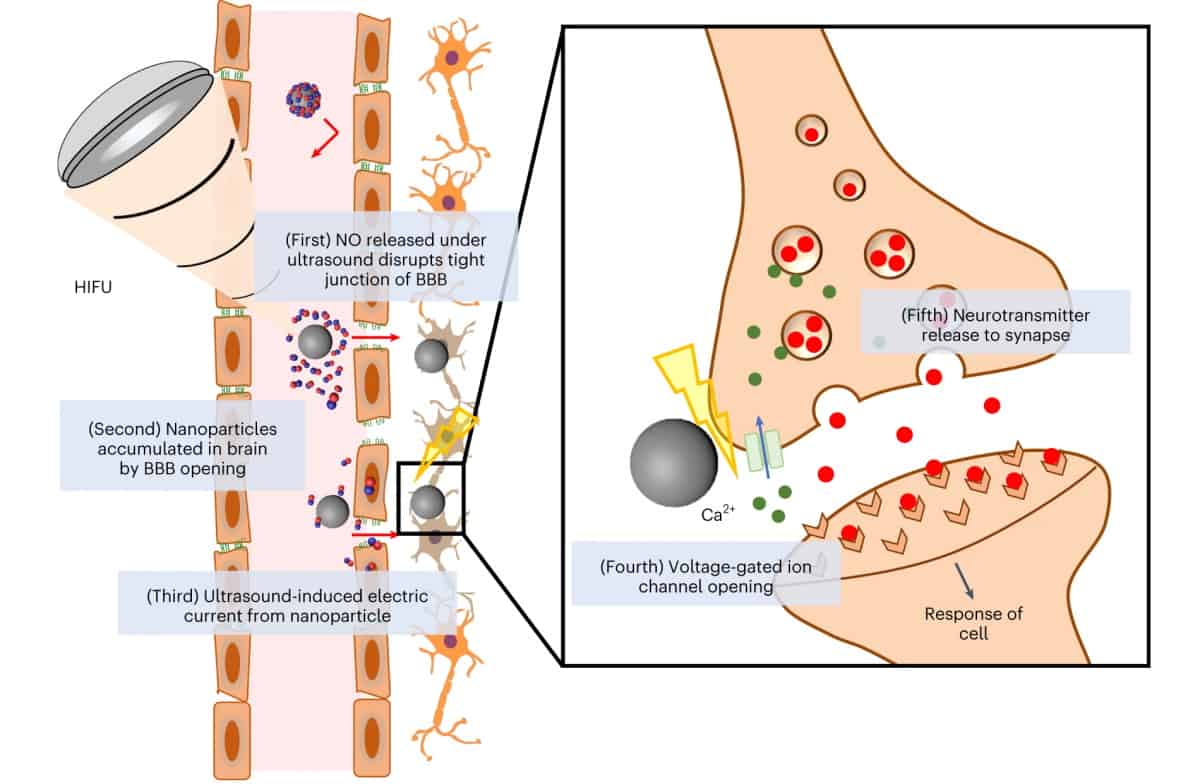
BBB opening and deep brain stimulation Schematic showing how systemically administered piezoelectric nanoparticles release NO locally in response to ultrasound and accumulate in the brain via BBB opening. The ultrasound-stimulated nanoparticles then generate current for neural stimulation, resulting in the release of neurotransmitters. (Courtesy: Nat. Biomed. Eng. 10.1038/s41551-022-00965-4)
Deep brain stimulation (DBS), in which electrodes implanted in the brain deliver electrical impulses to specific targets, is an effective clinical treatment for several neurological conditions. DBS is currently used to treat movement disorders such as Parkinson’s disease, essential tremor and dystonia, as well as conditions such as epilepsy and obsessive-compulsive disorder. The treatment, however, necessitates brain surgery to insert the stimulation electrodes, with the potential to cause numerous side effects.
To remove the need for invasive surgery, researchers from Pohang University of Science and Technology (POSTECH) in Korea are developing a non-invasive neural stimulation strategy based on piezoelectric nanoparticles. The nanoparticles serve two functions – transient opening of the blood–brain barrier (BBB) and stimulating the release of dopamine – both controlled by externally applied focused ultrasound.
Piezoelectric nanoparticles are of interest as neural stimulators because in response to external stimuli – such as ultrasound, for example – they deform and output direct current. The researchers propose that this current could then be used to stimulate dopaminergic neurons to release neurotransmitters.
One key challenge is delivering the nanoparticles to the brain, specifically, how to get them across the BBB. To achieve this, the researchers turned to nitric oxide (NO), a highly reactive molecule that shows potential for BBB disruption. They designed a multifunctional system, described in Nature Biomedical Engineering, comprising a barium titanate nanoparticle coated with NO-releasing BNN6 and polydopamine (pDA). In response to ultrasound, these nanoparticles should generate both NO and direct current.
To test their approach, lead author Won Jong Kim and colleagues first investigated the nanoparticles’ ability to release NO. In response to 5 s of high-intensity focused ultrasound (HIFU), the nanoparticles instantaneously released NO. They also evaluated the piezoelectric behaviour using a patch-clamp set-up. While solvent without pDA-coated nanoparticles exhibited no current spikes, in the presence of the nanoparticles, distinctive current spikes were seen with intensities proportional to the ultrasound intensity.
DBS is hypothesized to electrically stimulate the nervous system by opening Ca2+ channels of nearby neurons and then accelerating neurotransmitter release at the synapse. To investigate whether nanoparticle-generated current could provide similar neural stimulation, the team monitored the Ca2+ dynamics of neuron-like cells. Intracellular Ca2+ concentration significantly increased in cells receiving both nanoparticles and ultrasound, whereas either ultrasound or nanoparticles alone did not have any effect.
Cells treated with ultrasound-stimulated nanoparticles also generated an increased extracellular concentration of dopamine, indicating Ca2+ influx-mediated neurotransmitter release. Again, no significant change was seen with either ultrasound or nanoparticles alone. Tests using non-piezoelectric nanoparticles showed insignificant changes in Ca2+ influx and neurotransmitter release, indicating that these effects arise primarily in response to piezoelectric stimulation.
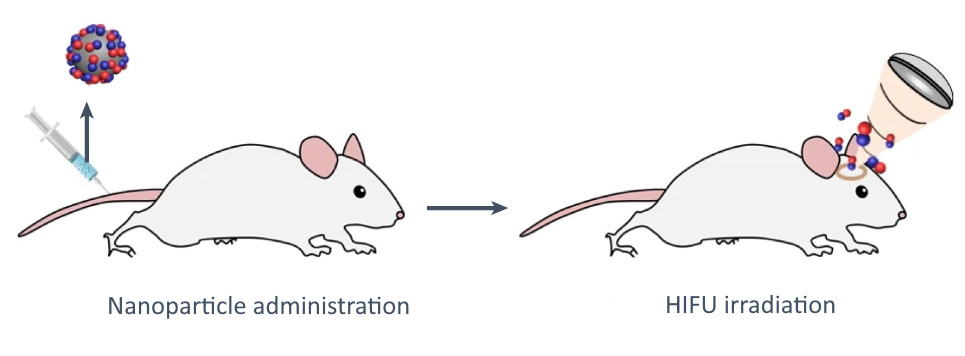
The researchers next performed a series of in vivo studies. To investigate NO-mediated BBB opening, they intravenously injected mice with NO-releasing piezoelectric nanoparticles and then applied HIFU to targeted brain sites under ultrasound guidance.
In vivo studies Mice received intravenous injections of nanoparticles, followed by HIFU. (Courtesy: Nat. Biomed. Eng. 10.1038/s41551-022-00965-4)
Two hours after injection, transmission electron microscopy revealed significantly higher amounts of nanoparticles accumulated inside the animals’ brains compared with control groups, demonstrating that the release of NO temporarily disrupted the tight junctions in the BBB. The researchers also showed that 2 h after HIFU application, the BBB was no longer permeable, confirming that the NO-mediated BBB disruption is only temporary.
Finally, the team evaluated the therapeutic effects of the nanoparticles using a mouse model of Parkinson’s disease. Mice were injected with nanoparticles followed by multiple applications of HIFU at the subthalamic nucleus (the US Food and Drug Administration-approved DBS targeting site) to restore dopamine levels in the brain.
DBS using the ultrasound-driven nanoparticles enhanced the animals’ behavioural functions, including motor coordination and locomotor activity. The mice showed a gradual improvement in motor function with daily HIFU stimulation for 10 days, with locomotor activity almost restored by day 16. The team surmise that the piezoelectric nanoparticles induced neurotransmitter release, which significantly alleviated the symptoms of Parkinson’s disease without causing any significant toxicity.
“We hope that ultrasound-responsive NO-releasing piezoelectric nanoparticles can be further developed into minimally invasive therapeutic approaches for the treatment of neurodegenerative diseases,” they conclude.
The group is now employing fundamental studies to determine out the underlying mechanisms for NO-mediated BBB opening. “We are also developing next-generation NO-modulatory materials to maximize their clinical usage while also minimizing their unwanted side effects,” explains first author Taejeong Kim.
The world is always in a state of flux – and no more so than now. Triggered in part by the COVID-19 pandemic, it’s clear that new technologies, such as telemedicine, digital payments and industrial automation, are moving faster than ever. We also need to find ways to decarbonize the economy, deal with an ageing population and harness the power of artificial intelligence.
In the light of these challenges, it’s vital that universities give students the right knowledge and skills so they can create and develop the next generation of technological solutions to tomorrow’s problems. With their unique combination of high-level scientific knowledge, numeracy and problem-solving skills, physicists are well placed to meet these needs in a wide range of hi-tech industries.
However, physicists often fall short on broader translational skills, such as effective communication, team working, creativity and the ability to find cross-disciplinary solutions to complex problems. Furthermore, traditional physics degrees often overlook the fact that many physicists do not end up in academic or physics-specific roles. Instead, they move into areas such as manufacturing, energy, finance and teaching, where they have to apply their knowledge in ways they have not been taught.
Ensuring enough physics graduates have the right mix of skills is a huge challenge for educators. It’s pleasing therefore that the Institute of Physics (IOP) revised its degree accreditation framework in 2022 to encourage universities to design more flexible physics degrees. Departments that want IOP accreditation now need to make translational skills more prominent, while placing an equal emphasis on knowledge and skills.
Future physicists To better prepare physics graduates, teaching methods need to change. (Courtesy: iStock/PeopleImages)
The new framework should ensure that physics graduates are better prepared for the world of work. It will give them “skills clusters” – combinations of translational and technical skills that are valued by graduate employers and can be used in many different careers. It will also encourage universities to teach and assess in innovative ways. Physicists heading into financial technology, cybersecurity or IT, for example, will need data-science and machine-learning skills alongside their core physics expertise.
We are also seeing the emergence of entirely new educational models that are challenging the traditional degree structure. Stanford University’s thought experiment Stanford2025, as well as UA92 in Manchester and 01 Founders in London, are all designed to attract students from more diverse backgrounds, and align more closely to employers’ needs. Rather than just being about what students learn, their focus is increasingly on how the students are taught and assessed.
But what would a physics degree look like if we were to start a new university or a new course entirely from scratch? How could we redesign physics courses to more closely match the skills that physics students and employers need? And what lessons can we learn from the way in which degrees were forced to adapt during the pandemic? Which changes were effective, and which were not?
Those were some of the issues that graduate recruiters and university physicists discussed during a series of IOP-supported webinars that took place in 2021. Organized by the UK’s South East Physics Network (SEPnet) and the White Rose Industrial Physics Academy (WRIPA), the webinars raised some fascinating issues that we summarize here. As the COVID-19 pandemic fades into the background, here are five important questions we need to ask ourselves if we are to create the physics degree of the future.
1. How do we teach students to tackle open-ended, unfamiliar problems?
Employers want graduates who can solve problems that are not necessarily well-posed or lie in a specific scientific area. However, those who recruit physicists often comment that candidates struggle with open-ended questions. This shortcoming may be due to the traditional “modular” nature of physics degrees, where each assessment only tests students on what they know about one particular topic.
No firm answer Physics students need to learn how to answer open-ended questions. (Courtesy: iStock/SeventyFour)
Take optics, for example. Students are often taught and assessed in terms of topics such as diffraction and interferometry, which means they only know how to solve questions framed in certain ways. It’s a method of teaching that reinforces “siloed thinking”, with students not realizing – or knowing – that optics is also hugely relevant to areas such as robotics, advanced driver-assistance systems and healthcare.
An alternative approach would be for students to be introduced to a number of topics at one time, with assessments based on all prior learning. This “programme-level” or “portfolio assessment” method could enable students to make new connections across different areas, and help them think more creatively about ways to solve unfamiliar problems.
Problem-based learning (PBL) programmes are already offered by a number of institutions, such as the University of Maastricht in the Netherlands, and the new coding college 01 Founders in the UK. Students here work in small groups to solve real-world problems that incorporate four key learning principles. They build knowledge from experiences rather than rote learning (“constructive education”), and apply knowledge and skill to societal challenges (“learning in a relevant context”). Meanwhile, “collective learning” and “self-directed education” mean students learn from peers and begin to manage their own education.
In terms of our future physics degree, a PBL programme could mean students taking part in one group project per term, during which they apply their learning to solve research or technical problems based on global challenges, possibly posed by businesses. Students would develop a variety of skills, such as project management, report writing, communicating and collaboration, as well as learning to think creatively in order to solve open-ended problems.
We also think that physics educators can learn from their colleagues in engineering. Far too often it’s assumed that physicists will stay in academia, with students striving to get top grades and universities reinforcing the idea that academic excellence is the only important measure of ability. In non-university roles, however, you need more than just academic ability to succeed.
Team work Some institutions offer group projects, where students work together to solve real-world problems. (Courtesy: iStock/franckreporter)
Engineers are much more aware of the realities of work. As well as using a variety of teaching methods that focus on the application of scientific principles, many engineering degrees do a far better job at engaging with industry and preparing their students for a variety of careers. We need much greater industry input into our future physics degrees to ensure we equip graduates with the skills that businesses need.
2. How do we account for students’ different learning styles?
The favoured method for teaching in universities, particularly in pure sciences, has long been the traditional lecture. However, the COVID-19 pandemic forced departments to try different approaches, including online sessions. It’s not been a smooth ride, with some undergraduates even having their tuition fees refunded because of complaints about the poor quality of tuition.
But there have been benefits. For example, some students seem more engaged and are more likely to ask questions in a chat box than they would if the lecture was face-to-face. Digital learning has also helped those with some disabilities or who face long commutes. What’s more, because online lectures are typically recorded with notes, the ability to return to recorded material later can be beneficial for reinforcing learning.
However, an over-reliance on online and recorded material can make it hard for students to choose and prioritize the resources they need. In addition, some students are not engaged by online learning, simply “switching off” during live sessions. Without face-to-face interaction, students lose the ability to interact with their peers and build their social skills.
The way that undergraduates study and learn has changed too. They rarely use textbooks, while libraries are now more valued as a space to study than somewhere to access learning materials. Tutorials have become more important for students to meet each other and staff in person. They are perfect for groups to work together to solve real-world problems, boosting their employability as well as their social skills.
But it’s not just about the students; academics are changing too. With staff and students returning to campus, academics have acknowledged the benefit of a hybrid form of teaching to engage more undergraduates. A tailored, “Netflix-type” offer featuring both in-person and virtual sessions could help meet a greater number of students’ individual learning needs and preferences to cover the same content.
3. How can we assess students on their ability to master challenges and apply their knowledge?
Traditionally, physics students were assessed through “closed-book” exams, where they sat in an exam hall for a fixed period of time and were tested on everything they know on one particular subject. But with the shift to online learning during the pandemic, educators have been forced to try new approaches to get a better understanding of a student’s ability and potential.
Continuous assessment, for example, has been introduced in some cases via regular online quizzes and “gamification” to measure progress and highlight gaps in understanding. It’s possible that, in the future, different online assessment methods (such as reflective journals, or patchwork assessment) could be used to assess the same academic content to suit students’ preferred learning style.
But should we go further? Why don’t we assess students based on their depth of learning (in other words, their ability to transfer and apply learning in different contexts) rather than on their ability to simply regurgitate information in order to progress to the next teaching level?
This alternative model of learning already exists in primary schools, where pupils of varying ages sit in different groups depending on their ability to accomplish certain tasks commensurate with a “mastery level”, rather than being separated according to age. Learners must demonstrate mastery in unit tests, typically achieving an 80% mark, before moving on to a new task. Mastery learning can be defined as a level of deep understanding about a topic that is maintained and can be recalled over time.
Mastering skills Primary-school pupils have to demonstrate mastery of a task before moving on to the next. (Courtesy: iStock/insta_photos)
In contrast, university students taking traditional “summative” tests typically need to get only 50% in their exams to move onto the next year of study. The problem with this approach is that students often end up with a superficial and shallow knowledge. What’s more, they often forget the information and are unable to apply it to different contexts. That’s no good for employers, who want graduates who can do more than just memorize facts and information.
If the model used at primary schools were adopted in a university setting, students would continue the cycle of studying and testing until the mastery criteria are met. Those who do not achieve this deeper level of understanding would be given extra support via, for example, tutoring, peer-assisted learning or small group discussions.
4. Can technology be used to enhance or replace laboratory work?
When it comes to experimental work, undergraduates are traditionally made to attend face-to-face lab sessions where they work their way through specific, well-known experiments. As well as developing practical skills, these timetabled hours give students structure to their working day, helping them plan and manage their time, and allow for group work and social interaction. However, the pandemic forced physics departments to reassess this approach almost overnight, and rapidly refashion experiments for an online world.
Some better-resourced universities were able to provide students with individual kits while others relied on video demonstrations. One department (which wishes to remain anonymous) offered some of their undergraduates socially-distanced, face-to-face lab sessions while others took part in virtual lab work online. This approach, while resource-intensive and challenging, did provide interesting results.
The assumption had been that students working online would have a less valuable experience than those in the lab. It turned out, however, that those very same students enjoyed working on their own – particularly as they could still interact with others to exchange ideas via chat forums. As a result, this department decided to continue with this approach to digital lab teaching.
Online laboratories Since COVID-19, virtual experiments have become more commonplace. (Courtesy: iStock/Alina-Vasylieva)
For some students with particular learning styles or needs, virtual labs are simply more effective. The Open University – which makes its students do experiments virtually through the OpenSTEM Labs interface – has also found that this method lets students learn from their mistakes. At in-person teaching labs, there’s often no time to make errors or repeat experiments as you would do in real research. Virtual platforms offer that flexibility and provide feedback about mistakes via a live feed.
For a future physics degree, a hybrid approach – with a mix of virtual and in-person experiments – seems essential. Students could, for example, go online to plan their experiments ahead of a class so that their time in the lab is more focused and involves more group work. They’d gain from the practical and social benefits of the real-lab experience, while also improving their independent learning.
Reduced time in the lab would also be cheaper for universities and free up vital lab space for other activities. We know that physics is an expensive degree course and the inclusion of high-quality virtual experiments, especially towards the start of a physics degree, could be vital in showing a university is ahead of the curve compared to others.
5. How do you attract and support a diverse community of students and staff in physics?
Most businesses understand that a diverse and inclusive workforce can lead to better ideas, decision-making and success. They realize the importance of reaching a wider talent pool to attract the best graduates, and of reviewing their recruitment processes and working environments to ensure they are more inclusive.
Universities need to do the same. Higher education is ultra-competitive, with degree courses increasingly measured and evaluated on the success of graduate employment and student satisfaction ratings. Universities need to ensure they provide a truly inclusive environment to better attract and support talented students from all backgrounds, and enable them to meet their full potential.
Specifically, universities need to do more for under-represented groups, including people with disabilities, those from minority communities and those from lower socio-economic backgrounds. Indeed, students with social communication difficulties, including autism spectrum disorder, have been found by the UK’s Association of Graduate Careers Advisory Services to be the least likely of all disability groups to be in full-time employment and the most likely to be unemployed. This is of particular concern for physicists because data suggests that students with social or communication impairment are more commonly found in physics programmes than any other undergraduate subject.
So what can we do to support university students with disabilities and learning needs? While school pupils are typically given an education, health and care plan (EHCP), undergraduates are not universally evaluated in this way. And even when information about a student’s disability or learning needs is given to a university, it is often not shared with teaching staff and departments because of concerns with confidentiality.
Staff therefore need to be trained so that they can spot problems, and point undergraduates to relevant help and support. We also need to find ways to share information about students’ learning needs when they enrol at university, while encouraging the students themselves to declare any disabilities they have.
Inclusive support A lecturer helps students – including those with disabilities – to work together in a lab. (Courtesy: iStock/FG-Trade)
Physics degrees also need to do a lot more to attract students from diverse backgrounds by widening access opportunities to attract the best talent. There has been some progress, with most physics departments already having well-established Equality, Diversity & Inclusion (EDI) committees and policies. However, we need to make sure that staff themselves are from a wide range of backgrounds too. They act as role models and mentors, and it’s important staff take part in EDI initiatives. But we must avoid making those who are from under-represented groups themselves shoulder all the responsibility for solving diversity issues. Empowering more staff to be accountable for diversity issues means the work isn’t dumped on just a few but is shared by many people.
So what does a physics degree of the future offer?
With the changing job market, growth of digital technology and greater awareness of diversity issues, physics degrees need to evolve.
Employers increasingly want graduates with good team work and problem solving skills, and it is possible to provide these via academically rigorous physics degrees. In fact, businesses do not want physics degrees to be “dumbed down” in any way. Instead, educators need to consider how these skills can be embedded within the curriculum so as to prepare students to better apply their knowledge at work.
Furthermore, across the higher education sector, new ways of teaching and different university models are being set up to attract and meet the needs of all students. These new approaches to curriculum design – along with changes to the IOP accreditation process – offer ideas about how the physics degree can evolve to equip every student with the skills and knowledge needed for future employment markets.
From the physics of the perfect burger to a board game inspired by a synchrotron, physics has had its fair share of quirky stories this year. Here is our pick of the best 10, in no particular order.
Diamond: the game
Synchrotrons and some board games have at least one aspect in common: they involve things going round in a circle. Mark Basham and Claire Murray from the UK’s Diamond Light Source synchrotron and Matthew Dunstan at the University of Cambridge saw the parallels and created “Diamond: the Game”. Suitable for anyone aged 10 and over, the game – which takes no more than half an hour to complete – puts players in the role of a researcher at Diamond. By visiting different beamlines while progressing round the board, participants learn about the diversity of science that is done at the facility – including physics, chemistry, cultural heritage and more. The game has been tested by more than 200 students and was released online as a free-to-print game in 2020. Since then, Diamond has been played by more than 14,000 players in more than 30 countries worldwide. Whether it makes being stuck on the beamline at 2 a.m. more bearable is open to question.
In the doghouse
The auction house Christie’s held its annual sale of rare and unusual meteorites in late February. The 66 lots included a 15 g fragment of the Winchcombe meteorite, which in 2021 became the UK’s most coveted rock after it was seen across the sky over the Cotswold town. It sold for a cool $30,240 while a smaller 1.7 g fragment fetched $12,600. Another item under the hammer was a meteorite that in April 2019 created an 18 cm hole in the oxidized tin roof of a doghouse in Aguas Zarcas, Costa Rica. Its resident, a German shepherd named Roky, survived unharmed. The kennel-striking meteorite, which is 70% covered with “fusion crust”, had a guide price of $40,000–60,000 but in the end went for a disappointing £21,240. But that wasn’t the most unusual item. “Lot 4” was the doghouse itself, placed on some artificial grass together with an orange dog bowl. The lot had a guide price of $300,000, and though it went for a paltry $44,100, that’s still probably enough to buy Roky a nice new home.
Here’s your chance of love
In late 2020 physicist Steven Wooding created an online resource to persuade “flat-Earthers” that the Earth is spherical and not a disc. Wooding was back this year with a new project about something just as tricky – finding your chances of love. Released just before Valentine’s Day, the Drake Equation for Love Calculator is an adaptation of the famous Drake equation, which estimates the number of alien civilizations in our galaxy with whom we could communicate. The love calculator – created with the help of data scientist Rijk de Wet – asks users to input their location, social skills and attractiveness as well as the age range of potential partners and whether they are university educated. The output is then compared to the possibility of an alien civilization existing within 1000 light-years of the Earth. Wooding told Physics World that his own odds of finding love are 2.1 times better than the possibility of alien life. Is he being perhaps a bit picky?
Jurassic race
Could the Jamaican sprinter Usain Bolt have beaten a 400 kg dinosaur in a 100 m sprint? It’s probably not a question you’ve wondered about before, but Scott Lee, a physicist from the University of Toledo in Ohio, thought it would be a good problem for his students to solve. To make it a fair race, Lee choose the theropod dinosaur Dilophosaurus wetherilli as it’s thought to have had a top running speed of about 10 m/s, which is just a shade over Bolt’s 9.58 s world record that he set in the 100 m sprint at the 2009 World Athletics Championships in Berlin. Using concepts from 1D kinematics and numerical techniques, the students discovered that Bolt’s acceleration at the start would leave the Dilophosaurus in the dust, with the legendary sprinter winning the race with a good two seconds to spare. Given that the Dilophosaurus had razor-sharp claws and the ability to spit venom at its pray (as DNA thief Dennis Nedry discovered in the film Jurassic Park), we imagine Bolt – in any hypothetical race – would have plenty of motivation to smash his own record.
Quantum life: an electron microscope image of a tardigrade. (Courtesy: Elham Schokraie et al./PLOS ONE 7(9): e45682/CC BY 2.5)
Entangled tale
Imagine being able to survive when chilled to near absolute zero. That’s what tiny organisms called tardigrades can do, but could these cute-looking “water bears” have another low-temperature trick up their sleeve? To find out, an international team of physicists chilled a tardigrade to below 10 mK and then used it as the dielectric in a capacitor that itself was part of a superconducting transmon qubit. The researchers then entangled the qubit – tardigrade and all – with another superconducting qubit before warming up the tardigrade and bringing it out of its latent state of life called cryptobiosis. Some physicists, however, remain unconvinced. “This is not entanglement in any meaningful sense,” Rice University physicist Douglas Natelson noted on his blog. Whether or not the researchers achieved quantum entanglement, they definitely did set a record for the extreme conditions that a complex lifeform can survive, with the tardigrade spending 420 hours at temperatures below 10 mK and pressures of 6 × 10⁻⁶ mbar.
Keeping a lid on it
Closing the lid on your favourite board game box can take a while as it slides down the base to close. This so-called “telescoping” cardboard box – where the lid barely overlaps with the base – is commonly used to hold or ship a variety of objects from board games and footwear to mobile phones. Such boxes are cheap to make and while the economic and environmental aspects have been well studied, the physics never had. To make amends, Jolet de Ruiter from Wageningen University and colleagues carried out experiments on commercially available boxes and 3D printed models to investigate the fluid dynamics of the sliding box lid. The researchers used low-Reynolds-number fluid flow to derive a theory for the flow of a thin film of air in the gap between the lid and base. They then compared this to experiments to find that the fastest way for the box lid to close is not based on a conventional straight lid-base configuration but for the lid to have a slight angle – just a few degrees – relative to the vertical base. If this design ever hits the shelves, we can thank the researchers for thinking outside the box.
Let’s do the twist
When it comes to eating an Oreo, some of us can’t resist twisting the two biscuits apart and licking the filling off. That’s because most – if not all – of the filling ends up stuck on one biscuit or the other. Crystal Owens, a PhD student at the Massachusetts Institute of Technology, tackled the physics of how that mysterious separation occurs. She and her colleagues created an “oerometer” – a rheometer that grasps the two biscuits and gives the cookie a twist until it separates into two. They confirmed that the filling always ends up on one biscuit, suggesting the effect doesn’t depend on precisely how an Oreo is twisted. The amount of filling doesn’t affect the separation process either, although what does make a difference is the twisting speed, with a slow twist being better for a clean break. Unfortunately, the research doesn’t explain why the filling always ends up on one side, though Owens reckons it could be linked to how Oreos are manufactured. Yeah, but what about custard creams?
Supersonic: gases escape very quickly from a champagne bottle. (Courtesy: Shutterstock/Lukas Gojda)
Fizz goes supersonic
Opening a bottle of good champagne is one of life’s great delights and it is also a process that involves a lot of physics. Gérard Liger-Belair from Université de Reims Champagne-Ardenne and colleagues studied the uncorking process in more detail, in particular what happens in the few milliseconds after a bottle has been opened. In 2019 research by the group showed, for the first time, the formation of shock waves in the fluid during cork popping. Building on that work, the team found that a succession of normal and oblique shock waves combines to form “shock diamonds” – patterns of rings typically seen in rocket exhaust plumes. It results in the gas mixture escaping from the bottle at supersonic speeds. “Our paper unravels the unexpected and beautiful flow patterns that are hidden right under our nose each time a bottle of bubbly is uncorked,” says Liger-Belair. “Who could have imagined the complex and aesthetic phenomena hidden behind such a common situation experienced by any one of us?” We’ll raise a glass to that.
The physics of the perfect burger
What is the most effective way to grill a burger or a steak – flip the meat once or many times? Some chefs think you should flip only once as doing so multiple times will mean less browning and therefore less flavour. Others, however, claim that regular flipping results in a more even cook and is also about 30% faster, given that each surface of the meat is exposed to heat relatively evenly and has less time to cool down. Mathematician Jean-Luc Thiffeault from the University of Wisconsin in the US created a “simple” model to demonstrate this speedy cooking time for flipped meat. Assuming a burger is an infinite thin slab and has symmetric thermal properties – i.e. the same at the top and the bottom – he used a 1D heat equation to find that flipping the patty once results in a final cooking time of about 80 seconds. This falls for every subsequent flip so that 20 flips results in a 20% drop in cooking time. Taking Thiffeault’s model to its mathematical extreme, a burger could cook in 63 seconds – if you flipped it infinitely many times. That would challenge even the most experienced grillers.
Follow ewe, follow me
What do the murmuration of starlings, the motion of micro-organisms, and the stopping and starting of traffic on a busy motorway have in common? They’re all examples of collective motion studied by physicists – and now you can add flocking of sheep to the list. Fernando Peruani from the Côte d’Azur University in Nice, France, led a study that examined the roles played by “leaders” and “followers” in driving the motion of flocks of sheep. His team combined observations of flocking with mathematical models to show that the sheep’s collective motion is governed both by the movement of a lead animal and the way in which other animals in the flock respond. Peruani and his gang also found that individual sheep alternate between leaders and followers in a seemingly random way. The team concludes that the collective motion of sheep is governed by both hierarchical and democratic processes within the flock. You herd it here first.
You can be sure that next year will throw up its fair share of quirky stories from the world of physics. See you next year!
See, swirl, sniff, sip and savour – these are the five S’s of wine tasting. You, or the oenophile (wine connoisseur) in your life may be well-versed in swirling that perfect glass of fruity Beaujolais, before deeply inhaling the bouquet, and then finally taking that first sip. While some people consider it a pretentious way to consume a beverage, these steps do have a direct impact on the taste of a glass of wine. Indeed, there’s a surprising amount of science that goes into each of the S’s of wine drinking.
Let’s start with the glass itself. While there’s nothing stopping you from drinking wine from any kind of vessel (including straight from the bottle, should it please you), the shape of a wine glass has a direct impact on the flavours we perceive. A traditional wine glass has four key components: the “foot” or the flat base of the glass; the “stem” or the spindly bit that you hold, which helps keep the wine at the right temperature; the “bowl” or the actual curved receptacle that holds the wine; and finally the “rim” or the edge of the glass.
The shape of the glass determines how the vapours of the ethanol – the alcoholic bit in wine – reaches the nose and mouth. The strength and intensity of a wine’s aroma depend on the size of the bowl relative to the rim – the bigger the bowl, the more aromas will be released; and the more tapered the rim, the easier it is for these scents to reach your nose. Most wine glasses are shaped so that the aromas are centred within the bowl, while the ethanol is pushed out to the rim, not reaching the nose.
Even the taste of the wine, once you sip it, is impacted by the shape of the glass. You’ll find yourself tilting your head either forwards (likely when tasting from a wide-brimmed glass) or backwards (while attempting to navigate your nose past the brim of a narrow flute). The tilt of your head determines the speed and intensity with which the wine enters your mouth, which in turn dictates how many of your tastebuds are impacted at the same time. This accounts for the strong “mouthfeel” of a full-bodied Merlot, for example.
Beyond the physical glass, aficionados are often tempted to swirl their wine, and comment on its “legs” as an indicator of quality. Also dubbed “tears”, “fingers” and even “church windows”, this is the ring of drops that forms near the top of your glass, and it is rooted in physics.
These tears are a consequence of wine being an inhomogeneous mix of water and alcohol (along with some sugars and acids). As you swirl your glass, most of the wine sloshes back down, but a thin film is left behind on the walls of the glass – capillary action making it climb the sides. What’s happening is that the alcohol and the water in the film begin to evaporate quicker than in the bulk of your drink – but the alcohol in the film evaporates faster than the water due to its higher vapour pressure. The alcohol’s swift evaporation and its consequent drop in concentration means that the surface tension of the film increases, pulling up liquid from the bottom of your glass, which has a lower surface tension (as it still has more alcohol).
This flow of liquid due to surface tension gradients is referred to as the “Marangoni effect” in honour of the Italian physicist Carlo Marangoni, who originally studied mass transfer along an interface between two phases due to a gradient in surface tension. But the first person to accurately describe the basic mechanism behind the “tears of wine” phenomenon, in 1855, was physicist James Thomson, the elder brother of Lord Kelvin.
While the Marangoni effect explains the flow of wine up the side of the glass, it was for many years unclear why the flow forms individual drops. But could gravity hold the answer? In 2019 Andrea Bertozzi and colleagues at the University of California, Los Angeles, carried out a theoretical analysis of the non-classical dynamics of wine glasses and wine tears, factoring in gravitational effects that were previously ignored (Phys. Rev. Fluids5 034002).
Their model found that the film’s thickness plays a key role in how the tears are formed. Indeed, if the film is uniform and thick enough, it flows back down in a sheet. Their experiments and calculations instead showed that the liquid moves up in a bulging wave that leaves behind a thin film. They describe this as an unstable “reverse undercompressive shock wave”, which breaks up to form tears.
This type of Marangoni flow does not just affect wine but has an influence on everything from crystal growth in semiconductors to the radiation of heat in your laptop. In fact, over the last decade, the European Space Agency (ESA), NASA and the Japan Aerospace Exploration Agency have all carried out experiments to study the effect on the International Space Station, in microgravity, with a new ESA experiment due to start next year.
Despite all the physics involved, the tears of wine don’t indicate how good the wine is, but simply its alcohol content. Literally, more alcohol means more tears.
Materials and nanotechnology are thriving fields for physicists, who often benefit from collaborating with chemists, biologists, engineers and, of course, materials scientists. This makes materials and nanotechnology fascinating to write about, and this year has been no exception. Here is a selection of some of our favourite materials and nanotechnology research stories that we published in 2022.
The integration of nanomaterials with living organisms is a hot topic, which is why this research on “inherited nanobionics” is on our list. Ardemis Boghossian at EPFL in Switzerland and colleagues have shown that certain bacteria will take up single-walled carbon nanotubes (SWCNTs). What is more, when the bacteria cells split, the SWCNTs are distributed amongst the daughter cells. The team also found that bacteria containing SWCNTs produce a significantly more electricity when illuminated with light than do bacteria without nanotubes. As a result, the technique could be used to grow living solar cells, which as well as generating clean energy, also have a negative carbon footprint when it comes to manufacturing.
Much of the world’s cultural heritage exists in material form and scientists play important roles in preserving the past for future generations. In Switzerland and Germany researchers have used an advanced, non-invasive imaging technique to help restore medieval objects that are covered in zwischgold. This is a highly sophisticated material comprising an ultrathin gold layer that is backed by a thicker layer of silver. Zwischgold deteriorates over the centuries, but experts had been unsure of its original structure and how it changes with time, making restoration difficult. Now, a team led by Qing Wu at the University of Applied Sciences and Arts of Western Switzerland and Benjamin Watts at the Paul Scherrer Institute have used an advanced X-ray diffraction technique to show that zwischgold has a 30 nm-thick gold layer, compared to gold leaf, which is typically 140 nm. They also gained insights into how the material begins to separate from surfaces.
The term “wonder material” is probably overused, but here at Physics World we think it is an apt description of the perovskites – semiconductor materials with properties that make them suitable for making solar cells. However, perovskite devices have their downsides, some of which are related to surface defects and ion migration. These problems are exacerbated by heat and humidity – the very conditions that practical solar cells must endure. Now, Stefaan De Wolf at the King Abdullah University of Science and Technology in Saudi Arabia and colleagues have created a perovskite device made from 2D and 3D layers that is more resistant to heat and humidity. This is because the 2D layers act as a barrier, stopping both water and ion migration from affecting 3D parts of the device.
The conservation of angular momentum is a cornerstone of physics. This is why scientists had been puzzled over the fate of spin in some magnets, which appeared to vanish when the materials are bombarded by ultrashort laser pulses. Now, researchers at the University of Konstanz in Germany have found that this “lost” angular momentum is in fact transferred from electrons to vibrations of the material’s crystal lattice within a few hundred femtoseconds. Firing laser pulses at magnetic materials can be used to store and retrieve data, so understanding how angular momentum is transferred could lead to better storage systems. The Konstanz experiment could also lead to the development of new ways to manipulate spin – which could benefit the development of spintronic devices.
Hot electrons: the scanning ultrafast electron microscope at the University of California, Santa Barbara. (Courtesy: Matt Perko/UCSB)
Speaking of wonder materials, 2022 was the year of cubic boron arsenide. This semiconductor had been predicted to have two technologically significant properties – high hole mobility and high thermal conductivity. Both of these predictions were confirmed experimentally this year and the researchers who did that are honoured in our Top 10 Breakthroughs of 2022. But it has not stopped there, later this year Usama Choudhry and colleagues at the University of California, Santa Barbara, and the University of Houston used scanning ultrafast electron microscopy to confirm that “hot” electrons in cubic boron arsenide have long lifetimes. This is another highly desirable property that could prove useful in the development of solar cells and light detectors.
It is estimated that 20% of all electricity used globally is expended on conventional vapour-compression refrigeration and air conditioning. Furthermore, the refrigerants used in these systems are powerful greenhouse gases that contribute significantly to global warming. As a result, scientists are trying to develop more environmentally friendly refrigeration systems. Now, Peng Wu and colleagues at Shanghai Tech University have created a solid-state caloric cooling system that uses electric fields, rather than the magnetic fields to create strain in a material. This is important because electric fields are much easier and much cheaper to implement than magnetic fields. What is more, the effect occurs at room temperature – which is an important requirement for a practical cooling system.
We are going to squeeze one more wonder material into this year’s round-up, and that is magic-angle graphene. This is created when layers of graphene are rotated relative to each other, creating a Moiré superlattice that has a range of properties that depend on the angle of the twist. Now, Jia Li and colleagues at Brown University in the US have used magic-angle graphene to create a material that exhibits both magnetism and superconductivity – properties that are usually at opposite ends of the spectrum in condensed-matter physics. The team interfaced magic-angle graphene with the 2D material tungsten diselenide. The complex interaction between the two materials allowed the researchers to transform graphene from a superconductor into a powerful ferromagnet. This achievement could give physicists a new way to study the interplay between these two usually separate phenomena.



 This webinar will demonstrate planning tools available for the Gamma Knife, such as inverse optimization, which can be used to improve plan consistency and quality and, remote access that allow users to contribute and explore plans from any location.