Crash, bang: the rollercoaster physics of ultra-long financial bonds

In the high-octane world of high finance, bonds are not usually the most exciting assets. Safe, slow, dependable, they are supposed to be the sensible choice for investors seeking long-term financial security. Often issued by governments that want to raise money to fund major projects, the bonds will be bought by investors who are effectively loaning their cash with guaranteed, long-term paybacks.

In 2022, however, the safety of bonds appeared to change. According to the US financial-analysis firm Bloomberg, the global bond market suffered an “unprecedented” loss between January and September of over 20%, in response to rising interest rates. Worse still, the value of a particular class of bonds – those that would mature and be cashed in over periods as long as 100 years – tumbled by as much as 60%.

To use a transport analogy, bonds have been behaving less like a smooth, dependable family saloon car, and more like a rollercoaster. In fact, the size of the losses has been beyond the usual predictors of bond behaviour. But for the physicist-turned-financier Jessica James, who is managing director at Commerzbank AG in London, the turbulence in the bond market came as no surprise.

In May 2021 James and two Commerzbank colleagues published a paper in the journal Quantitative Finance (21 1067), in which they pointed out that such a dramatic drop in value was a likely scenario – precisely because, as it turns out, very-long-term bonds and rollercoasters share similar physics. “There can,” says James, “be an extreme sensitivity to interest rate changes.”

Bonds: a simple guide

The basic concept of a bond is simple. It’s a debt, or an IOU: a contract between an “issuer” (such as a government or company) that needs to borrow money, and a “purchaser” (an insurance company, pension fund, bank or individual investor) that is prepared to loan the money for a specified time.

When that time is up, the bond is said to have reached “maturity” and the issuer must repay its debt in full. Until then, the purchaser can expect a regular stream of smaller payments, or “coupons”, from the issuer, which are a fixed percentage of the final sum. Issuers are usually large companies, banks or governments seeking to raise millions or billions of dollars.

Let’s say you buy a bond worth $1000 from an issuer with a coupon rate of 5% and a maturity of 10 years. As the purchaser, you’ve spent $1000, but will receive 5% × $1000 = $50 every year for the next 10 years, totalling $500. When the 10 years are up, the issuer will – hopefully – pay you back your original $1000.

That “hopefully” is important. Like any other financial investment, bonds carry a risk. The issuer might go bankrupt and be unable or unwilling to pay you back. And even if the issuer does pay you back in full, the money will – owing to inflation – not be worth as much as it once was in terms of purchasing power.

In our example, you can expect to accumulate a total of $500 in coupon payments once your $1000 bond has matured after 10 years. But if inflation is, like the coupon rate, 5%, then the $1000 itself will effectively have fallen in value by $629 compared with an equal investment that had kept pace with inflation. (The compounding effect of inflation means that 5% year-on-year equates to about 6.29% over 10 years.)

In other words, you’ll have lost more than you gained, and you’d have been better off putting your cash in gold or other investments that typically gain during periods of inflation. It’s why bond purchasers hope their coupon rates are much higher than inflation, so that their bonds retain their value, and on maturity realize net gains. And since interest rates tend to follow inflation, bond purchasers keep a close eye on inflation rates too.

Of course, if the economic situation looks bleak, a purchaser can always sell his or her bonds to someone else – for a price that reflects that new situation, and the current financial health of the issuer. In fact, that’s precisely what happened in the bond markets during 2022.

As inflation and interest rates rose, maturity payments became less attractive in present value terms. Investors therefore saw their bonds plummet in value and so progressively sold them on the expectation that inflation will continue to rise and their bond values will continue to fall.

Existing bonds, therefore, have become less valuable assets. A bond that was worth, say, $1000 in January 2022, might have been worth only, say, $800 by September. This volatility in the value of a bond is reflected in the “yield”, which is roughly the coupon payment divided by the bond value.

In January the yield would have been $50/$1000 = 5%. But by September, the yield will have risen to $50/$800 = 6.25%. So if the bond falls, the yield gets bigger and the investment becomes poorer. The bottom line is that for anyone buying a bond, rising yields are bad news.

Enter the ultra-long bonds

Despite this uncertainty, bonds have traditionally been viewed as fairly safe investments relative to stocks, which on the whole promise greater returns, but at greater risk. In fact, almost anyone with a pension will own a few bonds via their pension provider, having bought them as part of a diverse portfolio.

Once a bond is paid off it ceases to exist, which means the bond market is the sum of all current bonds. Indeed, the global bond market is enormous. The International Capital Market Association has estimated that, as of August 2020, the overall size of global bond markets was worth $128.3 trillion ($128.3 × 10¹²).

Bonds have become so important largely because of the economic situation that nations in Western Europe, North America and elsewhere have faced since the 2008 global financial crisis. After a crash, people tend to tighten their wallets, businesses struggle and staff get laid off. In response, central banks try to stimulate the economy by cutting interest rates, which encourages people to borrow and spend more money.

Macro shot of stock market screen showing plummeting prices

But within months of the 2008 crash, interest rates were already very low, at just 1%. By 2020, they were even less, hovering close to zero. So like other central banks, the Bank of England created vast amounts of new money and used it to buy bonds issued by the UK government and large corporations. The method, known as quantitative easing, pushes up the overall price of bonds, which in turn drives down interest on bank loans, so people can borrow and spend more easily.

Within a year of the crash, the UK had bought £200bn of bonds for this purpose. By 2020, having also had a Eurozone debt crisis, Brexit and a coronavirus pandemic to contend with, that figure had risen to nearly £900bn.

Yet the sheer size might not be the most incredible aspect of the modern bond market. Historically, most bonds, government included, have had maturities between one and 30 years, reflecting the time periods over which people feel naturally inclined to speculate. But in recent years, a new type of bond has come to the fore, with “ultra-long” maturities of up to 100 years.

Several countries, such as Argentina, Austria and Mexico, have sold these century-long bonds. So too have large corporations, including the Walt Disney Company and Coca-Cola in the US. Even academic institutions, such as the University of Oxford in the UK, have sold them.

Although ultra-long maturities might seem ridiculous – most people will be long dead before the final pay out – they have proved attractive for investment groups or individuals who intend ultimately to sell their bonds and collect coupon payments in the meantime. In fact, James believes the rise of the ultra-long bond is directly due to the post-2008 economic situation.

“The problem is that when interest rates are very low, organizations like pension funds almost can’t invest,” she says. “They’re searching for any safe-looking instrument that has a positive yield associated with it. Also, bond issuers were keen to get folk interested in their debt. The one place you could still issue a bond with a positive coupon was in the very-long-maturity range.”

Jessica James: from physics to finance
Jessica James

Jessica James completed a PhD in theoretical atomic physics at the University of Oxford in 1994 under the supervision of Patrick Sandars, who had previously taught Stephen Hawking before the latter went to Cambridge. James admits she was “not going to be his next Hawking” – so when the First National Bank of Chicago approached the Oxford physics department for suitable postdocs, she was quick to accept a flight over for an interview.

Switching from physics to finance – to become a quantitative financier or “quant” – is these days a well-trodden path. But James claims that, when she got the job in Chicago in the mid-1990s, she was one of the first. With powerful computing becoming more widely available, the bank wanted to put more resources into modelling commodities mathematically, and to find out fair prices for bond contracts.

During her career in Chicago and at other banks, James has written books about her work, and in 2001 started an academic journal, Quantitative Finance. Originally part of IOP Publishing, which also publishes Physics World, the journal is now owned by Taylor & Francis. James has also written a Physics World Discovery ebook on the field.

Mathematical modelling

A physicist by training (see box above), James herself did not talk up the virtues of ultra-long-term bonds. Indeed, after moving into her current role at Commerzbank in 2012, she began to have doubts about the character of the ultra-long-term bond market. Despite not being complicated, the mathematics that’s used to estimate the sensitivity of the value of bonds to underlying changes in interest rates was, she feels, overly simplified.

To a first approximation, investors would assume that the relationship between total return and yield is linear, with a first derivative (i.e. slope) equal to the bond duration. In other words, the longer the duration, the more likely the return is to deviate from its original figure. If investors wanted to be more precise, they would plot the relationship between return and yield as a simple quadratic curve, with a second derivative known as “convexity” (due to the curve’s convex shape).

Convexity tends to look attractive for bond investors, says James, because it suggests that a bond holder will make bigger gains when interest rates and yields drop, and smaller losses when they rise. “The idea that convexity is good for bond holders has become totally embedded in the thinking process,” says James. “It made long-dated bonds look great.”

For James, however, there was an obvious reason to be cautious about very-long-term bonds. Over the course of a century, some degree of inflation is pretty much a given, making the final payback of a bond practically worthless. If, say, inflation were to average 5% year-on-year, as it has over the past 60 years, then a $1000 bond bought now would be worth, in real terms, about $7.60 in a century’s time.

It’s not that this isn’t understood. It’s bond maths and it’s relatively easy

Jessica James

“You don’t have the cushion of the final payment being a dominant part of the bond’s value, as you do in a short-term bond,” says James. “It’s not that this isn’t understood. It’s bond maths and it’s relatively easy. But usually it’s only these two derivatives [duration and convexity] that are looked at. The loss can be much higher.”

Looking past second derivatives is not unusual for physicists. When faced with a complex system or function, they are apt to approximate it to increasing degrees of precision by using a “Taylor expansion”. In other words, rather than just expressing the function using linear and quadratic terms, you also include cubics (third derivative), quartics (fourth derivative), and so on.

Engineers concerned with passenger vehicles are also familiar with higher derivatives. According to Newton’s second law, a force on a car, say, will give it an acceleration, which is the second derivative of position. But as any driver knows, suddenly applying a force (an accelerator or brake) is likely to cause passengers considerable discomfort, and possibly even a spilled coffee.

Vehicle designers therefore often try to minimize the third derivative of position, appropriately called “jerk”, which describes the rate of change of acceleration over time. Further comfort can be achieved by considering the fourth derivative of position, which is the rate of change of jerk, or “jounce”. It’s why modern rollercoaster loops are not circular, as you might expect, but teardrop-shaped.

Riding the big dipper

While they might both have their fair share of thrill-seekers, there is not much that theme parks and financial markets have in common. Still, James and her Commerzbank colleagues Michael Leister, Christoph Rieger and Hauke Siemssen wondered how much merit the inclusion of these higher, third and fourth derivatives of bond value with respect to yield had for risk assessment. As it turns out, quite a lot (figure 1).

When James and colleagues looked at models that included the higher terms, they realized that models incorporating duration and convexity alone had been underestimating gains when yields and interest rates fell, and underestimating losses when yields and interest rates rose. The effects were most apparent for very long bonds. “A 100-year bond is not a stable instrument,” says James. “It’s a highly volatile instrument.”

1 Century blues: the problem of ultra-long-term bonds
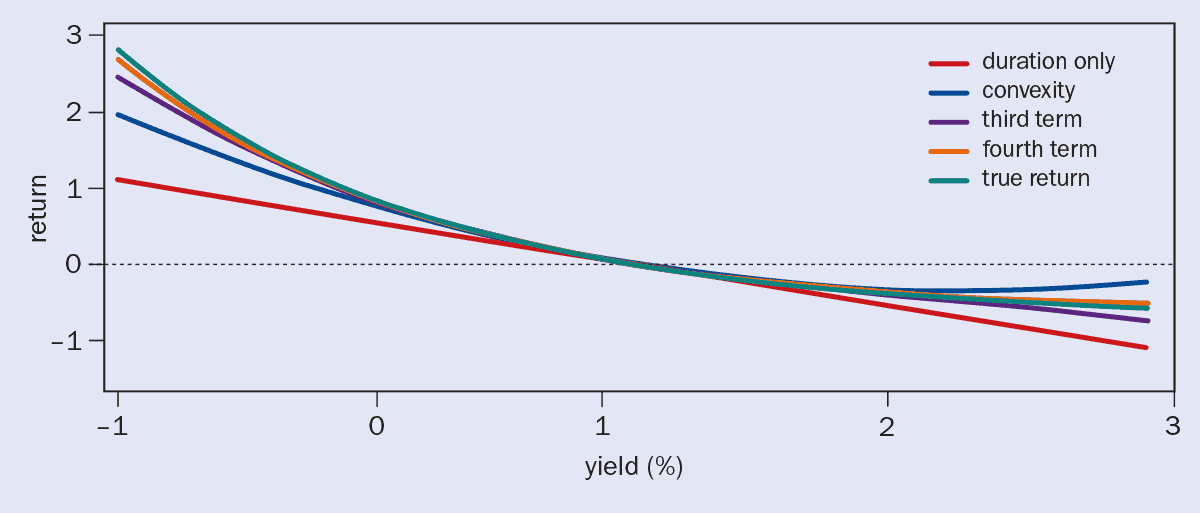
figure showing yields of ultra-long bonds

Jessica James, Michael Leister and Christoph Rieger from Commerzbank AG in Frankfurt and London have used mathematics to calculate the return for an ultra-long-term bond that matures in 100 years. This graph plots the return as a function of yield after a yield change, where yield is roughly the coupon payment divided by the bond value, with high yields being bad news for those buying the bonds (see main text). In this example, we’ve assumed the bond has a coupon payment of 2% with an initial yield of 1%. The return depends on how many terms are included in the mathematical series expansion of the return: first-order term only (“duration” – red curve); second-order term (“convexity” – blue curve), third-term (purple) and fourth-term (orange). Once you include higher terms, it is clear that models incorporating only first-order terms and second-order terms underestimate return at low yields – but underestimate the financial losses on these ultra-long bonds as yields rise.

In January 2022, some eight months after James and colleagues published their paper, their predictions were put to the test. In response to rapidly rising inflation, central banks across the world began to hike interest rates faster than at any time since the 1990s. The Bank of England, for example, raised the UK interest rate from 0.25% at the start of the year to 3% by November, with further rises due.

Suddenly, the real sensitivity of century bonds to interest rates became apparent. One issued by the University of Oxford, for example, dropped in value by nearly half, as did another issued by the German state of North Rhine–Westphalia. Yet another, issued by Austria – according to Bloomberg, one of the most highly rated government debtors – fell by over 60%.

It is, of course, impossible to know how risky the purchasers considered these bonds. If they had estimated potential losses due to interest rate hikes on the basis of duration and convexity, as is common, they would have substantially underestimated the dangers. In the case of the North Rhine–Westphalia bond – which was issued in 2021 for €3bn – such an analysis would have predicted a loss of 35%. Had they considered third and fourth derivatives, however, they would have predicted a loss of 52% – within 2% of the actual figure.

David Blake, an economist at City, University of London, agrees that the inclusion of third and fourth derivatives improves the accuracy, and such calculations are “worth doing with very-long-term bonds”. He also says it is “quite neat” that James and colleagues have provided a straightforward means to include the derivatives in calculations of bond returns in response to yield changes via the derivation of “closed form” formulae, which can be computed in a finite number of steps. He adds, however, that the formulae will only work for standard, fixed-income bonds paying regular coupons, and not those depending on more complex contracts.

The power of new thinking

The collapse in the long-term bond market might deter investors from turning to such century bonds in the same way they once did. But, says James, they are unlikely to go away – not least because ultra-long-term debt has a longer history than many people can remember.

Gertrude Janeway, one of very few widows of American Civil War veterans who lived to see the 21st century, was still collecting a $70 pension cheque every month from the Veterans Administration when she died in 2003 – almost 140 years after the war ended. Meanwhile, in 2014 the UK government chose to redeem about £2.5bn of “perpetual” bonds (those without any fixed maturity) that it issued 300 years ago – before the Napoleonic Wars.

The message is clear. Very ultra-long-term debt is probably here to stay, and it will continue to thrill financiers – and physicists – with its ups and downs for many years to come.

• This article was corrected on 12 December 2022. A $1000 bond will have fallen after 10 years by $629, assuming inflation and a coupon rate of 5% (with the 5% year-on-year equating to about 6.29% over 10 years, not 6.5% as stated). Also a $1000 bond bought now would be worth, in real terms, about $7.60 in a century’s time (not $6.80 as originally stated).
Handheld diagnostic platform could help combat epidemics

Major epidemics, including SARS, Zika and Ebola, and pandemics such as H1N1 and COVID-19 have gripped the world in the last two decades. As infectious disease outbreaks emerge with increasing regularity, the need to expand viral diagnostic and surveillance testing capacity to contain epidemics and prevent pandemics becomes progressively evident. Researchers led by Dino Di Carlo and Sam Emaminejad from the University of California, Los Angeles (UCLA) have now developed a handheld viral diagnostic test based on a swarm of millimetre-sized magnets (termed “ferrobots”). The technology could significantly increase the throughput of disease testing, while minimizing costs and usage of scarce supplies.

Describing the diagnostic lab kit in Nature, the researchers outline the working principle and adaptability of the platform for multiplexed and pooled viral testing. They also report results from a clinical study using samples from individuals with COVID-19 symptoms. Comparing test results using the lab kit with the same samples tested for COVID-19 using the gold-standard reverse transcription-polymerase chain reaction (RT-PCR) assay revealed a test sensitivity of 98% and specificity of 100%.

Overcoming supply shortages and reducing cost

Among the options for viral diagnostic and surveillance testing, nucleic acid amplification tests (NAATs) show clear advantages over antigen- and antibody-based tests, in terms of sensitivity, specificity and the capability for rapid provision without prior generation of specific diagnostic antibodies. However, previous NAAT-based testing platforms were unable to perform the integrated liquid handling, analysis and automatic feedback processes needed to achieve flexible workflows and maximize disease screening efficiency.

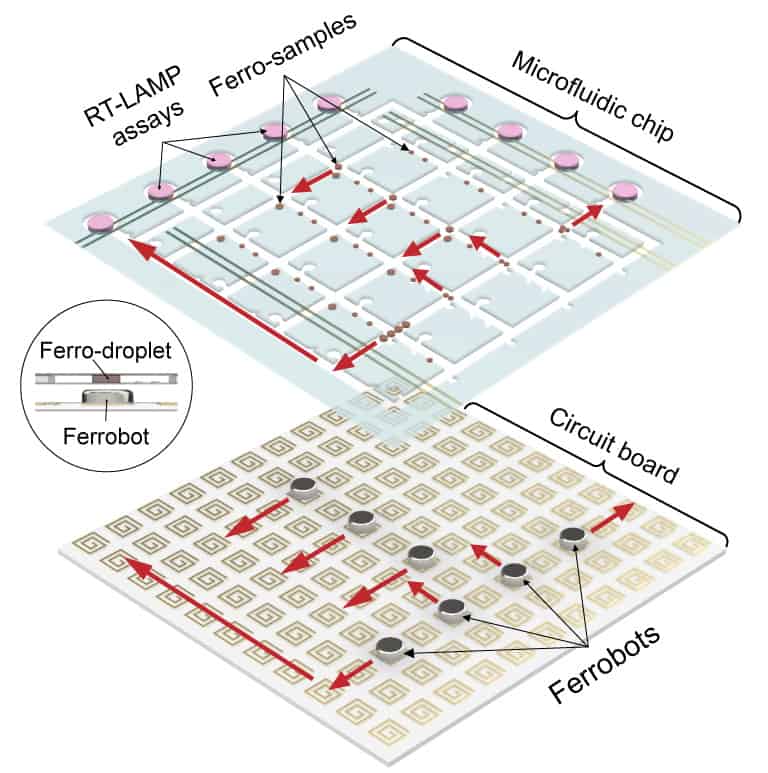
To overcome this shortfall, the UCLA researchers created a palm-sized printed circuit board-based programmable platform that performs liquid handling and bioanalytical operations in a parallel manner. In contrast to previous methods, which required bulky, resource-intensive instruments, the miniaturized platform delivers substantial cost savings over a wide range of viral prevalence, while simultaneously offering high precision, robustness, adaptability and scalability.

“Our handheld lab technology could help overcome some of the barriers of scarcity and access to tests, especially early in a pandemic, when it is most crucial to control disease spread,” says Emaminejad. “And beyond its potential to address issues of short supplies and high demand, it could be broadly adapted to test for many types of diseases in the field and with lab-grade quality.”

Moving to multiplexed and pooled testing

The researchers developed a suite of operations to detect the presence of genetic material from a virus – in this case, SARS-CoV-2 that causes COVID-19. The circuit board controls a swarm of ferrobots to transport magnetized samples through the diagnostic NAAT workflow, including automated transportation, aliquoting, merging, mixing and heating of sample droplets to amplify the reaction product (DNA). Finally, the results are determined based on a colour change of a pH indicator, which enables a binary interpretation of the test, above or below a threshold, as positive or negative, respectively.

Ferrobots in a microfluidic chip

The UCLA researchers also demonstrated parallelization – moving many of the ferrobots at the same time using electromagnetic tiles in the circuit – as well as sequential task operations in a collaborative manner by each ferrobot (in coordination with the other ferrobots).

“This platform’s compact design and automated handling of samples enable easy implementations of pooled testing where you can test dozens of patient samples at the same time, and all with the same materials it currently takes to test just one patient,” says Di Carlo. “For example, you could test students in an entire college residence hall with just a few dozen test kits.”

By implementing a pooled testing algorithm, which can test up to 16 samples in a single assay, the system requires much lower reagent costs than needed to test the samples individually. If the pooled test showed a positive result, a subsequent streamlined set of operations takes place within the platform until the actual positive samples are identified. Ultimately, the researchers note, chemical reagent costs could be reduced by 10 to 300 times depending on the viral prevalence.

As well as testing for several diseases simultaneously, the platform can analyse a large number of input samples in parallel and asynchronously as they arrive, avoiding wait times associated with batch processing. As such, the team concludes that this technology serves as a promising solution to increase testing capacity globally for epidemic and pandemic preparedness.

Meteorites have a seismic effect on Mars, revealing what lies below the surface

Two meteorite impacts on the Martian surface have given scientists a better understanding of the interior structure of the Red Planet. The impacts happened in 2021 and an international team of researchers has shown that surface seismic waves detected on Mars were caused by the impacts. A second, related study, examined the seismic waves in detail and concluded that the planet’s crust varies in density.

One impact crater is on the Amazonis Planitia, which is an extremely flat plain in the northern hemisphere of the Red Planet. The impact that made this feature occurred on 24 December 2021, according to the researchers. The second impact crater is in the Tempe Terra, which is a rugged region that is also in the northern hemisphere. This crater was created on 18 September 2021.

Much of what we know about the interior of the Earth comes from monitoring seismic waves as they travel through our planet. Waves that propagate near to the surface of a planet shed light on the planet’s crust and upper mantle, while body waves moving through the centre of a planet, tell us something about the deep interior. While NASA’s InSight seismic monitoring lander has detected body waves in Mars, these are the first surface waves to be observed.

Now, scientists have analysed these waves. One study was led by Liliya Posiolova of US-based Malin Space Science Systems and the other led by Doyeon Kim of Switzerland’s ETH Zurich and the University of Maryland in the US. Posiolova, Kim and several of their colleagues were involved in both studies.

Making links

Possiolova’s team made the link between the Amazonis and Tempe craters and seismic signals using satellite images of the Martian surface taken by NASA’s Mars Reconnaissance Orbiter (MRO). They describe their work in Science.

“At first we constrained [the Amazonis impact] to about five days in late December, but with further processing we managed to constrain it to a 25 hour time period centered roughly on December 24, 2021,” says Posiolova. That date jogged her memory, and she realized that InSight had recorded a seismic signal on that day.

Posiolova’s team quickly looked up the estimated epicenter of the 24 December event and realized that the Amazonis crater must have been the source of the seismic disturbance. Not resting on their laurels, the researchers looked into another seismic signal that was detected on 18 September and linked it to the Tempe Terra crater. As well making connections between meteoric impacts and seismic signals, the craters are the two largest that have been found by the MRO in its 16 years of operation.

Closer look

Meanwhile, Kim and colleagues took a much closer look at the seismic data, which he says was no mean feat. His team also reported its results in Science.

“The seismic data collected on Mars are much more difficult to analyze compared to those collected on Earth,” says Kim. “Because the sources of the two impacts are at the surface, they were effective at generating [and] propagating waves along the planet’s surface. Before the detection [and] identification of surface waves on Mars, our understanding of the Martian crust has been limited to what’s beneath the InSight landing site.”

One important discovery made by the team is that north of Mars’ equatorial dichotomy, the crust has a uniform structure and depth. They also found that the crust there has a high shear velocity of about 3.2 km/s. This implies that this region has a higher crustal density than what has been observed directly below InSight, which is near the equator.

Impressive accomplishment

This addition to our knowledge of what lies below Mars is an impressive accomplishment, given that there is just one seismic station on the planet. Indeed, the research establishes that spatial information about the crust can be obtained from just one seismic monitor. 

The research also sheds further light on how meteorites impact Mars. This is expected to be much different than impacts on Earth, where our planet’s much thicker atmosphere tends to act as a protective shield that burns up smaller meteorites.

Posiolova points out that this is the first time we have data documenting large meteorite impacts, including temporal records from InSight’s Seismic Experiment for Interior Structure (SEIS) instrument and spatial records from the MRO imagers. This can tell scientists a lot about how meteorite impact energy is distributed into the Martian ground and atmosphere.

While our current understanding of Mars’ crust and upper mantle is reasonably good, Posiolova says that the planet’s deep mantle structure is still “not yet fully understood.” Seismic data from meteoric impacts could shed further light on this shady part of the planet’s interior.

How nanoscience brings physics into biology

Part showcase, part manifesto, Sonia Contera’s Nano Comes to Life makes the ambitious attempt to convey the wonder of recent advances in biology and nanoscience while at the same time also arguing for a new approach to biological and medical research.

Contera – a biological physicist at the University of Oxford – covers huge ground, describing with clarity a range of pioneering experiments, including building nanoscale robots and engines from self-assembled DNA strands, and the incremental but fascinating work towards artificially grown organs.

But throughout this interesting survey of nanoscience in biology, Contera weaves a complex argument for the future of biology and medicine. For me, it is here the book truly excels. In arguing for the importance of physics and engineering in biology, the author critiques the way in which the biomedical industry has typically carried out research, instead arguing that we need an approach to biology that respects its properties at all scales, not just the molecular.

As evidence for this, Contera introduces the reader to experiments on the mechanical properties of cells, showing that the right tweak or pinch can cause a cell to completely change its properties. Particularly fascinating is the description of work showing that stem cells can be made to behave more like brain cells when grown on a softer surface and more like bone when on a harder one. As Contera puts it, “Biology does not distinguish between the domains of science; it uses them all.”

However, we are being held back, she argues, by institutional inertia. Pharmaceutical companies have devised highly automated high-throughput methods of testing new drugs but still rely on a chemistry-centred approach – hardly better than blindfolded dart throwing. With new knowledge from biophysics and biomedical engineering, we can instead approach medicine from multiple scales – making nanoparticles tagged with antibodies and emitters to simultaneously treat and image, or using advances in 3D-printed tissues to investigate new processes for “organs on a chip”. These new ideas, which view biology from an engineering perspective, allow us to see ourselves as machines that are part of the physical and mechanical world around us.

Despite the complex ideas conveyed in Nano Comes to Life, I never found myself bogged down in technical details. Indeed, some of the unfamiliar concepts are illustrated with high-speed atomic force microscope images from the Contera’s own lab, giving us a nanoscale peek into how scientists know what is going on at such small scales.

Nano Comes to Life is aimed at both the general reader as well as scientists, emphasizing and encouraging the democratization of science and its relationship to human culture. Ending on an inspiring note, Contera encourages us to throw off our fear of technology and use science to make a fairer and more prosperous future.

  • 2022 Princeton University Press 240pp £14.99pb

Self-powered smart watches for cows, how honey bees cope with topological defects

Are you one of those people who tracks all their activities with a smart watch to ensure that they are getting enough exercise. I am borderline obsessive in that way and cows might be next – if researchers at Southwest Jiaotong University in China have their way. Zutao Zhang and colleagues have developed a wearable smart device for cows that harvests kinetic energy from the creatures’ smallest motions. This is converted to electrical energy that is stored in a battery, which powers “smart ranch technology” sensors.

According to Zhang, information that could be gathered by the sensors include oxygen concentration, air temperature and humidity, amount of exercise and more. Data would be uploaded from the field by 5G networks and could improve the world’s food systems, say the researchers.

Zhang says that the energy generation system has also been tested on humans, and a light jog was enough to run a temperature sensor.

“Kinetic energy is everywhere in the environment—leaves swaying in the wind, the movement of people and animals, the undulation of waves, the rotation of the earth—these phenomena all contain a lot of kinetic energy,” says Zhang, “We shouldn’t let this energy go to waste.”

The research is described in iScience.

Topological beehives

From cows to bees, researchers in the US have investigated how honey bees modify the structure of their honeycombs to fit them into cavities and other constrained areas. Nominally, honeycombs have a hexagonal lattice. However, they are often built within enclosed spaces with geometrical constraints. Bees adapt to these constraints by introducing non-regular hexagons and topological defects to their honeycombs.

To understand how bees do this, Francisco López Jiménez and Orit Peleg of the University of Colorado and colleagues have used 3D printing to create a collection of “starter frames” that contain specific geometric frustrations for honeycomb-building bees.

The team says that it found “clear evidence” that bees use certain recurring patterns in response to specific frustrations. They also modelled and replicated the bees’ strategy using a simulated annealing process. Because honeycomb lattices occur elsewhere in nature, most notably in graphene, the team hopes that its study could shed light on a wide range of structures and materials.

Their research is described in Proceedings of the National Academy of Sciences .

The physics of car crashes and the winners of the Institute of Physics Business Awards

In this episode of the Physics World Weekly podcast, collision expert Michael Hall explains how Newtonian physics is used to piece together what happened in motor vehicle accidents, sometimes revealing insurance fraud. Hall is a physicist and head of research at GBB – a company in Preston, UK, that provides impartial scientific, forensic and engineering advice on traffic collisions. He has also written an article for Physics World about the physics of car crashes. It is called “Using Newton’s laws to weed out bogus car-crash claims”.

Also in this episode, Physics World’s Margaret Harris reports back from the 2022 Institute of Physics Business Awards gala, where seven companies were honoured for their innovations. These include two firms that make technologies for diagnosing cancer and a company that has just won a £60m contract to build a quantum computer.

Mushroom-based substrates create flexible and sustainable electronics

Fungal mycelium skins can be used as substrates for electronic devices, physicists and materials scientists in Austria have shown. The team used the thin skins to create autonomous sensing devices consisting of mycelium batteries, a humidity and proximity sensor, and a Bluetooth communication module. As well as providing a flexible surface for electrical circuits to be patterned on, the skins are biodegradable and could help cut electronic waste.

The researchers produced the mycelium skins from the fungus Ganoderma lucidum, which grows on dead hardwood in mild temperate climates. To create electronic circuits, they used physical vapour deposition to place a thin layer of copper and gold on the skin. Metal was then removed from this surface layer via laser ablation, leaving behind conducting paths. The researchers named this novel approach to creating flexible and biodegradable electronics “MycelioTronics”, describing their work in Science Advances.

The vast number of devices produced nowadays, along with their decreasing lifetimes, leads to enormous amounts of electronic waste, and the volumes are rising rapidly. According to the Global E-Waste Monitor 2020, a record 53.6 million tonnes of such e-waste was discarded in 2019 – a figure that’s projected to increase to 74.7 million tonnes by 2030.

There’s also an increasing focus on the development of flexible electronics, for autonomous sensors for health monitoring, for example, that have lifespans of just days or weeks. According to Martin Kaltenbrunner, a physicist at the Johannes Kepler University, for these types of electronics, biodegradable components would be very advantageous.

“The one thing that is really difficult to recycle is the flexible or printed circuit board… they’re just too cheap and too difficult to separate into their individual parts,” Kaltenbrunner explains. Scientists have been looking at replacing polymer-based circuit boards in flexible devices with paper, but Kaltenbrunner says that this is not sustainable. Paper production is too water and energy intensive.

Paper-like skins

While working on mushroom-based materials for building insulation, Kaltenbrunner and his colleagues noticed that the fungi were producing a dense and compact skin of mycelium, which is a network of fungal threads. These skins looked like paper and the scientists wondered if they could be used for flexible circuit boards.

The team grew mycelium skins by covering moist beech wood shavings inoculated with Ganoderma lucidum with a polyethylene separator grid and storing them at 25°C. After sufficient fungal growth, the separator was ripped off the substrate and the mycelium skin was carefully peeled off the separator. The wet mycelium was then dried and compressed to produce the final skins.

Mycelium-based device

After deposition and laser ablation of the metal layer, the researchers tested the resulting mycelium circuit boards. They found that that they had high conductivity and thermal stability, and were able to withstand around 2000 bending cycles before the metal film started to crack and electrical resistance increased. The skins could also be folded several times with only moderate increases in resistance.

Next the researchers created a flat, 2 cm2 mycelium battery, using a mycelium skin soaked in a highly ion-conducting electrolyte solution (ammonium chloride and zinc chloride) as the separator, and two mycelium skins as the outer casing. This structure results in a high percentage of the battery being biodegradable, they claim.

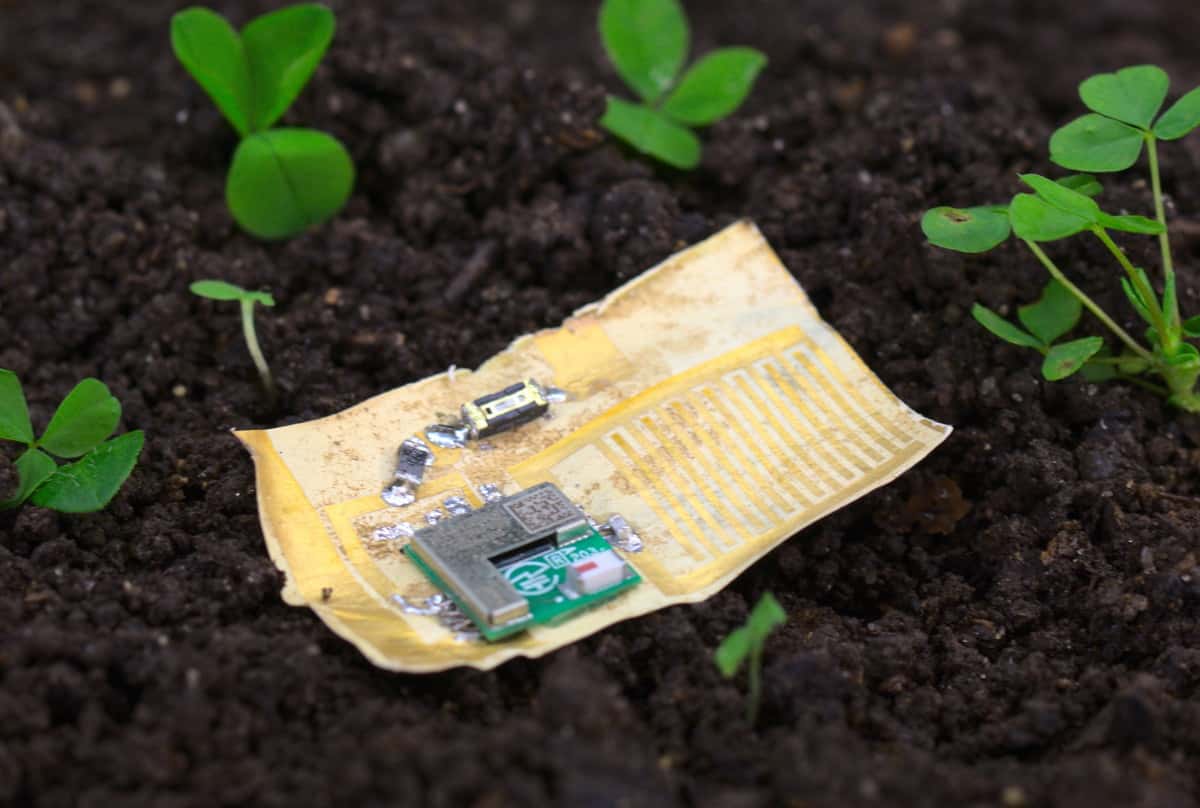
To further demonstrate their concept, the team created an electronic device consisting of a mycelium battery, a Bluetooth data communication module and an impedance sensor soldered onto a mycelium circuit board. Tests showed that this sensor device was able to detect an approaching finger and changes in humidity in a climate chamber.

Once they had finished with the circuits, the researchers found they could remove the reusable surface-mounted components using a heat gun or solder iron. This left the mycelium circuit board, which disintegrated in a compost heap. Within 11 days it had lost 93% of its dry mass and after this point any remains were indistinguishable from the soil.

“You can put it in your household compost,” Kaltenbrunner tells Physics World. He explains that this is the advantage of their fungal materials over biodegradable plastics that require specific conditions to breakdown, “mycelium is literally everywhere in our natural environment” and the skins are a completely natural product.

Quantum teleportation opens a ‘wormhole in space–time’

The equivalent to a wormhole in space–time has been created on a quantum processor. Researchers in the US used an advanced quantum teleportation protocol to open the wormhole and send quantum signals through it. By studying the dynamics of the transmitted quantum information, the team gained insights into gravitational dynamics. The experiment could be further developed to explore quantum gravity or string theory.

A wormhole is a bridge in space–time that connects two different locations. While wormholes are consistent with Albert Einstein’s general theory of relativity, they have not been observed by physicists. Unlike wormholes in science fiction, they are not traversable – meaning things cannot pass through them.

Although general relativity forbids travelling through a wormhole, it is theorized that exotic matter – matter with negative energy density and negative pressure – could open a wormhole and make it traversable. But these theories are difficult to test, even if one could create a wormhole in a lab.

Quantum teleportation

But physics has a trick up its sleeve – in the form of the quantum teleportation of information between two entangled particles. This process occurs instantaneously and therefore emulates the process of sending quantum information through a gravitational wormhole. In both cases, however, it is not possible to communicate faster than the speed of light because a subluminal signal is required to decode the information.

Quantum entanglement plays an important role in quantum computing, therefore a quantum processors is the ideal experimental device to explore the similarities between quantum teleportation and wormholes. In this scenario, quantum bits – or qubits – on the quantum processor are entangled with each other and teleportation is the equivalent of the qubit travelling through a wormhole.

Down the wormhole

Now Maria Spiropulu at Caltech, Daniel Jafferis at Harvard University and colleagues have done such an experiment. Their aim was to create a system that has the right ingredients for the type of teleportation that resembles a wormhole.

An important challenge that they first had to overcome is that it appeared that a large number of qubits would be needed to perform the experiment properly – many more qubits than are available in today’s quantum processors. To solve this problem, the researchers used machine learning to work out the minimum number of qubits required and how they should be coded to set up the quantum teleportation protocol. They discovered that they could create the wormhole dynamics on nine qubits with 164 two-qubit gates on a Google Sycamore quantum processor.

In their experiment the researchers showed that they could keep a wormhole open for a sufficient amount of time by applying negative energy shockwaves, which came in the form of special pulses of quantum fields. They then studied the dynamics of the quantum information that was sent through. Signals that travel through a wormhole experience a series of scrambling and unscrambling, with the quantum information exiting the wormhole intact.

Powerful testbed

On the Sycamore processor, they measured how much quantum information passed from one side to the other, when applying a negative versus a positive energy shockwave. And because only negative energy shockwaves would open up the wormhole, they found that only these shockwaves allowed signals to pass through. Overall, the information passing through the wormhole had key signatures of a traversable wormhole. This constitutes a step towards probing gravitational physics using quantum processors and could lead to the development of powerful testbeds to study ideas of string theory and quantum gravity.

Juan Maldacena at the Institute for Advanced Study, in Princeton, US, who was not involved in the research, describes the work as an interesting first step in trying to create complex quantum systems that can have an emergent space–time description. He thinks the result is important because it is a demonstration that allows us to experimentally test some of the theoretical ideas about the connection between quantum mechanics and emergent space–time geometry. He says the research’s biggest achievement is that it has reproduced a kind of quantum teleportation that is inspired by gravitational problems.

Team member Daniel Jafferis believes that there are many additional protocols and new ideas to explore and he expects more “gravity experiments” to be performed by quantum computers in the future. He thinks that some of these will require much larger quantum computers or much deeper circuits, but that others are well-suited for near-term experimentation.

“One of the things we would like to do next is to realize somewhat larger systems and try to observe more detailed structure of the emergent wormholes and their gravitational dynamics”, he tells Physics World.

Edward Witten, also at the Institute for Advanced Study and not involved in this research, says that the authors have done a nice job of describing a simplified version of the protocol that could be realized experimentally. He calls this experiment – and the presumed improvements that may be possible – to be a “milestone” in developing control over microscopic quantum systems. He states that even though such an experiment can certainly not give the sort of information that comes from physics experiments such as LIGO or the LHC, success with such experiments can confirm the validity of quantum mechanics in a rather subtle situation and also confirm that the theory has been analysed correctly.

The research is described in Nature.

Ever felt your ordinary human experience is being delegitimized? It’s the fault of ‘scientific gaslighters’

In the 1944 movie Gaslight, the character Paula (played by Ingrid Bergman) sees a gas-powered lamp in her room dim late at night. Unbeknownst to her, Paula’s husband Gregory (played by Charles Boyer) is sneaking into the attic to hunt for jewels. When he turns on the attic light, it depletes the gas in all the other house lamps. But Gregory has intimidated Paula into thinking that the dimming (and other things) are not real, that they are happening only inside her head.

These days, the term “gaslighting” is often used to refer to someone imposing their views of reality, such as a narcissist promoting false but seemingly believable stories in an unpleasant attempt to exert control over others. But in the sense inspired by the 1944 movie – and by its 1940 precursor of the same name – gaslighting refers to someone trying to delegitimize someone else’s experience.

I feel that same sense of delegitimization when I read certain popular-science books. They’re the ones suggesting that when I see, for example, a sunset or sunrise, I’m really just seeing the Earth spinning. I’m not observing rainbows, they say, but only reflections and refractions. I’m not seeing stars but only leftover glimmers of faraway objects that ceased to exist billions of years ago.

“Scientific gaslighters”, as I term them, want to foster an appreciation for science. But their strategy of delegitimizing ordinary human experience can have the opposite effect.

Turning the tables

Almost a century ago, the British astronomer Arthur Eddington identified the puzzle that gaslighters condescendingly attempt to solve. It arises in his 1928 book The Nature of the Physical World, which begins by describing two tables. One is a familiar, extended, coloured and motionless object. The other is the same table as dissected by science, consisting mainly of tiny electrical charges swarming in empty space.

Physicists, Eddington said, may claim that the scientific table is “the only one which is really there” – but they will “never succeed in exorcizing” the table of ordinary experience. Eddington admitted he was unsure how the two tables are related, saying that the question lies outside the scope of physics. Gaslighters, however, are certain. Only the scientific table is real and the ordinary one is just in our heads. There is no need to relate them.

It’s fortunate that Eddington didn’t ditch his ordinary table. For even as he was writing his book, quantum mechanics was being developed, forcing Eddington to rewrite some of his manuscript. Evidently, even “scientific” tables can be defective and swapped for newer models. But Eddington was wise to say that ordinary experience can’t be exorcised: indeed, it’s the precondition for any knowledge at all.

Consider the optical illusion where two parallel lines appear to lie at an angle. To correct the illusion, you absolutely need ordinary experience. That’s because to understand how the bowed lines relate to the straight ones, you need to play around and acquire more experience. Those experiences aren’t irrelevant; they enrich your knowledge so that you know what’s going on.

It’s a theme touched on by the German philosopher Edmund Husserl (1859–1938), who towards the end of his life began an essay called “The original ark, Earth, does not move”. The editors of his posthumous works thought this sounded too absurd and retitled it “Foundational investigations of the phenomenological origin of the spatiality of nature”. But the point of the essay was exact. Experiencing a non-moving background environment is not a mistake, Husserl argued, but a precondition for us to develop a sense of movement and to be able to model ourselves on a moving Earth.

Enter the cave

Scientific gaslighters love the famous “cave” allegory of Plato’s Republic. Written 2500 years ago, it describes prisoners who are chained in their seats and can experience only images on a wall. What these cave-dwellers don’t realize, however, is that they are only seeing shadows projected by influencers behind them. According to scientific gaslighters, people today are like the cave-dwellers – except that we have this wonderful thing called science to tell us about the real world outside.

This is an illiterate way to read the Republic. In Plato’s story, the cave-dwellers liberate themselves with the help of a teacher, who turns them around to see for themselves what’s happening in the world, preparing them perhaps to see a little more. The teachers are not telling the cave-dwellers what to believe. After all, why should we believe what might be yet another crowd of influencers whose words we should take with a grain of salt?

Most inconveniently for gaslighters, though, is that Socrates – the one who speaks in Plato’s Republic – only uses the cave image to inspire his students. Education is a long, arduous and neverending path and he wants to encourage them. Plato’s cave is only a story, like the one the gaslighters are telling. The cave doesn’t actually have an outside.

The critical point

The gaslighters’ motive is educational and benign, for they want to encourage people to appreciate the wonders of science. But there is a danger in distinguishing between ordinary experience and what scientists say that experience is about. By labelling only the latter as “real”, it encourages the notion that there is a class of elite influencers (i.e. scientists) who think they possess the truth, while the rest of the population (i.e. non-scientists) are confused and misled.

By essentially mocking non-scientists, this makes it easier – seemingly justified – for people to ignore the claims of the elites as untrustworthy. Maybe sea levels are not rising, glaciers not melting. Maybe vaccines cause autism. Maybe the rising amount of human-produced carbon dioxide in the atmosphere – if that’s even true – is not responsible for global warming. Who knows? Why trust those influencers?

The alternative would be to do what the teacher in Plato’s story does. The teacher does not try to tell the cave-dwellers what to believe about the world. Instead, the teacher turns them around so they can see for themselves, helping them connect these new experiences with their former ones. That’s what would undim the lights.

AI model determines cardiovascular risk from routine chest X-ray

A deep-learning model developed by researchers from the Artificial Intelligence in Medicine (AIM) Program can predict the 10-year risk of death from heart attack or stroke using a single chest X-ray.

Currently, this risk is estimated using the atherosclerotic cardiovascular disease (ASCVD) risk score. This statistical model requires numerous input parameters, including age, sex, race, systolic blood pressure, hypertension treatment, smoking and type 2 diabetes status, and blood tests. Patients with a risk of 7.5% or higher are recommended statin medication. Often, however, these variables aren’t all available in the patient’s electronic record.

To remedy this shortfall, the researchers created a deep-learning model that can estimate the 10-year risk of major adverse cardiovascular events from a routine chest radiograph. At this week’s RSNA 2022, the annual meeting of the Radiological Society of North America, lead author Jakob Weiss presented the team’s work.

“Our deep-learning model offers a potential solution for population-based opportunistic screening of cardiovascular disease risk using existing chest X-ray images,” Weiss explains. “This type of screening could be used to identify individuals who would benefit from statin medication but are currently untreated.”

Weiss and colleagues developed their CXR-CVD risk model using 147,497 chest X-rays from 40,643 participants in the PLCO cancer screening trial. They tested its performance using an independent group of 11,430 outpatients who had a routine chest X-ray at Mass General Brigham and were potentially eligible for statin therapy. Over the median follow-up of 10.3 years, 9.6% of these patients suffered a major adverse cardiac event, with significant association between the model-predicted risk and the observed events.

In the 2401 patients with sufficient data available, the team also compared the prognostic value of the CXR-CVD risk model with the established clinical standard for deciding statin eligibility. In this subset of patients, the model exhibited similar performance to the clinical standard.

“The beauty of this approach is you only need an X-ray, which is acquired millions of times a day across the world,” Weiss says. “We’ve long recognized that X-rays capture information beyond traditional diagnostic findings, but we haven’t used this data because we haven’t had robust, reliable methods. Advances in AI are making it possible now.”

Weiss notes that that additional research, including a controlled randomized trial, is needed to validate the model, which could ultimately serve as a decision-support tool for physicians.

Copyright © 2026 by IOP Publishing Ltd and individual contributors