The optical physicist Margaret Murnane has won the 2022 Isaac Newton Medal and Prize “for pioneering and sustained contributions to the development of ultrafast lasers and coherent X-ray sources and the use of such sources to understand the quantum nature of materials”. Presented by the Institute of Physics (IOP), which publishes Physics World, the international award is given annually for “world-leading contributions to physics”.
Born in 1959 in County Limerick, Ireland, Murnane obtained a Master’s degree in physics from University College, Cork, in 1983. She then moved to the US to carry out a PhD in laser physics at the University of California at Berkeley, which she completed in 1989. Murnane remained in the US, working first at Washington State University and then in 1996 at the University of Michigan, Ann Arbor. In 1999, Murnane moved to the University of Colorado at Boulder, where she has remained since.
It had been thought it would be too difficult to create an X-ray laser given that the power requirement would be over a billion times that of a visible laser. Yet Murnane and colleagues’ work, which has spanned over three decades, overturned this belief as they managed to create and then shrink down high-intensity X-ray lasers so that they could fit on tabletops, making devices more accessible and affordable.
Murnane and colleagues began this effort at Washington State in the early 1990s, where they created a device that was based on titanium-doped sapphire laser that could generate pulses lasting less than 10 femtoseconds. They then worked on the amplification of these pulses to produce a peak power of about a terawatt.
Murnane – together with her partner Henry Kapteyn – then began to shift the wavelength towards X-rays. They used a process called “high-order harmonic generation” in which a noble gas is used to convert a femtosecond laser pulse into ultraviolet wavelengths. In 2012 Murnane then managed to produce X-ray light from a tabletop laser.
The techniques Murnane and colleagues have developed over the decades have had many applications such as in medical imaging and for industrial use. Indeed, Murnane and Kapteyn co-founded a spin-off laser company, KMLabs.
Murnane told Physics World it is a “great honour” to receive the prize for her work in laser physics. “l am surprised, humble and grateful at the news,” added Murnane. “Through physics, I have made so many wonderful friends, met my life partner, and worked with amazing students and collaborators from all over the world.”
A positive impact
Murnane’s honour formed part of the IOP’s wider 2022 awards, which recognize everyone from early-career scientists and teachers to technicians and subject specialists.
Other winners include science writer, broadcaster and regular Physics World contributor Sharon Ann Holgate who receives the William Thomson, Lord Kelvin Medal and Prize for “communicating science to a wide variety of audiences and for positive representations of scientists from non-traditional backgrounds”.
“This award means a great deal to me,” Holgate told Physics World. “Due to my physical disability, I have faced many obstacles in my career and I hope that the award can encourage other people, no matter what their background is or what challenges they face, to pursue a career in science.”
Imperial College PhD student Amy Smith, meanwhile, receives the Jocelyn Bell Burnell Medal and Prize for “exceptional contributions to physics education and efforts to reducing barriers to progression and increasing sense of belonging amongst under-represented groups”.
“I am incredibly honoured to have received this award,” says Smith. “It is wonderful that the IOP and the wider community are recognizing physics educators and physics education researchers as being fundamental to the advancement of physics.”
In a statement, IOP president Sheila Rowan congratulated all the winners. “Each and every one of them has made a significant and positive impact in their profession, whether as a researcher, teacher, industrialist, technician or apprentice.”
The full list of 2022 award winners is available here.
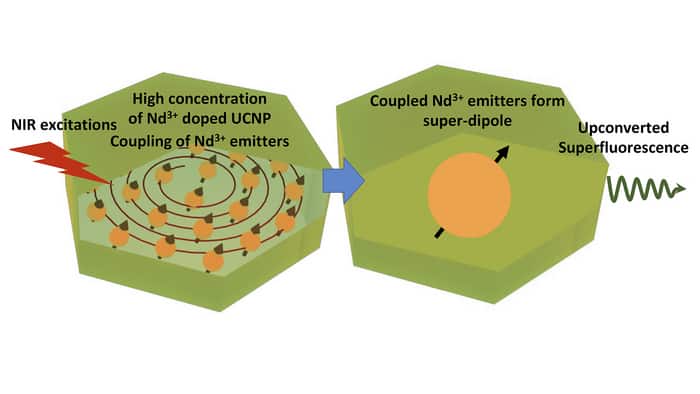
The process for achieving superfluorescence at room temperature. (Courtesy: Shuang Fang Lim, NC State University)
Researchers in the US have created nanoparticles that emit pulses of superfluorescent light at room temperature. Unusually, the emitted light is anti-Stokes shifted, meaning that it has a shorter wavelength (and thus a higher energy) than the wavelength of light that initiates the response – a phenomenon known as upconversion. The new nanoparticles, which the team discovered while looking for a different optical effect, could make it possible to create new types of timers, sensors and transistors in optical circuits.
“Such intense and rapid emissions are perfect for numerous pioneering materials and nanomedicine platforms,” team leader Shuang Fang Lim of North Carolina State University tells Physics World. “For example, upconverted nanoparticles (UCNPs) have been widely employed in biological applications ranging from background-noise-free biosensing, precision nanomedicine and deep-tissue imaging, to cell biology, visual physiology and optogenetics.”
Shielding electron orbitals
Superfluorescence occurs when multiple atoms within a material simultaneously emit a short, intense burst of light. This quantum-optical phenomenon is distinct from isotropic spontaneous emission or normal fluorescence, is difficult to achieve at room temperature and tends not to last long enough to be useful. UCNPs, however, are different, says team member Gang Han of the University of Massachusetts Chan Medical School. “In a UCNP, the light is emitted from 4f electron transitions that are protected by higher-lying electron orbitals that act as a ‘shield’, allowing for superfluorescence even at room temperature,” Han explains.
In the new work, the team observed superfluorescence in ions that couple with each other within a single nanoparticle of neodymium-ion-compacted lanthanide-doped UCNPs. Unlike superfluorescence in other materials, such as highly ordered perovskite nanocrystals or semiconductor quantum dots assemblies that use each nanoparticle as an emitter, in lanthanide-doped UCNPs, each lanthanide ion in a single nanoparticle is an individual emitter. “This emitter can then interact with other lanthanide ions to establish coherence and allow for anti-Stokes-shift superfluorescence in both random nanoparticle assemblies and in single nanocrystals, which at just 50 nm in size are the smallest-ever superfluorescence media ever created,” Lim says.
Synchronization into a cohesive macroscopic state
“The superfluorescence comes from the macroscopic coordination of the emissive phases of the excited ions in the nanoparticle after the excitation energy is deposited,” adds team member Kory Green. “A laser pulse excites the ions within the nanoparticle and those states are not coherently organized at first.
“For superfluorescence to occur, that initially disorganized set of ions have to synchronize into a cohesive macroscopic state before emission. To facilitate this coordination the structure of the nanocrystal and the density of the neodymium ions has to be carefully selected.”
The discovery, which the team report in Nature Photonics, was made by chance while Lim and colleagues were trying to make materials that lase – that is, materials in which light emitted by one atom stimulates another to emit more of the same light. Instead, they observed superfluorescence, in which the initially unsynchronized atoms align, then emit light together.
“When we excited the material at different laser intensities, we found that it emits three pulses of superfluorescence at regular intervals for each excitation,” Lim says. “And the pulses don’t degrade – each pulse is 2 nanoseconds long. So not only does the UCNP exhibit superfluorescence at room temperature, it does so in a way that can be controlled. This means the crystals could be used as timers, neurosensors or optical transistors on photonic integrated circuits, for example.”
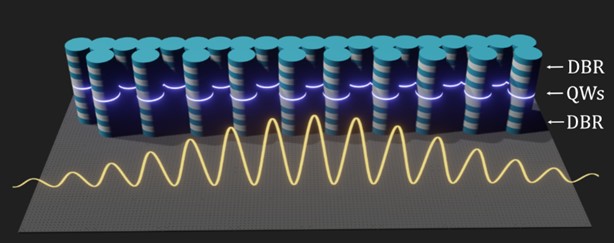
How it works: the wave in the foreground is an illustration of the phase of an out-of-equilibrium Bose-Einstein condensate in a 1D cavity, which belongs to the Kardar-Parisi-Zhang universality class. In the background is an illustration of the Fabry-Perot cavity, composed of two distributed Bragg reflectors (DBRs), with quantum wells (QWs) embedded inside. (Courtesy: Charly Leblanc)
Describing different systems using the same fundamental law is an ancient idea. In the early 18th century, for example, the French mathematician Évariste Galois gave birth to group theory, which is an important part of mathematics but has also found concrete applications in physics and chemistry. In statistical physics, other mathematical tools called universality classes can describe systems with the same macroscopic characteristics, although the microscopic details of these systems can be very different. Some universality classes use just a few parameters to describe systems composed of a large number of particles in thermal equilibrium.
However, most systems in nature are not in equilibrium. In 1986, Mehran Kardar, Giorgio Parisi, and Yi-Cheng Zhang derived the Kardar-Parisi-Zhang (KPZ) equation. This breakthrough created the KPZ universality class, which describes the dynamics of a wide range of interfaces. These include crystalline surfaces, wildfire fronts, and frost on a window. These are systems that expand and shrink in a random manner and are therefore classified as out-of-equilibrium systems.
Now, Sylvain Ravets and Jacqueline Bloch at France’s Université Paris-Saclay and an international team of collaborators have done an experiment that shows that polaritonic Bose-Einstein condensates (BECs) could provide a tunable platform to study the KPZ universality class and its rich physics. They report their results in Nature.
Light and matter quasiparticle
Exciton–polaritons – often simply called polaritons – are quasiparticles arising from the coupling between photons and electron–hole pairs, which are themselves called excitons. In their experiment, the team used a laser to emit photons that are confined within a Fabry-Perot microcavity. This is composed of two distributed Bragg reflectors as shown in the figure. The photons are absorbed by semiconductor quantum wells that are embedded into the cavity, creating excitons. Then, the excitons annihilate by electron-hole recombination and create photons again. This gives rise to polaritons if the process happens numerous times before photons escape the cavity.
An important property of polaritons is that they are bosons, and therefore are not subject to the Pauli exclusion principle. Hence it is possible to create a polaritonic BEC, which is composed of a macroscopic number of quasiparticles in a single quantum state. Compared to BECs made from atomic gases, which need to be cooled to sub microkelvin temperatures, polaritonic condensates can be normally created at temperatures of a few kelvin – and sometimes at room temperature – depending on the semiconductors used. Another important difference between atomic and polaritonic BECs is that atomic BECs are in thermal equilibrium, while polaritonic BECs are out-of-equilibrium systems. Indeed, to maintain a polaritonic condensate, scientists must continuously excite the cavity with a laser to stabilize the number of photons going in and out of the system.
The KPZ equation was first used to describe the haphazard dynamics of out-of-equilibrium systems, such as the interface of expanding bacterial colonies. Indeed, it has been shown that nearly all growing interfaces fall into the KPZ universality class. Ravets, Bloch and colleagues measured the phase of their polaritonic BECs and demonstrated that it falls into the KPZ universality class. This confirms a prediction that was made in 2015. More precisely, they have shown, using optical interferometry, that the decay of the phase of a 1D polariton condensate follows the KPZ scaling law, both numerically and experimentally.
“Beyond 1D, exciton–polariton lattices offer exciting perspectives for the exploration of KPZ physics in 2D, where an experimental realization is highly sought after,” the team writes in Nature. Also, polaritonic experiments can be precisely controlled, which means that their research paves the way of a tunable polaritonic platform to study various out-of-equilibrium quantum systems belonging to the KPZ and other universality classes.
Finding joy: Louise Edwards. (Courtesy: California Polytechnic State University)
I’m 16 years old, and I’m wearing my prettiest dress and tiny brown suede heels. I walk into the middle-school gymnasium, and it feels amazing. I’ve never been surrounded by this many Black nerds!
My family has made the trek from Victoria, Canada, to Vancouver to attend the Junior Black Achievement Awards. And I see that I am not the only one. I am not alone. I’m experiencing comfort, belonging, celebration and camaraderie.
This is joy. Whether as a child in Victoria or as an associate professor in San Luis Obispo, California, US, I have found that cultural and community connections have brought wonderfully joyous moments and experiences. I want to share some experiences inside and outside the physics world that have brought me joy.
Cultural traditions
Piiiiing ping ping. The unmistakable sweet sound of the steel pan (or steel drum) rings through the house. My father is practicing “Yellow Bird”, and the music is a portal. The song, credited to 19th-century Haitian composer Michel Mauléart Monton and lyricist Oswald Durand, was covered by many calypso artists in the 1950s and 1960s, when my father was a young man.
When I think of this music, I’m tapping into something bigger than myself: my history, my ethnicity, my Trinidadian roots. My father, a mathematics and French teacher, had moved from Trinidad, where at the time there were no higher-education institutions, to Canada in the 1950s to go to the University of British Columbia. But he often talked about home, seemingly dreaming about retiring to his homeland. My mother, an English and science teacher, has Scottish and Irish roots and grew up in Victoria.
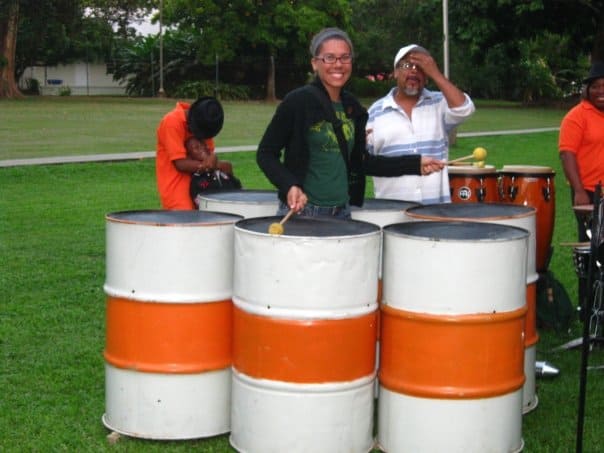
Born in Victoria, I grew up pretty Canadian, but my dad shared this greatest joy of his with me: the steel pan. We would spend hours playing together. Starting with an oil barrel, you can cut the drum down to various depths so that different standing waves reverberate within. Once you tune the drums, you can make an entire band with the different-sounding instruments. I played the double second pan, two mid-depth drums hung side by side. The double second allows both high notes and beautiful deep ones. My father played the shallowest, highest-pitch lead instrument: the tenor pan.
During the winter holidays, we would apply for city busker licenses and play carols together along the causeway. I’d wear my puffy leather bomber jacket and full-length knit skirt (this was 1994), and he’d don dark trousers, a pastel-coloured button-up shirt, and a tan suede overcoat. These are happy memories for me: father and daughter out in the cold, my hours of practice coming to fruition as we perform “Joy to the World” and “O Christmas Tree” for passers-by.
Trini roots: Louise Edwards playing the bass drum in Trinidad. (Courtesy: Louise Edwards)
There weren’t a lot of other steel pan players in Victoria. But each year our family would make the trek to join the larger Trinidad and Tobago community in Vancouver for the Caribbean Days picnic. The journey consisted of a two-hour ferry ride followed by another two hours in our colossal 1980s Chevy Impala station wagon – silver, with wood panelling – with my dad’s mix of soca, calypso and reggae blasting from the tape deck. I loved this family tradition because we’d get to hear the steel drums, taste the roti and curried goat, and see all the colourful costumes that folks were wearing for the parade. We’d get a chance to hang out with our Vancouver side of the family. I loved those times! It felt like I was a part of a community. This is joy. The joy of cultural tradition and community connections.
Finding and creating community
Those of us who follow an academic path often don’t get to choose where we make our homes. We may move to a new town for graduate school or a new country for postdoctoral positions. We must make our homes where we happen to land jobs.
Professional connections: Louise Edwards (second from right) with her research group at a meeting of the American Astronomical Society in Hawaii, US. (Courtesy: Louise Edwards)
For me, home is often somewhere with very small Black and Canadian populations. It isn’t usually obvious to others in my astrophysics circles that I’m Canadian. If I want to, I can keep a low profile (until I talk about going “oout and aboout toomorroh”). But as a physicist in North America, I constantly find myself the only Black person in the room – and sometimes the only woman. There are days, weeks, months that will pass in which that is the status quo. There is a special joy that bubbles up when I am not the only one. And I get that by engaging in cultural and community events.
For me, culturally focused activities have been important in academic settings as well. Black academic spaces allow me to exist free of the many negative stereotypes that surround Black folks. I can simply be, without fearing that my statements will be taken as representative of all Black people or that my mistakes will reinforce stereotypes about what Black folks can and can’t do.
If you, too, find yourself on a mostly solitary journey, what I’m writing may resonate with you. You might not have other Black folks in your classes or in your department. If so, my advice is to branch out. Reach out to chemistry majors or those in other departments. Look for student groups that focus on diversity and inclusivity issues. If a group like that doesn’t exist, create it. The community I live in, San Luis Obispo, is about 2% Black, but when we come together as a community, we can still fill a room.
If sticking out in the physics world sounds foreign to you, I hope reading these words inspires you to reflect on how important these spaces are. Make room for students in your research groups or classrooms to find connections, and help them in doing so. And consider providing support for your students to attend meetings like the annual conference of the National Society of Black Physicists or the National Diversity in STEM Conference.
I’m going to admit something embarrassing. When I initially came across First Dawn, I literally judged the book by its cover and title. I sat down expecting to read about my research area: the era of the first stars in our universe. Just a few pages in, however, it dawned on me that this book would not allow me the luxury of basking in what I already knew. I was to be reminded instead of how much I did not know, and the smallness of my academic comfort zone.
So what exactly is this book about? Everything and nothing. Or rather, how little we know about an awful lot. Instead of focusing on what we know about one topic within astronomy, Roberto Battiston joyfully discusses how far we have come and how far we have left to go on subjects “From the Big Bang to Our Future in Space”, as the subtitle reads.
Battiston, a physicist and former head of the Italian Space Agency, is a hugely likeable narrator. Reading about the ignorance of humanity on subject after subject could easily be discouraging, but you get the sense that the author positively revels in the unknown. It rather feels like running to keep up with a tour guide with an umbrella, who is gleefully pointing out one sight after another. In one memorable insight, Battiston describes the hours he spent in the CERN libraries before the World Wide Web was invented. “I remember… sitting on the floor, surrounded by books, one open on top of another, in order to compare texts and references in real time. It was like having an analogue computer with a lot of open windows and being able to jump from one PDF to another.” Then, you had to work hard to find information, whereas now there is arguably too much knowledge at our fingertips. We find it hard to dedicate ourselves to any one topic, or question, or tab.
For me, the major trauma of working at home is seeing people’s shared screen with a browser full of dozens of open tabs – it makes me anxious just looking at it. I cannot handle half-considered content, a task undone or an unexplored tab with a potential answer to a question. So First Dawn was a welcome challenge for me, because it is a book that explores outstanding questions on topics as diverse as inflation and interstellar migration – opening new windows with abandon.
I often felt a little breathless and stunned at the end of a quick dip into a complex field but, as the author points out, there’s no shame in this
Divided into 33 short chapters, each one is a round-up of why a topic is interesting, how our knowledge has progressed, and where astronomers are concentrating their focus next. The pace of the book reflects the pace of knowledge evolution that Battiston wants to highlight. In fact, I often felt a little breathless and stunned at the end of a quick dip into a complex field but, as the author points out, there’s no shame in this. While full of short introductions to various scientific concepts and areas, this is not an “intro to” book; and it is possible that readers will lose out if they do not have some prior passion for the field. In short, it is a gift for the scientist in your life, or that friend who watches Brian Cox documentaries, but maybe not your neighbour who has never looked up in wonder.
The last few chapters, where Battiston discusses antimatter (his research speciality) and the future of space travel, are particularly fascinating. You can hear his passion, and you get details and anecdotes that you just wouldn’t be able to find using a search engine, with his role as a space agency head granting him a unique view. He describes his visits to the factories of SpaceX, for example, refers to Elon Musk on a first-name basis, and discusses the political geography of research funding in an era of space billionaires.
Even if you have only a few spare minutes at a time to read this book, you will glide through chapters. You’ll be reminded about what a fermion is, make a note to look up more about the Higgs boson, and excitedly learn about space-based experiments to find dark matter. You’ll end up with a lot of open tabs in your brain, so do not expect to come away feeling satisfied with answers. Instead, you’ll understand the urgent need to ask that next big question: Can we travel at near-light speeds? Is there life on other planets?
In his preface, Battiston writes that he has always been “intrigued by edges, attracted by the discontinuity that exists between the frontier and the abyss, between the new and the old, between knowledge and ignorance; this is why I chose to become a scientist, and I have never regretted it”. I do not regret misunderstanding the content of this book when I first picked it up. It challenged me in areas where I knew nothing and humbled me in areas where I thought I knew everything. Prepare to be dizzied and ask Santa for some page markers – you’ll need them.
See. Shape. Strike. That’s the shared call-to-arms for a growing international cohort of radiation oncology clinics seeking to transform patient care and treatment outcomes through the deployment of ViewRay’s MRIdian MR-guided radiotherapy (MRgRT) system. Underpinning that collective effort – and key to clinical success – is the MRIdian value proposition. Put simply, diagnostic-quality MR images open up new possibilities for visualization of the tumour target, as well as its surrounding anatomy, with exceptional soft-tissue contrast both prior to and during treatment – allowing clinicians, in turn, to adapt the treatment plan with the patient on the table.
In this way, MRIdian combines online image guidance and adaptive radiotherapy tailored to the unique requirements of each patient – adjusting radiation delivery to address the daily variation in the tumour and surrounding healthy tissue, while enabling the clinician to rework the plan for tumours that respond rapidly to treatment, as well as those that prove unresponsive to standard doses of radiation. Equally significant, the ability to use real-time MR imaging to track the tumour and its environment “on the fly” – automatically turning the beam off if the tumour shifts out of position and on again when it moves back – means it is now routinely possible to increase the radiation dose to diseased tissue in real-time while still protecting adjacent organs-at-risk (OARs) and other critical structures.
The next iteration
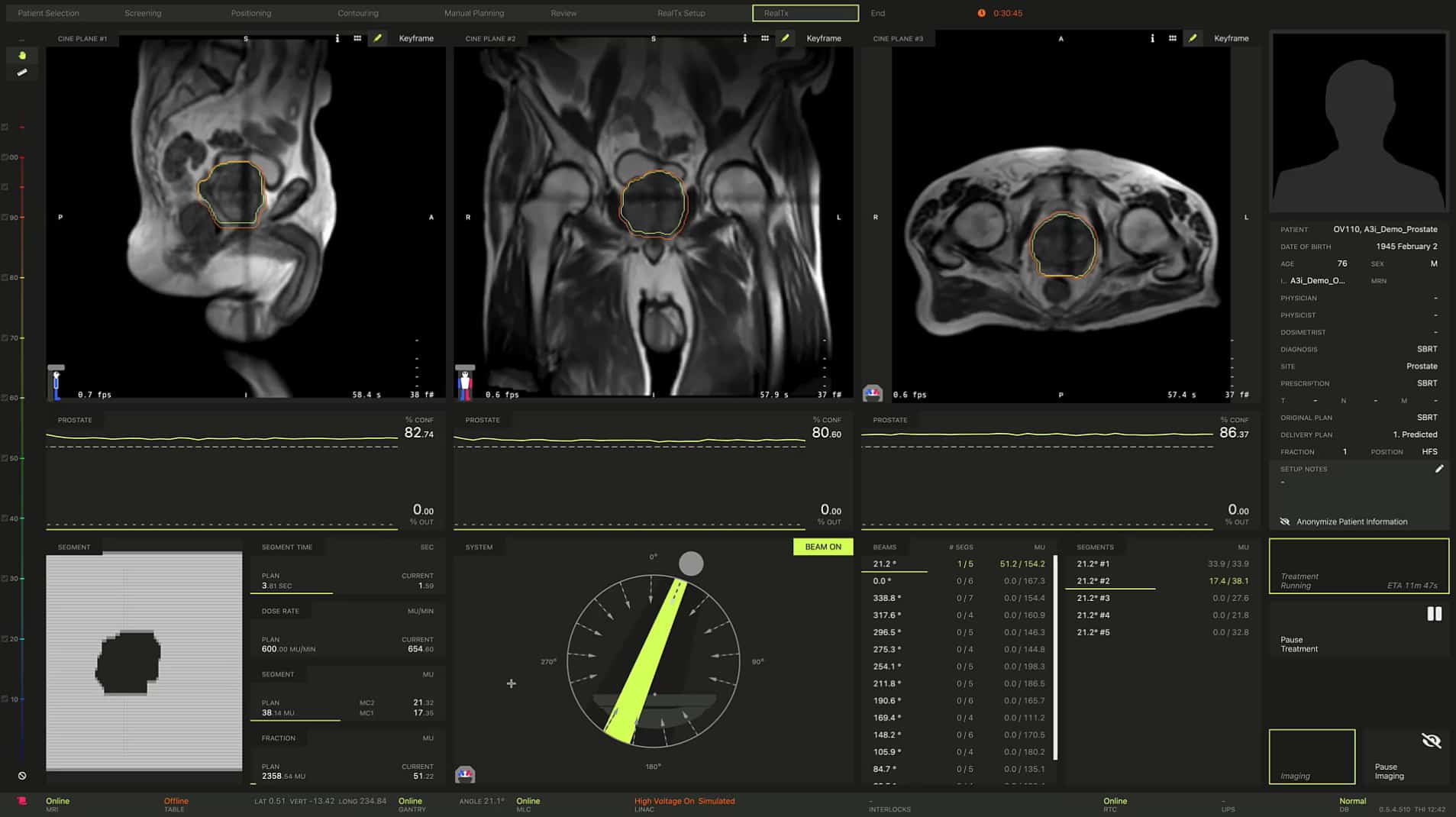
As the MRIdian technology push scales to meet demand from existing (and prospective) clinical users, ViewRay will showcase its new MRIdian A3i system at the ASTRO Annual Meeting in San Antonio, Texas, this week. For visitors to the ViewRay booth, the big MRIdian A3i take-aways will likely include streamlining of the on-table adaptive workflow – allowing clinicians, physicists and radiotherapists to collaborate simultaneously and connect remotely during patient treatment. Meanwhile, the real-time, multiplanar, 3D tissue tracking and automated beam-gating functionality mean clinical teams are now able to select up to three different tracking structures (which can include tumour targets and/or OARs) in any combination of coronal, sagittal or axial planes (automatically stopping the beam when any single tracking structure exceeds clinician-defined treatment boundaries).
The big picture: MRIdian A3i’s multiplanar tracking capabilities offer unprecedented visualization of the tumour and surrounding healthy tissue during treatment. (Courtesy: ViewRay)
Another key addition within MRIdian A3i is the brain treatment package (BrainTx), comprising a dedicated brain coil and an integrated stereotactic brain immobilization system – the combination of sub-mm volumetric resolution, real-time imaging and automated beam gating extending the utility of MRIdian into cranial stereotactic radiosurgery (SRS) and stereotactic radiotherapy (SRT).
Enhanced patient experience is also to the fore in ViewRay’s ASTRO narrative, with MRIdian A3i’s integrated patient display allowing the patient to participate, and be in control, during the treatment process. As such, the display provides visual feedback of the real-time imaging to help the patient “hold” the tumour in the correct position for radiation delivery. When the patient needs to relax and take a breath – and the tumour moves out of position – MRIdian’s automated beam gating turns the beam off. Conversely, when the patient holds their breath again, they use the display to keep the tumour in position, with the beam turning back on automatically.
Cutting-edge cancer care
Among the early-adopting clinical users of MRIdian A3i is the Miami Cancer Institute (MCI), part of the Baptist Health South Florida healthcare network. MCI went fully live with MRIdian in 2018 and to date has treated more than 600 cancer patients using ViewRay’s variation on the MRgRT theme. “We describe the radiotherapy programme here as ‘high-tech, high-touch’,” explains Alonso Gutierrez, chief physicist in MCI’s department of radiation oncology. “The ViewRay MR-Linac forms part of an evolving portfolio of cutting-edge technologies that we use to deliver the highest-quality cancer care.”
Alonso Gutierrez: “The ViewRay MRIdian forms part of an evolving portfolio of cutting-edge technologies that we use to deliver the highest-quality cancer care.” (Courtesy: MCI)
In large part, the clinical focus of MCI’s MRIdian programme is on stereotactic body radiotherapy (SBRT) and high-dose hypofractionated treatment schemes that exploit the machine’s online MR imaging capability to track moving targets and adapt radiation delivery in real-time. “We’re pushing the boundaries regarding the ablative dose we’re able to deliver to patients safely – using isotoxic dose escalation while respecting the OARs,” notes Gutierrez.
For context, more than 80% of MCI patients treated on the MRIdian system receive five or fewer fractions, with clinical trials underway to evaluate the feasibility of single-fraction treatments for specific disease sites. “What we’ve seen with MRIdian’s motion-management capabilities are clear and sustained benefits regarding accurate and streamlined delivery of dose across a range of disease indications – pancreas, adrenal, liver and lung among them,” he adds.
Listen, learn, deliver
If that’s the back-story, the here-and-now for MCI’s MRIdian programme is all about the roll-out and clinical exploitation of the MRIdian A3i system – a multidisciplinary undertaking that’s headed up by Kathryn Mittauer, a medical physicist and the MRIdian lead at MCI. “Working with ViewRay on the latest iteration of MRIdian has been one of the most rewarding experiences of my career,” she explains. “It’s been invaluable for our MCI team and other institutions to have had direct input on MRIdian A3i development – ultimately improving the functionality of MR/RT for all our collective patients.”
What Mittauer is alluding to is ViewRay’s customer-centric approach to MRgRT innovation and continuous improvement of the MRIdian system. Fundamentally, MRIdian A3i is the result of listening to MRIdian users at the sharp-end of treatment delivery so as to understand – at a granular level – the A to Z of the MRgRT clinical workflow (and the big wins therein). The so-called “Sim Clinics” that Mittauer and colleagues attended at ViewRay’s Mountain View facility in California are a case in point. “These simulated clinics [held over multiple days] provided hands-on experience with the work-in-progress MRIdian A3i system and the opportunity for users to give direct feedback to the product development team,” she explains. “That open dialogue with end-users was central to the MRIdian A3i requirements-gathering process and the prioritization of new features.”
Kathryn Mittauer: “Expanding the clinical application of MRgRT is what MRIdian A3i is all about.” (Courtesy: MCI)
It’s three months since MRIdian A3i was installed and commissioned at MCI and, according to Mittauer, the impact on MRgRT workflow efficiency has been immediate – and impressive. Most notably, MRIdian A3i’s parallel adaptive workflow means the radiation oncology team is able to work collaboratively (and simultaneously) on the patient through localization, contouring and plan review. “As a result, we’re seeing a roughly 30% reduction in overall treatment session time per fraction with MRIdian A3i versus the same workflow for comparable patients before the upgrade,” notes Mittauer.
In terms of the specifics for, say, complex breath-hold SBRT treatments, the MCI team is currently at less than 45 minutes/fraction for the majority of MRgRT patients – from the patient walking into the treatment room and out again – though Mittauer reckons that 30 minutes (or thereabouts) will eventually become the norm thanks to MRIdian A3i. “Greater patient throughput means improved patient experience, with less time spent on the treatment couch,” she explains. “What’s more, the aggregate time savings mean we’ll be able to open up additional MRgRT treatments to more patients while expanding the role of MRgRT to other disease sites.”
Alongside MRIdian A3i workflow efficiencies, the MCI team is also seeing significant upsides from the addition of multiplanar tracking to MRIdian’s MR-guidance capabilities. The goal here: unprecedented, real-time visualization of the tumour and surrounding healthy tissue during treatment, allowing clinicians to safely ablate disease sites where there is significant intra- and/or inter-fraction motion of the target and nearby OARs.
Mittauer cites the example of a multisite, single-isocentre liver patient treated on MCI’s MRIdian system soon after MRIdian A3i went live. “Using a Gd-based contrast agent,” she explains, “we were able to simultaneously track both of the liver lesions in two sagittal planes and safely use a 3 mm treatment margin – something we’d never been able to do before.” The advanced multiplanar, tissue tracking and automated beam gating are also relevant for single-lesion patients, helping the clinical team to see in 3D what’s really going on inside the patient.
“Multiplanar tissue tracking and beam gating offer another level of precision,” adds Mittauer. “Every once in a while, for example, we will have a patient with a lateral displacement that we were unable to see previously because we didn’t have coronal or axial-based tracking. For such cases, we can now make any necessary fine adjustments while the patient is on the table before continuing with treatment.”
The next big thing
From a strategic perspective, Gutierrez is increasingly focusing on what’s next in terms of MCI’s exploitation of the MRIdian A3i system. Near term, he’s excited about the SRS/SRT opportunities afforded by MRIdian A3i, with the radiation oncology team exploring options for related clinical trials. “The new brain treatment package opens up a new application space for MRIdian,” he notes. “We already have a Gamma Knife [from Elekta], a CyberKnife [from Accuray] and are installing other SRS modalities. Having all these stereotactic treatment systems under one roof and being able to compare MRIdian alongside them is going to be really interesting.”
Mittauer, for her part, says the long-run operational priority is to unleash the full potential of MRIdian A3i and, in turn, open up MRgRT treatments to a wider patient population. “Expanding the clinical application of MRgRT is what MRIdian A3i is all about,” she concludes. “It helps, of course, that MCI has a team of clinicians whose default setting is to push the boundaries. As a medical physicist, it’s a privilege to be part of that collective endeavour.”
Adaptive thinking drives MRIdian innovation
James Dempsey: “The MRIdian A3i remote, collaborative workflow is a game-changer in MRgRT.” (Courtesy: ViewRay)
As chief scientific officer and founder of ViewRay, James Dempsey is seeking to rewrite the rulebook for radiation oncology and, in so doing, deliver enhanced treatment outcomes at-scale. Here he gives Physics World the headline take on MRIdian A3i’s advanced functionality and the clinical upsides for users of ViewRay’s MRIdian treatment system.
Speed, automation, ease-of-use
One of the priorities for MRgRT users is workflow efficiency, so we have rewritten much of the MRIdian software from the ground up. In MRIdian A3i, for example, we have streamlined the on-table imaging and adaptive radiotherapy algorithms by minimizing manual steps and automating everything we could automate – all of which is reinforced by rapid screen transitions and load times. Those automated workflow steps and contouring tools minimize clinician time and increase patient throughput. New-look treatment planning software is also in the works, which means we’ll be “A3i-ifying” the whole MRIdian software architecture and further streamlining the process of patient care.
Parallel workflows
What we’re calling the remote, parallel, collaborative workflow is a game-changer in MRgRT treatment delivery. MRIdian A3i’s remote portals mean clinical staff can work simultaneously and connect remotely (using video or voice chat) during the patient treatment – in effect, streamlined on-table ART from anywhere. The ability for cross-disciplinary teams to collaborate in this way is liberating and, for many complex adaptive cases, users are telling us that the 20-30 minutes of extra work with a conventional serial workflow is being crushed down to just a few minutes.
Control along multiple coordinates
MRIdian A3i offers real-time, multiplanar tissue tracking and automatic beam gating in up to three planes. Clinicians have the flexibility to select up to three different tracking structures (tumour targets and/or OARs) in any combination of coronal, sagittal or axial planes and to automatically stop the beam when any single structure exceeds the clinician-defined treatment boundaries. It became clear to us, even as early as the simulated clinics in Mountain View, that this capability would open up exciting possibilities for our users, facilitating control of the treatment beam in 3D space rather than just a single plane. Our expectation, over time, is that this additional level of control will deliver improved treatment outcomes.
Stereotactic ablative radiotherapy (SABR) is a standard-of-care treatment for patients with early-stage thoracic tumours, and can be safely and effectively delivered in a single fraction. The Amsterdam University Medical Centers (VUmc) implemented MR-guided SABR in 2016, immediately applying the technique to treat thoracic tumours. The researchers have now demonstrated that it’s possible for patients to receive MR-guided SABR for lung cancer – including consultation, treatment simulation and planning, and radiation delivery – in a single day.
Previous studies have shown that single-fraction SABR for lung tumours is equivalent to fractionated SABR in terms of local control, progression-free survival, overall survival and toxicity. Adding MR-guidance brings additional benefits: online planning tailored according to the patient’s anatomy of the day; real-time imaging of the tumour position; and gated delivery. MR-guided radiotherapy improves upon conventional image-guided radiotherapy by providing high soft-tissue definition without any additional radiation exposure.
Study leaders: Miguel Palacios (left) and Suresh Senan. (Courtesy: Miguel Palacios)
Led by Miguel Palacios and Suresh Senan, clinicians in the department of radiation oncology conducted a 10-patient study to investigate the clinical feasibility of delivering MR-guided SABR for early-stage lung tumours in a single day – referred to as a “one-stop-shop”. The researchers report their successful experience in Physics and Imaging in Radiation Oncology.
The study included 10 patients aged 63 to 85 years. All had small lung tumours (no larger than 5 cm in diameter), with gross tumour volumes (GTVs) ranging from 1.3 to 22.9 cm3 (median 2.2 cm3). The prescribed doses for these patients ranged from 28 to 34 Gy.
Prior to their appointment, patients had a telephone conversation with a radiation oncologist, who explained the procedure and also determined that the patient was fit enough to have everything done in a single day.
On the day, the one-stop-shop treatment started with a 20 min in-person consultation with the radiation oncologist. The patient then underwent MR simulation using the MRIdian MR-guided radiotherapy system, which included at least one 3D MR scan in shallow inspiration/expiration breath-hold. Next, the team performed MR-cine scans in the sagittal, coronal and axial planes to determine tumour motion characteristics.
During the MR simulation, patients were given repeated breath-hold instructions to determine their ability to understand and comply with breath-hold procedures. To assist patients during breath-holds, real-time MR-cine frames showing the GTV and tracking boundary contours were displayed on an MR-compatible monitor. This also enabled patients to gain confidence in the video-assisted delivery procedure.
The choice between gating in inspiration or expiration breath-holds was made on the basis of patient convenience and compliance, as well as a visual assessment of the automatic tumour contour “tracking”. Ultimately, nine patients were treated in inspiration breath-hold and one in expiration breath-hold.
After the MR simulation, the researchers imported the 3D MR into the MRIdian treatment planning system (TPS) for delineation of the target and organs-at-risk (OARs). A CT scan performed in the selected breath-hold state was also imported into the TPS, enabling the physician to compare the MRI-based GTV contour with the CT-based contour and make adjustments at their discretion.
The researchers used the TPS to generate treatment plans for step-and-shoot intensity-modulated radiotherapy. A planning target volume (PTV) margin of 5 mm around the GTV and a 3 mm gating boundary were generated to account for intra-fraction residual motion and possible microscopic tumour spread. They explain that this approach led to an overall improvement of the GTV area covered during beam-on, with an average of at least 94.4% of the GTV always present inside the PTV.
The MR-guided SABR treatments were delivered with real-time visual feedback of the actual GTV position. Radiotherapy was performed in two consecutive sessions, with a rest period between each. This protocol minimized fatigue by elderly patients caused from repeated breath-holding, and limited the time during which patients had to lie completely still.
All 10 patients successfully completed the one-stop-shop treatment, with the entire procedure, including waiting time, taking less than 7 h. Median durations were 0.3 h for consultation, 1.1 h for simulation, 2.8 h for planning, review and approval, and 1.2 h for delivery. The researchers note that they were able to reduce the time required for treatment planning by employing semi-automatic contouring of sensitive structures around the target and performing pre-treatment planning on a previous diagnostic CT scan. This shorter duration resulted in higher patient satisfaction survey scores – assessed via patient questionnaires following treatment completion.
“We are adding new functionality to our MR-linac which will improve our single-day SABR planning and treatment delivery,” Palacios tells Physics World. “We will extend this procedure in the next months after refinement of our procedure. Taking into account the high patient satisfaction, we intend to offer the one-stop-shop service to patients with tumours in the abdomen, such as adrenal gland metastases.”
Murmurations of starlings, the purposeful motion of some bacteria, and the stopping and starting of traffic on a busy motorway are all examples of collective motion that have been studied by physicists. Now, we can add the flocking of sheep to this list.
Luis Gómez-Nava, Richard Bon and Fernando Peruani have just published a paper in Naturethat looks at the roles of leaders and followers in driving the motion of flocks of sheep. Based at universities in France, the researchers combined observations of flocking with mathematical models to show that the collective motion of sheep is governed both by the movement of a lead animal and how other animals in the flock respond. Furthermore, the trio found that individual sheep alternated between leaders and followers in a seemingly random way.
As a result, the trio concludes that the collective motion of sheep is governed by both hierarchical and democratic processes within the flock. Something to think about the next time you are on a country walk and come across a field full of sheep.
Modelling fish
Some fish are famous for their collective motion, which is often used to confuse predators. But that is not the focus of research done by mathematicians at the UK’s Aston University, who have created new models of how creatures such as fish reduce their drag as they move through water or air.
Paul Griffiths and colleagues focused on the onset of turbulent flow around a moving object, which is known to increase drag significantly. One thing that fish use to reduce drag is the slime that covers their skin. By understanding how this and other natural drag-reducing techniques work, the Aston researchers hope to reduce the drag on vehicles – and therefore the amount of energy they require to move. So who knows, maybe we will see slime covered cars in the future.
When you buy packaged food, the label should tell you where the food has come from and what it contains. But food packaging constitutes a large chunk of the waste we produce – so wouldn’t it be nice if we could do away with packaging and still know the provenance of food?
Smart cookies
That is the plan of Yamato Miyatake and colleagues at Japan’s Osaka University, who have developed a way of creating QR codes in cookies. A 3D printer was used to create patterns within the bulk of the biscuits – and the codes can be read by shining light through the cookie. As a result, the team says that information about the food is available throughout its journey from the bakery to your pantry.
“We realized that the insides of edible objects such as cookies could be printed to contain patterns of empty spaces so that, when you shine a light from behind the cookie, a QR code becomes visible and can be read using a cellphone,” explains Miyatake, who is now at Bosch Japan.
Understanding or learning different measurement techniques – and planning appropriate experiments for the questions I want to answer – are the main skills I use. I also need to present my ideas, my work and my results to colleagues, superiors and external partners. Semiconductor technology is a complex area and you only get good results by collaborating with others, which requires effective communication. I work with colleagues from many different countries and, although our common language is English, it helps to know other languages too, especially when communicating with technical staff, who often struggle with English. I also need to be familiar with various analytical tools and basic programming skills to analyse the huge amounts of data that our experiments produce.
What do you like best and least about your job?
I love the variety of my job. I work with many different techniques and am still learning about photovoltaic technology as I previously worked on different kinds of semiconductor devices. In fact, learning new stuff is great as it broadens my horizons and gives me new skills all the time. On the other hand, the number of meetings can get tedious. And although I enjoy interacting with colleagues – in fact, it’s vital for my work – getting interrupted can be frustrating, especially if I want to concentrate on a topic in depth.
What do you know today that you wish you knew when you were starting out in your career?
I wish I’d known how beneficial a healthy amount of self-doubt is. I definitely struggled with insecurity when I started out, thinking that somebody clearly must have thought of this or that before me. Those doubts held me back and made me incredibly nervous whenever I was trying to make a step forward. I still often struggle with insecurity, but I now know how to deal with it – in fact, I consider it a strength. When you’re doing an experiment, many things can go wrong, even with a simple measurement – and your first answer is rarely the correct one. Going back over an analysis or a calculation and doubting the easy answer is a vital part of the process. My job is not just about reaching good answers, but about asking good questions. I wish I’d known back when I started that I was doing just fine.
The Nuclear Waste Management Organization is responsible for Canada’s plan to manage used nuclear fuel. It will rely on the long-term containment and isolation of nuclear materials in a deep geological repository (DGR) in a willing and informed host community. The ongoing site selection process began in 2010 and is planned to conclude in 2024 with the selection of a single preferred site, after which extensive regulatory efforts will initiate. Concurrent with site selection (which includes both social and geological assessment of the regions of interest), NWMO has been conducting extensive science and engineering studies to support the design, construction and safety case for the DGR. The used fuel container (UFC) is an integral part of the design, as safety relies on the long- term containment of radionuclides present in the used nuclear fuel. To prevent corrosion, the design relies on an integral copper coating on the outside of the UFC’s structural steel. Over the past decade, extensive work has gone into developing the copper coating, which will comprise electroplated copper on the container body and lid, and cold spray to cover the closure weld once the container is filled with used nuclear fuel.
This webinar provides details for the electroplating processes as well as the extensive corrosion studies that have been underway to support the UFC design.
Peter Keech is manager of engineered barrier science at the Canadian Nuclear Waste Management Organization (NWMO). Peter has been with NWMO since 2011, having worked on the project previously as a postdoctoral fellow at Western University. He currently leads a team of PhD-level scientists and engineers who collaborate extensively with academic institutions, national laboratories, and international collaborators, researching the engineered barriers that will be used to safely contain Canada’s used nuclear fuel in a deep geological repository.