Cosmic muons have been used to image structures deep within tropical storms, according to an international team of researchers. Led by Hiroyuki Tanaka at the University of Tokyo, the team used a network of muon detectors to identify differences in air density within several typhoons. Through further improvements, their approach could provide important information for early warning systems for severe storms.
Tropical cyclones such as typhoons and hurricanes cause a great deal of damage – and sometimes loss of life – across a wide swathe of the Earth’s lower latitudes. As a result, people rely on warning systems that can predict storm strengths and trajectories as accurately as possible. Today, forecasts rely heavily on satellite images. These can provide detailed aerial views of evolving air patterns but offer far less information about the 3D structures of air pressure and density contained within cyclones. These features are often crucial to predicting how a storm will develop in the future.
Tanaka’s team has shown that the rapidly-developing technique of muography can be used to study storms in 3D. Their approach uses the multitude of muons produced when cosmic rays collide with atoms in the upper atmosphere. Most of these muons will then travel to the surface of the Earth, where they can be detected.
Measuring attenuation
Muography takes advantage of the fact that some muons are absorbed as they travel to detectors on Earth – by the atmosphere, the sea and even by solid structures such as buildings. Physicists can calculate the rate at which cosmic muons are produced, so they know how many to expect on the ground – allowing then to determine how much attenuation occurs along the way.
Muography measures this attenuation and uses that information to create an image of the intervening structure. So far, the technique has been used to image the interior of an Egyptian pyramid and monitor water depth in Tokyo Bay.
Now, Tanaka and colleagues have used muography to study eight typhoons that struck the Japanese city of Kagoshima in 2016–2021. They focussed on the density of the air within the cyclones – with denser air absorbing more muons.
Vertical profiles
Using a network of scintillator detectors on the ground, the researchers built up vertical profiles of the air density within the storms, while capturing the time evolution of the density. The detectors clearly showed how warm, low-pressure cores in the typhoons were encircled by cold, high-pressure exteriors. These structures cannot be detected in satellite images alone.
The team is making further improvements to its detector network, which will allow the detection of atmospheric muons from multiple directions. With this upgrade, Tanaka and colleagues hope that muography could be used to spot storms from as far away as 300 km, and forecast their future development in real time. If combined with satellite images and barometric data, this could ultimately lead to far more accurate early warning systems for tropical cyclones – providing communities with vital time to prepare for imminent natural disasters.
When two particles are levitated in the focus of a laser beam, light reflects back and forth between them to form standing waves. The interaction with these standing waves causes the particles to self-align in a phenomenon known as optical binding. Now, for the first time, researchers at the University of Vienna, the Austrian Academy of Sciences and the University of Duisburg-Essen, Germany have succeeded in fully controlling this binding between two optically levitated nanoparticles in parallel laser beams. The achievement provides a new platform for exploring collective quantum dynamics with two or more particles.
In the work, the researchers showed that by tuning the properties of the laser beam, they could control not only the strength of the interaction between particles, but also whether this interaction was attractive, repulsive or even non-reciprocal. “Non-reciprocal means that one particle pushes the other but the other one doesn’t push back,” explains team member Benjamin Stickler of the University of Duisburg-Essen. “While this behaviour seemingly violates Newton’s third law in a system that looks quite symmetric, it doesn’t because some momentum is carried away by the light field.”
Coherent scattering
Previous studies of optically-bound particles had not described this non-reciprocal behaviour, but the team say that it stems from a phenomenon known as coherent scattering. Essentially, when laser light impinges on a nanoparticle, the nanoparticle becomes polarized so that it follows the oscillations of the light’s electromagnetic waves.
“As a consequence, all light that is scattered from the particle oscillates in phase with the incoming laser,” explains team member Uros Delic of the University of Vienna. “Light that is scattered from one particle can interfere with the light that traps the other particle. If the phase between these light fields can be tuned, so can the strength and character of the forces between the particles.”
To tease out this behaviour, team members in Vienna set up two parallel optical tweezers with a spatial light modulator, which is a liquid crystal display that can split or shape the laser beam. “The particles are initially trapped close to each other to see how they interact via the light that bounces off them – that is, how they optically bind,” explains Delic. “The way to do that is to observe how their oscillation frequencies as we put them close: the more they change, the stronger the interaction.”
Thanks to theoretical calculations by their colleagues in Duisburg, the researchers found that the interactions can become non-reciprocal for a specific setting. This finding was confirmed by observations in the laboratory, where it turned out the interaction between the particles was more complex than anticipated.
“A radically new tool”
“Our experiment provides a radically new tool for controlling and exploring the interactions between levitated nanobjects,” Delic and Stickler tell Physics World. “The level of achieved control and operation in the quantum regime opens up many interesting research avenues, for example studying complex phenomena in multiparticle systems.”
The researchers say they will now try to scale up their technique so that it can be extended to many levitated nanoparticles. “The tuneable interactions will allow us to program connections between particles and explore how they collectively move and form patterns,” Delic and Stickler say.
There can’t be many research environments where scientists in one laboratory are investigating the use of graphene as the basis of high-quality recyclable clothing, while along the corridor their peers are running a course on the ancient Japanese woodblock printing technique Mokuhanga. That, however, is exactly what happens at the Centre for Print Research (CFPR) at the University of the West of England (UWE) in Bristol, where the arts–science and industry–academia divides are bridged on a daily basis.
Following an ethos of convergence, collaboration and co-creation, the CFPR is an interdisciplinary enterprise that brings together senior researchers, postgraduates, technical specialists and apprentices in everything from fine-art print-making and design to physics, materials science and engineering. Their goal is to deliver innovative solutions for the future of print by carrying out empirical investigations into the artistic, historical and industrial significance of creative print practices, processes and technologies.
The applied physicist
Adaptability and openness to new research pathways are prerequisites at the CFPR. Take, for example, applied physicist Susanne Klein. Having studied medical physics, Klein shifted to optical research. She then spent two decades as an industrial R&D scientist at HP Labs in Bristol, where her research programme ranged from colloidal chemistry, liquid crystals and advanced display materials to 3D-printing technologies and optical cryptography. Now, Klein is leading a five-year project at the CFPR. Funded to the tune of £1.2 million, its aim is to reimagine various 19th-century printing processes to make them cheaper, faster and more accessible.
One technique Klein is studying and modernizing is Woodburytype, which was the first commercially successful photomechanical printing method to reproduce the continuous tone of photographs. Patented in 1864 by British inventor Walter Woodbury, the process begins with a “wet-collodion” negative, which was the photographic technique used at the time. The negative is placed over a layer of dry, dichromated gelatin and put in sunlight for about 60 minutes. Any gelatin that is not exposed to light through the negative remains water-soluble, and is simply washed away.
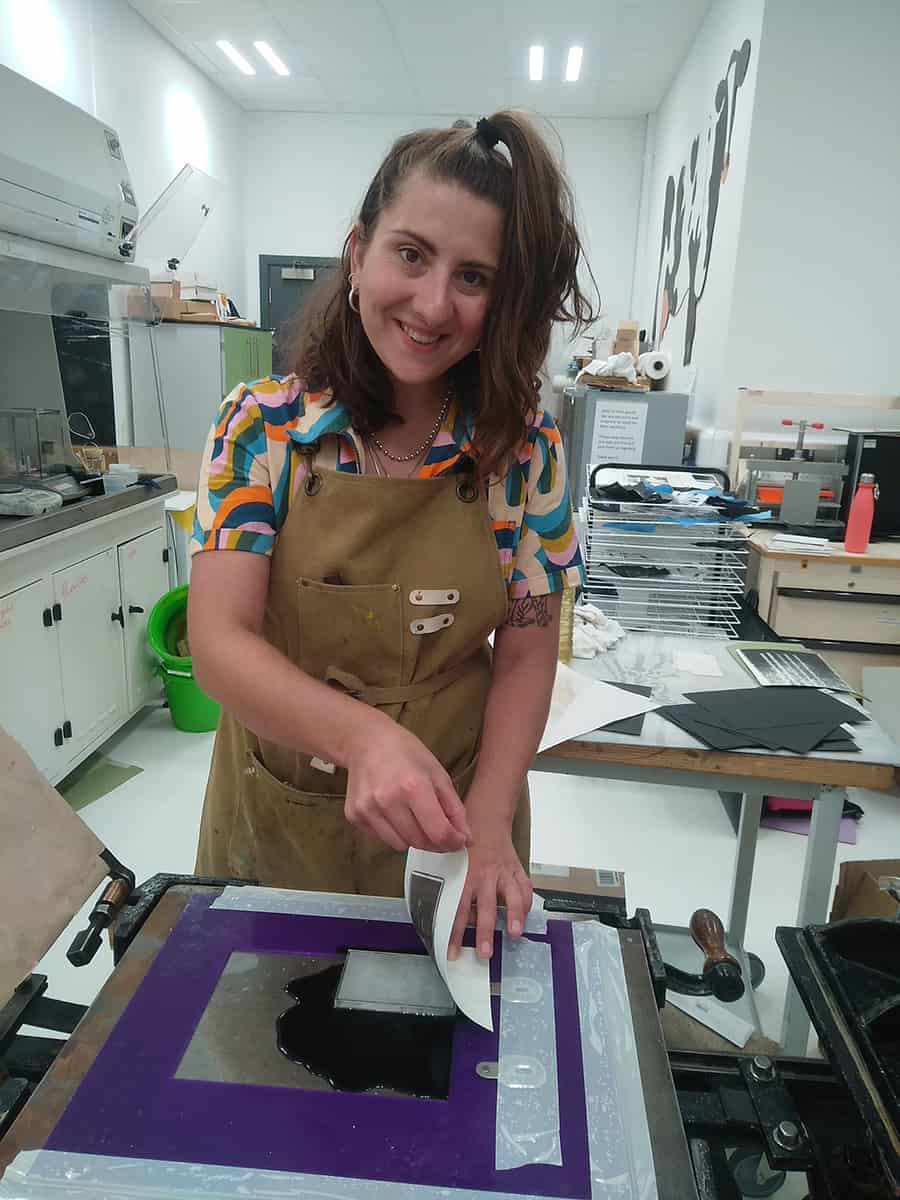
What’s old is now new Trainee CFPR print technician Harrie Fuller is a member of physicist Susanne Klein’s research group, reinventing traditional printing techniques like Woodburytype and Lippmann photography. (Courtesy: CFPR)
The result is an astoundingly robust 3D relief (a mold) of the image, which can be pressed into lead using a hydraulic press. The lead printing plate is then oiled, filled with a warm gelatin pigmented with soot, and covered with paper before going into a printing press. After about five minutes, the paper is pulled off, and once the ink is dry, the print is finally flattened and trimmed. Originally, up to 10 printing plates could be made from a single gelatin relief, and these could be mounted in a printing carousel for mass printing.
“Since Woodburytype prints are based on pigmented gelatin, they are completely archivable because soot or carbon black is extremely ‘light-fast’ and gelatin will not deteriorate or change chemically as long as it is not exposed to extreme humidity,” says Klein. “Although the original process is time-consuming and became obsolete when lithography took off, the image quality is unsurpassed. Even today, Woodburytype is still the only continuous-tone photomechanical reproduction method.”
In revisiting the technique, Klein and her colleagues have developed two alternative routes for creating Woodburytype prints with modern materials. “In one method,” explains Klein, “we follow the original workflow, but replace dichromated gelatin with photopolymer, and lead with silicon.” In this way, the exposure time is reduced from 60 minutes to seconds, while printing plates can be made within hours rather than days. An even faster method uses a laser-cutter to create a relief in acrylic – producing a 10 by 15 cm printing plate in 10 minutes, for example. The precision of the laser-cutter also means the layers of cyan, magenta, yellow and black needed to create full-colour images can be easily printed on top of each other.
Both methods are attractive to fine-arts practitioners for the creation of original works of art, but they are also interesting for companies seeking an environmentally friendly way of creating high-end photographic reproductions for art installations and commercial advertising in public spaces. The advantages are that laser-cutting of printing plates is energy-efficient and produces almost no waste, while the inks are gelatin-based (a waste product of the meat-processing industry). Furthermore, the prints are biodegradable and the ink can be removed from the paper by washing with water.
Another area of investigation for Klein involves the industrial application of “structural colour”, where colour is generated not by pigments but by microscopic patterns reflecting and refracting light in unique ways (as in the wings of a butterfly). One intriguing option is to introduce additional layers of cholesteric (chiral nematic) liquid crystals into the relief of a Woodburytype, to print structural colour. With the appropriate materials, the liquid crystal could be oriented by the layer and the original printed colours changed by applying a magnetic or electric field, not dissimilar to a bistable display.
Possible applications include anticounterfeiting for the labelling of luxury goods, designer fashion and pharmaceuticals. “The commercial opportunity here is significant,” adds Klein. “The challenge is to produce secure packaging with printing inks that will change colour every time an item is authorized at different stages of the supply chain on its way to the customer.”
The materials scientist
Klein’s colleague Nazmul Karim – research lead in the centre’s Graphene Application Laboratory – is another academic seemingly made-to-measure for the CFPR’s multidisciplinary melting pot. Before joining UWE in 2019, Karim spent four years working on graphene-based, high-performance functional clothing and wearable electronic textiles (e-textiles) at the National Graphene Institute at the University of Manchester, UK.
His current research interests – which are part of CFPR’s new materials programme – include preparing graphene (via exfoliation and functionalization) graphene and other 2D materials for e-textile applications. Karim is also studying how to make graphene wearables via highly scalable fabrication techniques such as coating and printing (i.e. with graphene “inks” applied directly onto textiles). “My team is passionate about introducing smart materials and artificial intelligence to printed electronics for non-invasive personalized healthcare applications,” says Karim.
Wear it well Graphene Application Laboratory scientists Shaila Afroj (foreground) and Md. Rashedul Islam are working on the printing and coating of 2D nanomaterials within high-performance wearable e-textiles. (Courtesy: CFPR)
The group’s latest results, based largely on work carried out by PhD student Md. Rashedul Islam, demonstrate the tangible commercial opportunity taking shape. Islam has developed a versatile e-textiles platform that is fully printed, highly conductive, flexible and machine-washable. The material can store energy using printed graphene supercapacitors while monitoring a range of physiological indicators, such as heart rate, skin temperature and assorted activity metrics. Even more impressive is that, when fashioned into a separate headband, the prototype e-textile can record brain activity (an electroencephalogram or EEG) to the same standard as conventional rigid electrodes. At the moment the supercapacitors are charged using an external power source, but the goal is to make them self-sufficient in the future by introducing energy-harvesting functionality.
The fabrication process exploits a highly scalable screen-printing technique, in which the graphene-based ink is passed through a custom-designed mesh on to a rough and flexible textile substrate. The conductive tracks are then encapsulated for insulation and protection, to produce a machine-washable e-textiles platform. The hope is that early-stage successes like this will open the way to volume production of multifunctional graphene-based e-textile garments, in which each item of clothing has a network of wearable sensors and is powered by the energy stored in graphene-based textile supercapacitors.
On a related front, the Graphene Application Laboratory is looking into the use of graphene and other functional materials (including antimicrobial coatings) as the basis of high-quality recyclable clothing. Right now, around 55% of textiles are made from synthetic polyesters – most commonly polyethylene terephthalate (PET), which is not biodegradable and can remain in the environment for hundreds of years. “Understandably, there’s growing interest from fashion brands and retailers to move away from virgin PET to recycled polymer (rPET)-based polyester fabrics with reduced environmental impacts,” says Karim.
The trouble is, current iterations of rPET suffer from thermal ageing, and degrade as a result of random mixing with other materials during the recycling process. It’s still early days, notes Karim, but initial results from CFPR show promise, with graphene-enhanced rPET having already been spun into fibres that are lighter, mechanically more robust and easier to recycle. “This will be a long game,” adds Karim, “and we’re going to need sustained collaboration across the innovation ecosystem. That means academic groups like ours working hand-in-hand with graphene suppliers, textile manufacturers, and the big fashion and clothing retailers.”
The ceramic designer
An altogether different manufacturing opportunity preoccupies Tavs Jorgensen, a craft potter and designer in the ceramics industry before he went on to pursue a career in academia. Jorgensen is in the vanguard of CFPR’s R&D efforts in digital manufacturing, aiming to fast-track the hitherto limited application of 3D-printing technologies, computer-controlled machining and robotics in ceramic production.
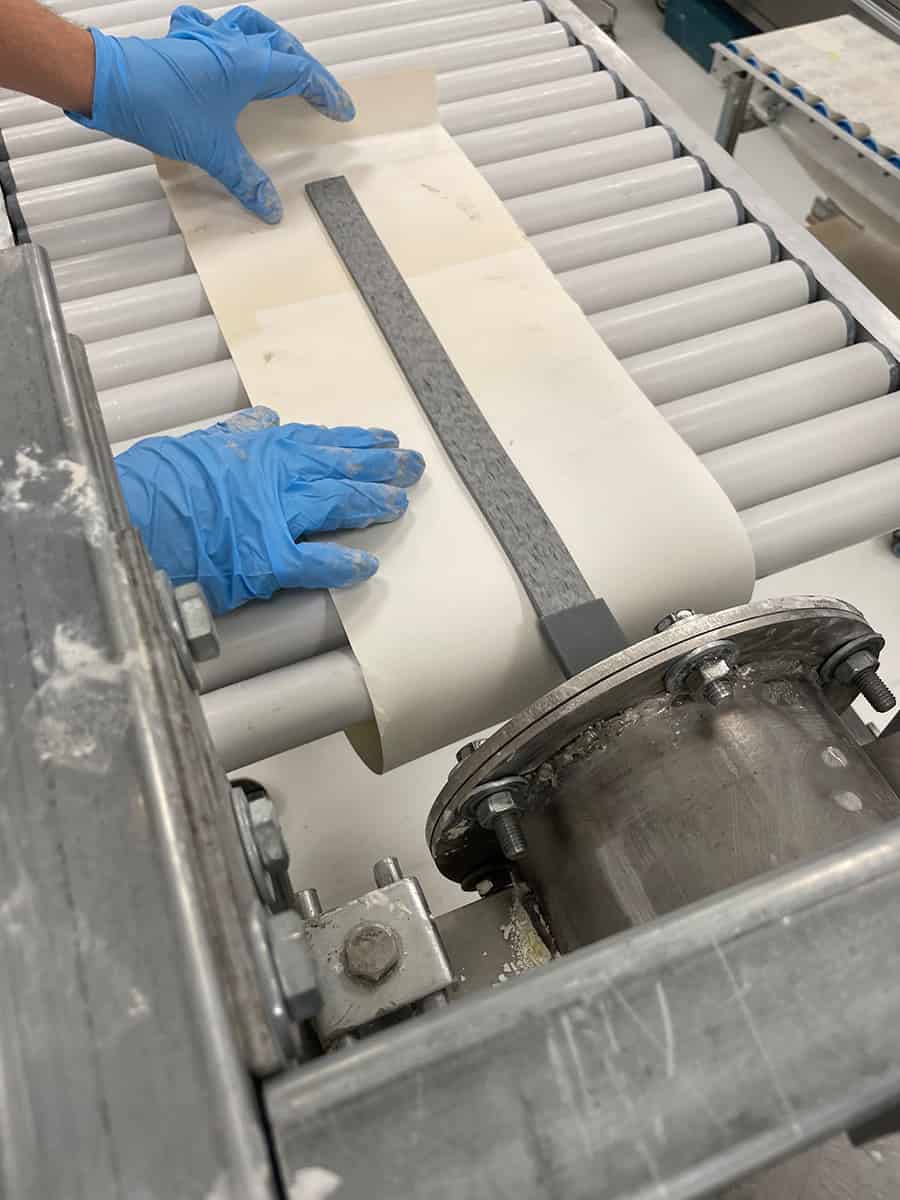
Tough enough CFPR’s R&D collaboration with the UK National Composites Centre is optimizing the extrusion of ceramic matrix composites for applications in aerospace and the nuclear power industry. (Courtesy: CFPR)
Jorgensen and his team are particularly interested in a production process known as extrusion. This is when soft and mouldable clay is forced through a channel, or “die”, that imparts a particular cross-sectional shape to the material, and yields a continuous linear clay strip that can be cut into pieces to produce individual parts such as bricks, tiles, cladding and other architectural components. Industrial extruders are used to make specialized ceramic parts, including filters for catalytic converters and high-temperature components for furnaces and autoclaves. Meanwhile, hand-operated extrusion systems are often found in craft workshops to create handles and one-off decorative elements in support of other production methods such as pressing and casting. “Our challenge,” says Jorgensen, “is how can we exploit digital technologies and robotics to extend the current uses of clay extrusion into more innovative commercial and design-led applications.”
The team’s default setting is based largely on practical experiments. “Sometimes tests are carried out as open-ended explorations with highly unpredictable outcomes, an approach driven largely by curiosity – what happens when we do this?” Fundamental physical and materials insights are an important element in understanding how the clay behaves. For example, during the drying and firing, the extruded clay pieces shrink by around 10–15%, and they can bend and crack due to tensions from the extrusion process.
“The nature of the clay extrusion makes theoretical calculations of the outcome challenging,” says Jorgensen, “although some work has been done to develop algorithms that can help to predict the flow of clay in an extrusion situation.” In an opportunistic cross-disciplinary tie-up, Jorgensen turned to the expertise of Damien Leech – a former CFPR theoretical physicist now based at the Belgian nanoelectronics centre imec – to develop models predicting how particular die geometries might affect the pressures needed to extrude clay. “While empirical testing remains the core methodology with the investigations,” Jorgensen adds, “the theoretical modelling has proved invaluable, providing a basic understanding of which geometries would be best deployed in the real-world physical experiments.”
Helping hand CFPR researchers evaluate robotic-assisted bending of ceramic extrusions as they emerge from the die. The process enables the creation of one-off ceramic parts for the creative arts and architectural contexts. (Courtesy: CFPR)
The team is also creating tooling workflows that allow novel die designs for 3D printing to be quickly prototyped and tested, which is opening up applications for ceramic extrusion in high-performance industrial applications. Front-and-centre is CFPR’s R&D collaboration with the National Composites Centre (NCC) in Bristol. They are interested in the potential for extruding ceramic matrix composites (CMCs), a class of materials in which ceramic paste is mixed with inorganic binders to increase fracture toughness under mechanical or thermomechanical load.
The CFPR/NCC partners are currently defining and iterating the process specifics – including the supporting tools, jigs, components and workflows. Long-term, though, they are eyeing all manner of applications in sectors like power generation and aerospace, where CMCs are increasingly used for high-temperature heat-shield systems. “Extrusion is an entirely novel way of producing CMCs,” says Jorgensen, “and this research opens up the opportunity for us to create CMC parts with exotic geometries, such as pipes and profiles with complex internal structures.” Such CMC pipes are attracting interest for the next generation of nuclear power plants, while the extrusion process has the potential to support the UK’s net-zero carbon target for construction materials, with Jorgensen and colleagues exploring extrusion of unfired clay and fibre mixtures for low-carbon building components.
An open mindset and open for business
If convergence, collaboration and co-creation are fundamental to the CFPR research model, so too is the centre’s blend of artists, designers, scientists and technologists, working across both traditional and digital print disciplines.
The group also brings together people from a variety of backgrounds, with researchers from industry as well as academia. This mix of expertise and experience supports the CFPR’s broad international academic and industrial collaborations; with commercial partners including specialist printing companies, ceramic manufacturers and multinational technology firms. Joint R&D projects range from targeted contract research and feasibility studies through to the co-development of advanced materials, processes and full printing systems.
It’s apparent that there’s no hard-and-fast rulebook on collaboration at the CFPR, rather variations on a theme in which open-minded thinking is blended with creativity, science and technology innovation in advanced print practices.
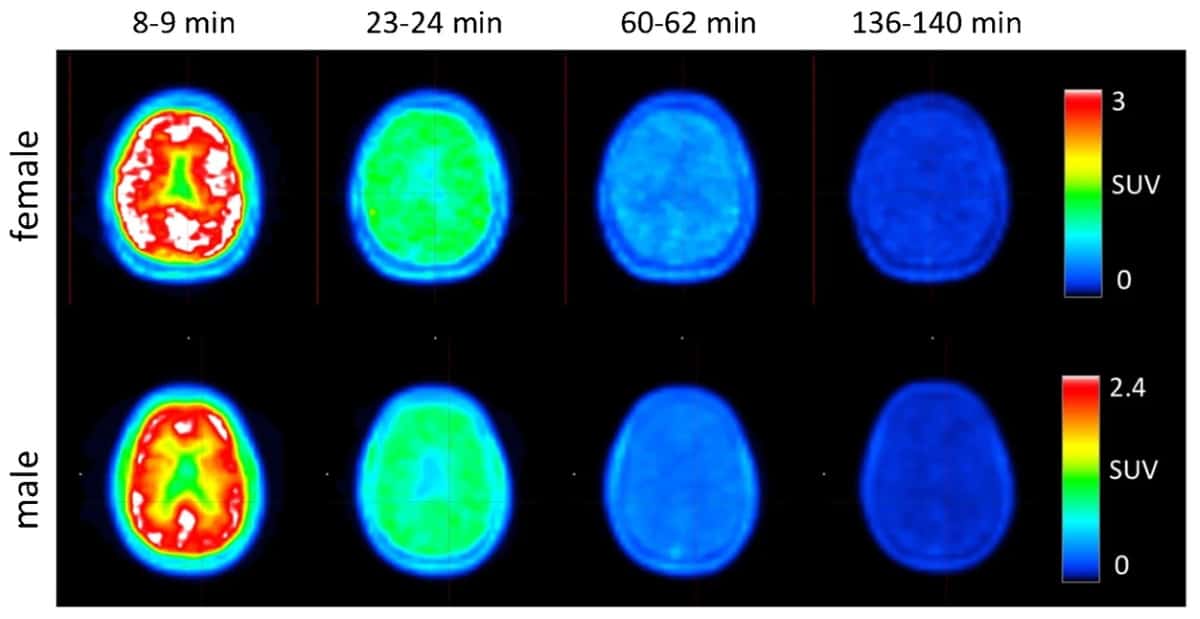
In vivo assessment: Representative whole-body 18F-3F4AP PET images of a female (top row) and male participant at different time points. (Courtesy: CC BY 4.0/P Brugarolas et al Eur. J. Nucl. Med. Mol. Imaging 10.1007/s00259-022-05980-w)
Myelin is a protective layer that forms around nerves to insulate them and speed transmission of electrical impulses. Demyelination, loss of this insulating layer, contributes to many neurological diseases, including multiple sclerosis, Alzheimer’s disease, stroke and dementia. An effective technique to detect this potentially reversible condition could improve diagnoses of brain diseases and enable monitoring of possible treatments. Currently, however, no imaging tests can accurately identify demyelination.
To address this shortfall, researchers from the Gordon Center for Medical Imaging at Massachusetts General Hospital and Harvard Medical School are investigating the use of a novel PET radiotracer – 18F-3-fluoro-4-aminopyridine (18F-3F4AP) – to image demyelinated lesions in the brain. They have now tested the tracer in humans for the first time, reporting their findings in the European Journal of Nuclear Medicine and Molecular Imaging.
“Having an imaging tool that it is specific to demyelination can help to better understand the contribution of demyelination to different diseases and better monitor a disease or the response to therapy – for example, a remyelinating therapy,” says first author Pedro Brugarolas in a press statement.
18F-3F4AP is a radiofluorinated version of the multiple sclerosis drug 4-aminopyridine. The tracer, which enters the brain via passive diffusion, binds to demyelinated axons in a similar manner to the drug itself. Previous studies demonstrated that PET with 18F-3F4AP can detect lesions in a rat model of demyelination, and that the tracer has suitable properties for imaging the brains of rhesus macaques, prompting the team to investigate its use in humans.
Brugarolas and colleagues performed PET scans on four healthy volunteers after administering 368±17.9 MBq of 18F-3F4AP. Following a low-dose CT scan, they started PET immediately upon tracer injection, recording a series of images in seven scanner bed positions to cover the entire body. To capture the tracer kinetics and maximize image quality, the initial scan time per position was 1 min, increasing to 2, 4 and 8 min per position. The entire PET acquisition took 4 h.
The resulting PET images and time-activity curves (TACs) revealed that the tracer distributed rapidly throughout the entire body, including the brain, and quickly cleared via renal excretion. At 8–14 min post-injection, maximum activity was seen in the liver, kidneys, urinary bladder, spleen, stomach and brain. At 22–28 min, the highest activity was in the kidneys, biliary duct and urinary bladder. After 60 min, most of the activity had cleared from the organs and accumulated in the urinary bladder.
Capturing tracer kinetics: Brain PET images at four selected time points. (Courtesy: CC BY 4.0/P Brugarolas et al Eur. J. Nucl. Med. Mol. Imaging 10.1007/s00259-022-05980-w)
The team also used the integrated TACs to perform dosimetry. The average effective dose was 12.2 ± 2.2 µSv/MBq for the four participants, with no differences seen between male and female volunteers. The researchers note that this effective dose is significantly lower than that estimated from non-human primate studies (21.6 ± 0.6 µSv/MBq), likely due to the faster clearance seen in humans than in rhesus macaques. This dose was also lower than for other PET tracers, such as 18F-FDG.
Importantly, the tracer and imaging procedure were well tolerated by all participants, with no adverse events occurring during the scan. There were no significant differences in volunteers’ vital signs (temperature, blood pressure and oxygen saturation) before and after the scan, and no significant changes in blood metabolite and electrocardiogram results obtained within 30 days before and after the scan.
The researchers conclude that 18F-3F4AP readily enters the brain and is safe in for use in humans, with an acceptable level of radiation dose. They suggest that their findings open the door for further studies investigating the tracer’s ability to detect demyelinated lesions in different patient populations.
Renewable energies are taking an increasingly larger stake in many countries’ energy mixes. But despite rapid expansion, solar and wind are intermittent. Batteries will go a long way to solve that issue, but many experts believe we will still need “on tap” forms of energy generation to ensure that grid base load power is always met.
One radical idea for replacing fossil fuels – explored in this video – is to harness solar energy directly in space and beam it back to Earth. Find out more about the quest for space-based solar energy in this feature article by science writer Jon Cartwright.
On grid: a visualization of a mathematical apparatus used to describe electrons moving on a lattice. Each of the thousands of pixels represents a single interaction between two electrons. Machine learning has been used to reduce this visualization to just four pixels. (Courtesy: Domenico Di Sante/Flatiron Institute)
Using artificial intelligence, an international team of physicists has shown that the thousands of equations needed to model a complex system of interacting electrons can be reduced to just four. This was done by using machine learning to identify patterns previously hidden within the system of equations. The technique could be used to vastly reduce the effort required to calculate electronic properties, says the team, which was led by Domenico Di Sante at the University of Bologna, who is also a visiting research fellow at the Flatiron Institute in New York City.
Quantum interactions between electrons underly the properties of matter, and over the past century physicists have developed mathematical and computational tools to boost our understanding of systems ranging from individual atoms to solid materials. These models must consider entanglement, a quantum phenomenon that allows stronger correlations between electrons than exists in classical physics.
A powerful mathematical tool for studying how quantum interactions between electrons in a material affect the macroscopic properties of the material is the renormalization group. However, this approach still comes with enormous challenges associated with solving large systems of coupled differential equations. Indeed, thousands, or even millions of equations may be required.
Hop to it
In their study, Di Sante’s team considered how the complexity of the renormalization group could be reduced by using machine learning to spot patterns hidden within large groups of equations – patterns that have escaped the notice of human researchers. To explore this idea, they considered the idealized 2D Hubbard model in which electrons “hop” between adjacent lattice sites in a solid material.
In this model, transitions between conducting and insulating electron systems are simulated by adjusting parameters that describe two competing processes: one that encourages the quantum tunnelling (hopping) of electrons between neighbouring lattice sites; and the other reflecting the fact that multiple electrons do not want to occupy the same lattice site.
As electrons interact with each other, they become entangled. This entanglement persists over long distances and must be accounted for in the coupled differential equations describing the system – making the equations very difficult to solve using renormalization group techniques.
Identifying redundancies
To solve the renormalization group of this model, Di Sante and colleagues first trained an artificial neural network to recognize underlying patterns within hundreds of thousands of differential equations. By identifying redundancies within multiple equations, their algorithm sought to reduce the problem to a far smaller group of equations. After weeks of training, the algorithm reduced the problem down to just four equations, and the team says this was done without sacrificing any accuracy in their solutions.
The researchers hope that their hugely successful result could soon be readily applied to quantum problems beyond the Hubbard model. This could allow researchers to model quantum states of matter such as superconductivity with far greater computational efficiency. This could in turn lead to designs of exotic new materials. By investigating the patterns picked up by the artificial neural network, Di Sante’s team also hope that physicists may gain deeper insights into quantum effects that have evaded physicists so far.
If you’re looking for a bed-time story to inspire your child, The Joy of Science is it. Written by the physicist, author and broadcaster Jim Al-Khalili from the University of Surrey in the UK, the book is an uplifting fairy tale of how science can help us pierce through the veil of ignorance and discover “how the world really is”. A rainbow, for instance, is “so much more than a pretty arc of colour” but angles of reflection and refraction.
The good news, says the author, is that while we humans often deceive ourselves with prejudices and biases, “thinking scientifically is in our DNA”. What’s more, he continues, knowing what the world really is like does not just illuminate us; it also benefits humanity too – just contrast humanity’s response to the Black Death in the 14th century with our response to COVID-19.
The book’s make-believe account of “the scientific method” paints it as all but fool-proof thanks to its reliance on evidence and testability. The book does not want to get into all the contortions that would be required to explain familiar but inconvenient cases such as the development of Yang–Mills theory – pronounced experimentally disconfirmed at the outset – and most of the steps that led to the concept of the Higgs boson and its discovery.
The Joy of Science is not really a book for children, but has that tone. It presents science as the basic process through which we can come to know a “superior” and more real world than the one we experience in the here and now. If this book inspires people to look at the rainbow not for its rich palette of colours but for angles of reflection and refraction, it will have succeeded.
2022 Princeton University Press 224pp £12.99/$16.95hb
High pressures dramatically change the properties of materials, sometimes producing physical and chemical characteristics with useful applications. The problem is that these desirable properties usually disappear once the materials leave the bulky vessels that make such high pressures possible. Now, however, researchers from the Center for High Pressure Science and Technology Advanced Research (HPSTAR) in China and Stanford University in the US have succeeded in maintaining the properties of high-pressure materials outside such vessels by instead confining them in free-standing nanostructured capsules made from diamond.
In the work, a team led by Charles Qiaoshi Zeng of the HPSTAR subjected a sample of an amorphous and porous form of carbon known as glassy carbon to a pressure of 50 gigapascals (roughly 500 000 times the pressure of Earth’s atmosphere) while heating it to nearly 1830 °C in the presence of argon gas. Although the glassy carbon is initially impermeable to the argon, it absorbs it like a sponge at high pressures. The result is a nanocrystalline diamond composite that retains argon in numerous isolated pores even after it is removed from the high-pressure vessel in which the experiment was carried out.
Using high-resolution transmission electron microscopy, the team found that these pores, which they call nanostructured diamond capsules (NDCs), contain high-pressure “grains” of argon. Denise Zhidan Zeng, the lead author of a paper in Nature describing the results, says this finding is important because until now, it has been difficult to characterize high-pressure materials in-situ without resorting to probes such as hard X-rays that can penetrate the thick, strong walls of pressure vessels. “The new NDCs allow us to do away with this bulky apparatus while maintaining the high-pressure conditions and therefore the high-pressure properties of the materials being studied,” she says.
Diamond inspiration
The researchers chose to use diamond because unlike most materials, this form of carbon retains its extraordinary mechanical and optoelectronic properties at ambient pressures after it forms at higher ones. “We were inspired by natural geological diamond inclusions and found that diamond alone is strong enough to maintain high pressures within these inclusions,” Qiaoshi Zeng explains. “We therefore decided to make synthetic diamond inclusions in which high-pressure materials are preserved with a high confining pressure within a thin diamond envelope.”
The researchers found that their NDCs can maintain pressures of up to tens of GPa even though the walls of the capsules are just tens of nanometres thick. The thinness of the walls enables the team to obtain detailed information on the atomic/electronic structures, composition and bonding nature of the materials inside using modern diagnostic probes, including various techniques based on transmission electron microscopy (TEM) and soft X-ray spectroscopy that are otherwise incompatible with high-pressure vessels.
Gas and liquid samples
Traditional, static high-pressure techniques also put limits on sample sizes: the higher the pressure, the smaller the sample needs to be. Another recently-developed technique gets around this by using high-energy electron irradiation to introduce pressure on solid particles encapsulated inside nanostructured carbon such as carbon nanotubes (CNTs), but Qiaoshi Zeng points out that this technique has important restrictions. In particular, successfully sealing a target solid material particle inside CNTs and then applying pressure to it with radiation is technically challenging even under ideal experimental conditions, and is not feasible for gas or liquid samples. “In contrast, there is no such limitation for our NDCs,” QiaoshiZeng tells Physics World.
Many materials with desirable properties have been discovered at high pressures, he adds, and these new materials would be especially attractive if it becomes possible to retain these properties under ambient conditions. “Our work is an important step towards retaining novel properties that only emerge in high-pressure materials, such as room-temperature superconductivity,” he says.
The researchers are now studying a variety of materials using the technique with the hope of preserving these high-pressure states in NDCs. “We are also looking into scaling up our high-pressure materials synthesis,” reveals Qiaoshi Zeng.
Pushing the boundaries of nanoscale imaging while embracing the extremes of ultralow operating temperatures. That’s the core value proposition offered by attocube, a German manufacturer of specialist nanotechnology solutions for research and industry, when it comes to the design, development and optimization of its portfolio of scanning probe microscopes (SPMs) and related accessories.
Despite the complexities associated with cryogenic operation, the attocube product design team is intent on bridging the gap between room-temperature SPM and ultralow-temperature applications. In short: the realization of versatile and easy-to-use SPM instrument platforms spanning a range of modalities, including (but not limited to) atomic force microscopy (AFM), conductive-tip AFM, magnetic force microscopy (MFM), piezo-response force microscopy and Kelvin probe force microscopy.
A “lighthouse customer” in this regard is Stuart Parkin, whose team at the Max Planck Institute for Microstructure Physics in Halle, Germany, is using the attocube MFM (an attoAFM I microscope with an attoMFM upgrade in an attoLIQUID2000 cryostat) to study the physical properties of materials systems with possible applications in so-called “racetrack memories”. This early-stage technology, the basic principles of which were originally elaborated by Parkin in 2002, represents a promising candidate for next-generation solid-state, non-volatile memory devices that exploit the current-controlled motion of magnetic domain walls in magnetic nanowires.
Magnetism deconstructed
The broader commercial drivers here – ultrahigh-density storage capacity and significantly enhanced energy efficiency – are rooted in fundamental materials physics. Not least the fact that racetrack memories are innately three-dimensional – in contrast to the inherent 2D structure of both magnetic disk drives (with data stored in a single 2D sheet of magnetic material) and silicon-based microelectronics (in which logic is carried out using a single sheet of transistors fabricated in the surface of single-crystal silicon).
Stuart Parkin: “It’s clear that attocube builds products with a lot of forethought and consideration to take advantage of emerging research opportunities.” (Courtesy: Max Planck Institute for Microstructure Physics)
Right now, Parkin and his team are focused on understanding the underlying physical properties of a specific class of magnetic nanostructure – known as topologically protected, non-collinear magnetic domain walls – while evaluating their potential utility as a vehicle for fast and energy-efficient data transfer in future racetrack-memory devices. “What we want to do is image these magnetic textures down to the nanoscale,” explains Parkin. “It’s not so easy, though – there aren’t many ways to do this effectively.”
One approach that’s being pursued in Parkin’s laboratory is Lorentz transmission electron microscopy – a powerful tool to study crystal and magnetic domain structures in correlation with novel physical behaviours. The downside, however, is that this imaging modality requires the scientist to make very thin, electron-transparent laminar membranes of the sample so that the electron beam can pass through – a significant overhead in terms of research productivity and output. “Sample preparation is tricky, time-consuming and can also damage the material under study,” notes Parkin.
Positioning for success
Conversely, sample preparation is a lot simpler for cryo MFM imaging (as the grown sample just has to be glued to the sample holder and contacted electrically prior to cool-down and measurement). In terms of specifics, the attoAFM I works by scanning the sample below a fixed cantilever and measuring deflection of the latter with a fibre-based optical interferometer to reconstruct the magnetic texture of the sample surface (with a lateral resolution of <30 nm).
The microscope exploits a set of xyz positioners for coarse positioning of the sample over a range of several mm, while dedicated, mechanically amplified piezo-based xyz scanners ensure a very large scan range even at cryogenic temperatures. Crucially, the use of non-magnetic materials throughout the system means the microscope is ideally suited for low-temperature MFM applications (down to 1.8 K) in combination with high magnetic fields (up to 12 T).
“The attocube MFM gives us access to a wide operating temperature range [1.8 K up to 300 K],” explains Parkin. “Equally important, the system’s vector superconducting magnet means it is also straightforward to apply magnetic fields to our samples – whether perpendicular, in-plane or at a range of angles.” Flexibility is a given: as such, the system can be equipped with the user’s choice of superconducting magnet, be it a single solenoid, split coils or 2D/3D vector magnets (including a suitable magnet power supply and the superconducting leads).
One of attocube’s main technology differentiators, says Parkin, is the manufacturer’s “expertise and legacy” in the design and development of nanopositioning stages for sample manipulation (with the patented slip-stick principle providing several degrees of freedom over several mm and with sub-nm precision). “The attoAFM I is a versatile platform,” he adds. “What’s more, attocube manufactures the whole system, integrating the MFM head, nanopositioning stage, magnet and cryostat, and with the control software knitting it all together.”
Equally important is the vendor–customer relationship and what Parkin identifies as a collaborative model of technology innovation. “It’s clear that attocube builds products with a lot of forethought and consideration to take advantage of emerging research opportunities,” he concludes. “In this way, the attocube product development team is happy to gather feedback from end-users who might have ideas for novel instrument designs and improvements.”
Engagement is everything: listening to the end-user
Mirko Bacani: “My job is to put myself in the customer’s shoes.” (Courtesy: attocube)
Mirko Bacani is the senior product manager for attocube’s cryogenic instruments portfolio, a business unit comprising four main product lines: cryogenic nanopositioners, automated low-vibration cryostats, scanning probe and confocal microscopes, and measurement tools for “cold science”. Here he tells Physics World how the company’s mission to facilitate cutting-edge materials research “starts and ends with a granular understanding of the scientific customer’s evolving requirements”.
What does your role at attocube involve on a day-to-day basis?
I have a research background in condensed-matter physics, with specialist know-how in the application of cryo MFM to a range of problems in fundamental science. As such, I speak the same language – in fact, the same dialect – as the physicists and materials scientists using our cryogenic instruments. My job is to put myself in the customer’s shoes, so I spend a lot of time analysing trends in condensed-matter research and talking to scientists – whether in their laboratories or at conferences – to understand their technology requirements versus emerging lines of scientific enquiry. Effectively, I act as a bridge between the customer and our in-house product development teams, communicating “must-haves” from the end-user and then agreeing the appropriate technical solution and product implementation.
How does attocube differentiate itself in terms of product development and innovation?
Vertical integration underpins the attocube value proposition. We develop and manufacture all of the core building blocks in our commercial instruments, giving us full control over functionality and quality assurance at the component, subsystem and system level. In cryo MFM, for example, those enabling technologies include the nanopositioning stage, scanning subsystem, deflection detection unit as well as the microscope housing and low-vibration cryostat. That granular level of control shapes our product development roadmap and ongoing technology innovation, allowing our engineering teams to iterate advanced product features in a modular fashion and ultimately deliver an optimized product to fulfil the “workhorse” role in research labs around the world.
What about your approach to customer acquisition and new business?
Here again, we prioritize specialist domain knowledge and expertise in our front-line sales engineers, all of whom have postgraduate research experience in the physical sciences. Their role is much more than sales, though, it’s specialist technical consulting – understanding the customer’s science and their instrumentation requirements. Put simply: we don’t need to know the answers to the customer’s research questions, though we do need to understand the questions themselves. In this way, we can develop enabling technologies that will unlock the creativity, ingenuity and imagination of all our end-users. It’s an approach that works: many new customers come to us when they see the success of existing customers with attocube equipment.
So ultimately it’s all about that close engagement with the end-user?
Correct. Every cryo MFM, for example, is installed in the laboratory in the presence of the customer. That process – installation, commissioning and acceptance – takes around three days, with an exhaustive approach to product training and knowledge transfer. All part of attocube’s mission to enable ongoing scientific impact for its customers through cryogenic instrumentation.
The discovery of life on another planet or moon would have a profound effect on how we see our place in the cosmos. Such discoveries could be forthcoming because astrobiologists are looking for signs of life in the ice-covered moons of Saturn and Jupiter; and also on the growing number of exoplanets that have been discovered orbiting stars other than the Sun.
One way to search for evidence of life is to determine the chemical composition of a planet’s atmosphere. This can be done by observing star light that has passed through its atmosphere and looking for absorption lines associated with specific chemicals. Not only is this difficult to do, but it is not clear which chemicals we should be looking for. Methane, for example, is associated with life here on Earth but can also be produced by non-biological processes.
Now, Michaela Leung at the University of California, Riverside and colleagues in the US have done research that suggests that gases emitted by broccoli and other plants could be useful targets in the search for extraterrestrial life.
Extraterrestrial detox
Plants emit these gases in a process called methylation, whereby toxic compounds are turned into gases so that they can float away from the plant. One of these gases is methyl bromide, which Leung and colleagues believe would make a particularly good target. One reason, according to the team, is that the compound is expected to have a relatively short lifetime in an extraterrestrial atmosphere. This means that methyl bromide would have to be continuously produced – presumably by life. Also, the presence of methyl bromide is more likely to signify life than other compounds such as methane – although the team cautions that the compound could also be created by non-biological processes.
Recently, Physics World’s industry columnist James McKenzie sang the praises of the new iPhone 14. He is particularly pleased that the device can operate as a satellite phone without the need for an unwieldly antenna. But it turns out the latest smartphone has a new feature that may not be as welcome – at least for people who enjoy a trip to an amusement park.
Which way is up?
Most smartphones contain an accelerometer, which is mostly used to tell which way is up when you change the orientation of your phone. However, there are more sophisticated ways of using the accelerometer on your phone and, not surprisingly, there are apps for that.
Indeed, the new iPhone and some Apple watches have an app that will call the emergency services and your loved ones when your device is subjected to the sort of violent acceleration that would occur in a serious car accident. The alert goes out if the victim does not respond to an automated call.
The problem is that people riding on rollercoasters are triggering calls and they are missing the automated calls – presumably because of all the noise in the general vicinity of a roller coaster.
Warning from Dollywood
According to the BBC, six emergency calls have been put through on behalf of people on rides at the Kings Island amusement park in the US. What is more, Dolly Parton’s theme park Dollywood is warning visitors that their phones might make bogus calls to emergency services. And it is not just rollercoasters that are the problem, the relatives of a motorcyclist received crash alerts when he dropped his phone while travelling at high speed. He was unable to respond because the phone was damaged in the fall.
As well as using the accelerometer, the smartphone also looks for a change in air pressure (yes, your phone measures air pressure) that results from the deployment of an airbag and loud noises – but it seems that their algorithm may need a tweak or two.