Astronomers have explained a “baffling” image that was taken earlier this year by the James Webb Space Telescope (JWST).
The picture, taken in July, shows a distant binary star known as WR140 surrounded by concentric geometric ripples. The WR140 binary, located just over 5 000 light-years from Earth, is made up of a huge “Wolf-Rayet star” and an even bigger blue supergiant star, gravitationally bound in an eight-year orbit.
A Wolf-Rayet star is an O-type star that is at least 25 times more mass than the Sun and is nearing the end of its life where it will likely collapse to form a black hole.
The JWST image of the binary star surprised astronomers and even triggered Internet speculation that it might be evidence of an alien megastructure light-years across.
Yet researchers have now offered a more mundane explanation. They say that the 17 concentric rings seen girdling the star are actually a series of huge dust shells created by the cyclic interaction between the pair of hot stars locked together in a tight orbit.
Each ring is created when the two stars came close together and their stellar winds – streams of gas they blow into space – meet, compressing the gas and forming dust.
“Like clockwork, WR140 puffs out a sculpted smoke ring every eight years, which is then inflated in the stellar wind like a balloon,” says Peter Tuthill from the Sydney Institute for Astronomy at the University of Sydney. “Eight years later, as the binary returns in its orbit, another ring appears, the same as the one before, streaming out into space inside the bubble of the previous one, like a set of giant nested Russian dolls.”
The tiniest defects in a metal can cause it to fail, but predicting when this so-called metal fatigue will occur is difficult. Now, however, researchers in the US and France have found that the fatigue strength of a metallic material can be calculated after just a single loading cycle thanks to a new nanometre-resolution digital image correlation technique. The technique enabled the team to observe incipient weak points known as slip localizations on the surface of a wide range of alloys and could guide the design of fatigue-resistance alloys in the future.
“We found that after the first fatigue deformation cycle, the amplitude of the plastic localization events that developed determines the fatigue strength of metallic materials,” explains Jean-Charles Stinville, a materials scientist and engineer at the University of Illinois at Urbana-Champaign who led the research. “This observation identifies the origin of fatigue failure and paves the way to rapidly predicting fatigue strength, which measures how many times a certain amount of stress can be applied to a material before it fails.”
When a metal is under load, linear defects known as dislocations move through its crystal lattice, causing the atoms to slip over each other and the metal to deform. These surface slip localizations are where stress concentrates and they act as nucleation sites for cracks that grow progressively with further loading cycles, eventually causing failure.
Fatigue strength and yield strength
Researchers currently measure the strength of a metal or alloy by testing samples under different cyclic loading conditions to calculate the highest stress the material can withstand for a given number of cycles – a complex and time-consuming method. In the new work, Stinville and colleagues found that the (irreversible) slip localization after the first loading cycle was linearly correlated to the fatigue strength of different metals. This correlation provides a way to rapidly predict the fatigue strength of metals, they say.
In their work, they subjected a variety of face-centred cubic (FCC), hexagonal close-packed (HCP) and body-centred cubic (BCC) metallic materials to cyclic deformation and observed their behaviour on the nanometre scale at the earliest stages of cycling. They observed that the characteristics of slip events varied as a function of the crystal structure and microstructure. For instance, slip localization is usually less intense in BCC metallic materials, explaining their better fatigue strength in comparison to FCC and HCP materials.
“Our experimental tool allows for statistical quantification of nanometre-scale deformation events that are involved during the deformation of metals,” Stinville tells Physics World. “Their characteristics inform the structure’s and microstructure’s effects on the mechanical properties, and in particular fatigue strength.”
Such analysis is helpful for identifying alloys that show exceptional or unusual behaviour and provides a different approach for identifying fatigue-resistant alloys quickly and simply, he adds.
The researchers say they now plan to extend their technique to loading conditions under extreme environments, such as high and cryogenic temperatures. “Such measurements will be useful for identifying metals for transport applications and those that require extreme temperatures,” Stinville says.
Cricket and golf have little in common. Sure, there’s a tradition of wearing knitted jumpers while playing both sports, but from the point-scoring system and the number of players, to the size of the ball and the playing area, they are very different games. There is one feature the two share though – both cricket and golf involve hitting a ball that has a textured surface. This apparently minor detail allows golfers and cricketers to exploit the principles of aerodynamics to help them win.
In golf, the ball is manufactured to have a uniform covering of hundreds of dimples. These create pockets of turbulence, which make the air flow pass closer to the ball’s surface than if it were smooth. The effect reduces the low-pressure zone behind the ball, thereby lowering the drag and allowing the ball to travel further.
Another benefit of this dimple design is that it amplifies the “Magnus effect”, a phenomenon that occurs when a ball spins as it travels through the air. Named in honour of the 19th-century German physicist Heinrich Gustav Magnus, it is a result of the pressure difference across a spinning surface, between the side where the ball’s motion opposes the air flow, and the side where it is in the same direction.
This pressure difference causes an overall force across the ball in the direction of low pressure. In the case of a golfer creating backspin – where the “top” of the ball rotates towards the golfer – the net force is upwards so the ball travels further than it would if it wasn’t spinning.
The physics of a cricket ball is even more interesting. It’s manufactured to be smooth and glossy, with a raised stitched seam encircling it. The onus is on the cricketers themselves to alter the texture of the leather surface (provided they do so within the laws of the game). It’s a responsibility with interesting consequences, and a history of scandals.
In cricket, there are many styles of bowling, but they all fall into two broad categories – fast and spin. Spin bowling is a slower delivery but by rotating the ball rapidly, the bowler can get the ball to bounce at unusual angles, making it difficult for the person batting to predict its incoming pathway. In contrast, fast bowlers try to fire the ball as quickly as possible at the batter to force a mistake.
But within fast bowling there’s another discipline called swing bowling, where the aim is to make the ball deviate from a linear trajectory. The idea is that this will confuse the batter and not give them enough time to adjust their shot, making a wicket (meaning the batter is out) more likely. A fast bowler can achieve this delivery from a shiny new ball by angling the raised seam away from the intended direction of travel.
In scientific terms, swing is a net force acting sideways on the ball, resulting from a pressure difference across it. When a ball is bowled, a thin layer of air – the boundary layer – surrounds part of the ball. This detaches from the surface at two locations, known as separation points, “behind” the ball relative to the direction of its motion.
A turbulent boundary layer detaches from the ball later than a laminar one (where the air flow is smooth), and that later separation point leads to a lower pressure on that side. By having both laminar and turbulent boundary layers on opposite sides of the ball, the separation points become asymmetric, resulting in a pressure gradient across the ball.
The bowler will angle the seam away from the direction of delivery, which will disturb the air flow over one side of the ball
So how do you create both types of boundary layer on the same ball, especially when that ball is a smooth new cricket ball? It is here that the prominent seam of the ball comes into play. The bowler will angle this seam away from the direction of the delivery, which will disturb the air flow over one side of the ball. The boundary layer on the other side stays laminar and thus you have your asymmetry and your swing; in this case, in the direction of the seam.
A brand new, beautifully firm and glossy cricket ball doesn’t retain its shine for long however. Being hit and bounced all over the pitch for potentially hundreds of deliveries creates cracks, wrinkles and general scruffiness. While it may seem that angling the seam on a uniformly scruffy ball should serve the same purpose as it does for a smooth new ball, this is not the case. As the ball ages, the seam too will undergo wear and tear, and become less prominent. Essentially, it will be less effective at tripping the air flow to make one side even more turbulent.
In contrast, having half the ball smoother than the other means that the bowler doesn’t need to create laminar and turbulent boundary layers themselves – instead these will form as per the surface that they flow over. Players therefore try to maintain the ball’s physical asymmetry, which requires the bowling side to keep one half of the ball as smooth as possible. This is usually done by polishing the ball on their clothes, creating the distinctive red streaks on a cricketer’s white kits, or smoothing it with their sweat before bowling it.
As scientists develop the technology to quantify every variable of a ball’s trajectory, athletes and their coaching teams are understanding more about these aerodynamic phenomena, and how to manipulate them. The game is therefore constantly developing, with boundaries being pushed further and further in the pursuit of trophies.
To maintain a healthy balance between nutrient absorption and bacteria populations, the human gut likely alternates between two distinct patterns of muscle contraction, according to a study by researchers in Germany and the US. Through simulations, a team led by Karen Alim at the Technical University of Munich showed that these patterns are intrinsically linked to the speed of fluid flowing through the gut.
The ways in which our digestive systems absorb nutrients are heavily influenced by muscle contractions in our intestines. This can happen through two possible ways: in peristalsis, muscles surrounding the small intestine radially contract and relax. These contractions propagate as a wave, driving fast flows of digested food along the tube. Weaker transport is driven by segmentation – where muscles on the inner walls of the intestine contract and relax in a pattern resembling a rippling checkerboard.
Another crucial factor behind nutrient absorption in the gut are the vast numbers of bacteria living inside the intestines, together known as the “microbiota”. These microbes compete with the gut as they absorb nutrients, and play a crucial role in the functioning and general health of the gut – but can also trigger dangerous side-effects if their density becomes too high.
Each of these three phenomena has been studied independently in some detail – but so far, researchers haven’t yet considered how they may be connected. To answer this question, Alim’s team modelled the small intestine as a hollow, deformable cylinder with a nutrient-laden fluid flowing through. They then used fluid dynamics simulations to examine the differences between flow speeds generated by peristalsis and segmentation, allowing them to monitor the resulting effects on populations of bacteria flowing through the gut.
The model showed that the slower flow speeds associated with segmentation caused nutrients to remain in the gut for longer. This would allow the body to absorb nutrients more efficiently, by mixing unevenly spread nutrients into more uniform concentrations. Simultaneously, it would allow the microbiota to grow larger before being flushed out of the gut. In contrast, peristalsis hastened flow speeds through the gut – leading to lower levels of nutrient absorption, while flushing out bacteria at a faster rate.
From their results, Alim’s team suggest that the gut alternates between the two patterns of contraction to optimize the efficiency of nutrient absorption, while regulating the growth of microbiota. Their discovery offers a new understanding of the complex dynamics that link the microbiota to muscle contractions in the gut, and also provides important insight into how our digestive systems operate. By drawing from these results, researchers could develop new ways to diagnose and treat gut-related diseases.
In this episode of the Physics World Weekly podcast, the physicist and nuclear forensics expert Tom Scott sings the praises of careers in the nuclear industry and explains why tracing illicit radioactive materials benefits from a multidisciplinary approach. Based at the UK’s University of Bristol, he also describes new type of battery that runs on nuclear waste.
Also on hand is Blanca Biel Ruiz, who is a physicist at Spain’s University of Granada. She is setting up a summer school with the aim of encouraging people to pursue careers in big science. There soon will be plenty of opportunities in Granada, where work is underway to build the IFMIF-DONES facility for testing materials for future fusion reactors.
Two US-based research teams have developed quantum information processors that use neutral ytterbium (Yb) atoms as qubits – the first time this atomic species has been employed for this purpose. Trapping 100 Yb atoms in a 10 × 10 array, the researchers showed that they could perform entangled two-qubit gate operations on them, paving the way towards quantum computers based on this choice of qubit.
In principle, qubits can be any quantum system capable of transporting information through a so-called quantum register, which houses qubits in the same way as a classical register houses bits in group of 8, 16, 32 and 64. Previously, however, all neutral atom qubits were based on alkali metals such as rubidium or caesium. Owing to their single valence electron, this group of atoms is highly controllable using advanced, well-understood techniques such as laser cooling and trapping.
In the latest experiments, independent teams led by Adam Kaufmann from JILA in Colorado and Jeff Thompson from Princeton University in New Jersey instead used the nuclear spin of a Yb isotope, Yb-171, as their choice of qubit. The rich internal structure of the “alkali earth-like” metal Yb offers numerous possibilities for cooling and trapping while also making it possible to create qubit systems that are robust to external perturbations. Yb-based qubits could therefore allow for more efficient gate operations, boosting the performance of quantum information processors.
Setting up an optical tweezer array
An important criterion for a high-fidelity quantum computer is to have as much control as possible over the way the quantum register is set up. In a technique the JILA team call “near-deterministic loading”, a gas of atoms is first cooled and prepared in a magneto-optical trap. The gas is then compressed to increase the atom density before the atoms are loaded into an optical potential formed by a 10 × 10 array of devices known as optical tweezers. The increase in density ensures that each of the 100 tweezer sites contains at least one atom.
The trapped atoms are then placed in a magnetic field, which divides them into separated groups determined by their magnetic substates. This allows the researchers to use an additional laser beam to “kick out” excess atoms from overloaded tweezer sites in order to isolate a single atom at each site. This sequence loaded a single atom in more than 90% of the array, and according to Aruku Senoo, a PhD student working on the JILA experiment, combining it with the well-developed tweezer rearrangement protocol should make it possible to scale qubit numbers.
Single-qubit gate operations
Once they prepared their qubits in the -½ magnetic substate of Yb-171, members of both teams were able to demonstrate single-qubit operations, initializing the qubits to the ½ state with a fidelity (a measure of the operation’s control) of 99.95%. Because this sequence exploits the magnetic substructure of Yb’s energy levels, Thompson thinks the operation’s maximum coherence time – that is, the qubit lifetime – of 3.7 seconds can be further increased by stabilizing the magnetic field used in the setup. Furthermore, the trapping mechanism depends on the polarization state of the light fields, so optimizing this further could make the trapping more efficient.
The biggest challenge both teams had to overcome was determining the final state of the qubit. A common way to do this is by fluorescence imaging – essentially, shining light on the atoms to excite a transition between atomic energy levels and then measuring the light they emit in response. However, picking the right wavelength for the imaging beam proved tricky. While the JILA team utilized a broad transition at 399 nm, the Princeton team decided to use a so-called “magic” wavelength that would leave the qubit state unchanged during imaging and reduce the loss of atoms. But since the energy levels of the Yb-171 isotope have not yet been mapped in detail, the Princeton team first had to find this magic wavelength.
“That spectroscopy took a month or two because we were cobbling together random lasers with low power that could sometimes only make one or two tweezers, but it was necessary as there was no precise theoretical prediction,” Thompson says.
Two-qubit entangled Rydberg states
According to Thompson, these experiments are “just the beginning of finding out what we can do with qubits in Yb-171”. One particular avenue of interest would be to develop scalable quantum computers based on entanglement mediated by highly-excited Rydberg states. The Princeton team demonstrated such an entangled state in Yb-171 for the first time. Using a sequence of light pulses, the corresponding entangled states, or Bell states, were generated with a fidelity around 85%.
Although the two-qubit gate fidelity demonstrated is below that demonstrated by ion or superconducting qubit platforms so far, Senoo says that a Yb-based qubit system has a promising path to building 1000-qubit arrays, whereas scaling up the number of trapped-ion or superconducting qubits even to the 100-qubit level is not very straightforward. Moreover, Rydberg state-mediated entanglement has the advantage of limiting crosstalk and undesired interactions in a many-qubit entangled system. Such interactions decrease the fidelity of qubit operations, as has been shown with trapped ions and superconducting qubits.
According to Thompson, neutral atoms are certainly having a moment now. Both teams are working towards quantum error correction to achieve a better two-qubit gate fidelity by utilizing other transitions in Yb-171. Their research is published in back-to-back papers in Phys Rev X.
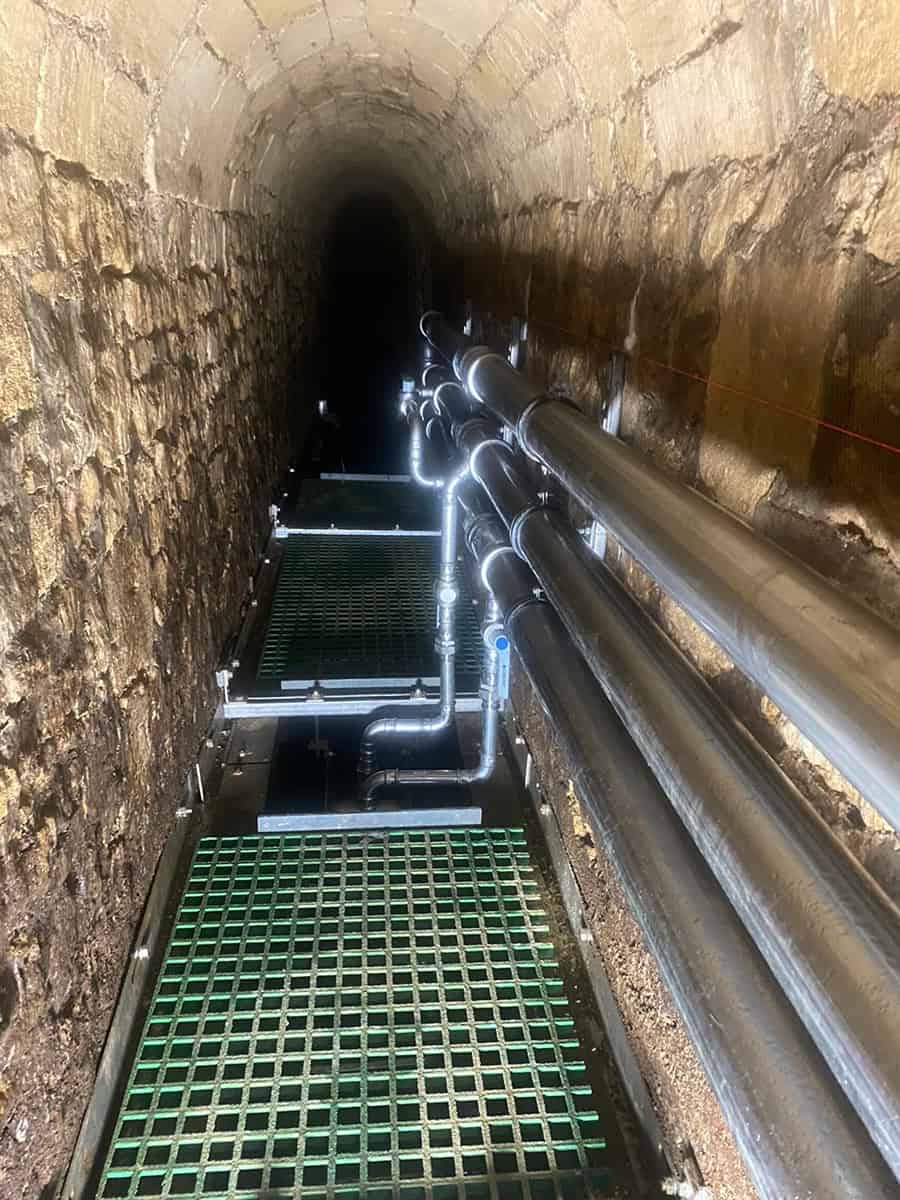
Deep beneath the flagstones of the medieval Bath Abbey church, a modern marvel with an ancient twist is silently making its presence felt. Completed in March 2021, the abbey’s heating system combines underfloor pipes with heat exchangers located seven metres below the surface. There, a drain built nearly 2000 years ago carries 1.1 million litres of 40 °C water every day from a natural hot spring into a complex of ancient Roman baths.
By tapping into this flow of warm water, the system provides enough energy to heat not only the abbey, but also an adjacent row of Georgian cottages used for offices. No wonder that the abbey’s rector praised it as “a sustainable solution for heating our beautiful historic church”.
But that wasn’t all. Once efforts to decarbonize the abbey’s heating were under way, officials in the £19.4m Bath Abbey Footprint project turned their attention to the building’s electricity. Like most churches, the abbey runs from east to west, giving its roof an extensive south-facing aspect. At the UK’s northerly latitudes, such roofs are bathed in sunlight for much of the day, making them ideal for solar photovoltaic (PV) panels. Gloucester Cathedral – an hour’s drive north of Bath – has already taken advantage of this favourable orientation, becoming – in 2016 – the UK’s first major ancient cathedral to have solar panels installed on its roof.
Divine light The Dean of Gloucester Cathedral, Stephen Lake, blesses the cathedral’s solar panels after the solar-energy firm MyPower installed them in November 2016. The array of PV panels generates just over 25% of the building’s electricity. (Courtesy: MyPower)
To find out if a similar set-up might be suitable at Bath Abbey, the Footprint project worked with PhD students in the University of Bath-led Centre for Doctoral Training (CDT) in New and Sustainable Photovoltaics. In a feasibility study published in Energy Science & Engineering (2022 10 892), the students calculated that a well-designed array of PV panels could supply 35.7% of the abbey’s electricity, plus 4.6% that could be sold back to the grid on days when a surplus was generated. The array would pay for itself within about 13 years and generate a total profit of £139,000 ± £12,000 over its 25-year lifetime.
Home truths
Installing solar panels on the roof of Bath Abbey remains, for now, just an idea. “This is a viable option for the future – when the timing is right,” as Footprint project director Nathan Ward puts it. But for many people across the UK – ordinary householders as well as custodians of famous buildings – the timing is starting to look very urgent indeed. Driven by the Russian invasion of Ukraine, strong global demand for gas and various local factors, energy prices have been rising to unprecedented levels.
In forecasts released in August, the consultancy Cornwall Insight reckoned that the average UK household could spend £355 a month on energy in January 2023 if the situation did not change. The UK government’s Energy Price Guarantee, announced in September, provided some relief by subsidizing energy bills. Even so, between October 2021 and October 2022 the maximum unit price that energy suppliers are able to charge UK householders increased substantially, rising from 7p to 10.3p per kilowatt-hour (kWhr) for gas and from 21p to 34p per kWhr for electricity.
State of the art Part of Bath Abbey’s new heat pump system, which harvests heat from water flowing through an ancient Roman drain. Due to the difficult conditions underground, engineers from Isoenergy, the firm that designed the system, worked in 20-minute intervals to install it. (Courtesy: Isoenergy)
Bath physicist Alison Walker, who is director of the CDT, says that her team’s paper was, at the time,more of a hypothetical proposition to show that the abbey was serious about reducing its carbon footprint. Now, however, “the cost of energy has gone up so sharply, if you generate your own power, it may become a lot cheaper and less susceptible to energy price fluctuations such as we have experienced this year”, she says.
For householders who want to reduce their energy bills, their carbon footprints or both, solar panels are among the easiest and cheapest ways of doing it. Silicon-based PV panels are a mature technology, their price has plummeted over the past 10 years, and a rooftop array takes only a few days to install. But with government support for solar installations no longer available to householders, up-front costs are a barrier for many, and installers have long waiting lists.
Worse, solar panels are not suitable for all dwellings, either for technical reasons or because of how they look. “In the UK, we are very conscious about the aesthetics of buildings,” says Mike Walls, a physicist at Loughborough University’s Centre for Renewable Energy Systems Technology. “There are some buildings, particularly old ones, that people would not put solar panels on because they don’t look nice or they don’t fit in well with the overall appearance.” Gloucester Cathedral’s head of projects Anne Cranston notes that her team had to prove the panels would be “as ‘stealth’ as possible” before planning authorities would accept them.
In any case, slapping a few PV panels on the roof is seldom enough, on its own, to free householders from their dependence on fossil fuels. Obviously, the Sun does not shine at night, while the average direct normal insolation – a measure of the Sun’s energy per unit area – for northern Europe is no more than a few kWhr/m2. Even on the sunniest winter days, a typical UK rooftop PV array will therefore not produce enough energy to heat the house beneath it – as I discovered when I had solar panels installed on my own home in February (see box “One home at a time”).
If solar panels are not a complete answer, householders who want to end (or at least reduce) their reliance on fossil fuels – and who lack Bath Abbey’s convenient Roman hot water supply – must find other solutions. One option is to get rid of traditional gas-fired boilers and replace them with alternative heating systems. Indeed, as part of the UK government’s pledge to achieve net-zero carbon emissions by 2050, starting in 2025 it will no longer be legal to install gas boilers in newly built homes in the UK. But efforts to retrofit existing premises are proceeding slowly. So how are we going to “green” the UK’s housing stock?
Keeping the heat in
UK homes lose heat up to three times faster on average than homes in other European countries
The experts I spoke to for this article were united on one point: everything would be much easier if dwellings were better insulated. “Really, the answer is insulation, insulation, insulation, because that simply is by far the best way to reduce your energy costs,” says Walker. “Efficiency isn’t really given the attention that it should be,” agrees Zoe Robinson, a professor of sustainability at Keele University.
The figures are sobering. A 2020 study by the smart-heating technologies firm Tado° found that UK homes lose heat up to three times faster on average than homes in other European countries. Using data gleaned from 80,000 customers across Europe, analysts at Tado° concluded that a UK home heated to 20 °C on a 0 °C day loses an average of three degrees after five hours when the heating is switched off, compared with just one degree for a home in Germany.
This poor performance is partly due to the age of the UK’s housing stock. But Laurie Peter, an expert from Bath on using solar energy to generate fuels, says the problem extends to newer homes, too. “Successive governments have chickened out in terms of the regulations over building houses,” he argues, adding that this is true for a house’s overall carbon footprint as well as its energy use. “We are still more or less where we were in Victorian times in terms of house building and insulation, which is a disgrace, frankly.”
Due to this combination of older buildings and lax regulations, half of the 28.5 million homes in England have the same wall insulation as Bath Abbey – which is to say, none. Double glazing is more common, but according to the 2020–2021 English Housing Survey, 14% of English homes still lack it. Worse, retrofitting rates have fallen off a cliff. In the year 2012, some 2.3 million homes had new loft, cavity-wall or solid-wall insulation installed, but this number has dropped to under 200,000 per year after the government replaced a successful retrofitting programme with incentives that proved less effective.
One home at a time
I live in a two-physicist household, so when we replaced our gas boiler with a heat pump and installed solar panels on our roof, we naturally treated the installation as a scientific experiment with results we could monitor over time. Would we use less energy? And would it make any difference to our bills?
Home experiments Margaret Harris and the heat pump that was installed to heat her house. (Courtesy: Margaret Harris)
Our Edwardian brick terraced house is relatively efficient for its age, with double-glazed windows and loft and cavity wall insulation. Even so, switching to a heat pump required preparation. After measuring our rooms and windows, the installers (a local plumbing firm that does heat pumps as a sideline) calculated that we would need an 8 kW heat pump, a new high-efficiency hot water tank, and longer, double-wide radiators in every room.
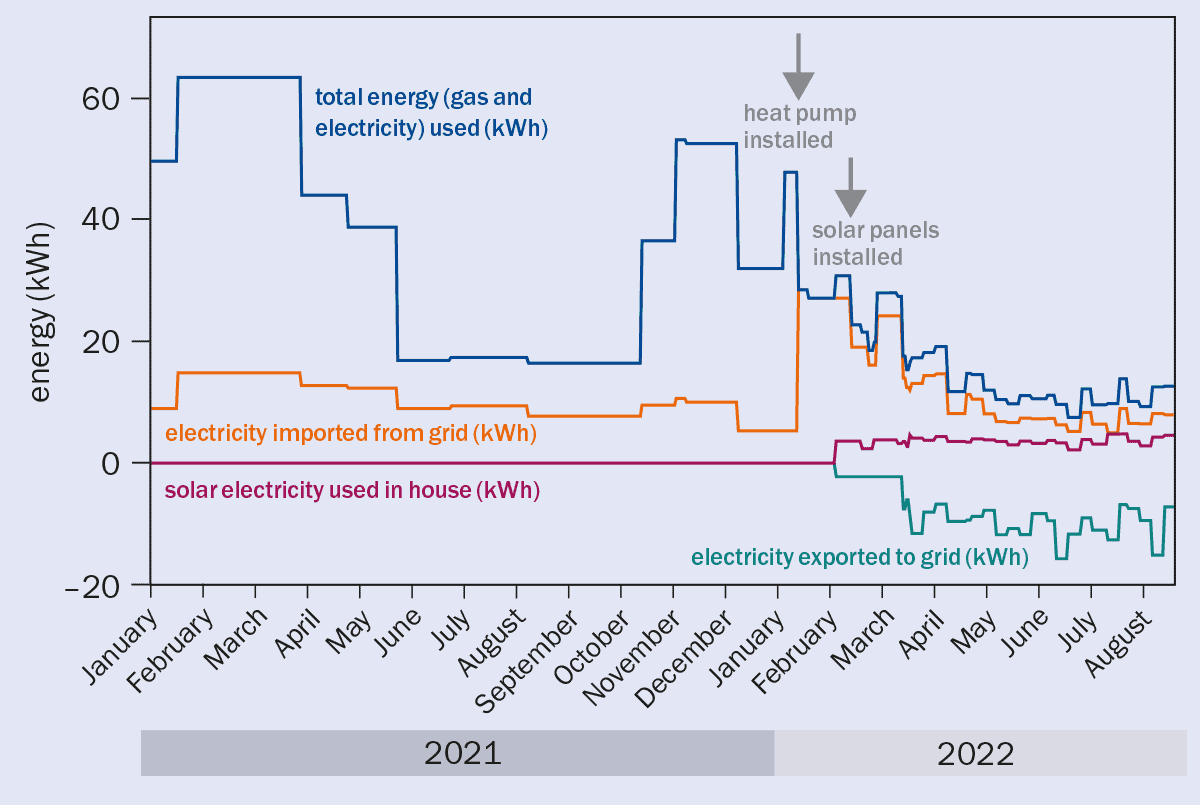
Strong demand put the installers on a tight schedule, so when they offered us a slot in mid-January, we accepted even though it meant no heating for up to two weeks (this would have been harder for households containing small children or people with disabilities). High demand and supply-chain problems likewise delayed the solar panel installation to February. But once the retrofit was complete, it worked beautifully, as this graph of the house’s energy usage from January 2021 to August 2022 shows.
(Courtesy: IOP Publishing; based on data from Margaret Harris)
The heat pump started working on 19 January. For the rest of the winter and into early spring, our house’s average daily energy use (blue line) was around half that of the same period in 2021 (note that the 2021 dataset is based on quarterly or bimonthly readings, while usage from February 2022 onwards was recorded weekly). The solar panels installed on 3 February had a smaller effect, partly because a lack of space and budget for batteries meant that some electricity got exported to the grid (green line) rather than used in the house (pink line). The house also continued to import electricity (orange line) in the evenings, on cloudy days and at periods of high demand. Still, by late spring and early summer, the panels’ average daily production routinely exceeded the house’s average daily use – a heartening result.
The financial benefits are less clear-cut. The UK’s electricity comes from a variety of sources, including renewables, gas, nuclear and (rarely) coal, but electricity prices are tied to the most expensive source (currently gas). UK electricity prices also include environmental taxes that do not apply to gas despite the latter’s higher environmental cost. So while our house is using less energy, the energy it continues to import is considerably more expensive than gas on a per-unit basis. Selling electricity from the solar panels helps, as does a heat-pump grant from the UK government’s (now-closed) Domestic Renewable Heat Incentive scheme, but this part of the problem is ultimately about politics, not physics.
Pumping heat
As well as saddling householders with higher energy bills and increased carbon emissions, poor insulation limits options for changing how homes are heated. The UK government’s plans for achieving net-zero carbon emissions rely heavily on replacing natural gas boilers with heat pumps, with a target of 19 million heat pumps by 2050 compared with around 250,000 today. It is a strategy that, in some ways, makes sense.
Heat pumps operate on the same principles as refrigerators, except they pull heat in from the air or ground outside to make the inside warmer. And thanks to the laws of thermodynamics, they are remarkably efficient: for each unit of electricity they take in, they kick out 3–4 units of heat (see box “How heat pumps work”). The technology is also commercially mature, with major manufacturers such as Mitsubishi Electric and Daikin producing a range of models.
Unfortunately, certain aspects of the UK’s current energy set-up throw a spanner into the works. Zhibin Yu, an engineer at the University of Glasgow, sums up the situation. “In the UK, most of our houses are connected to a gas grid, so our central heating systems are designed for boilers,” he explains. By circulating water at 60, 70 or even 80 °C, a traditional natural-gas boiler can keep a house toasty (albeit at high cost) even if the radiators are small and the walls and loft badly insulated.
The performance of a heat pump, in contrast, depends on the temperature difference between the heat pump’s source (such as the outside air) and its supply (the water or air circulating around the heating system). As Yu explains, if the gap is big, the performance is low. To achieve the highest energy efficiency, you’d ideally want your supply to be between 35 and 45 °C.
That might be fine for underfloor heating systems like those in use at Bath Abbey. But the heat-transfer area of standard-sized radiators is seldom large enough to keep a room warm if water is circulating round them at a relatively tepid 45 °C. As a result, occupants may end up feeling uncomfortably chilly – not great news for anyone who has spent time and energy ripping out their gas boiler and installing a heat pump.
Bigger radiators and better insulation can fix this problem – for a price. According to Yu, an air-source heat pump powerful enough to heat a typical semi-detached house generally costs between £3000 and £5000. But a complete installation, including retrofitting radiators, can cost more than twice that, making the whole project as much as four to five times more expensive than installing a new boiler. “That is a challenging situation,” he concludes.
How heat pumps work
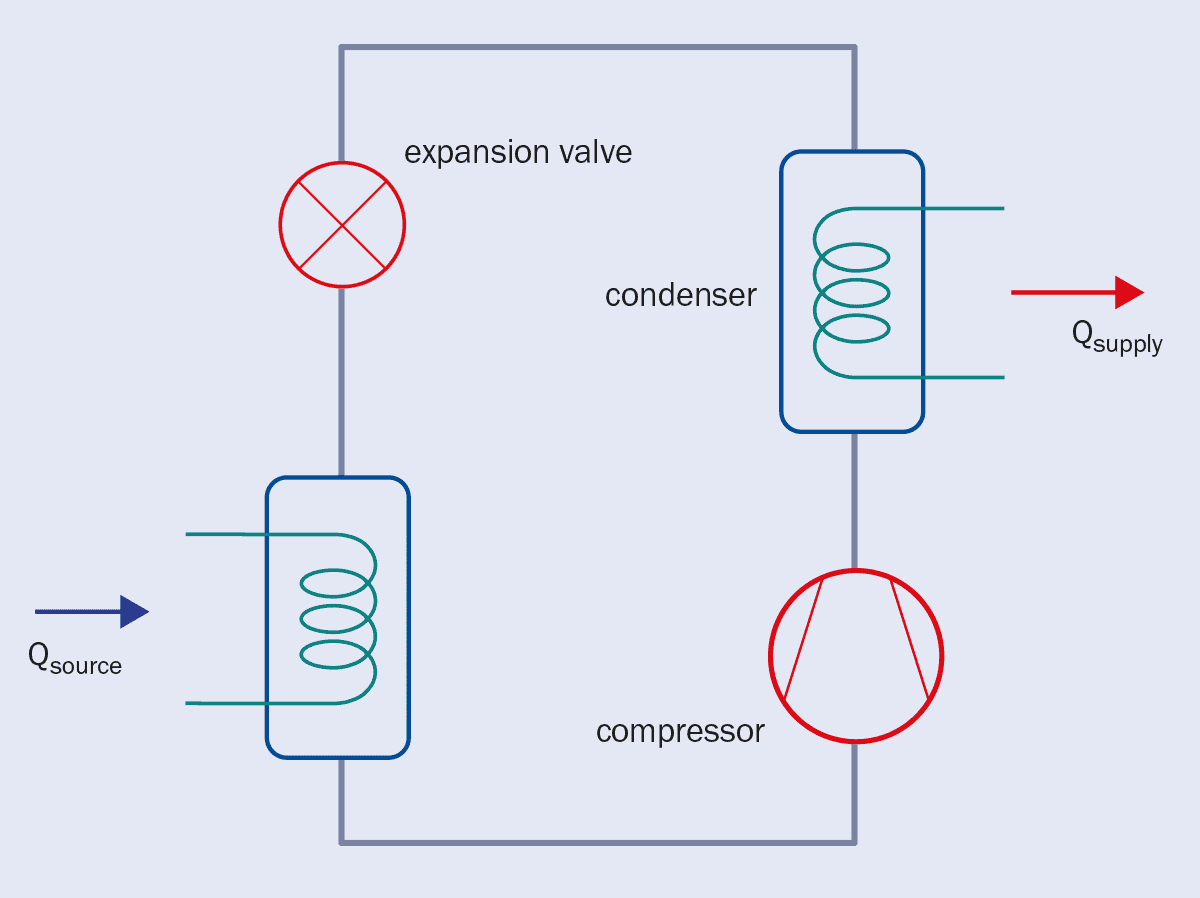
(Adapted from Yu et al. 2022 Commun. Eng.1 17)
Unlike standard electric heaters, which work by passing current through a resistive wire, heat pumps operate on the same thermodynamic principles as refrigerators. At their heart is a working fluid such as difluoromethane that vaporizes at a relatively low temperature and pressure. This allows the fluid to absorb heat even from low-temperature sources (Qsource) such as soil, water or the outside air in winter.
After it absorbs heat, the working fluid turns into vapour and passes through a compressor, which increases its temperature further, and a condenser, which turns the warm, high-pressure vapour into a liquid. The heat released in this phase change (Qsupply) is then transferred to a central heating system, and afterwards to the building via air blown through ducts or water circulated through radiators or underfloor pipes. Once the working fluid has released most of its heat, it is sent through an expansion valve, reducing its pressure (and therefore its temperature) so the cycle can begin again.
Deploying hydrogen
One alternative to swapping boilers for heat pumps might be to change the boilers’ fuel to hydrogen. Unlike natural gas, hydrogen releases no carbon dioxide when burned, and in principle it can be produced in an eco-friendly way. This is the rationale behind the recently completed HyDeploy project, in which several hundred UK homes burned a blend of natural gas and up to 20% hydrogen by volume.
The pilot study was designed to make the transition as painless as possible for householders. Luckily, modern gas boilers are designed to cope with up to 25% hydrogen, so few homes needed retrofitting. Both phases of the pilot took place across limited geographic areas (near Keele University in Staffordshire and Winlaton in north-east England), making it possible to address residents’ initial concerns about safety and cost individually.
Robinson, who is involved in HyDeploy as a social scientist at Keele, says that so far, her survey data indicate a high degree of public acceptance. “The majority of people really aren’t that bothered, particularly because with blended hydrogen, they don’t have to do anything,” she says. “It just happens.”
Those are the good points. Here are some of the downsides. UK regulations generally restrict the amount of hydrogen in the gas grid to below 0.1%, so rolling out higher fractions would require a change in policy. Another problem is that hydrogen is much less dense than methane, which means that blending in 20% hydrogen by volume (not mass) reduces carbon emissions by just 7%. What’s more, increasing the fraction of hydrogen further would require not only new boilers but also replacement pipes, since hydrogen in high concentrations causes steel to become brittle.
A further issue is that most of the 87 million tonnes of hydrogen the world produces each year comes from steam reformulation of methane, making the technology “grey” rather than “green”. The main green way of producing hydrogen is to use electricity from renewable sources to split water into oxygen and hydrogen. But Peter, the solar-fuels expert at Bath, says that finding enough renewable electricity to do this at scale is tricky. “If you try to generate that all by solar-generated electrolysis, this is an impossible task,” he says. “It just can’t be done.”
Peter points out that around 40% of the world’s hydrogen is currently used to produce fertilizer, with much of the rest going into oil refining. Both industries are trickier to decarbonize than domestic energy consumption, and Peter argues that household hydrogen burning doesn’t make logistical sense either. “Generating ‘green’ hydrogen by electrolysis, sending it down the pipe to you, and you burning it, is energy inefficient compared with sending ‘green’ electricity to your house,” he explains. “I don’t see hydrogen, myself, becoming a major player in terms of what’s going on in your house.”
In the long run, Robinson agrees that domestic hydrogen “doesn’t make sense” in efficiency terms. However, she points out that installing alternative heating systems will take time. “One of the issues at the moment is that when someone’s boiler crashes, the response will be to just replace it with another boiler,” she says. “There’s a skills gap in terms of heating engineers and the advice that people get.”
In Robinson’s view, hydrogen could act as a “stepping-stone”, reducing dependence on fossil fuels until heat pumps become cheaper and more common. “It could be that [once] blended hydrogen creates that market for green hydrogen production, then you start to use green hydrogen somewhere else in the energy system.” In this respect, she sees parallels between green hydrogen and offshore wind energy, which was expensive until countries and manufacturers started investing in it, creating enough demand to drive prices down.
From heating systems to energy systems
Apart from heat pumps and hydrogen, a few other technologies could smooth the path to lower-carbon homes. High-efficiency PV panels that use crystalline silicon and materials known as perovskites in a tandem structure are due to go into commercial production next year, and Walker thinks they will make a “serious impact” on the cost of solar energy. Walls is similarly enthusiastic about the prospect of developing integrated solar panels for electric cars and panels that look like standard roof tiles, to reduce aesthetic objections to solar power. “Of all the renewables, PV has the best chance of being attractive at a residential level,” he says.
Another area attracting lots of innovation is energy storage. Many domestic solar installations already incorporate lithium batteries for when it’s cloudy or dark. Larger-scale storage is also becoming a reality, and heat-pump technology isn’t standing still either. At Glasgow, Yu has developed a new, flexible pump that incorporates a heat-storage device between the condenser and the expansion valve.
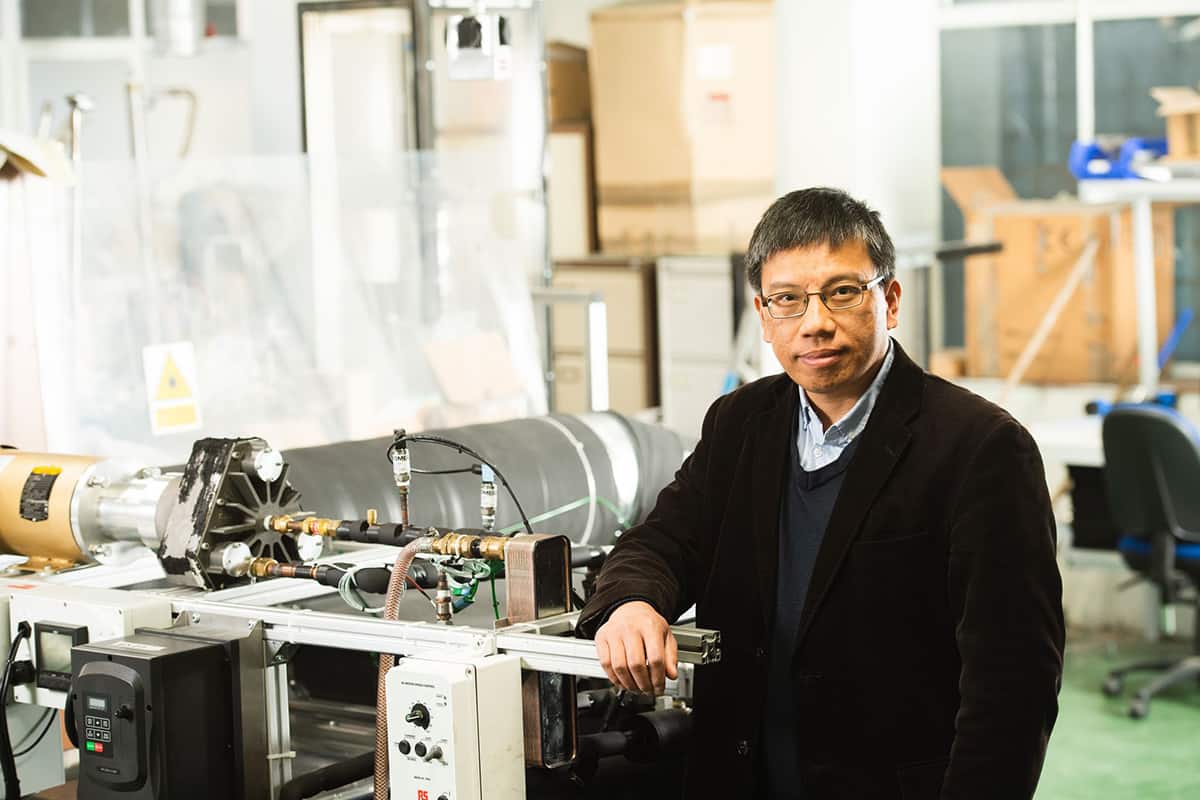
Thermodynamic advantage Zhibin Yu with a prototype of the new flexible heat pump. (Courtesy: University of Glasgow)
This device takes some of the heat that would otherwise be lost and makes it available for the heat pump’s operations. For example, the auxiliary heat could be used to defrost the heat pump’s outdoor unit, as is regularly required when ambient temperatures fall below about 6 °C. Overall, Yu thinks a 10% improvement in efficiency is feasible with his design, which he believes would “make a big difference when you look at the payback period” for installing heat pumps.
Thanks to its in-cycle auxiliary heat storage, the flexible heat pump would also open other possibilities, such as exploiting the heat we throw away every day. “For example, when we have a shower,” Yu observes, “we heat the water to 70 or 80 degrees, mix it with cold water to get it down to 35–40, and then it leaves the shower at 20–30 – the heat it contains is just thrown away in the drainage.”
A better approach might be to consider our homes as integrated energy systems. “You basically try to manage the energy flows in your house, heating and cooling,” Yu says. “You need the fridge, you need the freezer, you need the boiler, you need the air-conditioner – you throw a lot of heat away, you then extract a lot of heat from the air. Why don’t we integrate these processes?”
Setting a precedent
Back in 2016, when planning authorities decreed that Gloucester Cathedral could, after all, have solar panels on its roof, they warned project director Cranston that the decision did not set a precedent for other historical buildings. Six years on, Cranston says “things have changed significantly” both at the planning authority and within the Church of England. “NetZero makes clear the challenge ahead of us all,” she says. “Heritage buildings have to play their part.”
At Bath, Ward stresses that the way is still open for the abbey to follow suit. The church’s Roman-inspired geothermal heating system is, he says, “very much seen as a first step in moving Bath towards zero carbon”, with the city council and conservation bodies eager to pursue additional options. The city’s Roman Baths complex is already installing its own version of the abbey’s heating system, and Ward and his team are keen to put solar panels on the roof of their offices.
“As far as we know, there are no sustainable energy solutions currently in the city, so we are in early discussions with the council and other stakeholders to investigate how quickly we could install a system,” he says. “The hope is that we can continue to collaborate to speed progress.”
Researchers in the US have developed a “placenta-on-a-chip” that closely mimics the molecular exchange of nutrients between mother and foetus during pregnancy. Sarah Du and colleagues at Florida Atlantic University created the device using a pair of microfluidic channels, separated by an intricate network of hydrated fibres cultured on each side with different placental cells. The setup enabled the team to recreate disruptions to nutrient exchange caused by placental malaria, and could be a key step towards developing a treatment for the disease.
The placenta is an organ that develops alongside a foetus during pregnancy. It plays a vital role in mediating the exchange of nutrients, oxygen and waste products between a mother and her developing foetus. Among the most pressing threats to this exchange is placental malaria: a disease caused by a parasitic, single-celled organism named Plasmodium falciparum, which infects the mother’s red blood cells. By disrupting the supply of nutrients to the foetus, this disease can result in severely diminished birth weight – ultimately causing up to 200,000 newborn deaths, as well as 10,000 maternal deaths each year.
The placenta’s structure is intricately complex: featuring multi-layered structures made up of many different types of cell, as well as branching blood vessels named “villous trees” where the molecular exchanges between maternal and foetal blood take place. These structures can trap parasite-infected red blood cells, restricting the flow of nutrients between mother and foetus.
These complex structures are exceptionally challenging to reproduce using models; but ethical constraints also mean that infected placentas can’t simply be examined during pregnancy. As a result, treatments for this disease have so far proven particularly difficult to develop. To address this challenge, Du’s team developed the novel placenta-on-a-chip.
The device is centred around an extracellular matrix gel containing a hydrated network of tough collagen fibres that allow molecular nutrients to pass through. The researchers cultured one side of the gel with a sample of the trophoblast cells found on the outer layer of the placenta, which directly interact with the mother’s blood. On the other side, they developed a culture of the cells that line the inside of the human umbilical vein, which interact with the foetus’ blood.
This gel was then used to separate a pair of co-flowing microfluidic channels – representing the blood of a mother and her foetus. Using this simplified setup, Du and colleagues infected blood in the channel facing the trophoblast cells with Plasmodium falciparum and observed how the infected blood cells adhered to the surface, using a specific molecule expressed by the placental cells. Subsequently, they observed a diminished transfer of glucose across the gel barrier: reproducing a key feature of placental malaria.
This successful result shows that the placenta-on-a-chip could become a vital resource for studying placental malaria, and possibly even other types of placenta-related diseases. By offering a clear view of how the disease unfolds, Du’s team hope that their device could eventually lead to novel treatments, which may ultimately save thousands of lives globally each year.
Costly business Traditional satellite phones were expensive and needed big, chunky antennas. (Courtesy: iStock/amathers)
When the first mobile phones came out, I simply couldn’t wait to have a go with the latest version and see what incredible technological innovations they’d contain. Back in the early 2000s, it amazed me that phones could now be used to browse the Internet, send e-mails, and work out where you were with GPS. The world was moving fast and I’d avidly and eagerly follow every new development.
I was even more excited when Apple launched the first iPhone in 2007. The device really did focus on the customer, boasting an array of revolutionary features, being easy to use and having a sturdy protective Gorilla glass coating. Over the next five years, smart phones developed still further, featuring better cameras, longer-lasting batteries, more powerful processors and all sorts of new apps.
Unlike previous satellite phones, Apple’s new device contains all the relevant technology inside the standard, thin iPhone glass slab
But for about the last 10 years, from my perspective, smart phones have just got a bit dull. Yes, their cameras might have become better than my own eye. And occasionally there were nifty developments like phones being waterproof or letting you pay for things with a simple tap. However, I found myself only getting a new phone if, say, I’d smashed my old one or I’d dropped it in the toilet by mistake.
Mobile magic Apple’s latest iPhone is the first product from the company to let you communicate directly with satellites, which could be vital in an emergency. (Courtesy: Apple)
Then, in September this year, my interest was re-awakened. That’s because the new Apple iPhone 14 lets you communicate directly with satellites, which could be a life-saver if you’re in an emergency or in a remote location. And unlike previous satellite phones, which came with a huge dish or a six-inch stick antenna, the new device contains all the relevant technology inside the standard, thin iPhone glass slab. It’s also up to 40% more powerful than the previous model.
We could – finally – be at the start of the “always-connected” era.
Cool technology
Satellite phones first came onto the market in the 1980s. Developed by the British firm Inmarsat, they communicated via three large satellites in geostationary orbit roughly 36,000 km above the Earth’s surface. The phones were originally used by pilots, sailors or people in remote locations, who could now make phone calls, send data and be tracked anywhere on the planet (except if they drifted too near the poles).
Inmarsat later offered smaller, cheaper, hand-held sat phones, which opened up the customer base further. In 1997 they were joined on the market by Thuraya, a firm based in the United Arab Emirates that provided coverage across Europe, Africa, the Middle East, Asia and Australia. Unfortunately, users faced eye-watering phone bills and had to contend with long time lags because signals had to travel all the way to geostationary satellites and back.
The next major development came in 1998 with the launch of the Iridium network, which consisted of 77 satellites in low-Earth orbit (so named because iridium has an atomic number of 77). The satellites were placed in six polar orbital planes at a height of about 780 km, communicating with ground stations and with each other via radio links. The shorter round trip slashed delay times, but users balked at the high price and lack of full global coverage. In under a year, Iridium went bust.
The device uses the latest radio chip sets from US semiconductor manufacturer Qualcomm and some impressive antenna technology
Fortunately, in late 2000 the US government stepped in to save Iridium by giving the bankrupt company a $78m, two-year contract and allowing its assets to be sold for $25m. The fire sale erased over $4bn of debt and allowed Iridium to restart operations later that year via the new Iridium Satellite LLC. Its handsets still looked like bricks and required a large folding antenna but over the years they became more compact, and eventually pocket sized.
Iridium continues to thrive and has recently replaced its original ageing constellation by launching 75 new satellites on SpaceX Falcon 9 rockets. Indeed, satellite phones have benefited hugely from falling launch costs. When NASA unveiled its space shuttle in 1981, it cost about $85,000 per kilogram to put an object in space, but by 2020 SpaceX’s Falcon Heavy vehicle had broken the $1000/kg barrier. Firms can now cheaply and easily deploy lots of low-Earth orbit satellites, giving users much better coverage at a much lower price.
Handy business
But how does the new iPhone manage without the big antennas traditionally associated with sat phones? It seems the device uses the latest radio chip sets from the US semiconductor manufacturer Qualcomm and some impressive antenna technology. Together, these developments let the phones connect to the Globalstar network, which covers most of the world’s landmass with 24 satellites in low-Earth orbit.
It would be easy to dismiss this new feature as a fad. After all, the service is pretty basic, merely providing emergency text services when there is no mobile or WiFi service. You also have to point your phone in the right direction to maximize the signal in “satellite” mode. And you won’t be able to use your new sat-nav device in China or North Korea either as sat phones are banned there.
But as technology progresses and highly-sensitive phased-array antennas get added under the glass to future versions, I am sure the price will fall further. I also expect voice and data services to be included too. Other players in the “direct-to-handset” satellite connectivity market include AST SpaceMobile and Lynk, which are developing their own satellite constellations to provide messaging and eventually voice services.
A third system was announced in August 2022 when T-Mobile US and SpaceX announced a partnership to add satellite-phone service to the Starlink Gen2 satellites, which are due to be launched from late 2022 onwards. The service will let people use their mobile phones in those parts of North America that currently lack any signal. Initially, they’ll only be able to send text messages, but phone calls and data services will eventually be added too.
My dream of a smart phone that can be used anywhere in the world surely can’t be a long way off.
The CERN particle-physics lab near Geneva will be reducing the planned operation of its accelerator complex by 20% next year. The lab says the cuts are a response to the energy supply and cost crisis gripping Europe and the rest of the world. CERN will also stop experiments this year at the end of November – two weeks earlier than initially planned.
CERN buys around 70–75% of its electricity needs at the French regulated tariff Accès Régulé à l’Electricité Nucléaire Historique (ARENH). When all accelerators are operated for physics including the Large Hadron Collider (LHC), CERN’s total power consumption is about 185 MW, with the LHC infrastructure alone requiring about 100 MW.
To avoid winter blackouts, France has launched a national plan to cut energy consumption by 10% over the next few years. CERN has also been working with Électricité de France (EDF) on plans to reduce power to help the French electricity supplier cope with possible supply and demand issues over the winter months.
Mike Lamont, CERN’s director for accelerators and technology, told Physics World that as a large industrial consumer of electricity, CERN feels its social responsibility. At the end of the year, CERN usually runs a few weeks of heavy-ion collisions, in which lead nuclei are collided instead of protons. Lamont says that this year’s programme will now be cancelled and pushed to 2023.
Following the heavy-ion run, CERN normally ends operations over the winter when energy prices are high. In that time, the lab carries out essential maintenance and consolidation activities and most of the systems are completely turned off or switched to low power modes. Lamont says that doing so two-weeks earlier than normal will provide considerable energy savings.
Taking a hit
As part of the planned energy savings in 2023, the physics experiments planned at accelerators such as the Super Proton Synchrotron (SPS) and the LHC will be curtailed by 20%. “For the LHC this will mean less integrated luminosity for the experiments,” Lamont says.
In essence, a 20% reduction in operation time means 20% less data and although there will be attempts to make up time on missed work in future years, the proton–proton programme will be affected. “The precision study of the Higgs, for example, will take a hit,” adds Lamont. “Some things have to give, and it really is the formal physics programme at CERN that will suffer.”
There will also be other energy-saving measures across CERN’s sites, such as switching off street lighting overnight and turning on building heating later than usual. “We think [the moves are] a relatively moderate hit to be taken in the circumstances,” says Lamont.