A study of Antarctic ice shelves suggests that the ice shell covering Jupiter’s moon Europa could contain a significant amount of underwater “snow”. This could have important implications for NASA’s upcoming Europa Clipper mission, which aims to use ground penetrating radar to study the ice shell and the ocean beneath.
The research was done by a team in the US led by Natalie Wolfenbarger at the University of Texas at Austin and focused on two processes by which Antarctic ice shelves grow from the bottom. The study also has implications for our understanding of whether life emerged in Europa’s ocean, which is encased in an ice shell some 15–25 km thick.
By examining the dynamic features that appear on the surface of Europa’s ice shell, scientists have found compelling evidence that the ocean beneath is constantly interacting with its ice shell. So far, however, the lower layers of this shell have proven more difficult to study.
Two mechanisms
To learn more about the processes which may be unfolding beneath Europa’s surface, Wolfenbarger and colleagues drew parallels with oceanic ice on our own planet. In Earth’s polar regions, ice shelves grow from the bottom through two possible mechanisms. One is congelation, whereby ice freezes at the interface between the ice and the water directly beneath it. The second mechanism involves the creation of frazil ice, which forms as millimetre-sized, randomly shaped crystals within columns of supercooled water. These columns are prevented from freezing more completely by turbulent currents. Under buoyant forces, these crystals travel upwards to rest on the underside of the ice, where they resemble underwater snow.
The researchers compared the contributions of each mechanism to ice formation by examining a variety of ice cores collected from ice shelves in Antarctica. They say that this environment is a close analogue to the temperature, pressure, and salinity of Europa’s ice sheet. Some of these samples were collected from features like rifts and glacier tongues, where the ice is thinner. Others were gathered from ancient ice shelves, which can reach several kilometres in thickness.
Their analysis revealed that congelation dominated the gradual thickening of older ice. On Europa, this process would be driven by the gradual cooling of the moon’s solid interior. In contrast, frazil ice is most likely to accumulate where the ice thins – either in small-scale rifts and fractures, or in warmer regions, often found at lower latitudes. On Europa, large sections of the ice shell are also warmed and thinned out through tidal heating, which is generated by Jupiter’s gravitational pull.
Low salinity
The team also found that these mechanisms create sea ice with very different salinities. While frazil ice retained just around 0.1% of the salinity of water from which it formed, congelation ice had a salt content of around 10% of the local water. Salinity strongly affects a variety of important properties of sea ice: including its strength, heat conduction, and its mechanical responses to ocean currents beneath.
Ice composition may also affect the habitability of the ice-ocean interface. Even if life is only present deeper down in Europa’s ocean, the team suggests that biosignatures could be trapped between accumulated frazil ice crystals on the underside of its ice sheet.
These insights could provide important guidance for NASA’s Europa Clipper mission, scheduled for launch in 2024. Using radar, the spacecraft will search beneath the moon’s icy shell – with the goal to determine whether its liquid ocean could harbour conditions suitable for life to emerge.
Researchers who repeatedly collaborate with other scientists across multiple research disciplines produce papers that are more highly cited. That’s according to an analysis of more than 3000 scientists who publish in physical-science journals. But scientists who prefer to stick to single research topics tend, on average, to produce more papers than their peers (Proc. Natl Acad. Sci.119 e2207436119).
Carried out by a team led by Shlomo Havlin, a physicist at Bar-Ilan University in Israel, the study identified 3420 scientists who had published at least 50 papers in American Physical Society (APS) journals. For each of these “focal” scientists, the team picked out collaborators in the APS dataset who had co-authored at least two papers with them.
When the researchers examined the topics covered by the collaboration networks, they discovered that scientists work with collaborators on a relatively limited number of different fields. On average, 63% of a scientist’s collaborators work with them on just a single research topic. A quarter of collaborations cover two research topics, while only 12% span three or more topics.
The team also examined how successful scientists work with their collaborators. Two metrics of success were used: productivity (measured by the total number of publications) and impact (average number of citations per paper).
It turns out that the most productive scientists have a high proportion of single-topic collaborators, but only an average citation impact. Researchers with the highest impact, on the other hand, have more collaborators who they work with on multiple topics, yet are only as productive as the average scientist.
Keeping a balance
The study’s authors suggest that impactful scientists lean towards collaborators sharing similar research interests, while those who publish more papers select collaborators who specialize in a particular topic. Compared with more productive scientists, those researchers with high citation rates are more likely to collaborate with peers with many publications and high citations per paper.
According to the study’s authors, single-topic research is still important due to the specialist knowledge it helps accumulate but the results suggest that advancing science and breaking new ground is hard to do alone. “The challenges of the modern world are becoming increasingly more complex, which usually requires interdisciplinary collaborations,” Havlin told Physics World.
He adds that reorganizing science with the aim of “encouraging multi-topic collaborations might be helpful for advancing science”, but this should not be the only focus. “When encouraging multi-topic collaboration, one should meanwhile keep a reasonable balance with single-topic collaboration since specialization is also important for scientific collaboration,” Havlin adds.
“When I take an action on the world, something genuinely new comes out.”
That might sound like a deep remark you’d expect from a practitioner of Zen Buddhism. In fact, it was uttered by Christopher Fuchs, a quantum physicist, during the opening talk of the third “Phenomenological approaches to physics” meeting in Linköping, Sweden, in June. Fuchs, who is based at the University of Massachusetts Boston, said the statement was the “noble truth” needed to make sense of quantum mechanics.
Fuchs is the principal promoter of an interpretation to quantum mechanics known as “QBism”. Coined in 2010 by Fuchs, the term was originally short for “quantum Bayesianism” but has since lost that connection and is now self-standing. According to QBism, experimental measurements of quantum phenomena do not quantify some feature of an independently existing natural structure. Instead, they are actions that produce experiences in the person or people doing the measurement.
For the likes of Fuchs, quantum mechanics is thus not about an already existing world being measured – that’s the “noble truth” part – but is a theoretical guide for predicting what we will experience in future events.
It was as if the door between physicists and philosophers – slammed shut for perhaps a century – had suddenly collapsed and we found ourselves in the same room
By putting experience at the heart of laboratory work, QBism has seized the attention of a group of philosophers known as “phenomenologists”, who examine the different ways that experience gives rise to everything humans know, and can know, about the world. The Linköping conference brought together these physics-versed phenomenologists, such as myself, with philosophically sensitive physicists, in roughly equal numbers. It was as if the door between physicists and philosophers – slammed shut for perhaps a century – had suddenly collapsed and we found ourselves in the same room, dazed and amazed, with the two groups sometimes speaking a little awkwardly with each other.
Back story
For nearly a century, the mathematical formalism of quantum mechanics has been clear and conclusive, yet its meaning has been opaque. In trying to work out what quantum mechanics says about the world, some interpretations suggest that quantum theory does not describe the world outright but is simply a tool for making predictions about it. Those are “epistemological” interpretations.
Other interpretations of quantum mechanics, however, are “ontological”. They consider what happens once we uncover more about the quantum world (when we find variables that are still “hidden”) or once we accept that some of its structures (such as the wave function) aren’t the ones we’re familiar with. When that occurs, we’ll see that its fundament, or “ontology”, is more or less like ours.
QBism is different. It is agnostic about whether there is a world that is structured independently of human thinking. It doesn’t assume we are measuring pre-existing structures, but nor does it pretend that quantum formalism is just a tool. Each measurement is a new event that guides us in formulating more accurate rules for what we will experience in future events. These rules are not subjective, for they are openly discussed, compared and evaluated by other physicists.
QBism therefore sees physicists as permanently connected with the world they are investigating rather than somehow getting “behind” it. Physics, to them, is an open-ended exploration that proceeds by generating ever new laboratory experiences that lead to ever more successful, but revisable, expectations of what will be encountered in the future.
Phenomenologists like myself find this obvious. We see QBism as simply stating that physicists form their ideas about the world the way the rest of us do: through experience. Humans are pre-connected with the world, and experience comes first. As Laura de la Tremblaye – a philosopher from the University of Geneva – said at the Linköping meeting: “QBism is a phenomenological reading of QM.”
Overlapping thoughts
These remarkable overlaps between QBism and phenomenology made physicists at the conference feel they needed to study phenomenology – and the phenomenologists to study physics. Fuchs himself explained how he’d once driven 75 miles through Boston traffic to pay $1600 for a complete set of the works of William James, the 19th-century American philosopher and proto-phenomenologist. Meanwhile, Delicia Kamins – a philosophy student at Stony Brook University who also spoke at Linköping – last year used her Fulbright fellowship to bone up on quantum mechanics at the University of Bonn.
For phenomenologists, experience is always “intentional” – i.e. directed towards something – and these intentionalities can be fulfilled or unfulfilled. Phenomenologists ask questions such as: what kind of experience is laboratory experience? How does laboratory experience – in which physicists are trained to see instruments and measurements in a certain way – differ from, say, emotional or social or physical experiences? And how do lab experiences allow us to formulate rules that anticipate future lab experiences?
Another overlap between QBism and phenomenology concerns the nature of experiments
Another overlap between QBism and phenomenology concerns the nature of experiments. They don’t magically beam physicists into a special, more fundamental world. Instead, as I have long argued, experiments are performances. They’re events that we conceive, arrange, produce, set in motion and witness, yet we can’t make them show us anything we wish. That doesn’t mean there is a deeper reality “out there” – just as, with Shakespeare, there is no “deep Hamlet” of which all other Hamlets we produce are imitations. In physics as in drama, the truth is in performance.
The critical point
In the final session of the June conference, the question arose as to whether QBism is an “interpretation” of quantum mechanics – i.e. a new perspective on it – or simply a “reconstruction”, a reassembly with new pieces. That led to a heated, insightful, productive (if occasionally technical) discussion among the philosophers and physicists present as to what these terms mean. I had always dreamed that this sort of debate would occur. I just didn’t think it would happen in my lifetime.
Streamlined commissioning: The THALES 3D SCANNER has been designed to speed up acceptance testing, beam model validation, and quality assurance for bore-type image-guided radiotherapy systems, in particular Varian’s Halcyon and Ethos machines (Courtesy: UZ Brussel)
After 30 years of outright domination in the radiotherapy suite, conventional C-arm beam-delivery systems are now being joined by bore-type machines that look more like a CT or MR scanner. Initially driven by the emergence of MR-guided radiotherapy, which can only be realized with a ring-shaped design, image-guided radiotherapy machines with the same geometry have found favour in the clinic for their speed, simplicity, and improved patient comfort. Early adopters of Varian’s Halcyon system have even reported a 70% reduction in energy usage compared to a previous installation of the vendor’s more traditional TrueBeam radiotherapy machine.
But the more confined geometry of a ring-shaped design demands a different approach to quality assurance. Take, for example, the water phantom that is used by medical physicists to record accurate dosimetry measurements when commissioning a new radiotherapy system, or for periodic checks of the radiation beam profile during the machine’s lifetime. “Medical physicists want independent QA and verification tools to confirm that the radiotherapy system is working as it should,” comments Thierry Mertens, business development manager for healthcare at LAP, a company that specializes in laser systems and radiotherapy QA. “A water phantom provides rigorous beam data and beam model visualizations to verify that the system is delivering the correct dose to the patient.”
While water phantoms originally designed for conventional linacs can be used with ring-shaped systems, Mertens says that their large size and weight adds unnecessary complications to the measurement workflow. For a start, extra care must be taken to ensure the phantom does not collide with the sides of the machine as it moves into the opening, while additional corrections need to be made to compensate for the heaviness of the water tank on the couch.
In contrast, the THALES 3D SCANNER has been designed from the outset to validate bore-style machines such as the Halcyon, as well as Varian’s new AI-enabled Ethos adaptive radiotherapy system. For the medical physicist that means greater workflow efficiency: the compact system works seamlessly with the smaller 3D volumes of these machines, with extra guidance plates to enable different types of detectors to be incorporated into the device. The motorized phantom offers an automated set-up that takes less than 15 minutes, as well as pre-defined measurement sequences to help the medical physics team complete their test routines more quickly. Dedicated software is also provided for acquiring and analysing the data, with a rolling upgrade programme to improve the functionality in response to customer feedback.
“LAP has carefully considered the design to make the device as easy to use as possible,” says Thierry Gevaert, professor at the Vrije Universiteit Brussel and deputy head of the radiotherapy department at UZ Brussel (UZB) in Belgium. “We use a water phantom a few times a year, and with this system there is no need to relearn the measurement process each time. Many of the steps are automated, so we don’t need to waste time finding the right position of the chamber before starting the measurements.”
The THALES 3D SCANNER is the second iteration of the company’s water phantom, with the first version designed specifically for commissioning and testing a new generation of MR-guided linacs such as the MRIdian MR-guided system from ViewRay. Released in 2021, the THALES 3D MR SCANNER is fully compliant with the challenging requirements of the MR-linac environment, with all system components made from non-ferromagnetic materials that have been certified for use within the MRI scanner’s 0.35 T magnetic field. “The THALES 3D MR SCANNER provides a golden-standard dose accuracy check for MR-guided radiotherapy systems,” comments Mertens. “It is a perfect fit for commissioning the beam model of the MRIdian system.”
Effective translation: LAP’s Thierry Mertens (second from right) with Thierry Gevaert (right) and two of his UZB colleagues. Tests by the UZB team showed that the MR version of LAP’s THALES water phantom provides accurate beam data when used with Varian’s image-guided Halcyon machine (Courtesy: UZ Brussel)
The THALES 3D MR SCANNER has already been used by several radiotherapy centres around the world to support the commissioning and acceptance of the MRIdian system. At UZB, for example, the medical physics team were given just five weeks to complete their commissioning and acceptance protocols, as well as machine and patient-specific QA, before the machine was deployed in the radiation oncology clinic. “With only a day and a half of training, we were able to set up the phantom and take all the measurements by ourselves,” comments Gevaert. “The software is very intuitive, and we were able to collect all the necessary data within a week.”
When UZB’s satellite centre, ASZ Aalst, acquired a Halcyon machine, Gevaert was keen to see whether the THALES 3D MR SCANNER could be used to check the beam parameters that had been provided by the vendor. Because it’s not used very often, a water phantoms is a big investment for just one machine,” Gevaert points out. “We wanted to see whether we could translate our MR version of the THALES system to the Halcyon, since both machines have the same geometry.”
Both Viewray’s MRidian and Varian’s Halcyon come pre-commissioned, with all the beam data already loaded into the planning system, but Gevaert says that it is still important for medical physicists to verify that the data is correct. “We wanted to use a water phantom for the Halcyon as we believe it is the golden standard for acquiring and remeasuring beam data,” he comments.
Working with the engineers from LAP, Gevaert found that it was straightforward to set up the MR version of the phantom to work with the image-guided Halcyon. Just one new adjustment was needed to level up the device, since otherwise the weight of the water caused the phantom to sag when it was positioned on the couch. “We were one of the first to use the MR version with the Halcyon, so we needed to check that the measurements would still be accurate,” said Gevaert. “We found a good agreement with the data we received from the company.”
Meanwhile, the newly released THALES 3D SCANNER offers all the same functionality and performance as the MR-enabled device, with the only major difference being that the MR-specific capabilities have been stripped out to produce a more affordable solution for treatment centres that plan to install one or more image-guided bore-type machines. Varian has certified the phantom to be fully compatible with both its Halcyon and Ethos machines, and the device shares the same regulatory approvals in the US and Europe as the original MR-compatible version.
Both iterations of the phantom come with an annual maintenance visit, an ongoing programme of software and hardware updates, and a configurable multi-year warranty. “We know we are the new kids on the block. Our modern phantom design has been shaped by clinical physicists and we continue to incorporate their feedback to inform our upgrade programme,” says Mertens. “We will continue to improve the product through new software-enabled capabilities.”
As an example, Gevaert is currently working with LAP on new functionality that will make it possible to benchmark new dosimetry measurements against previous readings or a reference dataset. “That will enable us to directly compare measurements taken at different times,” he said. “Ideally we want to have everything built into one piece of software to avoid the need to export the data into another tool.”
Mertens and his colleagues at LAP are also evaluating the THALES water phantom for other bore-type accelerators such as Elekta’s MR-guided Unity and Accuray’s Radixact systems. “The voice of the clinical radiotherapy user is fundamental to our requirements-gathering and for understanding how the machine is being used in a clinical context,” Mertens adds.
Note that LAP and THALES are trademarks of LAP. Designations of other companies and products are only used to describe the application of our products.
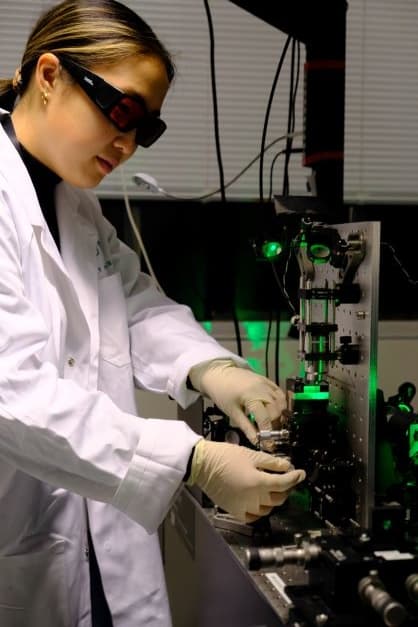
Photons on demand: Helen Zeng performing optical measurements to characterize the hBN-solid immersion lens integrated single-photon source. (Courtesy: Helen Zeng)
Single photons are a key foundation for many emerging quantum technologies, but creating the perfect single-photon source is challenging. This is particularly true when trying to develop compact systems that can operate outside the carefully controlled lab environment without bulky sub-zero cooling infrastructure. Scientists in Australia have now addressed this challenge by developing a new source design that can produce more than 10 million single photons per second while operating at room temperature.
A perfect single-photon source would provide the user with exactly one pure single photon on demand. Real-world devices often feature a trade-off between these ideal characteristics that varies depending on the application. In the latest work, researchers led by Igor Aharonovich of the University of Technology, Sydney based their single-photon source on a 2D crystalline material called hexagonal boron nitride (hBN). The crystal’s atomic structure is imperfect, and light from an intense source such as a laser can cause these imperfections, or defects, to emit single photons even at room temperature.
A better collection method
One of the challenges when using these materials is to develop a collection method that makes sure the generated photons are actually usable. Aharonovich and colleagues addressed this challenge by directly depositing flakes of the hBN material onto a small hemispherical collection lens, known as a solid immersion lens (SIL).
Integrated hBN lens: The components within the portable microscope set-up. (Courtesy: Helen Zeng)
These SILs have a diameter of just 1 mm, which makes handling them a particular experimental challenge. Armed with tweezers, the researchers painstakingly placed the integrated hBN-lens into a portable custom-made microscope set-up (see image). A carefully positioned laser source then excites the sample and the SIL focuses the emitted single photons onto a detector. By combining the 2D material with a lens, the researchers demonstrated a six-fold improvement in photon collection efficiency compared to previous methods. These other methods also rely on complex nanoscale engineering processes, which makes them less suitable to mass-scale everyday quantum communication applications.
The researchers went on to demonstrate that the single photons they produce are of an excellent purity. Purity here refers to the probability of emitting a single photon rather than multiple ones – an important metric in assessing the quality of these sources. Long-term tests showed that the system generates high-purity single photons in a stable way, further confirming its suitability for deployment in applications such as quantum key distribution (QKD). In this application, better single-photon sources could improve the security of cryptography protocols used to enable the secure transmission of information without signal loss or vulnerability to eavesdroppers.
High transmission rates
Once they knew how many photons their system produces per second, the researchers estimated how effective it would be in a practical QKD scenario using a widely adopted QKD protocol known as BB84. They show that this single-photon source can maintain high transmission rates over an area around 8 km in radius, which would allow for QKD coverage on a citywide scale. Combined with the fact that the system operates at room temperature, this highlights the practicality of the system for everyday secure quantum communication applications.
Commenting on the future direction of the work, Helen Zeng, one of the researchers working on the project, states, “We are ready to turn our attention towards incorporating these quantum 2D materials into real-world applications which will undoubtedly have far-reaching consequences in the field of quantum communications.”
The new single-photon source is described in Optics Letters.
A 40-year-old debate about charm quarks in protons may have been settled by a new machine-learning analysis of data from the Large Hadron Collider (LHC) at CERN and other facilities. However, not all particle physicists agree with this assessment.
For decades, physicists have debated whether protons contain what are known as intrinsic charm quarks. Quantum chromodynamics (QCD), the theory of the strong nuclear force, tells us that protons consist of two up quarks and a down quark bound together by force carriers called gluons. But it also predicts that protons, like neutrons or any other hadron, contain a host of other quark–antiquark pairs.
Large numbers of these additional particles are known to be generated when gluons are accelerated during high-energy collisions between protons, just as electromagnetic theory tells us that photons are given off when charged particles accelerate. But what is less clear is the extent to which there could be additional quarks within the protons and neutrons to begin with – so-called intrinsic quarks that contribute to the hadrons’ quantum wavefunctions.
Heavier than protons
Scientists agree on the existence of intrinsic strange quarks, given that strange quarks have a far smaller mass than protons. However, there continues to be uncertainty about the existence and possible contribution of intrinsic charm quarks. These quarks are heavier than protons, but only by a small amount – leaving open the possibility that they provide a fairly small but nevertheless observable component to a proton’s mass.
While some researchers have concluded that charm quarks can provide no more than 0.5% of a proton’s momentum, others have instead found that a contribution of up to 2% is possible.
In the latest work, the NNPDF Collaboration – made up of physicists from the University of Milan, the Free University of Amsterdam and the University of Edinburgh – says it has found “unambiguous evidence” that intrinsic charm quarks do indeed exist. It has done so by drawing on reams of collision data from the LHC and elsewhere that it previously used to work out what are known as parton distribution functions (PDFs), which they call NNPDF4.0.
Point-like particles
Parton is a generic term to describe point-like particles within a hadron, proposed by Richard Feynman in the 1960s to analyse particle collisions and is now equivalent to a quark or gluon. Because the momentum, spin and other properties of partons are determined by the strong force under conditions of very large coupling, their values cannot be calculated using the approximations possible with perturbative QCD. However, by studying the kinematics of hadron collisions it is possible to build up probability distributions showing the odds that a parton will have a certain fraction of a hadron’s momentum at a particular scale.
The new research involved calculating a charm quark’s PDF by considering the momentum that it and the three lightest quarks – up, down and strange – contribute to a colliding proton in the scattering process. They then used perturbative QCD – approximating strong interactions by using either the first two or three terms in an expansion of the strong coupling expression – to convert this PDF into one consisting of radiative components from only the lightest three quarks. As they point out, stripped of the charm quark’s own radiative component this new PDF would comprise only intrinsic charm.
Doing so using neural networks to best match experimental data with the shape and magnitude of PDFs, they conclude that intrinsic charm quarks definitely exist. Although they work out that intrinsic charm contributes less than 1% of proton momentum, its associated PDF strongly resembles that expected from theory – a peak at a momentum fraction of around 0.4 (the tiny probabilities involved meaning integration yields a small total) while tailing off rapidly at small fractions. It also closely matches the PDFs worked out from other collision data – specifically, recent results involving the production of Z bosons at the LHCb experiment and much earlier data from CERN’s European Muon Collaboration (EMC).
NNPDF calculates that with the data from its 4.0 analysis alone the statistical significance of intrinsic charm being real is about 2.5σ, while the significance rises to around 3σ if the LHCb and EMC data are also included. A statistical significance of 5σ or greater is usually considered to be a discovery in particle physics.
“Our findings close a fundamental open question in the understanding of nucleon structure that has been hotly debated by particle and nuclear physicists for the past 40 years,” the collaboration writes in a paper in Naturedescribing its research.
Neutrino observations
The researchers say they look forward to further studies of intrinsic charm at experiments such as CERN’s LHCb and those at the Electron–Ion Collider (currently being built at the Brookhaven National Laboratory in the US). Observations at neutrino telescopes are also of interest because particles containing charm quarks can decay to generate neutrinos in Earth’s atmosphere. “These measurements can help to pin down the shape and magnitude of intrinsic charm, as well as probe any differences between intrinsic charm quarks and antiquarks,” according to group member Juan Rojo of the Free University of Amsterdam.
Other experts too welcome further data but disagree on the importance of the latest work. Stanley Brodsky at the SLAC National Accelerator Laboratory in the US says the result provides “convincing” evidence for intrinsic charm. However, Ramona Vogt of the Lawrence Livermore National Laboratory, also in the US, points out that its statistical significance falls short of that needed for discovery in particle physics. “This result is a step forward but it’s not the final word,” she says.
Wally Melnitchouk at the Thomas Jefferson National Accelerator Facility, again in the US, is more critical. Far from being definitive, he regards NNPDF’s evidence as contingent on how it defines intrinsic charm and the choices it makes for the perturbative calculation, arguing that definitions from other groups that have not found evidence are equally valid. He maintains that a much more compelling signal would be the observation of a difference between the charm and anticharm PDFs in the proton. “A non-zero difference between these is much less susceptible to choices of theoretical schemes and definitions,” he says.
Like so many others, I have always been fascinated by science and maths, the disciplines that underpin the physical world. This curiosity has fuelled a desire to keep learning about the world around me and broaden my horizons, eventually bringing me to the energy industry and my current role as bp’s chief of staff in Iraq. I believe that the career path I have followed demonstrates how pursuing your passion, and applying it to a wider purpose, can take you to places you never imagined you could reach.
A technical grounding
I joined bp in 2013, having applied for a graduate internship at the company after completing my BSc in physics at the University of Leeds. I was fortunate enough to build my internship into my MSc in the exploration of geophysics, which bp sponsored, meaning I was able to gain hands-on experience alongside my academic studies. After that, I joined bp on a full-time basis through its “Challenge” graduate programme, and I have been with the company ever since.
My first role as a petrophysicist was highly technical. As a discipline, petrophysics is all about understanding how fluids flow through a reservoir and how to extract oil and gas from it in the most efficient way. My job concentrated on gaining a deeper understanding of how we could improve our reservoir modelling by integrating seismic and well-log data, so production could be managed more efficiently. I then had an opportunity to take on a reservoir-management role in which I was focused on understanding how the oil and gas reservoirs perform.
A big moment for me came when I was first asked to move to Iraq in 2018, taking on a lead petrophysicist position. I headed a team of 12 petrophysicists overseeing the acquisition of production logging data supporting the development of the oil field. And then, just before the start of the pandemic, I moved into my current job.
I am now bp’s chief of staff in Iraq, where I support the day-to-day running of the Rumaila Operating Organization (ROO) – a joint venture between bp, PetroChina and Basra Oil Company, and the SOMO (State Oil Marketing Organization) businesses run by the Iraqi government. The consortium manages the Rumaila oil field, the third largest in the world, which produces around 2% of the world’s oil production and employs close to 7000 people.
My current role is much more far-reaching, and I like to describe myself as “the eyes and ears” of the business. I am responsible for updating the general manager on what is – and is not – going well, and building strategies and plans for the business, among other things. I also facilitate correspondence between the Iraqi government and the oil field. I believe that the strong technical grounding I acquired in the early stages of my career has given me the confidence to have the right conservations at the right level, understand the wide range of challenges facing the business and increase its overall performance.
However, I would not be where I am today if I had not stepped out of my comfort zone and kept an open mind at the beginning of my professional life. When you first join a company, it is so important to be open and available, to avoid saying no to opportunities, and to take on the different challenges that arise. By asking as many questions as possible, making sure you understand how the business works, and having the right conversations with the right people, you will set yourself up for success later in your career. I would also stress the importance of having a strong technical understanding – a quality that will let you influence decisions on how the business is operated and fully understand the uncertainty bounds, and risks, when making strategic decisions.
Global nature, local impact
It may sound contradictory, but two aspects of my position that I value most are the global nature of my role and the local impact of my work.
As an employee at a company like bp, which has operations in every continent, I have been fortunate enough to travel and work in North America, Europe and the Middle East. Working with up to 70 nationalities on-site at ROO, as well as alongside professionals in Iraq, offers you so many different perspectives to learn from. Becoming adept at integrating diverse ideas and experiences has strengthened me as a professional and supports the overall business.
At the same time, it is a privilege to observe the impact of our work on the communities in which we operate. The ROO generates close to 35% of Iraq’s total gross domestic product in the oil field we lead, and our work to develop the field helps Iraq to invest in its people, services and infrastructure.
We also help upskill the local workforce, who will take over the field in the future, so it is our responsibility to leave a positive legacy and equip the community with the necessary skills to take over the reins.
The world is changing at a frantic pace. The energy mix of the future will be drastically different from that of today, as the world embarks on the transition from traditional fossil fuels to low-carbon sources of energy. We know that global production of oil and gas will decrease across the world but will still be needed to power the energy transition. If we want to remain competitive, which is a major objective for my role, I’ll be looking at how to ensure that the oil and gas we are producing is the cheapest and has the cleanest barrels, and that no resource, such as the methane gas emitted, is wasted. I truly believe that physics, a discipline that makes us question the world around us and find solutions to the world’s greatest problems, will play a critical role in the transition to this future.
A hunger to learn
To those at the start of their professional journey, my main advice would be to think about your passion, reflect on what drives your sense of purpose, and then choose a career that creates opportunities for discovery, empowerment and self-improvement. At the same time, let your curiosity guide you. A hunger to learn more and broaden your own horizons will open you up to a wide array of exciting challenges and opportunities in the future.
Through an explosive technique, researchers in Japan have produced the smallest nanodiamonds to date, capable of probing microscopic temperature differences in their surrounding environments. With a carefully controlled explosion, followed by a multi-step purification process, Norikazu Mizuochi and a team at Kyoto University fabricated photoluminescent nanodiamonds some 10 times smaller than those produced with existing techniques. The innovation could substantially improve researchers’ ability to study the minute temperature differences found inside living cells.
Recently, silicon-vacancy (SiV) centres in diamond have emerged as a promising tool for measuring variations in temperature across nanoscale regions. These defects form when two neighbouring carbon atoms in diamond’s molecular lattice are replaced with a single silicon atom. When irradiated with a laser, these atoms will brightly fluoresce over a narrow range of visible or near-infrared wavelengths – whose peaks shift linearly with the temperature of the diamond’s surroundings.
These wavelengths are particularly useful for biological investigations as they pose no threat to delicate living structures. This means that when nanodiamonds containing SiV centres are injected into cells, they can probe the microscopic temperature variations of their interiors with sub-kelvin precision – allowing biologists to closely study the biochemical reactions taking place inside.
So far, SiV nanodiamonds have largely been produced through techniques including chemical vapour deposition, and subjecting solid carbon to extreme temperatures and pressures. For now, however, these methods can only fabricate nanodiamonds down to sizes of roughly 200 nm – still large enough to damage delicate cellular structures.
In their study, Mizuochi and team developed an alternative approach, where they first mixed silicon with a carefully selected blend of explosives. After detonating the mixture in a CO2 atmosphere, they then treated the explosion’s products in a multi-stage process, which included: removing any soot and metal impurities with a mixed acid; diluting and rinsing the products with deionized water; and coating the nanodiamonds that remained with a biocompatible polymer.
Finally, the researchers used a centrifuge to filter out any larger nanodiamonds. The end result was a batch of uniform, spherical SiV nanodiamonds with an average size of roughly 20 nm: the smallest nanodiamonds ever used to demonstrate thermometry using photoluminescent lattice defects. Through a series of experiments, Mizuochi and colleagues observed clear linear shifts in the photoluminescent spectra of their nanodiamonds, over temperatures ranging from 22 to 45 °C – encompassing the variations found in most living systems.
The success of this approach now opens the door for far more detailed, non-invasive thermometry from within cellular interiors. Next, the team aims to optimize the number of SiV centres in each nanodiamond, making them even more sensitive to their thermal environments. With these improvements, the researchers hope that these structures could be used to study organelles: the even smaller and more delicate subunits of cells, which are vital to the functioning of all living organisms.
The researchers describe their findings in Carbon.
Further insights into the curious dimming of the star Betelgeuse have been unveiled by an international team of astronomers led by Andrea Dupree of the Harvard–Smithsonian Center for Astrophysics. The researchers used observations by the Hubble Space Telescope and several other instruments to show how a large convective cell rising to the surface of the star could have ejected a huge amount of material into space – creating a cloud that blocked some of Betelgeuse’s light from reaching Earth. The work confirms previous research that linked the obscuring cloud to a large cool spot observed on the surface of the star.
Betelgeuse is a red supergiant star that is about 548 light-years from Earth and is one of the brightest stars in the sky. Normally the brightness of the star pulsates with a period of 416 days, but in 2019–2020 light output from the star dropped to an unprecedented low before recovering – an event called the ”Great Dimming”.
Astronomers believe that the dimming was caused by the ejection of material from the star, but the exact nature of the process was unknown.
“Our [research] pulls together a vast number of observations to trace the dynamics of the mass ejection and compile a logical timeline for its occurrence,” Dupree tells Physics World.
Besides Hubble, these observations included data collected by the SPHERE (Spectro—Polarimetric High-contrast Exoplanet REsearch) instrument on the Very Large Telescope in Chile, which showed a dark, cool spot in Betelgeuse’s southern hemisphere. The team also used data from Japan’s Himawari-8 weather satellite, which by chance observed Betelgeuse in the background of its Earth observations. These observations by Himawari-8 connected the cool spot to a cloud of dust that obscured part of the star.
Eruptive star
Dupree and colleagues’ model suggests that an enormous convective cell rose through Betelgeuse’s interior, forming a huge bubble on the star’s photosphere – its gaseous surface. This caused a vast plume of material equivalent to the mass of Mars to leave the star. This ejected material travelled through Betelgeuse’s diffuse outer layers, where it cooled and condensed into dust. Meanwhile, the roiling stellar surface was left with a giant wound that plasma expanded into, cooling along the way. This created the large dark cool spot that had been seen on the star.
Daisuke Taniguchi of the University of Tokyo led the analysis of the Himawari-8 observations but he was not a member of Dupree’s team. He tells Physics World that “This new concept of a surface mass ejection sounds like the most reasonable one to explain all the observations”.
Although the dust has now dissipated, having been driven away by Betelgeuse’s stellar wind, and the star has returned to its normal brightness range, Dupree’s team believes that the photosphere is still unstable.
I like the analogy of an ‘unbalanced washing machine’ as it tries to come to a new equilibrium
Andrea Dupree
“I like the analogy of an ‘unbalanced washing machine’ as it tries to come to a new equilibrium,” says Dupree.
Hidden Pulsations
The roiling instabilities resulting from the photosphere sloshing around in the wake of the surface mass ejection is currently masking Betelgeuse’s 416-day pulsation period. Dupree describes this pulsation period as the star’s fundamental mode. These pulsations are typical of red supergiant stars such as Betelgeuse, and their period varies from star to star depending upon the star’s mass.
“I believe the intrinsic 416-day pulsation rate is still ongoing,” says Dupree. “The period may not be exactly the same once Betelgeuse recovers, but it should be a relatively stable pattern.”
As well as the 416-day pulsation period, there is also an underlying 2100-day period that is not so well understood. Some researchers believe it is related to the time it takes for giant convective cells on the photosphere to turn over. The Great Dimming came just after the 2100-day cycle reached a minimum brightness, which also coincided with a minimum in the 416-day cycle.
In the mid-1980s, the late Harvard astronomer Leo Goldberg predicted that when long-term and short-term minimums coincide to create a grand minimum, unusual changes in the star’s brightness and activity might occur. Goldberg’s theory had been mostly forgotten, but since the Great Dimming it has been very much in line with current thinking.
Next dimming in 2026
“I’m speculating here,” says Dupree, “but if [a Great Dimming] happens again, it should be in 2026 after the next 2100-day minimum in 2025.”
With better monitoring of the star by both professional and amateur astronomers than in the 1980s, there is a greater chance of spotting when something is amiss on Betelgeuse.
“Astronomers should keep focusing on this exciting star,” says Taniguchi, who will keep monitoring Betelgeuse with both the Himawari-8 and Himawari-9 satellites. Meanwhile, inspired by Taniguchi’s success with weather satellites, Dupree and her colleagues plan to use archive data from the NOAA’s GOES series of weather satellites to look at Betelgeuse’s activity.
Betelgeuse’s importance to understanding other red supergiant stars cannot be understated. Betelgeuse is a fairly typical red supergiant, so astronomers expect similar surface mass ejections to occur on other stars.
Dupree believes that detailed observations of Betelgeuse will be key to understanding other stars. “I would like to think that Betelgeuse can be a Rosetta stone for stellar physics,” says Dupree.
US president Joe Biden has signed a bill to supercharge the US semiconductor industry. The $280bn CHIPS and Science Act, signed on 9 August, aims to stimulate research and innovation in the field as well as encouraging US companies to invest in onshore production of chips.
According to the US-based lobbying group Semiconductor Industry Association, the global percentage of chips provided by US facilities fell from 37% in 1990 to 12% today as manufacturing moved to countries such as Taiwan and South Korea. In recent years China’s government has invested heavily in its own chip manufacturers.
Passed by bipartisan majorities in the House of Representatives and Senate, the CHIPS act provides $52.7bn over five years for US semiconductor research, development, manufacturing and workforce development. The bulk of the money – $39bn – will go towards incentives for manufacturing.
Manufacturers of semiconductors and related equipment will also receive 25% from the government towards the capital expenses involved in creating new facilities. According to chip firm Intel, that will cut about $3bn from the roughly $10bn cost of a new chip fabrication facility.
The Biden Administration notes that the legislation has spurred companies to announce investments worth more than $44bn in new manufacturing. That figure includes $40bn from Micron Technology, Inc. in Boise, Idaho, to produce memory chips.
“[The act] will strengthen American manufacturing, supply chains, and national security, and invest in research and development, science and technology, and the workforce of the future to keep the United States the leader in the industries of tomorrow, including nanotechnology, clean energy, quantum computing and artificial intelligence,” the Biden administration announced.
When the chips are down
The act goes beyond just chips. It provides significant incentives for R&D. It will establish a “technology, innovation and partnerships directorate” at the National Science Foundation that will focus on advanced technologies in fields ranging from computing and communications to quantum information and biotechnology.
The legislation will also expand fundamental and developmental research at the Department of Energy’s Office of Science and the National Institute of Standards and Technology with the goal of “sustain[ing] US leadership in the sciences and engineering as the engine for American innovation”.
The same segment of the CHIPS and Science Act has a specific focus on equality of opportunity, among regions and members of the US workforce. It authorizes $10bn for investment in regional hubs around the country to bring together state and local governments, universities and colleges, local unions, businesses, and community organizations. And to expand the diversity of opportunities, the legislation provides investments, mainly through the National Science Foundation, in colleges that serve members of minority groups.
Meanwhile, the Biden administration has also signed the $740bn Inflation Reduction Act, which focuses on combatting climate change through tax credit. Signed on 16 August, the act includes financial support for the DOE’s Office of Science, which will receive $1.5bn over the next five years for new facilities and upgrades at its 10 national laboratories. Another $250m will be devoted to buildings and equipment focusing on nuclear fusion. The National Oceanic and Atmospheric Administration will get about $500m for climate and weather forecasting.