Researchers in Germany have created the first bipolar transistor made from an organic semiconductor. The new transistor boasts outstanding performance, a vertical architecture and a high differential amplification, and could find applications in high-performance thin-film and flexible electronics where data must be analysed and transmitted at high speeds.
Transistors are used throughout modern electronics as switches to control the flow of charge carriers – electrons or holes – through a circuit. Bipolar transistors are special because they make use of both electrons and holes, and this extra capability means they are well-suited to high-speed and high-power applications. Building them from organic semiconductors, rather than inorganic ones, could give electronics designers the scope to make such high-speed and high-power devices flexible and transparent.
A team led by Karl Leo of TU Dresden has now taken a step towards this goal by constructing an organic bipolar junction transistor from highly ordered (crystalline) thin films of an organic semiconductor called rubrene. This material has a high charge mobility, meaning that charge carriers move through it extremely fast and over long distances.
Layer by layer
Bipolar junction transistors consist of three terminals separated by semiconducting materials that are either p- or n-type. In the devices, these semiconductors are arranged alternately, in either a pnp or a npn configuration.
Leo’s group had previously made both p- and n-type rubrene films, but in the latest work, it took the additional step of engineering these films on a very thin crystalline rubrene layer around 20 nm thick. The films then act a seed for subsequent p- and n- layers as well as layers that are i-type – that is, they are neither n- or p- and thus carry neither negative nor positive charge carriers. “While such films had been made before, we are the first to electrically dope them and realize complex device stacks,” Leo explains.
Device characterization
The researchers estimate that the transition frequency of their new device – essentially, a measure of its speed – is 1.6 GHz. This is much higher than that the record for organic field-effect transistors (OFETs), which is 40 MHz for a vertically configured device and 160 Hz for a horizontally configured one. However, Leo notes that the device’s speed per voltage is a more relevant measure of its performance. “Here, the new device with about 400 MHz/V is almost a hundred times faster than previous organic transistors,” he says.
What is more, Leo tells Physics World that the team’s new transistors can be used to determine an important device parameter for organic materials: the minority carrier diffusion length. This parameter, which is key for optimizing device efficiency, is the distance that the minority carrier (electrons in p-type semiconductors; holes in n-type semiconductors) can travel before it recombines with a carrier of opposite charge. In silicon, this quantity can be many microns in length. The value for organics was expected to be much smaller, but in this class of materials it was basically unknown, Leo says.
In the highly ordered layers employed in this work, the TU Dresden team determined that the minority carrier diffusion length was 50 nm, long enough to make the transistors work well. However, Leo stresses that further studies are still needed to determine which parameters of the material control this quantity and how it can be optimized.
According to the researchers, the new transistor could be used in applications such as signal processing and wireless transmission in which data must be analysed and transmitted at high speed. They are now working to reduce the leakage current in the device, which would allow them to measure its operating speed directly. “We also wish to generalize the application of the highly ordered layer technique to other devices,” Leo reveals.
A highly effective surgical dressing designed for patients with skin cancer could speed up the healing process after surgery. Developed by researchers in the UK and China, the dressing also exploits photothermal effects to prevent tumours from reappearing.
Photothermal therapy (PTT) has emerged as a promising technique for treating skin cancer. It involves injecting tumours with conductive nanomaterials that convert light into heat, and then illuminating them with specific wavelengths to kill cancer cells. For large tumours, this treatment must be carried out in combination with surgery, leaving wounds that must be treated with surgical dressings to prevent infection.
Recently, more advanced treatment methods have been proposed in which PTT is integrated directly into the surgical dressings. The hope is that these materials could promote healing in the skin, while preventing tumours from re-emerging after treatment. The theorized designs for these dressings are based around the photothermal material reduced graphene oxide (rGO). This material can be synthesized by bonding oxygen-containing groups to single-layer graphene sheets, and then subjecting them to a process that reduces their oxygen content.
Currently, this technique faces a major roadblock: rGO is toxic to living cells, meaning it can’t be used directly in surgical dressings. Before the reduction process, graphene oxide can be made more biocompatible by combining it with biomolecules like peptides and proteins. However, in order to enhance its photothermal response, the material must then endure a harsh reduction process: carried out in a sealed reactor at temperatures exceeding 180°C, in an environment of pure ethanol. While reducing the material’s graphene oxide, this also destroys the more delicate biomolecular structures attached to it.
The team, led by Yuanhao Wu at the University of Nottingham, has now developed a new technique that allows the reduction process to occur at lower temperatures. It involves an assembly of graphene oxide flakes, encased in a protein biopolymer named “elastin-like recombinamer” (ELR), which is known for its ability to promote skin repair and heal wounds. By controlling the molecular interactions between these structures, the team produced a multi-layered graphene oxide core, surrounded by an ELR shell.
Afterwards, the researchers exposed this structure to a disinfectant containing 70% ethanol. Typically, this liquid would penetrate straight through bacteria and the protein shells of viruses. In this case, it passed straight through the ELR shell to interact with the pure graphene oxide inside. This allowed the team to trigger the reduction process at far lower temperatures of 85°C, while leaving the ELR’s structure intact.
Altogether, the final structure combined the high PTT efficiency of rGO with the capacity to promote tissue regeneration. As an added bonus, the material was sterilized through its treatment with ethanol.
The researchers validated their approach using in vivo experiments in mice, demonstrating that the dressings could prevent tumour recurrence and promote wound healing after tumour resection. The material only needed 15 s exposure to near-infrared light every 48 hr to be effective.
Wu’s team hopes that the unique dressings could lead to practical post-surgery treatments that patients with skin cancer could deliver at home: both speeding up the healing of their surgical wounds, and preventing tumours from re-emerging as their skin regenerates.
How can a set of spinning tops be made to equal Euler’s equation? Kenneth Brecher – a retired physicist from the Massachusetts Institute of Technology – revealed all at the 14th Gathering for Gardner (G4G14), which was held from 7–10 April in Atlanta, Georgia. Inspired by Martin Gardner (1914–2010), who wrote the Recreational Mathematics column for Scientific American between 1957 and 1981, the biennial conferences bring together an unusual mix of scientists, artists and magicians.
First held in 1993, the conferences are always called “G4G” plus the suffix of the series number; this year’s event was thus G4G14. In fact, the series number – in this case, 14 – is always a playful and recurring theme in many of the 100 or so talks. These are strictly limited to six minutes each, forcing presenters to be amusing, concise and instructive. As a member of the board of directors of the G4G conferences, I have given several myself.
The talks are strictly limited to six minutes each, forcing presenters to be amusing, concise and instructive.
Brecher, a self-styled “topaholic”, used G4G14 to reveal a pancake-shaped ellipsoid that he had made out of brass. He’d dubbed it eTop because its diameter divided by maximum thickness equals Euler’s number e (2.718…). Brecher also explained how he’d created an imaginary top or “iTop”. Decreeing it to be the least imaginable object you could think of, he’d made it by machining a thin, almost 2D “tippe top”
(a top that flips over when spun). He got the largest laugh, though, when spinning both tops – and two others from previous G4Gs – in a way that represents the Euler equation: eiπ = –1.
A question of handshakes
Brechner’s talk followed the conference’s opening address, which was given by Skona Brittain, a mathematician from the SB Family School in Santa Barbara. She’d written her talk before the pandemic when she’d assumed that a nice opening activity for delegates would be to shake hands and introduce themselves. How many different ways, she asked, could n pairs of people sitting around a table shake hands simultaneously without crossing their arms? She showed the answer is the nth “Catalan number” (a sequence of numbers in combinatorics) with the answer at a typical 8-person table being 14 different ways. The audience applauded the solution, fist- and elbow-bumping in this wary post-pandemic era.
Adam Atkinson – another mathematician – described the science behind the inventions of Daedalus, the pseudonym of New Scientist columnist David Jones (1938–2017), who would propose outlandish improvements to everyday activities such as drinking, swimming and seeing. Can someone, Jones once pondered, survive in the Sahara desert by extracting water from the air? Yes – just build a 2.4 km tall column of a deliquescent substance such as sulphuric acid and install a semi-permeable membrane at the bottom. The pressure will make a constant stream of water flow out the base.
Can one swim and breathe at the same time without scuba gear? Sure! Squeeze xenon to the density of water and mix it with oxygen (the snag being you’d need the world’s supply of xenon and you’d vomit). Want to see the back of your head without a mirror? Replace the atmosphere with sulphur dioxide, which increases the index of refraction so it can make light bend around the Earth.
Miquel Duran, a chemist from the University of Girona in Spain, used his six minutes to explain how he uses playing cards to teach concepts and calculations from quantum mechanics. Other speakers discussed the mathematics of various topics: snowflake growth, fibre arts, topological dancing, origami toroids, Escher-like mathematical walkable structures, and stretchable rulers for measuring graphically depicted graphs without digitizing them. Others, meanwhile, talked about mathematics education, explaining how they react to complaints that maths is “boring/useless/difficult” or only for people who “don’t look like me”.
Lew Lefton, a mathematician and computer scientist from the Georgia Institute of Technology, spent his allotted time with a series of one-liners that made the audience chuckle. “You either believe in the law of the excluded middle or you don’t.” Laughter. “That’s the only time that joke has ever got a laugh.” Laughter. “That was my 14th joke.” Laughter. “That was my 15th joke.” Laughter. “Now you know the rest of my set by induction.” More laughs.
As Dr Matrix pro-14 in Atlanta, I cited the indispensable role that 14 plays in human culture and science.
During his long career, Gardner invented a fictitious numerologist named Dr Matrix, who believed that numbers govern real objects and events. A traditional event at the G4Gs is the appearance of two versions of Dr Matrix, one of whom speaks for the series number and the other against it. As Dr Matrix pro-14 in Atlanta, I cited the indispensable role that 14 plays in human culture and science, naming important people (such as Donald Trump) who were born on the 14th. I also pointed out key events that occur on that day – including Valentine’s Day – and the number’s significance in religion, such as the 14 stages of the cross.
As Dr Matrix anti-14, Stony Brook philosophy graduate student Delicia Kamins named famous people, such as Stephen Hawking, who had died on the 14th, pointing out that Valentine’s Day is often a disaster for couples, and noting that the 14 stages of the cross involve suffering.
The critical point
Initially, participants at the G4Gs were those who had been directly inspired by Gardner’s column. As time went on, and especially following Gardner’s death, attendees gradually became more and more drawn by the spirit of the conferences. I’d define that spirit as “interflexionality” – a word I’ve invented based on terms such as interdisciplinarity and intersectionality (where structures overlap yet depend on each other) coupled with flexion (the bending required to make something happen).
Interflexionality involves playing at the intersection of different fields; it might be fun but the activity enriches those other fields. As one presenter said: “Don’t apologize for doing useless research.”
A degree in physics opens up so many doors, that it can be hard to know what path to follow when you graduate – or where to even start. Physics World Careers 2023 is here to help, by bringing you case studies of physicists working in business and academia. From what physicists do day-to-day and how they got there, to their tips and advice for a successful career; our free-to-read 110-page guide covers it all.
As always, we also have a comprehensive “Employer directory”, where you can find out more about companies and institutions currently hiring physics graduates.
Our “Career development” section offers more general advice about planning for the future. Don’t miss the article by Carol Davenport, who reveals the 16 key “soft skills” you should keep up to scratch. Too often physicists think career success is all about how much physics you know, when what also counts are attributes like open-mindedness, curiosity and resilience. Her article could give you that vital edge when it comes to landing that dream job you’ve always wanted.
In the “Case study” section, you’ll find articles by or about physicists who work in a range of different sectors. Sure, physics can lead to a conventional career in academia – and even, in the case of Lia Merminga, to become head of one of the world’s biggest particle-physics labs. But physics graduates also end up in everything from fibre-optic research and navigation technologies, to metrology and the start-up sector.
Finally, check out our “Ask me anything” section, where we bring you bite-sized tips from physicists at different stages of their career journey.
If you’re ready to start your job search, do check out the Physics World Jobs site, where you can find vacancies in physics and engineering, for people at all career stages. You can also sign up for the Physics World careers newsletter, sent out every two months. To subscribe, simply sign into your free Physics World online account and tick the “Careers bimonthly” box.
US technology start-up Rydberg Vacuum Sciences (RVS) continues to chart a forward trajectory as a “go-to” equipment provider in the emerging test-and-measurement ecosystem supporting the development and validation of small-satellite space missions – broadly instruments with a mass ranging from 1 to 500 kg. More precisely, RVS is carving out a specialist niche in the provision of affordable, off-the-shelf thermal vacuum bake-out and thermal vacuum cycling products – core enabling technologies in the preflight qualification workflow for small satellites and their constituent components, subsystems and instrumentation.
The evolving market context here is instructive, one in which small-satellite developers are opening up commercial and scientific opportunities in applications as diverse as astronomical observation, remote sensing, environmental protection and asset tracking and logistics. At the heart of it all, small-satellite innovation is proceeding at pace, with established and new-entrant manufacturers, as well as academic research groups, squeezing more and more functionality into ever-decreasing payloads while further lowering the barriers to entry to the space industry.
Testing for mission-readiness
All of this translates into relentless downward pressure on the capital and operational expenditure of satellite developers and their engineering teams – not least when it comes to the exacting test programmes needed to qualify satellite systems for launch and, ultimately, long-term operation in orbit. A case study in this regard is the Center for Astronomical Adaptive Optics (CAAO) at the Steward Observatory, the research arm of the department of astronomy at the University of Arizona (Tucson, AZ). The CAAO team is also the latest addition to the growing network of RVS customers and, as such, has been putting the vendor’s thermal vacuum (TVAC) test chamber through commissioning and acceptance over the past couple of months.
“We’re building prototype research instruments – including adaptive optics systems, advanced IR and UV detectors, and high-performance cryostats – that will be incorporated into future space-based small-satellite telescopes,” explains Ewan Douglas, assistant professor and assistant astronomer at the Steward Observatory. Douglas, for his part, heads up a broad-scope research effort spanning space instrumentation, wavefront sensing and control, and high-contrast imaging of extrasolar planets and debris disks. “The TVAC chamber’s testing capabilities will enable us to advance the technical- and mission-readiness of our scientific instruments and satellite payloads,” he adds. “In this way, we hope to make University of Arizona responses to NASA funding proposals that much more compelling.”
The operational detail
For any prelaunch test programme, instrumentation developers like Douglas and his CAAO colleagues will typically generate a model of the temperature extremes a small-satellite mission is likely to experience once in orbit. That’s followed by an exhaustive programme of laboratory-based thermal vacuum testing – essential for iteration and validation of the modelling and to ensure that any localized heating/cooling units are having the desired effect on front-line research instruments and their associated hardware.
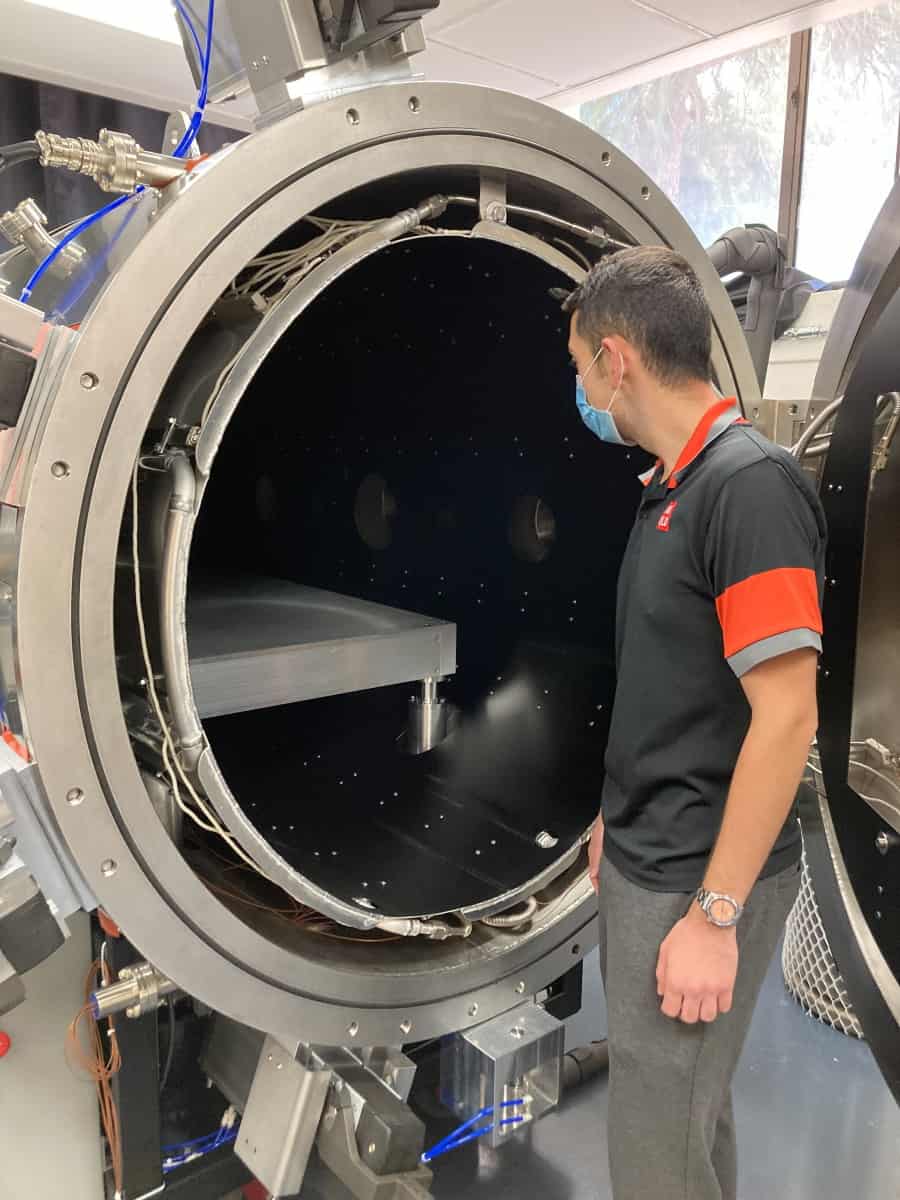
Made to measure: Kian Milani, a University of Arizona optical sciences PhD student, inspects the RVS TVAC chamber. (Courtesy: Lori Harrison)
In this scenario, the RVS TVAC chamber allows developers to evaluate technology performance along multiple coordinates. A thermal vacuum cycling test, for example, will see the craft’s hardware and instrumentation put through its paces and subjected to a “step-and-repeat” programme of extreme hot and cold temperatures in a high-vacuum environment, while a thermal balance test aims to demonstrate the effectiveness of the craft’s thermal control systems for maintaining the temperature of key systems within predefined limits. There’s also a vacuum bake-out requirement, in which the satellite hardware is heated to high temperature under high vacuum to quantify levels of material outgassing (the products of which can adversely affect the functioning of on-board imaging systems, thermal radiators, solar cells and the like).
Herein lies another opportunity. For even while the CAAO team is pushing the performance limits of its space-based instrumentation, a parallel commitment to cost-reduction remains very much part of the R&D mix – not least in the deployment of commercial off-the-shelf (COTS) hardware and software (rather than the development of bespoke technology solutions). “A key use-case for the TVAC chamber involves taking COTS products – say an optical detector or an onboard computer – and making sure that they still work in a space-like environment,” says Douglas. “Space-qualified COTS technologies are fundamental to driving down the overall cost of small-satellite astronomy missions.”
Delivering versus requirements
Equally important is the emphasis that RVS puts on its own off-the-shelf thermal vacuum systems. Put another way, that means thermal testing at a palatable price-point while also ensuring that ease-of-use is paramount. “In responding to our call for proposals, RVS was competitive on price and delivered versus desired functionality,” notes Manny Montoya, CAAO technical manager, who heads up a diverse team of engineers, technicians and machinists supporting the research of Douglas and other astronomers at Steward Observatory.
The functionality in question covers a general-purpose vacuum test chamber that any small-satellite mission on the Tucson campus can use to investigate the effects of temperature extremes in high vacuum. What’s more, the TVAC chamber also gives Steward Observatory astronomers the ability to access vacuum regimes as low as 10-8 Torr – an essential requirement when qualifying high-end instrumentation destined for scientific missions like Aspera. This NASA project, led by Steward Observatory astronomer Carlos Vargas, is developing an extreme-UV astrophysics small satellite that will map the warm-hot-phase coronal gas around nearby galaxy halos (and, in turn, shed light on galaxy formation and evolution).
Another CAAO must-have is vibration isolation, so that Douglas and his team can evaluate precision adaptive optics systems inside the TVAC test chamber. In this respect, RVS proposed a novel solution comprising an optical table suspended by pneumatic legs outside the vacuum chamber – a configuration that isolates the optics under test by dampening any vibrations coming through the building floor (from passing road traffic, for example, or from doors opening and closing).
“In responding to the request for proposals,” concludes Montoya, “RVS did a great job of understanding CAAO’s technical requirements and adapting the TVAC system accordingly – testament to the company’s extensive technical domain knowledge on thermal vacuum testing for research and industry applications.”
A study into bone loss in astronauts returning from long spaceflights has shown that some may have incomplete bone recovery even after one year back on Earth, with sustained losses equivalent to 10 years of normal age-related bone loss on Earth.
The multi-year TBone study began in 2015 and followed 17 astronauts before and after spaceflight to understand whether bone recovers after long periods in space. The research team used high-resolution (61 μm) peripheral quantitative CT to scan the tibia (shinbone) and radius (forearm) to assess bone strength, density and microarchitecture.
The results, published in Scientific Reports, show that weight-bearing distal tibia bones only partially recovered in most astronauts one year after spaceflight – suggesting permanent bone loss similar to about a decade’s worth of age-related bone loss on Earth. The research also found that some astronauts who flew on shorter missions, under six months in duration, recovered more bone strength and density in the lower body compared with those who flew for longer durations.
“Bone loss occurs because bones that would normally be weight-bearing on Earth, like your legs, don’t have to carry weight in microgravity. To understand what happens, our research team travelled to NASA’s Johnson Space Center near Houston, Texas, to scan the wrists and ankles of the astronauts before they left for space, on their return to Earth, and then at six and 12 months,” says principal investigator Steven Boyd, director of the McCaig Institute for Bone and Joint Health at the University of Calgary.
“The key objective of the research was to understand how well astronauts can regain bone within one year of returning to Earth,” Boyd adds. “Conducting research on astronauts is not only a fantastic opportunity to learn about their ability to recover bone, but also provides a basis for understanding how we all are able to adapt our bones.”
According to Boyd, the rapid rate of bone loss experienced by astronauts in microgravity is unparalleled by any bone loss scenario on Earth – meaning that it would take decades to study this magnitude of bone loss on our home planet. The short recovery time frames seen when returning to Earth after spaceflight also allows researchers to better understand the limits of human bone adaptation.
“Although recovery is incomplete, the rate of new bone being formed after spaceflight is greater than any known anti-osteoporosis treatment effect, so it provides an ‘upper limit’ on understanding the ability of bone to adapt,” explains Boyd.
Space for difference
Although bone loss and incomplete bone recovery has long been viewed as a problem for astronauts, Boyd reports that differences between the experiences of individuals can sometimes be quite striking.
“We’ve seen astronauts who had trouble walking due to weakness and lack of balance after returning from spaceflight, and others who cheerfully rode their bike on Johnson Space Center campus to meet us for a study visit. There is quite a variety of response among astronauts when they return to Earth,” he says.
To put the results in context, Boyd notes that astronauts typically travel to space for six months, and return with bone loss similar to what would happen over 20 years of ageing on Earth; they then recover about half (10 years) of that bone loss. Boyd also believes that, unless preventative measures improve, bone recovery will probably worsen as space missions get even longer than the current six-month standard spaceflight.
“This research is also relevant to non-astronauts who lose bone due to ageing or being immobilized for long periods of time with fractures, spinal cord injuries or bedrest,” he says.
Although further study is necessary, Boyd also points out that preventative measures, such as resistance-based exercises, modified diet and potentially even pharmaceuticals to minimize bone loss, may eventually be incorporated into spaceflight.
The next study in the works is TBone2, which will follow astronauts for up to two years after spaceflight to see if any additional bone recovery occurs beyond one year. TBone2 will also include astronauts on one-year space flights, enabling the researchers to compare bone loss between six-month and one-year missions.
“For future long-term missions, such as a trip to Mars, it will be important to understand whether the bone loss we measured after six months becomes even worse after a year or more, or if we start to see a stabilization of the skeleton,” says Boyd. “We hope the skeleton stabilizes so that somebody travelling to Mars doesn’t have too much bone loss, which would be difficult to recover upon return to Earth.”
The risk to people on the ground of being killed by the uncontrolled descent of a rocket stage is increasing, with legislation urgently needed to prevent potential tragedies, says a team of political scientists and astronomers in Canada.
Most space launches still result in the uncontrolled return to Earth of at least parts of rockets – uncontrolled in this sense referring to the absence of an engine burn to put the rocket stage on a safe trajectory into the ocean. Although many pieces of space debris meet a fiery end in Earth’s atmosphere, parts of rockets can be large enough to reach the ground and cause damage.
The group behind this fresh assessment of the risks is led by Michael Byers, who is a professor of global politics and international law at the University of British Columbia in Vancouver. The team found that the greatest danger is to people living in the southern hemisphere, often in poorer nations that have no direct connection with space launches. In May 2020, for example, wreckage from the 18 tonne core stage of a Chinese Long March 5B rocket hit two villages in the Ivory Coast, damaging buildings. In July 2022, suspected wreckage from a SpaceX Crew-1 capsule impacted farmland in Australia, while another Long March 5B was allowed to fall uncontrolled towards waters just south of the Philippines at the end of that same month.
A matter of luck
This is not a new phenomenon. In 1979, NASA’s Skylab fell back to Earth after its orbit rapidly and severely degraded, scattering debris across Western Australia. In all of these cases it was a matter of luck that nobody was injured.
Yet the lessons of Skylab were not heeded, says Aaron Boley, an astronomer at the University of British Columbia who worked with Byers on the latest study. “Because Skylab was a special, single event, it remained easy moving forwards to ignore cumulative effects from launches that typically have much lower risks when viewed in isolation,” Boley tells Physics World.
The risks from individual re-entry events are low, partly because of regulations. In the US, the Orbital Debris Mitigation Standard Practices stipulates that all launches should have a risk of casualty from an uncontrolled re-entry of no less than 1 in 10,000. However, the US Air Force, and even NASA, have flouted this rule on numerous occasions according to the new study. Other nations may have different regulations, or none.
Cumulative danger
The danger, as Boley implies, is cumulative. In the past 30 years more than 1500 rockets that have fallen out of their orbits, and almost three-quarters of these have done so in an uncontrolled fashion. In their new study, Byers, Boley their University of British Columbia colleague Ewan Wright and Cameron Byers of the University of Victoria in British Columbia, calculate that during those three decades there was about a 14% chance that someone on the ground could have been killed.
As the number of launches is set to continue increasing as more nations and companies join the space race, the new study recommends several actions that could be taken to mitigate the risk. One is providing extra fuel so that a rocket can be re-ignited and directed towards a safe re-entry, perhaps crashing at “Point Nemo”. This is a “spaceship graveyard” that is located at the point in the Pacific Ocean that is farthest from land — and will be the final resting place of the International Space Station. However, launch providers have been reluctant to direct rockets using extra fuel because of the additional cost.
Another approach is to adopt reusable rocket stages, as SpaceX have successfully pioneered. However, “not all missions will be conducive to reusability of all parts, and in those cases we should still strive to bring back equipment controllably,” says Boley.
Official response
In response to the study, the European Space Agency’s Tim Flohrer, who is the Head of the Space Debris Office at the European Space Operations Centre in Darmstadt, Germany, gave the following statement to Physics World.
“On-ground risk is addressed in space debris mitigation guidelines and standards. ESA is very active in the further development and adoption of these together with its international and industrial partners. The re-entry risk affects people at geographical latitudes below launch inclination, i.e. the risk evolves over time with the population density and distribution. As suggested in those guidelines, the de-orbiting of rocket bodies immediately after satellites have been deployed is a good approach to minimizing the risk from re-entries – and we have observed a positive trend in getting to better compliance levels, e.g. visible from our space environment report.”
NASA was also contacted by Physics World for comment but has not replied.
Possible solutions
Should spacefaring nations not adopt measures to reduce the risks of falling debris, the study suggests that the only course of action remaining to southern hemisphere nations in the firing line is to make their case to the United Nations and to create a treaty. Even if they cannot convince space-faring nations to sign on, the British Columbia team suggest that it could generate enough press and public attention to improve the situation. They draw analogies with the 1997 Anti-Personnel Landmines convention, which although it was not ratified by the major powers, has led to a significant reduction in mines.
Precedence may also be sought from the aviation world, where material cannot be dropped recklessly from aircraft. “Dumping fuel for weight considerations, such as what might be done in an emergency landing with a plane over its landing weight, is a highly coordinated activity,” says Boley.
Other examples of collective action to protect against a global problem include mitigative policies combating CFCs and oil spills, although regarding the latter it took the Exxon Valdez disaster in 1989 to really spur action. The concern is that it will also take a disaster to prompt space-faring nations to take action against uncontrolled re-entries.
Glass is ubiquitous in everyday life. Being highly transparent, stable and durable, it’s an important material for a myriad of applications, from simple windows to touch screens on our latest gadgets to photonic components for hi-tech sensors.
The most common glasses are made from silica, lime and soda. But for centuries additional ingredients have been added to glass to confer properties such as colour and heat-resistance. And researchers are still working on glass, seeking to give it further functionality and improve its performance for specific tasks, creating increasingly hi-tech glass and what could be referred to as “smart” glass.
Smart materials aren’t easy to define, but broadly they are designed to respond in a specific way to external stimuli. In terms of glass, the most obvious “smart” application is for windows – in particular, controlling the amount of light that passes through the glass. That way we can boost the energy efficiency of any building: reducing the heat in the summer, while keeping it warm in colder weather.
Window voltage
The colour or opacity of some smart glass can be changed by applying a voltage to the material, thereby altering certain optical properties – such as absorption and reflectance – in a way that is reversible. Such “electrochromic” smart windows can control the transmittance of certain frequencies of light, such as ultraviolet or infrared, on demand, or even block them altogether. The application of this technology is popular not only in buildings, but also in electronic displays and tinted car windows.
Indeed, electrochromic windows are ahead of other technologies in this field, and have already been commercialized. But despite working well, they have some obvious disadvantages. They are quite complex and expensive, and retrofitting them to older buildings generally requires installing new windows, window frames and electrical connections. They are also not automatic – you need to switch them on and off.
To address some of these issues, researchers have been working on thermochromic windows, which are triggered by changes in temperature instead of voltage. One big attraction is that they are passive – once installed, their properties change with the ambient temperature, with no need for human input. The dominant method for creating such thermochromic windows is applying a coating of vanadium dioxide to glass (Joule 10.1016/j.joule.2018.06.018), but other materials such as perovskites can also be used (J. App. Energy254 113690). These materials undergo a phase transition, becoming more or less transparent as the temperature changes, an effect that can be tuned for different conditions.
While vanadium dioxide shows a lot of promise for smart windows, there are obstacles to overcome. Due to its strong absorption, vanadium dioxide produces an unpleasant brownish-yellow tint and further work is needed on environmental stability (Adv. Manuf.6 1). A recent review also suggests that although these technologies could provide significant energy savings, more research is needed on their use and impact in real-world settings. For example, the energy performance of thermochromic windows has been found to vary a lot between different cities using the same film type, but far less so between different film types used in the same city (J. App. Energy255 113522).
But hi-tech glass doesn’t end with smart windows. Researchers have found that if they add more unusual metals to glass, it can help to protect solar panels and make them more efficient (see box: Improving photovoltaic cover glass). Bioactive glass, meanwhile, can help us regrow bone and other tissues (see box: Fixing bones and other tissue), while new etching processes could allow us to add multiple functions to glass without the need for surface coatings (see box: Anti-reflective, self-cleaning and antibacterial). And although not traditional optical glasses, new phase-change materials could help create lighter and more compact optical systems (see box: Non-mechanical control of light). Finally, glass might one day even be able to heal itself (see box: Immortal glass).
Improving photovoltaic cover glass
Clear benefit Most photovoltaic cells are topped with a layer of glass. Researchers can adjust the properties of the glass to protect the lower layers from UV damage. (Courtesy: Shutterstock/Iaremenko Sergii)
It might seem surprising, but not all sunlight is good for solar cells. While photovoltaic units convert infrared and visible light into electrical energy, ultraviolet (UV) light damages them. Just like a case of sunburn, UV light negatively impacts the carbon-based polymers used in organic photovoltaic cells. Researchers have found that the damage from UV light makes the organic semiconductor layer more electrically resistant, reducing current flow and the cell’s overall efficiency.
This issue isn’t limited to organic cells. UV light also hampers the more common silicon-based photovoltaic, which consists of a stack of different materials. The silicon-based photoactive layer is sandwiched between polymers that protect it from water ingress, and this unit is then topped with a glass cover, which further protects it from the elements while allowing sunlight through. The problem with UV light is that it damages the polymers, allowing water to penetrate and corrode the electrodes.
Paul Bingham, an expert in glass at Sheffield Hallam University, UK, explains that to improve solar-panel efficiency “the overriding direction of travel in the past few decades has been to make the glass clearer and clearer”. This means removing chemicals that colour the glass, such as iron, which produces a green tint. Unfortunately, as Bingham explains, this lets more UV light through, damaging the polymer further.
Bingham and his colleagues have therefore been going in the other direction – they have been chemically doping glass such that it absorbs damaging UV light but is transparent to the useful infrared and visible light. Iron is still not an ideal additive, as it absorbs some visible and infrared wavelengths, and the same is true for other first-row transition metals such as chromium and cobalt.
Instead, Bingham’s team has been experimenting with second- and third-row transition elements that would not normally be added to glass, such as niobium, tantalum and zirconium, along with other metals like bismuth and tin. These create strong UV absorption without any visible colouration. When used in the cover glass, this extends the lifespan of photovoltaics and helps them maintain a higher efficiency, so they generate more electricity for longer.
The process also has another benefit. “What we’ve found is that many of the dopants absorb UV photons, lose a bit of energy and then they re-emit them as visible photons, so fluorescence basically,” Bingham says. They create useful photons that can be converted to electrical energy. In a recent study, the researchers showed that such glasses can improve the efficiency of solar modules by up to about 8%, compared with standard cover glass (Prog. in Photovoltaics 10.1002/pip.3334).
Fixing bones and other tissue
Active fibres A borate-based bioactive glass fibre, called Mirragen Advanced Wound Matrix created by ETS Wound Care, Rolla, Missouri. (Source: Int. Wound J.19 791. Reused with permission from Wiley & Sons.)
In 1969 biomedical engineer Larry Hench, from the University of Florida, was looking for a material that could bond with bone without being rejected by the human body. While working on a proposal for the US Army Medical Research and Design Command, Hench realized that there was a need for a novel material that could form a living bond with tissues in the body, while not being rejected, as is often the case with metal and plastic implants. He eventually synthesized Bioglass 45S5, a particular composition of bioactive glass that is now trademarked by the University of Florida.
A specific combination of sodium oxide, calcium oxide, silicon dioxide and phosphorus pentoxide, bioactive glass is now used as an orthopaedic treatment to restore damaged bone and repair bone defects. “Bioactive glass is a material that you put into the body and it starts to dissolve, and as it does it actually tells cells and bone to get more active and produce new bone,” says Julian Jones, an expert in the material, from Imperial College London, UK.
Jones explains that there are two main reasons the glass works so well. First, as it dissolves it forms a surface layer of hydroxycarbonate apatite, which is similar to the mineral in bone. This means it interacts with bone and the body sees it as a native, rather than foreign, object. Second, as it dissolves, the glass releases ions that signal cells to produce new bone.
Clinically, bioactive glass is mainly used as a powder that is formed into a putty and then pushed into the bone defect, but Jones and his colleagues have been working on 3D-printed scaffold-like materials for larger structural repairs. These are inorganic–organic hybrids of bioactive glass and polymer that they refer to as bouncy Bioglass. The 3D-printed architecture provides good mechanical properties, but also a structure that encourages cells to grow in the right way. In fact, Jones has found that by changing the pore size of the scaffold, bone marrow stem cells can be encouraged to grow either bone or cartilage. “We’ve had a huge amount of success with bouncy Bioglass cartilage,” Jones says.
Bioactive glass is also being used to regenerate chronic wounds, such as those caused by diabetic ulcers. Research has shown that cotton wool like glass dressings can heal wounds, such as diabetic foot ulcers, that have not responded to other treatments (Int. Wound J.19 791).
But Jones says the most common use of bioactive glass is in some sensitive toothpastes, where it prompts the natural mineralization of teeth. “You have sensitive teeth because you have tubules that go into your nerve cavity in the centre of the tooth, so if you mineralize those tubules there is no way into the pulp cavity,” he explains.
Anti-reflective, self-cleaning and antibacterial
Nanoscale rods Scanning electron microscopy shows pyramid-like nanostructures engraved onto glass by physicists at University College London. At 200 nm they are 100 times smaller than a human hair. Controlling the surface morphology at the nanoscale allows scientists to tailor how the glass interacts with liquids and light with high precision. (Courtesy: Alaric Taylor, UCL)
At University College London, researchers have been etching nanoscale structures into the surface of glass to give it multiple different functions. Similar techniques have been tried in the past, but it has proved challenging and complicated to structure the glass surface with fine enough detail. Nanoengineer Ioannis Papakonstantinou and his colleagues, however, have recently developed a novel lithography process that allows them to detail glass with nanoscale precision (Adv. Mater. 33 2102175).
Inspired by moths that use similar structures for optical and acoustic camouflage, the researchers engraved a glass surface with an array of sub-wavelength, nanoscale cones to reduce its reflectiveness. They found that this structured surface reflected less than 3% of light, while a control glass reflected around 7%. Papakonstantinou explains that the nanocones help bridge changes between the refractive index of the glass surface and that of air, by smoothing out the usually abrupt air-to-glass transition. This reduces scattering and therefore the amount of light that reflects off the surface.
The surface is also superhydrophobic, repelling droplets of water and oils so that they bounce off cushions of air trapped in the nanostructures. As the droplets roll off, they pick up contaminates and dirt, making the glass self-cleaning, as Papakonstantinou explains. And as a final benefit, bacteria struggle to survive on the glass, with the sharp cones piercing their cell membranes. Focusing on Staphylococcus aureus – the bacteria that cause staph infections – scanning electron microscopy has shown that 80% of bacteria that settle on the surface die, compared with around 10% on standard glass. According to the researchers, this is the first demonstration of an antibacterial glass surface.
Non-mechanical control of light
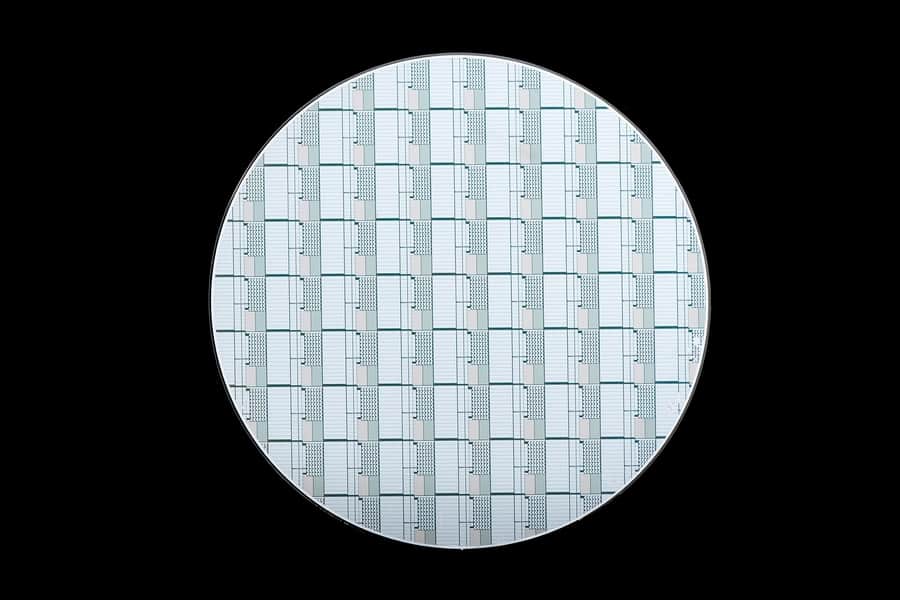
Image control This 8-inch wafer contains phase-change pixels that can be controlled to modulate light. Researchers at Massachusetts Institute of Technology are studying the properties and behaviours of the pixels to inform the creation of future devices that use phase-change materials. (Courtesy: Nicole Fandel/MIT)
Light is generally controlled in optical systems by moving parts, such as a lens that can be manipulated to change the light’s focal point or steer a beam. But a new class of phase-change materials (PCMs) could change the properties of optical components without any mechanical intervention.
A PCM can switch between having an organized crystalline structure to being amorphous and glass-like when some form of energy, such as an electrical current, is applied. Such materials have long been used to store data on optical discs, with the two phases representing the two binary states. But these materials have not really been used in optics beyond such applications, because one of the phases is normally opaque.
Recently, however, researchers in the US have created a new class of PCMs based on the elements germanium, antimony, selenium and tellurium, known as GSST (Nature Comms10 4279). They discovered that while both the glassy and crystalline states of these materials are transparent to infrared light, they have widely different refractive indexes. This can be exploited to create reconfigurable optics that can control infrared light.
Juejun Hu, a materials scientist at the Massachusetts Institute of Technology, says that instead of having an optical device with one application, you can programme it to have several different functions. “You could even switch from a lens to a diffraction grating or a prism,” he explains.
The properties of PCMs are best utilized, Hu says, by creating optical metamaterials, in which nanoscale, sub-wavelength structures are fashioned on the surface and each is tuned to interact with light in a specific way to create a desired effect, such as focusing a beam of light. When an electrical current is applied to the material, the way the surface nanostructures interact with the light changes as the material’s state and refractive index switches.
The team has already demonstrated that it can create elements such as zoom lenses and optical shutters that can quickly switch off a beam of light. Kathleen Richardson, an expert in optical materials and photonics at the University of Central Florida, who worked with Hu on the GSST materials, says that these materials could simplify and reduce the size of sensors and other optical devices. They would enable multiple optical mechanisms to be combined, reducing the number of individual parts, and remove the need for various mechanical elements. “Multiple functions in the same component makes the platform smaller, more compact and lighter weight,” Richardson explains.
Immortal glass
Long lifetimes Despite the robustness of Gorilla glass, mobile screens crack much too often, and so researchers in the UK are developing self-healing polymer coatings for glass. (Courtesy: iStock/Pete Bemmer)
“You can bend the laws of physics, but you can’t break them,” says Paul Bingham, who specializes in glasses and ceramics at Sheffield Hallam University, UK. “Fundamentally, glass is a brittle material and if you apply enough force over a small enough part of the glass then it’s going to break.” Still, there are various ways that their performance can be improved.
Consider mobile phones. Most smartphone screens are made from chemically toughened glass, with the most common being Gorilla Glass. Developed by Corning in the 2000s, this strong, scratch-resistant yet thin glass can now be found in around five billion smartphones, tablets and other electronic devices. But chemically strengthened glass is not completely unbreakable. In fact, Bingham’s phone screen is broken. “I dropped it once and then I dropped it again and it landed on exactly the same point and that was game over,” he says.
To improve the durability of glass screens further, Bingham has been working on a project entitled “Manufacturing Immortality” with polymer scientists at Northumbria University, led by chemist Justin Perry, who have developed self-healing polymers. If you cut these self-healing polymers in half and then push the pieces together, they will, in time, join back together. The researchers have been experimenting with applying coatings of such materials to glass.
If you apply enough force, these screens are still going to break, but if you dropped one and cracked the polymer layer it could self-heal. This will happen under ambient, room-temperature conditions, although heating them up a bit, by leaving them somewhere warm for example, could speed up the process. “It’s about improving lifetimes of products, making them more sustainable and making them more resilient,” Bingham says. And it could be useful for many products that use glass as a protective layer, not just smartphones.
Focal therapy using MRI-guided focused ultrasound is safe and effective for men with intermediate-risk prostate cancer who seek to avoid more invasive treatments, according to the results of a new clinical study. The first-of-its-kind phase 2 trial, described in Lancet Oncology, found that two years after treatment, 88% of participants had no evidence of intermediate- or higher-risk prostate cancer in the treated area.
Treatments for intermediate-risk prostate cancer include radical prostatectomy and radiotherapy and are traditionally directed at the whole prostate gland. But men who undergo such treatments often have persistent side effects, such as urinary and sexual problems, that could reduce their quality-of-life. In contrast, focal therapy only treats areas of malignancy within the prostate, preserving normal prostate tissues outside of the treatment margins.
Led by principal investigator Behfar Ehdaie of the Memorial Sloan Kettering Cancer Center, the study took place at eight healthcare centres in the USA (seven academic and one private). The teams treated 101 newly diagnosed patients with grade group 2 (78%) or 3 (12%) prostate cancer visible on MRI and confirmed on combined (MRI-targeted and systematic) biopsy.
Treatments were performed using a closed-loop MRI-guided focused ultrasound system that combines a transrectal ultrasound transducer with MRI of the pelvis. The MR imaging visualizes the target tumour, monitors the therapy with MR thermometry, and evaluates the ablated tissue immediately after treatment.
Ehdaie and colleagues explain that the ExAblate phased-array transducer directs acoustic energy to the targeted location, heating the tissue to ablative temperatures of 60-70 °C, guided by real-time MRI-based temperature feedback. The target was the MRI-visible lesion plus a margin of 5–10 mm of surrounding healthy-looking tissue.
Sonications were swept across the target slice-by-slice through the prostate gland and repeated until the target was covered by the required thermal dose. After each sonication, the researchers acquired anatomical MRI to enable modification of the treatment plan to account for treatment-induced changes in the gland volume. The median duration for the entire procedure was 110 min.
The researchers assessed the safety of the therapy every 90 days in the first year after treatment, and at 18 and 24 months. All patients also underwent combined prostate biopsy six and 24 months after the procedure. No serious treatment-related adverse effects occurred during the 24-month observation period, with only one grade 3 adverse event (urinary tract infection that resolved within three days) reported. Self-reported erectile and urinary function scores were slightly lower than at baseline, but compared very favourably to patient-reported outcomes after whole-gland treatments.
At six months, 96 of the 101 patients had no evidence of grade group 2 or higher prostate cancer in the treated area of the prostate gland. The six-month biopsy identified that 19 of the men had newly detected grade group 2 or higher prostate cancer outside of the treatment area. The researchers suspect that rather than being new sites of cancer, these were likely tumours that were undetected before treatment.
At 24 months, 11 of the 89 patients evaluated did have cancer detected in the treatment area, three of whom had grade group 4 or higher cancer. These patients were referred for conventional whole-gland treatment.
The authors cite three key strengths of their study: the patient cohort was geographically diverse; none of the enrolled patients had low-grade prostate cancer; and, in spite of this, findings were comparable with other prospective focal therapy clinical trials with lower-risk patients.
In the future, the research team will focus on delivering a randomized controlled trial to determine the effectiveness of focal therapy compared with managing prostate cancer with active surveillance. “Overall, avoiding whole-gland treatments will reduce the side-effects associated with surgery and radiation, including sexual, urinary and bowel dysfunction,” comments Ehdaie.
“Further, future studies will also report the impact of salvage treatment in patients with disease progression after focal therapy,” says Ehdaie. “The goal is to provide a treatment option for men diagnosed with prostate cancer along the spectrum of successful options spanning from active surveillance to whole-gland treatment and prolong life and preserve quality-of-life.”
I’m having trouble knowing how to start this article. That’s because we’ve been busy compiling a Physics World book quiz for you to enjoy on your summer holidays (or winter holidays for readers in the southern hemisphere).
We’ve pulled together the first sentences from several well-known popular-science books and your job is to match them to the titles in question. You can take the quiz here.
In seeking examples for the quiz, it quickly dawned on us that opening sentences are tricky to get right. The 16 books we’ve picked out all have striking starts. But many we looked at were excluded for being too obvious or just plain boring.
A few contained quirky, surprising or supposedly amusing anecdotes that presumably sought to draw the reader in and yet they just ended up droning on. Other books started with the clichéd “This book” before launching into a humdrum précis of the contents. (I won’t name names.)
Another tired trope is to invoke humans gazing in wonder at the night sky (invariably since the dawn of civilization) as they muse on their tiny, insignificant place in the cosmos.
In fact, history is always fertile territory for popular-science writers despite it being easy to get wrong when attempting to be dramatic. John Gribbin, for example, starts his seminal In Search of Schrödinger’s Cat by claiming that Isaac Newton “invented physics”.
Apart from actually reading the whole book, perhaps the quickest way of gauging its quality is the “page 99 test”. First suggested by American writer and literary critic Ford Madox Ford, the idea is that by page 99 an author will have hit their stride and the text there is likely to reflect the rest of the content. The opening pages or back-cover blurb, in contrast, will have been given extra attention and might provide a misleading impression of what’s to follow.
Although initially aimed at works of fiction, Ford’s approach is now used for all types of books, including science. There is, of course, a website that casts its verdict on selected titles. And if you think turning to page 99 might provide too many spoilers, there’s an alternative called the “page 69 test”. In these days of information overload, I reckon both are a neat, time-saving ruse, if potentially brutal for the books’ authors.
But of all the entries in our quiz, my favourite has to be the almost biblical opening sentence, “The Cosmos is all that is or ever was or ever will be.” If it sounds familiar, jot down your answer on the back page. I think this opening gambit is a wonderful beginning that compels the reader to continue.
Fortunately, they won’t be disappointed.
What’s your favourite start to a popular-science book? E-mail us at pwld@ioppublishing.org
• First continuous condensate created – A new Bose–Einstein condensate cooling technique has been shown to reduce atom losses and could open the door to continuous-wave atom lasers, as Tim Wogan reports
• Physicist becomes US science adviser – Applied physicist Arati Prabhakar becomes the first woman to hold the directorship of the Office of Science and Technology Policy. Peter Gwynne reports
• China sets out its climate ambitions – Scientists in China are scrambling to support the government’s plan to reach “net zero” carbon emissions by 2060, as Ling Xin discovers
• How to extinguish burnout – Caitlin Duffy argues why it is important for PhD students to develop interests outside the lab and not just solely focus on their research
• Magnetic economy – James McKenzie realizes that we’re going to need lots of magnets if we want to turn the economy green
• Hello interflexionality – Robert P Crease relives the recent G4G14 meeting, where fun and science met
• Newton’s laws and car-crash claims – Fraudsters routinely try to make money by pretending they have been injured in traffic accidents. But as Michael Hall explains, simple Newtonian physics can reveal which claims are genuine and which are bogus
• The unique universe of Satyajit Ray – Andrew Robinson delves into the life and work of the famed Bengali film director, who blended art and science, and uncovers the story behind his sci-fi film that didn’t make it to the screen, but nevertheless influenced Hollywood
• A novel window into smart glass – From fixing bones to making antibacterial surfaces, Michael Allen talks to the researchers making glass that has additional functionality and performance
• Out of sight, beyond imagination – Laura Hiscott reviews The Invisible Universe: Why There’s More to Reality than Meets the Eye by Matthew Bothwell
• As time goes by – Sharon Ann Holgate reviews A Brief History of Timekeeping: the Science of Marking Time, from Stonehenge to Atomic Clocks by Chad Orzel
• From intern to chief of staff – Petrophysicist Oliver Grimston talks about his career at British oil and gas company bp, from taking part in their graduate programme to his current role as the firm’s chief of staff in Iraq
• Ask me anything – Careers tips from documentary-film maker Taghi Amirani
• The first-sentence challenge –Take our books quiz compiled by Sarah Tesh.