Electromagnetic cavity could enhance high-temperature superconductors

Researchers at Harvard University in the US have put forward a possible new way to enhance superconductivity in cuprate materials. The approach, which involves embedding the materials in an electromagnetic cavity, could pave the way toward realizing room-temperature superconductivity, which the researchers call “a holy grail of modern condensed matter and material science”.

Scientists have long known that shining intense light on a quantum material can alter its properties. More recently, researchers have suggested that similar results could be achieved by resonantly coupling the material to an electromagnetic cavity.

One promising application of this technique would be to control antiferromagnetic correlations in certain copper oxides (cuprates) that conduct electricity without resistance at temperatures above 77 K. Such correlations are thought to underlie many of the exotic and potential useful aspects of these so-called “unconventional” superconductors. Being able to manipulate them could thus have important near-term applications as well as providing a potential route to crafting materials that remain superconducting at still higher temperatures.

Magnon mediation

The conventional theory of superconductivity (known as BCS theory after the initials of its authors) states that below a certain critical temperature Tc, the electrons in a material overcome their mutual repulsion and join up to form so-called Cooper pairs that then travel unimpeded through the material. The formation of these Cooper pairs is mediated by phonons – quasiparticles that arise from vibrations of the material’s crystal lattice.

While this theory holds true for most superconducting materials, it does not apply to the cuprates. For them, Cooper-pair formation is instead thought to be mediated by magnons, which are collective oscillations of the material’s spin magnetic moments. Unlike phonons, these quasiparticles do not need to pair up to travel long distances.

In the new work, a team led by Jonathan Curtis studied an unconventional bilayer superconductor with the chemical formula YBa2Cu3O6 (YBCO) and a Tc of 100 K. The researchers began by trying to understand the various ways in which coupling between phonons and the electromagnetic cavity could affect the magnons in the material. Based on their theoretical results, Curtis and colleagues predict that the strongest effect – that is, the one that could lead to the greatest increase in Tc – occurs when the cavity–phonon–magnon interaction stems from distortions of the crystal lattice of YBCO (and indeed other bilayer cuprates). The team also predicts that other cuprates – including monolayer ones – will experience a weaker effect due to phonons exciting magnons through a relativistic interaction between an electron’s spin and its motion.

Need for experimental verification

The Harvard researchers, who report their work in Physical Review Research, stress that they do not yet know whether it is indeed possible to increase Tc using their technique. However, they believe there are several interesting future directions to take their work. “Of course, the first and most important is for us to carry out real experiments, since after all our study is still only theoretical,” Curtis says. “I think that people are starting to reach the necessary parameter regimes to actually construct these devices and I hope that they will try to realize what we have described in this work.”

Curtis adds that on the theoretical front, the most important thing is to analyse what effects such a resonant device will have on Cooper pairing. “This is a challenging problem in large part because these materials are notoriously difficult to model, but we hope to start analysing these effects and at least determine whether there may be a reasonable effect or not,” he tells Physics World. “At the moment, this is something we are actively working on.”

Schrödinger lecture theatre at Trinity College Dublin renamed after sexual-abuse reports

The school of physics at Trinity College Dublin has renamed a lecture theatre that was previously named in honour of the Nobel-prize-winning physicist Erwin Schrödinger. The move is in response to revelations about Schrödinger’s life, specifically that he groomed and sexually abused young girls. The university says that it is also considering the future of its annual Schrödinger Lecture Series, which began in 1995 and is supported by the Austrian Embassy and the National Bank of Austria. 

Born in 1887 in Vienna, Schrödinger spent most of his early life in Germany and Switzerland. In 1933 he moved to the University of Oxford and that year shared the Nobel Prize for Physics with Paul Dirac for formulating a wave equation that accurately calculates the energy levels of electrons in atoms. Yet Schrödinger’s personal arrangements – in which he lived with two women – were not welcomed and, following a stint at Princeton University, he returned to Austria in 1936. 

As an educational institute, we cannot condone or glorify someone who abused the trust between teacher and student

Jonathan Coleman

In 1938 Schrödinger was invited to Ireland to set up the Dublin Institute for Advanced Studies and was based at Trinity until 1955, becoming an Irish citizen. In 1943 he delivered a series of lectures at Trinity on how concepts in physics can be applied to living things, which resulted in the now classic book What is Life? . 

On 11 December last year the Irish Times published a story that outlined Schrödinger’s controversial past, which included relationships with two girls. The article prompted the physics executive committee at Trinity to meet on 20 January to discuss the article and the shocked reaction from staff and students.

A day later, Jonathan Coleman, head of physics at Trinity, e-mailed the department saying it would recommend to Trinity’s provost – Linda Doyle – that the Schrödinger Lecture Theatre be renamed and that it “would be inappropriate” to continue with the annual Schrödinger Lecture series. “It was noted that the majority of people had not been aware of and were shocked by the reported details of Schrödinger’s personal life and sexual history,” Coleman said in his e-mail. 

Following the meeting with the provost in February, they agreed to rename the lecture theatre to “Physics Lecture Theatre”. Since then, a portrait of Schrödinger in the university’s FitzGerald building has been removed.

It has also been proposed that the annual lecture – which has been cancelled this year – will be renamed the What is Life Lecture Series and be overseen by one of the biology schools rather than physics. Discussions are ongoing about how Trinity will commemorate that the 1943 lecture took place while acknowledging Schrödinger’s wrongdoings. 

Coleman told Physics World that he thinks the university has taken the correct, appropriate response. “As an educational institute, we cannot condone or glorify someone who abused the trust between teacher and student,” he says, but added that physicists should not begin to rename scientific concepts or teach about Schrödinger’s demeanours during physics lectures. “What we need to do instead is get much better at teaching the history of science,” says Coleman.

Anna Krylov, a theoretical chemist from the University of Southern California, Los Angeles, who has previously voiced concern about  what she calls “the politicization of science”, disagrees with Trinity’s decision. “These cancellations rob us of the opportunity to learn,” she says. “History should be discussed, not obliterated.”

Krylov fears that other institutions might follow Trinity’s move, leading to Schrödinger’s name being removed from medals, awards and even the equation itself. “The cathedrals of science were built by people, not by saints, and while some committed truly reprehensible acts, when we use their names, we recognize their scientific contributions and honour their intellectual legacy, not their morals or political views” she says. 

US planetary scientists call for mission to investigate solar system’s ice giants

NASA should send a probe to Uranus within the coming decade as well as develop a craft to see if Saturn’s icy moon Enceladus harbours life in its interior ocean. Those are just some of the conclusions contained in the latest decadal survey of planetary sciences and astrobiology.  The 780-page report, released today, prioritizes the scientific themes and concepts for US planetary science for the coming decade.

Composed by a 19-member steering committee convened by the US National Academies of Sciences, Engineering and Medicine, the report focuses on 12 priority science questions within three themes. “Origins” covers issues such as the evolution of the protoplanetary disk, accretion in the outer solar system, and the origin of the Earth and other bodies in the inner solar system. “Worlds” focuses on the evolution of, and interactions among, planets and accompanying bodies in the solar system. Meanwhile, “life” examines the evolution of life on Earth and the possibilities of life elsewhere.

The report outlines a list of space probes need to address these themes. In large-class missions, top priority goes to the Uranus Orbiter and Probe (UOP) – a $4bn multi-year mission intended to gain fresh knowledge of the Uranian system and ice giants. Uranus and Neptune are the only planets that have never been studied with a dedicated orbital probe and the UOP would carry out several flybys of Uranus and contain a probe to sample Uranus’ atmosphere. The report states that a launch within the next decade is “viable on currently available launch vehicles”.

The second highest-priority large-class mission is the Enceladus Orbilander, which would study the Saturnian satellite’s interior ocean and search for evidence of life. Launched in 1997, NASA’s Cassini spacecraft discovered that the icy moon has a subsurface ocean that vents water into space. The Enceladus Orbilander, costing around $5bn, would carry out orbital observations of Enceladus for over a year before landing on the moon, where it would spend two years studying the plume from its interior ocean.

This recommended portfolio of missions, high-priority research activities, and technology development will produce transformative advances in human knowledge

Robin Canup

The report also recommends that NASA maintains its Mars Exploration Programme, prioritizing the Mars Life Explorer as the next medium-class mission. The explorer would search for signs of life currently on the planet – rather than, say, ancient signatures as previous and current missions do – and access the habitability of the red planet. For NASA’s New Frontiers programme, which funds missions costing less than £850m, the report recommends the space agency cover mission themes such as a Ceres sample-return probe, a comet surface sample return, a Titan orbiter as well as a Venus explorer.

Threats from above

Closer to Earth, the report calls on NASA to enhance its detection and tracking of near-Earth objects (NEO) and to develop methods of deflecting those that threaten Earth. It calls on the space agency to support the development and launch of the space-based NEO Surveyor, which operates in the mid-infrared. Following the surveyor, as well at the launch of the Double Asteroid Redirection Test, NASA should develop a “rapid-response, short-warning” demonstration concept that would perform a fly-by mission of an NEO about 50–100 m in diameter – roughly the size of an object that poses a high probability of causing damage on Earth.

Robin Canup of the Southwest Research Institute, who co-chaired the report’s steering committee, says the document sets out an “ambitious but practicable vision” for planetary science exploration in the coming decade. “This recommended portfolio of missions, high-priority research activities, and technology development will produce transformative advances in human knowledge and understanding about the origin and evolution of the solar system, and of life and the habitability of other bodies beyond Earth,” she says.

The report is the first decadal survey to examine diversity, equity, inclusivity and accessibility in planetary science. “A strong system of equity and accountability is required to recruit, retain, and nurture the best talent into the community,” the report states. Although claiming that progress has been made, particularly in terms of women’s prominence in the field, “much work remains to be done, in particular to address persistent and troubling issues of basic representation by race/ethnicity”.

To make progress, the report recommends that NASA’s planetary science division implement codes of conduct for its missions, conferences and field campaigns. NASA – along with the other funders, institutions and professional societies – should also work to mitigate bias at all levels, for example by analysing decision-making practices and procedures as well as engaging with the community to develop initiatives to uncover and stop bias.”This is the first report to consider the state of the profession,” adds Canup. “To the extent we don’t have complete participation, we miss out on great ideas and great people.”

Sir Martin Wood: the supercool thinker who founded Oxford Instruments

It all started in a garden shed in Northmoor Road, Oxford, in 1959. That was where Martin Wood and his wife Audrey set up a company to build superconducting magnets for use in scientific research. At the time, Wood was based in the Clarendon Laboratory at the University of Oxford, where the concept of a spin out was unheard of. But Oxford Instruments proved to be a staggering success and, in 1983, became the first Oxford spin out to be listed on the London Stock Exchange.

These days the company is a hugely profitable FTSE 250 business with global revenues of over £300m, most of which come from exports, and a market capitalization of £1.2bn. Historically best known for its magnetic resonance imaging (MRI) scanners, Oxford Instruments now builds, rents, sells and services a range of hi-tech tools across a wide range of applications. Its technology stretches from X-rays and plasma equipment to microscopy and nanoscience.

I got introduced to the company’s remarkable story by Jonathan Flint, a former president of the Institute of Physics who was chief executive of Oxford Instruments from 2005 until 2016. As he explained, Wood set up the firm while working as a senior research officer at the Clarendon lab (a position he held from 1955 to 1969). His job was to manage its high-magnetic-field facility, designing and making powerful electromagnets that his boss – the Hungarian émigré scientist Nicholas Kurti – and his colleagues wanted for their research.

Martin Wood’s electromagnets proved so popular that when students from the Clarendon left for other jobs, they would ask him to make magnets for their new labs

Wood found he could generate these electromagnets using superconducting materials operating at a few degrees above absolute zero. Indeed, they proved so popular that when students from the Clarendon left for other jobs, they would ask Wood to make magnets for their new labs. Realising this was an opportunity to go into business, he sought approval from Kurti, who fortunately gave his full backing to what was then regarded as a most unusual request.

Wood built the magnets in his garden shed, which years later moved to the grounds of his family’s new home in recognition of the pivotal role it played in the development of superconducting magnets. As noted in his obituary in the Guardian, starting a company was the realization of Wood’s long-held ambition to create a productive and rewarding working environment. Audrey covered the finance and people issues, while Martin concentrated on technical and customer aspects.

A different culture

As well as being pioneers in the commercialization of university research, Audrey and Martin Wood always adopted an unusually positive culture toward staff. It was a pioneering approach that many ex-Oxford Instruments people speak fondly of and carry forward in their professional lives. Flint himself told me how he was invited to the Woods’ home during the selection process for the top job at Oxford Instruments.

“The visit was completely unlike any executive selection I had been involved in before,” Flint recalls. “Martin and I had a wide-ranging discussion on topics from the natural world to the potential of the then embryonic field of quantum computing. By the end of the afternoon, I was enthralled by Martin as a person and quite forgot I was in a job interview.”

Claire Flint, a former group human-resources director at Oxford Instruments, has similarly positive recollections. “Sir Martin instinctively understood that engaging the whole workforce in shared endeavour was right for the people and the organization,” she says. “More than 50 years on, his ethos is still a core part of what makes the company commercially successful and a special place to be a part of.”

Oxford Instruments grew rapidly, becoming a global leader in designing and making superconducting magnets. Its products made it possible for people like the Nottingham University physicist (and future Nobel laureate) Peter Mansfield to image the body using MRI. Indeed, the company supplied superconducting magnets designed by Wood for the first whole-body MRI scanners in 1980.

As time went by, Martin and Audrey moved into philanthropy, supporting business start-ups, scientific innovation, young people and the natural environment

As time went by, Martin and Audrey moved into philanthropy, supporting business start-ups, scientific innovation, young people and the natural environment. Wood, however, kept a substantial shareholding in Oxford Instruments even after delegating the day-to-day running of the organization. And although the business was a financial success, it was always the science and people of Oxford Instruments that really interested him.

Nurturing minds

Aware of the challenges facing fledgling companies, in 1985 the Woods set up the Oxford Trust, buying an old builders’ yard in the city the following year. It became home to the Science and Technology Enterprise Project – the first innovation centre in the region and a catalyst for Oxfordshire’s now-flourishing ecosystem of innovation incubators and science parks. These days the trust runs the Wood Centre for Innovation and the Oxford Centre for Innovation, which provides work space for 40 science and tech start-ups.

Speaking shortly after Sir Martin’s death on 23 November 2021, Steve Burgess – chief executive of the Oxford Trust – paid tribute to Wood’s passion for innovation and physics, which saw him support new tech firms at a time when no-one else had the vision to do this. “With Audrey always at his side, the duo made an incredible impact on today’s entrepreneurial landscape and science education.”

Over the last 30 years, the Oxford Trust has supported hundreds of businesses including Quantum Dice, which last year won a business start-up award from the Institute of Physics. Sir Martin proved not only that high-technology start-ups can thrive in the UK, but also that they can grow into billion-pound businesses – without losing touch with the people and the science that made them possible.

Machine learning predicts when background noise impairs hearing

Machine learning algorithms could one day be used to improve speech recognition in hearing-impaired people, researchers in Germany have shown. Using a novel algorithm, Jana Roßbach and colleagues at Carl von Ossietzky University could accurately predict when people with both normal hearing, and those with different levels of hearing impairment would mishear over 50% of words in a variety of noisy environments – an important test of hearing-aid efficacy.

The lives of many hearing-impaired people have been significantly improved by hearing aid algorithms, which digitize and process sounds before delivering an amplified version into the ear. A key challenge still faced by this technology is improving the devices’ ability to differentiate between human speech and background noise – something that is done using digital signal-processing algorithms.

Researchers often use listening experiments to evaluate the ability of hearing aid algorithms to recognize speech. The aim of these tests is to determine the level of noise at which hearing aid users will recognize only half of the words spoken to them. However, this approach is expensive and time consuming and cannot easily be adapted to account for different acoustic environments, or for users with different levels of hearing loss.

Deep machine learning

In their study, Roßbach’s team used a human speech recognition model based on deep machine learning, which uses multiple layers to extract higher-level features from raw input data. When combined with conventional amplitude-enhancing algorithms, the model could be used to extract phonemes – these are the units of sound that form the building blocks of words.

To train their algorithm, the researchers used recordings of random basic sentences, produced by ten male and ten female speakers. They then masked this speech using eight possible noise signals, which included a simple constant noise and another person talking over the speaker. The team also degraded the recordings to different degrees, to mimic how they would sound to people with different levels of hearing impairment.

Noise threshold

Afterwards, Roßbach and colleagues played the masked recordings to participants with both normal hearing, and those with different degrees of age-related hearing loss. After asking the participants to write down the words they heard, they could then determine the threshold of noise that caused each listener to mishear over 50% of the words. As the team hoped, the responses of participants with different hearing abilities closely matched the predictions of the machine learning model, to within an error of just 2 dB.

The researchers still face several challenges before their algorithm can be used to improve practical hearing aids. For now, the technology cannot be used to identify which words were spoken in the speech it interprets as being misheard. This means it cannot accurately reconstruct the correct phonemes within the amplified sounds produced by hearing aids.

In their future research, the researchers will adapt their technique to maximize the intelligibility of speech for any hearing-impaired person. If successful, their approach could eventually be implemented in hearing aids which are tailored to the needs of specific users.

The research is described in The Journal of the Acoustical Society of America.

Physics of cooking perfect pasta, plant-inspired actuator cracks bricks

For some reason physicists love pasta – and I don’t mean eating it, the physics of pasta is something that seems to fascinates scientist. So much so, that in 2014 two physicists at the UK’s University of Warwick invented a new type of pasta they called anelloni, which has a large ring shape. You can find a link to a recipe for anelloni and learn why it was inspired by polymer physics here: “A taste for anelloni”.

Anelloni is a fresh pasta, so it is easy to cook – just 3–5 min in boiling water is all it takes. With dry pasta, however, it can be much more difficult to gauge when pasta is ready. But the days of crunchy or gloopy pasta could soon be over thanks to a team of mechanical engineers at University of Illinois at Urbana-Champaign.

Sameh Tawfick and colleagues studied how pasta swells, softens, and becomes sticky as it takes up water. They measured parameters such as expansion, bending rigidity, and water content and this allowed them to develop a theoretical model of the swelling dynamics of starchy materials. His team normally studies how deformable materials such as hairs interact with fluids, and they realized that pasta provided a good opportunity to further their knowledge. The fact that many of them were working at home during the pandemic also pointed them towards pasta.

Salt matters

One thing the team found is that the amount of salt added to the water had a significant impact on how long it took the pasta to cook. This could explain why some people struggle to produce perfect pasta despite following the instructions on the packet.

The team also made some important observations about how pasta changes as it cooks – observations that could be very useful for budding chefs.

To study how cooked noodles interact with each other, they observed what happens when pasta is lifted out of boiling water. They found that the liquid surface energy creates a meniscus that sticks noodles together. The is opposed by elastic resistance from bending the noodles, but aided by the adhesion energy from the surface tension of the liquid.

Stick test

Not surprisingly, the degree to which the pasta stuck together increased with cooking time. They conclude that by observing what percentage of two strands of spaghetti stick to each other, a chef could work out if their pasta is cooked to perfection (see figure).

The team also found that as spaghetti cooks its length expands 3.5 times more than its girth. This could explain why I always seem to not put enough water in the pan when I cook pasta. As a result, measuring the increase in length of a noodle as it is cooked would be another way of getting consistent results when making pasta.

You can find out more about their research in: “Swelling, softening, and elastocapillary adhesion of cooked pasta”, which is free to read in AIP Physics Of Fluids.

Super seedlings

We put a new patio in a few years ago and ever since we have been busy pulling out little plants that sprout up from the mortar between slabs. After a seed gets into a tiny gap in the mortar, the delicate-looking seedling manages to crack and move the much harder material so that the plant can grow.

Inspired by this annoying phenomenon, Hyeonuk Na and colleagues at Seoul National University have created a hydrogel actuator that can crack bricks. Plants can grow through mortar thanks to turgor pressure – which is osmosis-driven hydrostatic pressure confined within a plant cell’s walls. Na and colleagues wrapped a hydrogel in a stiff yet flexible semipermeable membrane. This membrane controlled and confined the osmotic swelling of the hydrogel. This resulted in an actuation force of about 730 N, which is 1000 times greater than that achieved by existing hydrogel actuators. This was enough force for the device to be used to break a brick.

You can read more about the actuator in Science.

Measuring gravity outdoors using a quantum gas, breakthroughs in materials processing and particle physics

In this episode of the Physics World Weekly podcast, four physicists at the University of Birmingham explain how they used two clouds of ultracold atoms as a portable gravity sensor. Their device was able to locate a small tunnel on the university campus and can be used outdoors – and impressive feat because the atoms were held in ultrahigh vacuum and millikelvin temperatures.

Also this week, Physics World editors chat about recent breakthroughs in physics including the first mass-produced silicon spin qubits and a surprisingly heavy W boson.

Quantum measurement splits information three ways

A strange feature of quantum systems is that observing them inherently changes their quantum state. More precisely, the act of measurement redistributes the information contained in a quantum system. Now, physicists in South Korea have refined this idea further, experimentally demonstrating a three-way information split in quantum measurements. The result could have applications in understanding information flow during measurements and optimizing protocols for quantum information processing.

Theorists had previously shown that during measurement, information encoded in a quantum state becomes split between the measurer, the measured state, and information that can be recovered. The measurer’s information is known as extracted information, since this is the information they gain by measuring the system. The information left in the measured state is known as transmitted (undisturbed) information. Finally, there is some chance of recovering the system’s original quantum state by performing a reverse operation on the measured system. The maximum probability of restoring the state is known as the reversible information.

The magnitudes of the three types of information vary depending on the type of quantum measurement being performed. For instance, a weaker measurement gives the measurer less information (less extracted information), leaving more of it in the measured state (more transmitted information) and making it less probable that the original state will be recovered (less reversible information). The best balance of the three will depend on the purpose of the measurement.

Pie chart showing extracted, transmitted and reversible information

Types of measurements can be further distinguished by how the sum of the three types of information compares to the information in the quantum state. Whereas optimal measurements preserve the total information in the quantum state, such that it is entirely split between the three types, in non-optimal measurements some information is lost. This lost information can be due to noise in the experiment or inefficient estimates of the original quantum state. Yet sometimes it is inherent in the quantum measurement itself. Such inescapable information loss in non-optimal measurements could give insights into how the classical world appears to emerge from quantum measurements.

Preserving three-way information using photons

In their experimental study, which is published in Physical Review Letters, Seongjin Hong and colleagues at the Korea Institute of Science and Technology and the Korea Institute for Advanced Study showed how the information about a quantum state splits into these three parts. The researchers used photons to experimentally demonstrate information-preserving optimal measurements in which each photon could be in one of three possible states. They then used optical components to perform measurement and reversing operations on the photons, before characterizing their final states and demonstrating the quantitative balance between the three information types.

“The conditions for optimal measurements provide a useful guide for an optimal design of measurement-based quantum information processing protocols”, corresponding authors Seung-Woo Lee and Hyang-Tag Lim tell Physics World. For instance, to discriminate or estimate quantum states, the best strategy is to maximize information gained by the measurement and to minimize disturbance of the state. Alternatively, for tasks where it is important to reverse the measurement, such as quantum teleportation or quantum error correction, the reversibility should be maximized and information gain minimized.

Lee and Lim say the team is now planning further studies of information loss in quantum measurement. They hope to tease out how this loss relates to the transition between the classical and quantum worlds. The results could also have interesting links to the second law of thermodynamics, which describes how irreversibility emerges over time. “One of our inequalities implies that the disturbance in quantum measurement never decreases by any subsequent reversing operation,” Lee and Lim explain, adding that the implied increase in disturbance is “intuitively plausible by the second law of thermodynamics”.

LASER shines on in Munich

One of the world’s leading trade fairs to be devoted to all types of lasers and photonic technologies will once again fill the cavernous halls of Messe München in Germany. LASER World of PHOTONICS, which will take place on the rescheduled dates of 26–29 April 2022, will bring together more than 800 exhibitors to showcase the latest innovations in both industrial systems and scientific equipment.

Key industry sectors to be featured at the exhibition range from industrial manufacturing and quality control through to biophotonics and information processing. Parts of the main exhibition will be focused on sensors and measurement, and illumination and energy, while for the first time there will also be a dedicated World of QUANTUM event.

With the last event in the series taking place three years ago, there will be plenty of new innovations for delegates and exhibitors to discuss. A dedicated start-up pavilion will also enable newly formed companies to present their novel laser and photonics solutions to an international audience of industry insiders. Read on to find out more about some of the companies and product innovations that will be featured at the show.

Spectrometer combines speed with sensitivity

Ocean Insight will be debuting the all-new SR2 spectrometer, which combines high-speed spectral acquisition with best-in-class signal-to-noise ratio (SNR) performance. The Ocean SR2 spectrometer is ideally suited for applications such as laser characterization, plasma monitoring and absorbance measurements, which benefit from the excellent SNR (380:1) offered by the instrument. Combined with high speed – with integration times as low as 10 µs – the system can be used for many different applications without the trade-offs typical of comparable spectrometers.

SR2 spectrometer

The fully configurable spectrometer is produced using industry-leading manufacturing techniques, ensuring excellent thermal stability and minimal unit-to-unit variation. Pre-configured models are available with entrance-slit widths ranging from 5 to 200 µm, providing users with a range of options for optical resolution (FWHM) and signal throughput to meet the requirements of different experiments.

The Ocean SR2 spectrometer is compact and versatile, and is compatible with Ocean Insight’s range of light sources, accessories and software to enable users to configure their set-ups for different applications. Each SR2 instrument is supplied with OceanDirect, a powerful, cross-platform Software Developers Kit (SDK) that allows users to optimize spectrometer performance and access critical data for analysis. The software includes an Application Programming Interface (API) to offer maximum flexibility, while the SR2 is also compatible with OceanView, Ocean Insight’s powerful desktop spectroscopy application.

  • Find out more about Ocean Insights’ full range of spectrometers and measurement solutions at booth 421 in Hall A6.

Timing generator ensures precise synchronization

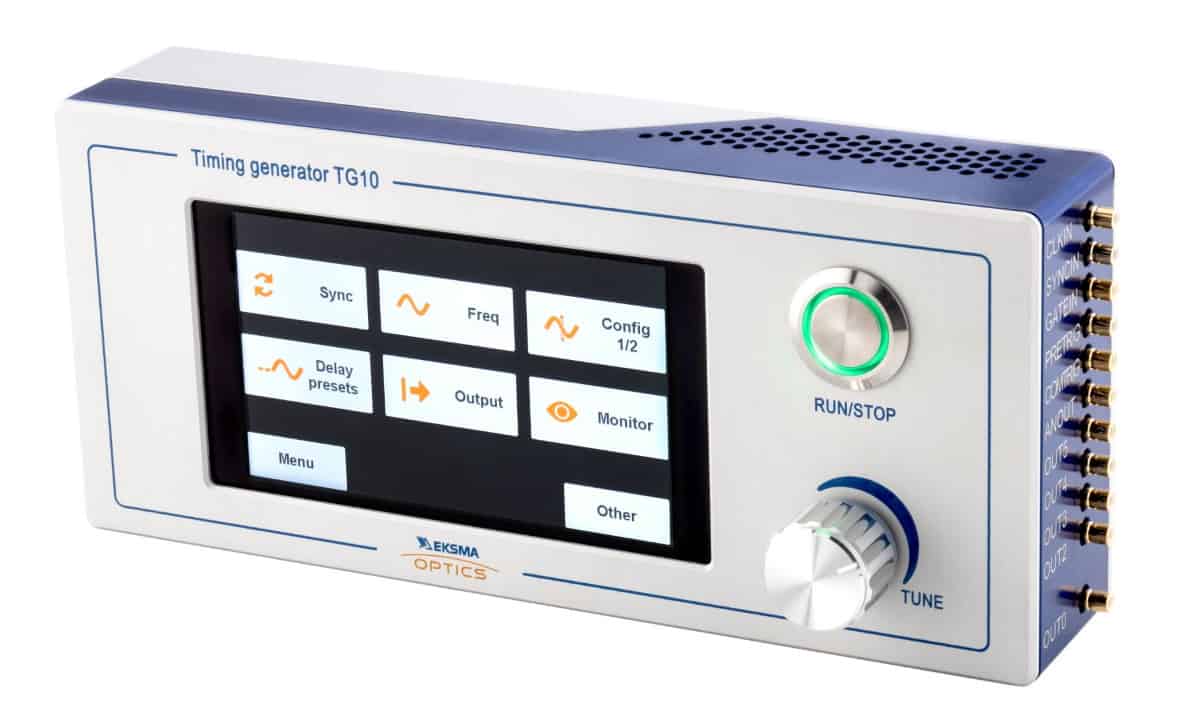
EKSMA Optics is expanding its electro-optics and laser electronics product group and production capacity, with a move at the end of 2021 to a new facility with even more cleanroom space. At LASER World of PHOTONICS the company will be showcasing its experience in the design of electro-optic devices, ranging from a comprehensive selection of Pockels cells to complete laser-pulse picking systems. EKSMA’s continuing innovation aims to integrate different technologies into easy-to-use modulation and control instruments for laser applications.

TG10 timing generator

One of the new additions is the timing generator TG10, designed to synchronize laser systems with other laser components such as detectors, laser-pulse pickers, and drivers for Pockels cells, laser diodes and flash lamps. The TG10 can create up to eight delayed output sequences precisely synchronized to its ultrastable internal or external clock. The TG10 also features a precise trigger output with an exceptionally low jitter of 3–5 ps, making it an ideal choice for high-speed acquisition systems such as streak-camera triggering.

EKSMA Optics will also present its uniLDD series of universal laser diode drivers, which are highly customizable and designed for easy OEM integration. At its core, the uniLDD is a DC input power converter that can supply a continuous current of up to 100 A or 360 A in pulsed, quasi-continuous wave mode, and it is compatible with single emitters, bars, stacked laser diodes and high-power VCSELs in constant current mode. These highly versatile devices are based on digital signal-processing technology and can be adapted for different laser diodes and modes of operation based on customers’ requirements.

  • See EKSMA Optics’ full range of electro-optics and laser electronics products at Hall H5, booth number 353.

Femtosecond fibre lasers open up ultrafast applications

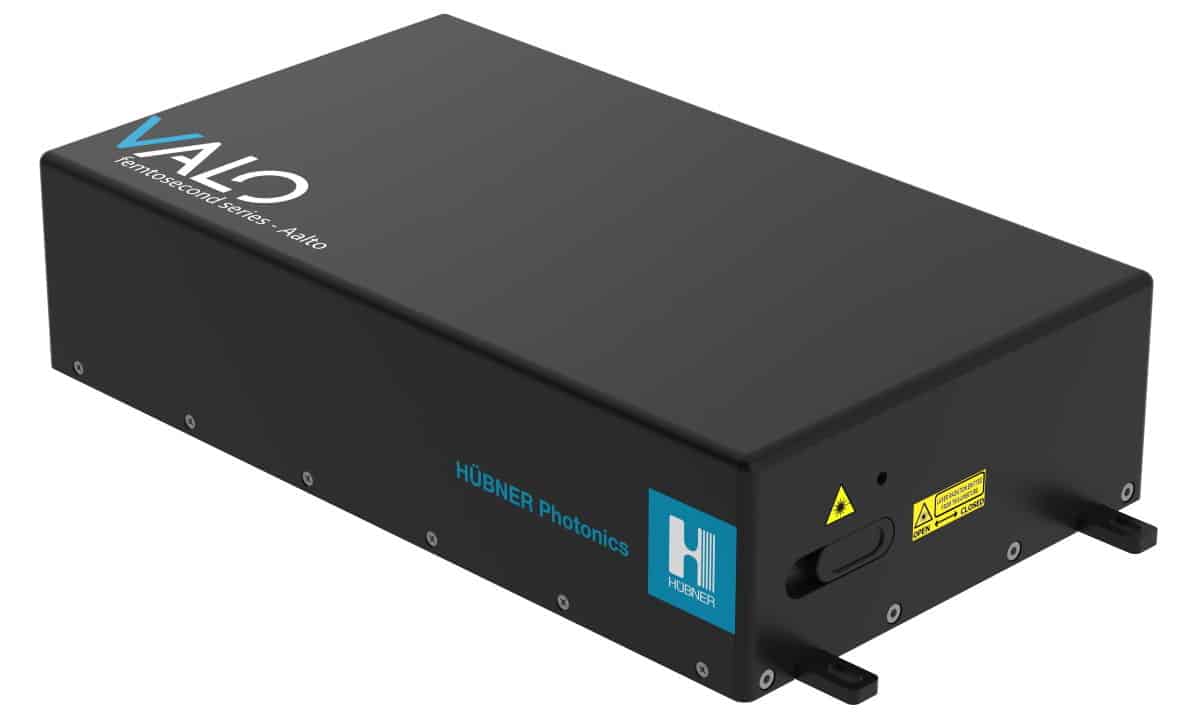
The acquisition of VALO Innovations by HÜBNER Photonics at the end of 2021 has added short-pulse femtosecond fibre lasers to its already diverse technology portfolio, which includes compact single-frequency CW lasers, diode-laser modules and nanosecond pulsed lasers across the full UV, visible and near-IR spectrum.

VALO Innovations

The fibre-laser technology developed by VALO Innovations offer market-leading short-pulse performance, with pulse lengths of less than 50 fs and peak powers above 2 MW from a compact and stable turn-key system. Combined with computer-controlled compensation for dispersion and other nonlinear effects, these ultrashort and ultrafast femtosecond fibre lasers will help new applications in bioimaging, spectroscopy and optogenetics.

“Ultrafast lasers represent a natural complement to the HÜBNER Photonics portfolio and VALO Innovations provides the ideal vehicle to fast-track that ambition,” comments Oliver Prochnow, CEO of VALO Innovations. “For the VALO Innovations team, meanwhile, we are now positioned to develop and scale our femtosecond fibre-laser offering within an established innovation and manufacturing ecosystem.”

Key applications for VALO’s fibre-laser technology include multiphoton microscopy for studying complex and dynamic biological processes deep within living tissue, optogenetics for controlling the activity of neurons or other cells using light, and amplifier seeding – in which femtosecond pulses can increase the energy of selected laser pulses by several orders of magnitude. Integrating the short-pulse sources into multiphoton microscopy or spectroscopy systems can yield a significantly higher peak power, which Prochnow says enables “greater signal efficiency, enhanced penetration depth in tissue, better contrast and reduced photothermal damage”.

  • HÜBNER Photonics will be presenting its full technology portfolio at booth 421 in Hall B5.

Quantum approximate optimization algorithm can be implemented using Rydberg atoms

Quantum computers are often discussed as a technology of the future, but many devices exist already. Because there is no consensus on a single, universal quantum computer design, however, determining the best use for each existing device can be daunting. Recently, researchers at the University of Innsbruck in Austria started to address part of that question by proposing a new way to implement a quantum optimization algorithm by using extremely cold atoms. Their theoretical work could point towards an efficient way of using the strengths of existing quantum computation devices to tackle practical problems in logistics, the energy sector and finance in the near future.

The Innsbruck work centres on the quantum approximate optimization algorithm (QAOA), which recasts optimization in terms of minimizing the energy of a physical system of atoms. For example, instead of trying to find the best way to balance the electric grid, physicists can tackle the equivalent issue of determining the lowest energy assumed by some system of atoms that all interact with each other. Here, the details of the original problem are encoded into specific interatomic interactions.

Controlling those interactions, often between atoms that are far away from each other, is the big experimental challenge for this approach, explains Wolfgang Lechner, Innsbruck physicist and the co-author of a paper describing the new study. “In order to implement an optimization problem on a quantum simulation device one physically has to build these interactions, which is often nearly impossible,” he says. “The original motivation for our work was to reduce everything to local interaction. This opens a plethora of possibilities.”

Mathematical map

The new scheme proposed by Lechner and colleagues relies on a mathematical map that translates the optimization procedure onto an experiment in a way that requires exact calibration of interactions between nearby atoms only. In their study, they modelled how this could be implemented in a system of electrically neutral atoms caught in optical tweezers (held in place by laser beams) and Rydberg atoms, which are more energetic and larger than other atoms. Such a laboratory setup is readily available in many of the world’s research universities and even some commercial startups.

“There has been an outburst of platforms using Rydberg atoms for quantum computing in recent years,” notes Jiri Minar, a physicist at the University of Amsterdam in the Netherlands, who was not part of the study. Optical tweezers let physicists create arbitrary arrangements of atoms in space, he explains, and there are standard experimental procedures for controlling strong interactions between Rydberg atoms. In the Innsbruck team’s model, laser pulses lasting less than a microsecond are used to simultaneously set interactions between four quantum bits (qubits) made of these atoms. Minar says that this experimental simplicity is a big selling point for the practicality of the proposal.

“It’s a single [quantum logic] gate for controlling interactions where normally you would need a whole series of gates that are actually designed for some other tasks,” underlines Rick van Bijnen, physicist and team member at Innsbruck.

Just a few laser pulses

Loic Henriet, a physicist and chief technology officer at the French quantum information processor startup Pasqal comments, ”It’s a new way of implementing a four qubit gate, which is the thing required for implementing QAOA rather natively on Rydberg atoms. With only a few laser pulses, you’re able to do this thing rather efficiently”. Advances in experimentally implementing QAOA could have broad consequences since its applicability ranges from solving logistical problems to balancing financial portfolios, he says.

While the new study is theoretical, the Innsbruck team is keen on staying in lockstep with experiments. In anticipation of a proof-of-principle experiment, they have already numerically tested whether their scheme would work in the presence of noise, explains the paper’s lead author Clemens Dlaska. Since numerical simulations can only handle a small number of qubits, 20 as opposed to a few hundred, current promising results invite more explorations in the lab.

“Existing quantum devices can actually do things that we cannot compute with classical computers. The question is only can we harness this computational power that is apparently there,” van Bijnen says. “Maybe doing arbitrary computational problems is a bit much to ask, so we are now looking at whether we can match problems well to available quantum hardware.” Many current experiments involving Rydberg atoms would likely not require any radical changes in instrumentation that is already being used, he adds.

Lechner says that scientists from academic and commercial laboratories have been reaching out to his team since the study’s publication. This has encouraged the team keep working on mathematical models to make their proposal even more efficient. “We’re not just waiting for the experiments to get better,” says van Bijnen.  The research is described in Physical Review Letters.

Copyright © 2026 by IOP Publishing Ltd and individual contributors