In case you have never eaten one, an Oreo is sandwich of two round biscuits with a sweet creme filling. Many folks will separate the two biscuits and eat the filling first. Crystal Owens at the Massachusetts Institute of Technology is probably one of those people, because she and her colleagues have published a paper about the physics of how that separation occurs.
Oreo fans will know that the cookie almost always comes apart leaving most – if not all – of the filling on one biscuit. And now Owens and team have created an “oerometer” to find out why.
Their device is a rheometer that grasps the two biscuits and gives the cookie a twist until it separates in two. The team then quantified how much filling was on each biscuit.
Perfect twist
“I had in my mind that if you twist the Oreos perfectly, you should split the creme perfectly in the middle,” said Owens. Instead, they found that filling was always on one biscuit, suggesting that the effect was not caused by how people twist Oreos.
The team found that the flavour of the Oreo and the amount of filling did not affect the separation process. What did have an effect was the twisting speed, with the conclusion being that a slow twist is best for a clean break.
As for why the filling always ends up on one side, the team is not much wiser and suggests that it might have something to do with how the Oreos are manufactured. They say this because they found that cookies in the same box separate with the same orientation to how they were packaged.
If want to try their experiments at home, the team has designed an open-source, 3D-printed oreometer (see above video). They describe all of this in “On Oreology, the fracture and flow of ‘milk’s favorite cookie®’”, which is published in Physics of Fluids.
Edible metamaterials
Moving from cookies to chocolate, researchers at the University of Amsterdam, Delft University, and Unilever in the Netherlands say that they have designed the perfect piece of chocolate. The team has shown that the mouthfeel of chocolate can be engineered by creating chocolate metamaterials. Physicists will know that metamaterials are artificial materials with internal structures that are specifically designed to give the metamaterial specific properties – having a certain optical response, for example.
The team heated chocolate and then created various metamaterials using a 3D printer. They found that how the chocolate cracked when chewed could be controlled by altering the design of the metamaterial. Subjects who ate the chocolates reported that pieces with more cracks had a better mouthfeel.
South Africa has completed the construction of two new nuclear labs that will be used to train students and develop novel nuclear-physics detector technology. The Modern African Nuclear Detector Laboratories, or MANDELA, is a partnership between the University of York in the UK and the universities of Western Cape (UWC) and Zululand in South Africa.
Officially opened in late March, the MANDELA labs were built byrefurbishing the nuclear laboratories at UWC and Zululand. Funding also went towards the development of fast digital electronics and data-acquisition systems at the lab. UWC nuclear physicist Nico Orce adds that the labs will allow scientists to develop technology for cancer imaging that can be “brought to the poor communities of South Africa and the African continent as a whole”.
The UK’s Science and Technology Funding Council provided £500,000 from its Global Challenge Research Fund to the project while South African universities also financially contributed. Part of that partnership between South Africa and the UK saw some 20 students from the two South African universities travel to York in 2018 and 2019, where they worked on radiation detectors and ran Monte Carlo computer simulations of new detector designs.
In the second phase of the project, which will begin this year, the students will carry out computer simulations to create prototypes of next generation positron-emission tomography scanners and develop new detectors for environmental monitoring and mining.
“The idea was to upskill young people through training visits to York and to develop detector development laboratories at the South African universities with similar equipment to what we have at York so they can lead their own efforts and can collaborate with us,” says York nuclear physicist David Jenkins, who led the project.
Nokuthula Kunene, deputy vice-chancellor of research and innovation at the University of Zululand, hailed the lab for giving students the opportunities and confidence. “We appreciate the labs because it will not only be a case of getting data to analyse, but now students have the opportunity to create the data, which is essential for learning,” she says.
The physics of high-temperature superconductors in unstable, transient states is surprisingly similar to that of the same materials at equilibrium, raising hopes that these out-of-equilibrium states could be stabilized and used in practical applications. The finding, which researchers at the US Department of Energy’s SLAC National Accelerator Laboratory obtained by using a flash of light to kick-start superconductivity in materials known as cuprates, could help us better understand high-temperature superconductors and how to trigger the formation of these transient states.
Superconductors are materials that conduct electricity without any resistance when cooled to below their superconducting transition temperature, Tc. In the Bardeen-Cooper-Schrieffer (BCS) theory of conventional superconductivity, this occurs when electrons overcome their mutual repulsion and form so-called Cooper pairs that travel unimpeded through the material as a supercurrent.
The first conventional superconductors to be discovered (beginning with solid mercury in 1911) had transition temperatures only a few Kelvin above absolute zero. Beginning in the late 1980s, however, a new class of superconductors with much higher Tc began to emerge. These materials were not metals, but ceramic compounds known as cuprates that are made up of layers of copper and oxygen atoms, interleaved with atoms of other elements. The BCS theory does not apply to these high-temperature superconductors and the way their electrons pair up is not fully understood.
Non-equilibrium states
To shed more light on these materials, researchers often study them in unstable or non-equilibrium states. In the latest work, the researchers generated such a state in yttrium barium copper oxide (YBCO) by applying a laser pulse to it. In this unstable state, the material remains superconducting at temperatures much higher than its usual Tc of around 100 K.
Until now, researchers were unsure whether the properties of such unstable states bore much relation to how the materials would behave in their stable states – that is, the states that would be exploited in real-world applications. A team led by Jun-Sik Lee has now shown that in fact, these unstable states behave in a very similar way to their stable cousins.
Switching on and off
The researchers studied what happened when the normal superconducting states of YBCO were switched off using pulses of light from SLAC’s Stanford Synchrotron Radiation Light Source (SSRL) and the Pohang Accelerator Laboratory’s X-ray free-electron laser (PAL-XFEL) in Korea. They focused on a particular phase of matter in superconductors known as charge density waves (CDWs), which are wavelike patterns of higher and lower electron density. CDWs are different from ordinary waves in that they are static and they serve as markers of the transition point at which superconductivity turns on or off.
The researchers then repeated their experiments by switching off the superconductivity in YBCO using a magnetic field. This is the conventional way to study CDWs in normal equilibrium states of a high-temperature superconductor.
“Crazy experimental adventure”
The team discovered that regardless of whether they exposed the material to a magnetic field or light, similar patterns of three-dimensional CDWs appeared. Why and how this happens is, they say, still unclear, but the result does show that the states induced by either magnetic fields or laser light have the same fundamental physics. It also suggests that laser light might be a good way to create and explore transient states that could be stabilized for practical applications.
“Our result implies a common ground for normal states attained using a magnetic field and an optical pump,” Lee tells Physics World. “Inversely, with the equilibrium states, optical pump approaches can drive room temperature transient superconductivity.”
And that is not all: Lee says that it may be possible to apply an additional driver in the form of a magnetic pulse. “When three pulses, such as X-ray, magnetic and optical pulses are synchronized, it might be easier to monitor how to recover broken Cooper pairs via the magnetic field in a timely manner.”
“This would be a crazy experimental adventure, but we believe it might provide more insight into understanding high-temperature superconductivity.”
In this episode of the Physics World Weekly podcast, the space physicist Xiaojia Zhang explains how whistler waves in Earth’s radiation belts are accelerating high-energy electrons towards the North and South poles. As well as causing spectacular aurorae, these energetic particles can also disrupt modern technologies such as GPS, the UCLA-based researcher says.
We also chat about the latest meteorite that appears to have fallen on England and give a few tips about what to do if you happen to come across a rock from outer space.
Navigation has become incredibly convenient in recent years thanks to the proliferation of devices that use the Global Positioning System (GPS) and other similar global navigation satellite systems. Occasionally, however, you may experience your tracking dot struggle to pinpoint your position – usually when there are obstructions between you and the satellites. Inertial sensors in your phone can help out in these situations but they often become overwhelmed by electrical noise, making them unreliable.
This video introduces an alternative form of tracking being developed by the physicist Lia Li. Her start-up company, Zero Point Motion, is designing a new type of mass market optomechanical sensor based on a similar mechanism to that found in the Laser Interferometer Gravitational-Wave Observatory (LIGO). If successful, the sensor could find other varied applications – from avoiding blurred photos, to tracking patients’ heart rates and even monitoring wear and tear in civil infrastructure.
Find out more about Zero Point Motion and Li’s personal journey from academia to industry in this special profile article, originally published in the April issue of Physics World.
The chaotic nature of weather could be turned to humanity’s advantage by allowing a series of tiny changes to keep weather systems on track. That is the vision of two scientists in Japan who have used computer simulations based on a butterfly attractor to show how even the smallest perturbations could prevent extreme events such as tornadoes or heavy downpours – assuming they are able to confirm their idea with more realistic modelling.
Scientists have been experimenting with weather manipulation for decades and there have been numerous attempts to induce rainfall by releasing aerosols into the atmosphere from aircraft or ground stations to stimulate condensation of water vapour. But while advancing our knowledge of cloud physics, such trials have yielded mixed results when it comes to their practical exploitation, according to Takemasa Miyoshi and Qiwen Sun at the RIKEN Center for Computational Science in Kobe.
The two researchers point out that there are also major efforts under way to investigate the feasibility of altering the climate via geoengineering. But these proposals – including the launching of giant mirrors into space or the dispersal of dust in the upper atmosphere – are controversial given their potential for unintended side effects.
Chaotic control
Miyoshi and Sun have taken a different approach. Rather than attempting to induce irreversible changes to nature, they say that they aim to “control the weather within its natural variability and to aid human activities” – such as by shifting a specific weather system spatially so that rain can be dumped where it does less damage. Their tool in this endeavour is chaos – the fact that chaotic systems are extremely sensitive to changing inputs. “If the proper infinitesimal perturbations are within our engineering capability, we could apply the control in the real world,” they say.
Their work makes use of the simplified system known as Lorenz’s butterfly attractor. Edward Lorenz was an American mathematician and meteorologist whose work on chaos theory inspired the popular idea of a butterfly flapping its wings in Brazil and setting off a tornado in Texas. The butterfly in this case illustrates the same basic idea of a chaotic system’s sensitivity to initial conditions, although the name refers to the shape of a region bounding possible trajectories in phase space.
Lorenz formulated a set of three differential equations to describe in simple terms the convective properties of a layer of fluid in the atmosphere. The equations feature three variables – the rate of convection as well as the horizontal and vertical temperature variation – which are represented as the positions along three orthogonal axes. The equations describe a chaotic system that evolves by tracing out a series of orbits that resemble a butterfly – having two wings connected in the middle. Although the system remains confined to that region of phase space, it can suddenly and unpredictably flip from one wing to the other.
Side-by-side simulations
The aim of Miyoshi and Sun was to establish whether infinitesimal perturbations to a chaotic Lorenz system could keep it confined to just one of the butterfly wings – and thereby avoid dramatic changes in the weather. They did so by running two simulations side-by-side, the first representing unmodified nature while the second, starting from the same initial conditions, they controlled using imperfect knowledge of the former to try and avoid sudden shifts to the other wing.
The researchers ran their simulations using discrete time steps. At every eighth step they updated the second system with noisy information about the natural system’s current coordinates in phase space, then used an ensemble of three models to provide a revised estimate of where the system would end up at a given point in the future. Were any of the models to predict that the system would switch wings, they would then change the coordinates of the controlled system by the same tiny amount at each step until next observing the current state of “nature”.
Each computational experiment carried out by the researchers involved 1000 such cycles, with 40 experiments being run for each of a range of model time horizons and perturbation sizes. By modelling far enough out to the future, they found they could keep the controlled system in the same wing at least 80% of the time, despite nature flipping wings. The perturbations, meanwhile, needed to be not too big and not too small to achieve the best results.
Cost and energy expenditure
Having shown that their chaos-based approach can in principle be used to control the weather, Miyoshi and Sun now plan to apply the technique to more realistic weather simulations. They also say they need to investigate just how small interventions could be in terms of cost and energy expenditure to make a difference to extreme weather events.
Above all, they say that caution is needed. They point out that keeping nature on one wing of the Lorenz attractor may not necessarily guarantee success – it being possible that extreme events could occur without switching sides. “We must consider and assess every potential impact caused by the control and have proper protocols for social, ethical, and legal agreement about real-world operations,” they say.
Eugenia Kalnay at the University of Maryland in the US suggests that perturbations could in principle be generated by increasing or decreasing the drag created by wind turbines in specific ways over short periods of time. “One could imagine reducing the precipitation during a heavy flooding event, or increasing the precipitation during a drought,” she says, stressing that this example is hypothetical.
In this second instalment of innovations being presented at LASER World of PHOTONICS, the international trade fair taking place at Messe München in Germany on 26–29 April, we highlight several exhibitors who are taking part in the inaugural World of QUANTUM event. They will be showcasing laser solutions designed specifically for current and future applications of quantum technologies, including sensing and imaging, computing, and secure communications systems.
Meanwhile, other innovations featured in this preview address the need for greater automation in microassembly processes and the perennial need for easy-to-use software for laser simulation. Read on to find out more.
TOPTICA showcases lasers for quantum applications
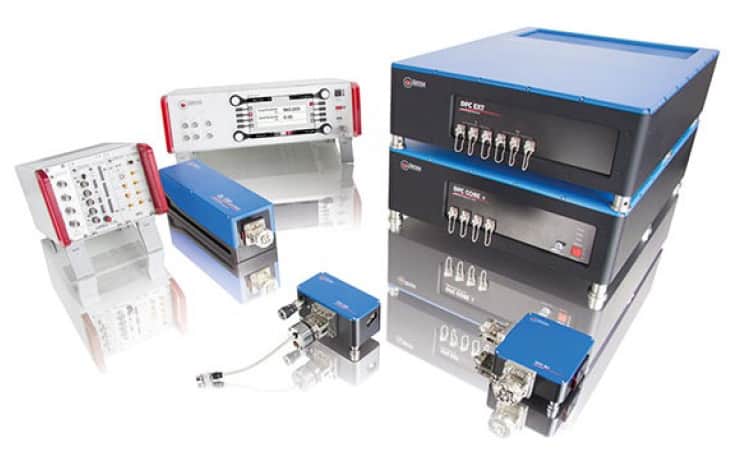
Specializing in state-of-the-art diode-laser technologies, TOPTICA is a key enabler for applications in quantum optics and spectroscopy. Highlights for this year’s LASER World of Photonics include complete frequency-comb solutions for quantum experiments that are built around the robust and reliable DFC CORE +, a device that delivers more power per tooth along with a larger frequency spacing. These complete DFC systems can be customized to include any desired wavelength extension, beat units, stabilization electronics, wavelength meters, counters and lasers.
Strong and stable: Complete systems based on the DFC CORE + frequency comb are suitable for a variety of quantum experiments. (Courtesy: TOPTICA)
TOPTICA has also introduced modular and compact 19-inch laser-rack systems for quantum applications that save valuable bench space when configuring complex laser set-ups. For experiments with quantum dots, meanwhile, the company has expanded its family of continuously tunable lasers. The new CTL 900 laser extends the wavelength range down to down to 880 nm, while still maintaining the upper limit of 1630 nm.
In addition, the company’s versatile range of tunable diode lasers are now available with an intra-cavity electro-optic modulator. The high bandwidth provided by these lasers, which are suitable for a variety of applications, lock to narrowest linewidth and lowest phase noise. The DLC pro all-digital controller, which can be used to drive all of TOPTICA’s tunable diode lasers, also now includes a MOTORpro option for motorized wavelength selection and the AutoPID wizard for frequency locking with automatically optimized parameters.
Frequency-converted lasers are also available at any wavelength between 205 and 4000 nm, with higher powers now available in the visible range for standard systems (e.g. 2 W at 556 nm) and in the UV for fibre-amplified systems (e.g. 3W at 317 nm).
TOPTICA will display their latest laser systems at booth 103, hall B5, while dedicated solutions for quantum applications will be shown at booth 171, hall A4, in the WORLD of QUANTUM exhibition.
High-performance fibre lasers shine on quantum experiments
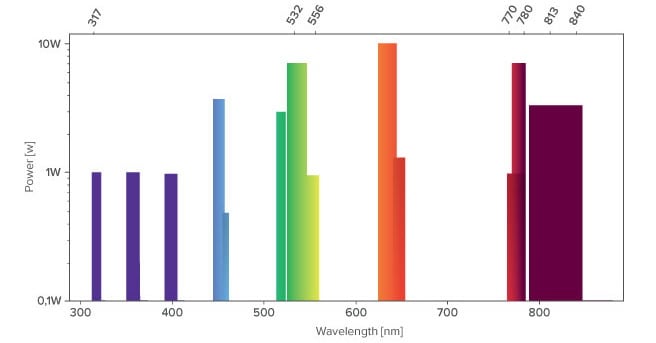
A new range of Koheras HARMONIK frequency-converted fibre lasers from NKT Photonics have been designed with quantum applications in mind, offering new wavelengths for working with rubidium, strontium, barium and ytterbium, along with low noise, up to 10 W of power and a linewidth below 200 Hz.
Quantum focus: The power output from the new range of Koheras HARMONIK lasers at different wavelengths. They are all pumped by low-noise fibre lasers operating in the near infrared, allowing them to be locked to frequency references at either their fundamental or converted wavelengths. (Courtesy: NKT Photonics)
The fibre lasers are inherently stable, providing industrial-level reliability and ease-of-use to maximize experimental time. They do not require any alignment or maintenance, benefitting from the experience that Koheras has gained from installing lasers in demanding industrial applications and even in space.
Koheras HARMONIK lasers are now available at the following wavelengths as standard:
780, 840 and 1064 nm for rubidium
317, 813 and 1064 nm for strontium
532 and 1762 nm for barium
399, 556, 638, 770 and 1064 nm for ytterbium
For any other wavelength, contact NKT Photonics to discuss your requirements.
NKT Photonics will be displaying its full range of laser solutions for applications in quantum technologies, life science and industrial manufacturing at booth 328 in hall B5.
PicoQuant celebrates 25 years of laser expertise
PicoQuant will not only showcase its latest product innovations, but also conclude its celebrations marking the company’s 25th anniversary. “I am really excited and happy that we can mark this occasion with an in-person gathering at the exhibition,” says Rainer Erdmann, managing director of PicoQuant. “I’d like to invite everyone to our booth [Hall B5, number 425] at 16:00 on Wednesday 27 April to raise a glass of sparkling wine.”
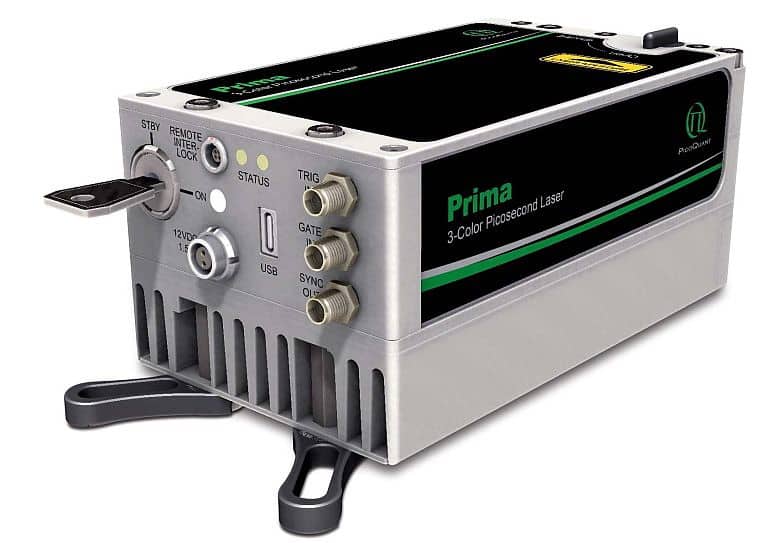
Exciting times: The Prima laser module from PicoQuant generates single-frequency light at red, green and blue wavelengths, in either continuous-wave or pulsed-picosecond modes. (Courtesy: PicoQuant)
New product developments include Prima, a standalone diode-laser module that provides access to three individual wavelengths in either picosecond-pulsed or continuous-wave mode. This fully computer-controlled laser module generates laser light at 635, 510 or 450 nm, to meet the excitation needs for daily lab tasks, including lifetime or quantum yield measurements, and photoluminescence and fluorescence measurements.
The company’s VisUV/VisIR laser modules have also been updated to be fully remote controllable via a graphical user interface. Two new VisIR laser models expand the covered emission range towards the mid-infrared at 1950 nm, and deliver an average output power of more than 0.5 W with pulse duration below 100 ps FWHM. Flexible repetition rates with constant pulse parameters, combined with a compact form factor, make those models of particular interest for metrology, ranging measurements, and for testing detectors and cameras.
PicoQuant has also updated the MultiHarp 160, a scalable plug-and-play unit for event timing and time-correlated single-photon counting (TCSPC), to include on-board event filters that can be defined by the user. These offer an efficient way to reduce the file sizes and amount of data that must be sent via the instrument’s external interfaces. The MultiHarp 160 is optimized for applications requiring up to 64 timing channels with high sustained count rates, a time resolution of 5 ps, and an ultrashort dead time of less than 650 ps.
Find out more about these latest product innovations at booth 425, Hall B5, in the main exhibition or booth 113, Hall A4, in WORLD of QUANTUM.
SmarAct launches new company to focus on high-precision automation
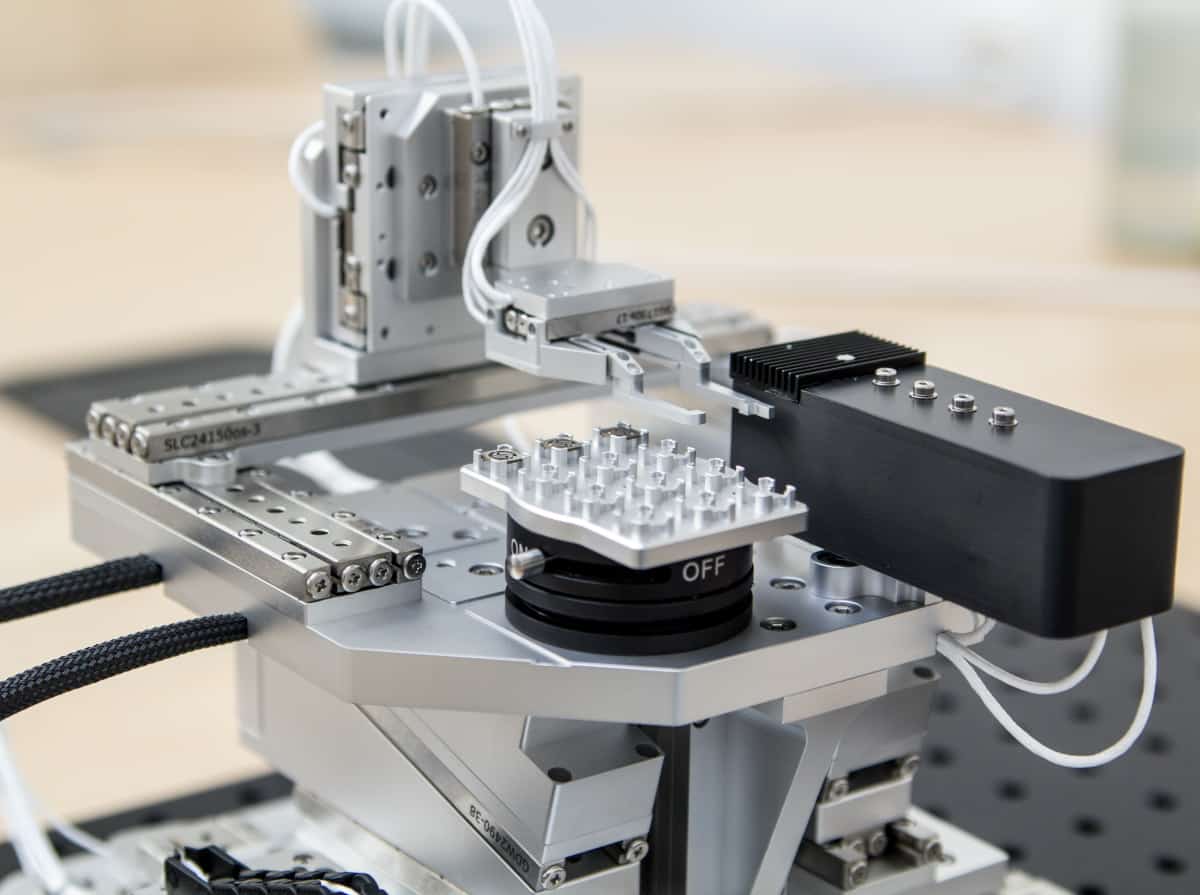
SmarAct Automation, the newest company of the SmarAct Group, was founded in November 2021 to address the increasing demand for automated microassembly solutions. At this year’s LASER World of PHOTONICS, SmarAct Automation will introduce itself as a partner for developing applications where miniaturization is necessary for future development. Such applications demand high-precision alignment, handling and joining of components – whether on a nano-, micro- or meso-scale.
New kid on the block: SmarAct Automation develop high-precision solutions for automating microassembly processes. (Courtesy: SmarAct)
As part of the SmarAct Group, SmarAct Automation benefits from 15 years of know-how in high-precision positioning technology, as well as customized engineering and application development. The company exploits a strict modular framework to develop both partially and fully automated systems, combining the most advanced products from the SmarAct Group along with other state-of-the-art technologies to deliver precise, fast and reliable automation solutions.
To complete its portfolio, SmarAct Automation also offers process development, outsourced manufacturing options, and the mandatory maintenance and service packages for these products – enabling rapid development and future-proof integration of microassembly processes into a production environment.
Contact SmarAct Automation to discuss your microassembly requirements, or talk to company representatives at booth 113, hall B5. SmarAct Group will also be exhibiting in World of QUANTUM at booth 201, hall A4.
Laser-simulation software locates aberrations within seconds
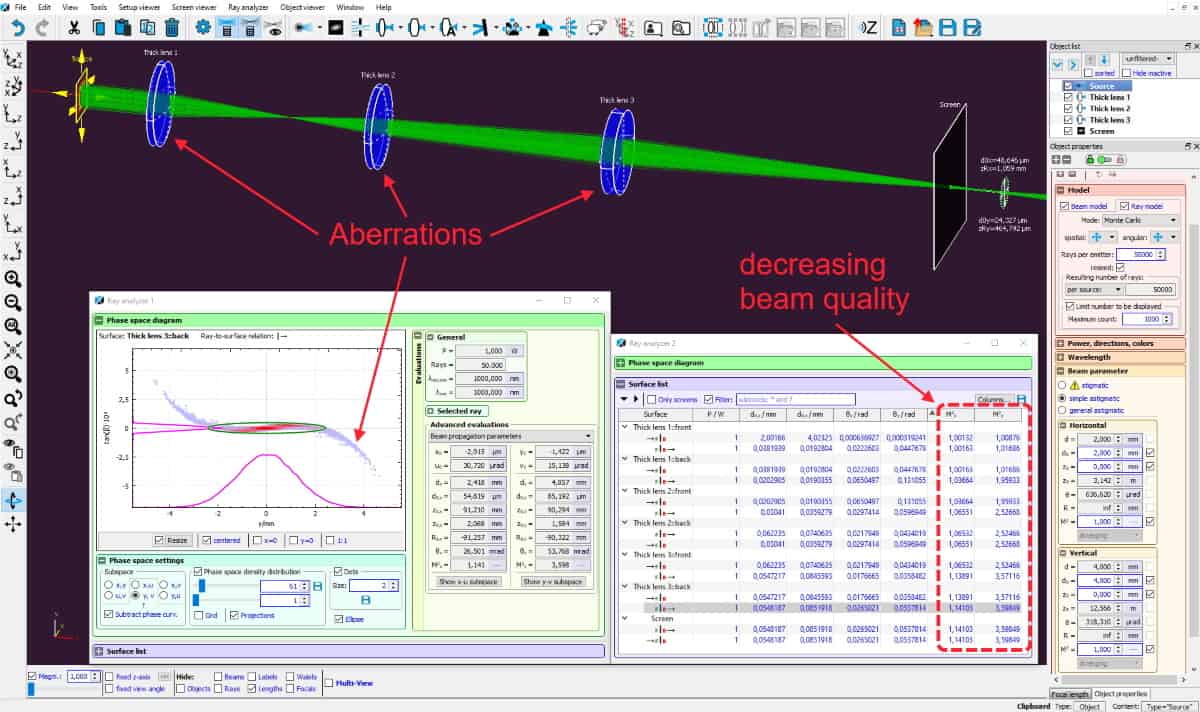
Berlin-based start-up BeamXpert has updated its laser-simulation software to quickly identify the source of aberrations in optical systems, and to directly display the impact that any changes in the laser set-up have on the key parameters, particularly the beam quality M². The software, called BeamXpertDESIGNER, is an easy-to-use 3D simulator of laser-beam propagation that returns ISO-compliant results.
Laser simulator: BeamXpertDESIGNER determines the variations in beam quality when an astigmatic laser beam passes through an optical system with aberrations. (Courtesy: BeamXpert GmbH)
The software now offers Monte Carlo ray generation and multi-core support for its ray model. Together with the addition of a new ray analyser, the influence of aberrations on the beam quality can be evaluated almost in real time, while the laser-beam parameters can be displayed on the surface of any optical component. An improved grating object and a new compression algorithm for data storage adds to the software’s appeal as a universal tool that can be used by all laser system engineers.
BeamXpert has welcomed the positive response it has received from customers working in both basic research and more applied opto-mechanical engineering. Additionally, these clients appreciate that the BeamXpertDESIGNER software is available through a single-purchase license that is not time limited.
For more information visit booth 528, hall B5, at the LASER World of PHOTONICS trade show, or go directly to beamxpert.com.
We are used to the idea that in medicine, simple fixes often come with side effects. Taking pain relief for a headache, for example, can leave you drowsy. Now it turns out that a similar principle applies to quantum error correction (QEC). Although QEC protocols are designed to keep quantum devices accurate by eliminating the headache of environmental noise, researchers at ETH Zurich in Switzerland and the Massachusetts Institute of Technology (MIT) in the US have shown that QEC can also introduce bias into the output of quantum sensors. In their analysis, the researchers recommend remedies for this side effect that could prove important in developing commercial quantum sensors for navigation and environmental surveys, among other applications.
Quantum sensors are often better than their classical counterparts at detecting electric or magnetic fields or measuring quantities such as temperature and pressure. However, there is a trade-off: the same quantum effects that give these devices their sensitivity are also very easily destroyed by the equivalent of a crackle in your headphones or glitches on the edges of your computer screen. Because environmental noise can render a quantum sensor’s output inaccurate, QEC protocols are formulated to cancel it out at every step of the sensing process. Each time the sensor performs some action to detect the quantity of interest, the protocol corrects the resulting signal before the next detection occurs – a bit like a sailor correcting a ship’s course as it moves through choppy waters that push it in random directions.
Delayed correction
Crucially, for any realistic quantum sensor, this “steering” cannot happen immediately after the ship starts to veer off. Instead, there is a small delay between the error and the correction, explains Florentin Reiter, a physicist at ETH and the co-author of a study in Physical Review Letters describing the research.
“In the early days of quantum error correction, you simply assumed to have perfect error correction, but that’s just not realistically going to happen. That’s not what we have now,” Reiter says. With sensors based on extremely cold atoms that are controlled by laser light, for instance, Reiter explains that perfect error correction would require those lasers to be infinitely powerful. “QEC is actually being experimentally realized now so we have to be more realistic about it,” he observes.
Quntao Zhuang, a physicist at the University of Arizona, US who was not involved in the study, agrees that we need more realistic and nuanced theoretical models of error correction to fully understand how to make quantum sensors most accurate. “This work explores a problem that was overlooked in the past,” he says. “When you do error correction with operations that have a finite speed, there will be some side effects on how well you can estimate parameters in the system [where sensing is being done].”
Biased measurements
The side effect Reiter and collaborators identified was a consistent bias of the sensor’s output, analogous to a ship tending to drift in the direction of the current. This bias means that all the sensor’s readings will be somewhat inaccurate, and perhaps even unrealistic. What is more, the bias could lead to overly optimistic estimates for the minimum signal the sensor can detect in the first place.
The specific case that Reiter and colleagues considered in their study involved implementing QEC into a procedure for detecting an electromagnetic signal using a system of many identical quantum bits (qubits). However, in the study they demonstrated that their conclusions are true for quantum sensors very generally. Put simply, “when you use error correction, you have to take care of the bias that comes from finite corrections,” says Ivan Rojkov, a PhD student at ETH and the study’s lead author.
The team’s work also contains suggestions for how this side effect of realistic QEC could be remedied. Namely, researchers could anticipate the QEC-induced bias and account for it from the get-go. “If you have full information about how fast you correct and how strong the noise in your system is, you can determine the strength of your error and sort of have a re-calibration of the sensor,” Rojkov explains.
While Zhuang points out that implementing error correction in quantum sensors is technically challenging in the near term, and comparable to the task of developing small-scale quantum computing, the ETH-MIT team is optimistic about the impact the work may have in the future. Reiter says that the combination of QEC and bias correction could help physicists push their already extremely precise devices (atomic clocks, for instance, can measure time with an accuracy of 10-15 s) even further. And with several start-ups working to commercialize this technology for applications in navigation, the need for a detailed understanding of quantum effects and quantum information protocols transcends academic research – though Reiter underlines that the new work is relevant for fundamental physics, too. “You could measure tiny relativistic effects and potentially gain better insight into the nature of the universe as given by the most precise values of fundamental constants,” he suggests.
Under a microscope, bacteria appear to wriggle and wobble to get to where they need to go. These bizarre motions are nevertheless effective: every second, a bacterium can swim tens of times the length of its body, the equivalent of a human swimming faster than 20 metres per second. Incredibly, in fluids such as those lining the lungs and stomach, bacteria can swim even faster. In fact, the “messier” the fluid, the straighter and faster bacteria travel. After decades of research, the physics of this phenomenon is still under debate.
How bacteria swim in fluids…maybe
Bacteria are single-celled organisms a few thousandths of a millimetre in size. To swim in fluids, they rely on flagella, flexible helical filaments that are connected to “motors” anchored to the cell surface. The thrust generated when the motors turn propels the bacteria forward. When all the motors are synchronized, the flagella appear as a single bundle that rotates uniformly. To balance this rotation, the bacteria’s cell body rotates, too. Imprecise alignments between the motion of the cell body and the flagellar bundle result in the helical, corkscrew-like trajectory seen as “wobbling” under a microscope.
This bacterial swimming looks different depending upon the fluid in which the bacteria are immersed. In complex fluids, such as those lining some organs, bacteria swim much faster than in simple fluids such as water – an observation that has intrigued scientists for over sixty years.
“Previous studies have shown that bacteria swim faster in polymer solutions of low concentrations than in pure water. But exactly why they show such an unusual behaviour was not known,” says Xiang Cheng, from the University of Minnesota.
Theories put forth to date about how bacteria swim in complex fluids focused on the dynamics introduced by the presence of polymers (molecules made by linking many small units together to form larger molecules). Yet, a new study finds similar enhanced bacterial swimming behaviours in the presence of colloids, polymers that are distributed evenly throughout a fluid.
A new model for bacteria swimming
The study, published in Nature, is the result of a collaboration between Cheng’s team and scientists at Beijing Computational Science Research Centre and Beijing Normal University. The researchers analysed how individual bacteria swim by studying low concentrations of fluorescently tagged E. coli injected in a colloid solution (at high concentrations, bacteria such as E. coli show collective swimming, like bird flocking or fish schooling, that changes swimming behaviours). The team noted seven features, such as swimming speed and tumbling rates, that agreed with bacterial swimming behaviours observed in polymer solutions and concluded that dynamics induced by the presence of polymers alone cannot explain why bacteria travel faster in complex liquids.
The researchers realized that each particle, whether a colloid or a polymer, appears as a solid surface to a travelling bacterium. Bumping into the surface of an object induces a torque, bending the flagella and decreasing the misalignment between the flagellar bundle and the cell body, resulting in straighter, faster swimming overall. To combine their experimental results mathematically, the researchers then developed a mathematical model of bacterial swimming. Their parameter-free model introduces a new way to think about bacterial swimming by combining the rigid-body rotation of the bacteria with the angular velocity of the cell body.
Cheng says that while micro-organism movements are relevant to many microbiological processes, such as disease infection, fertility and reproduction, and ecosystem health, his motivation for engaging in this field of research is a passion for how small swimmers such as bacteria live in their natural environments.
“I am simply interested in how such a small creature swims and moves around in their normal life,” he says.
Fortunately – for Cheng at least – this study is not the last word on bacterial swimming. His team is now investigating how bacteria behave in the presence of high concentrations of colloids and how bacteria interact with large solid boundaries.
The German philosopher Friedrich Nietzsche once proposed a terrifying thought experiment. Suppose, some lonesome night, a demon whispers in your ear and says you’ll have to live your life over and over again – each time in precisely the same way as before. “Every pain and every joy and every thought and sigh and everything unutterably small or great in your life will have to return to you,” Nietzsche warned, “all in the same succession and sequence.”
Given that you’ll be continually re-living your life, you need to be extremely careful about how you react. That’s because the demon imagined by Nietzsche, which appeared in his 1882 book The Gay Science, is effectively forcing you to take full responsibility for your life. So do you run away from this little beast or cry out, “Bring it on!”
Demons like Nietzsche’s have played a long and important role in literature, philosophy and science. Another famous example can be found in Meditations on First Philosophy, a book by the 17th-century French scientist and philosopher René Descartes. He invited the reader to imagine a demon who sought to cloak you in such a perfect simulation that you’d be deceived into mistaking it for reality. Could the demon, Descartes wondered, fool you completely and forever?
It was a question that worried Descartes: if we’re all being fooled, how can we prove that science is really telling us truths about the world? Could it be that science is telling us only about the illusions created by the demon? The good news, according to Descartes, is that we can thwart that demon, for even a demon can’t force a conscientious thinker to say “I do not exist” and really believe it. And once that truth is established, more and more truths unfold from it until – eventually – your confidence in the validity of science is restored.
But Nietzsche’s demon still haunts us with the horrifying thought – which surfaces now and then in science fiction – that time might repeat over and over again in a loop. Descartes’ demon, meanwhile, has spawned generations of descendants from the Matrix movies to “brain-in-a-vat” thought experiments, in which a person’s mind is removed from their body and hooked up to a computer that perfectly simulates the outside world. In The Matrix, one escapes the simulation by swallowing a red pill; for Descartes it requires philosophical reasoning.
Red pill blue pill The Matrix films are descended from Descartes’ demon, a thought experiment about living in a simulation so perfect it cannot be distinguished from reality. In the movies, swallowing a red pill offers an escape back to the supposed real world. (Courtesy: Shutterstock/diy13)
Descartes’ demon has also inspired the philosopher David Chalmers’ recent and provocative book Reality+: Virtual Worlds and the Problems of Philosophy (Allen Lane, 2022). Based at New York University in the US, Chalmers argues that we already pretty much live in virtual reality and that there is no significant difference between it and everyday reality.
In these and other thought experiments, demons are just imaginary beings. Still, they are powerful, insightful and can manipulate anything (or almost anything); you engage with them or ignore them at your peril.
Why demons matter
In some ways, the history of demons offers a particular insight into the history of Western culture. That’s why I have been working with Elyse Graham – a colleague of mine in the English department at Stony Brook University in the US – to create a course for our undergraduates both in the humanities and in the sciences, in which we let demons do the teaching. Graham and I were inspired to develop the course, which we’re calling “Demons to think with”, after reading Jimena Canales’ superb book Bedeviled: a Shadow History of Demons in Science (Princeton University Press, 2020).
Canales, who is a science historian at the University of Illinois, was aware that demons feature in numerous books by novelists, priests and anthropologists about things like black magic, the supernatural and primitive cultures. She also knew that demons threaten us with eternal recurrence, saturate us with fake facts, and can even physically make our computers crash. But what really surprised Canales was how often demons turn up in respected academic journals working alongside scientists like James Clerk Maxwell, Charles Darwin, Albert Einstein, Richard Feynman and others.
Demons are found throughout physics – whether trying to overthrow the fundamentals of thermodynamics, expose the incompleteness of quantum mechanics, or mess with a variety of other natural laws
Demons, in fact, are found throughout physics – whether trying to overthrow the fundamentals of thermodynamics, expose the incompleteness of quantum mechanics, or mess with a variety of other natural laws. Some demons fiddle with atoms. Others un-conserve energy. There are demons travelling at the speed of light, or establishing the exact position and momentum of elementary particles, or seeking to carry out other feats that theorists have declared impossible. Sometimes these demons are successful at it, sometimes not.
After reading Canales’s book, Graham and I realized that demons would make terrific undergraduate instructors. Witty, rebellious and charismatic, they would captivate students and be able to instruct them in a variety of topics while delivering important ethical lessons. In our course at Stony Brook, I will deal with the demons that physically inhabit the real world, while Graham, who has a PhD in digital humanities and a background in computer security, will discuss the demons that dwell virtually in computers (see box below).
Demons to think with – a new kind of university course
(Courtesy: iStock/bymuratdeniz)
The course on demons that Elyse Graham and I are developing at Stony Brook University promises to be unique in appealing to science and humanities students alike. While I will be managing the metaphysical demons, Graham will be corralling the physical ones that lurk in software and computer systems. Often known to computer geeks as “daimons”, this race of super-demons has been created through the growth of artificial intelligence (AI). Smarter than humans, these demons can learn and even assign themselves tasks.
Created by hackers and software designers, scientists and spies, these demons lurk in the background, waiting for the right moment to pop up and do something beneficial or harmful, before dropping out of sight again. So whereas literary demons are fictions, and philosophical or scientific demons are thought experiments, these computer demons actually do things using software and IT. These demons won’t go away: better computing will simply yield yet more powerful versions of them.
Graham’s part of the course is project-based. Students will write code to create demons of different kinds and understand how they work. She will not try to teach students to create Cartesian deceivers, Nietzschean provocateurs, Maxwellian midget manipulators or the like. Rather, she will teach students enough coding – in Python – to create and cope with elementary versions of things like Trojan horses, sniffers, spoofers and other dangerous demon-like programs lurking in cyberspace.
Graham will also teach what’s known as “address resolution protocol” (ARP) spoofing. ARP spoofing demons can manipulate these protocols to convince one computer that it is talking to another computer. The demon can therefore set itself up between the two devices to make each one “think” they are exchanging messages with the other. But in the middle, the ARP is intercepting these messages and passing them back and forth – and sometimes adding a little bit more. “It’s terrifyingly simple,” says Graham of the program, which is just a few lines long.
Computer demons are also relevant to “chatbots” and voice assistants such as Alexa, which message or speak as if they’re human. They can turn into demons when they engage us in dialogue, make us feel able to confide in them, and pretty soon steal our souls. But chatbots and voice assistants can also help us cope with our own “Freudian demons” – obsessions created by our psychic activity, perhaps in response to some traumatic experience. These demons continue to return and consume us – “the return of the repressed” as Freud put it – unless we pay attention. If properly programmed, chatbots and voice assistants can draw these obsessions out in the open for us to contemplate, analyse and find better ways to cope with them.
A new generation of demons
Practically as old as religion, demons have come a long way since they first appeared in ancient texts. Those “old-school” demons were scientifically illiterate but morally astute in the sense that they knew how to corrupt you. Each possessing their own wills and objectives, they cannily sought opportunities to steal, betray, sabotage and cause other physical and moral harm. To evade such demons, humans had to mature, and improve their ethical demeanour and cognitive skills. Shakespeare’s Hamlet, for instance, must decide whether what confronts him on the parapet is a deadly demon or a genial ghost, and prepare himself for either eventuality.
What I call “New Gen” demons first began to appear at the start of the 17th century with the birth of modern science. The turning point, in my judgement, was a parable by the philosopher Francis Bacon about a sphinx who haunted the wilds around Thebes. With the wings of a bird and the claws of a griffin, the sphinx would lie in wait for travellers, “whom she would suddenly attack and lay hold of; and when she had mastered them, she propounded to them certain dark and perplexed riddles”.
But Oedipus, whom Bacon described as “a man of wisdom and penetration”, solved the riddle, rendered the sphinx powerless, and slew it. Bacon saw the parable as a metaphor: the demon represented nature and Oedipus represented the scientist. Nature could be deadly, Bacon implied, but it was knowable. So by investigating the demon and thinking through its issues rationally you can render nature harmless.
As modern science progressed, scientists began to realize that demons have skills and abilities that they themselves lack, setting demons to work tackling apparently insoluble problems.
Indeed, as modern science progressed, scientists began to realize that demons have skills and abilities that they themselves lack, setting demons to work tackling apparently insoluble problems. If the demons could solve a particular question, then maybe eventually the scientists could as well. And if the wise and (nearly) all-powerful demons couldn’t solve those problems, at least scientists knew they were on the right track. Demons, in other words, can tell us “What are the things we can’t – or eventually can – do?”.
Particularly interesting is the “imperialist” demon invented by the French mathematician Pierre-Simon Laplace in 1814. Laplace was a proponent of Newton, who had famously pictured the celestial sphere as a clockwork universe. If you know where every piece is and how each moves, Newton’s reasoning implied, you’ll know everything about how the cosmos had worked and how it will in future. Laplace’s demon cleverly carried those Newtonian laws down to the tiniest atomic level.
Although Laplace did not know what makes up matter at such small scales, the implications were massive. That’s because if you know the positions and motions of everything in the cosmos, then she (Laplace, as Canales points out, referred to his demon as “une intelligence”) will know everything that ever was and ever would be. She could solve crimes, answer historical questions, predict the weather, and even strip human beings of their free will.
Her calculational prowess inspired the British mathematician Charles Babbage’s early computers and other mechanical devices, provoked Charles Darwin to contemplate the purely mechanical development of life, and led Erwin Schrödinger to wonder whether something with analogous powers didn’t maintain cellular order. Laplace’s demon ruled for about a century and was only overthrown at the start of the 20th century when physicists developed quantum mechanics, which rendered them powerless to pin down the positions and motions of tiny stuff.
Maxwell’s demon
Perhaps the most famous demon in physics is that devised by Maxwell in 1867. His demon had a completely different job from Laplace’s, being stationed at a door between two chambers of gas. The demon quickly opens and closes the door to let fast-moving molecules go through in one direction and slow-moving molecules go in via the other. One chamber therefore warms and the other cools, reducing the overall entropy and violating the second law of thermodynamics (figure 1).
In her book, Canales calls Maxwell’s demon “more dangerous than Descartes’ demon” because he acts directly on the natural world without having to deceive anyone. He is also more powerful than Laplace’s demon because he does not just know history backwards and forwards but can change it too. What’s more, the ability of Maxwell’s demon to sense the difference between approaching fast and slow atoms in time to grant or refuse them entry to the other side seemed to give him special powers.
The demon could seemingly power perpetual motion machines, make or break molecules, reverse time, reduce entropy, and carry out a host of physics law-breaking activities. If the demon could indeed pull these things off, it meant that the obstacles standing in the way to achieving them were not theoretical but practical. Physicists have long been studying how much entropy the little demon “sweats” and heats up in his efforts, and if it’s enough to ruin his goals.
The bombshells of relativity and quantum mechanics at the start of the 20th century inaugurated a new generation of demons with still more miraculous abilities.
The bombshells of relativity and quantum mechanics at the start of the 20th century inaugurated a new generation of demons with still more miraculous abilities. Canales recounts how Einstein tried to exorcise ones who travelled faster than light and who used a force called “gravitation” (rather than space–time) to push and pull things. There are also quantum Maxwell’s demons (QMD), nanoscale demons and even nuclear magnetic resonance (NMR) demons.
Feynman once contemplated a computer, modelled on DNA-replication processes, that could get work out of nearly random fluctuations. The US mathematician Norbert Wiener mixed features of Laplace’s and Maxwell’s demons to create a cybernetic, or “self-governing”, demon that can learn from feedback. The cosmologist John Wheeler introduced demons who live in black holes, devouring information and energy, seemingly making entropy disappear. The philosopher John Searle, meanwhile, had a demon who lives in the brain and consumes neural synapses.
In her book, Canales tracks down demons in game theory, neuroscience, economics, management and beyond. Demons are found in art, such as the Spanish painter Francisco Goya’s haunting drawing The Sleep of Reason Produces Demons [Monstruos]. Demons appear in literature. You can find them in philosophy, poetry, psychology, religion and even in popular culture – a demon is mentioned, for example, in an entirely different context and to make an entirely different point, in a video for “Montero” by the rapper Lil Nas X. Demons are the seamy underside of the science and technologically permeated modern world.
A demonic future
But back to our course on demons at Stony Brook. Graham and I are not mixing cyber and cultural demons to turn our students into cybercops or cybercriminals. Instead, we hope to teach them important lessons that cross the sciences and the humanities. Demons make tangible our intentions, placing them materially in the real world, able to act independently of the intentions that led us to construct them. This makes them easier to observe and evaluate than when we simply try to reflect on them. Our course will help students not only to code but also to evaluate their intentions before they build demons (rather than afterwards when it’s too late).
If “Demons to think with” succeeds, Graham and I will have achieved the holy grail sought by Stony Brook and most universities we know of. For we will have developed a course that appeals equally to humanities and science students, inspiring and instructing them, and forcing them to work together (though Graham quips that teaching coding to arts students will be easier than getting scientists to read humanities texts). Students, Graham and I believe, need to cope with demons and understand their principles – and would be poorly educated if they couldn’t.
We’ll soon be trying out the course – unless some sphinx is lurking in wait.





![The Sleep of Reason Produces Demons [Monstruos]](https://vignette.wikia.nocookie.net/warehouse-13-artifact-database/images/6/60/Goya_etching.jpg/revision/latest?cb=20151101153755)