Error carried forward: why we need to be vigilant even about textbooks

A question in a Year 9 exam paper for 13–14 year olds states that a scientist places a plotting compass next to a current-carrying coil with a soft iron core in it and notices a deflection. The core is removed; the deflection stops. The student must explain why.

The real answer is that whoever wrote the question never did the experiment, and hopefully wasn’t a physicist. Neither provenance nor author for the paper could be found. Well, these things just turn up. An information sheet also says that naughty old Copernicus had been detained because of his belief in a Sun-centred solar system. Not Galileo Galilei then? Never mind. We scientists spotted it, we talked about it, it was corrected.

Move forward a few years: a shiny new textbook for a new AQA AS-level physics course. Calculation questions and answers: one wrong, two wrong – just a blip, surely? 10 wrong, 15 wrong – best to let the publisher know. A groan down the phone from Nelson Thornes: “You haven’t found loads of mistakes have you?” Well, one or two and a factual error about particle decay. “Can you send a list to us?” To their credit, the publisher sends out a list of errata quickly plus a correction concerning the particle problem. All’s well in science teaching again.

One wrong, two wrong – just a blip, surely? 10 wrong, 15 wrong – best to let the publisher know

The same curriculum: an exam practical. Students lift one end of a water-filled tray to measure a water wave in it. In the paper, they’re asked what might affect the measurements. Seven write “the height the tray is dropped from”. The marking scheme indicates no mark for that. I ring the local AQA branch, curious to hear the justification. The representative makes statements mirroring my argument for awarding the mark, but says that the committee agreed that the mark shouldn’t be awarded. Confused – and not alone – I append a letter to the marked papers opining that the pupils’ answers were correct. The good people of AQA have a change of heart and award the mark. Once again, we scientists spotted it, we spoke about it, it was corrected.

2020: we are presented with samples of a new primary-school curriculum, developed by an academy in Surrey. It is “a fully resourced, intelligently sequenced, knowledge-rich curriculum, informed by the best research evidence available…written exclusively by practising classroom teachers, assisted by subject experts, academics, senior leaders and leading educationalists”. Wow.

“What do you think?” we’re asked.

“Colourful” and “engaging”, some say. But I’ve been here before – I won’t praise this one prematurely.

Three weeks later, we try it out. My seven-year-old pupils read aloud that the Earth’s mantle is liquid rock. “Er. No, that’s a mistake,” I tell them. I let them read on. Another mistake. Wiechert and Gutenberg are positively spinning in their graves. Plan B. There’s a BBC Bitesize link too – the mistake is included there. I let my school know. Little happens.

I watch the curriculum developers in a recorded webinar describing their rationale. I’m told the authors “leaned on” their secondary colleagues’ expertise and primary teachers are not specialists but “generalists”. After this downer I look through the science materials; the downer becomes a headlong plummet.

Among errors in English, I read that light “bounces”. I also read that Mars has no atmosphere, comets are both large space rocks and dusty balls of ice and that Copernicus (back again) published his heliocentric universe theory on his deathbed because of the pesky Catholic authorities. My review isn’t positive.

The headteacher asks if I can let him know what errors I’ve found so he can pass them on. I’ve pointed out some, but how much time have we got? I’m not paid for this – presumably the academy is.

In the same academic year, I find further items that appear to have been copied and pasted from American websites. I let our school trust’s director of education – an Ofsted inspector – know of the issues by e-mail. No reply from him. We teachers are asked to comment on the school’s curriculum. One must be honest, though I do see some mistakes have been corrected, such as imperial units replaced by metric ones.

We’re then told that Pearson has “bought” the curriculum, for geography and history at least. Their web-bumf says they’ve been working behind the scenes with the academy in Surrey. Surely Pearson will listen? Nelson Thornes and AQA did. A person called Jhon says “Hello there. We fear we are unable to provide a direct contact yet” and offers a marketing link I’ve read before. I tell him I’ve pointed out mistakes going back over a year, that they’re still there and I want to tell someone directly. Someone from customer services says “We need some more information: please can you let me know your school and its complete address?” Been here before, too. I say no, explaining how long the process has taken.

So, we scientists spotted it, made little progress for a year and a half, and expect that for many UK pupils taught in 2020–2021, the mantle is liquid, light is bouncy and Mars has no atmosphere. Poor Copernicus’s reputation trashed, too.

But what’s this? An e-mail from Alicia, senior curriculum manager for primary content at Pearson. I detail several errors. She replies “Your current materials are supplied by the academy. We will be taking over from them soon. I will make sure that our team is aware of these points so that no errors are carried forward.” Pearson to the rescue. Perhaps, soon, all will be well in science teaching again.
Physics on the cheap: the secret to the best undergraduate science projects

“What are some of the best and cheapest physics undergraduate projects that one can do?” That was the question that Desmond Rakumo, a third-year student at Maseno University in Kenya, posed to Physics World in an e-mail late last year. Rakumo is pursuing a bachelor of science degree in physics but admitted he was “not well familiarized with how to handle physics projects”.

I wrote back to Rakumo, pointing out that being cheap and being good may sound like exclusive attributes but don’t have to be. Going jogging, say, costs next to nothing but does wonders for your physical fitness and the same can be true when it comes to your mental agility. Still, coming up with a suitable undergraduate physics project that ticks both the “good” and “cheap” boxes requires ingenuity.

The price is right

Some students are fortunate enough to have links with institutions that let them work freely on advanced equipment. For example, at my own university (Stony Brook in the US) some undergraduates carry out projects at the National Synchrotron Light Source at the nearby Brookhaven National Laboratory. In the past, some even did experiments at an on-campus tandem Van de Graaff generator. The superconducting linear accelerator attached to it could reach well over a million MeV.

Coming up with a suitable undergraduate physics project that ticks both the “good” and “cheap” boxes requires ingenuity

Now if you don’t have access to such state-of-the-art equipment, one place to look for alternatives is in the pages of the Institute of Physics’ journal Physics Education. During the pandemic, it put together a collection of experiments that can mostly be done at home. One neat example describes measuring the Reynolds number using just a plastic bottle, Blu Tack and some water.

Another source of inspiration is the back catalogue of The Physics Teacher, a journal published by the American Association of Physics Teachers. Monthly columns such as “How things work” and “Apparatus for teaching physics” have ideas for an astounding range of projects. Graduate students and advanced undergraduates will find many ways to apply relatively inexpensive equipment to ambitious projects.

These include ingenious, low-cost ways to make a Michelson interferometer, a Faraday cage and cloud chambers. There are ideas for quantitatively studying everything from the wavelength of light, the double-slit phenomenon and Lissajous figures to Planck’s constant and the photoelectric effect. But when I asked Gino Elia, a former physics teacher who is now a graduate student in Stony Brook’s philosophy department, I was in for a surprise. “Tennis balls,” he informed me, “are a must.”

Bounce a tennis ball on receipt paper, where it leaves a mark, and you can use your smartphone’s slow-motion camera to evaluate the conservation of energy or get a value for the acceleration due to gravity. Roll tennis balls down inclined planes, let them fall off table-tops, or fire them through a serving machine and you’ve got the perfect means for studying acceleration and projectile motion. They’re also handy for studying spin and elastic and inelastic collisions. You can even illustrate the Doppler effect by cutting a tennis ball open, inserting a tiny speaker and whirling the ball round your head with a string.

Bounce a tennis ball and you can use your smartphone to evaluate the conservation of energy or get a value for the acceleration due to gravity

Other cheap equipment that Elia recommends for simple projects include wind-up cars and trains for measuring energy, velocity, distance and displacement (see, for example, J. Phys. Conf. Series 1076 012026). “A single yo-yo can be used to make a lab for every principle of mechanics,” he adds (I’ll leave it as an exercise to the reader to work out how) while bungee cords, strings and yarn are handy too. One Physics Teacher column even discussed the physics of hot dogs, making them roll using principles of heat transfer.

Good, better, best

So much for “cheap”. But what does a “good” project entail? I told Rakumo that planning a project can be done top-down or bottom-up. Top-down means choosing your objective first. That’s like deciding to put on Hamlet, say, and then looking around for the right players, props and support with which you can pull it off. A bottom-up approach means first surveying available resources and then seeing what to do with them. That’s like deciding what show you can do with your available actors, props and stage. Maybe not Hamlet.

A good physics project, like a good play production, most likely lies in between, negotiating objective and resources. And just as a good Hamlet involves actors who interact rather than simply mouthing the right lines, so a good physics project is one whose outcome arises from its various elements working well together – and not simply giving an answer near to the known value.

Think about experiments to produce tangible evidence that the Earth is spinning by seeing which direction the plane of a pendulum drifts or which way water swirls down a drain. Both are effectively useless with inexpensive equipment given their susceptibility to environmental conditions. If the plane or the swirl doesn’t go in the “right” direction you know the parts aren’t working together properly.

The critical point

So where does all this leave Rakumo? He told me he had access to – and experience with – solar panels, electrical equipment and a desktop computer, and that his interests lay in space physics, space weather and astronomy. His problem was how to co-ordinate the kit with his interests.

I could only think of two suggestions. One, based on a project that I wrote about in a previous column, is to build Geiger counters, widely distribute them, and then carry out a study of cosmic-ray showers.

Another, linked to an idea I read in Physics Teacher, is for Rakumo to build equipment to measure properties relevant to the Poynting–Robertson effect, which describes the drag sunlight has on grains of dust. Such a project tallies with Rakumo’s interest in planetary astronomy.

Both my ideas address important scientific issues without having a specific number as a target. But surely many other projects are possible. So what would you recommend to Rakumo?

Microwave metasurface is reconfigured using stepping motors

A metasurface that can be reconfigured using electric motors has been designed by researchers in the US and China. The structure can be programmed in real time to control impinging electromagnetic waves and was developed by a team led by Weili Zhang at Oklahoma State University. The metasurface comprises an array of dielectric “meta-atoms”, which can be reoriented in groups. The set-up enabled the team to use the device to perform three very different tasks that involved manipulating microwaves.

Metasurfaces are ultrathin films that comprise arrays of tiny dielectric structures that behave much like atoms – hence they are called meta-atoms. The meta-atoms are separated by distances smaller than the wavelengths of incoming electromagnetic waves. The result is a modification of the amplitude, phase and polarization of incoming wavefronts. This can be used in several different ways to create practical devices.

While some devices use fixed metasurfaces that only perform one function, electrically reconfigurable metasurfaces have also been developed. This usually involves connecting each meta-atom to a diode, creating circuits that consume significant amounts of electrical energy. The result is a design trade-off between the number of meta-atoms in a device, and its overall power requirement – which has hindered the development of large-scale devices.

Rotating meta-atoms

These shortcomings have led researchers to explore the development of mechanically reconfigurable metasurfaces, such as folding devices inspired by origami. Now, Zhang and colleagues have created a metasurface that can be reconfigured by using stepping motors to rotate groups of meta-atoms.

The device consists of a 20×20 array of supercells – creating a square surface that is 87 cm on edge. Each supercell contains a 4×4 array of meta-atoms, which are rotated by a stepping motor using connecting gears (see figure). By adjusting the angular orientations of the meta-atoms, the device can be reconfigured to have different effects on impinging microwaves. It can, for example, achieve  a continuous and arbitrary control of the phase of microwaves with high efficiency and uniform amplitude. Although stepping motors do consume energy, the requirements of the system are much lower than diode-based systems.

To demonstrate their device, Zhang and colleagues used their metasurface to perform three very different tasks. First, they programmed the device to behave as a metalens, which provides an extremely space-efficient way to focus microwaves. Second, they used it to convert incoming plane waves into vortices with wavefronts that are twisted like a corkscrew around their direction of travel. Finally, they produced a series of holographic images –generating the Chinese characters for “Tianjin University” and “Datong Yungang”, which floated as much as 60 cm above the metasurface.

The researchers hope that their technology could soon be used in a broad range of practical applications. They describe their metasurface in Advanced Photonics.

The transformative power of physics and how it has helped to build the modern world

They say in real estate there are only three things that really matter: location, location, location. People who think seriously about science communication have a similar mantra about what to focus on: audience, audience, audience. Everything is dictated by who you intend to communicate with, from the analogies you choose to the zigs and zags of your storyline twists.

With Ten Days in Physics that Shook the World: How Physicists Transformed Everyday Life, popular-science writer Brian Clegg sets out to engage a general audience with a dive into 10 key breakthroughs that have transformed our lives. The book has an overarching philosophy of connecting these pivotal events to their subsequent impacts, to provide relevance to the non-physicist reader.

Clegg starts with Newton’s publication of the Principia in 1687 and ends with the establishment of the first link of the Internet in 1969, by computer scientists Steve Crocker and Vint Cerf. Each short chapter sets the scene with respect to what was known or believed scientifically at the time. There is also a little biographical sketch of each main character, at least for the first seven topics, and a scattering of fun asides that dig a little deeper into related tangents. For example, the chapter on Faraday’s discovery of electrical induction briefly discusses the (possibly apocryphal) story of Benjamin Franklin flying a kite in a thunderstorm to study electricity.

For a reader with little to no background in physics, Clegg gives bite-sized overviews of the major concepts, from Newtonian mechanics and thermodynamics to electromagnetism and radioactivity. Each chapter ends with a list of life-changing applications that have evolved from breakthroughs in our understanding of these phenomena. There are passages that clearly indicate a background in physics is not assumed:

“modern physicists, since Maxwell, try to get a better understanding of the world around them by building systems of mathematics that produce numbers that correspond to what happens in the natural world”

Other sections, however, seem likely to be significantly more opaque for a non-technical reader, such as this one on experiments that appear to cool matter below absolute zero:

“The circumstances in which such an effect occurs are having a gas in which most of the particles have very high energy (though not kinetic energy). The combination of high energy and low number of ways to organize the constituent parts means that the usual distribution of energies in a gas is inverted; this has been, somewhat artificially, represented as having a negative absolute temperature, despite the contents not being cooled below absolute zero.”

Non-physicists can likely skip over some of these more detailed passages without losing the main thread of the chapter, but it did strike me that there were several instances where an editor could (should) have asked: is this level of detail or this tangent necessary? For example, most of a page is devoted to the question of whether or not Newton was born on 25 December in the year in which Galileo died.

As a physicist, and perhaps not the primary target audience, I found the greatest value came from the historical context. For example, I learned that the word “transistor” was chosen by polling employees at the lab where the first such device was successfully made; that an early example of network theory was a problem called the Seven Bridges of Königsberg, solved by Euler in 1736; and that both the Romans and Greeks believed you could stop a magnet from working by rubbing it with garlic and then restore its power by dipping it in goat’s blood.

This could make for a fun diversion in the undergraduate electricity and magnetism course I teach. These and other examples scattered throughout the book inject some colour into the storytelling, making it both more entertaining and more memorable.

The biggest absence in this book, in my opinion, is that the subsections describing the human side of the featured scientists only appear in the chapters about breakthroughs 1 to 7. Clegg explains his departure from the general structure as being due to the changing nature of research, away from individual study and towards teamwork, “where there is less benefit to understanding the development in exploring individual lives in any detail”. But why is this the only reason to explore the lives of the scientists associated with these breakthroughs? Colour, character, conflict and context are all important elements in storytelling.

I would love to know more about John Bardeen and Walter Brattain, pioneers of the transistor; James Biard and Gary Pittman, who first patented the light-emitting diode; and Internet developers Crocker and Cerf, than just their dates/places of birth and the educational institutes they attended. The trope of the physicist as a single-minded, socially awkward loner could have been explored critically here. Instead, in five of the seven profiles we encounter descriptions such as: “one of the more isolated workers in the field” (Newton); “generally avoided socializing” (Faraday); “a determined worker, still said to have been continuing his academic work on his deathbed” (Clausius); “initially socially awkward” (Maxwell); “considered paternalistic and overbearing” (Kamerlingh Onnes).

By not including a three-dimensional sketch of the personalities associated with the more recent advances, Clegg misses a golden opportunity to highlight the diverse and complex nature of today’s scientists

The nature of research has irrefutably moved away from the individual natural philosopher experimenting as a hobby. But by not including a three-dimensional sketch of the personalities associated with the more recent advances, Clegg misses a golden opportunity to highlight the diverse and complex nature of today’s scientists, sadly leaving the stereotype to prevail unchallenged.

Nevertheless, if you have a friend or family member who wants to learn more about the big concepts in physics, this is an interesting approach written in a style that is largely accessible for a general audience. Stitching together 10 major breakthroughs with an emphasis on their impact on our everyday lives provides an engaging structure, with enough elements of narrative to hold the reader’s attention.

  • 2021 Icon Books £12.99hb 240pp

Engineered spinal cord implants restore movement to paralysed mice

Researchers in Israel have engineered functional human spinal cord implants that they say could be used to help those with spinal injuries walk again. The technique transforms human tissue from elsewhere in the body using a process that mimics the embryonic development of the spinal cord. The implants enabled 80% of mice with chronic paralysis to walk again.

Every year, as many as half-a-million people around the world suffer a spinal cord injury. The vast majority of these are caused by traumatic events in which a sudden blow fractures, dislocates, crushes or compresses one or more vertebrae, or an object penetrates the body and cuts the spinal cord. Such traumatic spinal cord injuries have a catastrophic impact on health and quality-of-life.

In the weeks following the initial injury, progressive tissue damage usually occurs – caused by inflammatory and other responses – leading to the formation of scar tissue. This glial scar is a poor environment for cell growth and prevents tissue repair and natural neural regeneration. Strategies for treating paralysis focus on bridging this scar tissue to rewire the spinal cord. But it is not easy. Cells designed to regrow the spinal cord can be rejected by the patient’s immune system. They also lack a structural matrix in which to grow and struggle to thrive in the hostile micro-environment of the glial scar.

Tal Dvir, an expert in tissue engineering at Tel Aviv University, and his colleagues believe that the key could lie in growing spinal cord implants from the patient’s own tissue. A few years ago they developed a novel technique for making such implants. Using small samples of belly fat from patients they produced a thermo-responsive hydrogel and stem cells capable of generating several different cell types. They demonstrated that the hydrogel encourages the cells to grow in a natural way by producing several functional implants, including cardiac and spinal tissue.

Dvir explains that, like all tissues, the belly fat consists of cells and an extracellular matrix. “After separating the cells from the extracellular matrix we used genetic engineering to reprogramme the cells, reverting them to a state that resembles embryonic stem cells – namely cells capable of becoming any type of cell in the body,” he says. “From the extracellular matrix we produced a personalized hydrogel that would evoke no immune response or rejection after implantation. We then encapsulated the stem cells in the hydrogel and, in a process that mimics the embryonic development of the spinal cord, we turned the cells into 3D implants of neuronal networks containing motor neurons.”

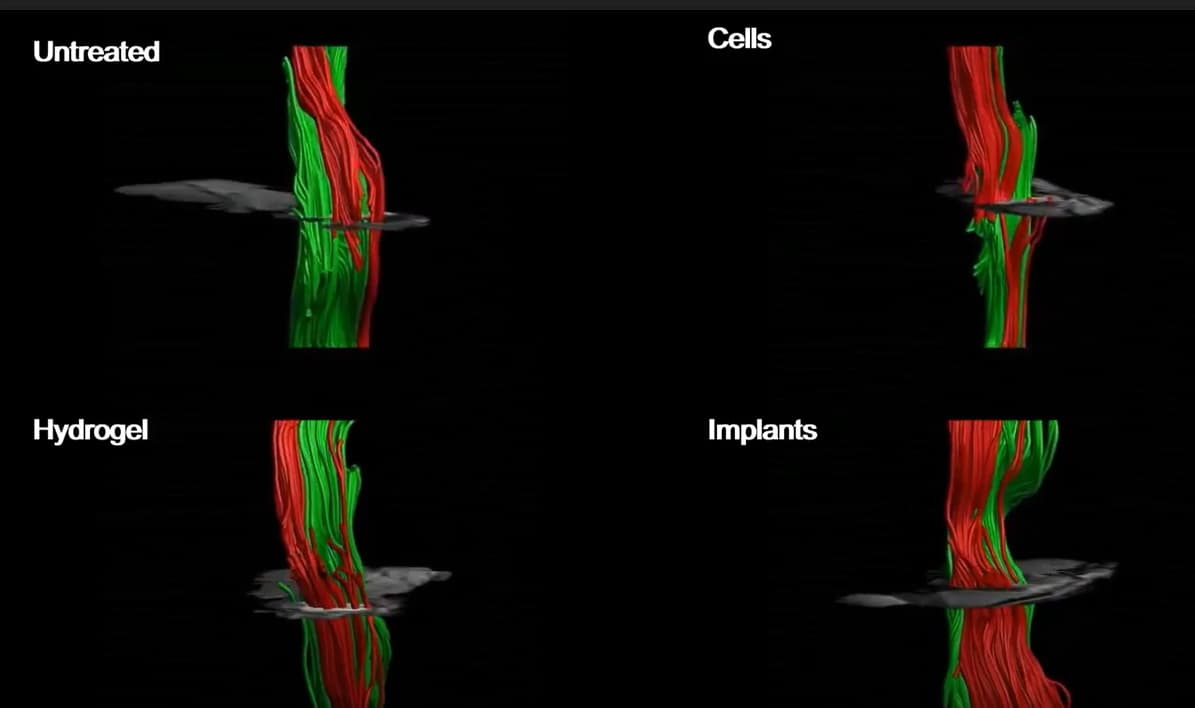
In their latest work, published in Advanced Science, the researchers inserted laboratory grown spinal cord implants in mice. The implants were produced using extracellular matrix from pigs and stem cells generated from human belly fat. When mice received these implants immediately after spinal cord injury, 100% of them regained their ability to walk. Treating humans at this stage, however, would be impractical, as the extent of their injury would be unknown and it takes weeks to engineer the personalized implants.

To test a more realistic scenario, in which scar tissue has fully developed and recovery has plateaued, the researchers placed implants in mice six weeks after spinal cord injury. They explain that this is similar to a year post-injury in humans. Six weeks later, 80% of the mice could walk again.

Healing injured spinal cord

Recovery in the mice was rapid. Four weeks after treatment, imaging showed that intact nerve fibres were crossing the injury sites. In the weeks after receiving the implants, the mice demonstrated gradual improvements in co-ordination, feeling in their feet, and motor and sensory recovery, indicated by less missed steps as they walked. The animals exhibited significant recovery in various sensorimotor tests four weeks after they received the spinal cord implants.

“There are millions of people around the world who are paralysed due to spinal injury, and there is still no effective treatment for their condition,” Dvir says. “Individuals injured at a very young age are destined to sit in a wheelchair for the rest of their lives, bearing all the social, financial and health-related costs of paralysis. Our goal is to produce personalized spinal cord implants for every paralysed person, enabling regeneration of the damaged tissue with no risk of rejection.”

The future of high-performance computing: are neuromorphic systems the answer?

Want to learn more on this subject?

Titans of the tech field will go head to head to convince each other of where they believe the future of computing lies.

Neuromorphic Computing and Engineering editorial board members Kwabena Boahen and Ralph Etienne-Cummings, will attempt to convince Yann LeCun and Bill Dally of the benefits of neuromorphic computing over mainstream neural computing.

We expect this webinar to be a friendly, but no-holds barred debate. Join us to see what side you are on.

About the speakers
Yann LeCun is chief AI scientist at Meta and professor at New York University. An ACM Turing Award laureate for his research on deep learning, Yann also researches computer vision, robotics and computational neuroscience. He does not think that neural computing needs to be neuromorphic to be effective.

Bill Dally is chief scientist at NVIDIA and a professor at Stanford University. With his Stanford team, Bill developed much of the technology that is found in most large parallel computers today and previously made significant advances at MIT and CalTech. He remains to be convinced of the need for neuromorphic computing.

Kwabena Boahen is the founder and director of Stanford’s Brains in Silicon lab. The lab develops silicon integrated circuits that emulate the way neurons compute and computational models that link neuronal biophysics to cognitive behaviour. This bridges neurobiology and medicine with electronics and computer science. Kwabena is a firm believer in the power of neuromorphic computing.

Ralph Etienne-Cummings directs the Computational Sensory-Motor Systems Laboratory at Johns Hopkins University. Ralph’s research spans a range of electrical and computer-engineering topics. Including, but not limited to, mixed-signal VSLI systems, computational sensors, computer vision, neuromorphic engineering, smart structures, mobile robotics and neuroprosthetic devices. His research has convinced him of the need for neuromorphic computing.

Chair
Regina Dittmann currently works at the Peter Grünberg Institute, Forschungszentrum Jülich. Since November 2012, Regina has been a professor at RWTH Aachen University, in the Department of Electrical Engineering and Information Technology. She is an expert in the growth and understanding of memristive materials and devices that make modern high-performance computing possible.

Want to learn more on this subject?

About this journal

Neuromorphic Computing and Engineering is a multidisciplinary, open access journal publishing cutting edge research on the design, development and application of artificial neural networks and systems from both a hardware and computational perspective.

Editor-in-chief: Giacomo Indiveri, University of Zurich, Switzerland.

Classical computers race to catch up with quantum advantage

For quantum computers to be considered viable, they need to successfully and verifiably perform tasks that are hard to reproduce on any classical computer – a situation known as “quantum advantage”. As both quantum computers and classical methods improve, however, it becomes difficult to draw the line beyond which quantum machines have the upper hand.

A recent development spearheaded by researchers at the University of Bristol, UK, has taken the competition up a notch by showing that classical machines can solve one such “hard” task drastically faster than previously thought. Although the quantum computer remains in the lead, the Bristol team’s new algorithm narrows the gap between classical and quantum by about nine orders of magnitude.

Photonic advantage

In late 2020 experimentalists at the University of Science and Technology of China (USTC) reported that they had demonstrated quantum advantage using a technique known as Gaussian boson sampling (GBS). Their experiment was based on the idea that the task of sampling probability distributions generated by quantum states in certain settings is known to be intractable for classical computers.

In GBS, the probability distributions come from a set of photons that pass through optical circuits. As the photons travel through the circuit, they interfere with one another before being measured. As the size of the optical circuit and the number of photons increases, calculating the statistics of the output measurements gets exponentially harder for classical computers. In just a few minutes, the quantum set-up built by the USTC team managed to calculate what a classical machine was expected to require several million years to compute.

Classical speedup

Unfazed by this gigantic gap, a team at Bristol’s Quantum Engineering Technology Labs (QET Labs), along with colleagues at Imperial College London and Hewlett Packard Enterprise, took on the challenge and came up with a way to reduce the classical runtime for solving the same problem. They showed, in a recent paper in Science Advances, that it is possible to simulate USTC’s experiment in mere months – a speed-up factor of around a billion when compared to previous estimates.

This new result overhauls several algorithms used in GBS simulations and outputs the results of an experiment, with the possibility to add noise and errors at will. This extra ability sets it apart from many other efficiency-focused simulation algorithms, which tend to explicitly rely on the way errors affect the output of the physical experiment to achieve faster simulation times. Adding noise models that represent experimental losses to classical simulations of GBS has been shown to reduce their complexity and hence shorten their runtime.

Implications and a look to the future

According to Jacob F Bulmer, a PhD student at Bristol and a lead author of the study, the goal of these experiments and simulations is not to solve a particular real-world problem. Rather, it is to better understand and demonstrate the criteria for quantum advantage. While the new result is still not faster than the quantum experiment, it pokes holes in what was previously conceived to be “difficult” for classical computers and raises the bar for future experiments.

“I think the main implication is that we provided a clear benchmark which GBS experiments should be compared against,” Bulmer explains. “I hope that from now on, any new progress in GBS will include a comparison to our methods, which stand as the fastest classical algorithms for exact simulation of GBS.”

The race for quantum advantage is not over. On the classical side, the Bristol researchers have yet to fully exploit the noise and imperfections of experimental set-ups in ways that would speed up their simulations even further. At the same time, quantum technologies are continuing to race ahead. In October 2021, the USTC group reported new results in Physical Review Letters that surpass their 2020 findings by a large margin. Although the USTC team did not provide a benchmark against the new classical algorithm, with advances coming from both sides, it remains to be seen what quantum advantage really means for GBS.

‘Speed limit’ on changes in non-equilibrium systems confirmed by new experiment

A “speed limit” on changes in non-equilibrium systems that was first predicted in 2020 has been confirmed by a new experiment done in China. By carefully controlling the electronic states of a single trapped ion, a team led by Mang Feng at the Chinese Academy of Sciences in Wuhan, showed that the rate at which entropy was created during electronic transitions was intrinsically linked to the speed at which the transition occurred. Their discovery could lead to a better understanding of systems as diverse as living organisms and quantum computers.

The dissipation of heat is an important aspect of every process in nature. No real thermodynamic system, be it a living organism or an industrial process, exists in a state of equilibrium. Instead, energy continually flows through systems and the second law of thermodynamics requires that some of it is dissipated as waste heat – thereby increasing the overall disorder (or entropy) of the universe.

In 2020, physicists Gianmaria Falasco and Massimiliano Esposito, both at the University of Luxembourg, established a mathematical relationship between changes occurring to non-equilibrium systems, and the heat they dissipate in the process.

Dissipation–time uncertainty relation

The duo established that the rate at which heat is dissipated in a non-equilibrium process multiplied by the time taken by the process can never be smaller than the Boltzmann constant. This is reminiscent of Heisenberg’s uncertainty principle in quantum mechanics, so they called it the “dissipation–time uncertainty relation”. The upshot is that faster changes in non-equilibrium systems will inevitably lead to higher rates of heat dissipation (and entropy production).

To test this theory, Feng’s team developed a highly simplified set-up containing a single calcium atom, confined in an electromagnetic trap. When excited to a higher-energy state by a laser, the atom will subsequently decay back to its original lower-energy state. Falasco and Esposito’s proposal predicts that if the decay rate of the excited state could be reduced, this should be accompanied by a lower rate of energy dissipated from the system.

Cold and hot baths

To measure this dissipation, Feng and colleagues used laser light to excite the ion to several other states. Some of these states behaved like a “cold bath” and accepted dissipative energy from the ion in the excited state of interest. Other states behave like a “hot bath” and dissipated energy into the excited state. In this way the decay resembled a more complex non-equilibrium process with energy flowing through it.

By tracking the state of the ion over time, Feng’s team could then measure both the time taken for its excited state to decay, and the average amount of heat dissipated during this jump. For the first time, their findings confirmed Falasco and Esposito’s predictions experimentally. They observed that longer decay times were usually associated with less dissipative decay pathways.

Further studies of the dissipation–time uncertainty relation could shed light on a wide range of non-equilibrium processes including the function of living organisms and the operation of quantum computers.

The research is described in Physical Review Letters.

Eric Lander resignation leads to controversial split of US presidential science adviser role

US president Joe Biden has responded to the recent resignation of his science adviser Eric Lander by controversially splitting Lander’s former job into two. Lander had quit earlier this month following an investigation that found “credible evidence” he had mistreated and demeaned staff at the Office of Science and Technology Policy (OSTP).

In a move that has surprised much of the American scientific community, Biden has now appointed Francis Collins, who retired as director of the National Institutes of Health in December, as interim science adviser. Meanwhile, Alondra Nelson, a sociologist who is OSTP’s deputy director for science and society, will head OSTP for now.

In a strongly worded editorial entitled “Biden doesn’t get it”, Science magazine’s editor Holden Thorp asserts that Nelson should have both jobs. Meanwhile, Neal Lane, who was president Bill Clinton’s science adviser, argues that the arrangement could cause bureaucratic confusion.

John Holdren, president Barack Obama’s science adviser, however, thinks that Collins and Nelson will be able to work together, particularly in “domains where Francis is not an expert”.

Toxic work environment

Before becoming director of the OSTP last year, Lander had a successful career co-heading the effort to sequence the human genome, and founding and leading the Broad Institute for genomic research.

As the first presidential science adviser to be a member of the president’s cabinet, Lander headed a new Cancer Moonshot initiative intended to cut cancer’s death rates and had led efforts to create a new Advanced Research Projects Agency for Health to fund potentially significant biomedical advances. He had also played a key role in the administration’s response to tackling COVID-19.

The investigation into Lander’s conduct, which was prompted by a complaint from OSTP lawyer Rachel Wallace, revealed that Lander had overseen a toxic work environment in which he frequently bullied, cut off and dismissed subordinates.

Scientists with experience in government saw the resignation as inevitable following the findings of the report, which tallied with his reputation as an excessively demanding manager who has little patience with colleagues.

“I am devastated that I caused hurt to past and present colleagues by the way in which I have spoken to them,” Lander wrote in his resignation letter. “That was never my intention. Nonetheless, it is my fault and my responsibility.”

The American Association for the Advancement of Science also withdrew Lander’s invitation to speak at its annual meeting, which was held over the weekend. “OSTP should be a model for a respectful and positive workplace for the scientific community,” the organization noted in a statement.

Machine learning and advanced imaging improve prediction of heart attacks

A machine learning model that combines data from two advanced imaging techniques can predict a patient’s risk of a future heart attack better than conventional clinical assessment. Writing in the Journal of Nuclear Medicine, the model’s developers report that contrast-enhanced CT angiography (CTA) and PET using the radiotracer 18F-sodium fluoride (18F-NaF) are complementary predictors of heart attack risk in patients with established coronary artery disease.

Predicting the future risk of heart attack is challenging, particularly in patients with coronary artery disease. Advanced imaging can help: CTA can be used to quantitatively analyse coronary plaque, while 18F-NaF PET can assess disease activity in the coronary arteries. Importantly, data from contrast-enhanced CTA and 18F-NaF PET can be acquired in a single imaging session on a hybrid PET/CT scanner.

A multinational, multidisciplinary team led by Piotr Slomka of the Cedars-Sinai Artificial Intelligence in Medicine division investigated whether the two methods produced complementary data that could provide superior predictive performance when combined. Their study examines 293 patients with established coronary artery disease receiving treatment at Cedars-Sinai and the University of Edinburgh’s Centre for Cardiovascular Science. The researchers followed the study group (84% male, aged 56 to 74 years) for a median 53 months. During this time, 23 patients had heart attacks, three of which were fatal.

Study participants initially underwent a comprehensive baseline clinical assessment, which included evaluation of their cardiovascular risk factor profile, followed by a coronary 18F-NaF PET and contrast CTA scan. Using a hybrid PET/CT scanner, the researchers acquired a non-contrast CT attenuation correction scan, followed by a 30-min PET scan, a low-dose non-contrast electrocardiogram (ECG)-gated CT and a contrast-enhanced ECG-gated coronary CTA.

The team used the PET data, with the aid of CTA-defined vessel boundaries, to calculate coronary microcalcification activity – a reproducible and robust measure of disease activity that’s predictive of disease progression and heart attack risk. They measured the coronary artery calcium score from the CT scans, and used the CTA scans for quantitative plaque analysis (calculating total, calcified, non-calcified and low-attenuation plaque volumes).

To analyse the data, the researchers developed three predictive machine learning models. The first, a clinical model, used baseline characteristics including age, sex, comorbidities, medication, biomarkers, past medical history and coronary calcium score. The second model was derived from the quantitative plaque analysis variables from CTA, while the third combined the clinical, CTA and 18F-NaF PET data.

The third model had the highest predictive value, followed by the second model. The clinical model showed limited predictive performance when incorporated into machine learning models.

“We showed that risk prediction does not depend on cardiovascular risk scores, stenosis severity or CT calcium scoring,” the researchers write. “Rather, the risk of myocardial infarction [heart attack] is primarily governed by the analysis of plaque type and plaque burden provided by coronary CTA and assessments of disease activity by 18F-NaF PET.”

Piotr Slomka

Slomka says that combining 18F-NaF PET with anatomical imaging provided by CTA offers the potential to enable precision medicine by guiding the use of advanced therapeutic interventions. “Our study supports the use of artificial intelligence methods for integrating multimodality imaging and clinical data for robust prediction of heart attacks,” he explains.

“Our current efforts focus on patients who have experienced myocardial infarction or have stable multi-vessel disease,” he adds. “The risk stratification in patients with advanced coronary artery disease is particularly challenging. Therefore, in such patients, the uptake of 18F-NaF PET could provide important new information, and this novel imaging modality might address a critical clinical need.”

Slomka is encouraged by other recent research investigating 18F-NaF uptake as a predictor of disease progression and adverse outcomes for patients with other cardiovascular conditions, including valvular heart disease and aortic aneurysms. He cites the PREFFIR study of 700 patients being followed for five years by the University of Edinburgh to evaluate the prognostic significance of 18F-NaF PET.

“This study shall soon determine whether, in patients hospitalized with myocardial infarction and angiographically proven multi-vessel coronary artery disease, 18F-NaF PET is a strong predictor of future recurrent heart attacks,” he explains.

The Slomka Research Lab is continuing research in this field, including analysis of another independent dataset and the development of further automation for analysis.

Copyright © 2026 by IOP Publishing Ltd and individual contributors