Ultrashort pulses of light can dramatically alter the electronic and magnetic properties of certain materials. Indeed, such pulses have already been used to modify band gaps in graphene and topological insulators. The main drawback is that the laser light employed is extremely intense, making it easy to damage the materials through excessive heating. Researchers at the California Institute of Technology (Caltech) have now developed a new method that does away with this problem. Their approach could aid the development of ultrafast light-based computers and even make it possible to create materials such as exotic quantum magnets that are difficult or impossible to produce naturally.
The Caltech method relies on a technique known as Floquet engineering in which the properties of a quantum system are modulated by means of an applied field, such as a light field, over very short timescales. This technique requires strong driving (or “pumping”) electric fields characterized by the so-called Floquet parameter E ≡eaEpu/ ħΩ, where e is the charge on the electron, a is the material’s atomic spacing, Epu is the pumping field, ħ is the reduced Planck’s constant and Ω is the driving frequency. For a typical solid with a ≈ 3 Å, the field required is around 109 V m−1 at optical or near-infrared frequencies – more than enough to heat up the material.
To get around the problem of laser heating, a team led by David Hsieh chose a magnetic insulator, manganese phosphor trisulphide (MnPS3), that naturally absorbs only a small amount of light over a wide range of frequencies in the infrared part of the electromagnetic spectrum. They then fine-tuned the frequency of the laser light so that it changed the material’s electronic properties without imparting any heat to it.
Coherent optical engineering
In their work, Hsieh and colleagues used intense infrared laser light pulses, each lasting around 10-13 seconds, to rapidly change the energy of the electrons in their sample. In the process, the five-fold degenerate 3d orbitals in the manganese split into a low-energy t2g triplet and a high-energy egdoublet. This rearrangement causes the material to change from a highly opaque state to a highly transparent one. Importantly, the change is reversible: once the laser beam is switched off, the material spontaneously reverts to its original state without suffering any damage to its electronic structure.
The team note that this spontaneous reversion would not be possible if the material had absorbed the laser light and heated up. They explain that the method, which they term “coherent optical engineering”, works because the laser light alters the difference between the energy band gaps of electrons in the MnPS3 without “kicking” the electrons into different energy levels – the process that generates heat.
“It’s as if you have a boat, and then a big wave comes along and vigorously rocks the boat up and down without causing any of the passengers to fall down,” Hsieh explains. “Our laser is vigorously rocking the energy levels of the material, and that alters the materials’ properties, but the electrons stay put.”
The technique, which is detailed in Nature, could be used to create artificial materials such as exotic quantum magnets using light, Hsieh adds.
The revolution in mobile technologies has been enabled in large part by advances in rechargeable lithium-ion batteries, allowing more powerful mobile devices with super-sized screens to operate for longer. Unfortunately, however, the battery remains one of the most common points of failure. Thousands of charge-and-discharge cycles take their toll on materials inside the cell, eventually reducing the ability of the battery to store charge and supply power to the device. In the worst cases, thermal runaway in a damaged or degraded lithium-ion battery can become a safety hazard, causing the device to bulge, rupture, and even explode.
To design safer batteries with longer lifetimes, scientists and engineers need a fundamental understanding of the electrochemical processes at play within the cell. That’s why Sascha Nowak and his team in the Analytics and Environment group at the MEET Battery Research Center – part of the University of Münster, Germany – have perfected an array of analytical techniques to probe not just the material properties of the components inside the cell, but also the chemical reactions and mechanisms that cause the battery’s performance to deteriorate over time. “Through comprehensive analysis, our research group gains the in-depth knowledge needed to significantly improve the performance and service life, as well the safety and sustainability, of electrochemical energy-storage devices,” comments Nowak.
In one recent research study, Nowak and his colleagues devised an experimental strategy that exploits a combination of thermal analysis techniques to assess the complex ageing processes that degrade the performance of a lithium-ion battery. “We wanted to establish the reaction mechanisms that are happening inside the battery,” he says. “That could make it possible to design additives or coatings that would slow down these reactions, or even prevent them from taking place.”
Nowak was particularly keen to evaluate the thermal stability of the binder materials that hold together the powdery materials typically used for the electrodes. “The binder is often neglected in studies of the ageing process,” he comments. “Most analyses focus on the electrolyte because it is the most unstable component, or will look at the anodes and cathodes. We wanted to find out how the binder reacts and decomposes at different temperatures to understand the whole battery system.”
To start with, the researchers investigated the decomposition of both anodes and cathodes using a thermogravimetric analyser (TGA) from TA Instruments, which provides precise measurements of the weight loss from the sample over a broad temperature range. They compared the TGA profiles of electrodes in their pristine state with the same components after two charge-discharge cycles and then again after 100 cycles, and in both their charged and discharged states. “We look at the first cycles because there will be some initial decomposition of the electrolyte and some ongoing reactions at the liquid–solid interfaces, and we then measure the profiles after 100 cycles to check whether the system is stable,” explains Nowak. “We also take measurements in both the charged and discharged states, since the presence of lithium inside the anode can influence some of the reactions.”
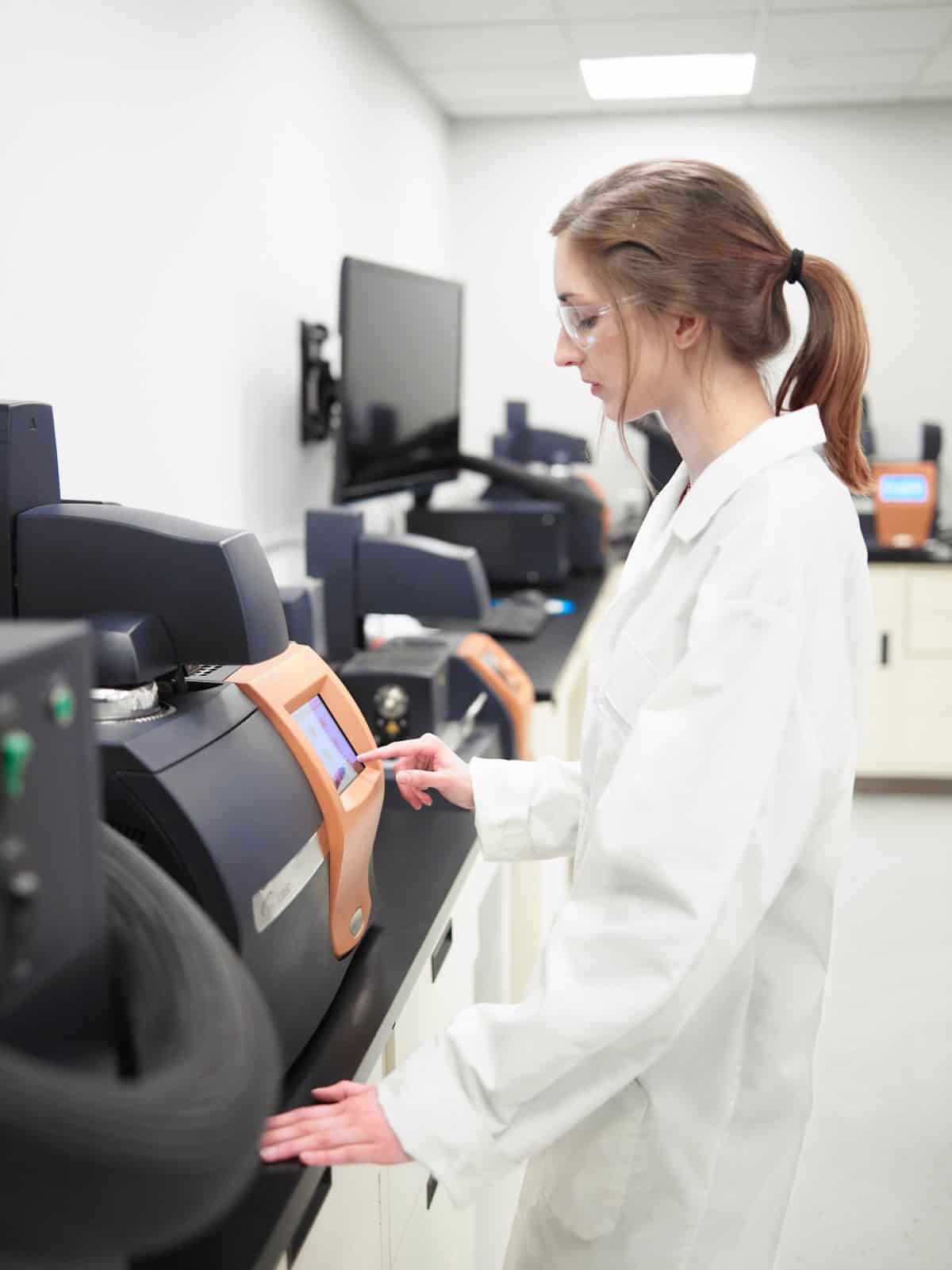
Reaction clues: Differential scanning calorimeters from TA Instruments measure any heat flow within the sample over a broad temperature range, which is a good indicator of any chemical reactions taking place inside the material (Courtesy: Waters Corporation)
For all the electrodes the TGA analysis revealed significant weight loss at temperatures below 200 °C, which is most likely to be caused by the evaporation of residual electrolyte from the porous electrode structure. The thermal profile of the anodes also revealed two weaker decomposition zones at higher temperatures – one at 200–300 °C and the other at 300–500 °C – which Nowak and his team attribute to the decomposition of two different types of binder. Meanwhile, the TGA profile of cathodes in their charged state exhibits a strong peak between 200–350 °C, which corresponds to the oxygen that is released by a lithium-ion battery cathode during normal operation.
The team then used a differential scanning calorimeter (DSC) from TA Instruments to measure any heat flow within the cathodes – which is a sure sign that chemical reactions are taking place inside the material. No distinct reaction peaks were observed for the pristine sample, or for the newly formed and aged cathodes when in the discharged state. When charged, however, the DSC profile of both cathodes clearly show a strong exothermic reaction at around 270 °C, which is related to the release of oxygen from the cathodes as observed in the TGA analysis.
While TGA and DSC are established techniques for studying the thermal behaviour of battery electrodes, the MEET team exploited another analytical method to investigate the chemical compounds released by the electrodes over a broad temperature range. “We had a pyrolyser that we can heat up to 1000 °C, and attached it to a combined gas chromatograph-mass spectrometer (GC-MS),” explains Nowak. “The chromatograph splits the released compounds into their constituent components, which can then identified by the mass spectrometer.”
The thermal profiles obtained with this technique, called evolved gas analysis mass spectrometry, shows good agreement with the decomposition zones that were observed in the TGA and DSC profiles. Mass spectrometry also confirms that oxygen is released from the cathode at around 270 °C, and also reveals significant evaporation of carbon dioxide from the cathode at temperatures above 250 °C – which could originate from the electrolyte or other organic molecules, including the binder material.
Having identified the decomposition zones from the thermal profiles, Nowak and his team exploited the same combination of pyrolyser and GC-MS to find out which compounds are being released at specific decomposition temperatures. This pyrolysis–GC-MS technique enables a more detailed analysis of the chemical products released from the binders, as well as the separators that are used in batteries to provide a physical barrier between the anode and cathode. “From this study we can conclude that lithiated anodes show intense decomposition behaviour and reactions with electron-rich binder molecules,” comments Nowak. “Meanwhile, charged cathodes are prone to phase changes that can be detected through the release of oxygen.”
While the results from this study offer some important clues about the chemical processes at electrode–electrolyte interfaces, Nowak points out that the main outcome from the work is to provide a starting point for probing the dynamic electrochemical behaviour inside a lithium-ion battery. “This was the first analysis of its kind, and we tried to set the ground rules for what you can do by combining together these different methods,” he comments. “We could show not only the reactions and the weight loss with DSC and TGA, but we could also work out whether the evaporated compounds derived from the electrolyte or from the binder.”
Nowak believes that the same methodology could be used to analyse many other processes inside a lithium-ion battery. “Thermal profiling using a variety of analytical methods turned out to be a valuable tool for the comprehensive analysis of both anodes and cathodes,” he concludes. “From basic characterization right up to detailed investigations of battery ageing, this method set could be used as a tool to unravel the reactions that determine the safety properties of lithium-ion batteries.”
TA Instruments is part of Waters Corporation, a specialty test and measurement company. More detailed information about the optimal testing solutions for battery materials and components can be found on the Waters/TA Instruments website.
Alternative path Perdi Potgieter works in the mass team at the National Physical Laboratory, having done an apprenticeship with them at 16. (Courtesy: NPL)
What projects do you work on at NPL?
I split my time between two areas, one being the Kibble balance project and the other being measurement services. The Kibble balance is an instrument that has been designed to generate a standard mass by comparing virtual electrical and mechanical power. It will allow the SI unit of mass to be defined in terms of very accurate quantum electrical units: the Josephson voltage and quantum Hall resistance, with relation to the fixed numerical value of the Planck constant.
What specific tasks do you do?
Within the Kibble balance project, I have my own smaller projects to focus on, one of which is a low-thermal electromotive force (EMF) switching system. The aim of this is to minimize electrical errors due to the generation of thermal EMFs from the small temperature differences that exist in critical parts of the wiring of the apparatus. Tasks on this project include working with manufacturers to design a bespoke switch, prototyping and designing a test rig, and testing isolation and latching forces.
Are these the same kinds of tasks done by people who have done a degree in physics?
It is important to remember that we are all part of a team, and each of us has our unique skills and talents. I enjoy the practical aspects, such as soldering and building pieces of equipment. When it comes to maintaining the UK mass scale, we are all responsible regardless of the level of qualification each person has. I am incredibly lucky to work in a team where the attitude has always been “if you can do something, then do it. If you want to learn, give it a go”. If you can help, there will always be something for you to do. When you’re asked to do something, no one is asking how many years you spent in education; they’re asking what your skills are.
I have found I can try a lot of things and learn as I work. Naturally, there are some tasks that I can’t do, which people on the team with a degree can. Likewise, there are tasks that I can do, that others with a degree can’t. I am proud of my practical skills, which come from being in the department for six years. I know a lot more about some of the specifics of my department than someone with a degree, although they will know more about physics than me. I don’t think this makes one of us better than the other, just different, which is never a bad thing.
How have you developed the skills and knowledge required for your job that many people in science and engineering careers get from university?
I can comfortably say I have a lifetime of learning to do. I’m part of such a supportive team of people who enable my development and allow me to get involved in different projects. A lot of what I’m doing now, I wouldn’t have known even if I did go to university, as it is such a niche job. There aren’t many labs around the world where you will be dealing with the national standards. I enjoy learning so I ask a lot of questions, which has helped improve my knowledge. I have learnt lots of skills through trying and undertaking various activities in my day-to-day job.
Do you find any advantages or disadvantages in having gone straight from school into your career, compared with going through university?
I am now doing a degree through The Open University in electromechanical engineering and I’m enjoying it. Doing the apprenticeship and working in industry has helped me to solidify what career I want and what sector I want to work in. The practical experience has been invaluable and helps me put theoretical work in perspective. It is great that I can say at 23 that I have almost seven years of industry experience. I wouldn’t be as far in my career if I had gone to university, although now I have the opportunity to do my degree through The Open University funded by NPL. Despite my great experience of the apprenticeship, I do think a degree is a good and important qualification and I can now bring my academic skills in line with my practical skills. Doing a degree at 18 isn’t for everyone and the route I’m doing has worked fantastically for me, but wouldn’t necessarily work as well for others.
Stereotactic radiosurgery (SRS) is commonly deployed in cancer centres worldwide for the treatment of single and metastatic tumours in the brain, exploiting multiple narrow beams from different directions to deliver conformal, high-dose radiation to the disease target in one or a few fractions while minimizing collateral damage to surrounding healthy tissue and organs-at-risk (OARs).
Yet despite the at-scale clinical adoption of stereotactic treatment systems, the precision targeting inherent to SRS remains a non-trivial operational and QA challenge for the radiation oncology team, necessitating a high degree of accuracy in target localization and dose delivery – not least when it comes to focusing “high-payload” radiation onto metastatic small lesions and having it fall off as quickly as possible. Put simply, small errors in the SRS treatment machine or workflow can amplify the clinical complications, resulting in significant under-treatment of portions of the tumour volume and/or overdosing of adjacent healthy tissues.
The Stereotactic End-to-End Verification (STEEV) phantom is designed to minimize the scope for such errors by providing high-fidelity patient simulation during SRS commissioning and pre-treatment patient QA checks. Developed by CIRS, a US manufacturer of tissue-equivalent phantoms and simulators for medical imaging, radiation therapy and procedural training, STEEV gives medical physicists the QA tools they need to check all of the key workflow steps through SRS treatment planning, management and delivery — from diagnostic imaging with CT, MR and PET to QA of the treatment plan versus delivered dose.
Tailor-made for SRS QA
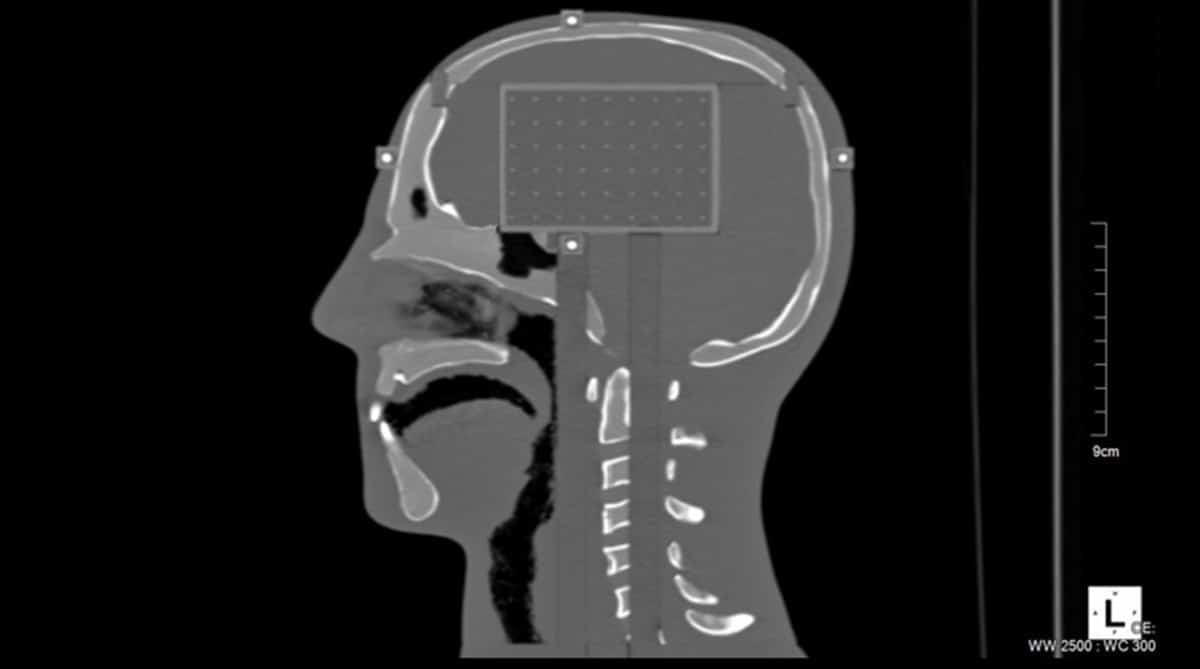
In terms of specifics, STEEV’s anthropomorphic exterior allows for the use of multiple positioning and fixation devices, reflecting the diversity of SRS clinical implementations. Internal details – such as cortical and trabecular bone, brain, spinal cord, teeth, sinuses and trachea – provide realistic clinical simulation to evaluate the effects of complex intra- and extra-cranial anatomies. At the same time, a range of geometric and tissue-equivalent target inserts underpin comprehensive image QA, geometric machine QA and treatment planning system (TPS) QA – all of which ensures increased confidence in the SRS treatment system when it comes to targeting accuracy and dose distribution accuracy.
Strategically, CIRS has also positioned STEEV as a core QA platform for the independent dosimetry auditing of new and established SRS treatment centres. A case study in this regard is the central role played by STEEV within a UK benchmarking exercise to regulate the provision of cranial SRS services, with 30 participating centres audited in an end-to-end test that incorporated local clinical procedures for immobilization devices, CT scanning, target contouring, treatment planning and treatment delivery.
The independent SRS audit was run by a team of medical physicists and biomedical engineers from several prominent UK cancer centres in collaboration with the National Physical Laboratory (NPL), the UK’s National Metrology Institute. The lead investigator was Catharine Clark, now honorary professor of translational radiotherapy physics at University College London, while out in the field the QA assessment of participating SRS centres was undertaken by Clark’s PhD student Alexis Dimitriadis (now a medical physicist at the International Atomic Energy Agency in Vienna).
Putting STEEV to work
Ahead of the on-site QA work, Clark and her colleagues first customized the STEEV phantom to contain a single irregularly shaped target (approximately 8 cm3) located 10 mm anterior to the brainstem. Their phantom design allows the introduction of interchangeable cuboid inserts – to image and irradiate – in the centre of the brain and the insertion of radiation detectors through two parallel cylindrical access cavities. “STEEV is a versatile solution that is readily adapted to suit a clinic’s local best practices,” Clark explains. “In this respect, we worked closely with the product engineering team at CIRS, as well as colleagues in the NPL workshop, to design the phantom inserts exactly to our specifications.”
With the phantom optimized, the end-to-end SRS QA at each clinic saw EBT-XD Gafchromic films and alanine pellets used to measure absolute dose – inside both the planning target volume (PTV) and the brainstem – followed by comparison versus TPS predicted dose distributions. In summary, the PTV alanine measurements from gantry-based linacs showed a median percentage difference to the TPS of 0.65%, while CyberKnife systems registered a median difference of 2.3%, with Gamma Knife showing the smallest median difference of 0.3%. Similar trends were observed with alanine measurements in the OAR, showing median differences of 1.1%, 2.0% and 0.4% for gantry-based linacs, CyberKnife and Gamma Knife systems respectively. All of the SRS platforms showed comparable gamma passing rates between axial and sagittal films.
Although logistically challenging, independent assessment of SRS dosimetric delivery is an invaluable exercise. That’s especially so – as per the UK study – when the evaluation is mapped across a multiplatform, multicentre SRS setting in which each clinic has its own unique planning processes and priorities. As such, the UK audit, which was conducted in 2016-17, quantified what is achievable with intracranial SRS systems, yielding a gold-standard data set that has subsequently been used to set tolerances for clinical trials as well as future external SRS audits. What’s more, the variations in clinical approach observed between the participating centres provided a starting point for greater convergence and standardization in terms of what constitutes SRS best practice.
“The national SRS audit has been extended to include multiple brain metastases, which will be used to credential centres to join clinical trials,” explains Clark. “Following the publication of our results, several international centres have also requested and undertaken this audit, which we have carried out remotely.”
Phantom profile: CT image of STEEV with thermoluminescent dosimetry insert. (Courtesy: CIRS)
When used in conjunction with multimodality imaging inserts, STEEV provides an end-to-end QA solution that’s applicable across a range of SRS treatment systems. Product highlights include:
End-to-end testing for SRS system commissioning (as specified by AAPM TG-101)
Verification of patient positioning using frame/frameless systems, head-and-shoulder masks or other positioning/fixation devices
Verification of the patient treatment plan in the PTV and OARs
Geometric machine QA; Winston-Lutz isocentre verification tests; and localization and repositioning with couch shift
Image-guided radiotherapy QA procedures for X-ray and onboard kV and MV imagers, including cone-beam CT
Assessment of image fusion, image transfer QA, accuracy verification and TPS testing with multimodality imaging capabilities (CT, MRI and PET)
Accuracy QA of TPS deformable-image registration algorithms
A quantum sensor based on nitrogen-vacancy centres in diamond could be used to detect viruses like SARS-CoV-2, which is responsible for the current COVID-19 pandemic. This is the finding of researchers at the University of Waterloo in Canada, who performed detailed mathematical simulations to show that the new technique would make it faster and cheaper to detect viruses with high accuracy.
Since November 2019, there have been more than 400 million reported cases of COVID-19 worldwide and nearly six million deaths. This huge toll highlights the importance of rapid and cost-effective tests that detect infection with low false negative rates (FNRs). Such tests allow preventive measures (such as asking infected individuals to isolate) to be taken early, when they are most effective. In the absence of treatments, testing also provides vital clues to help epidemiologists track the virus’s spread and contain outbreaks.
At present, the most accurate and widely-used tests for the SARS-CoV-2 virus rely on a technique known as reverse transcriptase quantitative polymerase chain reaction (RT-PCR), which detects the presence of the virus’ genetic material, or RNA. Extracting and amplifying this RNA from samples can take several hours and requires trained personnel, special testing and analytical equipment. Even so, the FNR for this method can exceed 25% depending on the viral load of samples and how they are obtained. This is a problem, since infected people who receive false negative results may not isolate and could go on to infect others.
An alternative, faster, technique is antigen testing. This involves detecting specific viral proteins, such as spike proteins, found on the surface of the virus. Antigen tests are, however, even less accurate than PCR tests. What is more, they cannot quantify the amount of virus present.
Quantum sensors based on NV centres
According to new work by Paola Cappellaro, Mohammad Kohandel and colleagues, this is where quantum sensors could come into their own. Though still in the early stages of development, such sensors have emerged in recent years as powerful tools for detecting chemical and biological signals, and the Waterloo team have identified sensors based on nitrogen-vacancy (NV) centres in diamond as particularly promising.
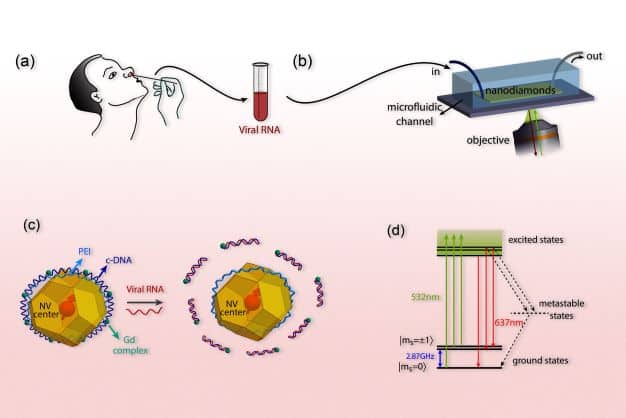
Chain of events: the testing scheme proposed by the team. a) Samples are taken from people with possible COVID and b) sent through a microfluidic channel containing nanodiamonds that have c) been “decorated” with chemicals that react to any viral RNA present in a way that affects d) the time required for NV centres in the diamond to change their quantum state. (Courtesy: Changhao Li, Paola Cappellaro, et al., edited by MIT News)
NV centres are defects in the diamond lattice that occur when two adjacent carbon atoms in the lattice are replaced by a nitrogen atom and an empty lattice site. Together, the nitrogen atom and the vacancy behave as a negatively-charged entity with an intrinsic spin and three spin sublevels, denoted |ms = 0⟩ and |ms = ±1⟩. Illuminating this NV– centre with a laser polarizes its spin into the |ms = 0⟩ sublevel, which fluoresces intensely. The system then relaxes to its thermal equilibrium state, which fluoresces less. This thermalization process occurs over a certain characteristic period of time known as the longitudinal relaxation time, T1, which depends on the magnetic field sensed by the NV centre in its environment. For this reason, NV centres can be used as highly sensitive magnetic resonance probes capable of monitoring changes to spins in a sample over distances of a few tens of nanometres.
The Waterloo team’s proposed device would be made by coating nanodiamonds containing NV– centres with cationic polymers such as polyethyleneimine (PEI), which can form reversible complexes with viral complementary DNA sequences. Magnetic molecules such as Gd3+ (gadolinium) complexes could then be incorporated into the sequence to form hybrid c-DNA-Gd pairs.
In the presence of viral RNA, these pairs will detach from the nanodiamond surface thanks to a process called c-DNA and virus RNA hybridization. The newly formed c-DNA-Gd3+/RNA compound will then freely diffuse in solution, thereby increasing the distance between the magnetic Gd and the nanodiamond. As a result of this increased distance, the NV centres will sense less magnetic “noise” and thus have a longer T1 time, which manifests itself in a larger fluorescence intensity.
Sensitive detection and low FNR
By optically monitoring the change in relaxation time using a laser-based sensor, the researchers say they could identify the presence of viral RNA in a sample and even quantify the number of RNA molecules. Indeed, according to their simulations, Cappellaro, Kohandel and colleagues, who report their work in Nano Letters, say that their technique could detect as few as a few hundred strands of viral RNA and boast an FNR of less than 1%, which is much lower than RT-PCR even without the RNA amplification step. The device could also be scaled up so that it could measure many samples at once and could detect RNA viruses other than SARS-CoV-2, they add.
More than 650 Russian scientists and science journalists have signed an open letter calling Russia’s war against Ukraine “unfair and senseless” and stating that there is no “rational justification” for the invasion, which began in the early hours of 24 February. The Kremlin’s decision to launch a full-scale invasion of Ukraine triggered new sanctions from Europe and the US, and has also cast a doubt over several scientific collaborations with Russia, particularly in space.
Following the invasion, scientists in Russia swiftly circulated the letter, which was then published on TrV-Nauka – an independent Russian science news site. The letter states that having unleashed war, Russia has “doomed itself” to international isolation and to the position of a “pariah country”.
“This means that we, scientists, will no longer be able to do our job normally: after all, conducting scientific research is unthinkable without full co-operation with colleagues from other countries,” the letter states, adding that the isolation would result in further “cultural and technological degradation” of Russia, with the war with Ukraine representing a “step to nowhere”.
“We respect Ukrainian statehood, which rests on really working democratic institutions,” the letter states. “We treat the European choice of our neighbours with understanding. We are convinced that all problems in relations between our countries can be resolved peacefully.”
The letter ends by calling for an “immediate halt” to the operation against Ukraine. “We demand respect for the sovereignty and territorial integrity of the Ukrainian state,” the letter states. “We demand peace for our countries. Let’s do science, not war!”
Physicist Mikhail Glazov from the Ioffe Institute in St Petersburg, who signed the letter, told Physics World that personal, cultural and scientific ties between people in Russia and Ukraine are still solid. “These ties should help to form a basis for negotiations,” he adds. “I do not think that the army should resolve conflicts. We all need to find a peaceful resolution to the conflict.”
Space programmes
Russia’s increasing international isolation could also impact international collaborations. Following the announcement by US president Joe Biden of a tranche of new sanctions, NASA issued a media release stating that it was continuing to work with all international partners, including the Russian Space Agency Roscosmos, for the “ongoing safe operations” of the International Space Station.
“The new export control measures will continue to allow US–Russia civil space co-operation,” the release continued. “No changes are planned to the agency’s support for ongoing in-orbit and ground-station operations.”
Roscosmos director Dmitry Rogozin took a similarly measured line, noting on Twitter that “NASA confirmed its willingness to continue to co-operate with Roscosmos” before adding that “we continue to analyse the new US sanctions to detail our response”.
Speaking in the House of Commons on Thursday, however, the UK Prime Minister Boris Johnson questioned the future of scientific collaborations with Russia. “I’ve been broadly in favour of continuing artistic and scientific collaboration,” noted Johnson. “But in the current circumstances, it’s hard to see how even those can continue as normal.”
Several European-led missions are scheduled to be launched via Russian-built rockets later this year or in 2023. The Rosalind Franklin rover, previously known as the ExoMars rover, is currently scheduled to take off in September from the Baikonur Cosmodrome in Kazakhstan via a Proton-M rocket. Designed to seek out evidence of past life on Mars, it is a joint mission between the European Space Agency (ESA) and Roscosmos.
An artist’s impression of the ExoMars rover on the surface of Mars. (Courtesy: ESA/ATG medialab)
The orbital dynamics of Earth and Mars mean that launch windows only open for a short period every two years, to take advantage of the two planets’ closest approach to one another. The rover’s launch has already been delayed from 2020 to 2022 amid parachute and electronics difficulties and the impact of the COVID-19 pandemic. If it launches in September, it would reach Mars by April 2023 at the earliest, but additional postponements could mean a further two-year delay.
ESA is also expected to launch the €500m Euclid mission via a Russian Soyuz spacecraft in 2023 from Kourou in French Guiana. Euclid is designed to explore the mysteries of dark energy and dark matter, using a 1.2 m-diameter telescope, a camera and a spectrometer to plot a 3D map of the distribution of more than two billion galaxies – a view that will stretch across 10 billion light-years, revealing details of the universe’s structure and its expansion.
ESA director general Josef Aschbacher took to Twitter to say he is “sad and worried as the aggression continues to worsen in Ukraine” and that they are continuing to monitor the “evolving” situation. “Civil space co-operation remains a bridge,” noted Aschbacher. “ESA continues to work on all of its programmes, including on ISS and the ExoMars launch campaign, in order to honour commitments with member states and partners.” He adds that ESA member states will take “any decisions needed”. “But for now, support for our missions and colleagues continues until further notice.”
The Russian invasion is also having an impact on international meetings. The International Congress of Mathematicians 2022 (ICM) is currently scheduled to be held in St Petersburg on 6–14 July, but several mathematical societies have called for the International Mathematical Union (IMU), which is responsible for the event, to cancel. The London Mathematical Society, for example, says it no longer plans to send delegates to the ICM. “The society strongly recommends that the IMU not hold the ICM in Russia in July 2022,” it noted in a statement.
“The IMU has been approached by several societies and individuals who raise serious and understandable concerns about the consequences of the conflict for the ICM,” the IMU said in a statement. “The executive committee of the IMU is now assessing the situation, and will make a decision as soon as possible regarding how to proceed. We will communicate this decision to our members once it has been made without delay.”
Update 26/02/2022: In a statement, the IMU announced that the ICM in July will now not take place in St Petersburg but instead be moved online following the original time schedule for St Petersburg. It also noted that the IMU’s general assembly, which was also due to take place in St Petersburg, will take place as an in-person event outside of Russia. “We strongly condemn the actions by Russia,” the statement notes. “Our deepest sympathy goes to our Ukrainian colleagues and the Ukrainian people.”
Meanwhile, Roscosmos head Rogozin noted today that the Russian space agency is withdrawing its technical personnel, including launch crew from Kourou in French Guiana. In response, Thierry Breton, European commissioner for space, says that the decision by Roscosmos has “no consequences on the continuity and quality” of the EU’s Galileo global navigation satellite system or the Copernicus Earth-observation programme.
“Nor does this decision put the continued development of these infrastructures at risk,” Breton adds. “We are ready to act decisively, together with the member states, to protect these critical infrastructures in case of aggression, and continue to develop Ariane 6 and VegaC to ensure Europe’s strategic autonomy in the area of launchers.”
Update 27/02/2022: More than 4100 people have now signed the open letter calling for an immediate halt to the war in Ukraine. The signatories include the condensed-matter physicist Konstantin Novoselov from the University of Manchester, who shared the 2010 Nobel Prize for Physics with Andre Geim for their work on graphene, as well as the theoretical physicist Mikhail Shifman from the University of Minnesota, who shared the 2016 Dirac Medal with Nathan Seiberg and Arkady Vainshtein for their contributions to field theory.
There are also reports that eROSITA – an X-ray survey instrument designed and built by Germany’s Max Planck Institute for Extraterrestrial Physics (MPE) in Garching – has been put into safe mode. eROSITA is one of two instruments aboard the German–Russian Spectrum-Roentgen-Gamma (Spektr-RG) X-ray telescope that launched in 2019 and is designed to detect 100,000 galactic clusters allowing astrophysicists to constrain the properties of dark matter and dark energy. The move came following the decision by Germany’s BMBF to freeze all scientific collaborations with Russia.
Update 28/02/2022: In a statement today, ESA said that the launch of ExoMars is now “very unlikely” to happen this year. “The sanctions and the wider context make a launch in 2022 very unlikely,” the statement notes. “ESA’s director general will analyse all the options and prepare a formal decision on the way forward by ESA member states.” If it was delayed beyond this year, then it would result in a 2024 launch date at the earliest. ESA also said that in light of the sanctions it was assessing the “consequences on each of our ongoing programmes conducted in cooperation with Roscosmos”.
With its combination of narrow roads and hills, Bristol in the UK isn’t the easiest place to drive, but after living here for 25 years I am pretty good at getting around. I have noticed that sometimes the driving routes suggested by apps like Google Maps are not the routes that I would naturally take. Some roads I avoid because parked cars make them very difficult for two-way traffic and other routes involve tricky (and sometimes dangerous) junctions that I would rather avoid.
So as an experienced driver, I often don’t take the shortest route. Now, researchers at Texas A&M University have backed up this strategy in a study of the effect of navigation systems on safety in four regions of Texas. They found that always suggesting the fastest routes to motorists increases the risk of accidents by 23% – while reducing journey times by just 8% – when compared to safer routes.
Dominique Lord and Soheil Sohrabi evaluated the safety of routes by looking at accident history, traffic density and road characteristics such as the physical layout of junctions and the number and width of lanes in a road. Based on their findings, they have suggested a way that navigation systems could consider safety as well as journey time. They describe their research in Transportation Research Part C.
Singing in the brain
I’m one of those people who can’t sing and won’t sing, so I was very interested to read about research on the neurology of singing that has been done at the Massachusetts Institute of Technology. Sam Norman-Haignere (now at the University of Rochester) and colleagues have found a population of neurons in the brain that lights up when we hear singing, but not other music.
The team used electrocorticography to study the electrical activity of neurons in the auditory cortex, which is part of the brain’s temporal lobe that processes sound. They found that these neurons responded to a specific combination of voice and music – but not to instrumental music nor non-musical speech.
Electrocorticography involves placing electrodes inside the skull, so it is not usually used in scientific studies. In this case, however, epilepsy patients who were being monitored by the technique prior to surgery volunteered to take part in the MIT study. The 15 participants listened to 165 sounds and a statistical analysis of their responses revealed a neural response pattern that occurred only when the subjects heard singing. The researchers believe that this part of the brain may be responding to interaction between words and perceived pitch before sending information to other parts of the brain for further processing.
Ultrathin solar cells have reached record-breaking efficiency thanks to a novel manufacturing method that introduces specific types of disorder within the cells’ nanocrystalline structure. The low cost, reduced mass and non-toxic nature of this type of cell makes them ideal for integration into cars, rooftops or mobile devices, and the newly streamlined way of manufacturing them paves the way for their large-scale production.
Conventional silicon-based solar cells are highly efficient at generating electricity from sunlight. However, fabricating them is an expensive and energy-consuming process, and the resulting devices are heavy and bulky. Thin-film solar cells are an attractive alternative in some ways, but they often contain elements that are toxic (such as lead or cadmium) or scarce and expensive (such as indium or tellurium). In the mid-2010s, a further alternative emerged when researchers at the Institute of Photonic Sciences (ICFO) in Spain developed a low-cost, non-toxic cell based on AgBiS2 nanocrystals. These nanocrystals can be fabricated into a solar cell just 35 nm thick via a layer-by-layer deposition process, but with an efficiency of around 6% compared to 25% or more for silicon, the material was not yet commercially competitive.
Cation disorder engineering
To boost the optical absorbance of AgBiS2-based cells, researchers at the ICFO, together with collaborators from University College and Imperial College in the UK, investigated the impact that disordered positive ions (cations) have on the material’s optoelectronic properties. After finding evidence for inhomogeneities due to Ag- or Bi-rich areas that form within the nanocrystals, they used density functional theory (DFT) calculations to determine the effects of these inhomogeneities. Based on these calculations, they concluded, somewhat counterintuitively, that careful placement of defects in the crystalline lattice – a technique they term “cation disorder engineering” – results in a more homogenous cation distribution because it promotes ionic migration. They then used a process called low-temperature annealing to produce samples of AgBiS2 with the specified characteristics.
When the researchers placed cells made from the optimized material under artificial sunlight, they recorded a power conversion efficiency in excess of 9% – a record for this type of ultrathin solar cell. They also saw absorbance across a wide spectral range, from ultraviolet (400 nm) to infrared (1000 nm). Their device, which they fabricated on glass/indium-tin-oxide and coated with a poly-triaryl-amine solution, is no more than 100 nm thick, making it 10–50 times thinner than current thin-film photovoltaic (PV) technologies and 1000 times thinner than silicon PV.
On a bright path
ICFO physicist Gerasimos Konstantatos, who led the research and co-authored the paper in Nature Photonics describing it, says that the team’s work demonstrates for the first time how changing a material’s atomic ordering affects its optoelectronic properties. This type of materials engineering could also prove useful in other fields, such as catalysis, and Konstantatos notes that the team’s method ticks many boxes for the PV industry, including low cost, scalability, and use of non-toxic elements.
Alwin Daus, a researcher at RWTH Aachen University in Germany who was not involved in the ICFO study, says that understanding how cation segregation develops and how to control it could prove important for low-cost thin-film solar technologies. He adds that the team’s fabrication process appears ideal for scaling up. However, Daus suggests that the use of ~6 nm diameter nanocrystals could prove a barrier to further improvements in efficiency, as the diffusion length for charge carriers in this type of material is only around 25 nm. Nevertheless, he stresses that the research is important because of high demand within the solar community for stable and environmentally friendly inorganic solar-cell compounds.
Konstantatos says that the team now plans to increase the cells’ open circuit voltage (Voc), which is currently 0.5V. “The Voc is a measure of how much voltage can be drawn from the solar cell and relates to the bandgap of the semiconductor. One should expect to achieve as high as 0.7–0.8V,” he tells Physics World.
Photothermal therapy – a cancer treatment based on laser irradiation of injected gold nanorods – provides high tumour targeting accuracy with low toxicity. Now researchers in China have developed a new nanoplatform that completely eliminates solid liver cancer tumours in mice following a single five-minute light dose and without toxic side effects.
The treatment works by injecting gold nanorods directly into a tumour and then irritating them with near-infrared (NIR) laser light. This causes the nanorods to heat up and kill surrounding cancer cells. Photothermal therapy alone, however, can fail due to incomplete tumour ablation, particularly for larger lesions. This is mainly due to the limited penetration depth of light into tissue and the nanorods not fully permeating throughout the tumour.
To address these issues, the researchers deposited clusters of palladium (Pd) on the ends of gold (Au) nanorods to create heterogeneous Pd–Au nanorods. To improve biocompatibility, they modified the nanorod surfaces with bovine serum albumin (BSA). The introduction of Pd nanoclusters improves the photothermal therapy in three unique ways.
Firstly, the BSA–Pd–Au nanorods absorb light at longer wavelengths than standard gold nanorods, extending the maximum absorption wavelength from 950 to 1050 nm. In this NIR-II region, light penetrates deeper into tissue and can be used at higher maximum skin exposures.
Secondly, the nanorods can be used to activate Pro-5-Fu, a prodrug of the chemotherapy drug 5-fluorouracil (5-Fu). By injecting Pro-5-Fu intraperitoneally, then synthesizing 5-Fu in situ at the site of the BSA-Pd-Au nanorods, the potential for damaging healthy cells is minimized. Finally, the nanorods convert hydrogen peroxide into harmful reactive oxygen species. This so-called chemodynamic therapy (CDT) helps eliminate any residual tumour cells.
“Tumour eradication has been the dream of cancer patients and researchers for many years. It is of great importance to eliminate recurrence and metastasis of cancer elsewhere in the body,” says Ya Ding from China Pharmaceutical University. “However, due to the complexity, diversity and heterogeneity of tumours, a single therapy is unlikely to completely eradicate the tumour. That’s why we aimed to design a simple material or system to synergistically treat and eradicate tumours.”
In vivo testing
To evaluate the therapeutic potential of the new nanorods, Ding and collaborators (also from Peking University) examined 30 tumour-bearing mice. They divided the animals into six groups, for treatment with: saline; Pro-5-Fu; 5-Fu; BSA-Pd-Au nanorods plus Pro-5-Fu; nanorods plus laser light; and nanorods plus Pro-5-Fu plus laser light. The prodrug was delivered intraperitoneally and the nanorods injected into the tumour 1 h later.
The team used thermal imaging to assess the photothermal performance of the BSA-Pd-Au nanorods. In tumours injected with the nanorods, 1064 nm irradiation at 1 W/cm2 increased the temperature at tumour sites to 55.4±2.9 °C within 5 min. In mice treated with saline, irradiation only increased temperatures by around 7 °C.
Next, the researchers examined the efficacy of the six treatment regimes. Compared with saline, the inactivated Pro-5-Fu showed negligible therapeutic efficacy; active 5-Fu showed slightly better therapeutic efficacy than its prodrug. Both of the dual treatments – nanorods plus Pro-5-Fu, and nanorods plus laser light – displayed moderate antitumour effects with higher tumour inhibition abilities than 5-Fu alone.
The most striking antitumour effect, however, was seen in animals treated with nanorods, Pro-5-Fu and laser light. Following a single 5 min irradiation, tumours in all mice in this group were completely eradicated from the 10th day, with zero recurrence until day 24. This treatment also conferred the highest biosafety, with animals exhibiting steadily rising body weights and prolonged survival time. All mice had no perceivable side effects and all lived at least 30 days post-treatment, a milestone marker in animal model cancer research, according to the investigators.
“For the first time, we made slight and reasonable structural changes to the nanorods, comprehensively improving the nanomaterials’ ability to navigate complex disease. The result is a novel therapeutic agent that can effectively treat tumours,” says Ding.
The team describe the nanoplatform in Nano Research.
In this episode of the Physics World Weekly podcast, we speak to Mirella Koleva and Gaby Slavcheva, who are the co-founders of the UK-based company Quantopticon. The firm develops software for simulating quantum photonics devices and Koleva and Slavcheva explain why there is a need to understand the fundamental physics behind the devices that underpin the latest quantum technologies. They also talk about the importance of start-up accelerators for companies like Quantopticon.
Also in this episode, we hear from a physicist who has struggled within the mental health system. After a horrific reaction to a medication and multiple diagnoses that got him nowhere, Alexander Mendelsohn (not his real name) explains why he believes that the mental-health system operates in a bizarre, awful and unscientific way. He also explains why his physics background makes him wonder why more quantitative rigour is not used in treating mental illness.