Researchers in China have found strong evidence of ultracold triatomic molecules forming within a mixture of ultracold atoms and diatomic molecules. The result, if confirmed, would provide an ideal pathway to studying chemical reactions on an atomic scale, and could even allow physicists to perform quantum-mechanical simulations of the notoriously difficult three-body problem.
Chemical reactions are so complex that only the very simplest among them can be fully understood with current technologies. Cooling the reactants to just above absolute zero helps, as it limits the number of quantum states they can be in. The problem is that making ultracold molecules is difficult. One approach is to laser-cool the molecules directly, as is commonly done with atoms. However, few polyatomic molecules have the right internal structure for laser cooling to work. Another possibility is to create ultracold atoms and use them as “building blocks” to assemble ultracold molecules. In principle, this method is more broadly applicable, but it has previously only been used to form diatomic molecules. Extending it to triatomic molecules or molecules with even higher numbers of atoms would thus offer many new research opportunities in both physics and chemistry.
Triatomic molecules
In the current work, researchers at the University of Science and Technology of China (USTC) and the Institute of Chemistry within the Chinese Academy of Sciences (CAS) set out to make triatomic molecules by using a so-called Feshbach resonance to create an association between 40K atoms and 23Na40K molecules in their rovibrational ground state. Feshbach resonances occur when the energy of an atomic or molecular bound state (in this case, the triatomic molecule) coincides with the energy of a scattering state. Close to the resonance, the coupling strength between the triatomic bound state and the atom‒diatomic molecule scattering state is greatly enhanced, making it far more favourable for the triatomic molecule to form.
At ultracold temperatures, atoms and molecules can be tuned across a Feshbach resonance by applying an external electromagnetic field. This radio-frequency (RF) association technique is a well-established way of creating diatomic molecules. However, it was not clear whether it would work for triatomic molecules because the coupling mechanism and the coupling strength between the triatomic bound state and the atom-molecule scattering state are both completely unknown.
A new frontier
To drive this free-to-bound transition, the USTC/CAS researchers applied a RF pulse to ultracold mixtures of 23Na40K and 40K. They then monitored the loss of 23Na40K molecules from the mixture by looking for an additional dip in the mixture’s RF spectrum alongside the dip associated with the loss of atoms. The researchers found that the gap between this additional dip, which they identify with the formation of triatomic molecules, and the known atomic transition changed with the applied magnetic field. This is significant because the gap is equal to the binding energy of the triatomic molecule, which is expected to vary as a function of the magnetic field. Measuring it thus allows the researchers to estimate the binding energy of the triatomic molecule.
“Our research is one of the first steps toward preparing ultracold triatomic molecule gases,” says Bo Zhao, a physicist at USTC and co-author of a paper in Naturedescribing the research. The biggest uncertainty within their experimental results, he explains, is that there is currently no theoretical model to compare them to because ultracold atom-molecule Feshbach resonances are so difficult to understand. The team’s work, he concludes, “largely improves our understanding of the extremely complicated atom-molecule Feshbach resonance”.
John Doyle, a physicist at Harvard University in the US who was not involved in the study, says the result marks a new phase of doing ultracold chemistry with alkali metal polyatomic molecules – something he emphasizes is brand new for the field. In his view, the most important part of the work is that it provides very strong evidence that triatomic molecules can be created via light-enabled associative methods using ultracold atoms. Such triatomic alkali metal molecules would have many applications in quantum science, and Doyle notes that they are particularly favourable for quantum simulation. This is because alkali metal trimers have a vibrational bending mode that provides fundamentally different “handles” and features advantageous for quantum simulation and precision measurement, compared to atoms or diatomic molecules.
As a next step, the USTC/CAS researchers hope to prepare an ensemble of ultracold triatomic molecules, provided they can find ways of understanding and suppressing the molecules’ decay mechanisms.
As the size of electronic devices goes down to a few nanometres, interfaces become increasingly relevant and often dominate and interfere with a device’s performance. Hybrid devices are a particularly good example, because they rely on interfacing materials with different physical properties to control superconductivity, spin or other carrier characteristics in the active parts of the device. The performance of these structures depends critically on their reliable fabrication and interface characterization.
In this webinar, Jelena Trbovic and Heidi Potts will take you from general interface considerations to nanodevice characterization with lock-in amplifiers: you will learn how to set up low-noise measurements and how to characterize devices on ultrafast timescales using RF reflectometry.
Jelena Trbovic is an application scientist at Zurich Instruments, where she manages nanotechnology and magnetism applications, and the MFLI Lock-in Amplifier. She received her PhD from Florida State University for research on semiconductor spintronics. As a postdoc at the University of Basel, she studied quantum transport in carbon nanotubes, quantum dots, graphene, and superconducting wires. Jelena enjoys discussing the importance of good measurement practice.
Heidi Potts is an application scientist at Zurich Instruments. She received her PhD from EPFL in Lausanne: her background is in semiconducting nanostructures and quantum dots. At Zurich Instruments, she is excited to meet researchers from different fields and discuss their measurement challenges.
A new cryogenic 3D printing technique could one day enable fabrication of off-the-shelf artificial muscle fibres, according to research published in Advanced Materials.
Printing synthetic tissue that mimics the structure of muscle remains a major challenge in tissue engineering. Muscle fibres are anisotropic, meaning that their physical properties, including the ability to transmit mechanical forces, are direction dependent. Introducing a temperature gradient during the fabrication process, from sub-zero temperatures upwards, is a simple way of creating tissue scaffolds with anisotropic microscale pores. However, the freezing process is harmful to cells encapsulated within the scaffold.
Enter cryobioprinting: an all-in-one fabrication and preservation technique developed by scientists at Brigham and Women’s Hospital and Harvard Medical School. Cryobioprinting combines a customized freezing plate with cryoprotected bioinks to produce cell-laden structures with anisotropic microchannels. The scaffolds can be stored in liquid nitrogen for several months and revived on demand, a feature that would allow pre-made products to be used in a clinical setting.
“Cryobioprinting can give bioprinted tissue an extended shelf life and allows convenient transport of tissue between sites, which is something conventional bioprinting methods do not readily enable,” says senior author Y Shrike Zhang. “[Cryobioprinting] may have broad application in tissue engineering, regenerative medicine, drug discovery and personalized therapeutics.”
Taking bioprinting to new heights
The cryobioprinting technique is an icy take on 3D extrusion bioprinting, where bioinks are printed layer-by-layer to form a tissue scaffold. Unlike traditional methods, cryobioprinting uses a temperature-controlled printing plate to print freeform structures that maintain their fidelity, even in the vertical (z) direction.
The team first explored the capabilities of the technique by printing filaments of a gelatin methacryloyl (GelMA) bioink into vertical, pillar-like structures. Each strand of GelMA freezes as it comes into contact with the frozen plate; heat transfer then occurs upwards along the z direction of the strand, creating a vertical temperature gradient within the pillars. Importantly, the lamellar ice crystals that grow along this gradient produce aligned (anisotropic) microchannels once thawed.
Using fluorescence microscopy, the researchers found that the diameter of the microchannels increased along the temperature gradient with increasing distance from the frozen plate (from 70.68 ± 15.64 µm in the bottom layer to 513.63 ± 39.88 µm in the top layer, when the plate temperature was set to –20 °C). What’s more, they determined that the scaffolds were stiffest in the direction parallel to the temperature gradient, confirming the scaffold’s anisotropic mechanical properties.
The researchers also experimented with more sophisticated freeform structures, including multi-material pillar arrays printed at a range of angles relative to the frozen plate. While the longest printable length (8.48 ± 0.25 mm) was achieved when printing perpendicular to the plate, the pillars were still printable at oblique angles close to 0° without the use of a support bath.
“The success of vertical cryobioprinting is pretty high and can work with bioinks featuring a wide range of rheological properties,” says Zhang.
Printing the muscle-tendon unit
To demonstrate the flexibility of the cryobioprinting technique, the researchers fabricated a synthetic muscle–tendon unit (MTU), a structure responsible for basic human movement.
Preliminary biological characterizations revealed that myoblasts (cells that differentiate into muscle cells) formed myotubes that aligned with the vertical microchannels on the muscle side of the muscle–tendon junction. Likewise, fibroblasts (cells that synthesize collagen, a structural protein found in connective tissues) remained functional on the tendon side. The alignments and behaviours of these cells mimicked those found in the natural MTU, suggesting that the cryobioprinted constructs could help to regulate cell activities.
“This is the only bioprinting method so far that synergizes macroscale anisotropy (i.e. the pillars) and microscale anisotropy (i.e. the aligned microchannels) to guide cellular behaviours,” explains Zhang.
The researchers note that more in-depth characterizations are needed to understand the biological effects on the technology before it is ready for clinical translation. Nevertheless, the team is hopeful that cryobioprinted structures could one day find use in a plethora of tissue engineering applications.
Quantum computers are often touted as the solution to all our problems. They are expected to cure disease, alleviate world hunger and even help mitigate the effects of climate change. Fuelled by this enthusiasm, a number of quantum computing firms have started joining established markets. However, despite this interest, there is still a lot of uncertainty around the near-term uses of quantum computers. A crucial question facing quantum researchers today, in both academia and industry, is a pretty fundamental one: what problems are best solved with these devices?
The publicized uses of quantum computers often hinge around an optimization problem. Optimize the supply-chain network, for example, and you have efficient manufacturing and distribution. Optimize production of fertilizers and you reduce world hunger. Optimize the placement of electric charging stations in relation to traffic and you may have an energy-efficient fleet. Even minuscule improvements in optimization can translate to significant savings in resources. For a large airline or a delivery network like FedEx, optimizing travel routes even by a mere couple of percent means an enormous reduction in fuel usage and emissions.
The hope that quantum computers will help these sectors is based on a faith that they will let us optimize these processes better than classical computers. However, the aspirations invested in quantum-enhanced optimization often seem overmatched for the current science behind it.
Optimization is hard
Optimization decisions, large or small, govern pretty much all aspects of our lives. The route for your Uber ride is optimized to shorten travel time. The algorithms underlying the internet optimize the flow of your data through servers. Meanwhile, banks around the world use complex financial optimizations to decrease risk. Some of these optimization decisions are easy – in the sense that an optimal solution can be found quickly by a computer algorithm. Computer scientists group these problems into a family called “P”. However, many optimization problems are difficult, with the problem of identifying the best route to deliver mail and packages – the well-known Travelling Salesman problem – being particularly hard. The reason these problems are so tough is that there is no easy way to obtain the best solution without exploring all possibilities. Many of these hard problems belong to the class “NP-hard”.
Perhaps the most exalted question in computer science is whether all problems have efficient algorithms. More popularly known as the P = NP question, it’s one of the Clay Mathematics Institute’s seven “Millennium Problems”, a proof of which would win you a million dollars. But even after more than half a century of research, there has been little progress in proving P = NP, and it seems the two classes are destined to remain separate. According to Scott Aaronson from the University of Texas, Austin, who is one of the foremost experts in complexity theory, proving P = NP would be “almost like discovering faster-than-light communication or a perpetual motion machine.”
Optimal solutions Complex optimization problems abound in industry. Global aerospace company Airbus, for example, has a dedicated team looking into solutions for problems including how to best determine the payload for an aircraft, planning trajectories and improving computational fluid dynamics simulations. (Courtesy: Airbus/Helmut Hofer)
Despite being a hard problem, we still use optimizations all the time. For many of these problems it is often enough to have a decent solution that avoids needless waste, and computer scientists have developed powerful algorithms to generate decent solutions fast. Opting for good instead of perfect makes optimization work. A pizza delivery route may not be perfect, but it is usually good enough to make sure most pizzas get delivered within a reasonable time. Researchers working in quantum optimization similarly hope that quantum algorithms might produce better solutions by exploiting quantum effects that conventional or classical computers cannot access. The most popular family of algorithms designed for such optimization goes by the name “variational quantum algorithms.”
Taking the guess out of guesswork
The variational method traces its roots to the early days of quantum mechanics, a central problem in which is finding the lowest energy or ground-state wavefunction. A wavefunction describes the configuration of a system of particles or fields and has a certain energy, determined by a mathematical object known as a Hamiltonian. Given a Hamiltonian describing, for instance, a system of electrons moving around many nuclei, we may want to find a configuration of atomic orbitals that minimizes energy, which is the configuration the molecule would occupy at low temperatures where quantum mechanical effects are more pronounced. Researchers care about the ground-state wavefunction because it describes the most stable shape or geometry of a molecule, which would be critical in, for example, designing drugs and new materials.
Solving the ground-state wavefunction can be extremely hard, even for a simple system like two electrons moving around a nucleus. Because of mathematical complications due to electrons repelling each other, the Hamiltonians of such systems do not lend themselves to analytic solutions that can be derived using pen and paper. Confronted with such an intractable problem, what physicists often do is conjure a “guess” wavefunction and calculate its energy. The guess wavefunction is then tweaked slightly to lower the energy. Repeating this process many times, varying the wavefunction at each step, we reach a solution that, hopefully, is very close to the real ground-state wavefunction. The variational technique has had such a successful run that it is a quintessential chapter in modern physics textbooks.
Hard problem As the number of electric vehicles grows globally, a key issue will be finding ways to charge cars quickly, efficiently and in a way that does not overload a grid at busy times. (Courtesy: iStock/SpicyTruffel)
Variational quantum algorithms adapt the variational technique to quantum computers. It has been known for some time that quantum computers can do certain tasks, like factoring numbers, unequivocally faster than known classical algorithms. Factoring numbers is one of those problems for which we still do not have an efficient classical algorithm, and much of cybersecurity, in particular encryption, depends on this assumed computational hardness. In 1994, Peter Shor gave a blueprint of a quantum algorithm that would factorize a number quickly. However, algorithms like Shor’s need a quantum computer with many qubits as well as a very high degree of accuracy, both of which are beyond the reach of the quantum computers available today. This invites a question: is there anything useful we can do in the immediate future using noisy quantum computers with a small number of qubits?
A promising answer emerged in 2014 through a collaboration led by Alberto Peruzzo and Jarrod McClean, then at the University of Bristol and Harvard University, respectively. Inspired by the variational method popular in quantum chemistry, they proposed using a quantum computer to generate good guesses for the ground-state wavefunction of a chemical system (Nat. Commun.5 4213). This was motivated by the belief that since nature itself is described by quantum mechanics, a guess produced by a quantum computer could offer better approximations to the real ground-state. Quantum computers operate by rotating qubits, one at a time or in groups. A quantum circuit describes a sequence of such rotations. You can construct a quantum circuit to produce a guess state and you can measure the energy of that particular guess. If you can systematically tweak the rotation parameters such as angles, you can lower the energy until it reaches a minimum. This is a variational quantum circuit.
Also in 2014, Edward Farhi and Jeffrey Goldstone from the Massachusetts Institute of Technology, together with Sam Guttman from Northeastern University, Boston, adapted the variational method to solve an optimization problem (arXiv:1411.4028). They chose a celebrated NP-hard problem, the “MaxCut” problem, which involves dividing a graph into two groups such that the number of connections between them is maximized. Farhi and his team observed that this problem can be encoded into a variational quantum circuit, which can then be used to generate systematically better guesses. The algorithm wouldn’t promise to perfectly solve the problem, but it would give a good approximate answer most of the time. Indeed, the trio showed that the solutions obtained from this quantum version of the algorithm were, on average, better than any classical algorithms known at the time. They dubbed their algorithm “quantum approximate optimization algorithm”, or simply QAOA. “It was the first time that anyone had given a quantum algorithm that gave an approximation better than a classical algorithm,” reminisces Aaronson, who was one of the first to draw attention to this work with a post on his popular blog.
2 The P versus NP problem How long does it take to execute an algorithm to find a solution to a certain problem? This is a key question in computer science, for a general class of relatively easy problems, for which an algorithm can provide an answer in polynomial time is “P”, versus a class of seemingly very, very hard problems with a short answer that can be verified in polynomial time is “NP”. P versus NP asks whether every problem whose solution can be quickly verified can also be solved quickly. Here is an ‘Euler diagram’ to show the relationships between the P, NP, NP-complete and NP-hard set of problems. The left side is valid assuming P ≠ NP, while the right is valid under the assumption that P = NP. (Courtesy: Behnam Esfahbod, CC BY-SA 3.0)
Since then, researchers have applied the variational quantum technique to a plethora of optimization problems, from designing electric-vehicle charging grids to improving aircraft flights. At the core of these seemingly diverse cases are only a handful of graph-theoretic concepts, MaxCut being one of them. Researchers are still trying to consolidate the quantum advantage for such core concepts. In a more recent work, Farhi approached the Sherrington–Kirkpatrick model, another famous problem in physics and computer science that aims to minimize the energy of a system of spins. A celebrated solution developed by Giorgio Parisi, who shared the 2021 Nobel Prize for Physics, gives the minimum energy attainable by a solution to the Sherrington–Kirkpatrick model. When Farhi and his team studied this problem using computer simulations, they observed their solutions getting gradually better with repetitions of QAOA, leading them to surmise that it might actually reach the optimal limit identified by Parisi. Aaronson, however, cautions against treating tenuous numerical results on small instances of problem as credible evidence of quantum superiority, especially in light of steady advances being made with non-quantum algorithms. In fact, the original edge of QAOA over classical algorithms has vanished since its conception – the support for techniques like QAOA remains merely hypothetical.
The fault in our stars
The grand vision of using the variational quantum computer to solve hard optimization problems is not without its sceptics and detractors. Computer scientists do not expect quantum computers to solve NP-hard optimization problems efficiently. Doing so would be “almost as amazing as proving P = NP” according to Aaronson, and would likely dismantle the entire edifice of complexity theory. If you subscribe to this conviction, then it seems implausible that the variational technique would somehow give efficient solutions to problems for which there were none. Something would have to give, and only recently are we getting insights into what might derail this grand vision.
Variational algorithms “vary” a circuit to obtain approximate solutions to an optimization problem. In other words, they optimize the construction of a circuit to solve another optimization problem. It may sound convoluted, but this technique is very widely used and is extremely successful in machine learning, where the parameters in a neural network are systematically changed to lower the discrepancy between the predictions of the neural network and the training data. A helpful picture to understand this concept is that of trying to find the bottom of a valley by following the curves in the landscape. For example, a blindfolded person standing on a hilly slope can tell from the forces acting on them what direction to follow to get to the bottom of the hill – the steeper the slope, the easier it is to find the way down. Much in the same way, you can only systematically optimize the circuit or train the neural network if you can identify the direction to move for the next update. In a serious setback, in 2018, researchers at Google led by Jarrod McClean and Sergio Boixo found that the vast majority of quantum circuits are simply untrainable (Nat. Comms.9 4812). In the language of landscapes, instead of curves one can follow, all one sees is a plateau with no indication of the direction in which a solution may lie – almost like being lost in a desert with no compass or sense of direction. This phenomenon is referred to as “barren plateaus.”
At other times, instead of reaching the bottom of a valley, it’s also possible to get stuck in a small ditch nowhere near the bottom – the variational technique, in this case, is said to be stuck in some “local minimum”. Untrainable circuits, barren plateaus and deceptive local minimas appear to be nature’s tricks preventing us from reaching solutions to hard problems. In work done in September 2021, researchers Lennart Bittel and Martin Kliesch from Heinrich Heine University Düsseldorf showed that the variational optimization process of tweaking the circuit until you arrive at some minimum is itself an NP-hard problem (Phys. Rev. Lett.127 120502). Their results indicate that not only are variational algorithms futile against the hardest optimization problems, but the variational route remains intractable even for some problems that should be easy using other conventional techniques.
It is very possible that there are interesting problems for which variational training is efficient
This makes one wonder if variational quantum optimization might just be a really onerous and cumbersome way to solve a problem. Nevertheless, we still have some room to be wishful. It is very possible that there are interesting problems for which variational training is efficient; just because the variational technique doesn’t work for some particularly unfortunate problems doesn’t necessarily mean that it won’t be useful for an average problem we are more likely to encounter. When asked if his results preclude decent approximations to an average-case problem, Kliesch muses, “Well, that is the big question.” In fact, he suggests that there may be a way of getting around this negative result by adding more knobs to a variational circuit – by adding more qubits and running circuits for longer times – than they considered in their current work.
Noisy neighbours
Running quantum circuits to longer times, though, invites a new problem: noise. Even though the variational technique was developed for near-term noisy computers, recent research has shown that the effect of noise can be very debilitating. Indeed, Daniel França from the University of Copenhagen and Raul Garcia-Patron from the University of Edinburgh have shown that noise degrades the performance of quantum optimization algorithms so much that they are not going to be any better than very crude classical alternatives (Nat. Phys.17 1221). According to França, the noise levels would have to go down by a magnitude of one or two compared with current levels for variational quantum methods to have a chance against classical algorithms.
Garcia-Patron notes one more obstacle: most of the quantum computers being built today have limited connectivity, that is, you can only do operations on adjacent qubits.
In contrast, optimization problems often demand operations between all pairs of qubits. “For many instances, the connectivity of the device will not match the connectivity of the problem, which makes noise accumulate even further,” Garcia-Patron says. In fact, when researchers at Google recently implemented Farhi’s new quantum solution to the Sherrington–Kirkpatrick model on their Google Sycamore superconducting qubit quantum processor, they noticed that the performance degrades strongly with noise (Nat. Phys.17 332) (figure 1). França and Garcia-Patron studied the work from Google very closely and found that “their decay is consistent with our predictions.”
Despite the pessimism of complexity theorists, as well as the difficulties with noisy hardware, researchers in quantum optimization remain hopeful that each of these obstacles can be addressed one by one. Circuits untrainable because of barren plateaus? There has been steady progress on algorithms that get around these. Too much noise? Quantum hardware has been gradually improving for the last couple of decades – give us a few more years and we might get to noise-resistant quantum computers. In fact, fault-tolerant qubits have been demonstrated by several labs around the world. It just remains to scale fault-tolerance to a large number of qubits.
“Perhaps variational algorithms will be the first useful algorithms of the fault-tolerance era,” surmises Garcia-Patron. The biggest challenge against variational quantum optimization is really the one originating in complexity theory. There is a mathematical chasm separating quantum computers from the optimization problems we would like to solve with them. Unlike the case with noise, there has been no progress in bridging this chasm for more than half a century, and it is possible that it may never happen.
Quantum computers have even faltered in the easier job of finding approximate solutions. When Farhi, Goldstone and Gutmann first provided a quantum algorithm that attained a higher approximation ratio (a measure of how close solutions are to the optimal solution) than classical algorithms for solving MaxCut, computer scientists responded by discovering a classical algorithm with an even higher approximation ratio. The quantum advantage for MaxCut was only ephemeral. Since then, there has been an ongoing dance between quantum researchers claiming a quantum advantage on hard problems and computer scientists trying to develop even better classical algorithms to surpass the claims made by quantum researchers.
Hard problemsxkcd’s take on the ‘Travelling Salesman Problem’. While anyone selling goods on the likes of eBay or Amazon may not have to figure out the best delivery route, it is in reality a major optimization problem for such companies. (Courtesy: xkcd.com/399, CC BY-NC 2.5)
Even with the Sherrington–Kirkpatrick model that Farhi and his team at Google studied, Aaronson points out that there is a classical algorithm developed in 2018 that is already conjectured to reach the optimal value identified by Parisi. The debate continues and, as of now, we do not have strong evidence to believe that quantum optimization techniques have any definite advantage over good classical alternatives. “We still do not have a killer example where we are confident that QAOA reaches a certain approximation ratio and we are confident that a classical algorithm does not. It remains an excellent open question,” explains Aaronson.
To be sure, similar criticism can be levelled against deep learning and artificial intelligence, where we do not always have provable performance guarantees. Yet, deep learning has yielded astoundingly successful results in the last decade. Machine learning did not get to this stage overnight; it had to wait until computer processors were powerful enough to run deep neural networks. “Optimizing a unit in a neural network is also NP-hard,” says Kliesch, noting that complexity theoretic hardness doesn’t necessarily prevent usefulness and that quantum optimization could follow a similar arc. Indeed, if quantum algorithms work well in practice, perhaps the search for a provable quantum advantage would be misguided and there would be a strong justification for using quantum optimization.
What’s more, not only do we not have large enough quantum computers to test algorithms on, it is also notoriously hard to study a quantum algorithm using simulations. Even the most powerful supercomputers struggle to simulate a quantum algorithm on more than 50 qubits. Whatever research we have on quantum optimization comes from studies of very small problems. In some of those studies, quantum algorithms look promising, but we will have to test these algorithms on large instances of similar problems to be sure.
Reading the fine print
The world of quantum optimization is rife with speculation, conjectures and convictions. We have a novel technology whose promises are difficult to ascertain or debunk. Since the formulation of QAOA in 2014, there has been an enormous amount of interest in solving industrial optimization problems, leading to a slew of research collaborations and publications. According to Aaronson, this volume of interest might be deceptive. “There is a pathology where there have been hundreds of papers over the past six or seven years about QAOA, creating an impression to an outsider that there is a quantum speedup when there is none. That is, at best, harmless,” he says, adding that one has to be aware of the caveats and fine print while assessing new research.
There is, nevertheless, one point on which everyone seems to agree: it is very likely that some problems exist where quantum optimization is provably superior to classical methods, but these problems will likely occur in the realm of physics and not in finance or industrial operations. “Nature is quantum. If nature can solve a problem, so should quantum computers,” says França, who is confident about problems involving molecules or quantum materials like superconductors. “The strongest case for variational algorithms,” Aaronson says, “seems to be on problems that are themselves quantum.”
Researchers have invented a new quantum holography technique that images objects using undetected light. This counterintuitive process, which involves two correlated beams of nonclassical light in an interferometer, could find applications in biomedical imaging and other areas where the wavelengths of light best suited for imaging are technically challenging to detect.
A hologram, at its heart, is a record of an optical interference pattern between light waves. To generate such a pattern, two beams of coherent light – known as the object beam and the reference beam – are made to overlap (or interfere) in a photosensitive material such as a photopolymer or silver-halide emulsion. The object beam propagates from the object being imaged and thus carries information about its shape. The reference beam, meanwhile, records the hologram.
Classical holography techniques have been very successful in areas ranging from microscopy and fundamental research to manufacturing. However, imaging objects with light outside the visible range of the electromagnetic spectrum is a challenge.
Imaging with undetected light
To overcome this restriction, Markus Gräfe and colleagues from the Fraunhofer Institute for Applied Optics and Precision Engineering IOF in Jena, Germany, developed a new type of holography technique in which the light that illuminates the object being imaged is not detected at all. What is more, the light that is detected never interacts with the object.
“The fancy thing is that now we can spectrally separate illumination and detection of an object,” Gräfe explains. “The technique could be useful for bioimaging, which is usually done with mid-infrared light. Since this light is hard to detect, we would illuminate with mid-infrared but detect visible light, which is much easier to visualize.”
Photon pair states
To accomplish this trick, the researchers replaced the classical light beams of standard, phase-shift-based holography with a pair of beams in which the photons are spatially correlated. These two-photon states, known as photon pair states, are generated via a process called spontaneous parametric down conversion. By exploiting a certain quantum effect (termed induced coherence without induced emission), it becomes possible to use one of these correlated light beams to illuminate the object inside the interferometer, while the other correlated light beam detects the light from the object on a camera outside the interferometer.
In a further step, Gräfe and colleagues combined this “quantum imaging with undetected light”, as they have dubbed it, with classical holography so that the technique can be used in real-world applications. “Our work is an important step towards quantum imaging and allows to detect objects with light wavelengths that are hard, or indeed impossible, to detect technically,” Gräfe tells Physics World.
The researchers, who report their work in Science Advances, say they will now be improving the optical performance of their system. “We also want to make it compatible with commercial (laser scanning) microscopes,” Gräfe adds.
Researchers in the US have developed a perovskite-based device that could be used to create a high-plasticity architecture for artificial intelligence. The team, led by Shriram Ramanathan at Purdue University, has showed that the material’s electronic properties can be easily reconfigured, allowing the devices to function like artificial neurons and other components. Their results could lead to more flexible artificial-intelligence hardware that could learn in much the same way as the brain does.
Artificial intelligence systems can be trained to perform a task such as voice recognition using real-world data. Today this is usually done in software, which can adapt when additional training data are provided. However, machine-learning systems that are based on hardware are much more efficient and researchers have already created electronic circuits that behave like artificial neurons and synapses.
However, unlike the circuits in our brains, these electronics are not able to reconfigure themselves when presented with new training information. What is needed is a system with high plasticity, which can alter its architecture to respond efficiently to new information.
Hydrogen doping
In their study, the team showed that this could be done with devices made from the perovskite crystal NdNiO3. They doped the material with hydrogen (proton) impurities, which increases local resistivity of the material. By applying single-shot electrical pulses across a device, they could shift the locations of the impurities, thereby changing the electronic properties of the device. A similar approach had been taken in other materials by moving around oxygen atoms, but this was much slower and less effective than moving the much smaller protons.
The team was able to reconfigure their devices on demand, switching the function of a device between four options: resistor, memory capacitor, artificial neuron and artificial synapse. This reconfigurability is a first for a machine-learning device. The team found that the device is very robust, retaining its functionality after being programmed over a million cycles. An additional benefit of the device is that it can be made using standard chip fabrication techniques.
To demonstrate its potential applicability to machine learning, the researchers did computer simulations of how the device would work in reconfigurable neural networks. The simulations suggest that the system would outperform static machine-learning architectures on two very important tasks: the recognition of numbers and letters from a large database of both handwritten and spoken digits; and the classification of heartbeat activity, as detected by an electrocardiogram.
The team is now developing large-scale test chips that it will use to build a computer inspired by the brain. The device is described in Science.
Making decisions about your career can be an exciting process, but for most people it’s also a tricky one. It can be hard enough to find out what jobs even exist, let alone whether they would be a good match for your skills and interests.
Decisions, decisions The latest Physics World Careers guide is available online now.
As careers editor of Physics World, I have learned much more in the past year about the many paths you can follow with a physics degree than I ever did when I was researching what to do after I finished my own studies in the subject. But most people don’t get to spend a whole year speaking with people in all kinds of jobs about what their work involves and what their advice is for people starting out now.
That’s why Physics World creates an annual guide to career options, collecting all this valuable information in one place for physics students and graduates. We recently released the sixth edition, Physics World Careers 2022, which is available online now.
As always, the newest guide contains profiles of physicists working in fields across academia and industry. From quantum technology and nuclear power to astronomy and medical physics, these case studies offer insights into how different physicists approached the decision-making process, and how they got from their degree to where they are now.
There is also a collection of shorter “Ask me anything” interviews that give a glimpse into the nitty-gritty of what various jobs entail. These focus on the key skills required, what the ups and downs of each job are, and what advice people who are further on in their careers would give their former selves if they could turn back time.
But COVID isn’t the only recent development affecting what recruiters are looking for. With quantum technology approaching the jump from research to real-world applications, we’ve included an article about the current state of the field, and how to boost your employability if you’ve got your heart set on working in this exciting sector.
There is also a whole special section about the variety of green jobs that physicists can pursue. Working in renewable energy might be the first option that springs to mind, but it’s far from the only one; as you can read about in “Green jobs for physics graduates” there are physicists using their skills to accelerate sustainability through their work in policy, consultancy and finance too.
If you want to find out from employers themselves how you can give yourself an edge in applications, make sure to check out the “Employer directory” section of the guide. Here you can read about companies and institutes who want to hire physicists, what it’s like to work for them and which attributes they look for in new recruits.
So if you’re currently navigating career decisions, I hope this guide gives you some inspiration and helps you take the next steps towards your future, whichever path you take.
Brachytherapy is a cancer treatment in which a seed containing an ionizing radiation source is implanted directly within the tumour. The localized nature of brachytherapy enables delivery of high radiation doses to the target lesion while minimizing exposure of surrounding healthy tissues, reducing the risk of side effects. The treatment can, however, cause localized skin damage such as radiodermatitis and radionecrosis.
A research team headed up at University at Buffalo has investigated whether photobiomodulation (PBM) – a form of low-dose light therapy – could mitigate such skin damage. Motivated by reports on its efficacy for healing radiation damage and chronic wounds, the team demonstrated that PBM can speed tissue healing in mice with implanted iodine-125 (125I) brachytherapy seeds.
“To our knowledge, this is the first report on the successful use of photobiomodulation therapy for brachytherapy,” says senior author Praveen Arany in a press statement. “The results from this study support the progression to controlled human clinical studies to utilize this innovative therapy in managing the side effects from radiation cancer treatments.”
In vivo investigations
Arany and colleagues, also from the Nuclear and Energy Research Institute (IPEN) and the Federal University of Rio de Janeiro, subcutaneously implanted 125I brachytherapy seeds in 18 mice. They divided the animals into three groups, for treatment with: brachytherapy alone; brachytherapy plus PBM with red light; and brachytherapy plus PBM with near-infrared (NIR) light. Two further groups of mice received red or NIR light alone, and one group acted as untreated controls.
The team delivered PBM therapy using red (660 nm) or NIR (880 nm) LEDs with a 1 cm2 beam spot, an irradiance of 40 mW/cm2 and a fluence of 20 J/cm2. Treatments started on day zero and were repeated once per week over the site of the seed for 60 days.
In all mice, the first signs of skin radionecrosis appeared 21 days after seed insertion, when the total radiation dose reached roughly 8.5 × 10⁴ Sv. Analysing digital images of the wounds revealed that PBM significantly reduced the incidence and severity of skin damage, particularly when using red light. Without PBM, wounds took an average of 61 days to heal. With NIR light, healing occurred within an average of 49 days, while red light therapy reduced the healing time further to an average of 42 days.
Radiation-induced tissue damage can lead to reduced blood perfusion and prolonged inflammation. To evaluate these parameters in the mice, the researchers performed laser Doppler flowmetry (to assess blood flow) and thermal imaging of the radiation-damaged skin every seven days. At 42 days post-seed implantation, when skin damage was maximal in the brachytherapy-alone group, the PBM-treated mice exhibited improved blood perfusion and significantly reduced inflammation.
The researchers also performed µPET-CT with the tracer 18F-FDG to assess tissue metabolism, which can be impacted by irradiation. At 42 days, they saw significant tracer uptake around the 125I seed in the brachytherapy-alone group. The NIR PBM-treated group demonstrated lower and less accentuated uptake around the seed, while the FDG signal was least prominent in the red PBM-treated group, indicating the lowest metabolic changes.
These observations correlate with the findings that brachytherapy side-effects such as inflammation and tissue damage are significantly attenuated by PBM therapy. The researchers also validated the changes via histological analysis, with one animal per group sacrificed at 42 days.
As PBM therapy becomes increasingly popular for use alongside brachytherapy, potential off-target effects on tumour cells could cause concern. The researchers note that evidence to date suggests that while PBM has a modulatory effect on normal cellular responses, it appears to have an inhibitory response on tumour cells. They emphasize, however, that these responses need to be investigated further.
The team is currently evaluating the efficacy and molecular pathways of PBM therapy for managing skin radionecrosis in mice, mimicking the side effects of brachytherapy for prostate and ovarian cancer in humans. “For this, we had to produce equipment with specific optical properties, such as wavelength, power density and spot size, and we used LED-based equipment,” first author Rodrigo Mosca tells Physics World.
“In addition, we validated the LED-based devices against laser-based devices,” Mosca adds. “With this, we were able to drastically reduce the cost of PBM treatment, making it more affordable, with the same level of confidence and accuracy as laser equipment. For some treatments, there is still a difference, but in general, this is a great advance for PBM.”
The researchers report their findings in Photonics.
A new class of nanomaterials engineered to “capture” wayward chemotherapy drugs before they damage healthy tissue could reduce the side effects of cancer drugs during and after treatment. The nanomaterials are based on “hairy” cellulose nanocrystals, and members of the team that developed them say that one gram of these crystals can capture more than 6000 mg of a widely used chemotherapy drug, doxorubicin (DOX), making them 320 times as effective as alternative DNA-based materials.
At some point in our lives, nearly 40% of us will be diagnosed with cancer. While standard chemotherapy drugs are very good at killing many types of cancer cells, they also affect healthy cells, leading to side effects that can include anaemia, hair loss, repeated infections, jaundice and fever.
To reduce these so-called off-target effects, cancer researchers are seeking ways to decrease the concentration of the drugs circulating in the blood during and after treatment. In recent years, they have pursued several strategies, including the use of external catheter-like devices comprising a nylon mesh cylinder filled with an ion exchange resin as well as DNA-coated magnetic nanoparticles and polymers that are inserted into the body.
The problem with external devices is that despite their relatively large size, they only remove a small amount of DOX from blood (around a few micrograms per milligram of adsorbent within several minutes). To remove physiologically relevant concentrations of DOX, they would need be made even larger – up to 0.5 m – which would be uncomfortable for patients. Highly charged nanoparticles containing functional groups that may bind to chemotherapy drugs are thus an attractive alternative. The complex composition of blood, however, means that these nanoparticles may lose their charge. And while uncharged molecules such as polyethylene glycol have been widely used to protect nanoparticles in blood via mechanisms known as steric repulsion, they also reduce the drug-binding affinity of the nanoparticles.
Negatively charged “hairs”
A team at Pennsylvania State University in the US has now found a way around this problem. Led by Amir Sheikhi, an assistant professor of chemical and biomedical engineering and the founding director of the Bio-Soft Materials Laboratory (B-SMaL), members of the team applied a chemical treatment to cellulose fibrils to break them down into nanocrystals that are then sandwiched between layers of disordered cellulose. These disordered “hairs”, which are in fact clusters of highly functionalized polymer chains, significantly increase the nanocrystals’ capacity for capturing off-target drugs. Indeed, the researchers found that a gram of these nanocrystals could remove more than 6000 mg of DOX from human serum, which is the protein-rich part of blood that lacks red or white blood cells or platelets.
And that was not all: the researchers report that the nanomaterials were robust to the ionic composition of blood, did not harm red blood cells in whole blood, and did not affect cell growth (as tested in human umbilical vein endothelial cells).
Looking forward, the researchers, who report their work in Materials Today Chemistry, say they now plan to develop devices based on these nanoparticles for use in the minimally invasive removal of unwanted substances from the body.
Based at the Lawrence Berkeley National Laboratory in the US, Björn Lehnert is a neutrino physicist who originally did a PhD at the Technische Universität Dresden in Germany on the GERDA experiment. Following a postdoc at Carleton University in Canada, he moved to California in 2018, where he works on the double-beta-decay experiment LEGEND. He is also part of the KATRIN collaboration, which today in Nature Physics reports a new upper limit on the mass of the neutrino.
Can you explain what KATRIN (the Karlsruhe Tritium Neutrino Experiment) is designed to do?
KATRIN, which is based at the Karlsruhe Institute for Technology in Germany, was inaugurated in 2018 and is a collaboration between the Czech Republic, Germany, Russia, the UK and US. It consists of about 130 scientists and is the only experiment that can make direct measurements of neutrino mass.
How do you measure the mass of a neutrino?
Neutrinos are the most abundant – and elusive – particles in the universe and measuring neutrino mass is very difficult. There are several approaches, some are model dependent in that they are based on assumptions about the universe. First there is the cosmological approach that considers where neutrinos have influenced the evolution of the universe, specifically in the creation of large-scale structures such as galaxy clusters. If neutrinos are light, it would favour the formation of smaller-scale structures, while heavier neutrinos disfavours smaller structures. By measuring the distribution of smaller and larger structures in the universe, it is possible to infer the neutrino’s mass. Another method is double-beta-decay experiments that search for whether neutrinos are their own antiparticles, so called Majorana particles.
So how does KATRIN measure mass?
KATRIN’s main component is the world’s largest spectrometer – measuring 23 metres long and 10 metres wide – to boast an ultrahigh vacuum. Tritium – an isotope of hydrogen – undergoes beta decay, producing an electron and an antineutrino. We then guide the electrons into the spectrometer without changing their energy. We cannot measure the neutrino directly because it is so weakly interacting, but we can precisely measure the electron’s energy. As both particles share energy, it is possible to resolve the small influence from the neutrino’s mass by looking at the electrons with the highest energies in the spectrum.
KATRIN has today announced an upper limit for the neutrino mass of 0.8 eV. What does this signify?
KATRIN started its five-year run in 2019 and this is the first time any lab experiment has produced the required sensitivity to rule out the mass of the neutrino being greater than 0.8 eV (Nature Physics). That is a real advance as it breaks the “psychological barrier” that we had in not knowing whether the neutrino is heavier than 1 eV. Importantly, we now know that the neutrino is at least 500,000 times lighter the electron.
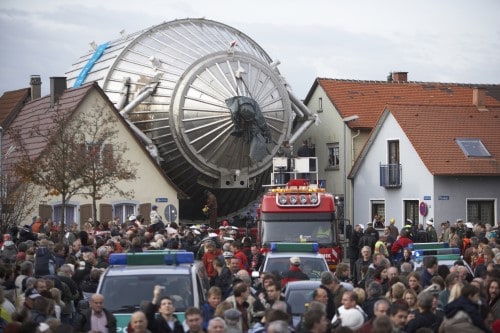
Tight fit: KATRIN’s huge spectrometer travels through the German town of Eggenstein-Leopoldshafen in 2006 on its way to the Karlsruhe Institute of Technology. (Credit: Karlsruhe Institute of Technology)
In 2019 the KATRIN experiment provided a first stab at the mass of a neutrino. How is this year’s result different?
This finding is the result of more data with the experiment also running at a higher tritium source strength. The initial finding showed KATRIN worked and that we could improve the mass limit by a factor of two compared to previous experiments. This result improves that mass limit by close to a factor of three.
What was your role in the experimental analysis?
I was involved in carrying out the statistical analysis using a Bayesian approach and co-leading the group looking at how electrons scatter on their way to being detected. The probability of scattering and the amount of energy they lose when they scatter is crucial to obtaining a high precision result that allows you to then extract the neutrino mass.
What’s next for KATRIN?
KATRIN will run for another three years and in that time we will get better statistics. We then expect the uncertainty from the measurement statistics to be roughly the same as systematic uncertainties from the experimental set-up. We will then stop the measurement expecting a final sensitivity of about 0.2 eV.
And what about beyond KATRIN?
The limiting factor of KATRIN is chemistry because we use molecules of tritium (T2). Molecules are complex objects – they have more degrees of freedom than atoms – so every decay is a little bit different, and the final state of electrons have a distribution. At some point, we cannot improve neutrino mass measurements because the initial decay has an uncertainty. The only way to improve is to use atomic tritium. This is planned for a future experiment called Project 8, which is promising but will be some years yet before it comes online.