Structural batteries put multifunctional materials to the test

Ongoing advances in battery technology have for the first time made electric vehicles a viable alternative to cars powered by fossil fuels. However, further innovation will be crucial to drive widespread adoption of battery-powered vehicles – in particular to engineer improved energy-storage devices to allow drivers to travel further on a single charge – and for electrical solutions to be extended to other modes of transport, such as aviation.

One approach being explored by Jodie Lutkenhaus and her team at Texas A&M University is to design batteries and supercapacitors that could also become part of the vehicle’s load-bearing structure. Such structural energy-storage devices could provide more power without adding extra weight, improving the fuel efficiency of electric vehicles and potentially offering a secondary source of power for aircraft. “In a commercial airliner, for example, batteries embedded in the flooring could provide power for the touchscreens and other electrical equipment in the cabin,” explains Lutkenhaus. “Overall it could improve the fuel efficiency because you’re not using so much energy to power the electrical components.”

The multifunctional materials that are being developed for these structural devices must deliver a challenging combination of properties. Most electrode materials are powdery, with enough porosity to enable efficient ion transport, while structural components need to be stiff and strong. “We’re trying to create batteries and capacitors that mimic the properties of structural composites made from carbon-fibre reinforced epoxy,” explains Lutkenhaus. “We use additives like graphene and Kevlar nanofibres to improve the stiffness, but they are not very active. They dilute the battery-like behaviour in favour of the mechanical properties.”

Lutkenhaus and her team have tackled the problem through interfacial chemistry, enhancing the bonding between the additive and the electrode material to reduce the amount of additive needed to strengthen the material. In one recent research study, they demonstrated that supercapacitors made from reduced graphene oxide (rGO) could be strengthened by chemically modifying the structure using polydopamine, a highly adhesive polymer, and then adding just a small quantity of Kevlar nanofibres. “You can just sprinkle in just a little bit of the nanofibres and the mechanical properties go right up,” says Lutkenhaus.

Assessing the properties of these multifunctional materials requires a comprehensive suite of tests. To probe the mechanical properties of the electrodes, Lutkenhaus and team exploit a dynamic mechanical analyser (DMA) from TA Instruments, which is most commonly used to measure the changes in mechanical properties as the temperature is varied, or when stress or strain is applied. “We’re using it more as a tensile tester, which is a little unusual,” comments Lutkenhaus. “We use the DMA because the battery electrodes are very thin, around 100 microns or so. The DMA provides a thin-film and fibre-clamp arrangement that allows us to measure properties like modulus, toughness, and ultimate stress.”
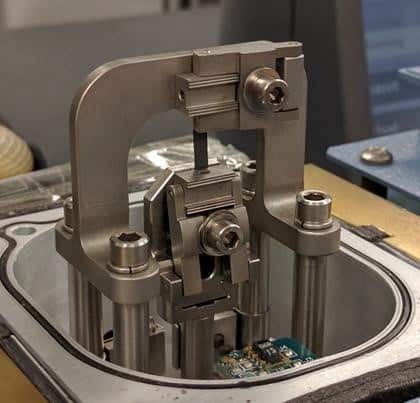
Dynamic mechanical analyser

The tests revealed that adding 10% by weight of Kevlar nanofibres to the modified rGO electrodes yields structures with a tensile strength of almost 200 MPa and a Young’s modulus in excess of 10 MPa – which is similar to the mechanical properties of natural materials such as wood or bone. Earlier work had required higher concentrations of nanofibres to achieve the same strength and stiffness, but in this study the chemical modification of the rGO electrodes increased the capacitance by 23% while still maintaining comparable mechanical properties.

Lutkenhaus and her team have also used Kevlar nanofibres to engineer battery separators, which provide a physical barrier between the anode and cathode to prevent short circuits but still need to allow ions to move between the two. “Battery separators are really difficult to design,” says Lutkenhaus. “They need a challenging combination of properties, including good ionic conductivity, mechanical robustness, and thermal stability over a wide temperature range.”

Lutkenhaus points out that the most common commercial separator used in lithium-ion batteries, called Celgard, starts to degrade at higher temperatures. “The material goes through a melting or softening transition that eventually causes the battery to fail,” she explains. “In our study we needed to identify any thermal transitions that would put a limit on the battery’s operating temperature.”

Lutkenhaus and her team compared the thermal properties of the standard Celgard separator with one based on Kevlar nanofibres. To measure thermal behaviour they used a differential scanning calorimeter (DSC) from TA Instruments, which at different temperatures measures the amount of heat needed to change the temperature of the material. As expected, the DSC profiles revealed that Celgard started to melt at around 160 °C, and on cooling recrystallized at 113 °C. In contrast, the Kevlar-based separator shows no change in thermal behaviour at temperatures of up to 400 °C. “It’s the unique case where you’re doing experiments in the hope of getting a flat line, because you don’t want to see any thermal signature,” says Lutkenhaus.

Other tests investigated the temperature at which the physical structure of the separators start to break down. Using a thermogravimetric analyser (TGA) from TA Instruments, which measures the mass of the sample as the temperature is increased, the researchers found that Celgard starts to lose mass at around 270 °C, while the Kevlar-based separator can be heated to almost 450 °C before showing any signs of degradation. Kevlar-based nanofibres were also found to self-extinguish when exposed to a flame – an important safety feature for batteries – while commercial Celgard versions shrank in dry conditions and burnt completely when wettened with an electrolyte.

Mechanical testing with a DMA show that in dry conditions the Kevlar-based separator has a Young’s modulus some 1000 times greater than that of the commercial Celgard version, and broadly equivalent strength and stiffness when wet. Meanwhile, creep measurements that probe the mechanical behaviour of the material under a constant stress reveal that the Celgard separator stretches out at higher temperatures, consistent with the melting and softening effect observed in its thermal profile. “The Kevlar-based separator does not show any deformation at temperatures of up to 400 °C, again showing better thermal stability than commercially available separators,” comments Lutkenhaus.

Lutkenhaus believes that the superior thermal properties of separators based on Kevlar nanofibres would make them suitable for energy storage devices operating in extreme environments. However, more work is needed to boost their electrochemical properties, since integrating the Kevlar-based separator into a lithium-ion battery resulted in a slightly reduced capacity compared to the Celgard version, as well a significant fall in capacity after 50 charge/discharge cycles.

Lutkenhaus and her team are also now investigating the potential of carbon fibre, commonly used in structural composites, to act as a mechanical matrix for battery materials. Embedding electrode materials into carbon fibre have been shown to yield devices that are stiff and strong, but do not yet store enough energy to rival standard lithium-ion batteries. “We also have a lot of interest in thermal behaviour because vehicles that need structural batteries might operate at lower temperatures or in a high-temperature desert,” says Lutkenhaus. “In addition, we need to start thinking about the effects of mechanical impact on these devices to understand how they might behave in an accident.”

Multimodal MRI reveals brain areas that can still ‘see’ after a stroke

Scientists in the UK have used magnetic resonance imaging (MRI) to map the brain’s responses to visual stimuli after a stroke. In stroke survivors with vision loss, brain imaging revealed responsive areas that were inaccessible to current vision tests. The researchers’ findings could help clinicians better understand vision loss in stroke, and design tailored rehabilitation programmes for survivors. The researchers, from the University of Nottingham, describe their work in Frontiers in Neuroscience.

Every year, an estimated 100,000 people in the UK have a stroke. Globally, the number of strokes each year has risen by 70% since 1990, and stroke remains one of the leading causes of death and disability worldwide.

About a third of all stroke survivors experience visual field loss, in which a quarter or one half of their total visual field is impacted. Currently, there are no universally accepted rehabilitation strategies for vision loss in stroke, and the success of existing programmes varies significantly across survivors.

Visual field loss after stroke is usually diagnosed using perimetry, a technique that uses bright lights of differing size and brightness to test a patient’s visual response. However, perimetry only provides a coarse map of residual visual function and cannot pinpoint pathways in the brain that no longer process visual information.

To reveal more detail, the researchers used different MRI techniques – functional, anatomical and diffusion-weighted MRI – to chart affected visual pathways in the brain in four stroke survivors.

Mapping the the visual field

By measuring responses in the brain to visual stimuli, they were able to map the visual field in stroke survivors in much finer detail compared with perimetry. When they overlaid their visual field maps with perimetry maps, they were able to see spots in the visual field that still elicited a response from the brain.

Denis Schluppeck

“By examining different types of brain scans we can actually see areas of ‘residual vision’ – places where the eyes and brain can still process images, even if this doesn’t reach awareness,” explains Denis Schluppeck, senior author of the study. “Using MRI to pinpoint these areas of functional vision, clinicians could work with the stroke survivor and train them to recover some function in that particular spot.”

Rehabilitation strategies for vision loss in stroke include strengthening existing or alternative visual pathways in the brain. Combining brain imaging and optometric tests could provide a cost-effective way to understand which brain areas to focus on. The researchers note that their MRI protocol takes just one hour to perform.

“I think what was most challenging about the study was recruiting stroke survivors,” says first author Anthony Beh. “As with any clinical group, there are extra considerations to make when working closely with them, such as mobility challenges, past medical history and other stroke-related impairments. It was also important to get in touch with local stroke communities to visit and speak more about the project.”

Anthony Beh

Going forward, the researchers plan to use what they have learned to understand other forms of visual loss. “We hope to use a similar approach in children and younger individuals who have cortical visual impairment – visual loss that is not caused by damage to eyes or early parts of the visual pathway – to understand that set of disorders,” Schluppeck explains.

Bullying and harassment in physics affects us all

Do you ever think about the make-up of our workplaces? What makes us effective in our teams? Do you ever wonder what environment creates colleagues that are happier and more productive? Do you ask yourself what changes could be implemented to foster a cheerier workplace? The evidence indicates that some of us, especially those in senior positions, do not think about these questions on a regular basis or perhaps only consider them once problems arise. Yet it is important to know that the implication of not contemplating whether the workplace is a welcoming and safe environment can have long-lasting consequences. 

Many of us will have seen disillusioned colleagues being treated badly. Ongoing research by the Speak Out Revolution – an award-winning non-profit organization that aims to cancel the culture of silence on workplace harassment and bullying – found in 2021 that over 80% of those who have been bullied or harassed at work want to leave their organization, with a similar percentage experiencing mental health issues. They also found that 1 in 5 do not report harassment, mostly for fear of being labelled “over-sensitive” or because they expect that no action will be taken. Reports show that while more than a third of people formally report to their organizations, over a quarter are silenced with a so-called non-disclosure agreement (NDA). Only 4% feel they have fully resolved the situation after issuing a complaint. 

It is easy to get lost in statistics, but the impact of harassment and bullying in the workplace can cause life-lasting damage. Take the story of Julie (not her real name). She is a physicist who worked in a physics-based company with a training scheme accredited by the Institute of Physics (IOP). Julie, however, ended up working in an environment with colleagues who belittled and undermined her. They disregarded her opinion in team meetings, with newer team members taking credit for her work. Julie was further excluded from meetings and technical conversations. Instead, she was given additional administrative tasks as a pre-requisite to involvement with the scientific work of the team.

It is easy to make someone know that they are not wanted, but the intention to do so is remarkably hard to prove. After Julie raised a grievance, an investigation ensued. But it took almost a year to begin, during which time she was expected to work with colleagues who knew about – and indeed were implicated in – her complaint. Julie was not only sidelined, but other team members and senior scientists who supported Julie were also targeted. Even today, their own progress in the company remains jeopardized. 

Julie was unable to take up prestigious conference invitations due to the presence of people connected with the grievance and was also denied important training opportunities. Julie also reported sexual assaults by a colleague that provided a motivation for the bullying. But because disclosing such experiences is never easy, she reported them after the grievance. Julie was told that this complaint was made too late to take further. Managers at the company had effectively put a time limit after which sexual assault cannot be reported. 

Julie left the company claiming constructive dismissal before finally signing an NDA to draw a line under the misery she had experienced over three years.  But it wasn’t just her professional life that suffered. Her personal life fell apart too as her long-term relationship collapsed. She had to take time off work to deal with the stress and now no longer works in physics – all because it was easier to dehumanize and gaslight her than it was to address major problems in the workplace. Of course, this is only one case and one side of the story. But given the NDA, those responsible will never be named, merely promoted. And yes, one of those whom Julie named has moved up in the organization. The others are still there. And this story is not unusual – much wrongdoing across industry and academia remains secret through the use of NDAs. 

The future for physics

With responsibility comes accountability, but too many organizations are avoiding it via NDAs. Maria Miller, the MP for Basingstoke, recognizes the problem and has proposed to ban NDAs in workplace disputes. The success of her bill, which will have its second reading in the UK parliament in the coming months, is necessary. But what can be done now so that those like Julie stay happy in the job that they love? We should not accept non-inclusive behaviours, which drive out diversity and ideas to instead foster groupthink.

It is important that we all use our influence to address bullying. Given that the IOP accredits training programmes at more than 20 companies and the degree programmes of virtually all universities offering physics courses in the UK and Ireland, maybe we can link accreditation to policies that are shown to address issues such as bullying? The same applies to other learned societies too, so perhaps we could work together to find a solution across engineering, education and healthcare?

Learned societies represent members and have a role to play in ensuring that our interests are promoted, but it requires all of us to contribute to make improvements either through the IOP or in our own workplace. 

Julie could have been any of us, so this affects us all.

Mysterious X particle spotted in quark–gluon plasma at CERN

A mysterious “X” particle comprising four quarks and first seen in 2003, has been found in the quark–gluon plasma produced in heavy ion collisions at the Large Hadron Collider (LHC). The observation was made by physicists working on CERN’s Compact Muon Solenoid (CMS) experiment and if confirmed, it could help researchers understand the structure of the exotic particle. Further studies of the particle could help explain how familiar hadrons such as protons and neutrons formed from the quark–gluon plasma believed to have been present in the early universe.

The exotic X particle – formally known as X(3872) because of it 3872 MeV mass – was first spotted by the Belle experiment in Japan. It has subsequently been studied by other experiments at electron–positron colliders and hadron colliders, but its nature is not fully understood. It could be a tightly bound tetraquark (a particle comprising four quarks) or a more loosely bound “molecular” state comprising two mesons (each containing two quarks).

Others have suggested it may be more bizarre still. “A common hypothesis is that the X(3872) might be a superposition of a conventional charm–anticharm pair and either a tetraquark or a molecule,” says particle physicist Tom Browder of the University of Hawaii, who was part of the Belle collaboration and now works on its successor Belle II.

Insights into hadronization

Studying the X particle’s production in a quark–gluon plasma could help to resolve this debate. This is because different internal structures are predicted to have different decay rates  within the quark–gluon plasma. Another reason to study this system is that the normal matter in the universe (protons and neutrons) is thought to have condensed from a quark–gluon plasma a fraction of a second after the Big Bang – a process called hadronization. Studying the decay of exotic particles like X(3872) into normal particles could provide valuable insights into this process.

The problem is that, even in powerful colliders such as the LHC, it is extremely difficult to accelerate particles such protons or electrons to sufficient energies to generate a quark–gluon plasma when they collide. There is, however, an alternative: “While quark–gluon plasma is not expected to be produced in proton-proton collisions…it is a general phenomenon in heavy-ion collisions at the LHC energy,” write Yen-Jie Lee and Jing Wang of Massachusetts Institute of Technology.

Nuclear theoretician Ralf Rapp of Texas A & M University, who was not involved in the research, explains the potential of this approach: “We have these heavy ions colliding, it forms this quark–gluon plasma, it lives for a time, it expands and transforms back into hadronic matter, which further expands,” he says. “This fireball has a relatively long lifetime on quantum chromodynamic timescales, and if experimentalists can determine [X particles’] production within a factor of two then we can get an idea about their internal structures.”

Noisy background

Unfortunately, the size of heavy ions brings new challenges. While their mass makes it easier to accelerate them to high energies, their internal complexity means that many different final states are produced by their collisions. As a result, trying to observe the decay of X particles within this sea of background noise is a formidable task.

To this end, Wang, Lee and colleagues in the CMS Collaboration turned to a machine learning algorithm. They used computer simulations of both X particle decays and a conventional decay path that produces the same particles with different energies and momenta. Then they taught the algorithm to recognize the differences between the signals produced in the CMS in each case. Finally, they set the algorithm to comb through the LHC’s 2018 dataset of 13 billion lead-ion collisions to search for X particle decays.

The researchers report the detection of around 100 X particle decays, which corresponds to statistical significance of 4.2σ above background. Moreover – the data suggest that the X particle production rate may be enhanced in the quark–gluon plasma, although the result here is not statistically significant.

Run 3 data

“The current precision is still not good enough to conclude the nature of the X(3872) particle,” write Wang and Lee. “At the end of this year, LHC will start Run 3, and then we will collect more data. Also, we will measure the X(3872) particle in other collision systems like proton–lead collisions.”

“It’s a pioneering [measurement],” says Rapp, “The experimental uncertainties are still large and prevent us from drawing strong conclusions at this point for several reasons, but the very fact that they could measure [the X(3872)] state in a heavy ion collision is a milestone.”

Browder adds, “It’s very interesting…They had to put down the flag now for the detection of X(3872) in the quark–gluon plasma because if they hadn’t maybe next week maybe LHCb, ATLAS or ALICE would have done it. Although the statistics are very weak – it doesn’t even qualify as evidence – I think for the community this hint that it’s enhanced, maybe by a factor of 10, is very intriguing.”

The research is described in Physical Review Letters.

A rising star in the search for extraterrestrial intelligence

Imagine this. You have just joined the search for extraterrestrial intelligence (SETI) community and you are asked to investigate the most intriguing signal of the past half century. That’s what happened to the astrophysicist Sofia Sheikh while working towards her PhD at the Berkeley SETI Research Center in 2020.

Sheikh – who now works at the SETI Institute – was asked to lead a team to investigate the Breakthrough Listen Candidate 1, an intriguing signal that appeared to be coming from Proxima Centauri. Watch this short video to find out what happened next.

Discover more about Sofia Sheikh’s rise to prominence in the SETI community, in this feature article, originally published in the February issue of Physics World.

Credit where it’s due: why not nominate yourself or a colleague for an Institute of Physics award?

Everyone loves winning a prize, right? In physics, it’s a sign you’ve done important and influential work that’s been recognized by your peers. A prize signifies a job well done and achievements that matter for the progress of physics. Few scientific awards come with much financial reward, so it’s about the kudos, not the cash. 

But who gets to win awards in the first place? And how can we ensure that those physicists who most deserve prizes get properly rewarded?

If you can only win by being nominated by someone else, there’s a danger that prizes will end up in the hands of those with influential colleagues in high places. And if the application process is off-putting or complex, there could be a bias towards nominations by people who know how to “play the game”.

It was for those kinds of reasons that the Institute of Physics (IOP), which publishes Physics World, last year revamped its awards, to allow self-nominations for the first time and to encourage a wider pool of applicants through greater publicity.

Coming in response to criticisms that previous groups of winners did not accurately reflect the diversity of the physics community, these changes are starting to have some effect.

Of those winners of IOP awards last year who chose to include data about their personal background, some 19% were from Black, Asian or other minority-ethnic groups (for comparison they make up 16% of UK academic physics staff).

Still, the only way to ensure that deserving candidates don’t get overlooked this year is to step forward yourself or nominate others. Awards are given to everyone from early-career scientists and teachers to technicians and subject specialists – so who do you think should win?

The first electron counts – how anaerobic microbes ‘breathe’ iron

Life has a way of adapting to challenging environments. While humans – as well as animals and plants in general – rely on oxygen to burn their nutrients, some microbes in low-oxygen habitats have learnt to rely on iron-containing minerals as a substitute.

Scientists at ETH Zurich and the Swiss Federal Institute of Aquatic Science and Technology have now reported that the speed of two-electron transport from microbes to extracellular minerals may be best described by just considering the ease with which the first electron hops over. Using insight from electrochemical experiments combined with UV-Vis spectroscopy, the researchers reconciled literature data on the rate and energy balance of a reaction that is crucial to micro-organisms in anaerobic environments.

Most living species power various biological functions by passing electrons through a sequence of carriers of decreasing potential energy within a respiratory chain. Such a chain needs a constant source of high-energy electrons, usually from food (ingested or generated by photosynthesis) or another substrate, plus a sink to suck up low-energy electrons after they have done their useful work.

For most ecosystems, oxygen acts as this terminal sink; but under low-oxygen conditions, cells need to find alternatives. For example, minerals in the soil that contain iron in an oxidized form can take up these electrons. Because these grains of rock are located outside the cell, some microbes use extracellular electron shuttles (EES) – small molecules that can transport one or two electrons – to ensure efficient delivery. Therefore, the final stage of respiration in such organisms involves the release of electrons stored in EES to the iron mineral.

Anaerobic respiration

For any chemical reaction, two quantities are often of interest: how fast the reaction progresses – expressed as the reaction rate – and the free energy balance, which determines the direction of the reaction. Although these are not generally related parameters, Marcus Theory predicts that the transfer of an electron between two molecules will be faster if it is more energetically favourable (except in what is termed the “inverted” Marcus region). However, this correlation was not obvious in existing data describing the transport of two electrons from an EES to iron.

This quandary motivated the Swiss team’s experiments. The energy change involved in a reaction can be found mathematically by subtracting reduction potentials of the participating molecules. “Our biggest challenge was to find reliable values for the standard reduction potentials of EES,” explains first author Meret Aeppli (now at Stanford University). “These values were indispensable for the calculation of Gibbs free energies.”

Importantly, the researchers were able to determine this potential for each step of the two-electron process, not just an average value describing the overall reaction. Their results showed how the transfer of the first electron releases less energy than that of the second electron. When the researchers compared results from three different EES to the respective reaction speeds, they observed a consistent correlation only for the energy associated with the transfer of the first electron.

“We show that rates of iron oxide reduction by reduced EES scale with the free energy of the less exergonic [less favourable] first of the two electron transfers,” says Aeppli. Moreover, the “free energy relationship unifies rate data from this and past work for different EES and different solution conditions”.

While the research is completed for now as the final part of Aeppli’s PhD thesis, she sees potential in future investigations “extending the framework presented in the paper to other iron minerals and mixed mineral systems” as well as “conducting experiments with iron minerals and added microorganisms, extracellular electron shuttles and organic substrates”. Such studies could enable scientists to gain an even deeper understanding of the electron transport processes happening in and around anaerobic microbes.

The research is described in the Proceedings of the National Academy of Sciences.

Meet the technosignature researcher on the lookout for exo-civilizations

Sofia Sheikh

When a suspicious radio signal emerged from the direction of the solar system’s nearest neighbouring star in 2019, the Breakthrough Listen project put Sofia Sheikh in charge of figuring out what produced it. Was it from an alien civilization from an exoplanet in the habitable zone orbiting Proxima Centauri, just 4.2 light-years from Earth? Or was it a radio signal from any of an almost innumerable number of potential sources on and around Earth?

Sheikh, a first-year postdoctoral researcher, was then part of the Berkeley SETI (Search for Extraterrestrial Intelligence) Research Center at the University of California, Berkeley. She co-ordinated a team that analysed the collected data in great detail, looking for similar signal patterns. Meanwhile, other project members searched, as best they could, through whatever public information they could gather on satellite transmissions and planetary spacecraft. They even examined aircraft in Australia that happen to use frequencies close to the suspicious five-hour signal. Dubbed the Breakthrough Listen Candidate 1 (BLC1), the signal was detected by the 64-metre Parkes Murriyang radio telescope in New South Wales, Australia.

Now 26 years old, Sheikh received her undergraduate degree in physics and astronomy from the University of California at Berkeley in 2017. While there, she worked with the Breakthrough Listen project to plan a search campaign of the Earth Transit Zone. It’s a special band of space from which an extraterrestrial observer would be able to detect Earth, by seeing it transit in front of the Sun. In this region, our own technosignatures – a clear indication of past or present technological activity, pointing out the existence of an advanced planetary civilization – can be easily picked up, thereby making potential advanced alien civilizations elsewhere more inclined to send radio signals our way. The work was published in the Astrophysical Journal in 2020 with Sheikh as the lead author (160 29).

When she entered graduate school at Pennsylvania State University, Sheikh thought she would move from studying technosignatures to the more accepted field of exoplanet research. “It’s adjacent, but better supported,” she felt. But through talking to her future adviser, astronomer Jason Wright, a leader in the SETI field, she remembered what she loved so much about technosignature research. “I thought, even if it’s tricky, I want to continue,” recalls Sheikh, who ended up doing a PhD on radio techno-signatures and pulsars.

10th PhD in SETI

Earning her PhD in 2021, Sheikh was just the 10th person to finish a dissertation in SETI in the physical sciences, says Wright. In September last year, she was awarded a Mathematical and Physical Sciences Ascending (MPS-Ascend) postdoctoral research fellowship by the National Science Foundation. Sheikh moved to SETI as of January this year, and is now working with the legendary astronomer Jill Tarter and Andrew Siemion, director of the Berkeley SETI Research Center and principal investigator for the Breakthrough Listen programme. This $100m privately funded programme was launch in 2015 by Russian billionaires Julia and Yuri Milner.

“The combination of Sofia’s keen scientific abilities and audacious passion for carving her path is truly remarkable,” says Siemion, adding that Sheikh is a “world-class scientist who is demonstrating vision, tenacity and academic excellence in researching a profound and challenging topic”. Tarter herself agrees, saying that “When you work on a potentially multi-generation project, you really need to think seriously about training your replacements. Sofia’s MPS-Ascend award gives us the opportunity to invoke the next generation and think laterally about what/who/where we can expand opportunities for commensal observing programmes.”

Proxima Centauri

The BLC1 signal was first identified by Shane Smith, while an undergraduate student at Hillsdale College in Michigan, when he was sifting through four million signals from a 26-hour period of the Parkes radio-telescope data. It was soon shared on Breakthrough Listen’s Slack platform, and initial screening tests quickly ruled out any obvious sources of radio interference. The team then began looking for other interference in detail. Sheikh had a “could-this-be-it?” moment, she recalls. “I just stopped for a second after seeing the BLC1 plot, where I thought this is everything we wanted it to be.”

Sheikh and her team analysed an estimated 160 terabytes of data that the telescope had also collected, looking for similar signals to the BLC1 signal that had been identified. It required a great deal of learning along the way and a lot of coding in Python to characterize signals quickly and efficiently. The COVID-19 pandemic made for even more challenging conditions. “It was fun to focus on one thing, dig deep, with a detective mind set,” she tells Physics World. The whole team worked very hard, she says, even meeting on Christmas day, 2020.

The BLC1 signal happened to be “weird” in just the right way to fool our filters, but it was a good dry run for when the next tantalizing signal arrives

Sofia Sheikh

Ultimately Sheikh and her colleagues found around 60 signals that had many of the same characteristics as the original BLC1 candidate signal, but remained after the telescope was pointed away from Proxima Centauri. “We can therefore say confidently that these other signals are local to the telescope and human-generated”, she told SciTechDaily in October. Appearing at regular frequency intervals, they likely came from oscillators commonly used in various electronics devices. The BLC1 signal, she explains, “happens to be ‘weird’ in just the right way to fool our filters”. Despite this, their analysis let them develop a great deal of code to characterize signals quickly and efficiently. By helping to improve search algorithms, their work was effectively a good dry run for when the next tantalizing signal arrives, she adds.

The Guardian broke the story of the BLC1 signal on 18 December 2020, and soon the news was everywhere. A screenshot on a YouTube video about the work included Sheikh’s e-mail address, and she quickly started receiving comments from the public. Not all of them, however, were friendly. Sheikh recalls some nasty e-mails targeting her for being a woman in STEM; as well as her identity, with a Pakistani last name. Luckily, Sheikh’s personal experiences as a woman in science “for the most part hasn’t been too much of an issue” except for occasional microaggressions that “you brush off”. Good, supportive mentors, such as Wright and Siemion, have helped in that regard, she adds.

Star Trek and “impossible” ideas

Sheikh grew up in South Carolina, where her father was a gastroenterologist and her mother a homemaker and stained-glass artist. She was “for sure” a fan of science fiction, and watched plenty of Star Trek with her dad. She was also captivated by books such as Physics of the Impossible by physicist and science communicator Michio Kaku.

While by no means unique to SETI researchers or astronomers in general, her interest in science fiction has helped Sheikh develop plans to look at alternative strategies for detecting intelligent alien life. One could be to look for Clarke exobelts – rings of geosynchronous satellites around exoplanets. Another would be to search gravitational waves from accelerating spaceships moving somewhere nearby in the galaxy.

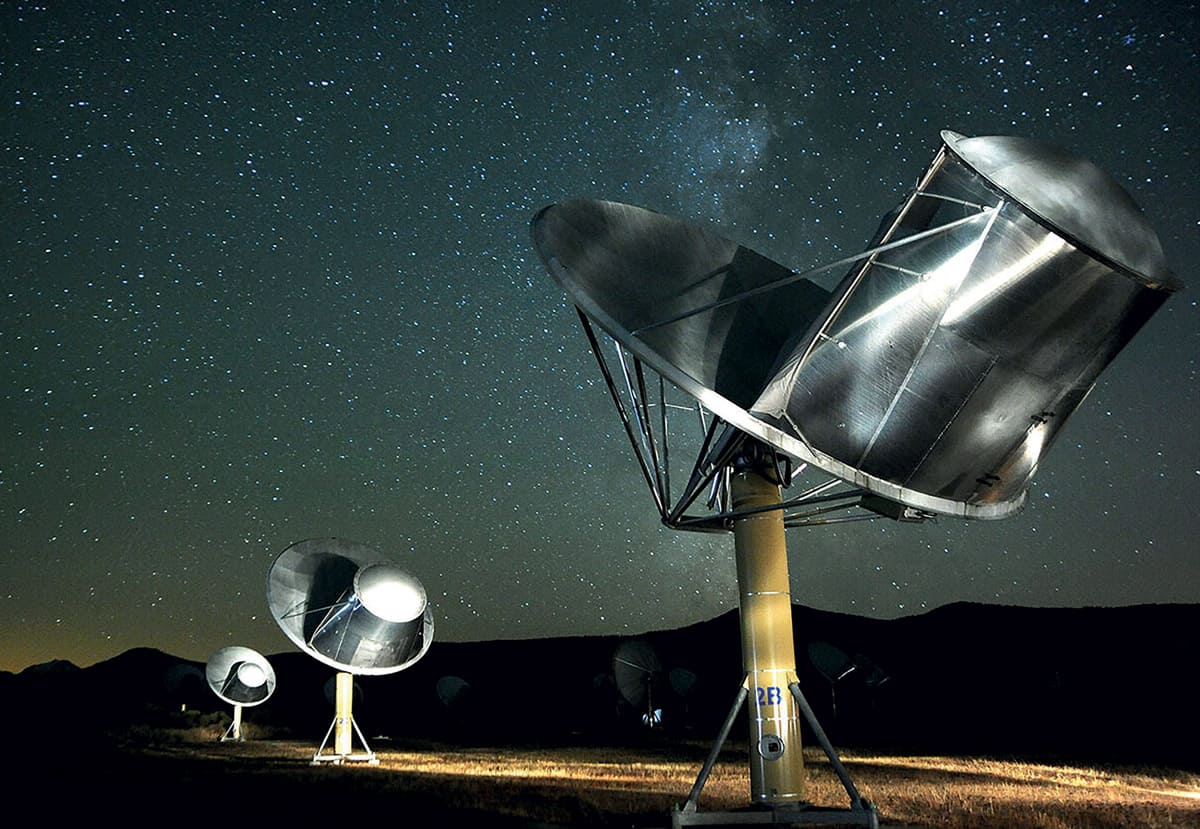
As part of her new position at the SETI Institute, Sheikh is also developing a mentoring programme involving science and coding for sophomore community college students in the Bay Area around San Francisco. She plans to take feeds from the refurbished Allen Telescope Array in northern California and run projects for students to understand the radio-frequency interference environment. At the same time, she will provide students with the skills to take on other astronomy and physics projects.

Allen Telescope Array

Rising star

Today, Sheikh is rising to prominence in the field, speaking at conferences and publishing recognized papers, serving as lead author on an October 2021 Nature Astronomy paper that presented the analysis of the BLC1 signal (5 1153). Sheikh has also been invited to collaborate on important ventures, like the Characterizing Atmospheric Technosignatures project led by Adam Frank of the University of Rochester in New York. The study will build a library of technosignatures produced by current-day Earth that examines how sensitive our state-of-the-art instrumentation can be at detecting those signals. It’s the first NASA non-radio techno-signature grant ever awarded.

So what does Sheikh attribute her success to, at such a young age? Her “incredible mentors” Jason Wright and Andrew Siemion played a key role. Sheikh also advocates “always saying yes to speaking opportunities and conferences to get your work out there.” Young students who want to get to the cutting edge of any scientific field need to build a network, attend conferences, workshops and meetings. “See if you can find a place to show up.” But just as important, Sheikh believes, is to try your best to “juggle a half-dozen projects at any given time”. What you need to do, she says, is “to be involved with everything!”

While neither a pessimist nor optimist about finding extraterrestrial life during her career, let alone a large spaceship appearing over London or Johannesburg, “the fact that we’ll have the technology is exciting” she says. Sheikh is now open to looking at other unusual ways for possibly detecting intelligent alien life.

Bitcoin encryption is safe from quantum computers – for now

How big does a quantum computer need to be to accomplish something useful? Physicists from the University of Sussex, UK recently set out to answer this question for two pragmatic computational tasks: breaking the encryption used in Bitcoin transactions and simulating the behaviour of an agriculturally important nitrogen-fixing molecule. By estimating the number of quantum bits, or qubits, that different types of quantum computers would need for each task, members of the team say their theoretical study should help other researchers decide which designs to pursue.

Although there is no standard hardware platform for quantum computers, two of the most popular ways of engineering qubits involve superconductors and trapped ions. In either case, the number of qubits available to perform quantum operations is significant, explains Mark Webber, a PhD student at Sussex who is also involved in a Sussex spin-out called Universal Quantum. Using more qubits, he adds, may enable quantum computers to tackle important real-world problems on practical timescales even on platforms for which individual qubit operations take longer – as is the case for trapped-ion machines compared to those based on superconducting qubits.

In a study published in AVS Quantum Science, Webber and his collaborators set out to explore this balance between qubit number and operation times for superconducting and trapped-ion qubits. “The question really is, how big does your quantum computer need to be to solve really impactful problems? And how does that answer change when we’re talking about a trapped ion platform or superconducting platform?” Webber tells Physics World. Winfried Hensinger, a Sussex physicist and the study’s co-author, adds that by looking closely at the available hardware, the team’s work “immediately links to the actual hardware designs we can build and capitalizes also on the advantages of these hardware designs”.

Assume an error-corrected machine

The Sussex team began by considering common algorithmic methods that could be implemented on a quantum computer. Importantly, the physicists focused on codes and algorithms that are self-correcting, meaning they assume errors in calculation will occur and that have built-in mechanisms for rectifying them before users see the results. “This paper is using some of the most up-to-date methods on the algorithm side, and also the up-to-date methods on the quantum error correction side,” notes Gavin Brennen, a physicist at Macquarie University, Australia, who was uninvolved with the work. “And they focused on two key problems that are of use to the world.”

The first problem the team examined concerns a molecule called the FeMo cofactor (FeMo-co) that bacteria use to extract nitrogen from air and create ammonia. This same process is performed on an industrial scale in the fertilizer industry, but in a way that is much less efficient and accounts for almost 2% of the world’s energy use. A better understanding the physics of FeMo-co could boost the efficiency of this industrial process, but as the molecule is so large, Webber explains that simulating its behaviour is beyond the capabilities of classical computers.

According to the team’s calculations, a quantum computer made up of tens of millions of superconducting qubits or hundreds of millions of trapped-ion qubits could simulate FeMo-co in about 10 days. A classical computer, meanwhile, would stand no chance of producing meaningful contributions to this question in any amount of time.

Is Bitcoin quantum-safe?

In the second part of the study, the team calculated the number of physical qubits needed to break the encryption used for Bitcoin transactions. Marek Narozniak, a physicist at New York University (NYU) in the US who was not part of the study, points out that this question – whether cryptocurrencies are safe against quantum computer attacks – comes with additional constraints not present in the FeMo-co simulation. While a 10-day computation time may be acceptable for FeMo-co simulations, Narozniak notes that the Bitcoin network is set up so that a hacker armed with an error-correcting quantum computer would have a very limited time to decrypt information and steal funds.

According to Webber and collaborators, breaking Bitcoin encryption within one hour – a time window within which transactions may be vulnerable – would take about three hundred million qubits. Based on this result, Narozniak concludes that “Bitcoin is pretty safe”, although he warns that not all cryptocurrencies operate the same way. “There are other cryptocurrencies that work differently, and they have different algorithms that could be more vulnerable,” he says.

Super-size my quantum computer

While today’s quantum computers contain a little over 100 qubits at best, Tim Byrnes, who leads Narozniak’s quantum research group at NYU, says that scaling these machines to the millions of qubits discussed in the Sussex team’s work is not an impossible goal. “That sounds big, but there are commercial companies where these qubit numbers are the target. Certainly not today, but given some years, this is not too out of reach,” he says.

Because the new work compares necessary hardware specifications for different types of quantum computers, it also adds new information to the competition among different quantum computer designs. “It’s been assumed that superconducting systems, because they are much faster, have a leg up on the ions,” Brennan explains. “But this paper actually shows that in some regimes the two architectures are really quite competitive.”

Webber and Hensinger, for their part, note that their work was motivated precisely by their efforts to design and engineer a competitive, error-correcting trapped-ion quantum computer. “We have a clear development path to build quantum computers with millions of qubits,” Hensinger explains. “But we really have to understand what type of error correction is needed, and what kind of advantages we can use in order to get to interesting problems like simulating molecules or breaking encryption.”

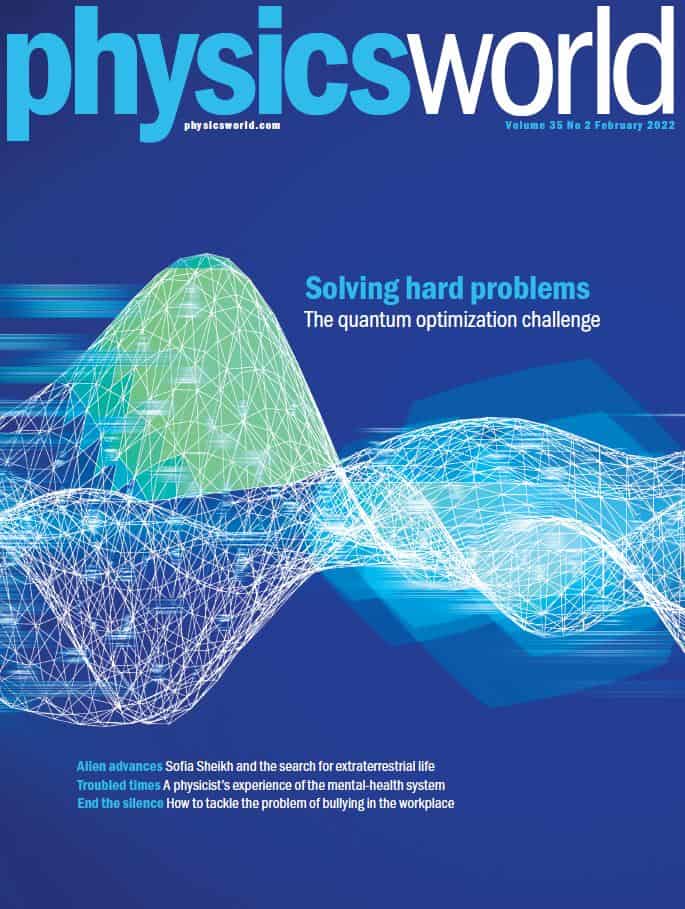
Quantum optimization, alien life and mental health in physics: the February 2022 issue of Physics World magazine is now out

Cover of Physics World February 2022 issue

Quantum computers are often touted as the solution to all our problems – be it curing disease, alleviating hunger or solving climate change. But there is still a lot of uncertainty surrounding what these devices might actually be useful for in the near term.

Many potential uses of quantum computers hinge around what’s known as an optimization problem. Optimize the placement of electric charging stations, say, and you might make a fleet of cars more energy efficient.

With even tiny improvements in optimization leading to massive savings, the hope is that quantum computers will let us optimize these processes better than classical computers could ever do. But as Pradeep Niroula from the University of Maryland explains, our hopes for quantum-enhanced optimization are being held back by the fact that we simply don’t understand the problem well enough.

If you’re a member of the Institute of Physics, you can read the whole of Physics World magazine every month via our digital apps for iOSAndroid and Web browsers. Let us know what you think about the issue on TwitterFacebook or by e-mailing us at pwld@ioppublishing.org.

For the record, here’s a rundown of what else is in the issue.

• CERN sets stringent limits on antiprotons Researchers from the BASE experiment have carried out the most precise measurement of the proton and antiproton charge-to-mass ratios ever made, as Hamish Johnston reports

• NASA celebrates JWST deployment – The James  Webb Space Telescope has completed a series of daring manoeuvres as it moves closer to becoming an operational observatory, as Michael Banks finds out

• Bullying in physics affects us all – Marie Hemingway and Mark Geoghegan say that physics can only be more inclusive and welcoming if agreements that stop people speaking out about harassment and bullying in the workplace are banned

• Smaller is better – James McKenzie thinks that small modular nuclear reactors could help many countries to meet their “net-zero” emissions targets

• Physics on the cheap – The simplest questions are often the best. Robert P Crease tries to answer one from a physics student in Kenya

• Hyped as the solution to many problems – both hard and easy – quantum-enhanced optimization is a burgeoning research field. But with untrainable circuits, “barren plateaus” and deceptive local minimas, nature itself may prevent the use of quantum solutions for hard problems, as Pradeep Niroula explains

• The technosignature researcher on the lookout for exo-civilizations – Meet Sofia Sheikh, one of a handful of postdoctoral researchers who have specialized in the search for extraterrestrial intelligence. She talks to David Appell about strange signals, Star Trek, picking a tricky research field and the importance of mentorship

• A physicist’s experience of the mental-health system – Having suffered from depression and other mental-health problems for more than 10 years, Alexander Mendelsohn wonders why the mental-health system lacks the quantitative rigour that physics benefits from

• A most improbable physicist – David Appell reviews A Quantum Life: My Unlikely Journey from the Street to the Stars by Hakeem Oluseyi and Joshua Horwitz

• The transformative power of physics – Joanne O’Meara reviews Ten Days in Physics that Shook the World: How Physicists Transformed Everyday Life by Brian Clegg

• Laughing in the face of danger – Laura Hiscott reviews the film Don’t Look Up, directed by Adam McKay and available now on Netflix

• Branching out in your career – Akihiro Kojima and Mike Lee are two of seven physicists who shared the 2022 Rank Prize for Optoelectronics for developing new materials for solar cells. They speak to Laura Hiscott about how they switched into different career areas long after doing the work that led to the award

• Ask me anything – Career advice from Donna Strickland, optical physicist at the University of Waterloo, Ontario, Canada, who shared the 2018 Nobel Prize for Physics for developing the technique of “chirped pulse amplification”.

• Error carried forward – David Marshall on the traumas of correcting mistakes in physics textbooks.

Copyright © 2026 by IOP Publishing Ltd and individual contributors