Artificial intelligence (AI) has potential to play a pivotal role in many areas of medicine. In particular, the use of deep learning to analyse medical images and improve the accuracy of disease diagnosis is a rapidly growing area of interest. But AI is not perfect. A new study has revealed that radiograph labels can confuse AI networks and limit their clinical utility.
The problem arises due to a phenomenon called hidden stratification, in which convolutional neural networks (CNN) trained to analyse medical images learn to classify the image based on diagnostically irrelevant features.
For example, a neural network trained to diagnose malignant skin lesions was discovered to actually be looking for the presence of a ruler, included for scale in images of cancerous lesions. Elsewhere, CNNs trained to detect pneumothorax (collapsed lung) on chest radiographs used the presence of a chest tube as a shortcut to identify such events, resulting in missed diagnoses if no tube was present. Other confounding features include arrows on the image or radiograph labels – commonly used to identify the radiographer or distinguish right from left on an X-ray image.
In this latest study, Paul Yi, director of the University of Maryland Medical Intelligent Imaging (UM2ii) Center, and collaborators assessed how radiograph labels impact CNN training, using images from Stanford’s MURA dataset of musculoskeletal radiographs. They hypothesized that covering up such labels could help direct the CNN’s attention towards relevant anatomic features.
The researchers used 40,561 upper-extremity radiographs to train three DenseNet-121 CNN classifiers to differentiate normal from abnormal images. They assessed three types of input data: original images containing both anatomy and labels; images with the labels covered by a black box; and the extracted labels alone.
For each CNN, a board-certified musculoskeletal radiologist inspected heatmaps of 500 test images to identify which features the CNNs emphasized. The researchers found that CNNs trained on the original images focused on the radiograph labels in 89% of the 500 heatmaps. When the labels were covered, in 91% of the heatmaps, the CNNs shifted the emphasis back towards anatomic features such as bones.
The team also assessed the area under the curve (AUC), a measure of how well the algorithm performs, for the three training regimes. For CNNs trained on original images, the AUC was 0.844; this increased to 0.857 for images with covered labels. A CNN trained on radiograph labels alone diagnosed abnormalities with an AUC of 0.638, a greater-than-chance accuracy. This indicates the presence of hidden stratification, with some labels more associated with abnormalities than others.
The researchers conclude that CNNs are susceptible to confounding image features and should be screened for this limitation prior to clinical deployment. “Because these labels are ubiquitous in radiographs, radiologists developing CNNs should recognize and pre-emptively address this pitfall,” they write. “Covering the labels represents one possible solution. In our study, this resulted in significantly improved model performance and orientation of attention towards the bones.”
“We are now actively working to better understand hidden stratification, both in identifying potential confounding factors for deep-learning algorithms in radiology and in developing methods to mitigate these confounders,” Yi tells Physics World. “The implications of these issues are huge for ensuring the safe and trustworthy implementation of AI and this initial study has only scratched the surface.”
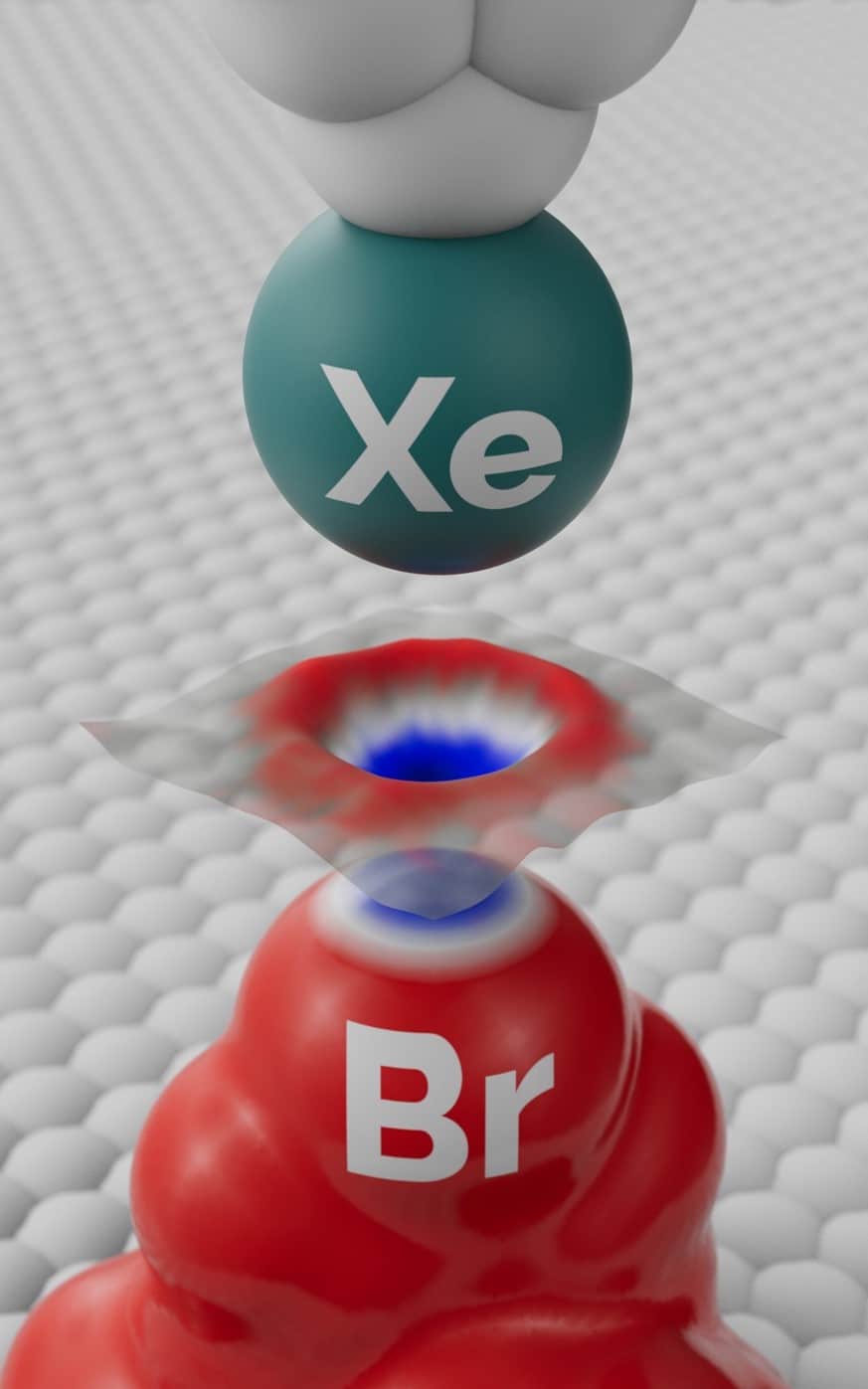
Positive crown: Schematic view of the experiment used to visualize the sigma-hole on a bromine (Br) atom in a molecule using a scanning microscope tip functionalized with a single xenon (Xe) atom. (Courtesy: FZU/DRAWetc)
Scientists have long suspected that bonds between certain negatively charged halogen atoms are made possible by regions of positive charge called sigma-holes, but they lacked experimental proof. Now researchers in Czechia have used a method known as Kelvin probe force microscopy to image these subatomic structures directly – an achievement they claim will lead to a better understanding of molecular crystals and the folding of biomolecules, among other phenomena.
The stability of certain molecular crystals had long been a puzzle to scientists, since the crystals contain pairs of negatively charged atoms that would ordinarily be expected to repel one another. These pairs consist of either two atoms from the halogen group of elements (such as bromine), or one halogen atom and another electronegative atom such as oxygen or nitrogen.
Several groups have proposed that halogen bonds come about through an anisotropy in the atoms’ charge distribution. In other words, rather than having a spatially uniform negative charge, they consist of a belt of negative charge topped off by a positively charged crown – the sigma-hole. However, while quantum-mechanical simulations and observations of crystal structures provided indirect support for this idea, no-one to date was able to image the anisotropy directly.
Kelvin probe force microscopy
A group headed by Pavel Jelínek of the Czech Academy of Sciences in Prague and Palacký University in Olomouc has now achieved this feat by exploiting Kelvin probe force microscopy. Based on work originally carried out by William Thomson (Lord Kelvin) at the end of the 19th century, and adapted more recently to image intramolecular charge distribution, the technique involves suspending a tiny cantilever over a sample and electronically connecting the two so that they form a capacitor. The next step is to set the cantilever vibrating and record how its frequency of vibration shifts as it is brought close to the sample. This shift is measured over a range of voltages and the resulting distribution plotted as a “Kelvin parabola” with a peak at a particular value. This value represents the difference between the work function – a macroscopic quantity describing how much energy is needed to remove an electron from a surface – of the cantilever tip and that of the sample.
Scientists had previously used a Kelvin probe force microscope with a tip comprising a single atom to map the atomic-scale local variation in charge density by measuring shifts in the parabola’s peak. Jelínek and colleagues have now refined the theoretical understanding of this technique and optimized the experimental procedure. This allowed them to enhance the sensitivity of the electrostatic interaction between probe and sample, and thereby push the technique’s resolution beyond the atomic scale.
The researchers carried out their experiment by depositing molecules of a bromine-containing compound (tetrakis(4-bromophenyl) methane) on a silver surface inside an ultrahigh vacuum at cryogenic temperatures. Each molecule had a tripod-like shape, with the bromine atom uppermost and so easily probed. At the cantilever tip the researchers placed a xenon atom, which has a uniform charge distribution and therefore avoids confounding signals. By moving the probe through a grid of points above the bromine atom and plotting a separate Kelvin parabola at each point, they were able to map regions of higher and lower electron density within the halogen atom.
In doing so, the researchers found that the bromine atoms do indeed contain a sigma-hole surrounded by a more negative bulk. They backed up their result with simulations based on density functional theory, and also carried out analogous experimental measurements involving the same molecules but with fluorine replacing the bromine. Although fluorine is also a halogen, it attracts electrons so strongly when forming chemical bonds (it is highly electronegative) that a sigma-hole cannot develop. The team’s measurements revealed, as expected, that the fluorine atoms have a uniform negative charge distribution.
Direct imaging of anisotropic atomic charge
According to Jelínek, the findings not only confirm the existence of the sigma-hole and the concept of halogen bonds but also constitute the first direct imaging of anisotropic atomic charge. “The resolution of the sigma-hole opens up a new way to characterize the electron density of single atoms,” he says. “We can now think about measuring the electron cloud’s response to an external field.”
Among the systems that could be probed in more detail, he adds, are atomic defects in 2D materials. Kelvin probe force microscopy, he says, could be used to establish whether a defect is positively or negatively charged and whether the charge distribution is asymmetric or not.
The open hardware movement advocates the sharing of designs for material objects. For the global science community it means people can access instructions to 3D print increasingly sophisticated tools. Just as importantly, the movement is decentralizing knowledge and giving users the ability to customize scientific equipment then repair it when things go wrong.
In the latest episode of Physics World Stories, Andrew Glester meets researchers at the University of Bath who are part of the open science community.
First, social scientist Julieta Arancio discusses the open hardware movement’s origins and some impactful projects. Among them are: Open Science with Drones; GORGAS tracker for Malaria and Human Mobility in the Peruvian Amazon; and Mboa Lab, a makerspace community in Cameroon.
Later, Richard Bowman and Julian Stirling describe the journey of developing a low-cost, laboratory-grade microscope. The OpenFlexure project, developed with the University of Cambridge and partners in Tanzania, can become an important tool in the fight against malaria.
Wearable robotic systems have great potential for assisting locomotion during clinical rehabilitation, as well as use in recreation and to ease demanding occupational tasks. Walking patterns, however, vary according to a person’s age, height and physiology, may be affected by neural or muscular disorders, and change in different environments. As such, there’s a need for wearable robotics that can customize walking assistance to each user and task.
To address this need, researchers at Harvard University have developed a novel robotic ankle exosuit that uses ultrasound measurements recorded during walking to tune the level of assistance to an individual’s own muscle dynamics and walking task. The team – from Robert Howe’s Harvard Biorobotics Laboratory and the Harvard Biodesign Lab run by Conor Walsh – describes this new muscle-based assistance (MBA) strategy in Science Robotics.
The researchers predict that such personalized assistance should improve exosuit performance and support the adoption of wearable robotics in real-world, dynamic locomotor tasks. “By measuring the muscle directly, we can work more intuitively with the person using the exosuit,” explains co-first author Sangjun Lee in a press statement. “With this approach, the exosuit isn’t overpowering the wearer, it’s working co-operatively with them.”
Personalized assistance profiles
The researchers tested their MBA strategy on nine healthy adults. To calibrate the exosuit assistance level, they first recorded the baseline dynamics of each individual’s soleus muscle (one of the large muscles in the calf) while they walked on a treadmill (without wearing a device) at multiple speeds as well as at a 10% incline.
A portable ultrasound system strapped to participants’ calves measured the muscle dynamics as they walked, capturing continuous B-mode ultrasound images of the soleus muscle. For each participant and task, the researchers used these images to estimate the force produced by the muscle, with the system only needing a few seconds of walking to determine the muscle profile. They then designed the exosuit’s assistance profile to be proportional to that estimated force, generating individualized, task-specific MBA profiles.
After a training session, participants performed walking tasks with the ankle exosuit applying assistive force according to their individual MBA profiles. Compared with not wearing a device, the bilateral ankle exosuit reduced users’ metabolic expenditure by an average of 15.9%, 9.7% and 8.9%, for level walking at 1.25, 1.5 and 1.75 m/s, respectively, and by 7.8% when walking at 1.25 m/s on the incline.
The team notes that these metabolic energy benefits were achieved while applying less assistive force than previously reported assistance strategies. This ability to provide assistance using relatively low forces has implications for future exosuit design, enabling the use of smaller and lighter power sources and actuators, which further decreases loading while increasing the user’s comfort.
Finally, the researchers performed a proof-of-concept real-world demonstration of online adaptive assistance by a mobile ankle exosuit. When tested in variable-speed, outdoor walking situations, the exosuit could quickly adapt to changes in walking speed and incline. In future work, the team aims to improve estimation methods and closed-loop controllers to enable real-time dynamic control for real-world tasks.
NASA has launched a mission to test whether it is possible to deflect an asteroid using “kinetic impact”. The Double Asteroid Redirection Test (DART) craft – the first mission dedicated to demonstrating this method of asteroid deflection – took off at 06:20 UTC today from Vandenberg Space Force Base, California, aboard a SpaceX Falcon 9 rocket. The mission will slam into a binary asteroid to see if the kinetic impact of a spacecraft could one day successfully deflect an asteroid that is on a collision course with Earth.
DART is a critical next step for planetary defence
Cristina Thomas
Asteroids and comets that orbit the Sun like the planets are collectively known as near-Earth objects (NEOs) and are dangerous because they can come within 50 km of Earth’s orbit. In 2005 the US Congress called on NASA to find, track and characterize – by 2020 – at least 90% of the predicted number of NEOs that are 140 m or larger in size. While no known asteroid bigger than 140 m has a significant chance to hit Earth over the next century, fewer than half of the estimated 25,000 NEOs that are 140 m and larger in size have been found to date.
Weighing around 60 kg, DART’s target is a binary, near-Earth asteroid system that consists of a 780 m-diameter asteroid called “Didymos” and a smaller, 160 m body “Dimorphos” that orbits it. The DART payload is made up of a single instrument called DRACO – a high-resolution imager that will take images of Didymos and Dimorphos on approach to measure their size and shape.
The mission also contains the Light Italian CubeSat for Imaging of Asteroids (LICIACube) – a CubeSat that has been contributed by the Italian Space Agency. LICIACube carries two optical cameras and will be deployed from the DART spacecraft 10 days prior to impact.
Measuring impact
DART is expected to carry out the impact on Dimorphos between 26 September and 1 October 2022. It will do so travelling about 6 kilometres per second. Soon after impact, LICIACube will fly past Dimorphos to image the kinetic impact itself, the resultant ejecta plume and possibly the impact crater.
Ground-based observations carried out at several facilities – including the Lowell Discovery Telescope in Arizona, Las Campanas Observatory in Chile, the Las Cumbres Observatory global network, and the Magdalena Ridge Observatory in New Mexico – will also track the impact of DART and the subsequent response by Dimorphos.
Scientists will then compare the results of DART’s kinetic impact with computer simulations to evaluate the effectiveness of this approach and assess how best to apply it to future planetary defence scenarios. “DART is a critical next step for planetary defence,” says planetary astronomer Cristina Thomas from Northern Arizona University who heads the DART observations working group. “It is, on the surface, a simple test, but we will not completely understand what will happen until we do it.”
In 2024 the European Space Agency’s Hera mission will launch to the asteroid system and, once it arrives two years later, it will perform a close-up “crime-scene” investigation of DART’s impact.
Exoplanets have been spotted orbiting at right angles to each other by an international team of astronomers led by Vincent Bourrier at the University of Geneva. The team believes that this unusual configuration is caused by the influence of a yet-to-be-discovered companion object orbiting the exoplanets’ star.
A star and its planets are believed to form from the same rotating disc of gas and dust. Therefore, the spin of a star should point in the same direction as the plane of the orbits of its planets. The planets in the solar system follow this rule to within a few degrees, but the dwarf planet Pluto is off by about 17°.
Astronomers have discovered more than 3500 exoplanetary systems so far – systems of planets orbiting stars other than the Sun. Studies of the relative orientations of spins of stars and the orbits of their planets would provide important information about how planetary systems form and evolve.
Mini-Neptunes
To do this, astronomers measure the trajectories of exoplanets as they “transit” in front of their star and compare this to a measurement of the spin of that star. In 2019, observations using the HARPS-N spectrograph in the Canary Islands revealed a particularly extreme example of misalignment. Around the star HD3167, two out of three orbiting planets – both “mini-Neptunes” – were misaligned with the star’s spin by close to 90°.
At the time, limitations in spectral and temporal resolution prevented astronomers from determining the orbital plane of HD3167’s much smaller innermost planet. Called HD3167b, this “super-Earth” completes a full orbit in just 23 h. To study this exoplanet, Bourrier’s team developed a new technique that extracts more orbital information from observed optical spectra.
The study involved taking measurements using two ESA instruments: the ESPRESSO spectrograph – part of the Very Large Telescope in Chile – and the CHEOPS space telescope. Together, these instruments allowed the team to determine the misalignment of HD3167b’s orbital plane to within just a few degrees, while measuring its transit time to within an accuracy of just one minute. This revealed that HD3167b’s orbit is mostly aligned with its star’s spin, making it perpendicular to its two planetary companions.
This suggests that HD3167’s two outermost planets have been influenced by the gravitational tug of a yet-to-be-discovered fourth body. This would have pulled the planets from the original orbital plane of the system and caused them to migrate to their current orientations. In contrast, the results show that HD3167b is likely to be more strongly coupled to its host star, forcing it to continue orbiting in the original plane. Using these results, Bourrier’s team will now expand their search for HD3167’s elusive fourth companion – potentially uncovering new details on how planetary orbits evolve after their initial formation.
A neurosurgeon, who is about to retire, approaches a historian of science and says: “I’m thinking of taking up history of surgery; can you give me any tips?”
“Yes I can!” replies the historian. “As it happens, I’m also retiring and I plan to take up brain surgery; do you have any pointers for me?”
This caustic and surely apocryphal story is beloved by historians, for it highlights and mocks a perceived asymmetry between professions. Science and medicine are regarded as much more difficult, and to require much more specialized training, than history, which seems to be within the skill set of amateurs.
A dramatic illustration of what’s wrong with that perception can be found in a project I’m currently working on – editing a book on the history of materials-science institutions across the world as part of a four-volume series on the history of materials science. It sounds easy in principle. Just compile a list of the laboratories that focus on materials science, describe how they evolved and say what they discovered.
But labs do materials science in different ways. National laboratories tend to be mission-driven and respond to government priorities. Metrological laboratories have (until recently) focused on making standards and testing materials. Industrial labs are product-driven and can target single materials (such as Corning) or a range of them (like IBM). Military labs, meanwhile, study defence-related materials and devices.
Science and medicine are regarded as much more difficult, and to require much more specialized training, than history
A history of institutions has to describe and evaluate this diversity. What’s more, materials-science labs depend on a network of funding agencies, professional societies, educational institutions and journals geared to the field.
Diverse discipline
In the US, which is only one of the regions that I have to cover, a variety of federal agencies sponsor such research. One of the most successful is the Defense Advanced Research Projects Agency (DARPA), which the Economist recently said had “shaped the modern world”. In the 1960s, DARPA’s predecessor agency, ARPA, set up materials-science research centres at several universities to sharpen US prowess in key military areas during a heightening of the Cold War, each of which went on to become key parts of the materials-science network in their own right.
So much for the labs themselves. My volume on the history of materials science also needs to record how universities train material scientists. In the US, those institutions fall into two camps: prestigious places such as Berkeley and Cornell that focus on high-quality work and those that turn out lots of students. Then somehow I have to acknowledge different educational models. At universities like Northwestern, materials science is in a single department, whereas at the University of Texas, Austin, say, it’s interdisciplinary and spread across departments.
And what about institutions that publish and disseminate research? There are learned-society publishers like the APS and the Institute of Physics, which publishes Physics World, as well as commercial companies such as Elsevier. Then there are magazines from the likes of the MRS and repositories like arXiv. I also have to identify which institutions have done key work on the real-world applications of materials. Can they be processed? Are they too expensive? Will they pollute?
It’s clear that an entire network of institutions is required to make materials science happen, and there are different networks in different nations and regions. Each needs to be flexibly and efficiently managed for the research to happen. These networks evolve, with new ones entering and existing ones changing focus or disappearing.
New networks spring up in areas such as nanotechnology. There has also been a blurring between “hard” and “soft” materials, and the arrival of 2D materials, quantum materials and other exotic forms of matter.
How did there come to be “materials science” in the first place?
Finally, how did there come to be “materials science” in the first place? Until recently, materials such as ceramics, glasses, semiconductors and metals were studied separately using different instruments and theories. Only in the past few decades did those fields draw together into a single, coherent fields of science such as solid-state physics and condensed-matter physics.
That, in turn, raises the philosophical question of how and why this disciplinary consolidation occurred.
The critical point
Let me conclude with a story that Ian McEwan tells in his best-selling 2010 novel, Solar. The protagonist, a male physicist, is attracted to a woman who he knows is interested in the 17th-century poet John Milton. Keen to impress her, he spends a week reading books and biographies, memorizing passages and facts. The ploy succeeds – leading the physicist to conclude that English literature is easy and an academic scam compared to physics, which takes years to become skilled in.
The physicist gleefully points out his belief to an English professor. She, however, puts him firmly in his place, wryly remarking that of course he deserves a degree in English literature – provided he approaches 90 different women in the same fashion (which would involve studying one poet a week for three academic years) while at the same time crafting an aesthetic overview of all those poets’ works.
And that is why I wouldn’t recommend working on a history of materials science institutions to a neurosurgeon.
Magnetic moment: Tino Gottschall of the Dresden High Magnetic Field Laboratory in Germany was awarded the 2021 Nicholas Kurti Science Prize for his work on magnetic refrigeration. (Courtesy: R Weisflog/HZDR)
This year’s Nobel prize for physics, announced in early October, was awarded to three scientists who laid the theoretical groundwork for understanding complexity in physical systems. Their fundamental insights have had far-reaching consequences across many different areas of scientific research, ranging from the chaotic dynamics of climate change through to the effects of disorder in exotic states of matter.
While this year’s Nobel prize celebrated the long-lasting impact of work that was done several decades ago, it is just as important to recognize the achievements of early-career researchers and how they might influence the science of the future. For that reason Oxford Instruments NanoScience has since 2005 sponsored the Nicholas Kurti Science Prize, awarded by a panel of leading academics to young European researchers who have pioneered novel experimental techniques that exploit low temperatures or high magnetic fields – or sometimes both.
“Receiving the Nicholas Kurti prize was a great honour,” says Tino Gottschall, the winner of the 2021 prize. “I strongly believe that it will be a real booster for my scientific career.”
Gottschall, who studies magnetic materials at the Dresden High Magnetic Field Laboratory (HLD) at the Helmholtz-Zentrum Dresden-Rossendorf (HZDR) in Germany, is particularly pleased that his modern-day research is directly descended from the work of Nicholas Kurti. While working at Oxford University in the 1960s, Kurti used a technique called magnetic refrigeration to reach lower temperatures than had ever been achieved before – down to one microkelvin. Today, Gottschall is exploiting the same technique at room temperatures to develop cooling devices that offer a greener alternative to conventional refrigerators.
Gottschall explains that magnetic cooling exploits materials that exhibit a strong magnetocaloric effect – in other words, the temperature of the material changes when it is exposed to a rapidly changing magnetic field. The spins in these materials are usually disordered, and only become aligned when a magnetic field is applied. “Going from a disordered state to an ordered state reduces the entropy in the material,” says Gottschall. “If the magnetic field is applied quickly enough, this entropy is transferred from the magnetic system to the crystal lattice. The atoms vibrate more vigorously and the temperature of the material increases.”
The opposite happens when the magnetic field is removed: the spins fall back into the disordered state and the material cools down. “We can use these effects to build a machine that acts as a refrigerator,” says Gottschall. “The big advantage at room temperatures is that we only need water to pump the heat, which makes it much more environmentally friendly than the gaseous refrigerants typically used today.”
To investigate the properties of these magnetocaloric materials, Gottschall exploits pulsed-field magnets designed and built at the HLD that can deliver field strengths of up to 100 T for short periods of time, typically a few milliseconds. For the rare-earth element gadolinium, for example, he measured a temperature increase of 60 K when the pulsed field reached 60 T. “In the very moment the field goes back to zero the temperature change also goes back to zero,” he says. “It’s really fascinating. There is no other class of materials that can do such a thing.”
One of the big experimental challenges for Gottschall is to precisely measure the temperature of the sample within such short timescales, which he has achieved by creating thermocouples as thin as 35 µm. Other material properties need to be quantified at the same time, particularly changes in length and volume that can be quite pronounced in magnetocaloric materials, while Gottschall also uses a calorimeter based on a static 16 T superconducting magnet to record the heat capacity of the samples over a wide temperature range. “Pulsed-field experiments are unique because they offer the opportunity to measure temperature changes as well as kinetic effects, but we also need static conditions to get the full picture and enable us to optimize the materials,” he says.
Gottschall is now keen to explore the potential of magnetic cooling for the liquefaction of hydrogen, a crucial process for storing and transporting large amounts of hydrogen fuel. The current technology is extremely energy-intensive, with efficiencies of just 20–25%, which means that the liquefaction process consumes almost all of the energy contained inside the hydrogen. Gottschall believes that magnetic refrigeration has the potential to make the process much more efficient. He is currently applying for research grants, and hopes that winning the Nicholas Kurti prize will provide an important external endorsement to bolster his research proposals.
“Of course publications and citations are crucial, but the people who make decisions about research funding are often not experts in the field,” he says. “This kind of recognition is really important to raise the funding I need to push my research forwards.”
Rebeca Ribeiro-Palau shared the 2020 Nicholas Kurti prize for her investigations of the quantum properties of stacked two-dimensional materials. (Courtesy: Rebeca Ribeiro-Palau)
Rebeca Ribeiro-Palau, who shared the 2020 prize for her work on two-dimensional materials, agrees that this external recognition can boost the profile of early-career researchers. “It’s really important to get your name known within the research community,” she says. “If people are more familiar with your work, it might you help you to get a better job, raise some research funding, or establish new connections and collaborations.”
Ribeiro-Palau points out that it can be very difficult for younger researchers to promote their research to the wider research community. “It’s not easy when you are just starting,” she says. “As a junior researcher you don’t get invited to conferences as often as senior academics because the organizers always ask the big names.” For that reason, along with a cash prize of €8000, the Nicholas Kurti award includes financial support for the winner to attend and present their work at a European conference – although neither Ribeiro-Palau nor Gottschall has yet been able to take this opportunity because of the COVID-19 pandemic.
One key aim for Oxford Instruments NanoScience, which also awards several other science prizes in different geographic regions, is to help talented young researchers to establish their own research programmes. “We are really proud to support innovation in scientific research through our science prizes, which we have been awarding for more than 15 years,” comments Stuart Woods, managing director of Oxford Instruments NanoScience. “Innovation is at the core of everything that we do, and we are really excited about the opportunities this programme provides for scientists to do ground-breaking work to advance our human understanding.”
For Ribeiro-Palau, one unexpected benefit of winning the Nicholas Kurti prize is that it has acted as a magnet for attracting talented post-docs and PhD students. “We have one very good post-doc who had decided to change his research direction,” she says. “He found out about the prize, thought the research looked interesting, and asked to join the group. It was a perfect match.”
Ribeiro-Palau’s research at the University of Paris-Saclay explores the unique electronic properties that emerge when layers of two-dimensional materials are stacked on top of each other. Changing the angle between the weakly coupled layers can completely alter the properties of the material – such as the discovery in 2018 that aligning two sheets of graphene at a “magic angle” of 1.1° yields a superconducting structure at 1.7 K – which opens up the possibility of tuning the material’s properties simply by twisting one layer relative to the other.
“We are using these stacked materials to investigate and enhance new quantum properties of matter,” says Ribeiro-Palau. “I am particularly interested in electron transport inside these materials, since at low temperatures they can exhibit robust electronic states that are protected from the environment as well any defects in the materials. Such topologically protected states could form the basis of future quantum technologies.”
To investigate these electrical phenomena, Ribeiro-Palau needs to make precise measurements of the movement of charge carriers at low temperatures. High-quality samples are essential to reveal the quantum effects she is looking for, plus the experiment is extremely sensitive to any source of noise. “The experiment needs to be completely isolated from the environment, not just to reach low temperatures but also to prevent electrical interference from other lab equipment and even the computers we use to run it,” she explains. “We need to use very low-noise equipment and very sensitive amplifiers.”
Within the next few years, Ribeiro-Palau hopes to develop a lab that offers complementary techniques for investigating low-temperature electron transport in twisted 2D structures. She is also keen to study a phenomenon called the anomalous quantum Hall effect – which enables current to flow along the edges of the 2D materials with virtually no resistance, even in the absence of a magnetic field – which can be tuned by changing the angle of alignment between adjacent layers of different 2D materials. “The goal would be to use this phenomenon to develop new metrological standards,” says Ribeiro-Palau. She also has ambitions to create a start-up company, but says with a smile that “I need to focus on the next five years first.”
Flash Joule heating recovers valuable and toxic metals from electronic waste. (Courtesy: Jeff Fitlow/Rice University)
Electronic waste could be transformed from an environmental headache into a literal goldmine thanks to a technique known as flash Joule heating. The technique, which scientists at Rice University in the US have now expanded to include a broader range of materials, can be used to recover valuable metals from waste quickly and simply, without toxic solvents and with much less energy than current laboratory methods. The processed waste also contains a very low concentration of heavy metals, making it safe for agricultural use.
The world’s consumers produce more than 40 million tonnes of electronic waste each year. Since only about 20% of this e-waste is recycled, it is becoming an increasingly serious problem. Most of the rest ends up in landfills, which is disastrous for the environment – not least as it often contains heavy metals such as chromium (Cr), arsenic (As), cadmium (Cd), mercury (Hg) and lead (Pb), some of which are highly toxic.
Sustainable resource
With the right type of processing, however, e-waste could also be a substantial – and sustainable – source of precious metals like rhodium (Rh), palladium (Pd), silver (Ag) and gold (Au). Indeed, the concentrations of some of these elements are actually higher in e-waste than they are in natural ores. For this reason, recovering metals from e-waste – a process known as urban mining – is becoming more cost-competitive with traditional mining.
The drawback is that e-waste recycling processes are far from perfect. The main ones are based on pyrometallurgy, which involves creating a molten soup of metals at high temperatures, and thus lacks selectivity as well as requiring a lot of energy. These methods also produce hazardous, heavy-metal-bearing fumes, especially when the waste contains metals like Hg, Cd and Pb that have relatively low melting points. Other methods rely on hydrometallurgy, in which metals are leached out of e-waste using acids, bases or cyanide. While these methods are more selective, they produce large amounts of (often highly polluted) liquid waste and sludge, and involve kinetically slow chemical reactions, making them hard to scale up. A third family of techniques, known as biometallurgy, involves harnessing biological processes in microorganisms to separate metals, but this promising research is still in its infancy.
Flash Joule heating
In 2020, a Rice University team led by James Tour developed a way of producing graphene from carbon sources like waste food and plastic. The same team has now adapted this flash Joule heating method to recover metals like Rh, Pd, Au and Ag from e-waste. A further advantage is that the same approach can also remove toxic metals like Cr, As, Cd, Hg and Pb from the waste after the more valuable metals have been extracted.
The technique relies on the fact that the metals in e-waste have vapour pressures that are very different from those of typical substrates such as carbon, ceramics and glass. In a process known as evaporative separation, the researchers vaporize these metals in a flash chamber by applying a brief (less than 1 second), intense pulse of current to the waste, rapidly heating it to 3400 K. The vapours are transported under vacuum from the flash chamber to a cold trap where they condense into their constituent metals, explains team member Bing Deng. The metal mixture in the trap can then be further purified using well-established refining methods.
The researchers claim that their technique, which they describe in Nature Communications, can recover more than 80% of metals like Rh, Pd and Ag when halide additives are included in the mix, while yields for Au exceeded 60%. They also report that a single flash Joule reaction reduced the concentration of Pb in the remaining char to below 0.05 ppm – the level deemed safe for agricultural soils. Increasing the number of flashes reduced the levels of As, Hg and Cr further, too. “Since each flash takes less than a second, this is easy to do,” Tour says.
The process, which the researchers say is scalable, consumes roughly 939 kilowatt-hours per tonne of e-waste processed. The Rice team say that this is 80 times less energy than commercial smelting furnaces and 500 times less than lab tube furnaces.
In the not too distant future, wearable biometric sensors may be able to detect the early stages of acute viral respiratory infections in people before they develop any symptoms. Such non-invasive devices could be used for infection screening to help limit community spread of airborne viruses. If a biometric sensor could also predict the severity of infection, a person could also receive faster and potentially better medical treatment.
A study conducted by researchers at Duke University showed that a wristband with biometric sensors could detect an influenza infection (H1N1) in an asymptomatic person with up to 92% accuracy, and the common cold (rhinovirus) with up to 88% accuracy. An infection severity prediction model designed by the researchers was able to distinguish between mild and moderate infection 24 hr prior to symptom onset, with an accuracy of 90% for influenza and 89% for rhinovirus, according to findings published in JAMA Network Open.
“Resting heart rate, heart rate variability, accelerometry, electrodermal skin activity and skin temperature can indicate a person’s infection status or predict if and when a person will become infected after exposure,” the researchers write. “Detecting abnormal biosignals using wearables could be the first step in identifying infections before symptom onset.”
Principal investigator: Jessilyn Dunn from Duke University.
Principal investigator Jessilyn Dunn and colleagues recruited 39 participants for the H1N1 influenza challenge and 24 for the rhinovirus challenge. The groups were inoculated with intranasal drops of diluted influenza virus or diluted human rhinovirus, respectively. The influenza group only was isolated in a clinic for a minimum of eight days after inoculation.
For the study, the team employed the Empatica E4 wristband, a medical-grade wearable device that measures heart rate, skin temperature, electrodermal activity and movement in real time. The influenza group wore an E4 wristband one day before and 11 days after inoculation, while the rhinovirus group wore the wristband four days before and five days after inoculation. The wristband recorded data continuously, which were transmitted electronically twice daily. Participants performed a nasal lavage polymerase chain reaction (PCR) test every morning to record viral shedding, and self-reported symptoms twice daily.
The researchers measured observable symptoms (including fever, stuffy or runny nose, coughing, sneezing, shortness of breath, hoarseness, diarrhoea and wheezy chest), self-reported unobservable symptoms (such as fatigue, headache, ear pain, throat discomfort, chest pain, chills, fatigue and itchy eyes) and viral shedding. Participants were divided into subgroups by infection similarity, specifically being asymptomatic or non-infected, having a mild case or having a moderate case, and by disease trajectory.
The team developed and tested 25 classification models to predict infection versus non-infection from wristband data, with each model covering a different time period after inoculation or using a different definition of infected versus uninfected. The final analysis included 31 participants for the influenza group and 18 for the rhinovirus group.
Using only data collected from the wearable device, the H1N1 models were able to distinguish between infection and non-infection with an accuracy of up to 92% for H1N1 (90% precision, 90% sensitivity and 93% specificity). Models predicting whether or not a participant was infected with rhinovirus achieved up to 88% accuracy (100% precision, 78% sensitivity and 100% specificity).
The researchers also developed 66 models for prediction of infection severity prior to symptom onset, for different time periods after inoculation. These models also performed well, distinguishing between mild and moderate infection 24 hr before symptom onset, with an accuracy of 90% for influenza and 89% for the common cold. The most important features for predicting infection severity were resting heart rate and mean heart rate variability.
The researchers report that an accuracy plateau occurred between 12 and 24 hr after inoculation, for 24 of the 25 infection detection models and for 64 of the 66 infection severity models. “This finding indicates that the most critical of the physiologic changes that occur in response to viral inoculation and that predict pending illness severity occurred within 12 to 24 hours after exposure,” they write.
Dunn says that research to improve the algorithms is ongoing, and that another influenza study will be conducted to evaluate models using different dosage levels of virus inoculation.
Dunn and Ryan Shaw, director of Duke’s Health Innovation Lab, are co-principal investigators of CovIdentify, an ongoing study launched in April 2020 to assess whether smartwatch wearers’ health, such as sleep schedules, oxygen levels, activity levels and heart rate, can be used to detect early symptoms of COVID-19. The study is currently collecting data from around 8500 smartwatch wearers, who also complete a short online survey for up to 12 months, and continues to recruit volunteer participants.
“We hope to learn what sickness with COVID-19 looks like at the physiological level, and how parameters around heart rate, sleep and movement change when a person gets infected,” Dunn explains. “We are also interested in comparing data from unvaccinated individuals, as well as people who develop breakthrough infections.”