Variational principles and topological constants of motion for MHD

Want to learn more on this subject?

In this webinar, presented by Asher Yahalom, we describe how MHD can be formulated through a variational principle as a field theory. In particular, we will address the appropriate choice of variational variables that will minimize the computational load and allow us to obtain new analytical solution and better numerical schemes.

We will also show how the new action principles will allow us to derive new constants of motion using Noether’s theorem, some of them with a topological interpretation.

Attend this webinar to:

  • Understand how MHD can be formulated as a variational problem.
  • Understand how MHD can be simplified mathematically.
  • Learn how to use the formalism to obtain new conservation laws.

Want to learn more on this subject?

Prof. Asher Yahalom is a full professor and the former vice dean of the Faculty of Engineering at Ariel University and the academic director of the free electron laser user center, which is located within the University Center campus. Born in Israel, hereceived a BSc, MSc and PhD in mathematics and physics from the Hebrew University in Jerusalem, Israel in 1990, 1991 and 1996 respectively. Asher was a postdoctoral fellow (1998) in the Department of Electrical Engineering of Tel-Aviv University, Israel, and a visiting fellow at the University of Cambridge, UK, during 2005–2006, 2008 and 2012.


Quantum advantage takes a giant leap in optical and superconducting systems

Two different quantum computers, one using light and the other superconducting circuits, have done calculations well beyond the capability of conventional computers – according to physicists in China. The breakthroughs provide further encouragement that quantum computers could soon be solving practical problems that are impossible to implement on conventional, or “classical”, computers.

The quantum computers were built by two groups at the Hefei National Laboratory for Physical Sciences of the University of Science and Technology of China. Both groups are led by Jian-Wei Pan.

Both systems were used to calculate the output probabilities of quantum circuits. These are systems that accept multiple quantum states as inputs; have those states travel through a quantum circuit; and then deliver multiple states as output. An example is system whereby single photons are input in parallel to an optical circuit where they can interfere with each other via components such as beam splitters and then emerge from multiple output ports.

Exceedingly difficult

The computational goal is to work out the probability that a certain input configuration would lead to a certain output configuration. It turns out that this task is exceedingly difficult for a classical computer if the quantum circuits have more than a few tens of inputs and outputs.

A quantum computer, however, can use quantum sampling techniques to calculate random instances of the probability distribution in much less time that a classical computer. As a result, sampling experiments are a way to demonstrate “quantum advantage”, the idea that quantum computers are much better than their classical counterparts at solving certain problems.

Huge speedup

In a paper in Physical Review Letters, Pan and colleagues explain how they used a technique called Gaussian boson sampling to analyse the output of a 144-mode optical interferometer. The team says that their system has 1043 possible outcomes and that their implementation can sample the output 1024 times faster than a classical supercomputer. This quantum speedup is a huge increase over the team’s previous result of 1014 times, which they reported in December 2020. The result makes it extremely unlikely that a specialized classical algorithm can be devised to match this performance, thereby establishing quantum advantage.

In a second paper in Physical Review Letters, another team led by Pan used a quantum computer that comprised 66 transmon superconducting qubits that are connected via 100 tuneable couplers. Their sampling experiment involved using 56 of the qubits, and the system was put through 20 quantum logic cycles.

Although their computer is just three qubits larger than the 53 qubit system used in 2019 by researchers at Google to demonstrate quantum advantage, Pan and colleagues estimate that their sampling calculation is as much as 1000 times more difficult to do on a classical computer. As a result, they claim that a calculation that takes about an hour on their system would take eight years to complete on a classical computer.

Qubits for the future: YouTube documentary explores how quantum computing could promote sustainability

How could quantum computing help us to fix climate change? This is the question at the heart of Quantum Technology | Our Sustainable Future, a half-hour-long documentary published on YouTube in July.

Made by “The Quantum Daily”, a resource for news and information on all things quantum, the documentary consists of interviews with people working in a host of organizations in the sector, from Oxford Instruments NanoScience to Google Quantum AI. The main idea is that, since quantum computers have the potential to be much more powerful than classical ones, they could speed up the discovery of solutions, such as molecules that would be very effective at carbon capture.

One concept I find especially intriguing is “using nature to simulate nature”. Since quantum effects are involved in certain naturally occurring processes, quantum computers should be able to simulate them better than classical computers. This could help us understand nitrogen fixation that happens in soil, for example, which we might then simulate to manufacture fertilisers at room temperature. (Our current methods require very high temperatures and pressures, and account for around 2% of our global energy usage.)

The final section of the documentary acknowledges that there is a long way to go to achieve useful quantum computers, and addresses the fact that they currently require vast amounts of energy, since they need to be cooled down to temperatures colder than space. With the latest IPCC report stressing that immediate action is paramount, I’m not sure this technology will arrive in time to help us. However, the quantum scientists’ excitement is infectious, and I look forward to seeing how it plays out.

Monochromatic X-ray method promises dramatic cut in radiation dose

© AuntMinnieEurope.com

A technology called monochromatic X-ray imaging could reduce radiation dose per mammogram by a factor of five to 10 times, according to a research review published in the European Journal of Radiology.

Michael Fishman from Boston University and Madan Rehani from Massachusetts General Hospital proposed that contrast-enhanced digital mammography with monochromatic X-rays provides a simpler and more effective imaging technique at substantially lower radiation dose.

“Lowering radiation dose by a factor of five to 10 while maintaining image quality implies a major reduction in total exposure from breast cancer screening and dramatically less risk of radiation-induced cancers in at-risk women,” Fishman and Rehani write.

X-ray systems of today are largely based on the hot cathode X-ray tube first developed by William Coolidge in 1913, and this technology remains the universally accepted method for breast cancer detection due to its wide availability, low cost and repeatability, the authors write.

However, the radiation delivered by the technique has been a focus of debates regarding possible cancer risk associated with breast screening. Monochromatic X-ray imaging is a recent development that could reduce cancer risk in mammography by dramatically reducing radiation dose.

While conventional radiography systems use multiwavelength X-ray emission extending over a broad energy band, monochromatic X-rays use two X-ray emission processes to generate monochromatic X-ray beams. The first beam is similar to conventional X-ray, as high-energy electrons bombard a metal target to emit broadband X-ray energies.

The second emission process involves the concentration of X-rays onto a small, thin-foil metallic target. This target emits monochromatic X-rays via fluorescence, and its elemental composition can be identified by its energy.

“It is especially important for examining dense breast tissue where image quality frequently is suboptimal and limited in sensitivity,” the authors write.

Fishman and Rehani wanted to examine details from previous studies about monochromatic X-ray technology and its application to breast imaging. They analysed study results using a prototype system developed by Eric Silver from Imagine Scientific for breast imaging that generates such X-rays through fluorescence emission.

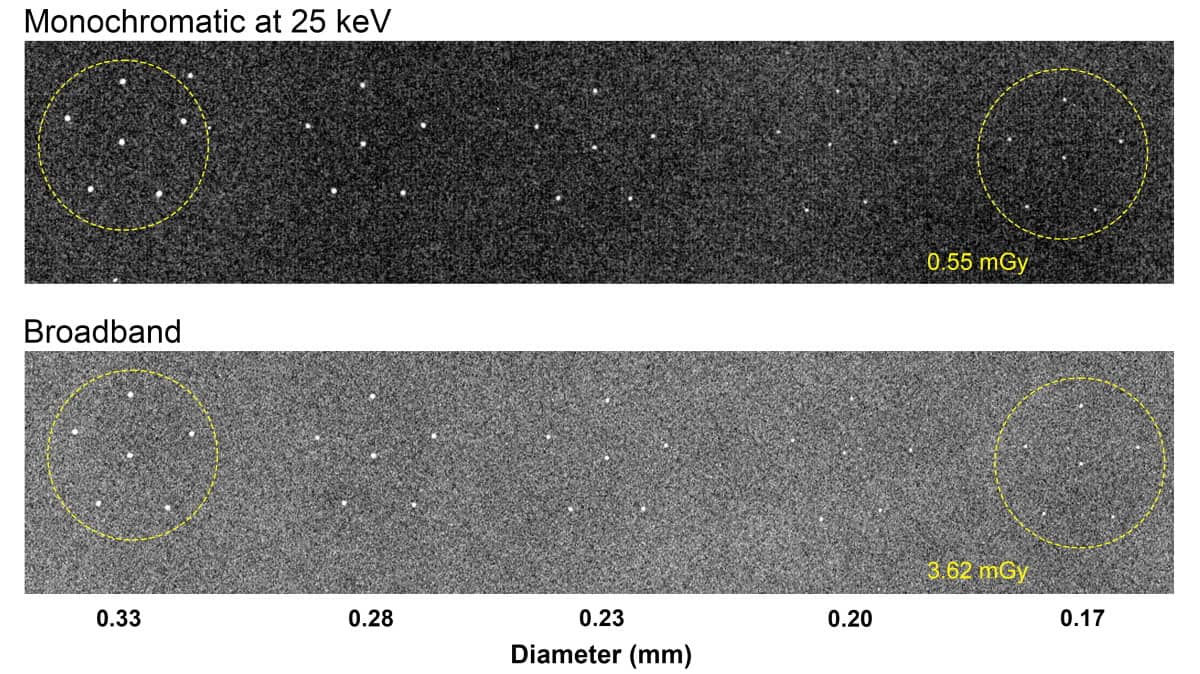
Monochromatic versus broadband X-ray imaging

“[We] anticipate its [system’s] first use in the clinic within several months,” Silver tells AuntMinnie.com.

Fishman and Rehani also assessed signal-to-noise ratio as a measure of image quality at different doses in breast phantoms of different sizes, and reviewed the comparison of parameters with a standard mammography system.

Along with finding a five- to 10-times reduction in radiation dose, the researchers found promise for a phantom simulating thick breasts (9 cm). For such simulations, the signal-to-noise ratio for monochromatic X-rays was 2.6 times higher and the radiation dose was 4.2 times lower than conventional X-rays.

“For the conventional broadband system to equal the signal-to-noise ratio of the monochromatic system, it would require a dose of 19 mGy, 29 times higher than the dose delivered by the monochromatic system,” they note.

Rehani tells AuntMinnieEurope.com that the technology is ready for human imaging and has the potential to replace millions of X-ray tubes in the world currently in breast imaging, CT, fluoroscopy and radiography machines. He also says that more funding and clearances are needed before it can be widely accepted.

“There is a plan to upgrade technology to reduce exposure time which is again more of a financial issue rather than development of technology,” he says.

Silver tells AuntMinnieEurope.com that the prototype system is being adapted for use at higher energies to address CT applications with and without contrast.

  • This article was originally published on AuntMinnieEurope.com ©2021 by AuntMinnieEurope.com. Any copying, republication or redistribution of AuntMinnieEurope.com content is expressly prohibited without the prior written consent of AuntMinnieEurope.com.

All-optical processors could compute any linear transformation, machine learning reveals

Researchers in the US have shown how all-optical processors could be used to carry out a range of linear mathematical transformations, including Fourier transforms. Using machine learning techniques, Onur Kulce, Aydogan Ozcan and colleagues at the University of California, Los Angeles, generated the blueprint for set of diffractive surfaces that can be used to produce specific optical outputs from any arbitrary input. When implemented in the lab, the approach could provide an alternative for calculating linear transformations using conventional computers.

To process information, computers often use linear transformations to perform mathematical operations on data. A classic example is the Fourier transform, which converts a time sequence of data – such as sound captured by a microphone – into a representation of the frequencies present in the data.

The speed at which such transformations can be done is limited by the processing power of electronic computers, but recently researchers have been exploring the possibility of using purely optical devices to do the task. Since optical waves travel effortlessly at the speed of light, this approach could one day be used to process information at far higher speeds and using far less energy than conventional computers.

Metamaterials and metasurfaces

Recent advances in photonics have led to the design of new metamaterials and metasurfaces, which are engineered to diffract light in very specific ways. As wavefronts of light interact with these materials, the light is transformed in ways that depend on the geometry of the surface. By carefully adjusting the properties of diffractive surfaces, researchers can control the nature of the linear transformations they cause in light waves.

In their study, Kulce, Ozcan and colleagues showed how a series of diffractive surfaces could be used to achieve any arbitrary transformation between input and output waves. To do this, they used machine learning methods to design the surfaces required for specific transformations.

Filtering operations

Through this technique, they successfully designed a wide array of arbitrary linear transformations including Fourier transforms, image permutations, and filtering operations. In addition, they showed that the efficiency of their transformations could be significantly improved, simply by increasing the number of diffractive surfaces.

The team’s results could pave the way for a new generation of all-optical processors that could offer several advantages over conventional computers. Aside from the energy used to generate the optical waves themselves, these devices could operate completely passively; requiring no power to run.

Through future research, the techniques developed by Kulce and colleagues could soon be used to create diffractive surfaces in the lab: potentially bringing an all-optical transformation processor a step closer to reality.

The research is described in Light: Science & Applications.

Burning back burnout

Burnout is a multi-faceted phenomenon, and everyone’s experience of it is different. Remarkably, though, these unique experiences often get boiled down to similar descriptors: “I feel exhausted,” “I don’t feel like it,” or “This feels impossible.” Among the millions of professionals across all fields who experience burnout each year, the common thread is that activities they once found empowering and energizing have become exhausting and taxing.

I define burnout as the crippling experience of discovering that one’s passions are turning into sources of stress. Like waves crashing on a shore, burnout gradually erodes one’s sense of purpose to the point where it becomes unrecognizable, leading to a loss of motivation, identity and belonging in the workplace. As someone who has both experienced burnout and witnessed it in others, I have often wondered whether it is an inevitable part of life, or a problem with a solution. My optimism and experiences incline me to the latter view, and during my journey from undergraduate physics and chemistry major to 3rd-year atomic physics PhD student, I have developed several strategies for handling burnout. These responses have been critical to my survival as Black physicist.

Mentorship networks

At my undergraduate institution, I had professors, colleagues, a church and friends, but I did not really have a dedicated advocate I could relate to, or anyone who showed a long-term, vested interest in my individual success. Although I made a strong connection with my mentor during a summer research internship at the University of Mississippi (part of the US National Science Foundation’s Research Experiences for Undergraduates programme), once the summer ended, she was hundreds of miles away and understandably had obligations to her more-permanent students.

In the final (senior) year of my undergraduate degree, I won an NSF Graduate Research Fellowship. Once the news got out, nearly all my physics professors approached me in earnest, saying “Wow! Congratulations! I didn’t even know you were thinking of applying for this!” But although I was doing well, I felt a chronic, exhausting uncertainty about my place in physics, and I didn’t really understand why.

It wasn’t until I entered graduate school that I became part of a dedicated mentorship network. My two research mentors; the Sloan Scholars programme (which provides professional mentoring for under-represented STEM graduate students); my head of department; and several other members of the Illinois physics community – as well as the students I mentor myself – all help me survive burnout. They never make me feel uneasy for requesting their time, seeking counsel from them, or unapologetically addressing the isolating position of being a Black physicist. My mentorship network has been an invaluable piece of my strategy for burning back burnout because it provides me with a sense of belonging in physics.

Outreach and recognition

The absence of mentorship during my undergraduate experience has motivated me to do physics outreach in the Black community. In my senior year, I organized the Waco Physics Student Initiative, or WPSI (WΨ), to introduce local high school students to physics as a research field, rather than just a class you take for a grade. Witnessing the fire for physics ignite in the young Black students after our presentations, demos and tutoring sessions rekindled my own fire. I was further rejuvenated when an all-Black team of students, each of whom I had gotten to know personally, won first place in my department’s annual Physics Bowl for local high school students.

While fostering interest in physics among younger community members is important, organizations and events that simply celebrate and openly recognize Black physicists have been essential in helping me survive burnout. During my first year of graduate school, I experienced the National Society of Black Physicists (NSBP) conference for the first time. It was my first time ever being in a room with so many Black scientists. Simply being around and engaging with other Black physicists, collectively celebrating our experiences, our accomplishments and our presence, reinforced my resolve to keep doing my best. My drive to do my part in preserving that room of Black scientists burns back my burnout and helps me thrive in physics.

Introspection

Over the course of my young adulthood, I have learned how valuable it is to take time getting to know myself and how important it is to continuously evaluate my strengths and weaknesses. During the 2019 APS Division of Atomic, Molecular, and Optical Physics (DAMOP) conference, for example, I was new to the field, and I was also the only Black physicist in nearly every room I was in. As my ears filled with unfamiliar phrases like “Feshbach resonance” and “Franck–Condon factor”, I started to lose my motivation and identity in physics.

To fight back, I listened out for terms I didn’t know and wrote them down phonetically in my notebook. As I heard similar terms more, I started to contextualize them. Slowly, I learned how to ask the right questions, the ones that would unlock meanings. I was learning how I learn, one word at a time, by relying on a method that felt natural to me.

This type of introspection is my greatest strategy for burning back burnout because it helps me remember my strengths when I doubt myself. My motto for learning physics is “when in doubt, write it out”. I journal about physics in ways that feel natural, from working out the details of a mathematical derivation for atomic interactions to writing a pedagogical narrative that compares the way atoms handle electrons to the way people handle money. Journaling helps keep my experience of physics light and enjoyable, even during stressful times.

As DAMOP progressed, so too did I. I became comfortable having conversations with speakers and attendees, and I continued to add to my growing library of new physics terms in my notebook, which I labelled Book 1. Two years later, I’m on Book 9 of my physics journey, and my strategies for burning back burnout are the tools that will keep me going, filling more books with my knowledge and sharing what I’ve learned.


99 maps visualizing human impacts on the planet

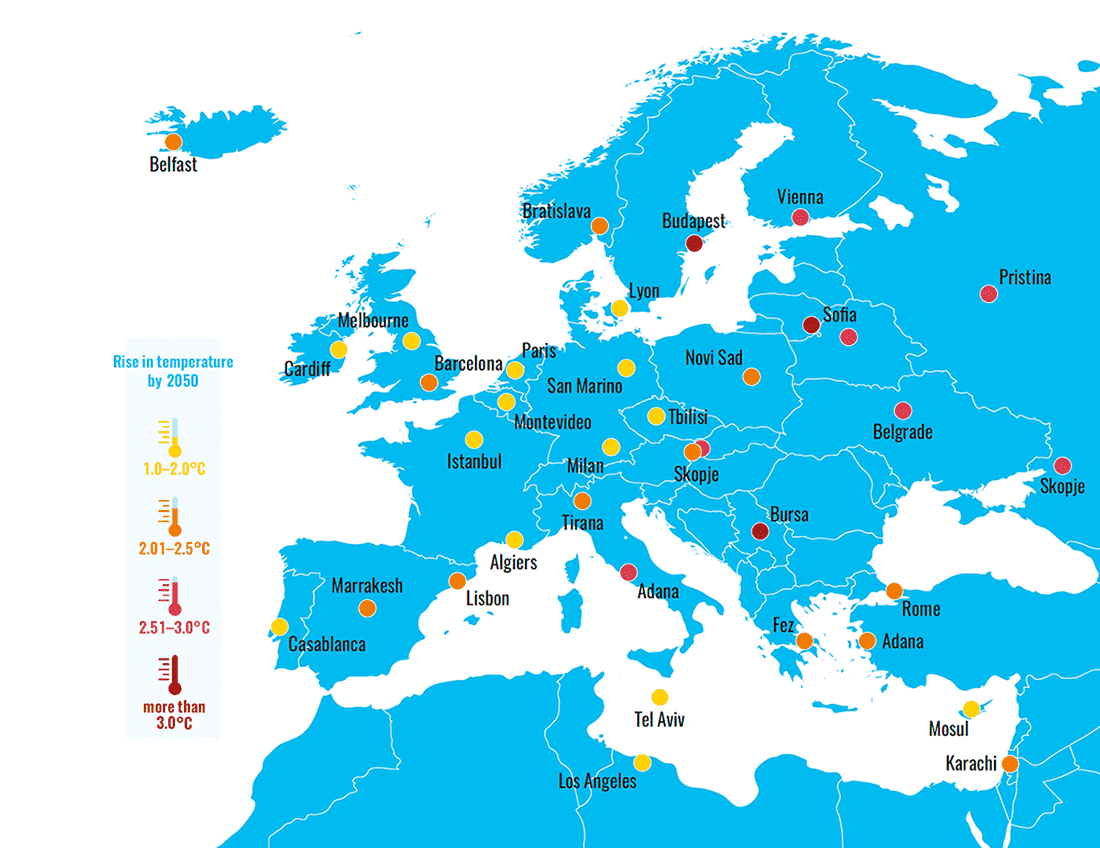
Illustration of Europe showing major cities and temperature rise

A few years ago, a friend introduced me to the idea that it’s possible to be shocked but not surprised. This is how I often felt as I flicked through the pages of 99 Maps to Save the Planet, a book that visualizes human impacts on the environment.

Put together by KATAPULT – a German magazine that creates insightful infographics on various social issues – the book has an introduction by conservationist and TV presenter Chris Packham. He makes the point that being bombarded with too much complex information can sometimes leave us confused and floundering. “There is no struggle to grasp the facts displayed so lucidly here,” he says, “no excuse to ignore them.”

While some of the ideas depicted will be familiar to most readers, such as Earth overshoot day, many of the infographics represent information in new ways that are freshly eye-opening for me. For example, in one map cities are labelled not with their own names, but the names of other cities whose current climates they will experience at various degrees of warming. At a temperature rise of 2.01–2.5 °C, London is projected to feel like Barcelona does now. Troublingly, some cities’ future climates cannot be compared with any existing ones.

There is occasional humour throughout, and some pages feel tongue-in-cheek. One, for instance, shows a map of “where people drive SUVs” in blue and “where people need to drive SUVs” in black. The map is, of course, 100% blue, with the exception of groups of islands coloured in red. The key indicates that these are islands that will soon be submerged by the sea.

The book has some positive pictures too, such as one showing the dramatic global reduction in consumption of substances that damage the ozone layer as a result of the Montreal Protocol that was implemented in the 1980s. But this just leaves me wondering why climate change hasn’t been treated with similar urgency. I hope that the shocking information in this book helps to spur some action, even if it comes without the surprise.

  • 2021 Bodley Head £16.99hb 208pp

Humidity controls frost pattern formation

Frost forms different patterns as it spreads across a surface depending upon the level of humidity, a novel imaging technique has revealed. These patterns range from complete surface coverage to fractal geometries.

Lukas Hauer, at the Max Planck Institute for Polymer Research in Germany, and his colleagues grew the frost on a microstructured surface covered in an array of micropillars spaced 30 µm apart. While this doesn’t replicate the types of surfaces that frost grows on naturally, it allowed the researchers to control the distribution of water droplets at the start of experiments. And condensation does tend to form in a pattern.

“When you have condensation on a surface, little droplets form on the surface and these droplets are usually separated by a certain distance and this distance is actually an average value. This is basically a property of the wettability of the surface,” explains Hauer. “So even if you have a smooth surface that is not microstructured, you will still see that droplets forming on the surface are separated by a characteristic distance.”

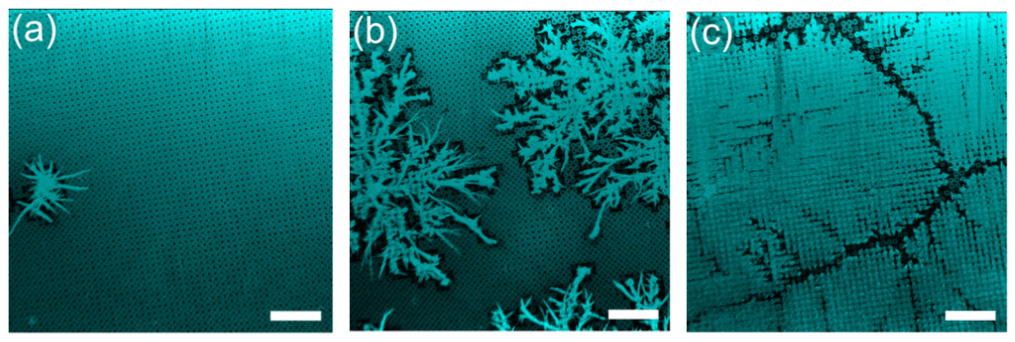
To see how frost changed with humidity, the researchers cooled the surface to −30°C and placed it in a sealed chamber. They then introduced nitrogen gas with a water vapour content of 14%, 24% or 34%. To observe the frost patterns, they used laser-induced fluorescence microscopy. The microstructure surface was infiltrated with silicon oil dyed with a fluorescent powder, which helped visualize the frost patches by increasing surface contrast.

This is the first time that this technique has been used for imaging frost and the researchers say that it allowed them to visualize frost formation in a more accurate and detailed way.

After the gas is introduced to the chamber, supercooled droplets condense on the micropillar tops, before randomly starting to freeze. These become frost nucleation sites, with frost patches growing out from them facilitated by water vapour. At the lowest humidity level (14%), most of the droplets evaporated quickly. This meant that few froze and those that did were unable to link with other droplets. Instead, they formed small spiky frost patches as droplets of water vapour froze to them.

At the highest humidity level of 34%, frost covered the surface. Evaporation was slower and almost all the droplets formed nucleated frost patches and ended up connecting to each other. Growing frost patches did halt as they approached each other, however, creating a small ditch that separated them.

Frost formation at varying relative humidity

Intermediate humidity (24%) produced an intermediate level of evaporation. Frost patches spread out and connected with neighbouring liquid droplets, growing larger than in the low-humidity environment. But this did not always happen, as some droplets evaporated before the frost bridges could reach them. This led to a branching pattern with a fractal geometry. “It is a less dense frost; with the humidity, the density of the frost changes,” explains Doris Vollmer, also at the Max Planck Institute.

Hauer tells Physics World that the rate of evaporation is linked to the initial size of the water droplets. In less humid environments, small water droplets condensate on the micropillars and evaporate quickly.

The researchers also found that the number and size of frost patches can be tuned by surface temperature. At −25°C, with a relative humidity at 28%, a few large frost patches formed. When the temperature was reduced to −35°C, more but smaller frost patches formed, and at −45°C, the droplets all froze straight after condensation, creating almost as many frost patches as micropillars.

Vollmer tells Physics World that improving our theoretical understanding of frost formation could help us reduce frosting and associated damage. She explains that understanding how humidity and temperature interact could allow us to develop different techniques for different parts of the world and different times of the year, which are linked to local environmental conditions, such as different anti-frosting surfaces.

“But it is difficult, because it is much, much more difficult to prevent frost formation than it to describe frost formation,” Vollmer says.

The researchers report their findings in Physical Review E.

Welcome to #BlackInPhysics week 2021

In October 2020 Physics World took part in the first ever #BlackInPhysics week, an event dedicated to celebrating Black physicists and revealing a more complete picture of what physicists look like.

This year’s #BlackInPhysics week runs on 24–30 October 2021 – and we’re delighted to be involved once again. In partnership with the organizers of #BlackInPhysics week, we’ll be co-publishing with Physics Today a series of five essays by Black physicists at different stages of their careers.

The focus of the essays will be on burnout in physics: how the problem manifests itself, how researchers can deal with it and (ideally) avoid burnout in the first place.

First up is Garrett Williams, a PhD student at the University of Illinois in the US, who is finding ways of using laser-cooled atoms as qubits for quantum computing.

Speaking to Margaret Harris on the latest episode of the Physics World Weekly podcast, Williams defines burnout as “a crippling experience where your passion starts to turn into sources of stress”.

In his case, it arose because Williams originally started his university career studying chemistry and, once in grad school, had to grapple with new, tricky and difficult concepts.

It didn’t help that at conferences he’d often be the only Black physicist in the room, with no role models or mentors to look up to. “It was very stressful for me and I started to question my place in physics,” Williams recalls.

I want to dispel the belief that physics is something that only certain people can do.

Garrett Williams, University of Illinois

Check out the podcast and Williams’ essay, which will be published later today, to discover his strategy for dealing with burnout. One tactic is keeping a journal to remind himself of what he’s good at.

Another is to do lots of outreach work, thereby helping the wider community too. “I want to dispel the belief that physics is something that only certain people can do,” he says. “Physics is universally hard, but it’s rewarding because it’s hard.”

For the record, here’s a list of upcoming essays in #BlackInPhysics week 2021, which will be published simultaneously on both the Physics World and Physics Today websites.

Other events during #BlackInPhysics week 2021 include a three-minute thesis competition, a “self-care cooking class”, a job fair, as well as webinars on avoiding burnout as you become a grad student and as you seek to become a professional physicist.

You can see the full list of events here.

  • For more on #BlackInPhysics week, including all the essays by outstanding Black physicists, please visit the dedicated pages at Physics World and Physics Today.

Black-hole laser could have quantum computing applications

An electromagnetic analogue for a black hole laser – a system that could theoretically amplify Hawking radiation from the event horizon of a black hole and make it observable – has been proposed by Haruna Katayama of Hiroshima University in Japan. The idea follows on from demonstrations of analogues using Bose-Einstein condensates and has the potential to provide new insights into the relationship between quantum mechanics and gravity. If built, the device could even advance technologies such as quantum computing.

Hawking radiation is one of the few hypothetically observable predictions arising when the two great pillars of modern theoretical physics – general relativity and quantum mechanics – bump into each other. At the event horizon of a black hole, quantum mechanics predicts the creation of photon pairs. One of the photons, which has negative energy, disappears into the black hole. The other, which has positive energy, escapes into outer space. This effect would cause black holes to emit radiation, giving them a measurable temperature – which would be theoretically revolutionary as it would suggest they had internal degrees of freedom. Unfortunately, the temperatures of all known black holes would be lower than that of the cosmic microwave background. The radiation emitted would be masked by the radiation absorbed and be unobservable.

In 1981, however, William Unruh, of the University of British Columbia in Canada showed that several physical systems are mathematically identical to that which produces Hawking radiation and therefore the effect could be studied in the lab. Among these analogues are water waves, fibre-optic systems and Bose-Einstein condensates.

Disputed claims

“[These analogues are] not going to get to the heart of any question having to do with quantum gravity because that’s going beyond the regime one is exploring here,” explains theoretical physicist Miles Blencowe of Dartmouth College in the US; “but there are still important questions with Hawking’s calculation. In a way you can think of these analogues as like quantum simulators.” Groups working with different “analogue gravity” systems have competed to produce the first evidence of various predictions of  Hawking, and claims by one group have often been disputed by others.

In the new work, Katayama proposes that one of the most eye-catching predictions of Hawking’s theory, made in 1999 by Steven Corley of the University of Alberta in Canada and Ted Jacobsen of the University of Maryland in the US, could be tested in a superconducting electric circuit. The duo outlined the operation of a black hole laser that requires a black hole to have a “white hole” inside it. The inner horizon of this white hole reflects negative energy photons back towards the black hole horizon, where, unable to escape, they are reflected back. The energy of the photons grows ever more negative as it bounces between the horizons, causing the energy of the photons emitted into outer space to become ever more positive.

“It’s very unlikely that one of these could be realized in nature, but it is possible to generate these in analogues,” says Blencowe. Indeed, the first such black hole analogue was produced in 2016 in a Bose-Einstein condensate.

Entangled radiation

In this latest work, Katayama proposes using the Josephson effect, which allows a superconducting current to become quantized, to create a non-dispersive wavepacket called a soliton in a metamaterial resonator. The soliton itself behaves as a resonant cavity, with radiation in the soliton becoming quantum-mechanically entangled with radiation emitted from the soliton. This emitted radiation is the analogue of Hawking radiation.

“Unfortunately, at this stage we have not been able to make proposals that surpass other [analogue] systems with this system,” says Katayama. “However, the dynamic Casimir effect, which is the dynamic fluctuation of the vacuum, has been revealed based on the proposed superconducting quantum device, and the photon detection technology developed in this system is a great advantage that cannot be imitated by other systems. In addition, this system, which is based on nanotechnology, has good controllability. Therefore, by controlling the circuit parameters, it is possible to bring the black hole from the classical domain to the quantum domain, so it may allow us to study the quantum pair creation of black holes and white holes from a vacuum.”

Blencowe  agrees the system’s sensitivity could aid the search for Hawking radiation: “Systems very close to this have been realized: they’re very important as very sensitive detectors of microwave photons and they’re very important in superconducting quantum bits,” he says; “If the proposals are realized it would be a very clean demonstration of the Hawking effect – the signal is relatively large and you wouldn’t have to worry about the noise so much.” Moreover, he sees significant potential for technology transfer: “Quantum computing is all about generating entanglement as a resource, so entangled microwave photons generated through these kinds of systems could be very useful,” he suggests.

The research is described in Scientific Reports.

Copyright © 2026 by IOP Publishing Ltd and individual contributors