Water-mediated intercalation mechanisms in transition metal oxides

Want to learn more on this subject?

Understanding host–guest interactions of layered inorganic solids ushered in the modern era of portable electronics powered by lithium ion batteries. Future improvements in the power capability of these devices, and their potential use in emerging technologies such as water treatment, critical element recovery and ion-based electronics, depend on the development and understanding of new ion insertion hosts with fast insertion kinetics. One avenue is via tuning the interlayer environment of a layered material, since many are flexible hosts, whose interlayers can accommodate not just electrolyte ions but also solvents, organic molecules, polymers and organometallics.

This webinar reviews the Augustyn Research Group’s investigation of the mechanistic understanding of water-mediated ion intercalation in transition metal oxides. Topics covered include the role of ordered and confined water networks in transition metal oxide hydrates; design of metastable hydrated oxides via displacement of interlayer ions by water; and the role of disordered and confined water networks in electrochemical capacitor materials. The fundamental understanding of these materials, which blur the distinction between solid and liquid, paves the way for electrochemical ion insertion applications with high-power capability.

Want to learn more on this subject?

Veronica Augustyn is an Associate Professor of Materials Science and Engineering and a University Faculty Scholar at North Carolina State University (NC State), US. From 2013–2015, she was a Postdoctoral Fellow at the University of Texas at Austin, US. She received her PhD from the University of California, Los Angeles, US, in 2013 and BS at the University of Arizona, US, in 2007, both in Materials Science and Engineering. Her research group focuses on the design, synthesis and characterization of materials for electrochemical energy technologies including batteries, electrochemical capacitors, electrolyzers, and fuel cells. In particular, Augustyn is interested in the relationships between material structure, composition and morphology, and the resulting electrochemical mechanisms. She leads SciBridge, an award-winning international project at NC State that develops renewable energy research and education collaborations between universities in Africa and the United States. Her research group was recognized with a 2019 Sloan Fellowship in Chemistry, 2019 DOE Early Career Award, and 2017 NSF CAREER Award. In 2021, she was named an NC State Goodnight Early Career Innovator and received the George H Blessis Advising Award for her mentorship of undergraduate students.


Cosmic-ray threat to quantum computing greater than previously thought

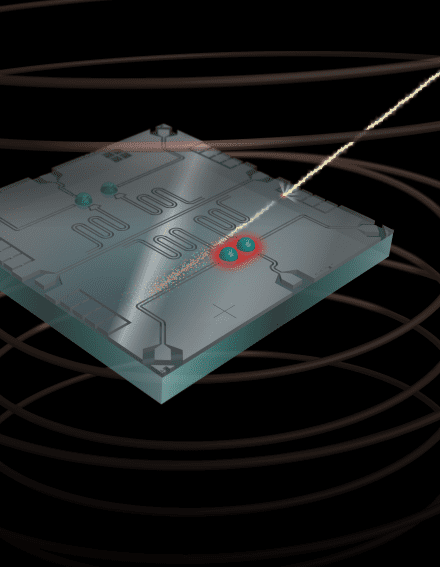
Artist's impression of a cosmic ray striking a qubit chip

Quantum computers may need a redesign to protect them from background radiation, say physicists. After earlier experiments showed that cosmic rays can severely disrupt the operation of superconducting quantum bits (qubits), an international team led by Robert McDermott of the University of Wisconsin-Madison, US, has now concluded that a leading error-correction method is unlikely to fix the problem on its own. Instead, McDermott and colleagues suggest that a combination of shielding and changes in qubit chip design may be required to keep errors at a manageable level.

Cosmic rays have created headaches in classical computing for decades. When these energetic particles fly in from space and strike a silicon computer chip, one or more bits in the chip may change state, or flip, in ways that programmers never intended. If these errors go uncorrected, damaging glitches may result – including, in one case, injuries to passengers on a Qantas flight after a bit-flip error fed incorrect data to the aeroplane’s instruments.

Surface code error correction

For quantum computers, the problem is more complicated since qubit states can flip in two directions (representing the X and Z axes) rather than one. Nevertheless, a form of error correction known as a two-dimensional surface code should, in principle, be able to handle qubit flips as long as the quantum processor meets certain requirements.

Surface code error correction works by encoding information in a flat sheet of superconducting qubits, each of which is connected to its nearest neighbours. If the error rates of individual qubit operations are low enough, it should be possible to use some of these qubits to identify and correct errors in neighbouring qubits via multi-qubit operations. The other requirement is that errors cannot be correlated – in other words, an error that affects one qubit cannot affect its neighbours at the same time.

Unfortunately, McDermott’s team discovered that errors caused by cosmic rays and gamma rays from background radiation do not meet this second condition. “We basically are finding multiple mechanisms for correlated errors,” Chris Wilen, a PhD student at Wisconsin and the lead author of a new study about the research, tells Physics World.

Quasiparticle poisoning

To study these correlated errors and quantify their effects, McDermott and colleagues constructed a chip containing two pairs of qubits: one pair separated by 340 μm, the other by 640 μm. While performing quantum operations on this four-qubit system, the physicists observed numerous simultaneous jumps in the charge induced on the paired qubits. When they modelled these bursts of charge using a standard particle-physics toolkit, they determined that the correlated jumps stem from collisions between the chip and a mixture of gamma rays and cosmic rays.

The probability of correlated jumps was highest for the qubit pair with the smallest physical separation, indicating that spacing qubits further apart reduces the direct effects of energetic particles striking the chip. However, the group also encountered a thornier problem: the energy released in these strikes ultimately gets transferred to the qubit substrate in the form of phonons, which are vibrations in a material and can lead to the creation of quasiparticles. As these phonons spread, they produce other kinds of correlated errors, and these errors affect the entire millimetre-scale chip. This phenomenon is known as quasiparticle poisoning, and Wilen says it “could be really damaging for error correction” unless it can be mitigated.

Writing in Nature, the researchers suggest two possible solutions. One is to protect the quantum processor by shielding it with lead and shifting it to an underground site, as is already done for dark matter and neutrino detection experiments that are especially sensitive to radiation. Another is to reduce the sensitivity of the qubits by, for example, adding materials to the chip that can trap quasiparticles or funnel them away from the qubit substrate. “It’s a roadblock that we’re going to get over,” Wilen says, adding that the Wisconsin group plans to explore several of these mitigation strategies in the future.

Solar radio waves could help monitor glacier thickness

Radio signals from the Sun could be used to monitor changes to ice sheets, researchers from the US have demonstrated. This new, passive radar system could offer a cheaper, lower power and more easily scalable method to gather long-term data on the melting of ice sheets and glaciers due to climate change, say the researchers.

The melting of land ice is one of the principal drivers of sea level rise, threatening coastal and low-lying communities around the globe. At present, the main way of measuring the extent of these ice sheets is to make ice-penetrating radar measurements from aircraft, using an active system to transmit a radar signal down through the ice sheet and measuring the radio waves reflected back. Airborne radar has its limitations, however, being both resource-intensive and able to provide only a snapshot of ice conditions at the time of the flight.

Low-energy monitoring

The alternative, proposed by radar engineer Sean Peters of the Massachusetts Institute of Technology (MIT) Lincoln Laboratory in the US and colleagues, instead uses naturally-occurring radio waves emitted by the Sun. The team’s sensors isolate a snippet of solar radiation in the 200–400 MHz band, then listen for that same signature in the echo created when the Sun’s radio waves bounce off the base of the underlying ice sheet – taking advantage of the randomness of the Sun’s emissions, which are, the team explain, somewhat like a song that never repeats. As with airborne radar, the delay between the original signal and the echo can then be used to calculate the distance between the surface sensor and the base.

Without the need to transmit its own signal, the team’s system is considerably less energy-intensive than its active counterparts. It could even run off batteries, potentially facilitating the creation of practical, continually-operating ice monitoring networks if the hardware can be suitably miniaturized, the team say.

“Our goal is to chart a course for the development of low-resource sensor networks that can monitor subsurface conditions on a really wide scale,” explains Peters, who conducted research for the study during his time as a graduate student at Stanford University in California, US. Such a network, he added, “could be challenging with active sensors, but this passive technique gives us the opportunity to really take advantage of low-resource implementations”.

Glacier tests

The researchers tested their approach on Store Glacier in western Greenland. There, the prototype sensor recorded an echo delay time of around 11 microseconds, which equates to an ice thickness of about 900 m — the same value recorded by ground-based and airborne active radar systems.

The concept does have limitations. One is that the level of solar radiation is relatively low, especially at the Earth’s poles. However, Hugh Griffiths, an electrical engineer from University College London, UK, who was not involved in the research, says that integrating the signal for long periods should help overcome this barrier. “The solar radiation is broadband, and in polar regions the likelihood of any interference is practically zero,” Griffiths adds.

Another drawback is that, just as active airborne systems only work during a fly-over, the passive sensor concept only works when the Sun is positioned above the horizon. The team is presently exploring whether it might be possible to harness other naturally-occurring or human-made radio sources to overcome this restriction.

Icy moon measurements

Terrestrial ice monitoring is not the only potential application for this passive radar system. The concept was originally conceived by team member and astronomer Andrew Romero-Wolf of NASA’s Jet Propulsion Laboratory as a means of probing Jupiter’s icy moons. In that application, the need for a passive system arose after it became clear that radio waves from Jupiter itself would interfere with active radar systems aboard a spacecraft — but also that the very same waves could be used to solve the problem they created.

“Monitoring ice sheets under climate change and exploring icy moons at the outer planets are both extremely low-resource environments where you really need to design elegant sensors that don’t require a lot of power,” explains team member and Stanford geophysicist Dustin Schroeder.

Electrical engineer Chris Allen of the University of Kansas, US, calls the design a “significant accomplishment that will spark other innovations in passive radar applications”. Allen, who was not involved in the work, adds: “There is no doubt that with the advent of future generations of software-defined radar technologies, the realizable spatial, spectral, and temporal resolutions will likewise improve.”

The study is described in Geophysical Research Letters.

Why these tax benefits could help you start a business

I wrote last month about the role that venture capitalists play in funding fledgling businesses. These are people who will invest cash in potentially risky but promising start-ups in return for a stake in the company. But there is a bewildering array of other options to get your new firm off the ground, including business angels, grants, loans and incubator programmes.

Another great option is to take advantage of government tax incentives. In the UK, the most useful is the Enterprise Incentive Scheme (EIS), which since 1994 has been providing tax breaks for those taking a risk on – and investing in – qualifying companies. For even earlier investments, there is the Seed Enterprise Incentive Scheme (SEIS). It was launched in 2012 with the ambitious goal to “stimulate entrepreneurship and kick start the economy”.

There is a bewildering array of other options to get your new firm off the ground, including business angels, grants, loans and incubator programmes.

SEIS applies to the first £150,000 invested in a business by outside investors, who can claim back 50% of their cash from Her Majesty’s Revenue and Customs (HMRC) via income tax relief. Even better, if the business succeeds (and the shares are sold at a profit by the investor), the investment is largely exempt from capital gains tax as well. So far over 12,000 companies have received more than £1bn of funding on which investors have received tax relief via the scheme.

As for the EIS, which is for later-stage investments into companies, it allows investors to claim back 30% of their investment via income tax relief. More than 31,000 companies have so far received investment via this scheme, raising some £22bn of funds in the process.

I’m not a financial adviser so do check out the latest official information about both schemes from the UK government website before taking any business decisions. But if you have a new firm, then as soon as you’ve finalized your first draft business plan, I would definitely encourage you to apply for advanced assurance from HMRC to confirm that the proposed investment in the company will qualify for a tax break for future investors, such as business angels.

Securing final confirmation from the HMRC can take several months, so that early assurance could be vital in persuading a would-be investor to plough cash into your business. You can, of course, apply to EIS and SEIS after an investment has been made but getting advanced assurance will reassure potential investors that they will get the tax break. In fact, they might end up investing more than planned.

Credit where credit’s due

Another consideration for a fledgling business is whether to take advantage of research and development (R&D) tax credits. These are great as they reduce the overall cost of R&D projects by allowing companies to obtain tax relief on the money spent on such work. Here in the UK, they were launched in 2000 for small- and medium-sized enterprises (SMEs), before being extended to larger companies in 2002.

In practical terms, R&D tax credits allow companies that have not made a profit in a particular year to receive money from HMRC. The cash can be crucial, especially for early-stage physics-based firms that need to spend a lot on R&D to create a product. In 2017/18 alone, tax credits provided some £5.1bn of support to nearly 60,000 British businesses. For larger and more established companies, such schemes can even influence which countries they locate R&D projects in.

Here in the UK, the government has just completed a consultation on how these schemes can be improved to encourage more investment through them. With an ambitious target to raise total investment in R&D to 2.4% of UK gross domestic product (GDP) by 2027, the government believes that R&D tax reliefs can encourage this investment by cutting the costs of innovation. The Institute of Physics (IOP) has already responded formally after consulting IOP members via its Business Innovation and Growth group.

The IOP has identified areas where the scheme could be improved to benefit physics-based businesses. In particular, there is a concern over what qualifies as R&D, which currently makes the scheme seem inaccessible to many such companies. They have to show how a project “could not be easily worked out by a professional in the field”, which naturally appears to fit with lower levels of technological readiness levels (TRL) and appears more like a patent definition.

A simpler definition of R&D would also help with the application process, which is so complicated that it has spawned an entire industry of advisers. Usually operating on a “no-win-no-fee” basis, they do a good job. But if you do succeed, you might have to pay them as much as 20% of the benefit gained – money that should be going to fund further R&D. A simplification would also encourage more firms to apply.

As the IOP has stated in its submission, a broader definition of R&D would allow firms to apply for tax credits on much later TRL development costs too. That could be a great benefit for physics-based firms, which often face big risks and costs even when building production lines. Currently those investments wouldn’t count as R&D, which has a much narrower scope.

The consultation is a great opportunity for the UK government to fine tune its R&D tax credit schemes.

Another drawback of the current scheme is that it only applies to money that has already been spent. You can only make a claim once the financial year is over, which means it can take up to 18 months (if your accounts need to be audited) to get any money back on your investment. That can be far too long for a fledgling firm, where cash flow is crucial

But I don’t want to end on a sour note. I do believe the consultation is a great opportunity for the UK government to fine tune its R&D tax credit schemes, which will help to boost the UK economy and increase the global competitiveness of British physics-based businesses. In this post-Brexit era, that’s more important than ever.


New material breaks low-thermal-conductivity record

A new inorganic material with the lowest thermal conductivity ever reported could be a boon to technologies that convert waste heat into power. The material, which conducts heat almost as poorly as air, was designed and synthesized in a way that combines two different arrangements of atoms, each of which slows down the speed at which heat moves through it.

Of all the energy generated worldwide, a staggering 70% currently goes into waste heat. As well as being bad for the environment, waste heat also causes electronic devices to overheat, decreasing their efficiency and lifespan. Some of this heat can, however, be harnessed by using materials with a low thermal conductivity κ to convert it into electricity.

Reducing heat transport via phonons

A solid’s thermal conductivity stems from the behaviour of its phonons, which are vibrations of its crystal lattice. There are two main ways to reduce heat transport via phonons: reduce the length over which the phonons scatter, or reduce the speed at which they travel as a group.

The phonon scattering length depends on the scattering between phonons themselves and the scattering of phonons by defects or boundaries within the material. The phonon group velocity, on the other hand, depends on the structure and composition of the material. Researchers have previously tried to reduce the phonon scattering length by engineering defects in materials and producing materials with nanostructures specially designed to have a low κ. Other techniques include changing the layers between crystals to alter phonon interactions at the interface between the layers.

Synergistic combinations

In the latest work, Matt Rosseinsky, Jon Alaria and colleagues at the University of Liverpool, UK, produced a composite material containing layers that selectively target phonons travelling along and across the material’s bulk. By interfacing layers of BiOCl and Bi2O2Se with Bi4O4SeCl2, they succeeded in suppressing (respectively) the contributions of longitudinal phonons and transverse phonons to the material’s total thermal conductivity. The resulting composite has a thermal conductivity of just 0.1 watts per metre Kelvin (W/m K) at room temperature along its stacking direction — among the lowest of any bulk inorganic material and only four times greater than the thermal conductivity of air.

“The starting point of the new research was to understand how the structure of a material would allow us to control heat transport through it,” Rosseinsky and Alarai explain. During their ongoing five-year-long investigation into so-called multiple anion materials, they first needed to develop new chemistry that would allow them to synthesize their material by synergistically combining two different and unusual arrangements of atoms. They also needed to identify the mechanisms responsible for reduced heat transport in each arrangement by measuring and modelling the thermal conductivities of the different structures involved.

“It is difficult to combine the mechanisms in a single material because you have to control exactly how the atoms are arranged within it,” they explain. “Intuitively, you would expect to get an average of the physical properties of the two components. By choosing favourable chemical interfaces between each of these different atomic arrangements, we experimentally synthesized a material that combines them both.”

Improved low-κ materials

Importantly, the new material has a much lower thermal conductivity at room temperature than either of the materials containing just one such arrangement. This unexpected result shows that the location of the different atoms in the structure is important, and it helps to explain why the properties of the whole are better than those its component parts.

Rosseinsky, Alaria and colleagues now hope to optimize the electronic properties of their material to create a thermoelectric. They also plan to transfer the new design principle to other classes of inorganic material that could be employed in thermal barrier coatings for gas turbines. These coatings need to have a thermal conductivity lower than that of silica glass, which has a κ of 0.9 W/m K.

According to the researchers, their strategy of combining different atomic arrangements to maximize their effectiveness in reducing heat flow has not yet reached an endpoint. “These materials could be improved even further by optimizing the arrangement of each of the structures individually before combining them,” they tell Physics World.

Full details of the research are reported in Science.

Bullying and harassment rife in astronomy and geophysics, finds poll

Astronomy and geophysics have a systemic bullying and harassment problem, the effects of which are disproportionately felt by women and individuals belonging to minority groups. That is according to an investigation by the Royal Astronomical Society (RAS), which has also found that younger researchers were more likely to be the victim of bullying than their more senior counterparts.

Commissioned by the RAS Committee on Diversity in Astronomy and Geophysics, the survey asked recipients whether they had witnessed or been subjected to workplace bullying or harassment over the last two years, if they felt their institution did enough to combat such behaviours and whether they felt treated with dignity and respect in their position.

The survey – which was distributed in spring 2020 – received 661 replies, of whom 390 reported being based in the UK, and 100 in Europe. Around half, meanwhile, were RAS members. The results revealed that 44% of respondents had been bullied or harassed at work in the previous two years – and that victims of this behaviour were found in all demographic groups analysed.

However, some demographics were worse off than others. Women and non-binary persons were around 50% more likely to be bullied than men, for example, while both disabled and black or ethnic minority individuals were 40% and 37%, more likely, respectively, to be mistreated than their non-disabled or white peers. Additionally, half of LGBTQ+ respondents reported having been bullied at least once in the previous 12 months, and 12% of bisexual astronomers reported incidents occurring on at least a weekly basis.

Feeling pushed out

Many respondents who had either witnessed or been on the receiving end of harassment wrote that they felt unable to report the incidents to their institutional authorities – with reasons cited being the power imbalance between them and their persecutor, a lack of available support, or even being dissuaded to do so by the nature of policies and structures involved.

The results from the survey are very concerning, and we must act to change this unacceptable situation

Emma Bunce

“It’s bleak – and sadly somewhat unsurprising – but this is unequivocal evidence to show we need to improve the workplace culture in academia,” says RAS diversity officer Aine O’Brien, who conducted the survey. “We have a well-reported diversity problem in [science] and this does nothing to help. Women and minorities are feeling pushed out. By shining a light like this…it means no institution or research sub-field can say ‘it doesn’t happen here’. We have a collective responsibility to address this.”

O’Brien speculates that future steps to tackle the problems could involve an inquiry into the issue, additional funding to support grassroots minority groups in the field or trying to encourage funding councils to factor bullying reports into their decision-making processes (although some have previously expressed reluctance to do this).

The team also notes that respondents on non-permanent contracts were more likely to report having been the victims of workplace harassment. Other concerning findings from the study include that most respondents with disabilities felt that they were less likely than their peers to be treated with dignity and respect at work – while 17% reported receiving bullying and harassment on a weekly basis.

As the first of its kind in these two fields, the study is unable to show whether the situation is changing, although future iterations of the survey may be able to provide a more long-term perspective. However, O’Brien notes that the results broadly mirror findings from a census last year by the Space Skills Alliance, in which women, ethnic minorities, LGBTQ+ people and those with disabilities were less likely to report feeling welcome working in the space sector.

“The results from the survey are very concerning, and we must act to change this unacceptable situation,” says RAS president Emma Bunce. “[The society] is committed to working alongside the community to urgently improve the environment in astronomy and geophysics.”

The full findings of the survey are expected to be published later this year.

Ask me anything: Mariya Lyubenova – ‘I love the constant supply of food for thought that research offers’

Mariya Lyubenova

What skills do you use every day in your job?

Science is a highly creative endeavour and also requires logical problem solving, so what I use most often are my analytical skills and creativity. In both my science communication work and my research, these skills are indispensable.

Another skill that I use on a daily basis is the ability to learn fast about research in other fields and disciplines. My own scientific expertise is in the area of galaxy evolution. However, my work as a science adviser and editor of a science and technology journal confronts me with a variety of fields in astronomy and engineering, and often with other natural sciences (and sometimes even social sciences). So I need to learn quickly about those fields to understand what I’m reading.

Last, but not least, I rarely have a day in which I don’t need strong diplomacy and negotiation skills; these are very important in all areas of my work. Combined with analytical skills, they give me the ability to get to the root of a problem and find common ground, so we can reach a mutually beneficial outcome for all.

What do you like best and least about your job?

I like the variety that my job offers, and that I am working at the forefront of astronomy research. Making sure that new science results reach as broad an audience as possible is really rewarding. Due to the nature of my position, I wear several hats at once, which guarantees that I never get bored. My daily job can change completely in the course of a few hours.

My various tasks include reviewing scientific manuscripts for publication in our science and technology journal, or as a press release, or in another communication product; providing science and strategy advice to stakeholders regarding their communication activities; discussing new ways to visualize scientific concepts with our visual artists; meeting my students to ponder puzzling questions that come up in their science projects; and making progress on my own scientific research. I love the constant supply of food for thought that research offers, as well as having the opportunity to work and interact with a diverse range of colleagues in terms of expertise and cultural backgrounds.

I love the constant supply of food for thought that research offers, and working with diverse colleagues in terms of expertise and cultural backgrounds

What I don’t enjoy is the time pressure of deadlines, which can often be very tight. A key to meeting the deadlines is having good self-discipline and distributing tasks to the members of my team who are best suited to accomplishing them.

What do you know today, that you wish you knew when you were starting out in your career?

I wish I knew that one failure is not the end of everything. There is really no need to be absolutely perfect from the beginning in whatever you do – if you were, you would miss vital opportunities to learn from mistakes. I know this sounds a bit cliché, but I really wish I had internalized this understanding earlier. I don’t mean to promote sloppiness – quite the contrary. I have come to realize that I learn best and fastest when I am able to quickly analyse a mistake and then move on to apply what I have just learned to my next endeavour, and ultimately achieve a better result.

PET imaging tracks ingested microplastics in mice

Microplastics, tiny pieces of plastic debris less than five millimetres in length, are designed for commercial use or created through the breakdown of consumer products and industrial waste. They litter our oceans, they have been detected in everything from aquatic life to drinking water, and they take lifetimes or longer to decompose. In 2019, the World Health Organization called for more research on the effects of microplastics to the environment and human health.

Humans ingest and inhale microplastics, and they also can absorb them through the skin. Less is known about the risks and health effects of these exposures. In some animal studies, exposures to large amounts of microplastics have been associated with inflammation, metabolic disruptions, increased cancer risk and other adverse health effects.

To begin to learn more about how microplastics interact with the body, researchers in South Korea turned to functional imaging.

Tracking radiolabelled microplastics in mice

Jin Su Kim, Choong Mo Kang and their teams at the Korea Institute of Radiological & Medical Sciences and the University of Science and Technology observed and imaged mice that had ingested microplastics that were labelled, or paired, with a harmless radioactive compound.

The mice ate small plastic compounds joined to copper-64, a positron-emitting radioisotope, and DOTA, a molecule that helps bind copper-64 to plastic. For two days the researchers traced the paths taken by the tagged microplastics after they were ingested, by detecting pairs of gamma rays created during the decay of copper-64.

Positron emission tomography (PET) scans and accompanying gamma camera scans confirmed that the microplastics had spread throughout each animal’s body. Over the 48-hour observation period, the plastics passed through and were taken up by the stomach, intestines, liver, spleen, heart, lung, kidney, bladder and other organs. The researchers also observed the accumulation of radiolabelled copper-64 in tissues.

Ex vivo thin layer radio-chromatography confirmed that the small PET signals were indeed coming from radiolabelled microplastic and not another form of copper-64, and organs were identified using simultaneously acquired computed tomography (CT) scans.

What now?

The researchers’ results, which were published in the Journal of Nuclear Medicine, “may be used as the basis for future studies on the toxicity of microplastics,” says Kim, one of the senior authors on the study.

“There are many studies on the absorption of microplastics using fluorescent plastics in the body,” explains Kim. “However, we are the first to identify the in vivo absorption pathway of microplastics over time using radioisotope and PET techniques.”

The big advantage of the researchers’ PET imaging technique is that, unlike fluorescent plastics-based studies, it doesn’t require animal sacrifices at each observation time point.

The researchers’ next steps are to evaluate the biological effects of long-term exposure to microplastics in organs and continue to identify the in vivo pathways of small pieces of plastic derived from the breakdown of larger plastic debris, another type of plastic that they would like to track with PET. Major challenges for future work include labelling radioisotopes to these larger microplastics, which requires the addition of molecules not ordinarily present in plastic, and then detecting useful signals.

Twisted trilayer graphene could be a spin-triplet superconductor

Physicists in the US and Japan have observed superconductivity in a graphene-based material during the application of very high magnetic fields. What is more, the superconductivity re-emerges after dropping to zero as the field strength is increased.

The team, led by Pablo Jarillo-Herrero at the Massachusetts Institute of Technology, spotted the curious behaviour in magic-angle twisted trilayer graphene (MATTG), which is a member of a family of 2D materials that have extraordinary properties. The team’s observations suggest that MATTG displays the extremely rare property of 2D spin-triplet superconductivity – which could be used to create more resilient quantum computers.

When an electrical current is applied to a conventional superconductor, Cooper pairs of bound electrons can move through the material without any electrical resistance. Normally, these electrons exist in spin-singlet Cooper pairs, in which the electrons’ spins point in opposite directions.

Pauli limit

When a strong magnet field is applied to a superconductor, these spins are forced to both point in the same direction, thus destroying the Cooper pairs and the superconductivity. This occurs at a field strength called the Pauli limit, which in conventional superconductors is about 3 T.

In some exotic superconductors, Cooper pairs can be formed by electrons in a spin-triplet state in which both spins point in the same direction. In this case, pairs can stay bound together in magnetic fields above the Pauli limit.

Graphene is a sheet of carbon just one atom thick and Jarillo-Herrero’s team made their discovery as part of their exploration of the exotic electrical properties of stacked sheets of graphene. In 2018, the team found that if the atomic lattices of bilayer graphene are rotated slightly by a magic angle, the material becomes a superconductor. In 2021, the team found that magic angle twisted trilayer graphene (MATTG), where the atomic lattice of the middle layer is rotated slightly relative to the top and bottom layers is also a superconductor, but also appeared to be unusually resistant to high magnetic fields.

High fields

Now, the team has investigated this property of MATTG further. When applying a current to the material and measuring its resistance, they found that superconductivity only disappeared entirely at applied magnetic field strengths of around 8 T.

But that is not all. When the team further increased the strength of the magnetic field, the material became a superconductor again. Indeed, the superconductivity endured to fields as high as 10 T, which was the maximum strength of their magnet. This is 2–3 times the expected Pauli limit for MATTG.

Called re-entrant superconductivity, this effect has been seen in other spin-triplet superconductors, leading the team to suggest that MATTG is such a material – something that they hope to confirm in future studies.

Even if MATTG is not a spin-triplet superconductor, its resilience in high magnetic fields could lead to significant improvements in technologies such as magnetic resonance imaging (MRI) – which relies on superconducting magnets to create high magnetic fields. Superconductors are also used as quantum bits (qubits) in some quantum computers, and MATTG-based devices could be more resilient to debilitating magnetic noise.

The research is described in Nature.

US Nobel-prize-winning physicist Steven Weinberg dies aged 88

The US physicist Steven Weinberg, who shared the 1979 Nobel Prize for Physics for his theoretical contributions to the Standard Model of particle physics, died on 23 July aged 88. In the 1960s Weinberg’s work was instrumental in understanding the weak interaction in particle physics, which is best known for its role in nuclear decay. He shared the 1979 Nobel prize equally with Sheldon Glashow and Abdus Salam.

Born in New York on 3 May 1933, Weinberg attended the Bronx High School of Science, which has seen seven former pupils go on to win physics Nobels. In 1954 Weinberg received a degree in physics from Cornell University and after a year at the Institute for Theoretical Physics in Copenhagen (now the Niels Bohr Institute), he returned to the US to compete his PhD at Cornell University, graduating in 1957.

After a stint at Columbia University, in 1959 Weinberg went to the University of California, Berkeley, before heading to Harvard Univeristy in 1966. A year later, Weinberg became a visiting professor at the Massachusetts Institute of Technology where he carried out much of his pioneering work in unifying the weak and electromagnetic interaction.

Unifying forces

In 1967, at the age of 34, Weinberg published his groundbreaking work. Entitled “A Model of Leptons” and barely three pages long, it became a cornerstone of the Standard Model of particle physics – and one of the most highly-cited papers in physics. The work predicted the existence of the W and Z bosons, which carry the electroweak force, and also theorized that “weak neutral currents” dictated how elementary particles interact with one another.

Working independently to Weinberg, Glashow (who was in the same year group as Weinberg at the Bronx high School), and Salam made their own contributions to the model, which later became known as the Salam-Weinberg theory. However, at the time it was not taken seriously by some in the community because it seemed impossible to subject the theory to the usual “renormalisation” procedure. This meant it generated infinite and therefore meaningless expressions, so it seemed impossible to perform accurate calculations with it.

That particular issue was overcome in 1972 when the Dutch physicists Matinus Veltman and Gerardus ‘t Hooft showed how to carry out this renormalisation and used their theory to make precise calculations of particle properties. A year later and physicists working at the CERN particle-physics lab near Geneva announced the discovery of weak neutral currents — interactions that are governed by the Z boson. In 1979 Glashow, Salam and Weinberg were awarded the Nobel Prize for Physics for “for their contributions to the theory of the unified weak and electromagnetic interaction between elementary particles, including, inter alia, the prediction of the weak neutral current.” The W and Z particles were then detected for the first time in 1983 at CERN.

[Weinberg was] one of the most accomplished scientists of our age, and a particularly eloquent spokesperson for the scientific worldview

John Preskill

In 1973 Weinberg went back to Harvard where he also held a position at the Smithsonian Astrophysical Observatory. In 1982 he moved to the University of Texas at Austin, where he spent the remainder of his career. Weinberg was a vocal advocate for the proposed $4.4bn Superconducting Super Collider – a huge 87.1 km circumference circular collider to be built in Waxahachie, Texas – that failed to receive funding and was cancelled in 1993. He also had a long-time interest in nuclear proliferation and served as a consultant for the US Arms Control and Disarmament Agency.

Book and prizes

Weinberg never retired and worked in many areas of physics throughout his career. One of which was cosmology — an interest that he developed in the 1960s. Weinberg published numerous books including the popular-science account The First Three Minutes (1977), which told the story of the origin of the universe as well as Dreams of a Final Theory (1993), in which he wrote about his belief that physics was on the verge of discovering a theory that would unite physics.

One of his last books —  To Explain the World: the Discovery of Modern Science (2015) – examined the history of physics from the ancient Greeks to the present day. Yet it was criticised by some science historians and philosophers given that it judged the past from the standpoint of the present – known as “Whig interpretation”. Weinberg knew, however, that the book would ruffle feathers telling attendees at the American Physical Society meeting in Baltimore in 2016 that he was “being naughty” with the approach. He added that without the perspective of where we are now, “the story we tell has no point”.

Weinberg unlocked the mysteries of the universe for millions of people, enriching humanity’s concept of nature and our relationship to the world

Jay Hartzell

Weinberg was the recipient of numerous prizes including the National Medal of Science in 1991 and the Benjamin Franklin Medal for Distinguished Achievement in Science in 2004. Last year, he received a Special Breakthrough Prize in Fundamental physics – and with it $3m – for his contributions to physics.

A ‘colossal’ loss

Physicists have voiced their admiration for Weinberg’s work and life. John Preskill from the California Institute of Technology (Caltech), who was supervised by Weinberg as a PhD student at Harvard, says Weinberg’s death is an “immeasurable loss”. “[Weinberg was] one of the most accomplished scientists of our age, and a particularly eloquent spokesperson for the scientific worldview,” adds Preskill. “[He] remained intellectually active to the end.”

That view is backed by fellow Caltech physicist Sean Carroll who says Weinberg is one of the “best physicists we had; one of the best thinkers of any variety” who “exhibited extraordinary verve and clarity of thought through the whole stretch of a long and productive life.” Brian Greene, from Columbia Univeristy, meanwhile, says that Weinberg had an “astounding ability to see into the deep workings of nature” that “profoundly shaped” our understanding of the universe. “His passing is a colossal loss to science and the world,” adds Greene.

“Weinberg unlocked the mysteries of the universe for millions of people, enriching humanity’s concept of nature and our relationship to the world,” noted Jay Hartzell, president of the University of Texas at Austin, in a statement. “From his students to science enthusiasts, from astrophysicists to public decision makers, he made an enormous difference in our understanding. In short, he changed the world.”

Copyright © 2026 by IOP Publishing Ltd and individual contributors