Brain–machine interface turns thoughts into actions

Brain-machine interface

Although Marvel Comics’ portrayal of telekinesis may frighten some, long-range control of objects or machines may eventually be realizable through brain–machine interface technology. Such technologies involve connecting external devices with electrical outputs from the brain to facilitate communication between humans and computers. Recently, a team of researchers from South Korea, the UK and the US developed soft scalp electronics for real-time brain interfacing and motor image acquisition. Their study, published in Advanced Science, details the design and application of this device.

The leading technique for non-invasive acquisition of the brain’s electrical activity is electroencephalography (EEG), which measures brain activity via scalp-mounted electrodes. Unfortunately, these electrodes need to be attached by (an often bulky and uncomfortable) hair cap with extensive wiring. Moreover, EEG typically requires conductive gels or pastes to minimize the effects of motion artefacts and electromagnetic interference.

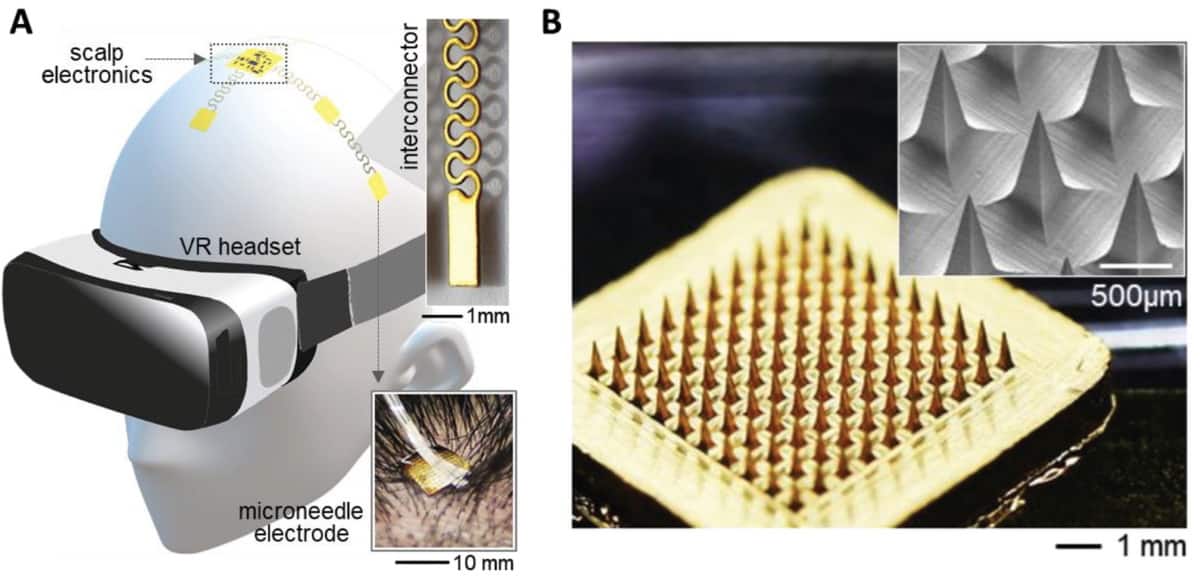
To address these shortfalls, the research team – headed up by Woon-Hong Yeo at Georgia Institute of Technology – has developed a portable EEG system that’s soft and comfortable to wear. The new device uses an array of flexible microneedles that acts as an electrode to detect brain signals. These signals feed through a stretchable connector into a wireless circuit, which filters and processes the inputs in real-time.

Woon-Hong Yeo's team

The gold-plated microneedle electrode provides biocompatibility and excellent contact with the scalp. Mechanical testing demonstrated the array’s impressive durability, yielding a low resistive change after a series of 100 bends. The microneedles themselves also showed mechanical robustness, with their shape and electrical coating remaining intact after 100 insertions of the needles into porcine skin.

To test the device’s efficacy in classifying brain signals, the team paired it with a virtual reality video game and a machine learning algorithm. In the video game, four volunteers responded to visual cues to perform motor imagery tasks every four seconds. By recording the brain’s activity, the convolutional neural network interpreted the input to determine the subject’s intended tasks. The system achieved high accuracy, correctly classifying 93% of inputs at a high information transfer rate of 23 bit/min, allowing real-time wireless control of the game.

The researchers conclude that this motor imagery technique offers significant potential to act as a general-purpose brain–machine interface. They note the need for further work in optimizing the placement of electrodes to maximize the number of functional imagery classes while maintaining high classification accuracy. The group believes that, in time, the technology may offer a solution for individuals suffering from paralysis, brain injuries or disorders such as locked-in syndrome.

Perhaps Stan Lee had a premonition of brain interface technology when he first depicted Wanda Maximoff’s telekinetic powers back in 1964…

New theory explains why metallic oxides are transparent

Few materials are both transparent and electrically conductive, and one of the rare examples that fits the bill – metallic oxides – may be transparent for reasons other than previously thought. While the usual explanation involves interactions between the material’s electrons, researchers at the Universitat Autonoma de Barcelona say that the conditions required for metallic transparency could instead arise from quasiparticles called polarons. As well as being important for fundamental science, this radically different view could aid the development of next-generation materials for touchscreens and displays.

At present, most smartphone and tablet touchscreens are made from indium tin oxide (ITO), a semiconductor that is also widely used in solar panels, LEDs in LCDs or OLEDs and for aircraft windshield coatings. Thanks to the scarcity of indium, however, ITO is becoming increasingly expensive, and researchers are looking for alternatives.

A substitute for ITO

One possible ITO substitute is vanadium strontium oxide (SrVO3), a transition-metal oxide that is metallic but becomes transparent when made into thin layers. The electrons in materials like SrVO3are confined in narrow 3orbitals, which enhances the electrostatic Coulomb interactions between them. These enhanced interactions are thought to increase the electrons’ effective mass to such an extent that they no longer resonate with the electric field of light – meaning that light particles (photons) pass straight through the material rather than interacting with electrons and being reflected.

However, researchers led by Josep Fontcuberta from the Institute of Materials Science of Barcelona (ICMAB, CSIC) say that their studies of SrVO3 suggest an alternative explanation. In their view, the effective mass of electrons is high in SrVO3not because of interactions between the electrons themselves, but because of the formation of polarons, which are couplings between electrons and the material’s ionic lattice. These couplings cause the lattice to distort around the electrons as they move through the material, which likewise increases the electrons’ effective mass.

“Serious difficulties”

The researchers obtained this result, which they describe in Advanced Scienceby analysing the optical and electronic properties of SrVO3epitaxial films grown under different conditions. “Our measurements revealed some serious difficulties when it came to describing the properties of the SrVO3with the ‘correlated electron’ scenario,” Fontcuberta tells Physics World. “Something was wrong and forced us to revise the whole picture.”

Preliminary first-principles calculations by collaborators at Germany’s Frankfurt University backed up the team’s findings, indicating that carrier-lattice coupling does indeed play an important role in the material’s transparency. According to Fontcuberta, this result may have profound implications not only for metallic oxides, but also for materials such as cuprates, which are high-temperature superconductors. These other materials, he says, “might also share the electron–polaron coupling feature we have observed”.

Looking forward, the researchers say they will now try to tune the coupling between the lattice and electrons in SrVO3. “We will also be extending our study to different materials to find out what mechanisms are responsible for the electron-lattice coupling becoming dominant as opposed to an electron–electron correlation, which should still surely be present,” Fontcuberta says.

Supersolidity enters a second dimension

Atoms in a Bose-Einstein condensate (BEC) can exist in a mysterious “supersolid” state in two dimensions, researchers in Austria have shown. The work, which builds on research from 2019 demonstrating supersolidity in one dimension, opens the way to hitherto impossible tests of theoretical predictions about this long-unexplained phenomenon.

Supersolidity is a counterintuitive state of matter that was first predicted in 1957 by the theoretical physicist Eugene Gross. At temperatures near absolute zero, Gross reasoned that vacancies in crystals of bulk solid helium-4 could condense into a superfluid that would flow through the solid. Gross’ original conjecture remains unproven: a purported 2004 discovery was, in 2012, shown by the same researchers to be the result of experimental error. Subsequent studies have produced nothing definitive.

Physicists have had more success, however, by starting from superfluids and working in the opposite direction. BECs (ultracold gases of trapped atoms all cooled to the quantum ground state of the trap) of highly magnetic atoms can spontaneously form regular, ordered clusters in an applied magnetic field, showing the emergence of supersolidity from a completely isotropic superfluid state. “The atoms inside the gas are all phase coherent, and they figure out that if they pile one on top of the other head-to-tail they can decrease their energy,” explains Francesca Ferlaino, an experimental atomic physicist at the University of Innsbruck and the Institute for Quantum Optics and Quantum Information. “In principle they could try to make an infinite filament, but actually they cannot do this because there is a kinetic energy cost and there is a trapping potential cost.”

Instead, the atoms form a series of regularly spaced piles, leading to a lattice of peaks in their shared wavefunction. This produces a crystalline order in the atoms’ density, even though each individual atom is completely delocalized.

From one dimension to two

That’s the theory. In practice, while three groups – including Ferlaino’s – achieved emergent crystalline order in superfluids in one dimension in 2019, nobody managed it in two dimensions. This severely limited researchers’ ability to perform experiments on supersolidity using quantum gases. “The interesting physics is in the behaviour of the crystals – the transport of the particles, the type of excitations that you can create,” Ferlaino explains. However, creating 2D supersolidity in a quantum gas was expected to be far from trivial: “There was this idea in the community that to reach 2D supersolidity would be much, much more difficult and would require many more atoms that were maybe at the limit of what experiments could do,” she says.

To overcome this barrier, Ferlaino’s group worked with theorists led by Luis Santos of the Institute for Theoretical Physics in Hanover, Germany. By calculating precisely how tailoring the shape of the trapping potential would alter the shape of the wavefunction – and thereby allow the researchers to turn a linear supersolid into a 2D one – the theorists “identified a way to enter into the supersolid state which was not clear”, Ferlaino says.

Using these tailored traps, the experimentalists showed how, depending on the field they applied, cooling the atoms might produce an unmodified condensate, a state comprising separate droplets or – in a very narrow range between the two – a supersolid.

Progress through competition

Giovanni Modugno, a physicist at the University of Florence, Italy whose group (including the theorists in the present work) published another of the 2019 observations of one-dimensional supersolidity, is impressed. “Normally when you have bosonic particles at zero temperature, they go to the ground state of the system, which is a wavefunction with no nodes and no modulations,” he explains. “What is extraordinary here is that we are still in the ground state of the system, but we have these places where the wavefunction almost reaches zero but doesn’t really: from the point of view of textbook quantum mechanics, these modulations are something extraordinary and extremely difficult to realise. That’s why it took 50 years or more.”

“The one-dimensional supersolids kind of appeared two years ago and it was a really big surprise when three groups overcame that hurdle,” adds theorist Blair Blaikie of the University of Otago in New Zealand, who was not involved in the latest research. “Maybe because of that competition things have really progressed quite quickly. This two-dimensional system just has a lot more features we expect of a supersolid. There’s still a lot of deep theoretical questions about the transitions between different crystalline arrangements and the nature of the phase transitions, and I think there will be a lot of interest in using this system to answer some of these questions.”

Ferlaino is keen to start answering these questions, too. “Now we’ve produced this new state, we have many things we want to study,” she says. “We want to know, say, the dispersion relation, and to study the out-of-equilibrium dynamics.”

The research is published in Nature.

National Ignition Facility heralds ‘significant step’ towards fusion break-even target

Scientists at the $3.5bn National Ignition Facility at the Lawrence Livermore National Laboratory in California say they have come a step closer to their ultimate goal of realizing “ignition”, at which fusion reactions generate at least as much energy as its lasers put in. In an experiment conducted on 8 August they say they achieved a yield of more than 1.3 megajoules (MJ) – about 70% of the energy that the laser pulse delivered to the sample.

NIF trains 192 pulsed laser beams on to the inner surface of a centimetre-long hollow metal cylinder known as a hohlraum. Inside is a fuel capsule, which is a roughly 2 mm-diameter hollow sphere containing a thin deuterium-tritium layer.

This result is a historic step forward for inertial confinement fusion research.

Kim Budill, Lawrence Livermore director

Each pulse lasts just a few nanoseconds and the lasers can deliver about 1.9 MJ of energy. This powerful blast causes the capsule to implode rapidly, creating immense temperatures and pressures inside a central hot spot, where fusion reactions occur.

Since NIF was turned on over a decade ago, its long-term goal has been to show it can, achieve ignition. This involves self-sustaining reactions, in which the alpha particles that are also emitted during fusion emit heat to initiate further fusion.

But after experiments between 2009 and 2012 fell well short of reaching ignition, NIF’s focus switched to supporting the US National Nuclear Security Administration’s work on the physics of nuclear weapons and maintaining America’s nuclear deterrent without further underground testing.

While ignition is part of that overall programme, scientists at NIF decided to change their ignition strategy, which included alterations to the shape of the laser pulses to create much more stable implosions as well as improvements to the precision of the laser and diagnostic equipment.

What has been achieved has completely altered the fusion landscape

Steven Rose, Imperial College

The work began to pay off and in 2014, these “high-foot” pulses each yielded up to 17 kJ of fusion energy (and later 26 kJ) compared to just 10 kJ in earlier experiments. In 2017, NIF researchers then obtained 54 kJ of fusion energy per laser pulse – as measured by the number of neutrons and alpha particles produced – and by last year were creating regular shots that produced around 100 kJ of fusion energy.

More bang for your buck

The shot on 8 August, which was announced yesterday, produced 1.3 MJ, generating more than 10 quadrillion watts of fusion power for 100 trillionths of a second. Although still short of break-even, the figure far exceeded previous markers.

“This result is a historic step forward for inertial confinement fusion research, opening a fundamentally new regime for exploration and the advancement of our critical national security missions,” says LLNL director Kim Budil.

Thomas Mason, director of the Los Alamos National Laboratory, says that the work is the culmination of decades of scientific and technological work stretching across nearly 50 years. “This [result] enables experiments that will check theory and simulation in the high energy density regime more rigorously than ever possible before and will enable fundamental achievements in applied science and engineering,” adds Mason.

Fusion experts outside NIF are also enthusiastic about the latest results. Plasma physicist Steven Rose, who is co-director of the Centre for Inertial Fusion Studies at Imperial College London, says the NIF team has done an “extraordinary” job, dubbing the latest breakthrough is the “most significant advance” in inertial fusion since it began in 1972.

“What has been achieved has completely altered the fusion landscape and we can now look forward to using ignited plasmas for both scientific discovery and energy production,” adds Rose.

NIF officials say the lab now plans to repeat the experiments to get a better understanding of what parameters were responsible for such a leap in energy production, cautioning, however, that it will take “several months” to do that work.

Saturn’s rings oscillate to the tune of its large and ‘messy’ core

The internal structure of Saturn has been mapped by using data from the Cassini spacecraft to observe seismic oscillations in the planet’s rings. The study reveals that the core is both larger and more diffuse than previously thought.

The research is described in a paper in Nature Astronomy and could improve our understanding of the Saturn’s formation and evolution.

“The conventional picture of Saturn’s interior is of a compact core of rocks and ices that is surrounded by an envelope of hydrogen and helium,” explains the paper’s co-author Christopher Mankovich  who is at the California Institute of Technology (Caltech). “Based on the unique information now available from Cassini ring seismology, we found that this distinction between core and envelope is not so tidy. The transition must be gradual, hence the ‘diffuse’ or ‘dilute’ core.”

Rock and ice

Along with co-author Jim Fuller at Caltech, Mankovich has found a rock and ice-dominated fluid at the centre of the planet. The hydrogen and helium content of the fluid gradually increases, moving outwards from the core as does the fraction of heavier elements.

In addition to discovering the lack of a clear boundary separating the core from the planet’s outer layers, the duo also found that the core is considerably larger than previous models had suggested.

“The diffuse core region to occupies the inner 60% of Saturn by radius, a dramatically larger number than the 10% or 20% expected from conventional models with a neatly separated core and envelope,” explains Mankovich. “At 60% of Saturn’s total radius this is a dramatic departure from previous models for Saturn’s structure, which came as a surprise to both of us. But after a long and careful investigation it does simply seem to be what the data require.”

What separates this latest work from previous studies of Saturn is the unique use of seismology data collected from the rings of Saturn — arguably the gas giant’s most famous feature.

Shaken from the core

Saturn’s rings were first observed by Galileo in 1610. They comprise a multitude of objects made of ice and traces of silicates, ranging in size from microns to metres. The closest ring to the surface of the planet is about 7000 km away, so it might come as a surprise that monitoring this stunning feature can reveal details of the interior of Saturn.

Mankovich explains that this is possible thanks to spiral patterns stirred up in Saturn’s rings by the planet’s gravitational influence and natural oscillations. “The planet itself is constantly ringing at a variety of frequencies, just like a musical instrument has its own rich spectrum of sounds at any given time,” he explains, adding “These oscillations in the planet cause small amounts of mass in the planet to essentially wobble back and forth slightly as a function of time, and this carries over into a wobbling gravitational field that can stir up waves in the rings.”

Saturn’s ring system is sub-divided into separate bands and data from Cassini has revealed dozens of waves in the C ring of Saturn driven by the gas giant’s oscillations. The frequencies of these waves allowed Fuller and Mankovich to better constrain the planet’s interior than previous methods have allowed.

Internal gravity waves

“Typically the interior structures of the outer solar system planets are constrained using their gravity fields, but this information only goes so far, since the gravity measurements are not very sensitive to the deepest parts of the interior,” Mankovich says. “Seismology is a handy and independent way to study the interior, especially at Saturn where the ring waves include those produced by Saturn’s internal gravity waves which inherently probe the deepest parts of the interior. It’s the frequencies of these internal gravity waves that turned out to eliminate many otherwise plausible interior models and let us arrive at our surprising result.”

Mankovich says that when it comes to their approach to mapping Saturn, he and Fuller took considerable inspiration from helioseismology — the use of the Sun’s regular oscillations to model its interior. Despite decades of development in this field and the growth of the related field of asteroseismology, a powerful method of charting the interiors of stars, understanding gas giants with seismology is still no mean feat.

“It’s difficult! This success story never would have happened were it not for the Cassini mission, which orbited Saturn for longer than a decade and collected a wealth of data,” concludes Mankovich. “The crucial next step will be to search for an interior model in which both of these stable regions might coexist, with the aim of explaining the ring seismology, gravity field, and magnetic field simultaneously. The best picture ever for Saturn’s structure is really starting to come into focus.”

Summer internships: Marion Cromb – ‘I learnt good coding practice, and the code was actually sold to customers at the end’

Marion Cromb

While the summer can be a nice break from studying, three months can feel like a long time to have nothing to do. After an extra-long summer between finishing a one-year art foundation course and beginning a physics degree at the University of Birmingham, Marion Cromb “never wanted to have another summer without much to do”. So they sought out internships to keep them occupied every summer throughout university.

Cromb had mixed experiences of internships. The first one was at a 3D-printing company based in London, and was unpaid apart from travel expenses. “I learnt a lot about employment law,” says Cromb, who ended up negotiating an early end date because the work was repetitive and not very interesting. “You should make sure you’re getting something out of it, and don’t be afraid to quit early if you’re not” they say, “especially if it’s unpaid.”

Despite this negative experience, Cromb searched online for internships the following year, and had better luck when applying to Metaswitch, a telecommunications software engineering company headquartered in London. The application process involved aptitude tests around basic maths and reasoning, as well as an interview. “You didn’t need specific coding skills. Metaswitch was going to train us, so it was just about making sure I had the fundamental skills and would be worth training.”

During the internship, Cromb was based at Metaswitch’s Enfield location, and built code designed to send manufactured data packets across a connection to see if there was any loss, which is a standard networking protocol. The code was built in the programming language C, and had to meet company standards. “That was great experience of learning good coding practice, and the code was actually sold to customers at the end, which was cool.”

Cromb was one of many interns at Metaswitch, and the company arranged lots of social activities for them to get to know each other. “It was 2016 – the summer of Pokémon Go,” they say. “The company organized a hackathon week, and we made a rip-off of Pokémon Go, called Metaswitch Go, where we used facial recognition to capture the faces of Metaswitch employees that you could put in your Metadex.”

Cromb did two further internships, both in academia. The first came about after they asked a professor at Birmingham, who was going to be their MSc supervisor the following year, about any potential projects they could do. The professor arranged a summer project in which Cromb investigated using laser light to improve the accuracy of particle tracking. Quantum uncertainty was the key: by increasing the uncertainty in the amplitude of the light you can reduce it in the phase, or vice versa, a trick known as “squeezing“ light.

Cromb heard about the second internship through an e-mail from their university, advertising a placement at Cardiff University. For this project they built a Michelson interferometer to be used in outreach demonstrations.

Comparing industry with academia, Cromb found that the industry placement was a lot more structured, with more guidance. “In academic placements, you often have less formal supervision, but you should ask for help if you need it. At one point in the project at Birmingham, we realized we’d spent a few weeks trying to do the wrong thing.” Another difference they found between academia and industry is that industry generally pays better. “Well, some industry pays better. Some doesn’t pay at all.”

Cromb advises prospective interns to apply to as many things as possible, “because you’ll probably get rejected from most things”. But there are lots of options out there, so it’s a numbers game.

Once you have a placement lined up, there are things you can do in advance to make for a smoother start. Cromb e-mailed their supervisor the week before to let them know what their pronouns are, and to explain what it means to be non-binary. “There are some things you can get out of the way before you arrive” they say, “to make sure you feel welcome when you get there.”

Of the four internships Cromb has done, three were positive experiences, but even the less helpful one was a good learning opportunity, and they still got something out of it. “I got to keep some of the things we 3D-printed,” they say. “I still have some miniature replicas of museum statues and a wobble toy of BB8 from Star Wars.”

Shape memory scaffolds support soft-tissue healing

Scientists from the University of Birmingham and the University of Warwick have unveiled a new class of polymeric four-dimensional (4D) printable resins for use in soft-tissue engineering.

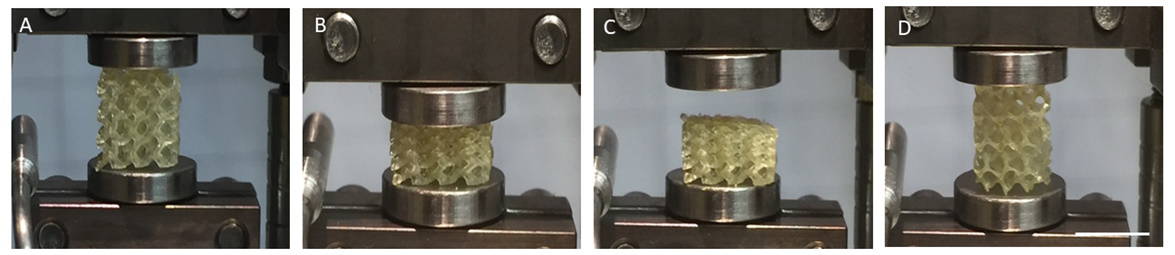
Commercialized by 4D Biomaterials under the tradename 4Degra, the resins display the physical properties needed to promote tissue regeneration following injury or surgery. When printed into scaffolds, they exhibit high compressibility and strain recovery, meaning that they can be used to create self-fitting, void-filling support structures. Moreover, their interconnected pore network allows cells to infiltrate the scaffold, which promotes ingrowth of tissue and blood vessels.

“4Degra is the first biocompatible and fully biodegradable UV-cured resin for 3D printing,” says lead researcher Andrew Dove. “This means that complex shapes tailored to an application can be printed with high resolution using UV-based 3D printing methods.”

Filling the void

For patients with soft-tissue trauma, regions of tissue loss (“dead space”) severely limit the healing process. The cells responsible for tissue regeneration cannot proliferate inside the dead space, leading to deformities.

Because shape memory materials conform to the dimensions of their surroundings, they can fill these voids and subsequently provide a physical structure for cells to migrate into. This ensures consistent tissue support during the healing process.

The polycarbonate-based 4Degra resins are formulated with a photo-initiator and photo-inhibitor to ensure that they rapidly form gels when exposed to visible light, making them compatible with stereolithography-based 3D printing techniques.

By modulating the resin composition, the researchers printed porous scaffolds with a wide range of thermomechanical properties. In addition, the scaffolds demonstrated excellent shape-recovery properties (up to 85% compressibility and less than 1 N expansion force) when inserted into alginate gel, a soft-tissue-mimicking material. These results suggest that the scaffolds can be implanted inside the body via minimally invasive surgery, without inflicting pressure (and therefore pain) on the surrounding tissues.

Shape-recovery properties

The researchers also tested the biocompatibility of their scaffolds in a mouse subcutaneous model. After two months, they observed that adipocyte (fat) cells had infiltrated the pores and formed lobules, indicating healthy tissue regeneration. Interestingly, less scar tissue formed on the porous scaffolds than on solid polycarbonates investigated for comparison. The researchers concluded that the increased surface area of the porous scaffolds further improved the biocompatibility of the resins.

Controlled degradation

Long-term studies confirmed that the scaffolds can support tissue ingrowth for more than a year. The resins slowly degrade into non-acidic products throughout the tissue healing process, but maintain enough mass to provide the much-needed mechanical support in the early stages of cell infiltration.

“Polycarbonates facilitate healing while reducing the risk of acidosis [increased acidity in the blood] over the material’s lifespan,” explains Andrew Weems, first author of the study.

“When degrading, polycarbonates surface erode, meaning that the degradation and reduction in mechanical properties is more controlled. This is in contrast to many other biomaterials that bulk erode,” adds Dove.

Now that the researchers have validated the printability and the performance of the 4Degra resins, they are collaborating with partners to test the material in a variety of medical devices.

The team describes the research in Nature Communications.

The business of holidays: why going away can earn you money

It’s not been a great year for holidays. Coronavirus restrictions mean you can’t just book tickets and jet off to your chosen beach or city destination – there are quarantine arrangements, lateral-flow tests and jabs to consider. Still, this month’s special issue of Physics World has got me thinking about why a break from the daily grind can be so important to get your creative juices flowing. And that’s just as true for academics as for those, like me, who work in industry.

According to a survey of 1000 small business owners by Sandler Training (UK) in 2014, nearly one in five (19%) of those who have been successfully trading for more than five years claim they dreamt up their business idea while on vacation. I’m not saying you should spend your valuable holiday time glued to your laptop doing market research. No, the trick is to let your mind wander. Daydreaming can let you “think outside the box” or have a “Eureka!” moment – and then explore it.

Daydreaming can let you “think outside the box” or have a “Eureka!” moment – and then explore it.

In the travel sector, perhaps the most famous example occurred when Maureen and Tony Wheeler (an engineering graduate) embarked on a journey in an old banger from Europe to Australia for their honeymoon in the early 1970s (hitching a lift on a yacht for the final leg). The couple decided to share their travel tips in a book, later called Across Asia on the Cheap. It was the start of the Lonely Planet travel-publishing empire, which has so far sold more than 145 million guidebooks.

Other successful businesses that started on holiday include the file-hosting service Dropbox. It was dreamt up in 2005 by Drew Houston, a former computer-science student at the Massachusetts Institute of Technology, who was travelling on a bus from New York to Boston. Frustrated he’d left his USB memory stick at home yet again, Houston recalled in a 2017 interview with Business Insider how he just decided to open his laptop and start writing code that let him store and share files. The company now has a $10bn valuation.

Then there’s the photo- and video-sharing app Instagram, which occurred to Kevin Systrom in 2010 while strolling on a beach in Baja California, Mexico. Having studied engineering and management science at Stanford University, Systrom had been developing a prototype app called Burbn. But when his fiancée Nicole said she’d never use it as images taken with her iPhone 4 camera didn’t look great, Systrom decided to add filters that could enhance the quality of the pictures. Renaming it Instagram, the company was snapped up by Facebook for $1bn two years later.

Perchance to dream

I sadly haven’t got a multi-billion-dollar business to my name, but some of my best ideas have occurred while away from the day-to-day grind, when my mind has time and space to explore ideas. I remember once returning to Heathrow airport after a business trip to the US and heading straight on to Thailand, where I’d booked a fly-and-flop beach holiday. At the time I was working for an optical-instrumentation company, which meant I had my laptop and a small spectrometer with me.

On my first morning in Thailand, jetlag woke me before sunrise. Feeling restless, I decided to fire up the spectrometer and measure the spectral characteristics of the Sun from my balcony. After recording data for a couple of days, I realized how much I liked the bright light in Thailand and began to wonder why I (and others too) couldn’t have it in gloomy old Britain. The idea spawned a business selling light-emitting diodes (LEDs) that emit “circadian” light.

After recording data for a couple of days, I realized how much I liked the bright light in Thailand.

These devices mimic the spectral content of the Sun by being bright and having lots of blue during the day, while transitioning smoothly to a dimmer, candle-like glow with lots of red at night. Our lighting products were mostly sold to hospitals and care homes, who used them to shorten patients’ recovery times and boost the well-being of long-term residents. I even installed them in my house, which magically took me back to Thailand whenever I turned them on..

The big picture

Sometimes, though, a good holiday isn’t about developing a new business idea – but getting a sense of perspective about what’s truly important in life. That was certainly the case on my last “proper” holiday, when my wife and I were driving from Spain, up into France and then down through Italy. Realizing we’d be passing near the huge ITER experimental thermonuclear fusion reactor, which is being built north of Marseille, I decided to call them up from the car and see if I could drop in.

Casually mentioning my links to the Institute of Physics, which publishes Physics World, I managed to bag a last-minute tour of the construction site the following day. The visit gave me a chance to see in the flesh this inspirational, international megaproject, which will harness the power of the stars to produce green and carbon-free energy – surely one of the last great problems humanity needs to solve. I didn’t get any new ideas on that occasion, but you never know what a break can do.

Take the Scottish microbiologist Alexander Fleming, who in 1928 famously left a sample of inoculated Staphylococcus bacteria on culture plates in his lab before heading off on holiday with his family to his Suffolk country home. Returning a few weeks later, Fleming saw that one culture was contaminated with a fungus that had destroyed nearby colonies of bacteria but left those further away untouched. The mould was from the genus Penicillium, which can be used to make penicillin – the first and most famous antibiotic. Simply by being on holiday, Fleming had stumbled across a world-changing discovery.

So for anyone who thinks they’re too busy to go on holiday or it’s waste of time – remember that a change can be as good as a rest.

Enhanced optical tweezer speeds up nanodiamond transport

Physicists in the US have developed a new platform for trapping and rapidly manipulating the positions of nanoscale quantum objects. Justus Ndukaife and colleagues at Vanderbilt University and Oak Ridge National Laboratory used a combination of gold nanopillar arrays and a specialized optical tweezer to transport individual nanodiamonds to specific locations within just a few seconds. Their techniques could pave the way for a diverse range of advanced quantum technologies.

Suspended colloidal nanodiamonds are highly effective tools for enhancing interactions between light and matter. Measuring less than 100 nm in diameter, each nanodiamond contains a point defect known as a nitrogen-vacancy centre that can emit single photons under room-temperature conditions – a key building block for quantum photonics.

To exploit these point defects in practical applications, the nanodiamonds’ emission properties must first be enhanced by trapping groups of them and then creating entanglement between the spin states of their nitrogen-vacancy centres. Previously, this has been done via a combination of optical tweezers and arrays of nanopillars that act like tiny antennas. When illuminated by their resonant wavelength, these structures create highly localized and enhanced electromagnetic fields within volumes that are much smaller than the smallest possible spot sizes of optical tweezer laser beams, thereby trapping nanoparticles within deep, narrow wells.

Despite these advanced capabilities, however, researchers have so far only been able to rapidly confine nanodiamonds at specific positions defined by the locations of the nanoantennas. It remains extremely difficult to transport individual particles into positions outside these “hotspots”, meaning that it can take hours to assemble groups of nanodiamonds with entangled nitrogen vacancy centres.

Field distortion

In their study, which is published in Nano Letters, Ndukaife’s team overcame this issue by developing a new manipulation tool known as a low-frequency electrothermoplasmonic tweezer (LFET). As well as a laser beam, this device incorporates an alternating current (AC) electric field that induces thermal gradients in the nanopillar array, distorting the electric field it experiences. This combination allowed the researchers to establish a robust electrohydrodynamic potential capable of stably trapping and dynamically manipulating individual nanoparticles.

As a proof of concept, the researchers used the LFET to trap a single nanodiamond on top of an array of gold nanopillars and manipulate it by moving a near-infrared laser beam over the array. This nanoparticle transport method proved so rapid that Ndukaife and colleagues ultimately cut the time required to assemble a group of nanodiamonds from several hours to just a few seconds.

The researchers hope that their techniques will pave the way for scalable assemblies of ultra-bright sources of single photons. Ultimately, the LFET could become a reliable tool for fabricating large, stable systems of quantum bits (qubits), thereby opening up new capabilities for technologies such as on-chip quantum information processing and low-noise, high-resolution quantum sensors.

Cuprate superconductors contain a strange component

Nobody really understands why cuprates – highly doped copper oxides – are high-temperature superconductors, and researchers in the UK and the Netherlands have now discovered that the materials don’t conform to conventional theories in their metallic state either. Instead, the researchers suggest that cuprates may contain a mix of “strange” and conventional metallic components, but this only poses a further question: which component is responsible for the cuprates’ superconductivity?

Superconductivity occurs when a material loses all resistance to an electrical current below a certain critical temperature. Conventional theory (also known as BCS theory after the initials of its authors) states that at this critical temperature, the electrons in the material overcome their mutual repulsion and join up to form so-called Cooper pairs that travel unimpeded through the material.

Conventional theory does not apply

While this theory holds true for most superconducting materials, it does not apply to the cuprates, which are special in several ways. First, they become superconducting at considerably higher temperatures than other superconductors. Second, they form a new type of metallic state in which their electrons behave in a peculiar way. Unlike electrons in ordinary metals, which travel freely with few interactions and little resistance, electrons in so-called “strange” metals move sluggishly and in a restricted fashion. They also dissipate energy at the fastest possible rate allowed by the fundamental laws of quantum mechanics.

In their experiments, researchers led by Nigel Hussey of the University of Bristol and Radboud University began by painting electrical leads onto tiny single crystals of two families of cuprates: Bi2201 and Tl2201. They then placed these crystals inside a cryostat housed in one of the world’s largest resistive magnets, located at the HFML-FELIX laboratory at Radboud. Next, they measured how the magnetoresistance of the materials varied with temperature – only to find that the data did not fit models based on the conventional theory for metallic transport. Instead of increasing quadratically with temperature, as expected, the increase in electrical resistance was linear.

Signature for incoherent transport

“This result provides strong evidence that the magnetoresistance in these materials does not originate from normal charge carriers (electrons),” Hussey explains. “It instead provides a signature for ‘incoherent’ transport – that is, coming from carriers whose energy is being dissipated at the maximal rate allowed by quantum mechanics.”

The new work also backs up a previous study by the same group in which the data also hinted at the presence of incoherent carriers. The results from both studies suggest that superconductivity in high-temperature superconductors may derive from carriers that show signatures of incoherent transport in their normal (that is, non-superconducting) state, Hussey explains. This explanation is completely different from the coherent carriers that form the foundations of the conventional BCS theory of superconductivity.

“For a long time, we thought that we could explain the metallic states of highly doped cuprates using the same theory that we apply to conventional metals like copper, despite the fact they were high-temperature superconductors,” Hussey says. “This work shows that this is simply no longer possible.”

The researchers say they are now investigating how the unusual quadrature magnetoresistance develops across the entire phase diagram of the cuprates they studied to see if they can learn more about where the incoherent effect comes from. “We will also carry out a comprehensive quantitative study of the Bi2201 system in order to study how the superconducting charge carriers and incoherent carriers are empirically correlated,” Hussey reveals.

The research is detailed in Nature.

Copyright © 2026 by IOP Publishing Ltd and individual contributors