Light cages could give quantum-information networks a boost

A new on-chip device that is very good at mediating interactions between light and atoms in a vapour has been developed by researchers in Germany and the UK.  Flavie Davidson-Marquis at Humboldt University of Berlin and colleagues call their device a “quantum-optically integrated light cage” and say that it could be used for wide range of applications in quantum information technology.

Hybrid quantum photonics is a rapidly growing area of research that integrates different optical systems within miniaturized devices. One area of interest is the creation of devices for the control, storage and retrieval of the quantum states of light using individual atoms. This is usually done by integrating on-chip photonic devices with miniaturized cells containing warm vapours of alkali atoms. However, this approach faces challenges due to inefficient vapour filling times, high losses of quantum information near cell surfaces and limited overlaps between the wavelengths of light used in optical circuits and the wavelengths of atomic transitions.

Arrays of dielectric cylinders

Now, Davidson-Marquis and colleagues have addressed these issues by creating an on-chip light cage that is integrated onto an alkali vapour cell. Fabricated extremely precisely using a 3D laser nanoprinter, the pipe-like cage has a diameter of about 24 micron and is made from arrays of dielectric cylinders, arranged in a hexagonal pattern around a hollow core.

Unlike the fibres and planar waveguides used previously, this compact, easy-to-handle light-guiding structure can be accessed laterally – allowing alkali atoms to diffuse into and fill the core in minutes. Furthermore, by coating the cage with an alumina nanofilm, the researchers could precisely tune the wavelength of the transmitted light to that of the alkali atom transition. The coating also prevents the corrosive alkali vapour from damaging the polymer cage cylinders.

Transparent window

In experiments involving vapours of caesium atoms, the team observed the emergence of electromagnetically induced transparency (EIT) within their light cage. This is a useful quantum-optical effect that occurs when specific atomic transitions induced by a light beam create a window where light with a narrow range of wavelengths can propagate freely through an otherwise opaque vapour. EIT can also be used to “store” light signals within an atomic vapour.

The team envisages clear routes towards further improvements to their on-chip device. Owing to its long-term stability, ease of integration, and versatile production through 3D laser nanoprinting, the device could be interfaced with other silicon-chip-compatible devices such as waveguides for light modulation and frequency conversion. It can also be coupled to optical fibres.

In the future it should be possible to use EIT to create a broad range of transparent windows. This could be useful for creating highly compact storage devices for quantum information or systems that control the arrival times of photons in quantum networks. Potential applications of devices with these capabilities include optical switches, quantum memories and quantum repeaters.

The device is described in Light: Science and Applications.
Ultrasonic probe promises stiffness-based disease diagnostics

One of the oldest medical procedures, palpation, consists of feeling body parts in search of abnormalities that could help diagnosis. For example, a stiffer area on the skin might indicate a tumour mass. But the nature of this physical examination limits information to the most superficial tissues and large abnormalities. What happens if tumours are located deeper inside the body or are too small to be detected manually?

A group of researchers from the Optics and Photonics Research Group at the University of Nottingham may have come up with a solution. In a proof-of-concept study published in Light: Science & Applications, they showed how an ultrasonic probe deployed on the tip of a standard optical fibre can simultaneously determine 3D spatial information and mechanical properties of microscopic structures, generating images with nanoscale depth resolution.

This “phonon probe” could represent the highest resolution ultrasonic 3D fibre imaging device in the world and could pave the way towards minimally invasive point-of-care diagnostics. “We believe its ability to measure the stiffness of a specimen, its bio-compatibility and its endoscopic potential, all while accessing the nanoscale, are what sets it apart,” says Salvatore La Cavera, first author of the study.

Brillouin scattering

Practically, the phonon probe works by pulsing coherent acoustic phonons – synchronized sound particles – into the specimen and detecting the sample’s vibrational response to infer its viscoelasticity.

The probe incorporates two lasers that emit short pulses. One of the laser pulses is absorbed by a gold nanotransducer fabricated onto the tip of the fibre, generating high-frequency phonons that are pumped into the specimen. Then, when a second laser pulse is incident on the specimen, the photons collide with the phonons and undergo a process called Brillouin scattering.

Based on the geometry of this collision, the phonon will either give or receive energy from the photon, resulting in a frequency shift in the light (Brillouin frequency shift). Measuring this shift provides a measure of the sound velocity through the medium. Combining this velocity with the rate at which the specimen dissipates acoustic energy – measured by tracking the decay of the phonon amplitude over time – quantifies the sample’s viscoelasticity.

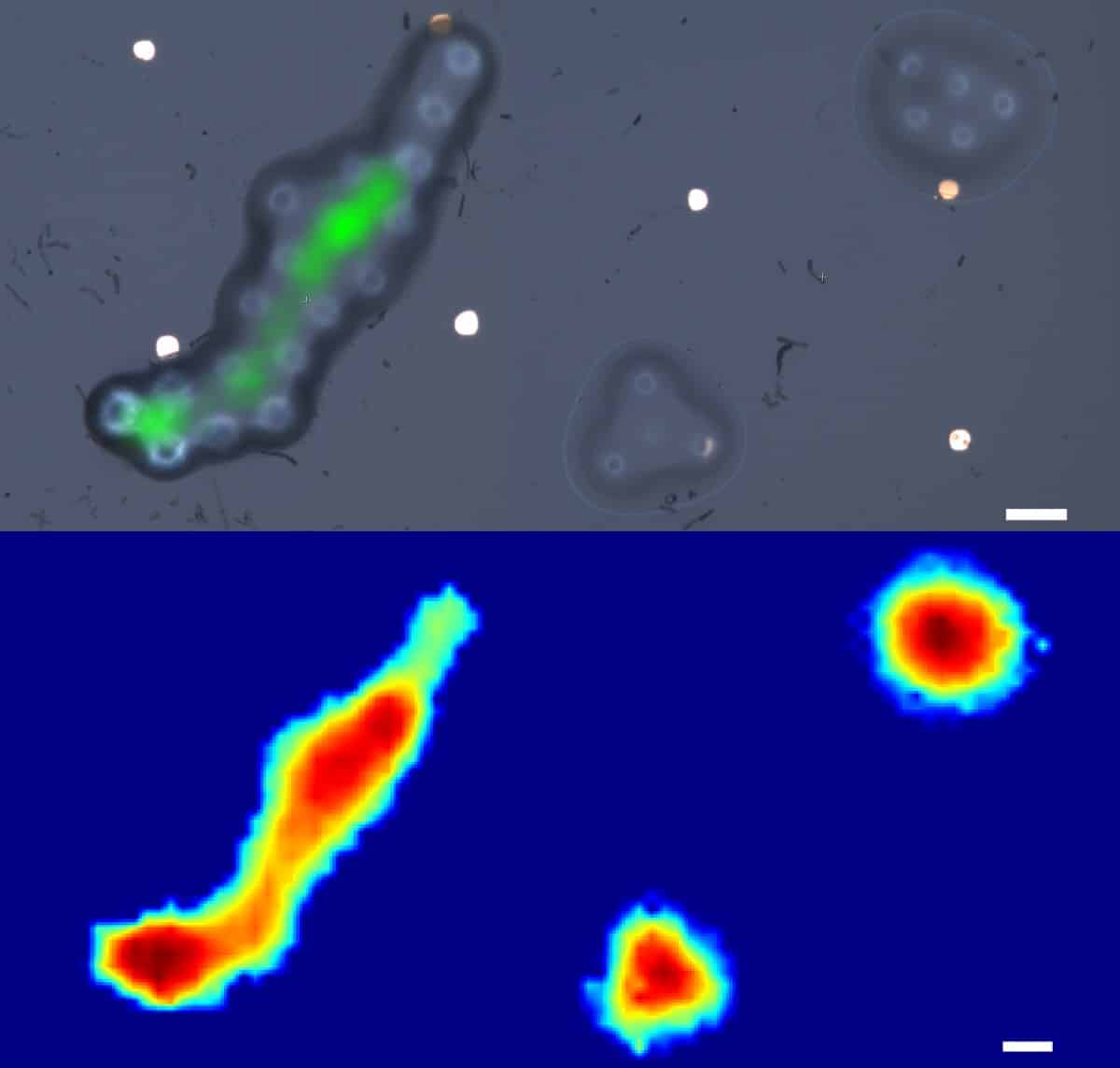
To demonstrate the probe’s ability to perform parallel 3D topographical mapping and spatially resolved elastography, the team assembled 10-µm-diameter microspheres into complex microstructures and partially melted them to create height irregularities. They used the fibre probe to scan a 100 x 100 µm area centred on the microstructures, in steps of 2 µm.

The probe demonstrated 2.5-µm lateral resolution and could measure height with 45-nm precision, over an order of magnitude smaller than the probe’s optical wavelength.

Mapping stiffness and topology

The whole scanning process took 2.8 hr, but the researchers note that in practice, this could be made much faster through sensor optimization. Indeed, probes can be deployed at the tip of each of the 20,000 fibres that make up an imaging bundle, such as in an endoscope, and immediately provide an image of the region-of-interest.

From microscopy to metrology

This is not the first use of Brillouin scattering to assess biomechanical properties of tissues. Brillouin microscopy is already used to characterize tissues in several fields, including cancer biology, tissue regeneration and 3D mapping of corneal biomechanics, where its non-contact and label-free nature make it a method of choice. But the apparatus required is cumbersome, immobile and unsuited to clinical settings, limiting assessments to ex vivo samples.

The phonon probe would provide an immediate inspection tool to help clinicians examine cells within hard-to-reach parts of the body, such as the gastrointestinal tract, and offering more effective diagnoses for diseases ranging from gastric cancer to bacterial meningitis. The team is now looking to develop a series of biological cell and tissue imaging applications to create a viable clinical tool in the coming year.

Looking further afield, the potential of such technology is not limited to healthcare. Fields such as precision manufacturing and metrology could also use this high-resolution tool for surface inspections and material characterization: either as a complementary or replacement measurement for existing scientific instruments.

Accelerating quantum start-ups, meet the CEO of D-Wave Systems

In just a few short years, quantum science and technology has gone from the lab to the boardroom with companies ranging from tech giants to tiny start-ups seeking to commercialize quantum devices and algorithms.

In this special Quantum Week edition of the Physics World Weekly podcast, we look at the challenges facing young companies and also hear from a firm that has been in the quantum business for over two decades.

First up are Jay Schrankler and David Awschalom who explain how the Duality start-up accelerator is nurturing new quantum science and technology businesses in the Chicago area.

Then we speak to Alan Baratz, who is president and CEO of Canada’s D-Wave Systems. He explains why his company is now focussing on providing its customers with cloud services on its quantum processors.

If you enjoy this episode, make sure to also join us for the inaugural Physics World Quantum Week. Running on 14–18 June 2021, the event showcases the latest developments in quantum science and technology. It includes a series of free-to-view webinars and a curated selection of quantum articles.

Novel brachytherapy device treats eye cancer with intensity-modulated radiation

“That may be one of the reasons why people in the medical physics world are interested in getting a conformal brachytherapy treatment for the eye.”

David Medich, an associate professor of physics at Worcester Polytechnic Institute, was explaining why internal radiation, or brachytherapy, may be preferable for treating ocular melanomas over external-beam radiation therapy: using brachytherapy to deliver radiation to an ocular tumour also protects healthy tissues and critical structures, like the optic nerve and retina, from radiation-induced damage.

Work recently reported in Physics in Medicine & Biology introduces a new device for intensity-modulated high-dose-rate brachytherapy. The device, designed by John Monro III, managing director of Montrose Technology Inc, and simulated by Medich’s research group, delivers a more conformal treatment to ocular tumours than conventional brachytherapy approaches. The device would also shorten treatment from one to two weeks to less than 10 minutes.

The authors

Brachytherapy and ocular melanomas

Ocular melanoma, though rare relative to all other cancers, is the most common type of eye cancer in adults. Plaque brachytherapy treatments deliver radiation to eye tumours via radioactive sources called pellets or seeds, which are placed in a device called a plaque that is sewn onto the surface of the eye.

Plaque brachytherapy treatments can be low-dose-rate (LDR) or high-dose-rate (HDR). LDR brachytherapy plaques are sewn on the eye for days at a time and may require patient hospitalization. HDR plaque brachytherapy treatments, on the other hand, can be performed as outpatient procedures because radioactive pellets are only in the body for tens of minutes at a time.

Whether a brachytherapy treatment is HDR or LDR, most brachytherapy plaques do not modulate the intensity of radiation incident on a tumour, and there is little to no collimation. In other words, most plaques cannot be adjusted to precisely conform the delivery of radiation to the tumour, so some critical structures and healthy tissues will be irradiated.

New plaque to treat ocular melanomas

The new ocular plaque is thin and ring-shaped. It’s made from gold, which is biocompatible and doesn’t react with the body’s tissues. The proposed plaque houses a series of ytterbium-169 pellets coated with stainless steel. Ytterbium-169 is a middle-energy source that emits photons with average energies of around 93 keV.

The properties of ytterbium-169 and gold have two consequences. First, the gold plaque can be used to attenuate photons emitted by the ytterbium-169 pellets and shield healthy tissues and critical structures. Second, a clinician can sew an empty plaque onto a patient’s eye and then feed the ytterbium-169 pellets into the plaque remotely, eliminating any radiation dose that might otherwise be delivered to the clinician.

In addition, the new plaque, unlike most others used in ocular brachytherapy, can be adjusted to optimize how and where radiation is delivered to the eye – a clinician can select plaques that deliver radiation to tumours at different diameters and angles.

Simulation results

The researchers modelled the new HDR plaque and ytterbium-169 pellets in two computer code systems (MCNP and BrachyDose) and validated the plaque’s performance against a commonly used LDR brachytherapy plaque and radiation source. They performed simulations for multiple tumour sizes and depths.

The new plaque reduced the dose absorbed by critical structures in the eye by up to 14%. Combined with its other advantages – shortened treatment time and reduced dose to a clinician – the researchers believe that this new plaque can feasibly treat ocular melanomas.

The researchers’ next steps are to collect experimental data to validate the performance of the plaque in the lab and to experimentally determine a prescribed treatment radiation exposure that will produce a biologically equivalent tumour response relative to conventional treatment times.

Has Betelgeuse’s ‘Great Dimming’ finally been explained?

Dimming of Betelgeuse

The dramatic dimming of the red supergiant star Betelgeuse in 2019–20 was caused by a cold spot on the surface of the star causing a nearby gas cloud to cool and condense into obscuring dust, according to new findings.

Betelgeuse, on the shoulder of Orion, usually shines as the tenth brightest star in the sky. As a semi-regular variable star, it does fluctuate slightly as it pulsates but beginning in October 2019, Betelgeuse was seen to sharply dip in brightness, from magnitude +0.5 to an unprecedented magnitude +1.64 – three times fainter – by February 2020.

This “Great Dimming” event captivated both amateur and professional astronomers, resulting in some wild speculation that Betelgeuse was about to explode in a supernova. On the contrary, it has since returned to its regular brightness.

Images taken during the dimming by the SPHERE instrument on the Very Large Telescope in Chile were able to resolve Betelgeuse, which is about 548 light years away, as a disc. They showed that the dimming was confined to a region of Betelgeuse’s southern hemisphere. This region was ten times fainter than the rest of the star.

Two explanations

When the dimming was first observed, two main explanations emerged. One was that an orbiting dust cloud was obscuring the star and the other was that an anomalous cold patch had formed on Betelgeuse’s surface. The dust cloud explanation had been most favoured, however, the dust could not be orbiting the star, because that would cause a periodic dimming, which was not seen by SPHERE

Now an international team of astronomers, led by Miguel Montargès of the Observatoire de Paris in France and the Institute of Astronomy at KU Leuven in Belgium, argue that both explanations are correct, and connected.

“We think the rapid condensation of dust due to a cool spot caused [Betelgeuse’s] brightness to drop off so steeply,” Montargès tells Physics World.

Large convective cell

Their conclusion builds on work done in 2020, when a team led by Graham Harper of the University of Colorado, Boulder used photometry to observe light emitted by molecules of titanium oxide in the atmosphere of Betelgeuse. They found that whatever instigated the dimming did indeed manifest as a cold patch in the star’s atmosphere. Cool stars like Betelgeuse are highly convective, with convection cells the size of giant planets bubbling up to the surface and sinking again. The cool spot therefore could have been produced by an unusually large convective cell.

Also in 2020, research by Emily Levesque of the University of Washington, Seattle, and Philip Massey of Lowell Observatory in Arizona, showed that Betelgeuse’s overall temperature did not drop below 3600 K, which is too high to translate into the observed dimming. Therefore, the cool spot alone could not have resulted in a significant enough decrease in overall temperature to affect Betelgeuse’s luminosity so dramatically.

Now, Montargès’s team has linked the cool spot with the formation of dust — and connected both with the star’s cycle of variability. Previous work by a team led by Meridith Joyce, formerly of the Australian National University and now at the Space Telescope Science Institute in the US measured Betelgeuse’s primary period of variability as being 416 days (± 24 days) and confirmed that the variability is the result of the star’s natural pulsations. The onset of the dimming came 424 days after the previous minimum in the star’s brightness cycle, coinciding with the next expected minimum and implying a connection between the dimming and the 416-day-long pulsation period.

Clumps of gas

Montargès and colleagues suggest that the cool spot, brought about by the pulsations, reduced the amount of radiation incident on a gas cloud that had been emitted by the star, but which was not in orbit around it. The origin of this gas cloud is uncertain, but observations of Betelgeuse with SPHERE in March 2015 showed asymmetries in its disc, which could be clumps of gas being ejected by the star.

“Our best guess is that [the gas cloud] was ejected by a more powerful than usual convective cell on the star,” says Montargès. Aligned with the cooler spot along our line of sight, the cloud would have dropped in temperature and condensed into dust particles that obscured the star, causing even more dimming.

Joyce agrees that a link between the period of variability, the cold spot and dust formation is probable, and that the gas cloud must have been ejected recently, rather than being in orbit around Betelgeuse. “To my knowledge, this is the first such event that has been observed and monitored so extensively, and now explained,” Joyce says.

Betelgeuse’s prominence in the night sky means that it is observed more often than any other red supergiant, but Joyce says, “I’m sure there will be great interest in other, similar red supergiants in the future”.

Montargès echoes this, pointing out that currently only a handful of red supergiant stars out of thousands that exist in our galaxy are routinely monitored. However, “The Vera Rubin Observatory will change this,” says Montargès of the 8.4-metre survey telescope in Chile that will begin scientific operations in 2022–23.

The research is described in Nature.

‘Talking’ quantum dots could be used as qubits

New atomic-scale computer simulations of how quantum dots “talk” to each other could lead to a wide range of practical applications ranging from quantum computing to green energy.

The research was done by Pascal Krause and Annika Bande at the Helmholtz Centre for Materials and Energy in Germany and Jean Christophe Tremblay at CNRS and the University of Lorraine in France, who modelled the absorption, exchange, and storage of energy within pairs of quantum dots. With further improvements to the model, the use of quantum dots could be expanded to include a diverse array of real-world applications.

Quantum dots are tiny pieces of semiconductor crystal contain thousands of atoms. The dots are quantum systems that behave much like atoms, having electron energy levels that can absorb and emit light at discrete wavelengths. For example, when illuminated with ultraviolet light a quantum dot can be excited to a higher energy state. When it drops back down to its ground state, it can emit a visible photon – allowing quantum dots to produce glow with vivid colours.

More complex behaviours can occur when two or more quantum dots are close enough together to interact with each other. For example, interactions can stabilize excitons, which are quasiparticles that comprise an electron and a hole and are created when electrons are excited. Long-lasting excitons can have applications ranging from photocatalysis to quantum computing

Sheer complexity

So far, computer simulations of quantum dot interactions have been limited by their sheer complexity. Since the processes involve thousands of atoms, each hosting multiple electrons, the characteristics of exciton formation and recombination cannot be fully captured by even the most advanced supercomputers. Now, Krause, Bande and Tremblay have approximated the process through simulations of scaled-down quantum dots, each containing just hundreds of atoms.

In their study, the trio successfully modelled the behaviour of the quantum dots at the femtosecond scale. Their simulations revealed how the quantum dot pairs absorb, exchange, and store light energy. They also found how excitons can be stabilized by applying a sequence of ultraviolet and infrared pulses to quantum dots. While an initial ultraviolet pulse can generate an exciton in one quantum dot, a subsequent infrared pulse can shift the exciton to a nearby quantum dot – where the energy it contains can be stored.

The team simulated interactions between three pairs of germanium/silicon quantum dots, which had different shapes and sizes. They now plan to create more realistic simulations that will allow them to model how environmental factors such as temperature can affect interactions. Through further improvements, their results could lead to a wide range of applications for quantum dots including quantum bits (qubits) that can reliably store and read out quantum information and photocatalysts that absorb sunlight, facilitating reactions that produce hydrogen gas as a carbon-free fuel source.

The research is described in the Journal of Physical Chemistry A.

Personalized 3D-printed shields protect healthy tissue during radiotherapy

One of the primary goals of radiation therapy is to deliver a large radiation dose to cancer cells whilst minimizing normal tissue toxicity. However, most cancer patients undergoing such treatments are likely to experience some side effects caused by irradiation of healthy tissue. The extent of this damage is dependent on the treatment location, with the most common toxicities involving the oral cavity and gastrointestinal tract.

Materials with a high atomic number (Z), often known as radiation-attenuating materials, can be used to shield normal tissue from radiation. However, integrating such materials into current patient treatment protocols has proven difficult due to the inability to rapidly create personalized shielding devices.

James Byrne and colleagues at Brigham and Women’s Hospital, Dana-Farber Cancer Institute, Massachusetts General Hospital and MIT have addressed this need. The team has developed 3D-printed radiation shields, based on patient CT scans, incorporating radiation-attenuating materials to reduce the toxicity to healthy tissue.

Producing personalized 3D-printed shielding

Before a patient undergoes radiotherapy, they undergo CT scans to provide anatomical information that is used to plan their treatment. Byrne and his colleagues utilize these CT images to design personalized radio-protective devices, which they produce through 3D printing.

To determine the most appropriate shielding materials for the device, the researchers tested various elements and alloys, including liquids, with a high Z number. They characterized these materials by measuring their relative mass attenuation coefficients. From this, the team determined that elemental materials demonstrated greater radiation shielding than alloys or composites, and that mercury largely outperformed all other liquids. They then incorporated the high-Z materials into the personalized 3D-printed devices. The devices were made such that the shielding material could be removed to reduce artefacts during CT imaging and replaced prior to treatment.

To evaluate the device’s ability to shield healthy tissue from radiation, the team treated 14 rats with single-dose irradiation, half with and half without radio-protective devices in place, and examined the incidence of toxicities such as oral mucositis and proctitis.

The group also simulated clinical radiation treatments by modelling the radio-protective devices in the treatment planning software. The dose distributions with and without shielding were compared to evaluate the dosimetric impact of the device. The researchers simulated treatments of prostate and head-and-neck cancer patients, selecting the appropriate positioning of the device based on the regions of increased radiation exposure.

Evaluation of radio-protective devices

Histopathological analysis revealed that only one of seven rats with radio-protective devices in place during treatment suffered ulceration on the surface of the tongue. In contrast, all seven control rats, with no device in place, experienced extensive ulcerations on the tongue surface.

The clinical simulations identified that using radio-protective devices during prostate cancer treatment could reduce the dose to healthy tissue by 15% without reducing the dose delivered to the tumour. For the head-and-neck cancer treatment, the dose absorbed by inner-cheek tissue was reduced by 30%.

The results clearly show that the radio-protective devices may improve patient comfort throughout the course of treatment. “Our results support the feasibility of personalized devices for reduction of radiation dose and associated side effects” claims Byrne.

Future clinical implementation

The benefits of using 3D-printed radio-protective devices in the clinic are clear. “This personalized approach could be applicable to a variety of cancers that respond to radiation therapy,” says Byrne.

The researchers acknowledge that full clinical translation of 3D-printed shielding devices will require further development. “Given the small sample size of our dosimetric studies, further investigation in larger cohorts is needed to validate these approaches,” they say.

The researchers publish their findings in Advanced Science.

Helgoland and the captivating origins of quantum theory

In June 1925 Werner Heisenberg retreated to Helgoland in the North Sea, a treeless island offering the 23-year-old German physicist a space to think, along with some respite from the extreme hay fever he was suffering. On that remote outpost, Heisenberg had an idea that would revolutionize physics and bring profound implications for philosophy and technology. This was an event that would kickstart quantum mechanics.

Carlo Rovelli

Helgoland is the title of the latest book by physicist and science writer Carlo Rovelli. It is essentially a journey through the origins of quantum physics, interwoven with narrative about Heisenberg, Dirac, Einstein and the other luminaries from the first quantum generation. Rovelli also discusses his own interpretations of the quantum world, and connects quantum theory with diverse ideas, from Buddhist thinking to the grand themes of the Russian revolution.

Rovelli speaks about Helgoland in this latest episode of the Physics World Stories podcast. In a wide-ranging conversation with podcast host Andrew Glester, Rovelli discusses quantum concepts, the often overlooked role of philosophy in science, and his minimalist approach to science writing.

If you enjoy this episode, make sure to also join us for the inaugural Physics World Quantum Week. Running on 14–18 June 2021, the event showcases the latest developments in quantum science and technology. It includes a series of free-to-view webinars and a curated selection of quantum articles.

Quantum microscope uses entanglement to reveal biological structures

Quantum entanglement has been used to overcome a key limitation on the speed, sensitivity, and resolution of a bioimaging technique called stimulated Raman scattering (SRS) gain microscopy.

The breakthrough was made by Warwick Bowen and colleagues at the University of Queensland in Australia and Germany’s University of Rostock, who showed how correlations between the detection times of photons from a bright laser could greatly improve the signal-to-noise ratio of SRS — allowing detection of molecular samples with 14% lower concentrations than were previously possible.

SRS is widely used for imaging biological tissues on molecular scales. It works by illuminating samples with two lasers with different frequencies. First light from a “pump” laser undergoes Raman scattering from a molecule of interest,  causing the molecule to emit a photon at a different frequency than the pump light. This “Stokes” photon is characteristic of the molecule’s unique vibrational mode and collecting these photons allows the molecule of interest to be imaged in a sample.

Clever trick

However, this Stokes signal is very weak, so a clever trick is used to enhance it. A second laser at the Stokes frequency is used to illuminate the sample, which enhances the emission of Stokes photons and makes the molecular signal easier to measure.

However, for this technique to work, noise in the Stokes laser must be reduced to a minimum. Since photons are discrete energy packets, there is an inherent randomness in the times at which they each arrive at the detector. This creates unavoidable “shot noise” in the detected signal, that can all but drown out the desired signal — putting fundamental limits on the speed, sensitivity, and resolution of the technique. This problem could be overcome by raising the intensities of the pump and Stokes lasers, however this would risk damaging delicate biological samples.

Squeezed states

Now, Bowen’s team have lowered the shot noise of the system by preparing the Stokes laser’s photons in “squeezed-amplitude” quantum states. The photons are entangled quantum mechanically, which means that their quantum states are no longer fully independent of each other. This results in a significant reduction in the randomness of photon detection times.

Although the intensity of the molecular signal remained unchanged, this new approach made it far easier for Bowen’s team to distinguish it from noise. Overall, they achieved an improvement in signal-to-noise ratio as high as 35%, allowing them to detect molecular samples with 14% lower concentrations than were previously possible – without increased risk of laser damage.

Although this improvement was relatively modest, it allowed the researchers to observe biological structures that could not otherwise be resolved. The success of their technique also illustrates potential for using quantum-correlated light in other optical imaging applications – which could potentially lead significant improvements in speeds and sensitivities.

The new technique is described in Nature.

Light-squashing ‘spaceplates’ could lead to paper-thin smartphones

The drive to miniaturize optical systems has led to the design of many new devices, from Fresnel lenses to metamaterial wave-plates. However, most optical systems still contain empty space between components – think of the empty barrel between the lenses of a telescope or the camera bump on the back of a smartphone – that could be further reduced. Now, researchers in Canada have tackled this issue and designed three different “spaceplates” that effectively compress space, reducing the size of optical devices and paving the way towards extremely compact optical systems.

Designing materials to squash space

It is relatively simple to stretch space in an optical system by allowing light to travel through a material of higher refractive index. But finding a material that has the opposite effect, compressing space instead of stretching it, is not an easy task. As well as being compressed, the beam of light should not change direction, and the phase and amplitude of the beam should appear exactly as if it had simply travelled a longer distance through empty space. This ideal material should also work over a broad range of frequencies and incident angles. Hence the team at the University of Ottawa, had a tricky problem to solve.

Orad Reshef, lead author of a paper in Nature Communications describing the work, summarized their approach to tackling this issue, “The spaceplate is a fundamentally different imaging element from any type of lens we’ve seen before. Whereas a lens operates on a beam of light as a function of position over the cross section of a beam, a spaceplate operates as a function of the light field’s momentum. It is one of the first optical elements that behaves this way.”

Diagrams showing a spaceplate

With these conditions in mind, the team had a few material options to try. A material with a lower refractive index than its surroundings would work, as would a carefully chosen uniaxial material like calcite – which has an index of refraction along one crystal axis (the extraordinary axis) that is different to the index of refraction along the other two axes. Another possibility is a structured material with optical properties designed to depend on the angle of the incident beam, known as a non-local material. The researchers explored these different approaches and proved that all three could be used to create a spaceplate.

Putting it to the test

Increasing the background refractive index by filling the beam line with oil was the starting point for their first experiment. The team aimed to measure the shift in the focal point of a focused beam after a spaceplate was added and find the compression factor – the factor by which the spaceplate shrinks the local region of space. When a 4.4 mm-long chamber filled with air was inserted into the oil in the path of the light, the focus of the beam was pulled forwards by 2.3 mm, which meant a compression factor of 1.48.

The second experiment involved placing the uniaxial crystal calcite into the oil-filled beam line, to make a 29.84 mm-long spaceplate that advanced the focus of a beam polarized along its extraordinary axis by 3.4 mm – a compression factor of 1.12, which was constant over a large range of incident angles.

However, the largest compression factor measured by the team was achieved using a non-local metamaterial in air. A genetic algorithm selected the ideal thicknesses of 25 alternating layers of silicon and silicon dioxide, and the result was a metamaterial with a refractive index that varies with the incident angle of the beam. This metamaterial was just over 10 μm thick and pulled forward the focus of a beam by 43.2 μm compared to the beam travelling in vacuum, setting the team’s record compression factor of 5.2.

Capturing an image

One thing we may be able to look forward to after this work is more compact lenses for cameras. To demonstrate this, a colour image of a painting (Canadian artist Emily Carr’s, War Canoes, Albert Bay, 1912) was taken inside a vat of glycerol. With the 30 mm long calcite spaceplate in place, the image was formed 3.4 mm closer to the object, with no additional aberrations.

Jeff Lundeen, the team’s principal investigator, shared his vision of the potential impacts of the team’s results: “The spaceplate illustrates a way of manipulating light that when combined with metasurfaces, could allow for completely general image processing, beyond what is possible with conventional computational processing of a recorded image.”

The combination of these very promising experimental results and the design of the super-compact metamaterial spaceplate, mean that surely the future of ultra-thin optical systems is closer than it looks.

Copyright © 2026 by IOP Publishing Ltd and individual contributors