A new electrostatic de-icing technique that exploits the natural charge separations in growing frost crystals has been developed by Jonathan Boreyko and colleagues at Virginia Tech in the US. The team used high-speed cameras to show how ice particles are broken off and propelled away from chilled surfaces when liquid water is suspended above them. Their discoveries could significantly improve our ability to remove stubborn frost layers from surfaces including aircraft and car windscreens.
Spontaneous charge separations in growing ice crystals have been studied for decades. For atmospheric scientists, the effect is key to understanding how clouds become charged during thunderstorms. However, one related effect, characteristic of frost formation, has remained largely unexplored until now.
When surfaces including glass and metal are chilled in humid air, ice crystals with branching, tree-like structures called dendrites can form. As these crystals grow, their upper branches will gradually become warmer, while their bases will remain cold. This generates higher concentrations of thermally activated negative ions, including hydronium and hydroxide in the branches, creating an excess of negative charge in those regions.
Jumping the gap
Borekyo’s team explored the idea that this charging effect could be exploited to develop better techniques for de-icing frosty surfaces. In their experiment, they prepared layers of dendrites on both glass and metal surfaces and suspended thin films of liquid water a few millimetres above them. Since water molecules are strongly polar, they became aligned in the presence of the negatively charged dendrite branches. This generates an electrostatic attraction between the branches and the liquid water; causing branches to dramatically break off and jump across the gap to stick to the water (see video).
Since no airflow or applied voltage is involved in the process, Borekyo and colleagues could non-invasively capture these jumps using a high-speed camera and compare their observations with numerical simulations. Their images showed strong agreement with the simulations; enabling them to precisely measure the electrostatic forces involved, and to determine their dependence on the temperature gradient across the dendrites.
The results could now provide fresh insights for atmospheric scientists studying how growing ice crystals drive electrification in thunderclouds. In addition, the research could lead to practical new electrostatic de-icing techniques; suitable for removing built-up frost from surfaces including aircraft, air conditioning units, and car windscreens on cold winter mornings.
Borekyo’s team now plan to scale up their technique in future research. By replacing water films with high voltage, actively charged electrodes, they could cause larger masses of ice, including entire dendrites, to be propelled away from surfaces.
Accurate and reproducible patient positioning is the essential first step in any optimized radiation therapy workflow, allowing the clinical team to plan and deliver high-precision radiation dose to the tumour while minimizing damage to adjacent healthy tissue and organs at risk. Operational success starts with the lasers used for patient alignment and marking during CT imaging in the treatment position (the basis of treatment planning and dose optimization). These lasers are also essential for patient positioning and marking in the MRI systems increasingly employed to visualize the tumour target, as well as its surrounding anatomy, with exceptional soft-tissue contrast – both prior to and during treatment. The same goes for the delivery of radiation treatment, with lasers ensuring accurate, repeatable positioning of the patient versus the linac isocentre.
In this way, positioning laser systems underpin robust and precise registration of CT/MRI data for treatment planning, while minimizing the stress experienced by the patient during subsequent radiotherapy fractions in a conventional linac or MR-Linac. “Our lasers enable fast and repeatable positioning of the patient in the imaging and treatment unit – increasing patient safety and streamlining the radiotherapy workflow,” explains Torsten Hartmann, director of product management (healthcare) at LAP, the German laser and radiotherapy QA specialist.
As for specifics, LAP supplies more than 5000 room lasers each year for patient positioning and marking in CT, PET/CT, MRI and linac installations – an offering that’s complemented by a portfolio of phantoms that enables medical physicists, dosimetrists and technicians to carry out regular QA checks on their imaging systems and linac machines. “The room lasers are a fundamental component of manufacturer-independent QA,” Hartmann adds, “guaranteeing precise orientation of the phantom in a range of testing set-ups.”
Collaborate, innovate, accumulate
Right now, Hartmann and his colleagues are busy working on LAP’s next-generation laser offering for the radiation oncology market. It’s a product roadmap that, in large part, will be shaped by an ambitious R&D collaboration with the Institute of Product and Process Innovation at Leuphana University in Lüneburg, Germany. Dubbed “Innovative Support for Reproducible Patient Positioning”, the project runs till summer 2022 and is backed with funding of €700,000 from the state of Lower Saxony and the European Regional Development Fund.
Within the collaboration, LAP is developing its laser portfolio while exploring broader opportunities around workflow automation, cybersecurity and big data. Near-term, the partners are focused on enhanced integration and interoperability between LAP’s lasers and the imaging and treatment systems within the radiation oncology clinic – innovations that will simplify the networking of clinical devices and the import/export of machine and patient data. In this way, it will be possible to integrate functionality in one system to control another – for example, QA tools that interact directly with the positioning lasers to improve patient safety.
A big driver here is the development of open interfaces between LAP’s lasers and imaging and radiotherapy systems from multiple OEMs. “Ultimately,” notes Hartmann, “that will mean enhanced usability, saving the medical physicist time during the positioning of the patient in the imaging suite or on the treatment couch – all of which means improved patient experience, increased patient throughput and reduced cost of care.”
Another area of interest for LAP is intelligent laser systems. “With built-in intelligence,” argues Hartmann, “our lasers could help to track and adjust for geometric deformations in patient anatomy between treatment sessions – for example, when they gain or lose weight or when the stomach, bladder and bowel contents change.”
Taken together, these efforts represent a logical progression for LAP. The manufacturer has worked previously with Siemens Healthineers, for example, to create a unified user interface for the latter’s syngo.via RT Image Suite. This multimodality imaging system allows clinicians to access CT, MR, PET/CT and cone-beam CT imaging data to support organ contouring, treatment planning and response assessment via a single interface.
Significantly, the syngo.via RT user interface was extended to incorporate direct steering of LAP’s DORADOnova room lasers via an integrated “virtual laser view” based on LAP’s CARINAnav control software (see the animation, below). “The collaboration with Siemens Healthineers demonstrates the benefits of open interfaces and interoperability,” says Hartmann. “As a result of this collaboration, the clinical end-user is able to control our lasers with just a few clicks via a single user interface within the syngo.via RT Image Suite.”
Listening to the customer
Alongside these flagship R&D partnerships, LAP is also casting the net wider in an effort to facilitate bottom-up, customer-driven product innovation. With this in mind, the regional sales teams are front-and-centre in the vendor’s collective conversation with the clinical user base – and a productive conduit for requirements-gathering at scale.
Torsten Hartmann: “For the product management function, the priority is more dialogue, more often, with more customers.”
“For any promising idea, the product management team will first work up a set of user stories to flesh out the clinical and commercial opportunities,” says Hartmann. “Our ‘lighthouse customers’ are invaluable in this regard, helping us to iterate our thinking and articulate the best way forward.” A case in point is Strahlentherapie Singen-Friedrichshafen, which has teamed up with LAP on various workflow questions and the evaluation of industry 4.0 concepts to support embedding of next-generation laser systems in the radiotherapy equipment chain.
Those close links are replicated into LAP’s global service organization, with Hartmann and his team disseminating the latest product know-how and training so that LAP service engineers have the information they need to support clinical customers out in the field. That training is especially important given that LAP treats every laser installation as unique, with customers benefiting from upfront room planning and design support from their LAP service team.
“There are various possibilities for combining wall-, ceiling- or floor-mounted laser units,” Hartmann adds. “Different attachment systems and flexible, adjustable retainers allow us to adapt the laser system to the specifics of the customer’s imaging suite or treatment room.”
Post-pandemic, Hartmann is looking forward to re-engaging directly – not just over Zoom – with LAP’s diverse clinical customer base. “For the product management function,” he concludes, “the priority is more dialogue, more often, with more customers – which is especially tricky just now. Down the line, it’ll be nice to spend more time with customers out in the clinic again, working with them to understand the day-to-day challenges they face in the imaging suite and the treatment room.”
Intra-operative shear wave elastography, showing the brain tumour lying under the ventricles. (Courtesy: CC BY 4.0/Front. Oncol. 10.3389/fonc.2021.619286)
Shear wave elastography can detect the presence of residual cancerous tissue after brain tumour resection as effectively as expensive MRI scans, and 2.5 times better than surgeons, according to researchers from the UK. Should it prove as effective in wider trials, the approach could have the potential to improve surgical outcomes by helping to ensure that cancers are comprehensively removed during surgery, thereby reducing the chance of a recurrence.
When surgically removing brain tumours, ensuring that as much of the cancerous tissue is removed as possible without damaging healthy tissue is key to optimizing patient outcomes. The gold-standard approach to identifying residual tumour tissue is MRI. Unfortunately, such scans are expensive to perform, require facilities not commonly available in operating theatres, and are time-consuming to the point of being somewhat impractical, as individual scans can take in excess of an hour-and-a-half to perform.
As a result, many surgeons rely on visual inspection and tactile feedback to determine the nature of the tissue being considered for removal – with tumours typically being stiffer than regular brain tissue.
Taking advantage of this fact, medical physicist Jeffrey Bamber of the Institute of Cancer Research and colleagues turned to elastography, an ultrasound technique that determines the stiffness and stretchiness of matter and can thus map out areas that may represent tumour tissue. It works by measuring the passage of vibrational waves, which move faster through stiffer tissue.
“Shear wave scanning can quickly and affordably map the stiffness of brain and tumour tissue in patients during surgery,” Bamber explains. “Using this new type of scan, surgeons could greatly increase confidence that no cancerous tissue is going to be left behind after surgery.”
Tumour detection
In their study, the researchers recruited 34 patients aged between one and 62 years who were undergoing surgery to remove a brain tumour. During each operation, the team performed both regular 2D ultrasound and shear wave scans before, during and after tumour resection – alongside asking the surgeons to manually identify cancerous tissue before they were shown the results of the two ultrasound examinations. Following each operation, each patient was also given an MRI scan for comparison.
The researchers found that shear wave elastography was more sensitive in identifying residual tumour tissue after initial resection than either a standard ultrasound or a surgeon’s evaluation. Specifically, it detected tumour tissue with 94% sensitivity, compared with 73% and 36% for regular ultrasound and physical examination, respectively.
There was a drawback, however, with the shear wave scans only detecting tumour tissue with a 77% specificity – better than the 63% for 2D ultrasound, but not on par with the 100% success rate of the surgeons. This means that the new approach risks yielding false positives but, as the researchers explain, would work best when used in tandem with the surgeon’s evaluation.
“We have shown for the first time that this new tool is better than either a standard 2D ultrasound or a surgeon’s judgment on its own – and has the potential to supplement a surgeon’s opinion as a means of improving outcomes from operations,” Bamber says.
Furthermore, the researchers report that interoperative shear wave scans were as good as post-surgical MRIs at detecting the presence of residual tumour tissue – while still inherently more economical, faster and practical to deliver.
“Intraoperative ultrasound is a versatile and low-cost technique that has proven to be a helpful tool in the image-guided resection of brain tumours,” comments Santiago Cepeda, a neurosurgeon from the University Hospital Río Hortega in Spain, who was not involved in the present study. He added: “We will probably be able to include elastography within the neurosurgical armamentarium shortly.”
“Elastography definitely represents a reliable, cost- and time-effective advancement for oncological neurosurgery,” agrees Francesco Prada, who is the director of the acoustic neuroimaging and therapy lab at the Fondazione IRCCS Istituto Neurologico Carlo Besta in Italy.
A new type of maser made from periodically driven xenon atoms can detect low frequency magnetic fields far better than any previous magnetometer, according to scientists in China and Germany. The researchers believe their device is ready for use in a proposed gravitational wave search and might in future be used to find hypothetical dark matter particles.
Masers are the microwave-wavelength equivalent of lasers and their extreme frequency stability allows them to make invaluable contributions to atomic clocks, radio telescopes and several other areas of physics. In a traditional maser – as in a traditional laser – the masing action occurs between two energy levels in an atomic or molecular gain medium confined in a cavity. As electromagnetic radiation bounces back and forth in the cavity, photons whose frequency is resonant with the energy difference between the two levels are repeatedly emitted and absorbed by the atoms. Eventually, a “population inversion” with more atoms in the upper level is achieved, and stimulated emission from these atoms produces a highly monochromatic beam of microwave radiation.
Floquet sidebands
With their new maser, Xinhua Peng and colleagues at the University of Science and Technology of China in Hefei, in collaboration with Dmitry Budker of Johannes Gutenberg University of Mainz in Germany, took a more subtle approach. They replaced the normal, static gain medium with a gas of xenon-129 atoms in a vapour cell. When placed in a magnetic field, atoms with nuclear spins aligned anti-parallel to the field become slightly higher in energy than atoms with parallel nuclear spins, and masing between the two energy levels is possible. A periodic perturbation applied to this field creates a periodic perturbation in the energy shift. This manifests as a series of so-called Floquet sidebands either side of the central masing frequency.
“If we see sidebands, we can see from the frequency of the sidebands the frequency of the magnetic field and, from the amplitude of the sidebands, the amplitude of the magnetic field,” explains Min Jiang, who is first author on a paper in Science Advancesdescribing the work.
The researchers tested their Floquet maser at sensing perturbations when driven at various frequencies. They showed how the amplitude of the first-order sidebands grew as the driving frequency decreased, suggesting the magnetometer’s sensitivity was increasing. For driving frequencies below 1 Hz, it was not possible to make simple measurements like this as the maser entered a different regime showing a very large number of sidebands. The researchers therefore analysed the frequency spectrum of all the sidebands. Their measurements suggest that the magnetometer was most sensitive to extremely low frequency perturbations – the opposite behaviour to that seen in other state-of-the-art magnetometers such as superconducting quantum interference devices (SQUIDs) and spin exchange relaxation free (SERF) atomic magnetometers, which are more accurate at measuring higher frequency perturbations.
“Substantially better” performance
“We measured, for example, 1 mHz and then 10 mHz and then we fit our data,” says Jiang. Between 1–100 mHz, the researchers say, their device performed “substantially better” than any other magnetometer, with a sensitivity of 700 fT/Hz.
The current limitations of the device are not fundamental so the researchers believe that it should be possible to achieve even better sensitivity at even lower frequencies. “It’s mainly limited by the instability of our maser, which mainly comes from the laser that we use to optically pump the system,” says Jiang, “at low frequencies that noise goes up”.
With a more stable setup, it may be possible to reach a sensitivity of about 7 fT/Hz at 1 mHz. Even in its current form, the detector could help to monitor the alignment of the mirrors in eLISA (Evolved Laser Interferometric Space Antenna), which is a proposed space-based gravitational-wave observatory. A more advanced maser could prove invaluable in the hunt for ultralight dark matter particles, some of which are predicted to create low frequency magnetic fields detectable on Earth: “I think this opens a new window that nobody has reached before in dark matter searches,” says Peng.
Mike Romalis of Princeton University in New Jersey, one of the inventors of the SERF magnetometer, is sceptical, however. “I am sure that their conclusion that sensitivity improves at lower frequency is wrong,” he says. “They measured the frequency response only down to 1 Hz but then extrapolate down to millihertz and arrive at an un-physical conclusion. Sensitivity of any detector cannot improve indefinitely at lower frequency.”
Cancer stem cells (CSCs) are responsible for tumour growth and metastatic spread, as well as cancer cell repopulation following chemotherapy or irradiation. Finding safe and effective methods to destroy CSCs is of critical importance in cancer treatment, because they tend to be resistant to both radiation and chemotherapy.
The answer may lie in the use of microsecond pulsed electric fields (µsPEF), according to researchers from the Italian National Agency for New Technologies, Energy and Sustainable Economic Development (ENEA). Exposure to µsPEF provides an effective, destructive tool to retard tumour growth and when followed by radiation, could stop malignant tumour growth entirely. The researchers demonstrated the effectiveness of this approach on laboratory mice with medulloblastoma tumours, who experienced no tumour regrowth for nearly four months following the combined treatment.
Described in the International Journal of Radiation Oncology, Biology, Physics, this finding could have significant implications for improving cancer therapy, in particular, treatments of malignant brain tumours. In addition to improving survival outcomes, µsPEF radiosensitizes the CSCs prior to radiotherapy. This enables the delivery of lower doses of radiation to the brain, which could help minimize the risk of neurocognitive damage, particularly when treating paediatric patients.
Selective sensitization
Pulsed electric fields of high amplitude and short duration provide a powerful means to induce cell electroporation, in which the cell membrane becomes increasingly permeability to ions and macromolecules. One such approach, electrochemotherapy, which enables chemotherapy drugs to better permeate cell membranes, is now widely used to treat superficial and deep tumours. Others, such as irreversible electroporation (IRE) and high-frequency IRE (H-FIRE), cause direct, nonthermal cell death. The effectiveness of IRE and H-FIRE for treating a range of cancers is currently being evaluated in numerous clinical trials.
These electrically mediated therapies also offer the possibility to selectively target CSCs. CSCs are present in brain cancers and are believed to be responsible for their fast regrowth rate and the extremely high recurrence of brain tumours following treatment. Brain cancers in children are of particular interest, such as medulloblastoma, the most common malignant paediatric brain tumour.
Lead author Mirella Tanori and colleagues investigated the effects of µsPEF on D283Med cells, a human medulloblastoma cell line reported to be rich in CSCs, and on a normal human astrocyte (NHA) primary cell line.
The researchers report that cell membrane permeability of D283 cells increased proportionately to the number of electric pulses administered. They identified a specific pulse protocol – five 40 µs pulses at 0.3 MV/m (PEF-5) – that produced high cell mortality within 72 hours. PEF-5 exposure reduced the clonogenic capacity (a cell’s ability to clone itself) of D283 cells by four times compared with sham-treated cells. The team note that NHA cells were resistant to this treatment, suggesting that NHAs have a higher threshold for irreversible electroporation than D283 cells.
Exposure of D283 cells to PEF-5, followed 3 hr later with 2, 5 or 8 Gy irradiation, demonstrated the effectiveness of the combined treatment. Notably, PEF-5 reduced clone formation with the same efficacy as the highest X-ray dose delivered, implying that PEF-5 could be used as a pre-treatment to de-escalate radiation dose.
Clonogenic survival of D283 medulloblastoma cells in vitro after exposure to ionizing radiation, with and without pulsed electric fields. (Courtesy: Int. J. Radiat. Oncol. Biol. Phys. 10.1016/j.ijrobp.2020.11.047)
Electric pulses act as stressors for cell membranes, causing exposed cells to generate reactive oxygen species to defend themselves. Thus the team also evaluated ROS production. In D283 cells, they observed a significant ROS increase 3 hr after the electric exposure. DHE cells, however, did not show this increase after PEF-5 exposure.
In vivo success
The team also investigated the use of µsPEF on medulloblastoma tumours in laboratory mice – and the results were similarly impressive. Compared with sham-treated mice, PEF-5 exposure alone inhibited tumour growth by 46.47%, while irradiation at 5 Gy inhibited growth by 87.18%, 43 days following treatment. The combination of PEF-5 and a lower radiation dose of 2 Gy inhibited tumour growth in mice by 100%, and there was no subsequent growth for up to 110 days.
“Pulsed electric field exposure may play an important role in sensitizing CSCs, also blocking their proliferation capacity and hence possibly promoting a stronger action with X-rays on the pre-treated D283 cells,” write the authors. They also believe that the combined treatment represents “an interesting therapeutic strategy to selectively target CSCs, safeguarding the healthy tissues and overcoming radiation therapy-associated cognitive disabilities typically associated with brain tumour therapies.”
Clear pictureThe Apotheosis of Washington in the US Capitol links democracy and science. (Courtesy: Architect of the Capitol)
If you stand in the Great Rotunda in the neoclassical US Capitol Building and look up, you’ll see high above a concave fresco entitled The Apotheosis of Washington. Painted in 1865 by the Greek–Italian artist Constantino Brumidi, it shows the first US president surrounded by six allegorical scenes. The details are hard to make out from 50 m below, but with binoculars – or Google – you can spot George Washington gesturing towards a scene representing science.
The central figure in that particular scene is the Greek goddess Athena. Neither looks at the other; Washington has other things on his mind, while Athena is teaching people – including Benjamin Franklin, Samuel Morse and the steamboat pioneer Robert Fulton – about a spark gap. Brumidi knew that Washington, like America’s other founding figures, believed in an association between effective democratic institutions and science.
I thought of Brumidi’s fresco on 6 January this year as I watched live TV footage of domestic terrorists in the Great Rotunda assaulting police, smashing artefacts and splashing blood on a sculpture (Brumidi’s painting, high up in the oculus of the dome, was unharmed). The carnage was incited by leaders who (amplified by social media) were warring against both democratic institutions and science. I wondered about the connection between the two wars.
The three Cs
Each war is associated with a “grand story”. The grand story of the war on democracy is that the 2020 US presidential election was fraudulent; the grand story for science is that evidence for things like climate change, the pandemic and vaccines is false. Each story provides justifications for rejecting contrary evidence, with the key elements being that the evidence has been faked, that a group of people plotted that fakery, and that attacking it is moral and just. I think of these elements as the “three Cs”: conviction, conspiracy and community.
Let’s start with the first C, that adherents are firmly convinced of their beliefs. Such convictions insulate belief against the doubt that might inspire need for further inquiry; contrary evidence must be wrong or was manipulated.
“If my friends lose the election, ballots were stolen,” say believers of the first story; “Scientific evidence against my view was faked,” say believers of the other. Alternative “experts” are found to reassure believers. The Capitol invaders, for instance, swear by certain disaffected politicians, while science deniers turn to the likes of Bjørn Lomborg (for his views on climate change), Peter Duesberg (AIDS) and Andrew Wakefield (anti-vaccination).
If contrary evidence persists, the reason must be a conspiracy – an organized effort to produce falsehoods. In one grand story, the conspirators are socialists, political opponents, those of other races, and the “deep state”; in the other, foreigners and the medical and scientific establishment. Conspiracies explain contradictory evidence and strengthen buffers against it.
The trouble with conspiracies is that they’re non-falsifiable, because any evidence against them is dismissed as manufactured by the conspirators
The trouble with conspiracies is that they’re non-falsifiable, because any evidence against them is dismissed as manufactured by the conspirators. Conspiracies are also comforting, as they tell believers that the truth is not difficult and that they already know what’s really happening. Believe in a conspiracy theory and you don’t need to understand, say, climatology, epidemiology, demographics, physics or voting machine technology.
The third element bolstering grand stories is that they make believers feel spiritually and morally uplifted. Grand stories provide an apparent moral clarity, dividing the world into a blameless “us” and a wicked “them”, with the former representing the community as a whole and the latter a malevolent minority. To keep the group from splintering into sub-tribes with different views and aims, grand stories maintain unity through pageantry and entertainment.
I’ve seen anti-nuclear protests against research reactors that were picnics, with folk singers and dancers and people dressed as mushroom clouds and skeletons, while pro-science groups also have slogans and symbols. The Capitol’s invaders shared a mix of anger and celebration. Some painted their faces in patriotic red, white and blue and dressed as bald eagles or revolutionary war figures, while others carried iconography of racism and antisemitism such as Confederate flags.
Antidotes such as “better communication”, “science literacy” or “more dialogue” are ineffective; the messier and more difficult truth is harder to explain
The three Cs reinforce each other in a way that makes them propagate easily. Wouldn’t it be great if you didn’t need to investigate complex issues involving your health and welfare? Which would you rather watch: a parade of invaders smashing the halls of government, or broadcasts of a legislative session or scientific conference? Don’t you wish truth and moral clarity were easier?
Grand stories aim to spread enough distrust so that the most persuasively and vividly presented position seems the truest. This is why commonly suggested antidotes such as “better communication”, “science literacy” or “more dialogue” are ineffective; the messier and more difficult truth is harder to explain.
Democracies have ways of tolerating grand stories without suppressing them or letting their members dominate headlines, affect decisions or invade buildings. These ways involve a sifting process in which experts and institutions exercise judgment by weighing evidence, consulting experts and repeated inquiry.
This is not elitism, but democracy trying to make itself work. In the US at least, this process broke down well before 6 January. There’s a long-term danger if we allow grand storytelling to metastasize in social life and become normalized in politics, disconnecting beliefs from reality and blurring the distinction between fact and fiction.
The critical point
I have no idea what George Washington and Athena would have thought about the rampage taking place beneath them. The kind of battle occurring was not one each had to fight. To keep it from recurring will involve rebuilding trust and creating an even grander and still more uplifting story whose key elements are periodically rechecked facts, discerningly chosen experts, respect for irritations of doubt, and messier truth and moral vision. This is painstaking, frustrating and never-ending work, but the price of effective democracy.
Researchers in China have shown that the spin of a molecular quantum bit (qubit) can remain coherent for more than 1 millisecond – long enough to perform 145 000 basic logic operations. This number, known as the qubit “figure of merit”, is 40 times higher than previously reported for this molecule, raising the chances that such qubits could be used in quantum computing applications as well as in biomedical imaging and quantum sensing.
Quantum computers can, in principle, solve certain problems much faster than classical computers because they exploit a quantum particle’s ability to be in a superposition of two or more states at the same time (as opposed to classical bits that have only 0 and 1 states). Promising candidates for qubits include superconducting circuits, trapped ions, defects in solid materials and quantum dots.
Electron spins in magnetic molecules as qubits
Recently, electron spins in magnetic molecules have emerged as another qubit possibility. Compared with other physical systems, these molecular qubits have several advantages. For one, researchers can easily tailor their structure by changing their chemical makeup. It is also relatively straightforward to fabricate lots of identical molecular qubits and deposit them in regular arrays to create circuits.
Like all qubits, however, the superposed states in molecular qubits are fragile and easily disrupted by noise in the environment. This noise destroys the quantum information stored in the states, in a process known as decoherence. While various methods exist for overcoming decoherence in molecular qubits (including diluting the qubits in a diamagnetic matrix, enhancing the rigidity of the molecules and isotropic purification), the longest coherence time measured for a molecular qubit to date has been less than a millisecond.
Dynamic decoupling technique
A team at the University of Science and Technology in Hefei has now improved on that figure by applying microwave pulses to “flip” the quantum state of molecular qubits – a method known as dynamical decoupling. As team member Xing Rong explains, inverting the state of the molecule’s electron spin greatly averages out the coupling, or interaction, between the qubit and its environment, so extending the qubit’s coherence time.
Rong and colleagues made their molecular qubits from the transition-metal complex (PPh4)2[Cu(mnt)2]. Using a modified commercial X-band pulsed electron paramagnetic resonance spectrometer, they measured a coherence time of 1.4 milliseconds for the system. The previous best value for the material was just 6.8 μs.
Applications and future challenges
“The dynamical decoupling method described in our work does not require us to specially modify the molecule, in contrast to other approaches,” Rong tells Physics World. “The longer coherence time we measured could enable the molecular qubit to be widely used — not only in the field of quantum computation, but also in magnetic biomedical imaging and quantum sensing.”
The researchers, who report their work in Chinese Physics Letters, say they now plan to steer the spin coherence of their molecular qubit at the single molecular level. “This is a key step for a molecular qubit in quantum information processing and is very challenging because the signal from a single molecular qubit is very weak,” Rong says.
For several years, Physics World headquarters had large windows with a northern exposure, and that coupled with showery weather in Bristol meant that we often saw spectacular rainbows. It turns out, however, that Hawaii not Bristol is the best place in the world to view rainbows – at least according to Steven Businger of (you guessed it) the University of Hawaii.
Indeed, rainbows are so plentiful in the US state that the Hawaiian language has many different words for rainbow related phenomena. According to Businger, “There are words for Earth-clinging rainbows (uakoko), standing rainbow shafts (kāhili), barely visible rainbows (punakea), and moonbows (ānuenue kau pō), among others”.
Hawaii has lots of rain showers punctuated by sunshine and Businger points out three factors that make this happen. Hawaii’s mountains create showers, as do the combination of warm sea surfaces and cold air in the morning. Later in the day, the hot sun drives convection related precipitation. He also says that the relatively clean air of Hawaii makes its rainbows appear crisp and clear.
Staying on the subject of brilliant colours, The Pazyryk carpet is the oldest known knotted-pile carpet in the world, dating back to 400 BCE when it is believed to have been made in central Asia. Now in the State Hermitage Museum in Saint Petersburg, Russia, the carpet’s still-brilliant colours have long puzzled textile experts – particularly because the carpet lay buried in extreme conditions for 2500 years.
Now, researchers at FAU University in Germany have used high-resolution X-ray fluorescence microscopy to conclude that the wool used to make the carpet was fermented before it was dyed. This process allowed more of the dye to penetrate deeper into the wool fibres, which prevented the colour from fading. By fermenting and then dying some wool themselves, the team was able to confirm its hypothesis.
A new theory for the mysterious origins of Mars’ two tiny moons Phobos and Deimos has been developed by Amirhossein Bagheri and colleagues at ETH Zurich in Switzerland and the US Naval Observatory. The team used a combination of data and modelling to conclude that both moons may have come from the same body (a “protomoon”), which then broke apart. Their model could soon be improved with the help of Japan’s upcoming Martian Moons Exploration mission, due for launch in 2024.
Of all the moons in the solar system, Phobos and Deimos are among the most enigmatic in origin. With their irregular shapes, cratered surfaces, and diameters of just 22 km and 13 km respectively, the pair are commonly believed to be asteroids pulled in by Mars’ gravitational field. However, they also follow highly circular orbital paths, which lie almost perfectly in Mars’ equatorial plane. These paths would be highly unlikely for randomly captured asteroids, suggesting instead that Phobos and Deimios formed alongside Mars.
Yet one further aspect of their orbits, relating to their widely differing orbits, mean that this theory is also problematic. Notably, Phobos orbits well beneath Mars’ synchronous radius – the point at which a moon’s orbital period perfectly matches the rotation of its host planet. Meanwhile, Deimos orbits well beyond this point. These factors make it difficult for astronomers to explain how Phobos and Deimos could have formed at the same time.
Tidal interactions
Bagheri’s team explored the problem from a new perspective: this time, accounting for the energy dissipated during tidal interactions between the three bodies. To determine how these interactions would affect the orbits of Phobos and Deimos, the researchers used the latest geophysical data for Mars, gathered by NASA’s InSight mission. They also combined these data with both lab-based and theoretical models describing Mars’ tidal deformation.
Based on their results, Bagheri and colleagues conclude that Phobos and Deimos may have both originated from a protomoon – which formed alongside Mars at a roughly synchronous radius, before breaking into two parts. To explore this idea, the researchers used simulations to turn back the clock on the orbits of both moons.
This revealed that after breaking away from Deimos, Phobos would have initially had an elliptical orbit, which became increasingly circular due to tidal energy dissipation. As this happened, Phobos would have moved beneath Mars’ synchronous radius, reaching its current path after roughly 2.7 billion years. Meanwhile, Deimos would have had a more circular orbit from the start, meaning not enough energy was tidally dissipated to drive the moon under the synchronous radius.
This theory offers key clues about the futures of both bodies. While Deimos will likely continue to recede from Mars, Bagheri’s team predict that Phobos will continue on its inward spiral; eventually either crashing into Mars, or tidally disintegrating into a ring in roughly 39 million years. The proposal is still far from complete, but crucial new insights could soon be gathered by the Martian Moons Exploration – which will collect samples directly from Phobos, and make flyby observations of Deimos.
Spheroids – three dimensional “balls” of cultured cells – are widely used within medical research and increasingly employed as building blocks for tissue engineering applications. Current methods for creating these spheroids, however, are time-consuming, require large amounts of reagents and have high running costs.
A research team in Austria has now developed a versatile and cost-effective technique for high-throughput spheroid production, using compartmented cell-culture dishes. Writing in Biofabrication, the team explains how the new system considerably reduces production costs and time, and can create spheroids with potential for use in tissue regeneration.
The researchers used laser engraving to quickly and easily create grids on standard 60 mm cell culture dishes. Each dish can produce approximately 200 spheroids, with one spheroid growing in each compartment.
“In previously work, we observed that growth surface restriction can cause focal cell aggregations. Realizing the potential for 3D culture generation, we developed a system based on compartmented culture plates,” explains Sylvia Nürnberger from Medical University of Vienna. “On these surfaces, mesenchymal stromal cells and chondrocytes not only aggregated, but formed complete spheroids that eventually detached from the surface. This method of spheroid formation is completely new.”
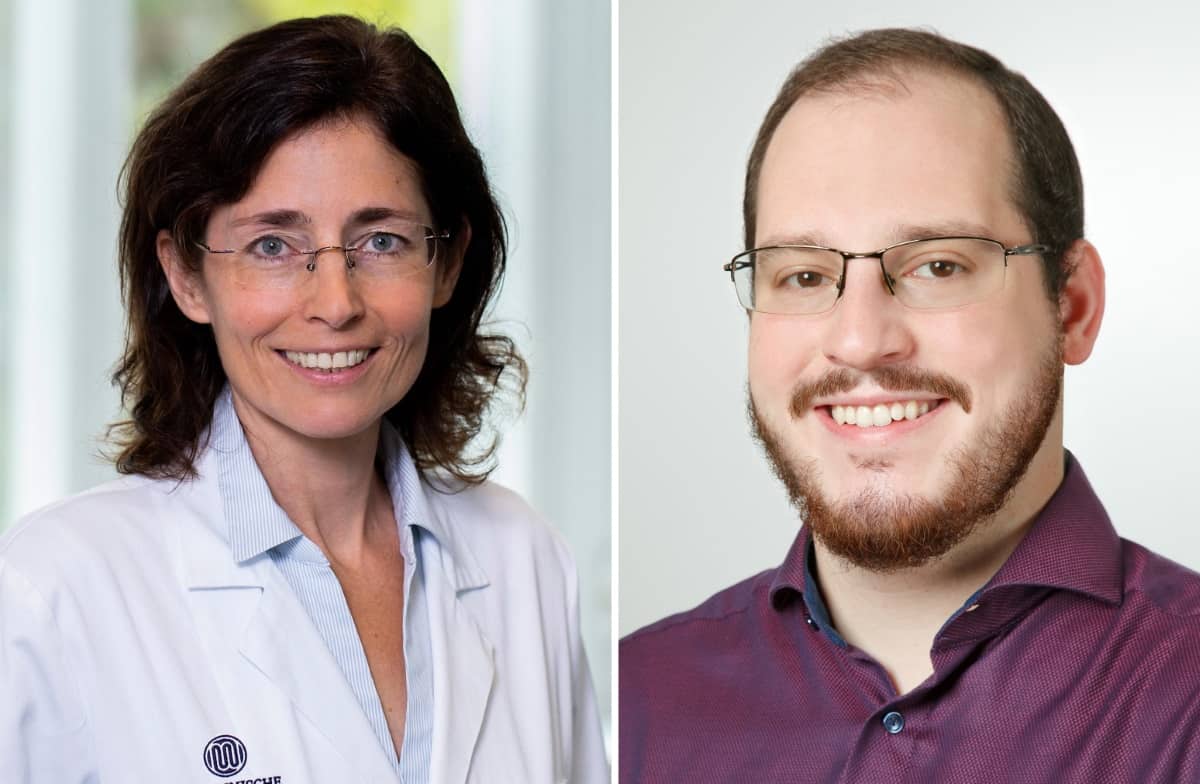
Sylvia Nürnberger and Marian Fürsatz. (Courtesy: MedUni Wien-feelimage)
The novel production method requires less handling time than standard pellet culture approaches, in which spheroids are grown in a 96-well plate, and uses 10 times less media, significantly reducing reagent costs. “Our system also allows for additional early read-outs, since the spheroid formation phase by itself provides additional information on the cellular fitness,” adds first author Marian Fürsatz.
Spheroid growth kinetics
Nürnberger and colleagues studied spheroid formation using human adipose-derived stem cells (ASC/TERT1) and human articular chondrocytes (hAC) – cells with potential for use in cartilage repair.
When seeded in the grid plate, both cell types adhered only to the compartment surface (not to the laser incisions), where they initially formed a 2D cell monolayer. Spheroid formation started with contraction of this monolayer at the compartment edges, followed by rolling up of the cell layer, typically leaving a few points anchored to the plate surface. Conversion into spheroid form involved rapid loss of an anchor point, contraction and then full condensation into a sphere.
The stem cells formed free-floating spheroids after approximately three weeks, the chondrocytes after two months or more. By changing the grid size, the researchers could control the final spheroid size. Growth on 1 and 3 mm grids resulted in ASC/TERT1 spheroids with mean diameters of 134 and 340 µm, respectively.
As the stem cells created spheroids faster than the chondrocytes, the researchers tested whether adding ASC/TERT1 to hAC cultures could speed up their formation. Surprisingly, they found that the co-cultures formed spheroids even faster than ASC/TERT1 cells alone.
Assessing different ASC/TERT1:hAC ratios (80:20, 50:50 and 20:80) revealed that co-cultures with 50:50 and 20:80 ratios formed spheroids in roughly seven and six days, respectively, significantly faster than pure ASC/TERT1 cultures, which took around 21 days. The co-cultures created spheroids with slightly lower diameter, due to their faster formation, with higher hAC ratios causing greater size variation and more small spheroids.
Next, the researchers compared the differentiation capacity of spheroids generated by grid plates and via standard pellet culture. The relative gene expression and differentiation index were comparable between grid-plate and pellet culture spheroids. Both production methods created spheroids with similar circularity and roundness.
Comparing the internal structure of grid-plate spheroids and standard pellet cultures revealed clear differences in their internal structure. In particular, grid-plate ASC/TERT1 spheroids exhibited internal strands of dense matrix. These compact matrix strands might provide a denser and more cartilage-like environment for the cells and a higher stiffness, which could be an advantage for in vivo application.
Tissue regeneration potential
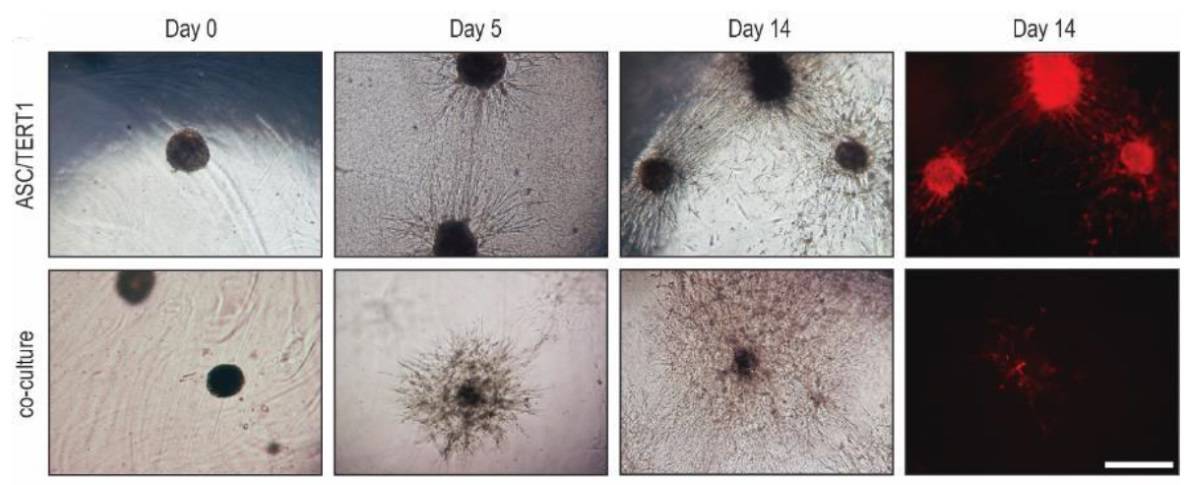
The researchers next assessed the suitability of grid-plate spheroids for cartilage repair, by embedding ASC/TERT1 and 50:50 hAC:ASC/TERT1 spheroids into a fibrin hydrogel. Co-cultures showed strong cellular outgrowth in all directions, reaching an approximate radius of 0.5 mm after 14 days. ASC/TERT1 spheroids showed higher outgrowth towards other spheroids, but slower outgrowth in other directions. Staining revealed that co-cultures induced greater matrix deposition around the spheroids.
Bright-field and fluorescence images of ASC/TERT1 and ASC/TERT1:hAC spheroids generated on grid plates and embedded into fibrin (scale bar, 500 µm). Both types exhibited cellular outgrowth, however, this was much more pronounced in the co-culture. (Courtesy: Biofabrication 10.1088/1758-5090/abe186)
This strong outgrowth and matrix deposition suggests that the spheroids would likely also grow if delivered in vivo and thus could be used for cartilage repair. “This is one of the intended applications,” Nürnberger tells Physics World. “Spheroids could be implanted directly into the defect or be used as building blocks for bio-printing prior to implantation.”
The team is now investigating strategies to use the spheroids for cartilage defect regeneration, as well as in drug screening, since spheroid formation speed is altered by influences such as cytokines and drugs. “However, we are always thinking of new possibilities to apply our spheroid formation approach to new applications,” adds Nürnberger.