Gauge theory could give quantum error correction a boost

Concepts from gauge theory could lead to a more efficient way to perform fault-tolerant quantum computation by reducing the number of qubits required for key operations – according to work done by Dominic Williamson and Theodore Yoder at IBM Quantum in the US.

By adapting ideas from gauge theory, the researchers show how quantum information spread-out across a machine can be measured using only local checks, significantly lowering computing overhead. Their approach works for a wide class of quantum error-correction codes and could help accelerate the development of practical quantum computers.

One importance difference between quantum computers and ordinary computers is how information is stored. Instead of bits, which can be either 0 or 1, quantum computers use qubits, which can exist in a combination of both states at once. Qubits can also be entangled and it is these and other quantum effects that can be harnessed to solve some problems much fast than conventional computers.

However, this power comes with a major drawback. Qubits are extremely sensitive to disturbances from their environment, which can easily introduce errors. This fragility is one of the main reasons why building large-scale quantum computers is so difficult.

To overcome this, researchers are developing fault-tolerant strategies that allow a quantum computer to continue working correctly even when some of its components fail. Williamson, who is now at Australia’s University of Sydney, describes this as using “carefully designed methods with built-in checks so that, when those checks pass, the final result has not been corrupted”.

Such methods typically store information held in one “logical qubit” across many “physical qubits” so that errors can be detected and corrected. But this protection comes at a cost, often requiring a large numbers qubits to perform even simple operations.

Measuring quantum information

In their new work, Williamson and Yoder tackle one of the central challenges in fault-tolerant quantum computing: how to measure information that is spread across many qubits without introducing too many extra resources.

The researchers draw on gauge theory, a concept from mathematical physics. “Gauge theories describe how local interactions can connect distant parts of a system,” Williamson explains. “In our work, we use this idea to measure information that is spread out across many qubits by adding extra helper qubits and performing only local checks.”

In practice, this means breaking down a complicated, global measurement into many small, local ones. By combining the outcomes of these local checks, the overall result can be reconstructed. This avoids the need for large, complex operations that would otherwise require many additional qubits.

According to the study, the number of extra qubits required grows only slightly faster than the size of the measurement itself. This is a substantial improvement over earlier methods, where the overhead could increase much more rapidly.

The approach is also flexible and can be applied to a wide range of quantum error-correcting codes. Barbara Terhal at the Technical University of Delft in the Netherlands highlights this point, noting that “the advance in this [work] is that it shows how to do this measurement in a reliable way for any of these codes, and also makes clear how many extra qubits are needed.”

She adds that such measurements are essential because they enable the key steps of quantum computation. “By measuring these operators, you can perform all the key steps needed for a full quantum computation.”

The method is particularly effective when implemented on highly connected structures that allow information to spread efficiently. Williamson notes that, “using this kind of highly connected structure reduces the number of extra qubits needed for fault-tolerant computation.”

Future directions

Despite its advantages, the new method does not remove all obstacles. One important trade-off involves time. Reducing the number of qubits can make computations take longer.

Terhal explains, “There is an inevitable extra time cost when you try to reduce the number of qubits”. In some cases, a system with fewer qubits may need more time to complete a calculation, while one with more qubits could run faster. Finding the right balance remains an open problem.

Another limitation is that the current study is largely theoretical. As Terhal points out, “[This work] focuses on the mathematical side and does not yet study how well the method performs in realistic simulations, which are very important for practice”. Further work will be needed to understand how the approach performs in real devices.

Williamson says, “We are working on ways to reduce the cost even more,” including lowering both the number of qubits required and the time needed to perform computations. He also notes that the method “has already been used in several follow-up studies” and is expected to appear in early fault-tolerant quantum computers in the coming years.

As quantum computing continues to advance, reducing the resources required for error correction will be crucial. By showing how to perform key operations with fewer qubits, the new work offers a promising step toward scalable and practical quantum machines.

The research is described in Nature Physics.
How pictures can help school students learn quantum physics

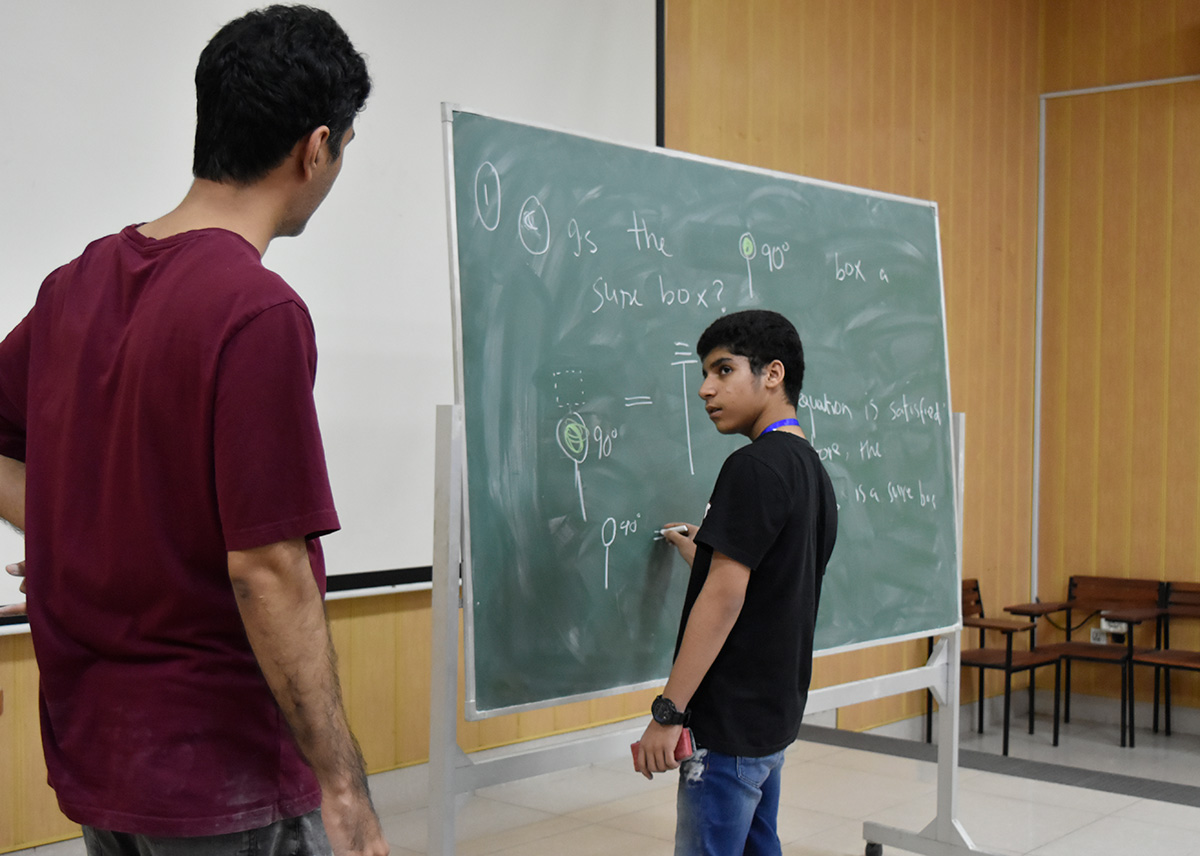
Teacher oversees a pupil drawing on a blackboard

Humans perceive knowledge, make decisions and build the consciousness of knowing through vision and speech. This interplay between visual and nonvisual patterns collectively shapes how we learn complex concepts such as quantum physics. That is despite the subject’s reputation as being incomprehensible and difficult to reconcile with our everyday conceptions.

The issue when teaching quantum mechanics also lies in the shortcoming of using literary constructs to accurately describe what quantum mechanics really means. As the Hungarian-British philosopher Michael Polanyi once noted: “We always know more than we can tell.” It is hard to accurately capture in language the full meaning of quantum phenomena such as nonlocality, superposition, no-cloning, teleportation, counterfactual quantum computation, delayed choice or the many other uniquely quantum phenomena.

This also means that terms such as wave, particle, superposition and entanglement are not truly complete until followed by detailed calculations or elaboration of their consequences. The result is that introductory quantum mechanics courses often require prerequisite mathematical grounding in complex numbers, matrices, linear algebra and differential equations.

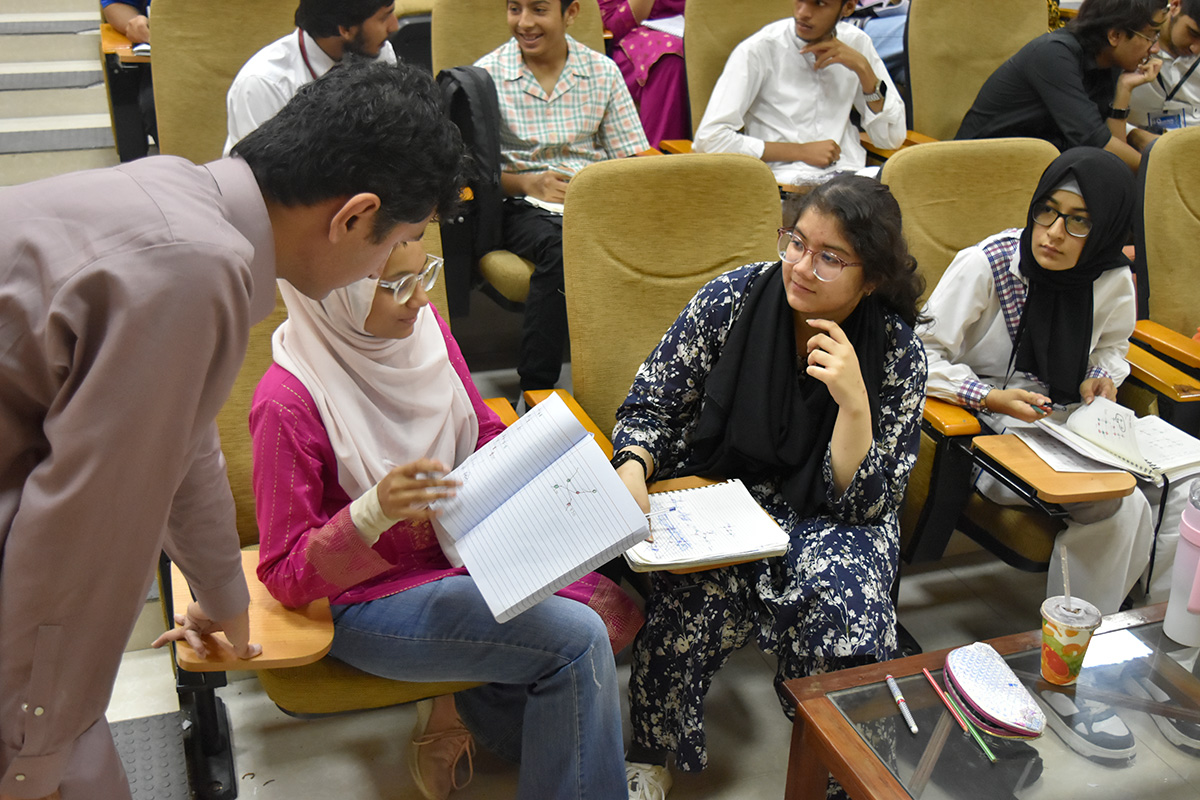
Yet I believe this tortuous preparation can be bypassed – in an accurate, comprehensive and consistent way – simply through “pictures”. With that in mind, we conducted an experiment last year at Government College University in Lahore, Pakistan – alma mater of the physics Nobel laureate Abdus Salam. The four-week-long summer school – Quantum in Pictures – was organized by the Khwarizmi Science Society, a not-for-profit grassroots science association that aims to make scientific education accessible especially for resource-deprived communities.

Some 50 school students attended lectures and demonstrations led by Muhammad Hamza Waseem from the UK firm Quantinuum, who works with Bob Coecke, one of the founders of a pictorial approach towards quantum physics and education.

Most of the students, who had no prior knowledge of quantum mechanics, came from Lahore while the remainder were from nearby towns and villages where opportunities especially in advanced fields are generally minimal. On top of that classroom engagement is largely discouraged and an outdated model of examination fosters rote learning. Almost half of the participants who attended the school were girls, with 75% of participants aged between 14 and 18 – the youngest being a 13-year-old girl from a village called Syedanwala in Kasur.

Teacher and pupils discuss work over notebooks of diagrams

To capture ideas about quantum mechanics, we used “string diagrams” as our basis. Such diagrams, simply put, are made using boxes that represent processes. Wires coming in at the top and at the bottom represent the input and output systems being processed by the box. Simulating quantum processes translates to connecting boxes with wires, chopping and straightening wires or sliding boxes along wires like beads on a string.

Even though this formalism is rigorous and derived from category theory, the manner in which it is presented is unhindered by burdensome abstractions. In terms of quantum mechanics, such diagrams are able to capture ideas about how quantum states transform, how quantum operations work as well as counterintuitive notions about measurement.

A new confidence

When I teach quantum mechanics to undergraduates, colleagues often discourage me from “spilling the beans” on quantum mechanics too early before we have covered the mathematical acrobatics of Hilbert spaces, unitary transforms, eigenvalues and Dirac’s bra-ket notation. Yet I believe school students should relish the counterintuitive repercussions of quantum mechanics much earlier than they currently do. I believe that introducing such aesthetic visuals – an overlooked concept for learning – can make the discipline more comprehensible and attractive to students.

A diagrammatic technique helps to avoid all this and democratizes the knowledge of our quantum world. After all, the future quantum workforce must be trained earlier than ever, given we do not want students missing out on the quantum revolution. In addition, quantum computing is not the purview of physicists alone. Many computer scientists and programmers, who will never be formally trained in physics, will need an initiation in quantum mechanics.

When it comes to making education accessible and within the direct grasp of millions of eager learners, demystifying traditional modes of learning and introducing new approaches helps students and teachers. Learners gain the confidence to ask questions, synthesize connections between bodies of knowledge and prepare themselves for a workforce that may require competency instead of a paper degree.

According to a survey of students who completed the course, 60% engaged in interactive discussions or used the chalkboard to solve problems while 80% asked or responded to questions. For most of these students, this level of engagement with the instructor was a first in their lives. This is the confidence that our liberated students walked away with as they completed their final exams in the Quantum in Pictures summer school.

Laser-driven free electron laser runs for more than eight hours

A laser plasma accelerator (LPA) has been used to power a free electron laser (FEL) for more than eight hours, delivering stable pulses of coherent light. The system was created in the US by researchers at the company Tau Systems and Lawrence Berkeley National Laboratory. The team says that its achievement represents a major breakthrough in stability for LPA-driven FELs, which could someday make coherent UV and X-ray pulses more accessible to academia and industry.

An FEL creates bright pulses of coherent light – usually in the ultraviolet-to-X-ray portion of the electromagnetic spectrum. These pulses are used in a wide range of research including physics, chemistry, biology and materials science.

The pulses are created by sending bunches of high-energy electrons through a device called an undulator, which applies a transverse magnetic field that alternates in direction as the bunch propagates. As the electrons are accelerated back and forth by the field they emit light. Under the right conditions the emitted light interacts with the electron bunch in such a way that the coherence and brightness of the light increases as the electron bunch travels through the undulator.

FELs require a bright and stable source of high-energy electron bunches, so today’s facilities are driven by large and expensive electron accelerators. The European X-ray Free Electron Laser, for example, is located at the end of a 3.4 km linear accelerator.

Surfing a plasma wave

High-energy electron bunches can also be created by firing high-intensity laser pulses at a plasma target. Electrons in the plasma are much lighter than the ions, so they are accelerated more by the intense electric field of the laser pulse. The result is a region of separated positive and negative charge that contains a large electric field. This region trails the laser pulse like the wake of a ship – and is called a wakefield. If electrons are injected into this wakefield, they are captured and accelerated to near the speed of light. The process is similar to how a surfer is propelled by an ocean wave.

While LPA-driven FELs would require expensive lasers, they would be smaller and cheaper than accelerator-driven facilities. Today, however, the electron pulses delivered by LPAs are not good enough to drive a FEL. Some shortcomings are related to fluctuations in the focal point of the laser and well as changes in the pulse energy and duration. These fluctuations can be caused by mechanical vibrations, temperature fluctuations and other environmental disturbances.

Founded in 2021, the Texas-based company Tau Systems is developing practical LPAs for a range of applications including FELs. Now, the company has joined forces with researchers at Berkeley Lab’s BELLA Center to implement a set of laser-stabilization technologies on BELLA’s Hundred Terawatt Undulator beamline.

The team implemented five active systems that worked together to stabilize the focal point of the powerful laser. Some of this was done using a “ghost” beam – a low-power copy of the driving beam – to observe subtle fluctuations that would not be apparent by monitoring the main beam.

High-quality bunches

As a result the system delivered bunches of 100 MeV electrons at a frequency of 1 Hz and at high stability for over 10 h. These bunches were then used to drive  a self-amplified spontaneous emission (SASE) FEL based on a 4 m-long undulator that is embedded within a vacuum chamber.

The LPA–FEL delivered violet (420 nm wavelength) pulses for more than 8 h without any human intervention. The FEL gain of the system was about 1000, which is the ratio of brightness of the emitted coherent FEL pulse to the brightness of light emitted by unamplified undulation.

This run is a significant improvement on the team’s 2025 achievement of using a LPA–FEL setup to deliver pulses of similar quality for an hour.

“This is the moment the community has been working toward,” says  Stephen Milton of Tau Systems. “We have shown that an LPA-driven FEL is not just a proof-of-concept experiment. It is a platform capable of delivering the stability that real scientific and industrial users demand.”

Finn Kohrell of the BELLA Center adds, “Maintaining FEL stability for a record eight hours represents a significant advancement in LPA-driven FELs and provides deeper insights both into achieving optimal FEL performance and into validating LPAs as high-brightness injectors, which is crucial for LPA application in future light source facilities”.

During operation, the team gathered data about the stabilization process and mapped correlations between the parameters of the drive laser; the plasma source; the electron bunches; and the FEL’s output pulses.  The researchers are now using this information to improve their control systems and they say that these data indicate that further gains in stability and brightness are possible.

The next experimental step will involve increasing the FEL energy to their system’s maximum value of 500 MeV.

“At this level, we can lower the undulator radiation wavelength to the 20–30 nm range, placing it in the hard ultraviolet or soft X-ray regime,” explains Kohrell. “[This would be] a crucial step toward making the technology viable for real-world applications.”

The new system is described in Physical Review Accelerators and Beams.

Stanford Medicine unveils world’s first ultracompact proton therapy facility

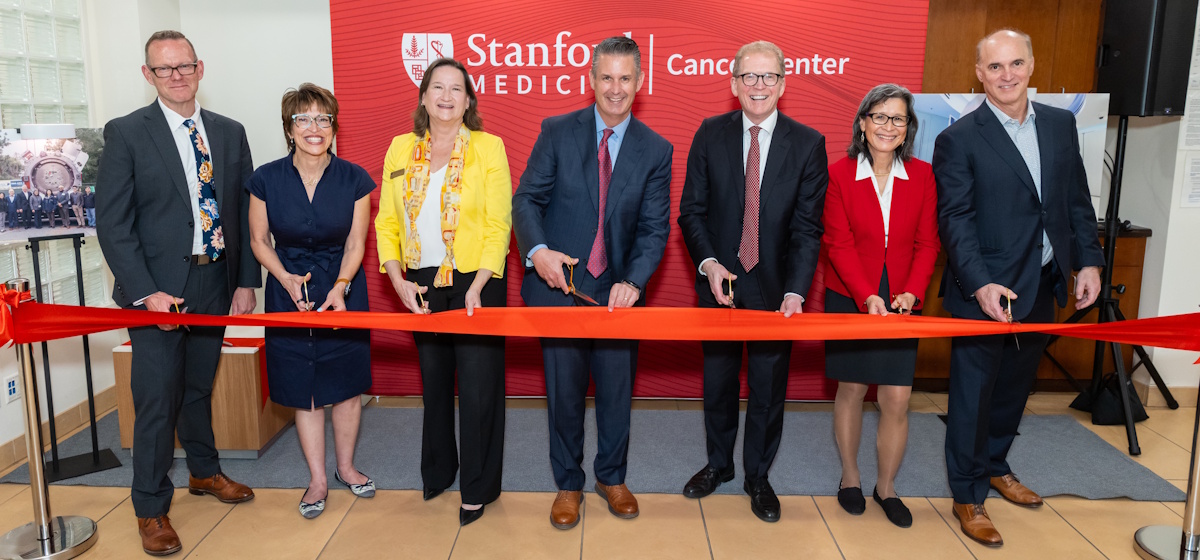
Stanford Medicine has opened a new proton therapy facility – featuring an ultracompact treatment system that’s small enough to fit in a room the size of a conventional linear accelerator vault.

Proton therapy is an advanced cancer treatment that offers precise tumour targeting while minimizing dose to healthy tissues. The technique is particularly beneficial for treating tumours located near critical structures and for treating cancers in children. Currently, however, access to proton therapy is limited by its high costs and substantial space requirements.

The new treatment facility – opened earlier this week at Stanford Medicine Cancer Center in Palo Alto, CA – incorporates the S250-FIT proton therapy system from Mevion Medical Systems, the most compact cyclotron in the industry. But even with a much small accelerator, proton therapy delivery usually requires a bulky gantry that rotates around the patient to aim the proton beams at the optimal treatment angles. As such, most proton facilities need a whole new multi-storey building to be built just to fit everything in.

To eliminate this obstacle, the Stanford facility is using a positioning system from Leo Cancer Care to deliver protons via a novel approach known as upright radiotherapy. Here, the patient is treated in an upright position (rather than lying down) and rotated in front of a static treatment beam, removing the need for a gantry and slashing space requirements and installation costs.

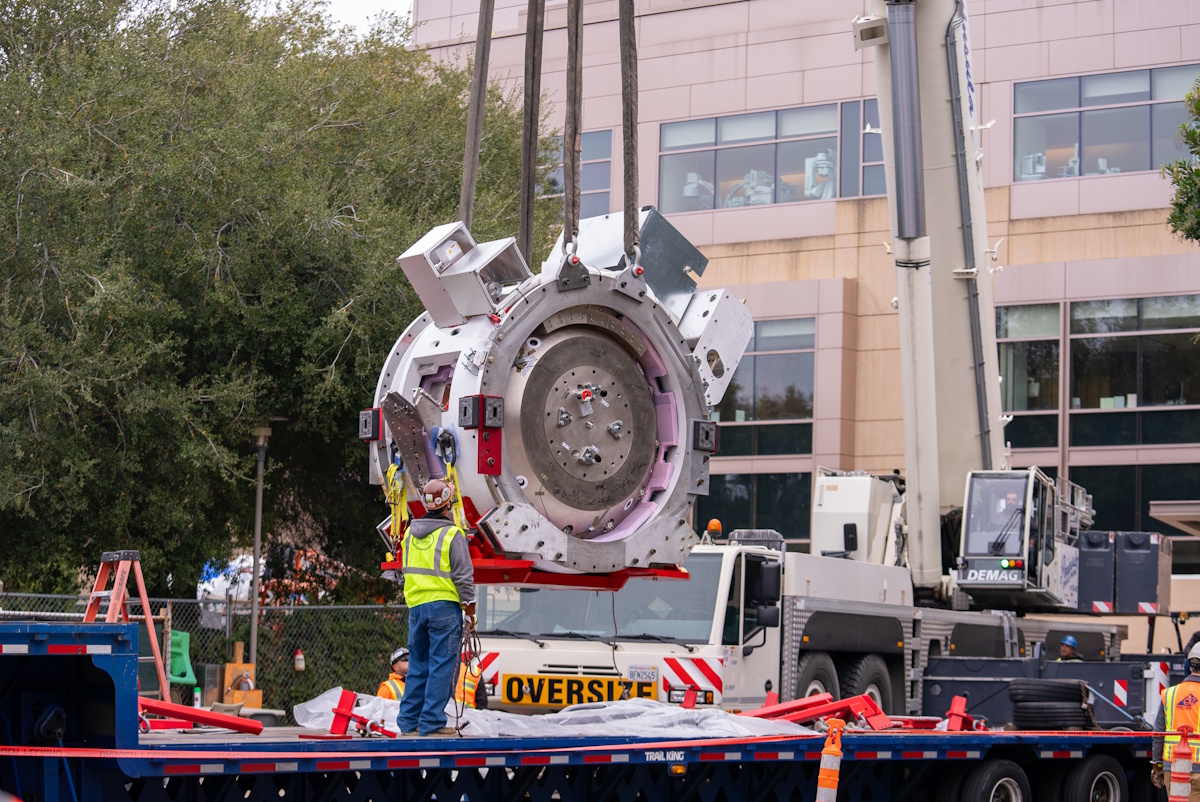
Installation of the compact cyclotron

By combining these advanced technologies, the new equipment fits into a standard 1200 sq. ft linear accelerator vault (as used for standard X-ray-based radiotherapy) and was installed without having to construct a new building.

The advanced system also incorporates built-in CT scanning, enabling extremely precise targeting of tumours within patients with minimal collateral damage to the rest of the body.

“Developing this novel approach to proton therapy at Stanford Medicine, in collaboration with our industrial partners Mevion and Leo Cancer Care, gives us an important additional tool to treat our patients in a personalized, case-by-case way,” says Billy Loo, professor of radiation oncology and co-director of particle therapy at Stanford Medicine. “We are excited to pioneer this world’s first ultracompact and efficient technology that will benefit not only patients at Stanford but expand access to proton therapy worldwide and improve patient outcomes.”

“This milestone really marks the transition from concept and theory to clinical reality,” adds Leo Cancer Care’s CEO Stephen Towe. “Proton therapy installed inside a linac vault always felt like an impossible goal – our partnership with Stanford and Mevion has made that vision possible.”

Loo tells Physics World that patient treatments on the new proton therapy system are likely to start this summer. “As with any first-of-its-kind system in medicine, introducing this complex technology requires a rigorous process of testing and optimization to ensure it meets our high standards for patient safety and treatment quality,” he explains. “We are moving through these steps now.”

The Stanford Medicine team emphasize the particular advantages of proton therapy for children, not least that it can really decrease the radiation dose delivered to normal tissues. Minimizing irradiation of sensitive developing tissue can dramatically reduce the risk of long-term side effects. In addition, treating children while they are sitting up and actively engaged may be far less intimidating for them than having to lie down and have the treatment “happen to them”.

Ribbon-cutting ceremony at Stanford Medicine Cancer Center

The first proton treatments will likely be “cranial and head-and-neck sites, for both adults and selected paediatric patients, for which we already have established patient positioning solutions,” says Loo. In parallel, the radiation oncology team will develop the workflows and immobilization solutions for all other anatomic sites.

The team also plans to investigate new ways to advance the technology and explore the clinical advantages of delivering upright radiotherapy. For example, evidence suggests that for some diseases, such as lung cancer, upright treatment puts the targeted organ in a more favourable position to irradiate safely. Upright positioning also provides greater flexibility to deliver radiation from many different angles. The team will also study the impact of upright positioning on FLASH treatments, in which radiation is delivered at ultrahigh dose rates.

Looking ahead, nine other medical centres are installing this new ultracompact proton therapy system, ultimately making proton therapy increasingly accessible to patients around the world.

“The clinical data to support the use of protons is stronger than ever before,” says Towe. “The strength of this data, combined with the cost reductions delivered by Leo’s technology, has sparked a new wave of growth for protons globally.”

Have you published a disruptive paper? New machine-learning tool helps you check

Scientists in the US have unveiled a new machine-learning tool that, they claim, can identify disruptive scientific breakthroughs. They say their method, which assesses how much a paper reshapes its field, is better than other techniques at spotting such disruptions even if they are simultaneously discovered by independent research groups (Sci. Adv. 12 eadx3420).

The work examined 55 million papers listed by Web of Science and the American Physical Society (APS) published between 1893 and 2019. The papers were mapped using a machine-learning technique known as neural embedding, with each publication represented by two vector points. The first vector characterizes the body of work the paper builds on while the second represents the research it inspires.

Papers that disrupt tend to cause future research to depart significantly from previous work in the field, making these “past” and “future” vectors diverge sharply. The greater the divergence, the higher the paper’s so-called Embedding Disruptiveness Measure (EDM) score.

The team, based at Indiana and Binghamton universities, tested their EDM technique against Nobel-prize-winning papers and milestone publications as selected by APS editors. The EDM identified these landmark contributions as being highly disruptive.

The researchers discovered that the EDM was more consistent at spotting such papers than similar metrics, such as the “disruption index”, which focuses more on a publication’s closest citations. While this makes it sensitive to individual citations, it can miss the bigger picture, the researchers found.

The team discovered that the 10 papers with the biggest difference between the EDM and the disruption index were all examples of “simultaneous disruption”. This is where multiple papers have independently reached the same conclusion, or scientists have published their work across publications. Citations that linked these simultaneous disruptive papers weakened their disruption index.

One notable example is the two 1974 papers announcing the discovery of the J/ψ meson. As both groups cited each other, the disruption index ranked these publications in the bottom 1% of disruptive papers while the EDM placed them both in the top 10%. A similar pattern was seen for the two 1964 papers – one by Peter Higgs and the other by François Englert and Robert Brout – on the Higgs mechanism.

The team claims that the EDM also provides a new way to detect simultaneous discoveries, finding that papers that report the same breakthrough tend to be cited in similar contexts by later work, meaning their “future” vectors cluster together.

“By having more accurate metrics, we can actually investigate where the disruption is happening in the map of science,” says data scientist Sadamori Kojaku from Binghamton University.

The researchers say their tool could help science funding and policy to drive transformative breakthroughs. “It can have significant implications for science policy and it’s also helpful for prioritizing funding,” adds Kojaku. “We now have the quantitative metrics to investigate at which stage of research the disruptive work occurs and matters most.”

Backing winners in deep tech: physicist and venture capitalist Alexandra Vidyuk

The physicist and venture capitalist Alexandra Vidyuk is our guest in this episode of the Physics World Weekly podcast. She is the chief executive and founding partner of Beyond Earth Ventures, which provides funding and support to early-stage companies in deep-tech sectors including space, robotics and energy.

In conversation with Physics World’s Margaret Harris, Vidyuk explains how her BSc in applied mathematics and physics and her early career in banking and fintech set her on a path to deep-tech venture capital.

Vidyuk talks about the specific challenges facing deep-tech entrepreneurs and reveals what she looks for when deciding which companies to fund. She also emphasizes the importance of building an organization that understands its customers and can communicate effectively with them.

Word wave puzzle no.2

Here’s how the game works:

  1. Enter a word guess – in this game the word has six letters.
  2. After submitting your guess, each letter in the guessed word is coloured to provide feedback:
    • Green: The letter is correct and is in the correct position in the target word.
    • Yellow: The letter is correct but is in the wrong position in the target word.
    • Grey: The letter is not in the target word at all.
  3. Using this colour feedback, refine your next guess.
  4. Continue guessing until you correctly identify the hidden word(s) or run out of attempts.

If you need any hints, read this recent feature article.

Fancy some more? Check out our puzzles page.

Advent Research Materials wordsearch

Advent Research Materials is an Oxford-based specialist supplier of high-purity metals, alloys and polymers to the global scientific research community.

With a catalogue of over 10,000 items, ISO 9001:2015 accreditation, and more than 35 years of experience supplying researchers, universities and industry, Advent is a precision materials partner trusted worldwide.

All products are held in stock and available for rapid dispatch.

Want to make a peptide material go from soft to stiff? Just add water

Protein molecules are highly dynamic, continually changing shape in response to changes in external conditions. Scientists have long sought to mimic this behaviour in artificial materials, and now a team at the City University of New York (CUNY) in the US has done just that, constructing a crystalline solid that switches between several distinct architectures as the ambient humidity changes. Their work could make it easier to fabricate adaptive materials on a large scale for applications such as humidity-responsive coatings.

Proteins owe their shape-shifting character to a series of complex interactions that take place between two or more molecules. These supramolecular interactions, as they are known, allow proteins to adapt their properties – and therefore their functions – as needed. Water plays an important role in such interactions because it stabilizes certain structures while weakening others.

“Stripped-down” versions of protein behaviour

In the new work, researchers led by CUNY chemist Rein Ulijn and chemical engineer Xi Chen studied peptides, which are the molecular building blocks that make up proteins. In particular, they focused on leucine (L) and isoleucine (I), which are isomers, meaning they have the same chemical formula but different structures. “Such short peptides give us access to ‘stripped-down’ versions of protein behaviour,” explains Ulijn, who is also the founding director of CUNY ASRC Nanoscience Initiative. “They’re simple enough to design systematically, but still rich enough to encode sometimes surprisingly complex and dynamic behaviour.”

They found that when the chemical potential of water in the system – effectively, the humidity – changed, the solid-state porous architecture of LI crystals reorganized, reversibly switching between rigid perpendicular/parallel honeycomb structures and layered soft van der Walls structures. Importantly, Ulijn explains, this transformation occurs without compromising the peptides’ overall structural integrity.

“What makes this particularly significant is that most dynamic supramolecular systems are limited to relatively minor changes in organization,” he says. “In contrast, the peptide side chains in our system undergo very dramatic conformational reorganization, which translates into the topological changes observed.”

Uljin adds that this process offers a completely new way to design materials that can switch between distinct structural states. “This opens the door to solid materials that are both robust and highly adaptable, a combination that is difficult to achieve with existing approaches,” he tells Physics World.

A new toolbox for designing dynamic solid-state materials

The researchers say they undertook their study to address a “fundamental gap between biological systems and synthetic solid-state materials”. Although proteins routinely undergo sequence-encoded conformational changes to access multiple functional states in solution, replicating this kind of dynamic behaviour in solid materials has been a major challenge. “Our goal was to create a minimalist, peptide-based system that could mimic this adaptability without relying on large, complex structures and that could be triggered by low energy inputs,” they explain.

The team says the work provides a new toolbox for designing dynamic solid-state materials with tuneable topology and function, which could potentially impact a wide range of fields. One potential application is the development of adaptive materials with switchable mechanical properties, where stiffness and softness can be controlled through environmental humidity or temperature. “This could be useful in soft robotics, responsive coatings, or smart structural materials,” Chen notes.

The researchers are now studying other peptide structures in hopes of better understanding the fundamental rules for conformational control of short peptides. Ultimately, they say this programme should lead to specific design rules for porous peptide materials, making it possible to explore a broader range of sequences and side-chain chemistries. “We are also interested in scaling these materials to enable practical demonstrations in hydration-responsive coatings,” Chen adds.

The team reports its work in Matter.

The dark heart of the lithium-ion battery revolution

In a book about batteries, you might not expect the author to be detained by Congolese secret police because he attempted to meet a rebel warlord whose militia has been linked with cannibalism. But that’s exactly what happened when journalist Nicolas Niarchos was doing research for The Elements of Power: a Story of War, Technology and the Dirtiest Supply Chain on Earth.

In his debut book, Niarchos dives into the global supply chain of critical metals for lithium-ion (Li-ion) batteries. Nowadays Li-ion technology powers electric vehicles, laptops and smartphones, and provides backup for renewable energy when the Sun stops shining and the wind stops blowing. The critical metals in these batteries come from all corners of the Earth. In 2024 Australia, Chile and China were the top three producers of lithium; Indonesia produced over half of the world’s nickel; and the Democratic Republic of Congo (DRC) dominated the cobalt mining industry.

Building on his earlier reporting for The New Yorker and other outlets, Niarchos shines a light on the dark underbelly of green tech. He takes the reader from the underprivileged mining communities extracting the raw materials, to the global superpowers profiting from Li-ion technology.

This is a story of geopolitics, deep-rooted inequality, and history repeating itself. In recent decades, governments, corporations and opportunistic intermediaries have jostled for the lion’s share of resources in mineral-rich countries. As in colonial times, wealth has again concentrated in the hands of a few, while communities near the resources bear the costs of greed and corruption.

“The world is facing the biggest supply–demand dislocation in living memory with critical metals,” writes Niarchos.

The race to develop and commercialize

In The Elements of Power, Niarchos includes the history of Li-ion batteries and their commercialization. Key scientific figures include British chemist Stanley Whittingham, US solid-state physicist John Goodenough, and Japanese chemist Akira Yoshino, who all shared the 2019 Nobel Prize in Chemistry for their breakthroughs that led to commercial Li-ion batteries.

Whittingham laid the foundations in the 1970s when his work on fast ionic transport in solids led to a cathode made from titanium disulphide that could house (or “intercalate”) lithium ions. Goodenough then introduced a lithium cobalt oxide cathode – raising the battery voltage and making it less explosive – before Yoshino took the final step to a commercially viable battery by adding a carbon-based anode in 1985.

Niarchos highlights how Japan failed to capitalize on this early lead. Although Japanese firm Sony released the first Li-ion battery in 1991, production and commercial impetus soon switched to China and South Korea. In fact, at the turn of the millennium, Japan controlled 90% of the Li-ion market, but by 2012 Sony’s value had dropped to one-ninth of Samsung’s in South Korea.

The electrification of transport has been a key application of China’s push for Li-ion batteries – it drives economic growth and tackles air pollution. The speed of progress is striking. In 2018 China produced 1.26 million electric cars over the course of the whole year. By 2024 it was producing a million in a month.

To fuel battery demand, Beijing has steadily strengthened its foothold in places like the DRC and Indonesia. Niarchos highlights the 2007/2008 Sicomines “minerals-for-infrastructure” deal, which was a major, yet controversial, partnership made between the DRC government and a group of Chinese investors. It swapped massive copper/cobalt mining rights in the DRC for $6bn in Chinese-financed infrastructure, which has been slow to materialize.

Niarchos shows how China’s economic miracle has been fuelled by ruthless geopolitical pragmatism in strengthening its mining deals over decades, but also how the US administration’s manoeuvrings in places like Greenland are an unsubtle sign that it intends to catch up.

Inevitably, Elon Musk and Tesla make several appearances in the book. For example, Niarchos includes how a futuristic Tesla Gigafactory near Berlin, Germany, was attacked by protestors. The episode reveals the conundrum facing progressives in the West who want to go green but in the right way, led by the right people.

The people behind the metal

While Niarchos looks at how global superpowers profit from Li-ion technology, it’s his reporting on the sources of critical metals that reveals the truly dark side of the supply chain.

Cobalt, often used in Li-ion battery cathodes, is perhaps the starkest example of the problem, and the book gives particular attention to its production and the mining practices in the DRC. More than 70% of global supply comes from the DRC, with most mined in the mineral-rich Katanga region, comprising of the provinces Tanganyika, Haut-Lomami, Lualaba and Haut-Katanga. Extreme poverty is rife, cholera outbreaks are common, and conflict has displaced hundreds of thousands.

One of the book’s strengths is how Niarchos weaves the story of Li-ion batteries with the social history of the DRC. In works like this, the human sections often provide light relief from dense scientific explanations. Here, the opposite is true, as the cycles of violence and exploitation against the Congolese people – which goes back centuries – make for grim reading.

What is now the DRC was colonized in the 1870s by Belgium, and forced labour, starvation, violence and mass death were inflicted on the Congolese people in relation to the ivory and rubber trade. While the country gained its independence from Belgium in 1960, the turbulence of power struggles and civil war has led to deeper corruption, opaque webs of international finance, and foreign magnates whose dealings raise eyebrows among global watchdogs. Today the country seems haunted by its past, trapped by the cruelty of power dynamics and the corrupting influence of promised wealth.

The most resonant pages of The Elements of Power describe modern daily life in the Katanga region. Most people see barely a trickle of the vast mineral wealth they help dig up. In 2020 some 74 million Congolese lived below the poverty line of $2.15 a day, and 43% of children in the country were malnourished.

Many adults and children resort to digging for mineral seams using rudimentary tools and minimal safety gear. Referred to as “artisanal” miners by multinational corporations but known as creuseurs (French for digger or burrower) in the DRC, they often come from the very poorest stratum of society and do not have the education or the contacts to get jobs with the mining corporations that have official permits to extract the cobalt. Just in Kolwezi – the capital city of the Lualaba Province with a population of nearly 600,000 – an estimated 170,000 of these unofficial miners dig for the black ores, which they then sell to unscrupulous intermediaries.

One of the saddest passages is when Kolwezi resident Françoise Ilunga describes how her husband was crushed and suffocated, along with at least 150 other creuseurs, after a tunnel collapsed in the city. Unable to get official jobs, the miners had entered a secluded part of a cobalt mining site without permits or safety gear to find ore to sell so they could support their families. The mine was run by the Anglo-Swiss multinational Glencore (which incidentally had to pay $700m in 2022 relating to bribery offences in several African nations). Françoise and her family spent two days digging up her husband’s body.

It is easy to see how cycles of poverty have been sustained in the DRC. Niarchos interviews children who say they mined out of necessity for food and clothes. In their villages and towns, conflict still bubbles under. When Niarchos is detained by the DRC’s secret police, he had planned to meet a man called Gédéon, whose militia group, Bakata Katanga, has agitated for a separate Katanga state. Niarchos had heard a rumour that Gédéon was funding himself through artisanal mines. You’ll need to read the book for the full story, but it’s fair to say Niarchos won’t be returning to the DRC anytime soon.

Save solutions for another day

While The Elements of Power touches upon some solutions – such as recycling batteries, and sodium and sulphur-based alternatives to Li-ion batteries – no fully scalable solution is presented. And at times, I found the web of organizations and individuals hard to follow. I’m also a bit of a geology geek so I wish there was a bit more on why the DRC is blessed with so many critical minerals in the first place.

That said, the book feels incredibly timely given the current state of geopolitics. It is essential reading for anyone who cares about the origins of materials powering their phones, cars and many other aspects of daily life in wealthy nations. It shines a light on how difficult it is to know what percentage of critical minerals in your devices has come from ethical sources, despite what tech companies might say.

If there is a key takeaway, it’s that any system-wide solution for greener, ethical mining must consider the entire supply chain. Above all, we should listen to people on the ground sourcing the raw materials that make our shiny new technology possible. A supply chain is only as clean as its grubbiest link.

  • 2026 William Collins 480pp £25 hb
Copyright © 2026 by IOP Publishing Ltd and individual contributors