Among the working satellites and telescopes orbiting our planet is a lot of rubbish. From full satellites that no longer work to tiny bolts shed as spacecraft release spent rockets, there are millions of human-made pieces of debris in the space around Earth.
The problem is a hot topic within the space community. The presence of space junk has implications for both ground and space-based astronomy; there is an impact to atmospheric science that we’re only just beginning to understand; and it also presents a threat to our highly space-reliant society.
To highlight what is being – and needs to be – done to tackle the issue of space junk, experts Katherine Courtney and Alice Gorman talked to Physics World online editor Margaret Harris as part of a Physics World Live panel discussion in November 2025.
Courtney started her career developing products and services for the telecoms industry before moving to the public sector and working in the UK government. While she was the chief executive of the UK Space Agency she came to realize the impact of space debris.
Courtney is now chair of the Global Network on Sustainability in Space (GNOSIS), which has about 1000 members from research and industry across more than 45 countries. GNOSIS aims to accelerate research and development efforts to tackle problems like space debris. Courtney also mentors start-up companies that are trying to solve these problems and does outreach with young people to educate them on the topic.
Gorman studied archaeology and for several years worked on terrestrial projects before becoming a space archaeologist. Now at Flinders University, Australia, she is known as Dr Space Junk, and focuses not just on debris in Earth orbit, but also planetary landing sites, deep space probes, terrestrial rocket launch sites and tracking stations.
Gorman’s research into space junk involves looking at objects in an environmental context, examining their cultural value and what it means to retain these objects. Along with Justin Walsh, she trained crew on the International Space Station to do what was effectively the first archaeological field survey outside Earth.
What is space junk and how much is there in orbit around Earth?
Alice Gorman: Space junk is commonly defined as any object in space that does not now or in the foreseeable future serve a useful purpose. The biggest contributors to the space debris population are the US, Russia and China.
The latest figures estimate that there are 54,000 human-made objects in orbit that are larger than 10 cm, including over 14,000 operating satellites and spacecraft. Envisat is one of the largest in that category, being 26 m long. There are also medium-size objects, which can be anything from 1 to 10 cm. Current statistical models estimate there are about 1.2 million objects of this size. At an even smaller scale, there’s an estimated 140 million objects 1 mm to 1 cm in size.
Not all these objects are tracked and catalogued – the number regularly tracked by Space Surveillance Networks is only about 44,870. But that doesn’t mean that’s everything there is – that’s just the things we can see and know are there.
Taking up space
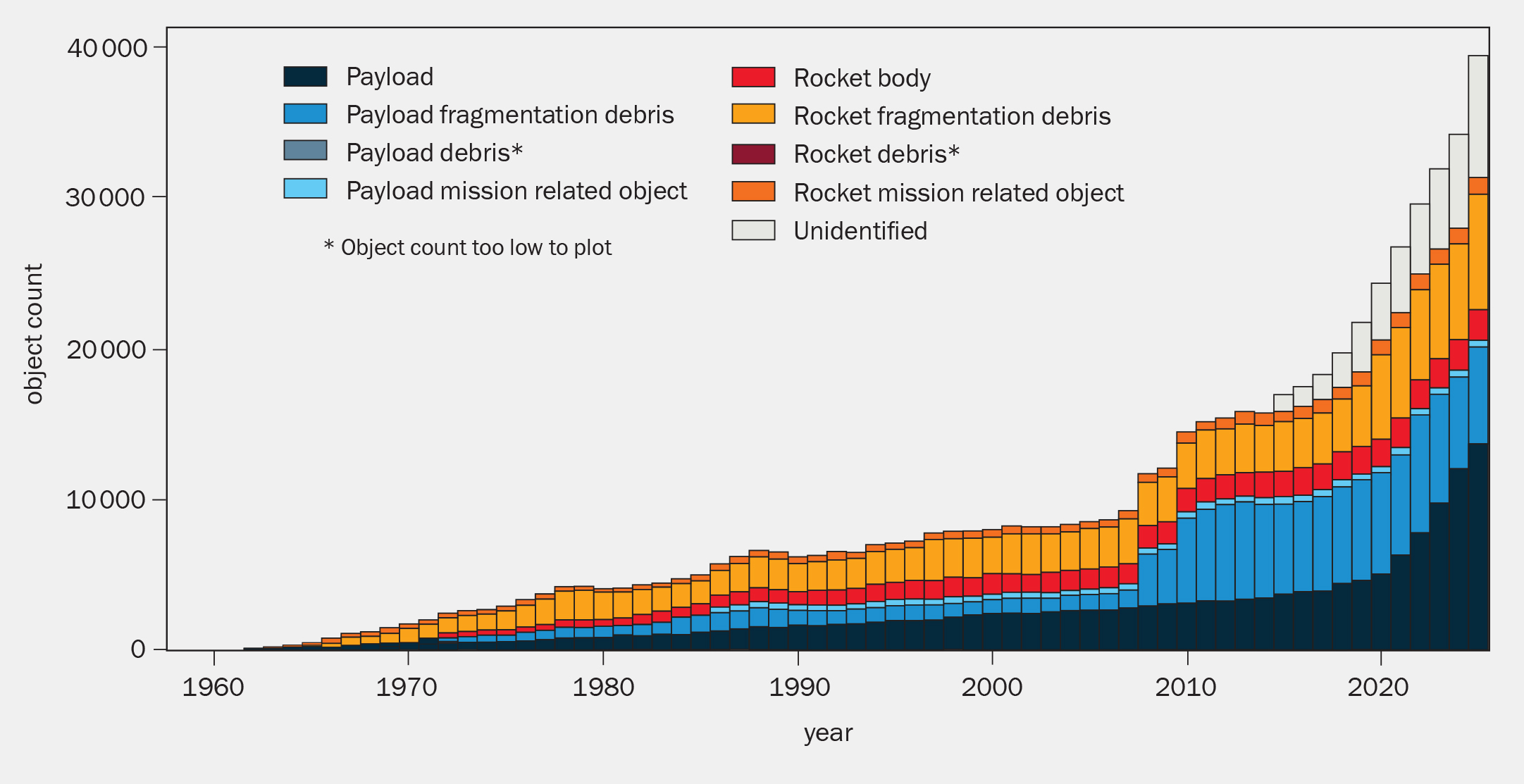
The count evolution of different types of human-made debris in geocentric orbit, as recorded by the European Space Agency:
- Payload– an object designed to perform a specific function in space (excluding launch functionality). This includes operational satellites as well as calibration objects.
- Payload fragmentation debris – an object that has fragmented or unintentionally released from a payload as space debris with origins that can be traced back to a unique event. This class includes objects created when a payload explodes or when it collides with another object.
- Payload debris – an object that has fragmented or unintentionally released from a payload as space debris for an unknown reason but orbital or physical properties allow it to be traced to a source.
- Payload mission related object – an object that served a purpose for the payload and has intentionally been released as space debris. Common examples include covers for optical instruments or astronaut tools.
- Rocket body – an object designed to perform launch-related functionality. This includes the various orbital stages of launch vehicles, but not payloads which release smaller payloads themselves.
- Rocket fragmentation debris – an object that has fragmented or unintentionally released from a rocket body as space debris with origins that can be traced back to a unique event. This class includes objects created when a launch vehicle explodes.
- Rocket debris – an object that has fragmented or unintentionally released from a rocket body as space debris for an unknown reason but orbital or physical properties allow it to be traced to a source.
- Rocket mission related object – an object intentionally released as space debris that served a purpose for the function of a rocket body. Common examples include shrouds and engines.
- Unidentified – an object that has not been traced back to a launch event.
What sorts of objects make up space junk?
Alice Gorman: First, there are whole satellites that no longer work. There are the upper stage rocket bodies that are left in orbit after they’ve delivered their payload – and in some cases are still attached. There are bolts, lens caps, fuel tanks – all kinds of debris that are released into orbit as part of a spacecraft’s mission or satellite launch.
Then you have the hundreds and thousands of fragments from exploded spacecraft. There have also been a number of anti-satellite tests that have added to the debris population. One notorious example was when China destroyed its own Fengyun-1C satellite using a missile in 2007. The event created around 3500 trackable objects and many more smaller pieces of debris, a lot of which are still in orbit.
There are also all the tiny fragments resulting from debris being continually bombarded by micrometeoroids and other bits of space junk. Plus, materials decay and erode when they’re in space.
Where is all this space debris?
Alice Gorman: The most congested area is low-Earth orbit – about 200 to 2000 km above sea level. Among the working satellites in this orbit are around 9000 that are part of SpaceX’s Starlink network.
Medium-Earth orbit (between roughly 2000 and 35,000 km) has a lot of stuff in it but also contains the Van Allen radiation belts so tends to be avoided. Then we get to geosynchronous and geostationary orbit at 35,786 km, where a lot of telecoms satellites are. Finally, beyond that is the graveyard orbit, where geostationary satellites that no longer work are sometimes boosted up to.
What hazards do these human-made objects pose to the space environment?
Katherine Courtney: First you have to consider just how dependent we are on the infrastructure that is orbiting the planet. The Internet, mobile telephones, banking networks, utility grids, emergency services, food distribution, climate change monitoring, stock markets – all of these things and so many more depend on space.
In 1978 American astrophysicist Donald Kessler proposed that if certain orbits get too congested with debris and active satellites there could be a collision that triggers a chain reaction of further collisions, making those areas of space unusable for generations. It’s what’s known as the Kessler Syndrome.
Kessler and UK astronautics engineer Hugh Lewis recently released an update to that original paper. Using European Space Agency (ESA) data on space debris, they determined that Kessler Syndrome is actually already happening at some orbits, and there are a whole range of other orbits that are now considered unstable and potentially at risk.
We don’t know for sure that we’re at that catastrophe scenario where the orbits become too congested with objects that can’t be controlled by humans. But the modelling suggests we are well on our way to that situation.
Even tiny debris can make a satellite inoperable. Satellites often just stop working, and nobody knows if that’s because they’ve had a debris strike, an electrical malfunction or some other fault. In ESA’s latest annual report on the debris population, they say that even if no further launches occur, the debris population will continue to expand because of the decay and fragmentation of those legacy rocket bodies and big defunct objects that we have no way of retrieving, reusing or controlling.
Debris isn’t the only hazard. There’s quite a complex system up there where hazards are impacting each other. Some orbits are now getting so congested that it’s getting very difficult for operators to avoid collisions, and they are having to manoeuvre satellites daily to avoid them. Starlink publishes their collision manoeuvre statistics and – when you plot it – you can see how it’s going up and up as they increase the size of their constellation.
But debris doesn’t advertise where it is. As Alice described, we only have a certain number of trackable objects – the other million plus are not trackable. So there’s an interplay between how crowded inoperable things are and how crowded manoeuvrable things are.
Distribution of space debris
Debris distribution An ESA animation released in 2019 showing the distribution of debris in orbit around Earth. The colours represent different object types – functional and dysfunctional satellites (red), rocket bodies (yellow), mission-related objects (green), and fragments (blue).
What impact does space weather have on debris?
Katherine Courtney: Every time we see an aurora in the night sky, it might look pretty but it means that the satellites in orbit around the Earth are being washed with some serious magnetic particles from the Sun. Along with the risk that a massive solar storm could knock out satellites if it was blasted in Earth’s direction, the influx of these particles increases the atmospheric drag and moves the debris in unpredictable ways. Space weather interacts with both active satellites and debris in a way that increases the uncertainties about just how many things we can safely operate up there.
This is also becoming more hazardous because constellation operators in low Earth orbit have started to introduce artificial intelligence and automated manoeuvring systems. They’ve done that because if you have 9000 satellites, you can’t employ (or don’t want to employ) 9000 people to operate them from the ground. So they have all developed automated station keeping, which is a good idea if the idea is to keep the satellite in place.
But there isn’t really a system in place whereby operators announce in advance these automated manoeuvres. Yes, they will try and contact other operators on a sort of “best efforts” basis if they are going to do planned manoeuvres, but unplanned ones are a whole new hazard.
What impact can space junk have on astronomy?
Katherine Courtney: Space junk is quite a challenge for astronomers. They have facilities that have taken 10 years to build and cost billions, but they are getting streaks in their imagery and they are losing data points. It’s a real challenge to deal with that because when these telescopes were designed, we didn’t have 13,000 satellites flying around and more than 10,000 of them moving fast in low Earth orbit.
Radio astronomy is also being interfered with because satellites are transmitting signals all the time. There is some evidence they are also leaking unintentional emissions from their electrical systems, which – again – interferes with astronomy.
And what impact does space debris have on the environment?
Katherine Courtney: There is emerging evidence that when debris re-enters the Earth’s atmosphere, it deposits particulate matter into the atmosphere that we have never experienced before. Naturally occurring matter from meteorites and micrometeorites don’t carry the metals we’ve extracted from Earth and launched into space, which are now burning up on their way back down.
And not all objects burn up. You can find some quite scary pictures of very large things that have landed on Earth – thankfully not on anybody’s head as far as we know. They usually land in places like Australia, a long way from inhabited areas, or in the middle of the Pacific Ocean – but they’re not being controlled as they descend.
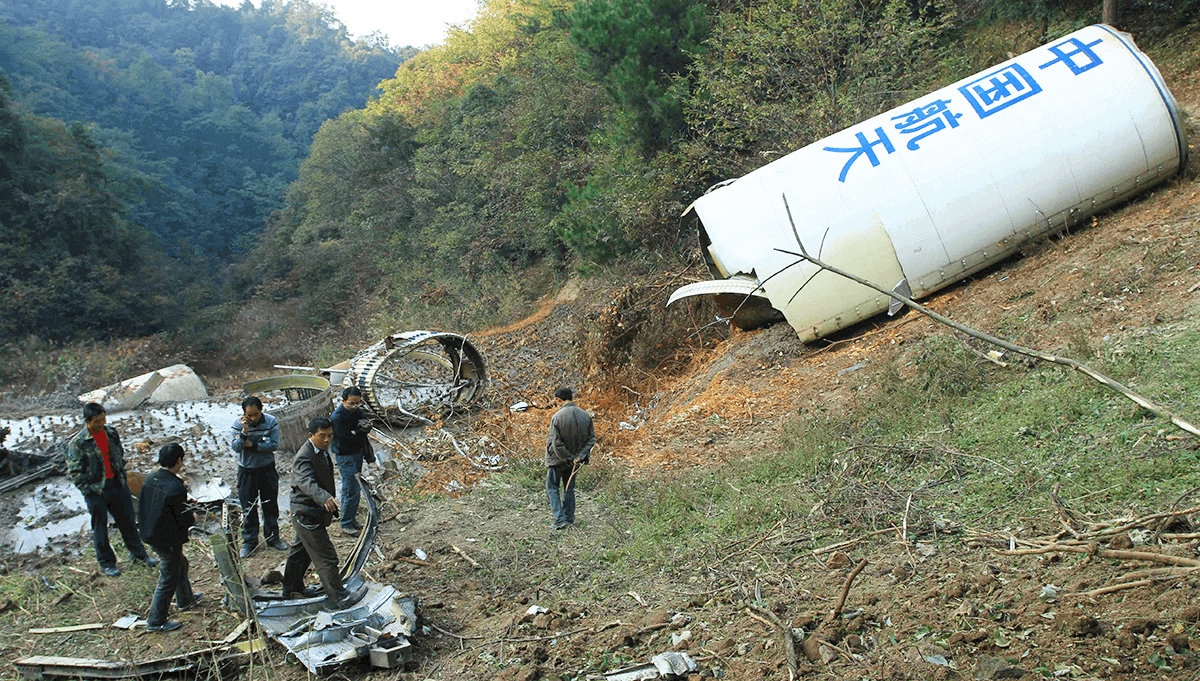
A couple of years ago, a Chinese Long March rocket body re-entered the atmosphere uncontrolled. If it had arrived 15 minutes earlier, it would have landed on New York City. All you can do is cross your fingers and hope that when objects come down, they’re not landing on a bunch of people somewhere.
What is being done – or could be done in the future – to reduce the hazards of space junk?
Alice Gorman: This is an urgent problem that we need action on. At the moment, there are many proposals and missions in testing or development to actively remove debris from orbit, but none are actually working. For new missions, however, there has been a really interesting shift.
We used to look on the atmosphere as a natural incinerator, and all the plans to get rid of stuff in orbit involved tipping them back into the atmosphere to mostly burn up. It was considered to be the logical and most harmless way to dispose of space junk. But objects don’t always burn up, and stuff still makes it to the ground.
We also now know that these aluminium and soot particulates [created by objects burning up] in the upper atmosphere are affecting the ozone layer. We thought we had solved that problem with the 1987 Montreal Protocol, when the world came together to stop the ozone layer being destroyed.
People now realize you can’t just let satellites burn up. In fact, there are now proposals, like ESA’s Zero Debris Charter, for new missions to not create any new debris – to be “debris neutral”. That’s great for current and future missions but are people actually going to do it?
There used to be a rule – don’t leave anything in orbit for 25 years and have an end of life strategy to get rid of it. That’s now down to five years, which is good. But apparently only 40 to 60% of satellite operators followed that protocol – the rest would simply do nothing to prevent their spacecraft from contributing to the debris problem.
We rely on satellite operators and launch operators complying with these international standards and norms. And when profit is at stake, I don’t think we can have any guarantee that they will actually do that.
Katherine Courtney: When I first began focusing on space debris, I sometimes felt there was just the United Nations (UN) long-term sustainability guidelines. They were voluntary, but people are now bringing that into their national space law. There is increasing awareness of the issue and satellite operators are beginning to engage in those conversations differently.
ESA’s Zero Debris Charter is a great initiative because it sets timed targets and detailed technical specifications for how not to create additional debris with your missions. Unfortunately, it still calls for five-year design-for-demise as best practice, which maybe isn’t the answer. Missions should be designed for reuse and recycling. Or we need to not only not create debris, but use new materials that have less impact when they re-enter the atmosphere.
The International Telecommunication Union (ITU) [the UN agency for digital technologies] are really the only multilateral body that have any sort of binding powers. They allocate global radio spectrum and satellite orbits to ensure telecommunication operations run smoothly. They have started holding an annual sustainability conference where they get ITU delegates together to talk about how to fix the problem of space debris.
In 2025, the UN’s Committee on the Peaceful Uses of Outer Space (COPUOS) also set up the Expert Group on Space Situational Awareness – under the Working Group on the Long-term Sustainability of Outer Space Activities (LTS) – because one of the real problems is that we don’t have a clear enough picture of what is going on in orbit.
As Alice described, we can’t see the vast majority of the debris, but we also collect the data about debris through lots of non-standardized observations that are not interoperable and are made by different space agencies around the world. There are competing models that give different estimates and different forecasts.
We need to come up with a standardized way of monitoring the space environment and modelling what impact increasing numbers of spacecraft is having, so it’s great to hear that COPUOS has decided to encourage that.
There is also hope from the UN’s Summit of the Future in 2024. Action 56 in the resulting Pact for the Future proposes a fourth UN Conference on the Peaceful Exploration of Outer Space (UNISPACE IV) in 2027. It will focus on debris, debris mitigation and management, space traffic management, and how the world can cooperate more effectively in this area.
So what do we need to make these initiatives work?
Katherine Courtney: We currently don’t have an international treaty with binding rules. Different countries require different things of their licensed operators, don’t necessarily keep other countries informed of their activities, and some space objects don’t even go into the intended orbits at all. We need something like the ITU – a non-military, cross-border independent authority – that could monitor and enforce standards internationally.
A little ray of light for me is that NASA recently received an e-mail from the Chinese National Space Administration to warn them of a potential collision between a Chinese object and a NASA mission. It was the first time that had happened. Communicating to avoid collisions should be the bare minimum to ensure a more sustainable space environment.
What missions and tests have happened or are in the pipeline to deal with individual pieces of debris?
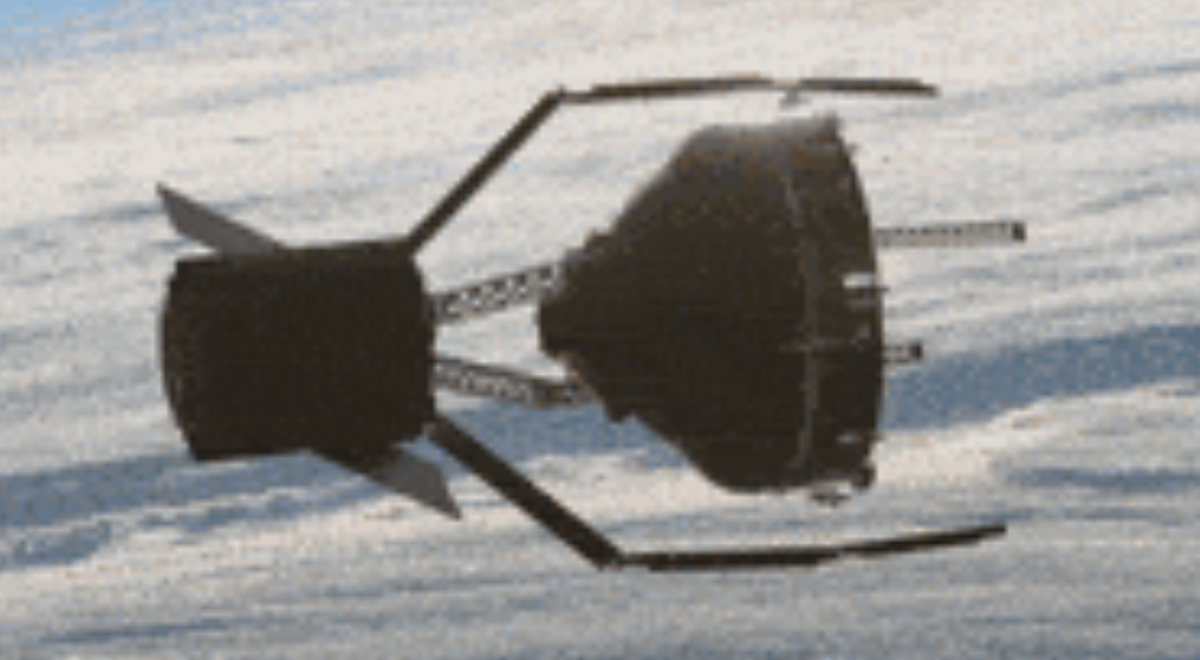
Katherine Courtney: The most advanced to date has been Japan’s Astroscale ADRAS-J mission, which has demonstrated its ability to safely approach a target object and examine it closely. Meanwhile, ESA is launching its ClearSpace-1 mission in 2029 to clear an old PROBA-1 satellite from low-Earth orbit.
These missions are tricky because the first rule is don’t make any more debris – but you have an object that is tumbling, maybe fragmenting and could be carrying fuel. You have to be very careful to prove that you have the technology that can safely capture that object. For ClearSpace-1, they are going to use a sort of robotic grappling mechanism, while Astroscale will use a magnetic solution to grab things.
The UK government has also announced further funding to not just remove one UK licensed object from orbit, but go back and remove a second. This is quite a technical feat – you have to safely take an uncooperative debris object, lower it to a point where Earth’s gravity will cause it to deorbit, and then go back and get another one, all without bumping into anything on the way.
China and Russia have also demonstrated their ability to safely approach objects but they haven’t published the outcomes of those missions. China’s efforts have been defence-focused but they have also started to look at commercial operations in that area. In fact, there are quite a few companies now really interested in being involved in this space.
Do some craft have heritage value?
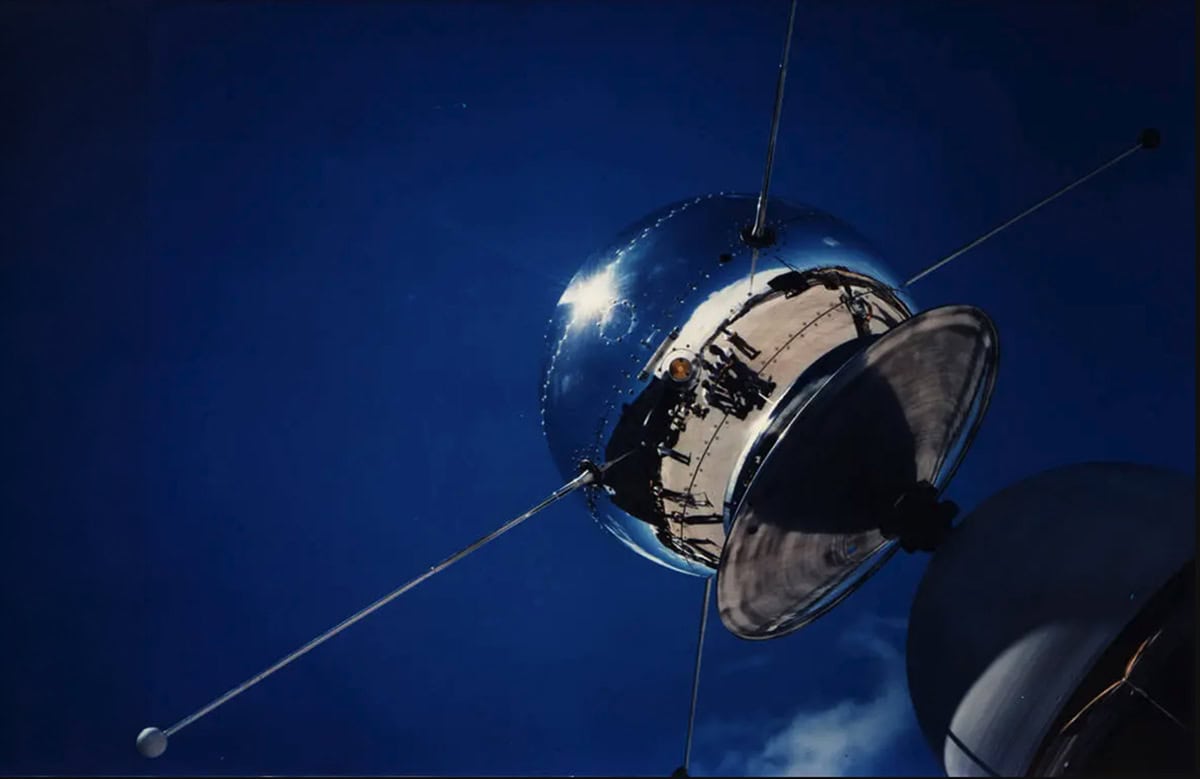
Alice Gorman: There have been proposals to test some debris removal technologies on older spacecraft on the basis that they might one day be a risk and they’re old so nobody cares. But to me many such craft have incredible heritage value.
People sometimes say to me, “But Alice, we can’t leave them there, they’re junk”. However, if they’re not currently collision risks, we don’t have to do anything about them. Instead we can assess their cultural heritage value. We can rank the objects so we can say, if something has to be removed, this object has a lower value than this one.
So, from my perspective, every nation needs to have a look at its heritage assets in orbit, assess their significance, and from that point decide what needs to be done. And in heritage terms you don’t do anything until you need to – the place where something is, is an important part of its cultural significance.
You could argue that the definition of space junk is something which has no use, but these objects actually do have a purpose. Their purpose is to connect people to their history in space and to space as a place. I want to see all proposals for active debris removal incorporate cultural heritage management.
How long might it take before the orbits get so crowded that we really just can’t put anything else into orbits?
Katherine Courtney: I’ve not seen a forecast on how long this will take, but currently people are launching satellites weekly and in batches. According to ITU filings, there are over a million permissions to operate in certain spectrum on file now. So, over the next 10 years, a million more satellites could theoretically be launched, which could be problematic.
Imagine a motorway where everybody can drive at whatever speed they want with no indicator lights. If your car broke down and you just left it in the middle of the road, that would soon become an unusable environment. Space orbits would soon be like that.
But we can use orbital capacity more efficiently. It’s just that it requires a great force of global collaboration to solve that problem because space, by definition, is a place without national borders.
My view is that 90% of space activity today is commercial. Businesses have to manage these hazards and risks or else they will close down. In fact, I see a day where something happens that makes everybody sit up. I call it the Exxon Valdez moment, a disaster that is small enough to hurt some operators financially, but not big enough that we have a Kessler syndrome and we all have to wait 200 years before we can use that space again. I think that’s when the economic incentives will be there for people to actually start collaborating.
Five years ago you never heard an operator say regulation was a good thing – I now regularly attend events where operators ask for regulation. So I think we can solve these problems.
Are there any alternative approaches to avoid more space debris?
Alice Gorman: Although we depend on space, we are in fact neglecting terrestrial infrastructure. The Starlink satellites, for example, have been strongly pushed in because they promise to provide communication to remote places – but only because there has been no investment in terrestrial infrastructure. We can choose to pull some functions back from space. We’re not completely committed to space for all these functions, and we shouldn’t be so dependent on space.
- This article is based on the 10 November 2025 Physics World Live event, which you can watch on demand here