This episode of the Physics World Weekly podcast goes to the movies with the physicist Jess Wade, who has reviewed the Marie Curie biopic Radioactive. Wade is in conversation with Physics World editor Margaret Harris about the much-anticipated film, which Wade thinks fails to live up to the extraordinary life of Curie.
Also this week, Physics World’s Tami Freeman describes a new technique for monitoring radiation therapy using fluorescent tattoo dye. The episode finishes with Hamish Johnston trying to answer ten physics trivia questions that Matin Durrani set for readers on Good Friday. Durrani reveals the answers including James Clerk Maxwell’s favourite pet.
Nobody paid much attention to V838 Monocerotis, a nondescript star 20,000 light years away, until January 2002. Then, suddenly, it brightened by a factor of 600,000, only to fade again that April. Nobody knows exactly what happened. Maybe it collided with another star. Maybe it swallowed a planet whole, or experienced an enormous thermonuclear pulse.
What we do know is that it was spectacular: the star produced an extraordinary flash of light that propagated into space and reflected off the gas and dust surrounding it. Hubble captured these “light echoes” in glorious detail, showing them expanding outwards over a period of months and years. The light reflecting off this interstellar material is still being analysed, and it could hold clues as to what happened to V838 Mon.
Solid-state radiation detectors use crystalline semiconductors, such as silicon or germanium, to directly convert X-ray photons into electrical current. Such devices outperform other detection technologies in terms of both sensitivity and detection limit. Now, a US research team has demonstrated that a new type of solid-state X-ray detector, based on a thin film of the mineral perovskite, is 100 times more sensitive than a conventional silicon-based device (Sci. Adv. 10.1126/sciadv.aay0815).
“Our materials, hybrid perovskites, contain heavy elements such as lead and iodine that can stop X-rays more effectively than silicon,” explains corresponding author Wanyi Nie from Los Alamos National Laboratory. “In this study, we hoped to demonstrate a much thinner layer of perovskite semiconductor than silicon that can still maintain detection performance.”
The thin-film perovskite detectors could enable medical and dental imaging at extremely low radiation dose, while also boosting resolution in security scanners and X-ray research applications. “The improved lower limit of detection will allow the same quality image to be generated using a much reduced X-ray dose, which is safer for patient,” says Nie.
Device testing
Nie and colleagues fabricated their X-ray detectors from 2D Ruddlesden-Popper (2D-RP) phase layered perovskites. They characterized the devices using a synchrotron beamline at the Argonne National Laboratory’s Advanced Photon Source.
To evaluate the feasibility of using thin-film perovskites as radiation detectors, they first determined the linear X-ray absorption coefficient as a function of incident energy for the 2D-RP perovskites, as well as for a 3D perovskite and silicon. The absorption coefficients of the perovskite materials were on average 10 to 40 times higher than that of silicon for higher-energy X-rays, with similar values seen for the 2D and 3D perovskites.
Based on the perovskites’ strong X-ray absorption, the researchers next assessed the current density–voltage characteristics of a thin-film p–i–n detector (with the structure: indium tin oxide/p-type contact/2D-RP thin film/n-type contact/gold) fabricated using a 470-nm 2D-RP thin film. As a reference, they also tested a commercial silicon p–i–n diode (600 µm thick) under the same conditions.
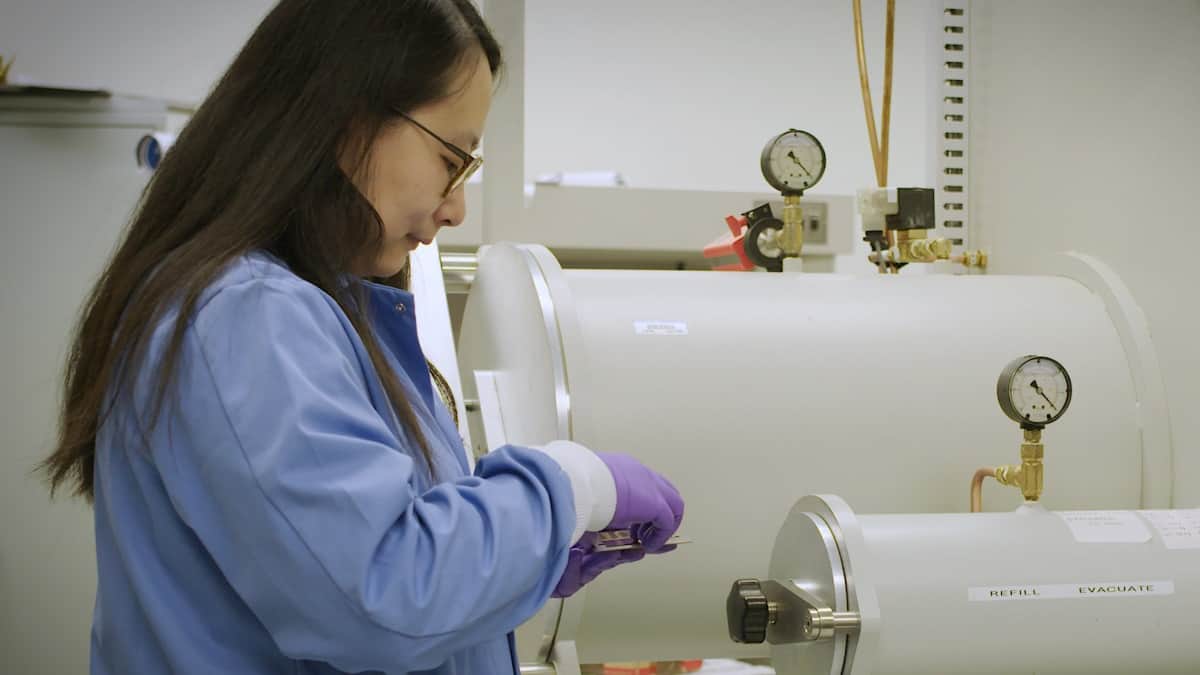
Wanyi Nie, a physicist who leads perovskite device development at the Los Alamos National Laboratory, holds a prototype X-ray detector produced in her lab. (Courtesy: Los Alamos National Laboratory)
An important requirement for a high-performance X-ray detector is a minimal dark current at reverse bias, so that signals generated at low X-ray doses can be resolved above the dark noise. Prior to X-ray exposure, the dark current density for the 2D-RP device was 10−9 A/cm2 at zero bias. At a reverse-bias of −1 V, the dark current density was 10−7 A/cm2 – which translates to a high diode dark resistivity of 1012 W·cm.
Upon exposure to a 10.91 keV X-ray beam (with a photon flux of 2.7 × 10¹² counts/cm2/s), the 2D-RP device showed a large increase in current density at zero bias: four orders of magnitude higher than the dark current. In comparison, the current density of the silicon device only increased by two orders of magnitude.
The researchers next quantified the detection limit of the devices, by examining the X-ray-generated charge density as a function of dose under zero bias. The detecting photon density limit for the 2D-RP device was about 5×10⁸ counts/s/cm2, while the silicon device had a limit of 3×10⁹ counts/s/cm2. They attribute the superior performance of the 2D-RP device to its low dark current.
The estimated X-ray detection sensitivity of the 2D-RP device was 0.276 C/Gyair/cm3, compared with 0.000333 C/Gyair/cm3 for the silicon diode. The researchers note that the sensitivity of the 2D-RP device is considerably higher than values reported for other perovskite thin-film X-ray detectors.
One big advantage of the 2D-RP device is the high sensitivity that it exhibits under zero bias (the primary current), which enables it to operate as a self-powered detector without an external power source. This is in contrast to larger bulk perovskite detectors, which require high-voltage operation that drastically reduces the operational lifetime. Tests on the 2D-RP device revealed that the thin film is stable under both bias and X-ray exposure.
The team conclude that the layered perovskite thin film is a promising candidate for a new generation of X-ray detectors. Nie says that it should be possible to fabricate large-scale detector arrays for medical imaging applications.
“Currently, semiconductor detectors are not widely used in large-scale applications because of the cost,” she tells Physics World. “As we can fabricate our device from solution, one could imagine printing a large, pixelated detector array, which could be drastically cheaper, especially for large-scale imaging applications.”
Artificial intelligence is a research field that attracts its fair share of hyperbole. Fuelled by popular depictions of intelligent robots that behave just like human beings, public debate has focused on how AI will transform our lives, replace our jobs and, in the most dystopian fantasies, take over the world. Even Sundai Pinchai, the chief executive of Google, is reported to have said “AI is one of the most important things humanity is working on. It is more profound than, I dunno, electricity or fire.”
Michael Wooldridge, a professor of AI at the University of Cambridge in the UK, seeks to rewrite that mainstream narrative in his latest book The Road to Conscious Machines: the Story of AI. For a start, he says, creating a robot that thinks and acts like us is fiendishly difficult, and it’s far from certain whether it would one day be feasible, let alone desirable. What’s more, those futuristic fairy tales overshadow the myriad examples of the real-world benefits already delivered by AI research, such as language translation, as well as healthcare monitoring and diagnosis.
As someone who often reports on how AI has become a crucial tool in many areas of science, I was particularly interested in Wooldridge’s examination of what AI is, and what it is not. Even the term “artificial intelligence”, originally coined by American academic John McCarthy in 1956, can be misleading for a non-expert, as it suggests that the goal is to create a machine that is capable of independent thought. Instead, it involves creating algorithms and programs that allow computers to follow hundreds of millions of instructions – all of which has become possible in recent years, thanks to exponential improvements in data-processing power, and the advent of big data.
This means that computers can now do specific tasks very well: they can beat the best human players of chess and Go, and can identify anomalies in thousands of X-rays more reliably than human clinicians. But machines still can’t understand a story well enough to answer questions about it, and nor can they interpret what’s really happening in a picture. Those and other abilities that we might call general human intelligence are far from being replicated by a machine.
To understand the possibilities and limitations of AI, Wooldridge explores its evolution from the initial ideas of Alan Turing right up the present day. He is an informative and entertaining guide, capturing the buzz of new research breakthroughs, while also explaining the key concepts that underpin modern AI research. But the book is not all about the achievements – indeed, Wooldridge also offers a candid appraisal of the many missteps along the way.
One such example was the Cyc project, initiated by AI visionary Doug Lenat in 1984, which aimed to capture everyday human knowledge in a vast expert system that would be able to answer questions in a human-like way. The information it contained was patchy, however, and its responses unpredictable, a failure that has become part of computing folklore: the scientific unit for measuring bogus claims is called a micro-Lenat, says Wooldridge, because “nothing could be as bogus as a whole Lenat”.
Despite setbacks like these, AI has in recent years been transformed from a curiosity for academics into one of the most feted areas of science and technology. That seismic shift has been enabled by advances in machine learning, which have allowed computers to solve problems without needing to follow a comprehensive list of instructions. Instead, powerful programs based on neural networks can be trained to perform specific tasks, such as playing a board game or basic language translation.
The power of these approaches was deftly illustrated in 2014, when AI start-up DeepMind showed that a computer program could teach itself to play a series of video games at a better-than-human level. Rather than relying on a vast input dataset, the program was designed to learn through a process of trial and error – in one case discovering a winning strategy that even its designers had not considered.
Even the most advanced AI systems have no real understanding of what they are doing
But even the most advanced AI systems have no real understanding of what they are doing, cautions Wooldridge, which can create problems if we place too much trust in a system that appears to make the right decisions most of the time. The first autonomous cars, for example, have caused fatal accidents when their human drivers weren’t paying attention, while a facial recognition system for identifying potential criminals failed because the input dataset was skewed by police mugshots in which no-one was smiling.
Wooldridge offers an even-handed analysis of these and other ethical issues, but I wasn’t convinced that someone so embedded in the research community could really scrutinize some of the moral issues that non-expert users of AI technology will need to tackle. While he recognizes that AI systems have the potential to be biased and to be used for the wrong reasons – lethal autonomous weapons anyone? – he doesn’t offer much reassurance that tentative guidelines proposed by scientists will become a regulatory framework anytime soon.
Wooldridge also indulges in some speculation on the prospects for strong AI: the road to conscious, self-aware, autonomous machines. Any such system would need to replicate what philosophers call the “theory of mind”: the human ability to understand and predict the behaviour of other people based on their beliefs and desires. Only this type of machine, says Wooldridge, would truly be able to pass the Turing test – to act in a way that would be indistinguishable from the real thing – and that goal may remain a fantasy for many years to come.
While writing my February column about environmental activist Greta Thunberg sailing rather than flying across the Atlantic, I came across information that shocked me. According to the Economist (11 March 2017), the emissions of nitrogen and sulphur oxides from 15 of the world’s largest ships match those from all the cars on the planet. Indeed, if the shipping industry were a country, it would be ranked between Germany and Japan as the world’s sixth-largest emitter of carbon dioxide.
Shipping is the lifeblood of the global economy and 90% of trade is seaborne. More than 90,000 ships crossed the oceans in 2018, burning two billion barrels of the dirtiest fuel oil. Ships belch out pollutants into the air, principally sulphur dioxide, nitrogen oxides and particulate matter. These nasties have been steadily rising and endangering human health, especially along key shipping routes. They also create 2–3% of the world’s total emissions of carbon dioxide and other greenhouse gases.
Shipping – like aviation – isn’t covered by the Paris Agreement on climate change.
But because of its international nature, shipping – like aviation – isn’t covered by the Paris Agreement on climate change, which seeks to limit the global temperature rise to 2 °C this century by reducing emissions. Instead, it is up to the International Maritime Organization (IMO) to negotiate cuts in emissions from the shipping industry. The IMO wants to reduce emissions from the sector by 50% by 2050, but it is facing increased demand from population and economic growth. If left unchecked, maritime emissions will rise six-fold by that date.
The worst fuel?
Most ships today burn bunker fuel. It’s a “heavy” fuel oil – mostly what’s left over after crude oil is refined. Literally, it’s the dregs. It’s also toxic when burned, and currently contains 3500 times as much sulphur as diesel fuels do.
The IMO has already adopted mandatory measures to cut greenhouse-gas emissions from international shipping. As of last year, all ships over 5000 tonnes – those that emit 85% of all maritime greenhouse-gas emissions – have been required to collect fuel-oil consumption data. And from this year, the IMO has capped sulphur emissions by banning the sale of high-sulphur fuels, which must now contain no more than 0.5% sulphur – down from 3.5%. Ships must also use “scrubbers” to deal with exhaust gases.
More than $12bn (£9.7bn) has so far been spent on fitting these exhaust-gas scrubbers to ships. These devices process the sulphur, creating a liquid by-product that contains pollutants, heavy metals and carcinogens that can harm sea-life. A total of 3,756 ships had scrubbers installed by 2019, which sounds great until you realize that about four-fifths of vessels – 3014 to be precise – have “open-loop” scrubbers that simply pump the toxic liquid by-products straight back into the sea. Worse still, scrubbers increase fuel consumption by about 2%, adding to carbon-dioxide emissions.
It is easy for the IMO to seem like the bad guys, but it’s made up of 174 individual national representatives, each fighting their own economic corner. In my view, the IMO – a UN body – is doing its best. Maersk – the world’s largest container-shipping company – estimates that the IMO’s 2020 rulings will result in a $2bn rise in its annual fuel costs to switch from high-sulphur fuel to marine gas-oil, which is almost 50% more expensive. The company itself has invested $1bn in cleaner technology development over the last four years.
Ammonia to the rescue?
One way of making shipping greener could lie with ammonia (NH3). A pungent gas in its natural form, ammonia is widely used by farmers as a fertilizer and might seem an odd saviour for the shipping industry, especially as the manufacturing process is far from green. Ammonia is made by reacting nitrogen at high temperatures and pressures with hydrogen obtained from methane. The latter is an energy-hungry process, known as “steam methane reforming”, that accounts for 1.8% of all carbon-dioxide emissions.
However, according to a new report from the Royal Society, ammonia has a vital role as a zero-carbon fuel and energy store. It says that the maritime industry is likely to be an early adopter of “green ammonia” – a fuel made by mixing nitrogen from the air with hydrogen obtained by electrolysing water using electricity from sustainable sources. Green ammonia could either be burnt in a ship’s engine or used in a fuel cell to produce electricity. Water and nitrogen are its only by-products and it has an energy content of 3 kWh per litre of fuel compared with just 2 kWh/l for liquid hydrogen.
According to a new report from the Royal Society, ammonia has a vital role as a zero-carbon fuel and energy store.
Although conventional fuel oil has a higher energy content of 10 kWh/l, ammonia is easily stored in bulk as a liquid at modest pressures (10–15 bar) or refrigerated to –33 °C – making it an ideal chemical store for renewable energy. Ammonia also benefits from a fully existing near global distribution network, in which it’s stored in large refrigerated tanks and transported around the world by pipes, road tankers and ships.
Earlier this year, the shipping body Lloyds Register along with engine maker MAN, Samsung Heavy Industries and the MISC Group announced plans to develop ammonia-fuelled tankers to deliver viable deep-sea zero-emission vessels by 2030. The UK’s Science and Technology Facilities Council has also been working on green-ammonia technology with three firms – Siemens, Engie and Ecuity – for some time. Indeed, Bill David – a chemist from the University of Oxford – told me at a recent business event that trucks and cars might one day use this fuel too.
Sure, ammonia costs more than conventional fuels for ships. But if the power to create the hydrogen and ammonia can come from carbon-free sources, such as renewables or nuclear, then surely green ammonia will be the future of carbon-free shipping and other sectors too.
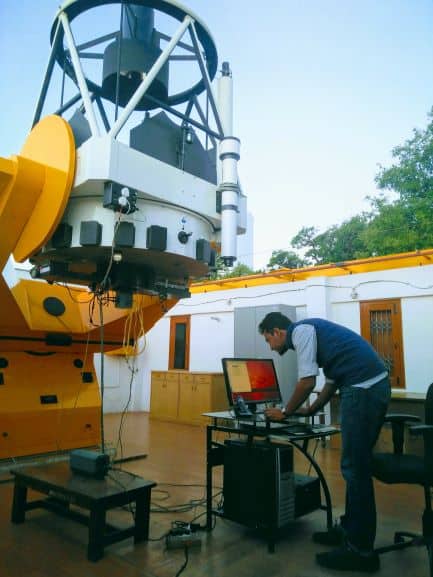
Safe mode: Vivek Kumar Jha closes down telescope operations after a night’s observing last year in Devasthal, Uttarakhand, India. (Courtesy: Vivek Kumar Jha)
My research work involves continuously monitoring active galactic nuclei (AGN) in the optical wavelength range through different telescopes. I spend most of my time at ARIES, and the remainder of my time at the institute’s observatory in Devasthal, which is located 70 km further into the Himalayas. Some of our observations are also done remotely with robotic telescopes in other parts of the world and with space-based telescopes.
My work is broadly divided into two parts: performing observations for a few nights every month at Devasthal, and reducing, analysing and modelling data obtained from this and other telescopes to get scientific outputs. On nights when we are scheduled to observe, we have to be present at the observatory along with the technical staff stationed there to help us run everything smoothly. When not observing, we work in our institute’s office cubicles. Most often our working hours extend into the night, with occasional tea and coffee breaks. In terms of group activities, we have daily discussions over arXiv papers within our research groups, weekly discussions with other research fellows in our science club and occasional seminars during the afternoon. We have some sports activities and we usually play volleyball, badminton and table-tennis during the evening.
The world’s biggest lockdown
Owing to safety concerns, ARIES asked us to leave a few days before 25 March, when India’s central government began to enforce the world’s biggest lockdown – effectively confining 1.3 billion people to their homes. Now, there are only a few essential staff on duty at the institute and the observatory. The technical operators at the observatory have been remarkable, keeping the telescope up and running even in these difficult times. Meanwhile, I returned to my home in New Delhi and am currently working from there.
Working remotely is a familiar thing for people involved in astronomy. Whether it’s using data from the robotic telescopes, filing online observation requests or holding meetings with our collaborators over Skype, we regularly work remotely even in normal times. And of course, for space-based telescopes, working remotely is the only possibility we have! With that in mind, I expected my experience of this pandemic to be more of a “change-of-workplace” rather than “work-coming-to-a-halt”. Working from home didn’t seem challenging at first sight, especially for those of us already equipped with the essentials – namely a computer, notepads and a good Internet connection.
But what I have discovered is that it is very difficult to work as usual from home. I read somewhere that the experience is like inviting your family to the workplace during office hours. Even the act of getting up and then walking a few feet to your desk doesn’t feel encouraging most of the time. The atmosphere doesn’t help either, with everyone anxious about what happens next. There are rumours galore even in the national capital – sometimes about food shortages leading to panic buying, sometimes about free buses for migrants leading to some crazily large gatherings of people trying to get home.
Friends and colleagues: For Vivek Kumar Jha (right), being surrounded by a community of like-minded people is one of the things he misses most about working life before the pandemic. (Courtesy: Vivek Kumar Jha)
Having said that, in these uncertain times it’s better to cherish what we have and not fall into the trap of negativity. I plan my day in the morning and make a list of things to do. My usual workday now involves reading relevant papers, working on my current project for a few hours, learning techniques online to solve some problems, and talking over the phone with friends. This pandemic has given us a good opportunity to catch up with old friends and family members, which eventually reduces the isolation we feel. But of course, working in a group, surrounded by like-minded people who share the same feelings as we go through the little ups and downs of research life – this is a component that suddenly disappeared. We try to make up for that by scheduling video calls occasionally, but the feeling of sitting together and having a chat can’t be replaced at all. Meeting face-to-face is a luxury we can’t afford right now.
Adjusting to a new normal
Initially, India’s national lockdown was supposed to end on 14 April, but after looking at the global and national trends, the government has extended it for another few weeks, to 3 May. I have prepared myself accordingly. Our group meetings have shifted to video conference apps like Skype or Zoom. Analysis work for the data I already have continues with occasional inputs from my supervisor. I plan to get a draft ready by the end of this month. On the observational front, I am able to submit observation requests for the robotic telescopes online, while at the Devasthal observatory my observations are performed by the technical operators with a request over a phone call. So far it has worked out, and I am hopeful it will continue this way until the crisis subsides.
Because we miss the company of friends and colleagues at ARIES, we decided to meet twice a week over Skype for an hour. The director of our institute has initiated a seminar series over Zoom that has been highly successful, with more than 40 people participating every day. I have also signed up to present a talk on this platform. Even though we miss being with our community, we can at least connect with people if we want to, thanks to modern technology. No-one can imagine what our life would have been like had the disease struck in the pre-Internet era.
Even though this crisis has reduced my usual work hours, my ability to work and communicate has not been lost. Luckily, my research doesn’t involve a lab that has been shut; although it involves a few telescopes, these have been functioning so far, albeit with reduced technical staff. The most difficult question I face these days is from my mother. Every morning while having tea, she has been asking, “When will this situation improve?” I have not been able to answer the question convincingly and hence it persists.
Predictions and hopes
Deep down, no-one among us has a convincing answer, as this is a crisis we have never experienced. It may extend for months, and at the moment there is no end in sight. Even if the virus goes away, the effects it will leave behind will be profound. Almost all the national and international conferences have been cancelled, including some as far off as November, which hampers our opportunities to interact with the research community. In the near future, work on ground as well as space-based telescopes will definitely slow down, and some projects may not even get started.
One final note. We have been divided along the lines of religion, race, caste and gender for a very long time. But for the time being, the talk of division along these lines has been replaced by talk of doctors, equipment and medical research. If we are seeking a positive message to come out of this crisis, I think it is that we should be united from now on, however Utopian it may sound. Leaders have been talking about the world being different after this crisis is over. I hope one aspect of this difference is that we can rise above the petty divisions among us and bring togetherness to all of humanity.
Ryan Flanagan, Vincenzo Nicosia and Lucas Lacasa from Queen Mary University of London have developed a new way of analysing “horizontal visibility graphs” – a time series of data points that can be used, for example, in medicine to distinguish patients who have certain diseases from those who do not.
The research is reported in full in Journal of Physics A, published by IOP Publishing – which also publishes Physics World.
What was your motivation for performing this research?
By means of the so-called horizontal visibility algorithm, a sequence of data points (a time series) can be transformed into a horizontal visibility graph (HVG). After doing that, tools of network science and graph theory can be used to describe the time series combinatorically, opening new avenues for characterization.
A typical application of this method often tackled in the literature is that of classifying and distinguishing patients with a certain pathology from healthy controls, by using the properties of HVGs as features for automatic diagnosis. But applications range from physiology or neuroscience, to physics (characterizing turbulence, for example), finance, biology and more.
While we have a theoretical understanding of why certain properties of these graphs provide important information on the time series structure, for some other metrics, such a link is more difficult to grasp. Among other properties, practitioners have used the spectral (i.e. eigenvalue) properties of HVGs as features to distinguish and characterize the complexity of time series. However, to date, the amount of theoretical work on how these spectral properties behave is very scarce. This was the main motivation for this work.
What approach did you take?
We explored the spectral (eigenvalues) properties of HVGs from a theoretical angle. We constructed HVGs from different types of time series, generated by the so-called Feigenbaum scenario (periodic series with different periods, and chaotic series with different Lyapunov exponents). We then derived rigorous, analytical and numerical results on the spectral properties of these graphs, to understand how these relate to the time series structure.
We also wanted to understand to what extent the approach often employed in the literature (use of the maximal eigenvalue of the adjacency matrix as a quantifier of the time series complexity) was sensible and well-defined.
What was the most interesting finding?
The most striking result was that, at odds with what was assumed before, the maximal eigenvalue of the adjacency matrix is in general not a proper quantifier of the time series complexity. Additionally, we found that other spectral features of the HVG could do a better job.
Besides this, this paper is the first one that attempts to make a rigorous analysis of the spectral properties of these kind of graphs. It opens up a line of research on the spectral properties of this family of graphs.
Why is this research significant?
We hope that this research will catch the interest of different groups of scientists. From an applied point of view, our results show that spectral properties of HVGs should be used cautiously if the aim is to characterize the complexity of a time series. From a theoretical point of view, we hope that spectral graph theorists and algebraic combinatorialists will be interested in a range of open problems that we flag. While HVGs have been mostly used in applications, their mathematical foundation is mostly in its infancy, and there is room for a lot of interesting work to be done.
What do you plan to do next?
There are several open problems. From a mathematical point of view, we aim to fully analytically solve the spectrum of HVGs (at least in the context of current analysis). In the paper, we propose several possible avenues for doing that. Particularly intriguing is to understand the apparent fractal shape of this spectrum (as seen in the image above).
Selecting a definitive list of the best images taken by the Hubble Space Telescope is an impossible task. The orbiting observatory has snapped so many superb shots of deep space that everyone has their own favourites based on aesthetic appeal and scientific importance. Nevertheless, in this series I’ll explore 10 images that ought to be contenders.
Number 10 on the list is this image of the Horsehead Nebula. Hubble saw this iconic dark nebula in a very different light in the autumn of 2012. The telescope was always famed for its prowess in visible and ultraviolet light, but with the addition of the Wide Field Camera 3 during its final servicing mission in 2009, Hubble also gained capabilities in the near-infrared. This allowed it to see through some of the nebula’s obscuring dust – which normally appears black against the red glow of the emission nebula behind it – to reveal the delicate, wispy structures that make up the nebula, which acts as a shroud, concealing the birthplace of stars within.
This short film takes you inside one of Spain’s premier materials science research facilities – the Materials Science Institute of Madrid (ICMM). Managed by Spain’s scientific research council, the institute deals with both fundamental and applied research with a strong focus on areas that could lead to real-world applications. In the video – recorded just before the nationwide lockdown – you meet three ICMM researchers with diverse interests.
María Concepción Serrano López-Terradas is developing graphene-based implants that could be used to treat patients with spinal cord injuries. Felipe Gándara is interested in metal-organic frameworks (MOFs) and covalent organic frameworks (COFs) that could be used for gas storage. Finally, Andrés Castellanos-Gómez is designing methods for straintronics – an emerging field of electronics devices whose properties can be tuned by mechanical deformation.
Within the next couple of weeks on this website, we will also be sharing extended video interviews with all three researchers looking in more detail at their work. In the meantime, you can also take a look at the Physics World Nanotechnology Briefing, published in April 2020. This free-to-read collection celebrates how nanotechnology is playing an increasingly important role in applications as diverse as medicine, fire safety and quantum information.