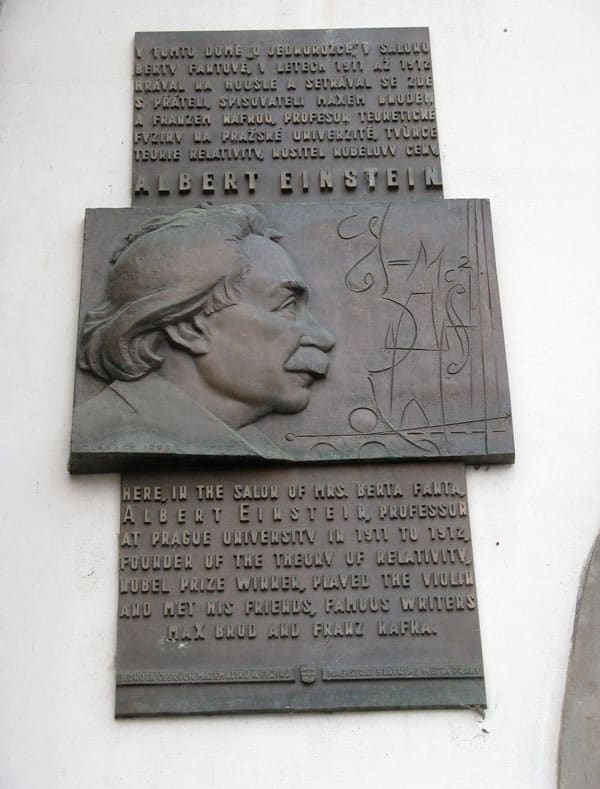
Briefly in Bohemia: Einstein’s 15 months in Prague are commemorated by a plaque at the location of Berta Fanta’s salon. (CC BY SA 3.0/Yair Haklai)
Not many people may know that the key experimental test of general relativity – the observation of the deflection of starlight by the Sun’s gravity during a solar eclipse – first occurred to Albert Einstein not in Zurich or Berlin, but in Prague. The city was then the capital of Bohemia, a region of the Austro-Hungarian Empire, prior to the post-war creation of Czechoslovakia in 1918. Einstein lived in Prague as a university professor of physics for a mere 15 or so months in 1911–1912, before moving back to Switzerland and then returning to Germany in 1914, where he published his general theory of relativity in 1915–1916.
In 1923 Einstein himself described the significance of his time in Bohemia, in a revealing foreword specially written for a Czech-language edition of Relativity: the Special and General Theory – his well-known booklet for the general reader, first published in German in 1916. Little-known even to the majority of Einstein scholars, the foreword (printed in Einstein’s German original followed by a Czech rendition by the publisher) has now been translated into English in Einstein in Bohemia – the deeply researched, wide-ranging and original book by historian Michael Gordin, which delves into Einstein’s relationship with Prague.
To quote Einstein: “I am happy that this small booklet…now appears in the national language of that country in which I found the necessary composure to gradually give a more definite form to the fundamental thoughts of the general relativity theory, which had been gathering already since 1908. In the quiet rooms of the Institute of Theoretical Physics of the German University in Prague on Vinicná ulice, I came in 1911 to the discovery that the equivalence principle required an observable degree of bending of light beams by the Sun, without knowing that more than a hundred years earlier a similar consequence had been drawn from Newtonian mechanics in connection with Newton’s emission theory of light. In Prague I also discovered the result, still not definitely established, of the redshift of spectral lines.”
Einstein’s tribute to the German University, though factually accurate, is an indication of his complex attitude towards Prague – both when he lived there with his first wife and children, and during the rest of his life until his death in the US in 1955. Gordin calls it “odd – one might almost say tone-deaf”, because it emphasizes the minority German-speaking community in Bohemia rather than the majority Czech-speaking community, which had long existed together in a state of tension. As a German-speaker appointed in Prague for his achievements in German physics, Einstein cultivated few contacts with the Czech community, and treated Prague with a degree of disdain. Indeed, Gordin’s chapter focusing on Einstein’s stay is titled “Anti-Prague”. Only later, after the rise of Adolf Hitler, the Nazi oppression of Czech Jews and the German occupation of Czechoslovakia in 1938–1939, did Einstein become more culturally sensitive to the Czech community.
Physics, and the history of science, appear throughout Gordin’s book, as do the many physicists who influenced and interacted with Einstein, including Ernst Mach, Max Abraham and, crucially, Philipp Frank. The latter, on Einstein’s recommendation, took over Einstein’s Prague university position in 1912. Frank later escaped from the Nazis in 1938, and went on to Harvard University in the US. In 1948 he published an influential English-language Einstein biography with a section on “Einstein at Prague”.
But the dominant theme of Einstein in Bohemia is unquestionably biographical, set against a cultural and political background – recalling Gordin’s excellent earlier study Scientific Babel: the Language of Science from the Fall of Latin to the Rise of English. In this latest volume, Gordin’s declared intention is to fill a significant gap in existing biographies of Einstein, rather than to dwell on the history of relativity. The book’s penultimate chapter deals entirely with Czech reactions to Einstein over the past century, including of course the politically contentious Soviet-dominated period from 1948 to 1989. For instance, Gordin discusses at length Frank’s much-quoted assertion that the Prague-born, German-speaking, Jewish writer Max Brod (best known for his friendship with Franz Kafka) based his portrayal of Johannes Kepler on his personal observations of Einstein in Prague, in his acclaimed historical novel, Tycho Brahe’s Path to God, published in 1915.
According to Frank, “Whether Brod did this consciously or unconsciously, it is certain that the figure of Kepler is so vividly portrayed that readers of the book who knew Einstein well recognized him as Kepler. When the famous German chemist W Nernst read this novel, he said to Einstein: ‘You are this man Kepler.’” Yet as Gordin observes, Brod was “horrified” by Frank’s claim – with its unsourced anecdote about Nernst and Einstein – and he worked to dispel this supposed link, both before and after Einstein’s death.
As for the idea that Einstein’s unconventional personal behaviour, symbolized throughout today’s world by his violin playing, wild hair, rumpled sweaters and lack of socks, was at heart “bohemian” – Gordin has little truck with it. As he reasonably points out, this iconic image belongs to the Einstein of later years, not to the younger physicist in Bohemia, who was generally groomed in the way conventionally expected of a German professor in 1911. But here, perhaps, Gordin misses a trick. He does not mention that the English word “bohemian” is derived from the French bohémien, meaning “gypsy” – a word that Einstein often used to describe himself.
It could be raining molten iron on some exoplanets, according to David Ehrenreich at the University of Geneva and an international team of astronomers. The team discovered evidence for the metallic precipitation in atmospheric spectra of the giant, ultra-hot planet WASP-76b that is about 390 light-years from Earth. Their findings could provide new insights into the exotic chemistry that plays out in the atmospheres of such hot gas giants.
“Hot Jupiters” such as WASP-76b comprise a widely studied group of giant exoplanets that orbit close to their host stars, where they can experience daytime temperatures exceeding 2000 K. Such conditions are extreme enough to break down molecules in the planets’ atmospheres into individual atoms, which recombine back into molecules during the cooler nights. Clearly, this effect would produce extreme differences in atmospheric chemistry between both sides of these planets, but so far, astronomers have not confirmed this asymmetry through direct observations.
In the new study, Ehrenreich’s team has measured such a chemical gradient for the first time, using the ESPRESSO spectrograph at the Very Large Telescope (VLT) in Chile. With the instrument, the researchers could collect light from any combination of the VLT’s four 8-metre telescopes. This provided them with sufficiently high spectral resolution to check for differences in the absorption spectra produced by the atmosphere on the day and night sides of WASP-76b as it passed in front of its host star. In particular, they looked for a gap in the star’s spectrum corresponding to the characteristic wavelengths absorbed by atomized, or “neutral” iron.
Dusk and dawn
Because of the orientation of a transiting exoplanet, it is difficult to obtain its day- and night-time spectra. This is because (from our perspective) the day side is on the far side of the planet and the night side is always dark. However, Ehrenreich and colleagues could observe the atmosphere during dusk and dawn by focusing on the ring of starlight that passes straight through WASP-76b’s atmosphere. As Ehrenreich’s team had predicted, a neutral iron absorption line is visible on WASP-76b’s evening side, but not on its morning side.
The observation confirmed that neutral iron is indeed produced on WASP-76b during hottest part of the day – but becomes far less abundant over the course of the night. Overall, these observations suggest that neutral iron in the atmosphere of WASP-76b condenses during the night to form clouds of liquid droplets – the most stable form of recombined iron atoms. This could then cause molten iron to rain down on the exoplanet during the night, before being atomized again during the day. In the future, Ehrenreich’s team hope that the process could be understood in more detail through 3D global climate models.
Researchers at the Massachusetts Institute of Technology (MIT) have developed a new dark-field imaging technique that does not require specialized microscope components. The technique, dubbed “substrate luminescence-enabled dark-field imaging” (SLED), involves adding a mirrored substrate to the sample stage of a standard optical microscope, and its simplicity could make dark-field imaging more widely accessible.
Dark-field microscopy produces high-contrast images of samples such as blood cells, bacteria, algae and marine organisms that are often transparent and provide little to no light absorption contrast. In a typical method, light is shone onto the microscope’s sample stage at a steep angle with respect to the sample surface normal. Because these highly oblique angles are larger than the maximum light collection angle of the microscope’s objective lens, the microscope only collects light that is scattered by the sample onto a cone centred around the instrument’s optical axis. This scattered light creates an image of the sample’s features that are in bright contrast to the dark background.
To create such images, however, researchers need to fit standard optical microscopes with specialized filter cubes. They must also use dedicated objectives or condensers to shape the incident light cone, adding to the expense and bulk of the instrument.
A luminescent photonic surface
A team led by Matthias Kolle and Cecile Chazot of the Mechanical Engineering Department at MIT has now succeeded in integrating the components needed to create the cone of light for dark-field illumination into the surface on which the sample is placed. In the MIT instrument, this surface – the sample substrate – is made from a luminescent photonic material that emits light only at high angles as measured from the substrate surface’s normal. This light, Kolle explains, can only enter the microscope objective if it is scattered by the sample. Regions where there is nothing to scatter light (for instance, just water) will appear dark, while – as in conventional dark-field imaging – the features of small aquatic organisms, bacteria and other hard-to-image micron-sized objects appear bright. The substrate is thus “self-contained” and allows for dark-field contrast without the need for additional components.
How it works
The light emitted by the substrate is confined to high polar angle ranges thanks to the interplay between three different modules, Kolle says. The first module is a light source with a narrow spectral range (in this case, red). In the MIT experiments, this source consisted of core-shell semiconducting quantum dots (made from cadmium selenide/cadmium sulphide dispersed in a polymer matrix), but the researchers say that simple light-emitting diodes (LEDs) could work equally well.
This light source is positioned beneath a second module, comprising a spectrally selective mirror that allows only light of specific wavelengths to pass through, and only in specific directions. This mirror is made from alternating nanoscale layers of transparent materials with different refractive indices, which means they reflect incoming light at different angles.
“We tune this mirror so that it allows the red light generated by the quantum dots to pass through only at high angles (with respect to the surface normal),” explains Kolle. “If the light hits the mirror at the wrong angles, it bounces back and doesn’t escape from the substrate.”
Bragg reflector “gatekeeper”
In effect, this mirror – known as a Bragg reflector after the father-and-son team who established the underlying theory of how it functions – acts like a “gatekeeper”, Kolle says. It only permits light of a given colour to escape from the substrate at specific angles.
But what happens to the light that isn’t allowed to escape or light that is emitted by the quantum dots far from the Bragg reflector? For that, the researchers added a third module below the light source – a micropatterned mirror containing small wells around 4 microns across. This mirror bounces light back towards the top Bragg reflector and redirects it so that it has the chance to hit the reflector at an angle at which it can escape. The mirror is moulded from solid transparent epoxy coated with a reflective gold film. According to Kolle, its design was inspired by the wings of the Papilio butterfly, which get their iridescent colour from their micron-scale structure.
Sending light onto the sample at the right angles
The researchers, who report their work in Nature Photonics, say they have already used their technique to image individual bacterial cells and microorganisms in seawater. They add that the crucial photonic substrate could be mass-produced with existing techniques, and that it could be integrated into even the most simple and compact optical microscopes. It might also be incorporated into miniature dark-field imaging devices for applications in point-of-care medical diagnostics and bio-analytics. Kolle says his team is working on prototypes for such applications.
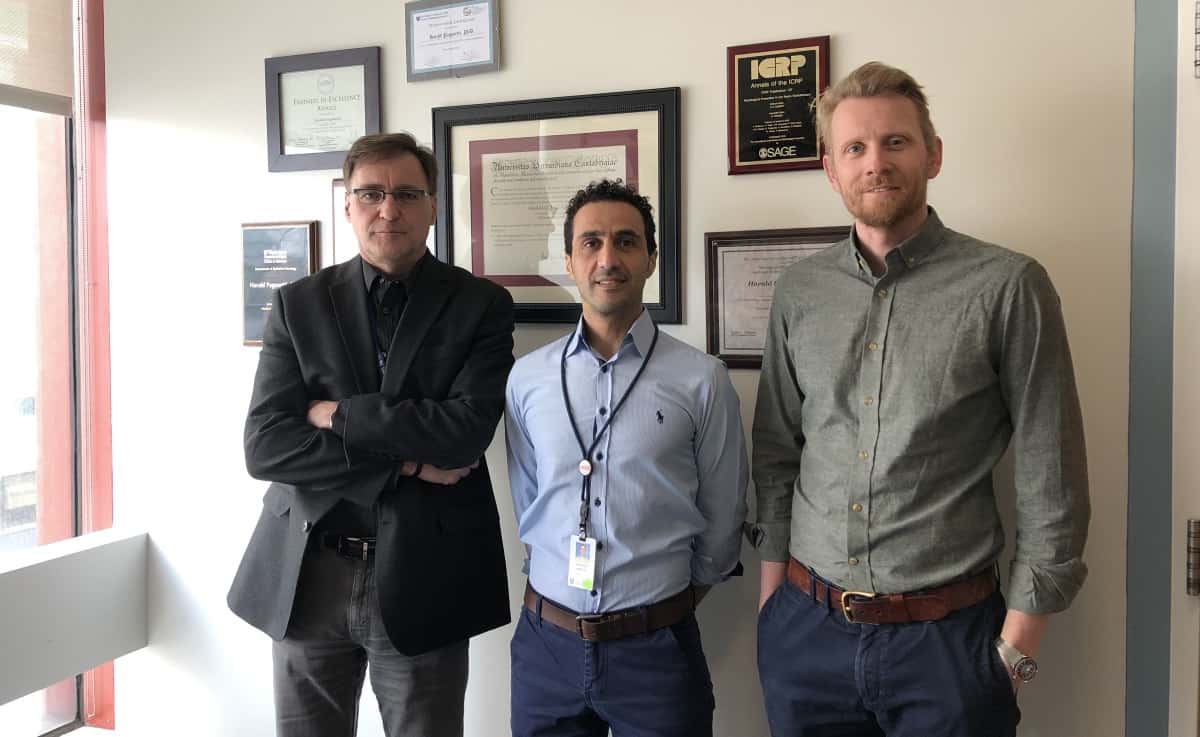
Harald Paganetti, Abdelkhalek Hammi and Clemens Grassberger (left to right) have modelled the dose to circulating blood during radiotherapy. (Courtesy: Abdelkhalek Hammi)
Radiation is known to be damaging to the immune system, with recent studies linking radiation-induced lymphopenia (loss of lymphocytes, the white blood cells associated with immune response) with poor survival after radiotherapy. To better understand how radiation treatments affect circulating lymphocytes, researchers at MGH/Harvard Medical School developed a 4D computational blood flow model to calculate the blood dose during radiotherapy (Phys. Med. Biol. 10.1088/1361-6560/ab6c41).
“The blood flow model aims to estimate the ionizing radiation dose to the circulating blood during a course of fractionated radiotherapy,” says first author Abdelkhalek Hammi. “This will improve our understanding of the suppressive effects of radiation on the patient’s immune system and the emergence of radiation-induced lymphopenia,”
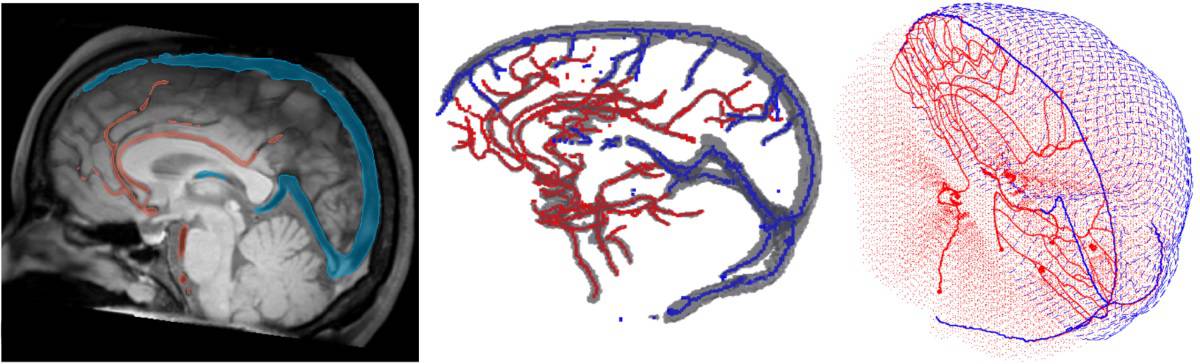
Hammi and colleagues developed an intracranial blood flow model based on major cerebral vasculature extracted from patient MRI data, and extended with a network of generic brain vessels. For blood distribution outside the brain, they developed the model according to the reference human body model. The cerebral model includes 1050 vascular path lines and simulates more than 266,000 blood particles; the model for the entire body contains 22,178,000 particles.
Left: intensity-based segmentation of brain vessels. Centre: lateral view of segmented arteries (red) and veins (blue). Right: the entire vasculature pathways of the brain including anatomy-based (solid lines) and generic vessel system (dotted/dashed lines). (Courtesy: Phys. Med. Biol. 10.1088/1361-6560/ab6c41)
To determine the dose to the circulating blood, the team use Monte Carlo simulations to track the propagation of each individual blood particle through the brain and the time-dependent radiation fields. In a single treatment fraction, the blood dose approximates the dose to the circulating lymphocytes. For treatments spanning several weeks, however, Hammi notes that the effects of lymphocyte repopulation and exchange cannot be ignored, and will be investigated in future studies.
For clinical use, the model would use patient-specific input data. “The model itself will not change, but parameters such as treatment fields and the exact time structure of delivery will change,” Hammi explains. “In addition, the model parameters can be adjusted to account for the patient’s age, gender, blood pressure and other haemodynamic parameters that affect how the blood particles move between compartments.”
Comparing modalities
The researchers used their model to generate blood dose–volume histograms (DVHs) after intracranial intensity-modulated radiotherapy (IMRT) and passive scattering proton therapy. They created IMRT and proton plans for the same patient and target volume, simulated 30 treatment fractions (2 Gy per fraction, at 2 Gy/min) and calculated blood DVHs for each modality.
After the first fraction, the calculated mean dose to the blood pool was 0.002 Gy for proton therapy and 0.004 Gy for IMRT. After 30 fractions, the mean doses were 0.061 Gy for protons and 0.133 Gy for IMRT – an integral dose difference of more than 118%. The highest doses to 1% of blood after 30 fractions were 0.196 and 0.343 Gy, for protons and IMRT, respectively.
The volumes of blood receiving any dose after one fraction were 10.1% and 18.4%, for proton and photon treatments, respectively. Approximately 90% of the blood pool will have been irradiated after the 11th fraction of IMRT, but only after the 21st fraction of proton therapy.
With a view to optimizing treatment parameters, the team investigated impact of dose rate on the dose to circulating blood. While dose rate did not affect the mean dose to the blood pool, an increased dose rate (and thus shorter beam-on time) reduced the fraction of blood receiving a low dose, but increased the volume receiving high doses.
For IMRT, increased dose rates did not significantly decrease the fraction of irradiated blood after 30 fractions: 97.7% and 94.2% at 5 and 12 Gy/min, respectively. For proton therapy, on the other hand, higher dose rates reduced the irradiated blood at the end of treatment: increasing the dose rate (from 2 Gy/min) to 5 and 12 Gy/min reduced the fraction of blood receiving any dose from above 95% to 78.8% and 60%, respectively.
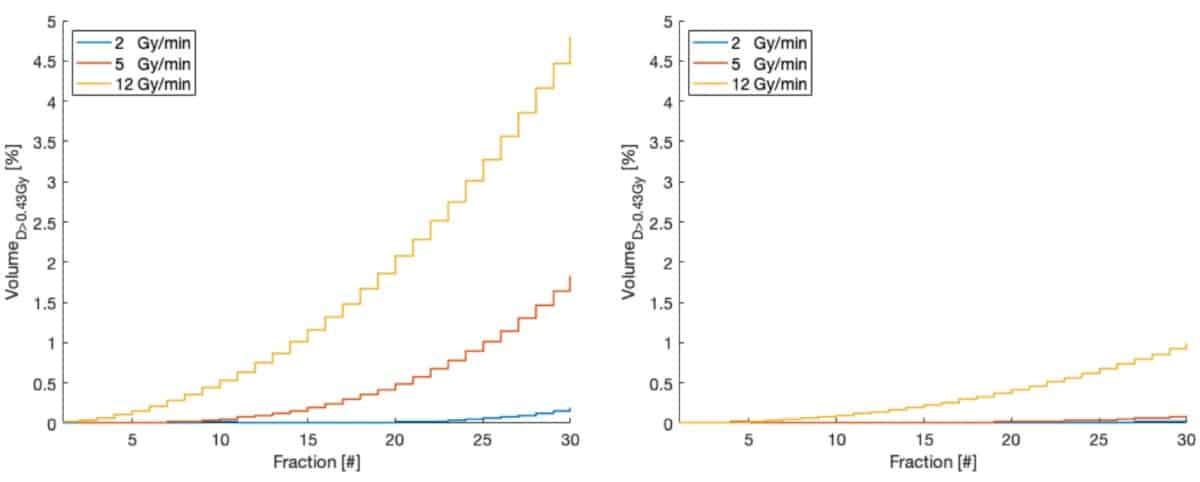
The team also quantified the fraction of blood receiving more than a threshold of 0.43 Gy (the dose thought to lower CD8 lymphocyte count by 10%), and saw that higher dose rates increased the volume of blood receiving this dose. Proton therapy, however, irradiated five times less volume to this threshold dose than IMRT.
Accumulated dose to the 0.43 Gy threshold for IMRT (left) and proton (right) treatments. (Courtesy: Phys. Med. Biol. 10.1088/1361-6560/ab6c41)
Finally, the researchers examined whether patient-specific variables such as cardiac output, gender and age affected the blood DVH. Higher cardiac output increased the blood volume receiving low doses and decreased the volume receiving high doses, mainly due to higher flow rate. They noted small differences between male and female patients (up to 4.3%), mainly due to differences in total blood volume and cardiac output. In younger patients, up to 10% more of the circulating blood received a low dose, independent of gender and treatment modality.
The researchers conclude that their blood flow model effectively estimates the dose to circulating blood during cranial radiation therapy. They showed that using proton therapy and increasing the dose rate can reduce the volume of irradiated blood.
“We are now working on end-to-end validation of the model based on measured lymphocyte depletion in patients treated with radiotherapy,” says Hammi. “We also want to extend the model to other organs and treatment sites.”
Compressing metallic glasses could make them less prone to fracture, greatly increasing their potential for structural applications. So say researchers from the University of Cambridge in the UK and the Institute of Metal Research in Shenyang, China, who have succeeded in strain-hardening these metastable materials to a degree hitherto thought impossible
Metallic glasses are materials with the properties of both metals and glasses. They contain metallic bonds and are thus conducting, but their atoms are disordered like in a glass, not ordered as in a crystal. They are produced by heating certain substances to above their melting points and then quenching them in a way that prevents them from crystallizing.
While the exceptional strength of metallic glasses makes them promising materials for structural engineering applications, they have one major drawback: they can soften when deformed, which makes them brittle. This contrasts with normal polycrystalline metals and alloys, in which stress produces strain-hardening: under increased loading, plastic deformation in normal metals starts locally, but then spreads uniformly, allowing the material to “stretch”.
Strain softening and shear bands
This ductility, as it is known in metallurgy, is crucial for preventing catastrophic mechanical failure in structures such as steel beams for buildings. Its absence in metallic glasses is thus correspondingly disastrous for structural applications, says project team leader Lindsay Greer of Cambridge. “This is all rather frustrating,” he observes. “Many of the other properties of metallic glasses are highly attractive. For example, they can have a high toughness and show a ‘damage tolerance’ – the product of yield stress and toughness – that is higher than any other known material.”
Greer explains that unlike normal metals, metallic glasses experience non-uniform plastic deformation. At room temperature, deformation occurs via ultra-localized flow in so-called shear bands, leading to instant failure – zero ductility – when the glass is placed under tension. While no similar catastrophe occurs when the material is bent, the shear bands do give rise to unsightly surface markings, which are planes of weakness that evolve into cracks.
Strain-softening and shear bands are the Achilles’ heel of metallic glasses, Greer tells Physics World. Finding a way to strain-harden these materials has thus been a sort of “holy grail” since the earliest days of research on their mechanical properties, he adds.
A rejuvenated metallic glass
Greer and colleagues say they have now found a means of preventing shear banding in metallic glasses during plastic deformation. Their technique consists of compressing cylindrical samples of the glasses in a such a way that the stresses along one axis differ from the stresses in perpendicular directions (see image). This type of compression (known as a triaxial test) causes little plastic deformation, but it does make the central region of the cylinder softer. When the researchers cut out this central region and subjected it to stress and strain, they found that the pre-conditioned, or “rejuvenated”, specimen was much less brittle than the untreated material.
Greer explains that this apparently counter-intuitive result comes about because in the rejuvenated metallic glass, plastic deformation causes the atoms to settle into a denser – that is, atomically better packed – configuration. “This more relaxed state is naturally harder,” he says. “The secret is to simply start with a sufficiently unrelaxed glass that wants to settle/relax in in this way.”
Similar function to annealing
The team confirmed this explanation by using calorimetric tests to measure the energy content of the rejuvenated metallic glass before and after plastic deformation. These tests showed that the energy in the glass does indeed fall during plastic deformation. Thanks to electron diffraction observations, the researchers also calculated that the average interatomic spacing in the material decreases during plastic flow, proving that the atomic packing is denser.
It may seem strange to soften a metallic glass by compression and then study how it hardens upon subsequent plastic deformation, but Greer points out that a similar thing happens when a conventional polycrystalline metallic alloy is annealed, or heat-treated. In both cases, the resulting material is softer, but also tougher.
The major difference is that in a polycrystalline alloy, the annealed state has few defects, making this the low-energy, relaxed state of the system. In this case, plastic deformation generates defects, and the system’s energy increases. In contrast, the rejuvenated metallic glass starts out in a more high-energy state. Its energy then decreases during plastic deformation, producing a glass that exists in a more ordered, relaxed state and has, in effect, a lower defect density.
Wider applications
The new work, which is detailed in Nature, overthrows the idea that metallic glasses can only strain-soften upon plastic deformation, Greer says. The team’s strain-hardening technique is simple and has several practical advantages. For one, it works on metallic glasses of different compositions. It also works for samples that have previously been annealed and made brittle, effectively reversing earlier adverse treatments. Finally, it can be used to create samples of significant size, simply by starting with longer or larger-diameter cylinders.
“We hope that metallic glasses with improved properties could now be made relatively easily and thereby find much wider applications than is currently the case,” Greer says.
Do you believe in climate change? I certainly do, though not everyone does – and some people don’t even care. But as businesses are slowly realizing, climate change is an existential threat. Whether it’s the pressure to cut carbon emissions or respond to damage to the local environment, climate change could put a company’s entire livelihood at risk. Climate change is, in other words, an example of a “Pascal’s wager”.
Pascal’s wager is a philosophical argument first presented by the French philosopher, mathematician and (let’s not forget) physicist Blaise Pascal (1623–1662). His logic was simple: God is, or God is not. Reason cannot decide between the two alternatives. The game is being played. You must wager (it’s not optional). Any rational person, Pascal argued in his posthumously published book Pensées (“Thoughts”), should live and act as though God exists regardless of belief.
If God doesn’t exist, you won’t have much to lose by believing in God or merely acting as if you do – you’ll only have forfeited a few pleasures. But if God does exist, then you stand to receive infinite gains (eternity in Heaven) and avoid infinite losses (eternity in Hell). As Pascal pointed out, our actions can have massive consequences, but our understanding of them is flawed.
Climate change is a modern-day Pascal’s wager, because so much is at stake.
Climate change is a modern-day Pascal’s wager, because so much is at stake. Doing nothing to tackle climate change could mean hell – rising sea levels, mass extinctions, droughts, ecosystem collapse, food shortages, famine, conflicts, war and possibly an uninhabitable planet for the next generation. But taking action could lead us to heaven – thriving as a species on a habitable plant. So even if you don’t believe in climate change, it makes sense to act rationally as though you do. The only way out is innovation and positive action.
Company action
Basically, we all need to start acting rationally, as the tech giant Microsoft is doing. In a truly inspirational new-year message released on 16 January, the company’s president Brad Smith promised that Microsoft would become carbon negative by 2030 and that, by 2050, it would have removed from the environment “all the carbon the company has emitted either directly or by electrical consumption since it was founded in 1975”.
The company also unveiled a new initiative to use Microsoft technology to help its suppliers and customers to reduce their own carbon footprints. In addition, it announced a $1bn “climate innovation fund” to accelerate the global development of technologies to reduce, capture and remove carbon. And the company promised, from the start of 2021, to make carbon reduction an “explicit aspect of our procurement processes for our supply chain”.
Now when the president of one of the very few companies with a trillion-dollar market capitalization makes such statements, the business world should sit up and take note. This is not some fluffy, feel-good PR stunt. Microsoft has drawn up a detailed plan, with milestones and a commitment to measure progress in its annual reports.
The other significant announcement in the business world was made on 15 January by BlackRock Inc – the world’s largest investment manager – in which it declared it would no longer invest in thermal coal. The company, which manages around $7 trillion of funds, also said it will “drop” any company directors (sell stock, vote against them etc.) who fail to act on financial risks from climate change.
More striking still, BlackRock’s chief executive Larry Fink wrote two letters: one to the heads of all companies it holds stock in and another to all of its clients. Published online, the letters reveal the firm’s environmental, social and governance priorities for the new decade and beyond. To say they’re significant doesn’t do them justice.
In his letter to chief executives, Fink said that climate change has become “a defining factor” in companies’ long-term prospects, pointing to events last September when millions of people took to the streets demanding action on climate change. “Many of them”, he wrote, “emphasized the significant and lasting impact that it will have on economic growth and prosperity – a risk that markets to date have been slower to reflect.” But, Fink continued, “awareness is rapidly changing, and we are on the edge of a fundamental reshaping of finance. The evidence on climate risk is compelling investors to reassess core assumptions about modern finance.”
Of course, businesses always face crises and challenges. But many that Fink has lived through over his 40-year career in finance – inflation spikes in the 1970s and early 1980s, the 1997 Asian currency crisis, the 2000 dot-com bubble, and the 2008 global financial crunch – were all essentially short-term. “Climate change is different,” he added. “Even if only a fraction of the projected impacts are realized, this is a much more structural, long-term crisis.”
Fink reckons that companies, investors and governments must now prepare for a “significant reallocation of capital”. Indeed, he claims that more and more of BlackRock’s clients around the world are looking to reallocate their capital into sustainable strategies. “If 10% of global investors do so – or even 5% – we will witness massive capital shifts. And this dynamic will accelerate as the next generation takes the helm of government and business.”
Young people, Fink pointed out, have been at the forefront of calling on institutions like BlackRock to address climate change, demanding more of companies and of governments, in both transparency and in action. “As trillions of dollars shift to millennials over the next few decades, as they become chief executives and chief information officers, as they become the policymakers and heads of state, they will further reshape the world’s approach to sustainability.”
Businesses, investors and fund managers are finally waking up and taking responsibility for their actions [on climate change].
My take-away message from these statements is that businesses, investors and fund managers are finally waking up and taking responsibility for their actions. So how will you wager on climate change in your business and personal lives? Will you act rationally? Or will you stick your head in the sand?
A new model that predicts the charging timescales of supercapacitors much more accurately than had been previously possible has been unveiled by researchers in the Netherlands and China. Cheng Lian and colleagues at Utrecht University and the East China University of Science and Technology built their model by describing the complex porous structures within a supercapacitor as stacks of thin electrode plates. Their work could improve our ability to predict the charging characteristics of supercapacitor energy storage systems used in a wide range of applications including electric vehicles and solar-powered street lighting.
Supercapacitors are used in a variety of applications that require relatively short, intense bursts of electrical energy. They fall between conventional capacitors and batteries in terms of charge/discharge speeds and energy capacity. Supercapacitors store far more charge than conventional dielectric capacitors by using porous electrodes, which can have surface areas as large as several square kilometres. A significant downside of these nanopores is that supercapacitors take far longer to charge than their conventional cousins.
There is currently a poor understanding of how nanopore structures could be optimized to reduce charging times. One approach has been to develop macroscopic models that fit parameters to experimental measurements of the charging process. The problem with this approach is that there seems to be very little correspondence between the parameters and the underlying physics of a supercapacitor.
Huge disagreement
Researchers have also done molecular-scale dynamics simulations, which provide insights into the charging mechanisms of up to a few supercapacitor nanopores. When used to predict the charging times of real devices, however, the results underestimate charging time by a whopping factor of 1012.
In their study, Lian’s team has taken a completely new approach that approximates electrodes as stacks of flat, fully permeable, and infinitesimally thin charged plates. The gaps between the plates are on par with the diameter of a typical nanopore and the researchers found that their new model could reliably reproduce characteristics of supercapacitors on both micron and nanometre scales.
Lian and colleagues used their model to explore the characteristic timescales of charging with both high and low voltages, which provided new insights into the physical mechanisms involved in charging. Given the simplicity of the model, the charging timescales it predicted agreed remarkably well with experimental values; differing by factors of just two or three, instead of many orders of magnitude. The team now hopes that their model could soon enable researchers and engineers in wide-ranging fields to design safer and more effective devices for energy storage.
Look carefully at one of those classroom posters that shows the sweep of the electromagnetic spectrum, from gamma rays to radio waves, and you’ll find a small patch squeezed in between the infrared and microwave. Called the far-infrared, submillimetre or terahertz region, it is nominally defined as spanning wavelengths from 30 μm (10 THz) in the mid-infrared, to 1–3 mm (0.1–0.3 THz) in the microwave domain. Although hardly prominent in these educational posters, this region is a rich research area for physics on and beyond the Earth.
While there are microwave and infrared sources that can produce thousands of watts of power at those frequencies, there is a lack of sources that work well across the terahertz range, which is why it is often referred to as the “terahertz gap”. Hot blackbodies only emit microwatts at terahertz frequencies, whereas microwave technology is not easily pushed below millimetre wavelengths, so standard spectroscopic methods do not apply. Yet the gap is well worth exploring. It is the right range to probe electronic, lattice and quantum properties in condensed matter, and to examine massive molecules. It supports applications in biomedicine, in security systems and in the study of artworks. Outside the lab, terahertz radiation is relevant to the cosmic microwave background (CMB) and other astrophysical phenomena, and is helping in the search for the origins of life in space.
Making do with microwatts and milliwatts
Fortunately, when scientists see a gap in understanding, they dive right in. Since the 1960s researchers have found ways to obtain high-quality terahertz spectra by using a Fourier-transform spectrometer. In this device, a hot source sends microwatts of terahertz power to a solid, liquid or gaseous sample where it is reflected or transmitted through. Next, the beam is split into two and each part is reflected from a mirror. The beams are then recombined, and a detector measures the resulting interference signal as one mirror moves relative to the other. Fourier analysis of this interferogram yields the frequency spectrum specific to the sample with a higher signal-to-noise ratio than in a conventional spectrometer.
Another common method of creating a terahertz source – which provides greater power – is by optically pumping the vibrational states of a molecular organic medium, such as methanol (CH3OH), with a CO2 laser. This excites molecular rotational sub-levels that emit discrete terahertz laser lines. Different media supply hundreds of lines at milliwatt powers, which yield precise data over broad ranges.
Since the 1960s and 1970s, in my lab and others, such terahertz Fourier spectrometers and pumped lasers have probed semiconductors and their nanostructures, superconductors, inhomogeneous materials, water in liquid and vapour form, and biomolecules. But more recently, lab research has been enhanced by powerful new terahertz sources based on semiconductor technology (see June 2016), and on synchrotrons and free electron lasers (see box, below). Indeed, according to a 2014 bibliometric study by Roger Lewis of the University of Wollongong in Australia, the number of papers published containing “terahertz” in the abstract, title or keywords grew exponentially between 1975 and 2013 (J. Phys. D: Appl. Phys. 47 374001).
Power for the terahertz gap
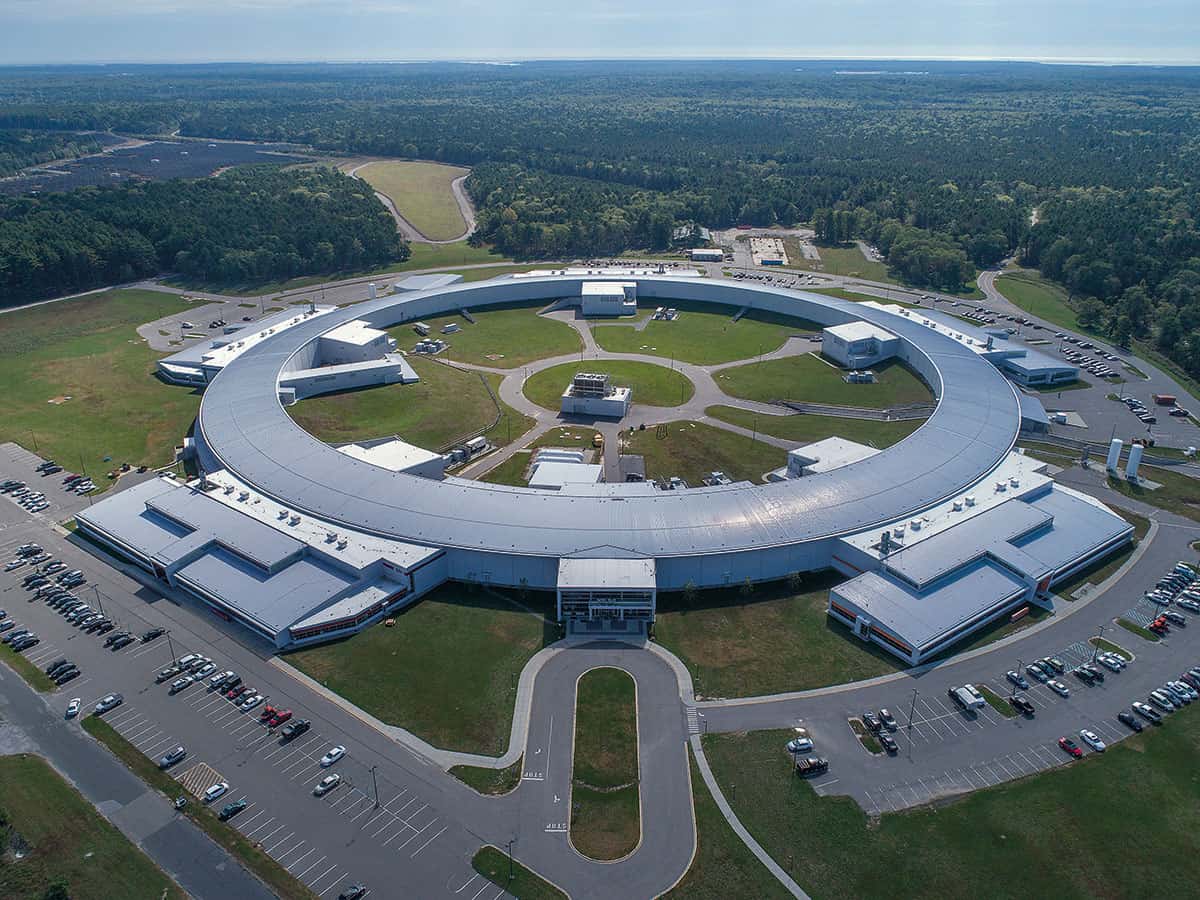
New source: The NCLS-II at Brookhaven National Laboratory in New York has terahertz capability. (Courtesy: Brookhaven National Laboratory)
Spacecraft-based astrophysical and cosmological research at terahertz frequencies – such as measuring the fluctuations in the cosmic microwave background – is made possible thanks to sensitive detectors that have been cryogenically cooled to reduce noise, as in the COBE and Planck projects. Sensitive detectors are also important for terahertz Fourier-transform spectroscopy in the lab that uses microwatts from a hot source.
Another approach for terahertz spectroscopy is to develop more powerful sources. Optically pumped lasers (see main text) generate milliwatts, which is ample for many uses, but they require a CO2 laser and, unlike a blackbody, do not offer continuous frequency coverage. Other powerful sources have different limitations. Quantum cascade lasers (QCLs, see June 2016 pp28–31) are semiconductor nanostructures that produce higher powers, but at fixed frequencies and under cryogenic cooling. One recent paper (L H Li et al. 2017 Electronics Letters53 799) describes a QCL that emits 1.8 W and 2.4 W at 4.4 THz, cooled to 77 K and 10 K, respectively.
High powers for demanding applications such as terahertz microscopy are also available at central facilities. One type of source generates powerful terahertz waves in a free-electron laser, where a beam of relativistic electrons moves past an arrangement of magnets with alternating poles. This gives the electrons a transverse wiggling motion, which produces monochromatic photons whose frequency can be tuned by changing the electron velocity or the magnetic field, and that are made coherent by confinement in a cavity. The free-electron laser at the University of California, Santa Barbara, for example, generates kilowatts from 0.1 THz to 4.8 THz. Another unit at the Budker Institute of Nuclear Physics in Novosibirsk, Russia, operates from 1.2 to 8.2 THz.
High-power terahertz radiation is also generated by electrons circulating in a synchrotron storage ring. The National Synchrotron Light Source at the Brookhaven National Laboratory in New York maintains a terahertz beamline that provides 100 mW of broadband power at frequencies above 0.15 THz, covering the terahertz range and beyond and acting as a source for a Fourier-transform spectrometer. A beamline at another synchrotron, the Canadian Light Source at the University of Saskatchewan in Saskatoon, also covers the terahertz range at high brightness as a source for Fourier-transform spectrometry and terahertz microscopy.
With judicious choice of detectors, sources or both, scientists have found footholds in the terahertz gap and perform research of the highest quality. But the ideal terahertz source – producing milliwatts or more, tunable over the entire range, compact and operating at room temperature – remains elusive. This is a major stumbling block to carrying out applications in security systems and biomedicine.
Terahertz physics takes to the skies
Back in 1964, terahertz physics also received a powerful push out of the lab and into the universe. That was when Arno Penzias and Robert Wilson, working with an antenna at Bell Labs designed for satellite communications, unexpectedly found a constant signal at the microwave wavelength of 7.35 cm that seemed evenly distributed across the heavens.
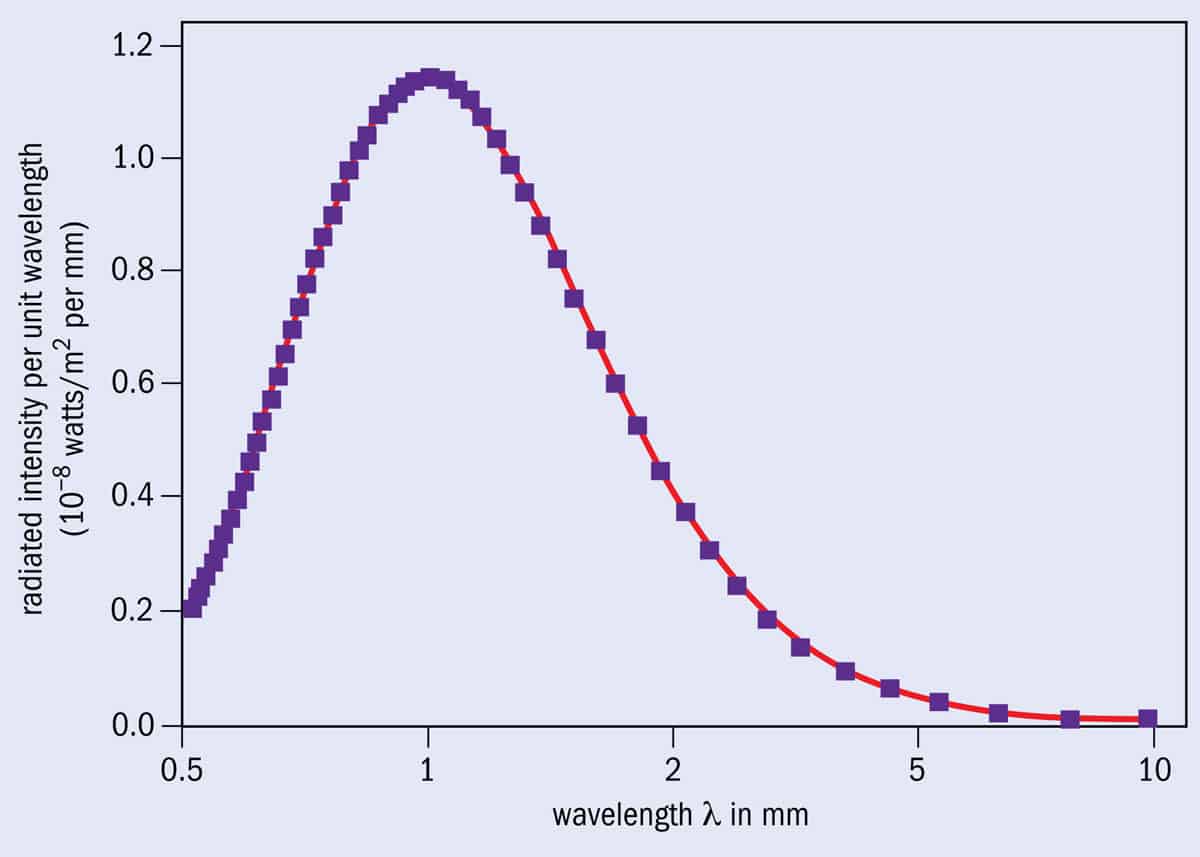
The definitive measurement of this unknown radiation was made aboard NASA’s Cosmic Background Explorer (COBE) satellite, which launched in 1989. Using a Fourier-transform spectrometer, COBE’s result was in near-perfect agreement with the emission curve of a blackbody at 2.725 ± 0.002 K. With peak intensity at 1.07 mm, this spectrum spans the terahertz range (figure 1), and Penzias and Wilson had picked up the tail end of the curve. Separately, COBE also compared millimetre-wave radiation from different sky directions and found that the CMB is slightly anisotropic, representing temperature fluctuations of 1 part in 105 (see February 2020).
1 Close curve
The cosmic microwave background data from COBE, which shows a remarkably close fit to the emission curve of a blackbody at 2.7 K, actually enters the terahertz range.
The blackbody data matched a 1965 prediction by the cosmologists Robert Dicke, Philip Peebles and colleagues that as the universe cooled after the Big Bang, it would be filled with residual blackbody radiation at ~3 K. This agreement provided strong support for the Big Bang theory and the results gave deep insights into the history of the universe. Indeed, when George Smoot and John Mather received the 2006 Nobel Prize for Physics for their work on COBE, the Nobel Committee noted that COBE can be “regarded as the starting point for cosmology as a precision science”.
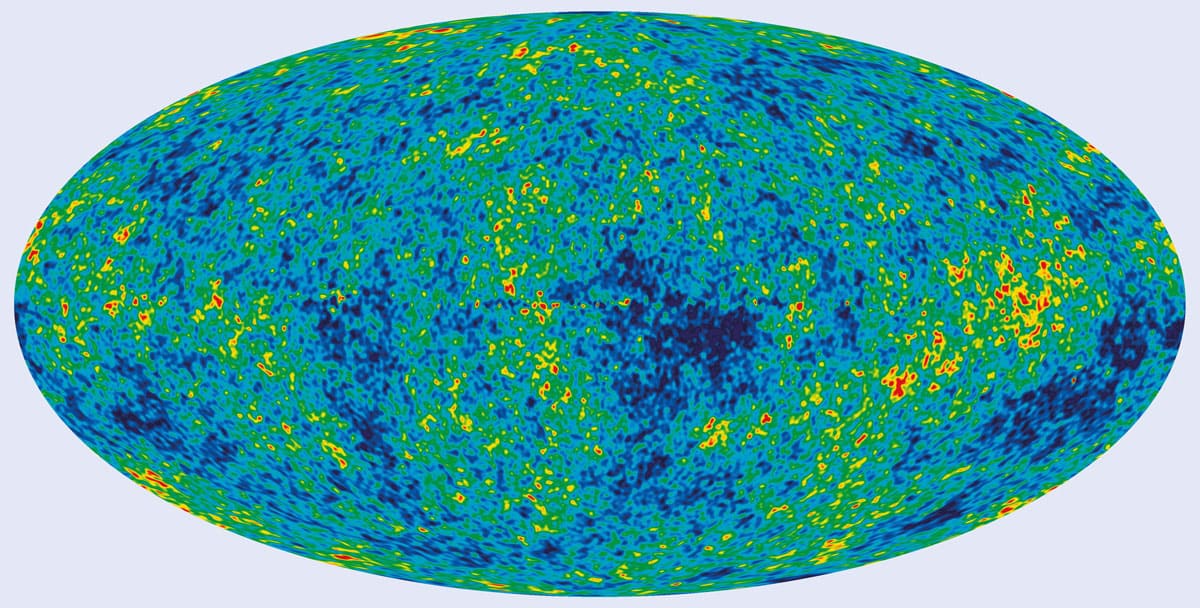
The CMB temperature fluctuations are also significant; they represent density variations in the hydrogen making up the universe 380,000 years after the Big Bang. These evolved into today’s cosmic structure, with filaments of galaxies surrounded by enormous voids. After COBE, the fluctuations were studied from space by NASA’s Wilkinson Microwave Anisotropy Probe (WMAP) launched in 2001, and the Planck spacecraft, launched by the European Space Agency in 2009. Advances in detection methods and space technology improved each subsequent mission. Planck sensed weak signals with heat detectors cooled to 0.1 K, giving attowatt noise levels, and covered the widest frequency range at nine values from 0.03 THz (10 mm) to 0.857 THz (0.35 mm). The spacecraft measured cosmic temperature differences of 5 μK or less at angular resolutions down to 4 arcmin, compared to 7° for COBE and 0.5° for WMAP (figure 2).
2 All in the detail
Successively higher resolution of temperature variations in the early universe as seen in the terahertz range by the COBE, WMAP and Planck spacecraft.
The terahertz data from Planck was analysed with the so-called lambda cold dark matter model (ΛCDM), the cosmological “standard model”. ΛCDM assumes that physics, including general relativity, is the same throughout the universe; that the universe was initially hot and dense and has always been expanding; and that it includes dark energy, dark matter, ordinary matter, photons and neutrinos. In 2018 the final results from Plank showed that the universe is 13.8 billion years old; it contains 31.5% matter (4.9% normal matter and 26.6% dark matter) and 68.5% dark energy; it most probably contains only three species of neutrinos, whose masses sum to less than 0.12 eV; and it is expanding with a Hubble constant H0 of 67.4 km/s/Mpc.
These results provide our most accurate and comprehensive picture of the universe to date and terahertz detection technology played an important role. However, with an uncertainty of only 1%, the Planck value of H0 is at variance with the value 73 km/s/Mpc derived from other supposedly reliable astrophysical data – a difference that perhaps points to new physics.
Seeing a black hole with millimetre waves
Another terahertz astrophysical project required far higher resolution than Planck attained. In April 2019 the international Event Horizon Telescope (EHT) collaboration presented the first ever image of a black hole – the supermassive black hole at the centre of the elliptical galaxy M87, 55 million light-years away.
The aim had been to study the region near the event horizon by observing the black hole’s “shadow”, a dark area within the glow emitted by hot accretion material flowing into the black hole. The shadow, caused by the gravitational bending and capture of light near the event horizon, has a diameter about five times the Schwarzschild radius (the radius of the black hole) as predicted by general relativity. It would subtend only a tiny angle of ~40 μarcsec.
Terahertz photons delineate a black hole because they come from deep within its gravitational well. Earlier studies of M87 at wavelengths from 1.3 mm to 7 mm had shown signs of a central 40 μarcsec structure but could not image it. These results did, however, show that the shorter the millimetre wavelength, the more closely the photons represented the actual site of the black hole within the bright region. But no individual radio telescope installation, single-dish or multi-dish, could provide the required angular resolution at millimetre wavelengths.
The answer was for the EHT to link eight separate installations around the Earth, including the Atacama Large Millimeter/submillimeter Array (ALMA) in the Chilean desert, the South Pole Telescope (SPT) in Antarctica, and the IRAM 30-metre telescope in Spain (figure 3). The resulting virtual telescope gave an angular resolution of the order of the 1.3 mm wavelength divided by the Earth’s diameter. After an intricate process of co-ordinating the telescopes and analysing petabytes of data, the composite network produced a striking image at a resolution of 20 μarcsec. It clearly shows the dark shadow within the bright emission region 42 μarcsec across, which itself displays details. Analysis of the data gave a central mass of 6.5 × 10⁹ solar masses, definitively establishing the existence of a supermassive black hole in M87 and supporting the supposition that black holes of this size lie at the centre of galaxies.
3 Worldwide telescope
The system of telescopes in the Event Horizon Telescope array, forming an Earth-sized virtual telescope to achieve ultrahigh angular resolution of the order of 1.3 mm wavelength divided by the Earth’s diameter. Green dots indicate future sites.
Seeking the molecules of life
Besides research in space to explore the origin and development of the universe, terahertz methods can also examine a different set of fundamental questions. How did life begin on Earth? Was it a unique process, meaning we are alone in the universe? Or did it seed life elsewhere?
One possible answer to these big questions is that the complex molecules of life, or their precursors, originated in the interstellar medium, and came to Earth and other planets via meteorites. According to what we know about earthly life, this means finding organic molecules in space that contain carbon along with hydrogen, oxygen and nitrogen. Some of these molecules – including the amino acids necessary to build proteins – have already been found in meteorites that landed on Earth, and now terahertz astronomical spectroscopy is being used to seek such biotic or pre-biotic molecules in space.
The universe seems to support active carbon-based chemical processes – indeed, the first molecule found in space was CH in 1937, and organic molecules still dominate the more than 200 species found since by ultraviolet to centimetre-wavelength spectroscopy. These results mostly come from radio astronomy at frequencies below 2 THz, where transitions between the energy levels associated with molecular rotations provide many identifying spectral features in emission or absorption. This is the same mechanism that in the lab generates terahertz laser lines from compounds like methanol, CH3OH (which has also been found in space).
The known astronomical organic molecules contain up to 13 atoms (excluding the non-biotic fullerenes C60 and C70), a level of complexity associated with biological function. In 2003 the simple amino acid glycine (NH2CH2COOH) was reportedly detected in space, but later measurements have not confirmed this. Other relevant findings are the sugar-related molecule glycolaldehyde (CH2OHCHO), and formamide (NH2CHO), a possible biotic precursor with the appropriate properties to form sugars and amino acids.
The high angular resolution offered by arrays like ALMA aids the search for complexity beyond the straight-chain carbon backbone found in most big organic molecules in space. In 2014 a team under Arnaud Belloche at the Max Planck Institute for Radio Astronomy in Bonn, Germany, used ALMA at 3 mm wavelength to find the first space molecule with a branched carbon chain, iso-propyl cyanide (i-C3H7CN). This feature is characteristic of the amino acids that have been seen in meteorites on Earth. The molecule was observed in the giant star-forming gas cloud Sagittarius B2 in our galaxy, suggesting that active areas in space tend to make complex compounds. Deeper physical and chemical understanding of how molecules form in diverse places, from interstellar and circumstellar regions to protoplanetary discs, will further focus the hunt for biotic molecules.
Lab measurements of complex molecular spectra are essential as well to guide astronomical research and interpret its results. Susanna Widicus Weaver, for example, is a chemist at Emory University who works on improving terahertz Fourier-transform spectroscopy and other methods, for these purposes and to study new areas in interstellar chemistry, such as molecular reactions with ice. These approaches, she wrote in a recent review article (Ann. Rev. Astron. Astrophys. 57 79), are “poised to fill the terahertz gap…offering analytical techniques that rival those used in the microwave and infrared regions of the electromagnetic spectrum”.
Researchers have extended microwave and infrared methods on and off the Earth to make the terahertz gap navigable and carry out innovative studies in both locales. This breadth illustrates the interdisciplinary nature of terahertz science as it explores the beginnings of the universe, the properties of matter in space and on Earth, and the fascinating, still-mysterious intersection where non-living molecules make the leap into life.
It should be possible to create materials that conduct both electric current and exciton excitation energy with 100% efficiency and at relatively high temperatures – according to theoretical chemists in the US. They have calculated that such materials would exist in a single quantum state but would demonstrate properties of two different condensates – one made from excitons and the other made from pairs of fermions.
Bose–Einstein condensates are made by cooling a gas of particles sufficiently that the de Broglie wavelengths of individual particles are comparable to the spacing between particles – allowing the system to condense into a single quantum ground state. The particles must be bosons, which have integer spin and can therefore all occupy the same quantum state simultaneously. However, condensates can also be made from bound-pairs of half-integer-spin fermions because pairs of fermions have integer spin and are therefore bosons.
In a superconductor, bound pairs of electrons (fermions) create a superfluid that allows electrical current to flow through the material without resistance. These “Cooper pairs” have a low binding energy, which means they are easily destroyed by thermal energy. Above a relatively low critical temperature, the pairs break apart and the material becomes a normal conductor.
Excited electrons
One possible way to boost the critical temperature of a condensate is to make it from excitons (bosons), which are electrons bound to holes. An exciton is created when an electron is excited from the valence band of a material – leaving behind the hole. A condensate of excitons can therefore carry this excitation energy through a material without resistance. Unlike Cooper pairs, however, excitons do not carry electrical charge. Excitons are more tightly bound than Cooper pairs, meaning that such condensates could persist at higher temperatures than superconductors. However, because particles and holes naturally annihilate very quickly, exciton condensates are hard to make.
Exciton condensates can be generated by placing the electrons in an optical trap or using twin layers of material such as semiconductor or graphene to keep particles and holes apart. Exciton condensates can also co-exist alongside fermion-pair condensates, where they allow Cooper pairs to exist at higher temperatures. Two years ago, for example, physicists at Royal Holloway, University of London, and the University of Southampton in the UK combined a superconducting ring with a semiconductor microcavity.
This latest research was done by LeeAnn Sager, Shiva Safaei and David Mazziotti at the University of Chicago. Mazziotti points out that the properties of the two types of condensate remain distinct from one another in such systems. The trio investigated whether it is theoretically possible to create a material that displays both sets of properties together. Such a material, they say, might be able to conduct both electricity and excitation energy with complete efficiency.
“Large family of wave functions”
The researchers first used a computer model to simulate the behaviour of a four-particle fermionic system, finding that it would indeed exhibit these dual properties. Lacking the processing power to scale this system up, they then calculated what would happen when entangling the quantum wave functions of a superconductor and an exciton condensate containing large numbers of particles. Doing so, says Mazziotti, they showed that there should be “a pretty large family of wave functions that combine these properties and in principle exist in the macroscopic world”.
Reporting their results in Physical Review B, the researchers say that this single quantum state, which they call a “fermion-exciton condensate”, combines the properties of the individual condensates “in a highly nontrivial manner”. They explain that the properties of each condensate are reduced somewhat when compared to their creation in isolation. However, this compromise diminishes as the number of electrons in the system goes up.
Mazziotti says that the group is now working with experimentalists to create such a material in the lab. Rather than using two semiconductor layers to create a purely excitonic condensate, he says that the most obvious candidate for a fermion-exciton condensate would be a pair of superconducting layers – although at this stage he does not know what type of superconductor they would use. “This would be the shake-and-bake recipe for materials that have these dual properties,” he quips.
However, Mazziotti is under no illusion that this is an easy project. One challenge, he says, will be handling the different binding energies of the Cooper pairs and excitons. Sager adds that it will be tricky to bring the layers close enough to create the bound pairs but not so close that electrons can tunnel from one layer to the other. But if those hurdles can be overcome then applications beckon, says Mazziotti. One possible use, he suggests, might be in medical imaging – with propagation of visible light without loss preserving resolution.
Peter Abbamonte of the University of Illinois, who was not involved in the research, feels “some luck would certainly be needed” to realise such a condensate in the lab. But he reckons that the theoretical result “makes a compelling case” for trying to construct exciton condensate-like structures from superconducting constituents.
Recent work has suggested that prostate tumours with high nerve densities are more likely to grow and spread than those with low nerve densities. Now, a team in China and the US has shown that such high-risk cases can be identified using a combination of MRI, magnetic particle imaging (MPI) and functionalized iron-oxide nanoparticles. In experiments with mice, the researchers also used the same nanoparticles to deliver a drug that blocks nerve function, slowing the spread of prostate cancer and improving the animals’ survival rate (Science Advances 10.1126/sciadv.aax6040).
Tumour development and proliferation is a complex process involving multiple tissue types and structures. Angiogenesis – the formation of blood-vessel networks – has long been recognized as a vital component, prompting the formulation of antiangiogenic drugs intended to control tumour growth. Only in the last decade, with studies of prostate cancer progression specifically, has the nervous system emerged as a similarly important part of the process.
Wenting Shang of the Chinese Academy of Sciences (CAS) – who led the research with Huijuan You of CAS and Huazhong University of Science and Technology – likens the development of cancer to the construction of a new building. “When a new building is built, you need to set up water pipes and wires for water to flow smoothly and the lights to blaze,” says Shang. “Angiogenesis can be seen as cancer cells building water pipes; a dense network of nerves can be seen as cancer cells laying wires.”
Spotting tumours that have laid down such a network of nerves could help determine how dangerous a given case of prostate cancer is likely to be. This would let clinicians tailor the scale of the intervention to suit the risk, avoiding overtreatment of less aggressive tumours.
Unfortunately, nerve density is a difficult tissue property to measure using typical imaging techniques. For example, while MRI – the method of choice for prostate-cancer imaging – can usually delineate a tumour clearly enough, those that are dense with nerves look very similar to those with undeveloped nervous systems.
To solve this problem, Shang, You and colleagues developed a contrast agent that targets nervous tissue specifically. The team started with nanoparticles of iron oxide, which have already found use in both MRI and MPI, and joined them to the nerve-binding peptide NP41.
Injected into the bloodstream of a mouse, the contrast agent disperses through the animal’s entire circulatory system but is quickly metabolized and removed. Because of the enhanced permeability and retention effect in the tumour, however, the nanoparticles accumulate in the cancerous tissue, where they bind preferentially to proteins around the nerve fibres. The researchers looked for this effect in mice with prostate tumours that had either been allowed to grow without interference (yielding high nerve densities) or from which the nerves had been surgically or chemically compromised (yielding low nerve densities).
Twenty-four hours after injection of the contrast agent, tumours with high nerve density showed up clearly on MRI scans – and even more so using MPI. In low-nerve-density tumours, in contrast, the nanoparticles were virtually undetectable with MRI but produced a faint signal using MPI. The researchers think that MPI therefore offers an ideal method to visualize nerve density in prostate tumours.
Given the importance of dense nerve networks for tumour growth and proliferation, the team proposed that interventions that not only highlight but also target the nerves might reduce a cancer’s aggressiveness. To test this, they added another component to the functionalized nanoparticles – a beta-blocker called propranolol, which affects nerve function.
Mice injected with the propranolol-conjugated nanoparticles tended to survive for longer: 45 days after the treatment, 83% of the propranolol-treated group were still alive, compared with 40–50% of those given either propranolol-free nanoparticles or propranolol alone.
The treatment also seems to have been without significant side effects. Despite the nanoparticles entering each mouse’s general circulatory system, they tend to deliver their propranolol cargo only in the low-pH microenvironment of the tumour. Combined with the preferential accumulation of nanoparticles in the tumour, this means that the mouse’s wider nerve network is relatively unaffected.
The researchers think that the procedure could produce similar results in solid tumours elsewhere in the body, as the relationship between cancer propagation and nerve networks is probably not prostate-specific. There is still much more work to be done before it is ready for the clinic, however.
“Firstly, MPI technology is still in the pre-clinical stage,” says Shang. “Secondly, our probes are not yet mature for clinical use, and still need to be optimized. We plan to conduct more comprehensive toxicological studies of our probes in the next stage.”



 The cosmic microwave background data from COBE, which shows a remarkably close fit to the emission curve of a blackbody at 2.7 K, actually enters the terahertz range.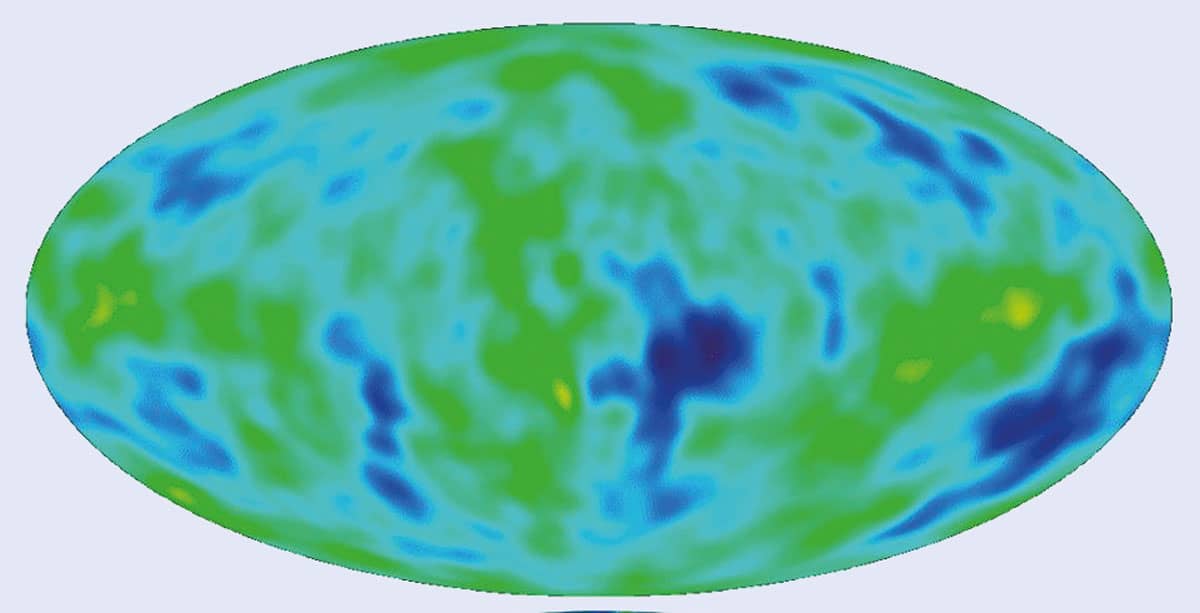
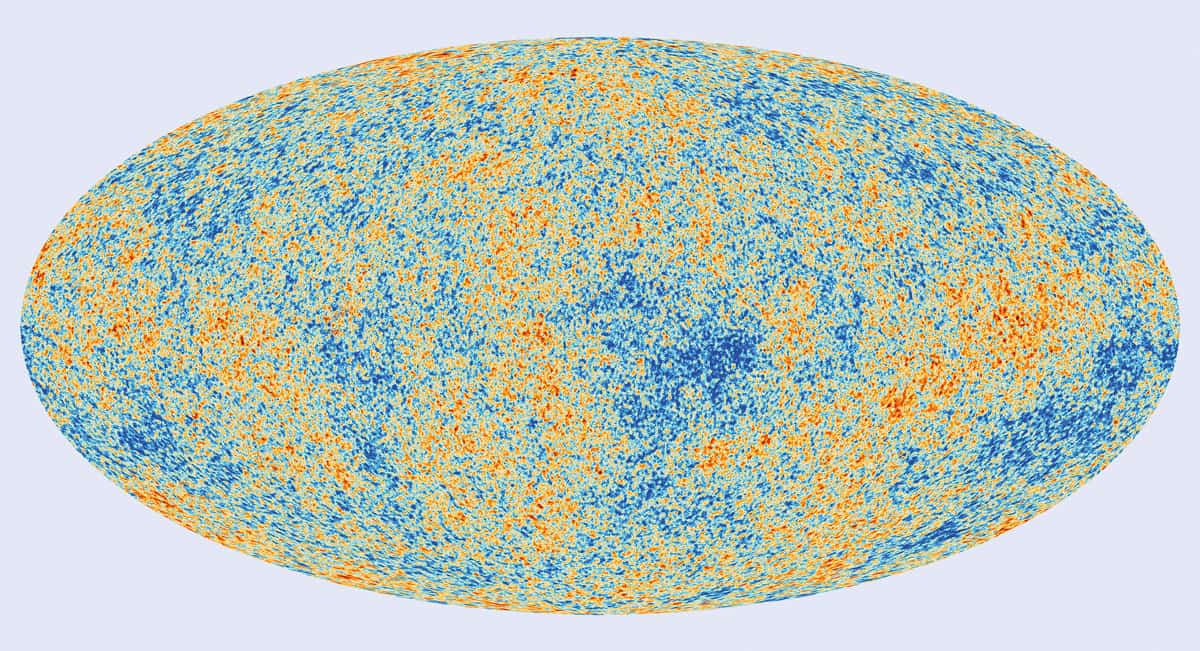 Successively higher resolution of temperature variations in the early universe as seen in the terahertz range by the COBE, WMAP and Planck spacecraft.
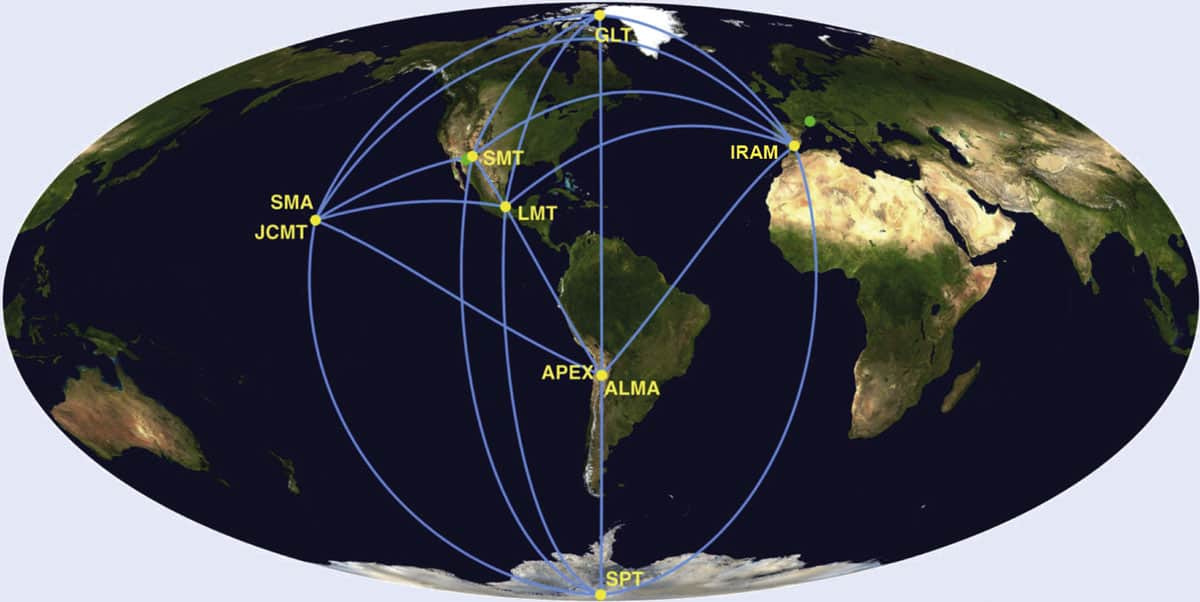 The system of telescopes in the Event Horizon Telescope array, forming an Earth-sized virtual telescope to achieve ultrahigh angular resolution of the order of 1.3 mm wavelength divided by the Earth’s diameter. Green dots indicate future sites.