Physicists take snapshots of quantum measurement

Anyone familiar with quantum mechanics knows that the act of measurement forces quantum systems into definite classical states. But new research shows that some measurements don’t destroy all quantum information in the process. It also reveals that measurements are not instantaneous, but instead gradually convert superposition states into classical ones.

The idea that all superposition is destroyed when a measurement is made was an underlying assumption of quantum mechanics as formulated by John von Neumann and others in the 1930s. Two decades later, however, Gerhart Lüders theorized that certain “ideal” measurements should only collapse superpositions of the specific states being probed, leaving others intact. In this way, he argued, a series of such measurements should preserve quantum coherence.

In the latest work, Markus Hennrich and colleagues at Stockholm University, Sweden, together with researchers at the universities of Siegen in Germany and Seville in Spain, performed an ideal measurement involving a single ion of strontium. As they report in Physical Review Letters, they began by using a laser to place the ion in a superposition of two states (out of a possible three), with each state corresponding to a different energy level of the ion’s outermost electron. They then used a short pulse from another laser to excite the ion from only one of the three states, causing it to fluoresce – an ideal measurement according to Lüders’ criteria.

Indirect detection

In this measurement, a single photon is emitted in a random direction, making it difficult to detect directly. Instead, Hennrich and colleagues carried out what is known as process tomography. This involves using laser pulses that reveal, for every possible combination of superposition states, whether the superposition has been destroyed or preserved.

Repeating this process many times over, the researchers found that the excitation and emission destroyed all the superpositions related to the state being probed. The other superpositions, however, remained intact. According to Hennrich, this shows that he and his colleagues had indeed carried out an ideal measurement. What’s more, the fact that they did not need to detect the emitted photons shows that the measurement process does not depend on the presence of an observer. “It is already happening as a result of one fluorescence photon being emitted into the environment,” he says.

Weak measurement

The group then studied the dynamics of the measurement process by varying the power of the laser used to excite the ion. The idea was to reduce the power such that the ion was no longer guaranteed to fluoresce, instead doing so only a fraction of the time. Because fluorescence is less probable at lower powers, Hennrich explains that these weak, or imperfect, measurements would be equivalent to intermediate stages in the measurement process – in other words, “snapshots” of that process.

By carrying out tomography at these varying power levels, Hennrich and co-workers showed that the measurement process causes the superposition to collapse gradually (although the whole process is over in about a millionth of a second). They found that the degree of superposition between the ion’s different states matched those predicted by Lüders’ model 94% of the time.

Proving that Lüders was right about ideal measurements will not come as a surprise to other physicists, says Hennrich. Indeed, he points out that in 2016 Arkady Fedorov and colleagues at the University of Queensland, Australia showed that ideal measurements could be made in a three-level superconducting qubit placed in a microwave cavity. But that system, he adds, was somewhat artificial. “What we have shown is that you can realize a Lüders process through a natural measurement,” he says.

Fedorov praises the European researchers for carrying out “a nice physical implementation” of a quantum measurement, pointing out that unlike his group they studied both strong and weak versions. But he feels that the distinction between natural and artificial processes is not very significant. If anything, he reckons, using an artificial system is more demanding given the need “to engineer a particular regime”. The choice, he says, “is a matter of taste”.

Error correction

As for possible applications, Hennrich says that the latest work might be used to improve error correction in quantum computers, given that weak measurements could in principle allow errors to be detected in quantum states without destroying those states in the process.

The researchers also want to investigate the possibility of more complex ideal measurements, in which the measurement process affects multiple states, rather than just one. “Whether such processes exist as natural processes and can be implemented with a fidelity comparable to our experiment is an open question,” they write.

Gold-plated pantyhose and poking holes in the h-index

“Smart” textiles are a hot topic in materials science right now, with researchers in various organizations striving to combine light-emitting displays with flexible substrates. One approach is to sew diodes, wires, and optical fibres into textiles, but the resulting garments lack the soft, stretchy quality of their non-luminous counterparts. (They’re hard to wash, too.) The main alternative is to build thin-film light-emitting devices directly into the fabric, but the porous nature of textiles makes such structures hard to manufacture.

Now, however, scientists in Canada have found a truly fabulous solution: gold-coated tights, or pantyhose as they’re known in North America. Yunyun Wu, a PhD student in Tricia Carmichael’s materials-chemistry group at the University of Windsor, was out shopping for fabrics for her research when she realized that sheer fabrics would make a great platform for the transparent conductor in light-emitting devices. From there, Carmichael says, a “second lightbulb moment” led the group to choose pantyhose as “an ideal material” upon which to build their electrodes.

The researchers employed a metal-deposition technique called electroless nickel-immersion gold metallization to coat their pantyhose with gold film. Afterwards, they used the still-stretchy material to create light-emitting textiles emblazoned with a smiley-face emoji and a digital-clock-like display. The next step, they say, is to develop correspondingly flexible energy-storage components that can keep their 10-denier light-emitters going strong until the wearer decides to switch them off.

Love/hate relationship

“My observation is that about half the scientific community loves the h-index and half hates it, and the h-index of the scientist itself is a great predictor of whether s/he belongs to the first or the second group.” That is the wry conclusion of the physicist Jorge Hirsch, who invented the h-index in the early 2000s and appears to have fallen into the latter camp

The index attempts to quantify the academic output of a scientist in terms of number of papers published and the number of times those papers are cited by others. As Hirsch explains in the essay “Superconductivity, what the H? The emperor has no clothes”, “If your h-index is 25, you have written 25 papers that each have 25 or more citations, the rest of your papers have fewer than 25 citations each”.

While Hirsch believes that his index provides an “objective measure of scientific achievement,” he concedes that there have been some unintended negative consequences of its widespread use.  One problem, according to Hirsch, is that it incentivizes a journal referee to approve a paper that cites the work of the referee – because doing so would boost the referee’s own h-index.

This bias, says Hirsch, could help explain why his theory regarding the role of holes in superconductivity never got going after he first proposed it in 1989. Hirsch has since written about 100 papers that “poke holes” in the widely-accepted BCS theory of superconductivity – but getting these accepted by journals has been a real struggle, he says.

These papers do not tend to cite the work of leading superconductor researchers, who are also referees, because these people are usually BCS stalwarts. Hirsch believes this could be part of his problem – although he does admit that an alternative explanation is that his ideas about holes could be wrong.

The acoustics of music and theatre venues

In the latest episode of the Physics World Stories podcast, Andrew Glester learns about the acoustic design of public spaces, through conversations with acousticians and architects. He visits the Bristol Old Vic – the oldest continuously running theatre in the English-speaking world – which has recently undergone a refurbishment. Glester also visits Manchester’s Bridgewater Hall, a place with which he has a strong personal connection, having worked there in the past.

Find out more about acoustics in architecture in this article by science journalist Anna Demming, which first appeared in the February issue of Physics World.

Report recommends ways to help women in STEMM fields

A new report from the US National Academies of Sciences, Engineering, and Medicine calls for systematic action to address the underrepresentation of women in these fields. The report recommends several ways for colleges and universities to improve recruitment, retention, and advancement of women in the so-called STEMM disciplines – science, technology, engineering, mathematics and medicine – and calls on government agencies and scientific societies to play complementary roles in promoting greater equity and diversity.

The report, entitled Promising Practices for Addressing the Underrepresentation of Women in Science, Engineering, and Medicine: Opening Doors, outlines the persistence of the challenge, particularly in the physical sciences. Women in the US received fewer than 20% of bachelor’s degrees in physics and computer science and 21% of those in engineering. In contrast, women are close to parity for degrees in chemistry, biology, and medicine – although the report notes that in these fields, they nevertheless “encounter barriers that block advancement into senior positions.” These issues are more severe for women of colour, it adds.

While acknowledging that there is no one-size-fits-all solution, the report’s authors call on academic institutions to adopt a step-by-step approach: identify specific problems, collect and analyse data on gender disparities; pilot evidence-based practices to respond to the findings; repeat data collection to check and adjust these pilot schemes; and institutionalize effective changes through shifts in policy.

Societies working together

Beyond academia, the report recommends ways that government departments and professional societies can contribute to overcoming gender and colour inequities in STEMM. “Leaders at federal agencies, policymakers in Congress, scientific and professional societies, and the White House can all play a powerful role in promoting transparency and accountability and in supporting and rewarding evidence-based actions to promote greater equity in the STEMM enterprise,” says Rita Colwell, a former director of the National Science Foundation and chair of the committee responsible for the report.

Billy Williams, who served on the committee and is also vice president for ethics, diversity, and inclusion at the American Geophysical Union, notes that the report highlights some exiting scientific society initiatives. These include the American Association for the Advancement of Science’s SEA Change; the Inclusive Graduate Education Network, which Williams describes as “a partnership of more than 30 societies, institutions, organizations, corporations and national laboratories poised to lead a paradigm shift in increasing the participation of underrepresented racial and ethnic minority students who enter graduate or doctoral level programmes in the physical sciences”; and the Societies Consortium on Sexual Harassment in STEMM, which counts more than 120 scientific societies as members.

Colwell, a microbiologist at Johns Hopkins University and the University of Maryland, says the study gives her “a strong conviction that the challenge of realizing a more diverse, equitable, and inclusive science, engineering, and medical enterprise can be met with great success, if all stakeholders share the passion, will, and perseverance to achieve positive change.”

Abbreviated breast MRI proves value for invasive cancer

© AuntMinnieEurope.com

Abbreviated breast MRI identifies more invasive cancers in women with dense tissue than digital breast tomosynthesis (DBT) does, according to a study by German and US researchers (JAMA 10.1001/jama.2020.0572).

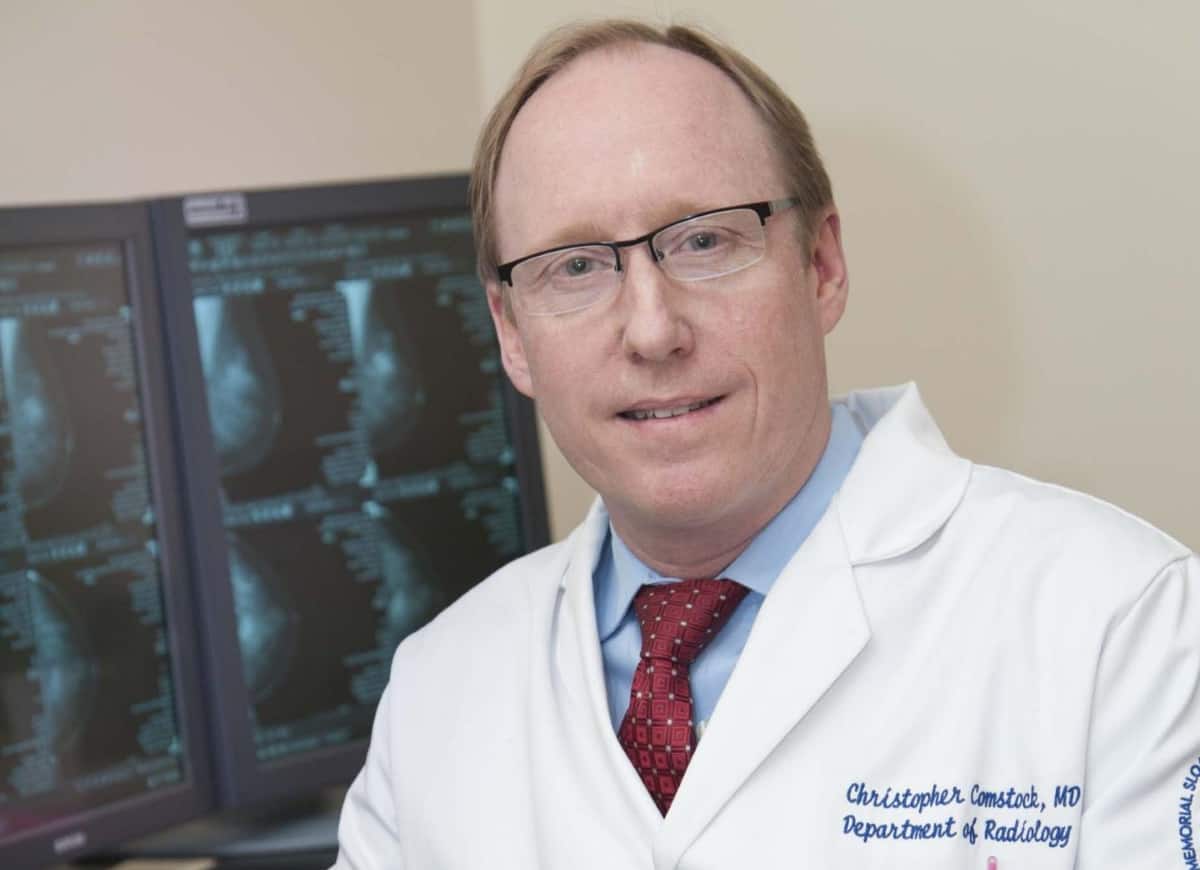
The results suggest that abbreviated breast MRI could be a powerful breast cancer screening tool in a clinical environment increasingly dominated by DBT, for women both at high and average risk, lead author Christopher Comstock of Memorial Sloan Kettering Cancer Center in New York City said in a statement released by the centre.

“When screening women at average risk with dense breasts, we found that abbreviated breast MRI detected almost two and a half times as many breast cancers as 3D mammography,” Comstock said. “We also found that the abbreviated breast MRI was well tolerated by women, with very few side effects.”

Christopher Comstock

Performance measures

Breast MRI boasts the highest cancer detection rate of all breast imaging modalities, Comstock and colleagues wrote, and has been shown to be useful not only in women at high risk of the disease but also those at average risk, corresponding author Christiane Kuhl of RWTH Aachen University in Germany told AuntMinnieEurope.com via email.

“The reason why MRI is superior to radiographic imaging is because it highlights angiogenic activity of breast cancers – unlike mammography or DBT, which are pure structural imaging,” she said. “It’s also impervious to dense tissue.”

But critics say that using conventional breast MRI to screen for breast cancer isn’t practical in a larger population, due to its expense, its longer exam time (45 minutes, compared with 15 minutes for a mammogram), and the fact that it requires a contrast agent. That’s why abbreviated breast MRI – which takes about 10 minutes – shows promise, Comstock and colleagues noted.

“Multiple studies have confirmed equivalent diagnostic accuracy of abbreviated breast MRI with full MRI protocols,” the group wrote. “These observations have led to the consideration of utilizing abbreviated breast MRI to screen women with dense breasts.”

The study, called Comparison of Abbreviated Breast MRI and Digital Breast Tomosynthesis, or EA1141, compared the screening performance of abbreviated breast MRI and DBT in women with dense breasts. It consisted of 1444 women who underwent breast cancer screening with both modalities between December 2016 and November 2017 at 47 sites in the US and one in Germany. The women were between 40 and 75 and had heterogeneously or extremely dense breast tissue.

The primary end point was the detection of invasive cancer. Secondary measures included sensitivity, specificity, the rate of additional imaging recommendations and positive predictive value of biopsy (PPV1). Biopsy results were the reference standard for cancer detection rate and PPV1, while interval cancers reported were used as the reference standard for sensitivity and specificity.

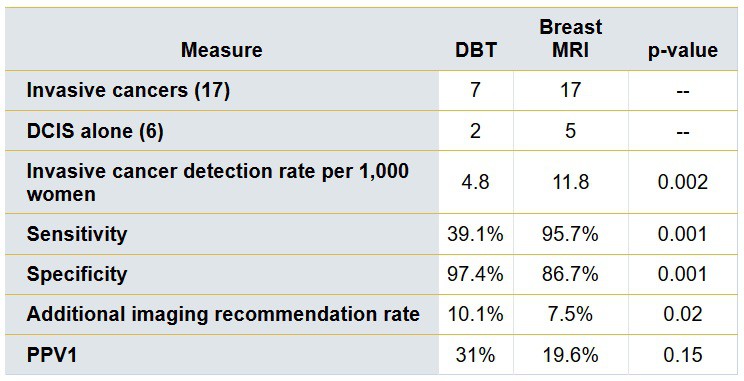
Twenty-three cancers were found in the patient cohort, 17 of which were invasive cancer with or without ductal carcinoma in situ (DCIS) and six of which were DCIS only. There were no interval cancers.

Breast MRI identified all 17 invasive cancers and five of the six DCIS cases, while DBT found seven of the 17 invasive cases and two of the six DCIS cases. DBT did outperform breast MRI when it came to specificity and PPV1, however, although the PPV1 values were not statistically significant.

Breast MRI versus DBT

The study offers further evidence that abbreviated breast MRI could be used on its own for screening rather than as an adjunct to mammography or DBT, according to Kuhl.

“Our study investigates abbreviated breast MRI as a standalone imaging method, not as a supplement to mammography or its ‘best in class’ successor, DBT,” she said. “Once the utility of abbreviated breast MRI is established and the demand for more MRI screening is obvious, I would hope vendors would develop dedicated MR systems optimized for screening purposes.”

Ready for the clinic?

Abbreviated breast MRI shows promise for breast cancer screening in women with dense tissue, but it may not be ready for the clinic, wrote Anna Tosteson, of the Dartmouth Institute for Health Policy and Clinical Practice in Lebanon, New Hampshire, US, in an editorial accompanying the study.

“The promise of abbreviated breast MRI is that it may improve cancer detection without the lengthy examination time and high costs of conventional breast MRI,” she wrote. “Abbreviated breast MRI acquisition requires less than 10 minutes. However, [it] still requires the contrast-enhancing agent used in full-protocol breast MRI and thus carries the same gadolinium-associated risks.”

More research is definitely required, Tosteson cautioned.

“Before widespread adoption, further evidence is needed to demonstrate that abbreviated breast MRI will address the limitations of conventional breast MRI in terms of practicality and cost-effectiveness for the larger screening population of women with dense breasts,” she wrote. “Importantly, the reductions in image acquisition and interpretation time will not overcome the need for better patient access to MRI, the requirement for intravenous gadolinium contrast administration, and the associated patient preparation time.”

  • This article was originally published on AuntMinnieEurope.com ©2020 by AuntMinnieEurope.com. Any copying, republication or redistribution of AuntMinnieEurope.com content is expressly prohibited without the prior written consent of AuntMinnieEurope.com.

Worlds beyond Earth

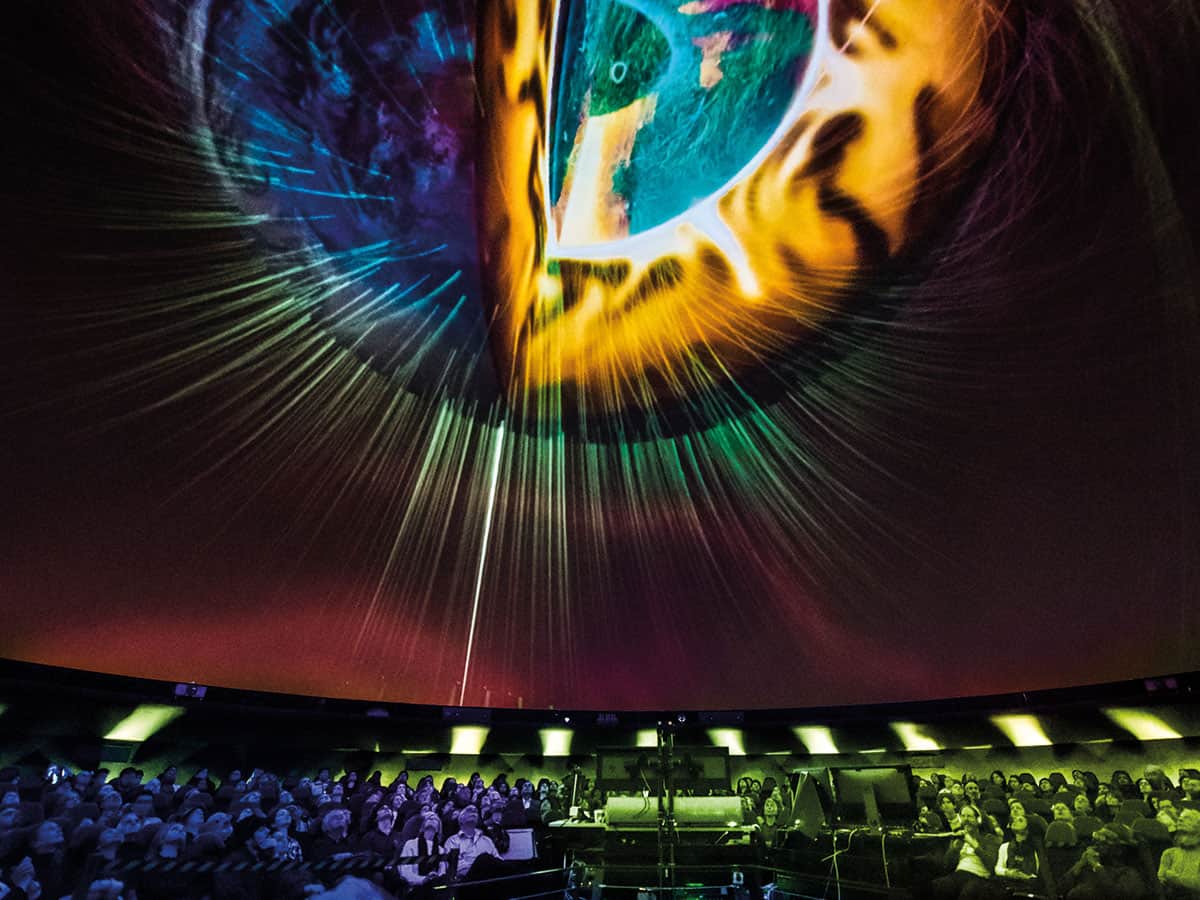
An Apollo spacecraft blasts off from Earth and then slowly descends onto the grey, pitted lunar surface. In the next 23 minutes of the thrilling new show at the Hayden Planetarium in New York City, we meet more spacecraft: Cassini, Huygens, Voyager, Rosetta, Galileo and Magellan. “Worlds beyond Earth” is a show that treats these spacecraft as protagonists on missions to different places in the solar system, flying into planetary atmospheres, over canyons, around comets, and through dense swarms of moonlets.

The planetarium show debuted on 21 January this year at the Hayden, which is in the Rose Center for Earth and Space – part of the American Museum of Natural History on Manhattan’s Upper West Side. The show differs radically from its predecessor, “Dark universe”. That one focused on telescopes and what they had discovered about the evolution of the cosmos. Many scenes in it featured throngs of galaxies exploding in the direction of the observer, reminding me of what it’s like to look up during a hailstorm.

“Worlds beyond Earth”, in contrast, is more a travelogue, full of orbiters, flybys and landers as well as scenes of the unique places that the spacecraft encounter. The fastidious attention to details – both their colour and resolution – makes the objects as absorbing as the fossils, crystals and bugs scaled up to the size of dogs that we encounter elsewhere in the museum.

The show’s distinctive character is no surprise given that it was curated by Denton Ebel, a geologist and the first non-physicist among the half-dozen to curate a Hayden Planetarium spectacle. “I wanted it to be tactile,” he told me when I visited him in his office a few weeks before the show opened. “I wanted it to be about the stuff.” This show provides a vivid feel for the colours, textures and roughness of the surfaces that the spacecraft explore. “It’s not just showing what we know,” he said, “it’s also showing how we know it.”

An enormous support system was put into play to mount the show. Two years in the making, it was produced by a team of 15 people plus numerous consultants and advisers. A key piece of equipment was provided by OpenSpace – a $6m interactive data-visualization software. Though still under development, the show’s creators were able to use it to recreate the journey of the spacecraft, showing accurate orbital trajectories and instrument targeting. These scenes – and those involving representations of the spacecraft and the places they studied – then had to be culled to 23 minutes.

Hayden Planetarium

What, I asked Ebel, did he most regret going on the cutting-room floor?

The geologist paused, mentally screening outtakes from different areas of the solar system. Finally, he said, “Pluto. It’s five light-hours away, a world of ice but full of colour, and not nearly as cratered as it should be. That means that it’s active and resurfaces itself.” Ebel had great images thanks to NASA’s 2015 New Horizons flyby, when the spacecraft journeyed between Pluto and its twin Charon. “But that required three minutes that we didn’t have.”

Still, Ebel hesitated. “But I dearly miss showing the plumes that rise from the surface of [one of Saturn’s six moons] Enceladus – plumes that feed ice particles to the outer ring of [the planet]. That would have taken 30 seconds, but we didn’t even have that. I also miss not showing the MESSENGER spacecraft mapping the surface of Mercury.”

Five shows have been staged at the Rose Center since it opened in 2000. And, thanks to my children, I’ve seen every one. All the shows have had celebrity narrators: Tom Hanks, Robert Redford, Harrison Ford, Whoopi Goldberg. The astronomer Neil de Grasse Tyson, meanwhile, did “Dark universe”. The latest show is delightfully narrated by the Academy Award-winning, Kenyan-Mexican actress Lupita Nyong’o.

“Worlds beyond Earth” was written by Natalie Starkey, a cosmic chemist who now works as a physics communicator at the Open University in the UK. The original score is by Robert Miller, who has composed the scores for four previous shows, and the music was recorded at Abbey Road Studios in London. The brilliant solo acoustic guitar passages are by the musician and retired Yankee baseball star Bernie Williams, who took the trouble to check out the acoustics of the Rose Center’s dome beforehand. The planetarium’s projection system was upgraded to give it a resolution of 8000 pixels and a 26-channel sound system, including two dedicated as seat shakers.

The critical point

“Don’t think of the solar system as full of objects,” Ebel says, “think of it as full of worlds.” Each place that we come across has vastly different features – not only surfaces, textures and colours but also volcanic activity, magnetic fields of different strength and shape, and internal dynamics. Mars has the largest volcanoes in the solar system but Jupiter’s moon Io is the most volcanically active. Saturn’s moon Titan has a methane atmosphere while Venus, in Ebel’s words, is a “greenhouse gas hellhole”.

What an audience member appreciates from visiting these worlds is the unique status of the Earth, from which the Apollo 15 spacecraft blasted off at the beginning of the show and to which we return at the end. By visiting so many other places in the intervening 23 minutes we appreciate the Earth’s special character even more. This sets the stage for the final element, which makes the show so different from the others – its particular emotional mood. That mood is expressed in the show’s final image of the full Earth rotating, half lit by the Sun, and is audible in Nyong’o’s voice as she concludes her narration by saying that the Earth’s atmosphere has “the perfect blend of molecules” for human life, and that “it’s up to us to sustain it”.

Novel photovoltaics generate electrical power from thermal sources

A new type of photovoltaic device can generate useful amounts of electrical power from sources that radiate heat at moderate temperatures. So say researchers at Sandia National Laboratories in the US, who succeeded in recovering power densities between 27–61 μW/cm2 from thermal sources at 250–400°C. The new energy-harvesting technology might be used on waste heat from nuclear power plants or chemical manufacturing facilities. According to Paul Davids, who led the research effort, it could also aid the development of compact thermal power supplies for deep space probes and other remote applications.

Standard photovoltaic devices (such as solar photovoltaic cells) work by absorbing incident radiation across the bandgap of a semiconducting device. These devices usually feature p-n junctions designed so that light is absorbed within a region of the device known as the depletion width. When this region absorbs a photon, the resulting electron-hole pair is spatially separated by the region’s internal electric field, and this separation of charge induces an open circuit voltage across the device.

Devices of this type work well for energetic photons in the visible range of the spectrum – including those produced by our Sun, which has an effective black-body temperature of around 6000 °C. Objects at temperatures between 100 to 400 °C, however, emit light mainly in the thermal infrared part of the electromagnetic spectrum, with wavelengths between 7-12 μm. The waste heat radiated from many modern industrial processes falls into this range, so putting even a small percentage of it to good use could significantly reduce energy consumption.

Photon-assisted tunnelling

The problem, Davids says, is that as the photons’ energy decreases and approaches the thermal energy of the converter, standard photovoltaic converters become exceedingly inefficient. This drawback led his team to seek alternative ways of generating current.

“In our device, the photocurrent produced by the electron-hole pairs is not from photon absorption but from photon-assisted tunnelling,” he explains. “This tunnelling acts to shuttle charge into a periodic array of wells formed by interdigitated p-n junctions under our subwavelength metallic grating.” 

The photon-assisted tunnelling current is driven by infrared radiation confined in the tunnel barrier of the device, which the researchers fabricated from a silicon dioxide layer just 3-4 nm thick. This structure provides a predominantly one-way path for electrons to be separated from holes, leading to a large open circuit voltage across the device and efficient conversion of infrared radiation into electrical power.

Application areas

The devices developed by Davids and colleagues can be made using standard CMOS processes routinely employed in manufacturing advanced semiconductor chips. This means they could be fabricated in high volumes. In the nearer term, the researchers say they would like to use their energy-harvesting technology to develop power supplies for deep space probes, which cannot use photovoltaic cells because they are too far from the Sun. The Sandia devices could also provide enough power to be used as a primary source of electrical power generation, or as a supplement to standard thermoelectric methods, Davids says.

Another potential application lies in recovering electrical power from large cloud-computing data centres, which dissipate a lot of heat and must be cooled continuously to keep processors below 120 °C. “If we can recover electrical power from this waste heat, we could improve the energy efficiency of this growing part of the energy consumption market,” Davids tells Physics World.

The researchers, who report their work in Science, say they are now focusing on enhancing the conversion efficiency of their devices and simplifying their fabrication process. “As we continue to improve the efficiency of our technology and scale up to larger areas, we are confident that many more application areas will emerge,” Davids says. “There are also several exciting connections with recent advances in passive photonic cooling and structured light emitters, which when combined with our technology could open up other untapped avenues for power creation and reclamation.”

Coronavirus hits the conference calendar, physicists excel in ‘deep tech’ start-up challenge, remembering Freeman Dyson

The big physics news this week is the cancellation of the March Meeting of the American Physical Society because of concerns over the spread of the COVID-19 coronavirus.

In this episode of the Physics World Weekly podcast we hear from conference delegates who had travelled to Denver Colorado, only to find that the March Meeting had been cancelled. We chat about how attendees have organized alternative meetings – in person and in cyberspace – and ponder the future of the scientific conference in the Internet age.

We also hear from physicists who came tops in a “deep tech” start-up challenge that was held last month at Photonics West in San Francisco and remember the iconoclastic mathematical physicist Freeman Dyson, who died last week age 96.

Crowdsourced AI challenge aims to improve mammography accuracy

Mammography screening is widely employed for early detection of breast cancer. But mammograms currently rely on subjective human interpretation and, as such, the screening process is not perfect. In the USA, for example, such screening leads to an estimated 10% false positives, which increases patient anxiety and can result in unnecessary interventions or treatments.

Advances in deep learning and increased computational power have recently renewed interest in the use of artificial intelligence (AI) to increase screening accuracy. With this aim, the Digital Mammography (DM) DREAM Challenge used a crowdsourced approach to develop and validate AI algorithms that may improve breast cancer detection. The goal: to assess whether such algorithms can match or improve interpretations of mammograms by radiologists (JAMA Netw. Open 10.1001/jamanetworkopen.2020.0265).

The DM DREAM Challenge – directed by IBM Research, Sage Bionetworks and the Kaiser Permanente Washington Research Institute – is the largest objective study of deep learning performance for automated mammography interpretation to date. “This DREAM Challenge allowed for the rigorous and appropriate assessment of tens of advanced deep learning algorithms in two independent databases,” explains Justin Guinney, president of the DREAM Challenges.

The challenge required participants to develop algorithms that input screening mammography data and output a score representing the likelihood that a woman will be diagnosed with breast cancer within the next 12 months. In a sub-challenge, the algorithms could also access images from previous screening examinations, as well as clinical and demographic risk factor information.

The data for the challenge were provided by Kaiser Permanente Washington (KPW) in the USA and Karolinska Institute (KI) in Sweden. The KPW data set, which included 144,231 screening exams from 85,580 women, of whom 1.1% were cancer positive, was split for use in algorithm training (70%) and evaluation (30%). The KI data set, used only for algorithm validation, comprised 166,578 exams from 68,008 women, of whom 1.1% were cancer positive.

To ensure the privacy of these data, both data sets were securely protected behind a firewall and not accessible to challenge participants. Instead, participants sent their algorithms to the organisers for automated training and testing behind the firewall.

Crowdsourced competition

The challenge was taken up by more than 1100 participants, making up 126 teams from 44 countries. In a first stage, the algorithms were trained and evaluated on the KPW data, with AUC (a measure of how well the algorithm’s continuous score separates positive from negative breast cancer status) used to evaluate and rank algorithm performance.

Interestingly, including clinical data and prior mammograms did not improve the algorithms’ performance. The DM DREAM team suggest that perhaps participants did not fully exploit this information and recommend that future algorithm development should focus on the use of a patient’s prior images.

DM DREAM Challenge workflow

The eight top-performing teams were invited to collaborate to further refine their AI algorithms, to evaluate whether an ensemble approach could improve overall performance. The output of this “community phase” was the challenge ensemble method (CEM), a weighted aggregation of algorithm predictions. This CEM model was also integrated with the radiologists’ assessment into a second ensemble model called CEM+R.

To compare CEM predictions with radiologists’ interpretation (recall/no recall), the competition determined CEM specificity when using the sensitivity of radiologists at each institution. For the KPW data set (with a radiologist sensitivity of 85.9%), the top-performing AI model, the CEM and the radiologists achieved specificities of 66.3%, 76.1% and 90.5%, respectively. While CEM remained inferior to the radiologists’ performance, CEM+R increased the specificity to 92%.

The challenge team repeated the assessment using the KI data. For these exams, each mammogram underwent double reading by two radiologists, so the first reader interpretation was used to mirror the KPW data set. At the sensitivity of first readers’ (77.1%), the specificities of the top model, the CEM, the radiologists and the CEM+R were 88%, 92.5%, 96.7% and 98.5%, respectively. Again, CEM+R provided the highest specificity. The team also compared the ensemble method with the double-reading results, observing that in this case, the CEM+R did not improve upon the consensus interpretations.

The results show promise for deep learning to enhance the accuracy of mammography screening. While no single AI algorithm outperformed the radiologist benchmarks, the CEM+R model improved performance over single-radiologist interpretation, such as used in the USA. In the double-reading and consensus environment, as seen in Sweden for example, adding AI may not have as great an effect. However, that it’s likely that training an ensemble of AI algorithms and radiologists consensus assessments would improve accuracy.

The challenge team conclude that combining AI algorithms with radiologist interpretation could reduce mammography recall rates by 1.5%. With some 40 million women screened for breast cancer in the USA each year, this means more than half a million women annually would not have to undergo unnecessary diagnostic work-up.

Death by prime numbers

Prime Suspects: the Anatomy of Integers and Permutations

Two people are dead, and the police are baffled. Arnie Int, the 60-year-old lieutenant to the godfather of the Integer crime family, is found brutally murdered in a drainage tunnel. Later, the petite body of young ballet dancer Daisy Permutation is also found and brought to the morgue. Gruff and grizzled lead detective Jack von Neumann suspects a link between the two, and has brought in a consultant on the case – legendary mathematician and professor of forensic science C F Gauss.

So begins the unique graphic novel Prime Suspects: the Anatomy of Integers and Permutations, an imagined world “where detectives work closely with mathematicians”. A forensic crime drama, mixed in with number theory, as well as an exploration of student–mentor relationships, all in the graphic novel format, Prime Suspects was written by the Canada Research Chair in Number Theory at the University of Montreal mathematician Andrew Granville and writer, educator and director Jennifer Granville; with illustrations by Toronto-based graphic designer Robert J Lewis. Bringing in elements from film noir, TV police shows and famous movies, coupled with some amazing art work, subtle mathematical humour and corny science jokes, and what you have is a one-of-a-kind creation – indeed, Prime Suspects has it all from minus to plus infinity.

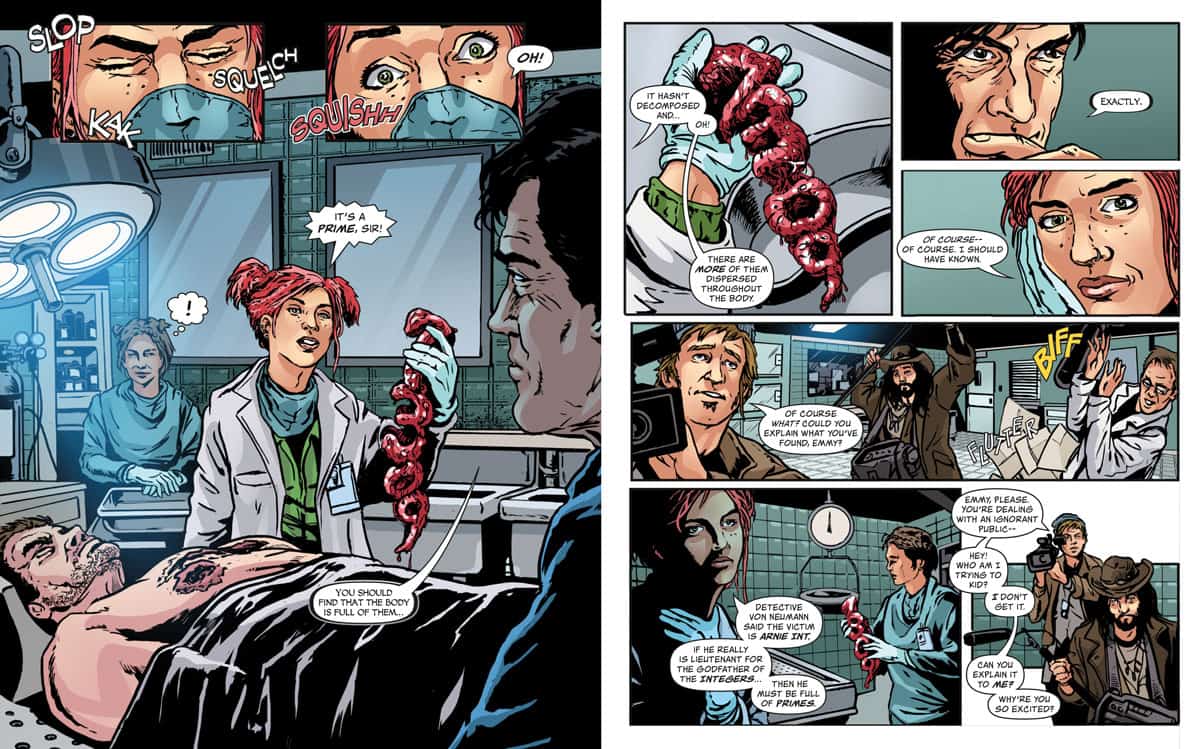
Early in the story, Gauss involves two of his most promising students – the snooty Sergei Langer and the hip, red-haired heroine Emmy Germain – while a pair of documentarians have arranged to record the team’s work. Eager to impress (and become the professor’s new research assistant), Langer and Germain both attempt to uncover the details of the murders. At the morgue, the team soon begins to find some surprising links between the two bodies, including peculiar cuts on the chest, and both hearts having been surgically removed.

While Langer barfs at the gruesome sight, Germain reaches into Int’s chest and pulls out a bloody clump of tissue with the distinct shape of “7309”; and so the book is off to the races. “Primes are the fundamental constituent parts of integers,” she tells the confused film producers, “their genetic code, if you like.” We also learn that the ballet dancer’s family business is the Alternating Group – a tongue-in-cheek description, though not as visceral as the primes. A bit corny, perhaps, but corny in the pursuit of larger truths.

A bit corny, perhaps, but corny in the pursuit of larger truths

As the story moves to Gauss’s luxury penthouse (don’t all legendary mathematicians have one?), the trio play billiards and discuss the similarities between primes, the fundamental constituents of integers, and cyclic permutations (or cycles), the fundamental constituent parts of [Daisy’s] permutation. Langer, ever anxious to show off his smarts, says “they’re about as similar as apples and iPhones”. In fact, as the rest of the book goes on to show, primes and cycles play similar roles in the study of integers and permutations, respectively. Even many of the equations describing their traits are similar; there’s a cyclic equivalent to the 15-year-old real mathematician Carl Friedrich Gauss, who found that the number of prime numbers among the first N integers is near log(N). (Physicists use the notation ln(N)).

As a student of physics who received their career-worst grade in undergraduate topology class (in my defence, I did join the class two weeks late), the properties of numbers and sequences come more easily to me than the more abstract properties of permutations. We all understand prime numbers. A permutation of, for example, the four integers (1 4 5 8) is (4 5 8 1); another is (5 8 1 2), and so on. M items can be permuted in M! (M factorial) ways, and every permutation can be broken up into “cycles”.

These cycles (a bit too involved to include in this review; see Wikipedia’s entry on “permutations”) all containing M or fewer items, uniquely represent a permutation much as primes uniquely represent an integer. Exactly one in every M permutations on M letters is a cycle. Phew.

Just when you start to fear the book is going over your head, and that you’ve missed something and can’t keep up with the maths, you thumb through the rest of the book to discover a chapter near the end called “The mathematics of prime suspects”. There, the mathematics of both primes and cycles is laid out in traditional mathematical garb, lingo and rigour. It felt like arriving home after a foreign trip.

It was then I realized the graphical storyline wasn’t meant to teach the details of the maths so much as to wet my whistle and motivate me to learn more. Which it did, not just via the later, textual chapters but by going online to Wikipedia and YouTube and reading a few papers (some by one of the authors, Andrew Granville). As it emerges, the central question here is: why are the anatomies of integers and permutations so similar?

Later in the book a third murder victim, Polly Nomial, is found whose body has been spread over Finite Fields…. I won’t give away the murderer or the story’s conclusion, but I will give away its success: it entertains while provoking one’s curiosity. Every page has something witty on a background sign or screen, and the book is chock full of homages to famous mathematicians, right down to the character names. With its beautiful and expressive artwork Prime Suspects is truly “mathematics as you’ve never seen it before”.

Copyright © 2026 by IOP Publishing Ltd and individual contributors