Queensgate: collaborating to push the boundaries of measurement science

Queensgate – a brand of Prior Scientific Instruments – offers their customers maximum precision and accuracy along with high-speed solutions for the nanopositioning challenges they face. Customer  applications range from hard disk testing for companies such as Seagate (see ‘Queensgate reaches the pinnacle of nanopositioning performance‘) to realizing units with national measurement institutes such as the National Physical Laboratory (NPL).

It is this reputation that has seen Queensgate provide high-precision nanopositioning stages for some of NPL’s atomic force microscopes (AFMs), including NPL’s extremely accurate metrological AFM.

The metrological AFM forms a key part of some of NPL’s most important work. As the National Metrology Institute for the UK, it is NPL’s responsibility to ‘realize’ the international standards of measurement – the SI units – in the country. NPL uses this AFM to calibrate transfer standards that are then passed on to other AFM users in order for them to calibrate their AFMs.

Queensgate has been working with NPL in this way for many years. But more recently, NPL came to Queensgate with a more challenging task.

Realizing the metre

The redefinition of the SI in 2019 now means all SI units are based on precise, unchanging and universal fundamental constants of nature. New definitions of the kelvin, ampere, mole and the headline-grabbing kilogram are now in effect. Perhaps less well-known are the changes made to realizing the metre.

The metre was already defined by the speed of light back in 1983. Since then, metrologists have used optical interferometers to realize the metre and make length measurements – and for most measurements this technique is extremely precise. At the nanoscale, however, metrologists must subdivide the wavelength of light, which is several hundred nanometres, making the technique prone to errors.

We needed a bottom up approach, at an atomic scale.

Andrew Yacoot

“We needed a bottom up approach, at an atomic scale,” explains Andrew Yacoot, principal research scientist at NPL and chair of the Working Group for Dimensional Nanometrology of the Consultative Committee for Length (one of ten Consultative Committees that oversee the SI units).

To solve this issue, Yacoot and colleagues from other metrology labs used a method directed towards measurement of the Avogadro constant in which the lattice spacing of silicon is measured very accurately using a technique called X-ray interferometry. “We were able to use this technique together with the known value of silicon lattice spacing to characterize and measure errors in optical interferometers or other displacement sensors, as a technique for making traceable length measurements at the nanoscale” he says.

Queensgate was tasked with designing a custom nanopositioning stage and digital controller for Yacoot’s X-ray interferometry work. “The specification was challenging, because I wanted a long range of measurement (several hundred micrometres) together with picometre resolution and the stage’s payload was almost 1 kg,” he explains.  “These are competing requirements for stage design.”

To reduce the overall system noise, the Queensgate team used a digital interface to apply commands.  This also allowed greater timing accuracy, as the field-programmable gate array (FPGA) could conduct all the data processing, including commanding the controller. “We provided an out of the box system that NPL can command and resolve down to 10­–20 picometres, ten times smaller than the spacing between the atomic planes in a silicon crystal,” says Queensgate’s Principal Electronics Engineer. “That, I think, is impressive.”

A bi-directional partnership

Dialogue was the key element of the partnership for Yacoot and his team: “We’re very keen to have a deep understanding of how every component works and access to all the signals and control of the equipment, rather than having a black box,” he says. “We want to [use equipment] produced by a company that’s open to a dialogue with us and willing to share information – that’s certainly been the case with Queensgate.”

We want to [use equipment] produced by a company that’s open to a dialogue with us and willing to share information.

Andrew Yacoot

In fact, two-way dialogue and collaboration is the bedrock for the relationship between the two organizations. All Queensgate products are tested using interferometers and electronics, most of which are supplied by NPL. NPL acts as a third-party collaborator in verifying measurements on new products, validating their performance which in turn has helped Queensgate secure substantial new business.

Collaboration, then, benefits both parties. NPL gets to use Queensgate’s high-precision piezo systems and gains access to industry-level expertise in designing high-precision, flexure stages for their applications. Meanwhile, Queensgate gains trusted verification of the accuracy of its products. Moreover, by working in partnership with NPL’s leading experts on applications that push the limits of performance, Queensgate is able to maintain its position as an expert in producing the highest precision stages. Perhaps best of all, the collaboration benefits us all, as knowledge gained from public–private collaborations like this one leads to more accurate measurements, which in turn lead to more efficient and effective technologies and products.

Introducing the π-ton, which could be the newest known quasiparticle

A new type of quasiparticle has been predicted by Anna Kauch and colleagues at Technical University Vienna in Austria. Using computer simulations, the team concluded that the “π-ton” (pronounced pie-ton) is created by the bonding between two electron-hole pairs in semiconductor-like materials. The researchers now hope that π-tons could soon be studied in real experiments and even put to work in photovoltaics.

Quasiparticles are particle-like excitations that emerge from the collective behaviour of electrons and other entities in solids. They include polaritons, which arise from the interaction between electrons and light and excitons that are created when an electron in a semiconductor’s valence band is excited by a photon to the conduction band. In the electron’s place, a positively charged “hole” is left behind in the valence band, which the electron remains strongly attracted to. The electron-hole pair behaves like a particle – an exciton.

Kauch’s team initially set out to study excitons by doing computer simulations of “strongly correlated” materials that have strong interactions between electrons. Unlike semiconductors, which initially possess filled valence bands and empty conduction bands, strongly correlated materials have half-filled conduction bands. This means that their behaviours are dominated by fluctuations in “charge density waves” – linear chains of fermions which form standing waves.

Reverse rotation

The researchers had hoped to study the characteristics of exciton formation in these materials, but to their surprise, their simulation seemed to yield a new type of quasiparticle entirely. Kauch and colleagues discovered that when excited by a photon, two electron-hole pairs became bound together by the material’s charge density wave fluctuations, which were reversed by 180°, or π rad, at each crystal lattice point. This behaviour led directly to the proposal of a new quasiparticle; which the team dubbed the π-ton.

To make sure this result is not simply a quirk of their simulation, the team recreated the same conditions across multiple models. The π-ton reappeared every time, removing doubt of its existence. Kauch’s team believe that this provides a strong reason to do experiments involving real strongly correlated materials – in which π-tons could be created through photon excitation, then confirmed by the photons they re-emit as they disappear.

Already, the physicists have suggested samarium titanate as a strong candidate material for these efforts, since previous experimental data appears to suggest that it can host unusual quasiparticles. If achieved, such experiments could bring about a more in-depth understanding of the quantum interactions that take place between light and solids. They could also provide materials physicists with new research opportunities; along with innovations in technological applications including photovoltaics and semiconductors.

The research is described in Physical Review Letters.

Taking a tiger’s pulse, mending a broken heart and dancing your PhD

How do you monitor a lion’s breathing rate or take a tiger’s pulse? With great difficulty, one would imagine.

A team at the University of South Australia has now developed a way to perform these routine health checks using a high-resolution digital camera. The new approach will save the animals the stress of an anaesthetic – and presumably will greatly lower the stress of the zookeepers too.

The researchers filmed animals at Adelaide Zoo – including a giant panda, African lion, Sumatran tiger, orangutan, koala, red kangaroo and a little blue penguin – from up to 40 m away. By detecting tiny movements in the chest cavity, they could record the animals’ heart and breathing signals without needing any physical contact or disrupting the animals’ daily routine. You can hear engineer Javaan Chahl discuss the pilot study in the video above.

On this Valentine’s day, while some may be planning celebrations, spare a thought for the broken hearted. But help may be at hand – at least in a bioengineering sense. Heart disease has a huge impact on patients’ quality-of-life and researchers are continuously looking to develop new treatments, such as cardiac patches, for example, which can help restore damaged heart tissue following a heart attack. Bioengineers from Trinity College Dublin have now fabricated a conductive cardiac patch that can endure the strains and stresses exhibited by human cardiac muscle tissue as the heart beats.

The researchers used melt electrospinning writing to make a patch that can withstand repeated stretching and showed good elasticity. They fine‐tuned the patch geometry to reflect the directionally‐dependent mechanics of the heart, and coated the patches with an electroconductive polymer to provide conductive properties close to those of human myocardium. The team says that this work “essentially takes us one step closer to a functional design that could mend a broken heart”.

Finally, today sees the announcement of the winners of the 12th annual Dance Your PhD contest. This year’s overall winner is neuroscientist Antoine Groneberg. Her zebrafish larvae-inspired video, Early life social experiences shape social avoidance kinematics in larval zebrafish, “merged dance and science for an aesthetically stunning and intellectually profound masterwork of art,” according to judge Alexa Meade.

The judges also highlighted the winner of the physics category for special recognition, for its “original rap and professional production”. The “hilarious and yet scientifically informative” video, Utilizing multispectral lidar in the detection of declined trees, is a dance about multispectral scanning of forests, created by Samuli Junttila.

Precision scaffolds tailor biomaterials to promote wound healing

Biomaterials are used in the clinic as dressings that promote healing of wounds or burns. In addition to conventional wound dressings, scientists are developing skin substitutes containing patient-derived cells, as well as biomaterials that incorporate growth factors to stimulate and facilitate the healing process.

Once implanted, such biomaterials are exposed to the body’s immune response, particularly macrophages that can be either pro-inflammatory (M1) or pro-healing (M2) in type. While an initial inflammatory state is important for healing, prolonged inflammation is detrimental to tissue regeneration. Directing the immune response after implantation is thus a major challenge in the design of new biomaterials.

One way to drive macrophage type is by controlling their physical microenvironment, for example by tailoring the biomaterial geometry. With this aim, researchers at the University Hospital of Würzburg, have used melt electrowriting (MEW) to create high-precision 3D tissue scaffolds that cause human macrophages to differentiate towards the anti-inflammatory M2 type (Biofabrication 10.1088/1758-5090/ab5f4e).

“We wanted to determine the optimal scaffold geometry for the polarization of human macrophages into the M2 type,” explains senior author Jürgen Groll. “And when we found that macrophages on box-shaped scaffolds showed enhanced M2 polarization, we wanted to further determine the optimal pore size for them.”

Shape matters

Groll and colleagues used a customized MEW printer to fabricate 3D porous fibre scaffolds from the biocompatible polymer PCL. They created scaffolds with box-shaped, triangular, round and disordered geometries, and cultivated human-monocyte-derived macrophages on these scaffolds for seven days.

Cellular morphology

Scanning electron microscopy (SEM) revealed that cell morphology differed according to scaffold geometry. In particular, macrophages grown on box-shaped scaffolds developed an elongated shape and stretched across the pores.

Gene expression profiles after seven days growth also depended upon scaffold geometry, with box-shaped scaffolds appearing most promising for promoting macrophage differentiation towards M2 type. Macrophages cultivated on box-shaped scaffolds showed the highest expression of the M2 marker CD163, as well as the strongest downregulation of the pro-inflammatory cytokines IL-1β and IL-8 (which are released by M1 macrophages).

Guided by these outcomes, the team fabricated further box-shaped scaffolds with pore sizes from 40 to 100 μm and seeded them with macrophages. SEM images showed that, after seven days, macrophages cultivated in these scaffolds could stretch along single fibres and bridge across pores.

Decreasing the pore size increased the number of elongated macrophages with long cellular extensions. On scaffolds with 40 μm pores, more than half of the cells were elongated and had an average length of 80 μm. For scaffolds with 100 μm pores, only 20% of the cells were elongated, with a length of roughly 50 μm.

Gene expression

To study the impact of pore size on macrophage differentiation, the researchers examined gene expression from macrophages grown for seven days on scaffolds with varying pore sizes, as well as on 2D PCL films. All of the porous scaffolds triggered a significant decrease in M1 markers compared with the 2D film, suggesting an anti-inflammatory differentiation effect of porous scaffolds over the seven days.

Immunofluorescent staining

Expression of M2-specific markers significantly increased on scaffolds with a pore size of 40–60 μm, but decreased on those with 80 or 100 μm pores. Macrophages on the 2D control showed minimal up- or down-regulation of M2 markers over the seven days.

The team also examined the macrophages’ phagocytic activity (ingestion of other cells or particles) by adding fluorescent beads to the culture medium. Phagocytic activity is important in initial healing, to act against pathogens that enter the wound. However, high activity is a characteristic of inflammatory M1 macrophages.

Fluorescence imaging showed that initial phagocytotic activity was far lower on scaffolds with smaller pores than on those with larger pores. After seven days, there was less phagocytic activity on the 3D scaffolds than on the 2D control.

“We showed that macrophages on 3D scaffolds have a higher phagocytotic activity on day one than on day seven and, therefore, would still be able to react against pathogens,” Groll tells Physics World. “However, the activity is lower on smaller pore sizes, which is beneficial because the risk of frustrated phagocytosis – where macrophages try to internalize something that is too large – is also diminished.”

Groll and co-authors conclude that scaffolds with precisely controlled pore sizes cause elongation of adherent human macrophages, along with a polarization towards M2 type – effects that were most pronounced for the smallest 40 μm pores. These findings could enable creation of pro-healing scaffolds solely through structural control, to improve biomaterials for tissue regeneration and wound healing.

The team has several follow-up studies ongoing and planned. “We are working on the development of other scaffold types that can also promote the elongation of macrophages,” says Groll, noting that this research was conducted within the ERC funded project Design2Heal. “In addition, we would like to investigate the biological mechanism for the elongation-driven polarization of macrophages. Finally, in vivo studies are planned.”

Conspiracy theories, smartphone apps for identifying skin cancer, classical time crystals

In this latest instalment of the Physics World Weekly podcast we scratch our heads over why people believe in conspiracy theories and ask what physicists can do to help avoid the propagation of bizarre and sometimes dangerous ideas.

We also look at smartphone apps that allow someone to analyse a skin lesion to decide whether to seek medical advice; and we chat about a study that looks at the physics that drives lotus plants to have differently-shaped leaves.

Finally, we delve into the mysterious world of time crystals and discover why they could be governed by purely classical physics.

An uncertain growth

Sunflowers

When I first picked up Vaclav Smil’s latest book, Growth: From Microorganisms to Megacities, I wondered whether his main argument would be that systems as diverse as nature and demographics follow a universal growth trend. Indeed, it’s true that there are many similarities to learn from: the height gained by sunflowers during the summer, for example, forms the same growth pattern as the average area of American houses since 1990 and the adoption of mobile phones over the past two decades. But Smil – a Czech-Canadian environmental scientist and policy analyst – also takes pleasure in exploring the idiosyncrasies of these different growth processes, and the factors that influence them.

Throughout Growth he presents rigorous quantitative analyses of disparate systems, ranging from biological processes and crop cultivation to economies and changes in population. Many of these follow an S-shaped growth trajectory, in which initial incremental gains are followed by rapid expansion, and then a long tailing off as the system approaches its limit. Other processes may show more exponential growth from the start – such as the rapid adoption of the telephone at the beginning of the 20th century – but the gains always seem destined to level off over time.

Smil exploits these detailed analyses to draw important conclusions about the nature of growth. It becomes clear that even small variations or external interventions can disrupt the neat progression of an expected growth trajectory. The rapid spread of a flu epidemic, for example, can be curtailed by vaccinating just 20% of the population, while only tiny changes in rainfall or temperature can wipe out expected improvements in crop yields. Coupled with that unknown variability is the difficulty of fitting the best growth curve to observed data.

I particularly enjoyed Smil’s discussion of attempts to estimate how many musical masterpieces Mozart could have produced if he had lived beyond the age of 35. Some previous commentators had fitted an S-shaped curve to Mozart’s cumulative musical output, from which they concluded that he must have written 18 unpublished works as an infant, and that his creativity would have been 91% exhausted by the time he died. Smil puts those claims into doubt by presenting four alternative growth trajectories, all of which provide a good fit to Mozart’s back catalogue, with the number of projected compositions at age 50 ranging from fewer than 800 to more than 1300.

The lesson to be learnt, argues Smil, is that growth models are an unreliable predictor of the future. Growth curves often provide valuable insights into the evolution and development of particular systems, and offer some predictive power for repeatable processes that are well understood – such as the growth of bacteria and other living organisms. But extrapolating a trajectory from a few early data points is fraught with danger, particularly when dealing with more complex systems such as cities, economies or civilizations.

Smil is particularly critical of what he sees as wildly optimistic predictions for the development and adoption of new technologies, such as claims that we will all be driving electric vehicles by 2025. Such growth projections, he argues, often mistake initial performance improvements for the early stages of an exponential curve, while most new technologies advance in a more stepwise fashion – where periods of fast growth as new materials or designs are introduced are interspersed with frequent and sometimes long-lived plateaus.

What can seem like disruption is also often the result of previous, more incremental, advances – the recent explosion of digital technologies, for example, has been enabled by successive innovations in optical fibres and long-distance communications systems over the last 50 years or so. Even Moore’s law, which for decades has successfully predicted exponential growth in the number of transistors that can be fitted onto a silicon chip, is likely to slow down, now that transistor linewidths have reached the atomic scale – although Smil notes that computing power will continue to grow rapidly due to other improvements, such as more specialized chips and the emergence of photonic and quantum technologies.

Smil is also sceptical of the role that technological innovation plays in driving economic progress. The key test, he says, is whether a new invention improves productivity or quality of life – and in those terms the most innovative period was the half century before the First World War, when electricity, telephones and motorized vehicles all became widespread. In contrast, the digital revolution of the past few decades may have changed how we communicate and consume information, but it hasn’t delivered any measurable improvement in economic prosperity.

Smil reserves most of his ire for the modern notion that economies are healthy only if they grow

But Smil reserves most of his ire for the modern notion that economies are healthy only if they grow. He has long been a critic of using gross domestic product (GDP) as an economic indicator, partly because it is an aggregate metric that hides as much as it reveals. Nor does it truly reflect economic prosperity, since headline GDP growth takes no account of unpaid work – such as caring for children or the elderly – and can be achieved without any significant improvement in the quality of life. Japan, for example, enjoyed annual GDP growth of around 8% throughout the late 1950s and the 1960s, but wages remained low for most industrial workers.

Even more troubling to Smil is that the GDP metric ignores the impact of economic growth on natural resources and the environment. Alternative measures that take these factors into account – including a study by Smil himself on China’s rapid economic growth in the 1990s – suggest that gains in GDP can be negated or even reversed by the loss of so-called natural capital.

And this is the crux of Smil’s argument: that the growth of human activity and productivity is fundamentally limited by the resources available on our planet, just as the growth of sunflowers is limited by the amount of light available for photosynthesis. Those limits are already being reached, he says, with soil erosion causing crop yields to decline, irrigation depleting deep aquifers faster than they can be replenished, and urban spread and deforestation causing a loss of biodiversity. These and other environmental impacts – including the unpredictable consequences of a rapidly warming climate – are largely ignored in the modern quest for perpetual economic growth.

Smil doesn’t necessarily believe that a climate calamity is just around the corner, but he also rejects the idea that radical technologies – such as terraforming Mars – offer a viable solution for our long-term survival. Instead, he believes we need to recalibrate our expectations of success. Our progress should no longer be defined by economic growth or material consumption, but by our ability to inhabit our planet alongside other species for millennia to come. It’s hard to argue with the conclusion, but easy to question whether those in power will be persuaded to chart a different course.

  • 2019 The MIT Press 664pp £30hb

Magnetized molecules monitor breast cancers

A new scanning technique that uses hyperpolarized carbon-13 MRI to monitor the metabolism of different types of breast cancer can identify how rapidly a tumour is growing. The technique, developed by researchers at Cancer Research UK Cambridge Institute and the University of Cambridge, could help doctors prescribe the best course of treatment for a patient and follow how they respond.

Breast cancer accounts for roughly a quarter of all cancer cases worldwide and is the leading cause of cancer death in women. There are many subtypes of breast cancer, with some being more aggressive than others. The new technique is the first to be able to detect differences in a tumour’s size, type and grade (a measure of how fast it is growing), while also yielding information on the variations in metabolism between different regions within the tumour.

Measuring pyruvate metabolism

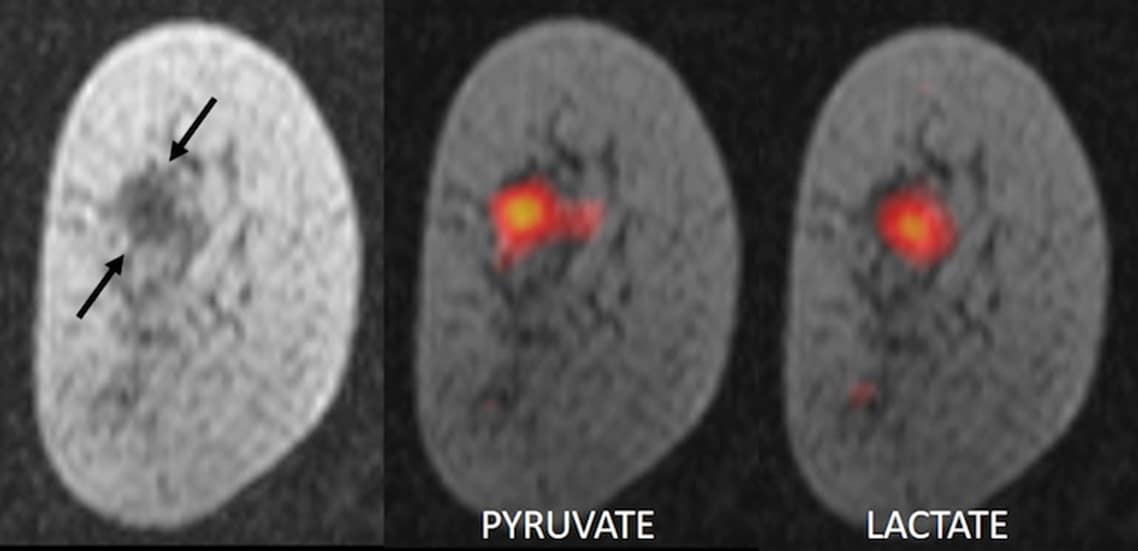
The technique works by measuring how fast a tumour metabolizes a naturally-occurring sugar-like molecule called pyruvate. In their experiments, the researchers used pyruvate that they had labelled with carbon-13, a heavier isotope of carbon. They then hyperpolarized, or magnetized, this carbon-13 pyruvate by cooling it to -272°C and exposing it to an extremely strong magnetic field and microwave radiation in a special machine called SPINlab. The frozen pyruvate sample was then thawed, dissolved into a solution and injected into the patient, who immediately underwent an MRI scan.

Tumours make use of large amounts of sugar and take up more pyruvate than normal tissue, explains team member Ramona Woitek. Inside the tumour, pyruvate is converted into lactate as part of a natural metabolic process. Since magnetizing the carbon-13 pyruvate molecules increases the strength of the MRI signal by 10 000 times, the researchers can monitor this process and visualize it dynamically in MRI scans.

The rate of pyruvate metabolism – and the amount of lactate produced – varies not only between different tumours, but also between different regions of the same tumour. By monitoring this conversion in real-time, the researchers say they are able to determine the type of cancer being imaged. They can also determine how aggressive a tumour is, as faster growing tumours convert pyruvate more rapidly than less aggressive ones.

MRI of a breast tumour

Monitoring chemotherapy

The technique will be useful for monitoring patients undergoing chemotherapy, says Woitek. It will allow determination of how efficient a given treatment is by imaging a tumour before and after the therapy, and repeatedly during the course of treatment. “Identifying patients that do not respond to a treatment will thus allow us to change the therapeutic strategy early on,” she says. “Conversely, we may even be able to reduce a treatment dose if a patient is responding well, thus sparing them unnecessary side effects.”

“Researchers are beginning to understand that the many different types of breast cancer respond differently to different treatments,” Woitek tells Physics World. “The new hyperpolarized carbon-13 MRI approach could allow us to identify the optimal treatment for each individual patient.”

The researchers, who report their work in PNAS, have tested their technique on seven patients, all with different types and grades of cancer. They say they now hope to study larger groups of patients.

Touch-responsive indium tin oxide is very thin and flexible

The first highly transparent, touch-responsive and conducting ultra-flexible thin sheets of indium tin oxide (ITO) have been made by researchers in Australia. Made using a new liquid metal printing technique, the ITO sheets are just 1.5 nm thick and can be deposited onto a variety of substrates – which can then be rolled up like a tube. They might be used to make the touchscreens of the future and could potentially be manufactured via roll-to-roll (R2R) processing – just like newspapers.

ITO is a transparent semiconductor and is used in applications such as touchscreens, smart windows and displays. The conventional way to make ITO involves evaporating the material in high vacuum and condensing it onto a surface such as a glass sheet using sputtering or pulsed laser deposition. These techniques are costly and time consuming. What is more, a relatively thick layer of ITO needs to be deposited to obtain a fully conductive film, which makes it brittle and thus unsuitable for flexible electronics applications.

Liquid ITO alloy

The new method was developed by a team led by Torben Daeneke of RMIT University in Melbourne and Dorna Esrafilzadeh and Kourosh Kalantar-Zadeh from the University of New South Wales, Sydney. The technique uses a liquid ITO alloy that melts between 150°C and 200°C. The researchers allowed this melted alloy to oxidize and cool down in air and tuned its composition so that the natural surface oxide has the same composition as commercial ITO.

They discovered that the oxidation process is self-limiting, meaning that the oxide always has the same thickness – of about 1.5 nm. If the surface of this liquid metal is then brought into contact with a substrate such as glass or plastic, the nanometre-thick 2D ITO sheets adhere to the substrate.

The team also found that when they printed two layers of ITO, they observed a van der Waals gap between them, indicating that they had made a new type of ITO. The films can be laid on top of each other like thin paper and the greater the number of layers, the more conductive the material is. “You can bend hundreds of these ‘papers’ together and they don’t break,” explains Kalantar-Zadeh.

Much more transparent

The liquid metal printed ITO is much more transparent than conventional ITO while still being highly conductive (it has a sheet resistance of just 5.4 kΩ), adds Daeneke. Indeed, a single layer of 2D ITO only absorbs about 0.7% of visible light. This is roughly 8-10 times less than a single layer of graphene (another highly transparent 2D material made of a sheet of carbon atoms) and less than the 5-10% of standard conductive glass. And since 2D ITO is extremely thin, its mechanical properties change, making it highly flexible. This will allow the creation of a new generation of flexible, transparent and printed electronics, say Kalantar-Zadeh and Daeneke.

The fabrication process is extremely easy and accessible to all, they add. The fact that the 2D ITO can be printed at low temperatures and in air not only makes it cheaper than conventional methods but also resolves the size limitations dictated by techniques that require a vacuum.

Fully functional touchscreens

The researchers showed that their technique can produce centimetre-squared-sized samples that are of a high enough quality to make fully functional touchscreens. They have also applied for a patent for their technology.

“Our technique could change the way we make transparent electronics”, they tell Physics World. “In the future we could simply print displays and touchscreens like we print newspaper. And since the 2D ITO is highly flexible, we could also create a new generation of displays that can be rolled up or folded.”

The researchers report their work in Nature Electronics and say they are now working on up-scaling their process. “We expect that automation will allow us to produce much larger samples than the centimetre-sized 2D ITO sheets we have produced thus far,” says Kalantar-Zadeh and Daeneke. “To this end, we are now looking for commercial partners that will help us move towards metre-scale production.”

Tiny inorganic scintillator offers high-resolution radiotherapy dosimetry

An optical fibre tipped with an inorganic scintillator makes an effective real-time dosimeter for small-field radiotherapy. Researchers at Aix-Marseille University and the Paoli-Calmettes Institute in France created such a device and compared its performance with a pair of commercial small-field dosimeters. The team found that the new device has a much smaller sensitive volume and is less susceptible to detector noise from Cherenkov radiation. It also exhibits excellent dose–response linearity and its output is stable over time (Med. Phys. 10.1002/mp.14002).

Using radiotherapy to treat early-stage tumours or tumours surrounded by critical organs requires small, sharp-edged radiation fields. Verifying the dose delivered in these cases means using a dosimeter with a correspondingly small sensitive volume: larger radiation detectors lack the spatial resolution needed to capture the high lateral dose gradients at the field margins.

To produce a dosimeter suitable for the job, Sree Bash Chandra Debnath and colleagues used silver-doped zinc sulphide (ZnS:Ag) as a scintillator – a compound long known to emit visible light when irradiated by X-rays. The team chose an inorganic scintillator because organic compounds generate more charged particles under ionizing radiation, contaminating the signal with high levels of Cherenkov radiation.

The researchers fabricated the dosimeter by dipping the end of an optical fibre into a mixture of powdered ZnS:Ag and poly(methyl methacrylate) (PMMA) dissolved in an organic solvent. After drying, the result was a ZnS:Ag-filled PMMA sphere about 200 µm across, which they coated in silver to keep out ambient light. At the other end of the optical fibre, the researchers fitted the photon counter and read-out electronics, which translated the scintillation signal into equivalent dose in real time.

To test their inorganic scintillator detector (ISD), the researchers used it to measure the dose inside a water phantom, which they exposed to X-ray fields as small as 0.25 cm2. They compared the ISD’s performance to that of two small-field dosimeters currently used in the clinic, one employing an ion chamber, the other a synthetic diamond.

Debnath and colleagues estimate the sensitive volume of the ISD to be a disc whose diameter and thickness correspond, respectively, to the width of the fibre core (100 µm) and the distance that light travels between emission and reabsorption by the scintillator (1.5 µm). This corresponds to a volume of about 1.2 × 10⁻⁵ mm3 – far smaller than that of the ion-chamber (0.016 cm3) and diamond (0.004 mm3) dosimeters.

Another area where the ISD could offer an advantage is in its high signal-to-noise ratio. This comes about because of the low levels of Cherenkov radiation produced in the small inorganic scintillator and the narrow optical fibre. The researchers think that they can reduce the Cherenkov noise even further in a future version of the device by using an entirely plastic-free fibre.

In all other respects, the ISD performed as well as required for a clinical dosimeter, and comparably to the two benchmark devices. Its dose response was linear over a wide range of dose rates and was consistent over multiple irradiations.

As inorganic scintillators are not tissue-equivalent in terms of radiation absorption, the team’s new device might be best suited to external dosimetry; used internally it would itself risk altering the dose distribution. The actual effect is likely to be small, however, and Debnath is optimistic about its potential in both situations.

“Indeed, we have already tested it for brachytherapy, and probably one of our next articles will focus on this application,” he says. “It might perturb the dose distribution, but negligibly, due to the small volume of the sensor.”

The team also intend to compare the ISD to a range of water-equivalent devices such as plastic scintillator detectors and radiosensitive films. Replacing the scintillator material with a more water-equivalent organic compound is a possibility but would, they think, come at the cost of increasing the detector’s size.

Why do people still believe in conspiracy theories?

Glacier

Global warming is a plot manufactured by a global community of scientists. United Nations panels deliberately understate the radiation levels of the Fukushima and Chernobyl disasters. US media outlets contrive “fake facts” to refute Tweets of Donald Trump. Venal politicians are behind Ebola and other epidemics.

Groundless conspiracy theories are now an established feature of the political landscape. They resemble epidemics themselves, appearing from nowhere, spreading like wildfire, disrupting normal life, and being all but impossible to stop. They threaten democracy by poisoning the ability of voters to lucidly deliberate issues of human life, health and justice.

In her recent book Democracy and Truth, the University of Pennsylvania historian Sophia Rosenfeld argues that conspiracy theories thrive in societies with a large gap between the governing and the governed classes. Such conditions, Rosenfeld writes, allow some of the governed to reject the advice of experts as out of touch with “the people”, and to create a “populist epistemology” associated with an oppositional culture.

Populists, Rosenfeld continues, “tend to reject science and its methods as a source of directives”. Instead, such people prefer to embrace “emotional honesty, intuition and truths of the heart over dry factual veracity and scientific evidence, testing and credentialing”. Modern science accentuates the gap between experts and non-experts, making it possible for populists to interpret “factual veracity” as tainted.

Galileo’s gap

In my book The Workshop and the World: What Ten Thinkers Can Teach Us about Science and Authority, I argued that this scientific gap emerged with Galileo. Writing in his 1623 book The Assayer, Galileo used a striking image to defend his seemingly heretical studies of nature. The book of nature, he wrote, “is written in mathematical language, and the symbols are triangles, circles and other geometrical figures, without whose help it is impossible to comprehend a single word of it”.

The use of mathematics creates a rift between those unable to understand this special language and those who do, making it easy for the former to distrust the latter.

The use of mathematics creates a rift between those unable to understand this special language and those who do, making it easy for the former to distrust the latter. Galileo’s Gap, as I call it, has widened in size and consequence in the four centuries since then, feeding the frequency and severity of conspiracy theories.

Hard to believe, but I received hate mail after The Workshop and the World came out. Some concerned what I’d written about The Preaching of St Paul – a 1649 painting by Eustace Le Sueur that now hangs in the Louvre museum in Paris. This dramatic and imposing work shows St Paul looming above a pile of burning books, some with geometrical figures on their pages. The not-so-subtle intent was to portray heretics who read the book of nature as dangerous criminals.

Contemporary conspiracy theories, I wrote, show that St Paul is back.

My critics were furious. The painting is not about Galileo, they chastised me, but a passage in the Book of Acts 19:19, where St Paul’s preaching prompted mystics to have “brought their books together, and burned them”. Besides, the critics added, this issue can be settled factually by noting that the figures on the pages of the burning books resemble nothing found in maths texts. What’s more, no trace exists of Le Sueur’s intent, or that of the religious authorities who commissioned the painting. I must surely therefore be part of a conspiracy to slander the good saint.

I responded that of course the figures in the burning books were not in modern maths texts; they are what a religious firebrand of 1649 might think geometrical figures looked like. I also said that no factual information about the painting’s creation could help us to understand its meaning, which can be understood only in the light of its historical context.

Le Sueur, a religious painter funded by church commissions, composed the work at a time when the most fundamental issue confronting the Catholic Church was that its claim to have the sole authority to interpret the Bible was being torpedoed by growing evidence in support of Galileo’s mathematically based findings. Only that explains why a devout Catholic painter would devote enormous time and resources to create a 4 m high work about a handful of words in the Bible that mention book-burning – and then paint geometrical figures on the books’ pages.

In a similar vein, the playwright Arthur Miller did not compose the 1953 play The Crucible because he had an interest in the Salem witchcraft trials. He did so to address the persecutions of supposed communist subversives taking place in the US in the 1950s. I probably did not convince my respondents. But their accusations that I had joined an anti-Christian conspiracy stopped.

The critical point

Modern anti-science conspiracies differ from their 17th-century antecedents, which emerged principally from the Church. Contemporary sponsors of conspiracy theories are multiple, spread not by preachings and paintings but by the Internet, and are energized by the ability to self-select information. But then, as now, conspiracy theories are not a sign of irrationality. Instead, they spring from the attempt by non-experts to make sense of often overwhelming and contradictory information based on personal values, available evidence, whom one trusts, and experience.

To reduce the impact of conspiracies, there’s little point quoting mainstream experts, citing scientific papers, appealing to facts, or even teaching more science, for all these things will be said to belong to the conspiracy.

To reduce the impact of conspiracies, there’s little point quoting mainstream experts, citing scientific papers, appealing to facts, or even teaching more science, for all these things will be said to belong to the conspiracy.

Far more effective is to provide people with better tools to make sense of their personal, political and social experience. Yet the disciplines that cultivate these interpretive tools, collectively called the humanities, are largely having their resources redirected to the sciences.

Ironically, the dazzling and visible successes of the 21st-century sciences are overshadowing and undermining the 21st-century humanities that ground the authority of the sciences themselves.

Copyright © 2026 by IOP Publishing Ltd and individual contributors