This week’s episode begins with a discussion of physics careers. We hear an Edinburgh-based recruiter, Bruce Hydes, share his views on what physics graduates can do to stand out in the jobs market, and explore whether reports of a “quantum bottleneck” in hiring for the emerging quantum-computing industry should be believed or taken with a quantum of salt.
We also hear from Manuel González, a Spanish astronomer and co-director of El Enigma Agustina. The subject of this so-called “fictional documentary” is a physicist called Agustina Ruiz Dupont. Although Dupont never actually existed, her story reflects the way that many real scientists and intellectuals – especially women – were forgotten or deliberately erased from history after the Spanish Civil War. If you’d like more information about the film (or you’d like to request a copy – English subtitles are available), please visit the website of the Astrophysics Institute of Andalucía.
Finally, we discuss the phenomenon of synchronized pendulums, which was first noted by Christian Huygens in the 17th century and continues to fascinate physicists today.
Vertical-cavity surface-emitting lasers (VCSELs) have emerged as a highly versatile light source over the past 30 years, with applications in areas from optical communications to instrumentation, manufacturing and sensing. A team of researchers in France and China has now augmented the VCSEL’s capabilities by integrating a nano-patterned beam-shaping structure into each laser during wafer-scale processing. This approach could make it possible to create light wavefronts designed to order, and thus construct devices such as ultra-compact programmable laser-on-chip arrays with whatever beam profiles are required.
First proposed by Kenicha Iga from the Tokyo Institute of Technology in 1977, the VCSEL is an efficient class of laser that uses very little current. Because VCSELs can turn on and off at high speeds, they can transmit vast amounts of data quickly. They also emit a circular beam of light, which greatly simplifies the optics required to focus the beam. Both attributes make VCSELs attractive for applications in telecommunications, and in recent years their applications have broadened to include image recognition. The iPhone X, for example, contains three VCSEL chips that are integral to its facial recognition system.
Like other lasers, VCSELs contain a cavity in which light is generated and emitted to produce stimulated emission. This cavity is sandwiched between two mirrors that provide the optical feedback necessary for lasing. In VCSELs, however, the laser cavity is very small, at just a few microns thick. This small size gives the laser its switching speed, but it also makes it hard to precisely control the shape of the light beam emitted. This is because light diffracts around features the same size as its wavelength, which makes it difficult to resolve, and thus control, smaller details.
Metasurface continually shapes wavefront
Laser beam shaping – that is, redistributing the laser’s intensity across the beam’s profile – is important for applications such as laser machining or medical devices that require laser light shaped in only one axis. Researchers led by Patrice Genevet of the Centre de Recherche sur l’Hétéro-Epitaxie et ses Applications (CRHEA) at the University Côte d’Azur and collaborators at the Key Laboratory of Optoelectronics Technology at the Beijing University of Technology have now demonstrated a way to achieve this control in VCSELs using flat, ultra-thin optical structures called metalenses.
In conventional bulky optical components, such as thick lenses, light rays travel more slowly in the thicker, central regions than in the thinner, peripheral ones because of the smaller phase velocity of light in glass compared with air. This distribution of phase delays in the lens leads to light refraction and focusing.
Metalenses produce similar effects, but with a different mechanism. In the CRHEA team’s work, the metalenses are made from a semiconducting gallium-arsenide (GaAs) film patterned with nanometre-sized circular pillars. These “nanopillars” are separated by distances shorter than the wavelength of the light they are designed to shape, and they act like optical antennas, introducing spatially varying phase delays in the light rays that pass through them and moulding the light beam according to the desired profile. The result is a metasurface that can be tuned for specific wavelengths of light simply by changing the size, diameter and spacing between the nanoantennas.
Laser collimation
To collimate their laser, Genevet and colleagues used a metalens design containing antennas of different shapes and sizes. These antennas cause the phase delays to be distributed radially around the lens, such that light rays are increasingly refracted further away from the centre, thereby shaping and focusing the wavefront of the incident light.
In their experiments, which are detailed in Nature Nanotechnology, the researchers fabricated VCSELs in a “back-emitting” configuration. They directly integrated the metasurfaces into the lasers by sculpting the bottom (substrate) surfaces of the lasers into them. The result, which they term a metasurface integrated (MS) VSCEL, means that the metalenses serve as purely passive beam-shaping elements – that is, they do not alter the laser’s properties in any way, and therefore do not compromise its performance.
Compatible processing
Genevet explains that the team’s technology can be easily applied to state-of-the-art wafer-level fabrication techniques for VCSEL devices, making it possible to create chips of programmable and directional laser sources. The metalenses themselves can be fabricated using standard electron beam lithography techniques, with reactive ion etching used to create the nanopillars.
In contrast to micro-lenses, the ultra-thin form, unique planar configuration and CMOS-processing compatibility of the metasurfaces makes them promising candidates for integrating into ultra-compact optoelectronic devices, he says. Indeed, the new MS-VCSELs could find use in a wide variety of applications, such as optical fibre communications, laser printing, smartphones, optical sensing, facial recognition, directional displays and ultra-compact light detection and ranging (LIDAR), he tells Physics World.
Intermediate-mass stars expire via thermonuclear explosions, rather than gravitational collapse, according to experiments and calculations done by an international team of astrophysicists led by Oliver Kirsebom at Dalhousie University in Canada. By measuring the rate of a “forbidden” nuclear decay that transforms fluorine-20 into neon-20, they were able to work out the rate at which neon-20 in a star will capture electrons in a stellar environment. This rate was much higher than previously thought, leading the team to conclude that such stars are more likely to expire in thermonuclear explosions
Intermediate-mass stars weigh-in at about 7-11 solar masses and are common in the Milky Way. Astrophysicists are confident that towards the end of their lifecycles, these stars have cores comprising mainly of oxygen and neon and eventually explode as supernovae. Until now, however, it has remained unclear whether the explosion is driven by gravitational collapse, as is the case for more massive stars, or through a thermonuclear explosion.
The key to solving this mystery lies in knowing the rate of electron-capture by ground-state neon-20, whereby neon transforms into fluorine-20. This process is a “second-forbidden” transition, occurring only incredibly rarely outside the extreme temperatures and densities of stellar interiors. Because the process is extremely rare in the conditions found on Earth, it had proven very difficult to study in the lab.
Reverse process
By doing experiments at the JYFL Accelerator Laboratory at Finland’s University of Jyväskylä, Kirsebom’s team has made the best measurement yet of this transition rate by studying the reverse process – the beta-decay of fluorine-20 into the ground state of neon-20. This was done by firing a beam of fluorine-20 nuclei into a carbon foil, where they are embedded. As the nuclei decayed, the team monitored the number of electrons produced with energies characteristic of ground-state neon-20 production.
While nearly all decays created neon-20 in an excited state, around 1 in 250,000 events created neon-20 in its ground state. While this is a tiny percentage, it is one of the strongest second-forbidden transitions ever measured. The next step was to use this information to calculate the rate at which ground-state neon-20 would capture electrons within a stellar environment.
This rate was found to be 100 million times higher than had been predicted by previous calculations. The led Kirsebom and colleagues to conclude that within intermediate-mass stellar cores, heating and oxygen fusion can occur earlier and at lower densities than previously thought. This means that instead of collapsing under their own gravity, the stars are more likely to expire through thermonuclear explosions, leaving behind white dwarfs containing mainly oxygen, neon, and magnesium.
By constraining the ground-state neon-20 electron-capture rate to within 25%, Kirsebom’s team has made a significant step forward in our understanding of the lifecycles of intermediate-mass stars. They will now use their results to explore the still poorly-understood role of convection in transporting energy outwards from stellar cores – something that increases the likelihood of gravitational collapse occurring.
If the dissolvable microneedle patches used to deliver vaccines could also implant an invisible record of the inoculation under the skin, a person’s vaccination history could be known with certainty. With this aim, researchers at Massachusetts Institute of Technology have developed a microneedle patch containing a nanocrystal dye that creates near-infrared-emitting dots under the skin. The emitted light is then detected by a specially modified smartphone (Sci. Transl. Med. 10.1126/scitranslmed.aay7162).
The microneedle patches can be customized to imprint different patterns that correspond to the type of vaccine, the date administered, and the vaccine’s manufacturer and lot number. This technique could reduce problems associated with lack of standardized vaccination record-keeping in many regions of the world.
The team’s goal was to develop a robust, inexpensive and easy-to-use platform that could be applied without difficulty in low-resource settings. For their proof-of-concept study, the researchers developed a robust dye that’s resistant to photobleaching, a technique to encapsulate the dye, and a microneedle design to optimize delivery under the skin.
The dye ultimately selected by the team was a colloidal quantum dot (QD) formulation called S10C5H. This formulation retained 13% of its fluorescent signal after exposure to five years of simulated sunlight through pigmented skin samples at sevenfold the intensity of the sun. To improve biocompatibility, the QDs were encapsulated in PMMA microspheres.
To detect signals from the QDs, the researchers adapted an inexpensive smartphone to have near-infrared imaging capability. Modifications included removal of the standard short-pass filter and addition of 850 nm long-pass filters to block both environmental light and light from LED illumination.
SEM image of the microneedle array. (Courtesy: K J McHugh et al Sci. Transl. Med. 2019)
Lead authors Kevin McHugh and Lihong Jing and colleagues analysed 50 microneedle shapes to identify one that ensured deep penetration of a high volume of QDs into a permanent layer of skin, and which was highly resistant to mechanical failure. They selected a microneedle with a height of 1500 µm, a diameter of 300 µm and a half-cylindrical/half-tapered design. This needle could pierce the skin deeply enough without bending or fracturing.
The robustness requirement of the new microneedles differed considerably from those developed to deliver vaccines, which only need to break the skin’s water barriers. Additionally, the patch containing the microneedles must be designed to not cause excessive pain and have sufficient spacing for each needle to act independently.
The researchers tested the patches on Wistar rats, administering QD-containing microneedle patches in three distinct patterns on their rear flanks and imaging the animals for nine months. The 120 needle markings were visible on the day of administration, declining to 92% visibility after 24 weeks. Nine months after administration, the signal was 29-fold higher than background signal.
The team also used a machine learning system (AlexNet) to automatically classify each pattern for 210 images acquired biweekly over 30 weeks. Classification accuracy remained above 98.4% in this time.
“Because there was no trend toward lower machine learning classification probability at three, six and nine months, it appears that the patterns are stable after an acute period of signal loss,” the researchers note. The machine learning system also was valuable when markings were missing, dim or imaged at an unusual angle.
Transferring this technology to the clinic will require additional steps including preclinical safety and toxicology studies, manufacturing scale-up and first-in-human studies. If vaccine information could be co-delivered with the vaccine, instead of consecutively, this could reduce costs and eliminate potential errors in failing to administer two patches. However, it will be necessary to ensure that the PMMA-encapsulated QDs do not interfere with the robust immune response generated by intradermal antigen delivery.
“Ultimately, we believe that this invisible, ‘on-body’ technology opens up new avenues for decentralized data storage and biosensing applications that could influence the way medical care is provided, especially in the developing world,” the researchers conclude. They are currently working to develop a dye that will be visible for longer than 10 years.
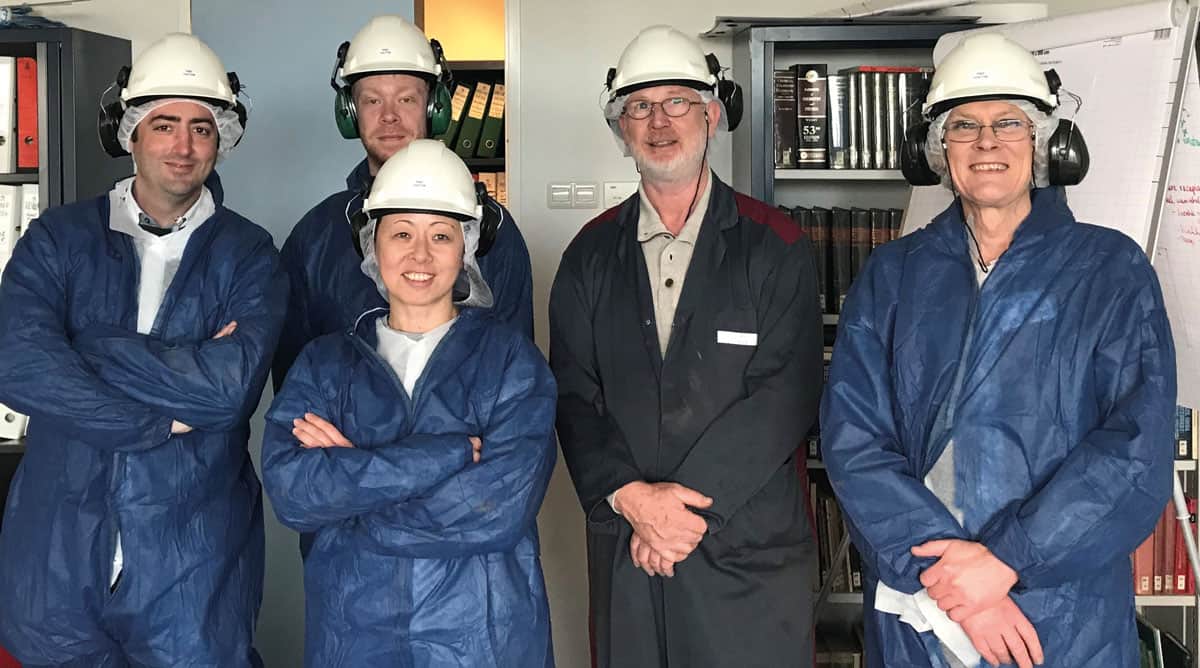
Back to the floor: Megan Povey (far right) and colleagues gear up for a visit to a cocoa factory. (Courtesy: University of Leeds)
It wasn’t quite a rock-and-a-hard place decision, but it wasn’t far off. On completion of a PhD with “significant military potential” back in the early 1970s, Megan Povey (or Malcolm as she was then – see box below) had no shortage of lucrative R&D job offers from leading US defence contractors. Trouble is, the American defence industry is not an obvious destination for an avowedly anti-war physics student and passionate advocate of the global civil-rights movement.
With a young family to support, Povey’s next move, into the School of Food Science at the University of Leeds, UK, turned out to be the right one. It was the beginning of a lifelong investigation into the physics of food – from the macro- to the nanoscale, with the fundamental and applied aspects of acoustics a defining theme throughout. “I knew nothing about food [science] at the time,” explains Povey, “only that I liked cooking it and eating it.”
Thinking and doing
From those scratch ingredients, Povey, who is now professor of food physics at Leeds, has built an international reputation on the application of ultrasound spectroscopy in food characterization and ultrasound processing in food manufacturing. More widely, her team’s priorities span computer and mathematical modelling of foods, studies of fat-crystal nucleation and growth, and process-equipment innovation – all built on a solid fundamental understanding of physical processes, properties and materials behaviour.
“Mathematics is the language of science and I learned to speak it early on,” says Povey. “Everything I do in food physics, I need a theoretical underpinning – a model – before moving onto the experimental aspects. I get such a thrill from doing the whole bloody lot – the thinking as well as the doing bit.”
That “thinking and doing” mindset is being brought to bear in the fight against obesity of late. For manufacturers of sweets and confectionery, one promising line of attack is to reduce the calorific value of their food products by using edible oil-based foams (or oleofoams) to prepare aerated chocolate bars, mousses and the like. These oleofoams comprise a liquid oil phase, air bubbles and a high-melting-point crystalline phase to stabilize the bubbles – a complex microstructure that in turn determines the macroscopic chemical, physical and nutritional properties of the final food product.
To help manufacturers translate commercial potential into product innovation, Povey and her colleagues are pioneering the use of broadband ultrasound spectroscopy for in situ characterization of foams in the food-processing line. Initial studies are promising and show that the approach can be used to analyse fat composition, aeration protocols and bubble-size distribution – key parameters in reducing the energy content of commercial food products.
Another line of enquiry for Povey’s team is the physics of digestion – and specifically the development of custom-made food products for older people. “A major reason why old people get ill is that they no longer salivate properly, to the point that they stop enjoying their food and in turn stop eating altogether,” explains Povey. “The physics of flow, melting and texture – a wide range of physical processes and properties – can be used to inform the development of appropriate foods for this target group.”
Multidisciplinarians needed
In food science, of course, physics and physicists don’t exist on an “island”, rather as part of a wider research ecosystem addressing the inherently multidisciplinary science and technology challenges in food R&D and manufacturing. Those challenges range from designing safe, nutritious and great-tasting food, to the process technology and manufacturing know-how needed to deliver such innovation.
You have to be a multidisciplinarian – an expert capable of working with other experts
“As a food physicist, you’re working in a multidisciplinary research environment spanning academia and industry, which is non-trivial,” explains Povey. “You have to be a multidisciplinarian – an expert capable of working with other experts rather than a ‘jack of all trades’. It’s essential to be able to interact effectively with process engineers, industrial chemists, biochemists, nutrition experts as well as commercial and business development teams in industry.”
In fact, Povey’s close relationship with the food manufacturing industry is another defining theme of her four decades in food research. “Industry has always been important to me from a funding perspective,” she adds, “though I have sourced research money wherever I could get it. The interaction with industry is crucial as far as I’m concerned: how can you do impactful research if you haven’t got a clue what’s going on out there in industry.”
That affinity is perhaps natural for someone who sees no divide between theory, applied science, technology innovation and process engineering. “My father was a flour-milling engineer and I used to go around flour mills with him as a child,” she explains. “I just love factories and what’s going on inside them – and yet too often today their importance is either denigrated or despised. Without them, though, civilization would be scuppered.”
Those close ties to industry were baked in when Povey was starting out as a postdoctoral researcher in the early days of the Leeds food-science programme. Back then, the department was dominated by chemists and biochemists and some of her ideas – including the use of ultrasound as a tool for investigating foods and their constituent materials – were initially met with scepticism from senior colleagues and research managers.
A team of visiting scientists from consumer goods giant Unilever – which at the time was a world leader in research on fats – took a different view, providing the encouragement and funding Povey needed to develop her early-stage ideas on the use of ultrasound techniques to study fats in food processing. “It was industry that backed my ideas initially, not the research councils,” she notes. “And because I was able to work closely with the leading scientists in the food industry, that gave me a bloody great leg-up – and still does.”
Her advice for early-career researchers embarking on a career in food science today is to engage proactively from the off with colleagues in industry. “Go to conferences, talk to industry scientists, go around the factories, get interested in their problems,” she advises. “But don’t lock your research in exclusively with industry partners. You have to think it through, spread your bets, and have diverse sources of funding.”
Povey, for her part, has always tapped into research-council funding and done basic research alongside her industry collaborations. “If you concentrate on the fundamental science, by and large you’re free to publish,” she notes. “In general, industry only really want to lock down applications and results with commercial significance.”
A question of identity
(Courtesy: University of Leeds)
For most of her life, Megan Povey coexisted in an uneasy, often distressing, truce with Malcolm Povey. Two sides of the same coin, but only one of them, Malcolm, permitted to be visible, present and self-evidently male in the wider world. That all changed in December 2017 when Megan came out to her family, telling them that for as long as she could remember she’d been a woman “inside her head”. Here she talks to Physics World about her subsequent transition to Megan – the fear, the liberation and the support and encouragement she’s had along the way.
What was life like for you before your transition from Malcolm to Megan?
I was never comfortable about who I was meant to be, to be honest. I’d hide away rather than meet people. It was easier in the workplace because I could relate to people entirely through my science. The female side of my personality was wanting to escape since I became conscious – and it’s not like something you can switch off.
That can’t have been easy
It was quite lonely. I have been a woman inside my head for a very long time – and I don’t have to pretend any more. Now that I’ve transitioned, I say to my female friends that I’ve suddenly discovered the other half of the world. And from their point of view, they could never have had the conversations with Malcolm that they now have with Megan.
How did going public with your transition make you feel?
It was very frightening, but I had to do it. The experience has been massively liberating because all my life – even from early school days – I’ve had to pretend I was somebody I wasn’t. Ultimately, it’s about intellectual honesty. Put that another way: staring at the gulf and pretending it isn’t there is a non-starter for me. Because I always want to know – and you don’t get to know by denying the existence of things.
I don’t think even five years ago I could have done this. The world has changed a lot of late, with more progressive approaches to gender equality, diversity and inclusion in the workplace and in society. I’ve benefited from all that.
How have people responded to your transition?
I’ve had lots of fantastic support from my family, the university HR department, plus my colleagues and collaborators have been amazingly accepting. I know my transition has had a positive impact within the university, and I’ve got a lot of kudos for doing it at this stage of my career. There have been a few issues, with some male colleagues, funnily enough, still treating me as a man – or rather the man they used to know. There’s also the fear of being outed as a trans-woman in the street and being attacked – that’s an ever-present concern.
What advice would you give to others going through a similar experience?
It’s an individual choice, but just be true to yourself. Fundamentally, this is about self-identification and being brave – though obviously you have to worry about the impact on family and the people close to you. The social context matters, but I think people should come out if they can. The situation is perhaps more complicated for a younger person who’s not yet established their own identity. For me, I want to claim my past and my work. I’m proud of it and it makes me who I am.
Fight the fight
Despite forging a research career in the multidisciplinary melting pot that is food science, it’s clear that Povey remains a physicist at heart. A fellow of the Institute of Physics (IOP), she’s a vocal champion of the role that physicists can play in solving the systemic and complex challenges facing the food industry, not least the growing demand from policy-makers and public for a more sustainable food system that makes better use of water, raw materials, energy and land.
She was one of the founding members of the IOP Physical Acoustics group and, later, the Physics in Food Manufacturing group, with both channels proving instrumental for her and her team in terms of connection and collaboration with like-minded scientists in academia and industry.
“I’ve always felt that people need to know about physics and the fact that physics is really fundamental to our world,” she concludes. “It has to be fought for, though, and being an active member of an organization that promotes and defends physics is important to me.”
Dynamic PET images of 100 ms frames alternating between end-diastolic and end-systolic phases of five cardiac cycles. (Courtesy: PNAS 10.1073/pnas.1917379117)
The uEXPLORER is a 194-cm-long total-body PET/CT scanner developed by a research team at UC Davis and manufactured by United Imaging Healthcare of Shanghai. The UC Davis team has now shown that combining this ultrasensitive scanner with an advanced image reconstruction method enables capture of real-time videos of blood flow and heart function (PNAS 10.1073/pnas.1917379117).
The researchers developed a method to perform ultrahigh-temporal-resolution dynamic PET, based on the use of kernel expectation maximization reconstruction. Working with Zhongshan Hospital, they tested their proposed approach by injecting 256 MBq of the PET tracer 18F-FDG into a leg vein of a healthy 60-year-old female volunteer. Immediately after injection, they used the uEXPLORER to perform a 60 min total-body dynamic scan.
To demonstrate the high temporal resolution for capturing fast tracer dynamics and real-time cardiac motion, the researchers divided the first minute of recorded PET data into 100 ms frames and reconstructed more than 600 consecutive frames. The reconstructed images demonstrated the scanner’s ability to visualize cardiac motion with high clarity, capturing changes in the cardiac blood pool, with clear delineation of the end-systolic and end-diastolic phases.
The team also created a video of the injected tracer travelling through the body with 100 ms temporal resolution. The video shows the tracer moving up the body to the heart, flowing through the right ventricle to the lungs, back through the left ventricle and on to the rest of the body.
“The breakthrough in this work is to capture the ultrafast whole-body dynamic tracer imaging with EXPLORER at the same time,” says UC Davis’ Jinyi Qi. “We can see global changes with improved image quality at a timescale of 100 ms, which was never seen before using any medical imaging modalities.”
The team generated time–activity curves (TACs) in four regions-of-interest – within the left ventricle (LV), ascending aorta, descending aorta and myocardium – during the first minutes after tracer injection. The curves showed a staircase pattern as new blood entered the LV in the diastolic phase of the cardiac cycle (during which, radiotracer concentration in the LV changed) and was pumped into the aorta in the systolic phase (when concentration in the aorta changed).
The researchers also observed that the TAC of the descending aorta was lower than those of the LV and ascending aorta and that the myocardium TAC had a clear cyclical rhythm from the heartbeat. They point out that none of these observations would be possible at the lower temporal resolution previously used in dynamic PET imaging.
The uEXPLORER’s ability to create dynamic PET images on 100 ms timescales should allow study of cardiovascular function, fast pharmacodynamics, use of shorter-lived radionuclides, and characterization of normal and abnormal brain function by measuring cerebral blood flow and cerebral metabolic rate of oxygen.
The high temporal resolution can also be used to freeze motion, either physiological (such as cardiac and respiratory motion) or involuntary body motion, which improves the spatial resolution of reconstructed images. Finally, the researchers note that high temporal resolution combined with uEXPLORER’s total-body coverage could enable new studies examining the dynamic function and interaction of multiple organs – such as the brain and heart, or the brain and gut – simultaneously.
“Currently the uEXPLORER scanner is routinely used at UC Davis for both clinical scans and a variety of research studies,” Qi tells Physics World. “For the high temporal resolution total-body PET, we plan to use it to study cardiac functions and also brain-heart interactions in the near future.”
In the spotlight: Natalia Ruiz plays fictional physicist Agustina Ruiz Dupont in a new film that aims to tell the story of those scientists – often women – who have been forgotten or erased from history. (Courtesy: Instituto de Astrofísica de Andalucía, IAA-CSIC)
By any measure, Agustina Ruiz Dupont had an incredible career. This Spanish theorist was Marie Curie’s star student at the Sorbonne University in Paris. She impressed Einstein at the 1930 Solvay conference (which she attended, unbeknown to most science historians), and later joined the Las Sinsombrero movement of female intellectuals in Madrid.
Driven by a passion to share her knowledge, Dupont also travelled through Spain giving musical-inspired performances under the stage name La Fotoncita de Jerez (“little photon of Jerez”). Ultimately, things took a dark turn for her, when she disappeared shortly before the Spanish Civil War. Rumour has it, she had managed to personally offend General Franco through one of her shows.
There’s just one small catch – Agustina Ruiz Dupont never actually existed.
Dupont (played by Natalia Ruiz) is the fictional character at the heart of a recent Spanish-language docufiction film El Enigma Agustina, directed by astrophysicists Manuel González and Emilio J García. She might not be real, but we’re told that pretty much everything else in the film is true. Dupont represents all the real scientists and thinkers – especially women – from the period preceding the Spanish Civil War (1936–1939) who were forgotten or erased from history. Among them is Felisa Martín Bravo, who in 1926 became the first Spanish woman to get a physics doctorate, before she was stripped of her academic functions by the Franco regime.
The bulk of the film is set in the present day, as historian Esther Vidal (played by Nerea Cordero) embarks on a PhD about the Spanish theorist Blas Cabrera, who really did attend the 1930 Solvay conference. Early in her research, Vidal catches wind of a mysterious baúl (trunk) that turned up in one of Franco’s private rooms during restoration of Madrid’s El Pardo Palace in the 1980s, following the dictator’s death. Within the trunk were Dupont’s PhD thesis (supervised by Cabrera), personal letters from Curie and Einstein, a photo of Dupont at the Solvay Conference, along with a flamenco shawl and a few other cultural items from the time.
Determined to discover more about Dupont’s life, Vidal switches the focus of her PhD to pursue the case. She recruits the science communicator Andrés García (played by Antonio Leiva) who had written a piece about the Solvay conferences. (Later, Garcia openly admits to having copy-and-pasted most of the article from Wikipedia, but this chancer attitude proves useful to the investigation.) The pair are overcome by questions: Why has nobody heard of Dupont before? Why were these items in Franco’s personal room? What happened to Dupont during the Civil War?
The rest of the film tracks the investigation – via Paris, Granada and Madrid – as Dupont’s story becomes more intriguing at every turn. Along the way, we occasionally jump to a black-and-white scene, seemingly in the 1930s, of Dupont in the dressing room of an unspecified theatre, passionately conversing with her musician cousin about her intellectual life. She talks about her friendship with Curie, her desire for a unified theory of physics, and her deep conviction to communicate scientific ideas with the Spanish public.
While the film’s plot may often seem far-fetched, it is always entertaining – you may wish to skip the next few lines to avoid spoilers. For instance, we learn that Dupont had a fling with Erwin Schrödinger, a credible plot device, given that Schrödinger was apparently a notorious womanizer. Indeed, it’s of historical record that Schrödinger (then married) took a mystery girlfriend with him to the Alps shortly before Christmas 1925, the trip where he famously crystallized the Schrödinger equation, which he published in January 1926. Yep, you guessed it: in the film, Dupont is revealed to be the girlfriend.
In terms of its theme, El Enigma Agustina reminds me of José Luis Cuerda’s 1999 film La Lengua de las Mariposas (“The butterfly’s tongue”), which also represented the Spanish nationalists’ brutal clampdown on freedom of thought during and after the Civil War. González and García, the film’s directors, are both based at the Astrophysics Institute of Andalucia (IAA-CSIC) and along with their scientific qualifications have extensive experience in communicating science. The duo’s creative approach to storytelling is unusual, and keeps the audience engaged. Indeed, I was gripped by the story and left wanting to know what happens next. Speaking at the international premiere of the film in London on 19 October 2019, the directors said they were influenced by the Spanish writer Almudena Grandes. Specifically, they were inspired by one of her stories about how progress does not always happen in straight lines.
El Enigma Agustina is timely, as Spain’s uneasy relationship with its past has been dug up once more – quite literally, as Franco’s remains were exhumed from the Valley of the Fallen monument north of Madrid and reburied in a more modest location last October. While most mainstream politicians agreed it was a necessary act, it reopened old wounds and right-wing parties made major gains at the Spanish general election in November.
Much of the Spanish Civil War period is shrouded in contested histories and partially erased information
Without drifting into a full armchair analysis, it strikes me that current tensions are fuelled by the fact that so much of the Civil War period is shrouded in contested histories and partially erased information. For example, Spanish historians are only now starting to learn about the achievements of Las Sinsombrero, the group that Dupont joins in the film. These female artists and intellectuals took their name from the act of removing their hats while passing Madrid’s Puerta del Sol, a gesture to display their freethinking attitude. Unlike their male contemporaries– including the artist Salvador Dalí and the poet Federico García Lorca – their achievements are only starting to be recognized.
A small criticism of the film is that its political leaning is not the most subtle at times. It is fascinating to learn about the ideals of the Second Spanish Republic (1931–1939), which included giving grants to more than 400 women to study science, many of whom took up positions at overseas universities. But this era is presented as a golden age for Spain, and there is no mention of the high unemployment levels and poverty linked with the global economic depression. Including this would have provided important historical context for that era, especially for a non-Spanish audience.
Ultimately, though, the film is a triumph of blending science with politics and history. The greatest praise you can give to any documentary is that it keeps you gripped throughout and leaves you craving more answers. El Enigma Agustina achieves that with gusto.
A way of using light to convert a normal optical material into a frequency doubler has been developed by Mohammad Taghinejad and colleagues at the Georgia Institute of Technology. The technique could have a range of applications from creating all-optical information-processing devices to studying quantum-mechanical tunnelling.
Frequency doubling is an optical effect that occurs in spatially asymmetrical materials that have a second-order nonlinear susceptibility. Two photons with the same frequency can interact with the material and combine to form a single photon with twice the frequency of the original photons. While most crystalline materials do not have the appropriate asymmetry in the bulk, frequency doubling can occur at surfaces and interfaces. However, relying on these very thin regions is not ideal for creating practical devices.
Researchers have managed to create bulk materials with the appropriate asymmetries by applying mechanical strain or electrical signals to materials that are normally symmetric. Now, Taghinejad and colleagues have come up with a way of creating a temporary asymmetry in titanium dioxide by applying laser light.
Gold triangles
The team’s device comprises a 25 nm-thick film of amorphous titanium dioxide – normally a symmetric material – that is sandwiched between an opaque gold film and an array of thin gold triangles. When illuminated by picosecond pulses of red laser light, electrons in the triangles gain energy and some of these “hot electrons” move onto the titanium dioxide via the triangle tips. This momentarily breaks the material’s symmetry. Pulses from an infrared laser are also fired at the device and analysis of the reflected light reveals the presence of frequency-doubled blue photons.
While the asymmetry was induced almost instantaneously within the titanium dioxide film, the team found that the second-order effects endured for several picoseconds after the red pulse ended. They also showed that their setup was dynamically tuneable, with the number of migrating electrons depending on laser intensity. Furthermore, they found that the effect can be sustained using a continuous laser beam.
This is the first example of asymmetry being created using optical techniques alone and the discovery could lead to a wide range of scientific and technological applications. The ability to use one light signal to control frequency doubling in another would be very useful for creating all-optical components for computing and telecommunications. Other potential applications of the technique include monitoring the quantum-mechanical tunnelling of electrons.
In future studies, Taghinejad and colleagues plan to explore how the strength of second-order effects can be maximized through certain combinations of metals and semiconductors; using different material shapes; and using lasers with different frequencies.
An international team of scientists has developed an affordable microfluidic-based sensor able to track variations in levels of metabolites and nutrients in a patient’s blood simply by analysing their sweat. The device could be used to diagnose and monitor a wide spectrum of conditions, with an emphasis on gout (Nature Biotechnol. 10.1038/s41587-019-0321-x).
If you suffer from trypanophobia (the fear of needles), then fear not, as technological help is on the way. While blood sampling used to be the only accurate way to monitor key metabolites such as tyrosine and uric acid (UA), important indicators of metabolic disorders and gout respectively, it might soon be possible to obtain the same information from a wearable sensor. No need to have a needle stuck in your arm anymore.
The device is the result of a cooperation between American and Chinese researchers from Caltech, Peking University, Santa Clara University, Princeton University and UCLA. It contains microfluidic channels and graphene biosensors engraved onto plastic sheets by a low-cost carbon dioxide laser.
Lead author Yiran Yang (left) and senior author Wei Gao. (Courtesy: Wei Gao)
This design makes the sensor easy to manufacture and enables the monitoring of small concentrations of sweat compounds. In contrast, existing prototypes can only target compounds appearing in high concentration in sweat, such as electrolytes, glucose and lactate. The sensor can also record respiratory rate, heart rate and temperature and transfer all data via Bluetooth.
“Such wearable sweat sensors have the potential to rapidly, continuously and noninvasively capture changes in health at molecular levels,” lead author Wei Gao says. “They could enable personalized monitoring, early diagnosis and timely intervention”.
A battery of tests
To see how well the sensor performed, the researchers compared data collected in healthy individuals and patients. For example, since tyrosine is influenced by physical fitness, they compared their levels in five trained athletes and five physically untrained subjects, and observed that the sensors showed lower levels of tyrosine in the sweat of the athletes.
The team was particularly interested in using the device to monitor gout, which is characterized by high levels of UA in the body that begin to crystallise in joints, causing irritation and inflammation. By monitoring UA levels in six healthy individuals initially subjected to fasting conditions and later fed with a meal rich in purines – compounds that metabolise into UA – the researchers observed that UA levels peaked in all of them after eating.
They similarly found that four subjects with hyperuricemia and six untreated patients with gout had higher sweat UA levels two hours after a regular meal than five healthy subjects, confirming the sensor’s ability to pick up variations in UA. Its accuracy also proved excellent, as UA levels derived from sweat were very closely related to those found in the blood serum in 46 biologically independent samples.
Informing patients’ health
Although the sensor has only been used in small samples and needs to be tested prospectively to noninvasively monitor disease development, the study holds promise. With its high sensitivity, ease of manufacture and Bluetooth connectivity, the sensor offers the potential to mass-produce a reliable alternative to needles that will allow patients to have real-time information about their health. Ideally, this would even allow them to adjust their own medication levels and diet as required.
“Considering that abnormal circulating nutrients and metabolites are related to a number of health conditions, the information collected from such wearable sensors will be invaluable for both research and medical treatment,” Gao concludes.
Ballet dancers moving in harmony to the rhythm of music. Violinists in an orchestra playing perfectly in unison. A school of fish swimming gracefully together in the sea.
Synchronization – two or more events happening at the same time – is one of the most common phenomena in nature. Extending from unconscious entities to human beings, it’s even an Olympic sport in the form of synchronized swimming or diving. Synchronization is essential to life too. Pacemaker cells, for example, have to fire electrical discharges synchronously to ensure our hearts beat properly.
For physicists, synchronization is particularly intriguing in inert systems. Place two identical metronomes on a wooden bar mounted on two fizzy-drink cans, and you’ll find that the rhythms of these mechanical devices – used by musicians to keep time – can synchronize within minutes or even seconds. But how do the metronomes “decide” to reach a common rhythm? And, more importantly, why do they do this?
To answer those questions, we need to wind back to the 17th century and enter the world of Christiaan Huygens – perhaps the greatest Dutch scientist of all time. Besides having a passion for astronomy and optics, Huygens was also a supreme mathematician. Indeed, his 1673 book Horologium Oscillatorium is one of the most important scientific works of his era, with Isaac Newton believing Huygens to be “the most elegant writer of modern times”.
Huygens also made various inventions, including the pendulum clock, which he believed could help to solve one of the greatest scientific challenges of the day. Lacking the location technology we take for granted today, sailors had to determine their latitude by estimating the height of the Sun above the horizon and the angle its rays make with the Earth’s equator. However, they had no physical reference for determining their longitude – how far east or west their ship was at sea.
Most ideas for solving the “longitude problem” consisted of determining the difference between the local time (obtained from the Sun) and the “reference” time at the port from where the ship had set sail. But Huygens wanted to show that his pendulum clocks would be the answer by providing a reliable and accurate reference time to sailors. And so it was that in 1664 Huygens planned a daring experiment with Alexander Bruce, one of the dozen men who had founded the Royal Society in London just a few years before.
Struggling at sea: Christiaan Huygens invented the pendulum clock as a (failed) attempt to solve the longitude problem, whereby sailors needed a clock that worked accurately at sea to determine their exact position east or west. (Courtesy: iStock/hitforsa)
A problem of motion
To test their hypothesis, Huygens and Bruce placed two pendulum clocks on board a ship commanded by the British admiral Robert Holmes. The idea of having multiple clocks was that if rough seas stopped one of the clocks from working, at least the other would be running at the correct frequency.
According to the instructions Huygens provided, the ship’s sailors were meant to look at the time indicated by the clocks (set to the time of the place of departure) and then determine the local time (indicated by the Sun). If the time on the clocks was later than the local time, it meant the sailors were moving east. But if the clock time was earlier, they were heading west. In both cases, each hour of difference was equivalent to 15° of longitude.
Departing from the island of St Thomas off the coast of Guinea in west Africa, Holmes’ vessel initially set off in a westerly direction. But after a few days, the master of the ship realized they were running out of drinking water. Using the time indicated by the pendulum clocks, however, Holmes was able to figure out the vessel’s location – barely 30 nautical leagues from one of the Cape Verde islands in the mid-Atlantic. Thanks to this vital information, Holmes steered the vessel towards the island and arrived safely the next day, exactly as expected from the calculations carried out using data from the clocks (1665 Phil. Trans.1 13).
Based on this successful trial, Huygens – who was as much an entrepreneur as a scientist – drew up a business plan and started to prepare his maritime pendulum clocks for sale. Huygens also published his instructions to determine longitude at sea with these devices (1669 Phil. Trans. 4 937). There was, though, one snag with Huygens’ set-up. It’s almost impossible to build two identical pendulum clocks, which means that one will always be slower or faster than the other. So if one of the clocks were to stop due to rough seas, then even if the sailors reactivated it to match the time of the other clock, it could be substantially “out” and give a wrong longitude. Even an error of just four minutes would lead to a 1° error in the ship’s longitude, which could be disastrous.
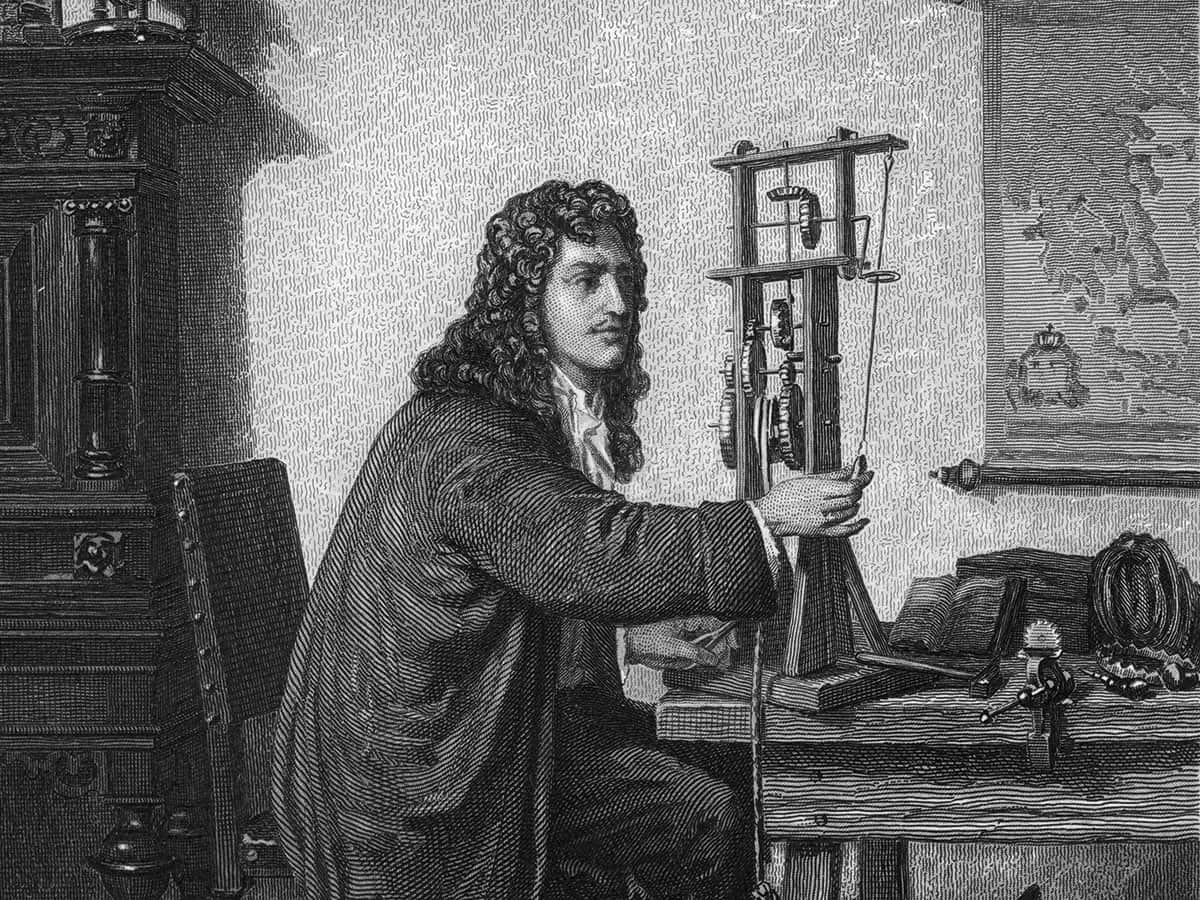
Double take: Christiaan Huygens was not just one of the greatest Dutch scientists, but he also invented the pendulum clock and was the first person to observe how pairs of them can synchronize. (Courtesy: The Print Collector/Heritage Images/Science Photo Library)
Moving in sympathy
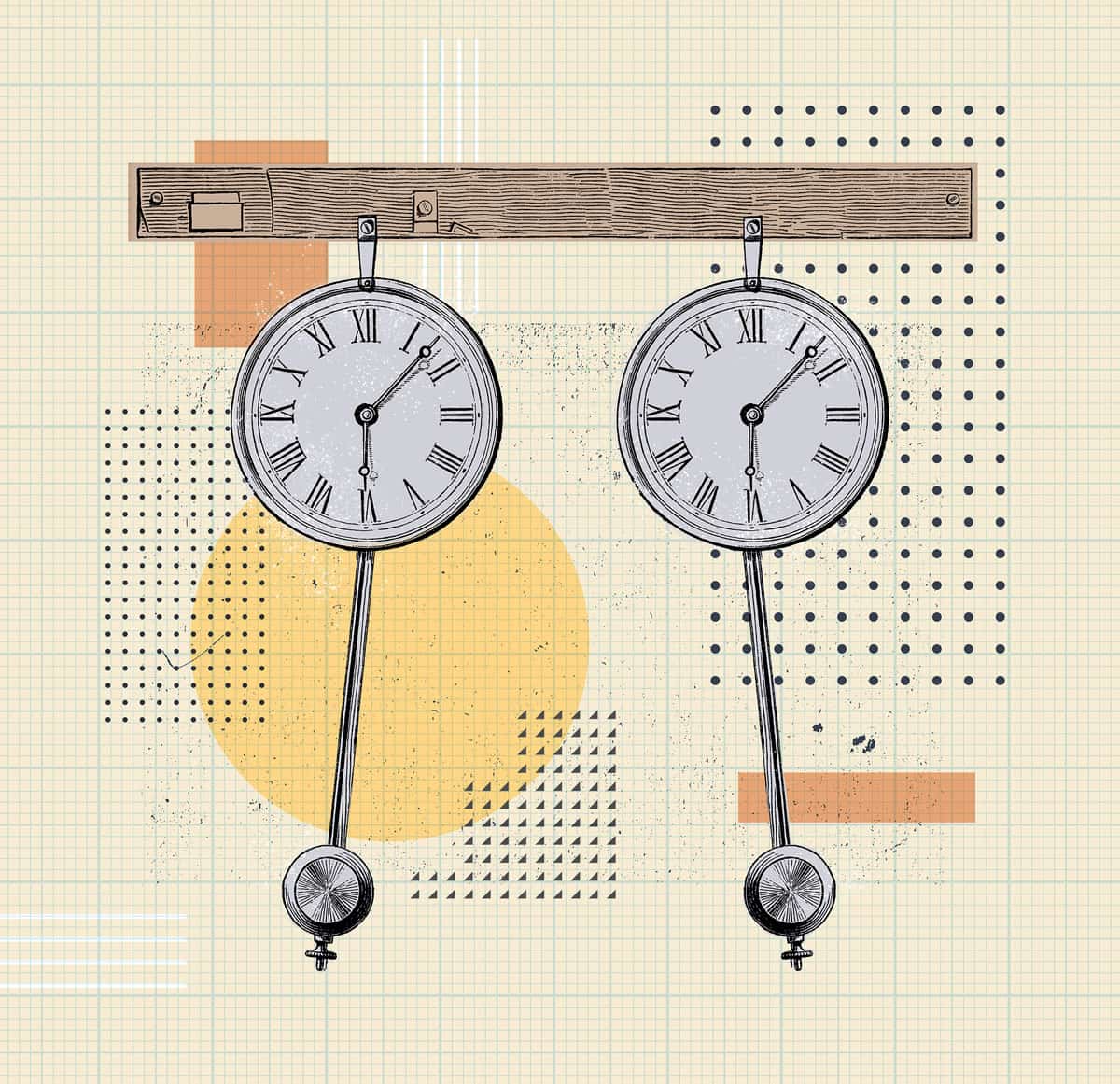
While working on the longitude problem, however, Huygens was surprised to discover that if he hung two of his pendulum clocks from a common support – a wooden bar supported by two chairs – the devices kept pace relative to each other. The two pendulums always swung at the same frequency albeit in opposite directions to each other. According to Huygens’ reports, it took the two pendulums about half an hour to reach this out-of-phase synchronization. In a letter to the Belgian mathematician René-François de Sluse, dated 22 February 1665, Huygens referred to this odd phenomenon as “the sympathy of two clocks”.
Huygens referred to this odd phenomenon as “the sympathy of two clocks”
For Huygens the beauty of the system was that even if one of the clocks stopped, the other would be keeping the correct time – and hence give the correct longitude measurement. In 1667 he therefore carried out a second maritime experiment, installing two linked clocks on a ship bound for the West Indies. Unfortunately, the clocks came to a stop in a storm and the sailor responsible for them failed to follow the instructions for resetting the devices – making it impossible to measure the time on board with them anymore.
Due to the practical difficulties, Huygens began to realize that pendulum clocks might not be the solution to the longitude problem, at least not in rough seas. Indeed, in December 1683, he sent a letter to the Dutch mathematician Bernard Fullenious, writing that “there is no small hope that it will succeed”. In the end, it was the English clockmaker John Harrison who came up with the final solution to the longitude problem almost a century later.
Further progress on what’s now known as “Huygens synchronization” did not occur until 1740 when John Ellicott – a renowned English clockmaker – submitted a manuscript to the Royal Society. In it he described an “odd” phenomenon: when two pendulum clocks were placed next to each other so that the pendulums were oscillating in the same plane, one of them always stopped working after about two hours, whereas the other kept swinging normally. Ellicott concluded that the two pendulum clocks were influencing each other through the common structure on which they were placed.
Little further progress was made on synchronized pendulums until 1873 when the British astronomer and meteorologist William Ellis, while working at the Royal Observatory in Greenwich in 1873, observed two pendulum clocks that had been placed on a wooden stand. Over nine consecutive days, he noticed that the times indicated by the clocks were identical, even though one pendulum was swinging to the left and the other to the right. The pendulums, in other words, were oscillating at the same frequency, but in opposite directions – exactly as in Huygens’ experiment.
Ellis recounted his findings in a paper published in the Monthly Notices of the Royal Astronomical Society (33 480), where he referred to the phenomenon of two out-of-phase pendulums as a “sympathy” despite neither he – nor Ellicott for that matter – mentioning Huygens’ earlier observations. In fact, the first formal attempt to explain the synchronized motion in Huygens’ pendulum clocks was only made in 1906 by the Dutch mathematician Diederik Korteweg and further progress on this mysterious phenomenon did not occur until the Soviet Union in the 1980s. Working at the Mekhanobr Institute in what was then Leningrad, Iliya Izrailevich Blekhman reproduced Huygens’ experiment using two small pendulum clocks placed on a common wall. Blekhman improved Korteweg’s mathematical model by adding terms describing the source of energy that keeps a pendulum clock running.
Remaining mysteries
All these studies have helped to shed light on the secret of self-synchronization in pendulum clocks. Although Christiaan Huygens didn’t have the mathematical tools to explain the strange phenomenon – differential calculus hadn’t been invented in the mid-17th century – we now know that he correctly understood the underlying mechanism. The synchronization is due to the clocks transferring energy to each other via the coupling bar in the form of mechanical vibrations. The clocks start moving exactly out of phase, in other words, when the vibrations exerted by one pendulum clock on the coupling bar are exactly cancelled by the vibrations exerted by the other.
But many questions remain unanswered, more than 350 years after Huygens’ discovery. What, for example, are the “minimal” requirements for self-synchronization? Will any pair of pendulum clocks eventually synchronize – or only certain types? And can you synchronize more than two pendulums? Only since the start of this millennium have scientists started shedding further light on these questions.
In 2002 a team led by Kurt Wiesenfeld at Georgia Tech in the US designed and built a simplified version of Huygens’ experiment using mechanical metronomes instead of pendulum clocks. They concluded that the sympathy observed by Huygens’ in his clocks is largely influenced by the coupling strength, which is the ratio of the total mass of the pendulums to the total mass of the coupling bar from which the clocks are hanging. A large ratio indicates a strong interaction between the pendulums, whereas a small ratio corresponds to a weak interaction. Furthermore, for a small ratio the pendulums synchronize with opposite phase, whereas for a large ratio the pendulums exhibit a “beating death phenomenon”, in which one pendulum keeps oscillating whereas the other comes to a stop (Proc. Roy. Soc. A458 563), as Ellicott had observed.
At about the same time, James Pantaleon from the University of Alaska Anchorage carried out a fascinating experiment consisting of two metronomes placed on a light wooden board sitting on two empty fizzy-drink cans so the whole system could roll. He found that the metronomes reached a common rhythm but oscillated in the same direction – rather than in opposite ways as Huygens and Ellis had seen.
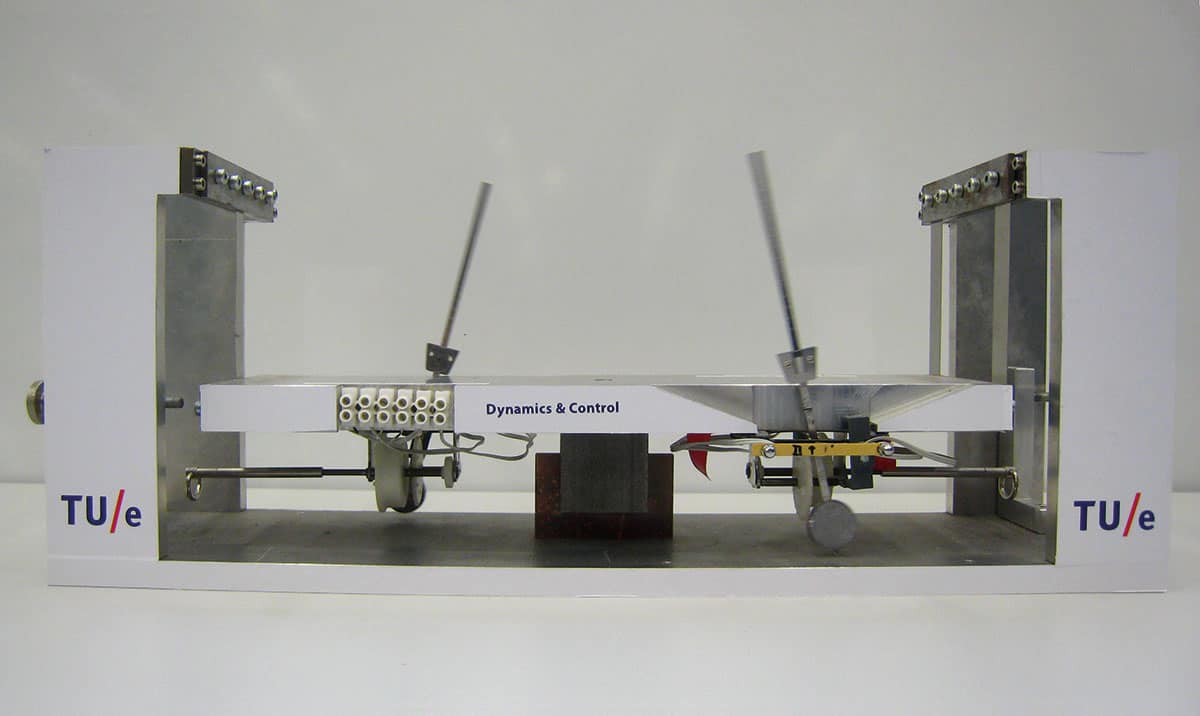
Mystified by this finding, in 2005 we decided to create our own version of Huygens’ experiment at Eindhoven University of Technology. Our set-up consisted of two metronomes mounted on a rigid metal bar suspended from leaf springs (figure 1). Confirming previous findings, we observed at least two types of synchronized motion. If the bar is relatively light, the metronomes start to oscillate synchronously in the same direction. But if the metal bar is heavier than a certain value, they oscillate at the same frequency but in opposite directions, just as Huygens saw. The critical transition mass in our experiment was found to be 2.35 kg.
1 From old to new
(Courtesy: P G M Hamels)
This simplified version of Christiaan Huygens’ original 17th-century experiment on synchronized pendulums was created by the authors at Eindhoven University of Technology in the Netherlands. It consists of two mechanical metronomes coupled through a metallic bar, which is elastically attached to a fixed support by means of springs.
It appears that a light coupling bar facilitates the onset of complete synchronization because the coupling strength is then relatively large. A heavier bar, in contrast, has a weak coupling strength, which results in the metronomes oscillating out of phase. We also derived a mathematical model for our coupled metronomes based on Newton’s second law, which revealed that the key parameters governing the onset of self-synchronization are the metronomes’ mass and oscillation frequency, as well as the mass of the bar and the rigidity of the springs from which the bar is suspended.
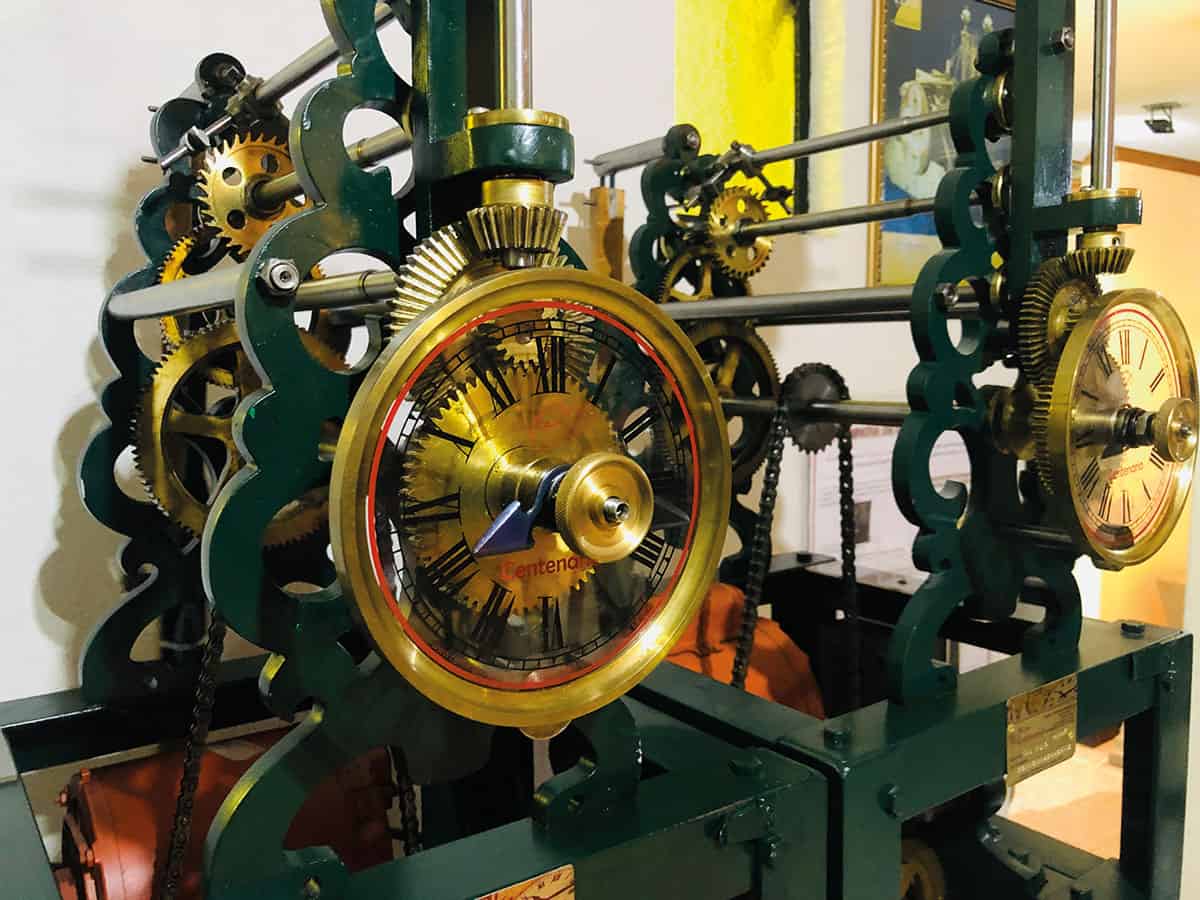
Recently, we have reproduced a modern version of Huygens’ experiment (figure 2) using two “monumental” pendulum clocks that were designed and built by Relojes Centenario – a specialist clock-making firm in Zacatlán, Mexico. The pendulum in each clock consists of a 5 kg metal mass attached to the lower end of a wooden rod just under 1 m long. At the heart of each clock is a structure, known as an “anchor-escapement mechanism”, that maintains the motion of the pendulum and is responsible for the characteristic “tick-tock” sounds of pendulum clocks. Connected to weights suspended from the clock, this structure gives the pendulum a “kick” each time its angular displacement reaches a certain threshold, thereby regulating the motion of the pendulum as it swings.
2 Monument to history
(Courtesy: Luis Alberto Olvera Cardenas)
This elaborate modern version of Huygens’ experiment was built by the specialist clock-making company Relojes Centenario in Zacatlán, Puebla, Mexico, and appears in the firm’s museum. Consisting of two pendulum clocks coupled through a wooden structure, the clocks end up moving in complete synchronization. The pendulum in each clock consists of a 5 kg metal mass attached to a wooden rod roughly 1 m long.
Using this equipment, we noticed that, after about 30 minutes, the pendulums were both oscillating in the same direction and at the same frequency. The clocks stayed synchronized for as long as potential energy was stored in the weights to drive the escapement mechanism. Indeed, each clock has a device that rewinds the weights roughly every 30 minutes, which means they could keep running for as long as desired. If it wasn’t in place, the clock would have stopped after about 14 hours.
Using this equipment, we confirmed the secret behind the onset of synchronization – first observed by Huygens all those years ago. As he suspected, it is due to the transmission of vibrations – and thus energy – through the wooden structure on which the clocks are attached. The wooden table, in other words, is the channel by which the pendulums can communicate with each other and eventually “decide” on a common rhythm. Although our modern clocks sat on a pine table, whereas Huygens’ devices hung from a bar, both depend on the elastic deformation of a piece of wood.
The final word
But we have also made some new observations that Huygens never noted. For example, clocks that are placed on the same wooden table and start moving in synchrony are no longer reliable time-keepers, losing 47 seconds per hour, which is almost 19 minutes a day. So even if Huygens had persisted in his use of pendulum clocks to find longitude at sea, and even if those devices weren’t disturbed by stormy seas, they still wouldn’t have worked as good timekeepers (Sci. Rep. 6 23580).
Coupled pendulums can do other strange things too, including “quenching” (both clocks stop working), undergoing seemingly chaotic motion (the clocks oscillate irregularly), moving in an unsynchronized way and more.
So do we now completely understand Huygens’ synchronization? In short, no. Most mathematical models, including our own, aren’t complete in that they don’t consider all the deformations experienced by the wooden support on which the clocks are hanging.
We hope, however, that a complete model will one day be created, not least because Huygens’ system of coupled clocks could shed light on many other systems. Consider for instance two driven “unbalanced” rotors mounted on an elastic support. Under certain conditions, the rotors can revolve synchronously in the same direction but in other cases the rotors start spinning in opposite directions. The latter can be useful as it can cut or even eliminate the vibrations of the common support when the rotors are running. However, synchronized rotation in the same direction is not good as it can make the support vibrate massively, which is bad news if you’ve ever seen or heard a washing machine go out of control.
Studies of Huygens’ clocks could also shed light on the many similar synchronization effects in living organisms. The human body, for example, has many different kinds of oscillating rhythms – including respiration, heartbeat, neuronal activity and blood perfusion – and when these synchronize with each other, very little energy is used. That’s good, but synchronization can also be damaging or dangerous. The generation of epileptic seizures, for example, is closely linked to the (abnormal) synchronization of millions of neurons (see September 2019).
We therefore believe that a thorough investigation of the synchronized pendulum clocks that Huygens first studied all those years ago could help us to get a better understanding of synchronization phenomena throughout the physical and the biological world. Indeed, in one recent paper, we have designed and built a system of synchronized electronic neurons that can – thanks to an “adaptive” training procedure – control a mobile robot driving around an unknown environment while avoiding obstacles (International Journal of Bifurcation and Chaos26 1650196). Who’d have thought that Huygens’ early observations on his sympathetic clocks would ever lead to such uses?