UK research network to advance radiotherapy developments

A £56 million research network announced today by Cancer Research UK will transform the UK into a global hub for radiotherapy research. The network – Cancer Research UK RadNet – will accelerate the development of advanced radiotherapy techniques, including FLASH radiotherapy, MR-Linac treatments, proton therapy, stereotactic radiotherapy and artificial intelligence.

RadNet will unite seven centres-of-excellence across the country. The University of Manchester, the University of Cambridge and the CRUK City of London Centre (a partnership between UCL, Queen Mary University of London, King’s College London the Francis Crick Institute) will receive funding for infrastructure and research programmes, including the formation of new research groups. The Universities of Glasgow, Leeds and Oxford and the Institute of Cancer Research, London/Royal Marsden will receive funding for infrastructure.

“Radiotherapy is a cornerstone of cancer medicine, with around three in 10 patients receiving it as part of their primary treatment,” says Michelle Mitchell, chief executive of Cancer Research UK. “The launch of our network marks a new era of radiotherapy research in the UK. Scientists will combine advances in our understanding of cancer biology with cutting-edge technology to make this treatment more precise and effective than ever before”.

The Cancer Research UK RadNet aims to improve cancer survival by optimizing and personalizing radiotherapy. The centres will develop new techniques for delivering radiotherapy and investigate new radiotherapy–drug combinations, with a focus on reducing long-term side effects and improving patients’ quality-of-life. Projects will include innovative research into:

  • FLASH radiotherapy, in which pulses of high-dose of radiation are delivered in a fraction of a second. Early research suggests that FLASH has the potential to cause less damage to healthy tissue near the tumour than traditional radiotherapy.
  • Proton therapy. The Christie NHS Foundation Trust in Manchester is the first NHS hospital to provide high-energy proton therapy; the second centre will open at University College London Hospitals NHS Foundation Trust next year. RadNet will support researchers across the country to optimize this new technology.
  • Overcoming hypoxia. Hypoxic tumours are far less susceptible to radiotherapy. Scientists will develop better ways to identify hypoxic tumours and new treatments to oxygenate them, making radiotherapy much more effective.
  • Cancer recurrence. Researchers will investigate why some cancers come back after radiotherapy by studying the role of cancer stem cells. These cells are remarkably resistant to radiation, and just a few remaining after treatment can cause a recurrence. For some patients, targeting stem cells could be the key to unlocking radiotherapy’s full potential.
  • Drug development. Scientists will develop and test drugs, including immunotherapies, for use in combination with radiotherapy. They will also study how tumours can repair DNA damage caused by radiotherapy and use the latest gene-editing technology to develop drugs that interfere with this process.
  • Artificial intelligence. RadNet researchers will use AI to design personalized treatment plans based on data from patients’ scans. This could improve radiotherapy accuracy and provide treatment options for patients whose tumours were previously too risky to target with radiation.

“I’ve seen first-hand how successful radiotherapy can be for patients that I treat, but it’s been frustrating to see the UK lagging behind other countries when it comes to prioritizing research into this vital treatment,” says Adrian Crellin, Cancer Research UK trustee and former vice-president of the Royal College of Radiologists. “Cancer Research UK’s investment will overhaul radiotherapy research in the UK to bring the next generation of treatments to patients sooner.”

ASTRO showcase: RaySearch highlights machine learning innovations

In this short video, filmed at ASTRO 2019, Frederik Löfman of RaySearch Laboratories explains how machine learning can improve consistency and efficiency in clinical practice.

Magic-angle graphene reveals a host of new states

Last year, researchers at MIT lead by Pablo Jarillo-Herrero observed superconductivity in a pair of graphene layers engineered to be slightly misaligned. Now, a team at the ICFO in Barcelona, Spain, says it has seen a host of additional correlated states in the same “magic angle” system, providing a much more detailed view of how twisted bilayer graphene behaves and opening up new ways of studying strongly-correlated physics.

According to Dmitri Efetov, the study’s lead author, magic-angle twisted bilayer graphene represents a simple system in which to investigate novel phenomena that arise due to interactions between electrons in a material. The electron density in this platform can be tuned by applying an electric field, which allows the strength of the electron-electron interactions to be varied. It also allows the material to be tuned between different phases – for example, between the superconductor and the correlated state. Being able to do this could shed light on the underlying mechanisms at play in superconductors – especially high-temperature ones based on cuprates, for which a fundamental understanding is still lacking.

To create their testbed, Efetov and colleagues followed the “tear and stack” method previously developed by Emanuel Tutuc and colleagues at the University of Texas. The researchers stacked two sheets of atomic-thick carbon (graphene) on top of each other with a small angle misalignment. When the misalignment reached an angle of exactly 1.1° — the theoretically predicted “magic angle” — the MIT researchers found that the material became a superconductor (that is, able to conduct electricity without resistance) at 1.7 K. The effect disappears at slightly larger or smaller twisting angles.

Fundamentally new approach to device engineering

The MIT result kick-started a flurry of activity in “twistronics”. In this fundamentally new approach to device engineering, the weak coupling between different layers of 2D materials (such as graphene) can be used to manipulate the materials’ electronic properties in ways that are impossible with more conventional structures, simply by varying the angle between the layers.

Xiaobo Lu and Dmitri Efetov

The crystal structure of a single layer of graphene can be described as a simple repetition of carbon atoms, which is known as its unit cell. When two graphene layers are stacked on top of each other at a slight angle, they form a moiré pattern or “superlattice” in which the unit cell expands to a huge extent, as if the 2D crystal was artificially stretched 100 times in all directions. This stretching dramatically changes the material’s interactions and properties, and simply varying the angle between 2D material layers changes its electronic band structure. At small twists, the moiré graphene superlattices can even be switched from fully insulating to superconducting, as Jarillo-Herrero’s team discovered.

Improving material homogeneity

In the new work, Xiaobo Lu, a postdoctoral researcher in Efetovs’s group, improved the structural homogeneity of the bilayer twisted graphene by mechanically cleaning it to remove trapped impurities and release local strain between the layers.

When he subsequently changed the charge carrier density within a device made from the material by applying a varying voltage to it, he observed that the device could be tuned from behaving as a Chern insulator (a state where the material’s electron bands are all either filled or all empty, and for which the filled bands have a net total Berry curvature or Chern number) to a superconductor. It could also be made to form an exotic magnetic state in which magnetism arises because of orbital motion of the electron rather than (as in typical ferromagnets) the electron spin. Such a state, Lu says, has never been seen before.

Competition between many novel states

Lu explains that magic-angle bilayer graphene seems to be competing between many novel states. “By tuning the carrier density within the lowest two flat moiré bands, it alternately shows correlated states and superconductivity, together with exotic magnetism and band topology.”

The researchers say that the different states they observed are very sensitive to the quality of device. However, they do not fully understand why the material behaves this way. “For the time being, we only know that all the correlated states come from the electron-electron interaction,” Lu says. “Their ground states and the interaction mechanisms between these quantum phases remains a mystery for now.”

Another “astounding” finding according to Lu is that the device enters a superconducting state at the lowest carrier densities ever reported for any superconductor, Lu says.  This result may have implications for applications such as quantum sensing, since it makes the material more sensitive to most kinds of radiation. The team have already tried to integrate magic-angle bilayer graphene into single photon detectors to make devices that might be employed in quantum imaging, bio-photonics and encryption systems, to name just three examples.

They were also able to increase the superconducting transition temperature of the material to above 3 K, a value twice that previously reported for magic-angle graphene devices.

Emergent quantum effects

“I think this a very interesting experiment,” comments Jarillo-Herrero, who was not involved in the ICFO team’s work. “The authors have found an interesting set of correlated insulator and superconducting states, some of which had not been seen before. This shows that the phenomenology of magic-angle graphene devices is even richer than previously thought.”

“While the origin of the new states and the differences with the results obtained by other groups remains to be understood, I believe this work will generate great interest and more experimental and theoretical work on this very exciting subject.”

Efetov’s team includes scientists from the University of Texas at Austin, the National Institute for Materials Science in Tsukuba and the Chinese Academy of Sciences in Beijing, and Efetov says they will now be focusing on investigating the superconducting mechanism in twisted bilayer graphene. “We will also be developing entirely new experimental techniques to study these emergent quantum effects in twisted low dimensional quantum materials, including graphene,” he adds.

The research is detailed in Nature.

PET imaging sheds light on immunotherapy response

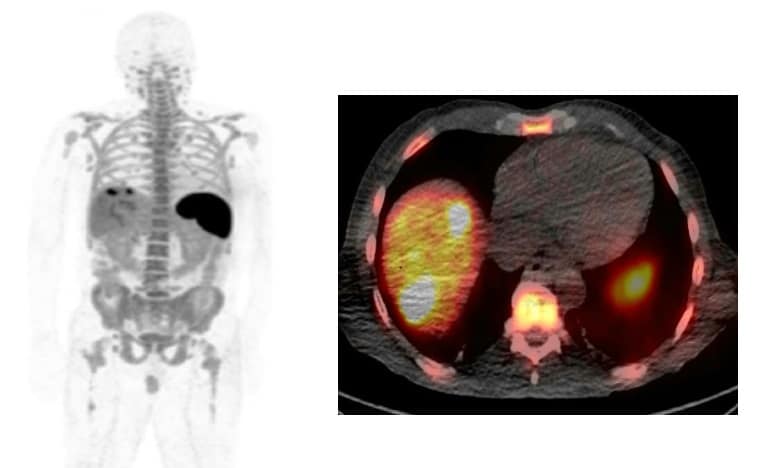
Whole-body PET images

Immunotherapy with checkpoint inhibitors is becoming an increasingly important tool in the treatment of several cancers. These checkpoint inhibitors, which block the proteins that stop the immune system from attacking cancer, can reactivate immune cells to enhance tumour killing. However, only a subset of patients respond.

A key determinant of successful checkpoint blockade therapy is the presence of CD8+ T cells, which play a central role in anti-tumour immune responses. As such, visualizing CD8+ T cells in vivo before and during treatment could provide insight into the mechanisms of immunotherapy and potentially predict a patient’s treatment response.

In a clinical trial sponsored by LA-based biotech company ImaginAb, a research team headed up at Memorial Sloan Kettering Cancer Center has now performed the first-in-human imaging of a tracer designed to non-invasively visualize the immune system (J. Nucl. Med. 10.2967/jnumed.119.229781).

The researchers used 89Zr-IAB22M2C, a minibody (antibody fragment) designed to target CD8+ T cells and radiolabelled for PET imaging. They tested the tracer, produced by ImaginAb, in a dose-escalation study of six patients with solid tumours (melanoma, lung cancer or hepatocellular carcinoma) who were undergoing or likely to receive immunotherapy.

Patients were injected with approximately 110 MBq of 89Zr-IAB22M2C, at minibody mass doses of 0.2 up to 10 mg. The researchers then performed whole-body PET/CT at various post-injection time points. They note that the infusion was well tolerated with no immediate or delayed side-effects observed for any mass dose.

Evaluating the biodistribution of 89Zr-IAB22M2C showed that the minibody targeted CD8+ T cell-enriched tissues, with high uptake seen in the spleen, bone marrow and lymph nodes. The biodistribution was dependent on the administered minibody mass, with uptake almost completely confined to the spleen at the lowest mass dose (0.2–0.5 mg).

The highest uptake was always seen in the spleen, followed by the bone marrow. As the mass dose increased, however, blood pool retention increased and higher liver uptake was seen at later times. The team notes that this may be a saturation effect, due to competitive binding from the increasing amount of cold (non-radiolabelled) minibody.

The researchers also took multiple blood samples from the patients to assess serum clearance. Clearance was typically bi-exponential and also depended upon minibody mass, with rapid extraction of lower minibody masses from circulation and slower serum clearance for higher masses (5–10 mg).

Tumour lesions showed variable 89Zr-IAB22M2C uptake among patients, possibly due to differing treatment profiles or the variable presence of CD8+ T cells. In two patients, PET revealed prominent uptake in lesions imaged at lower masses. Both patients were receiving immunotherapy and may thus have had a higher concentration of CD8+ T cells. Conversely, three patients with metastatic lung cancer did not show prominent uptake, possibly related to a lack of ongoing treatment with immunotherapy and therefore lower levels of T cells.

The researchers conclude that PET with 89Zr-IAB22M2C is safe and feasible, and that the minibody successfully targets CD8+ T cell-rich tissues. Initial results suggest favourable kinetics for early imaging within 6–24 hr, with uptake seen in normal lymph nodes and tumour lesions as early as 2 hr post-injection.

Due to the small number of patients in the study, the researchers could not establish differences in lesion uptake among minibody mass doses. However, lower masses (less than 5 mg) seemed to provide a more favourable balance of normal tissue and lesion visualization.

“This novel imaging agent has the potential to non-invasively assess the presence of CD8 T cells in patients’ tumours and results of this initial assessment are encouraging,” says lead author Neeta Pandit-Taskar. “With more research, this technology may ultimately serve a critical role as a biomarker of immunotherapy outcome and inform clinical trials of novel immunotherapies that act mechanistically through the presence of CD8 T cells.”

The ImaginAb team is now performing further evaluations in more patients and a study incorporating parallel biopsies is also accruing patients.

VFX in movies: from weightlessness to curly hair

Gravity

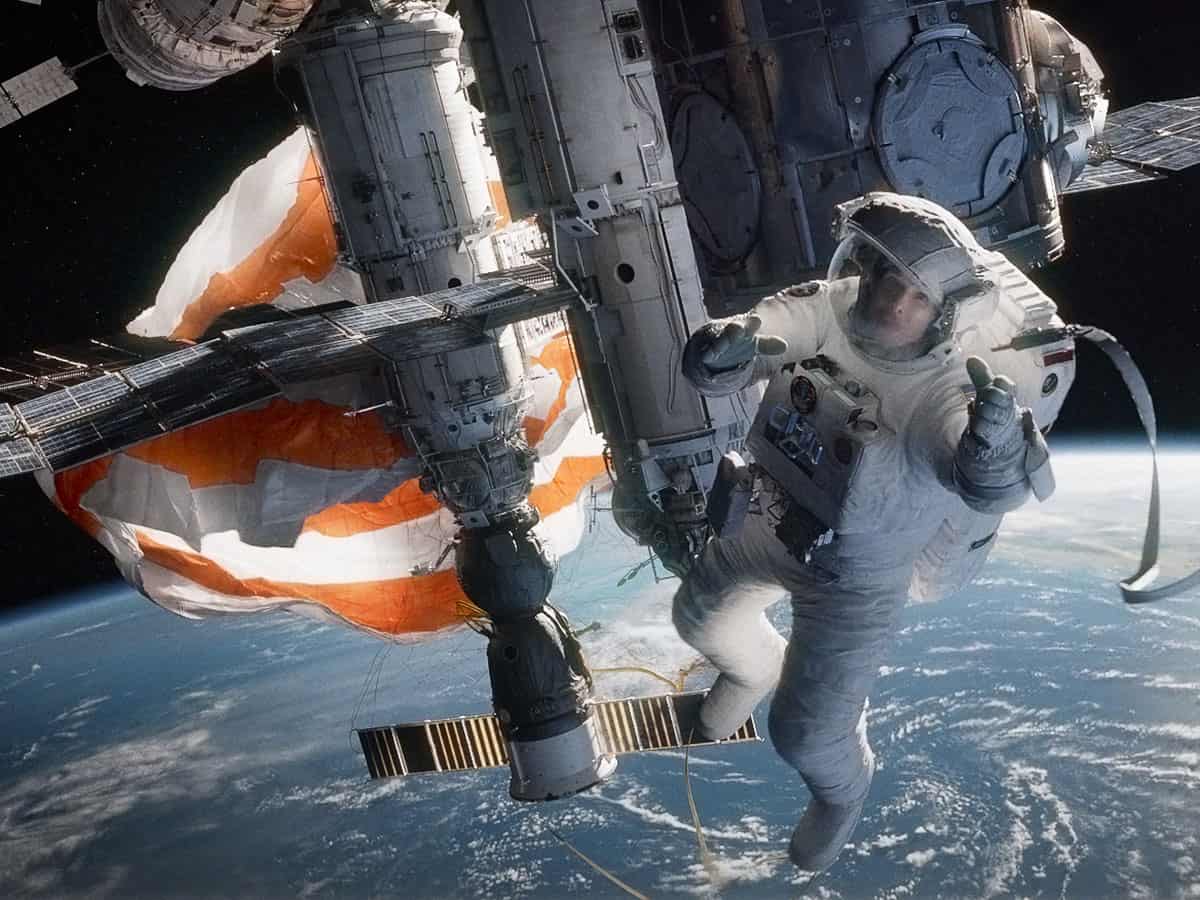
It’s almost ironic that, decades after failing to attend many of his own undergraduate physics lectures, Tim Webber found himself teaching his colleagues the physics they needed to do their job. As chief creative officer at London-based Framestore – one of the world’s leading visual effects (VFX) studios – he’d worked on blockbusters such as Harry Potter and the Goblet of Fire (2005) and The Dark Knight (2008). But it was his Oscar-winning work leading the visual effects on the Alfonso Cuarón movie Gravity (2013) that forced him to share his physics insights.

Gravity featured Sandra Bullock and George Clooney as space-shuttle astronauts fighting for their lives in a zero-gravity environment after their craft gets hit by space debris. According to Webber, the problem was that animators spend years developing the skill of creating virtual beings that don’t just look good, but also move in a way that suggests they have weight. “Suddenly,” he says, “they had to animate things that didn’t have weight, but still had mass.” It was a concept that Webber’s team struggled to get their heads around. “So I got them into a room and gave them physics lectures.”

His tutorials paid off. Webber – plus his colleagues Chris Lawrence, Dave Shirk and Neil Corbould – won the 2014 Academy Award for Best Visual Effects for their work on the movie. But then Webber has always had a creative bent. As an undergraduate at the University of Oxford in the early 1980s, he’d spend more time in arts studios than physics labs. Indeed, he’s one of many similarly inclined people who use their training in physics, engineering and maths in the VFX industry. And no wonder. When it comes to recreating a believable world on screen, physics is everything. “Maths and physics feature very heavily,” says Webber’s Framestore colleague Eugénie von Tunzelmann.

Before working at Framestore, von Tunzelmann – an engineer and computer scientist by training – was a visual-effects designer at another London VFX firm called Double Negative. While there, she worked on Christopher Nolan’s epic sci-fi movie Interstellar (2014) and ended up co-authoring a scientific research paper about Gargantua – the black hole that’s the focus of the film (Class. Quant. Grav. 32 065001). She wrote the paper with Paul Franklin, who had co-founded Double Negative, and another colleague from the firm, Oliver James. The trio had collaborated with Caltech physicist Kip Thorne (the fourth author on the paper) to create as realistic a simulation of a supermassive black hole as possible. The simulation won plaudits from physicists and Hollywood critics alike – and led to Franklin sharing the VFX Oscar in 2015.

From humble beginnings

Things have certainly come a long way since the iconic – but less-than-realistic – VFX of King Kong (1933) or Jason and the Argonauts (1963). The transition to computer-generated imagery (CGI) in films such as TRON (1982) and Jurassic Park (1993) was a game-changer, but there was still plenty that was unrealistic about the way light behaved, or creatures moved. This, though, is an industry that never stands still. “New techniques are constantly being developed,” says Sheila Wickens, who originally studied computer visualization and is now a VFX supervisor at Double Negative. “It is very much a continually evolving industry.”

These days, the industry has embraced what is known as “physically based rendering” whereby physics is “hard-wired” into the CGI. Industry-standard software now includes physics-based phenomena, such as accurately computed paths for rays of light. “The complex maths used in ray-tracing is in part based on maths developed for nuclear physics decades ago,” says Mike Seymour, a VFX producer and researcher at the University of Sydney whose background is in mathematics and computer science.

Other phenomena captured by today’s CGI include life-like specular reflection, which means that materials such as cotton and cardboard – which in the past did not reflect light in CGI scenes – are now modelled more realistically. A similar thing has happened with the inclusion of Fresnel reflection so that image-makers can account for the fact that the amount and wavelengths of light reflected depend on the angle at which the light hits a surface. Indeed, it’s no longer acceptable to make things up, or break the laws of physics, says Andrew Whitehurst, VFX supervisor at Double Negative, who won an Oscar in 2016 for his work on Alex Garland’s artificial-intelligence-focused thriller Ex Machina.

“When I began in the industry a little over 20 years ago, we cheated at almost everything,” Whitehurst admits. “Now, surfaces are more accurately simulated, with reflectometer research being implemented into code that describes the behaviour of a variety of materials. Our metals now behave like metals and, by default, obey the laws of energy conservation. Fire and water are generally simulated using implementations of the Navier–Stokes equations: the tools we use in VFX are not dissimilar to those used by researchers needing to compute fluid simulations.”

In fact, Whitehurst says, it’s hard to see how many things can be made any more realistic. “We can blow anything up we want, we can make anything fall down that we want, we can flood anything we want, and we can make things as hairy as we would like.”

Much of this accuracy comes out of deliberate research programmes, either in academia or within the studios themselves. The fact that filmmakers can now accurately model curly hair, for example, owes a debt to researchers at the renowned US animation studio Pixar, who, in the early 2010s, developed a physics-based model for the way it moves. Their model is described in a Pixar technical memo (12-03a) entitled “Artistic simulation of curly hair” by a team led by Hayley Iben, a software engineer who originally did a PhD at the University of California, Berkeley, on modelling how cracks grow in mud, glass and ceramics.

Brave
The Lion King

Modelling the movement of curly hair for animations, it turns out, is best done by representing hair as a system of masses on springs. The technique Iben and her team developed was used to great effect in the animation of the curly-haired hero Merida of Brave (2012), and later in films such as Finding Dory (2016) and The Incredibles 2 (2018). Admittedly, it’s more accurate to model hair as infinitesimally thin elastic rods, but this, the Pixar group says, straightens out the hair too much when in motion. Increase the stiffness to avoid this, and the hair takes on an unrealistic wiriness as the character moves their head.

Such compromises are important. After all, it’s the movie director who gets the final say in whether a visual effect works. “Being able to make something 100% real is actually just a stepping stone to making something cinematic,” says Seymour at the University of Sydney. “It is often critical to be able to create something real, and then depart from it in a believable way.”

Sometimes the departure doesn’t even have to be believable. Back at Framestore in London, von Tunzelmann recalls being asked to create fantasy fire where the flames curled in spirals. “There was no software that can do that, so we wrote a new fluids solver that measured the curl of the field and exaggerated it,” she explains. Everyone in the VFX industry, it seems, wants someone with a background in physics or engineering on their side (see box below).

Even in things where we are trying to play by the rules, we are going to bend them here and there

The same conflict between aesthetics and reality occurred in Interstellar. Whitehurst, who helped develop some of the VFX techniques used in the film, suggests that movie was both realistic and not. The team had to rewrite the ray-tracing software to account for the intense curvature of space around a black hole – and also had to dial down Gargantua’s brightness for the audience. “You can see exciting detail in it, and you probably wouldn’t be able to [in reality] because it would be so staggeringly bright,” Whitehurst points out. “Even in things where we are trying to play by the rules, we are going to bend them here and there.”

That human factor

For all the progress in making movie animations look as realistic as possible, one challenge still looms large: how best to represent human beings. Getting human features to look right for movie-goers is about more than just simple physics. We can make a human face that is photographically perfect – the issues of light transport through skin and modelling how wrinkles work have largely been solved. The difficulty is in the subtleties of how a face changes from moment to moment. The problem, Framestore’s Webber reckons, is that evolution has trained the human eye to analyse faces and work out if someone is lying or telling the truth, is healthy or unhealthy.

“Being able to recreate faces and fool the human eye is exceptionally tricky,” he says. And the truth is that we don’t even know what it is we see in a face that tells us something is awry: it’s a subconscious reaction. That means VFX designers don’t know how to fix a wrong-looking face – and just can’t generate one from scratch, let alone know how they might recreate a particular emotion that you want that character’s face to portray at that moment. “The last thing you want is a character saying ‘I love you’ when the eyes are saying the opposite,” Webber says.

And if you want to make life for a visual-effects designer even harder, try asking them to put a human face underwater, Seymour suggests. “The skin and mass of the face moves with gravity mitigated by buoyancy,” he says. “If they then quickly move a limb underwater near their face, the current produced by the simulated flesh of their hand needs to inform a water simulation that will affect their hair, their face-flesh simulation and any tiny bubbles of air in the water. These multiple things all interact and have to be simulated together.”

For now, animators compromise by combining CGI with motion capture, whereby an actor does their performance with dozens of dots glued to their face so that the image-processing software can track all the muscle movements from the recorded scene. VFX designers then use this information to create a virtual character who might need larger-than-life qualities (quite literally, in the case of the Incredible Hulk). Finally, they overlay some of the original footage to re-introduce facial movements. “This brings back subtleties that you just can’t animate by hand,” Webber says.

The Dark Knight
Harry Potter Goblet of Fire

It turns out that our eye is more forgiving when it comes to CGI representations of animals. That’s why we have seen a slew of movies led by computer-generated “live-action” animals, from Paddington (2014) to the recent remakes of Disney’s The Jungle Book (2016) and The Lion King (2019). Framestore has recently been working on Disney’s upcoming remake of Lady and the Tramp. Due out later this month, it mixes footage of real and CGI dogs – and the VFX are so realistic that many in-house animators can’t tell which is which, according to Webber. “People in the company have asked why a particular shot is in our showreel when it’s a real dog, and they have to be told – and convinced – that it isn’t!”

The new remake of Lady and the Tramp mixes footage of real and CGI dogs that’s so realistic that many in-house animators can’t tell which is which

Some things in movies, however, will never be truly realistic. Directors in particular want their monsters to move quickly because that’s more exciting. However, the laws of physics dictate that massive creatures move slowly – think how lumbering an elephant is compared to a horse – and our subconscious knows it. So when we watch a giant monster scurry across the screen, it can feel wrong – as if the creature has no mass.

“If Godzilla or a Transformer were actually to try to move at the speed they do in the movies, they would likely tear themselves apart, as F = ma last time I checked,” Whitehurst says. “This is a fight that I always have, and that everyone always has. But ultimately a director wants something exciting, and a Pacific Rim robot moving in something that looks like ultra-ultra-slow motion doesn’t cut it.” It’s a point echoed by Sheila Wickens, who studied computer visualization and animation at Bournemouth University and is now VFX supervisor on the BBC’s flagship Doctor Who series. “We usually start out trying to make something scientifically correct – and then we end up with whatever looks good in the shot,” she says.

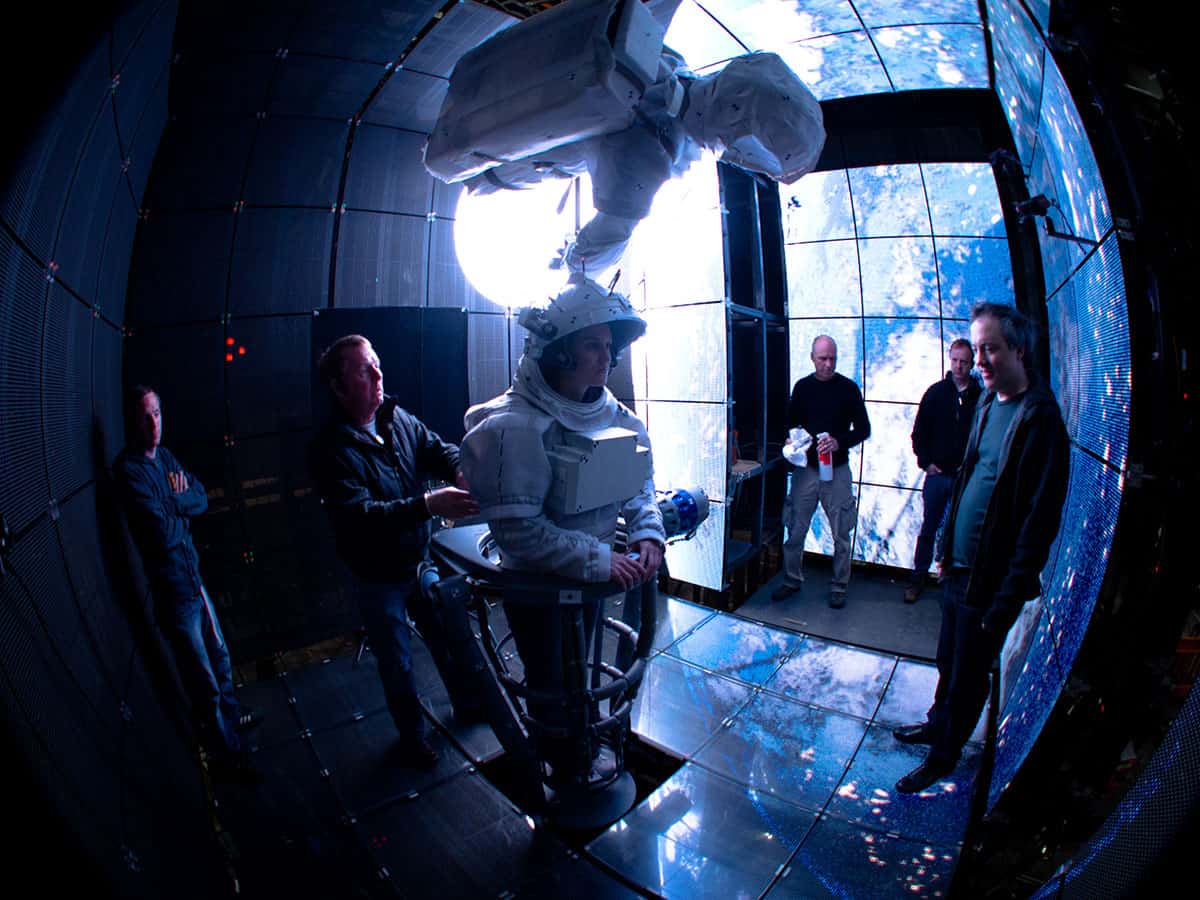
That fight between directors wanting visual excitement and animators wanting visual accuracy is what made working on Gravity so special for Webber. He says the film was the highlight of his career to date – but also “by far the most challenging movie” he’s worked on. “All we were filming was the actors’ faces, everything else was made within the computer,” he says. The team had to write computer simulations of what would happen in microgravity when one character is towing another on a jet pack, and the result became a plot point. “We found that they bounced around in a very chaotic and uncontrollable way,” Webber says. “It’s literally down to F = ma, but Alfonso, who was working with us, really loved it and folded that into the script.”

That was quite a moment, Webber says. Suddenly, all his physics lectures – given and received – had been worth it.

Paths to success in the visual-effects industry

LightBox Gravity

If you’re a physicist who wants to work in the visual-effects (VFX) industry, what opportunities are available and what skills do you need – beyond a willingness to lecture your colleagues about the finer points of F = ma?

Yen Yau, a Birmingham-based project manager who trains newcomers in the world of film

Having worked on careers publications for ScreenSkills – the industry-led skills body for the UK’s screen-based creative industries – Yau says there is huge diversity in the paths people can take. “Certainly, physics is going to be more important in some roles, but there are numerous routes in for all types of backgrounds and experiences of applicants.”

Eugénie von Tunzelmann, a visual-effects designer at London VFX firm Framestore

While most workers in the VFX industry don’t have a background in science, technology, engineering and mathematics (STEM) subjects, she says there is a need for people with skills in those areas. Anyone working in a job that involves programming a software plugin that, say, defines how light bounces off a surface will almost inevitably have a background in physics or optics. If you were trying to model fluid flow, “you’d need to have an understanding of thermodynamics”, she says.

Andrew Whitehurst, Oscar-winning VFX designer

Describing himself as “an artist with an interest in physics and engineering”, Whitehurst says that many people in the VFX industry are physicists or engineers with a creative itch that won’t go away. “I work with people with physics doctorates or engineering doctorates and art-school dropouts but we all meet in the middle. I have no formal background in physics, but I have a reasonable passing knowledge of a lot of physics and engineering principles. I need to know why camera lenses do what they do, for example, so that we can mimic their behaviour.” But scientists working in VFX will have to learn how to compromise, he notes. “We use a lot of science and engineering, but we are not in the business of scientific visualization. I am an enormous respecter of science, but if I can make a more beautiful picture that tells the story better, I’m going to do it.”

Tim Webber, physicist who is now chief creative officer at Framestore in London

Even if you don’t need to understand the maths hidden in the software that the VFX industry use, Webber feels it helps to understand the principles of what the equations are doing, pointing to his experience early in his career working on a 1996 Channel 4 TV mini-series dramatizing Gulliver’s Travels and starring Ted Danson. “There are lots of small people and big people and we had to work out the angles, where to put the camera, so that the perspective would match what it would match in the other scale. I was using bits of paper and rulers and protractors and calculators.”

Exploring the computational universe with Stephen Wolfram

Why did you create Mathematica?

Because I wanted to use it myself. I was interested in physics from a young age, and I started doing physics research when I was in my early teens, in the mid-1970s. I didn’t like doing all the mathematical calculations that were needed, and I thought it should be possible to automate them. I soon became the main user of the various experimental systems for doing mathematical computation that existed at the time, but by 1979 I had outgrown them, so I decided I had to build a system for myself.

The result was SMP, the first version of which was released in 1981. SMP ran on large computers and found users in quite a few areas, including physics. I started my first company to develop and market SMP. But quite quickly thereafter I went back to basic science, starting my explorations of cellular automata and the computational universe, and helping to found the field that’s now called complexity theory.

By 1986, though, I decided there was an opportunity to create a more powerful tool that would cover all the computation I would ever want to do. That was also a time when personal computers were beginning to be able to do serious computation. And I wanted to build a system that could bring computation to a wide audience. At the time, most physicists really didn’t use computers themselves. They would delegate computing to someone else. I was very pleased with the way that Mathematica changed that and let actual physicists compute things themselves. It was a very nice transition to watch.

How has the program changed over the past 30 years?

Ninety-five per cent of what’s in it now wasn’t there 30 years ago. The core principles of the system have stood the test of time extremely well, and I’m pleased to say that almost any version 1 program from 1988 will still run in version 12 today (something that is very rare in the computing world). The core symbolic programming paradigm of Mathematica was also already there 30 years ago, and was broadly applicable from the very beginning. But in the intervening years, we’ve dramatically broadened and deepened the coverage of mathematical computations. We’ve also expanded into a great many other areas, to the extent that mathematical computation is now perhaps only 10% of what the system does. We’re also dealing with multiparadigm data science, machine learning, all kinds of visualization, text computation, graphs and networks, image computation, geometry, audio computation, knowledge representation and so on. Another major thing is that the program incorporates a huge amount of built-in real-world data, about chemicals or particles or planets – or countries, movies, and companies. This is the same data that powers Wolfram|Alpha, and which, in turn, powers intelligent assistants like Apple’s Siri and Amazon’s Alexa.

Thirty years ago, we had already invented our notebook interface. Today that interface is considerably more developed, and it also runs in the cloud, so people can publish computable documents directly on the web. We’ve done a lot of work over the past 30 years, and the applications of Mathematica have dramatically expanded. Whether it’s being used as an embedded part of some robot or experimental data system, or for physics education with real-world data, or for the latest high-performance computation, there are things routinely done with Mathematica today that wouldn’t have been thinkable 30 years ago.

You’re developing something called Wolfram Language, which you’ve described as a combination of natural languages, mathematical notation and computational language. What’s the rationale behind this?

The concept of Wolfram Language (which is a direct extension of my original vision for Mathematica) is to have a computational language that can describe things in the world – things people want to talk about – in computational terms. It’s common to take small pieces of natural language (like “density of tungsten”) and have our natural language understanding system turn them into symbolic representations from which we can do computation. In that sense, Wolfram Language is, as much as anything, a description of what Mathematica has become, recognizing that “mathematics” is no longer a central focus.

I think there’s an interesting analogy between our effort to create a computational language and the origins of mathematical notation. Four hundred years ago, mathematics had to be described in words and ordinary language. But then mathematical notation was invented, and it provided a streamlined way for people to represent mathematical ideas – opening up the development of algebra, calculus and our modern mathematical sciences. It’s the same story with our computational language. We’re providing a broad language for representing computational ideas, and it’s unlocking “computational x” for essentially all fields x.

Computational essays are an important concept in Wolfram Language. Today, people write papers, for example in physics, using a combination of human language and mathematical notation. But with our computational language, it’s possible to routinely represent computational ideas, in a form that not only computers, but also humans, can readily understand. Our computational language provides a new channel for communicating ideas, and it’s also immediately executable. That means the papers of the future can be computational essays where people can not just read, but also execute, what’s said. Underlying data can be brought in (for example from our Wolfram Data Repository). And people can immediately build on one piece of work to do more.

How is computing different from programming?

The key to computational language is to find a way to express whatever one wants to talk about in a form that a computer can understand. Programming languages are about starting from the underlying operations in a computer and working out how to tell the computer which operations to perform. A programming language has concepts like arrays or pointers. Our computational language, in contrast, has concepts like differential equations, or galaxies, or chemical elements, or countries. A lot of what’s normally considered “programming” is completely automated when you’re using our computational language. You’re essentially operating at a much higher level, and we’re taking care of all the details of doing what you want to as efficiently as possible. The people who are doing “computational x” are really interested in computational thinking, not in programming as such.

What are some examples of ways that thinking computationally, rather than mathematically, about a system can aid understanding?

For 300 years mathematical equations were the dominant method used to make models of things. In just the last decade or so, there’s been a kind of silent revolution in modelling, and new models of almost any concept or system – regardless of whether it is physical, engineering, social, biological – have started to be based on computation (and effectively, programs) rather than mathematical equations. It’s quite a paradigm shift, which is why I called my big book on the subject A New Kind of Science. [Update: Wolfram has also written a collection of essays on computation, Adventures of a Computational Explorer, published in October 2019.]

Why do you think physicists, in particular, should consider framing problems in computational, rather than mathematical, terms?

Computation is a generalization of mathematics. Yes, there are plenty of systems that have traditionally been studied in physics that can be modelled mathematically, for example with differential equations. But there are a lot more systems (including plenty of physical ones) that need a generalization of the equations approach. There’s a lot of new physics that’s made possible by this.

What role do you think computation will play in the future of physics?

Physics was early in using computers to aid in working with its existing paradigms, and I would like to think that Mathematica helped with that. The biggest growth directions, I think, will be in the use of computation as a paradigm for physics. Part of this involves using computational models for physical systems. But part of it also involves understanding computational concepts like computational irreducibility, and seeing how they relate to phenomena in physics.

It’s hard to know what might crack the problem of finding a fundamental theory of physics, but perhaps it will be computation. Certainly, the intuition that we now have from exploring the computational universe of simple programs is something completely new – and it seems potentially highly relevant to questions of fundamental physics. I’ve been thinking about these kinds of things for a long time, and I’m finally about to mount a serious project to see whether there’s a computational way to approach fundamental physics that will get further than the quantum field theory and general relativity approaches that we’ve been trying for a hundred years. Of course, it may be the wrong century – or the wrong approach – to crack the problem. But there’s definitely a lot of interesting theoretical structure to investigate.

Fermilab’s photographer extraordinaire retires, win a trip for two to the LHC, can you spot an encroaching drone?

Many science journalists will be familiar with the work of Reidar Hahn, who is retiring after 32 years as Fermilab’s staff photographer. The above image is just one of many fantastic examples of how Hahn has captured the people and places of the particle-physics lab.

“People have been great to share what they’re working on with me, and I have a much greater understanding of how the universe works, and a real appreciation for all the tough, hard work people do at a frontier-science laboratory,” says Hahn.

On 6 November, Fermilab’s art gallery is putting on a show of Hahn’s personal work called Collections, which will run until 3 January, 2020. And if you happen to be at Fermilab next Friday, you can meet Hahn at free reception at the gallery.

I consider myself exceptionally privileged because I have been down the collider tunnel at CERN not once, but twice. The first time was almost 20 years ago, when the gubbins for the Large Electron–Positron Collider was still in the tunnel, about to be replaced by the Large Hadron Collider (LHC). I was there again in 2013 during an upgrade of the LHC.

Both visits were awe inspiring and that is why I urge you to enter this draw to win a trip for two to Geneva for a personal tour of the LHC. It is sponsored by the Perimeter Institute for Theoretical Physics in Canada. I’m afraid the draw is only available to residents of Canada and the US. Good luck!

The malicious use of drones has wreaked havoc at some airports around the world. If you were an aircraft pilot, do you think you could spot a drone encroaching on an airfield as you come into land. The above video will put your observational skills to the test.

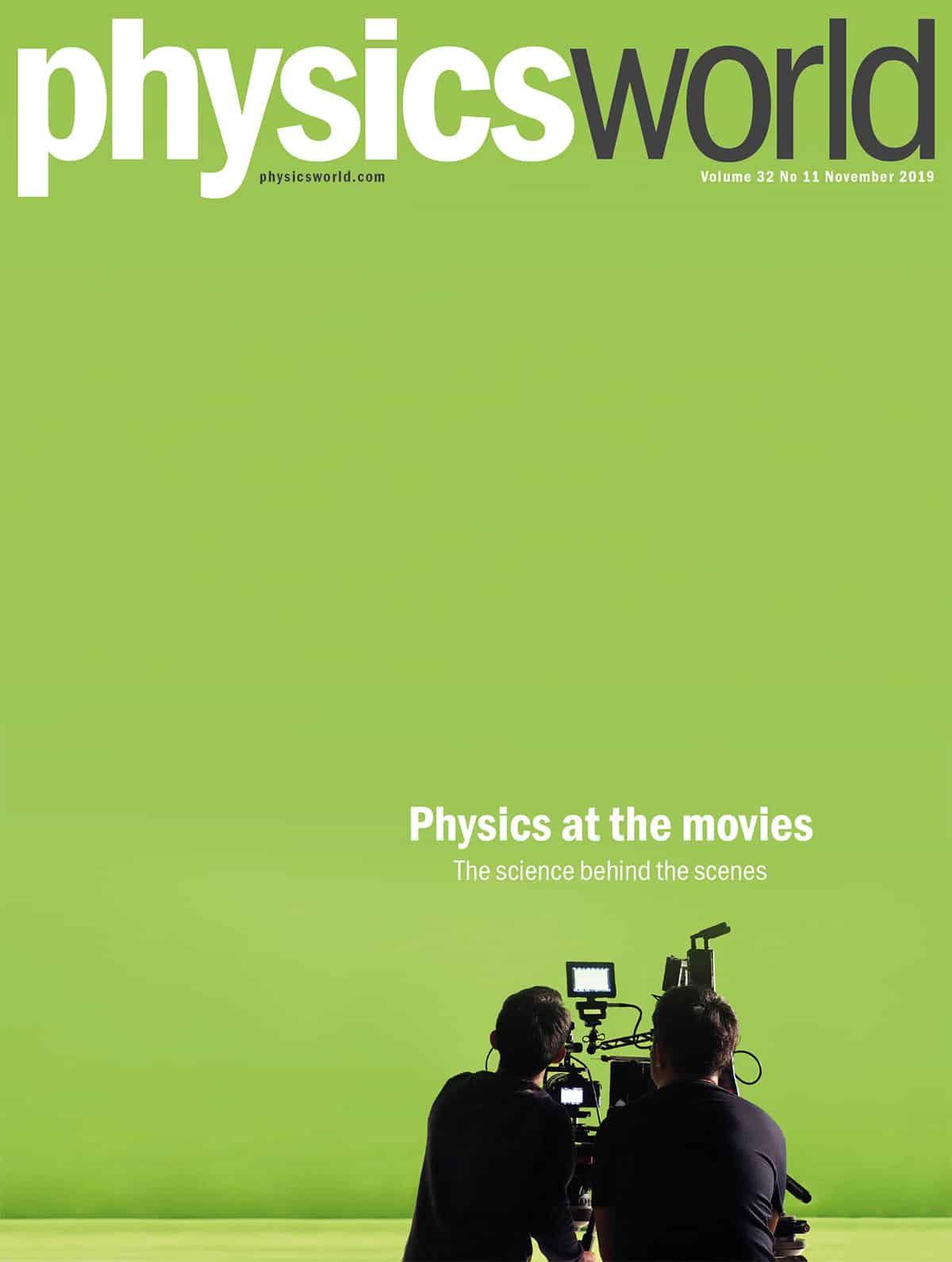
Physics at the movies – the science behind the scenes: the November 2019 special issue of Physics World is now out

It’s not often that film stars appear in science magazines. But in the November special issue of Physics World on physics and the movies, Harry Potter star Daniel Radcliffe talks to friend and physicist Jess Wade about what it’s like as an actor to work with visual effects (VFX), from 3D body mapping to green screens and tennis balls.

Physics World November 2019 cover

Elsewhere in the special issue, which is out now in print and digital format, find out how movie-makers rely on software and simulations from scientific research, explore what it’s like to be a Hollywood science consultant, and cringe at some of the classic science movie bloopers.

There’s also an exclusive interview with Douglas Trumbull – the legendary VFX pioneer who worked on 2001: A Space Odyssey – while Benedict Cumberbatch, who once starred as Ste­phen Hawking, explains the challenges of portraying scientists in film.

Plus there’s our usual mix of news, opinion, reviews and careers, and a movie-themed Lateral Thoughts illustration by Eugenia Viti and Ivan Viti.

Remember that if you’re a member of the Institute of Physics, you can read the whole of Physics World magazine every month via our digital apps for iOSAndroid and Web browsers. Let us know what you think about the issue on TwitterFacebook or by e-mailing us at pwld@ioppublishing.org.

Here’s a run-down of the full issue.

  • Scientific fireworks – Next time you’re watching a firework display, remember these explosions played a key role in the early days of modern science, says Robert P Crease
  • Elevator pitches – James McKenzie explains why a good elevator pitch is so vital, whether it’s introducing yourself, writing a CV or pitching a technology business plan
  • From weightlessness to curly hair – There’s no escaping the laws of physics – even at the movies. Michael Brooks reveals why they’re vital to creating the best possible effects
  • Tricks and wizardry – Visual effects play a crucial role in the modern movie industry. Daniel Radcliffe talks to Jess Wade about what it’s like as an actor to work with this kind of technology
  • A mutual appreciation – Legendary director Douglas Trumbull talks to Graham Jones about what moviemakers and scientists can learn from each other
  • Turning science to movie magic – What better way to accurately depict science in films than to ask the people studying it off screen? Emilie Lorditch talks to physicists who help filmmakers take science from the lab to the red carpet
  • The imitation game – Actor Benedict Cumberbatch talks to Andrew Glester about what it’s like to play famous scientists
  • A scientist in Hollywood – Mathematical physicists Spiros Michalakis talks to Sarah Tesh about his experience as a science adviser to Hollywood on films like Ant-Man and Captain Marvel
  • The fictional science of science fiction ­­– As the name suggests, science-fiction movies are just that – fiction. Unfortunately, that sometimes means the science is too. Rhett Allain examines some concepts that sci-fi movies regularly get wrong
  • The real physics of fantasy – Kate Gardner reviews Fire, Ice and Physics: the Science of Game of Thrones by Rebecca C Thompson
  • Crash and burn – Tushna Commissariat reviews the sci-fi movie Ad Astra starring Brad Pitt
  • Once a physicist – Meet Eben Upton, co-founder of the Raspberry Pi Foundation, a charity that promotes the study of computer science in schools, and the chief executive officer of Raspberry Pi, which develops small single-board computers for educational, scientific and industrial applications
  • Movie misdemeanours – An illustration by Eugenia Viti and Ivan Viti

Like the issue? Don’t like it? Did we miss something out? E-mail us at pwld@ioppublishing.org to share your thoughts.

Spiros Michalakis: a scientist in Hollywood

What’s your role and research focus at the California Institute of Technology?

I am a mathematical physicist at Caltech’s Institute for Quantum Information and Matter [IQIM]. My research focuses on the physical and mathematical mechanisms underlying the emergence of space–time. One of the best parts of working at Caltech is that I get to share with the public all the cutting-edge research we do here. For example, as manager of outreach for IQIM, I have worked with Google to add quantum physics to Minecraft, and convinced Paul Rudd to play quantum chess – a real game – against Stephen Hawking.

When and how did you originally get into advising for movies?

My involvement with Hollywood happened along two parallel tracks. First, my friend and colleague Sean Carroll introduced me to the Science and Entertainment Exchange – a programme of the National Academy of Sciences here in the US. That was about six years ago. Around the same time, another friend introduced me to Ed Solomon, a writer behind such classics as Bill & Ted’s Excellent Adventure [1989] and Men in Black [1997].

What films have you worked on?

My first film to make it to production was Marvel’s Ant-Man [2015]. Since then, I have worked on Now You See Me 2 [2016], Spider-Man: Homecoming [2017], Ant-Man and the Wasp [2018], Captain Marvel [2019] and the upcoming third Bill & Ted film Bill & Ted Face the Music [2020].

What specific elements of them did you influence?

I guess the biggest influence I had on the Marvel Cinematic Universe was introducing the Quantum Realm, a place where space and time work differently. During my consult on Ant-Man and the Wasp, I suggested that quantum entanglement could be the key to rescuing Michelle Pfeiffer’s character – Janet Van Dyne – from the Quantum Realm. I also had Bill Foster – played by Lawrence Fishburne – explain how quantum superposition between multiple realities gives way to our everyday experience of a singular, objective reality. On Now You See Me 2 I introduced the concept of topological quantum order, a powerful resource allowing us to observe quantum phenomena at macroscopic scales, while for Bill & Ted it was all about upgrading their time machine.

What has been your biggest highlight as a science adviser?

This August [2019] I spent a week with Keanu Reeves and Alex Winter on the set of the new Bill & Ted film. I will never forget Keanu asking me: “So, what’s new with physics?” Of course, I told him that the whole world is a hologram, referring to the gauge/gravity duality theory. He threw his hands up, said something to the effect of “You are making this up,” and started walking towards the camera, where everyone else was waiting to film a scene. Halfway to the cameras, he turned around, came back to where I was and said, “But, how can this be?” I spent the rest of the week telling him all about the latest physics, which he would then go and share with the rest of the cast and crew. Soon, everyone was asking me questions about physics. It was pretty cool and lasted all week. I just had to make sure it wasn’t disrupting the filming schedule for the day.

When working with Marvel, what was the process? Did you get sent a problem to solve or a script to read, or visit the set?

Working with Marvel has been a lot of fun. For Ant-Man, I met Paul Rudd and the rest of the crew at Pinewood Studios in Atlanta. We sat around a conference table and talked for hours. Paul was especially curious about quantum physics. For Ant-Man and the Wasp I went over to Marvel Studios, which is surprisingly close to Caltech. I met the writers and then they sent me the script to edit. That was a new experience, given Marvel’s caution regarding leaks. Work kept me from visiting the set during filming, but the writers would call and ask for advice in-between takes.

Has any of your advice been ignored?

I worked on the first draft of Captain Marvel with Guardians of the Galaxy writer Nicole Perlman. The plan was to have Brie Larson’s character, Carol Danvers – aka Captain Marvel – be a quantum physicist with expertise in quantum cryptography. Her powers would stem from her unique understanding of the processes that take place within the Quantum Realm. Nicole presented the idea to Kevin Feige, the head of Marvel Studios, but it didn’t make the cut. Recently, a mutual friend of ours arranged dinner with Brie and, after some good wine, I told her what my vision for her character had been. I think she liked the idea a lot – but maybe it was the wine.

As you were involved in developing Marvel’s Quantum Realm, were you a science adviser for Avengers: Endgame [2019]?

Given the importance of the Quantum Realm in Avengers: Endgame, I am often asked about my role in the movie. The truth is that I was not a consultant for either of the Infinity War movies. Interestingly, a lot of what I had shared about how time works in the Quantum Realm during my consult on Ant-Man and the Wasp made its way into Endgame. Still, when I watched the movie, I was surprised to hear terms such as “eigenvalues of inverted Möbius strips” and the “Deutsch proposition”. At first, I was incredulous. But, amazingly, it all seems to make sense.

Iron Man talks quantum

Editor’s note: The following piece contains spoilers for Marvel’s Avengers: Infinity War (2018) and Avengers: Endgame (2019).

For those unfamiliar with the final two Avengers films, here’s a very quick, spoiler-heavy, synopsis. In Infinity War, the Avengers are trying to stop the villain Thanos from getting the Infinity Stones – powerful objects that each control an aspect of existence. Unfortunately, things don’t go well and when Thanos brings the Stones together using the Infinity Gauntlet, he wipes out half of the population of the universe with a snap of his fingers. In Endgame, the surviving heroes try to take the Stones off Thanos to perform a reverse snap, but he has already destroyed them. Years pass, and the remaining Avengers try to adapt, until Ant-Man (Scott Lang) reappears from the Quantum Realm where he was trapped and offers a potential method to travel back in time and collect the Infinity Stones from different points in history. And that’s where this mind- and time-bending letter fits in.


The following content is a transcription of a letter penned by an individual claiming to be Anthony Edward “Tony” Stark. The letter is dated April 1st, 2023.

I am Iron Man

My name is Anthony Edward Stark. My friends call me Tony. Everyone else calls me Iron Man.

I’m writing this because I’m at a bit of a crossroads. We’ve just completed a most revolutionary experiment – a test jump through time. And it worked. Now it’s time to take the leap back and begin fixing things. But why risk losing myself in a parallel timeline and forever separating myself from my wife and daughter? Because despite having everything I’ve ever wanted, and the two people I never knew I needed, the world is not right. It is not whole.

Five years ago, a half-god, half-raisin named Thanos snapped his fingers, adorned with six fundamentally powerful Infinity Stones. Instantly, half of all life in the universe disappeared. Friends, family and countless strangers were taken — simply erased from existence. We, the Avengers, with all our superpowers and supersuits, weren’t immune to it either. We lost…too much. We had failed. Even when we tried to get the Stones back to perform a reverse “snap”, we found Thanos had already destroyed them. Any hope we had was gone.

It had been five years since the Snap and we’d all tried to move on when, out of the blue, someone who we’d assumed had been “snapped” reappeared – the annoying and stubbornly naïve ex-con and friend to insects, Scott Lang, aka Ant-Man. Using Pym particles he can shrink down to quantum scales, and it turns out he had actually been trapped in the Quantum Realm since the original Snap and only just emerged. But for him, those five years were only five hours. Turns out time doesn’t play by the same rules in the Quantum Realm.

So, now, our ragtag group are going to use this revelation to take an unprecedented leap through time to locate (okay, steal) the six Infinity Stones, which, when united, will give us a chance to make everything right again.

The question is: how will we do it? How will we travel in time? Pure. Quantum. Magic.

You can’t go backwards in time… (but maybe you can go forward to the past)

To anyone with half a Stark brain, it should be obvious that time can only move in one direction: forward. There’s the thermodynamic arrow of time after all.

Time can only move forward because it is the dimension along which we keep track of change. The clock keeps ticking even for a pendulum, which, by almost every definition, seems to go back in time after each swing. However – and the irony does not escape me – we use pendulums to keep track of the passage of time moving forward. Even so, the pendulum has no trouble transitioning to what looks like its thermodynamic past without dragging the rest of the universe along with it. Time, after all, is relative – local to each observer.

Basically, maybe we don’t have to reverse time for everyone and everything in order to access the past. Maybe some of us can detach ourselves from this macro reality and enter a simulated one that looks close enough to some point in our thermodynamic past.

What I mean by simulating the past is a bespoke, fault-tolerant evolution of the quantum state of our time-travelling hero and their local surroundings. I know, it sounds awesome. And slightly dangerous. But, at least, all the paradoxes involving old us being offed vanish into thin air. You are always moving forward in time, even if you are not following time’s arrow like everyone else. How profound is that? You would be the tiniest rebel in recorded history.

So, forget about closed time-like curves and traversable wormholes running on exotic matter. If you want to go to the past, you just have to use good old Schrödinger to time-evolve your quantum state back in time. As your friendly neighbourhood quantum physicist keeps telling you, time goes both ways in the Quantum Realm. There, there is no past and no future.

If only… At best, you may be able to fool the universe for a few milliseconds, before the thermodynamic arrow of time takes over and you lose control of your quantum system. It doesn’t even matter that you are quantum-scale thanks to Pym particles. The second law of thermodynamics, which states that you can only transition to a state with higher entropy and is responsible for the aforementioned arrow of time, only gets more powerful as you shrink. In fact, down there, there is an infinite number of second laws of quantum thermodynamics. And they all point to the same conclusion – we are all going to die. Including the universe.

To be more precise, left to its own devices, a quantum system can only move closer to a version of itself that is completely useless. Quantum thermodynamicists call such states “passive”. You may know them as thermal states, Gibbs states, equilibrium states, whatever states. They all have one thing in common – they are extremely boring. In particular, they are a mixture of perfectly good quantum states, so that when you put them together in a special way, they become collectively useless. How is that possible, you may ask? How is it that even a few particles feel the gravitational pull of the arrow of time? Isn’t thermodynamics a theory about the collective behaviour of a large number of particles? These are interesting questions. The answer is so profound, of such fundamental importance, that even I found it surprising – for a second. Also, the answer should help us reverse the Snap.

So much time, so little to do

The frame rate of human perception is about 150 Hz (150 frames per second). This means that each frame we register represents the end result of an evolution involving, roughly, one trillion quadrillion quadrillion quantum events. Relative to the frame rate of the universe at the Planck scale, we are VERY slow. Don’t take it personally. Even an ultrashort pulse of light, the fastest thing in the universe, looks like a platypus out on a walk at 10 trillion frames per second. And that’s still 30 orders of magnitude slower than the true frame rate of the universe.

Most laws of physics probably only emerge at frame rates many orders of magnitude above the quantum limit at the Planck scale. It doesn’t matter how small you are. The problem with reversing time is the sheer magnitude of time you never get to experience. And what you can’t experience, you can’t control.

With such a large number of random events taking place within every femtosecond of existence, something amazing happens. The maths behind the infamous law of large numbers kicks in and real order can emerge out of pure chaos.

Emergence.

The answer to one of the most important and least understood question in all of science: who is to blame for the tyranny of truth? If all things are possible, how come the universe is so predictable, so boring? Where is my unicorn, damn it!

The world at Infinity

Each Infinity Stone unlocks a gate to a more fundamental aspect of physical reality. The Tesseract, aka the Space Stone, allows one to teleport, by inverting so-called bulk tensors responsible for bridging our world to an underlying space known as the Quantum Code. Physical reality is built on top of an underlying network of entanglement superhighways. That network, and the nodes in it, form the Quantum Code. To move from node to node down there, you teleport. How? Using quantum entanglement, of course. In other words, the illusion of physical movement up here is nothing but a reflection of your information teleporting from one quantum node to the next one down there.

It gets weirder. The Quantum Code is also an illusion, a ghost world. In particular, it is a hologram — a hologram of a world with no gravity. The world at Infinity.

Gravity

Did you know that gravity can exist even in a universe without any matter? As Albert Einstein pointed out over a century ago, gravity is a direct consequence of the curvature of space–time. Curvature measures how units of space and time change as they partially interconvert into each other while you move through space–time, even if you are standing perfectly still. Feels kind of like the pull of gravity, right? You don’t need to do anything to fall to the ground.

As time folds into space, the same second law of thermodynamics responsible for the one-way flow of time begins to infect dimensions of space. Because of the curvature of space–time, units of distance in space, say metres, turn into a mix of time and space — like, 10% second and 90% metre. How is that related to gravity, you ask? If each dimension of space is bi-directional (you can move forward and backwards at will), why can’t you just take off like Captain Marvel and fly out into the void? Here is why: the dimension of space extending from the centre of gravity of the Earth to you is now 10% one-way, because it is now partially composed of time. Sure, with sustained effort you can escape Earth’s gravity, but that’s because that radial dimension of space is only 10% time. Things change drastically if you find yourself near a black hole.

Near a black hole’s horizon, if you are brave enough to cross to the other side, you are no longer travelling along space towards the singularity at the centre – you are travelling along time. The dimension of space connecting you to the singularity while you were safely far away from the black hole’s event horizon, is now completely gone, turned into time. Hence the one-way trip to your doom at the centre of the black hole. You want to escape a black hole? You’ve got to beat the second law. And in order to beat anything, you first need to understand it.

The Time Stone

Whereas the Space Stone allows its wielder to unlock the power of teleportation native to the Quantum Code, the Time Stone (housed within the Eye of Agamotto) is like a construction crew that has the ability to repave the landscape of the Quantum Code with new entanglement superhighways. Destroy some here, create some there, and suddenly what used to be far is now near. When you drop a glass and it breaks, the chemical bonds that used to hold the molecules of the glass together break. Bonds are relationships between electrons at the boundary of each molecule. And every relationship in the microscopic world is a manifestation of entanglement. Rearrange how each node in the Quantum Code is entangled with every other node and you rearrange matter up here – you put the glass back together. Like running the clock backwards.

If the Time Stone allows its wielder to travel back in time, all I needed to do was reverse-engineer it. Unfortunately, for that I would need the Time Stone, and if we had that, none of this would have happened. Thankfully, the protectors and users of this stone – the Masters of the Mystic Arts – keep notes.

What jumped out at me right away was that the Time Stone could only make local temporal changes. I don’t mean local in time. I mean local in space. That may not seem like much, but it was a huge clue as to its inner workings. I already knew that the stone had to mess around with the topography of the Quantum Code, but I didn’t know how it did it. Well, apparently, it could only make local changes in the Quantum Code’s geometry at any given instance. Like a quantum computer that can only run a few quantum gates at a time. In other words, the Time Stone had the ability to replace a local patch of the Hamiltonian driving the dynamics of a region in space–time with a different Hamiltonian – one, which, when turned on could generate changes in the local state of the universe corresponding to different points in time. Of course, to do that, it needed to temporarily rewire the connections between that local patch of space–time and its surroundings. That’s the easy part.

Here comes the hard part: how do you tell the universe, which has plans of its own for how things should be glued together, that you have something else in mind? How can you beat an infinite number of second laws, which are each a consequence of emergent interactions between a quantum system and its vast environment? If you can turn off those interactions for long enough, you have yourself an isolated, coherent quantum system that is ripe for bespoke Hamiltonian dynamics of your choice. But how?!? The answer lies, of course, in the eigenvalue of an inverted Möbius strip.

Just kidding. But not really.

Stone and crystal

You see, the Time Stone is a topological time crystal. It can generate its own quantum dynamics at frame rates beyond our comprehension, despite being driven by the environment at whatever frequency, like the rest of us. More importantly, the stone has the incredible ability to create a temporary version of the world at Infinity (the world with no gravity) at the boundary of the local patch of space–time (and, hence, the underlying Quantum Code) it controls. It is effectively performing topological quantum computation on that local patch, which is impervious to constant poking by the environment. And what do you need in order to create a non-trivial topological phase of matter like the Time Stone? A Hamiltonian with twisted boundary conditions – a version of a quantum Hall system. And guess what has precisely such a twisted boundary… It rhymes with öbius.

It didn’t take long for me and Bruce Banner (my science buddy aka the Hulk) to recreate this effect. The key was having access to the Quantum Code, you know, the Quantum Realm. By creating a device that effectively replaced the boundary of a local patch of the Quantum Code with an environment of my choice, I could generate a new state in that local patch by simulating the time-inverted dynamics of a Hamiltonian whose low-energy states were topologically ordered. The state of the local patch I needed would be labelled by its eigenvalue in the Hamiltonian. And the local patch would include an Avenger shrunk using Pym particles.

But, and this is the last but, how should I choose the final target of the quantum simulation in order to effectively travel back, say, to the 80s? The answer is so simple it hurts — choose a state of the Quantum Code that looks like the 80s. Not the real 1980s. Just my version of it with enough detail to make it seem real to whoever is there. The second laws should kick in at that point and fill in the rest of the details – plus, the arrow of time will do the heavy lifting of simulating the future of the past. The idea is to create a tiny version of our macro world so I can control its initial state. This tiny world will look just like ours from the perspective of its inhabitants, but everything will run much faster there relative to our frame rate. Also, it will run backwards in time for a quick sec, before I let the arrow of time kick in again.

I plan to send Banner to go after the Time Stone, because he is the second smartest Avenger and I hate feeling small. Plus, he is a Hulk of a man. Here is how it’s going play out. He jumps into the Quantum Realm, I turn on my “world at Infinity” modulator until I observe the distinct quantum signature of a topological time crystal in the Quantum Code, I wait for a few minutes before reversing the process (hopefully he has the stone and is back in the Quantum Realm by then), and finally he emerges triumphantly in this timeline with the Time Stone. Easy peasy. We obviously then use the Time Stone to rewind time to near where we last saw the other Infinity Stones, we bring them back, reunite them, reverse Thanos’ snap, return them to their points in history and we are home free.

Simple. What can possibly go wrong? I hope the other Avengers don’t feel too left out. It would be such a pain if everyone decided they wanted to time travel too and go after all the stones at once.


Copyright © 2026 by IOP Publishing Ltd and individual contributors