Boosting diversity in open access

Boosting diversity in open access

What is open access?

Since the early 1990s, physicists have benefited from free access to research papers through the arXiv preprint server. However, while arXiv provides access to early draft papers, peer-reviewed scientific articles have traditionally been accessible to readers through an institutional subscription. Open access, in the context of peer-reviewed journals, removes the requirement for subscriptions; articles are instead made immediately and freely available for anyone to read and reuse in their own work.

Antonia Seymour

Why does it matter?

Open-access publication benefits not only authors but also the wider scientific community and society. Open access enables articles to have greater visibility and impact, generating, on average, more downloads and citations than articles published in subscription journals. Open access also allows scientific knowledge to be more widely disseminated and accelerates scientific discovery. IOP Publishing, a subsidiary of the Institute of Physics, which publishes Physics World, has long been a supporter of open access. We see it as a key aspect within the wider “open science” movement, which is about making scientific processes and outputs more widely accessible.

What are the types of open access?

There are two main routes to open access. The first is “gold” open access, which simply means that the final, peer-reviewed version of record of an article is immediately free to access by anyone, with the author granting liberal reuse rights. At IOP Publishing we offer gold open access in all our primary research journals, including 12 journals that exclusively publish on a gold open-access basis. Through this route we ensure that authors also comply with any open-access requirements made by their funder, including those developed by the coalition of funders who have signed up to the “Plan S” initiative. This plan says that all scientific publications resulting from research funded by public grants provided by “national and European research councils and funding bodies” must be published in “compliant” open-access journals or on open-access platforms from 1 January 2021.

Open-access publication benefits not only authors but also the wider scientific community and society

And the second route?

The second type is “green” open access, in which authors deposit a copy of their peer-reviewed article in an openly accessible repository after a 12-month embargo, in addition to publishing the version of record in a subscription-based journal. While all our subscription journals facilitate green open access, we generally consider it to be less effective than gold. This is because it can be complicated for authors as different journals do not consistently share the same rules about which version can be posted in a repository, when it can be posted and under which licencing terms.

Does open-access publishing have different peer review and editorial standards?

Editorial decisions at IOP Publishing are never influenced by whether a paper will become open access or not – that’s a core commitment of ours. Indeed, open access applies only to how an article is published rather than the submission process itself. The open-access journals at IOP Publishing apply the peer review and editorial standards that best serve the journal. For example, our flagship open-access journal New Journal of Physics publishes only those articles that its peer reviewers’ judge to be highly-significant and relevant for a broad physics readership.

How is open access paid for?

With the removal of a paywall to access articles, publishers need to establish alternative ways to ensure that the costs of providing rigorous peer review and production services can be sustainable. The most common approach, and the one used at IOP Publishing, is to levy an “article publishing charge” (APC) when an article is published. This is often paid by the producers or sponsors of that research, with funders now regularly allowing for such costs within researcher grants. Yet universities are also increasingly seeking arrangements with publishers to cover APC costs on their faculty’s behalf. IOP Publishing was one of the first publishers to develop such an agreement as an alternative to the subscription model. We now have several of these so-called “transformative agreements” in place, which are designed to help both authors and institutions shift towards open-access publishing in a sustainable and financially viable way.

What about authors with no funding?

Inability to pay for some, or all, of the APC should not be a barrier to submitting work to an IOP Publishing journal, and we assist authors from lower-income economies to publish with us. IOP Publishing has an APC discount and waiver programme available to eligible authors

A theme of International Open Access Week is equity in open knowledge – what is IOP Publishing doing in this regard?

A key part of equality in open access is enabling as many authors as possible to publish on an open-access basis. There is also a wider ambition to be more inclusive and remove barriers to wider participation in science. At IOP Publishing, we have established a diversity and inclusion committee to make sure that anyone can become an author, reviewer or editorial board member across all our journals. We have also introduced a double-blind peer-review option on several of our journals. This is where the identities of the authors, their organization and other details that could identify the authors, such as where the study was conducted, are masked from the reviewers. This assures authors that their submission will be evaluated solely on the quality of the science.

Engines and imagers dominate awards for physics-based innovations

Innovative biomedical imaging systems and advanced engine components received top billing in the annual Institute of Physics (IOP) Business Innovation Awards, which honour companies for developing new products based on creative applications of physics.

At a ceremony held on 17 October in London’s House of Commons, representatives from the winning firms presented their work to members of parliament and luminaries from the UK science and business communities. The devices on show in the crowded riverside pavilion included Aeristech’s compressor for hydrogen fuel-cell cars; Elekta’s integrated MRI scanner/linear accelerator for targeted radiotherapy; FFEI’s high-resolution scanner for tissue samples; Horiba’s “molecular movie camera” for fluorescence imaging; and Reaction Engines’ heat exchanger for an air-breathing rocket engine. Four start-up firms – Matoha Instrumentation, Novosound, Opsydia and VeriVin – also received separate awards for products at an earlier stage of development.

During the ceremony, the awards’ parliamentary sponsor, Alok Sharma MP, paid special tribute to VeriVin, whose founder Cici Muldoon translated her PhD research in atomic and molecular physics into a spectroscopic analyser for wine and other complex liquids. Thanks to VeriVin’s system, Sharma enthused, “if you order a bottle of ’89 Bordeaux and you get a ’91 instead, you can send it back” – a comment he followed with a hasty assurance that he, personally, consumes wine only in moderation. Seven other parliamentarians, including shadow minister for science and innovation Chi Onwurah and physics-teacher-turned-MP Carol Monaghan, also took a break from the day’s Brexit debates to congratulate the winners and learn more about their devices.

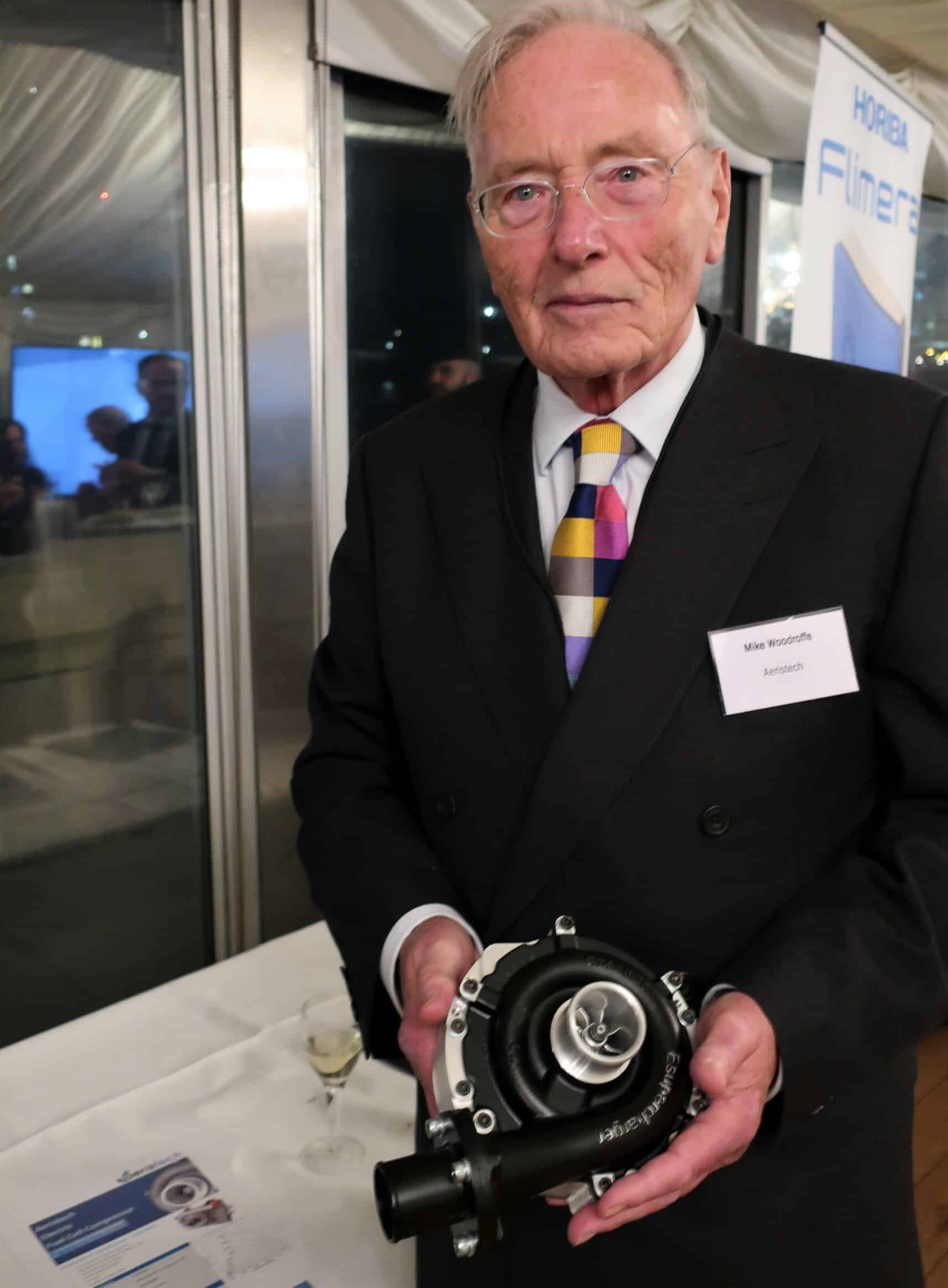
One of the evening’s honourees was Mike Woodroffe, a physicist who served as Aeristech's chair and played a key role in developing its centrifugal compressors. These compressors use 40% less energy than conventional devices, and the first hydrogen fuel-cell cars to employ them are due to roll off the production line in China next year.

Mike Woodroffe holding a small silver-and-black device in his hands

The second – very different – award-winning engine component on display was developed by Helen Webber and colleagues at Reaction Engines. Their heat exchanger can cool airstreams from 1000 °C to ambient temperatures in less than 1/20th of a second, making it a critical component of the firm’s Synergetic Air-Breathing Rocket Engine (SABRE). The exchanger is currently undergoing tests in the US, and Tom Page, the company’s public-relations chief, says they are on track to flight-test the completed SABRE in 2025.

Helen Webber and Andrew Davies standing in front of a screen displaying an artist's impression of the SABRE engine

The three biomedical winners each had to overcome unique design challenges. Elekta’s goal was to build a device that could image tumours in real time, while the patient is undergoing radiation treatment, so as to minimize radiation damage to healthy tissues and still deliver a clinically effective dose to the tumour. To accomplish this, Elekta physics research leader David Roberts explained that they first had to model how the magnetic field of their MRI scanner would interact with the electron beam of their linear accelerator. Once they understood that, they could then adapt their system’s magnets and shielding accordingly.

Photo of a man in a business suit, Martin Gouch, standing next to a scanner and a computer screen displaying an image of a tissue biopsy

For FFEI’s device, the challenge was to help pathologists diagnose cancers and other conditions more quickly, without the eyestrain associated with regular, prolonged use of conventional microscopes. Their solution is a digital imaging system that keeps tissue samples in focus over the entire multi-millimetre area of a biopsy slide, while also preserving the colours that pathologists are accustomed to seeing in a microscope.

Horiba’s award-winning FLIMERA camera also has applications in cancer screening, but its underlying technology is based on fluorescence lifetime imaging microscopy (FLIM). Managing director David McLoskey described this technique as “a way of looking at stored energy in molecules”, adding that the length of time between when a molecule absorbs a photon and when it radiates the energy away is an important probe for interactions between cells and proteins. Horiba’s device incorporates advanced software that enables videos of molecular interactions to be displayed and recorded at a rate of 30 frames per second.

A man in a business suit talking with a woman in a bright yellow turtleneck and pointing to an image on a computer screen

The IOP's Business Awards are now in their eighth year. The list of past winners includes more than 50 companies from across the UK and Ireland, in sectors ranging from defence to food manufacturing.

Extreme heatwaves pose spreading threat

Scientists in the US have added a new dimension to the growing hazard of extreme heat. As global average temperatures rise, so do the frequency, duration and intensity of heatwaves.

And that’s not the only factor to worry about. By mid-century, the area straddled by those bands of extreme heat could increase by 50% – if nations attempt seriously to contain climate change.

But if humans carry on burning fossil fuels in ever-greater quantities and felling more and more reaches of tropical forests, the most dangerous and extreme heatwaves in future could cover areas 80% bigger than at present.

“As the physical size of these regions increases, more people will be exposed to heat stress,” warns Bradfield Lyon, associate research professor in the Climate Change Institute and School of Earth and Climate at the University of Maine, US.

Lyon, lead author of a new study in the Environmental Research Letters journal, says: “Larger heatwaves would also increase electrical loads and peak energy demand on the electricity grid as more people and businesses turn on air conditioning as a response.”

Climate scientists have warned repeatedly that higher average temperatures must mean ever hotter extremes.

By the century’s end, under some climate projections, three out of four people on the planet could be exposed to potentially dangerous heatwaves.

Double punch

In some regions, the double punch of high heat and very high humidity could make conditions intolerable, and scientists in the US recently counted 27 ways in which high temperatures could claim lives.

In principle, extremes of heat are already a threat not just to public health, but also to national economies. Researchers in Australia have already started to count the cost.

Until now, the interest has focused on the highest temperatures by day and by night, the number of days of sustained heat, and the frequency with which extremes might return.

But the new dimension – the increased area oppressed by extreme heat – presents unexpected challenges for city authorities and energy utilities.

“If you have a large contiguous heatwave over a highly populated area, it would be harder for that area to meet peak electric demand than it would be for several areas with smaller heatwaves that, when combined, are the same size,” says one of the report’s other authors, Anthony Barnston, chief forecaster at Columbia University’s International Research Institute for Climate and Society.

How astronauts stay healthy, the future of fusion, quantum games for high schools

Becoming ill in space can be a big deal so astronauts must be in tip top health before they get anywhere near a rocket. And once up in space, astronauts must exercise to stay in good condition. In the above video, the former NASA astronaut Mike Massimino explains the challenges of staying healthy in space – including unexpected problems like vibrations from exercise machines disturbing delicate zero-gravity experiments on the International Space Station.

This week we are running a Twitter poll that asks what you think physicists will have achieved by 2040. One option is commercial fusion energy, and one of the more unlikely proponents of this potential power source is a former star of the reality TV show Made in Chelsea. Previously seen swanning around bars and boutiques in the King’s Road, Richard Dinan is the founder of Pulsar Fusion – a private firm that is building a small-scale fusion reactor in the English countryside.

Now, Dinan is back in front of the camera in “Fusion: the power to change” (below). In this nicely-done video he visits the UK’s Culham Centre for Fusion Energy to watch the Joint European Torus fusion reactor in action. Dinan also travels to the next-generation ITER facility, which is currently under construction in France and meets scientists working there. Then, it’s back to the UK where we hear from a Pulsar Fusion scientist who is looking at how fusion could be used for space propulsion.

Will we have commercial fusion by 2040? Probably not, but that doesn’t mean that physicists shouldn’t be trying to gain a better understanding of how to create and control nuclear fusion for a range of applications.

As quantum technologies such as cryptography enter the mainstream its essential that the basics of quantum theory are taught in high schools. But how to imbue the subtleties of Bell’s inequalities on your average 17-year-old?

Andrea López-Incera, Andreas Hartmann and Wolfgang Dür at Austria’s University of Innsbruck think that games are the answer. In “Encrypt me! A game-based approach to Bell inequalities and quantum cryptography” they describe a game in which a class is divided in two, with half the students playing the role of quantum bits of information (qubits) and the other half playing the role of physicists making measurements on those qubits.

Now that might sound a bit boring, but making a measurement actually involves the physicists throwing balls at the qubits who try to avoid being hit. Sounds like fun.


Celebrating exoplanets, dogs in space, emotional geography for physicists

In this instalment of the Physics World Weekly podcast we celebrate some of the amazing research that has been done on exoplanets – distant worlds that orbit stars other than the Sun. We chat about how astronomers can work-out the chemical composition of exoplanets that have been consumed by their stars and meet Giovanna Tinetti, whose team was the first to detect water vapour in the atmosphere of a rocky exoplanet.

A little closer to Earth, we review a book that looks at Soviet space dogs such as Laika, which made it possible for humans to travel into space.

We also explore the concept of “emotional geography” and learn why it can have an important effect on the career choices made by physicists.

Finally, we look at a famous bet between physicists that has just been settled and suggest a few wagers about physics breakthroughs that may (or may not) happen over the next 20 years.

Doomed exoplanets were much like Earth

Some rocky exoplanets bear a striking resemblance to Earth, according to Alexandra Doyle, Edward Young and colleagues at the University of California at Los Angeles. The team used the properties of light coming from six white-dwarf stars to calculate how much oxygen, iron and other elements were present in planets that once orbited the stars. Their observations suggest that these planets – which were consumed by their stars long ago – have the same geophysical and geochemical properties as Earth. While astronomers are able to observe rocky exoplanets, working out what they are made of is difficult and this research provides important clues regarding the composition of these Earth-like objects.

White dwarfs are the ancient remnants of stars that had masses less than about 10 Suns. This means that most stars in the Milky Way will eventually become white dwarfs – including the Sun. Many white dwarfs would have had planets, which would have been consumed by the stars at some point in their stellar evolution. The atmosphere of a white dwarf is expected to comprise only the lightest elements – hydrogen and helium – so the presence of heavier substances in the stellar atmosphere such as magnesium, iron and oxygen means that the star has probably ingested rocky planets or asteroids.

Minerals and metallic iron

Doyle, Young and colleagues did spectroscopic studies of light from six white dwarfs to determine the amount of oxygen, iron, magnesium, silicon, calcium and aluminium present in their atmospheres. In particular, they were interested in the abundance of oxygen relative to the other elements. This allowed them to work-out how much oxygen in a planet would be bound-up in minerals such as magnesium and silicon oxides – and also how much unreacted metallic iron would have been present in a planet. Earth, for example, has a huge amount of metallic iron in its core.

The study revealed that the white-dwarfs’ planets had elemental compositions similar to Earth, Mars and the asteroids. Describing their observations in Science, the researchers conclude that “at least some rocky exoplanets are geophysically and geophysically similar to Earth”. The abundance of oxygen determines the relative size of the metallic core of a planet; the geochemistry of its mantle and crust; the composition of its atmosphere; and the processes involved in mountain building. As a result, these observations suggest that some of the many rocky exoplanets expected to populate the Milky Way should be very similar to Earth.

Giant negative thermal expansion seen in nanomagnet

Most materials expand when they are heated up and contract when cooled down - a phenomenon known as positive thermal expansion (PTE). Over the past three decades, however, an increasing number of materials showing the opposite effect – that is, negative thermal expansion (NTE) – have been discovered. Researchers in Portugal and the US say they have now found NTE above the magnetic ordering temperature in magnetic nanoparticles for the first time. The new discovery will be important for making composites from PTE and NTE materials that have zero thermal expansion for use in a host of technology applications.

The researchers, led by João Pedro Araújo, André Pereira and Joao Belo of the University of Porto found the NTE effect in Gd5Si1.3Ge2.7 magnetic nanogranules at low temperatures of between 90 and 150 K and more interestingly, from the point of view of applications, at the room-temperature interval of 260-340 K.

Gd5Si1.3Ge2.7 belongs to the technologically important family of materials R5Six Ge4−x (where R = rare earth). These have been extensively studied since 1997, when researchers discovered the giant magnetocaloric effect in Gd5Si2Ge2. Since then they have also found giant magnetoresistance, spontaneous generation voltage and colossal magnetostriction in this compound. These effects come from the coupling between the magnetic and structural phases in the material, which lead to magnetostructural transitions at a transition temperature TMS.

In the bulk form, these materials show PTE in both the ferromagnetic (T<TMS) and the paramagnetic states (T>TMS).

“A curious story”

“Ours is a very curious story,” says Belo. “In previous experiments on nanoscale Gd5Si1.3Ge2.7, we had already obtained synchrotron X-ray diffraction data as a function of temperature in the 90 to 340 K range in 5 K step intervals. In this early work, however, we were so focused on trying to study the structural transition that we completely overlooked the diffractograms taken at temperatures away from the temperature at which this transition takes place – that is, below 150 K and above 250 K.

“It was only about two years later when we were trying to analyse and understand the negative thermal dependence of the electrical resistivity versus temperature curve of this material that we decided to look more closely at the diffractograms of these low-and high-temperature regions. And that was when we found the NTE and observed how it correlated with the negative thermal dependence of the electrical resistivity.”

This result is particularly interesting since there are no reports of any kind of NTE in Gd5(SiGe)4 materials in their bulk form, he tells Physics World.

Nanoparticles under pressure

The researchers say this particle size-reduction effect comes from the surface pressure of the nanoparticles (which they estimate to be around 11 kbar).

“This intrinsic surface pressure is very much like what happens when a drop of water forms and is present on every nanoparticle,” explains Belo. “This pressure is inversely proportional to the diameter of a nanoparticle so we believe that NTE could also be induced by applying pressure to macroscopic samples of Gd5Si1.3Ge2.7.”

The team hopes that the result will trigger a renewed interest in the study of the thermal expansion of R5(SiGe)4 and magnetic nanoparticles in general. Raman spectroscopy on these materials, for example, could help unveil what changes take place on lattice vibrations at the PTE to NTE transition.

Creating composites with near-zero thermal expansion

NTE materials mixed with a PTE material in composites that have near-zero thermal expansion are particularly useful as temperature-stable thermal contacts in microelectronic and semiconductor devices undergoing thermal cycling operations, says Belo. They might also find use in precision instruments in which any volumetric change induced by temperature variations can cause them to malfunction. Other possible applications include fibre-optic and electro-optical sensors and substrate materials for mirrors in various telescope and satellite applications.

The researchers, reporting their work in Physical Review B, say they are now optimizing their procedure to synthesize controlled-size Gd5(SiGe)4 nanoparticles with different compositions and Si/Ge ratios. “We are also planning high-pressure synchrotron X-ay diffraction experiments to evaluate how size-confinement and pressure affects the atomic structure of these materials and how similar these two effects are.”

Community spirit stems from London tradition

Are you a young scientist who is keen to make contacts among senior academics and industry leaders? Or perhaps you already have lots of experience in science and engineering, and would like the opportunity to meet and discuss your ideas with like-minded individuals, and also give back by nurturing the talents of students and scientists who are just starting out on their careers?

If that sounds appealing, you might consider joining a unique organization that has emerged from some of the oldest traditions in the City of London. This modern livery company – an updated version of the original livery companies that were established in medieval times to manage trade within the City’s Square Mile – has a specific focus on scientific instrumentation, but shares many of the same ideals, traditions and privileges of its ancient counterparts.

Today, some 110 livery companies are recognized by the City of London. Each one is affiliated with a specific profession, ranging from fishmongers and drapers through to gunmakers and architects, and nearly all take the formal title of “Worshipful Company”. While the last of the old-style livery companies was created in 1746, a new breed of modern livery companies started to emerge in the 1930s – and among them was the Worshipful Company of Scientific Instrument Makers (WCSIM), which was founded in 1955.

From medieval London to modern science

Whether old or modern, all livery companies follow the same traditions and pursue two main goals: to share knowledge and fellowship among their members, and to support their community through philanthropy or charitable donations. “Modern livery companies allow members to make connections with other people in the same profession, while also supporting each other and funding charitable causes that are linked to their line of work,” says Misha Hebel, who is Clerk of the WCSIM – the most senior permanent employee in the livery.

STEM day at the WCSIM

Alongside fellowship and philanthropy, members enjoy the heritage and traditions of the City of London – although Hebel points out that members of the WCSIM are located throughout the UK and in other countries too. All the livery companies also share a common lexicon that’s been passed through the generations, with the term “livery”, for example, referring to the distinctive dress that would have been worn in the past to denote that an individual belongs to a specific trade.

Anyone connected with scientific instrumentation can join the WCSIM. Current members range from school and university students through to experienced scientists and engineers from both industry and academia, which always generates plenty of lively conversation and offers lots of opportunities for younger members to meet company CEOs or senior researchers.

Members benefit from insights gained across disciplines too. “You might get a physicist sitting next to an engineer, or an academic talking to a company CEO, and it can suddenly spark a completely different idea or solution,” says Charles Holroyd, a member of the WCSIM who is currently serving as the Junior Warden.

Holroyd joined the WCSIM as a Liveryman, the most senior form of membership, which is open to those with extensive experience in scientific instrumentation. Less experienced members usually join as Freemen, with the prospect of becoming full Liverymen as their career progresses. And, despite the name, both men and women can and do join the company at any level.

Students at school and university can be invited to join as Apprentices and Scholars, respectively. They are usually promising science or engineering students who have won a prize or competition supported by the WCSIM, such as the Arkwright Scholarships that are awarded to school students who excel in science and maths. "The hope is that they will stay interested in the livery as they progress through university and into a career connected to scientific instrumentation,” says Holroyd.

Connections count

Liverymen from academic and industrial backgrounds give back to the scientific community by giving younger members help and advice, whether about science and technology, career options, or how to start a new business. They also get involved in events and activities that encourage school students to pursue careers in science and engineering. “The WCSIM has a database of interests that makes it easy to link people together,” says Holroyd.

Dinner with the WCSIM

As Clerk of the WCSIM, Hebel spends much of her time organizing events that bring together the membership. They include informal trips and gatherings, as well as formal black-tie dinners that members enjoy for the “surroundings, the good food and wine, and the chance to dress up”. She also works closely with various committees and a small group of the most senior members, called the Court, which is headed by the company’s Master. The Master is elected from the members of the Court and changes every year, and part of the Clerk’s role is to guide each new Master and help them to represent the livery at important events in the City.

The WCSIM’s current Master is Ken Grattan, a professor of scientific instrumentation and Dean of the Graduate School at City University London, and a Fellow of the Royal Academy of Engineering and the Institute of Physics. “It’s partly about the fellowship and camaraderie, but also about the opportunity to give something back to the community,” comments Grattan. “We provide support to young scientists though grants and prizes, while more experienced members can act as mentors to early-career scientists and engineers who want to broaden their horizons.”

All members can attend the WCSIM’s events and have access to its Livery Hall in central London – an impressive building that the WCSIM shares with two other livery companies. Freemen can be granted Freedom of the City of London through redemption, which today is largely symbolic but in the past would have been their license to trade in the Square Mile. “It used to be a piece of paper that was kept in a little red envelope and had to be shown on entering the City in order to trade,” explains Hebel. Liverymen must also be Free of the City before they can be admitted.

Liverymen, meanwhile, have additional privileges. Only Liverymen can serve in the Court and become a Master, and they can also vote in the City of London elections for the Lord Mayor – the most senior person in the City.

Giving back

Apart from the Apprentices and Scholars, all members of the livery company pay an annual membership fee, called “quarterage”, which varies with age, and they are also encouraged to make charitable donations on an annual basis or through a legacy. Those funds are primarily used to support the younger generation of scientists and engineers, including student prizes and the prestigious Beloe Fellowship for post-doctoral researchers. Schools are also supported, with funding recently given to provide equipment and science exercise books at a nearby primary school.

Members can choose to take part in some of these initiatives, such as judging scientific competitions or giving careers talks in schools. And the WCSIM’s charitable activities extend to their own members, with the organization’s Almoner – currently experienced scientist Diane Howse – dedicated to keeping in touch with members who are sick or may need some sort of support.

While anyone connected to scientific instrumentation can join the WCSIM, joining a livery company is considered to be a lifetime commitment. Members take an oath when they join, which says that they won’t bring the company or their profession into disrepute, and also that they are committed to the philanthropic effort. Many of the events are held in London, which makes it easier for members in the UK to enjoy the fellowship offered by the WCSIM.

  • Anyone interested in joining the WCSIM as a Freeman or Liveryman can apply online, while the Clerk is always available to talk to prospective members on the phone. There are also regular Open Evenings; please look at the website wcsim.co.uk for dates.

UK air is cleaner but challenges remain

Take a deep breath. If you’re a long-term UK-dweller the air in your lungs right now is almost certainly fresher than the air you inhaled forty years ago. Policy interventions in the UK have significantly improved air quality since the 1970s, according to a new study, and resulted in a halving of the number of deaths attributable to some of the most common air pollutants. But there are significant challenges associated with reducing secondary pollutants such as ozone; the study suggests where the UK needs to focus its clean-up act next.

Outdoor air pollution is estimated to kill 4.2 million people each year worldwide. In the UK around 30,000 deaths a year are attributed to air pollution. Long-term exposure to air pollution increases risk of cardiovascular and respiratory disease and lung cancer. Short-term exposure aggravates respiratory and cardiovascular illness and triggers asthma attacks. There is also emerging evidence of links between air pollution and diabetes, obesity, cognitive decline, dementia and adverse birth outcomes.

Like most other industrialised countries, the UK saw a rise in air pollution through much of the 20th Century, reflecting an increasing demand for energy and mobility, and a fall in air pollution in recent decades due to more stringent emissions standards. But how much impact did policy interventions really have?

Stefan Reis from the Centre for Ecology & Hydrology in Edinburgh and colleagues at the University of Edinburgh, University of Oxford and Institute of Occupational Medicine modelled changes in key air pollutant concentrations -- nitrogen dioxide, sulphur dioxide, fine particulate matter and ozone -- and related health effects across the UK over the last 40 years.

In order to correct for the variability caused by meteorological factors, they used a fixed meteorological year for all simulations. This meant that the modelled changes in air pollutant concentrations and related health effects were solely a function of changes in emissions, and reflected the impact of policy interventions such as phasing out specific fuels or substances, regulating use of particular chemicals, or developing cleaner and more efficient technologies.

Overall, the results show that the UK attributable mortality due to exposure to fine particulate matter declined by 56% and that due to nitrogen dioxide exposure dropped by 44%, while ozone attributable respiratory mortality increased by 17% over the same period (with a slight decrease between 2000 and 2010).

Analysing the data more closely, it was clear that policy interventions and reductions in emissions were behind many of the trends. For sulphur dioxide and fine particulate matter, the researchers observed a consistent downward trend over the entire time period. Nitrogen dioxide was more complicated. Growth in vehicle numbers and miles travelled resulted in an increase in NOx emissions between 1970 and 1990, but then more stringent vehicle emissions controls kicked in and emissions began to fall. “The further growth of vehicle numbers and mileage has been offset by individual vehicles emitting less,” says Reis.

Ozone concentrations showed a steady increase over the 40-year period; ironically some of the greatest increases have occurred in areas where NOx emissions have decreased most. That's because ozone is a secondary pollutant that forms from precursor pollutants including NOx and non-methane volatile organic compounds (NMVOCs). The ratio of nitrogen dioxide to NMVOC determines how much ozone is produced.

“Too much nitrogen dioxide leads to destruction of ozone, so you will typically not find high ozone concentrations on or near busy roads, but rather some distance away from the main sources, where the atmosphere is more mixed,” says Reis, whose findings are published in Environmental Research Letters (ERL).  “To reduce ozone further, consistent reductions of NOx and NMVOC emissions will be essential, so the current focus on reducing road transport emissions and more general fossil fuel combustion is on the right track.” Ozone can also travel long distances and so it will be important to look at sources outside the UK.

Reis and his colleagues suggest that there needs to be a greater focus on reducing emissions in sectors that have so far escaped major scrutiny. These include agriculture, domestic wood and coal burners, shipping and non-road mobile machinery. The researchers also note that we need to better quantify the sources contributing to the pollution and focus on a truly integrated assessment of policies to avoid unintended consequences. For example, the promotion of biomass for domestic heating has helped to reduce our carbon footprint but has also led to local air pollution hotspots because most domestic appliances do not have filters and can emit large amounts of fine particulate matter.

“Integrated policies that look at air pollution, greenhouse gases and other sustainable development indicators are essential to ensure interventions are leading to overall improvements, rather than solving one problem by creating new ones,” says Reis.

Targeted treatment guides radiation directly to pancreatic tumours

Targeted alpha therapy

Pancreatic cancer remains a leading cause of cancer‑related death worldwide. Patients are usually treated with chemotherapy or radiation therapy, but these are not always effective and can have toxic side-effects due to the treatments also impacting healthy cells.

A research collaboration between Osaka University and Heidelberg University Hospital is exploring an alternative approach: targeted radionuclide therapy, in which a radioactive molecule travels through the bloodstream to the tumour to deliver radiation directly to cancer tissue (J. Nucl. Med. 10.2967/jnumed.119.233122).

“With traditional anti-cancer therapies, there’s a trade-off between efficacy against cancer cells and off‑target effects in non‑cancerous cells,” explains lead author Tadashi Watabe from Osaka University Graduate School of Medicine. “We’re focused on finding ways to re-balance this trade-off in radiotherapy, by increasing the dose of radiation delivered to cancer cells while keeping it localized to those cells as much as possible.”

The new treatment employs the alpha particle emitting radionuclide 225Ac. Alpha particles travel a short distance in tissue, thereby limiting their off-target effect. The researchers targeted the therapy at the fibroblast activation protein (FAP), which promotes tumour growth and progression and is found almost exclusively on stroma cells surrounding pancreatic tumours and various other cancer types. The low expression of FAP in normal tissue makes it an excellent target for this approach.

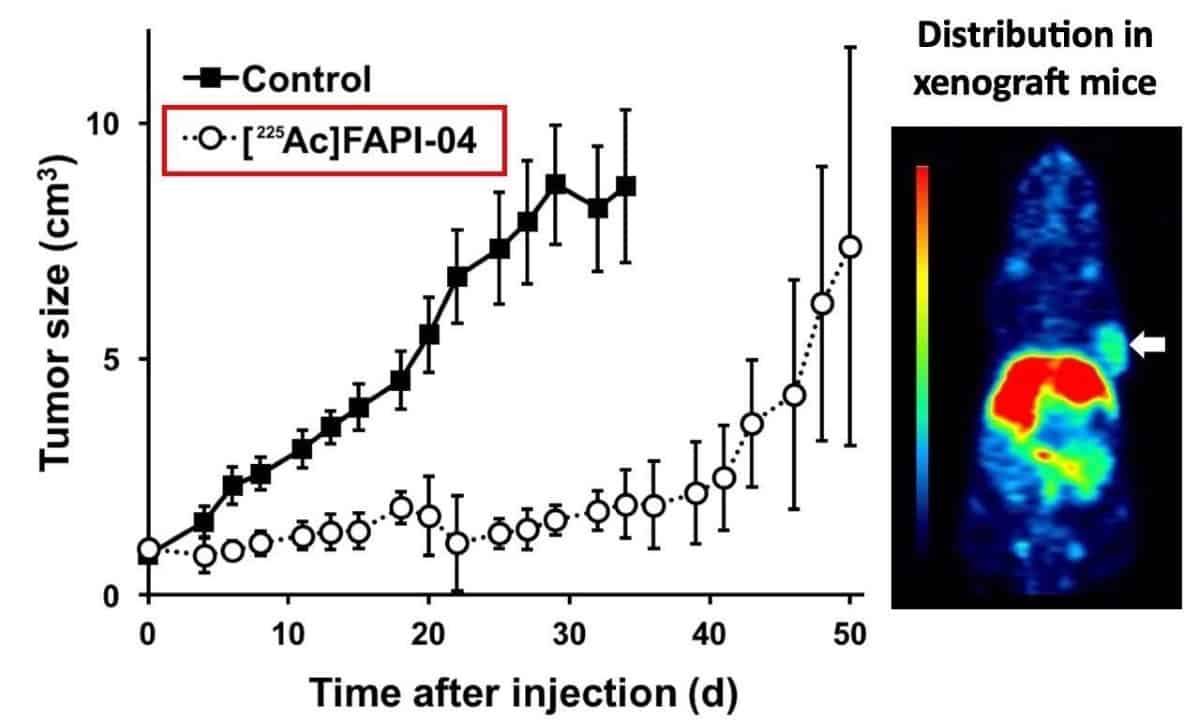
The researchers used the positron emitter 64Cu and 225Ac to label small-molecule FAP inhibitor (FAPI) probes. They employed 64Cu-FAPI-04 to evaluate tumour uptake in mice bearing human pancreatic cancer xenografts, and 225Ac-FAPI-04 to assess radionuclide therapy of the tumours.

PET scans of mice injected with 64Cu-FAPI-04 revealed mild uptake in tumours and relatively high uptake in the liver and intestine, with rapid clearance through the kidneys and slow washout from tumours. Immunohistochemical staining revealed abundant FAP expression in the stroma of tumour xenografts, while cellular uptake analysis demonstrated minimal accumulation in the tumour cells themselves.

For the targeted therapy using an alpha emitter, the researchers injected 225Ac-FAPI-04 (at a dose of 34 kBq) into the tail veins of six tumour-bearing mice. They observed significant reduction in tumour growth in these mice compared with control mice. Importantly, the treatment did not significantly change the animals' body weights, indicating that it likely had few toxic side effects.

“We are very encouraged by these initial results,” says Watabe. “We think the approach has enormous therapeutic potential, particularly for patients with pancreatic cancer who’ve exhausted their other treatment options. What’s especially exciting is that our method of targeting the stroma can in principle work against many other types of cancer. We think this could represent a new path forward in radiation therapy.”

Copyright © 2026 by IOP Publishing Ltd and individual contributors