It’s a mugs game, predicting who will win the Nobel Prize for Physics. Indeed, in the decade or so that I have engaged in such tomfoolery I have only been right twice. And those were pretty obvious – the 2013 prize to François Englert and Peter Higgs for the theoretical discovery of the Higgs boson and the 2017 prize to Rainer Weiss, Barry Barish and Kip Thorne for decisive contributions to the observation of gravitational waves.
I believe that the beauty of the Nobel prizes is that they often come out of the blue, honouring important research done long ago or work that you simply didn’t realize was extremely important.
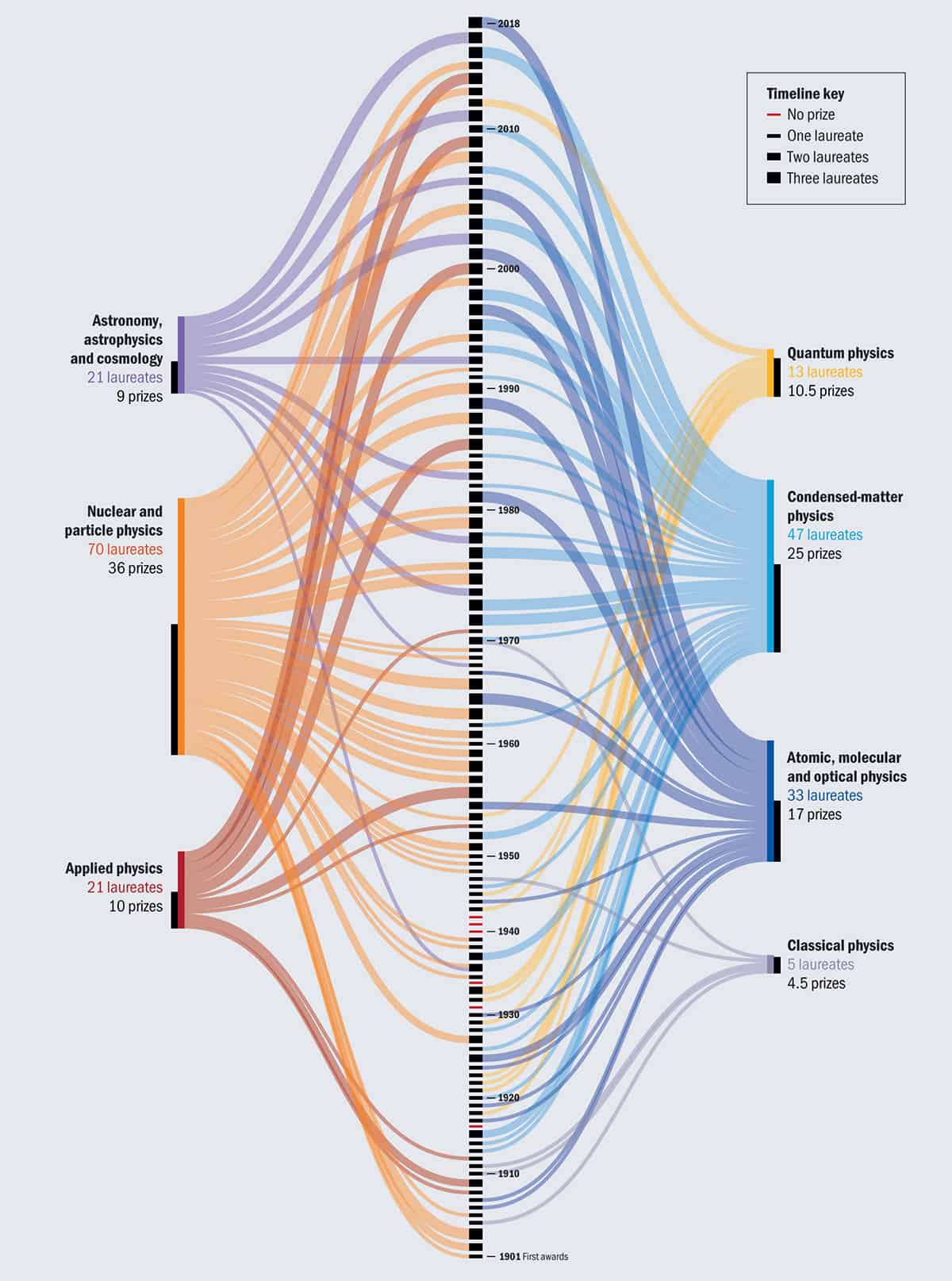
But I’m not giving up on making predictions quite yet, and I have recently updated an infographic we first published in 2014 that illustrates the subject areas of all the physics Nobel prizes since 1901. If you look at each subject area, it appears that subsequent prizes are separated by gaps of about 5-10 years.
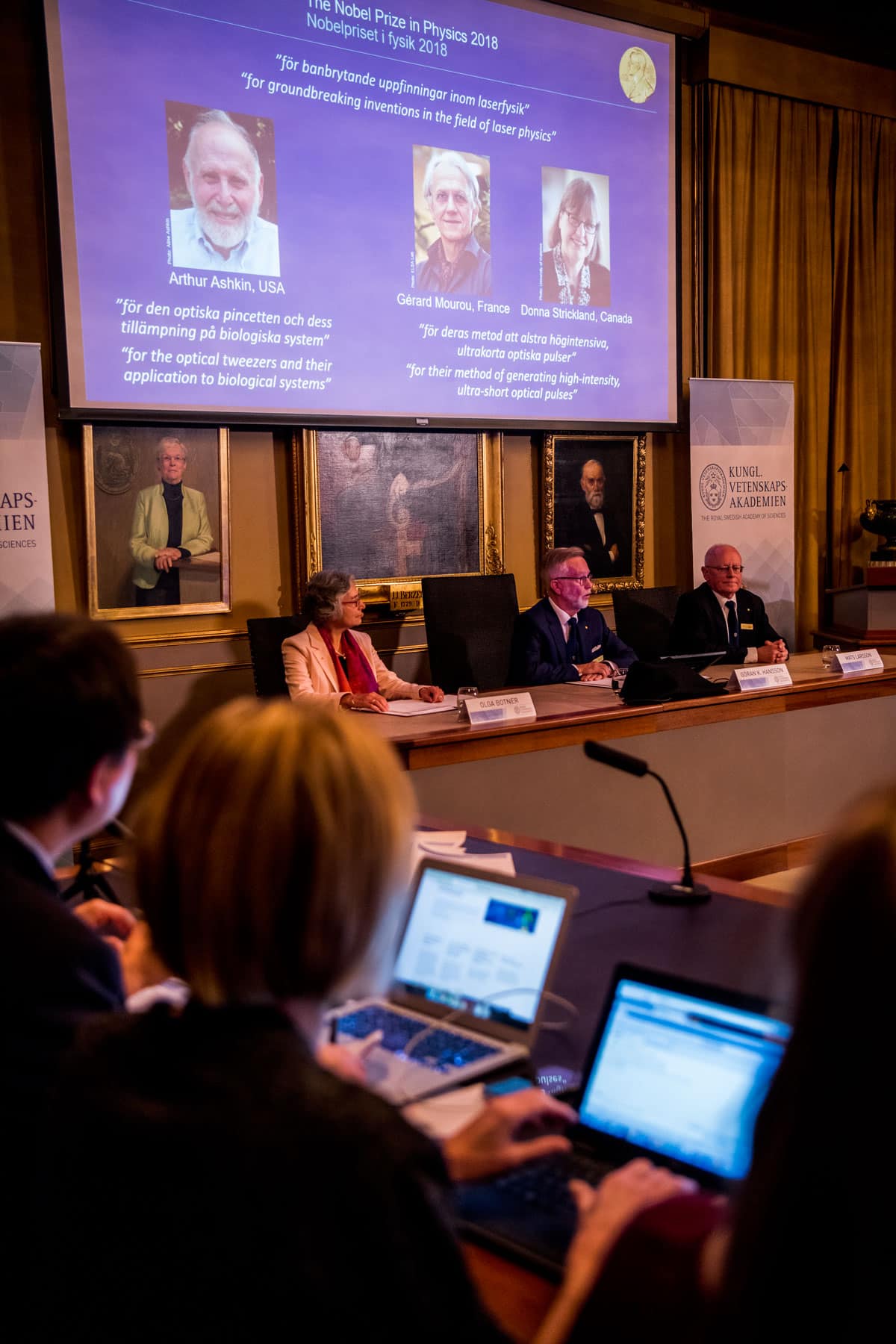
If we had looked at the infographic this time last year, we would have been struck by the fact that there had not been a prize for atomic, molecular and optical physics in over ten years – so one should be due. Sure enough, the 2018 prize went to Arthur Ashkin, Gérard Mourou and Donna Strickland for their “ground-breaking inventions in the field of laser physics”.
On that basis the official Physics World prediction is that this year’s prize will be awarded for work done in the foundations of quantum physics, a topic that has not garnered a prize since 2012. But who will be making the trip to Stockholm in December?
Our top pick is a prize shared by Alain Aspect, John Clauser and Anton Zeilinger for their work on testing Bell’s inequalities. Back in 2010 the trio bagged the Wolf Prize in Physics for this work – and this is often a harbinger of Nobel glory.
Our second pick is a quantum-information prize to Peter Shor, Gilles Brassard and Charles Bennett. Brassard and Bennett could share half the prize for developing quantum cryptography, while Shor would get the other half for creating his eponymous factoring algorithm for quantum computing. This prize would make it two prizes in a row for Canadian physicists – first Strickland and then Brassard.
Another possibility is a prize to Peter Zoller and Ignacio Cirac for their contributions to the development of schemes for processing quantum information. In particular, the duo published a ground-breaking paper in 1995 describing how a quantum computer could be implemented using cold trapped ions. This paper inspired David Wineland and colleagues to very quickly build such a device and Wineland went on to share the 2012 Nobel prize for his contributions to the control of quantum systems.
Slow light
Beyond quantum information, another longstanding prediction of mine is a prize to Lene Hau for her work on using ultracold gases to slowdown and even stop light. This is something that has already been useful for transferring quantum information from light to matter and then back again.
Finally, and going out on a limb. My final prediction is inspired by the popularity of a recent news story about the non-Abelian Aharonov-Bohm effect. I would be very pleased to see next week’s prize go to Yakir Aharonov and Michael Berry for their work on geometric phases in quantum mechanics.
Physics World‘s Nobel prize coverage is supported by Oxford Instruments Nanoscience, a leading supplier of research tools for the development of quantum technologies, advanced materials and nanoscale devices. Visit nanoscience.oxinst.com to find out more
The anaerobic bacteria P. aeruginosa formed biofilms in thick constructs. Left: Photos of the 3D bioprinted biofilm at day 0 and matured biofilm at day 14 (scale bar: 1 cm). Right: 2D projection and 3D reconstructed confocal laser scanning microscopy images of matured biofilm (scale bar: 100 μm).
Antimicrobial resistance is an increasing problem worldwide, with the World Health Organization calling for urgent action to avoid a “post-antibiotic era” in which common infections and minor injuries can once again kill.
Bacteria in acute infections usually exist in a free-swimming state and can be treated with antimicrobials. Chronic infections, however, can lead to the development of bacterial biofilms – 3D structures of bacterial cells – which are up to 1000 times more resistant and can render standard antimicrobial therapies ineffective. Unfortunately, most methods used to study biofilm resistance are 2D in nature, and thus unable to reflect complex 3D infection processes seen in vivo.
As such, there’s an urgent need for 3D biofilm models that realistically represent clinical infection. With this aim, a team headed up at the University of Strathclyde has developed a way to 3D print bacteria biofilms for antimicrobial resistance testing and screening of new drugs (Biofabrication 10.1088/1758-5090/ab37a0).
“Our aim is to create clinically relevant 3D bacteria biofilms that can potentially mirror in vivo bacterial growth and behave more closely than traditional 2D models, for example, in their responses to drug treatment,” says senior author Wenmiao Shu.
3D bioprinting
Shu and colleagues created a bacteria-laden bioink by mixing live bacteria into a partially-crosslinked hydrogel. They employed a custom-built bioprinter to extrude this bioink into constructs with precisely controlled thickness and design. After printing, the researchers immersed the structures in barium chloride solution to increase hydrogel cross-linking and boost stability.
Over time, as the bacteria grew, 3D biofilms developed on the constructs. The researchers observed excellent bacterial viability in the constructs, with production and maturation of biofilms possible for at least 28 days. This long-term stability more closely mirrors clinical biofilms than previous biofilm models.
To determine the ideal construct design, the researchers bioprinted solid and porous constructs with thicknesses from 0.25 to 4 mm. Using E. coli, they saw that biofilm formation was greater in thinner (0.25–1 mm) than thicker (4 mm) constructs, attributed to restricted diffusion of nutrients and oxygen. However, the thinner constructs were not robust enough for physical manipulation and analysis after 14 days.
Growth in solid constructs was slower than in porous constructs for all thicknesses, likely due to the porous design facilitating fluid transport and nutrient and oxygen diffusion. The optimal structure for an E.coli biofilm was a 1 mm porous construct.
Whilst aerobic E. coli grew less in thicker constructs, anaerobic bacteria can thrive in oxygen-depleted conditions. To test this, the researchers grew films of the anaerobic P. aeruginosa in non-porous 2- and 4-mm thick constructs. They found that P. aeruginosa formed an extremely dense biofilm layer in these structures, and note that the 4 mm biofilm is likely the thickest 3D bioprinted biofilm construct reported to date.
“The key challenge was the development of a stable hydrogel system that would allow 3D biofilm formation over a longer period of time,” explains Shu. “In this study, we successfully developed a stable hydrogel system that will last over four weeks and allows us to observe the full life-cycle of 3D biofilm development: formation, growth, maturation and finally dispersal, which is migration to a new site for infection.”
Resistance testing
To assess the susceptibility of 2D and 3D bacterial cultures to treatment, the researchers compared 3D printed biofilms with 2D bacterial cultures, using S. aureus. Most strains of this pathogen, including methicillin-susceptible S. aureus (MSSA), are sensitive to antibiotics. However, there is a growing worldwide prevalence of methicillin-resistant S. aureus (MRSA) infections.
The team determined the minimum concentrations of methicillin that prevented growth of MRSA and MSSA in 2D culture and in 3D biofilms. As expected, MRSA required higher drug concentrations than MSSA, indicating greater resistance to antimicrobials. However, for both strains, far higher doses were required to treat the biofilm than corresponding 2D cultures.
The researchers also compared 1- and 2-mm thick bioprinted E. coli constructs exposed to tetracycline. Thicker biofilms showed greater resistance to the antimicrobial drug, with more bacteria surviving in the 2 mm than the 1 mm constructs after seven days of treatment. They surmised that the thicker and longer-lasting biofilms behaved more closely to biofilms in in vivo infection.
1 mm (right) and 2 mm (left) thick E. Coli constructs after exposure to tetracycline discs. In the centre where the drug was directly applied, bacteria in the thinner biofilm were completely killed while more bacteria survived in the thicker biofilm.
This demonstrated ability to design and control the thickness of biofilms will also allow the team to study drug penetration in 3D, which is impossible for 2D biofilms. A more immediate benefit could be testing the impact of drugs on biofilm infections for an individual patient. More accurate bacterial biofilm models may also aid future development of novel drug compounds and therapies for tackling the disease.
“We are already working with the clinicians who are very excited about the new possibilities enabled by the new research,” Shu tells Physics World. “Our next focus is on applying the new bioprinting technology for studying and developing more effective drug treatment for specific biofilm-associated infections.”
Quantum gate. Credit: Physics Phys. Rev. X 9, 031045, Courtesy of Conor Bradley
Imperfections in diamond enable a 10-qubit register – a collection of qubits that can store data in a quantum computer – report researchers at Delft University of Technology in the Netherlands and Element Six in the UK. Their diamond-based system is capable of preserving an arbitrary single-qubit state for over a minute – a record for a solid-state qubit. The multiqubit register signifies important progress in quantum-information processing, which requires a large number of qubits.
Realizing multiqubit registers is challenging for two reasons: the quantum gates require selective control of qubits, and unwanted interactions must be avoided to protect coherence in the register. Hence, the scientists developed an electron-nuclear two-qubit gate by using radio frequency pulses, which rotate nuclear spins with phase control, and alternating them with dynamical decoupling pulses on the electron spin to avoid unwanted interactions. Such a two-qubit gate accesses more nuclear spins than previous techniques and enables “high-fidelity” control of nuclear spin qubits. The fidelity of a quantum state expresses the “closeness” of that quantum state to the target quantum state. In this case a fidelity exceeding 0.5 with the target Bell state confirms genuine entanglement of all pairs of qubits.
PhD-researcher Conor Bradley at QuTech and the Kavli Institute of Nanoscience, both in Delft University of Technology, alongside his collaborators, based their qubits on a defect in diamond consisting of a nitrogen atom and an adjacent empty lattice site in place of two carbon atoms – a nitrogen-vacancy (NV) centre. The 10 qubits in their quantum register are the electron and nitrogen nuclear spins of the NV center, along with eight surrounding carbon-13 nuclear spins. Researchers then show that the register is fully connected by preparing entangled states for all 45 possible qubit pairs.
The researchers also managed to generate N-qubit entanglement of up to seven qubits, which makes for better quantum algorithms. Furthermore, a nuclear spin qubit is a great contender for quantum memory as this research has reported the longest coherence times for individual qubits in the solid state. In their work at a temperature of 3.7 K Bradley and collaborators show that a state can be protected for over 75 s.
The study supervisor, Tim Taminiau, expects that the new method will be applied in other spin configurations in diamond, silicon and silicon carbide. In the QuTech news article he remarks: “Our findings pave the way for advanced quantum algorithms, quantum error correction and large multi-qubit quantum networks based on tens of solid-state spin qubits.”
You can read his insights in “Inside the Nobels” in the October 2019 issue of Physics World magazine, which is out now in print and digital formats. (You can also read the article online for free here.) The new issue has as well a special interview with Donna Strickland, who shared last year’s Nobel prize on what life’s been like for her over the past 12 months.
Scene of the crime: improving the forensic techniqiue of blood-spatter analysis is the cover feature of the October 2019 issue of Physics World
Elsewhere in the new issue, Sidney Perkowitz looks at how physics is helping to beef up the occasionally unreliable forensic technique of “blood-spatter analysis”, while James McKenzie examines the commercial prospects for LiFi – and explains why using light to transmit data might have some surprising applications.
Plus there’s our usual mix of news, opinion, reviews, careers and Lateral Thoughts.
You can enjoy the entire October 2019 issue of Physics World magazine via our digital apps for iOS, Android and Web browsers (membership of the Institute of Physics required).
• Life as a new Nobel laureate – What’s it like to win a Nobel Prize for Physics? Donna Strickland, the Canadian laser physicist who shared the 2018 prize, talks to Matin Durrani about her experiences over the last year
• Dealing with a climate emergency – Matthew Jones and Charles Adams say physicists need to change the way they work to make physics more sustainable
• On the retreat – If your life and livelihood were threatened by rising sea levels, where would you go and who would help? Robert P Crease reports from a conference on the difficulties of “managed retreat”
• Inside the Nobels – All of us dream of receiving a Nobel Prize for Physics, but how exactly do the winners get picked? Hamish Johnston gets the inside story from Lars Brink, a Swedish particle theorist who served on the Nobel Committee for Physics on eight separate occasions
• The physics of blood spatter – Analysing the blood stains following a shooting can be key to finding the perpetrator, but it’s a field of forensics that is being called into question. Sidney Perkowitz explains how understanding the physics behind the blood distribution could help uncover the truth
• Taking a bite out of food waste – Abi Ramanan describes how hyperspectral imaging and machine learning could change the future of food production, drastically reducing waste and increasing consumer satisfaction
• To boldly go – Ian Randall reviews The Consequential Frontier: Challenging the Privatization of Space by Peter Ward
• Meet the pup stars – Kate Gardner reviews Space Dogs: the Story of the Celebrated Canine Cosmonauts by Martin Parr and Richard Hollingham
• Heavenly vistas – Tushna Commissariat reviews Cosmos: the Art and Science of the Universe Roberta by J M Olson and Jay M Pasachoff
• Going the extracurricular mile – Getting experience beyond your core academic activities is crucial if you want to bag that dream job after graduating, as Institute of Physics careers manager VishantiFox explains
• There’s no place like home – Many physics graduates look for jobs in the towns or cities they already live in, rather than moving elsewhere. Andrew Hirst and Veronica Benson explore the implications of this “emotional geography” and discuss how universities can give physicists the skills local employers need
• Anything to declare? – Nicol Caplin on the news that the Israeli SpaceIL Beresheet lander – which crashed onto the lunar surface in April this year – was unknowingly carrying a payload full of reportedly indestructible biological samples.
For the first time, physicists in the US have confirmed a decades-old theory regarding the breaking of time-reversal symmetry in gauge fields. Marin Soljacic at the Massachusetts Institute of Technology and an international team of researchers have made this first demonstration of the “non-Abelian Aharonov–Bohm effect” in two optics experiments. With improvements, their techniques could find use in optoelectronics and fault-tolerant quantum computers.
First emerging in Maxwell’s famous equations for classical electrodynamics, a gauge theory is a description of the physics of fields. Gauge theories have since become an important part of physicists’ descriptions of the dynamics of elementary particles – notably the theory of quantum electrodynamics.
A salient feature of a gauge theory is that the physics it describes does not change when certain transformations are made to the underlying equations describing the system. An example is the addition of a constant scalar potential or a “curl-free” vector potential to Maxwell’s equations. Mathematically, this does not change the electric and magnetic fields that act on a charged particle such as an electron – and therefore the behaviour of the electron – so Maxwell’s theory is gauge invariant.
Just a phase
The Aharonov–Bohm effect arises in quantum mechanics because the addition of a potential results in the introduction of a phase in the wavefunction of the electron. Normally, this phase has no effect on the observed behaviour of the electron because the measurement of a property of the electron (such as its position) determines the amplitude of the wavefunction, not its phase.
However, this phase can be detected by measuring the quantum mechanical interference between electrons that have taken two different paths from a source to a detector. If these paths travel through regions with different local values of gauge potential, then a difference in phase will alter the interference pattern measured.
This effect was proposed in 1959 by Yakir Aharonov and David Bohm and confirmed by an experiment done by Robert Chambers in 1960. Chambers sent electrons on different paths that passed next to a very long solenoid. The magnetic field outside such a solenoid is negligible (and had little effect on the electron phase) but the vector potential outside a solenoid is significant and varies in space. As a result, electrons taking the different paths around the solenoid acquire different phases.
Rich in physics
This and subsequent observations of the effect involve “Abelian” systems, in which the physics plays out in the same way when time is run forwards and backwards. In 1975 Tai-Tsun Wu and Chen-Ning Yang conceived of the non-Abelian Aharonov–Bohm effect in which the gauge fields appear differently when time runs forwards or backwards. While expected to be rich in physics, the non-Abelian version of the effect has proved very difficult to achieve.
Now, Soljacic’s team has succeeded by creating two different types of non-Abelian gauge field using fibre-optic systems – with classical light waves taking the place of the electron wavefunction. They induced the first of these fields by passing light through a specialized crystal in a strong external magnetic field. The second non-Abelian gauge field was created by modulating the light using time-varying electrical signals.
As hoped, they saw that both gauge fields produced two different interference patterns, depending on the direction of travel of the light. This showed that both gauge fields were indeed different when played forwards and backwards in time.
The team believes that the techniques developed for this first demonstration of the non-Abelian Aharonov–Bohm effect could lead to important technological and scientific advances in the future. “(This approach) might inspire the realization of exotic topological phases in quantum simulations using photons, polaritons, quantum gases, and superconducting qubits,” says Soljacic. “Combined with interactions, it may potentially one day serve as a platform for fault-tolerant topological quantum computation.”
The Buckley lab researchers (from left to right): Eashani Sathialingam, Rowan Brothers, Paul (Seung Yup) Lee, Erin Buckley, Hongting Zhao and Kyle Cowdrick. (Courtesy: Erin Buckley)
A team of US-based researchers has demonstrated how low-cost, non-invasive diffuse correlation spectroscopy (DCS) can improve the assessment of cerebral blood flow in children with sickle cell disease – a genetic blood disorder that can have a substantial impact upon the brain.
DCS is an optical technique that employs near-infrared light to relate intensity fluctuations of multiply scattered reflected light detected at the tissue surface to a blood flow index (BFI) in the underlying tissue. The researchers, based at the Georgia Institute of Technology, Emory University and Children’s Healthcare of Atlanta, used DCS to quantify brain blood flow in 11 children with sickle cell disease along with 11 healthy controls. As expected, they found that BFI was significantly higher in subjects with sickle cell disease than in the control group (Neurophotonics 10.1117/1.NPh.6.3.035006).
“Previous studies using other neuroimaging modalities have shown that kids with sickle cell disease have elevated blood flow in their brain as a compensatory mechanism to improve oxygen delivery in the face of chronic anaemia,” says co-author Erin Buckley from Georgia Tech and Emory University School of Medicine. “We found that DCS was sensitive to expected elevations in brain blood flow with sickle cell disease.”
In Buckley’s view, DCS offers numerous other advantages over traditional neuroimaging modalities that measure brain blood flow. To begin with, she highlights the fact that the manufacturing cost of a DCS system – in the region of $40,000 for the system used in the study – is orders of magnitude lower than modalities such as MRI or PET. She also observes that DCS does not involve exposure to contrast agents or ionizing radiation, and is “well tolerated in children of all ages without the need for sedation”.
Low-cost tool
Moving forward, first author Paul (Seung Yup) Lee, a postdoctoral fellow in Buckley’s group, points out that DCS may provide a simple, low-cost tool for bedside assessment of brain blood flow. In particular, he and the research team envisage promising clinical potential for DCS in children with sickle cell disease.
Portable DCS system.
“Sickle cell disease can have profound effects on the brain, including a significantly elevated risk of stroke,” Lee explains. “DCS measurements could be routinely completed at a baseline when in good health, tracked over time, and monitored when ill to mitigate risk of stroke by identifying warning signs of abnormal brain blood flow compromise and enabling timely therapeutic intervention. In short, we envision that DCS could one day be for paediatric sickle cell disease what the blood glucose monitor is for diabetes.”
On a more cautious note, Lee stresses that, at present, DCS is strictly a research tool – and that, although a handful of companies have begun to commercialize the technology, such systems are not yet FDA approved, meaning they remain targeted at research use. Even so, he argues that if the research team continues to identify key applications that can potentially improve patient care, they are “confident the technology will eventually be implemented in routine clinical practice”.
From a technology development standpoint, Lee also reveals that the team want to better understand the potential effects of haematocrit (the ratio of the volume of red blood cells to the total volume of blood) on DCS measurements, a topic he believes is particularly relevant in sickle cell disease, given the wide range of haematocrit levels seen clinically in these patients.
“We are currently working on benchtop experiments in tissue-simulating phantoms and validation studies against MRI in order to better understand these effects,” he says.
Buckley reveals that another technology development aim for the future is to “continue to push the envelope” in terms of lowering the costs of manufacturing a DCS system and making the system wearable and wireless.
“From a clinical research standpoint, our next steps are to demonstrate that these non-invasive measurements of brain blood flow we are making may actually be helpful in clinical decision making,” she adds. “We have several prospective clinical studies in the works to explore the utility of these measurements.”
On the first or second Tuesday in October every year, three people walk into a room at the Royal Swedish Academy of Sciences in Stockholm, Sweden. Surrounded by oil paintings of famous scientists, the smartly dressed trio sit down at a long table facing expectant members of the international media. In the middle is the secretary-general of the academy – currently Göran Hansson – flanked on either side by the chair of the Nobel Committee for Physics and one other member of this elite group.
The three scientists are here to reveal the winners of the Nobel Prize for Physics. Currently worth about nine million Swedish kronor (about £760,000), the prize has been awarded almost every year since 1901, with the precise sum depending on the size of the academy’s coffers. It remains the most prestigious award in physics and the one that surely all physicists dream of winning, despite recent competition from newer prizes with bigger cash sums from rival organizations such as the Breakthrough and Kavli foundations.
With light filtering down from chandeliers hanging above, the secretary-general – in time-honoured tradition – reveals the winners first in Swedish, then in English. The physicists’ names and photos are flashed up on a large screen above and, from that moment on, the winners, of which there can be no more than three each year, are immortalized in history. They have joined the pantheon of great physicists of the past, from Wilhelm Röntgen, who won the first prize in 1901 for discovering X-rays, to Marie Curie, Paul Dirac, Albert Einstein, Werner Heisenberg and Erwin Schrödinger.
Part of the allure of the Nobel Prize for Physics is its mystery. The Nobel Foundation, which manages the finances and administration of the prizes, provides information about the nomination process online, but precise details of why each prize is awarded remain secret for a period of 50 years after each is awarded (though you can now do an online search of the archives of all prizes awarded more than 50 years ago at this link). It is therefore almost impossible to get an insight into the current Nobel committee’s thinking.
Man in the know: Lars Brink can now enjoy his summers after the work involved as a member of the Nobel Committee for Physics in 2002, 2004 and 2008–2013, serving as chair in 2013 too. (Courtesy: CC BY-SA 3.0/Holger Motzkau)
To tease out more information about the selection process, Physics World recently spoke to Lars Brink – a Swedish theoretical particle physicist who served on the Nobel Committee for Physics in 2001, 2004 and from 2008 to 2013. Brink was intimately involved in the awarding of those years’ prizes, especially in 2013 when he served as chair of the committee, which that year gave the Nobel prize to François Englert and Peter Higgs for developing the theory that underpinned CERN’s discovery of the Higgs boson.
Brink, who still plays a role in choosing winners of the Nobel prize as a member of the “Physics Class” of the Royal Swedish Academy of Sciences, says that awarding the prize every year is a monumental task, with no margin for error. “It took a lot of my time during those years,” he explains, referring to the eight occasions he served on the Nobel committee. “It is such a prestigious prize that we cannot make mistakes.” Indeed, he believes there have been “rather few” mistakes in the prize’s 118-year history.
All in a year’s work
Each year’s Nobel laureates are revealed in October, but the selection process actually begins the previous September. That’s when the committee, which comprises five members, two adjunct members and a secretary, sends out nomination forms to around 3000 people. Those invited to propose names include all members of the Royal Swedish Academy of Sciences, all previous physics Nobel laureates, all tenured professors of physics in the Nordic nations (Denmark, Finland, Iceland, Norway and Sweden), plus a selection of senior physicists around the world. Committee members can also make nominations themselves.
Nominations close at the end of January, by which time the committee has usually received around 400 forms. That might sound like a lot, but as Brink points out, it’s barely over 10% of the forms sent out. “You might wonder why so few people send in nominations,” he says, “but I have no good answer for that.” The committee’s secretary then compiles the nominations into a “thick book” before all committee members get to work on what Brink describes as “a very interesting time of the year”.
They scrutinize the nominations to establish whether nominees were the first people to do the cited work and if the work was high enough in quality to be worthy of the prize. Another important challenge is to ensure that the prize is awarded to no more than three people. And as they sift through the nominations, the eight members of the committee also have to decide whether to bring in external experts to help evaluate nominations in fields that lie outside their own expertise.
By the end of February, the committee will have winnowed down the nominations to a shortlist of about 20 preliminary candidates. At this point, invitations are sent out to specialists to write reports on these candidates, with the reports submitted to the committee by the end of May. This process begins afresh every year, which means that even if a physicist has been nominated previously, a new report is written each time. Indeed, Brink points out that eventual winners may have five or so past reports about their work. In a sense, these multiple reports are a “hot list”, says Brink, though he adds that each year they also see shortlisted nominations for new people.
After receiving the 20 or so reports on preliminary candidates, the committee members normally select their recommendation of the winner (or winners) in June, although Brink declines to say if this is done by majority vote or a unanimous show of hands. The committee then writes the first draft of a comprehensive report that outlines its recommendation. Although the draft report must get further approval from the Royal Swedish Academy of Sciences, in a normal year the prize will have been decided at this juncture.
While writing the report, the Nobel-committee members attend a two-to-three-day meeting, in which they meticulously go through the case for the award. As they do so, Brink says that the committee tries to ensure that information about the prize does not fall into the wrong hands. “We are extremely careful,” he says, explaining that the committee members never, for example, talk about the prize on the phone and that they always travel to have all discussions in person.
Committee members never talk about the prize on the phone and they have all discussions in person
The committee’s draft report is also made available to members of the Physics Class, which consists of about 50 senior physicists, mostly from Sweden. “The class can decide to make another recommendation,” says Brink, who serves as a member of the current Physics Class, despite no longer being on the prize committee itself. “I’m very active in those discussions,” he explains, drawing on his experience as a committee member and the time spent working on and thinking about prize proposals. Brink admits, though, that the class recommends an alternative candidate only “rarely”.
In September, with the official announcement barely a month away, the committee writes a comprehensive scientific report about the imminent winner(s) of that year’s Nobel Prize for Physics. This report is released to the public and the media on the day the prize is announced, along with a much simpler description of the research for non-scientists. All that remains now is final approval from the Royal Swedish Academy of Sciences, which selects the winner(s) through a majority vote. This approval occurs surprisingly late in the process – on the very same morning that the prize is announced.
Given that it’s taken over a year to get to this stage, leaving the final decision to the very last minute might seem precarious. Indeed, very occasionally, it is possible for the committee’s recommendation to be rejected at the final hurdle. Brink says that this happened in 1956 when the committee had initially intended to award that year’s prize to William Shockley, John Bardeen and Walter Brattain for their invention of the transistor in 1947. But during its deliberations, the committee changed its mind, later deciding that it was too early to award a prize for that work and recommending to the academy that no prize should be given that year. However, the academy overruled the committee and the trio were duly recognized after all.
Once the prize has been announced – this year it is due to be revealed at 11.45 a.m. Swedish time on Tuesday 8 October 2019 – Brink says it is “usually a relief because then there is nothing happening until the ceremonies during ‘Nobel week’, as we call it”. The centrepiece of these festivities, which occur in Stockholm in December, is a lavish and elaborate white-tie and ballgown banquet attended by the Swedish royal family. (There’s also a bizarre event at Stockholm University where students force newly minted Nobel laureates to jump around like a frog.)
Selection difficulties
In his time on the committee, Brink mostly covered particle physics and gravitational physics. Indeed, three awards were given during that period to work by particle theorists. In 2004 the prize went to David Gross, David Politzer and Frank Wilczek for discovering asymptotic freedom, which essentially explains why quarks behave almost as free particles at high energies. Four years later, one half of the prize went to Yoichiro Nambu for discovering the mechanism of spontaneous symmetry breaking in particle physics, with the other half shared by Makoto Kobayashi and Toshihide Maskawa for working out how the broken symmetry predicts the existence of quarks.
The 2013 prize, which went to Higgs and Englert, was perhaps the most notorious, with several other physicists having played crucial roles in the theory that led to the discovery of the Higgs boson. “Those years I had to work very hard, really trying to master those subjects,” Brink says. “I had to know exactly what people had done.” It was particularly challenging for these three particle-physics prizes, which were given for theoretical work done decades earlier.
“I had to understand what was happening back then,” Brink says. It involved lots of reading, commissioning confidential reports from experts and discussing the matter with Nobel laureates, he recalls. Indeed, he believes that the reports that the committee prepares and publishes when the prizes are announced are important contributions to the history of physics. “You learn a lot and expose yourself to criticism, but it is important to share the knowledge.”
Choosing Nobel winners is a heavy responsibility and Brink does have some regrets. One is that only three people can share the prize, and Brink says there have been cases in which deserving candidates were left out. Despite admitting that the three person “rule” – as he describes it – is harsh, Brink says that the academy is hesitant to open the Nobel Prize for Physics up to organizations or collaborations such as CERN. “We don’t want 5000 people calling themselves Nobel laureates,” he says.
But he says limiting the prize to three people is difficult, citing the 2011 award, which went to Saul Perlmutter, Brian Schmidt and Adam Riess “for the discovery of the accelerating expansion of the universe through observations of distant supernovae”. For this prize, Brink did much of the work on scrutinizing the theoretical aspects of the research. It had been carried out by two collaborations: the Supernova Cosmology Project (which included Perlmutter, who was awarded half the prize); and the High-Z Supernova Search Team (which included Schmidt and Riess, who shared the other half of the prize). “We worked for a long time to try to select one or two people from each of the collaborations,” says Brink.
To acknowledge the collaborative aspect of the work, Brink says that the formal prize citation was written so that the winners were described as members of their respective collaborations. Furthermore, the public materials describing the laureates’ work emphasized that it was carried out by two teams, with the 2011 press release, for example, stating that “in 1998, cosmology was shaken at its foundations as two research teams presented their findings”.
In the 2011 prize, a way was found to pick no more than three winners in a field where hundreds, if not thousands, of people had contributed. But Brink admits that the no-more-than-three “rule” is a recurring problem. “If there are four people, what do you do? I don’t have a solution for that,” he says. Fortunately for Brink, the heavy weight of choosing Nobel winners has been lifted now that he is no longer on the committee. “It’s really nice to be free in the summer,” he quips.
Brink says that, after a while, writing and updating reports on candidates became a bit of a burden. He says he did it because he was interested in the fields of physics he covered for the committee – sometimes fields in which there are not currently hot candidates – but he does not miss doing it and that he has full confidence in his successors. “It was difficult the year after [I left] being so involved in it for many years. In some sense, I miss it and on the other hand, as I say, I trust them.”
Physics World‘s Nobel prize coverage is supported by Oxford Instruments Nanoscience, a leading supplier of research tools for the development of quantum technologies, advanced materials and nanoscale devices. Visit nanoscience.oxinst.com to find out more
Contrary to what is believed, monolayer graphene (a sheet of carbon just one atomic layer thick) has 3D mechanical properties and they can now be properly measured and meaningfully described thanks to high-pressure Raman spectra measurements on the material. This result, from researchers at Queen Mary University of London, might have implications for when graphene – and indeed other 2D materials – are employed in applications such as mechanical sensors. It also highlights the fact that Raman spectroscopy can be used as diagnostic tool to measure the mechanical properties of graphene when it is employed as a reinforcement for other materials.
“Graphene is called a 2D material because its carbon atoms lie in a two-dimensional plane,” explains team member Yiwei Sun. “However, monolayer graphene has electrons in π-orbitals above and below this plane. If we compress a sheet of graphene in a direction normal to the sheet, graphene is strained because the π-electrons become compressed and strained. If the sheet is compressed in all three directions, it undergoes 3D strain, however. This means that 3D elastic parameters can and must be defined for this material.
“So, graphene should really be thought of as a 3D material, not 2D, as far as certain mechanical properties are concerned.”
Complementing previous experiments
Sun and colleagues also found that the stiffness of monolayer graphene is the same as that of graphite (which is a stack of graphene layers).
These results complement those from previous experiments in which researchers studied the effect of pressure in graphene supported on a substrate such as copper. The substrate strongly affects the contraction of graphene and thus skews the result, says Sun.
Such experiments are performed in a diamond anvil cell (DAC). Here, the samples are loaded into a pressure-transmitting medium, such as water, in a hole of a 50-micron-thick metal gasket sandwiched between two diamond culets 150 microns in size. Pressures of several gigapascals are then applied to the cell.
“What is new in our work is that we studied unsupported monolayer graphene in solution”, explains Sun.
The researchers started out in the usual way – with a monolayer of graphene on a copper substrate. They then got rid of the substrate by etching it away in a solvent after protecting the graphene by a polymer film (PMMA) so that it floated on the etchant and could be located. They took the graphene with the polymer out of the etchant, placed it on a glass slide and rinsed it with de-ionized water. Next, they loaded the graphene with the PMMA in DMF, which dissolved the PMMA leaving the monolayer graphene free-standing in it. “We loaded the monolayer graphene several times so that it was concentrated enough for a decent Raman signal,” says Sun.
The DMF prevents the graphene from crumpling and/or bonding together to form graphite for long enough to perform the high-pressure experiments. These involved compressing the graphene-containing liquid in a diamond anvil cell to pressures of 12 GPa and measuring its in-plane and out-of-plane (normal to the plane) stiffness using optical Raman spectroscopy.
In-plane and out-of-plane stiffnesses are the same for both graphene and graphite
The researchers compared their findings to those obtained on 3D graphite and found that both the in-plane and out-of-plane stiffnesses are the same for both materials, within the experimental errors of their experiment.
“Stiffness is usually defined in terms of the stress and strain (the change of thickness) a material can endure,” explains Sun. “We find that under pressure the thickness of graphene decreases at the same rate as that of graphite. Hence our claim that ‘graphene is graphite’ as regards some key mechanical properties.”
The team, led by Colin Humphreys and David Dunstan, also reports on a shift to higher energy frequencies of in-plane vibrations (phonons) of the unsupported monolayer graphene to 5.4/cm/GPa, which is very close to that of graphite (4.7/cm/GPa).
The in-plane force on graphene under pressure is significantly reduced since graphene, like graphite, is very soft out-of-plane (this is why we can write with the “lead” in pencils, which is graphite),” Sun tells Physics World. “This reduction is what causes the sublinear shift of its in-plane phonon frequency with pressure. This physically meaningful experimental observable allows us to define the thickness and strain of graphene in terms of the thickness of its π-orbitals.”
The technique employed in this study, which is reported in Physical Review Letters, might be used on other unsupported 2D materials in solution, he adds.
“Fiddly handiwork”
“High-pressure experiments like these are easy to describe, but they are notoriously difficult to perform,” writes John Procter of the University of Salford in a related Viewpointarticle. Procter’s group was the first to study the effect of strain using Raman measurements of graphene in Si/SiO2 substrates under high pressure. “Fiddly handiwork is required to align the DAC and sample with micrometre-precision. Because of these demands, such experiments also have a high failure rate. Sun and colleagues’ ability to study graphene under a known high stress – a first – is therefore a major achievement.”
He adds that the research could help in the development of strain sensors based on graphene. “It may also affect how Raman spectroscopy is used as a diagnostic tool for new types of graphene composites that serve to reinforce other materials. Here, the spectroscopy helps determine the extent to which stress or strain is transferred from the host material to the graphene reinforcement. Knowing graphene’s 3D characteristics will help researchers optimize this reinforcing behaviour.”
Sun and co-workers say they are now looking at how the atmosphere affects the mechanical properties of graphene and graphite. Such studies will be important for when it comes to real-world applications of these materials. “For example, a graphene-based device may perform very differently in a humid Manchester in the UK to a dry Arizona in the US,” says Sun.
For many years, the electric car industry was viewed as a fringe sector, with some believing that cars running entirely on electricity would always remain on the margins. But electric cars are becoming mainstream much faster than anticipated. In September 2019, 7.5% of all cars sold in Europe were electric, which is double the number for the previous September.The number in the US is lower, but it is projected that 10% of all new cars sold in China will be electric by 2020.
In the September episode of Physics World Stories, Andrew Glester investigates the latest technologies in electric cars and some of the developments expected in the near future. He also looks at some of the economic factors that are making electric cars a more viable choice for consumers. Entangled in the technology and economics are a number of environmental issues, including the need to find a sustainable source of metals and minerals for the batteries.
On his journey through the land of electric cars, Glester meets a variety of people. Most of the interviews took place at the recent Full Charged Live event at Silverstone – home of the British Grand Prix and other high profile motor races.
Actor and tech aficionado Robert Llewellyn speaks about his experiences as an early adopter of electric cars and the vast improvements in the UK’s network of charging points.
Chris Day, technical director of Jaltek Systems, discusses the interface between electricity grids and electric cars, including the idea that vehicles can store electricity that can later be transferred back to the grid.
Taking a different turn, Mihai Caleap from the University of Bristol, introduces the field of meta sonics. He explains how metamaterials can be used to filter external noises to make driving a car a more pleasant experience.
Finally, Clare Jones introduces an innovative new addressing system, developed by her company what3words. By giving every location an earth a unique string of 3 words, it will help drivers (and automated cars) to precisely locate places, including charging points that can be tricky to find.
Driving in the present, is a follow on to the August 2018 episode of Physics World Stories, entitled ‘Driving in the future’. That episode took a more general look at the need for more environmentally conscious transport decisions.
Glester will be back with another episode of Physics World Stories next month. In the meantime you can listen to our more regular podcast Physics World Weekly. You can subscribe to both programmes on Apple podcasts or your chosen podcast provider.
An exoplanet with about half the mass of Jupiter has been spotted orbiting a red dwarf star, challenging astronomers’ current theories of planet formation. Picked up by the CARMENES red dwarf survey, the unusual system was studied by an international team, led by Juan Carlos Morales at the Institute of Space Sciences in Barcelona. Their analysis led them to conclude that when planet-forming disks are both cold and large relative to their host stars, they may be more likely to fragment due to gravitational instabilities.
Having identified over 4000 extrasolar planets (exoplanets) to date, astronomers are gaining a good understanding of the stellar environments in which different types of planet form. For example, we now know that that while red dwarf stars – typically less than 60% of the Sun’s mass – are the most abundant type of star in the Milky Way, they only host around 10% of known exoplanets. At the same time, planets with similar masses to Jupiter only orbit around 10-15% of Sun-like stars, and are rarer still around dwarf stars. This pattern is thought to arise because of the inability of smaller planet-forming disks to develop solid cores large enough to quickly accrete gas before it escapes.
Now using a telescope in southern Spain, the CARMENES team has found an object that appears to defy this theory — a planet half the mass of Jupiter orbiting a red dwarf star called GJ 3512. The discovery was made using the radial velocity method, which calculates the mass and orbit of a planet by measuring how the star wobbles back and forth as the planet orbits around it. Morales and colleagues identified a highly eccentric orbit, which hinted at the presence of another planet with a similar mass, orbiting far further out.
The team’s analysis suggested that these planets could have bypassed the initial core stages in their formation; instead, gaining mass through the direct gravitational fragmentation of GJ 3512’s protoplanetary disc. In most discs, such fragmentation is prevented due to a combination of shear forces and gas pressure, but Morales’ team suggest that the case could be different if the disk mass is larger relative to its host star. If the disk is cold enough – which could be the case for GJ 3512, which emits less than 0.2% of the Sun’s energy — Morales and colleagues believe that the mechanisms preventing fragmentation could be overcome. If correct, the team’s new theory would suggest that disk instabilities could be far more efficient at forming planets around low-mass stars than previously thought.