Synthetic antiferromagnets host room-temperature skyrmions

Researchers have succeeded in stabilizing antiferromagnetic skyrmions in an ordinary material system at room temperature for the first time. The new result will be important for future real-world applications that make use of these tiny magnetic particle objects.

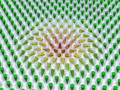
Magnetic skyrmions are quasiparticle magnetic spin configurations with a swirling vortex-like structure. They can be thought of as 2D knots (or “spin textures”) in which the magnetic moments rotate about 360° within a plane. They were first discovered about ten years ago in non-centrosymmetric manganese-silicon and cobalt-iron-silicon crystals, but they are now known to occur in a wide range of materials, including ultra-thin magnetic multilayers, which are much more compatible with potential future applications.

Magnetic skyrmions could be used as storage bits in next-generation memories that have a much higher density than today’s disk drives thanks to their small size and the fact that they can be efficiently controlled with spin currents. They are also robust to external perturbations.

In recent years, researchers have made skyrmions in low-dimensional magnetic materials and in nanoscale thin-film multilayers. They have also isolated skyrmions as room-temperature metastable states in ferromagnets by applying an external magnetic field. However, measuring around 100 nm across, the structures made so far are still too big for competitive real-world applications. Ideally, they need to be reduced in size to the 10-nm range or smaller.

Dipolar interactions hinder skyrmion stabilization

One of the main difficulties in hosting skyrmions in ferromagnetic thin films or multilayers, however, is that dipolar interactions in these materials do not allow for such small skyrmions. They also make it extremely difficult to stabilize skyrmions without applying external magnetic fields.

Researchers at the CNRS/Thales/Paris-Sud University in France say they have now overcome this problem and have stabilized antiferromagnetic skyrmions in synthetic antiferromagnets (SAFs) – at room temperature. “The SAF systems we employed in our experiments are widely employed in industry,” explains study lead author William Legrand. “This means that we now have easy access to antiferromagnetic skyrmions, which were before restrained to more complex alloys called ferrimagnets under specific conditions at one particular working temperature only.”

The strategy works because antiferromagnets contain two coupled equivalent magnetic subsystems aligned antiparallel to each other, he explains. This arrangement has no net magnetic moment and thus does not generate a dipolar field.

Antiferromagnetic coupling

The researchers made their SAF by stacking several layers of different ferromagnetic and non-ferromagnetic metals (platinum, cobalt and ruthenium in this case) with individual layer thicknesses of around a nanometre (or just three to seven atoms-thick) in a periodic fashion. These ferromagnetic layers are coupled antiferromagnetically through a non-magnetic spacer layer by Ruderman-Kittel-Kasuya-Yoshida (RKKY)-type interlayer electronic coupling.

Just as in antiferromagnets, SAFs do not have any dipolar interactions. However, there may be a small but measurable local dipolar field because of the presence of the non-magnetic spacer. Far from being a nuisance, this field could actually help the researchers to image the antiferromagnetic skyrmions hosted in the SAFs using local probe techniques such as Magnetic Force Microscopy (MFM).

Stabilizing spin textures

The researchers stabilized a particular kind of spin texture in their SAF, which is a “spin-spiral”, by adjusting the individual layer thicknesses in the material. These spin textures can then be turned into antiferromagnetic skyrmions by coupling the SAF electronically to a third magnetic layer, itself robust and adjacent to the SAF. “This layer biases only one of the layers of the two that make up the SAF,” explains Legrand. “It thus defines the exterior of the skyrmions and allows them to be stabilized.”

We believe that this platform for experimentally obtaining antiferromagnetic skyrmions without the need for an external magnetic field could be used to miniaturize skyrmion-based devices to much smaller sizes, he tells Physics World.

The researchers, led by Nicolas Reyren, Vincent Cros and Albert Fert, say that they now plan to study the dynamics of these antiferromagnetic skyrmions in more detail. “We would also like to build more robust SAF assemblies to further reduce the minimal size of the skyrmions we have stabilized. We shall then be truly on the way to atomic-sized skyrmions at ambient conditions.”

Full details of the research are reported in Nature Materials 10.1038/s41563-019-0468-3.

Science flourishes when leading researchers die, Hippocratic oath for scientists, walking on the Moon

The death of a leading scientist can lead to flurry of cutting-edge research by new entrants. That is the conclusion of “Does science advance one funeral at a time?” by Pierre Azoulay, Christian Fons-Rosen and Joshua Graff Zivin. The trio of economists looked at what happened after the unexpected deaths of 452 researchers who worked, somewhat ironically, in the life sciences.

They found a strong interdisciplinary effect in how a star scientist is replaced. “To our surprise,” they write, “it is not competitors from within a subfield that assume the mantle of leadership, but rather entrants from other fields that step in to fill the void created by a star’s absence”. Indeed, they noted an 8.6% increase in papers by new entrants to subfields that had been dominated by deceased stars.

The sudden absence of top researchers has a significant negative effect on their collaborators – with the trio finding a 20.7% decrease in papers by scientists who had previously co-authored papers with the stars.

There is a physics connection because the effect seems to have been postulated many years ago by Max Planck, who wrote, “A great scientific truth does not triumph by convincing its opponents and making them see the light, but rather because its opponents eventually die, and a new generation grows up that is familiar with it”.

The researchers have dubbed the effect “Planck’s Principle” and you can read more about it in this news article from the Massachusetts Institute of Technology.

Should scientists have to swear an oath promising to behave morally in the course of their research activities? Quantum-information guru Scott Aronson says he is in “broad support of the idea” to create a Hippocratic oath for STEM researchers. And to get us thinking about what such an oath should contain, he has posted his own 10-point version that he calls his “nerdocratic oath”.

Finally, please watch this brilliant video of what at first appears to be an astronaut walking on the Moon. I won’t ruin the surprise of where the footage was actually taken.

French wines show hot dry years are now normal

French wines tell a remarkable story: climate scientists and historians, with a new wine list to savour, have carefully reconstructed the harvest dates for Burgundy – one of the most important wine regions of France – to highlight the dramatic change in global climate.

Grapes in Burgundy are now picked 13 days earlier than the average for the last 664 years. And the advance in harvest dates has been dramatic: almost all since 1988.

The finding is based on painstaking study of data going back to 1354. From medieval times Burgundian growers and civic authorities had an unusual communal arrangement: they each year collectively considered the growing conditions and imposed a date before which no grapes might be picked.

And scientists from France, Germany and Switzerland report in the journal Climate of the Past that they worked through all surviving records to provide an accurate record of the harvest date around the city of Beaune.

Since grapes are highly sensitive to temperature and rainfall, and the quality and reputation of Burgundy has been well-established for centuries, the researchers are confident that the data confirm a dramatic warming trend.

Even in a much cooler past, exceptionally early harvests were not unknown. The researchers counted 33 altogether, and 21 of these happened between 1393 and 1719, and five between 1720 and 2002. In the 16 years since 2003, there have been eight outstandingly warm spring-summer seasons, and five of those have happened in the last eight years.

“In sum, the 664-year-long Beaune grape harvest date series demonstrates that outstanding hot and dry years in the past were outliers, while they have become the norm since transition to rapid warming in 1988,” they write.

Historical reconstructions are not easy: data had been assembled before, but these records turned out to be riddled with copying, typing and printing errors. There were administrative changes (after 1906, city authorities in the Burgundian capital of Dijon ceased to set or record a harvest date).

Narrative verified

There were accounts kept by the dukes of Burgundy, and records of payments for grapevine labourers maintained by church authorities in Beaune, evidence of purchases of food for the harvesters, and records of sales to the King of France.

But those six centuries were also marked by the Little Ice Age, the Thirty Years War between Catholic and Protestant states from 1618 to 1648, several epidemics of plague, and the arrival of the vineyard-destroying infection phylloxera.

So the researchers had to verify their proxy history of regional climate from tree-ring data, and from vineyard records kept in Switzerland, as well as temperature records from Paris.

The wine industry is vulnerable to climate change: researchers noted three years ago that harvests in Burgundy and in Vaud in Switzerland were up to two weeks earlier and that climate change had begun to warm southern England’s chalky soils to the a degree that made them yield sparkling wines to match qualities pursued in the Champagne region of France.

Inescapable conclusion

But the same soaring temperatures that for the moment have helped the grower have begun to impose costs on the grape pickers, who become less productive as the mercury rises.

So the confirmation that harvests are earlier is not in itself news. The data from Beaune and Dijon are best seen as another example of painstaking phenological research. Phenology is the science of when insects hatch, trees bud and birds nest, and in the Burgundian series climate scientists now have a continuous record stretching back 664 years. The story told by the series is unequivocal.

“The transition to a rapid global warming after 1988 stands out very clearly,” said Christian Pfister of the University of Bern in Switzerland, one of the authors.

“The exceptional character of the last 30 years becomes apparent to everybody. We hope people start to realistically consider the climate situation in which the planet is at present.”

Event Horizon Telescope researchers win 2020 Breakthrough Prize in Fundamental Physics

The 2020 Breakthrough Prize in Fundamental Physics has been given to members of the Event Horizon Telescope (EHT) collaboration for obtaining “the first image of a supermassive black hole, taken by means of an Earth-sized alliance of telescopes”. The $3m prize will be shared equally by all 347 authors of six papers that announced the image on 10 April 2019.

The image is a close-up of the region surrounding a supermassive black hole that lies at the centre of the Messier 87 galaxy, which is about 55 million light-years away. Although black holes are inherently invisible, the EHT team obtained the image near the point where matter and energy can no longer escape – the so-called event horizon.

A key feature of the image is a ring-like structure of radiation from the object’s accretion disc. The dark region at the centre of the disc is consistent with expectations for the shadow of a Kerr black hole – one that is uncharged and rotates about a central axis – as predicted by Einstein’s general theory of relativity.

The prize will be accepted by collaboration director Shep Doeleman at a ceremony on 3 November at the NASA Ames Research Center in California.

Winners of three 2020 New Horizons in Physics Prize – each worth $100,000 – have also been announced. Xie Chen of the California Institute of Technology, Lukasz Fidkowski of the University of Washington, Michael Levin of the University of Chicago and Max Metlitski of the Massachusetts Institute of Technology share one prize “for incisive contributions to the understanding of topological states of matter and the relationships between them”.

The second prize goes to Jo Dunkley of Princeton University, Samaya Nissanke of the University of Amsterdam, and Kendrick Smith of the Perimeter Institute “for the development of novel techniques to extract fundamental physics from astronomical data”. The third prize is given to Simon Caron-Huot of McGill University and Pedro Vieira of the Perimeter Institute and the South American Institute for Fundamental Research “for work in arithmetic algebraic geometry including applications to the theory of Shimura varieties and the Riemann-Hilbert problem for p-adic varieties”.

The Breakthrough prizes were founded in 2012 by the billionaire physicist Yuri Milner and are awarded annually.

What really weakens lithium battery efficiency?

Powering devices as small as smartphones to those as large as electric vehicles, the rechargeable battery is a familiar technology to consumers. Work in the field of battery research continues, however, as researchers struggle to improve the efficiency and longevity of rechargeable batteries. State-of-the art Li-ion batteries offer fast charging but suffer from low power density. Research has therefore focused on optimization of battery anodes, cathodes, electrolytes, and even on replacement of lithium itself with other metals like sodium.

Of these alternatives, lithium metal batteries, have been studied since the 1960s and 1970s. Lithium metal batteries intrinsically offer higher energy density than Li-ion batteries, but according to Shirley Meng, a professor at UC San Diego Jacobs School of Engineering, a lot of technical challenges have prevented its commercialization.

One challenge is the presence of inactive lithium at the solid electrolyte interface (SEI) that forms each time a lithium metal battery discharges. Over several cycles, the battery forms such a significant amount of inactive lithium that it loses the ability to recharge. For years, researchers have thought that both lithium metal blocked from the conductive pathways by the SEI and lithium ion compounds formed in the SEI contributed to inactive lithium.

Chengcheng Fang, a recent graduate from Meng’s group, has shown that the real culprit is the metallic lithium. To do so, Fang developed a tool based on gas chromatography that, for the first time, allows researchers to measure just how much inactive lithium metal forms versus the formation of lithium ion compounds.  The researchers found a linear relationship between the amount of metallic lithium present and loss of Coloumbic efficiency.

“Prior to [our work], the entire field had no idea [of] the quantitative contribution of capacity loss from SEI. The claims in literature were hypothesis only,” Fang said. “Since SEI has high surface area and is easy to detect, researchers turned to blame the capacity loss on SEI formation.”

Their findings, however, dispute this hypothesis, and show that metallic lithium is the main component of inactive lithium.

Identifying the right culprit

The researchers’ novel tool combines titration and gas chromatography to study battery systems. They leveraged the fact that the main difference between SEI lithium-ion compounds and metallic lithium is their chemical reactivity. Knowing that only metallic lithium reacts with water to generate hydrogen gas, they added H2O to a sample to measure the generation of hydrogen via gas chromatography.

Once the amount of unreacted metallic lithium had been determined, they calculated the amount of lithium ions present at the SEI as the difference between the total inactive lithium present (given by the capacity loss between the plating and stripping processes) and this calculated quantity of unreacted metallic lithium. Across tests on various electrolyte systems, they found much more lithium metal is present than other components containing lithium ions.

“This is a reliable method to quantify the two components of inactive lithium with ultrahigh accuracy, which no other characterization tool has been capable of doing,” Fang said in a press release from the University of California San Diego.

The researchers replicated the relationship between metallic lithium and efficiency loss across different systems. The type of electrolyte used, however, did affect the value of the Coulombic efficiency they measured, as it influenced the morphology of the inactive lithium.

Next steps

With their findings, the authors have begun exploring alternative electrolytes and other new avenues that would mitigate the issues raised by inactive lithium. They aim to use these improvements to allow for the safe use of lithium metal batteries for longer lifetimes than currently attainable.

In the future, researchers hope that their work will motivate the commercialization of lithium metal batteries.

“The goal is that if you enable lithium metal to cycle as current state-of-the art, then you can double the driving range for an electric vehicle,” Meng said.

In a separate interview with electrochem.org, she said, “There is no reason why we should be burning all this fossil fuel with millions of cars.”

Full details are reported in Nature.

Automated radiotherapy planning benefits clinicians and patients

Automated radiotherapy planning is a boon for medical physicists and dosimetrists, radiotherapy departments, and patients themselves – according to a team at Cone Health Cancer Center. A customized, automated planning model can reduce the preparation time of a patient’s treatment plan, decrease plan variation and improve healthy tissue sparing compared with manual planning.

Since 2015, dosimetrists and medical physicists at this community cancer treatment centre have used Varian’s RapidPlan, a commercial knowledge-based planning predictive model that generates estimated dose–volume histograms (DVHs) based on previous patient anatomy and dose distributions for use in the Eclipse treatment planning system. The team has now demonstrated that using RapidPlan with a customized automated planning model to develop volumetric-modulated arc therapy (VMAT) plans for prostate cancer patients reduced the average planning time from two hours down to 20 minutes.

With the exception of the maximum dose to the target, all planning target volume (PTV) metrics were dosimetrically similar between auto-generated plans and manual plans. Most importantly for patients, auto-generated plans conferred significantly improved rectal sparing (J. Appl. Clin. Med. Phys. 10.1002/acm2.12674).

“The creation of VMAT plans is still an intricate and time-consuming process due to complexity of treatment, anatomical deviation and level of planner expertise,” write the authors.

The planning software is based on shared knowledge representing clinical practice in leading treatment facilities. It takes into account each patient’s anatomy and planning goals, adjusts the estimated DVH, and provides optimization objectives based on treatment criteria for each individual patient. The software calculates acceptable clinical trade-offs for target coverage and dose to organs-at-risk (OARs).

Customized models can be created from the baseline models. Medical dosimetrist and lead author Christopher Amaloo took approximately a week to develop an effective RapidPlan model that uses plans from previously treated patients. This model was then applied with a totally automated system customized to the radiation oncology department’s protocols using Varian’s Eclipse Scripting Application Programming Interface (ESAPI), developed by medical physicist Lane Hayes.

Lane Hayes

“The Eclipse Scripting API is basically a set of programming tools that directly replace button clicks a person would perform in the Eclipse planning system,” Hayes told Physics World. “We developed and tested a logical framework over a several week period so that it would emulate the decision-making process of a planner setting up a new prostate treatment plan. Then a customized RapidPlan model is applied automatically at the end of the process to generate a patient’s customized treatment plan that is clinically acceptable.”

This model has been in use for one year to treat an estimated 100 prostate cancer patients with VMAT. “The combination of RapidPlan and ESAPI linked the plan creation to optimization through final calculation in a way that is more valuable and practically beneficial for our treatment planners,” explains Hayes. “While using the predictive model alone was comparable to manual treatment planning, the combination saves a tremendous amount of time for our planners.”

Plan comparisons

For their study, the researchers created manual and auto-generated VMAT plans for 20 prostate cancer patients prescribed 78 Gy in 40 fractions. For all patients, both plans met departmental guidelines for OAR sparing and minimal target coverage.

A team of eight dosimetrists, medical physicists and radiation oncologists independently blind-reviewed and compared each of the 20 paired test cases to determine suitability of the plans. For each case, they selected a preferred plan. For 18 of 20 cases, the majority of reviewers preferred the auto-generated plans or had no preference.

The auto-generated plans increased sparing within the rectal volume, while the manual plans reduced the bladder maximum dose, though neither plan provided consistently improved results. “While sparing of all OARs is important, the relative value of the bladder increase compared to the rectal sparing is regarded as an acceptable compromise,” the authors write.

The researchers note that the automated planning process, consisting of simple data entry and a singular button click, transforms an arduous manual process to one that is essentially resource-free. The automated approach reduces active planning time to under five minutes on average and the total planning time to 20 minutes, including optimization and calculation time.

“From a physician’s perspective, we have gained high reliability of plan quality, independent of the specific planner. This is helpful when team members have shifted coverage and roles,” says Hayes. “From the perspective of a medical physicist, these plans are more compliant with guidelines and naming conventions, and are typically completed with more lead time regarding the first treatment.”

Although the radiation oncology department has not changed staffing size, the time savings have helped shift the dosimetry team’s focus to more challenging and unique cases. For a busy community cancer treatment centre, this auto-generated planning model for VMAT has become invaluable.

Taking a bird’s-eye view of Chernobyl

The 1986 Chernobyl disaster left behind a post-human landscape. Indeed, it is believed that some 200,000 were relocated as a result of the accident and an exclusion zone of 2600 km2 still exists today in Ukraine. In recent years, however, the area has attracted a steady stream of people seeking an “alternative tourism” experience. Ukrainian authorities also plan to locate solar energy farms in the area, utilizing the existing power network.

This short video explains how a team from the University of Bristol is using drone-based technologies to build a detailed radiation map to identify areas that pose a risk to human health. Find out more in the article “Glimpsing Chernobyl’s hidden hotspots” by team members Peter Martin and Tom Scott, which was first published in the September 2019 issue of Physics World.

Graphene origami reaches quantum precision

It’s easier to fold a napkin than a notepad. The potential to manipulate graphite into precise nanostructures using a scanning probe microscope has teased researchers ever since Thomas W. Ebbesen and Hidefumi Hiura first reported accidental tears and folds in their graphite during scanning tunnelling microscope (STM) experiments in the mid-1990s. However, although ensuing studies by various research groups around the world were also able to demonstrate similar origami-like folding of graphite with a scanning probe, they could not command where or how the folds would occur. Now, by replacing the graphite with high-quality graphene nanoislands, researchers in China and the US have finally leveraged the atomic-level control of STM into an origami nanofabrication tool with a comparable level of precision.

“Similar to conventional paper origami, our current work has made it possible to create new complex nanostructures by custom-design folding of atomic layer materials,” says  Hong-Jun Gao, a researcher at the Chinese Academy of Sciences (CAS) who led this latest work. Alongside Shixuan Du and collaborators at CAS, as well as Vanderbilt University and the University of Maryland in the US, Gao reports how they can fold single layers of graphene with the direction of the fold specified over a range from around the magic angle at 1.1 ° (where observations of correlated electron behaviour have been causing such a stir) to 60 °, with a precision of 0.1 °. Their STM manipulations also leave tubular structures at the edges that have one-dimensional structure electron characteristics similar to carbon nanotubes.

“We have demonstrated that through such simple graphene origami we can realize various graphene structures like carbon nanotubes and their intramolecular junctions, which we can generally learn about only from text books,” he adds. They list superconductors, Weyl semimetals, and ferromagnetic materials among the fields they expect to benefit from the unprecedented precision of their graphene origami nanofabrication technique.

The pristine single layer advantage

Key to the success of their technique is the quality of the graphene they fold. Most previous experiments attempting to use STM in origami were on graphite with little control over the folds as a result. As Gao points out, “We all know that it is easier to make the art of paper folding with a single paper sheet, as compared with folding piles of papers.”

That said this is not the first report of scanning-probe manipulation of graphene. Hannes C. Schniepp and colleagues reported folding graphene with an atomic force microscopy tip in 2008. Their graphene was functionalized and the work concluded “the folding and bending behaviour of the sheets is dominated by pre-existing kink (or even fault) lines consisting of defects and/or functional groups.” Later work by Kim Akius and Jan van Ruitenbeek at Leiden University in the Netherlands also operated on graphene but “using the prepatterning in a new way, as a template for folding.” Gao and colleagues uniquely operate on pristine graphene letting the STM alone dictate the folding directions and angles. In addition, the STM manipulations are so delicate that even subsequent unfolding and refolding again in different configurations leave no trace of damage on the pristine crystal lattice structure.

To produce well controlled single-atom thick nanoislands for their experiments the researchers bombard highly oriented pyrolytic graphite with hydrogen ions for 10 cycles before annealing them. The whole procedure takes around 10 hours in a vacuum – the cordon bleu of graphene as opposed to fast food – but as the researchers are quick to point out, once these high-quality materials are ready, “the success rate of graphene origami with the assistance of STM is very high and reproducible as demonstrated in our report.”

Starting from a single graphene layer, also allows them to create different origami nanostructures by simply modifying the atomic layer itself, such as making a bicrystal graphene island. In future work, Gao and colleagues hope to extend their demonstration of the technique to other 2D materials such as MoS2 and hexagonal boron nitride.

A playground for new discovery

The signatures of delocalized electron behaviour in the electronic properties of their nanostructures is evidence of the high quality of the crystal retained throughout the manipulations. In the twisted bilayer graphene structures produced by folding, the researchers already demonstrate the moiré superlattices that have attracted so much study for understanding the twist-tuned electronic and magnetic properties in bilayer graphene near the magic angle.

In addition, current versus voltage measurements of the tubular structures at the edge reveal van Hove singularities characteristic of one-dimensional structures. The researchers also find the direction of the fold affects the electronic properties of the tubular structures just as for carbon nanotubes, and they detect effects such as peak shifts that they can attribute to interactions with the substrate.

“This [technique] can allow us to immediately explore and test some predicted new physics and device concepts that were otherwise not feasible in the past due to fabrication challenges,” he adds.

Schniepp, who led the team behind the first report of folding functionalized graphene with a scanning probe microscope tool, but was not involved with the current work told Physics World how much the high quality of this work impressed him. “The precision with which they repeatedly fold and unfold single-layer graphene at arbitrary angles is remarkable,” he says. “It’s a beautiful example of how scanning probe techniques cannot only image, but also to manipulate, control and engineer materials at the nano- or even at the atomic scale. I have always been intrigued by the scanning probe techniques and their possibilities, and this work just pushes the state of the art quite a bit further, which I find quite inspiring.”

Full details are reported in Science.

Survival of the fittest quantum states, scrutinizing antihydrogen, physics of chilled drinks

In this week’s podcast Physics World editors ponder quantum Darwinism, a proposed framework for understanding how measurements are made on quantum systems.

We also talk about how physicists at CERN are making very precise measurements of the properties of antihydrogen – and how their experiments could provide a glimpse of what lies beyond the Standard Model of particle physics.

If you are planning a party this weekend, we can point you in the direction of an online calculator that tells you how to chill your beverages to the perfect temperature.

Proton CT or dual-energy X-ray CT: which wins out for proton planning?

pCT prototype scanner

Proton CT is proposed as an alternative to X-ray CT for acquiring relative stopping power (RSP) maps for use in proton treatment planning. In parallel, researchers have shown that dual-energy X-ray CT (DECT) improves RSP calculation accuracy over conventional single-energy X-ray CT. A team headed up at LMU Munich, working with partners in the pCT collaboration, has now performed the first direct experimental comparison of the two modalities (Phys. Med. Biol. 10.1088/1361-6560/ab2b72).

“The evolution of DECT is already improving RSP accuracy clinically at some institutions,” says co-senior author Guillaume Landry. “Nevertheless, exploring alternative methods of RSP estimation is important to ensure continued improvement of treatment conformality. As a complete solution to the range uncertainty problem, pCT improves treatment planning and provides low-dose pre-treatment verification that’s not susceptible to metal artefacts. This may make it the preferred solution in the long run.”

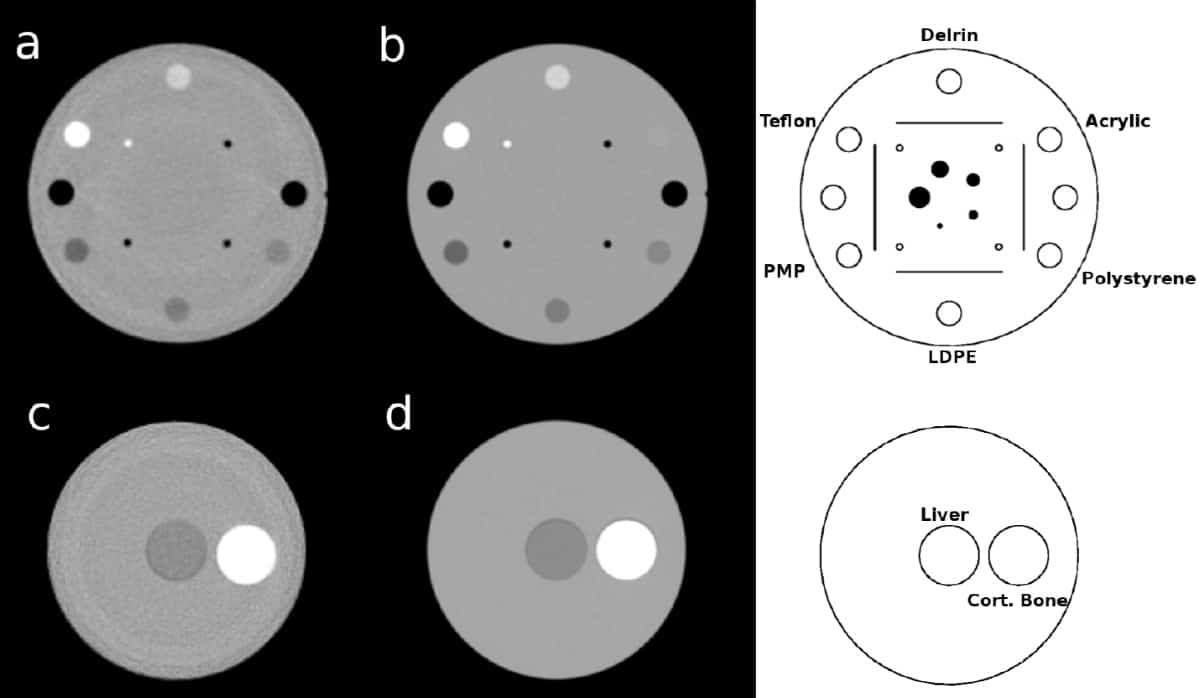
The international team compared a phase II preclinical pCT prototype scanner at the Northwestern Medicine Chicago Proton Center with a state-of-the-art diagnostic DECT system. To assess RSP accuracy, they used both systems to image phantoms containing tissue-mimicking inserts of known RSP. They also used Geant4 Monte Carlo code to perform realistic and idealized pCT detector simulations.

Reconstructed RSP images

In the experimental pCT scans, the measured RSP accuracy was better than 1% for all inserts except three (polymethylpentene, Delrin and Teflon inserts, with errors of 1.08%, -1.16% and -1.31%, respectively). In DECT scans, only cortical bone and Teflon inserts had errors above 1% (1.17% and 2.38%, respectively). The mean absolute percent error (MAPE) in RSP over all 13 inserts was 0.55% for the prototype pCT scanner and 0.67% for DECT. Excluding the Teflon insert, these values reduced to 0.49% and 0.53%, respectively.

In realistic full-detector pCT simulations, the three central inserts had errors greater than 1%, attributed to simplified modelling of gaps between proton tracker modules in the scanner as air. The MAPE was 0.69%, reducing to 0.50% without the central inserts, thus agreeing with the measurements. In ideal pCT simulations (where the proton’s exact position, direction and energy were scored), the RSP MAPE was 0.17%.

While the researchers did not explore the imaging dose limits of DECT in this study, they expect that pCT will enable volumetric RSP imaging at much lower absorbed (and likely also biologically effective) dose than DECT. “This difference in dose could prove crucial in cases of frequent volumetric isocentric imaging for patient alignment and treatment (re)planning,” notes co-senior author Katia Parodi.

Assessing the artefacts

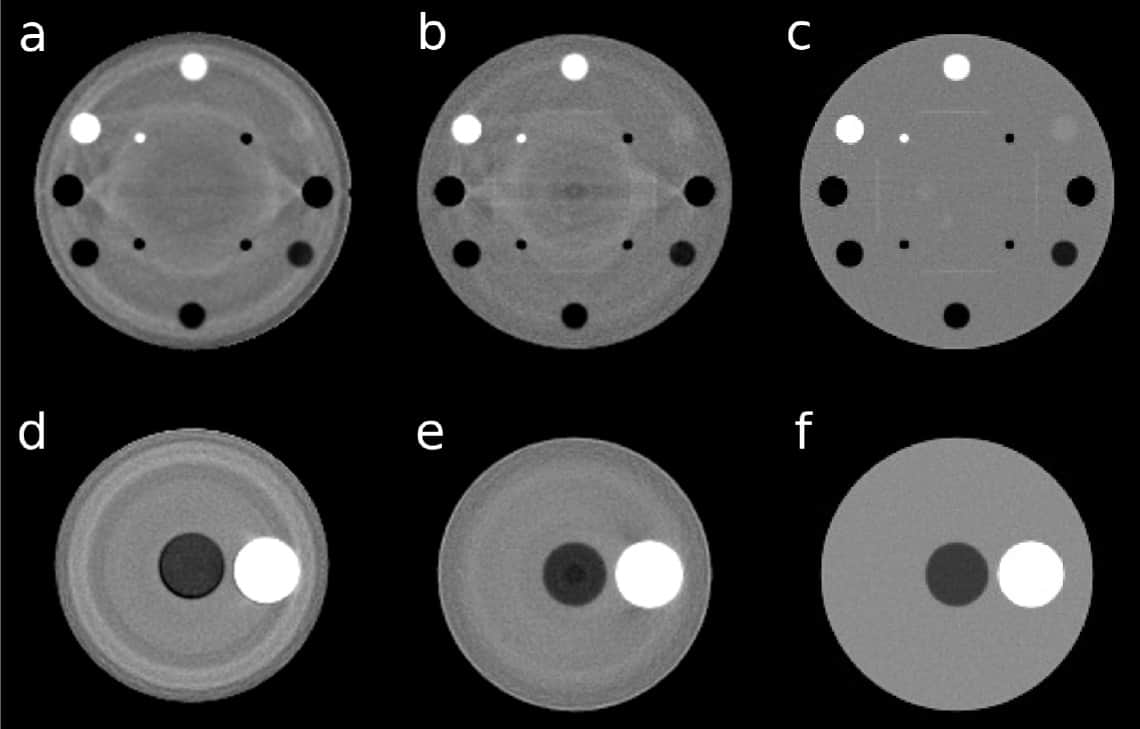
The experimental and realistically simulated pCT images contained ring artefacts that degraded the RSP MAPE compared with the ideal pCT simulation. In experimental scans, the strongest ring artefacts exceeded 2% in RSP and appeared mostly as RSP overestimation. In the realistic simulations, artefacts reached up to 2% and were mostly RSP underestimation.

Reconstructed pCT images

The researchers suggest that ring artefacts appear when protons traverse regions with higher errors in WEPL. These low-accuracy WEPLs arise from inaccuracies in the energy-to-WEPL calibration curve, due to interpolation between different stages of the energy detector, as well as interplay between the energy detector, the beam and the calibration phantom.

“We replaced the original calibration step phantom by a wedge, which reduced the ring artefacts to generally less than 1% of the underlying RSP value,” says co-senior author Reinhard Schulte. “The ideal solution would be to avoid stage interfaces and cover the imaging field with a scanned pencil beam that, depending on knowledge of the phantom thickness from prior imaging data, would adjust the beam energy so that the beam always stops in a single state (energy-modulated proton CT). This solution is currently being explored.”

The realistically simulated pCT images showed a dark (lower RSP) artefact at the centre of a water phantom placed at the isocentre. This artefact, stemming from the exaggerated tracker gap modelling with respect to the experimental setup, was stationary when the water phantom was moved. When the simulation modelled silicon in the tracker gaps instead of air, the dark spot almost disappeared.

The researchers conclude that this direct comparison of RSP accuracy demonstrates the competitive performance of the pCT prototype compared with a state-of-the-art DECT scanner in phantoms. Next, they plan to move on to more realistic tissue samples.

“Our final goal is to push this technology into the clinic, by combining hardware and software improvements of the imaging system with our recent proposal of fluence-modulated imaging, which could open further opportunities for dose reduction,” says lead author George Dedes. “Our ideal simulations suggest that subsequent pCT development cycles have promise to surpass what is currently achievable with latest generation DECT scanners.”

Copyright © 2026 by IOP Publishing Ltd and individual contributors