A new heat engine made from a single-electron spin – in the form of the valence electron of a calcium ion trapped in an electric field – could help us better understand how thermal fluctuations affect the performance of microscopic motors. The device, made by researchers at the University of Mainz in Germany, converts heat deposited into the electron spin by controlling its alignment via laser beams. The vibrations of the spin act like a flywheel that captures the useful energy generated by the engine.
Heat engines convert thermal energy into mechanical work and consist of four fundamental components: a working agent (such as the steam in a turbine); hot and cold heat reservoirs; and a mechanism for depositing or extracting the work generated.
Researchers have recently succeeded in fabricating microscopic heat engines and are now able to make such engines from atomic systems too. Indeed, a single-ion heat engine and an ion-crystal based refrigerator have already been made. Engines based on ensembles of nitrogen-vacancy centres in diamond, superconducting circuits or ensembles of nuclear spins in a nuclear magnetic resonance (NMR) set up have also been studied.
Thermal fluctuations are important
As the size of the constituent components decreases, well-established notions such as ‘work’, ‘heat’ and ‘efficiency’ will need to be reassessed, says a team led by Ulrich Poschinger in Mainz and John Goold in Dublin, whose group did the theoretical calculations in this study. In particular, the thermal fluctuations, which play a central role in microscopic-sized systems, will need to be accounted for and modelled.
In the new engine, the spin (or angular momentum) of the valence electron of the calcium ion plays the role of the working agent. This spin converts heat absorbed from applied laser beams into harmonic motion of the spin. These oscillations act like a flywheel that captures the useful work produced by the device and the energetics of the flywheel can be measured at a resolution below the single quantum level.
Measuring power output and useful work
Poschinger and colleagues say they can measure the power output of their atomic motors at the scale of single quanta of energy for the first time. They can also characterize the state of the calcium ion in their experiment and can thus precisely monitor the energy deposition process as the engine begins to operate – starting from energies close to the quantum ground state.
Starting the flywheel from rest (that is, from its ground state), the researchers characterized its states after different operation times by reconstructing its so-called Husimi Q function, from which they were able to extrapolate the energy deposited in the flywheel along with its fluctuations.
The measured fluctuations contain a significant thermal component, they say, which shows that not all of the energy transferred to the flywheel can be extracted as useful work. To quantify the actual work done by the engine, they thus determined its ergotropy – that is, the maximum amount of work that can in fact be extracted from it.
By characterizing their engine in this way, the Dublin-Mainz team says it hopes to better understand how the intrinsic fluctuations of the spin heat engine fundamentally limit its performance.
Scientists at the University of California, San Diego have used stem cells to create miniature brains that developed functional neural networks. These tiny lab-grown brains are the first observed to produce brain waves that resemble those of preterm babies, and could help shed light on the role of network activity in the developing human cortex (Cell Stem Cell 10.1016/j.stem.2019.08.002).
“The level of neural activity we are seeing is unprecedented in vitro,” says lead author Alysson Muotri. “We are one step closer to having a model that can actually generate these early stages of a sophisticated neural network.”
The team created cerebral organoids – a scaled-down model of the human brain, about the size of a pea – from human pluripotent stem cells. By growing them in culture medium that mimics the environment of brain development, the stem cells differentiate into different types of brain cells and self-organize into a 3D structure that resembles the developing human brain.
While researchers have successfully grown organoids with cellular structures similar to those of human brains, none of the previous models developed human-like functional neural networks. Such networks appear when neurons are mature and become interconnected, and are essential for most brain activities.
Muotri and colleagues designed an improved growth procedure, which included optimizing the culture medium formula. This allowed their organoids to become more mature than previous models. They grew hundreds of organoids for 10 months, using multi-electrode arrays to monitor their spontaneous electrical activity each week.
Pea-size brain organoids after growth for 10 months. (Courtesy: Muotri Lab/UCTV)
At about two months, the team began to detect bursts of activity from the organoids. The signals were sparse and had the same frequency, a pattern seen in highly immature human brains.
As the organoids continued to grow, they produced brain waves at different frequencies and the signals appeared more regularly. This transition suggests that the organoids had further developed their neural networks, with more functional synapses and increased connections between the neurons. The interactions between neurons contribute to signals at various frequencies.
To compare the patterns of brain waves seen from the organoids with those of human brains early in development, the team trained a machine learning algorithm with brain waves recorded from 39 premature babies between six and nine-and-a-half months old. The algorithm was able to predict how many weeks the organoids had developed in culture, suggesting that the organoids and human brain share a similar growth trajectory.
The approach provides the opportunity to investigate the emergence of network-level neurodynamics in humans. However, the researchers note that it’s unlikely these organoids have mental activities, such as consciousness.
“The organoid is still a very rudimentary model – we don’t have other brain parts and structures. So these brain waves might not have anything to do with activities in real brains,” Muotri explains. “It might be that in the future, we will get something that is really close to the signals in the human brains that control behaviours, thoughts or memory. But I don’t think we have any evidence right now to say we have any of those.”
Looking forward, the team aims to further improve the organoids and use them to understand diseases associated with neural network malfunctioning, such as autism, epilepsy and schizophrenia.
It’s April 2019 and a group of us from the University of Bristol, UK, are being driven though the exclusion zone surrounding the Chernobyl Nuclear Power Plant (ChNPP) in a minibus laden with all manner of radiation detectors, drones and protective equipment. Despite being only two hours north of Kiev, our surroundings could not be more different from the bustle of the Ukrainian capital. The densely vegetated landscape is intersected only by pothole-riddled multi-lane highways – a throwback to more prosperous times when more than just the occasional scientific group or tourist party would make the trip.
As our local driver swerves the bus from one side of the road to the other, it becomes increasingly apparent how different this nuclear fallout zone is from the one surrounding Japan’s Fukushima Daiichi Nuclear Power Plant, which we’ve visited extensively since the accident there in 2011. While the Japanese authorities have been steadily lifting evacuation orders from Fukushima’s original exclusion zone, the area around the ChNPP remains, for the most part, abandoned, and nature is taking over.
During the aftermath of the accident at Chernobyl in April 1986, some 49,000 people were evacuated from the nearby city of Pripyat (3 km from the plant) to various villages in the Kiev region – although this evacuation only began 36 hours after the explosion. Over the following 10 days, the exclusion zone was progressively expanded to a radius of 30 km from the site, and during the subsequent months a further 67,000 people were eventually evacuated from their homes. Indeed, it is believed that some 200,000 were relocated as a result of the accident.
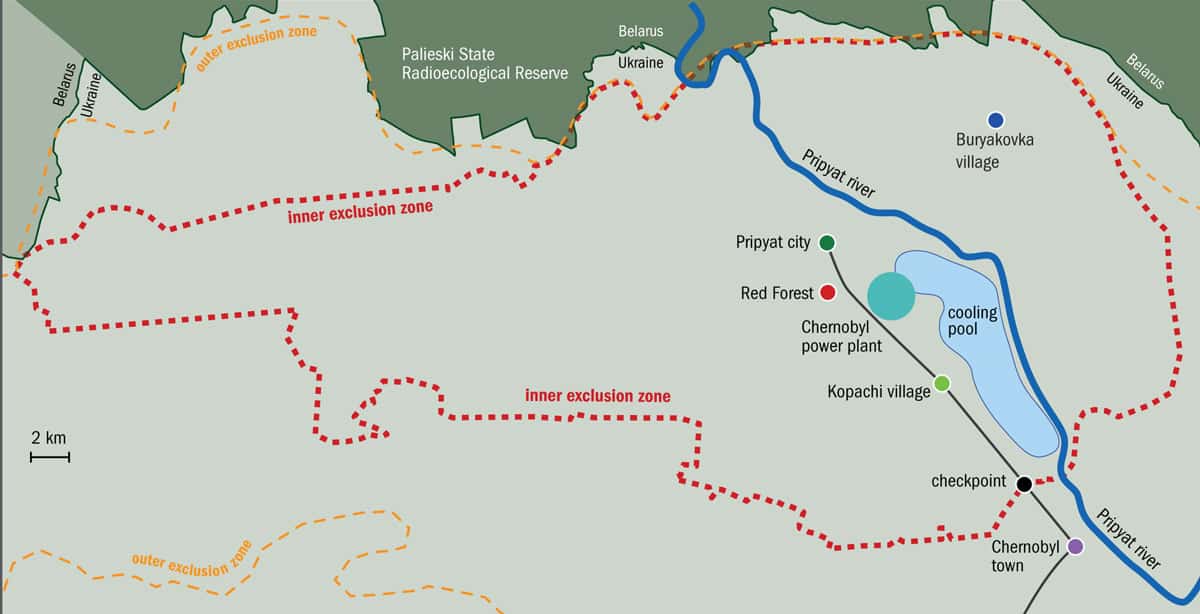
1 The lay of the land The Chernobyl Nuclear Power Plant is located in northern Ukraine, around 12 km south of the border with Belarus. The city of Pripyat is about 3 km away and was specifically built for those working at the plant. The exclusion zone covers an area of around 2600 km2 in Ukraine, while Belarus’s Palieski State Radioecological Reserve spreads over approximately 2200 km2 north of the border.
Today, the exclusion zone still forms an area of about 2600 km2 in Ukraine. Although more than three decades have passed since the accident, there are very few residents of the area (termed Samosely – those who either refused to evacuate or secretly returned). Indeed, in 2016 it was estimated that the total population was fewer than 200 people.
Since the accident at ChNPP’s number 4 nuclear reactor, much work has been done to protect its remains and prevent further radioactivity from being released into the environment. The latest effort becomes obvious as we approach the ghost city of Pripyat along the Soviet-era road and the imposing sight of the New Safe Confinement shelter dominates the horizon. Following the deterioration of the original confinement structure that was hastily erected over the exposed reactor core shortly after the disaster, this new dome-like building was completed in 2018 by an international team of engineers, and will provide a cover that should last for at least a century.
The eerie, unmoving silence of the surrounding exclusion zone amplifies our team’s amazement at this incredible engineering achievement piercing through the dense trees. The silence is short-lived, however, as the high-pitched dose-rate alarm of one of the personal dosimeters suddenly sounds. With the alarm threshold still set to identify a slight deviation above normal background radioactivity back in Bristol, it becomes further apparent quite how radioactive parts of this area still remain, even after 33 years. In Bristol we would expect 1–2 counts per second (or CPS) on our radiation detectors – here in Chernobyl we’re measuring more than 50 CPS.
The reactor and accident
One reason for the 1986 disaster was that the country then lacked a fundamental safety culture and competency when it came to nuclear power production. But the poor and unforgiving reactor design did not help either. The four reactors at Chernobyl were RBMKs (Reaktor Bolshoy Moshchnosty Kanalny) – a design that was, and still is, unique to countries that were part of the former Soviet Union.
Like Magnox and the Advanced Gas Reactor (AGR) types in the UK, an RBMK has a large graphite core that houses the reactor’s fuel elements in cylindrical channels, and acts as a neutron moderator (it slows the neutrons produced in a nuclear fission, to sustain the chain reaction). Unlike the two UK designs, however, an RBMK does not use carbon dioxide as the coolant – it uses water. When combined with other features of a Soviet-era RBMK, such as the poor design and insertion mechanism of the control rods, this significantly affects the reactor’s operational safety.
In an RBMK, electrical pumps bring the water in to cool the fuel rods. The heat from the nuclear reactions transforms the water to steam, which then turns the turbine generators, producing electricity. Crucially, however, the water pumps at Chernobyl were run on electricity from the national grid, so, in case of an electrical outage, a back-up diesel-run power supply was available to keep the pumps going and the fuel cool. Unfortunately, these generators took around a minute to power up when needed – a gap that could be enough to cause the reactor to overheat.
Having identified this as a problem, the crew at Chernobyl had been trying to develop a way to power the pumps with the turbine generators during that minute gap. However, tests had revealed that, without water coming in and producing steam, the turbines ran down too rapidly to keep an adequate water flow rate.
It was during the fourth such test, with the reactor shut down, that the accident occurred.
After turning off several safety features over many hours and following other logistical delays, the reactor was shut down – meaning its power output was reduced and stabilized – and the test began in the early hours of Saturday 26 April 1986. The turbines’ stop valves were closed so steam no longer turned them, and the water pumps powered by the slowing turbines started to run down. However, the reduced flow of water – alongside design flaws, human errors and the safety systems being intentionally disabled – made the water at the base of the reactor boil, triggering a catastrophic runaway increase in the reactor’s power. The final known reactor output was around 30,000 MW – 10 times its normal operational value – but it is thought it likely spiked at a further 10 times higher than that.
Two explosions occurred, ejecting fuel, moderator and structural materials from the reactor; starting fires and exposing the core to the atmosphere. Large volumes of radioactive material were dispersed into the environment, spreading far. Although only two workers were immediately killed by the explosions, more than 130 firefighters were soon hospitalized, with 28 dying of acute radiation sickness and a further 14 suffering from terminal radiation-induced cancers in the subsequent years. The total number of Chernobyl-related deaths is a matter of much controversy, with estimates ranging from 4000 to 60,000.
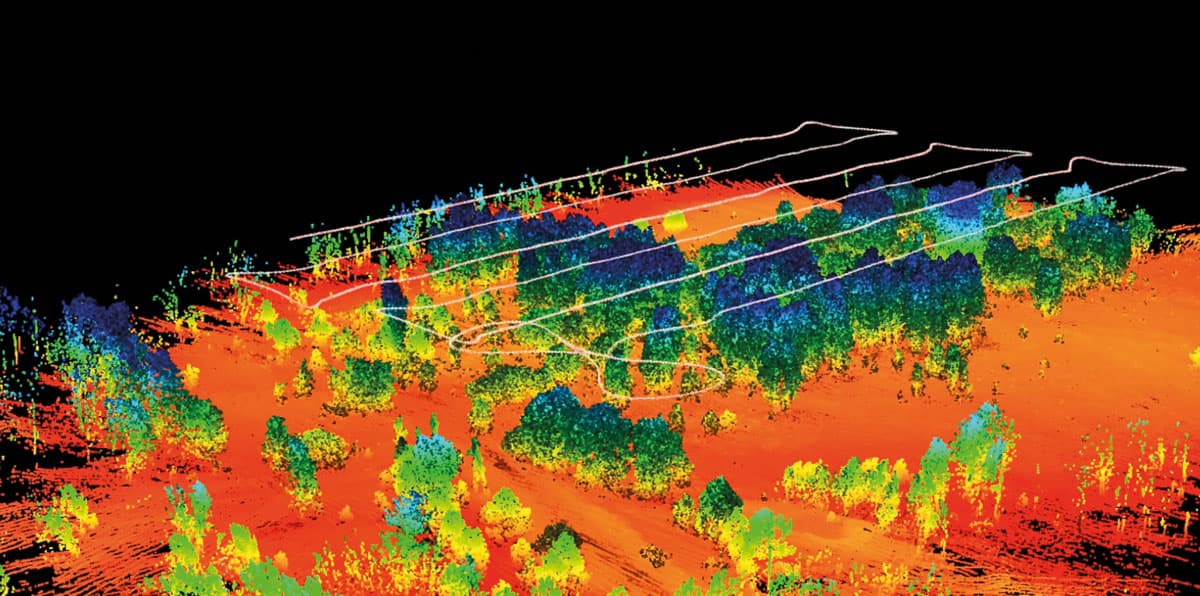
2 Birds-eye view A digital elevation model of part of the Red Forest, obtained using the 3D-scanning LIDAR mounted on the unmanned aerial vehicle. The laser scan detects surface features at the millimetre-scale, allowing us to obtain a high-resolution topographic rendering of the site. (Courtesy: Dr Yannick Verbelen)
The radioactive aftermath
Radioactivity from Chernobyl was detected around the globe, but most was deposited on or close to the site, with the area to the west of the reactor becoming extremely contaminated. It was this high level of radiation that was responsible for the red colouration, and eventual death, of the pine trees within the 10 km2 of woodland surrounding the plant – this later became known as the “Red Forest”. The area remains one of the most contaminated in the world, even though the trees were eventually bulldozed and buried by “liquidators”.
Those who remember the news coverage from 1986 will recall the grainy footage of teams of these liquidators, wearing grey lead aprons and gas masks. They performed crucial tasks in the highly radioactive environment to stop the ongoing effects of the accident from worsening, such as collecting burning graphite and performing initial assessments of the damage. In the months after the accident, these civil and military personnel (some 600,000 of them) also worked to demolish the numerous highly contaminated buildings and bury the debris – as well as other high-activity wastes associated with the accident – in hastily dug trenches. Their work meant that the liquidators were exposed to high levels of radiation, leading to many suffering from disabilities and radiation-caused cancers (the precise numbers are often debated).
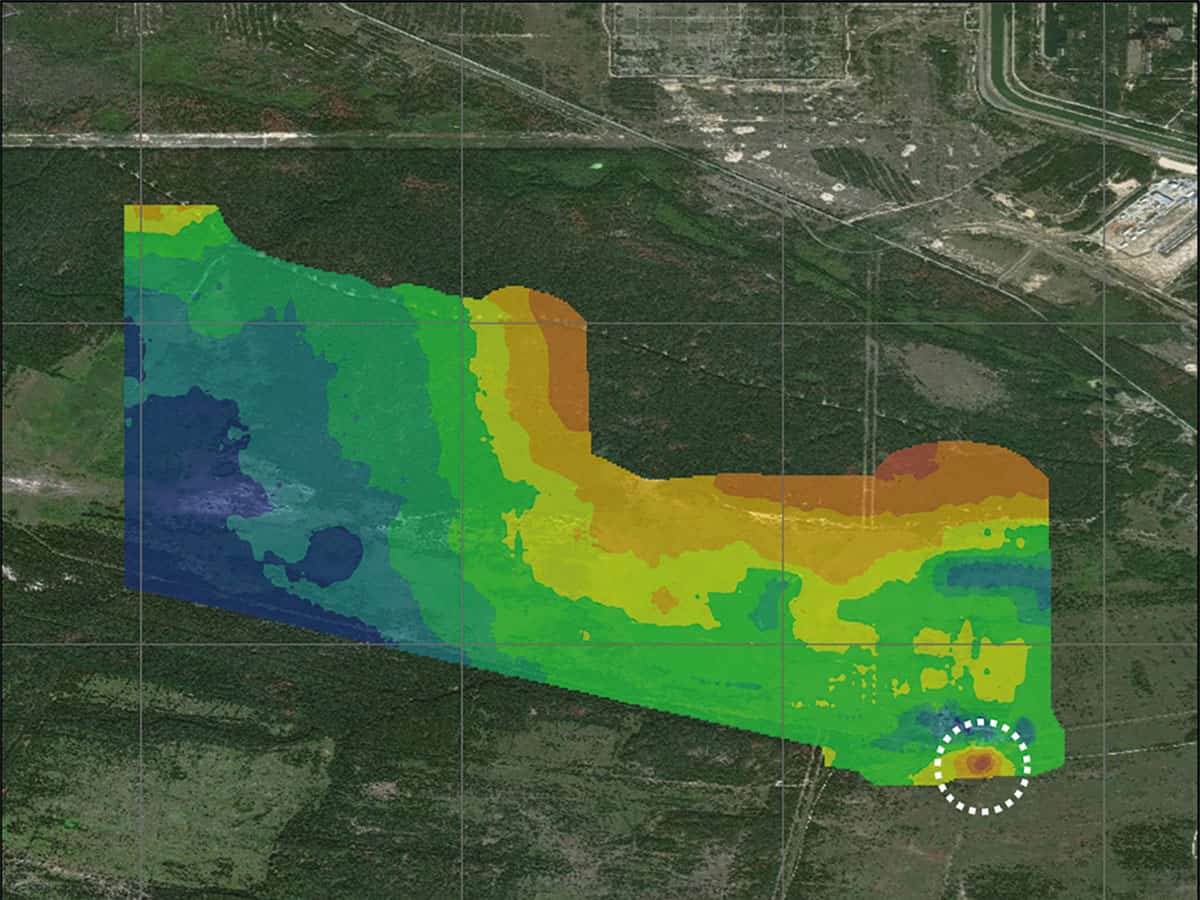
3 Highs and lows In this radiation map of the area to the west and south-west of the plant, it’s easy to pick out the Red Forest – the region of reds and oranges indicating it is still extremely contaminated. The survey also identified a small, previously unknown, hotspot of radiation to the south of the complex. (Courtesy: Dr Yannick Verbelen)
In contrast to the technology that exists today, the radiation monitoring following the accident was limited. To obtain a crude initial map of the distribution, intensity and composition of the radiation, people were sent out to take physical measurements around the area using small handheld units. It has since been shown that these were not capable of measuring the high levels of radiation that were released. Measurements were made using helicopters equipped with radiation detectors, but with environmental changes, even the most complete and accurate of these maps are now out of date.
Send in the drones
One thing that is clear though is that Chernobyl is still one of the most radiologically contaminated regions on the planet – and as you would expect, gaining access was not a quick procedure. Ahead of our trip, it took about four months to secure permission to fly unmanned aerial vehicles (UAVs or drones) from the head of the exclusion zone and the authorities running the plant today. And by the time the final permissions were granted, we only had a week before we were scheduled to be at the Chernobyl EcoCentre – which monitors the zone – in the town of Chernobyl.
Here, we were each given radiation-dose-measuring film badges to wear during our time working in the zone and were then taken by our guide to enter the inner exclusion area. The checkpoint that we passed through typified the Ukrainian attitude to the security of the zone, with armed guards closely checking all permission cards and IDs upon entry, and screening people and vehicles for radioactivity when exiting. More used to holiday makers taking part in “nuclear tourism” across the zone, the daily arrival and departure of a team of scientists and their extensive array of flying machines was always met with heightened scrutiny by the guard force. This militaristic façade was, however, softened somewhat by the dogs that are cared for by the security personnel – descendants of those left behind by past residents.
New views: The University of Bristol team took both a multi-rotor drone (left) and a fixed-wing drone (right) to Chernobyl so they could perform radiation maps at different altitudes. (Courtesy: Dr Yannick Verbelen)
Our team and the Ukrainian authorities both wanted to see if we could deploy a technology capable of mapping large and potentially inaccessible areas of the exclusion zone at greater resolutions than before, to determine the location and level of the residual contamination. While total decontamination and repopulation are never likely to occur in Chernobyl (unlike around Fukushima), the land is currently being considered for solar energy farms. Although this may at first sound a little unusual, the repurposing of land that has no other use or value – but utilizes the existing power distribution network that dissects the region – would contribute much-needed wealth to the local and national economies.
To survey the areas of interest, we were building on our team’s work of using multi-rotor UAVs for radiation mapping by developing a bridge between high-altitude (200–500 m) manned helicopters and low-altitude (<20 m) UAVs. Our fixed-wing drone aircraft can cover tens of kilometres while flying at an altitude of 45–100 m. Housed securely within the fuselage of the plane – which has a span of about 2 m – is a complex array of flight-control electronics, sensors, solenoids and highly sensitive radiation detectors that measure the energy of the gamma rays they intercept as the plane flies its survey route. The radiation detectors we used were caesium iodide scintillators that weigh only 150 g. These lightweight detectors are made by a UK company called Kromek that specializes in miniaturized gamma-ray detectors.
One of the contaminated sites where we deployed both the fixed-wing plane and the multi-rotor drone was a small industrial repair and scrap yard in the village of Kopachi, 2 km south of the plant. Unlike the fully automated take-off, surveying and landing that can be done by the multi-rotor UAV, the logistics and preparations for surveying with the lightweight plane are more extensive. As the plane needs lots of speed to get it airborne, it has to be physically propelled into the air by hand – literally thrown while at full power – in an open space. Once safely in the air, the plane can survey autonomously along its pre-set flightpath for up to an hour before returning home and using its parachute to gently drop down to earth.
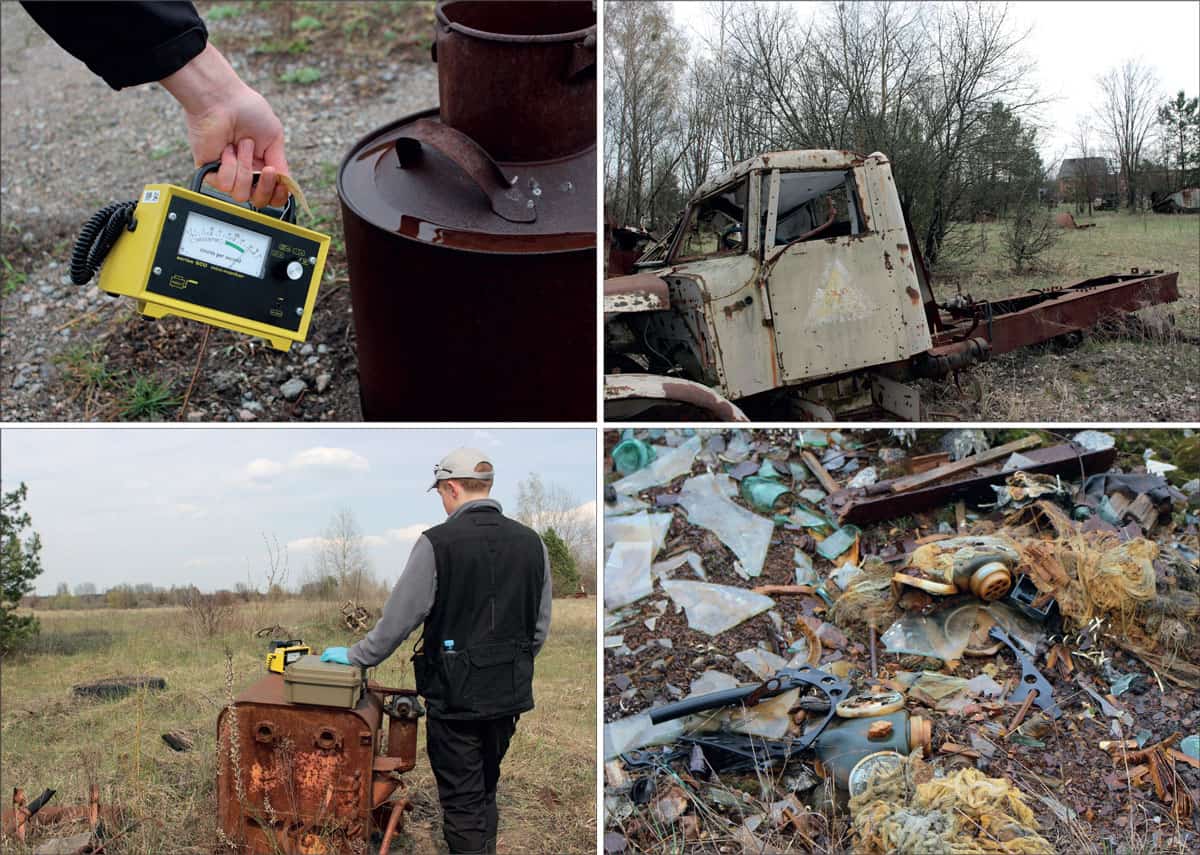
Hot stuff: Abandoned vehicles and machinery around Kopachi and Buryakovka are still radioactive 33 years after the disaster. (Courtesy: Dr Yannick Verbelen)
As we expected, the radiation levels are considerably higher than in the area surrounding most of the Fukushima plant. While the contamination is generally uniformly distributed, the sensitive detectors on our fixed-wing plane made it possible to locate regions with very high levels of radioactivity (up to 350 μSv/hr) – some of which were previously unknown to the authorities. After we had determined the area of interest with this higher-altitude platform, we then sent in the multi-rotor UAV. By surveying at lower altitudes and applying our algorithms to both sets of results, we were able to work out exactly where any on-the-ground radiation “hot spots” were located. At the Kopachi site, these isolated areas were found to be related to the accident response, such as where vehicles had been abandoned, buried or washed, with rain and ground water depositing the highly radioactive particulate around the area.
However, the most radioactive location in Kopachi is a bowl-shaped area containing three large metal hoppers, where bulk rock and sediments containing a component of radioactive material have been separated – with the radioactive material left in situ. While other sites are dominated by the gamma-ray emissions from fission products, the bowl-shaped site exhibits a spectrum that indicatives the presence of fuel waste. Needless to say, we didn’t hang around in the area as the dose-rate was equivalent to receiving your entire annual UK background dose (2.7 mSv) in just one hour.
The future of Chernobyl
Having visited Fukushima many times, our trip to Chernobyl truly emphasized the much greater scale of the accident there. The occurrence of areas with extreme radioactivity after three decades highlights the challenge that the Ukrainian authorities face, and shows why this is one of the most difficult and dangerous environments on Earth. We hope to return to Chernobyl soon to work alongside colleagues at the EcoCentre and continue deploying our aerial radiation-mapping systems and location algorithms.
The occurrence of areas with extreme radioactivity after three decades highlights the challenge that the Ukrainian authorities face, and shows why this is one of the most difficult and dangerous environments on Earth
With the Ukrainian authorities planning to transform large areas of the exclusion zone into solar-energy farms, there is a critical need to understand the exact location of harmful levels of radioactive contamination, without requiring individuals to enter these regions to take measurements. Equally, for areas frequented by tourists, it is important that the local authorities and guides have detailed maps of the residual radiation to delineate where to avoid. Although more research is still needed to improve our software algorithms as well as further enhancing flight performance, our systems could make a real difference in the months and years to come in helping transform the contaminated and lonely Chernobyl exclusion zone.
When you’re attending a scientific conference of over 20,000 people, it’s surprisingly easy to feel alone. International conferences are a rite of passage of a scientific researcher and science would benefit if we made them more welcoming for everyone.
Maybe you’re a PhD student who is presenting your first poster, thousands of miles away from the support of your own lab group. Maybe you’re a postdoc nearing the end of a contract, who knows the international travel will exhaust the end of your budget, and that this is one of your opportunities to find a new challenge. Maybe you identify as LGBTQ+, and while you’ve had the confidence to come out to colleagues in your home institution, you step back in the closet the minute you walk through the conference centre doors.
Perhaps you are religious and concerned about when and where you might be able to pray. Or you are a new parent who needs a lactation room. Or maybe you are from an underrepresented group and are exhausted by not seeing anyone who looks like you.
As summer draws to a close and scientists around the world reflect on their international conference experiences, we’d like to shine a light on SPIE Optics and Photonics, one of the most important dates in any optical scientist’s calendar. Since 2005 SPIE has advocated for women scientists, creating an annual Women in Optics Planner that is distributed to schools and colleges all over the world. Its regular meetings feature a range of equity, diversity and inclusion events, which include talks, training and networking opportunities. Inspired by SPIE’s efforts and our recent call to arms for increased diversity in physics, here is our advice.
Ensure your session co-ordinators are aware of their own unconscious bias, and support them in identifying speakers and poster presenters. Help to encourage equal opportunities in questions and discussions, training facilitators if necessary. Recognize where you have power to advance the conversation and correct biases.
Plan early. Don’t arrange a conference during religious holidays, ensure the rooms meet accessibility requirements and pick locations where delegates can afford accommodation.
Make sure all speakers use a microphone and that there is a hearing loop set up in each room.
Identify where in the conference venues there are gender-inclusive restrooms and point this out in your conference guide. Clearly designate single-user locking restrooms as “all gender” or “gender neutral”. Add signage to single-gender restrooms with information on the nearest gender-inclusive restroom.
Find private spaces for nursing mothers and people who need time for reflection or prayer.
Consider caring responsibilities. Offer childcare grants and, if possible, activities for young people.
Plan a series of diversity events and encourage senior leadership to attend.
Have an enforceable code of conduct, and advertise it widely in promotional materials and in the conference agenda, which outlines expected behaviour of delegates, co-ordinators and contractors.
Think about distributed materials and ensure the imagery is representative of the community you seek to build around the conference site.
Offer networking and training for early-career researchers and students. SPIE’s Lunch with the Experts is a fantastic way to connect established scientists with up-and-coming researchers.
Plan student networking events before the conference begins, encouraging students to meet other future leaders from around the world and ensuring they have friendly faces to reach out to during the conference.
Have pronoun stickers for your name badges, and ribbons acknowledging that your delegates care about diversity.
Familiarize yourself with bystander intervention strategies so you are equipped to intervene if you are a witness to harassment or bullying. You can also consider creating a network of allies to promote the creation of safe spaces at meetings. We recommend checking out the work of Ento-Allies and Astronomy Allies to model how this might take shape in your own community.
If possible, create travel awards to support the attendance of researchers who require financial assistance.
If you’d like to read more about planning, hosting and assessing scientific meetings, or want resources to take to an adviser or colleague, you’re in luck – 500 Women Scientists has put together a handy evidence-based guide.
A new unified theory for heat transport accurately describes a wide range of materials – from crystals and polycrystalline solids to alloys and glasses – and allows them to be treated in the same way for the first time. The methodology, which is based on the Green-Kubo theory of linear response and concepts from lattice dynamics, naturally accounts for quantum mechanical effects and thus allows for the predictive modelling of heat transport in glasses at low temperature – a feat never achieved before, say the researchers who developed it. It will be important for better understanding and designing heat transporting devices in a host of applications, from heat management in high-power electronics, batteries and photovoltaics to thermoelectric energy harvesting and solid-state cooling. It might even help describe heat flow in planetary systems.
“Heat transport is the fundamental mechanism through which thermal equilibrium is reached,” explains Stefano Baroni of the Scuola Internazionale Superiore di Studi Avanzati (SISSA) in Trieste, Italy, who led this research effort. “It can also be thought of as the most fundamental manifestation of irreversibility in nature – as heat flows from warm areas in the same system to cooler ones as time flows from the past to the future (the ‘arrow of time’). What is more, many modern technologies rely on our ability to control heat transport.”
However, despite its importance, heat transport is still poorly understood and it is difficult to simulate the heat transport of materials because of this lack of understanding. To overcome this knowledge gap, researchers employ various simulation techniques based on diverse physical assumptions and approximations for different classes of material – crystals on one hand and disordered solids and liquids on the other.
“No all-encompassing theory existed before our work and researchers did not know how to properly simulate a system that is comprised of different classes of materials (a crystal or glass, for instance) or a system that is not easily classified (a defective or partially disordered crystal, for example),” says Baroni. “And in the case of glasses at low temperature, in which quantum effects and disorder co-exist, no simulation method was available at all.”
Filling the gaps
Our new approach fills these gaps in a theoretically rigorous and practically viable way, he tells Physics World.
Until now, there were essentially two independent (and seemingly unrelated) approaches to describing heat transport, he explains. The first is the Boltzmann-Peierls kinetic approach and the second the Green and Kubo linear-response approach. The former assumes that heat is carried by quasi-particles known as phonons (which are the quanta that carry sound waves). These particles have a well-defined energy and velocity and in this approach the heat conductivity is proportional to the product of the square of the phonon velocity and its mean free path (that is, the distance it travels before it bounces off an impurity or another phonon).
“For this approach to apply, however, the mean free path needs to be much larger than the average distance between neighbouring atoms so that we can meaningfully define and compute the phonon velocity,” explains Baroni. “This is the case for crystalline solids, but not for glasses and disordered solids in general, or indeed for liquids, for which the very concept of quasi-particle beaks down.”
The Green-Kubo method, for its part, is, in principle, applicable to a wider range of materials, but in reality, it is extremely inefficient at low and intermediate temperatures (generally speaking, below half the melting temperature of a material). And while, in theory, it can account for quantum effects, no practical techniques are available to numerically simulate these effects.
“Our new approach unifies these hitherto distinct approaches into the same methodology that is applicable to all solids – be they crystalline or disordered/glassy,” says Baroni. “It also actually works better at temperatures in the regime where current implementations of the Green-Kubo theory fail.”
The Green-Kubo theory of linear response
At equilibrium, a system carries no heat current on average, but small current “flickers” do occur because of thermal fluctuations. “The Green-Kubo theory of linear response states that the heat conductivity is proportional to the product of the square of the (average) magnitude of the current fluctuations multiplied by the (average) time it takes them to fade off,” explains Baroni. “The fluctuations have to fade off otherwise the heat energy would be persistent and not flickering.”
Usually, the Green-Kubo theory requires that the equations of motion for a model system comprising several hundred to a few thousand atoms are solved (using molecular dynamics) for a time ranging from a few hundred picoseconds to a few nanoseconds, he says. The longer it takes for a system to reach equilibrium, the longer the simulation time must be. And the lower the temperature, the more ordered the system is and the longer it takes for the system to come to equilibrium. This is why Green-Kubo molecular dynamics is not the method of choice for ordered crystals at low temperature and the Boltzmann-Peierls approach is favoured instead – even though this approach does not apply to disordered systems.
The harmonic approximation
“Our methodology avoids these difficulties by analytically solving the equations of motion (either classical or quantum mechanical) in the so-called harmonic approximation, which is the basis of the theory of lattice dynamics, and means that we can now thus simulate quantum effects in thermal transport without making use of molecular dynamics,” explains Baroni. “The harmonic approximation assumes that the forces acting on individual atoms are proportional to their displacements from the positions of mechanical equilibrium that would be appropriate at zero temperature.
“As the magnitude of these displacements decreases when the temperature decreases, this approximation becomes increasingly more accurate as the temperature drops. We have shown that the Green-Kubo formula for the thermal conductivity can be analytically computed within this approximation and that it yields the same results as the Boltzmann-Peierls method in the case of a perfect crystal. But, it also happily provides well-defined results for glasses (for which the Boltzmann-Peierls approach would not work).”
Disordered and crystalline solids now on the same footing
Our scheme allows us to deal with disordered and crystalline solids on the same footing for the first time and with the same level of accuracy, he states. “This will allow scientists and engineers to understand and design heat transport for a wide range of technological applications that were thought unfeasible thus far. Such applications include: thermoelectric energy harvesting; solid-state cooling; thermal insulation; and thermal barrier coatings (all of which require extremely low thermal conductivity); and heat management in high-power electronics; batteries; and photovoltaics (all of which require high thermal conductivity).
“The materials employed in these applications are nanostructured, polycrystalline, highly defective or even glassy. We can now study them all with high accuracy, within a unified and practicable framework.”
The researchers reporting their work in Nature Communications 10.1038/s41467-019-11572-4, say they will now be looking for a methodology that allows them to treat quantum effects beyond the harmonic approximation – that is, at higher temperatures.
A handful of spins in diamond have shone new light on one of the most enduring mysteries in physics – how the objective reality of classical physics emerges from the murky, probabilistic quantum world. Physicists in Germany and the US have used nitrogen-vacancy (NV) centres in diamond to demonstrate “quantum Darwinism”, whereby the “fittest” states of a system survive and proliferate in the transition between the quantum and classical worlds.
In the past, physicists tended to view the classical and quantum worlds as being divided by an abrupt barrier that makes a fundamental distinction between the familiar macroscopic (classical) and the unfamiliar microscopic (quantum) realms. But in recent decades that view has changed. Many experts now think that the transition is gradual, and that the definite classical states we measure come from probabilistic quantum states progressively (although very quickly) losing their coherence as they become ever more entangled with their environment.
Quantum Darwinism, put forward by Wojciech Zurek of Los Alamos National Laboratory in New Mexico, argues that the classical states we perceive are robust quantum states that can survive entanglement during decoherence. His theoretical framework posits that the information about these states will be duplicated many times and disseminated throughout the environment. Just as natural selection tells us that the fittest individuals in a species must survive to reproduce in great numbers and so go on to shape evolution, the fittest quantum states will be copied and appear classical. This redundancy means that many individual observers will measure any given state as having the same value, so ensuring objective reality.
Isolated spins
To try and observe the redundancy experimentally, Fedor Jelezko of Ulm University in Germany and other experimentalists joined up with Zurek and some theorist colleagues. The team focussed on NV centres, which occur when two adjacent carbon atoms within a diamond lattice are replaced with a nitrogen atom and an empty lattice site. The nitrogen atom has an extra electron that remains unpaired. This behaves as an isolated spin – which can be up, down or in a superposition of the two. The spin state can be probed in a well-established process that involves illuminating the diamond with laser light and recording the florescence given off.
The researchers set out to monitor how the NV spin interacts with the spins of several neighbouring carbon atoms. Most carbon in the diamond is carbon-12, which has zero spin. However, around 1% of the atoms are carbon-13, which has a nuclear spin. Their experiment involved probing the interaction of a NV spin with, on average, four carbon-13 atoms, about 1 nm away. The carbon-13 spins – which serve as the environment – are too weak to interact with one another but nevertheless cause decoherence in the NV spin. This process involves the carbon-13 spins changing to new quantum states that depend on the state of the NV spin.
The experiment is done by shining a green laser light onto NV spins within a millimetre-sized sample of diamond and measuring the photons emitted as microwave and radiofrequency fields are switched on and off. Because they were not able to observe the carbon-13 spins directly, the team transferred these spin states to the NV spins and again exploited fluorescence measurements. This counter-intuitive approach was possible, says Jelezko, because the three steps in the experiment – preparing the spin states, decoherence and measurement – were cleanly separated in time.
Natural environment
Doing so, the researchers found the predicted redundancy. By measuring the spin of just one carbon-13 nucleus, and repeating the experiment many times, they found they could correctly deduce most of the NV spin properties most of the time. But measurements of additional nuclear spins added little to this knowledge. These results, they write in a paper accepted for publication in Physical Review Letters and posted on arXiv, “give the first laboratory demonstration of quantum Darwinism in action in a natural environment”.
The term “natural”, says Jelezko, refers to the fact that spin decoherence in solids usually takes place as a result of magnetic interactions with nuclear spins. He adds that this process makes it difficult to build quantum computers using spins in solids. The group’s next step is to scale its experiment up, although Jelezko admits that getting anywhere near the size of a macroscopic object – even a dust particle – is likely to prove impossible. “I don’t think we will be able to do a billion atoms,” he says, “but 20 would already make a big difference”.
Two other groups, meanwhile, one in Italy and the other in China, have carried out similar measurements (using the polarization of photons) that also show redundancy. These systems are less natural than the nitrogen vacancies but are easier to control, according to one member of the latter group, Chao-Yang Lu of the University of Science and Technology of China in Hefei. As such, Lu says that he and his colleagues were able to demonstrate not only the proliferation of classical information but also an “uptick” in information taking place at the quantum level – something that experimental noise prevents when using nitrogen vacancies.
However, quantum Darwinism is not the only game in town. Adán Cabello, a theoretical physicist at the University of Seville in Spain, argues that the latest experiments “offer only schematic versions of what a real environment consists of,” and that other approaches can reveal crucial insights into the emergence of classical reality. For example, he says, he and colleagues at the University of Stockholm have shown how to make measurements on trapped ions while still preserving some of the system’s quantum coherence. This, he says, shows that measurement “is not an abrupt transition but rather the result of a dynamical process governed itself by quantum mechanics”.
Her hunger growing, she broke a short branch from a tree, ripped off the side-shoots and leaves, stripped down the bark, and sharpened the end with her teeth. Jabbing this self-made spear into a tree hollow, she struck lucky first time and dragged a screeching bushbaby from its sleeping space. With a few swift blows this chimpanzee had achieved her aim: dinner.
It’s nearly 15 years since scientists first observed western chimpanzees – a critically endangered subspecies of the common chimpanzee – hunting with spears at a site in south-eastern Senegal. Native to western Africa, western chimpanzees (Pan troglodytes verus) are the only chimps known to use spears. They also differentiate themselves by living in caves, sharing food and travelling and foraging at night.
Despite this chimp subspecies being well studied, the data tend to be specific to particular localities. With no central database of findings, it was hard for scientists to compare studies, observe population trends or map out the density distribution of the animals. And these are the kinds of data that conservationists need to make evidence-based decisions on how best to protect the ape and where to prioritize conservation activities.
To remedy this issue, in 2005 scientists established the International Union for Conservation of Nature (IUCN) Species Survival Commission Ape Populations, Environments and Surveys database, or APES, to bring together survey data for all 14 taxa of great apes. Fourteen years later, they are able to show the benefits achieved by sharing data this way, and to demonstrate that similar databases would bring huge conservation benefits to other endangered species.
For western chimpanzees, APES collated 52 datasets collected during separate studies between 2001 and 2015 across nine different countries in West Africa.
By comparing the chimp data with information on forest loss, the researchers could see that western chimpanzees are highly sensitive to forest loss, and that if a forest shrinks by more than 10% the chimps tend to disappear.
In their most recent publication, in Environmental Research Letters (ERL), Heinicke and colleagues reveal that only 17% of western chimps live in national parks, and 10% of western chimps live within 25 km of four multinational “development corridors” currently planned for West Africa.
“The results from our study can be used to estimate how many chimpanzees would likely be affected by such developments and advise on the locations where population connectivity might already be low and should therefore be avoided by new developments,” says Heinicke.
As well as improving our understanding of western chimps, this database has allowed researchers to get a handle on the distribution of bonobos, central chimpanzees and the western lowland gorilla, providing valuable input to the conservation action plans for these species.
A handful of similar taxon-specific databases are in existence for other taxa, but the researchers argue that rolling out these collaborative databases more widely would have huge conservation value.
“These databases help to fill the gaps in biodiversity data and they provide the level of detail needed for conservation planning,” says Heinicke.
Right now, funding to create such databases is thin on the ground, but Heinicke and her colleagues hope that the value of the information emerging from the APES database will encourage funders to adopt similar programmes for other taxa too.
Could physics help people with epilepsy? That’s the question tackled by Louis Nemzer, a physicist at Nova Southeastern University, in the September 2019 issue of Physics World magazine, which is out now in print and digital formats.
He thinks that machine learning and real-time monitoring of the brain could give people with epilepsy live information about how much at risk they are of an imminent seizure – and is even developing a smartphone app to help them in daily life.
Elsewhere in the issue, Peter Martin and Tom Scott from the University of Bristol describe how they’ve used drones to map radiation levels at the Chernobyl plant (see video below), which you can also read on this website from 2 September, while Kate Brown from the Massachusetts Institute of Technology examines the health impact of Chernobyl fall-out.
And finally, don’t miss a great feature by Michela Massimi from the University of Edinburgh about how “model independence” could hold the answer to the deluge of data from current and future experiments in particle physics.
You can enjoy the entire September 2019 issue of Physics World magazine via our digital apps for iOS, Android and Web browsers (membership of the Institute of Physics required). Let us know what you think about the issue on Twitter, Facebook or by e-mailing us at pwld@ioppublishing.org.
• Disquiet over $3m supergravity prize – The decision to award a $3m Special Breakthrough Prize to three pioneers of the theory of “supergravity” has polarized opinion in the physics community, as Michael Banks reports
• Top Brazilian physicist quits after deforestation row – Data released earlier this month by INPE show that the overall devastation of the Amazon has increased by 68% between 2018 and 2019
• Ricardo Galvão resigns after Brazilian president – Jair Bolsonaro casts doubt on satellite data on Amazon deforestation rate, as Eduardo Campos Lima reports
• The personal impact of Mexico’s budget crisis – With Mexico’s new president making deep cuts to the country’s budget, including science, Fernando Fabián Rosales-Ortega – an astronomer from the National Institute for Astrophysics, Optics and Electronics – talks about how institutions are coping
• Supporting those in conflict – Kate Shaw, who has taught physics in several war-torn countries, says we must continue to support colleagues who work and study in such unimaginably difficult environments
• What’s in a name? – James McKenzie reflects on his recent experience of naming companies and explores what a minefield it is and (apparently) always has been
• Peering into the past – Robert P Crease talks to researchers in China who use physics-based techniques to understand the country’s history
• Glimpsing Chernobyl’s hidden hotspots – More than three decades after the world’s worst nuclear disaster at Chernobyl, Peter Martin and Tom Scott visit the exclusion zone surrounding the plant to map radiation levels using new drone-based technology
• Treating epilepsy with physics – Millions of people with epilepsy live in dread of unpredictable seizures from this medical condition. Louis Nemzer describes how novel approaches to predicting and treating these events are being developed thanks to advances in our understanding of the physics of the brain
• A relative revolution – Andrew Robinson reviews No Shadow of a Doubt: the 1919 Eclipse That Confirmed Einstein’s Theory of Relativity by Daniel Kennefick and Einstein’s War: How Relativity Triumphed Amid the Vicious Nationalism of World War I by Matthew Stanley and Proving Einstein Right: the Daring Expeditions That Changed How We Look at the Universe by S James Gates Jr and Cathie Pelletier and Einstein’s Wife: the Real Story of Mileva Einstein-Maric by Allen Esterson and
David C Cassidy, with contribution by Ruth Lewin Sime
• We shall inherit the Earth – Iain Dale-Trotter reviews Underland: a Deep Time Journey Robert Macfarlane
• Stepping stones into space – Libby Jackson, human exploration programme lead at the UK Space Agency, talks to Tushna Commissariat about taking chances, making bold choices, and finding her way into the space sector
• Once a physicist – Meet Chris Lucas is a research engineer in the AI research team at Babylon Health.
• The universe under a dome – Louisa Cockbill on the joys of teaching schoolchildren about science benath a giant inflatable planetarium
A low-power pulsed laser has been used to weld ceramic materials together in room-temperature environments for the first time. The technique, demonstrated by Javier Garay at the University of California, San Diego and colleagues, could bring about diverse new applications for electronic and optoelectronic devices.
Welding is a crucial element of modern manufacturing, but it is very difficult to do with ceramic materials because they have extremely high melting temperatures. While ceramics can be melted by lasers, the materials tend to be poor conductors of heat and this results in large temperature gradients and cracking. These gradients can be avoided by placing the components in a furnace and heating them to high temperatures, but this means that welding cannot be used to encase heat-sensitive objects such as electronics within ceramic containers — something that could be very useful to do.
Garay and colleagues reckoned that cracking at room temperature could be avoided by aiming ultrashort laser pulses directly along the interfaces between ceramic materials. By focusing heating on these interfaces for short durations, they discovered that individual molecules could be made to absorb multiple photons, preventing heat from spreading to other areas.
Short, sharp pulses
The team identified two sets of parameters required to optimize this technique. Firstly, the laser must have a pulse duration limited to 2 ps; a pulse repetition rate of 1 MHz; and a relatively small number of pulses should be used. Secondly, the ceramic should have the optimum balance of light absorption and scattering. These parameters enable efficient coupling between the laser light and the material, meaning the laser could operate at just 50 W, and in room-temperature environments. It also maximizes levels of two-photon absorption, which ensures heat remains highly localized to the weld itself.
Garay’s team then demonstrated their concept by fully enclosing an electronic payload inside a ceramic tube, capped by transparent ceramic circles at both ends. Where previous techniques risked destroying such a device through overheating, the highly localized weld left the payload fully operational once encased. The researchers also used the same pieces to contain a high vacuum, which held-up against leaking to a degree satisfactory to industrial standards.
While the researchers achieved welding with simple ceramic pieces around 2 cm in size, they hope to optimize their technique to work with larger-scale materials with more complex geometries in future studies. This could bring about electronics with casings that make them highly shatterproof, and able to operate in space and other harsh environments. It could also allow for optoelectronic devices for use in biomedical implants.
Physics World’s Laser at 60 coverage is supported by HÜBNER Photonics, a leading supplier of high performance laser products which meet the ever increasing opportunities for lasers in science and industry. Visit hubner-photonics.com to find out more.
Images of the fabricated NVCT. Credit: Nature Electronics 2019
“Over decades, both military and space programs all around the world have known the negative impact of radiation on semiconductor-based electronics,” says Meyya Meyyappan, Chief Scientist for Exploration Technology at the Center for Nanotechnology, at NASA’s Ames Research Center. What has changed with the push towards nanoscale feature sizes is that terrestrial levels of radiation can now also cause problems that had previously primarily concerned applications in space and defence. Packaging contaminants can cause alpha radiation that create rogue electron-hole pairs, and even the ambient terrestrial neutron flux at sea level – around 20 cm−2 h−1 – can have adverse implications for nanoscale devices.
Fortunately work to produce radiation-hardy electronics has been underway for some time at NASA, where space mission electronics are particularly prone to radiation exposure and cumbersome radiation shielding comes with a particularly costly load penalty. Vacuum electronics systems, the precursors to today’s silicon world, are actually immune to radiation damage. Alongside Jin-Woo Han and colleagues Myeong-Lok Seol, Dong-Il Moon and Gary Hunter at Ames and NASA’s Glenn Research Centre, Meyyappan has been working towards a renaissance of the old technology with a nano makeover.
In a recent Nature Electronics article, they report how with device structure innovations and a new material platform they can demonstrate nanoscale vacuum channel transistors that compete with solid-state system responses while proving impervious to radiation exposure.
Standing up for better drive currents
The first nanoscale vacuum channel transistors (NVCTs) followed a traditional architecture with the emitter and collector in the plane of the substrate but with a vacuum channel between the two instead of a semiconductor. As well as radiation immunity, the vacuum channel offers additional advantages in terms of the electron velocity. However, while the 10 μA at 2 V for a channel 50 nm long demonstrated an impressive proof of concept, the drive current did not match up to metal oxide semiconductor field effect transistors (MOSFETs) of the same size.
In the vacuum channel devices, the source pad is shaped into a 10 nm radius tip, which as Meyyappan described it proved “really a waste of the source pad real estate”. Instead the researchers flipped the structure on its side and redesigned the device for vertical emitters. “The drive current increases with the number of emitters fabricated on the source pad and thus, can be used as a design parameter,” says Meyyappan.
The next compromise to tackle was balancing the thickness of the oxide layer separating source and gate. Avoiding direct tunnelling leakage current requires a thick oxide layer, but a thinner layer allows better gate controllability. By folding over the gate, the researchers designed their NVCT to have a thick oxide layer in the field region to prevent parasitic capacitance and a thin layer at the emitter edge for optimized control.
Subverting silicon
The final masterstroke in optimizing their NVCT was to deviate from the standard silicon substrate. Although silicon is the go to material for today’s electronics, it turns out that silicon carbide has a higher bonding energy, as well as an exponentially increasing emission current with decreasing electrode gap and no current saturation or quantum screening, suggesting it may provide a better substrate for radiation-resilient NVCTs. The researchers produced NVCTs on both silicon and silicon carbide substrates and were able to demonstrate the superior radiation robustness with the carbide.
“SiC is not the first material anyone thinks of,” Meyyappan tells Physics World. “The first attempt is always using silicon. Then come materials like SiC, GaN, diamond etc. It is also possible that 2D material enthusiasts could attempt graphene and others as well.”
Back to the future of vacuum technology
The researchers demonstrate the wafer-scale manufacturability of their devices on a 150 mm SiC wafer. In the near term these NVCTs could provide complementary devices to conventional solid-state electronics for specific applications where voltage and breakdown field endurance, reliability and noise immunity requirements exceed what solid-state technology can achieve. However, for vacuum nanoelectronics to permeate the vast proliferation of electronics in everyday life, will require a significant amount of work to enable an industry that has been geared towards silicon for decades to embrace the fabrication, design and support of an alternative technology.
Despite the hurdles Meyyappan is hopeful of overcoming them. “There seems to be a resurgence of vacuum electronics, as witnessed by papers appearing in the literature and funding calls,” he says. The next step is developing full circuits based on NVCTs.